




Abstract
In school choice literature, class-based strategies for social reproduction of the middle classes are often the central explanatory framework. While race, ethnicity and other social categories are increasingly included in the analysis, they are often treated as secondary to class. Drawing on interviews from a racially and socio-culturally mixed sample of middle-class parents in Pretoria and Amsterdam, this study aims to contribute to existing theories on school choice and social reproduction through a comparison of contrasting cases. It takes the dominant theoretical framework of middle-class strategizing as a starting point to explain parental practices of school choice. The comparative analysis finds some remarkable homologies of school choice in Pretoria and Amsterdam, but also points to specific local and historical complexity and specificity of parents’ motivations. In both contexts, parents call on intersecting aspects of their identity beyond their classed position. While we acknowledge the relevance of social class, we suggest that middle-class parents’ school choice should be understood as ‘strategies of action’ emanating from classed and racial (dis)positions but also cultural and religious repertoires rooted in a multidimensional tool-kit.
Introduction
Social reproduction through education is often portrayed as the strategic intergenerational transfer of capital. In a society where ‘success’ strongly correlates with educational degrees, parents are demonstrated to make educational choices much like investment strategies. This strategizing is inherently geared towards the future, but ‘there are no guarantees [. . .] of a smooth and uneventful process of social reproduction’ (Ball, 2003, p. 164). Especially in UK literature, school selection has been described as a frantic and anxiety-ridden process (Butler & Hamnett, 2007), but also studies from other national and urban contexts stress that school choice lies at the heart of concerns over social reproduction (Benson et al., 2015; Boterman & Bridge, 2015; Lareau et al., 2016). Strategies in these studies are often analysed through the lens of (spatialized) Bourdieusian capital and distinction rooted in a classed habitus (Lareau, 2002; Reay et al., 2011). Moreover, while social reproduction and specifically school choice strategies are primarily linked to social class, other social categories are also highly salient. Especially from the US and UK a rich literature discusses the role of racial identity and racism in education, and especially how race and class crucially intersect in educational inequality (Byrne, 2009; Goyette, 2008; Lacy, 2007; Vincent et al., 2013, 2016).
Most of the globally used conceptualizations on the relationship between social reproduction and school choice strategies are based on studies from a limited set of contexts. These contexts, often cities in the Global North, and more specifically in the Anglophone world, are disproportionately represented in the canonical literature in urban studies (Robinson, 2011, 2013). This means that the literature has inherited specific meanings of social class and race. It is however not always easy to make these concepts travel smoothly across different national, institutional and spatial contexts. As pointed out in various comparative studies (Andreotti et al., 2013; Benson et al., 2015; Boterman & Bridge, 2015; Rose et al., 2013), understanding the highly historically, institutionally and spatially contingent nature of middle-class school choice is a huge academic challenge and requires careful analysis and durable dialogue.
This article aims to interrogate dominant theories of school choice revolving around social reproduction by analysing the narratives on school choice of middle-class parents in two contrasting cases: Pretoria, South Africa and Amsterdam, The Netherlands. Drawing on 29 in-depth interviews from a racially and culturally mixed sample of middle-class parents, we address the following question: To what extent can we understand middle-class parents’ school choice strategies in Pretoria and Amsterdam as social reproduction? Our answer expands the conventional understanding of social reproduction, to include belief systems, culture and language as well as the traditionally recognized impact of class. We embrace the multidimensional motivations/strategies of parents through the analytical vantage point of the tool-kit, a cultural repertoire, not unlike habitus, yet more attuned to preferences and dispositions beyond class. The tool-kit framework allows for the conscious and unconscious navigation of intersecting aspects of identity that come into play in the decision making around school choice.
Educational strategies and boundary making
Middle-class education strategies are centred on ensuring access to appropriate schools and the ‘right’ types of socialization during their children’s school careers (Benson, 2014; Benson et al., 2015; Butler & Hamnett, 2007; Karsten et al., 2006; Reay et al., 2011). This will assuage parents’ anxieties concerning their children’s future class position, in a time when educational success is an important precursor for occupational success and maintenance of class position. Therefore, the criteria for a ‘good’ school extend beyond test scores to include the social composition of the school and associated social capital; the strategies following from this stretch from the more invested ‘determined for the best’ to the more laissez-faire ‘hoping for the best’ (Vincent et al., 2013, p. 437). Parents might be cognizant of their relative privilege, and what the implications of their choices are for other children in the city, yet their primary concern is their children (Ball et al., 2004; Reay et al., 2008, 2011). Moral and ideological commitments to democratic values (which include equity and mixing) compete with individualism. This moral conundrum is one example of the pressures inherent to school choice strategies and the anxiety it can cause.
Implicit in the search for the ‘right’ school is a rejection of the unsuitable. This often pertains to racialized and classed others – the intersections of these categories underlying boundaries in society (Byrne, 2009; Christensen, 2009). The suitability of the school as a marker of position in a social field and trajectory is what defines belonging (Savage et al., 2005). This is usually described as ‘living with people like us’, fraught with symbolic meaning and prone to nuance (van Eijk, 2011). As parents make claim to a place based on the choice to school their children there, they create symbolic boundaries between these places and those that did not match their choice (Savage et al., 2005; Watt, 2009). The middle class employs games of ‘distance and proximity’ that allow them to select in which arenas they come into contact with differently classed and/or racialized groups (Andreotti et al., 2013). In schooling, for instance, exposure to (some) diversity is encouraged by parents who see the value of learning to manage difference in a globalized world (Byrne & De Tona, 2014; Reay et al., 2011). These studies have brought the tensions inherent to school choice in multicultural contexts to the fore, and show that parents are hyper-aware how their child will be situated in the classroom.
Moving beyond class and social reproduction
The dominant alternative to the class-focused work on social reproduction includes studies that take ethnicity or race into account (James, 2015; Saporito & Laureau, 1999). However, even then, considerations of race and/or ethnicity are used to reflect on classed positioning. Fathi’s study (2015) shows that Iranian middle-class professionals were cognizant of the social and racial hierarchy in English society and used their classed positions to set themselves apart from other migrants. It is shown that for middle-class parents with a minority background the choice regarding potential for occupational success is not as straightforward as in Savage’s elective belonging or in the work of Andreotti and colleagues (2013). Structural factors constrain choice, especially for those who are not of the ‘privileged’ or the ‘majority’ (Reay et al., 2011, p. 869; Yuval-Davis, 2006, p. 203). Also in other Bourdieusian scholarship other factors such as language, religion, but even race, are acknowledged but ultimately reduced to a form of capital (Butler & Hamnett, 2012). School choice practices are still construed as strategic in terms of social reproduction even as they are expressed by parents as related to social or cultural values, appreciation or avoidance of ethnic diversity – the effects of discrimination (Byrne & De Tona, 2014; Lacy, 2007; Vincent et al., 2013).
We argue that this is too narrow a conceptualization of what lies behind parents’ school choices, despite the merits of conceptualizing school choice in terms of class reproduction. We challenge the idea that parents’ school choice can be reduced to capital-based strategies of social reproduction of class. While we also embrace the idea of habitus, in which multiple layers and aspects of social identity are rooted, producing practice in both reflexive but also unconscious ways, we propose a perspective that expands social reproduction to move beyond class. We borrow from Swidler’s tool-kit (1986), which sees strategies such as those involved in school choice as not directly aimed at a goal (whether that is class reproduction or the transfer of values) but rather a way of doing things, a repertoire. People ‘build’ their lives based on what they know and what they have, and are influenced by their tool-kit in the form and process. Then strategy, as a ‘general way of organizing action [. . .] that might help one achieve life goals’ (Swidler, 1986, p. 277), is not necessarily consciously or unconsciously working towards social reproduction of class. This approach allows for multiple and intersecting facets of identity to become articulated in the specific moments of decision making. However, these preferences and dispositions beyond class are still located in social structures, which have become embodied in people’s habitus. Individuals and families embody different social categories, and exist in a variety of formats: single mothers (Lavee & Benjamin, 2015), divorced parents, extended family involved and so on. The implication is a negotiation of family tool-kits where different elements are used in different situations. Particularly in the highly differentiated urban societies we study here, families will be socialized in multiple, occasionally even contradictory, ways (Lahire, 2011).
This tool-kit is a somewhat coherent set of practices, situated and utilized in interactions providing agency to individuals. School choice in particular requires a manoeuvring with multiple temporalities, the repertoires from the past, the action of the present and the hopes or expectations of the future. This projective dimension (Emirbayer & Mische, 1998) involves substantial reflectivity on the part of parents and allows them to conjure innovative and contradictory modes of action, negotiating limitations and opportunities in the terrain. With this in mind, parents’ strategies of action capture the full range of motivations – highly personal and bringing together multiple intersecting categories of identity, some of which might be incongruous. It thus also captures the situations when class-based capital is not enough: in some cases parents cannot choose but must work out school placement lotteries and vague regulations (Lareau et al., 2016). It illuminates the role of personal histories, contextual factors as well as societal constraints – where one’s tool-kit is in effect immobilized by structural inequalities. This perspective informs the study in the focus on mechanisms of choice-making. It is through these choices that boundary making and the potential for social structures to create difference can be identified.
Comparative strategy
Amsterdam and Pretoria are starkly different urban and educational contexts. Social inequalities in Pretoria are bigger than in Amsterdam, and also the modus operandi of the educational system of both cities is different. Obviously, the historical legacy of Apartheid and the entrenched intersections of class and race and how they are etched into the segregated urban geography of Pretoria contrast with the relatively egalitarian context of Amsterdam (Fainstein, 2010; Uitermark, 2009). We would however argue that this contrasting design allows us to interrogate the universality of theories emerging out the traditional centre of Euro-American academia to discuss processes of school choice as well as expose some of the similarities in middle-class parents’ strategies in the field of education across these different contexts. This study compares middle-class parents with various cultural and racial backgrounds in two contrasting cities to open up the theory on strategies of school choice by juxtaposing these two geographies (Roy, 2009). In this vein, by carrying out fieldwork first in Pretoria and then in Amsterdam, theory can be interrogated and amended (Robinson, 2011) building on the understanding of the Amsterdam case in light of the Pretoria case findings. This comparative strategy was confronted by fluctuating meanings in different contexts, but its value was found in challenging what is considered universal and what is considered place-specific.
Pretoria’s school landscape
In Pretoria (Tshwane) public schools generally work with catchment areas although there are occasionally scholarship spaces reserved for children from the townships. The renowned public secondary schools also select students based on academic ability and familial connection to the school. There are extensive private school options for both primary and secondary school. Some private schools follow the national school system while others offer the International Baccalaureate. South African law states that a child may not be turned away from a public school, once admitted, on grounds of fees. The state supports over 60% of the nation’s public schools (Hunter, 2015, p. 42). Public schools that do charge fees enjoy relative autonomy and can practise selective admission. Apartheid reverberates through the public-school system (McKay, 2019). Up until the early 1990s schools were segregated and resourced according to Apartheid-defined racial categories, with Whites getting better quality education in what was known as Model C schools, separate from Indian, Coloured and African schools (Soudien, 2010). While schools have integrated since the transition to democracy, the gaps between formerly White and formerly Black schools remain and are coupled with geographic location. Therefore, good township schools are scarce and scattered while there is more choice for the more centrally located neighbourhoods. As a result, there is a lot of home-to-school mobility – children being bussed to schools outside their neighbourhoods – which arguably has done more for school desegregation than changes in residential patterns (Hofmeyr, 2000; Hunter, 2015).
There are some studies that suggest that in post-Apartheid South Africa segregation is increasingly occurring along class lines, instead of racial lines (Mabin, 2005; McKay, 2019). Notwithstanding, there is still a strong correspondence between social class and the historical social order based on racial Apartheid – with a particular significance in the schooling system (Hunter, 2020).
Amsterdam’s school landscape
Amsterdam is characterized by high levels of social and racial school segregation, which is explained by a combination of residential segregation and a high degree of parental choice (Boterman, 2019). Almost all schools are publicly funded but have distinct faith-based or pedagogically based profiles constituting a differentiated educational landscape (Karsten et al., 2006). The Dutch secondary school system is stratified and based on early selection of pupils (at the age of 11–12), with each level corresponding with different forms of tertiary education. A four-year VMBO diploma provides access to vocational training, a five-year HAVO diploma leads to a professional college and the six-year VWO/gymnasium diploma to university. Students are assigned to a level based on test scores on a centralized test (cito) but also on the discretionary advice of the teacher.
Amsterdam is referred to as a minority-majority city (Savini et al., 2016). Ethnic white Dutch are the largest group, but are a minority. The city is very diverse with migrants and their descendants from all over the world. Amsterdam children are most often of Moroccan, Surinamese or Turkish descent. Children may also have a background from other European countries of which Germany, UK and Italy are most common. Despite the fact that whiteness is not recognized as an ethnic/racialized position (Boterman, 2013; Weiner, 2015; Wekker, 2016), school choice in Amsterdam is colloquially framed in racialized terms. In the media, and by parents and school boards, school segregation and choice are often discussed in terms of ‘black’ and ‘white’ schools. Despite the hyper-diversity of these schools in terms of ethnic and even social class backgrounds of children, minority native-Dutch schools are referred to as ‘black schools’. Due to the – often unjustified – association with poor quality, ‘black schools’ are often avoided by white (middle-class) parents.
Data and methods
We study middle-class families who were considering their choice of a secondary school while still enrolled in primary school. Some interviewed families had children in both primary and secondary school, which was considered suitable as they could reflect on both processes.
‘Middle class’ in this study was understood to mean more than relative income (though most respondents did describe their position in that way). Level of education, type of occupation and property ownership were equally relevant (Benson et al., 2015; Lareau, 2002). In Pretoria most respondents were approached through private schools. Other respondents were approached through the researcher’s network. In Amsterdam, where private or denominational schools are publicly funded and do not have a clear bias in terms of social class, respondents were approached using a similar snowball-sampling approach.
A total of 29 interviews were conducted: 16 in Pretoria and 13 in Amsterdam (see Table 1 for sample description). The interviews lasted between 37 and 100 minutes and were usually with one parent. The semi-structured interview guide allowed respondents to create narratives necessary to understand their construction of social and symbolic boundaries but also provided the opportunity to reflect on unconscious or implicit choices. These conversations broached the topics of school choice (both primary and secondary school), residential choice and the family histories of the households. This also included the educational and occupational histories of the respondents. The analysis of the interviews focused on the reasons given for specific choices (narratives) and the outcomes.
Respondent characteristics, Pretoria and Amsterdam.
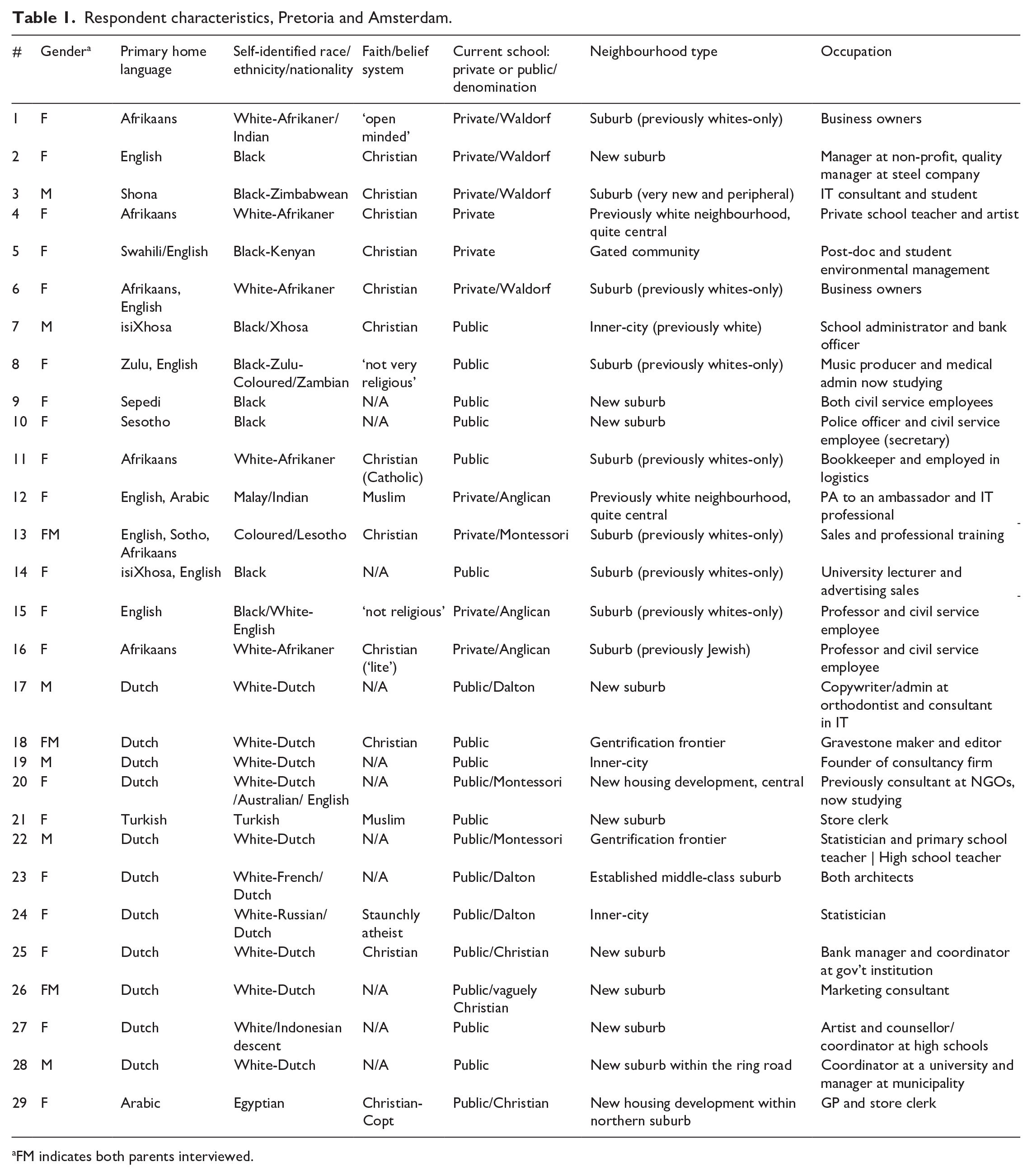
FM indicates both parents interviewed.
Given the salience of different social categories in both contexts respondents were asked to describe their identities. It should be stressed that both the institutional and everyday meaning of race is strongly context dependent and, in both Pretoria and Amsterdam, differs from for instance US or UK experience. Given the specific history of South Africa, race is a highly salient, if not dominant, category used for official and everyday (self)-identification. Parents in Pretoria hence often mentioned race, language or ethnic group, as well as nationality (where there was a migration history). For instance, the South African category ‘Coloured’ is widely – and not pejoratively – used for people of mixed racial heritage who predominantly speak Afrikaans but – often in more middle-class households – may also speak English at home. ‘Black’ often assumes meaning vis-a-vis Coloured and Whites, but is also often intersected by cultural/ethnic/language group such as Xhosa, Zulu and Sotho. White South Africans share common identities but are also divided by cultural/language categories Afrikaner/Afrikaans vs English-speaking.
In Amsterdam, more so than in South Africa (and also the US context), for most white parents, race or ethnicity is discussed as something that others have, others being non-white Dutch residents. It is in spaces where whiteness is in the minority that it becomes a conscious facet of identity (Stam, 2020). In Amsterdam, parents were less likely to immediately refer to their own race; however, as became evident in analysis, language in Amsterdam is used by the respondents as a proxy for race, ethnicity and nationality – particularly in schooling.
We decide to follow their lead in this case and use that to identify them. While respondents are identified in the text by their primary language, they may speak other languages – particularly in South Africa most are bi- or multilingual.
Analysis
Despite the differences in terms of the educational and spatial context, the respondents in Pretoria and Amsterdam describe the selection of schools in rather similar ways. All respondents emphasized the role of education in providing opportunities for their children. Although they stressed different aspects of the role of education, all considered education key to their dreams for the future and took steps to control the process. Through their practices of choosing schools many parents express that they are motivated to provide the ‘best’ educational and social environment for their children. The idea of searching for high performing schools with the best reputation, increasing the opportunities for successful academic careers, clearly resonates with the existing literature on middle-class school choice and social reproduction (Ball, 2003; Benson, 2014; Benson et al., 2015; Butler & Robson, 2003; Reay et al., 2011).
One element of strategizing for the future is reflecting on the past (Emirbayer & Mische, 1998). Parents use their personal histories and experiences to shape their choices for their children, whether it is an aversion to Catholic school or a preference for Montessori rooted in their own memories. Their experiences cannot be divorced from their (social) identities. What parents ‘know’ about language, their racial and ethnic identities and beliefs are employed in the moments and processes of decision making. We argue that these experiences are a part of the tool-kit and are employed towards a more specific social reproduction beyond that of class maintenance alone. Parents in both contexts were hyper-aware of the varying forms of difference: mentioning class, race, but also language and religion as factors to consider when choosing schools. In the following we outline these factors separately for pragmatic purposes, while understanding that these are intertwined in the lives and thus the motivations of the parents in our study.
Race and ethnicity
The class focus in social reproduction begins to strain when confronted with the multidimensional motivations that families navigate. Race and ethnicity have been explored in school choice literature, though often as proxy for class distinction. Here, we find that the aspirational aspects of school choice (‘ensuring the best quality education’) in a few cases was considered to conflict with a desire for a certain level of social and racial diversity, particularly in Amsterdam. Despite good academic outcomes, racial belonging weighs heavily for some, with anxieties over race and ethnicity taking over.
It is a good school with good results but, we have been there a few times, we know many children who are there, there are some negative stories and that is quite difficult because we live in West and there are just a lot of Moroccans it is quite decisive for the atmosphere, language, so that was a consideration. (Mother, white, Dutch, Amsterdam [#25])
This mother summarizes a quite often heard position: academic ‘objective’ quality of schools is trumped by racist rumours and impressions, which are often framed in coded terms. Nonetheless, many white parents in the study voice a commitment to diversity, seeking a balance, and a fair representation of the urban contexts. This illustrates a well-rehearsed theme in studies of middle classes in urban contexts: a distinct ambivalence towards a social mix of neighbourhood or school populations (Benson, 2014; Boterman, 2013; Hamnett et al., 2013; Reay et al., 2008; Vincent et al., 2016). A key dimension of experiencing diversity is whether one is part of the majority group or a minority. From the perspective of the majority diversity is often tolerated, something that can be accepted or sought out. Especially for white Amsterdam-based parents, racialized and classed others were a feature to manage in relation to parents’ concerns: There are also really black schools as in ‘we give Dutch lessons until sixth grade because the kids that come here barely speak Dutch’, and they don’t say hello every morning, and the street culture they have to deal with. If my child is the only one without black hair, well I have been thinking about this. Okay things don’t change if we get stuck in this line of thinking, but it’s my daughter and she has only one school life and I want her to feel safe and comfortable. If she is the only other, I wouldn’t like that. (Mother, white, Dutch, Amsterdam [#20])
In the above quotes the parents express their worries regarding racialized others in Amsterdam at school: the effects on their child’s socialization and a concern about being a minority in the class (in contrast to the general society). For these white parents in Amsterdam, the ethnic and racial composition of the school is a factor to be managed, weighed against good results and the acknowledgement that their choice might not reflect their purported values. In doing so they construct and defend boundaries, marking certain groups as ‘too different’ to feel a sense of belonging amongst them. ‘Street culture’, hair colour, ‘atmosphere’ are invoked to signal non-belonging or a sense of alienation all based on racialized and ethnic othering. This is then weighed against factors such as academic success.
This sense of comfort with regard to others of another race and/or nationality was reflected in Pretoria as well, albeit with a different minority–majority dynamic.
I think just for them to have a sense of culture, identity, belonging to a people, feeling comfortable in who you are and being Black. I think more than anything in being Black because I feel like the school they are growing up in, I get the sense that . . ., I don’t even know how this is done, but I get the feeling that they feel inadequate because they are Black and they feel like being white is the ideal. [. . .] I mean he’s had Indian and black friends but for the most part when we go to his white friends’ parties or hanging around or playdates it’s always the situation that he’s the only black child. I think it brings him up with feeling of why don’t I see anyone else that looks like me? (Mother, Black, isiZulu, Pretoria [#8])
Racial representation in the school body is equally important for this mother in Pretoria. Unlike her Amsterdam-based counterparts, her concerns about her son’s comfort are rooted in an understanding of anti-Blackness in society. While South Africa is a majority Black nation, structural inequalities translate into Black children being minorities in some high-status schools in Pretoria. By virtue of her class position the issue of representation and inferiority become significant. This mother, who is married to an Indian-British man, goes on to explain that her oldest child only speaks English and that she doesn’t want to speak isiZulu with him, but she does want to give him a sense of culture and to feel comfortable in being Black. She experiences that her children, who grew up in the UK, know only English, and attend a predominantly white school, feel inadequate in being Black. Her son is mainly exposed to whiteness as the norm and she fears that this may negatively affect his self-esteem. Her past experiences as a Black woman in South Africa and abroad shape her motivations. It is clear that she carefully tries to negotiate Blackness as part of her cultural identity and to empower him and avoid feelings of inferiority. The sentiment of being the only Black child in an otherwise white environment echoes the work on Black middle classes in US and UK studies. What is different, however, is the fact that South Africa is a majority Black country where white-dominant spaces are persistent relics of the Apartheid era. Nonetheless, the very racialized power relations in South Africa and the still hyper-segregated residential and school landscape make many high-status schools and neighbourhoods predominantly white and Anglophone.
Race and ethnicity are key factors parents negotiate in school choice, in some cases reinforced by class-aspirational factors and on occasion countering measures of academic performance. The work that race and ethnicity do in the lives and thus the choices of interviewees goes beyond their strategic negotiations of class. School choice is not removed from their broader life experiences and parents reflect on these in the process of making decisions around education.
Language
In Amsterdam, race and ethnic difference was often represented by language. Language can be used as a representation of (un)wanted diversity and sometimes racism. The lack of children and parents speaking Dutch is an indication of a school environment that is regarded negatively, as reflected in the below quote: Montessori education was so appealing to me. I must also honestly say that at the other school, we were told, ‘we have Dutch courses for parents after school’. And then you think, is that where I want to take my child? (Father, white, Dutch, Amsterdam [#22])
Much like the other Amsterdam parents mentioned above, this father has hesitations around a school based on its ethnic and racialized composition – however it is framed around language proficiency. With the parents’ fluency of Dutch as a reflection, assumptions are made about the kind of people he and/or his children will be socializing with.
Language (fluency) as well as the populations that it represents are also of relevance for Pretoria-based families: It is difficult raising kids in the city. Keep our culture in an area where it was initial[ly] a suburb area for whites but now it is mixing. Keep our culture, learn our language – Pedi. First language at school is English. They were the first year to speak English. Even for the teachers it was difficult, they were all Afrikaans. [. . .] They have an Afrikaans class and an English class but they are mixing things with Afrikaans. If I can get a school for him I will take him out, looking at expense I cannot take him to [the private school]. The budget does not allow. Most of the kids are from the neighbourhood. It was only whites there and now that the diverse group is coming, the school is trying to change but even the teachers – all white people. Yes we understand that if we take our kids to school there will be white people but we want the Indians, the Blacks there. (Mother, Black, Sepedi, Pretoria [#9])
For non-Afrikaans speaking families, the prevalence of schools where Afrikaans is – or until recently was – the primary language in Pretoria is a challenge. This quote illustrates that in post-Apartheid Pretoria spaces are still historically geared to the interests of specific groups, in this case Afrikaans-speaking whites. This mother is clearly dissatisfied with the school as it continues to impose specific normativities onto people of different backgrounds. Her children do not thrive in a school where they cannot speak not even their home language, but also where English – their second language – is still ‘mixed with Afrikaans’. She acknowledges that this is due to the neighbourhood composition, but also expects schools to adapt to the new emerging demographics of the increasingly mixed neighbourhood. Language in this quote exposes the multidimensional nature of choice. Firstly, this is evident in families where parents speak different languages: they may have two different mother-tongues, or they may have a mother-tongue that differs from their environment. This may be typical of South Africa with 11 official languages but has clear implications also for the linguistically diverse cities of the Global North. Furthermore, in a multilingual society the diversity of languages of instruction is a highly politicized and sensitive topic. Language is not only an issue in terms of providing a cultural match between home and school, but it is also overlapping and intersecting with racial and social class positionalities. It may be used as a euphemism for ‘others’ or represent worries about quality of education.
The families in our study show that the practices of school choice are rooted in more than class or perceptions of socio-economic status. In their strategies it becomes apparent that there are multiple facets of identity used to make choices. Juxtaposing the motivations of one white parent in Amsterdam with one Black parent in Pretoria illuminates the shared theme of difference and language, yet the vastly different dynamics of race and national and urban context. This relationality is the key value of the comparative approach for the study of school choice.
Language of instruction can provoke resistance (as in the case of respondents who refuse to consider Afrikaans schools), but it may also offer and represent opportunity. Despite being the language of one of the colonial powers in South Africa, English as a language of instruction specifically is associated with universalism and potential international opportunities. Interestingly, this is the case in both Pretoria and in Amsterdam. In Amsterdam, English as the lingua franca of an international world is associated with opportunity and has parents considering the dual-language high school.
That school is bilingual and I like that they study English. You never know, they might go back to Egypt or not. . . I always think it’s good to study English well that’s why we chose bilingual school. (Mother, Arabic, Amsterdam [#29])
In the quote above, the migration of the family shapes the motivation for a bilingual school in Amsterdam. This aspect of the family history and the choice to leave a door open for return to Egypt is an aspect of school choice that cannot be understood through the lens of class-based social reproduction alone. The language theme emphasizes that parents are motivated by different – sometimes conflicting – factors in their lives. Language use and aspirations are certainly intersecting with categories of class and race but are also about passing on one’s cultural identity and feelings of belonging. Language also exposes the future-minded aspects of parents’ motivations: as they reflect on their past experiences and trajectories, they make informed choices for their children that shape their options. The tool-kit as an analogy that encapsulates what parents know about themselves and how to relate to their societies helps to explain the variety within school choice of the middle class.
The interwoven themes of language and race or ethnicity are key to understand within the concept of the tool-kit because they have often been investigated as nuances to the otherwise class-determined process of social reproduction. Here, language and race show up in parents’ narratives as influential categories that reflect on their own memories and experiences, as well as their societal contexts.
Religion and belief systems
Belief systems particularly exert influence on schooling strategies in a way largely underexplored in social reproduction literature. While it is recognized that ethics and moral values may be informed by social class (Ball et al., 2004; Sayer, 2005), parents also explicitly state the importance of ethically right behaviour and moral orders of worth. The obvious examples are the parents that purposely send their children to faith-based schools. This does not mean that they do not take into consideration other aspects of schooling that are related to issues of social reproduction. Parents express the reality of a largely secular society where school quality in cognitive terms is important too.
Also from the point of view, you can also choose to give your child all Christian standards and values nice and safe at school, [. . .] but then they go to study, work, and then they come into the world where it is very different. [. . .] Then it is better for them when they are 12 years old that they come into contact with it, that they still need you as a parent, I think that is also a nice thing. E is on her own, she also rides horses and has friends from the neighbourhood, she has a lot to do with dissenters or other beliefs so it won’t be a shock, not at all. [. . .] I also have something like, then it can be nice Christian school but if the quality is lacking what do you have? (Mother, white, Dutch, Amsterdam [#25])
The mother above (#25) is quoted earlier in the section on race and ethnicity weighing academic quality against the ‘atmosphere’ of a school with a high proportion of Moroccan students. Here she weighs the preferred religious denomination of the school against the academic performance. Parents may pull one category of identity forward over the other in different moments of their decision making. This respondent points to the tensions and the perceived irreconcilability of different aspects of the families’ identity and social position. The selection of schools may provoke a trade-off of different aspects of what parents want to pass on to their children. These trade-offs differ depending on for instance language or faith, but are also related to ethnic or racial aspects. Family or cultural expectations form part of the tool-kit. While unplanned or automatic, the impact on a parent’s capacity to strategize is clear and underlines the value of considering these experiences as part of what drives choice-making.
Another reason I chose the Catholic school is because it is a Christian school, you know Christianity and Islam share the same principals of what is good and what’s bad. (Mother, Malay, Arabic, Pretoria [#12])
For this mother, similarly, religious values were important but secondary to the quality of the education and the school’s sport curriculum, factors she listed prior to making this comment. The statement is also relevant in highlighting that parents are constrained by the supply of schools in their cities or neighbourhoods (depending on their search radius). For this family, Pretoria lacked the Muslim community they were accustomed to in their hometown of Cape Town. Her choice of a Christian school because it approximated the values that she holds dear, sheds light on the nuances of these strategic choices, where parents weigh a variety of factors, including their belief systems. Less obvious value-making is conveyed by parents who approach spirituality differently or indirectly, for example through new age spirituality, selective religious values or secular values. Building on these values, as well as on their own life experiences and comparisons, parents navigate the terrain of school choice, picking what aligns and discarding what does not. The quote below illustrates what this Amsterdam mother searches for in a school: [S]elf-expression, that you discover what you like, what you’re good at, who you are. There is also a spiritual side of this, not the religious and incense aspect of this, but children also go through a spiritual development and [. . .] I went to a Catholic school myself and I thought it was horrible – so it is not so much all the Catholic stories and the dogma and the rituals. . . and I am not religious, passing it on to children – but in the Catholic Church you are a child of God and you are good as you are. You are in the world to develop and to contribute what you have to contribute, [. . .] I think that is beautiful. (Mother, white, Dutch, Amsterdam [#20])
This Amsterdam mother displays some ambiguities towards religion in this process. She did not like her own Catholic school, but still shows a sensitivity to spirituality and stresses the importance of religious values in choosing a school. She doesn’t care much for the rituals and the Church itself but appreciates the values of being ‘good as you are’ and all children under God. The importance of specific universal values is also clear in the quote below: I think the values that they teach the kids are on par with what I want them to learn. That they grow up to be good people and embrace diversity. The 11-year-old has got friends who are Jehovah’s witnesses. I think it is good for him to learn now that we are not all the same, and we don’t all believe the same things but we are all still humans. To respect other people’s beliefs and not being able to be swayed by his friends from his own beliefs. The school explains these things to the kids in a way they can understand. Exposure to diversity is important to me but it is not something that comes across until your kids are in the system. (Mother, Black, isiXhosa, Pretoria [#14])
Values to these parents is about learning where one stands as a moral being in a context with different and sometimes conflicting beliefs. It is also about not being swayed by other people’s beliefs, while still respecting them. This has little to do with diversity as a form of distinction: it is about moral integrity and autonomy. Parents, shaped by their own belief systems, experiences and contexts, have developed clear ideas on what they want to pass on to their children. These values might not be surprising, and might be shared by multiple parents, and yet they come forth out of unique circumstances and are applied to the negotiations of school choice. Their narratives also support the value of incorporating past experiences in our understanding of the tool-kit. These belief systems and their values are reproduced by these parents in ways that reflect their own histories.
These personal value and belief systems cannot be understood out of context. In Pretoria values are also related to maintaining self-respect and finding a way to morally deal with the Apartheid legacy. This may be related to teaching kids how to deal with racist confrontations and the legacy of being the historically oppressed, but also the historical positionality of being the oppressor and the historically privileged. The importance of race and ethnicity is underscored in these examples, racism and other forms of discrimination are immobilizing factors, one cannot strategize to avoid it, though parents employ different tactics to minimize its effects (when they are the victims of it).
Values are tied into their strategies, they move how parents act. The ways in which different social categories interact, one weighing heavier than the other in different situations, manifests itself in various ways for different families. Both in Pretoria and Amsterdam the selection of schools is about reproduction of personal belief systems rather than those of middle-classness only. Their values and belief systems are an integral part of the tool-kit parents employ in these different situations.
Conclusion and discussion
Based on the analysis of interviews from a racially and culturally mixed sample of middle-class parents in two contrasting cities, Amsterdam and Pretoria, we argue that school choice practices cannot just be understood in terms of social reproduction of class but should rather be seen as strategies of action, drawing on cultural repertoires that are strongly contingent on intersections of social class and race but also extend beyond this dominant framework. We find that, in line with the canonical literature on the racial and moreover class dimensions of school choice (such as Ball, 2003; Butler & Hamnett, 2007; Butler & Robson, 2003), that all the parents of our study emphasize the role of education in providing opportunities for their children. Parents made conscious efforts to control the conditions for the fulfilment of their aspirations, including strategizing for the best schools, but also engaging in ‘concerted cultivation’ (Lareau, 2003). The similarity within middle-class aspirations and strategies in Amsterdam and Pretoria point to the shared experience of social class in a stratified society, despite vastly different spatial and institutional contexts. This resonates with findings of other comparative work on middle classes (and social reproduction) that also identified remarkable similarities of practice across different spatial and institutional contexts (Andreotti et al., 2013; Benson et al., 2015; Boterman & Bridge, 2015). This points at least to some extent to the homologies of social class across very different societies.
Despite this, the comparison between the two cities also reveals a heterogeneity of motivations and reasoning, as well as a variety of intersecting categories of identification within one family and even within the same individual parent. There is variation in intensity and salience of categories of social differentiation when parents are pushed to reflect. While social class, race and ethnicity are often salient, this study showed how language, religion and other belief systems have important and sometimes even decisive influence on parents’ ideals for education. Moreover, the way in which these categories were applied are highly differentiated. In Pretoria, the reproduction of religious identity outweighed concerns over class reproduction for some parents. In other situations, race or language emerged as particularly salient. In Amsterdam, we found evidence that the selection of schools is often about reproduction of value and belief systems which intersect with other social positionalities, including race and class, but also representing key aspects of school choice in their own right. This resonates with the work of Valentine (2007), who argues that positionalities are situated accomplishments which stress both the fluidity and the hardness of social boundaries. How these categories become salient and how, when and where they intersect and sometimes conflict with other categories are empirical questions that we sought to address in this article. Herein lies the contribution of this study: the potential to work with a conceptual framework which accounts for the multi-layered tool-kit middle-class parents draw from to develop their strategies of action. While we acknowledge that strategies are rooted in embodied dispositions, often referred to as habitus, we question to what extent strategies of action can be reduced to social reproduction of class. Class and race relations are social structures that play a key part, but are not a conclusive explanation for school choice. School choice in particular is a useful process through which to parse the intersecting identities that parents grapple with in making future-oriented choices. The multi-layeredness, complexity and sometimes internally contradictory nature of embodied dispositions are present in a tool-kit that offers strategies of action, which can be related to class but not exclusively.
This study also speaks to the work that opens up the meaning of middle class to those of non-White/non-Western background (such as Fathi, 2015; Soudien, 2010; Vincent et al., 2013). Pretoria’s ethnic, racial and religious diversity opened up the possibilities for understanding complex and multi-layered family tool-kits. This stems from the recent upward social mobility of non-Whites, quite obvious in the South African context where historic changes have created the space for a Black middle class. This led to instances of resistance to the dominant Whiteness of middle-class education for example. Following that understanding, it can be recognized that in the Dutch context too social mobility has played a role in the middle-class landscape and the rules of negotiation in fields such as education which are especially important for this process. There is potential for future research to delve into the strategies of the non-white middle-class in the Dutch urban context from an intersectional perspective.
The comparative analysis served to flatten certain barriers in viewing the urban, not to downplay the differences that these urban contexts have, but to point to the shared mechanisms at work in the lives of the urban middle class. Additionally, the comparative approach enabled a critique of how processes in the theory’s place of origin are understood, in this case that of social reproduction. By using a horizontal field of analysis between spaces of the North and South, and one which acknowledges, questions and amends theory, there is potential to escape the constructed dichotomy of North and South, following Robinson (2011).
As an initial foray into a Global North–Global South comparison of processes of social reproduction, this study has attempted to open up the understanding of this process to more global meanings. There is an enormous potential for future research to deepen this understanding through the explorations of other contexts as well as other categories of social differentiation. The perspective used here also leaves room for an investigation into institutional sources of difference between urban contexts. Likewise, there is room to explore variation in economic capital, as this study chose to leave that aspect of variation unexplored.
Footnotes
Acknowledgements
We would like to express our gratitude to the interviewed parents in Amsterdam and Pretoria. We are indebted to Carolina Frossard and Rivke Jaffe for their comments on earlier versions of the article and are immensely grateful to the editors of The Sociological Review and the anonymous reviewers for their detailed feedback.
Funding
The authors received no financial support for the research, authorship, and/or publication of this article.