




Abstract
Growing awareness of environmental issues and their relation to consumption patterns has given rise to calls for sustainable consumption across the globe. In this article, we focus on the zero waste lifestyle movement, which targets high-consumption households in the Global North as a site of change for phasing out waste in global supply chains. Our article is concerned with asking how gender and household sustainability are mutually constituted in the zero waste lifestyle movement. We establish an analytical tension between understanding zero waste living as a further intensification of feminised responsibility for people and the planet and as offering potential for transformational change – as feminised concern or feminist care. Through qualitative content analysis of the 10 most influential zero waste blogs globally, we show how the five zero waste rules of conduct – refuse, reduce, reuse, recycle, and rot – guide consumers towards everyday and situated engagements with waste. Organised by three cross-cutting themes – communing with nature, organising time, and spending money – we present the normativities these rules call into being for reconfiguring domestic activities such as cooking, cleaning, and grocery shopping. In the discussion, we draw out the implications of zero waste living’s emerging, contradictory gender normativities, while recalling the political economy in which it is situated, namely a neoliberal, postfeminist landscape. We identify a continued feminisation of domestic responsibilities that is uncontested in zero waste living but also explore the progressive potential of waste-free living to bring collective, naturecultural worlds into being as part of domestic environmental labour.
Introduction
It is no longer considered hyperbolic to state that we are living in a time of socioecological crises. The future sustainability of our human and more-than-human worlds requires care for the environment that contravenes present-day capitalocentric logics (Gibson-Graham, 2011; Tronto, 2013, p. 182). The challenge to engage in alternative modes of environmental care is most urgently directed at those of us living in the Global North who have access to high-consumption ways of living. Our overconsumption contaminates soils and water aquifers, causes biodiversity loss, and induces global climate change. Growing awareness of these environmental issues and their relation to our consumption patterns gives rise to calls across the globe for sustainable consumption (Barendregt & Jaffe, 2014).
In this article, we focus on the zero waste lifestyle movement, which targets the household as a site of transformation for phasing out waste in global supply chains. As disposing of domestic waste has huge global and environmental impacts, with landfills leaching the toxic substances a considerable amount of waste contains, oceans turning into dumping grounds for plastic trash, and emissions from incinerators generating harmful air pollution, these environmental impacts are intimately entangled with our consumption patterns. The zero waste lifestyle movement seeks to engender a resource lifecycle in which no trash is sent to a landfill, incinerator, or ocean.
The news media has proclaimed Bea Johnson the ‘mother of the zero waste lifestyle movement’. She presents zero waste as ‘a philosophy based on a set of practices aimed at avoiding as much waste as possible’ (2013, p. 14). In her best-selling book, Zero Waste Home: The Ultimate Guide to Simplifying Your Life While Reducing Your Waste, she positions her readers, and potential zero waste practitioners, as consumers running a household: ‘In the home’, she points out, a zero waste philosophy ‘engages the consumer to act responsibly’ (Johnson, 2013, p. 14). Key to adopting a zero waste lifestyle is to disrupt habitual consumption patterns and replace them with new, experimental, and sometimes more time-consuming ones in order to minimise environmentally harmful consumption and the production of waste. In practice, Bea Johnson and other zero waste advocates predominantly target and experiment with three domestic activities in households with access to high-consumption ways of living – those associated with cooking, cleaning, and grocery shopping. This may involve shifting from meat-based to plant-based diets, the ingredients of which are often unpackaged, unprocessed foodstuffs, incorporating homemade cleaning products, and eschewing supermarket grocery shopping for local farmers markets, thereby articulating new forms of ‘domestic environmental labour’ (Farbotko, 2018).
Exciting and urgent as zero waste living appears, the ways in which this philosophy invests domestic routines with care for the environment require exploration. This is particularly important because households and much of the domestic labour that takes place there, are gendered (Altintas & Sullivan, 2016; Bianchi et al., 2012; Kennedy & Kmec, 2018). This article, thus, asks the question of how gender and household sustainability are mutually constituted in the zero waste lifestyle movement.
We begin with a theoretical discussion of ethical consumption and associated gender implications, and, more specifically, introduce a feminist-inspired ethics of care to explore engagements with waste as potentially disruptive of gender relations in households. We then present 10 influential blogs on zero waste, which form our object of study and account for our methodological choices. In the empirical section, we critically interrogate zero waste principles and the situated ethics they inspire when zero waste advocates put them into practice – for the routines of cooking, cleaning, and grocery shopping – on their blogs. Building upon the insights this reveals, we explore zero waste living as both a feminised concern and as feminist care to illuminate the relationships and solidarities instantiated when environmental responsibilities are practised. In the discussion, we draw out the implications of zero waste living’s emerging, contradictory gender normativities, while recalling the political economy in which it is situated, namely a neoliberal, postfeminist landscape. We identify the continued feminisation of domestic responsibilities that goes uncontested as part of zero waste living, but likewise explore the progressive potential of waste-free living to bring collective, naturecultural worlds into being as part of domestic environmental labour.
Ethical consumption, gender and care
Studies in the sociology of consumption have long pointed out the gender implications of ethical consumption (Cairns et al., 2013; Hawkins, 2012; Sandilands, 1993). Over 25 years ago, Catriona Sandilands (1993) provided an incisive critique of environmental agendas that target the household as a site of change: By valorizing the household as the primary locus of change, the trend towards environmental privatization ends up reifying a very conservative (not to mention white and middle-class) notion of womanhood as an ideal toward which all women should aspire . . . It is women’s ‘traditional’ terrain that gets elevated as the apex of environmental behavior. On the surface, this may seem a positive step: a revalorization of women’s work, of ‘maternal’ behaviour. But there is also a downside: if environmentalism is increasingly seen as household behaviour, then it is women’s lives that come under the most intense scrutiny as the new private ecological morality comes into focus. (pp. 47, 46)
Sandilands’ critique still resonates today. Recent scholarship shows a persistent ‘gender gap’ in domestic labour, including the labour that constitutes those tasks targeted by zero waste advocates (Altintas & Sullivan, 2016; Bianchi et al., 2012; Dzialo, 2017; Kennedy & Kmec, 2018). Copious research in the sociology of families reveals the overall time spent by women and men performing different domestic tasks. Time-use studies show, time and again, that cleaning – ‘maintaining a livable home’ through upkeep, housecleaning and laundry – is a woman’s job (Allen & Hawkins, 1999). Studies also show how high standards for household cleanliness reveal the role of wife and mother (Robinson & Milkie, 1998). Studies on consumer culture show that grocery shopping is one activity where traditional gendered family roles remain (Fiske, 2011). Feminist-inspired work on cooking – in the broad sense of preparing, processing, and cleaning up after meals – shows how this is gendered housework. As an act of ‘feeding the family’, it is valued in ways that reflect traditional relations between men and women (DeVault, 1991; Meah & Jackson, 2013). From this perspective, zero waste living is deeply problematic, since it transforms public environmental issues such as toxic pollution, soil contamination, and plastic litter into private, feminised concerns. That is, zero waste living locates the potential for environmental change in domestic activities by naturalising some of those activities as feminine (see also Dzialo, 2017; Farbotko, 2018; Kennedy & Kmec, 2018
However, a reading of zero waste living as necessarily negative for women and femininity must be considered alongside scholarship that illuminates the transformational potential of engaging with waste in everyday life. Moving outwards from the private, sociological studies show how waste can both materialise and mobilise societal concerns beyond the conventional boundaries of the home (Evans, 2012; Evans et al., 2012; Pickering & Wiseman, 2019). Beyond this, feminist STS scholarship demonstrates that care is extended to a wide array of living beings and earthly elements (Abrahamsson & Bertoni, 2014; Ibáñez Martín & De Laet, 2018; Latimer & López Gómez, 2019; Puig de la Bellacasa, 2019). These studies locate political agency in caring for, caring with, and caring about waste as part of our everyday embodied and material engagements.
As an approach for analysing and engaging with the challenges and transformations associated with the world’s ecological crises, thinking with care is a ‘disruptive thought’ (Puig de la Bellacasa, 2017, p. 1; see also Gibson-Graham, 2011, 2014; Plumwood, 2002). Oriented by Fisher and Tronto’s (1990, p. 40) definition of care, we adopt a relational understanding according to which care ‘includes our bodies, ourselves, and our environment, all that we seek to interweave in a complex, life sustaining web’. Like other feminist scholars working from a care perspective, we locate humans in a nexus of interrelations with all forms of life (Gibson-Graham, 2011; Plumwood, 2002) – humans, animals, plants, microorganisms – alongside elemental resources such as air, water, and soil (Puig de la Bellacasa, 2017). Yet, we do not subscribe to a moralising understanding of care: care is partial and not innocent (Murphy, 2015), our ‘care’ cannot extend to everything and, in the name of care, harm or even death may occur (Law, 2010; Mol & Hardon, 2021).
From this alternative perspective, zero waste living offers opportunities for exploring domestic activities as feminist care, to reveal how it brings the activist potential of relationships to the fore, most notably relationships with biotic and abiotic matter such as worms, soil, or plastic. It holds potential, in the words of ecofeminist Val Plumwood (2007, p. 1), to enact ‘a different mode of humanity’ as it explores ‘new ways to live with the earth, to rework ourselves and our high energy, high-consumption, and hyper-instrumental societies adaptively’. As Puig de la Bellacasa (2017, p. 161) states: A reclamation of care is not the ‘veneration of “feminine values”,’ but rather the affirmation of the centrality of a series of vital activities to the everyday ‘sustainability of life’ that has been historically associated with women’s lives. This is an important aspect for thinking a naturecultural meaning of care ethics.
There is, thus, analytical tension between understanding zero waste living as a further intensification of feminised responsibility for the home and the planet, a regressive gender politics, and as having potential for a progressive gender politics with respect to both gender relations and environmental issues (MacGregor, 2010). This analytical tension compels us to add to our guiding question of how gender and household sustainability are mutually constituted in zero waste living (see De Wilde [2021] on how these are constituted as part of energy transitions), to further ask: in what ways can we understand zero waste living as a feminised concern and/or feminist care? In the empirical sections below, we work with each of these analytical framings in order to make sense of the implied normativities (see also Mol et al., 2010; Vogel, 2021) of zero waste living.
Empirical focus and methods
The zero waste lifestyle movement originated in 2009, when Bea Johnson, a young mother in the San Francisco Bay Area, blogged about her everyday ‘zero waste journey’. The lifestyle movement really took off with Johnson’s bestseller Zero Waste Home in 2013. The book popularised zero waste as a concept among a wide audience and spurred an increase in zero waste blogs – predominantly authored by highly-educated women between the ages of 25 and 55 living in the Global North. Zero waste advocates communicate via publicly available informational websites, regularly posting inspirational, personal stories about the joys and challenges of living with less or with no waste. New blogposts are regularly announced and, ultimately, bundled in books to be sold or given away. By emphasising a zero waste lifestyle and sharing their experiences through blogs, zero waste advocates position themselves as experts in waste-free living.
Our study is based on a qualitative content analysis of the world’s 10 most influential zero waste blogs. We allocated the qualification ‘influential’ based on the number of Instagram followers each blogger has (see Figure 1). Because data on the total number of unique visitors to blogs are not publicly available, we captured their reach through bloggers’ Instagram accounts. We found the 10 most influential blogs using the Zero Waste Bloggers Network, a global digital platform that supports zero waste bloggers. To include bloggers who were not named on this platform, we also used Google to perform searches with the keywords ‘zero waste influencers’, ‘zero waste blogs’ and ‘zero waste movement’. Initially, we compiled a list of 30 blogs – of which 29 were written by women and one by a man – but decided not to include those with fewer than 50,000 Instagram followers to weed out blogs hosted by shops and bloggers who did not post regularly (at least twice a month).
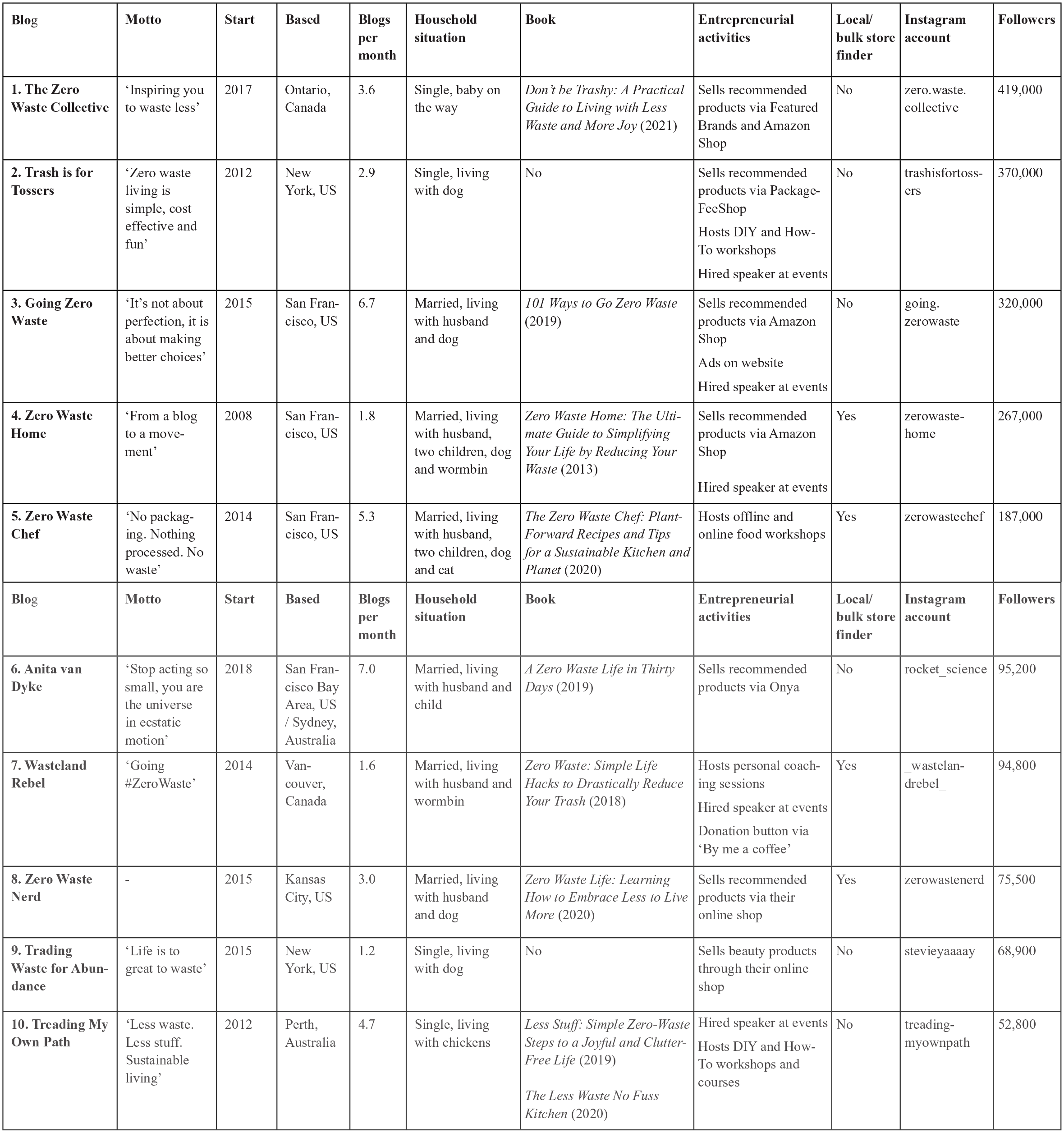
Information on the 10 zero waste blogs presented in this article (last updated October 2021).
Our analysis of zero waste blogs reveals that the top 10 are based in the United States (6), Canada (2) and Australia (2), with the majority begun in the past five years. A typical blog has an ‘about me’ page, a ‘get started’ section in which bloggers share essential zero waste principles; and a page with links to other zero waste blogs and organisations. The key section consists of posts on how to avoid waste. These posts are gathered into categories such as ‘home’, ‘bathroom’, ‘kitchen’, ‘cleaning’, ‘food’, ‘toiletries’, ‘shopping’ and ‘holidays’. On average, a blogger posts about twice a month in this section, with much more regular feeds on her Instagram account. As a mainstream digital platform, Instagram allows zero waste advocates to promote their way of life to a large audience and helps them direct traffic to their niche blogs. The majority of blogs also adhere to neoliberal discourses of entrepreneurialism and creative work (Taylor, 2015), most baldly through their ‘shop’ section, which directs zero waste consumers to websites where they can buy showcased products, varying from beeswax wrappers, to tote bags, to bamboo toothbrushes, from which bloggers often earn a commission. Some bloggers also offer Do it Yourself or How-To workshops.
Our dataset spans the period from February to April 2019. We manually scraped blogposts, including visual information, dating from each blog’s initiation, concerning domestic activities associated with cooking, cleaning, and grocery shopping. In analysing the blogposts, we focused on how advocates (re)imagine and reconfigure these three activities. Assisted by qualitative software – Atlas.ti – we coded the blogposts for frequently mentioned issues, concerns and phrasings. This led us to mentions of or allusions to a number of issues that we distilled into three recurrent themes: (1) communing with nature, (2) organising time and (3) spending money. We then probed for how and what these themes disrupt (or not) in terms of gender relations and environmental responsibilities in households, as the bloggers imagine them.
Finally, a reflection on digital research ethics. There are different strategies for collecting and presenting blog data in social science research (for an overview see Hookway, 2008; Marres, 2012). These strategies are shaped by concerns regarding privacy, accountability and transparency. Zero waste advocates’ blogs are publicly available so that these women can share their expertise, help build a lifestyle movement, and earn a living. Within the movement, the most influential bloggers are highly visible to the extent that they can be considered public figures. In this article, we acknowledge the knowledge and skills of zero waste advocates and their formative role in shaping this movement by crediting them as authors instead of providing them with respondents’ pseudonyms. Anonymising the blogs would have been possible to a certain extent, but would have counteracted that acknowledgement and also come at the cost of methodological transparency with regard to our social scientific community of expertise.
Zero waste living: A situated ethics
The zero waste lifestyle movement proclaims five rules of conduct for reducing one’s annual household waste: refuse what you do not need; reduce what you have; reuse what you can; recycle what you cannot refuse, reduce, or reuse; and rot the rest. This final step involves composting organic waste. These so-called ‘5 Rs of zero waste living’ intend to help zero waste consumers be environmentally responsible in everyday situations. In the following sections, we examine the normativities these rules effect in practice for reconfiguring cooking, cleaning, and grocery shopping. We organise our presentation of zero waste living according to three crosscutting themes: (1) communing with nature, (2) organising time, and (3) spending money. From these reconfigurations, we gain insights into the regressive and progressive gender politics of zero waste living – as feminised concern and feminist care.
Communing with nature
Zero waste advocates foreground the connections between household sustainability and the flourishing of all beings, in biographies that encompass more-than-human life. ‘We ARE nature’, one blogger declares, before continuing: It’s not too late to be a mindful, conscious species that treat our earth like it’s the only thing that will keep us alive - because without it, we would be nothing. Trading Waste for Abundance, ‘About me’
The connection between human wellbeing and environmental health is similarly invoked by another blogger, while sharing her personal rationale for living a zero waste life: I believe that health and wellness of SELF is inextricably linked to the health and wellness of the PLANET. I believe that your efforts no matter how big or small have a POSITIVE impact! Going Zero Waste, ‘About me’
As part of such reasoning, activities such as cooking and cleaning are transformed from dull domestic chores into opportunities to ‘experiment with togetherness’ (Abrahamsson & Bertoni, 2014). Bloggers frequently laud the quality of being grown, processed, or discarded by means of living organisms – such as bacteria, fungi and worms – and elemental resources such as sun, soil, and seasons. Here, humans are connected and located in new collectives with ‘awkward creatures’ (Ginn et al., 2014) and biochemical processes. But, what does this entail in practice?
Doing things ‘chemically, but in a good way’ is the short answer Wasteland Rebel provides in a post on ‘how to unclog your drain the natural way without harsh chemicals’. This involves avoiding products associated with industrial processes when cooking and cleaning. Blogger Zero Waste Home warns about these ‘toxic products’ and makes her readers aware how they ‘for[got] our grandmothers’ most powerful cleaning weapon’, namely vinegar which functioned as their ‘their non-toxic solution’ to any problems to do with mould, grease and sticky residues at home. This is in line with frequent advice: avoid cleaning products containing ingredients that are inedible. Zero Waste Chef offers consumers a witty mnemonic while introducing herself on her blog: ‘If it’s a plant eat it. If it was made in a plant, don’t.’
With regard to cooking, the dominant concern bloggers share is the toxic effects of industrial food production processes on human bodies and the environment. The adjective ‘real’ is often deployed in this regard. Take Treading My Own Path’s blogpost on ‘Clean eating/real food’: I love food! When I say food, I mean real food. Food made from real ingredients: ingredients that were alive, that were growing. Ingredients with names . . . that our great-grandmothers would recognise. Real food means proper meals, made from scratch and prepared with love. No chemicals, no fake ingredients, no fillers or artificial preservatives.
The invocation of great-grandmothers illustrates how connecting with nature ‘revalorise[s] the female’ (Pickering & Wiseman, 2019, p. 752), but in a way that positions women as closer to nature than men (as there is hardly any mention of (great)grandfathers). This reaffirms women’s role as keepers of both the household and the natural world.
Apart from this essentialised construction of women’s relationship with nature, connecting human wellbeing to environmental health also invites zero waste consumers to engage in experiments with natural ingredients, biochemical reactions and beneficial (micro)organisms (see also Lorimer [2020] on probiotic ways of living). Zero waste principles of reducing and reusing come to the fore through, for instance, do-it-yourself cleaners. Consumers are urged to look into natural cleaning products, the kind of biochemical reactions involved, digesting, breaking down, and unearthing the very root of natural stains and stinks. They try to convince consumers that it is not ‘rocket science’, but simply natural processes at work (Wasteland Rebel, ‘How to make zero waste liquid dish soap with non-toxic ingredients in just minutes’). Yet, wild experiments can go awry and consumers must develop hands-on skills, become knowledgeable about natural chemicals such as enzymes – proteins made by living organisms – and how they catalyse reactions in homemade enzyme-powered cleaners.
But cleaning is not the only household task in which the potential for building naturecultural worlds is explored. Cooking, in the broad sense of preparing, processing and cleaning up after meals, is another. Knowing how to reuse things figures prominently on zero waste blogs, most notably through natural processes of fermentation and rotting. Considering that a third of household waste is organic, working with bacteria, yeast and worms becomes imperative to reducing waste: another must-do as collaborations with more-than-humans break down food scraps and other biodegradable waste so they can become another type of food or rich soil instead of ending up in landfill sites. As Wasteland Rebel’s blogpost on ‘Try composting in your apartment – with a wormbin’ attests: Oh, I just love to say it: WE GOT WORMS! . . . I am talking about our worm bin – in the kitchen! All they do is to linger in there and eat, poop, and multiply . . . We . . . keep . . . it in the kitchen since that’s the best temperature for the worms. It does not smell and . . . it’s very educational too, since it is in fact its very own eco system! A worm bin does require taking care of it.
In processes of fermentation, bacteria and yeast transform their substrates and each other into new forms, textures, flavours, aromas and matters. Take Zero Waste Chef, who shares a recipe on how to make vinegar from apple scraps. Step 1 includes tinkering with ‘bad’ and ‘good’ elements and bacteria: Step 1. Combine apple scraps, water and sugar in a large, wide-mouth glass or ceramic vessel and stir. Cover with a thin cloth. With most ferments, you don’t want air to come into contact with your food. For vinegar, you do. Also . . . explosions are a real possibility. Pressure builds up in a closed container while the bacteria create carbon dioxide as a byproduct of fermentation. If you choose to close your vessel, in the next step, you will open it several times a day to stir and this opening will also release built-up CO2. Just always remember this step every day.
Practising fermentation thus invites open-ended collaboration across species boundaries, requiring attention, as well as a willingness to be changed by the process and to learn from it. By integrating biochemical reactions and biotic potential into cooking and cleaning routines, zero waste advocates invite hands-on engagement with biotic and abiotic matter in a waste-free world. They point to a progressive understanding of community as composed of ‘intimate entanglements’ (Latimer & López Gómez, 2019) with more-than-human others. This extended, naturecultural notion of community is important in terms of how it modifies naturalness as something of which zero waste consumers are part, instead of something external to them.
Organising time
Communing with nature for the benefit of a healthy planet reconfigures domestic labour, mainly through the organisation of time. Not surprisingly, zero waste advocates invite consumers to adopt a ‘slower’ pace of life in tune with natural rhythms. As a tip for zero waste parenting, Anita van Dyke advises consumers: ‘Go slow and buy what you need as ethically as possible.’ But this is not just an invitation, it is a bare necessity if consumers want to incorporate the 5 Rs of zero waste living into their domestic routine. It takes time to assemble a zero waste shopping kit, clean the bulk containers after grocery shopping, make grocery and errand lists, and source local suppliers. It expands this domestic activity. Zero waste shopping for groceries requires a household manager who aligns the various subtasks comprising it: a diligent housewife. By splitting grocery shopping into subtasks and demonstrating how a mindful organisation of these tasks can phase out household waste, zero waste advocates increase the time the chore takes. To justify this, they often explicitly refer to the lived experiences of grandmothers: I asked my two grandmothers-in-law what the heck they did with their trash back then. They laughed and said: ‘Trash? We didn’t have any!’ Everything today is packaged. Back then, they went with their baskets, bottles, cans and jars to the mom-and-pop store and got them refilled. Wasteland Rebel, ‘Zero waste – free your life from trash’
Invocating the routines of housewives of past generations is unsurprising since, traditionally, the coordination of domestic activities has been naturalised as women’s work (see DeVault, 1991; Oakley, 1974).
To reconfigure cleaning and cooking, zero waste advocates also call upon this traditionally feminised responsibility: Our cleaning cabinets are packed full of plastic packaged, toxic products . . . I’m just sure that my great grandmother didn’t have about 20 items for all of her cleaning needs. In fact, I know what she used. Vinegar, baking soda, and water. That’s it. She cleaned the majority of her house with these simple ingredients and it was always, ALWAYS squeaky clean. Zero Waste Nerd, ‘30 days to zero waste (Day 23: simplify your cleaning products)’
However, despite being touted as ‘simple’, blogposts about cleaning typically contain long lists featuring multiple cleaning recipes for making nontoxic cleaners, in which the same few ingredients are variously mixed depending on the specific item needing cleaning: carpets, pots, pans, windows, faucets, or floors. Consequently, cleaning also becomes fragmented into subtasks and therefore in need of planning and organisation. What is more, cleaning must be coordinated with grocery shopping, since the required ingredients should be bought in bulk and without packaging. Thus, when zero waste advocates describe the potential of revamped cleaning routines with natural, do-it-yourself cleaners, they relocate the production of cleaning materials from factories to the home – which requires organisation and management of time.
Guided by the 5 Rs of zero waste living achieving a natural food diet likewise demands strict organisational scheduling. The rhythm may be weekly, organising weekly dinner plans, monthly, preparing leftovers for future meals, or seasonally, conserving food. For example, consumers are encouraged to ‘ferment something’: If you also live in a cold climate, extend the season by learning to preserve food, something our grandmothers knew how to do . . . Preserving food through fermentation . . . puts you in touch with the natural cycles. Zero Waste Chef, ‘Good, better, best zero waste shopping’
The natural food skills and standards of cleanliness passed down from past generations – most notably from mothers and grandmothers – take on an objective quality in these blogposts, as if they emanate from outside the social relationships that sustained those women’s dependent positions in households.
Often zero waste advocates promise consumers that slowing down saves time in the long run. However, Sullivan’s (1997) insights into the gendered experience of domestic time indicate the need for caution in this regard (see also Organo et al., 2013). Specifically, she highlights two aspects of the experience of time: the intensity with which activities are performed and the fragmentation of leisure time when women often do a number of domestic tasks simultaneously. So, reorganising time in zero waste households risks adding to the gendered domestic burden because it increases the time needed to undertake housework: fragmenting some tasks, while combining others. For instance, shopping and recycling become part of cooking, while cooking and cleaning go hand in hand and, for instance, fermentation is a messy process.
While reorganising time risks expanding women’s domestic role, it also illuminates the transformational potential of engaging with waste in everyday life by extending care for the environment to nearby and/or like-minded others outside the home. This is captured in the often-invoked motto: ‘sharing is caring’ (Wasteland Rebel, ‘The 5R’s of zero waste’). Treading My Own Path sums up nicely why mobilising others into commitment and redistributing resources, offline or online, is praiseworthy: The reason that zero waste . . . is referred to as a movement is because there are lots of people . . . all working together towards a common goal. We’re sharing resources . . . and learning from one another . . . connecting with others who share our ideas, understand our concerns and want to make a difference too . . . We’re creating a community from all over the world . . . Be part of the community. This can be online, via social media . . . and blogs. Share your thoughts and insights . . . Post ideas and success stories . . . If you’re feeling brave, offer to run an event at your local library – it will be a good way to meet like-minded people . . . and share stuff.
Sharing experiences, inspiring others and joining forces are essential to building a movement. Zero waste advocates enact what social movement scholars call ‘relational activism’ (O’Shaughnessy & Kennedy, 2010): a long-term form of activism that blurs distinctions between public and private spheres by recognising and using everyday routines and relationships among networks of like-minded people as the locus for social and environmental change. It is here that reorganising time offers the potential for progressive politics in relation to gender relations and environmental issues. This is precisely because it creates an opportunity to revalue embodied, time-consuming skills – preserving food, making a natural cleanser, researching organic ingredients that are in season – which have become outmoded and require new experimentation. In so doing, these skills become part of new, elevated standards and routines of domestic environmental labour also reconfigured into an opportunity to empathise, share and connect with others.
Spending money
As has become clear by now, zero waste living is not about consuming nothing; it is about buying with purpose. Consumers are urged to ensure that each item they purchase has value: We, as the consumer . . . have the power to pay for what we believe in, if we believe in reducing our plastic waste, then we need to put our money where our mouth is. Anita van Dyke, ‘The net sum game – saving money on food’
Zero waste advocates value ‘thrifty’ consumption practices (Evans, 2011): spending money on produce and products is not positioned as bad or trivial; rather, it is positioned as significant for reducing environmental damage. Yet, at the same time, bloggers assume consumers are sufficiently affluent so that inexpensiveness should not be a decisive value: We are all consumers to some extent, and every time we make a purchase, we are voting with our wallets for the kind of world we want to live in . . . we can’t wish that organic produce was more readily available and buy conventional produce because it’s cheaper . . . There is no disconnect between what we want to see and how we spend our money. Treading My Own Path, ‘About me’
By placing a moral constraint on certain types of consumption – those directed by low cost or convenience – but not on consumerism per se, zero waste living is at ease with normative expectations of sustainable consumer culture. To ascertain the ‘true’ price of a product, it should be evaluated according to a variety of costs, which most notably includes the costs related to toxic pollution, soil contamination and plastic litter (Hickel, 2020).
Studies in consumer culture show that grocery shopping is one activity where conservative gendered family roles are sustained (Fiske, 2011). Applying Daniel Miller’s Theory of Shopping (1998), which shows that shopping is linked to family relations, most specifically those expressing love and care (see also Meah & Jackson, 2017), spending money to avoid waste and pollution may be understood as a feminist act of care. Yet, who is doing the caring is equally gendered – a feminised concern. This tension is evident in Zero Waste Home’s ‘seasonal recipe’ for fennel casserole: One of my favorite dishes growing up, was my mom’s fennel casserole . . . I thought about making it for my family . . . when I found some locally grown bulbs. My mom included ham . . . but to accommodate our vegetarian weeknights, I omitted it. The verdict? The kids loved it and asked for seconds . . . It has become a family favorite.
Implied is that ‘good’ mothers take care of both their children and the environment. In this, we observe an alignment with research showing that organic food reflects certain intersecting neoliberal ideals of motherhood and ethical food discourse (Cairns et al., 2013).
Zero waste’s emphasis on ‘buying power’ and ‘personal responsibility’ not only taps into already existing neoliberal discourses pertaining to thrift and organic products, but also to aesthetics. By showing off beautiful products and fresh produce in intriguing compositions on their blogs, zero waste bloggers perform and affirm a gendered ‘aesthetics of organisational performance’ (Hancock & Tyler, 2007, p. 512). Take cleaning. Despite the messiness of composting, the rubbish fermenting leftovers generates, or the inconvenience of cleaning bulk containers weekly, these routines are visually presented in an Instagram aesthetic, according to which homes are tidy, bright and clean (Savolainen et al., 2022). The desired upkeep demands consistent maintenance of things. Cleaning becomes part of an aesthetic economy that rests upon a desire to be seen, to be dressed up, to stage oneself. Designer glass bottles or steel containers that in itself are part of an aestheticisation of commodities may hold the cleaning products. In a paid partnership with the brand Cleaning Essentials, one blogger offers tips for do-it-yourself cleaning: Cleaning Essentials products make the DIY cleaning process even easier. They offer beautiful glass bottles (in blue or amber) with DIY cleaning recipes on the bottle. Zero Waste Collective, ‘2018 Holiday gift guide for zero waste in kitchen and cleaning’
Most zero waste advocates seek to capitalise on conventionally feminised activities via the sale of cleaning items, such as an ‘eco-chic’ bamboo toilet or bottle brush or ‘designed’ bees wax wraps. These are branded on the blogs, often with their promoters receiving a small commission on sales made via Featured Brands, Onya, and even Amazon. The feminised zero waste imperative to spend money on beautiful domestic objects is an expression of care that disregards the classed aesthetics that accompany it (see also O’Neill, 2021).
However, opening up domestic routines to the processes involved in reassessing monetary costs vis-a-vis the environmental costs associated with waste urges consumers to engage in new ways with supply-chain actors. Many zero waste blogs warn against ‘greenwashing’ – the marketing of green-living trends – and instead encourage consumers to ask companies about their products. As Treading My Own Path urges: Probe. Look deeper. Ask questions. Most companies with genuine ethical credentials will be able to answer your questions and address your concerns.
Spending money locally – at farmers’ markets and at local bulk and thrift stores – is another intervention: Just have a search in your local area! Because they are delivered straight from the farmers, they usually have very little or no packaging. This cuts down on the individual plastic wrapping you see in supermarkets. You’re also supporting local farmers and cutting out the middle man! Anita van Dyke, ‘5 minimalist hacks to simplify your life’
Going Zero Waste emphasises that shopping locally enacts care: A small family business is 1000x more likely to be accommodating than a large chain corporation. You’re building a relationship with these people . . . Small business owners care a lot more about having you as their customer. Going Zero Waste, ‘Zero waste takeout’
This call for an economic relationality forms an attempt to present zero waste living as something akin to ‘community economies’ (Gibson-Graham, 2014, p. 77). This involves purposefully engendering new kinds of economic subjects, who engage with others to make supply chains sustainable and plastic-free by breaking the market dominance of global plastic-producing corporations. Collective action is located in sustaining local supply chains and urging local shops, farmers and companies to produce only long-lifespan and repairable products and use minimal or recyclable packaging in order to phase out waste.
Towards a progressive politics of gender and household sustainability
Oriented by the question of how gender and household sustainability are mutually constituted in zero waste living, we demonstrated how the five zero waste rules of conduct – refuse, reduce, reuse, recycle and rot – guide consumers towards everyday and situated engagements with waste. Organised by three cross-cutting themes – communing with nature, organising time and spending money – we presented the normativities these rules call into being when it comes to reconfiguring cooking, cleaning, and grocery shopping. To gain analytical depth, we worked with the tension of understanding zero waste living as feminised concern and as feminist care. That is, we sought to understand zero waste living as an intensification of feminised responsibility for environmental issues and as offering potential for transformational change for both gender relations and environmental issues. In this discussion, we draw out the implications of zero waste living’s emerging, contradictory gender normativities, while recalling the political economy in which it is situated.
Understanding zero waste living as a feminised concern draws attention to the uncontested and expanding feminisation of responsibility for household sustainability that this way of living reproduces. In contrast to sociological research indicating changing norms regarding gender divisions of labour in households (e.g. Bianchi et al., 2012), zero waste living invokes traditional gender relations, most clearly by recalling what the bloggers’ (great)grandmothers did. This expansion of women’s activities in the home rests on a construction of women as keepers of the natural world and deploys essentialist notions of women as more caring than men. It does not, in the words of Victoria Lawson (2007, p. 1), ‘attend to the ways in which historical and institutional relationships produce the need for [feminised] care’. Efforts to revalorise feminised household skills through the zero waste lifestyle movement raise the spectre of the ‘double bind’ (Hochschild, 1997), according to which traditional gendered expectations remain, but zero waste consumers become ever more adept at fielding new affective obligations as care for the environment. Zero waste living thus holds the danger of locating women’s environmental care in the home.
A notable dimension of zero waste living is the presence of affluent women with time, money and educational capital to act. On the one hand, we note the laudable focus on high-consumption households, including shifting towards habits of naturecultural thinking. Indeed, Lucie Middlemiss’s (2010, p. 147) work illustrates the need for ‘differentiation between individuals’ responsibilities’ for environmental action as structured by different capacities, including class. Similarly, reassigning the responsibility for caring to the affluent rather than outsourcing caring activities to marginalised ‘others’ (Tronto, 2013) marks progress. On the other hand, is this progress if working-class or other marginalised groups do not have access to zero waste living and it does not address their concerns? By placing a constraint on certain types of consumption, for instance, those fuelled by thrift or convenience, zero waste advocates inadequately reflect on how they may deploy their own (cultural) standards to hold a ‘position of judgement’ (Skeggs, 2005, p. 977) over other women – who may have no or less access to such resources as time, money, or cultural and social capital. This stance hampers the movement’s potential to extend solidarities to poor and working-class women, since it hinders access to this lifestyle for those without financial resources.
Concerns such as these suggest we must situate zero waste living in a neoliberal, postfeminist landscape in order to then challenge these inflections (Banet-Weiser et al., 2020). The femininities idealised by zero waste advocates are constructed within a broad postfeminist context in which women are reclaiming and celebrating domesticity through a focus on personal, and consumer, choice. This postfeminism is deeply embedded in a ‘mediated feminist landscape’ (p. 3) that depends on media platforms such as the blogosphere and Instagram, where a market rationality tends to infiltrate all spheres of life, including the most private ones. Akin to the ‘clean eating’ health and wellness movement, zero waste living circulates in this feminist economy of visibility (O’Neill, 2021), according to which the aesthetics of the spray bottle with which you clean your kitchen suddenly has significance. In partaking in this aestheticisation of household products, zero waste advocates extend economic relations to domestic routines.
What is more, scholars analysing contemporary feminisms foreground ‘the relationship between neoliberalism, media, and subjectivity in the maintenance of continuing inequalities’ (Gill & Kanai, 2018, p. 324). Zero waste’s widespread uptake of digital media indicates a further extension of neoliberal modes operating within intimate life, which women in particular, as seemingly ideal neoliberal subjects, adopt. In reconfiguring domestic activities, zero waste living is at the forefront of transforming environmental care into a source of monetisation, a potential for consumerism. Not only does it obscure the labour involved in producing oneself according to the criteria of popular feminism, but it also ‘eclipses a feminist critique of structure’ (Banet-Weiser et al., 2020, p. 9; see also Lawson, 2007).
But we should not be too quick to defang zero waste living of its oppositional and productive potential. Understanding zero waste living as feminist care helps identify the ingredients that zero waste living offers to a progressive politics of gender and household sustainability – at locations where bridges are required between households and collective forms of action. Communing with worms, microbes and yeast, and learning about biochemical processes and ecosystems enacts some elements of the ‘different mode of humanity’ Val Plumwood (2007) envisioned as pivotal to the survival of our current ecological predicament. The feminist potential of this reconfiguration of household tasks lies in its extension of solidarity to more-than-human worlds (Puig de la Bellacasa, 2017). These bridges include shopping and cooking (seasonal buying and plant-based diets), and cleaning (tolerating the good germs as gut buddies). In offering an alternative understanding of the household as a site for exploring engagements with waste as a public matter (Evans et al., 2012) zero waste living may re-politicise household sustainability as it revamps old forms of ecological knowledge about more-than-human others and multispecies relations. This relational thinking decentres humans, while creating a politics of ethical obligation towards more-than-human others (Tironi & Rodríguez-Giralt, 2017; see also Haraway, 2018). Indeed, it is through this re-politicisation that we see some scope for de-gendering household sustainability – as something in which we all engage (see also Murphy & Parry, 2021).
Moreover, zero waste living’s extended, naturecultural notion of community is realised through an emphasis on buying power. As a movement, zero waste living attempts to engage in a politics of building new economic relations, much in the line of Gibson-Graham’s ‘community economies’ approach. Zero waste living ‘take[s] back the economy’ (Gibson-Graham et al., 2013) by showing consumers how markets are directly interlinked with the mundane choices consumers make while they run their households. Zero waste advocates urge consumers to change their domestic routines and, with it, to alter global supply chains which are so environmentally destructive. They offer a mode of living that challenges, and yet is within, capitalism by engaging waste as ‘an agent of ecological repair’ (Zhang, 2021, p. S298; Lehtonen & Pyyhtinen, 2021). Zero waste living can perhaps best be understood as a ‘heterotopia’, an emerging practice of alternate social ordering that stands in an ambivalent relation to mainstream capitalocentric logics (Saldanha, 2008; see Foucault, 1986).
The zero waste living movement, however, is still in the making; it is ongoing. By retaining the analytical tension between understanding this movement as both feminine concern and feminist care, we have sought to lay bare its emerging, contradictory normativities in the hopes that we – as sociologists – can identify opportunities for progressive futures pertaining to gender and household sustainability. It is incumbent on us to show the relations between household practices and political economy – their entanglements – instead of compartmentalising society, economy and the environment into separate sites of action. From this standpoint, we can stage the mundane as a site for ‘everyday activism’ (Chatteron & Pickerill, 2010; O’Shaughnessy & Kennedy, 2010), in which life beyond capitalism can sometimes unfold. As such, zero waste living is just one of the many sources that form building blocks for change. Other building blocks can be oriented towards a further responsibilisation of governments and transnational capital, for instance.
While we indicate feminist care as a progressive agenda, we equally acknowledge that ‘acts of care are always embroiled in complex politics’ (Martin et al., 2015, p. 627). This is because care forms a discriminatory mode of attention: it values some lives or issues, while foreclosing attention to others (Mol et al., 2010). The feminist-inspired ethics of care we employ calls us to engage with these inclusions and exclusions while building towards a zero waste politics of environmental care. Our analysis here occurs during the movement’s continuing emergence in troubled times, and it remains unsettled and unfinished. We have focused on gender, but there are other intersecting social categories requiring attention, such as race and class. To advance this intersectional politics implies a mode of feminist care that connects with other movements and keeps these various struggles together (see also Müller & Schönbauer, 2020). As a next step, zero waste advocates must enter into conversation with those active in environmental justice and antiracist movements, such as Extinction Rebellion and Black Lives Matter, for instance. Very slowly, but surely, some in the zero waste living movement have begun seeking to push towards the progressive and inclusive potential it can afford. In a recent post, Going Zero Waste responds to the many criticisms zero waste living has received. The title of the blogpost? ‘Why we need an intersectional, antiracist zero waste movement’. We invite you to read the post and decide for yourself how far the movement has come. 1
Footnotes
Acknowledgements
Earlier drafts of this article benefitted from valuable commentary by Thomas Franssen, Lisa Howard, Annemarie Mol and Faye Wade. Also, a word of thanks to the three anonymous reviewers for their critical and constructive comments. Finally, we appreciate Helen Faller’s editing work which fine-tuned the article.
Funding
This research was made possible by a postdoctoral fellowship at the Institute for Advanced Studies in the Humanities (IASH) at the University of Edinburgh.