




Abstract
In this article I outline an original creative method for qualitative research, namely the painting with data technique. This is a participatory methodology which brings creativity and participation through to the analytical phase of qualitative research. Crucially, I acknowledge but also challenge the dominant aesthetic that currently shapes qualitative research and renders life in a monochromatic palette. The painting with data method evidences an alternative aesthetic to the predominant one and I argue that we can understand this methodology by adapting Jennifer Mason’s concept of ‘layering’ to conceptualise how different aesthetics help us to see the different shapes, forms and moulds that make us, our relationships and our worlds. The process moves away from traditional ways of treating transcribed data, and prioritises addition above extraction; juxtaposition over thematisation; and collaging rather than ordering. This alternative aesthetic for qualitative research offers an evocative form and a conceptual schema through which to interpret the world, providing a route to novel insights, that enlivens the interpretative work of the analyst and offers opportunities to make and witness potent connections.
The aesthetics of qualitative research
Qualitative research is an aesthetic practice. Whether on paper or on computer screens, qualitative researchers are mostly engaged in grouping and ordering, selecting and filtering black text on white backgrounds. We carve our transcripts up into new texts, making more black and white shapes, aligned and spaced in similar styles, blocked-out into paragraphs, on pages or screens of a certain size, into writing that has a certain rhythm, a certain orderliness in the presentation of its data. In this process, we are guided by an aesthetic which prizes a particular scheme of taste in the translation and organisation of life rendered in a monochromatic palette. This aesthetic’s power over us has barely been registered, for it sinks so deeply into our practices of analysing and presenting textual data that we can scarcely see it; instead, it is part of how we analyse, of how we see transcripts. Rarer still have we sought to experiment with it.
In this article, I experiment with an aesthetic of transcript analysis inspired by processes of painting on and illustrating text used by the artist Thomas Phillips (2016). Specifically, I report on the use of paint, paper, pens and pencils in the analysis and reworking of transcribed qualitative interview data. The key to the method I used was to return to participants whom I had already interviewed, taking with me transcripts of those initial encounters, and – in the simplest way of putting it – asking them to paint on the pages. I argue that we can both literally and figuratively ‘paint’ with data, using transcripts alongside our participants, to enliven the modes through which we make sense of the stories we collect and those we go on to tell.
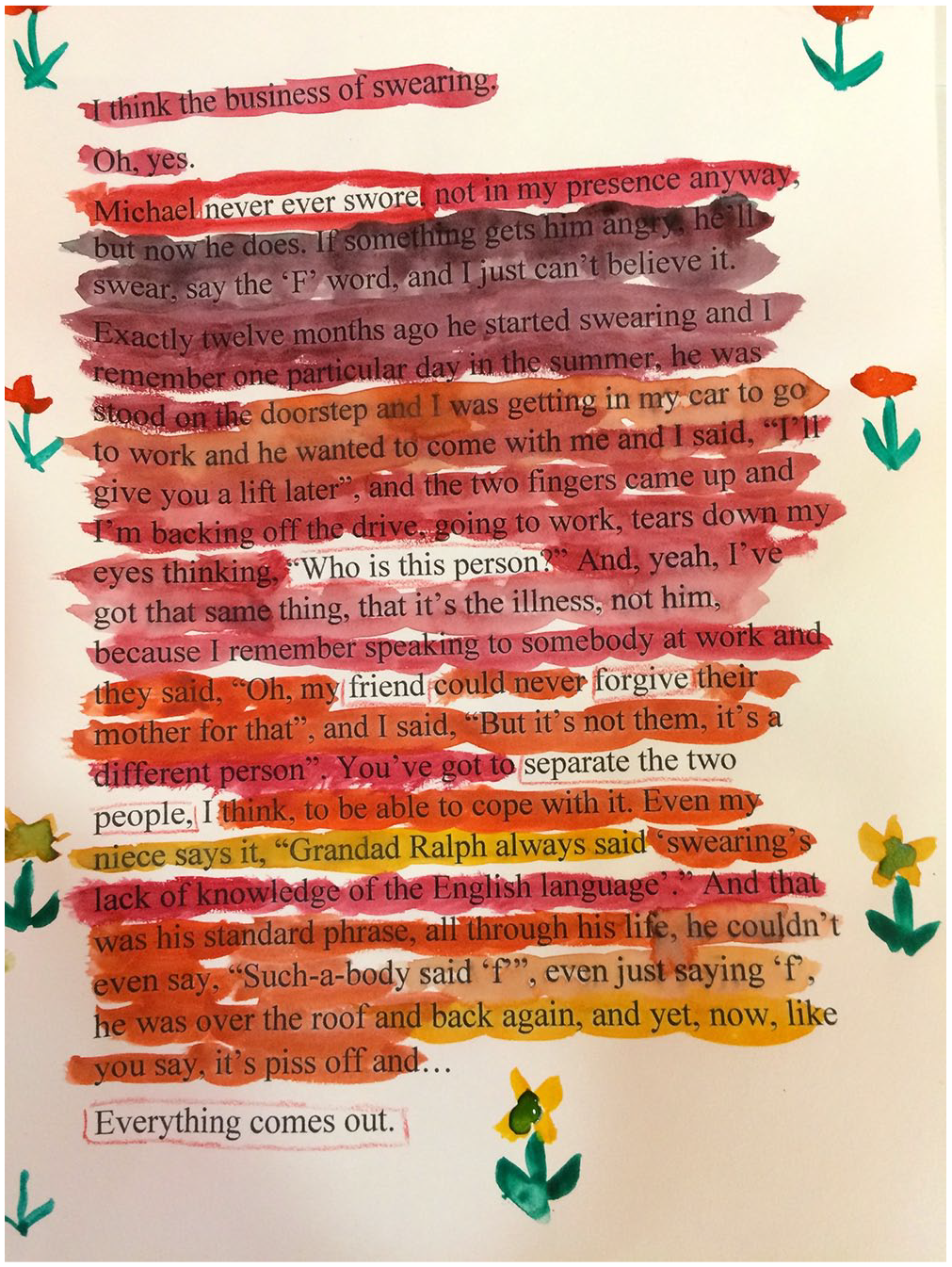
These processes produced data transcript pages that were often vibrant, profound and buzzing with life, as can be seen in the example in Figure 1, a page of transcribed text, which a participant has illustrated with red and yellow flowers in the margins, alongside a column of text which is awash with multiple reds, oranges and yellows of the same floral palette.
An example of a page produced by a research participant.
Despite decades of research on creative methods there remains relatively little reflection on ways of creatively engaging with transcribed data (Davidson, 2009) or with the literal material elements of transcript analysis: pages of talk. I seek to develop such a programme of work, and offer two principal concepts as starting points. First, I term this process ‘painting with data’, which means to treat the method not only as a form of data production, as a kind of object or visual elicitation which is now quite well-developed (though still underused) in creative methods research (Back & Puwar, 2012), but also to treat it as a style of analysis, too. Second, I draw on the concept of ‘layering’, inspired by Jennifer Mason’s (2018) use of the term in her book Affinities, but adjusted in order to apply to this particular methodological endeavour.
Although the existing literature is underdeveloped in this area, there are some useful starting points to bear in mind. Flick (2009, p. 302), for example, notes that ‘Every transcription of social realities is subject to technical conditions and limitations and produces a specific structure on the textual level, which makes accessible what was transcribed in a specific way.’ Likewise, Oliver et al. (2005, p. 1287) argue that we must be mindful that ‘Transcription is a powerful act of representation. This representation can affect how data are conceptualized.’ Atkinson (1992, p. 22) shows that ‘Textual conventions exert a powerful influence on the representation of informants’ or other social actors’ own words’, drawing attention to how we select, edit and represent spoken narratives. As Sandelowski (1994, p. 311) reminds us, ‘the researcher arranges features of the interview event, operationalizing decisions . . . concerning such matters as what nonlinguistic features observed during the interview (and recorded in field notes), such as facial expression and body movement, and what additional sounds, such as sighing, laughing, and crying, will be preserved and how they will appear in the text’. These are just some of the ways in which academic sensibilities can be seen to include aesthetic dispositions. This literature thus shows that what we can know about the world is influenced not only by the production of qualitative textual data, but by how we see or read them once made. And those styles of seeing and reading are differently practised according to different commitments regarding what the world is. Compare, for example, the style of rendering qualitative data in the ethnographic storytelling mode of reporting field notes, with conversation analytical approaches, where each pause, each inflection, is given weight and representation. These different commitments to how the data are presented reflect different commitments to what the data represent (different views of social order, interaction, meaningfulness, etc.). The aesthetic and the ontological are fundamentally entwined.
This can be seen in a broader sociological interest in the politics, ethics and economics of the aesthetic organisation of life. Recent work has sought to rejuvenate sociological theorising, to loosen up the sociological imagination (Latimer & Skeggs, 2011). It has also endeavoured to produce a ‘disruption to the usual ways of sensing and making sense of things [which] can enable people to access alternative feelings, understandings and identities’ (Lambert, 2016, p. 947). In this regard, such efforts are closely aligned with the aspirations of creative methods research. Foster (2019), for example, sees the aesthetic political project and methodological innovation as being very much entwined. Her efforts to revive the surrealist legacy within sociology, to bring through the playful and poetic from our data, shares much in common with my present efforts.
In broad agreement with this wider concern with political aesthetics, I have sought to understand the painting with data method through an ontological perspective on life that highlights the relational, embodied, affective, sensory, atmospheric, temporal and ecological dimensions of experience (Foster, 2019; Lambert, 2016). Creative methods research has made excellent progress in seeking to expand the range of data production techniques to better capture and represent these qualities of life (Back & Puwar, 2012). And there have been attempts to bring the creative through into all aspects of the research process (Ayrton, 2020) but the imaginative, playful or poetic dimension is still mostly confined to the data production phase, returning researchers to the transcript as the object of analysis and to the extract as the mode of presentation. I argue here that the approach to life which has been explored in the sociological scholarship on aesthetics requires us instead to push the boundaries of how we analyse data, to experiment with our aesthetics of analysis, too.
Mason’s work provides a powerful lens through which to see life in this fashion. Her approach has most recently explored affinities: . . . sparks or charges of connection that intensify, enchant or indeed toxify personal life and the experience of living. They are the revelation or charisma of potent connections that feel kindred in some way and in that sense they are fundamentally relational. . . . They are connections that are searing and affecting, which means they can be toxic and fearful just as much as they can be enchanting and joyous. And they can be manifest as affinities of opposition and alterity just as much as of empathy and resemblance. (Mason, 2018, p. 186)
In developing this account of affinities Mason explores the layering of experience, which she opens up and weaves together by looking at three specific facets, generating a layering of her own argument, as she moves through what she terms ‘sensory kinaesthetics’, ‘ineffable kinship’ and ‘ecologies and socio-atmospherics’. I use this approach to explore layering as it emerged in my own endeavours to breathe life into transcript analysis, but first I report on the more instrumental issue of what I actually got up to when I visited participants carrying a folder of printed transcripts and two boxes of art materials, and asked them to paint with their data.
The method
The data under consideration in this article come from a project in which I adopted a variety of methods to explore how people negotiate changes in everyday life in the context of living with dementia or when caring for someone who lives with dementia. In this piece I focus on my interactions with carers, to relate how use of this analytical technique has helped me to understand in greater depth carers’ experiences of changes in everyday phenomena.
My interest in the potential of a methodology which highlighted the more conceptual sense of painting with data began with a literal experience of watercolour paint, as Lynne Chapman, artist, illustrator and urban sketcher, took up residence in the Morgan Centre at the University of Manchester where I work. Funded by a Leverhulme artist-in-residence grant, Lynne set about the formidable challenge of encouraging academics in the Centre to experiment with sketching as a research method. Most of us were complete novices, but after much innovative training and coaxing on her part, Lynne opened up our eyes to a new way of seeing the world, which we tried to adopt and adapt, through what Heath and Chapman (2018) – reflecting on our group’s experiences – conceptualise as the application of a ‘sketchy’ research method. I found this a powerful experience and sketching became a part of my work in a variety of contexts (e.g. Balmer et al., 2020).
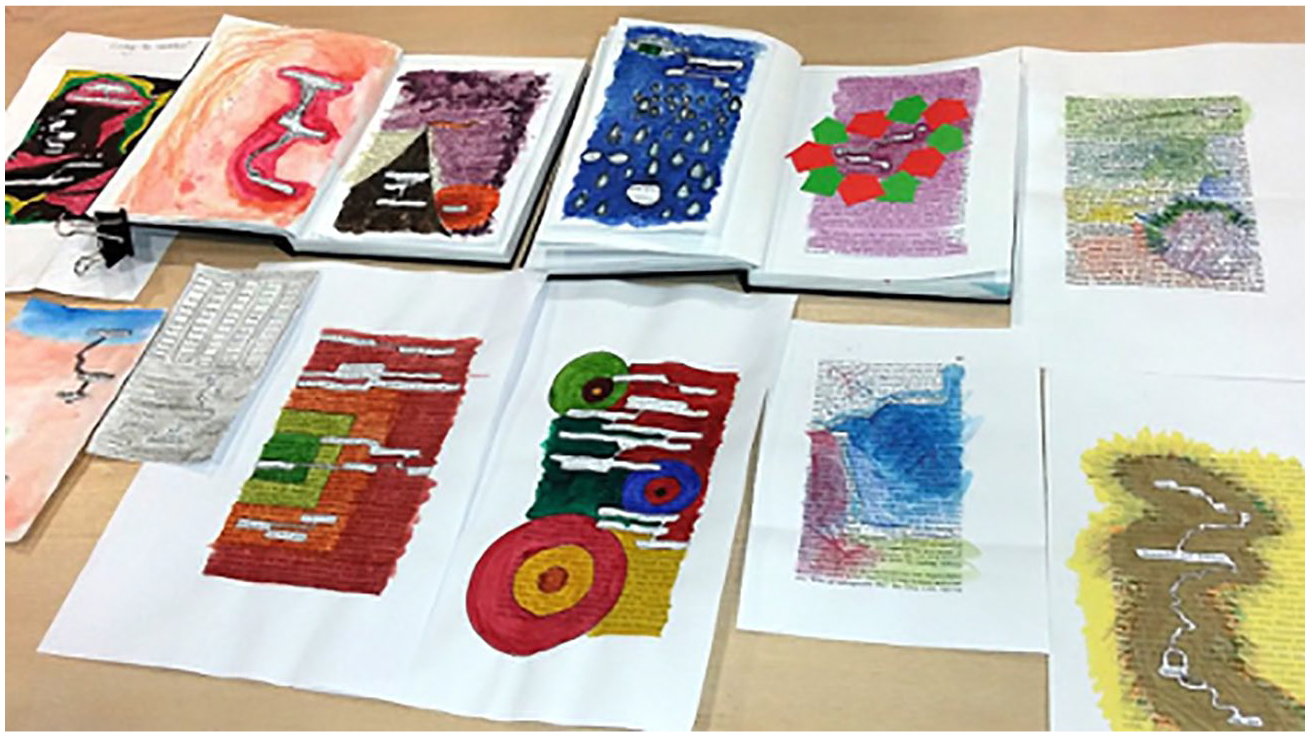
In one of our sessions with Lynne, she briefly introduced us to the idea of ‘humuments’: paintings or sketches layered on top of existing pages of printed text. These are best represented by Thomas Phillips’s book A Humument, a contraction of the title of another book, A Human Document. In Figure 2 are displayed some examples of humuments from the Morgan Centre workshop which Lynne led. I will return to the detail of both these books in a little while, for in A Humument’s original narrative and its recreation in Phillips’s artistic interpretation, we can find powerful inspiration not only for the practical methods I employed with my participants, but also for the way in which we might approach them analytically.
Examples of ‘humuments’ produced at a Morgan Centre workshop.
Taking humuments as a point of inspiration, I returned to my participants, taking with me transcripts of sections of our previous interviews. I invited participants to read and playfully engage with these texts, through the use of paint and pens. I organised five such encounters with individuals, one with a couple, and one focus group with three previous participants and four new participants, producing around 30 pages of painted data. These sessions lasted between one and two hours each, or roughly 10 hours in total. I audio-recorded the sessions and made handwritten notes on what was happening. I also took photographs and some short videos, and on two occasions – in one interview with a couple and at the focus group – took Lynne along as a sketcher, and thus produced some artistic sketches of the painting with data process, too.
Although it is not unheard of for researchers to share transcripts with participants (Forbat & Henderson, 2005) it is still quite unusual in social research. So it was with a little hesitation that I then also engaged in the less common activity of bringing along anonymised extracts from other participants’ transcripts as well, allowing people to choose to work with their own interview data or with data that might convey different stories. As far as I was able to discern, there were no significant differences in the process when participants worked with their own data versus when they worked with someone else’s. In the relevant sections of the article, however, I do make clear where participants are using their own materials or not, and explore any analytical consequences.
I was sensitive to the potential ethical questions arising from this process, and anonymised all transcripts provided to all participants. I also asked participants about what they felt about this process, and their comments were in keeping with Forbat and Henderson’s (2005) findings regarding people’s usual feelings about reading back their interviews (e.g. embarrassment at the wandering nature of talk, or lack of clarity, etc.). As such, I found that participants were not troubled by this element. Of course, this is not to say that this would always be the case. The people caring for someone with dementia whom I engaged in this process shared a set of understandings about their experiences and were all well-networked in the caring community, meaning they were used to talking about their lives with others and sharing these stories publicly, with strangers at conferences, workshops, support groups and in peer training schemes. In other situations, with other kinds of participants, significantly greater ethical concern might be warranted in how to navigate the process of sharing transcripts between participants.
With regard to the paint, pens and pencils, I gave participants a range of options, including palettes of watercolours, packs of watercolour pencils, felt-tip pens, some wax crayons, boxes of pastels, coloured pencils, and other bits and bobs familiar to the processes of sketching, like erasers, brushes, scissors and so forth. I gave them very little steer in what to do, but I did show them an example of a humument from our workshop with Lynne to provide them with one option for creative work with the transcripts, and to show them that the ‘level’ of sophistication anticipated was certainly no greater than the results of our own humble efforts. Participants therefore produced a range of different kinds of painted pages, but naturally many of them did take on (often only partially) the humument style.
I chose sections of talk to print that related to themes in which I was already interested, broadly determined by the main lines of enquiry I had followed during the interviews. This meant that although participants had quite a bit of choice in what content to paint with, their options were constrained, to some degree, by my own pursuits and my preliminary interpretations of the data I had collected. I gave them large chunks of transcribed talk, often spanning several A4 pages, allowing them to choose a page which included talk that spoke to them in some way.
In this regard, the unit of analysis shifted as I engaged with participants in this fashion. Usually, I work with lengths of transcribed text determined by their being ‘whole interviews’ (which I might be working through to code thematically or read in narrative style), ‘sequences of talk’ (which cover a theme in which I am interested and which I might return to several times in the process of analysis and writing), or ‘quotable extracts’ (which might be thematically drawn together in software packages, or might sit on their own in drafted articles, presentations, or thinking documents). As such, I predominantly encounter transcribed text within computational systems, such as word processing or qualitative data analysis software (or in printed forms derived from these softwares). These have their own aesthetics, as a result of the long history of computing, user-interface design, human computer interaction studies and so forth, but also because of how they have (to a greater or lesser degree) been designed to try to facilitate a certain idea of writing and sometimes specifically of social science work. They arrange, order and draw together quotations in particular ways (Sandelowski, 1995). Instead of working through these usual forms and interfaces, in painting with data I engaged in interpretation, along with participants, through the unit of the ‘page’. Methods-wise, this was quite unconventional, and I struggled for a while to get my head around what I was actually doing, but participants found pages to be entirely in keeping with their expected ways of working with paint, pencils and pens. In this regard, an alternative aesthetic approach to textual data was already in-the-making, by virtue of the styles and mundane practices of working with the page as a surface, which are commonplace in art and sketching, but antithetical to the usual means of rendering text in qualitative research.
Participants engaged imaginatively with the process and with very few concerns. Since academics in the Morgan Centre had been more than a little ashamed of our efforts at sketching and drawing, even under Lynne’s expert and gentle tutelage, I had expected my participants to respond in a similarly nervous fashion. But they surprised me. Although none of them were artists by trade and only a couple painted or sketched as a hobby, they readily took to the process and quickly seemed to let go of any embarrassment they might have felt, freely displaying and talking about their work with me (and with others, when present). They seemed to choose unreservedly between transcripts of their own talk and those of other participants, sometimes launching themselves into painting without much reading of the materials presented, sometimes taking some time to ‘find the right piece’ for them. But even those who jumped in, found they had to confront the content of the transcripts as they began to add layers of their own to the pages.
I also soon discovered that whilst I had – to some degree – constrained their choices of topic, they found it easy to leap from the surface content of the materials to other related topics, to their own experiences, or to unpredictable issues which they juxtaposed with the source materials in surprising ways. The use of the page as a unit of encounter also meant it was easy for participants to break the sequences I had arranged (which often spread over more than one page), allowing them to mix extracts together in piles, or in combined canvases, moving talk out of sequence, bringing participants’ voices together, and so forth. The page as a unit of analysis and expression seemed rapidly to intensify the intertextual, multi-authorial dimensions of qualitative data work. In some senses I was unnerved at how carefree they were in ascribing interpretations, in forging connections and re-contextualising what they found in the texts. It was clear that they did not approach the pages in the same way that I had the transcripts. However, it was also liberating to see a new way of analysing transcripts begin to emerge.
Painting with data: Layering on, layering life, layering voices
In this section I explore the concept of layering as a key part of the alternative aesthetic for textual data analysis when painting with data. In Mason’s (2018) work, layering refers to a process of argument that tries to move away from traditional efforts to encapsulate and thematise, does not worry about comprehensive coverage of a phenomenon, or aim to categorise and classify it. Instead, it seeks to produce a sort of cumulative picture, layering together flashes of insights and moments of analytical revelation on top of each other, so that no layer of the argument or analysis captures the others, and such that each is mixed in with each.
For an alternative aesthetics such as the one I am working towards, this layering approach is appealing in its conceptual resonance, for it already starts to turn us away from the will to separate, distinguish, organise and extract. Inspired by this, I explore how painting with data can be conceptualised through layering as an aesthetic process of interpretation. First, I explore layering as a layering of meanings onto the page, as participants added and expanded upon the texts by use of paint and pens; second, I explore layering life, showing how the physical process of painting itself is important analytically; and third, I look at layering of voices into data analysis, to play upon the already intertextual nature of transcript data. These layers each add to the understanding of what is happening in painting with data.
Layering on – Adding meanings and analysis
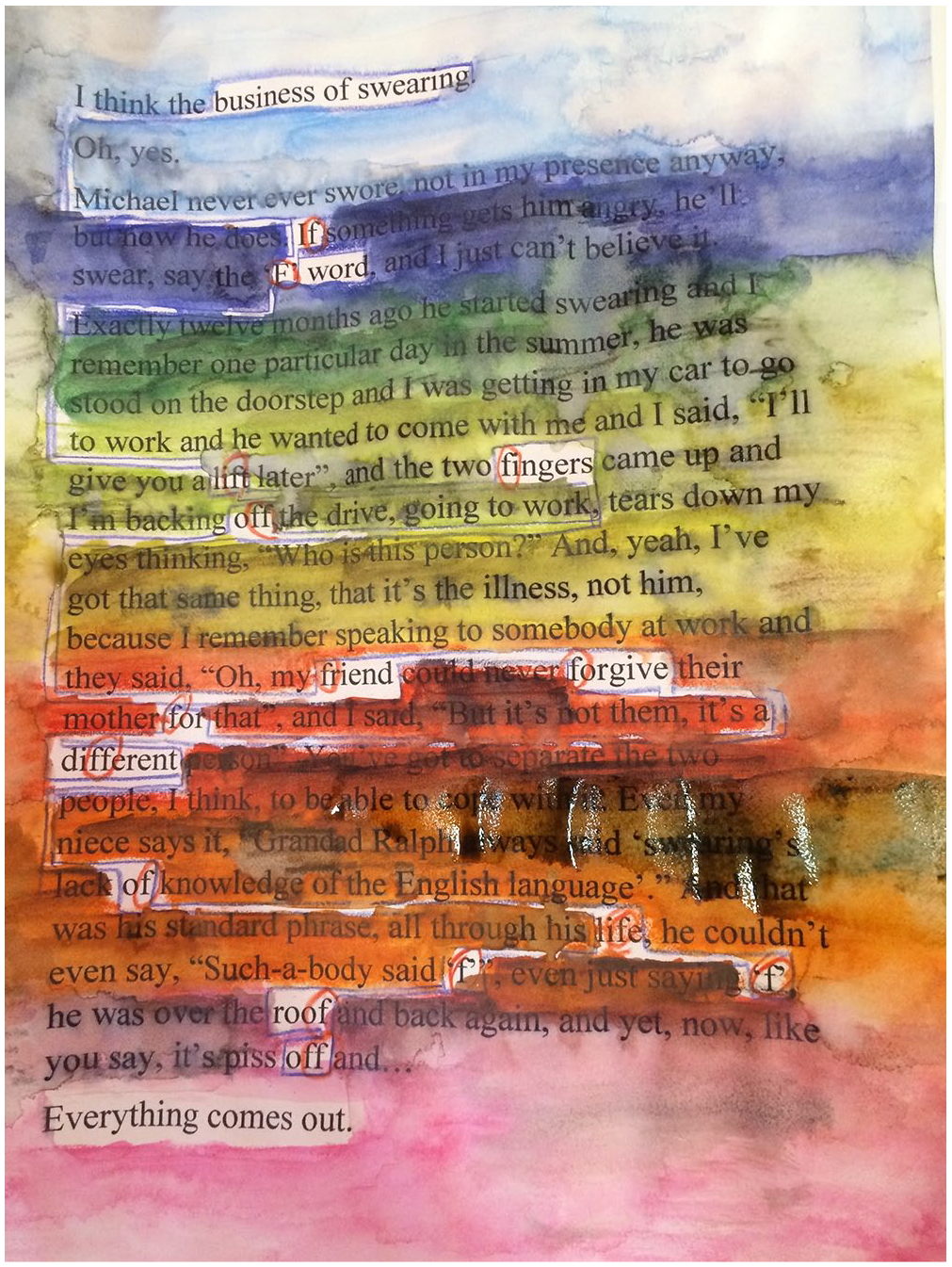
In Figure 3, a participant, Sandra, has highlighted the phrases ‘business of swearing’ at the top of her humument and ‘everything comes out’ at the bottom, and has then used a red pen to circle around the letter ‘f’ throughout the text.
Sandra’s rainbow palette humument highlights swearing as a change in her everyday life.
In this piece, Sandra worked with data that was not hers, showing how she used paint and pens to draw out a theme from the data, first by selecting a page of text to work with that resonated with her own experiences, and then by selecting a particular issue within that text, before highlighting it and developing it in her own way. The original extract conveys another participant’s experience of caring for her husband who had never previously been a swearer, but who, in developing dementia, had begun to swear more readily. In my own nascent interpretation of these data, this was an example of everyday changes in relationships. Sarah too was caring for her father who had dementia and there was now a similarly increased presence of swearing in her life. There were differences though, when contrasted with the original participant’s story, since unlike the transcript’s author, Sandra had highlighted all the ‘f’s on the page, indicating, as she explained, her ongoing but rather exhausting attempt to continue to manage the norm in her house of saying ‘the f word’ instead of swearing. Here she drew a comparison and a contrast with her own experience, through use of a simple but powerful artistic device: a red pencil. This added a layer of data for the meanings it had for me, too. The pencil highlighted the ‘f’s in a way which I find recalls teachers’ corrections of student work, and which for Sandra signified the increased presence of swearing within otherwise normal conversations. Red, culturally in the UK, usually signifies warning or wrongness. Here, the choice reflects Sandra’s feeling that it wasn’t right to swear but, having circled all the ‘f’s, not just those in the phrase ‘f word’, I find the result to be more powerful, for it conjures the anticipation of swearing amongst everyday talk, the prospect that an ‘f’ might just appear out of nowhere, and thereby added to my understanding of what was at stake in this linguistic change. In appreciating this figurative dimension of the piece, I realised that Sandra was dealing not just with the shift in norms in her household, but with the added uncertainty or unpredictability of when those norms might be breached. It helped me to see that a feeling of belonging together might become hesitant and nervous as changes creep into everyday talk.
Adding to this, Sandra’s use of the rainbow palette to wash a series of colours vertically down the page, indicated the biblical importance, as she explained, of trying to keep peace with each other, and of trying to help her father maintain his religious practices and identity as a Christian. What I realised in observing Sandra’s work, was that swearing and censorship were not only about the maintenance of habitual relational styles within normative conversational frameworks, but also spoke to broader belief systems through which people might understand things like ‘care’ or ‘swearing’. Forgiveness as a practice became a powerful feature of Sandra’s caring style and I could not help but see this as an ‘f’ word that paralleled her efforts to control her father’s talk. Alongside Sandra, I was analysing the data through the use of paint and pens in ways that took me beyond transcribed talk and into a spiritual layer of life which I had not, until then, realised framed quite a bit of what some of my carers were up to when they responded to changes in their experiences. These did not often come through in their talk, but the rainbow, with its cultural significance, spoke volumes. It also produced a charge of connection for me, as a gay man. And for a moment, I felt hope. I felt a connection between us, even though it was not spoken, and I am sure Sandra did not feel it, but it was powerful and important for me, as someone analysing this data, for I now read it in a new way. Not as a miserable tale of loss and grief and exhausting work, but as a suffusion of mundane experience with a hopeful orientation. Meanings were being added to the texts through paint and pens. Both Sandra and I, together and independently, were analysing life with dementia through the shifting aesthetic form of the page, as it came to life with colour, shape and style.
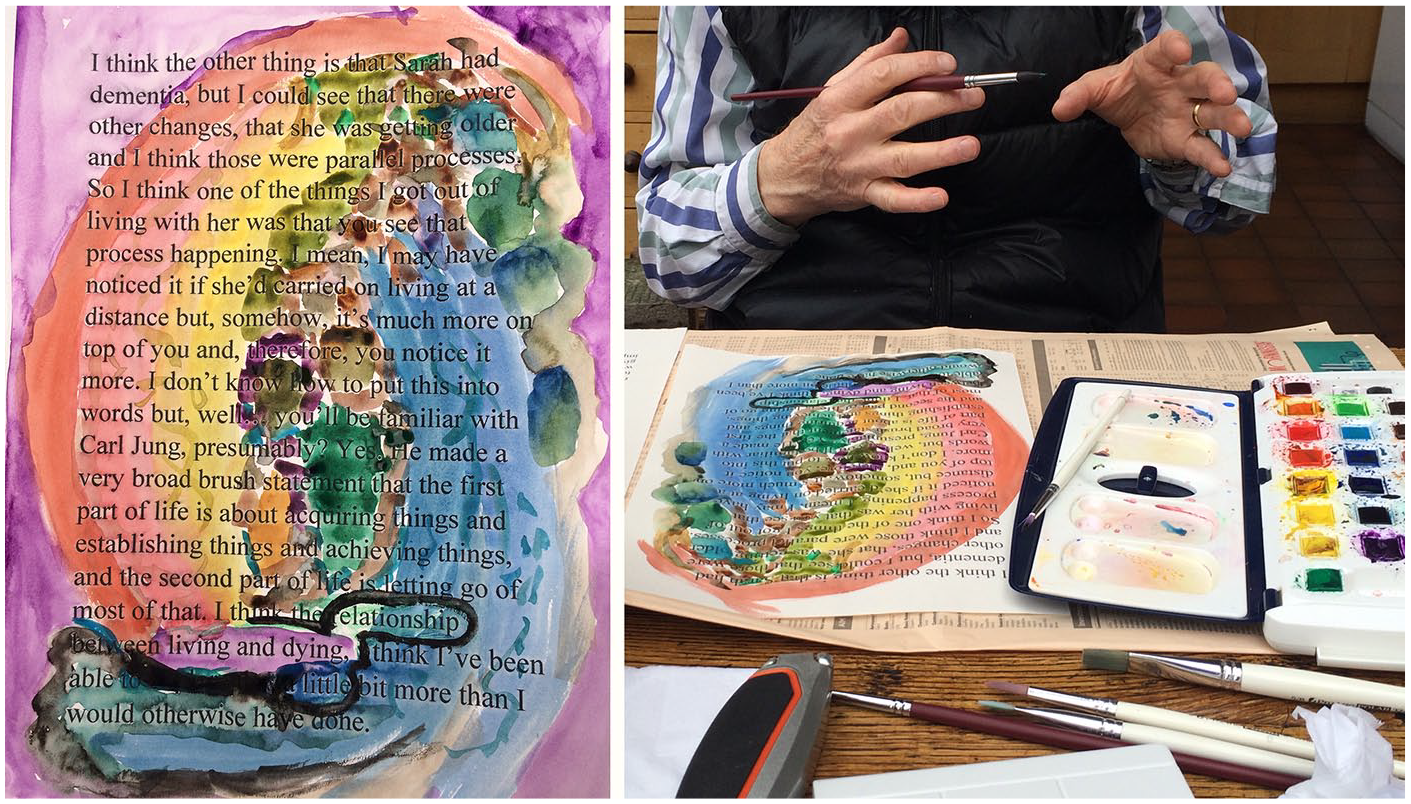
In another picture (Figure 4), Mark (a carer of his stepmother, who had passed away), reworked his own transcript, and also painted in a rainbow palette. He used watercolour paint to create a representation of a human brain, beautifully washed over the transcribed data from our previous encounter.
Mark’s brainbow, alongside a picture of Mark producing his piece.
Mark’s ‘brainbow’ layers on a level of meaning and interpretation, as a reflection upon the significance of what he had previously said in an interview. Having looked through several pages of text from his transcript, Mark chose to work with a page in which he had told me about a claim he attributed to Carl Jung, that ‘the first half of life is about acquiring things, and establishing things, and achieving things, and the second part of life is letting go of most of that’. Thinking back to this interview, he wanted to highlight that when we talk about dementia we are too often talking about a brain that is seen to be failing unnaturally, but once thought about in terms of Jung’s aphorism, the brain of someone with dementia was beautiful, for it followed the grand scheme of life, which we could learn to embrace in order to live more healthily, acknowledging ‘the relationship between living and dying’ that the brain embodies when living with dementia. Reworking the whole of his previous interview via the single page in front of him, Mark added the idea of a healthy and ‘natural’ body with dementia into his whole account through treating the page as a kind of synecdoche, and by doing so, spoke also to the broader, social discourse of illness that he realised he too was embroiled in.
These examples show there were a range of different ways in which the humument style was adopted and adapted by participants to paint with data. Some isolated key parts of the text, reinterpreting it but also drawing out a theme and pattern which linked to their ongoing experience; some significantly refined or transformed the meanings they saw in the texts, adding new elements with their brushes and through the additional talk we co-produced. In this regard, the method worked as a further opportunity to elicit data, through a form of visual or object elicitation.
But the most important dimension to this analytic process was that participants ‘layered on’ elements, which I mean both literally and figuratively. The materials themselves allowed for the page to become literally multi-layered, so that the black text came into dialogue with splashes of colour, letters of talk about dementia merged with shapes of brains and rainbows, with circles and lines of red pen, with big evocative sweeps of blue, and orange and green, in choices that expressed styles and taste and thus invoked all the symbolic dimensions of life which colour and form are routinely used to enact. The materiality of the transcript was opened up for transformation, and with it, the contents of the text on the page. So participants worked with me not only to identify themes in the material or to check, confirm or contrast their own experiences (which are all important things to do in themselves), but by doing so also offered to me, and allowed me to see for myself, alternative ways of analysing the materials, by generating alternative modes of them being materials (as more than black text and white background), producing vantage points from which I might otherwise have been unable to see.
Layering life – Juxtaposition as an analytical technique
In Figure 5, Erica, a participant who also took data from another person’s interview, selected a page of talk about religion and faith.
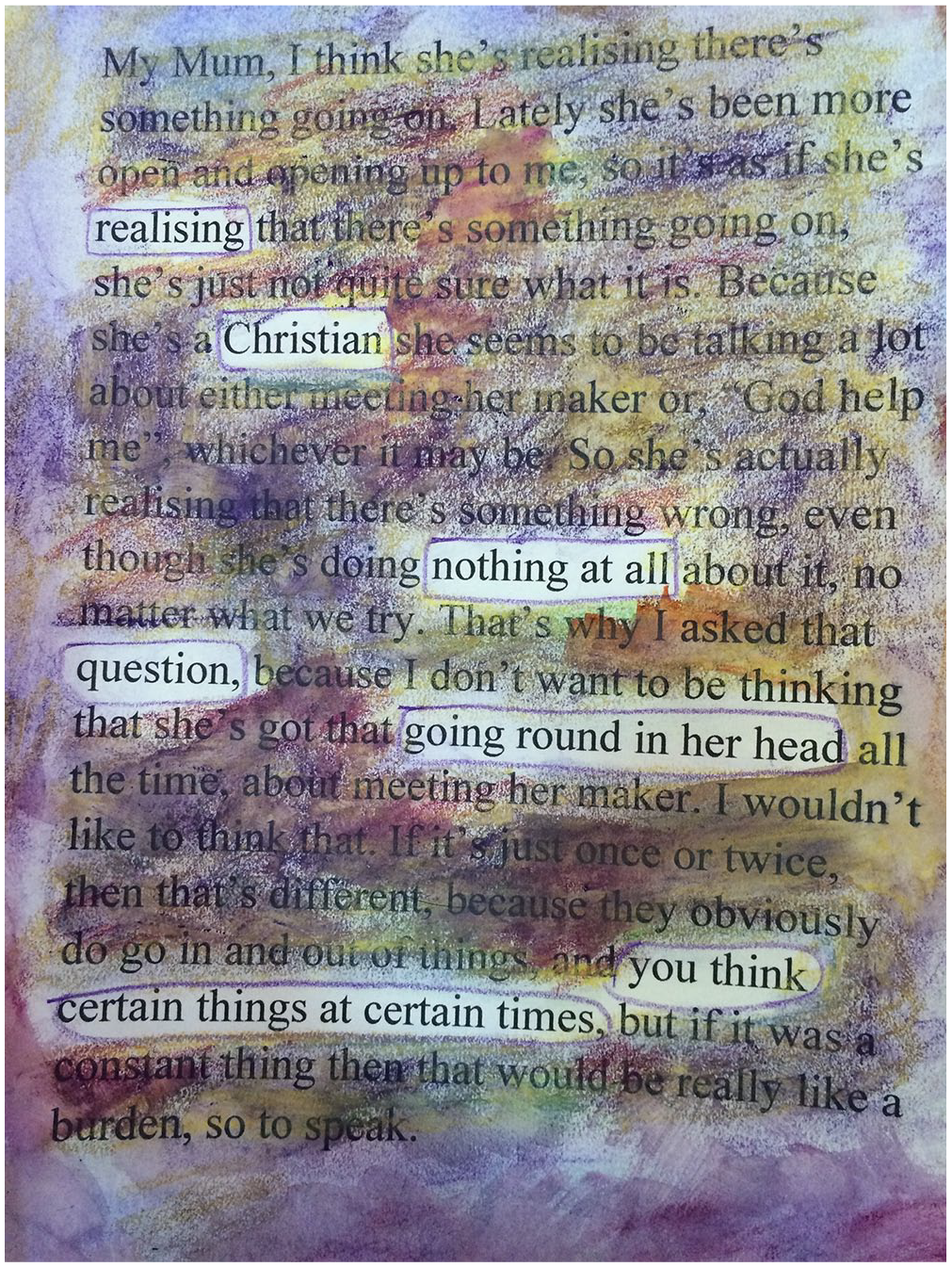
Erica’s bruise humument.
She pulled together a selection of pastels in what seemed a quite beautiful palette of plum, blue, orange and lemon. But this contrasted immediately with the ferocity of her sketching. Erica physically worked the page close to tearing, her body bowing over and her arm determinedly driving the pastels across the page. She then scribbled with extra force in sections, cross-hatching or zigzagging bold patches of animated, deep or bright colours. Her hands and arms zipping across the paper; her wrists turning and spinning, arching and stretching to produce the effects of movement that leap out from this picture. The key phrases she highlighted, ‘going round in her head’, ‘you think certain things at certain times’, led me, as I silently watched her work, to expect a theme about thinking, belief and memory, that would extend what the text already covered. However, her bodily movement sat uncomfortably with this and I began to feel that something else was in creation. As she explained her choice of colours it became clear that the physical process in which she had been engaged, and the selection of pigments, their layering, depth and movement spoke more than did the words she had circled. Erica had chosen instead to bring the flesh back into the text by the use of colours that she daily encountered in the bruises on her mother’s arms and legs, from falls, from struggles and from ageing. The startlingly physical way in which she had applied the layer of pigment reflected her feelings of sadness and anger at the way her mother’s body had changed, allowing her to emphasise the pain and rage of loss that was being archived daily in her mother’s skin, and to weave into the transcript’s page of issues pertaining to thought and mind, the physicality of dementia and older age. The emphasis on thinking in the text was contrasted with Erica’s analysis, for it highlighted the invisibility of the body in the talk by bringing it back in, figuratively in the choice of palette and style, and literally, in the physical work of painting.
Erica’s page shows the layering on of meanings once again, through layers of paint and pastels in the end result of the process. But in generating this work, Erica also found a way to paint as a form of analysis. The palette she selected, her physical interaction with the page, and the style of the piece with its cross-hatchings, zigzags, bleeding of colours and shapes, produce an effect in the moment of its production, too. It is analytical; it is generative. Her physical movements in combination with the styles of expression on the page become a moment of embodied reading of the text she is painting upon. It shows up what is missing in the page: the body, the sensory, the life of dementia and care, the effort and exhaustion, the emotion, the feeling of living. It is what Mason (2018) terms a kinaesthetic sensory experience, a potent connection, between Erica, the page, the paint, me and the author of the talk in the transcript. The painting with data method is not simply important because of the paint on the data, therefore, but because of the painting, the actual material style of analysis which the method makes possible. Painting, being a particular kind of embodied practice, lent movement, space, strength, feeling and form not simply to the data production process, but to the interpretative, analytical process of working with transcripts.
Layering voices – Collage as an aesthetic of living
Layering in these two ways were a powerful discovery in my early encounters with people in painting with data. But I realised there might also be reason to have methodological concerns regarding this layering process, for it does seem to change the way the texts are interpreted, to add voices that were not necessarily present in the original interview situation. Implicit in much qualitative analysis of transcribed talk is a kind of desire for authenticity – to be true to the participant’s account. This issue of authenticity and its relation to the multiple voices we find in transcripts is an issue I now want to explore by coming back to the source of inspiration for this technique, Thomas Phillips’s collection of humuments. To do so, it is worth briefly reporting and reflecting on the text that acted as the origin of Phillips’s own reworkings, namely a late nineteenth century novel by W. H. Mallock (1892) titled A Human Document, over the pages of which Phillips produced his drawings and paintings.
Mallock opens his Victorian era novel by relating a conversation with a countess in a European country house, who has invited him to peruse a collection of manuscripts she possessed, which – she tells him – contain documents written by a beautiful woman, now deceased. The countess, who refuses to give up the name of the author of the manuscripts, muses that the collection might intrigue Mallock, since he has previously expressed some interest in the biographical form, but which would, she warns, require him to pore and puzzle over it at length in order to make sense of its mysterious qualities. The countess explains that the manuscripts represent an apparently imaginary continuation of the then famous and widely read diaries of Marie Bashkirtseff (an historical figure), Russian diarist, painter and sculptor, who had died around a decade earlier aged 25.
However, upon opening the collection of documents, Mallock is surprised to find not merely a set of materials akin to a diary, in – as he puts it – ‘a woman’s handwriting’, but also an assortment of seemingly authentic letters with postmarks, scraps of poetry and various other snippets of text, interleaved with the diary entries, in the ‘handwriting of a man’. These, says Mallock, were not simply imaginations of the mysterious author, but were in fact startling ‘fragments of an actual life’ (Mallock, 1892). The novel, then, opens with an immediate query regarding the method through which documents come to report upon a single individual’s biography.
In 1966, then young artist Thomas Phillips set out to a second-hand bookstore in London to find a book that he would spend the rest of his life working on as an art project. He stumbled across Mallock’s novel and became fascinated by the text. Over the coming years, he would collage each page, layering paint and pen to create images that allowed some of the original text to show through, but which concealed the majority of the story, thereby editing and reworking the meaning of Mallock’s work to produce a new novel from what could be read and what was depicted. Over 50 years, Phillips gradually recreated the entire novel to create his work, the Humument (Phillips, 2016), leaving readers with a text that has at least five authors 1 and thereby speaking to the question of multiple authorship. Indeed, this is a key analytical point made in the literary and artistic works that are woven together here: that life itself is multi-authored, that voices overlap, tangle and become a kind of chorus of experience, sometimes harmonised, sometimes discordant. This way of seeing life is one that I find inspiring, and which can readily be brought out in the analytical process through the method and set of concepts I propose in this article.
Indeed, having already begun to paint with data, with people caring for someone with dementia, I found this story resonated powerfully with the intellectual issues with which I was grappling. I felt like Phillips himself might have felt when coming across Mallock’s novel: a sense of serendipity and excitement. For interviewing techniques always produce texts of co-authorship, between the interviewer and interviewee, but in my interviews with carers I found this issue had been brought right to the fore of our interactions. Carers often spent much of the discussion reporting upon the stories, life, thoughts and feelings of the person for whom they cared, whether they were present in the interview situation or not. This was made more complicated by the fact that most carers reported communication difficulties in their relationships with people with dementia (and vice versa), meaning these stories were often narrated as part of broader accounts which questioned the possibility of telling authentic stories in the first place. Relatedly, carers often feel as though the person they knew previously has undergone some kind of transformation in identity as a result of the effects of dementia, leading them to call their most intimate of relations ‘strangers’ or saying they have ‘become someone else’. Carers are often engaged in a number of day-to-day efforts to try to maintain what they understand to be the identity, personality and proclivities of the person they care for, a person who might actually openly resist those efforts. My encounters with carers, therefore, often troubled ideas of authorship, of narratives of self and other, and were rife with questions regarding authenticity and the hermeneutical difficulties of interpretation. Whose stories were these fragments of life which I was encountering in my interviews?
Multi-authorship and the troubles of interpretation can be seen in the images presented already. Sandra’s ‘f’s humument and Mark’s brainbow can both be seen as multi-authored pages (or texts, if you prefer), for Sandra explicitly worked her voice and the voice of her father into a text from another participant (whose account was already a mixture of her own voice and the voice of her partner, with me as the interviewer tangled in there, too). Mark’s text is his own, but he transforms it as Mark-now, looking back on Mark-past, adding his present voice to his past talk. A further example, in Figure 6, shows up the importance of the connection between this aesthetic mode of data production and analysis with respect to the intertextual dimension of living.
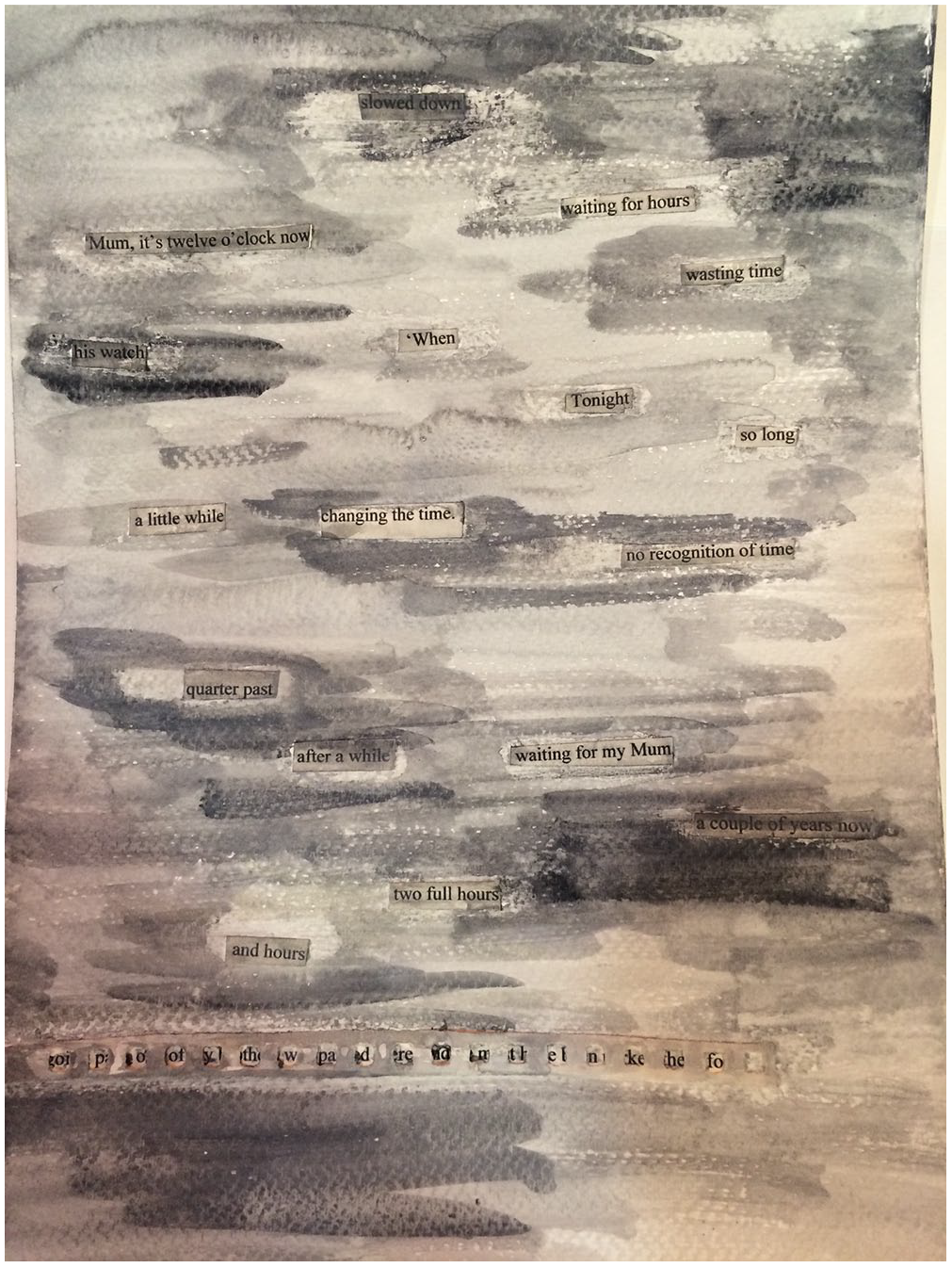
A participant’s inversion of the humument method.
The participant, working with someone else’s data, has inverted the humument method, drawing on the practice of collaging, to bring cut out snippets of text from the interview transcript, to a fresh page. She has then added a wash of grey paint, concentrated in areas but thinly layered at others, and has finished the page off with the addition of a strip of paper with holes cut into it, which are just visible at the bottom. The strip obscures some letters of the transcript entirely, cuts some in half, and highlights others. Together, these treatments create an entirely new account, piecing together fragments, but which nonetheless took inspiration from, and drew its words and letters out of, the original transcript. The grey paint symbolised to the participant a ‘grey fog’ between carers and the people they care for; the erasures and cuttings were the struggle to make sense of each other, the person with dementia having to find ways to communicate when the flow of language changed and the carer having to discern what they could from these efforts. Here, the process of rearranging the text, producing sentences newly created, partially revealed or entirely obscured by paint, paper and cutting brought out a dimension of talk that is often marginalised when we look solely at one participant’s quoted extracts. As with Mallock’s novel, the painting with data method shows how voices emerge, merge and submerge in intertextual play. Communication in the context of dementia care meant piecing things together, selecting, filtering, rearranging and re-presenting. In effect, I realised carers’ everyday lives now involved new aesthetic practices of interpretation, something which I would not have understood quite so powerfully without this participant’s stimulating analysis of the transcript which she reworked, through this particular material method. In this regard, methods of painting with data are perhaps especially powerful for bringing out the everyday ways in which life is already multi-authored, of the cacophony and harmony of the everyday, which is to say, of the aesthetic elements of life itself.
Alternative aesthetics of qualitative research
In a well-known and excellent guide to qualitative research, Richards (2005, p. 86) explains the process of coding data by use of a metaphor: . . . coding is more like the filing techniques by which we sort everyday information and ensure access to everything about a topic. Recipe clippings are most usefully gathered by food type. Go to ‘cakes’ and then ‘chocolate cakes’ and all the recipes will be there to review. . . . Qualitative researchers code in order to get past the data record, to a category, and to work with all the data segments about the category. Coding aggregates them, so you can then work with them. Together, gaining a new cut on the data.
Embedded in this description, which rings true with the style of data analysis that is commonly found in qualitative work, is an aesthetic practice which highlights extraction, order and thematisation. Its corollary in the visual register is the organisation of text into chunks. Perhaps covered in highlighter pens or bands of colour in a software package, but at its core, life is rendered in black and white.
In contrast, as Eisner (1981, p. 6) argues, an artistic approach to knowledge work is possible, one that seeks ‘not the creation of a code that abides to publicly codified rules, but the creation of an evocative form whose meaning is embodied in the shape of what is expressed’. This resonates closely with an ontological approach to life as poetic, magical, atmospheric and ineffable, recently expressed in detail by Mason (2018), whose work helps us to understand what it is that we might be trying to evoke through our sociological forms. At the heart of Mason’s (2018, p. 188) approach is a concern with affinities, connections which have potency, that ‘seem other-worldly and boundless yet we know, glimpse and touch them through the parochial aperture of our personal lives’. To know such connections sociologically, Mason (2018, p. 200) advises that ‘where conventional sociology has wanted to split and categorise human activity, individuals, groups and society into variables, typologies, structures, systems, processes, discourses, practices, or whatever, an affinities approach seeks out and explores connections, entanglements, energies, forces and flows involved in living in the world’. Eisner’s ‘evocative forms’ and Mason’s ‘potent connections’ offer a framework for understanding why it is that alternative aesthetics of qualitative analysis are so needed, for our existing, predominant aesthetic forecloses many possible sparks of connection, flows between participants, sensations and the frisson of the spiritual and ineffable.
What I discovered as my participants painted with data were kinaesthetic, sensory, affective processes for textual data analysis which offered alternative interpretative and stylistic priorities. Splashes, sploshes and sketches forewent a concern with unpacking and grouping in favour of layering. I have treated layering as the heart of an alternative aesthetic for guiding our work with text, one which prioritises (1) addition above extraction; (2) juxtaposition over thematisation; and (3) collaging rather than ordering. These three concepts help us to understand how to see life rendered through this aesthetic mode. In helping to show up other parts of life, in different ways, and by involving participants in analysis itself, this method and its conceptualisation also relate to the broader aesthetic concern in sociology. With how political, economic and ethical possibilities are bound up with the shapes, forms and moulds that make us, our relations and our worlds. Curiously, this concern has rarely been integrated into how we analyse the data that we make about the world. Only relatively recently has explicit effort been brought to bear on the aesthetic within the methodological, and I contribute to those efforts here by demonstration and conceptualisation of an alternative aesthetic mode for data production and analysis.
The painting with data aesthetic offers an evocative form and a conceptual schema through which to interpret it, providing a route to novel insights, that enlivens the interpretative work of the analyst by offering opportunities to make and witness potent connections. It is surely not the only such means to producing such insights, but in its specificity it points to a broader, tantalising possibility for the social sciences, that there might be any number of alternative aesthetics that we might adopt, adapt, generate and experiment with, to direct our interpretative, analytical work.
The humument, with its history of multi-voicing, intertextual play and mixed media composition, opened up and expanded possibilities of analysing and reworking data I had collected, allowing layers of life to be woven into the interpretation and analysis process: the spiritual, beautiful, affective and physical all found representation within the pages participants produced and in their kinaesthetic engagement in the painting process itself. These phenomena are, I note, all things which – in one way or another – are often difficult to express in talk, suggesting that the specific form of intertextual, embodied analysis made possible when painting with data is especially amenable to folding in and bringing out these ineffable elements of life. To adopt Eisner’s (1981, p. 6) words, the painting with data process is an evocative form ‘whose meaning is embodied in the shape of what is expressed’. Why should we expect black and white text, and the associated textual process of separation, thematisation, extraction and so forth, to be an adequate form through which to understand and express the so many varied sensations and emanations of living? To deploy an alternative aesthetic of data analysis means more than using a creative method and having non-textual forms of data, it means to read through a different style of looking, to have different experiences of the texts. The approach I recommend here is inspired by just one particular form from the world of art and literature, but there are a great many styles and forms in the world which we might draw upon to learn how to analyse in new ways. Moving beyond the use of objects, music, dance and photography as data, all important creative methods in themselves, we can now ask what might it look like, what might analysing be like, if we seek to ‘music with data’, to ‘dance with data’? Painting with data exemplifies a latent and powerful potential within our existing methods for radically transforming how we work with our materials by generating alternative aesthetics for qualitative analysis.
Footnotes
Acknowledgements
I am indebted on multiple fronts in the production of this article. First of all, to the Simon Endowment at the University of Manchester, for the generous funding of my Simon Fellowship which allowed me to conduct this work. Thank you to all the Morgan Centre sketchers for their collegiality and playfulness, especially to Lynne Chapman for sticking with us when our fears kicked in, and for introducing me to the idea of humuments in Phillips’s work. Thank you to the carers whose imagination made this article possible. Emphatic thanks are due to Jennifer Mason, for thoughtful and generous comments on a draft of this article. And thank you to David Morgan, for everything. We miss you already.
Funding
Project was funded by the Simon Fellowship endowment at the University of Manchester.