




Abstract
This article analyses the relationship between the accommodation of Dispersed asylum seekers and urban gentrification in the UK. We argue that alongside other racialised and classed minorities, asylum seekers are vulnerable to spatial strategies associated with gentrification such as neighbourhood ‘dumping’, containment and ‘territorial stigmatisation’, the highly coercive quality of the UK government’s Dispersal Scheme means that any relationship between asylum and gentrification must be treated as deliberate, the result of the multiscalar interests which have a stake both in Dispersal and urban ‘development’. Drawing on empirical research conducted in Glasgow, the recipient of the largest asylum seeking population annually in the UK, we find that asylum accommodation processes and gentrification have developed a symbiotic dynamic, whereby the ‘failure’ of mid twentieth-century urban ‘regeneration’ provided means and motive for Dispersal, and Dispersal provided sufficient resources to fuel further rounds of urban ‘regeneration’. We also find that recent changes to the Dispersal contract, from a dynamic in which resources were associated with housing availability, to one in which they are associated with maximum housing capacity, have created conditions for alternative forms of gentrification, in which strategies such as rent gap suppression are seen as having potential to yield more capital than infrastructural development. Finally, we argue that the respective spatial politics of both Dispersal and gentrification must be understood as mutually-interested, coercive technologies, which work together to contain and exploit racialised and bordered urban minorities. We call for urgent further research into how the asylum border is embedded in contemporary urban spatial economies.
Introduction
This article critically studies the relationship between urban gentrification and the processes through which asylum seekers are accommodated by the UK government. As racialised and classed minorities (Kone et al., 2019), asylum seekers are vulnerable to the spatial inequalities of gentrification, including ‘dumping’, ‘containment’ and ‘stigmatisation’ (see Phipps & Kay, 2014). In the UK, asylum seekers are also the subjects of ‘Dispersal’, a UK government-led scheme which forcibly ‘displaces’ already ‘displaced’ migrants to locations around the UK (Darling, 2016a) by offering housing on a no-choice basis and preventing alternative recourse to housing through social welfare routes (Meer et al., 2019a; Meer et al., forthcoming). In addition, asylum seekers are subject to the UK government’s ‘hostile environment’, a policy which has internalised border control activities by making educators, housing providers and employers responsible for border compliance (Meer et al., 2019a, 2019b, 2020a, 2020b). Cumulatively therefore, asylum seekers are not only vulnerable to ongoing urban spatial inequalities, but also subject to a highly coercive border regime which allows them no choice over their own accommodation, and also to an environment in which local actors are empowered to enforce immigration measures through housing control.
‘Gentrification’ is often described as advancing a classed (see Atkinson & Bridge, 2005; Gray & Mooney, 2011; Smith, 1996) and racialised ‘frontier’ (Jackson, 2017) upon neighbourhoods occupied by minority and marginalised populations: a politicised and coercive process (Slater, 2017; Smith, 2002), which, by manipulating the spatial economy of contemporary cities, seeks to ‘refashion’ urban residency towards consumer citizenship (Paton et al., 2017). Achieved by deploying diverse spatial strategies, including the leveraging of property and rent values (Smith, 1979, 1987, 2002), gentrifying processes are likely to disenfranchise classed, racialised and bordered marginalised residents of social and economic capital (see for instance, DeVerteuil, 2018; Lees, 2018; Smith, 1979). As Smith (1979) and Slater (2017) have noted, a definitive trait of gentrification is that it produces a system through which contemporary urban spatial economies are not produced by the choices, capital or mobility of the people who inhabit them, but by planners, developers and businesses with sufficient capital to mobilise the ‘rent gap’ in their own favour.
There is, therefore, clear potential for the coercive economies of gentrification and Dispersal to coincide, collide or collaborate. The questions that this article seeks to answer are, simply, to what extent does this occur? And what are their consequences? Put another way, how might the colonialist metaphor of gentrification as ‘the frontier’ be put to better use to understand what happens when ‘the frontier’ – and in this case, the asylum border – comes to gentrification? We situate our enquiry in Glasgow, a city with an established history of distinctive and destructive ‘regeneration’ policies (McIntyre & McKee, 2008; Paton, 2009), and with a more recent precedent for accommodating Dispersed asylum seekers.
Methods
This article is informed by empirical research conducted in Scotland in 2018 as part of the GLIMER (Governance and Local Integration of Migrants and Europe’s Refugees) Project – a funded project which studies the multiscalar governance dynamics relating to the ‘integration’ of asylum seekers and refugees across four European sites (in Scotland, Sweden, Italy and Cyprus) (see www.glimer.eu). The empirical data that inform this article come from a package of work specifically focused on accommodation, ‘regeneration’ and exclusion in local sites. Over 12 months, we conducted qualitative research with stakeholders at national (UK), devolved (Scottish) and local (Glasgow) level from the public and third sectors in Scotland with specialisms in accommodation and displaced migration. This included local government stakeholders with experience both of the Dispersal Scheme and of City Council ‘regeneration’ policies, and of devolved government stakeholders working on the New Scots policy (Scottish Government, 2018) and housing policy. It also included local third sector stakeholders involved in (a) accommodation advocacy for asylum seekers and refugees, (b) asylum accommodation policy development in Scotland and (c) the provision of emergency accommodation for displaced migrants. Stakeholders were initially identified through preliminary research into displaced migrant accommodation in Scotland, and subsequently through snowballing.
We endeavoured to work with a representative cross-section of the asylum accommodation/social housing sector in Scotland, with 16 third sector participants, 8 from local government and associated non-governmental bodies and 5 from devolved government. As the research was interested specifically in the effects of accommodation governance on asylum seekers and refugees, we also actively sought input from organisations led by people with displaced backgrounds. Five of these organisations are included in the total sample of third sector participants.
Our empirical research primarily took the form of audio-recorded, semi-structured interviews with representatives from each organisation, resulting in a total of 29 interviews (see Table 1). Interviews and field notes were subsequently transcribed, anonymised and inductively coded with NVivo to bring out dominant and emerging themes. We have taken care to remove any identifying details and maintain the anonymity of participants in the following analysis. In the next section we review existing scholarship on gentrification, the rent gap and displaced migration, before turning to our case in Glasgow.
Stakeholder types and interview totals.
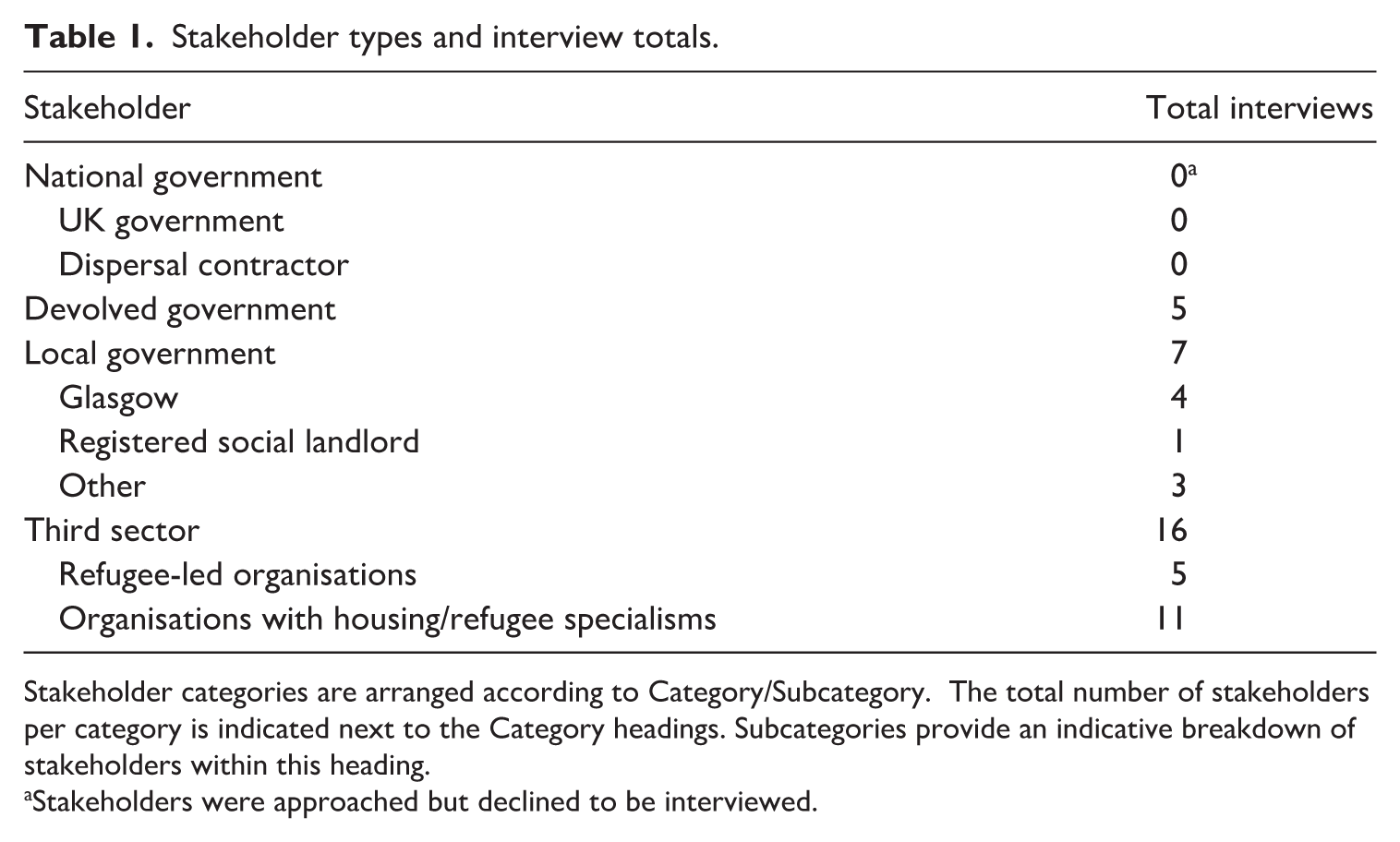
Stakeholder categories are arranged according to Category/Subcategory. The total number of stakeholders per category is indicated next to the Category headings. Subcategories provide an indicative breakdown of stakeholders within this heading.
Stakeholders were approached but declined to be interviewed.
Connecting the rent gap and asylum in the Global North
Used to refer to the planned ‘revitalisation’ of urban areas, the term ‘regeneration’ often masks the spatialised, social and economic inequalities enacted upon the very neighbourhoods targeted for ‘renewal’ (Slater, 2017). These inequalities, as Neil Smith (2002, pp. 445–446) has long argued, are underpinned by processes more comprehensively encompassed by the term ‘gentrification’, which swerves ‘anaesthetised’ analyses of urban development in favour of scholarship that tracks the stratified ‘cause and effect’ of ‘regenerative’ projects on social and economic relations. ‘Gentrification’ is far from a universal urban reality, and is mobilised for a variety of purposes in different forms in diverse global contexts (Lees et al., 2015); however, it is possible to identify some common traits across these environments. Gentrifying processes are likely to target minority and marginalised populations, and the areas in which they live. One of the ways in which this occurs is through the creation of ‘stigma’ that attaches to both people and place and associates them with a moral and ‘territorial’ ‘taint’ (Wacquant, 2008) that assigns responsibility for neighbourhood neglect and decline to local residents rather than policymakers and developers (Paton et al., 2017). The stigmatisation of people and place is often the factor on which gentrification pivots, either creating the means and ‘justification’ for proposed gentrification, or, by sustaining a neighbourhood reputation of being ‘too deprived’ to regenerate, suppressing the potential for development (Slater, 2017, p. 93). For both of these eventualities, ‘territorial stigmatisation’ does not act in the interests of the people resident in areas earmarked for renewal. Instead, gentrification projects tend to be designed to ‘renew’ through removal, a process in which residents are evicted or ‘displaced’ to other parts of the city to allow development to occur, and residents are subsequently priced out of the area once development is complete (Smith, 2002). The central thread amongst these processes is the use of the city’s spatial economy to enact uneven and discriminatory urban transformation, in order to ‘recreate space for the more affluent user’, and ‘refashion social relations’ in favour of consumer citizenship and capital (Paton et al., 2017, pp. 579–580).
One of the mechanisms key to the maintenance of gentrification is the combination of spatial, social and economic conditions defined as the ‘rent gap’. Rent Gap Theory (Smith, 1979, 1987, 2002) draws on theories of capital to show how gentrification occurs in areas where the potential use value of land and property outstrips the current use value. Scholarship on the rent gap has demonstrated that this most frequently occurs in areas of multiple deprivation where there is a gap between current and potential use values. To have gentrification potential, this gap must be sufficiently wide to accommodate outlays low enough to complete ‘renovation’ of existing property – or in some cases, the full-scale demolition of existing accommodation – so that the developers’ costs might (at least) be recouped, or (more likely) lay the foundations for profit from the now-realised (potential) use value of the unit (see Slater, 2017). The manipulation of the rent gap in this way, and the resulting difference between previous and realised rent values, means that previous residents are unlikely to be able to afford to live in the newly ‘regenerated’ area, resulting in permanent displacement. Far from resolving conditions of neglect or decline, the mobilisation of the rent gap relies upon the low social and economic capital of (ex)residents to (a) enable conditions for development and (b) severely limit the capacity of (ex)residents to oppose or halt development. It is because of these conditions that the dynamics of gentrified urban space must be understood as something led by the interests and activities of planners, developers and speculators rather than by the choices of urban citizens (Harvey, 2009; Slater, 2017, p. 88; Smith, 1979). Increasingly, these interests are characterised by collaboration between the public sector and private multinationals, rendering ‘local’ development the result of multiscalar negotiations in which the needs of ‘local’ residents are secondary to national and international power relations and consumer capital (Smith, 2002).
Whilst rent gap scholarship necessarily makes visible the class logics of urban gentrification, the role of race has been treated as somewhat secondary to class (Jackson, 2017; Lees, 2016, p. 208). This is a significant oversight, not only because ‘the intersection of class and race determines how the benefits and losses of gentrification are distributed’ (Lees, 2016, p. 213), but also because, as Danewid (2020, p. 291) notes, ‘the racialised nature of global cities exceed[s] the existence of discriminatory employers, lenders and landlords; indeed, rather than neutral playing fields where non-white individuals experience occasional forms of discrimination, global cities are themselves a mechanism through which capital produces raced space’. In the Global North, Jackson (2017 p. 52) observes, though ‘gentrification is often seen as engendering spaces of difference, it ultimately depends on bourgeois whiteness as a normative base for property valuation’. In the UK, for instance, the ‘pathologisation’ of race in urban areas has slowly developed into an opportunity for ‘commodified-capitalisation’, in which the presence of racialised minorities is transformed into an enabler of gentrification, lending credence to neighbourhood claims of ‘cosmopolitanism’ and ‘diversity’ (Lees, 2016, pp. 209–210). Of course, this progression has not halted racial discrimination, nor has it worked in the interests of racialised minorities; rather, it has simply repackaged existing spatial strategies for regulating race as something eligible for consumption by white, middle class populations. In the last decade, these spatial strategies have arguably shifted again – away from the commodification of diversity through gentrification, and towards revanchist and securitised approaches to urban citizenship which co-opt urban actors and infrastructure into ‘controlling and regulating’ minority populations for the state (Danewid, 2020).
Displaced migrants (asylum seekers and refugees) are not only singularly vulnerable to the multiform inequalities of gentrification, but also to its intersections. On account of their immigration status, displaced migrants – and particularly asylum seekers – are also likely to encounter difficulties and barriers to accommodation not experienced by other racialised and classed minorities. Since 1999, the UK government has designated asylum seekers as having ‘no recourse to public funds’ (NRPF) – a status which effectively removes asylum seekers from the UK’s social security system, prevents them from accessing housing, employability and disability welfare support, and (apart from in exceptional circumstances) prevents them from accessing the labour market (Bloch & Schuster, 2002; Meer et al., 2020a). Asylum seekers instead have access to a means-tested ‘shadow’ system of accommodation and subsistence (Hynes, 2011), which supports what is known as the ‘Dispersal Scheme’. Initially designed as a policy to remove the ‘burden’ of asylum seekers from Southeast England (Schuster, 2005, pp. 615–617), Dispersal offers asylum seekers accommodation in locations across the UK on a ‘no-choice’ basis. Once housing has been allocated, asylum seekers are obliged to travel to their prescribed location, and are unable to choose to move without forfeiting their accommodation (Darling, 2016a). Should they wish to leave Dispersal accommodation, their status as NRPF means they are unable to access social housing or any form of social security support. These controls on housing – an extension of border control to everyday life (El-Enany, 2020) – are both restrictive and coercive. They also make asylum seekers additionally vulnerable to gentrifying processes, as they are captive tenants, with no recourse to resist evictions, maltreatment or further ‘displacements’ by either Dispersal landlords or prospective gentrifiers.
Despite this, migration both displaced and otherwise, has remained on the periphery of existing gentrification and rent gap scholarship. Lees (2016) indicates that a rise in immigration to the UK from the 2000s onwards places migration in the crosshairs of gentrification scholarship. However, in the little existing scholarship on migration and gentrification in the UK, migrants are treated either as villains – as in Atkinson and Bridge’s (2005) claim that increased elite immigration is likely to increase competition for urban space, or fuel gentrification with an injection of international capital – or, alongside long-term residents, as victims of ongoing displacements (Phipps & Kay, 2014). Scholarship on migration outside the UK follows a similar trend. Gina Perez finds that Puerto Rican migrants to Chicago are likely to be caught in racialised displacements as barrio neighbourhoods are transformed into ‘trendy enclaves’ (Pérez, 2004, p. 140). Also in the US, DeVerteuil et al. (2019) trace the trajectory of Korean residents in Los Angeles as ‘immigrant gentrifiers’, who bring the global nature of international migration into sharp contact with the ‘parochialism’ of diasporic community development. DeVerteuil (2018) offers a five-part taxonomy of migration and gentrification. This model offers insight into how mobile migrant populations are able to negotiate the local frictions caused by gentrification; however, it does not offer insight into what happens when immobile migrant populations, such as asylum seekers, come into contact with gentrifying interests. More broadly, treating migrants as either villains or victims of gentrification limits scope for analysis as it fails to account for how displaced migration and gentrification co-habit, collide and collaborate in the spatial economies of contemporary cities in the Global North.
From ‘regeneration’ to gentrification in Glasgow
Occupying the middle ranges of the hierarchy of ‘advanced capitalist cities’ (Smith, 2002, p. 439), the precedent in Glasgow for gentrification arises not from the middle class ‘renovation’ activities observed by Ruth Glass in 1960s London, but from its (post) industrial environment (see Lees, 2018, pp. 1–2). By the end of the 19th century, overcrowding and unsanitary conditions in inner-city areas prompted city planners to propose a solution that would set a precedent for the next century and beyond (Pacione, 1979). Throughout the 20th century, successive ‘regeneration’ programmes built on the strategy of ‘depopulation, demolition and dispersal’ (Matthews, 2013; Walsh et al., 2016) and cleared swathes of inner-city tenements and their working class residents, the latter of which were relocated to ever-more peripheral parts of the city. These residents were often housed in publicly-owned, modernist visions of social housing, predominantly in the form of high-rise accommodation and housing schemes.
Though these mid-century developments might not be considered ‘gentrification’ projects in a conventional sense – demolition and dispersal was not initially designed to (a) capitalise on the potential value of inner-city land or (b) clear inner-city, working class spaces in favour of the middle classes – they nevertheless exhibited characteristics which are related to gentrification. The developments had a distinctly classed dynamic, to which territorial and moral stigma were attached (Boyle & Rogerson, 2006). They also created a precedent which, by the end of the 20th century, facilitated processes more closely matched with the socio-economic agenda of gentrification. From the 1980s onwards, the housing infrastructure built in response to the early rounds of ‘depopulation, demolition and dispersal’ was itself in serious decline (Leclerc & Draffan, 1984). To address this, city planners returned to the strategies of their forebears, earmarking sites of mid-century high-rise or housing scheme accommodation for demolition and (re)moving its residents to sites elsewhere . This has been most fully realised in Glasgow City Council’s ‘Transformational Regeneration Areas’ (TRAs), sites with concentrations of high-rise and housing scheme accommodation, high indices of multiple deprivations (Glasgow City Council, 2018), and allocated for demolition and redevelopment. The TRA initiative is strongly influenced by prevailing ‘place-making’ policy approaches to redevelopment in Scotland, which associate neighbourhood decline with local areas rather than the broader policy landscape in which they are situated (Matthews, 2013), and which have increasingly mobilised state/city/private partnerships in order to achieve neighbourhood ‘resilience’ or renewal (Slater, 2017). What has subsequently resulted in some of the TRA sites are redevelopments with what are characterised as ‘mixed tenures’ (McIntyre & McKee, 2008), the large majority of which are available for private purchase rather than social rental. 1 Alongside infrastructural redevelopment, TRA projects therefore arguably also attempt social redevelopment: seeking to repopulate the areas with a majority of property-purchasing residents rather than social housing tenants, an agenda closely associated with neoliberal gentrifying processes (Paton et al., 2017).
Glasgow, gentrification and the asylum ‘frontier’
The use of ‘depopulation, demolition and dispersal’ strategies over previous decades establishes an evolution in how Glasgow’s spatial economy is mobilised to achieve social and economic change. However, whilst the role of class is firmly established in the evolution of the TRAs and ‘regeneration’ efforts in Glasgow more broadly (see, for example, Gray, 2016; Gray & Mooney, 2011; Paton, 2009; Taylor, 2016), the role of other systems of inequality, including race and border controls, is far less clear. This is a notable oversight, particularly in an environment where Glasgow’s spatial economy is clearly racialised and exacts coercive spatial and housing practices on Black, Asian and minority ethnic populations (Emejulu & Bassel, 2015; Hill, 2017; Netto, 2011). This also extends to asylum seekers and refugees resident in Glasgow. Stakeholders from refugee-led and third sector organisations with displacement specialisms not only reported that clients experienced racist abuse which targeted their accommodation, but also that clients were prevented from moving to a safer location by Dispersal accommodation providers. A third sector stakeholder recalled: In some of the flats, we’ve had [reports of] some racial harassment, from some ae the locals there. And some a’ [our clients] asked to be moved. And we’ve had problems wi’ that because they said you [have to] get a police report. . . . So if somebody just complains they’re not gonna move [the clients]. It has to be a certain amount of incidents. I mean, one a’ the clients got moved once a window was smashed. But it took that much, to get [them] moved, you know. So [the housing contractors] . . . blame it on the Home Office. They say, we cannae blame [them], we cannae move you without the Home Office’s permission. (Third Sector Stakeholder, Interview 1, 2018)
A closer look at the combined effects of a racialised spatial economy and border controls reveals a strong correlation between (a) having asylum seeking status, (b) living in an area that scores highly on the Scottish Index of Multiple Deprivation (SIMD) and (c) living in an area that is also the current or historic subject of ‘regeneration’ processes. This is evident in Table 2, which we have compiled by cross-referencing data from a published FOI (Freedom of Information) response by the Home Office (UK Government, 2016), with the corresponding SIMD dataset (Scottish Government, 2016), and literature referring to ‘regeneration’ activities in Glasgow (Glasgow City Council, 2018; Leclerc & Draffan, 1984; Paton et al., 2012). The cross-referenced data illustrate that just over half of the sites in which asylum seekers are most populous are at least within the 20% most deprived areas in Scotland, and are also TRA sites. It also illustrates that of those areas which are not TRA sites, three are subject to the ongoing ‘regenerative’ legacy of the 2014 Commonwealth Games. Only three of the 13 sites in which asylum seekers are accommodated are not subject to current ‘regeneration’, though Easterhouse retains the legacy of the Glasgow Eastern Area Renewal (GEAR) Project (Lerclec & Draffan, 1984). Many of the sites listed in Table 2 are also those which are connected to past and present cycles of ‘depopulation, demolition and dispersal’, and take in sites of failed mid-century regeneration (including Sighthill and Red Road in Glasgow North East, Whitevale in Glasgow East and the Gorbals in Glasgow South). Also included are sites in which asylum seekers have been accommodated since the beginning of the Dispersal Scheme (Sighthill, Maryhill, Springburn and Govan), and sites which have been more recently utilised as Dispersal areas (Tollcross, Carntyne, Easterhouse and Parkhead).
Asylum population in Glasgow by area, index of multiple deprivation and regeneration initiative.
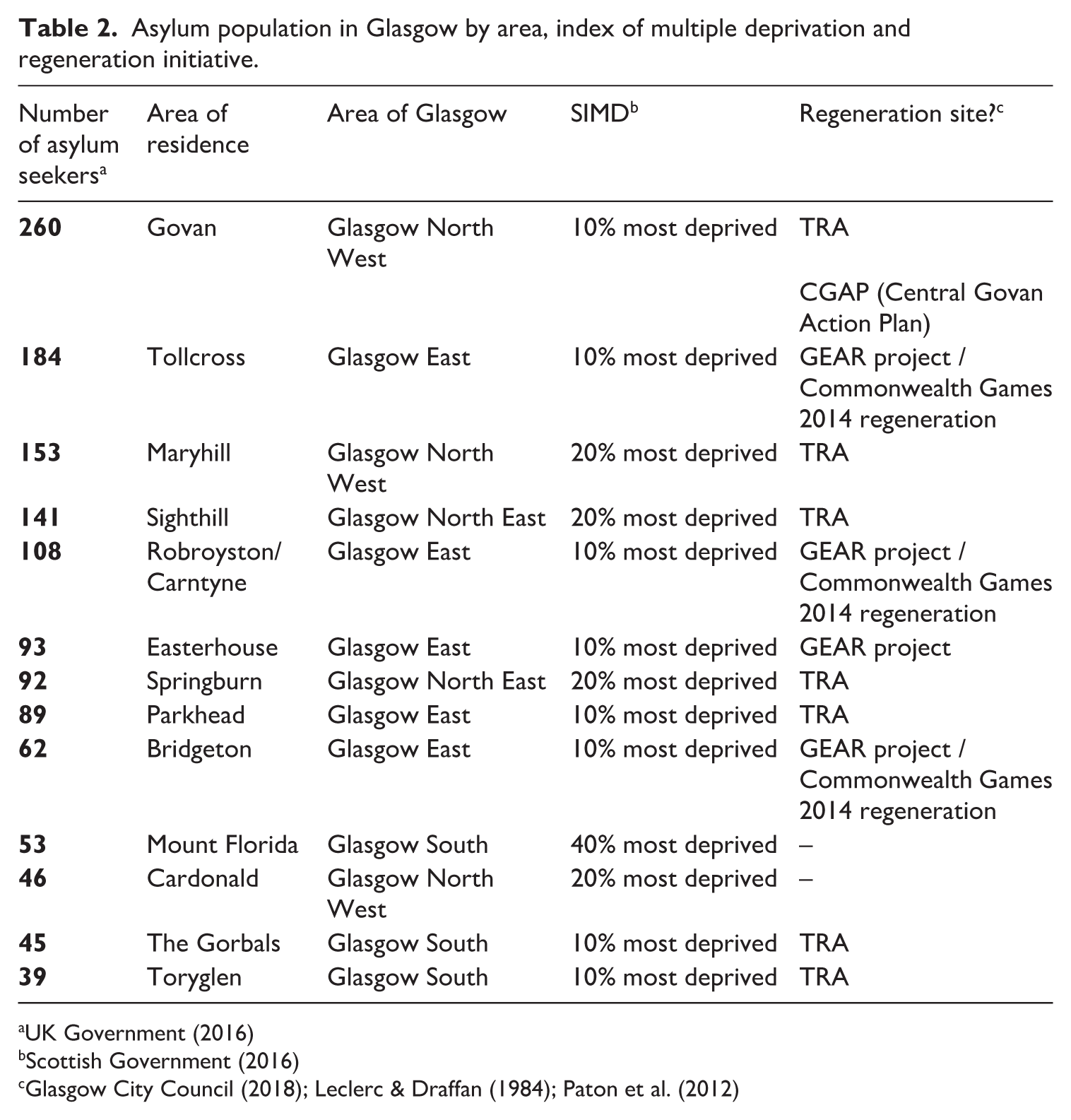
UK Government (2016)bScottish Government (2016)cGlasgow City Council (2018); Leclerc & Draffan (1984); Paton et al. (2012)
Table 2 therefore illustrates a series of phenomena. It confirms in very broad terms a relationship between areas which score highly on the SIMD and the likelihood of past or ongoing ‘regeneration’ projects. The majority of these projects have a distinctively Glaswegian take on gentrification, with an agenda of transforming social housing or working class areas into sites with consumer potential (McIntyre & McKee, 2008). The presence of asylum seekers in these areas confirms a trend observed globally that diverse minority or marginalised populations are often ‘dumped’ together in sites of ‘decline’, and that the urban infrastructure of these sites is used to control and contain their mobility (Cheshire & Zappia, 2016).
However, answering the question – why is there a trend in asylum seekers living in TRA or regenerative sites? – with the answer, ‘because they are “dumped” there’, mistakes the explanans for the explanandum. An alternative response to the question might be ‘because asylum seekers have no other option’ – and this orientates our enquiry towards the political, governance and policy conditions that have resulted in the relationship between gentrification and asylum in Glasgow. Dispersal is a coercive and regulatory policy that gives asylum seekers no autonomy over the location or conditions in which they live. This is instead a decision which is made first by the Home Office, which oversees the Dispersal policy, and then by the local agents contracted by the UK government to provide asylum seeker accommodation, who themselves make their decisions in response to the local spatial economy (Meer et al., 2019a). The relationship between gentrification sites and asylum seeking populations is therefore not the result of an ad hoc decision by housing providers, but the result of the multiscalar interests of the state, national and local agents who have a stake in the Dispersal Scheme. This means that there is potential for local actors, with local spatial investments, to mobilise their role in the Dispersal Scheme to influence the spatial economy. Consequently, there is potential for a highly deliberate relationship between Dispersal and gentrification to emerge, one which questions the sequence of causality between gentrification and asylum seeker accommodation: are asylum seekers ‘dumped’ in TRA sites because of gentrification past? Or has gentrification future occurred because of Dispersal?
Dispersal in gentrification sites/gentrification in Dispersal sites
To date, Glasgow is the only city in Scotland which participates in Dispersal. It receives up to 2000 Dispersed asylum seekers a year, which is the largest intake in the UK (McAllister, 2015, p. 244). The structure of Dispersal governance has remained the same since it started in 1999; however, its contract arrangements have altered significantly, resulting not only in a change of housing providers but also in a transition from a public to a privatised dynamic (Darling, 2016b). Dispersal began in Glasgow as a contracted agreement between the National Asylum Support Service (NASS), overseen by the Home Office, and Glasgow City Council for the latter to provide services and accommodation to Dispersed asylum seekers in the city (what we refer to as ‘Phase 1 Dispersal’). At the very beginning of the Scheme, the Council provided housing direct through its social housing services; however, following the housing stock transfers in 2003, it provided accommodation indirectly through Housing Associations, which are Registered Social Landlords (RSL) (Netto, 2011). Throughout the 2000s, the Dispersal contract gradually moved away from public housing provision, passing from the direct control of Glasgow City Council and into the administrative responsibility of RSLs and third sector organisations (Meer et al., 2019a).
The most significant change to asylum housing dynamics came in 2012, when the UK government completed a review of the Dispersal contracts. In the place of NASS, the government launched a programme known as Commercial and Operational Managers Procuring Asylum Support Services (COMPASS) (‘Phase 2 Dispersal’). The awarded contract was characterised by a series of marketised features (Darling, 2016a, 2016b), including public/private partnerships, the absence of local or devolved government, and housing provision by multinational private companies who specialised in security, or the administration of the carceral estates, including Immigration Removal Centres. COMPASS also significantly incentivised cost-saving measures, with a stated ambition of drastically reducing asylum accommodation costs by £140 million over 7 years (House of Commons, 2017). In Glasgow, multinational Serco was awarded the contract on the promise to accommodate asylum seekers at £450 per service user per month, a cost just over half of what a stakeholder estimated Glasgow City Council to have spent per user when the Council held the contract (Public Sector Stakeholder, Interview 2, 2018). To achieve this, Serco subcontracted private landlords who were able to offer lower rents than RSLs in existing Dispersal sites, and a combination of RSLs and private landlords in other, cheaper areas of Glasgow.
The evolution of the Dispersal system directly impacts who provides asylum accommodation, the relationship of the contractor with other accommodation providers in Dispersal sites, and the capacity in which they have influence in the local spatial economy. At the beginning of Dispersal, administration of both processes by the City Council resulted in a clear route through which Dispersal could be ‘integrated’ with local housing ambitions, including ‘regeneration’. Once the contract was removed from the Council, this potential was arguably lost. However, as we argue below, though changes to the Dispersal contract have altered its relationship with the local spatial economy, it has not diluted its capacity to interact with gentrifying interests.
Phase 1 Dispersal
There is certainly a case to be made that for Phase 1 of the Dispersal Scheme, the conditions created directly as a result of previous ‘regenerative’ initiatives contributed to Glasgow’s capacity and willingness to participate in the Dispersal Scheme. The decline of mid-century housing developments resulted in an environment at the turn of the millennium in which residential tenancies in some social housing blocks (such as Sighthill and Red Road) had become difficult for the Council to let. This created both the means and motive for Glasgow City Council to participate in Dispersal: the vacant housing allowed the Council to ‘avoid any impact on housing waiting lists for Glaswegian tenants’ (Crawford et al., 2012, p. 10), whilst Dispersal provided an opportunity to channel funds into housing that was causing budgetary difficulties. In addition, as a public sector stakeholder recalled, the growing population in previously abandoned housing blocks had something of a ‘regenerative’ effect on the local environment: the repopulated areas were in dire straits to be honest. And I think probably from [the Council] doing it [Dispersal] back in 2000, I kind of joke about this but it will be true . . . The money that the Council received for doing Dispersal, they were big contracts, you know . . . it was a lot of money generated into the system, if you like, and that helps with regeneration. (Public Sector Stakeholder, Interview 2, 2018)
As a high-value, sustained contract, Dispersal did not just provide Glasgow City Council with the opportunity to fill vacant accommodation; rather it offered an opportunity to turn property with surplus value into a commodity again, and earn an income on something from which they were previously making a loss. It also allowed the Council to revive housing into a ‘primary industry’ by providing additional employment opportunities for decorators, joiners and council officers. As the City Council oversaw both the administration of Dispersal and the maintenance of social housing, funding from Dispersal flowed through a closed circuit where tenancy funds were reinvested in Council property and Council workers. At this stage, though asylum accommodation was provided in an environment shaped by (failed) regeneration, and though it had driven small-scale, local regeneration, it would be inaccurate to describe these processes as ‘gentrification’ as they were not driven by a marketised, for profit, agenda.
This scenario changed as Dispersal continued, a trend made most visible following Glasgow City Council’s loss of the Dispersal contracts. Although the Council no longer had income from the Dispersal Scheme, it had managed to accumulate savings sufficient enough to support new ‘regeneration’ efforts in sites that had accommodated asylum seekers, as a public sector stakeholder also recalled: . . . all the demolition, and all the ones that are [now] getting done [like Red Road], a chunk of that money’s probably went tae reinvest on that, because they were getting rental income that they probably wouldnae have got for a large period. (Public Sector Stakeholder, Interview 2, 2018)
The ability of the Council to draw on accumulated Dispersal funds to finance future ‘regeneration’ indicates several changes to their approach to Dispersal. First, it indicates that in the process of accommodating asylum seekers, it was able to extract more funds from asylum tenancies than was needed to renovate the properties in which asylum seekers were accommodated; second, that it was able to do this on a scale that later enabled large-scale development programmes; and that third, by channelling these funds into the ‘mixed tenancies’ of TRA sites, it had abandoned a closed-circuit approach to social housing improvement, and instead was pursuing a project that would court the finances of private companies and consumer citizens. As these changes all have racialised and classed implications, this later stage development of Phase 1 Dispersal might be considered to facilitate processes that are far more closely associated with gentrification. The later stages of Phase 1 Dispersal also mark a shift in how the Council factored Dispersal into the social housing economy. If, in the early stages of the Scheme, Dispersal funds were used to transform vacant housing back into commodities, by the later stages, the commodification process had shifted focus, viewing asylum seekers as commodities, rather than the properties they inhabited, the accommodation of which attracted Dispersal resources, which could be used to accumulate wealth.
Phase 2 Dispersal
The COMPASS contract marked the end of Glasgow City Council’s involvement in the provision of Dispersal accommodation, a situation ‘strongly resisted by the local authority’ (Darling, 2016b). However, as we note above, despite the end of the NASS contract, the influence of the Dispersal Scheme on the Council’s ‘regenerative’ ambitions extended beyond its end-date. In combination with the new terms of the COMPASS contract, it also created ripple effects across Glasgow’s spatial economy, enabling new opportunity in its wake. This occurred in three parts.
1. The gentrification of former social housing sites has caused a push to the ‘peripheries’ of Glasgow, where accommodation is more readily available, and available at a lower cost.
By foregrounding demolition as a ‘regenerative’ strategy, TRA programmes created an immediate need for COMPASS providers to find asylum accommodation elsewhere. Furthermore, as a third sector stakeholder observed, once sites had been ‘regenerated’, rentals and living costs were too high for Dispersal contractors: . . . if it [regeneration] drives the cost up of accommodation, [Dispersal contractors] look for low cost accommodation in which to accommodate people. And . . . if it came to the stage where it became overly expensive to have accommodation somewhere then they may look to source it elsewhere. That’s why we have a large amount of accommodation in the East of Glasgow. It’s because it’s cheap. (Third Sector Stakeholder, Interview 2, 2018)
As the stakeholder notes, the combination of demolition strategies and the rising costs of rentals in newly regenerated sites has led to the creation of what Piacentini (2012) has called ‘secondary’ Dispersal sites, predominantly in Glasgow East, an area in which there is no precedent for asylum seeker accommodation.
2. The peripheralisation of Dispersal accommodation coincides with the marketisation of the Dispersal contract, which, because it incentivises ‘cost-saving’, further encourages the use of low-cost, low-quality accommodation in peripheral areas.
The effects of this development were mostly keenly experienced by asylum seeker residents. Stakeholders reported that asylum seeking clients in COMPASS accommodation reported poor housing maintenance, unsafe and unsanitary living conditions and social isolation (see also Bolt, 2018; Glen & Lindsay, 2014; House of Commons 2017).
3. The privatisation of the Dispersal contract and its emphasis on ‘cost-saving’ incentivises minimal property renovation and the suppression of rent values in secondary Dispersal sites.
Under the COMPASS contract, private subcontractors are empowered to mobilise funds as they see fit, including using them to improve Dispersal housing stock. However, under the cost-saving terms of the COMPASS contract, property renovation is rendered counterproductive. For instance, if a subcontractor was to make improvements to their housing stock, it would likely increase their rental value, making it an unattractive subcontracting option for COMPASS contractors looking for low-cost units. The cost-saving emphasis of COMPASS may therefore mean that subcontracted landlords may choose not to improve housing standards, as increased rentals may result in the loss of the contract with government contractors. In fact, the cost-saving incentives of the COMPASS contract may have implications beyond immediate property upkeep. If contracts and subcontracts are likely to be awarded on baseline rental costs, it is in the interests of property providers for the land and rent values of the areas in which their properties are located to remain suppressed. As property owners with decision-making powers over whether to renovate a property, it is also in the capacity of subcontractors to actively maintain suppressed value – a form of gentrification, but in the negative.
Though the terms of the Dispersal contract have changed, a relationship between Dispersal and gentrification has therefore persisted. However, because Phase 2 Dispersal disincentivised contractors and subcontractors to make improvements to or reinvest Dispersal funds in the local spatial economy, it instead gives accommodation providers a reason to have vested interests in other spatial practices associated with gentrification, particularly those that would maintain low-cost tenancies and ensure the continuation of their contracts, such as rent gap suppression and the maintenance of territorial stigma.
The transformation of Dispersal from an opportunity for redevelopment into an opportunity for what we might term ‘undevelopment’ is in no small part facilitated by the transfer of ‘commodity’ status from rental property to asylum seeker client, first previewed in the later stages of Phase 1 Dispersal. Indeed, without the protections of devolved housing standards, and with a cost-saving brief, COMPASS orientates contractors away from issues relating to housing quality or property value and towards maximising their capacity ratios. This has clear potential for housing malpractice (see Glen & Lindsay, 2014; Meer et al., 2019a). The transfer of ‘commodity’ status from property to asylum seekers arguably also provides contractors with opportunities to leverage the rent gap without necessarily having to ‘develop’ a property. In a Phase 2 environment, rent gap conditions that would otherwise be disagreeable to property development are less of a barrier to profit, because capital is less about the quality of the container, and far more about the number of ‘units’ – asylum seeking individuals – that can be put in it. Glick Schiller (2015, p. 2279) notes that ‘the privatisation of public resources and public spaces that take place within urban regeneration processes’ must be understood to dovetail with ‘the transformation of human bodies into a commodity to be bought, trafficked or stored by multi-scalar agencies, including detention centres and prisons’. Our research documents why the UK Dispersal system must be added to this list.
Conclusions
This article began with the aim of addressing the under-researched relationship between gentrification processes and the accommodation of immobile, bordered populations in the Global North. Based on our research in Glasgow, we have sought to evidence how the respective spatial politics of both Dispersal and gentrification have worked to complement and reinforce each other as coercive technologies by which racialised and bordered minorities are ‘contained’.
Taking a long view on the Disperal/gentrification evolution in Glasgow makes clear how two systems, ostenisbly operating on vastly different spatial scales – Dispersal with a national and international geography, and gentrification with an urban and local one – have expanded and contracted to respond to each other. Above, we question the sequence of causality in the spatial relationship between asylum accommodation and gentrification in Glasgow. Our analysis of Phase 1 and 2 Dispersal indicates that the relationship is not simply a case of one-before-the-other (i.e. regenerative failure providing an opportunity for Dispersal contracts), but rather is one of evolution: where the failure of mid-century regeneration projects provided opportunity for Dispersal, Dispersal resources provided the means to ‘regenerate’ TRA sites; where the development of these sites ‘displaced’ asylum seeking residents into ‘peripheral’, ‘secondary’ Dispersal sites, the privatisation of Dispersal provided opportunity for alternate forms of ‘undevelopment’. For each turn of the evolutionary wheel, the conditions offered by one party adapt to become advantageous to the other: on the one hand, the coercive and immobilising conditions of Dispersal enabling and emboldening the coercive quality of gentrification processes, for which Dispersal provided a captive population and a guaranteed resource; and on the other, the ongoing cycle of displacement, dispossession and immobilisation exacted on asylum seekers by gentrification processes doing the umprompted work of the ‘hostile environment’ – gentrification as the border ‘frontier’.
What also becomes clear is that this evolutionary progress does not work in the favour of any residents living in sites either of Dispersal or of rent gap potential. Glasgow’s policy of place-based gentrification subjects all residents of targeted sites, regardless of immigration status, to its dispossessions, displacements and ‘dispersals’. The combination of gentrification/Dispersal processes in these sites is parasitical: feeding off asylum seeking and other marginalised residents for resources and rentals, and moving onto the next location once they have been exhausted. However, whilst all marginalised residents are vulnerable to the effects of Dispersal/gentrification, the consequences of these effects are uneven and unequal. Already living with existing experiences of ‘displacement’, situated within precarious networks, and subject to highly restrictive border measures, asylum seekers are additionally vulnerable to the upheavals of gentrification. Gentrification-related ‘displacement’ may adversely impact asylum seekers’ wellbeing, especially those with trauma (Meer et al., 2019a). By moving asylum seekers to places with little history of accommodating migrants, it may destroy fragile support networks on which asylum seekers rely (Meer et al., 2019a). It may also result in asylum seekers being accommodated in predominantly white neighbourhoods, in which they are ‘hypervisible’ and more frequently the targets of racist abuse (Netto, 2018). As asylum seekers are unable to refuse accommodation, they are also more vulnerable to exploitation by landlords during the ‘displacement’ process, and more likely to be placed in undesirable accommodation at the end of it (Third Sector Stakeholder, Interview 3, 2018).
A prescient example of the inequalities exacted upon asylum seekers as a result of Dispersal/gentrification processes is that of Red Road. The result of mid twentieth-century ‘regeneration’ and their subsequent failures (see Mooney & McCall, 2018, p. 650), Glasgow City Council designated Red Road as a TRA in the late 2000s (Martin, 2019). In 2013, Commonwealth Games organisers announced that the flats would be demolished as the finale of the Games’ Opening Ceremony, symbolising Glasgow’s ‘regeneration’ from mid-century decline. Of the six high-rises remaining, planners intended to target five for demolition during the ceremony. The sixth block, not marked for demolition, housed asylum seekers, who were to be moved out during the show, and then expected to move back in following the demolition of the neighbouring buildings. The plans met with significant public resistance and were ultimately abandoned (Ferguson, 2014); however, they give insight into how asylum seekers are framed in contemporary gentrification processes in Glasgow.
The territorial stigmatisation that made Red Road such a public target for ‘regeneration’ applied to all Red Road residents, who were pathologised through classed and racialised narratives (Mooney & McCall, 2018). However, whilst plans were made to move non-asylum seeking residents from the site, asylum seekers were consigned to the rubble – a signal as strong as any that they were (e)razed from the city’s future plans. Their plight makes visible the highly exploitative conditions to which asylum seekers are vulnerable in the Dispersal/gentrification relationship. In the UK’s ‘hostile environment’, asylum seekers have very little consumer capital or ‘potential’ for consumer citizenship. As a result, though gentrification processes are happy to extract the resources associated with the process of accommodating asylum seekers, they have little interest in the wellbeing or citizenry of asylum seekers themselves. Thus located outwith the neoliberal logics of consumer citizenship, asylum seekers can be moved and removed, placed, displaced or re-placed from sites in which they are resident with little scrutiny and few consequences: a figure which can be constantly and cyclically consumed, but cannot itself consume. Their experiences, and the ongoing cycles of gentrification and (un)development in primary and secondary Dispersal sites across Glasgow demonstrate the urgent need for further research into the relationship between gentrification and bordering practices, especially that which pushes beyond the colonial scope of the ‘frontier’ metaphor.
Footnotes
Funding
This research has been funded by the Economic and Social Research Council, project reference ES/R00451X/1.