




Abstract
Intergenerational inequalities in economic security, health and political participation are frequently associated with inequalities in access to social capital. Millennials (those born after 1982) are often regarded as the least civically active generation, suggesting that they have less access to social capital, compared to other generations. Numerous studies have linked the decline of religion with falling social capital, as younger generations are deprived of a valuable source of social interaction; others, however, have claimed the link between the two is spurious because Millennials have developed different ways of interacting with social institutions and each other. Despite various studies exploring links between forms of religious and social capital, the role of religious decline in contributing to the intergenerational inequalities of today remains unclear. This study examines how religious capital is related to social capital for Baby Boomers and Millennials in the UK. Our analysis shows that while lower levels of religious capital are contributing to lower levels of social capital among Millennials, religious activity is also a more effective source of social capital for Millennials than their elders. We discuss possible interpretations of our data, including exploring whether greater religious engagement among Millennials may protect against intergenerational inequality and conflict.
Keywords
Introduction
It is widely argued that religion provides opportunities for individuals to broaden and deepen social networks, acquire knowledge and information, and develop skills that can be used in other realms of social life to achieve individual and community objectives (Caputo, 2009; Putnam, 2000; Putnam & Campbell, 2010; Sleeper, 2007). In other words, religious activity, belief and interaction can act as a form of social capital, which can be described as ‘religious capital’ (Caputo, 2009). Social capital is associated with a host of individual and communal benefits, and inequalities in social capital with inequalities in the realisation and/or distribution of individual and communal goods. These include political participation and representation, employment prospects and economic security, crime, education, mental health and life satisfaction (Bourdieu, 1985; Coleman, 1988; Li et al., 2005; Putnam, 2000, 2015; Rahn & Transue, 1998; Welzel et al., 2006; Whiteley, 2012).
An increasingly prominent dimension of inequality in Western societies is intergenerational inequality: inequalities between people of different ages, and in the social, economic and political conditions they experienced at the same age but at different points in time. Individuals born since the 1980s, for example, face far more economic insecurity when negotiating the transition to adulthood than did those born in the 1950s – wages are lower, they face more competition for low-skilled, secure jobs from migration, and markers of economic security (particularly houses) are far more expensive (Kingman, 2016, 2018). While they have greater access to education than their elders, they must pay tuition fees for university and the greater frequency of graduates means the economic benefit of a degree is reduced (Kemp-King, 2016; Nie et al., 1996). Younger people also receive less support from the state in other areas, particularly welfare (such as housing benefits and childcare) (Furlong & Cartmel, 2012).
A growing literature shows that there are also large generational differences in social capital, driven by people born since the 1980s being less likely to interact with the traditional institutions that have shaped social networks – such as local communities, community associations or trade unions (Hall, 1999; Heath, 2015; Putnam, 2000; Whiteley, 2012). The beneficial impact of social capital on economic, social and political outcomes leads some to argue that such generational differences contribute to wider societal intergenerational inequality (Flanagan et al., 2012; Putnam, 2000, 2015; Whiteley, 2012). Related to this is the lower tendency of younger generations to engage with religion (either through holding religious beliefs or identities, or participating in religious activity), which results in them having less religious capital, and so ultimately less social capital (Clements, 2015; Park & Smith, 2000; Putnam & Campbell, 2010). Through its beneficial impact on social capital, therefore, the generational decline of religious engagement may indirectly contribute to wider social, economic and political intergenerational inequalities.
An alternative theory argues that rather than disengaging from traditional social and religious institutions younger people are developing different relationships with them, based less on loyalty and deference and more on flexible associations that suit their values and lifestyles (Becker & Dhingra, 2001; Dalton, 2013; Wuthnow, 2002). They also employ new means of developing and maintaining social networks without the need for community interaction, particularly through information and communication technology (ICT) (Norris, 2002; Welzel et al., 2006). Rather than a decline of religious capital contributing to a decline of social capital, therefore, this perspective argues that younger generations develop different forms of social capital that still constitute a valuable social, economic and political resource. This perspective suggests that declining religious engagement would be, therefore, unlikely to contribute to intergenerational inequalities in social capital.
These alternative perspectives have received limited attention in research on how religion is related to social capital and the role played by both in explaining intergenerational inequalities. Studies of the link between them employing methods sensitive to generational differences are rare, and little account is taken of both the multifaceted nature of religion and the evolution of civic behaviour through which younger generations are argued to develop social capital (Driskell et al., 2008; Jennings & Stoker, 2004; Putnam & Campbell, 2010). We address this by using multidimensional indicators of both religious and social capital, and examining how the relationship between religious and social capital differs between generations in the United Kingdom (UK), focusing on two generations frequently identified as being at opposing ‘extremes’ of socio-economic and political inequality: Post-War/Baby Boomers (born between 1946 and 1958), and Millennials (born after 1982). Our analysis offers some support to the theory that religious decline contributes to intergenerational inequality, showing that Millennials’ more limited engagement with religion contributes to lower levels of social capital, even when a measure of the latter better suited to capturing generational differences in social interaction is used. We also find evidence, however, that the relationship between religion and social capital is changing, with religious participation and belief frequently having a more positive effect on some forms of Millennials’ social capital than Boomers’. While Millennials tend to have less religious capital than Boomers, it can be more effective in allowing them to access social capital. That said, our research also questions whether religion is quite as valuable a source of social capital as is often claimed, with our analysis frequently showing that the positive effect of religion on social capital is small or negligible. While religion is a potential source of social capital, therefore, it is not fair to say that simply getting more young people to engage with it would make a large difference to their social behaviour.
We begin by outlining theories of the link between religion and social capital, and how the two can contribute to intergenerational inequalities. This is followed by an outline of the research design, before results are presented. The discussion considers potential interpretations for our findings, while the conclusion outlines the implications for intergenerational inequalities and highlights avenues for future research.
Social capital and religion
Social capital is conceptualised as a resource derived – for both individuals and communities – from social interactions (Coleman, 1988; Putnam, 2000). This resource can be utilised for the realisation of individual and collective goals relating to economics, politics, health and leisure. Social networks are valuable sources of social capital because they directly and indirectly underpin interaction: people can engage in collective endeavours with others they know, and access resources that facilitate such endeavours, such as information, support and encouragement (Putnam, 2000; Verba et al., 1995). Religion has long been viewed as a ‘wellspring’ of social capital (Sleeper, 2007) because it provides resources – often identified as ‘religious capital’ (Caputo, 2009) – that facilitate civic participation and the development of social networks (Greeley, 1997; Putnam & Campbell, 2010; Wuthnow, 1991).
We define religious capital as a specific variant of social capital linked to religiosity. To ‘be religious’ is more than an individual’s identification with a community; it represents the beliefs they hold and the influence of these beliefs on daily life; their social, moral and political values; and their behaviour (Clements, 2015; Driskell et al., 2008; Lam, 2002; Park & Smith, 2000). Religious communities provide a framework reflecting both a common institution and shared beliefs around which social networks can be based. Participating in religious activity, such as attending services, brings people into contact with members of that network and develops bonds (King & Furrow, 2004; Putnam & Campbell, 2010; Wuthnow, 1992). In addition, some religious values promote civic activity that can broaden people’s social networks (emphasising, for example, the moral importance of helping those in need, which could encourage participation in schemes to feed the homeless), and religious activity can aid the development of civic skills that can be transferred to other social arenas (Becker & Dhingra, 2001; Driskell et al., 2008; Lam, 2002). There is some debate as to whether religion enhances bridging social capital (i.e. bringing people together who do not know each other well), bonding social capital (i.e. deepening existing relationships) or both, and the extent to which this varies between religious communities (some of whom are engaged across faith groups more than others). Dinham et al.’s (2009) assessment is that most religious communities tend to enhance both forms of social capital, by providing a means through which people can broaden their social networks and meet people whom they may otherwise have little reason to encounter, and deepening bonds through shared experiences. It is highly likely that there are differences in the nature of the effect of religion on social capital, however, that are extremely difficult to detect in survey research.
Decline or transformation?
The dominant explanation offered for declining social and religious capital is generational replacement: new generations are developing habits that make them less likely than their predecessors to hold religious beliefs, identify with religious institutions or communities, and participate in religious activities (Caputo, 2009; Clements, 2015; Putnam, 2000; Smith & Denton, 2005). This reflects their distinctive formative socialisation: the influences and experiences during adolescence that shape the values and behavioural habits we express throughout our adult lives (Grasso, 2014; Jennings & Stoker, 2004). Changes in the social environment of successive generations can lead them to develop distinct values and/or habits that change the way they interact with society and each other, and so give rise to generational differences.
A range of substantial societal changes – including political (such as falling party identification and class dealignment), economic (such as globalisation or the erosion of welfare for young adults) and technological changes (such as the development and expansion of ICT) – have led to Boomers and Millennials being socialised in very different circumstances, which some argue leads Millennials to develop habits that depress community interaction (Furlong & Cartmel, 2012; Putnam, 2000; Wattenberg, 2012), and religious participation (Putnam, 2000; Rahn & Transue, 1998; Wuthnow, 2002). This leaves them with less social and religious capital. The rise of ICT is a particularly important feature of Millennials’ socialisation. Putnam (2000) famously identified television as a key cause of declining social capital because it removed the need for people to interact with each other to alleviate boredom or stay informed about current affairs. Critics argue that the development of the Internet and social media have compounded this, further undermining the need for people to physically participate in their communities to maintain social networks (Geraci et al., 2019; Skocpol & Fiorina, 2004). Younger generations are also argued to be more likely to be sceptical about hierarchical, mass membership social institutions that constrain individual autonomy (Bauman, 2000; Dalton, 2013). If Millennials have less need and desire to interact with people in their neighbourhoods, or to affiliate with traditional institutions that have provided the basis for social networks in the past (such as community associations or religion) it follows that they will develop less social and religious capital, with the latter compounding their lack of the former.
Others are more optimistic, however, arguing that while Millennials may be less likely to interact with traditional institutions, this does not necessarily equate to religious or social disengagement. Instead, they are developing different ways of forming social networks and engaging with religion, thereby developing religious and social capital in new ways (Becker & Dhingra, 2001; Smith & Denton, 2005; Welzel et al., 2006; Wuthnow, 1992). Luckmann (1996) and Becker and Dhingra (2001) point to the ‘privatisation’ of religion, in which religious beliefs and behaviour have become increasingly varied, leading to ‘a shift in the locus of religious authority from sacred texts and religious officials to one’s own individual judgement and conscience’ (Becker & Dhingra, 2001, p. 318). Existing studies suggest that young people are more likely to view religious affiliation as a reflection of shared values (elected), rather than an expression of social identity (ascribed characteristics), and are more selective in their religious beliefs and practices, resulting in more varied or ‘patchwork’ religious identities (Dinham et al., 2009; Luckmann, 1996; Wuthnow, 2002). Moreover, trends of self-identifying with a religious denomination yet not engaging with its routine practices hint at younger generations being less traditional in terms of religious observance, but not necessarily less spiritual (Wuthnow, 2007).
Similarly, even if Millennials do tend to maintain their social networks with less face-to-face interaction and more online or mediated communication, this alternative perspective argues that this does not necessarily mean that they cannot access the same benefits from their social networks as their elders: they can still, for example, obtain information and be mobilised to participate in civic or political activities; and can feel more influential when doing so as a result (Dalton, 2013; Welzel et al., 2006). When looking for behavioural manifestations of social capital, therefore, a focus on ‘traditional’ activities may fail to account for the impact of social evolution on the way younger generations participate in their communities (Becker & Dhingra, 2001; Dalton, 2013; Norris, 2002; Welzel et al., 2006).
Research design
Using data from the UK’s Household Longitudinal Study (UKHLS), we examine the links between religion – in terms of activity, belief and identification – and a range of indicators of social capital. The UK is chosen for several reasons: first, it is a context in which intergenerational inequality and conflict are apparent in numerous areas of life (including health, economic security and politics); second, it provides an alternative to US-dominated literature on religion; and third, while religion and religious institutions have in some ways become more prominent in the UK – through the delivery of welfare and public services and the increasing salience of Islamophobia and anti-Semitism in political debate, for example – its overt social and political role has declined, making it an appropriate case to test the theories that younger generations’ relationships with religion are weakening or changing (Bruce, 1996, 2013; Clements, 2015; Dinham, 2009; Johnsen, 2013).
UKHLS is a large, household-based panel study of the UK population, with the earliest respondents recruited in 1991 as part of the British Household Panel Survey (BHPS). To measure social capital without over-reliance on ‘traditional’ indicators, we employed a multidimensional operationalisation consisting of both attitudinal and behavioural measures: associational membership, social trust and charitable giving (King & Furrow, 2004; Li et al., 2005; Putnam, 2000; Welzel et al., 2006). 1 Each was converted to a series of dummy variables, indicating whether respondents reported being members of any community associations, whether they agreed or strongly agreed that their neighbours could be trusted, and whether they had donated money to charity in the previous year (with ‘charity’ meaning whatever the respondent understood it to mean). 2 These are based on self-reported behaviour and attitudes from respondents, meaning they are subject to a number of biases (including social desirability, recall and response) that cannot be effectively controlled for in an analysis – they can only be mitigated against through the use of the UKHLS large sample and high quality data collection.
Religion was also measured using several indicators to reflect its multidimensional nature and recognise the more varied relationship younger generations may have with it. While UKHLS includes respondents from a range of religions, it is dominated by Christians (reflecting the wider UK population), meaning that the analysis focuses primarily on the way Christian identification, belief and participation is associated with social capital. Following Clements’ (2015) approach developed for the study of religion in the UK, we use a three-dimensional operationalisation:
‘Belonging’, referring to an individual’s affiliation with a religious community and measured using self-declared affiliation. 3 Different variables were created for each Christian denomination to reflect the potential for them to have differing effects on social capital because of distinctions in their institutional organisation, beliefs, worship practices and history (Driskell et al., 2008; Kolpinskaya & Fox, 2019; Lam, 2002). Variables identified Anglicans, Catholics, Presbyterians, Baptists, Methodists, ‘other Christians’ and ‘non-Christians’, with those of no religion the reference category. The proportions of Millennials and Boomers within each religious category are shown in Figure 1. 4
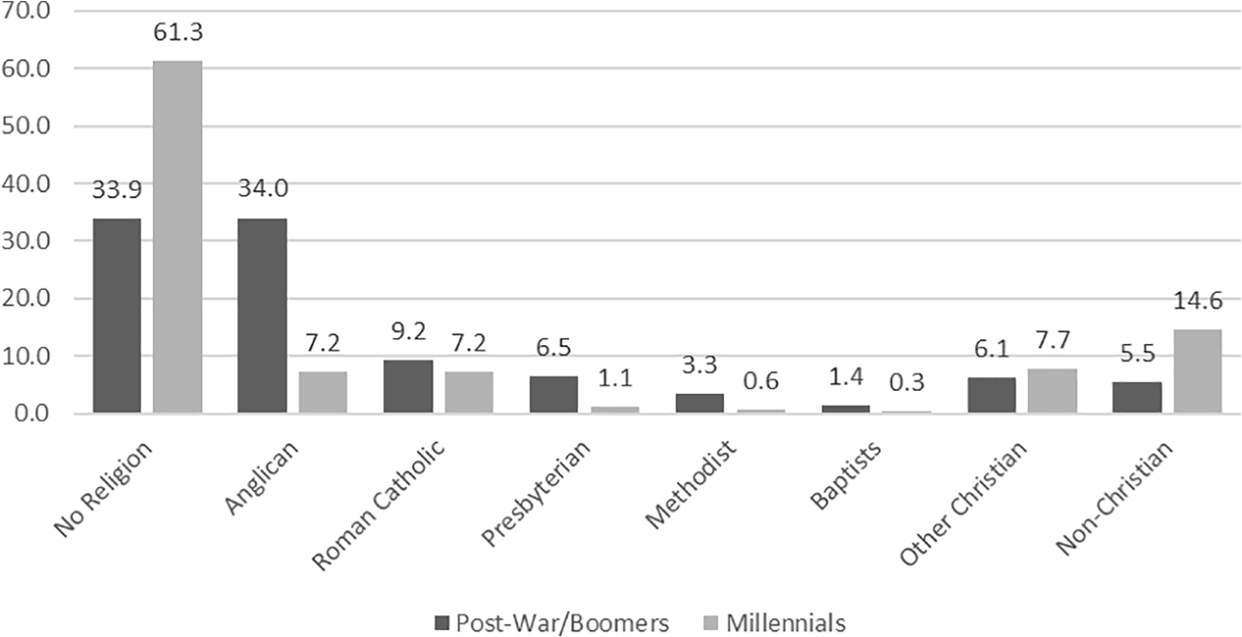
Belonging, i.e. religious denomination membership by generation (%).
2. ‘Behaving’, referring to religious participation, such as going to church or praying. It was measured using self-reported frequency of attendance at religious services, with variables identifying those who attend ‘at least once a year’, ‘at least once a month’, ‘at least once a week’, and ‘never’ as the reference category. Self-reported measures of religious participation are well-known to face problems with social desirability and recall bias that lead to over-reporting (Hadaway & Marler, 1998). This is not though to undermine comparisons between Millennial and Boomers participation, however, because there are no indications of such biases have differential effects across generations. This data are illustrated in Figure 2. 5
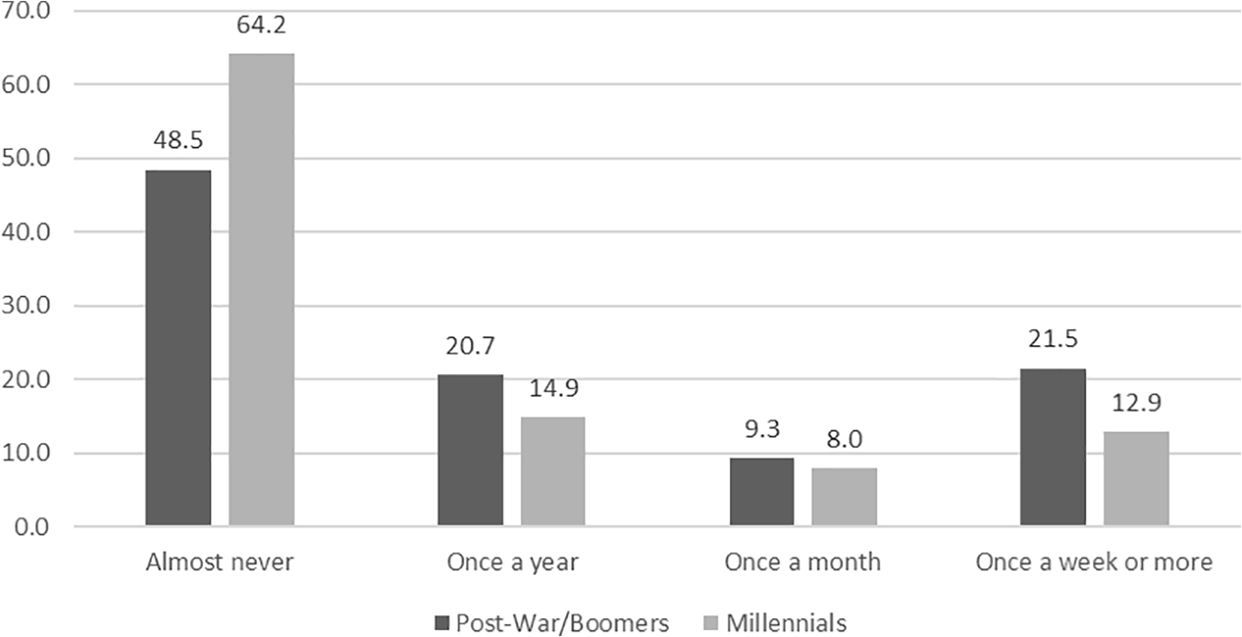
Behaving, i.e. religious attendance by generation (%).
3. ‘Believing’, referring to belief in religious tenets or doctrine and the strength of that belief. Measures of specific beliefs are not available in UKHLS, but a measure of the importance of religion in daily life is provided: this was used to indicate both the holding of a belief (someone with no religious beliefs is unlikely to say they have a large impact on their lives) and the strength of it (someone who holds the strongest beliefs is expected to feel that it has the greatest impact on their lives). Variables identified respondents for whom their religion made ‘a little difference’, ‘some difference’ or ‘much difference’, with ‘no difference’ the reference category. These are illustrated in Figure 3. 6
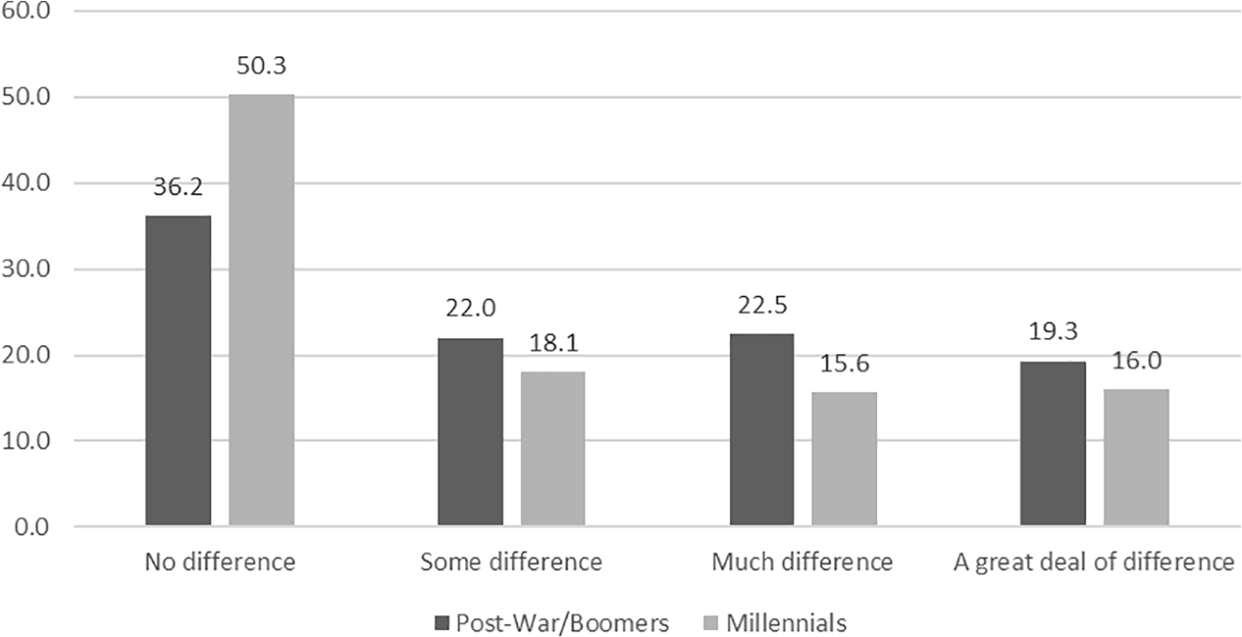
Believing, i.e. religion makes difference in one’s life by generation (%).
Our sample included all Post-War/Baby Boomers (born between 1946 and 1958) and Millennials (born after 1982) in the UKHLS panel. The Boomer generation is frequently identified as being the most engaged with politics, their communities and religion, as well as on the ‘winning side’ of intergenerational inequalities (for example, not paying tuition fees to attend university and benefitting from steep increases in the value of property), while Millennials are typically on the ‘losing side’ and identified as the least civically or religiously engaged or leading the way in developing new relationships with religion and their communities (Dalton, 2013; Furlong & Cartmel, 2012; Grasso, 2014; Jennings & Stoker, 2004; Norris, 2002; Putnam, 2000). Respondents were assigned to a generation based on their year of birth, depending on the period in which those individuals would have spent the majority of their formative years (i.e. the ages between 15 and 25) (Grasso, 2014).
The analyses were conducted on (long) panel data created by pooling observations from BHPS Waves 1–19 and UKHLS Waves 1–4 and stacking by wave (Wooldridge, 2013). 7 Respondents from Northern Ireland were omitted because of the substantially different – and more salient – role played by religion in social life and politics relative to Great Britain. Fully controlled random-effect logistic (Gaussian) regression models were used to model the effect of each dimension of religion on each dimension of social capital for both generations. 8 As the measures of religion were either time-invariant or very slow-changing, random-effects model specifications were favoured (Becketti, 2013), which allow for smaller standard errors than the corresponding pooled OLS estimators given the large sample size (Wooldridge, 2013). Separate analyses were run for each generation, to allow for any differences in the religion/social capital relationship to be highlighted without the need for extensive interaction effects. Subsequent models run on the full sample included the interactions, however, so that their statistical significance could be examined. The data were not weighted owing to the likelihood that this would unnecessarily over-complicate models and offer little to the objective of establishing the internal validity of theoretical relationships between the variables (Gelman, 2007).
To aid interpretation and comparison, predicted probabilities were calculated, showing the probability (expressed as a percentage) of being a member of a community association, trusting one’s neighbours or donating to charity for each independent variable, while accounting for the control variables. 9 We included controls based on traits related to civic participation and social capital in the literature, including age and life cycle events such as marriage, having children, completing full-time education and health; social and economic resources such as occupational social class, financial status and education; and respondents’ integration into their communities and social support networks, including length of time residing in their current community and whether they felt there was anyone they could talk to (Hall, 1999; Li et al., 2005; Putnam, 2000; Smets, 2016; Verba et al., 1995; Whiteley, 2012; Wuthnow, 2002). We also included socio-demographic indicators of gender and ethnicity.
Results
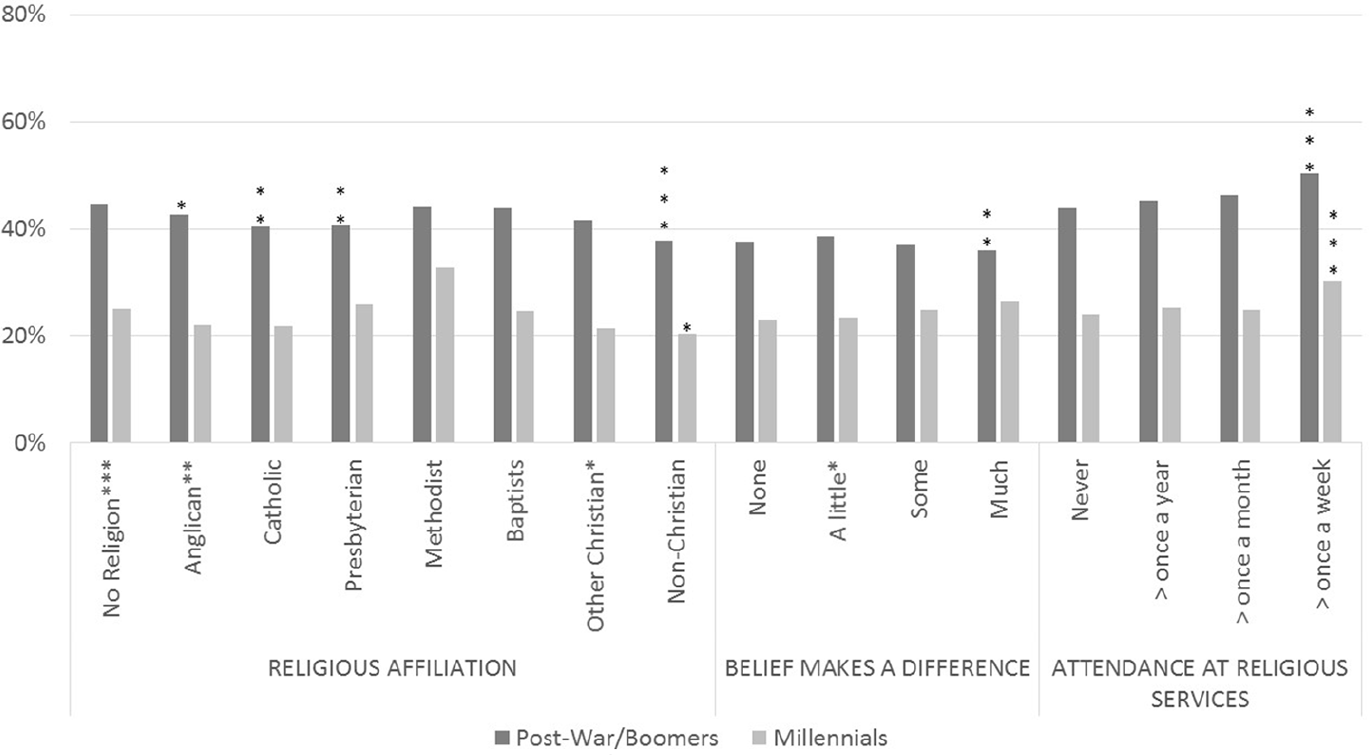
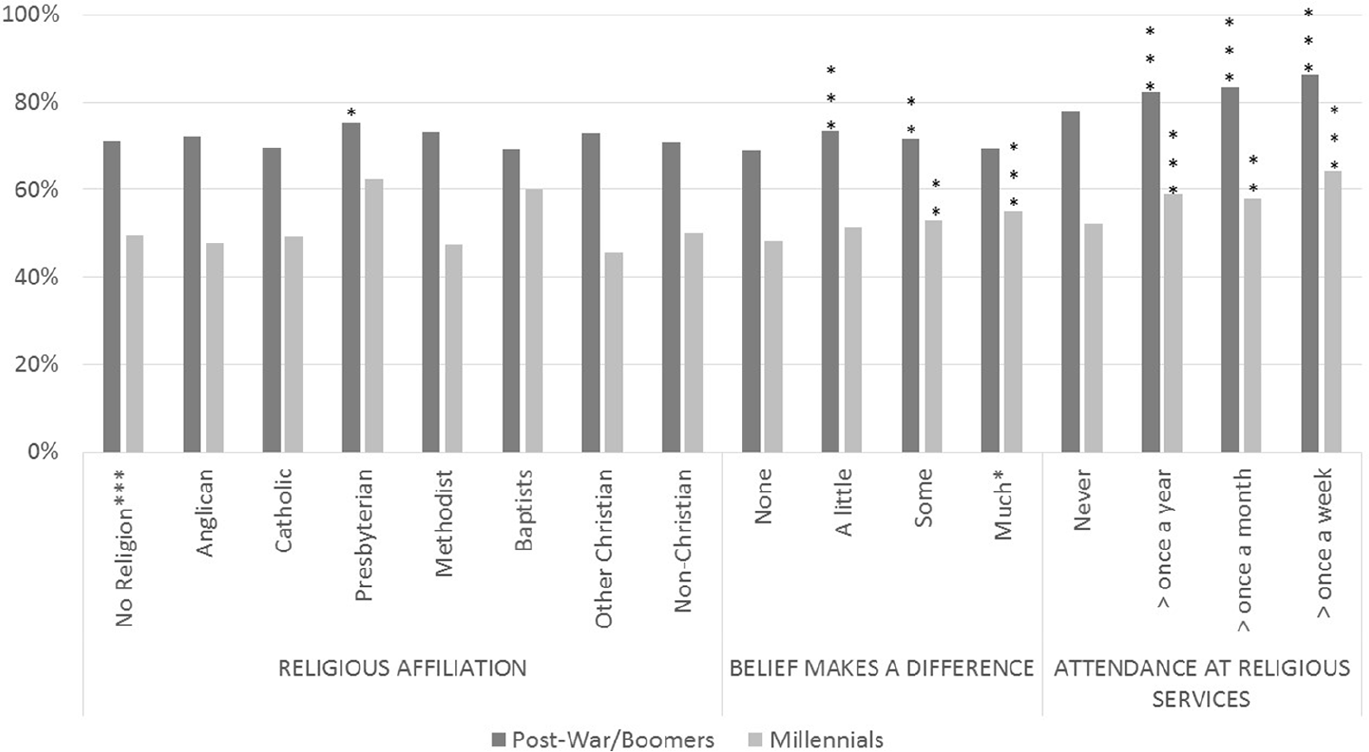
Figures 4 –6 illustrate the results of our regression analyses, showing the probability of a typical Boomer or Millennial being a member of a community association, trusting their neighbours or donating to charity depending on their religious affiliation, belief and participation (after accounting for the control variables). The full outputs from the models are available in the online Appendix. The asterisks above the bars indicate whether the effect was statistically significant relative to that of the reference category (e.g. in Figure 4, three asterisks above the effect of Boomers’ attending religious services ‘at least once a year’ shows that the difference in effect between these Boomers and those that never attend religious services is highly significant). The asterisks on the x-axis indicate whether the interaction effect between that variable and the generation variable is statistically significant (i.e. whether there was a statistically significant difference in the effect of that variable on the social capital of the Millennials relative to the Boomers).
Religion and associational membership
Figure 4 focuses on associational membership. The graph confirms that Millennials are for the most part less likely to join associations than Boomers, regardless of their religious characteristics (the same is true for the graphs relating to social trust and charitable giving in Figures 5 and 6, where the generational difference is considerably larger). This supports the multiple claims that Millennials tend to have less social capital than Boomers, however the focus of this research is on the effect of religion within each generation, and how it may differ between generations. The figure shows that the effect of religion on membership of community associations is limited; most of the differences are small and non-significant. The exceptions include Boomer Baptists and Methodists, who are around 8% and 4% respectively more likely to join community associations than Boomers in other religious communities (or none). The same differences between Millennial Baptists and Methodists and those in other communities are greater in magnitude but non-significant. 10 There is no indication that identifying with a religious community makes any substantial difference to associational membership among Millennials.
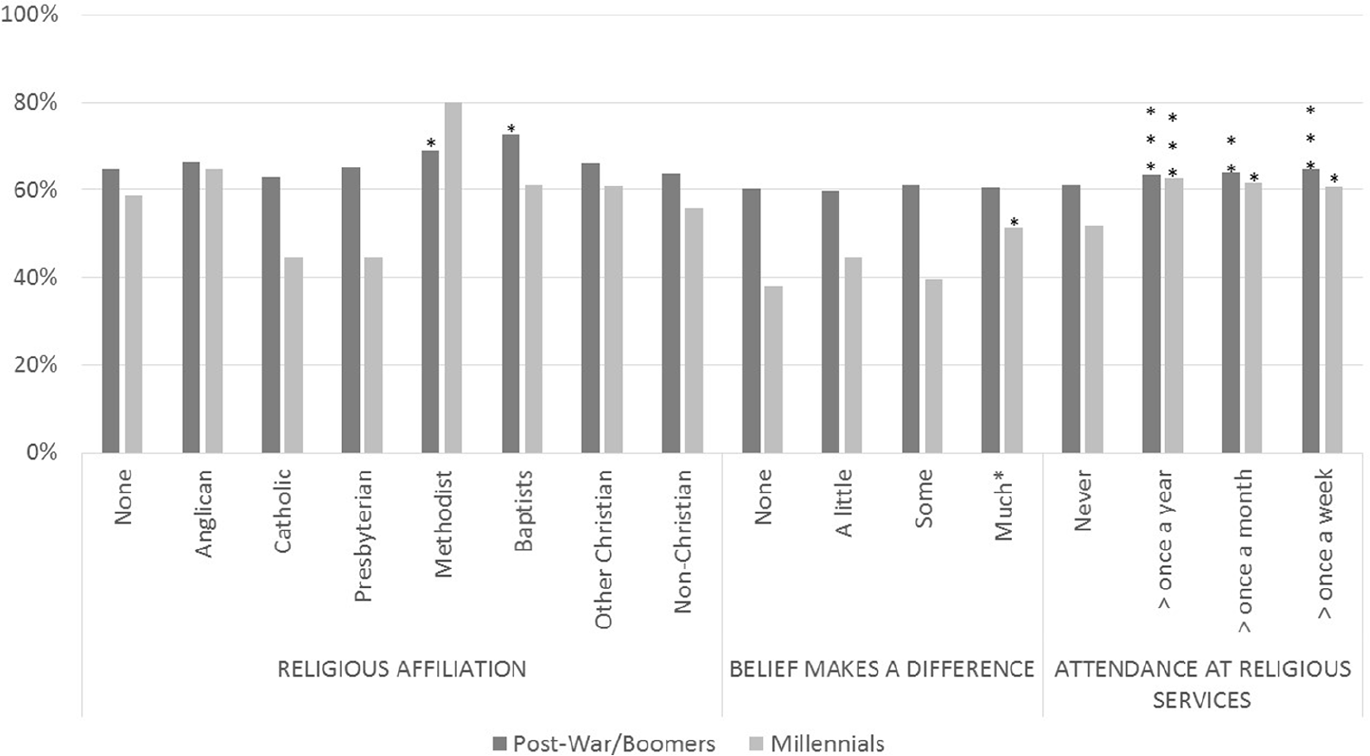
Predicted probabilities of being a member of an association by generation and three measures of religion (%).
Predicted probabilities of social trust by generation and three measures of religion (%).
Predicted probabilities of having donated to charity by generation and three measures of religion (%).
Religious belief has a similarly limited impact. There is no difference between Boomers regardless of their religious belief. There is a difference for Millennials, however, with those for whom religion makes ‘much’ difference to their daily lives being significantly more likely to join community associations (by around 13 points) than those for whom religious belief makes less of a difference. The significant interaction effect confirms that the difference in the effect of religious belief for between the generations is statistically significant. Finally, religious participation is shown to increase associational membership for both generations regardless of its intensity: what matters is the difference between Boomers or Millennials who participate in religious activity at all, and Boomers or Millennials who do not. The benefit of religious participation is of greater magnitude for Millennials – a Millennial who participates in religious services at least once a year (or once a month, or once a week), for example, is around 10 points more likely to join a community association than one who does not participate, while for Boomers the same difference is 3 points – but this difference in effect between generations is not statistically significant.
Religion and social trust
Figure 5 shows that religion has varying effects on social trust, with notable differences both within and between generations. For Boomers, there are no significant differences in social trust between those of no religion and those who are Methodists, Baptists or other Christians. Social trust was lower, however, for Anglicans (by around 2 points), Catholics and Presbyterians (each by around 4 points), all of which were statistically significant. There are smaller yet comparable differences between communities for Millennials, but none of the effects are statistically significant. Moreover, the interaction effects for ‘no religion’ and Anglicans were both significant, confirming that the difference between the impact of being an Anglican and of no religion for a Boomer and a Millennial (i.e. depressing trust for the former, no impact for the latter) is statistically significant.
Religious belief has a small effect on social trust; for the most part, there is no difference in the trust of Boomers regardless of their belief, except for those for whom religion makes ‘much’ difference to daily life. This group of Boomers are marginally less likely (around 2 points) to trust their neighbours than Boomers with less strong belief. The coefficients for Millennials suggest increasing social trust with stronger religious belief, although none of the differences are statistically significant, suggesting that belief has no appreciable impact on Millennials’ trust. Religious participation has a positive effect on social trust for both Boomers and Millennials: there are no differences between those (of either generation) who participate at least once a year or once a month compared with those who never participate in religious services, but the positive effect of participating at least once a week is highly significant for both generations, raising their respective likelihoods of trusting their neighbours by around 4–5 points each.
Religion and charitable giving
Finally, Figure 6 shows the relationship between religion and charitable giving. Religious affiliation has little impact for either generation: there is no significant difference in the likelihood of donating to charity for either Boomers or Millennials depending on their religious identification, with the only exception being Presbyterian Boomers, who are around 4 points more likely to donate to charity than non-religious Boomers. The interaction effect for being ‘non-religious’ is, however, highly significant (coefficient 0.29***): this suggests a positive effect on average for charitable giving for Millennials that identify with any religious group relative to non-religious Millennials that is greater than the effect for religious Boomers compared to non-religious Boomers. This is counter-intuitive given that none of the coefficients Millennials in specific religious communities indicated a significantly higher propensity for them to donate to charity than those of no religion; nonetheless, the data suggest that Millennials receive a greater benefit than Boomers to this particular form of social capital from religious identification.
Religious belief has a notably different impact on charitable giving for both generations. For Boomers, the effect is curvilinear: Boomers for whom religion makes no difference are as likely to donate to charity as those for whom it makes ‘much’ difference, but those for whom it makes ‘a little’ or ‘some’ difference are significantly more likely – by around 3 points – to donate to charity. For Millennials, on the other hand, stronger belief is associated with a greater likelihood of charitable giving: Millennials for whom religious belief makes ‘some’ difference to daily life are around 4 points more likely to donate to charity than those for whom it makes no difference, while those for whom it makes ‘much’ difference are 7 points more likely. The significant interaction effect for those for whom religion makes ‘much’ difference confirms that the difference in the impact of religious belief on charitable giving for Boomers and Millennials is statistically significant. Finally, religious participation is positively associated with charitable giving for both generations. A Boomer who attends religious services at least once a week is the most likely to donate to charity, and around 8 points more likely than a Boomer who does not participate in religious services. The same is true for Millennials, although the difference between those who participate weekly and who do not participate at all is 12 points (although the difference between the effects for each generation is not statistically significant). In general, Boomers and Millennials derive a comparable benefit to charitable giving from their participation in religious services.
Discussion
The results above confirm, first, that Millennials have lower levels of social and religious capital than Boomers: they are less likely to join associations, trust their neighbours or donate to charity, as well as to identify with religious communities, hold religious beliefs or participate in religious activities. Our results also support the theory that there is a relationship between the two. Our findings lend some support, therefore, to the theory that generational differences in religious capital contribute to intergenerational inequalities exacerbated by differences in social capital. Our data do not, however, provide evidence that the differences in social and religious capital, or the relationship between the two, is necessarily a generational effect, i.e. resulting from differences in value, behaviour and/or attitude stemming from distinct socialisation experiences. While our findings would be expected if there was such an effect, the differences between Millennials and Boomers could also reflect age effects – caused by differences in biological development and life circumstances – or period effects – caused by contextual factors. Our data are not capable of effectively estimating the three effects simultaneously and so estimating one (such as generational) while controlling for the other two, which is a prerequisite of reliably identifying generational differences.
Furthermore, while we have made considerable efforts to employ sufficiently diverse and relevant measures of religion and social capital, it is possible that indicators of other forms of social or religious capital that may differently represent the evolving relationships Millennials are theorised to have with religion and social institutions would produce different results. Our findings should not be taken as a generalised rejection of the possibility of Millennials having more social capital as expressed through other behaviour or attitudes, and that may be differently affected by religion, but rather evidence that they have considerably less social capital according to the best indicators available in a study of this nature. Further research that uses other indicators of social capital that may be more relevant to Millennials’ social preferences (such as protest or volunteering) to test the applicability of our findings is required.
Finally, while the above discussion has focused on the positive and significant relationships between religion and social capital, the broader pattern within Figures 4 –6 should also be noted: religion frequently has little or no effect on social capital. While it is fair to say that religious decline contributes to lower levels of social capital among Millennials, therefore, it should be noted that the benefits of religion for social capital are smaller than is often suggested in the literature. Given that most literature on the link between religion and social capital relies on US-based data, it is impossible to determine whether this is a finding that challenges previous research or applies only to the specific case of the UK. Nonetheless, there is clearly scope for further research into just how important religion is as a source of social capital and whether this varies across national contexts.
A further finding is that, while lower religious capital appears to contribute to lower social capital in Millennials, the relationship between religion and social capital looks to be evolving. While the differences are generally small and not found for all forms of religious capital, we find that some elements of religion have more positive effects for Millennials’ social capital than Boomers’. The negative impact of identifying as Anglican, Catholic or Presbyterian on Boomers’ social trust is also not apparent for Millennials. While this change does not lead religious Millennials’ to have as much social capital as their elders, it does mean that religious activity and/or belief could be a more valuable source of social capital for Millennials.
The reason for this is unclear, but the literature identifies several possibilities. First, it is possible that Millennials’ attachment to their religion (however expressed) is stronger or more intense than that of the Boomers, which results in the effects of that attachment being stronger. Several studies argue that younger generations develop more ‘individualised’ relationships with religion that are more tailored to their values, beliefs and lifestyles, which could potentially lead them to develop a stronger attachment to their religious belief or practice of choice (Becker & Dhingra, 2001; Park & Smith, 2000; Wuthnow, 2002). This cannot explain, however, why the negative impact of religion on social capital (such as that of being Anglican for Boomers’ social trust) is not apparent for Millennials. Another possibility is that our findings reflect Millennials’ weaker relationship with religion, which leads them to be more open to alternative influences on their social capital. People with strong connections to religion may have less time or inclination for other forms of social interaction, making them more dependent on religious capital for social relations and potentially increasing its impact (Lam, 2002). If religiously inclined Millennials develop weaker connections with religion, they may have ‘more room’ for interaction in other community environments that provide alternative sources of social capital. This could mean that the negative consequences of religion would be mitigated, and positive consequences supplemented, by those other sources.
A third theory is that these results reflect interactions between generations. As shown above, Boomers tend to have more social capital than Millennials and are more likely to be religious. Religious Millennials may be more likely to encounter and interact with Boomers than non-religious Millennials. This could give religious Millennials access to their elders’ social networks and resources as a result, thereby providing a ‘boost’ to the value of their religious capital. Religious Boomers, in contrast, are likely to encounter other Boomers who will have similarly high levels of social capital – their interactions may well bring them less of a benefit as a result. A final possibility is that these findings reflect the interaction of religion with other (unmeasured) social values. Rahn and Transue (1998) argue that both diminishing social and religious capital reflect the increasing prominence of ‘a value orientation characterised by the conjunction of non-traditional values with consumption-oriented values’ (Rahn & Transue, 1998, p. 551). Often associated with neoliberalism, this generates an ‘acquisitive syndrome’ that favours individual competition, prosperity and success. Interaction with others based on shared beliefs or interests, therefore, becomes less common and even counter-productive, and so religious and social interaction decline (Bruce, 2002, 2013; Dinham et al., 2009; Lam, 2002; Rahn & Transue, 1998; Wuthnow, 1992). This theory suggests that social changes are leading to a greater expression of such values during the formative socialisation of Millennials, and contributing to their lower levels of social interaction and capital (Dinham et al., 2009; Rahn & Transue, 1998). It both causes and is compounded by falling religious capital, as younger people are dissuaded from interacting with institutions that promote collective endeavour and shared prosperity (Rahn & Transue, 1998). Religious Millennials, therefore, are likely to be exposed to values and activities that are rare in other institutions in their lives (at least relative to the experiences of Boomers). This rarity might mean that religious experiences have more of an impact on the attitudes and values that inform their social behaviour, and so ultimately their social capital.
Conclusion
Intergenerational inequality is an increasingly prevalent feature of public debate, media discourse and policy-making in many Western societies, as evidence grows that today’s young people do not enjoy the same economic security or quality of life as previous generations. While differences in social capital are not the only cause of intergenerational inequalities or conflicts, the fact that social capital has a positive impact on many characteristics in which such inequalities are so stark makes them an important contributor. This study has examined the role of religion as a contributor to intergenerational inequalities in social capital. Traditionally identified as a ‘wellspring’ of social networks, skills and values, we have examined the relationship between religious and social capital for Boomers and Millennials in the UK and considered the potential for differences in religious capital to explain differences in social capital. While our findings support the claim that the relationship between religion and social capital is evolving, they primarily show that Millennials do indeed have less social capital than Boomers, and that their lower levels of religious capital contributes to this. That said, the overall impact of religion on social capital is fairly limited: while greater engagement with religion would most likely increase young people’s social capital, therefore, it would not dramatically alter their social attitudes or behaviour to the extent of reversing generational differences in social capital.
Our study raises important questions about the relationship between religion and social capital in the context of significant social change and the evolving relationship between citizens and social institutions. More research is needed to better understand the role that religion plays in structuring the social lives and relationships of younger citizens. Future studies might also pay attention to the different character of religious institutions both within and across different faiths – and the extent to which they are inward or outward facing – to better understand how they affect bridging and bonding social capital. A further question regards the role of geography: our analysis has essentially assumed that all respondents live and express their religious characteristics in the same environment, but the effect of religion could differ across different social environments. A Presbyterian in Wales, for example, is likely to be part of a very small and potentially exclusive community, while a Presbyterian in Scotland will be surrounded by many who hold similar beliefs. This would mean they have very different opportunities for social interaction and access to social networks of considerably different size; could this mean, therefore, that the benefits of being a Presbyterian, or holding Presbyterian beliefs, vary for the two individuals? This could also be relevant for intergenerational differences, with young people being far more likely to live in cities (particularly if they go to university) while older people are more likely to live in towns, suburbs and rural areas, which have considerable implications for social interactions and the opportunities to form social networks. Finally, future research might also consider the processes that drive young people towards a religious connection in the first place, given the diminishing role of intergenerational transmission in this process (as evidenced by the generational decline of religious identification), and the fact that such a connection makes young people part of an increasingly small minority among their peers.
Supplemental Material
sj-pdf-1-sor-10.1177_0038026120946679 – Supplemental material for Capitalising on faith? An intergenerational study of social and religious capital among Baby Boomers and Millennials in Britain
Supplemental material, sj-pdf-1-sor-10.1177_0038026120946679 for Capitalising on faith? An intergenerational study of social and religious capital among Baby Boomers and Millennials in Britain by Stuart Fox, Esther Muddiman, Jennifer Hampton, Ekaterina Kolpinskaya and Ceryn Evans in The Sociological Review
Footnotes
Acknowledgements
The authors would like to thank the anonymous reviewers and colleagues at the Wales Institute of Social and Economic Research, Data and Methods, the Annual Conference of British Sociological Association, the Annual Conference of the Elections, Public Opinion and Parties group, and the Annual Conference of the Political Studies Association for feedback and support with this research. All errors are the responsibility of the authors alone.
Funding
This research was partially funded by the Economic and Social Research Council (grant number ES/L009099/1).
Supplemental material
Supplemental material for this article is available online.
Notes
References
Supplementary Material
Please find the following supplemental material available below.
For Open Access articles published under a Creative Commons License, all supplemental material carries the same license as the article it is associated with.
For non-Open Access articles published, all supplemental material carries a non-exclusive license, and permission requests for re-use of supplemental material or any part of supplemental material shall be sent directly to the copyright owner as specified in the copyright notice associated with the article.
