




Abstract
Previous research on youth attitudes towards immigration has tended to focus on explaining why young people are more accepting of immigrants than their elders. In this article, therefore, we focus on the young people that are opposed to immigration. First, we use nationally representative survey data from young adults in England to highlight that a substantial minority hold negative attitudes towards immigrants. In the second half of the article, we then turn to qualitative data (in-depth interviews) to explore how young people talk about and justify holding these negative attitudes. Both the qualitative and the quantitative data suggest that anti-immigrant attitudes among young people are linked to the perception that immigrants pose an economic and cultural threat, and to the spread of culturalised forms of citizenship. What the qualitative data also reveal, however, is how these distinct discourses reinforce one another and how they intersect with other types of prejudice. We will argue that the idea of Hard Work is central to understanding anti-immigrant attitudes, as this has become a deeply-embedded cultural norm that is being used to include and exclude (immigrants and others), and to distinguish between who is deserving of membership of British society and who is not.
Introduction
In the aftermath of the Brexit referendum in 2016, there has been a great deal of discussion about the fact that young Britons are more ‘cosmopolitan’ than the older generations, and that they are more likely to be accepting of immigrants and immigration (see Norris & Inglehart, 2019; Sloam & Henn, 2019). Much of the debate characterises these differences as a generational divide and assumes that these inclusive attitudes are apparent amongst all young people. This focus on inter-generational differences has helped us to understand how and why attitudes to immigrants (and diversity more broadly) have changed over time. What these studies rarely address, however, is why some young people remain opposed to immigrants, despite the wider societal shifts that have fostered positive attitudes among the majority of their generation (Ford, 2008). One exception to this is found in studies of young people in radical right movements (most notably in a special issue of The Sociological Review in 2015 (Vol. 63(52), edited by Hilary Pilkington and Gary Pollock; see also Bessant, 2018). Explaining the latter is not the focus of this article, however. While the apparent increase in youth support for extremist views has been the subject of renewed debate (see Norris’s [2017] critique), in this article we wish to focus our attention on the more routine, ‘everyday’ nature of prejudicial attitudes towards immigrants that some young people hold, and on the discourses they draw on when expressing their views. These ‘everyday’ attitudes have often been overshadowed by the urgency of understanding the views of extreme groups. Yet we believe that the more routine anti-immigrant attitudes that we discuss below provide important insights into the new forms of inclusion and exclusion that are apparent in society more broadly, and indeed into the ways that citizenship itself is being transformed in the contemporary context.
In light of these goals, and using quantitative data from a survey among young adults in England in 2014, we will first show that anti-immigrant attitudes are not just found among young supporters of the radical right. Instead, these data suggest that a substantial minority of young people in England hold negative attitudes towards immigrants. In the second half of the article, we then turn to qualitative data to explore the anti-immigrant views that emerged in a sub-sample of in-depth interviews we conducted in 2013 and 2014. Both the qualitative and the quantitative data suggest that anti-immigrant attitudes among young people are linked to the perception that immigrants pose an economic and cultural threat, and to the spread of culturalised forms of citizenship. What the qualitative data also reveal, however, is how these distinct discourses reinforce one another and how they are linked to prejudice towards another much-maligned group (namely so-called ‘benefit scroungers’). We will argue that these prejudices are bound together by an increasingly dominant cultural norm, namely that a willingness to work hard is the most important disposition a person should have. By exploring the key themes emerging from youth narratives, we will show these different discourses are being used by young people as a means to include and exclude (immigrants and others), and to distinguish between who is deserving of membership of British society and who is not. Thus, while the data we draw on here pre-dates the Brexit referendum, this article nonetheless sheds light on some of the attitudes and discourses that contributed to the result (Hobolt, 2016).
First, to contextualise these findings, we set out the key theories that frame this analysis and that helped us to make sense of the anti-immigrant attitudes that emerged in our data.
Theoretical framework
There is an extensive literature on attitudes towards immigrants and immigration (see Hainmeuller & Hopkins, 2014), including perspectives that focus on the spread of more inclusive attitudes (e.g. the spread of cosmopolitan values, discussed briefly above) and theories that seek to explain negative attitudes and new types of exclusion (which are more salient for the analysis we present below). A key theme of these ‘negative’ perspectives is the role of competition and conflict between immigrant groups and their host populations. In contrast to the claims of contact theory (see Pettigrew & Tropp, 2006), this strand of the literature highlights how increased contact between groups can lead to conflict rather than the positive community relations that contact theory predicts. The basis of this conflict is often characterised as a matter of access to resources, as the arrival of new immigrant groups are perceived to threaten the dominant groups’ access to or control over certain resources (Quillian, 1995).
Hainmeuller and Hopkins (2014) note that much of the research on this topic tends to focus on the threat to economic resources, such as jobs, tax increases, social housing, and/or social welfare payments etc. As immigrants pose a greater threat for those that already have fewer resources to spare, anti-immigrant views are expected to be strongest among the unemployed, low skill workers, and the most disadvantaged sections of society. These tensions may be further aggravated in times of recession and/or austerity, as resources are even scarcer and therefore any new arrivals can increase competition for the ever-diminishing pool of resources. In keeping with this thesis, it has been suggested that the competition over scarce resources has become even more salient in the aftermath of the 2008 Global Economic Crisis, which exacerbated existing trends (more precarious jobs and economic inequality) while introducing further stringent reductions to state support for individuals and communities (so-called austerity measures). According to this view, these interlocking trends are feeding into a backlash against globalisation that includes greater xenophobia and opposition to immigration (see Norris & Inglehart [2019] for a review of this argument). This backlash has been particularly acute among those who have been already disadvantaged by global economic integration. One might also expect this category to include young people, who were not only being described as the ‘losers’ of globalisation even before 2008 (Blossfeld et al., 2006), but who have also borne the brunt of the fallout since 2008 (Schoon & Mortimer, 2017). However, it may be that the impact of these economic conditions is offset by the strength of the cosmopolitan values and anti-racist norms that are prevalent among the current generation of youth (Ford, 2011); this would lend support to the idea that immigrant attitudes are linked to culture not economics.
Conflict over culture
Although economic competition has been the focus of much research, Hainmeuller and Hopkins (2014) argue that there is little evidence to support the economic threat thesis more broadly, including the theory that an individual’s attitudes towards immigrants is correlated with their personal economic circumstances. Instead, they suggest that it is a threat to the cultural resources of the nation as a whole that drives anti-immigrant attitudes. This sense of threat is likely to be heightened when there is a sudden and sharp increase in the number of immigrants, as this can trigger a feeling that one’s identity, established ways of life, and one’s norms and values are being challenged by outsiders (Chandler & Tsai, 2001). This sense of cultural threat is more likely to be triggered in individuals that subscribe to an ethnic conception of national identity (as opposed to a civic one; see Heath & Tilley, 2005).
In the current globally-integrated world, ethnic-based national identities are supposed to have waned and to have been replaced with more cosmopolitan dispositions, particularly among the younger generations (see Keating, 2016; Sloam & Henn, 2019). Yet while post-national dispositions have proliferated, ethnic nationalism has not disappeared altogether, and indeed, some would argue that it is resurging in these febrile times. The starkest evidence for this is the increase in public support for populist parties across Europe, which propagate anti-immigrant and protectionist policies, and have prompted many mainstream parties to adopt a more negative attitude towards immigration (Mudde, 2013). More broadly, and in one of the few studies that focus on anti-immigrant attitudes among young people, Mieriņa and Koroļeva (2015) found that ethnic nationalism was the key driver of these negative attitudes, although political disengagement and resource competition were also found to play a role.
The culturalisation of citizenship?
This resurgence of ethnic identities is linked to what some have described as a ‘culturalisation’ of citizenship policies and public debates (see Tonkens & Duyvendak, 2016). According to Nicholls et al. (2016, p. 1593), this shift towards culturalising citizenship has ‘made “national belonging” (as measured by culture and habitus) into central criteria for assessing the claims of immigrants, irrespective of basic rights’. In this new citizenship regime, then, immigrants and immigrant groups are increasingly being asked to demonstrate that they share common values, attitudes, norms and behaviours with the host population (or are at least willing to acquire these attributes and assimilate rather than demonstrate their difference). These cultural demands are manifested in government regulations for citizenship acquisition, but also in public expectations about the types of immigrant that are considered ‘acceptable’ or ‘unacceptable’. The demands can include affective criteria (e.g. feeling of belonging to the host country) and/or functional criteria (e.g. knowing the language of the host country, its history, and the conventions of its socio-political systems) (Tonkens & Duyvendak, 2016). Failure to conform to these cultural codes means that immigrants can be deemed undeserving of membership of the host society (even if they have a legal right to do so), either by governments and/or by the public at large.
This latest trend builds on longstanding debates about how we conceptualise citizens and non-citizens. As Blinder (2015) points out, public perceptions tend not to be based on actual immigration flows but are instead based on an ‘imagined immigrant’ that is underpinned by deeply embedded stereotypes about race, ethnicity, colonial legacies and global inequalities (see also Ford, 2011). Furthermore, this culturalisation of citizenship also fits in a long tradition of debates about ‘the good citizen’ and their manifestations in legislation as ways to regulate access to the community of citizens. According to Brace (2015), nation-states have a history of denying full citizenship not only to immigrants but also to other groups not considered to have the independence of thought and ‘moral fibre’ to act as responsible members of society, such as woman, children, slaves and people of a different race. Elaborating on the notion of ‘the good citizen’, Anderson (2013, p. 3) introduces the term ‘community of value’, which she describes as an imagined community composed of ‘good citizens, law abiding and hard-working members of stable and respectable families’. People seen as fulfilling these criteria are part of ‘the legitimate us’ and rewarded with full citizenship rights. Groups seen as not meeting these criteria, such as migrants and welfare dependants, thus come to be viewed as the ‘undeserving poor’.
These reflections point to ‘deservingness’ as a crucial notion shaping public attitudes towards the social citizenship rights that immigrants are entitled to in the host country. One reason for the centrality of deservingness in relation to immigrants is the widespread belief that immigrants exploit the welfare system (Semyonov et al., 2006). However, even when immigrants are not believed to be abusing the system, van Oorschot (2006) found that immigrants are widely perceived to be less ‘deserving’ of social welfare than other groups that benefit from the system (such as pensioners, disabled people and the unemployed). Across Europe, immigrants were ranked lowest on the hierarchy of deservingness because of public perceptions that immigrants are culturally more distant from the in-group, that they have fewer needs than other groups, and that they contribute less to the welfare system, in the past, now, or in the future. Yet in this culturalised citizenship context, the latter is used not just as a means to exclude but also to include. Nicholls et al. (2016, p. 1594) note that individuals and groups are considered ‘good’ and deserving immigrants if they ‘fit in’ and observe the dominant norms, tastes, worldviews and language of the host society. The salience of this point becomes particularly apparent in the analysis below, when we examine how young people in England use cultural norms in their hierarchies of inclusion and exclusion of immigrants. First, however, we discuss the data and methods that frame this analysis.
Data and methods
This article draws on qualitative and quantitative data collected in 2013–14. The quantitative analysis presented here is primarily descriptive and utilises data from a unique, nationally-representative survey that was conducted for us online in 2014 by an independent survey company (TNS-BMRB). This cross-sectional survey covered a wide range of issues but included a series of questions to enable us to explore some themes (such as youth attitudes towards immigrants) in greater depth. The items that we refer to here have been widely used as indicators of attitudes towards immigrants and have previously been used in the British Social Attitudes study, the World Values Survey and the European Social Survey. The final sample from our web survey includes data from 1003 young adults in England aged 22–29, and is nationally representative in terms of gender, ethnicity, highest qualification and region.
Descriptive analysis of these data enabled us to identify how widespread negative attitudes towards immigrants were among young people, and to give us some preliminary indication as to the reasons why. However, it was the qualitative data we collected for the project that enabled us to explore how economic, cultural and culturalisation discourses are deployed in young people’s justifications of their negative attitudes. The qualitative data used here draw on 101 in-depth interviews that were conducted across England in 2013 and 2014 with young people aged 18–26. The vast majority of these interviews were conducted face-to-face by academic members of our project team, who used a variety of methods to recruit young participants, including: contacting young people that had participated in (nationally-representative) surveys we have conducted in the past; approaching FE colleges and youth organisations; inviting participation via social media sites such as Twitter; and snowballing. Despite these varied efforts, however, our academic team nonetheless found it difficult to recruit young people that had few/no qualifications. To address this, and with the help of a national youth organisation, we designed a small-scale, supplementary project that involved recruiting and training five young people from disadvantaged communities to conduct interviews on our behalf with their friends, family and peers (on the benefits and challenges of this approach, see Heath et al., 2009; McLaughlin, 2006). This approach enabled us to collect 14 additional in-depth interviews with a group of young people that had thus far been under-represented in our sample (that is, young people with few/no qualifications and often struggling to find secure full-time employment). These additional interviews reduced the bias in the sample towards the well-educated considerably: in our final qualitative sample 44 were graduates (43.6%) and 57 were non-graduates (56.4%) (Table 1). Nonetheless, non-graduates may still be overrepresented in our final sample; there is no population data available for exactly the same 18–26 age group, but at the time of the survey 38% of the entire UK population were graduates, and 61% were non-graduates (ONS, 2013). On the other hand, at this time only 8% of young people had no qualifications by age 17 (ONS, 2014), whereas just over 10% of our final sample had no qualifications.
Background characteristics of the full qualitative sample (N = 101).
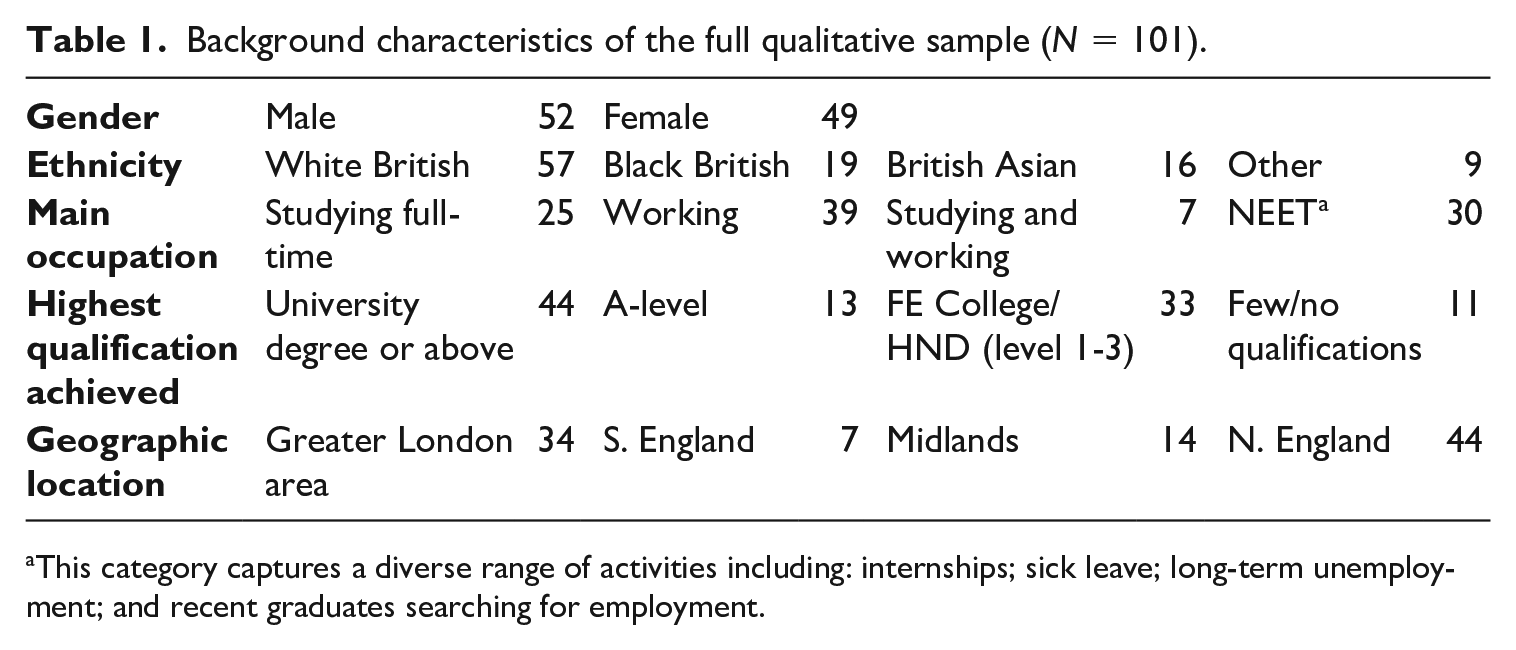
This category captures a diverse range of activities including: internships; sick leave; long-term unemployment; and recent graduates searching for employment.
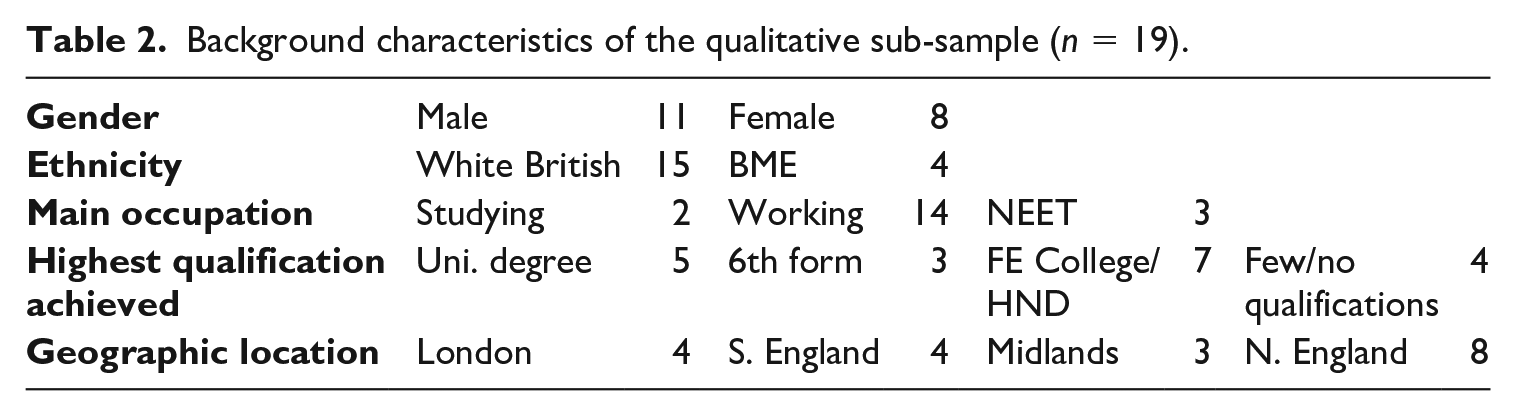
Regardless of the recruitment method, all of the young people that were interviewed were asked a range of semi-structured questions about their attitudes towards social and political life in Britain today. These questions were developed by the academic members of the project team and intended to complement or supplement the data being collected via the survey. The topic guide included questions about the young respondents’ attitudes towards (and experiences of) equal opportunities, prejudice, immigration and the benefits system; it is responses to these questions that provided the bulk of the qualitative data analysed and presented here. These interviews were audio-recorded, transcribed in full, anonymised and then coded (inductively and deductively) using a thematic analysis approach (Braun & Clarke, 2006). This coding process revealed that, much like in the quantitative data, around one-fifth of the sample expressed negative attitudes towards immigrants during their in-depth interview (n = 19; see Table 2 for an overview of their background characteristics).
Background characteristics of the qualitative sub-sample (n = 19).
Our analysis of the attitudes that emerged in the qualitative data is discussed below, where we present data extracts that distil the wider patterns we found in the data and illustrate the ways in which the young people in our sub-sample talked about and justified their views. These individuals are not meant to represent all young people, or indeed, even all young people that have negative attitudes towards immigrants; rather, these data are meant to provide insight into the discourses that young people draw on to explain their attitudes. Before this stage of the analysis, however, we present and discuss the wider patterns that emerged in the quantitative data.
Findings
The data from the 2014 cross-sectional survey revealed some striking patterns in young people’s attitudes towards immigrants and suggested that attitudes among this cohort are far from uniform. On the one hand, around 45% of our young respondents in England agreed that immigrants ‘are generally good for Britain’s economy’ and that immigrants ‘improve British society’. In addition, there were high levels of support for immigrants having equal rights; just over 50% of respondents agreed that ‘people who were not born in Britain, but who live here now, should have the same rights as everyone else’ (see Figure 1). Yet these same data also indicate that there are clear limits to youth support for immigration and cultural diversity. For example, over 50% of our respondents agreed that Britain does not have room to accept any more refugees (a group that is often conflated with immigrants by the media and politicians; White, 2015). Moreover, these same data also reveal that there is a substantial minority that hold explicitly negative attitudes towards immigrants and believe that immigrants pose a threat to the economic and social order: 33% agreed that immigrants increase crime rates, and over 20% disagreed that immigrants improve the British economy or society (see Figures 1 and 2). An even higher proportion appeared to view immigrants as an economic threat: 45% agreed that immigrants take jobs away from people born in Britain (see Figure 2).
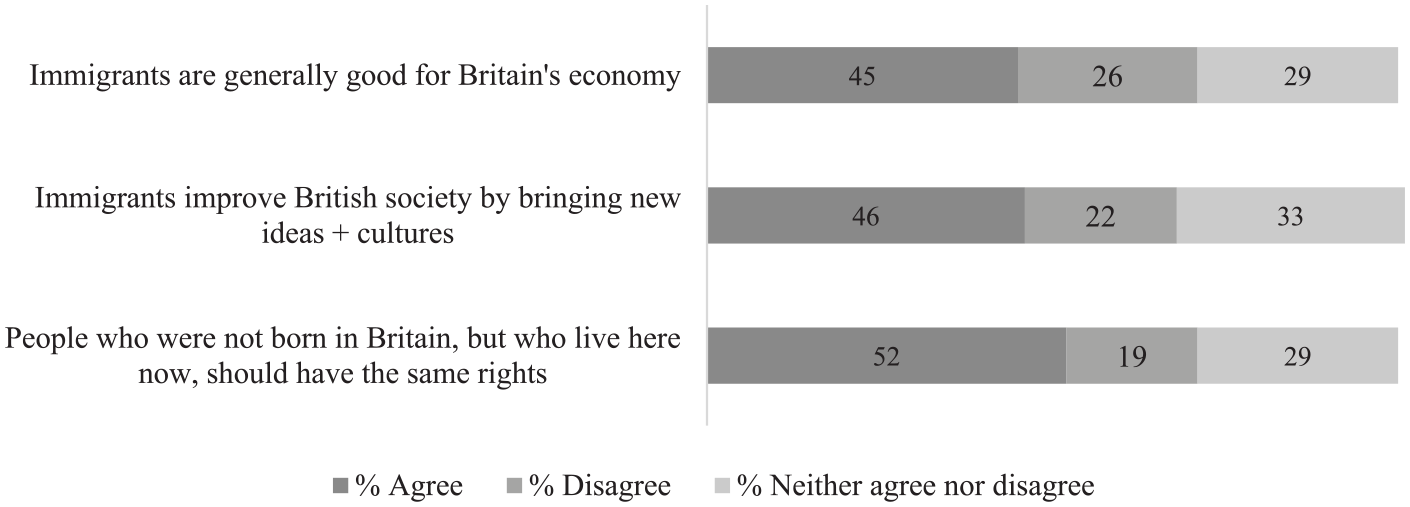
Support for positive statements about the impact of immigration on Britain.
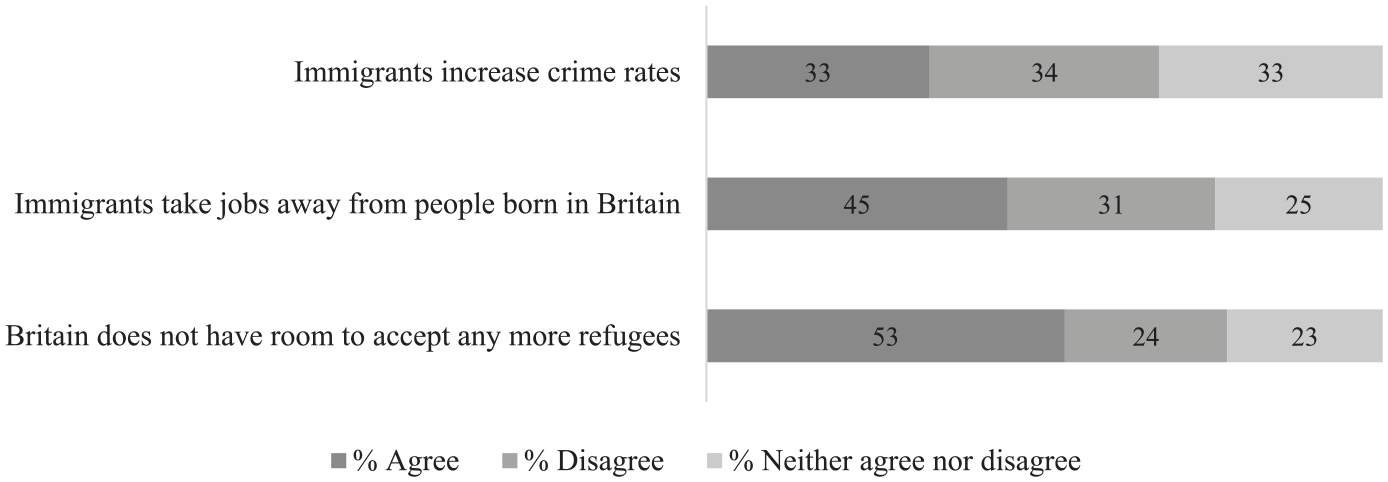
Support for negative statements about the impact of immigration on Britain.
The social distance measures in our survey indicate that a substantial minority view immigrants as a cultural threat as well as an economic one. Around 20% indicated that they would be bothered ‘a lot’ or ‘a great deal’ if their neighbours were immigrants, foreign workers, or people who spoke a different language (see Figure 3). As noted above, speaking a different language is one of the key indicators of cultural difference and ‘bad fit’ with the predominant cultural norms (Tonkens & Duyvendak, 2016). Furthermore, almost equal proportions reported that they are ‘a little’ bothered by the idea of living in close proximity to any of the groups we asked about. This means that around 44% of the young people we surveyed reported some level of discomfort with the idea of living near or beside people who speak a different language, and almost 40% are uncomfortable with the idea of immigrants or foreign workers as neighbours. Similar proportions and patterns emerged when we asked young people about their attitudes towards having members of each of these groups as colleagues. 1 In comparison, Figure 3 suggests young people are more accepting of racial and religious diversity than they are of immigrants, foreign workers and people that speak a different language. Only 12% reported ‘a lot’ or a ‘great deal’ of reservation about having people of a different race or religion in their close vicinity (and only a further 13% were ‘a little’ bothered). These data suggest that young people conceptualise immigrants as a distinct group that is less worthy of tolerance and inclusion.
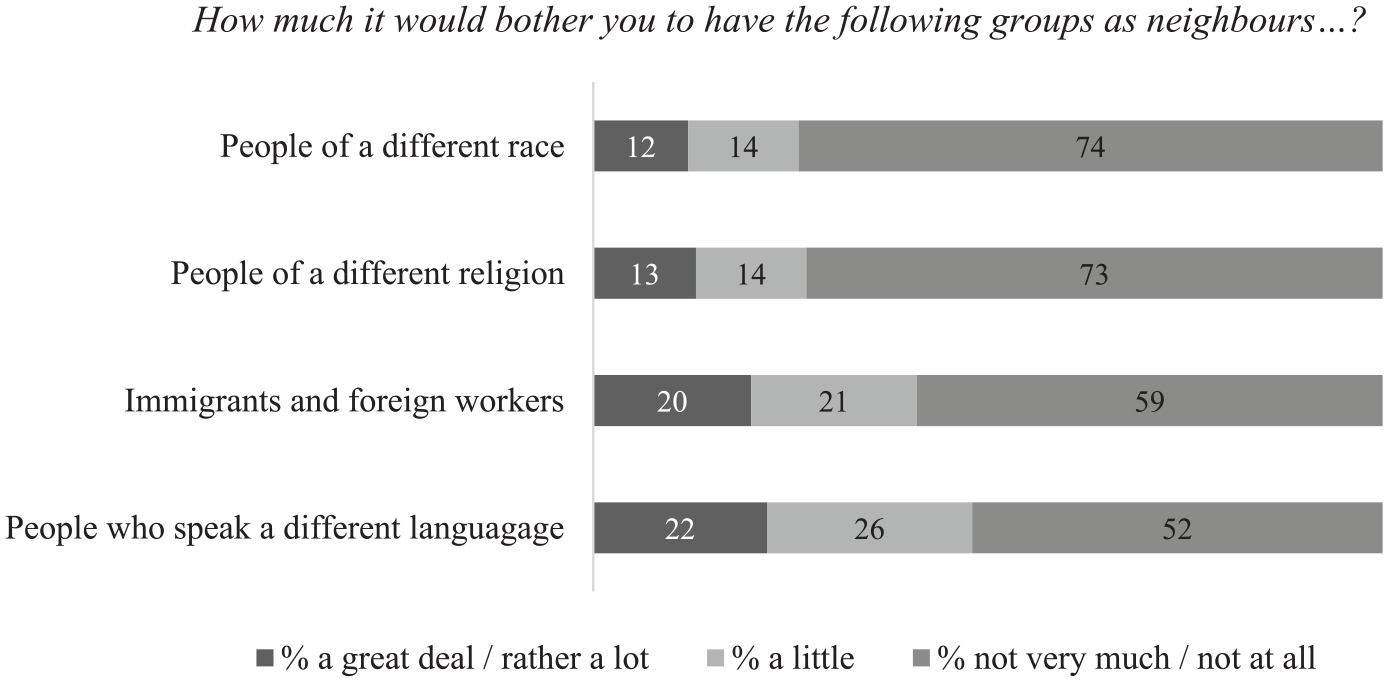
Social distance measures.
These patterns are replicated in other datasets, and indeed elsewhere we have shown that anti-immigrant views are gaining ground among young people in Britain, even though this same age group are getting progressively more tolerant of other social changes such as racial diversity and homosexuality (Janmaat & Keating, 2019; see also Ford, 2008). Through trend analysis of data from the British Social Survey and the World Values Survey, we show that the present generation of 18- to 30-year-olds expressed more negative and restrictive views on immigrants than previous generations of this age group. Furthermore, while this analysis also found that the present generation of young people were still more accepting of immigrants than older generations (as a spate of other studies have found; see Mclaren & Paterson, 2019), this generation gap had narrowed considerably over the last 20 years. For instance, in 1990 45% of 15- to 29-year-olds and 64% of those 50 and over supported the idea that employers should give priority to people ‘of this country’ over immigrants in times of high unemployment; by 2006 this difference had reduced to just 6% with as many as 57% of the 15- to 29-year-olds expressing support for this idea (Janmaat & Keating, 2019, p. 55).
Through further age-period-cohort analysis of the data, we concluded that this ‘illiberal’ turn in attitudes towards immigrants was a period effect, although data limitations meant that we could only speculate as to what specific element(s) of the period produced this effect. To further understand these attitudes, therefore, we now turn to our qualitative data, which allow us to analyse how young people talk about and justify their opposition to immigrants. Much like our survey data, our qualitative data indicate that a substantial minority of young people in England hold negative attitudes towards immigrants, and that these attitudes may be linked to perceptions of economic and cultural threat, and the spread of culturalised forms of citizenship. What the qualitative data are also able to demonstrate, however, is that these distinct discourses reinforce one another and that they are linked to prejudice towards another increasingly-maligned group (namely so-called ‘benefit scroungers’). We will argue that these prejudices are bound together by another increasingly dominant cultural norm, namely that a willingness to work hard is the most important disposition a person should have.
Immigrants as economic threat
When the young people in our sample talked about their opposition to immigrants, many of the objections put forward reflected the economic threat discourse that is prominent in (and familiar) from media debates and public opinion. A frequent refrain was that immigrants are coming ‘here’, taking ‘our’ jobs and housing, and undermining wages. The frustration and confusion that this has generated for some was summed up by Rashid, a young British Asian man from London who had been unemployed for 10 months at the time of his interview: I can’t understand why they keep bringing more and more people into the country, and they keep saying the people that are here are having more and more trouble. Why don’t you cut bringing people in and look after the ones you have, then bring more in? Because they’ve flooded everything, everyone’s come in here. We’ve got big housing problems, we’ve got big problems with jobs, problems are increasing – and so are the people. So, I don’t understand why everyone’s being accommodated.
An additional concern was that immigrants are not only using up Britain’s scarce resources, but also that they are getting preferential access to these resources. Paul (22), a White British graduate from Yorkshire, explained that ‘they get treated like even better than us, or the same as us or whatever’. Preferential treatment towards new arrivals was viewed as unfair; in their view, any such treatment should be directed towards people that already live in Britain. It was Danielle (a young White British woman working in the South West) who presented this argument most succinctly: You know, it’s not fair because we were born and bred here . . . Like, we should get the first opportunity; we’re here, do you know what I mean? It’s not fair.
The sense of resource competition was underpinned by their perception of the ‘imagined immigrant’ (Blinder, 2015), which tended to be that immigrants have little money, education, or language skills, and that they would therefore automatically need support from the state. This, combined with the perception that immigrants receive preferential treatment, had led some of our respondents to feel angry and aggrieved. This was particularly apparent in our interview with Mo, a young Black British man from the East Midlands who had spent lots of time at the Job Centre in the six years since he dropped out of college aged 17. Mo had found his encounters with the benefits system to be frustrating, particularly recently when: I was homeless, I was jobless, I had fuck all money, and they’re telling me they can’t help me. But yet someone can jump off a plane, that’s not even from this country, and can walk in there and say ‘I’ve just come from this country, I’ve got no money, I’ve got nowhere . . .’ and they will give them a 5-bedroom house. Are you taking the piss? Like, are you actually taking the piss? And it’s British people sleeping on the streets – come on?!
Here, Mo’s concerns echo one of the central narratives that underpinned the backlash against multiculturalism that emerged in the US, the UK, and across Europe in the 1990s and 2000s (see Hewitt, 2005; Vertovec & Wessendorf, 2010). This is sometimes characterised as a ‘white’ backlash, but Mo’s position as a Black British young man suggests that the backlash has evolved and widened its appeal over time and illustrates some of the contradictions of public attitudes towards minorities that Nayak (2003), Vertovec and Wessendorf (2010) and others have called attention to.
Immigrants as cultural threat
Concerns about economic and resource competition were often coupled with anxiety about the transformation of British society and the place of Britain in the world. These anxieties are based in part not just on their evaluation of the present, but also a nostalgic view of the past. For example, Kyle (White British, 22, living and working in the North West) talked wistfully about the Thatcher era, even though he was born two years after she left office: . . . I just feel like this society has completely changed to what it used to be like, even say 20 year ago. Everyone hates each other, don’t they? If Margaret Thatcher was in charge there wouldn’t be anything like that. And I know lots of people hated her but the country would not be in the predicament that it’s in at the minute. It’s like on the verge of collapse again and they can’t even see it. They’re saying [Britain’s] rising, but it’s not. They don’t see the people that I see every day that haven’t got a penny to scratch your arse with basically, and that’s what it is . . . Like, I live on my overdraft and I work full time – for what? I don’t live, I just pay bills.
Likewise, when explaining her concerns about immigration, Kelly (a young White British woman who was working as a carer in the East of England) told us that: You know, it’s not even Britain anymore. You go down [into town] and it’s like, you know, full of ethnics. You can’t even read any of the signs on the windows. And I’m like, ‘hello, where are we?’
Here, Kelly seems to be harking back to an imagined time, when cultural and linguistic diversity were not (as) visible in Britain’s towns, and her town looked more like the (White, English-speaking) home she imagines it was and should be.
Kelly was one of the very few of our interviewees who used explicitly racist or racialised language to express their concerns. Instead, most were keen to emphasise that their concerns about immigration were not racially motivated. As Mo (the Black British man we quoted earlier) put it: . . . I’ve got multi-cultural friends, like my whole group of friends is multi-cultural, I’m not racist, I’m nothing like that. But how I see it is, you’ve got to look after your [own] people at the end of the day.
Yet despite their claims to the contrary, the anxieties that were expressed were often underpinned by a sense of disquiet about increasing cultural difference and religious diversity. For example, Gary (White British, 22, working in North West England) felt that: . . . preferential treatment . . . can be a bit of a problem these days . . . With this whole diversity thing that they have for a lot of places, it feels like sometimes just because you’re a white person it feels like you can lose opportunities just because there’s this diversity thing.
Amid the general concerns about ‘this diversity thing’, the perceived need to accommodate the principles and practices of the Muslim faith was a particular concern for some. Again, there was a sense of special allowances being given to Muslims when, as our interviewees often saw it, Muslims should be assimilating into British society so that they would ‘abide by our rules, abide by our laws’ rather than ‘coming over here, telling [us] what to do’, as Nathan, a young White British male working in London, put it. At times, this anxiety manifested itself in explicit Islamophobia. For example, Paul (a White British university graduate working in Yorkshire) thinks that ‘there’s that many immigrants coming in, Muslims and stuff, I think eventually something’s going to happen before we become a Muslim nation, because I think we will do’. Meanwhile, Ryan, a young White British man who also works in Yorkshire, revealed that: I’ve been very scared of like the Muslim society, I feel like after that happened it’s . . . I feel like they’re all going to turn [a]round and they’re going to do someat to you.
The imagined immigrant in youth narratives: Hierarchies of inclusion and exclusion
Even when young people were strongly opposed to immigration, they nonetheless tended to made a distinction between ‘good’ immigrants and ‘bad’ immigrants – that is, ‘people who come here for the right reasons’ (as one interviewee put it) versus people who just want to ‘take advantage’ of the country. In the discussion above, we can see that, for some, the ‘bad’ immigrant was one that would challenge ‘our laws’ and ‘our rules’ by, for example, adopting distinctive religious practices or behaving in a ‘foreign’ way. Yet what was particularly striking about these youth narratives was that what constituted a ‘good’ immigrant or ‘bad’ immigrant was often not presented as a matter of race or religion. Instead, young people tended to distinguish between ‘hard workers’ (the good immigrant) and ‘scroungers’ that do not want to work (the bad immigrant). As Kelly explained to us: If you’re going to come here and you’re going to work, you’re going to work damned hard to send money back to your family, do it, do it, go ahead. But if you’re coming to have 20 kids and sit in a 3-bedroomed house with 20 of you on my taxes, then I don’t see why you should [be allowed to] really.
And Jason was one of many who made a similar point: I can understand if you’re coming over here, you’re going to get a job – no problem, I don’t have a problem with that. But when you’re coming over here just to reap the rewards of the benefit system and take the piss really, then I don’t think it should be allowed.
The importance of immigrants’ working hard emerged again and again in the interviews, including in interviews with young people that professed positive views of immigrants and immigration. In these discussions, the implication is often that ‘hard working’ immigrants are welcome (and thus deserving of membership of British society), whereas bad immigrants (that simply take up scarce welfare state resources) are not. This, in turn, suggests that, for young people, the hierarchy of deservingness is not based on need or entitlement, but on willingness to work hard.
In this, then, immigrants are viewed in a not dissimilar way to how many of our young respondents viewed British people that are unemployed and receiving social welfare support. In many of our 101 in-depth interviews, these individuals also tended to be dismissed as work-shy ‘benefit scroungers’. Over the past 25 years (and in tandem with the rise in immigration to Britain), there has been a resurgence of the idea that unemployment is a ‘lifestyle’ choice rather than a structural problem (Macdonald et al., 2014), and welfare recipients (or even groups that look like they might be welfare recipients) have been increasingly demonised for working insufficiently hard. Our findings also chime with those of Franceschelli and Keating (2018), who have argued that the idea that ‘hard work’ can help individuals to overcome all obstacles has become deeply embedded in the discursive and normative framework of Britain’s youth. This concept is used by young people to motivate themselves, particularly when they are facing obstacles in their own lives, but when applied to others, it is often used as a means to judge and condemn those that are perceived to be not working hard enough (Franceschelli & Keating, 2018; see also Mendick et al., 2015). In short, Hard Work is a pervasive and powerful cultural norm, and based on the findings we present here, it has become a double-edged sword that plays a defining role in how young people decide who is deserving of inclusion and who is not. In other words, hard workers are top of the hierarchy of deservingness and ‘benefit scroungers’ are at the bottom.
The fact that young people use a cultural norm (‘you must work hard to achieve your goals’) to determine who is included and who is not provides further supporting evidence for the culturalisation of citizenship thesis (Nicholls et al., 2016; Tonkens & Duyvendak, 2016). However, the use of this cultural norm is also tied to perceptions of immigrants being an economic threat. That immigrants should work hard and avoid scrounging off the state is linked to the pervasive assumption that all immigrants have little money, education, or language skills, and that they will need (and be a drain on) the scarce social welfare resources that are available. Because of the perception that they ‘scrounge’ off the state, immigrants pose both an economic threat (to the country’s resources) and a cultural threat (in terms of posing a perceived norm violation). Attitudes towards immigration are sometimes understood as being explained by either economic or cultural factors (Hainmeuller & Hopkins, 2014), but here we can see that the two are linked together in the discourse of Hard Work.
Discussion and conclusions
The primary purpose of this analysis has been to shed light on the substantial minority of young people that express anti-immigrant attitudes and to explore how young people that hold these negative views talk about and justify their attitudes. Where previous youth studies have focused more on anti-immigrant attitudes among far-right supporters, we sought to examine the more routine, ‘everyday’ discussions of anti-immigrant sentiments that emerged during our wide-ranging interviews with young people. One finding from this analysis is that when young people express anti-immigrant attitudes, these attitudes are linked to the perception that immigrants are an economic and cultural threat and that they receive preferential treatment. Youth attitudes thus echo the discourses that are widely apparent in British and other Western societies, and that have been identified elsewhere in the academic literature (Hainmueller & Hopkins, 2014; Norris & Inglehart, 2019). They also reflect the ongoing culturalisation of citizenship that is taking place across the Global North (Tonkens & Duyvendak, 2016).
What we also found, however, is that the concept of Hard Work (or lack thereof) plays a key role in how young people in England conceptualised immigrants and explained their attitudes towards this imagined group. In short, we argued that Hard Work is a deeply-embedded cultural norm that provides a discursive framework to help young people to discriminate between who deserves to be included or excluded. Accordingly, immigrants (and others) that do not work hard enough do not deserve to belong as they pose an economic threat (draining the welfare state’s resources) and a cultural threat (not behaving in a culturally-appropriate manner). In this sense, our findings reinforce those of Anderson (2015, p. 41), who argued that ‘the moral worth of labour is a feature of debates about both migration and welfare benefits and can be used to divide migrants and citizens’. We complement these observations by showing that the Hard Work discourse does not work in isolation; instead, it reflects, reinforces and extends the economic and cultural threat discourses we see elsewhere. It may also help some young people to express their anti-immigrant attitudes without violating another social norm that has come to predominate (that of anti-racism; Ford, 2011). Hard Work is perceived to be something anyone can do if they are only willing to do so, and success (or lack thereof) is merit-based. This perception is underpinned by the assumption that securing work and becoming financially independent is a universal option and an individual choice; that choices are made independently of structural barriers such as race, ethnicity, social class or religious affiliation (Franceschelli & Keating, 2018). To express your concerns in terms of willingness to work, then, becomes a means of asserting your meritocratic credentials and obfuscating the role of racism, classism and Islamophobia in shaping public attitudes towards immigrants.
When asked, the young people we spoke to tended to attribute their views to media reports rather than actual experiences or peer/family influence; this is perhaps unsurprising given that the subject has received relentless negative media attention for almost two decades (Shabi, 2019). Although the strength and spread of anti-immigrant sentiment caught many by surprise in the midst of the Brexit referendum debate, these discourses have been circulating for far longer, and were then further enflamed by the Global Economic Crisis, the subsequent ‘austerity’ policy regime, and political entrepreneurs seeking to exploit the situation and shift blame for other policies (Ford, 2011; Shabi, 2019). In this context, we believe that our qualitative data help to understand how public perceptions about immigrants are not only linked to the ongoing transformation of citizenship in Britain, but also to how the public makes sense of the socio-economic inequalities that have become ever deeper since 2008.
These findings have implications both for immigrants and for young people themselves. As Nicholls et al. (2016, p. 1593) remind us, the culturalisation of citizenship leads immigrants ‘to perform their deservingness, [as they must] find ways to justify why they deserve to be members of the society’. If immigrants feel they must demonstrate how hard working they are in order to become members of British society, they may accept working conditions that are exploitative, or deny themselves welfare benefits that they need and/or are entitled to. For young people more broadly, the emphasis on hard work as a criterion of deservingness may also have negative consequences for their own lives. For instance, it may result in the rights-based dimensions of social inclusion becoming weaker for existing citizens, not just for new or aspiring citizens. As social membership is becoming more intertwined with one’s relationship to work, this shift not only undervalues other ways of contributing to society, but also further undermines the idea of a social safety net for all.
Footnotes
Acknowledgements
The authors would like to thank the reviewers for their constructive comments.
Funding
The authors declared receipt of the following financial support for the research, authorship, and/or publication of this article: This work was supported by the ESRC (grant ref: ES/J019135/1).