




Abstract
The process of knowledge production involves negotiating several social worlds, whereby actors engage in positioning and repositioning to situate their intellectual labour and gain symbolic resources. This article considers the strategic positioning of policy research actors using interview and document data. It sets out the ways in which individual and institutional actors negotiate and situate their intellectual practice in order to gain capital from a range of relevant fields. The article considers how organisations position themselves in relation to other institutions, and how individual researchers position themselves vis-a-vis their own organisations and others in the hybrid space between more established fields. It demonstrates how identities are constructed in a relational way via comparison and juxtaposition in the liminal space of international development. In doing so, it directs attention to the strategic practices involved in the production of meaningful intellectual interventions.
Introduction
Expert knowledge is essential in addressing the most pressing social, economic and environmental issues of our day. Understanding how this knowledge comes to be, and how it gains legitimacy with intended recipients, is critical to producing meaningful research. Although historically the domain of universities (Delanty, 2001), expert knowledge is now created, shared and utilised by a number of diverse and networked actors. Profound social, cognitive and institutional changes have occurred in the last few decades, resulting in a rise of non-university knowledge producers (Enders, 2005; Gibbons et al., 1994), including think-tanks, government agencies, firms and NGOs. Although these broad changes in the production of knowledge have been well-documented, existing studies have primarily focused on distinct sites of production, such as universities, think-tanks or government agencies. As such, there are largely discrete literatures on different organisational types, each bound up with definitional challenges and contests over the form and function of knowledge.
This article is concerned with unpacking the presumed divisions between three policy research contexts, namely, university departments, think-tanks and government agencies. Sociological studies have largely focused on particular discrete modes of knowledge production observable within demarcated contexts (Abbott, 1988; Bourdieu, 1990). These bodies of literature run in parallel, serving to reify differences between types of organisations in the research–policy nexus. I aim to investigate how these divisions are borne out in discourse and action. Organisational types have tended to be understood as explanatory variables within self-contained contexts. This fails to consider the strategic identity formation and use of narrative involved in knowledge creation. This article draws on positioning theory to demonstrate how identities are constructed in relation to other actors in a hybrid space between more established fields or disciplines.
The article examines how actors engage in strategic positioning and repositioning to situate their intellectual labour and gain capital in a hybrid space that lacks clearly defined symbolic resources. It begins by outlining the nature of fields and capitals, as established by Bourdieu and developed by Medvetz. It then introduces positioning theory as a means of conceptualising the strategic ways different types of capital are sought and attained by research actors. By examining three different research contexts (universities, think-tanks and government agencies), the article provides an analysis of strategic positioning and explores the correspondence and tension between institutional and individual positions. In doing so, it unpacks the presumed divisions between research contexts and considers how they are borne out in language and practice. It reframes policy knowledge as existing within a ‘space between fields’ (Eyal, 2011), and takes research contexts not as self-contained units, but as negotiated sites of contemporary intellectual participation. It reinterprets the apparently discrete contexts as existing within an interconnected hybrid space where policy knowledge is created.
Fields and capitals
The existing literature on expertise and knowledge production in policy areas tends to focus on bounded, institutionalised contexts with clearly defined borders, which take the form of discrete organisational types, such as think-tanks or government departments, or independent areas of expertise, such as education, journalism and a range of formal disciplines (Abbott, 1988; Gieryn, 1983). These defined borders allow knowledge production in policy contexts to be understood through structural elements, such as modes of funding and evaluation. For example, institutionalist theory holds that an organisation’s actions display its institutionalised rules and processes (e.g. DiMaggio & Powell, 1983; Glaser et al., 2016), but tends to take organisational types as separate bounded units, which does not capture the significant overlap between sites of knowledge production. Furthermore, this line of enquiry often focuses on formalised and mature fields where professionals have recognised expertise and claims to particular types of knowledge (Haas, 1992). In these cases, such as law or medicine, it is easier to discern the logic of the field. However, many important areas defy this type of categorisation. These spaces can be characterised as irregular areas of expertise, such as international development, terrorism studies or transnational politics, which do not adhere to established national, professional or disciplinary distinctions (Mudge & Vauchez, 2012; Stampnitzky, 2013). Thus, there is a clear need for examination of policy knowledge contexts where there is no authoritative or consensual means for control over the production of either experts or knowledge (Stampnitzky, 2013).
The process of knowledge production in these contexts does not occur within bordered self-referential communities or within predefined organisational types. These irregular areas require a focus on how actors compete for power in an ill-defined space that involves the logics and symbolic resources of different fields, rather than more clearly defined institutionalised rules and processes (Dromi, 2016; Vauchez, 2008). In this way, symbolic power exists in plural forms, corresponding with multiple actors from multiple fields. As such, there is a need for a framework that accounts for the continuous negotiation of diverse symbolic resources required to gain prestige and legitimacy in policy research. In understanding the way in which intellectual authority is sought by individuals and vested in intellectual products, a theoretical vocabulary is required that can be used to understand the ways in which actors position themselves in light of existing structures, given a lack of established routines and traditions. For example, there is a growing body of research that considers the strategic identity formation and use of narrative involved in knowledge creation (e.g. Williams, 2018). This literature illuminates how research actors can position their intellectual practices and products to gain available forms of legitimacy and credibility. The policy research space is thus made up of individual and group contests over definitions, resources and expertise, which forces actors to position themselves by appropriating resources from more established fields, such as emphasising political clout or media skills. This appropriation allows them to produce knowledge that is applicable to academics, policymakers and practitioners.
Field theorists (e.g. Fligstein, 2001; Fligstein & McAdam, 2012) consider fields to be sites of struggle or contest where actors share common understandings and practices encompassing tacit knowledge and embodied behaviours (Bourdieu, 1990, p. 54). Within a field, the various actors share understandings of field-particular types of ‘capital’, and seek dominance over different types (e.g. social, logical, religious). They assess other actors on the basis of their accumulated capital, and endeavour to expand their own (Bourdieu, 1985, p. 724). Bourdieu depicts four types. Economic capital is the actual scarce resources that are at stake. Cultural capital is tastes and education that distinguish actors from one another. Social capital is the networks and access that permit access to other sources of capital. Symbolic capital is the prestige, reputation and eminence available in a particular setting. An actor’s portfolio of capitals shapes their strategies, practices and affordances, and ultimately, their position within the field (Medvetz, 2008). Thus, even amongst comparable actors, the various accumulations of capital and the corresponding positions within the field shape the strategies and opportunities that can be utilised to navigate that field (Croce, 2015).
Drawing on Medvetz’s (2012a, 2012b) framework of four key types of capital involved in the interstitial space of American think-tanks, Table 1 shows the strategic negotiations that allow policy research actors to gain different types of capital. In this approach, actors must engage in strategic positioning in order to maintain a balance between capitals because they cannot simultaneously occupy multiple fields. Instead, these actors draw on the capitals and logics of parent fields by differentiating themselves with reference to certain positions (Medvetz, 2012a). The language and concepts of the overarching fields are strategically mobilised by actors within the hybrid space. The use of different types of language can then be observed and analysed. This article diverts from Medvetz’s focus given its concern with the process of knowledge production across research contexts, rather than in a specific interstitial space (i.e. American think-tanks). It draws on notions of shared symbols in order to consider a broader range of policy research environments. This study shows how researchers acquire and mobilise materials to make successful intellectual interventions in various arenas.
Strategic positioning and corresponding capitals (adapted from Medvetz, 2012b).
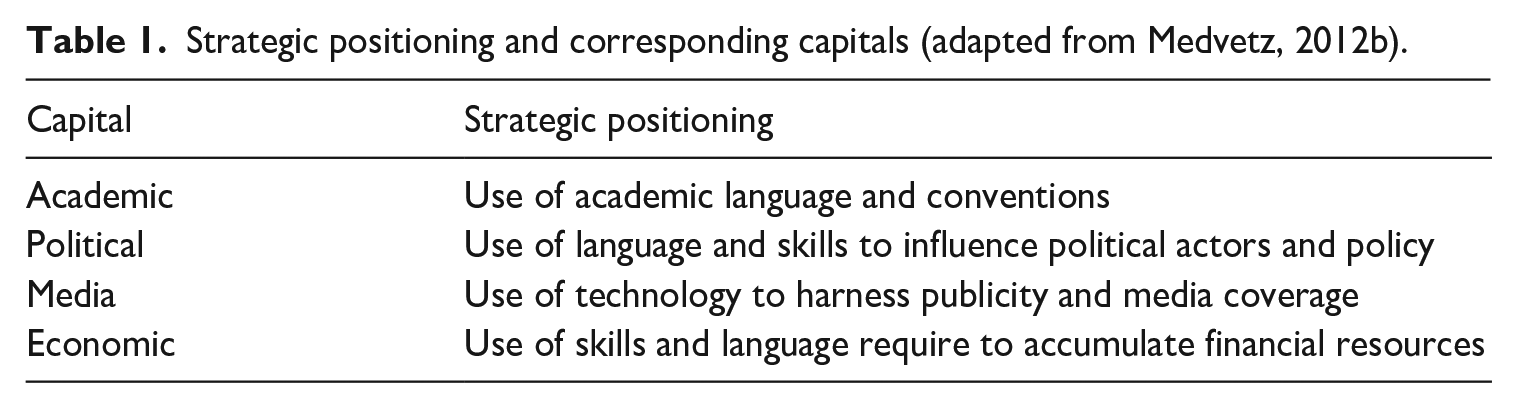
Actors are thus free to accumulate distinct capital portfolios and positions. This perspective allows for the inevitable variation in aims, strategies and interests within a given research setting over time, without relying on the modes of a single field or profession. Thus, typologies of ‘university’, ‘think-tank’, ‘government agency’ are relevant not for their descriptive labels, but for the negotiated positions that become available through capital portfolios of actors within the space between fields. Thus, although at first glance the three contexts might appear to lend themselves to a simple categorisation as ‘academic’, ‘hybrid’ and ‘political’, I suggest that each context should be understood in terms of their strategic positioning. This positioning can be observed by attention to the type of language and skills mobilised to gain different types of capital.
Positioning
To understand the way in which different types of capital are sought and attained by research actors, I utilise concepts provided by positioning theory. Positioning theory provides a theoretical vocabulary that can be used to understand the ways in which actors strategically position themselves, and their intellectual products, in a space without established routines and traditions. As Baert (2012, p. 304) states:
The reception, survival and diffusion of intellectual products – whether as research programmes, theories, concepts or propositions – depends not just on the intrinsic quality of the arguments proposed or the strength of the evidence provided, but also on the range of rhetorical devices which the authors employ to locate themselves (and position others) within the intellectual and political field . . . an intellectual intervention – whether as a book, article, blog or speech – does not have an intrinsic meaning as such; it acquires its meaning in a particular setting.
Positioning is thus inherently relational, and provides an alternative to the notion of fixed professional or intellectual ‘roles’ (Harré & Van Langenhove, 1998). Positions are flexible and ever-changing interpersonal interactions, and actors strategically position and reposition themselves and others through a coherent but malleable discursive process (Baert, 2012).
Positioning theory offers particular value in understanding how researchers position themselves in relation to one another as well as institutions, structures and the intellectual tensions and pressures of the contemporary policy research landscape. According to this perspective, there are two key elements of positioning (Baert, 2012). The first is the positioning itself, which is the focus of the discussion presented below, and the second relates to the interaction with pre-existing status and positioning of the actor within the field, as well as with the positioning of other individuals in the same field and the broader intellectual context. An important aspect of positioning theory lies in its ability to avoid the suggestion, inherent in Bourdieu’s (1990) and others’ work (Gross, 2009), that an individual’s environment and intellectual work are fixed over time (Baert, 2015). As such, it accounts for flexibility in how actors present themselves and situate others, which is crucial in the negotiation of the space between fields. Operationalised through analysis of language and skills that are displayed, the theory avoids speculating about the accuracy of positions (i.e. whether they reflect inherent identities and values), and instead focuses on the way actors act upon a position through language (Baert, 2012). Individuals are not able to position themselves and others at whim. Rather, positioning parties have unequal power, for example, in the way that we are positioned, and position ourselves, in terms of gender or race.
This version of positioning theory thus provides a theoretical foundation for the study of intellectual labour across research contexts. It allows for an exploration of the selective advantages or disadvantages that different types of positioning might provide within a specific intellectual, cultural and political context (Baert, 2012). It therefore provides a means of understanding how researchers’ and organisations’ self-positionings are attained in a poorly defined space. That is, how they perform authority through positioning their intellectual work discursively via the capitals and features of other fields, professions and settings.
The theory suggests an agential dimension where individuals have more capacity to strategically accumulate capital than is present in Bourdieu’s focus on the habitus of a field (i.e. the historically grounded socialising and structuring environment). Yet, despite attention to the strategic element of actors’ positionings, attention to the habitus of a field is important to avoid a simplistic conceptualisation of unregulated competition for capitals in a marketplace. Thus, this approach foregrounds how an individual or institution can strategically negotiate their way through various fields in order to gain particular types of capital contained within their particular habitus, given that the space between fields does not possess its own. The habitus within liminal spaces is therefore shaped by multiple intersecting fields, and represents a site of contestation over categorisation and identification that limits the tendencies for potential action and agency. Although there is some incommensurability between positioning theory and field theory, the approach outlined here shifts positioning theory towards a more structured Bourdieusian frame, whilst at the same time moving field theory into a more subjectivist position. This represents a novel conceptualisation of knowledge production that differs from the focus on institutional factors or field structure evident in much of the recent work (e.g. Glaser et al., 2016; Medvetz, 2012b) that seeks to examine the social processes by which policy knowledge is created, developed and transformed in a hybrid space that lacks demarcated symbolic resources.
Methodology
Research context
In this study, I sought to operationalise positioning theory (Baert, 2012) in the context of the space between fields (Eyal, 2011) by attending to the use of language. I examined the strategic positioning that forms part of the negotiation between research actors, intellectual interventions and intended recipients. The study investigated the positioning of research actors from three research contexts: specifically, university departments, think-tanks and government agencies within the British international development context, plus one international agency. In order to explore differences between research contexts, the analysis was limited to a single field of expertise and a primary country. International development was selected because it is an irregular or non-standard field (Stampnitzky, 2013), which has permeable borders with no clear training or certification procedures and weak control over who can practise. There is a stalemate over what counts as expertise, and knowledge is produced in the space between fields at the nexus of multiple worlds. This is of relevance to other areas, such as terrorism studies, where expertise is contested by a range of actors including practitioners, policymakers and academics in the absence of established sources of status or legitimacy as an ‘expert’. The UK was chosen because of its long history of international development research, and the international agency was selected to provide an understanding of transnational research organisations.
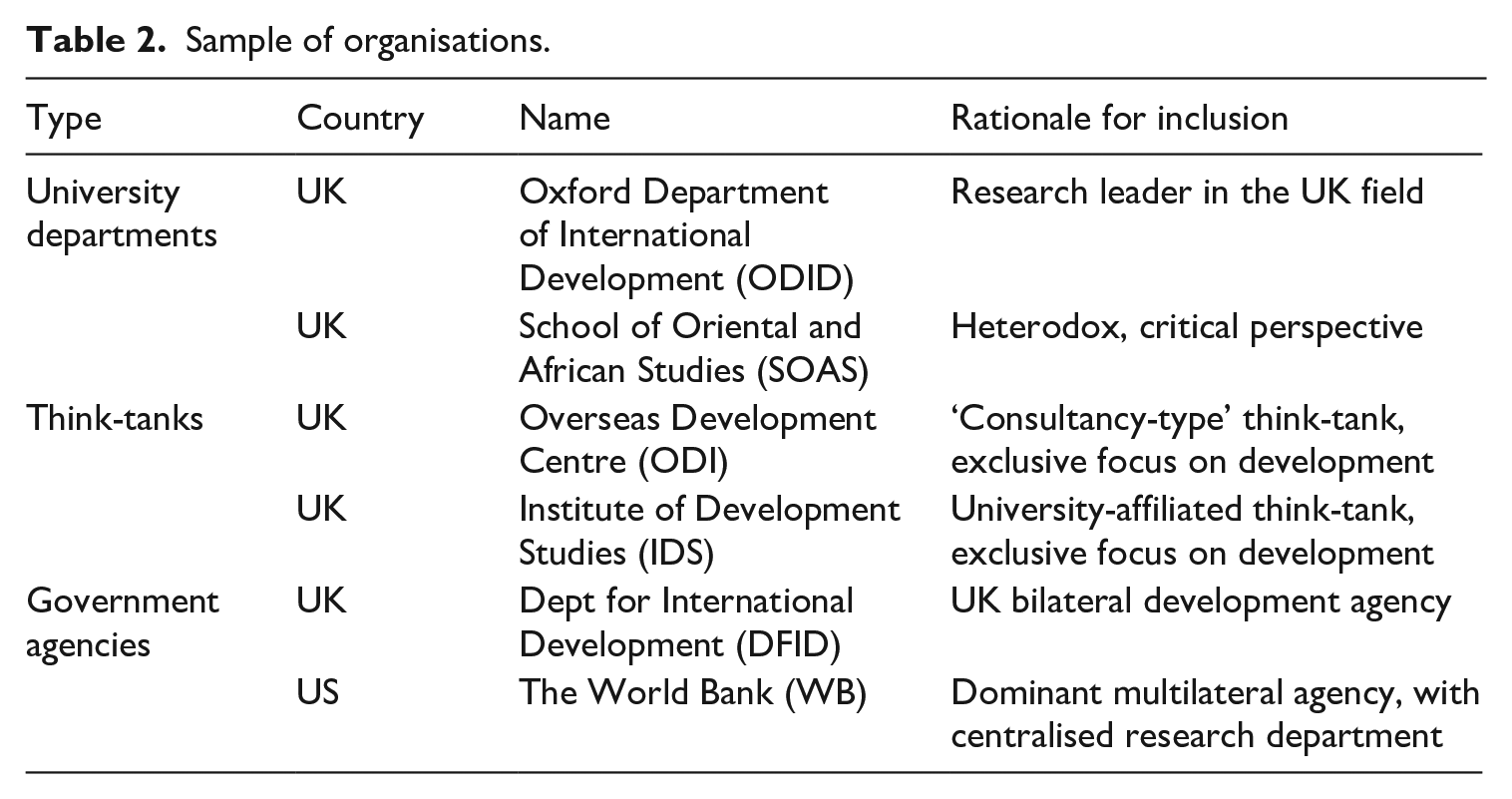
Six cases were selected; two from each research context. To select the cases, I triangulated several sources to establish a list of research organisations. Each case has an established policy-relevant research programme, and is actively engaged in producing knowledge for development research, practice and policy. A review of online materials was conducted to determine the nature and scope of their work in the field, and specific institutions best representing category types (e.g. university departments with strong reputations for development research, and prominent think-tanks that specialise in the field of international development) were selected for in-depth analysis, shown in Table 2. The institutions each have different profiles with regard to focus, funding and size, as outlined in Appendix A.
Sample of organisations.
From these six cases, documentary data were collected during 2015 by collation of documents or online artefacts that provided insight into an organisation’s self-positioning within the field. Limited to a period of 10 years (2004–2014), the document sources included: self-publishing and media presence, including policy briefs, reports, books, journals, website and blogs, events and public engagement, social media and media presence, as well as institutional materials, including annual reports, websites, financial statements and submissions to charity commissions or evaluation frameworks. Cited documents are provided in Appendix B. Publications are taken as intellectual interventions made by an author and an organisation, whereby each publication makes up the positioning that constructs the space between fields.
Interview data were collected through interviews with participants from the six cases. Interviews probed the everyday processes and practices of knowledge production that respondents were engaged in. Thirty-six interviews were obtained through two interrelated sampling strategies, conducted during 2014 and 2015. Purposive sampling (Schatzman & Strauss, 1973) was utilised to ensure respondents represented the research context of interest as well as a range of ages, ranks and disciplinary backgrounds. This strategy was employed in order to access a range of available positions taken up by researchers, and to showcase illustrative elements in the production of policy knowledge. Suitable participants were involved in producing and disseminating policy research outputs, and were identified through university and institute websites. The sample contained a balance of seniority and gender. The study was presented as an examination of knowledge production in international development, and discussion was guided by an interview schedule that focused on the field, research practice, processes and structures, as well as outcomes. Interviews lasted between approximately 45 minutes and one hour, with written consent obtained at the beginning of the session.
Analysis
The method of analysis was directed content analysis. Positioning and field theories were used to set the initial coding scheme and relationships between codes (Mayring, 2000). Key concepts were employed as preliminary coding categories (e.g. ‘academic’, ‘media’, ‘political’, ‘economic’; Potter & Levine-Donnerstein, 1999), to which operational definitions were assigned. Here, the analysis focused on the strategies of language that ‘naturalise’ relations of control (Fairclough, 1985). The application of this analysis to intellectual labour necessitated an examination of the processes of self-positioning to influence intended audiences. The interview transcripts and documents were coded and analysed using MAXQDA software. The process began with a period of categorisation and exploration of transcripts and documents, and recording variability and consistency in the data. The properties of positions taken by institutions and individuals were systematically examined, and explicit evidence was gathered by assigning segments to unique codes within the broader coding categories. The textual and contextual properties of positions taken by actors were systematically examined, and evidence for each account was coded. The codes were organised by: context/field (e.g. ‘university’, ‘think-tank’), topic (e.g. ‘funding’, ‘impact’), audience (e.g. ‘policy’, ‘practice’) and theme (e.g. ‘identity’, ‘value’, ‘boundaries’). The second phase of analysis was concerned with identification of the functions of patterns in the process of intellectual labour. The extracts presented in this article were chosen as illustrative examples of the identified patterns.
Results and analysis
Institutional positioning
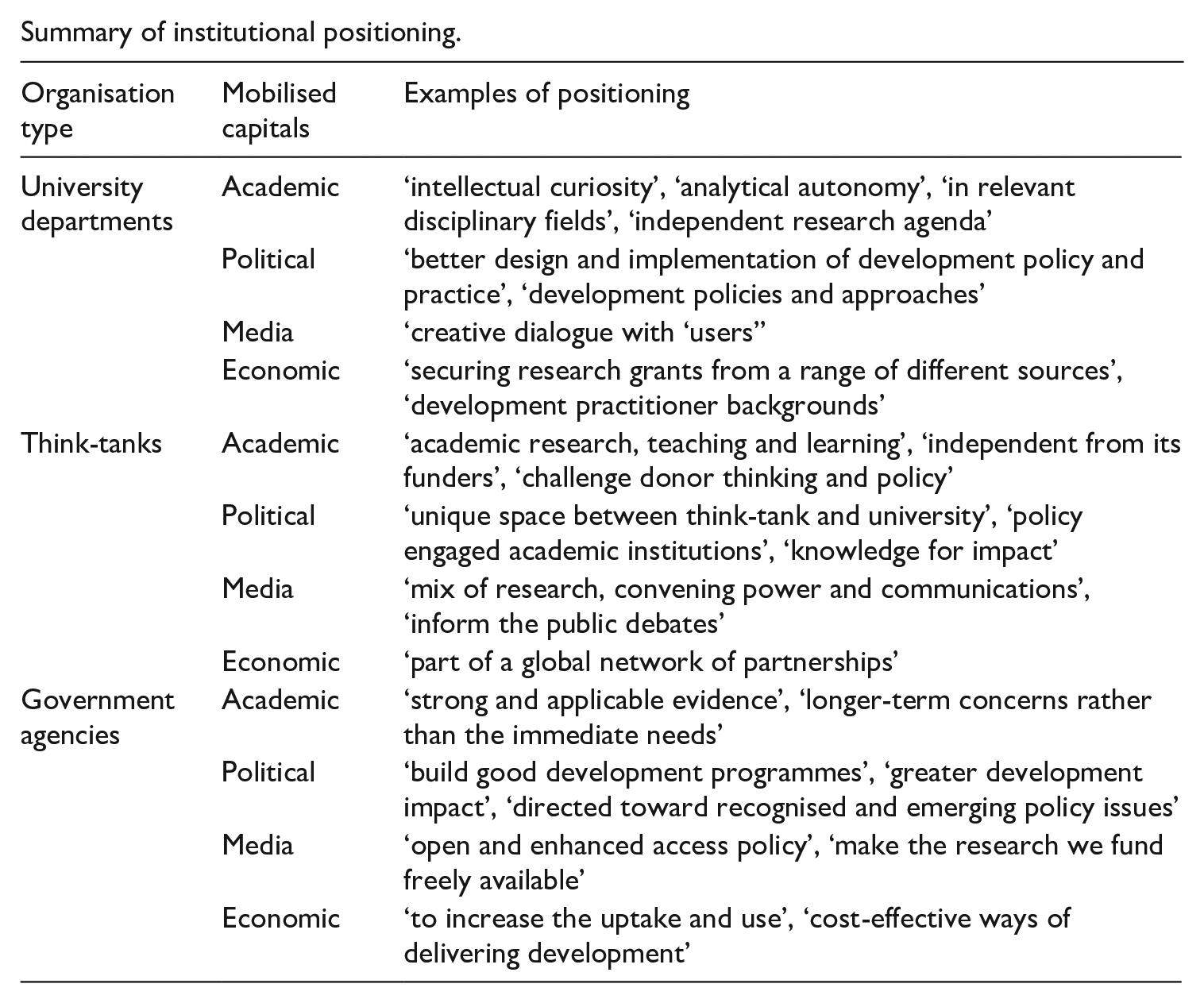
This section examines the positioning and identity formation of six policy research organisations, via document analysis (summarised in Appendix C). It considers how institutional accounts of intellectual labour position organisations within the space between fields.
Universities
The Oxford Department of International Development has a reputation for high-quality teaching and research. The department self-describes as ‘critical and multi-disciplinary’ (ODID, 2015b). The department’s annual report (ODID, 2015a; emphasis mine) illustrates explicit positioning within the wider field of international development. For this first case, I have annotated key instances of relevant capitals in parentheses, using Table 1 as a guide.
The range and depth of research at the department reflects the intellectual curiosity of its members rather than any agenda set by the University or external funders and donor agencies (academic). Individual researchers and research groups exercise analytical autonomy (academic) . . . While emphasising academic rigour, our research engages explicitly with policy issues (political) – albeit critically and with a long-term perspective (academic). We strive to contribute to better design and implementation of development policy and practice by both government and non-governmental organisations (political), based on sound empirical evidence and a critical analytical approach (academic) . . . In support of our independent research agenda (academic), we have had significant success in securing research grants from a range of different sources (economic) . . . The diversity of our external research funding encourages creative dialogue with ‘users’ (media) while preventing the ‘aid agenda’ from determining our priorities.
As shown, ODID strongly locates its work in proximity to the academic field, but also seeks to gain legitimacy from political, economic and media fields. This excerpt demonstrates a concern with self-positioning as simultaneously distinct from and similar to other fields (e.g. consultancies or government). ODID signals its cognitive autonomy via emphasis on its independence from a number of named entities (‘geopolitical forces’, ‘donor preferences’), but also signals some degree of heteronomy through highlighting its (limited) dependence on political clients (‘policy’ makers and ‘users’), economic clients (‘charitable trusts’, ‘funding agencies’) and media clients (‘users’ via public relations reports, publicity). ODID’s positioning thus involves a dual process of affiliation and disaffiliation.
In contrast to the broad focus of ODID, SOAS specialises in Asia, the Africa and Middle East. The Development Studies department emphasises a strong critical heterodox identity, but with close links to policymakers, practitioners and users. The department’s website (2007) provides some insight into its positioning:
Our department takes a heterodox approach, seeking not only to understand the major drivers of development, but also to critically evaluate them with a view towards informing more just and equitable approaches to development. Many of our staff come from development practitioner backgrounds and this informs what we teach. We are all engaged in field research which routinely sends us to places where development policies and approaches touch people’s lives in direct ways. (emphasis mine)
In addition, the department’s Research Assessment Exercise (RAE, 2008) submission states: ‘policy work has been extensive, but attached to critical assessment, and based on the maintenance of our independence, taking up or encouraging constructive critical positions in a bid to change prevailing policy’ and ‘almost all staff benefit from 100% core funding so that scholarly integrity and choice of research is not compromised by the need to obtain external funding’. These examples illustrate dual teaching and research orientations, and thus two distinct but overlapping audiences. In both cases, SOAS demonstrates political and practical engagement, thus seeking political and media capitals, while protecting their critical academic focus against accusations of dependence on external sources.
The above section illustrates how two universities position themselves within the development research space. Both cases achieve coherent identities, and their self-positioning suggests complex portfolios of capital via nuanced associations with various fields.
Think-tanks
The Overseas Development Institute is a charitable company limited by guarantee that positions itself as ‘one of Britain’s leading independent think-tanks on international development and humanitarian issues’ (Charity Commission, 2015; ODI, n.d.). ODI’s institutional materials frequently reinforce two key values: independence (e.g. ‘ODI’s research, public affairs and policy advice are independent from its funders, and staff are able to challenge donor thinking and policy and the wider development consensus’), and quality (e.g. ‘best practice, innovative approaches and continuous improvement are ensured in research, policy advice and public affairs’). The annual report (2015, p. 6) states:
Through our distinctive mix of research, convening power and communications, we have achieved global reach and global presence – making us uniquely placed to generate the ideas, influence the policies and inform the public debates. (emphasis mine)
ODI engages in careful positioning that allows it to be located within the ‘centre’ of the space between fields. It seeks a range of capitals, and engages in a complex juggling act. It signals cognitive autonomy by emphasising independence from ‘funders’, ‘donors’ and ‘the wider community’, but also signals heteronomy by highlighting dependence on political, economic and media clients (i.e. positioning its intellectual labour as marketable, politically/practically useful and cutting-edge). Academic expertise is established through the use of university titles (e.g. ‘fellows’) and political credibility is garnered through reference to networks and partnerships and the production of policy briefs. Similarly, economic credentials are demonstrated through ‘everyday business practices’ (e.g. sales income) and language (e.g. ‘maximum value’) and media skills are demonstrated by, streaming public events online, Twitter use and dedicated public affairs and communications staff. ODI views itself as a broker, ‘bridging the gap between research and policy and using innovative communication to reach the right audiences’ (ODI, 2015, p. 3).
The second think-tank, the Institute of Development Studies, is a self-described ‘university-affiliated think-tank’ located at the University of Sussex. Registered as a charitable company limited by guarantee, it is financially and constitutionally separate from the University (although IDS pays a fee for use of University buildings, services, and other benefits) (IDS, 2015a). A statement by Lawrence Haddad, former Director, illustrates a hybrid institutional position: ‘IDS occupies a unique space between think-tank and university [which] reflects widespread perceptions that we are one of the world’s leading policy engaged academic institutions’ (IDS, 2013; emphasis mine). Evaluation at IDS involves indicators of success that include scientific production in high impact publications in international journals as well as dissemination and impact on policy. IDS draws on the language of multiple fields in its self-description as: ‘A community of dedicated development professionals; A centre of academic research, teaching and learning; Part of a global network of partnerships; Mobilising knowledge for impact’ (2015b, p. 5; emphasis mine). IDS establishes academic expertise (e.g. highlighting journal publications, number of PhD students, expert reports/panels) and political credibility (e.g. emphasising parliamentary evidence and policy/practice impact). In addition, it seeks media credibility (e.g. metrics on public use of its products) and economic credibility (e.g. sale of knowledge services and fundraising skills). Thus IDS highlights cognitive independence, but also signals heteronomy by reinforcing the role of political, economic and media actors in its survival.
The above section illustrated how two think-tanks position themselves in a liminal space, drawing from established fields and working to gain legitimacy by demonstrating proficiency in each. The corresponding capitals are in constant tension; organisations are careful to never appear as a ‘natural’ member of any of the established fields. The think-tanks are structurally reliant on consulting models (economic field), which must be promoted to attract further funding but simultaneously managed (by emphasising media, academic and political skills) to avoid the perception of undue funder influence. Thus, the two above cases seek deliberately hybrid capital profiles.
Government research
DFID is the UK government department responsible for overseas aid. Research is an important part of DFID’s work, evidenced by a dedicated £1.2 billion commissioned research budget, a 47-page research strategy document and an online depository of over 40,000 DFID-funded research projects (DFID, 2008, 2015b). DFID has a suite of public relations materials that emphasise the prominence of research within the department. For example, the webpage (2015a) states:
Research is at the heart of DFID’s thinking. High quality research which generates strong and applicable evidence helps us build good development programmes. Research can open up new possibilities and empower us to deal with difficult problems. . . . DFID has an open and enhanced access policy to help make the research we fund freely available and to increase the uptake and use. (emphasis mine)
Here, research is presented as a stepping stone to ‘good development programmes’, and is also an important publicly accountability mechanism. The positioning of the Research and Evidence Division is more nuanced and detailed. Their operational plan (2012, p. 3) states:
[RED] works to make DFID more systematic in the use of evidence and thereby have greater development impact. Research helps DFID [to] find better and more cost-effective ways of delivering development, and . . . to support policy choices. (emphasis mine)
Across DFID, there is therefore a strong technocratic focus on using evidence to improve practice and an ever-present concern with public accountability (e.g. value for money). Thus, despite its mandate of practice and policy, DFID must still seek legitimacy via the academic, media and economic fields, by demonstrating scholarly expertise, public relations skill and cost-effectiveness.
The sole multilateral organisation within this sample, the World Bank, is an international financial institution that gives loans to developing countries in line with its official goal to reduce poverty (World Bank, 2011, p. 2). A key pillar of its work takes the form of policy advice, research/analysis and technical assistance (World Bank, 2012, p. 3). DECRG (2015b). The Bank’s principal in-house research unit provides analysis to Bank operations and external clients. Despite existing within a dominant political space, the research department positions itself as primarily academic, but with a policy focus (DECRG, 2015b). The language and concepts of academia dominate (e.g. emphasising journal articles, scholarly associations, ‘fellows’, a ‘research academy prize’, ‘research datasets and analytical tools’) (DECRG, 2015a). However, the Bank also self-positions as firmly policy-oriented, often distancing itself from academia:
Bank research, in contrast to academic research, is directed toward recognised and emerging policy issues and is focused on yielding better policy advice. Although motivated by policy problems, Bank research addresses longer-term concerns rather than the immediate needs of a particular Bank lending operation or of a particular country or sector report. (DECRG, 2015c; emphasis mine)
Thus, Bank research is positioned as ‘more useful’ than academic work because of its concern with improving policy, but also as ‘more academic’ than policy reports because of its longer-term focus. As its impact statement states: ‘Bank researchers produce a large volume of work that is of high quality and influential by academic standards, yet much more focused on development issues and developing countries when compared to the research of academic institutions’ (DECRG, 2015d, p. 3; emphasis mine). The Bank also accesses media capital by emphasising a ‘long tradition of openness’ (e.g. collaborations, public debates, freely available datasets) (DECRG, 2015d, p. 4) which positions it away from the ‘closed’ contexts of academia and politics, and closer to a ‘government affiliated think-tank’. In addition, the Bank research team adopts strategies to gain economic capital, such as consulting services and research wholesaling activities (e.g. datasets, software). Thus, it is engaged in a balancing act where it seeks to engage the language and resources of media, academic, political and economic fields.
The above section has sought to illustrate how two government research contexts position themselves in the space between fields. Like think-tanks, these two cases rely on hybrid capital profiles, held in tension with one another. DFID seeks to acquire media, academic and economic capital through a range of strategies in order to supplement its accumulated political capital, and similarly the World Bank seeks to develop a relatively even capital profile.
Institutional positioning summary
The positions that are negotiated by research organisations can be thought of as representing the ‘natural proximities’ of the organisations, which depend on formal structures, historical identities, and ongoing positionings and repositionings by the organisation. I have mapped these relational proximities in Appendix D. The location of the organisations on the map shows the respective identities that are created through the language and skills displayed by organisations and their agents, as well as structural features such as prescribed routines, practices or constraints (see also Williams, 2019). The following section will illuminate the bounds of these institutional positions and the ability of individuals to resist the inherent characterisations.
Individual positioning
The above section illustrates how organisations present their intellectual labour within a space between fields. Yet, research actors come with their own priorities, levels of investment, and endowments of social, cultural and economic capital. Thus, a crucial consideration is how the identities of individual researchers are negotiated in relation to their employers and other actors. This section considers how researchers position themselves in relation to their own and other organisations, respectively.
Internal positions
Individuals within research organisations are aware of the ways in which their institutions present themselves to relevant publics. Researchers demonstrated an ongoing process of negotiation between the institution’s brand and their perception of the authenticity and legitimacy of that brand. For example, many researchers talked about how the brand represents an ‘ideal’ organisation (i.e. as a producer of rigorous and applied research), but that the actual values, practices and processes taken up by employees represent a much more complicated picture.
Researchers are particularly aware of both conforming to the overall institutional brand and of maintaining their autonomy. One think-tank researcher described the challenge of ‘finding’ an individual identity within a hybrid context. The organisation takes on the form of a ‘strange person’, who embodies characteristics that can either be taken up or rejected, making it ‘difficult to navigate [and] find your identity’. Similarly, a multilateral researcher describes this negotiation in terms of corporate responsibility: ‘You are also drawn into a lot of corporate responsibility in terms of management, in terms of communication, in terms of advocacy, which involves internal meetings of senior managers but at the same time you are also representing the organisation offsite.’ The suggestion is that an employee is responsible for representing the appropriate character of the organisation when interacting with a broad range of audiences. Researchers also frequently described the challenges inherent in engaging different contributors and audiences in producing written reports. This shows how institutional identity is presented via conscious efforts of individuals to produce a cohesive and collective message. Yet, the organisational brand is constantly negotiated depending on the relevant audience and the particular goals and strategies of the individual researcher.
Thus, institutions and individuals are engaged in ongoing negotiation throughout the process of producing and disseminating their intellectual products. These products seek to establish a coherent organisational identity, which to varying degrees, tethers individual researchers to institutional values, processes and practices.
Juxtapositions
Researchers from each context have their own understandings, definitions and imagery surrounding actors in other contexts. The space between fields is a relational space, and as such, positioning occurs with reference to these other actors. For example, academic researchers defined think-tanks as something separate from academia, which was reciprocated by think-tanks and government research professionals, who often described academia as removed from the political and policymaking fields. The critical question here is not the structural features and material differences between the contexts, but rather the ways in which these are mobilised to construct the boundaries around them. Thus, the issue is not whether the communities are ‘actually’ distinct, but rather how the contexts become distinct. This section will demonstrate that the boundaries between experts, intellectuals and practitioners are not firm or constant.
The patterns found in interview data tended to mirror the institutional data described above. Of the three contexts, university researchers were more likely to use the established concepts of the ‘university’ or ‘discipline’ to orient their intellectual production, and to signal their autonomy and esteem. As hybrid, contested organisations, think-tank researchers frequently drew on a variety of professions: media, academia, politics and the market (i.e. consulting) to position themselves. To a lesser extent, government researchers also drew on a wider range of the established professions. Researchers from government contexts also appeared to be more self-referential; describing their intellectual labour in terms of ‘policy’, ‘practice’, ‘policymakers’ and ‘practitioners’. Across contexts, the university was the most frequently invoked concept for orienting knowledge production. In the case of think-tank and government agencies, it was used to compare research contexts and to illustrate tensions, challenges and characteristics. The concept was also relied upon by university researchers themselves, who used scholarly practices to substantiate claims.
A contrast between university academics and think-tank ‘generalists’ is illustrated by a think-tank researcher, who states: ‘I think most of the people I engage with, whether it’s in government here or in other think-tanks, they’re all pretty much generalists. . . . I am always struck by how little engagement there is between anyone who actually does development and the people who work on it in academia.’ This type of comparison between universities and think-tanks was often made to describe the trade-off between rigour and relevance at stake with different business models. For example, one academic described the forced ‘flexibility’ required by some think-tanks’ business models: ‘to bring in a lot of financing, they have to be a bit flexible about what they do, it may not exactly fit well with your expertise but you’re just going to have to rise to the challenge and do it’. This illustrates how think-tanks can be positioned as subservient actors to other interests. This judgement assumes that funder influence is inevitable and unidirectional, and is thus a performative act that privileges the ‘independence’ of the interviewee’s own organisation. There is thus a preconceived notion of an ‘improper’ think-tank, which can be mobilised to provide credibility for ‘appropriate’ funding models and modes of production.
Government researchers also make within-context comparisons, which illustrate a tension around autonomy from politics or bureaucracy. In comparing the intellectual labour of two international institutions, a multilateral research director describes ‘a fundamental difference in terms of political sensitivity’ that renders his own organisation ‘less prone to political sensitivities’ and more ‘independent’. Here, one organisation is held to be less ‘beholden’ to political constraints, which permits self-positioning as autonomous and unrestricted. In this way, proximity to the political field is simultaneously positioned as ideal and sub-ideal. Thus, there is an uneasy tension between ‘independence’ and ‘relevance’. On the one hand, the purpose of policy research is to anticipate the needs of policymakers, but on the other, anticipating too well can end in accusations of bending too far to political constraints.
The above observations suggest that researchers have varying degrees of autonomy to position themselves in relation to organisational goals and positions. This positioning is achieved through locating individual intellectual labour as convergent or divergent from the research practices, ideals and values of one’s own institution, as well as other prominent institutions. Individuals and institutions draw on the capitals of organisations located in other fields to bolster particular credentials. For example, through comparison with specific research organisations, intellectual work can be positioned as ‘more like’ academic research (in order to accrue academic capital), but at the same time positioned as ‘less like’ academic research (in order to avoid accusations of a lack of ‘usefulness’ and to accrue political capital). Thus, individuals and institutions rely on proximity and distance from other specific actors in the space between fields to situate their intellectual practice and outputs. That is, positioning can occur in relation to general qualities and skills of established fields, but also through juxtapositions across and within contexts.
The analysis illustrates differences between the three contexts in terms of the work required to establish their location in the space between fields. For example, university researchers had examples of academic practice close at hand to establish their cognitive autonomy, and were less likely to highlight fundraising or political processes than think-tank or government researchers. Think-tank and government researchers sought to bolster their academic credibility, while being able to emphasise the marketability and utility of their intellectual products more easily than university contexts. Thus, researchers were concerned with ‘going too far’ towards any particular type of capital at the expense of other types. Rather, the requirements for positioning shifted from moment-to-moment in the act of maintaining balance appropriate to their organisational identity.
Thus, individual actors are required to position themselves through ongoing negotiation in the space between fields, which lacks entirely regulated forms of behaviour or defined credentials and hierarchies. Adding a layer of nuance to the institutional analysis above, individual positions are thus dynamic and flexible elements actively taken up or rejected by researchers across all contexts to signal their legitimacy within certain established fields (Moghaddam, 1998), rather than prescribed modes of interaction, practice and action that correspond to ‘academic’, ‘think-tank’ or ‘government’ organisations.
Conclusion
This article outlines the findings of an investigation of the institutional and individual positioning of actors in the international development knowledge space. Examination of institutional documents suggests that organisational identities rely on ongoing positionings that draw on established fields to access capitals, such as those identified by Medvetz (2012b). In addition, examination of interview data suggests that actors centre their own intellectual practice by drawing on their own and other research contexts to access the capitals available to different fields. Furthermore, individuals have autonomy to ‘take up’ or reject the identities of their institutions, by emphasising similarity or dissimilarity in values, ideology and practices. Rather than neutral depictions of the content of research practice, institutional and individual accounts of intellectual labour should therefore be considered strategic actions by which policy and practice focused organisations create legitimate intellectual interventions. As such, this article provides an alternative to simple categorisation between different types of organisations within research contexts. Instead of taking predefined descriptors, such as ‘the university’ or ‘the think-tank’ as a starting point, I have demonstrated the ways in which organisations orient their production in relation to others in the space between fields.
In this space, organisations draw on capitals from different fields to establish their legitimacy and credibility. Accordingly, particular attention must be given to shifting positions and changing capital profiles in hybrid policy spaces. Although ‘pure’ professionals from more established fields (e.g. politics, academia) are found within each context, in applied interstitial settings like international development, permeable borders mandate the development of hybrid intellectual skills and practices across all contexts. Within universities, academics are increasingly oriented towards and capable of translating their knowledge into policy and practice. To gain legitimacy in policy whilst maintaining professional scholarly credentials, these actors are concerned with positioning themselves as receptive, active and engaged in the ‘real world’. Within think-tanks and government agencies, a wide range of potential positions are available. Many think-tank and government researchers self-position as academic and actively work against the potential perception of unscholarly practice. Others situate their work as primarily aiming to and achieving change in policy and practice, taking on multiple corresponding skills.
Organisation types are variable and malleable involving a great deal of crossover in personnel, function and production. Despite this malleability, organisations across contexts do have to maintain coherent identities. The possession of a brand serves to distil a symbolic character made up of staff, products, networks, legal status and material/non-material resources. A collective identity enables policy research organisations to make collective intellectual interventions and to be recognised over time, which in turn allows them to acquire resources and gain visibility beyond the capacity of individual researchers. It is therefore possible to conceive research organisations as intellectual teams, which strategically capitalise on diverse skills and expertise to construct broadly coherent intellectual identities. Intellectual teams can then be understood from the perspective of the agency of individuals, their ideas and products, in addition to organisational dynamics, institutional constraints and material factors. This article thus illuminates the process of knowledge production across research contexts in a liminal space, which is not limited to a specific interstitial space or field-type (e.g. Medvetz, 2012b) or to specific institutional factors or structures (e.g. Glaser et al., 2016). In this way, it contributes a theoretically grounded framework that incorporates a broader set of institutions than those of identified interstitial spaces and moves away from the idea of organisational types as discrete bounded units with specific institutional factors or field structures. Thus, it considers the ways in which knowledge is produced by actors in broad contexts while taking into account the interplay of individuals and organisations, and their relationships with other actors.
This article explored the relations and ongoing negotiations within a hybrid space between fields to provide insight into patterns of intellectual labour. This space is a weakly institutionalised setting made up of individual and group contests, which force actors to strategically position themselves, adapting resources from established fields in order to achieve their goal of producing knowledge simultaneously relevant to multiple audiences. This article offers a new way to conceive the continuous process of negotiation between outputs, institutional contexts and intended recipients. The coherence of an organisation’s identity becomes important as intellectual teams engage with other actors and become invested in contests over capital. A team’s name, its intellectual products and the discursive acts of its members are sites of capital and core assets for gaining legitimacy. By considering strategic positioning in the space between fields, this article provides a novel way of understanding the practices required in meaningful interventions.
Footnotes
Appendix A
Overview of case organisations.*
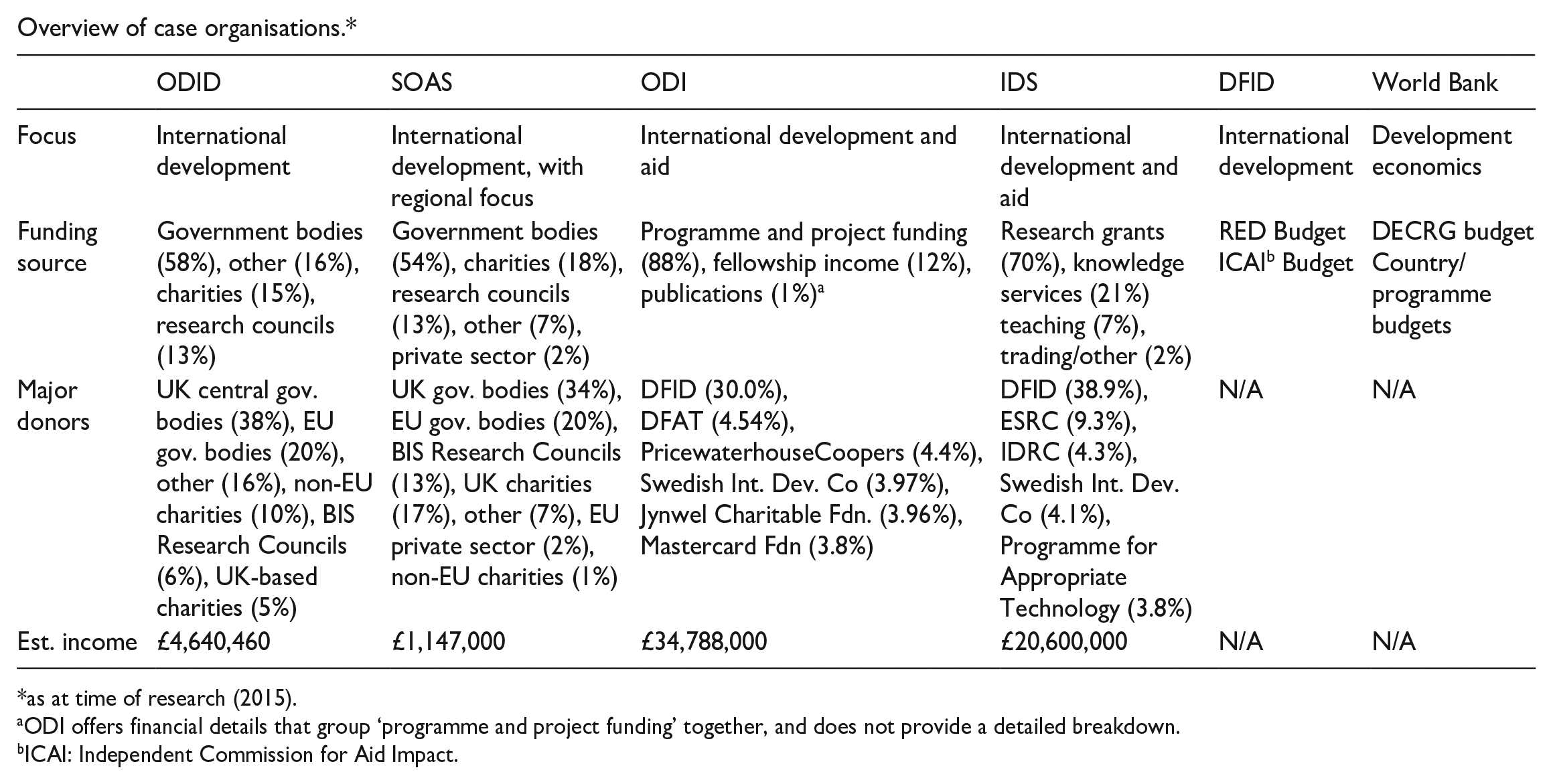
| ODID | SOAS | ODI | IDS | DFID | World Bank | |
|---|---|---|---|---|---|---|
| Focus | International development | International development, with regional focus | International development and aid | International development and aid | International development | Development economics |
| Funding source | Government bodies (58%), other (16%), charities (15%), research councils (13%) | Government bodies (54%), charities (18%), research councils (13%), other (7%), private sector (2%) | Programme and project funding (88%), fellowship income (12%), publications (1%) a | Research grants (70%), knowledge services (21%) teaching (7%), trading/other (2%) |
RED Budget ICAI b Budget |
DECRG budget Country/programme budgets |
| Major donors | UK central gov. bodies (38%), EU gov. bodies (20%), other (16%), non-EU charities (10%), BIS Research Councils (6%), UK-based charities (5%) | UK gov. bodies (34%), EU gov. bodies (20%), BIS Research Councils (13%), UK charities (17%), other (7%), EU private sector (2%), non-EU charities (1%) | DFID (30.0%), DFAT (4.54%), PricewaterhouseCoopers (4.4%), Swedish Int. Dev. Co (3.97%), Jynwel Charitable Fdn. (3.96%), Mastercard Fdn (3.8%) |
DFID (38.9%), ESRC (9.3%), IDRC (4.3%), Swedish Int. Dev. Co (4.1%), Programme for Appropriate Technology (3.8%) |
N/A | N/A |
| Est. income | £4,640,460 | £1,147,000 | £34,788,000 | £20,600,000 | N/A | N/A |
as at time of research (2015).
ODI offers financial details that group ‘programme and project funding’ together, and does not provide a detailed breakdown.
ICAI: Independent Commission for Aid Impact.
Appendix B
Appendix C
Summary of institutional positioning.
| Organisation type | Mobilised capitals | Examples of positioning |
|---|---|---|
| University departments | Academic | ‘intellectual curiosity’, ‘analytical autonomy’, ‘in relevant disciplinary fields’, ‘independent research agenda’ |
| Political | ‘better design and implementation of development policy and practice’, ‘development policies and approaches’ | |
| Media | ‘creative dialogue with ‘users’’ | |
| Economic | ‘securing research grants from a range of different sources’, ‘development practitioner backgrounds’ | |
| Think-tanks | Academic | ‘academic research, teaching and learning’, ‘independent from its funders’, ‘challenge donor thinking and policy’ |
| Political | ‘unique space between think-tank and university’, ‘policy engaged academic institutions’, ‘knowledge for impact’ | |
| Media | ‘mix of research, convening power and communications’, ‘inform the public debates’ | |
| Economic | ‘part of a global network of partnerships’ | |
| Government agencies | Academic | ‘strong and applicable evidence’, ‘longer-term concerns rather than the immediate needs’ |
| Political | ‘build good development programmes’, ‘greater development impact’, ‘directed toward recognised and emerging policy issues’ | |
| Media | ‘open and enhanced access policy’, ‘make the research we fund freely available’ | |
| Economic | ‘to increase the uptake and use’, ‘cost-effective ways of delivering development’ |
Appendix D
Funding
This research was supported by the Economic and Social Research Council (ES/N016319/1) and Commonwealth Scholarship Commission UK.