



Abstract
The US government response to the coronavirus pandemic has prompted renewed debate about the size and structure of the welfare state. Particular attention has been paid to prenatal and early childhood policy, domains in which the US safety net is less robust than those of its peer countries. Contra claims that the so-called care economy constitutes a sharp break with the neoliberal consensus, this article argues that the shift in social policy focus toward early life is consistent with changes in economic ideas about the best environment in which to grow “human capital”: the economization of early life. Building on insights about “critical periods” of development drawn from diverse fields including epigenetics and neurobiology, economists estimate that human capital gains are greatest when “investments in people” occur before the age of five. This article traces the history of how this research was brought to the attention of federal policy makers in the United States. While much human capital–focused social policy traditionally placed the burden of risk on the private family (e.g., with student loan debt or health insurance), in recent years, economists have instead argued that social programs dedicated to early childhood development are more “efficient” sources of public investment.
The nature versus nurture distinction is obsolete. The modern literature on epigenetic expression teaches us that the sharp distinction between acquired skills and ability featured in the early human capital literature is not tenable…. Additive “nature” and “nurture” models, while traditional and still used by many studies of heritability and family influence, mischaracterize how ability is manifested. Abilities are produced, and gene expression is governed, by environmental conditions (Rutter, 2006). Measured abilities are susceptible to environmental influences, including in utero experiences, and also have genetic components…. Genes and environment cannot be meaningfully parsed by traditional linear models that assign variance to each component. (Cunha and Heckman 2010, 3)
Introduction
“Boy, Jim, sounds like you’ve really turned into a social democrat,” James Heckman recalls Larry Summers saying to him in the early 1990s (Greeley 2014). Heckman, who would go on to win the Nobel Prize in economics in 2000 for research related to a statistical technique that corrects for selection bias, had just explained his newest pet project to Summers: convincing policy makers to publicly fund early childhood education programs. That Heckman was pushing this initiative came as a surprise to Summers, given that Heckman was one of the most well-known members of the third generation of Chicago School economics—a cast of characters consisting of committed free-market government skeptics such as Gary Becker, Eugene Fama, and Richard Posner. Yet Heckman’s interest in early childhood education was not the result of an ideological conversion or break with the Chicago School model; rather, his newest research had demonstrated that human capital gains—a key policy outcome for microeconomists interested in social policy—were greatest when investments were made early in life, before children developed the ability to make investments in themselves.
Historically, human capital has most commonly been associated with policies that promote (self-)investment in higher education, 1 whereas today a growing number of experts mobilize human capital arguments to advocate for greater investment in state interventions in children under the age of five. What accounts for this? Drawing on the history of ideas about how to conceptualize human capital as a trade-off between social investments and genetic endowments (Foucault 2008), this paper locates the shift in research networks assembled around economists such as Heckman and Princeton’s Janet Currie over the last several decades. While this expertise has by no means replaced more traditional human capital arguments about the economic benefits of formal education, it has gained traction in a variety of policy settings, from the municipal level all the way to the US White House. And though these research methods and data sources hew to the same “economic style of reasoning” (Berman 2022b, 5) that human capital is known for, the ideas that prompted this refashioning come from an unlikely source: fields such as epigenetics and neuroscience, which have revolutionized understandings of human biological development and are beginning to have tangible effects on the social sciences as well. Tracing the concept of human capital across different intellectual and policy landscapes reveals that the political valence of an idea is not inherent but rather becomes articulated differently in practical settings—in this case, as either a tool for advancing the neoliberal agenda (Berman 2022a) or in support of a countervailing “care economy” (Gould-Werth 2022). We see how these seemingly incompatible policy frameworks can be reconciled in support of interventions that reinforce the family form (Cooper 2017) through early childhood interventions considered to be both “efficient” as well as “equitable” in economic analysis (Hilger 2022).
The Economization of Early Life
What purpose does the notion of human capital serve in economic analysis and the design of social policy? What is being measured when the concept is invoked, and how does this change over time? Previous research has focused such questions on capital and economization more generally. For example, Marx’s critique of political economy holds that capital itself is not an economic concept, but the reification of historically specific social relations that exist within capitalism (Postone 1993). And while other forms of capital—cultural, social, symbolic, and so on—are meant to break with economism but arguably fall back on an economistic understanding of social relations that does not grasp the historically specific nature of capitalism (Calhoun 1993; Desan 2013), human capital is overtly conceptualized as economic by its proponents. This is precisely what makes human capital so interesting—its definition changes considerably not just due to researchers’ ability to measure it but also in accordance with the shifting social relationships that affect the organization and governance of work in postindustrial capitalist society (Weeks 2011; Block 1990; Winant 2021). This raises the question: precisely what is being “economized” with the notion of human capital?
Processes of economization are a growing topic of inquiry situated at the intersection of economic sociology and the sociology of scientific expertise (Çalışkan and Callon 2009). While this research initially focused on the social structures underpinning market institutions for the exchange of commodities (Callon 1998; Çalışkan and Callon 2010), scholars have recently looked into a wider variety of instances in which economic expertise configures arrangements that we traditionally conceive of as natural, social, or cultural as instead being fundamentally economic. For example, economization occurs with the quantification of health status through measures such as Quality-Adjusted Life Years and Disability-adjusted Life Years (MacKillop and Sheard 2018; Kenny 2017; Ashmore, Mulkay, and Pinch 1989), the creation of competitive labor markets for teacher accountability enforcement (Spring 2015; Ball 2003), as a means of managing insurance claims following environmental disasters (Elliott 2021), or as a tool of statecraft for managing populations (Murphy 2017; Foucault 2007). Economization can also be more or less definitive: “ambivalent economization” processes may decouple and recombine economic expertise from policy outcomes (Griffen and Panofsky 2021), as economic and moral considerations exist in tension with one another and are navigated through social interaction (Livne 2019; 2021).
In the case of human capital theory, economization has occurred largely due to the application of a particular kind of expertise—the “economic style of reasoning” that has become commonplace in US policy discourse (Berman 2022b). And yet this style of reasoning has not remained static but rather has changed over time and across social contexts (Reay 2012). This paper argues that the emergence of a policy discourse around human capital focusing on economic returns to investments made in children before age five is primarily the result of two related factors that have more broadly affected economics as a style of reasoning.
The first factor is the recognition by economists that findings about gene–environment interactions from seemingly disparate scientific fields could have potentially large ramifications for human capital theory. Economists have long recognized that what distinguishes human capital from other forms of capital is its embodied nature (Becker 1964, 112), but what precisely is being embodied has been a moving target (Teixeira 2020). For the vast majority of economists, the factors comprising human capital development have been what is easiest to measure and assign a market value—usually formal education, sometimes health status, and if possible a trade-off between different inputs that interact to produce individual economic outcomes (Becker 2007). Yet when it comes to the question of embodiment, there is an obvious complication: an individual’s human capital is the product of both “acquired elements” such as education or health status, as well as “innate elements” unique to individuals—genetics (Foucault 2008, 227). Complicating this dilemma even further, recent research from fields like epigenetics, epidemiology, and neuroscience demonstrates that gene expression is affected by environmental factors beginning in utero. Social scientists have only begun to scratch the surface of the epistemological repercussions of these developments (Landecker and Panofsky 2013; Richardson 2021). While in 1979 Foucault noted that there were not “as yet any studies on the problem of the hereditary elements of human capital,” he also pointed out that “it is quite clear what form they could take and, above all, we can see through anxieties, concerns, problems, and so on, the birth of something which…could be interesting or disturbing” (Foucault 2008, 227). These are the aspects of human capital development that economists have increasingly sought to measure in their research, leading to the economization of early life.
The way that economic expertise has configured early life development as an opportune target for state investment makes this a distinctive case for analysis of the contemporary “bioeconomy.” Previous research on the “bioeconomy” and “biocapital” focuses primarily on the capacity for life itself to become enrolled in processes of accumulation and speculation (Birch and Tyfield 2013; Cooper 2008; Franklin and Lock 2003; Helmreich 2008). Advances in biotechnology made possible by genomics become the fuel for the inflation of asset values, accomplished through market-based processes including “financialization,” “capitalization,” and “assetization” (Birch and Muniesa 2020; Birch 2017). However, to borrow a metaphor from economics, the focus in this literature is on the demand side of the bioeconomy: increases in the exchange value of biological materials are driven by market demands. By contrast, my focus in analyzing the economization of early life is to draw attention to supply side forces: economists calculate the potential value of human capital not by estimating market demand but rather by projecting the human capital gains to be made by investment in individuals on the supply side that will inflate the future value of biological selves. Economists’ emphasis on supply side investments in early childhood development, which has support from organized business (Uhing 2021), center-right think tanks (Teles, Hammond, and Takash 2021), and center-left technocrats (Klein 2021), is consistent with the seemingly paradoxical mutual constitution of social conservatism and neoliberal economics that characterizes contemporary US political economy (Cooper 2017; Brown 2006).
The other factor contributing to the flourishing of policy discourse around early-life human capital development is the changed US political economy wrought by decades of neoliberal policy reform. If earlier iterations of human capital theory located decision-making regarding what investments to make within the nuclear family organized around a male breadwinner (Cooper 2017, 219-27), the collapse of that social compact has altered the seeming rationality of that calculus. As millions of people in the US accumulate ballooning student and medical debt burdens while the economic returns to these more traditional forms of individual investment becomes more dubious, economists have mobilized the idea of early childhood interventions in service of expanding the economizing logic of human capital to cover more of the life course (Prentice 2009). This is consistent with a feature of modern bioeconomies identified by Melinda Cooper (2008), in which “the drive of capital to overcome its own material limitations not only finds new resources, but also constantly redefines the ‘nature’ of resources” (Helmreich 2008, 469). While moral objections are sometimes raised to this economization of early life—much as Becker’s early work was met with resistance 2 even from other economists (Horn 2011, 132-52)—this framing is, paradoxically, what prompted Larry Summers to accuse Heckman of becoming a social democrat. Heckman argues that the state, rather than individuals, should invest in early childhood interventions because these initial investments can be delivered in a cost-effective way that is compounded over the life course. 3 This is also consistent with the recent policy debates animating the national US Democratic Party, which some argue constitutes a belated acknowledgment that the neoliberal paradigm has been pushed as far as it can go (Mason 2021).
The rest of this paper is divided into two main parts. It first analyzes the central claims made by economists regarding the importance of investing in children—and hence human capital—before the age of five. These claims are motivated by findings that come from other fields and while economists by and large have not acquired the kind of “contributory expertise” (Collins and Evans 2007) that would allow them to be recognized as disciplinary specialists in these fields, they have developed sufficient “interactive expertise” to make sense of them—albeit in ways that noneconomists might occasionally think of as “economic imperialism” (Lazear 2000). I then examine the considerable effects this new network of human capital research has had on elite discourse regarding social policy in the United States. This includes the establishment of new nonprofit and advocacy organizations devoted to early childhood and maternal policy interventions, but also direct influence on the policy agendas of prominent US politicians including Bill de Blasio, Barack Obama, Hillary Clinton, Elizabeth Warren, and Joe Biden. Finally, the paper concludes by discussing how the economization of early life may or may not resonate with the emergent social democratic policy paradigm that has characterized some of the federal government’s pandemic response and the focus of the Biden administration’s legislative agenda—potentially constituting a challenge to the neoliberal agenda of previous decades, even if that challenge is coming from within the heart of neoliberal discourse (Berman 2022a).
Human Capital Investment: When to Start?
While there is an enormous amount of human capital research devoted to estimating the economic returns of formal education—so much so that the economics of education has at times been considered synonymous with human capital theory (Teixeira 2000)—scholarship on the effects of interventions that occur early in life is much newer. The basic insight undergirding this research is related to “critical periods” or “sensitive periods,” which are stretches of time that occur early in life when human development is relatively plastic, and epigenetic changes can have effects that endure throughout the life course (Landecker and Panofsky 2013). For economists, two critical periods have proven particularly fruitful for conducting research on human capital development: early childhood before the age of five—especially the period spanning ages three and four—and time spent in utero. I will review each of these in turn, focusing on the evidence economists have marshalled from other fields to make human capital arguments, and the types of interventions they have proposed to economize social policy during early life. A basic depiction of the life sciences fields that have influenced the two main research avenues of economists in this space is included in Figure 1.
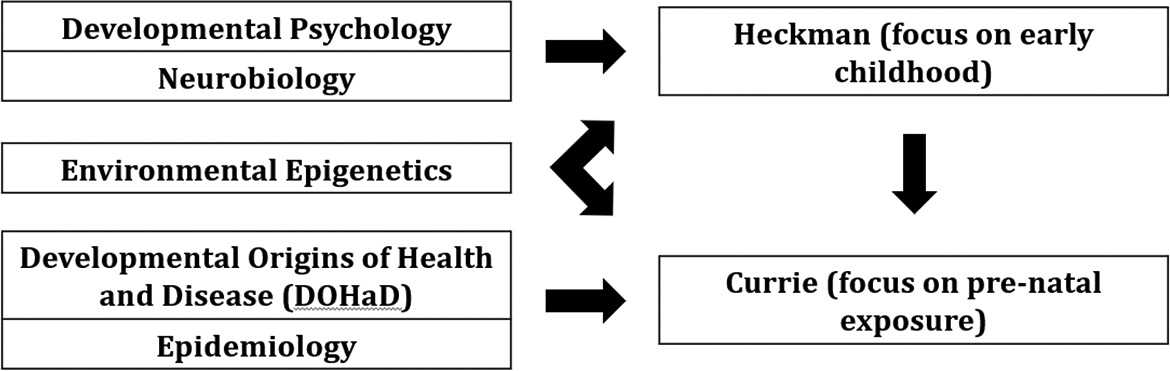
Influence of life sciences on human capital theory.
James Heckman is the economist most associated with this paradigm. His scholarship on human capital has served not just to cement his expertise as both a methodologist and policy scholar but has also been turned into a trademarked policy project, the Heckman Equation, and a worldwide research collective known as the Human Capital and Economic Opportunity Global Working Group. While the next section of the paper will explore the details of these initiatives, here I describe the basics of the conceptual framework that comprises the so-called Heckman Equation, as well as the work Janet Currie has done to extend this framework into prenatal development.
In a short 2006 article for the journal Science, Heckman draws on research conducted in collaboration with scholars from other fields to describe four key concepts that motivate his human capital research agenda: First, the architecture of the brain and the process of skill formation are influenced by an interaction between genetics and individual experience. Second, the mastery of skills that are essential for economic success and the development of their underlying neural pathways follow hierarchical rules. Later attainments build on foundations that are laid down earlier. Third, cognitive, linguistic, social, and emotional competencies are interdependent; all are shaped powerfully by the experiences of the developing child; and all contribute to success in society at large. Fourth, although adaptation continues throughout life, human abilities are formed in a predictable sequence of sensitive periods, during which the development of specific neural circuits and the behaviors they mediate are most plastic and therefore receptive to environmental influences. (Heckman 2006, 1900)
Throughout his work on human capital, Heckman (along with a large, evolving research team) has been primarily concerned with the importance of the technology of skill formation in early life (Heckman 2006, 2000, 2007; Cunha and Heckman 2007). What the notion of “skill formation” accomplishes is not merely a rhetorical translation of the technical findings on early life epigenetic changes into economic language, but rather a fundamental reconceptualization of the economic value of various inputs into human capital development. In addition, skills are not strictly conceptualized as cognition or intelligence. Heckman (2011) is also interested in “soft skills” including “conscientiousness, perseverance, sociability, and other essential character traits,” all of which can be crudely quantified and are believed to be an important component of human capital development in early life
A particularly important innovation to human capital theory is the “model of skill formation with multiple stages of childhood, where inputs at different stages are complements, and where there is self productivity of investment” (Cunha and Heckman 2007, 31). In Heckman’s estimation, the malleability of early childhood (due to the potential for epigenetic expression and neurobiological development) lends itself to an argument in favor of “policies that redistribute resources toward disadvantaged children toward the early years on the grounds of efficiency without any appeal to social justice” (Heckman and Mosso 2014, 691). Because “skill begets skill” and these early life investments will be compounded over the life course, “early investment facilitates the productivity of later investment,” a process that Cunha et al. refer to as “dynamic complementarity” (Cunha and Heckman 2007, 34). The existence of the notion of “dynamic complementarity” means that “there is no equity–efficiency trade-off for early childhood investment. The returns to investing in early life are high” (Cunha et al. 2006, 698). This, furthermore, means that for Heckman, “Investing in disadvantaged young children…reduces inequality associated with the accident of birth and at the same time raises the productivity of society at large” (Heckman and Masterov 2007, 2).
In calculating the present value of interventions—such as pre-K education, various types of childcare, parental attention, adequate nutrition, provision of healthcare, and so on—Heckman also estimates the comparative value of social programs that could have effects later in the life course, such as tutoring programs for secondary students or additional years of college education. This is key for understanding how the “critical period” identified by life scientists as biologically significant is represented by Heckman as having such economic value: the “properties of technology of skill formation show why investment in disadvantaged young children can be both socially fair and economically efficient, whereas later-stage investments in disadvantaged…persons, although fair, may not be economically efficient” (Heckman and Mosso 2014, 698). This is related to the rationale economists often give for opposing student loan debt forgiveness in the United States. While advocates argue that erasing debt burdens for people unable to afford the exorbitant costs of higher education is an equitable policy solution, there is a growing consensus in economics that the pursuit of additional education is less efficient than other sources of human capital investment that occur earlier in the life course and may have the capacity to unlock value at the more fundamental level of human biology. According to such arguments, the state will both achieve a better return on its investments and level the socioeconomic playing field by directing resources to early childhood education or childcare programs than by forgiving student debt.
The “technology of skill formation” as a compounding process whereby epigenetic malleability and social supports are combined thus appears in Heckman’s work as a machine-like process occurring inside the human body, with the result being a “species of biocapital” (Helmreich 2008) whose potential value as an efficient source of investment is mediated by a complex chain of economic reasoning. In other words, economizing early life in this manner attends to social policy considerations that normally fall under the label of equity while remaining firmly ensconced in the “economic style of reasoning” (Berman 2022b) that serves to promote the efficiency of human capital investment. Whereas previous models of human capital development were not able to account for potential effects of environmental influences on epigenetic expression, the Heckman Equation estimates these in a dynamic function that places greater emphasis on early childhood. And because, as Heckman notes throughout his work, “parents are credit-market constrained in the early years of their children” (Heckman and Mosso 2014, 703), this necessitates a role for state investment in early childhood to maximize the potential of this human capital, an argument whose policy traction will be explored in the next section of the paper.
Of course, while this may sound plausible in theory, can economists provide it empirically? Positing a relationship between investments in young children (or fetuses) and later economic outcomes is one thing, but actually measuring it is tricky, particularly because there are ethical issues to consider in researching human subjects who are too young to give their own consent. This is where Heckman’s research network, which expands well beyond economics, comes into play. To understand the efficacy of interventions with proximate effects on gene expression and brain development but distal effects on individual economic outcomes, economists have had to get creative, with experts from a growing number of increasingly diverse fields being brought into the fold. 4
The source of data that has proven particularly useful in Heckman’s own research on human capital comes from a pair of experimental studies that commenced in the 1960s. Both the “Perry Pre-School Project” and “Abecedarian Project” randomly assigned infants to either experimental or control groups in order to measure the impact of interventions on young children. The interventions studied include education, parental involvement, and nutrition programs, while the outcomes were determined by following up with research participants repeatedly into adulthood. Heckman has mobilized data from these projects in service of his early childhood research agenda, and while it has proven difficult to precisely specify the mechanisms through which these interventions have effects, he has substantiated claims about investing in human capital development early in life. Recently, however, a pair of criticisms have been raised about the validity of Heckman’s findings. One issue is the small sample size of both the Perry and Abecedarian Projects: each enrolled a total of just over hundred research participants, prompting scrutiny of Heckman’s methodology (Gelman 2019). Others have taken issue with the fact that both projects stopped studying the proximate effects of the interventions at the age of five, arguing that better quality studies exist that tracked children up until the third grade (Lipsey and Farran 2017). These remain open questions that are hotly debated by economists every time a new study is released and will likely continue to be contested as data from similar randomized controlled trials becomes available for economic analysis (Kamenetz 2022). Recent scholarship using administrative data (Barr, Eggleston, and Smith 2022) and from the Baby’s First Years experiment (Gennetian et al. 2022) demonstrate the potential for expanding the research and policy frontier to include new sources of data, with the potential to generate more robust results.
Meanwhile, a related strand of research is concerned with an even earlier “critical period”: fetal development occurring in the womb. The primary economist responsible for this work is Janet Currie, who is the most cited author in the field of health economics (IDEAS 2021). Currie’s work on the value of in utero investments began in the 1990s, when she demonstrated that participation in the federal welfare program Aid to Families with Dependent Children affected children’s birth weight (Currie and Cole 1993). Similar to Heckman, Currie’s work focuses on how developmental plasticity in early life makes it possible to design social policy interventions that can affect human capital growth and influence individuals’ future economic outcomes. Yet the findings that led Currie to this argument come not from developmental psychology or neurobiology but from a growing field of research known as Developmental Origins of Health and Disease, pioneered by epidemiologist David Barker. Barker’s research uses historical data to explore the long-term effects of environmental shocks that alter development (Barker 2007). The central theory based on these data—the fetal origins hypothesis—holds that changes to gene expression begin in utero, which according to Currie provides a rationale for policies to promote maternal health and well-being. For instance, Almond and Currie (2011, 154) argue that: Clearly, a full acceptance of the fetal origins hypothesis idea would have radical implications for individual decisions and policy alike, suggesting for example that the optimum time to intervene to improve children’s life chances is before they are born—and perhaps before mothers even realize they are pregnant.
As with research on early childhood, Currie’s basic theoretical insight is a plausible interpretation of how gene–environment interactions may affect later life outcomes, but difficulties arise when it comes time to precisely specify mechanisms using empirical data. Epidemiological research on the long-term effects of environmental shocks is by nature historical: events such as the 1918-19 influenza epidemic and the mid-twentieth-century thalidomide event in the United States have played an outsized role in establishing an evidence base for understanding the health consequences of in utero exposures. A decade ago, Almond and Currie (2011, 168) pointed out that: A major limitation in current research is our inability to make quantitative predictions as to how much a given fetal insult will affect later-life outcomes. To this end, it will be important to uncover which measures of maternal health, health at birth, or early-childhood health best capture incidental fetal origins effects. At present, this is an open question: to a surprising degree pregnancy remains a “black box”…. Promising possibilities include research in epigenetics, which aims to decipher when and how various genes are switched “on” and “off”…Progress in measurement will help delineate mechanisms by which fetal origins effects are generated. Economists can help by evaluating whether such measures indeed lie along the causal pathway.
Early Childhood Interventions as Social Policy
For these reasons, research on the efficiency of early childhood interventions reflects the extension of a familiar economic style of thinking to new terrain as findings about the plasticity of human development are incorporated into human capital theory. Yet my argument is a broader one; that the conceptual horizons of human capital theory are not only affecting ideas about investments in children. Rather the breadth of these ideas, their influence in US policy circles may portend a more fundamental revaluation of who and what the welfare state is for. This section of the paper is dedicated to the former point, followed by a conclusion exploring the latter.
Heckman’s research output became almost entirely focused on human capital theory and early childhood investments in the years surrounding his Nobel Prize win in 2000. That same year, the National Research Council of the National Academies of Sciences, Engineering, and Medicine released a landmark report synthesizing work on the “critical period” from birth to age five called From Neurons to Neighborhoods: The Science of Early Childhood Development (Phillips, Shonkoff, and Youth National Research Council [US], Board on Children and Families, Committee on Integrating the Science of Early Childhood Development 2000). While the report was not written by economists and thus not conceptualized with the economistic theoretical apparatus that Heckman was concurrently developing (Heckman 2000), it nonetheless offered similar insights: that what happens before children turn five can have lifelong effects not just on health but also on the formation of “skills” and ultimately economic outcomes. Ted Kennedy—a Senator from the State of Massachusetts and a consistent advocate in the US Congress for expanding healthcare and other social programs—was presented with an executive summary of the report upon its publication and reportedly asked his staff to provide him with the full 600-page document (Smith 2014). The science of early childhood development had thus made its way into the heart of the US political system.
In subsequent years, Heckman developed a research network extending well beyond the disciplinary confines of economics. Eric Knudsen, a neurobiologist whose previous research concerned the learning behavior of barn owls, met Heckman at a conference in the early 2000s and recalls that they “were both giving the same story, [but] with completely different data sets…. He was talking about the economics of investing in children in terms of education, and I was talking about the effects of early experience on changing the architecture of the brain” (Stanford Magazine 2006). Knudsen would go on to publish an article with Heckman and several other colleagues in the Proceedings of the National Academy of Sciences on “Economic, Neurobiological, and Behavioral Perspectives on Building America’s Future Workforce” (Knudsen et al. 2006)—this alliance of economists and life scientists may reflect broader trends toward the commercialization of science in the contemporary bioeconomy (Sunder Rajan 2006). The framing of the article around the importance of the workforce was key: while the findings about early childhood development were being investigated by scientific experts with a wide range of disciplinary backgrounds, incorporating this expertise into a human capital argument gave it additional policy relevance. For example, Knudsen et al. (2006, 10161) outline that: The implications of this rapidly evolving science for human capital formation are striking. The workplace of the 21st century will favor individuals with intellectual flexibility, strong problem-solving skills, emotional resilience, and the capacity to work well with others in a continuously changing and highly competitive economic environment. In this context, the personal and societal burden of diminished capacity will be formidable, and the need to maximize human potential will be greater than ever before.
The 2000 National Research Council report had led to the creation of a multi-university research network headquartered at Harvard, known as the National Scientific Council on the Developing Child. This network consisted of researchers from a variety of disciplines, including economists such as Heckman, who were “instrumental in placing early child and brain development into a practical context of human capital formation,” according to the Council’s scientific director Pat Levitt (Center on the Developing Child 2014, 5). In the 2000s, the Council also began to partner with the Frameworks Institute, an organization that “appl[ies] social science methods to study how people understand social issues—and how best to frame them” (Frameworks Institute 2021). This allowed them to turn research findings about early childhood development into a kind of translational science, and in this way, the Council was able to target state-level policy makers through organizations such as the National Conference on State Legislatures and the National Governor’s Association for Best Practices (Frameworks Institute 2021, 10-11). Influencing debate at the federal level, however, would require further effort from the experts armed with a style of expertise more familiar to policy discourse: economists.
In 2007, a project called the “Heckman Equation” was initiated and funded by the Pritzker Family Foundation and the Buffett Early Childhood Fund (Center for Economics and Human Development 2021). Organized around Heckman’s research, it was trademarked and organized as a communications initiative dedicated to translating for the public how important early life interventions are for human capital development. This was followed a few years later by the “Human Capital and Economic Opportunity Global Working Group” (HCEO), a network of over 500 researchers including economists, biologists, epidemiologists, physicians, and even experts from seemingly distant fields such as primatology and philosophy (HCEO 2016). In addition to providing networking resources for researchers investigating early childhood intervention and related topics, the Working Group hosts conferences, organizes summer schools for young scholars, and provides a platform to communicate new research on human capital to the public. Efforts like the Heckman Equation and HCEO allowed Heckman to capitalize on his existing notoriety as a Nobel Prize winner and mobilize resources to translate research into the policy domain.
How was the evidence that early childhood interventions can lead to desirable social policy outcomes translated into actual political achievements? At the local level, economists have partnered with organizations that have sprung up across the country to promote early childhood intervention programs. For example, nonprofits in Los Angeles such as First 5 LA and the LA Partnership for Early Childhood Investment advocate for citywide pre-K programs for disadvantaged children and work with economists to produce evaluations assessing the impact of pre-K interventions on toddlers’ later economic outcomes. However, while advocates of pre-K programs and other early childhood interventions have popped up in various locales over the last two decades (particularly in dense urban environments in states controlled by left-leaning political forces), the kind of organized movement that would actually enact policy at the federal level has remained unrealized (Schlozman 2015). Instead, the economization of early life has been relatively unmediated and can be better characterized as the result of economic work being directly taken up by think tanks that are increasingly deferential to the interests of billionaire philanthropists, even on the center-left (Reckhow 2013; Medvetz 2012).
In Heckman’s home base of Chicago, researchers from both the University of Chicago and from Harvard have teamed up since the 2000s to examine longitudinal data from an experimental preschool that has allowed for the kind of “scalable” evidence that has become increasingly commonplace in the policy process (List, Suskind, and Supplee 2021). Data from this project allow researchers to harness much greater statistical power than the Perry and Abecedarian Projects that much of Heckman’s early research on human capital relied upon. While the Chicago Heights Early Childhood Center was funded by Illinois billionaire Ken Griffin, other wealthy philanthropic foundations including the Bezos Family Foundation and Arnold Ventures have poured tens of millions of additional dollars into follow-up research and new pilot projects to further bolster the case for early childhood investments (Cohen 2018; Arnold Ventures 2021). In some cases, these findings have struck a chord with a broader public. For example, in New York City, Bill de Blasio first ran for Mayor and won in 2013. His electoral success was based in part on a platform that promise to establish a citywide universal pre-K program (Cassidy 2013), an initiative that he successfully followed through on in the most populated school district in the United States (Neuman 2017). But the success of this new human capital paradigm has in general been less driven by the concerns of grassroots social movements than it has by the connections forged between well-situated economists, such as Heckman and policy makers at the heart of the US policy process, up to and including the White House during the Obama administration.
In 2011, after Congress failed to include spending for early childhood interventions in the federal budget, the Department of Education earmarked US$500 million for an Early Learning Challenge Fund through Obama’s signature education initiative, Race to the Top (Slack 2011). That December, Heckman was invited to a meeting about early childhood education with cabinet members including Secretary of Education Arne Duncan and Secretary of Health and Human Services Kathleen Sebelius. Obama, whose policy inclinations often tend to reflect the intellectual milieu that shaped his early career as a professor (alongside Heckman) at the University of Chicago (Leonhardt 2008), cited statistical data drawn from Heckman’s research on early childhood education programs in his 2013 State of the Union address (Matthews 2013). Shortly thereafter, the administration released a comprehensive plan for early childhood education that would partially federalize pre-K education for four-year-olds living in poverty, dramatically ramp up the Head Start program and increase funding for the Nurse Family Partnerships program—all initiatives that were proven successful in randomized controlled trials and that met with Heckman’s approval (Matthews 2013). Then in April, the Obama administration went further and proposed a “Preschool for All” plan that would pour US$75 billion into various early childhood initiatives over the course of a decade, with the goal of making universal pre-K education a standard feature of the US welfare state (Scott 2013).
Ultimately, the Obama administration would fall well short of both the President’s and Heckman’s goals. Slightly over US$1 billion of funding was announced in December 2014 and it consisted mostly of public–private partnerships: a US$330 million federal campaign called Invest in Us conducted in collaboration with the First Five Years Fund, US$250 million in grants to states for expanding pre-K education programs, and US$500 million earmarked for Early Head Start (Maitre 2014). Yet the idea of creating a robust safety net dedicated to the “critical period” of early childhood did not cease at the completion of the Obama administration. The Council of Economic Advisers released a comprehensive report on the economic returns to early childhood investments as part of the Obama administration’s December 2014 summit on the matter (President’s Council of Economic Advisers 2014), and similar proposals formed the bulk of Hillary Clinton’s 2016 presidential campaign, as the former Secretary of State weaved the latest economic research on human capital development into her early career working for the Children’s Defense Fund and 1990s involvement in the creation of the Early Head Start program (Samuels 2016; Mongeau 2016). Despite Clinton’s loss in the general election, these issues remained at the forefront of public discourse due to the media buzz generated by Senator Elizabeth Warren’s policy-focused Presidential primary campaign in 2019 and 2020. One of Warren’s first splashy plans was a “Universal Child Care and Early Learning” program heavily indebted to Heckman’s research on the myriad effects of early life investment on educational attainment, income, and health outcomes (Warren 2019). Though Warren’s presidential ambitions were also stymied, her campaign’s focus on the issue of early childhood investment served as a bridge to the Biden administration, and all but ensured that it would remain a key policy issue for Democrats in the future. While ultimately the enactment and implementation of this social policy agenda remained a political question, the idea of early childhood as an investment opportunity had been successfully economized on the national stage.
Conclusion: Give a Kid a Fish or Go Fishing?
Human capital emerged as an analytically useful concept in the late 1950s and was institutionalized over time across the health and education policy fields, initially as a means of orienting policy toward public investment in social programs, though over time human capital investment was increasingly seen as the private responsibility of individuals or families. While social policy debate over human capital development in the United States has often focused on the role of attaining additional years of formal education as the most efficient means of investing in human capital, this paper has documented the emergence of a different target: a “critical period” of early childhood beginning in utero, up to age five. This idea was not the sole preserve of economics, nor was it entirely novel. As Foucault (2008) points out, the existence of a hereditary or innate component to human capital was articulated early on—but it was not until sufficient connections were forged between economics and fields such as epigenetics and neurobiology that policy energy would be reoriented toward a different set of policy interventions than human capital theory has traditionally been mobilized in service of. Some have argued that these developments constitute a substantial break with several decades of neoliberal policy reform (Levitz 2021; Mason 2021; Hughes 2021), while others contend that they are largely a facade—window dressing designed to distract from an inadequate welfare state that requires more substantial changes than technocratic reformers can provide (Karp 2021; Galbraith 2021). By way of conclusion, I want to consider how contemporary ideas about human capital development map onto the dispute over the vitality of neoliberalism as a policy consensus, which undergird different possible “imagined futures” (Beckert 2016) in the realm of US social policy.
On the one hand, the revival of aggressive fiscal policy in the United States might be mobilized in service of expanded state investment in early childhood education, public childcare programs, greater social supports for expecting parents, and so on. In his Give a Man a Fish, James Ferguson argues that transitions away from the austerity-minded, neoliberal policy paradigm can actually emerge from within that paradigm as products of “the push and shove of actual governing and actual politics” (Ferguson 2015, 27). The US federal government’s response to the coronavirus pandemic has been a step in this direction, as the Biden administration (and indeed, even the Trump administration) has overseen significant expansions of social policy initiatives including direct payments, enhanced unemployment insurance, a more generous and refundable child tax credit, subsidies to lower the cost of health insurance plans, and incentives for states to expand Medicaid (Mason 2021; Levitz 2021). 6 For example, the initial blueprint for President Biden’s American Families Plan, one component of the Build Back Better agenda, called for significant federal resources in welfare state expansion by creating new social programs including universal pre-K for children ages three and four, as well as state-subsidized childcare. Like President Obama’s aforementioned limited early childhood education initiative that consisted mostly of pilot programs and a modest proposal for funding local pre-K programs, the American Families Plan is inspired by Heckman’s research on human capital development during early life (The White House 2021). Yet the Biden administration’s proposal, at the behest of progressive Democrats calling for some US$700 billion of investment in federal childcare programs, is several orders of magnitude more than what Obama’s more fiscally constrained agenda had called for a decade earlier (Sheffey 2021).
These efforts, while certainly a break with the harsh fiscal austerity thinking that has been the hallmark of the neoliberal era, nonetheless represent the “economic style of reasoning” in US social policy: a preference for efficiency and targeted programs that can be challenging to administrate (Berman 2022b; Griffen 2022). Rather than fundamentally restructuring the existing federal social programs that are not universal benefits—which was attempted with the Affordable Care Act, to some success—the drive to create new entitlements to pre-K education and childcare seeks to expand the safety net in a way that economists argue will achieve the biggest welfare gains without having to take on special interests such as the pharmaceutical or hospital lobby (Walker 2021). Instead, some experts have proposed that programs meant to help children flourish in healthy and secure early environments ought to be offset by cuts to older “entitlement” programs such as Medicare and Social Security, making welfare state reform budget neutral (Cabrera et al. 2022). One “imagined future” of the US welfare state, then, is a renewed focus on social democratic programs that seek to “give a kid a fish”: to grow human capital by targeting benefits to people in early childhood through universal programs.
Another possibility is for expansion of the welfare state to be more consistent with the economization logic underpinning previous social policy-making informed by human capital theory. By now, it seems all but inevitable that pre-K education and other early childhood interventions will continue to be a primary focus of social policy at both the state and federal levels. Whether these programs are devised as universal benefits or incorporate some form of means-testing remains an open question even within the nominally left-leaning policy shops that advise Democratic Members of Congress (Jacobs 2017). If the federal turn away from austerity is short-lived, it is even possible to imagine a student loan industry for pre-K education emerging along with a slate of early childhood initiatives organized around the principles of social competition and consumer welfare (Nance-Nash 2012). 7 In this “imagined future,” human capital development in early childhood is conceptualized as a thoroughly private affair, potentially administered through the state in part but with the financial burden and its associated risks falling primarily on the nuclear family (Cooper 2017).
While domains such as economics, epigenetics, social policy have their own histories, previous attempts to bring them together have been fraught. The economization of early life described in this paper—economists diving into the complex world of developmental plasticity and environmental epigenetics with hopes of finding the most efficient ways to design social programs—is just one chapter in the history of human capital theory. Given how rapidly shifting disciplinary boundaries gave rise to this research paradigm, it also likely will not be the last chapter, so scholars of scientific expertise should pay attention—after all, what else is our human capital for?
Footnotes
Acknowledgments
I would like to thank the anonymous reviewers and the journal editor for some of the most useful feedback I have ever received on a manuscript. For their comments on the various antecedents to this text, I would also like to thank Hannah Landecker, Aaron Panofsky, Chris Rea, audiences at the Social Science History Association and the Society for the Social Studies of Science, and participants at the 2021 Inventing Human Capital Theory workshop at the University of California, Santa Barbara.
Declaration of Conflicting Interests
The author(s) declared no potential conflicts of interest with respect to the research, authorship, and/or publication of this article.
Funding
The author(s) received no financial support for the research, authorship, and/or publication of this article.
