




Abstract
This case outlines the dilemma faced by an entrepreneur about promoting and positioning his product in the market. The entrepreneur was aware of the huge scope available in the Indian sealant market. Though he wanted to launch the product in the market, he was in a fix to target an appropriate market. The instructor can use the case to discuss the promotion and positioning strategy analysis to mitigate the risk. Readers must think strategically about the business performance challenges if proper strategies are not put in place.
This case can be taught to address issues of marketing management, strategic marketing, product management, etc., in management courses.
Discussion Questions
Describe the importance of STP.
What are the efforts that companies need to take to secure and safeguard their information?
What are the various promotional strategies adopted by companies?
Which factors need to be considered for developing a distribution strategy and retail strategy for managing the growth of businesses?
What role does market research play in turning a run-of-the mill business into a booming business?
Amit Katariya, CEO of Perry Trading India limited liability partnership (LLP), was thrilled to receive an official letter from one of the top-notch institutes of technology retained by his company in May 2017. Perry Trading India LLP, a partnership firm, believed in innovation and developing a product with the world’s finest cutting-edge technology. The company was working on a new type of tyre sealant, and this technology institute confirmed the quality of sealant developed by Perry Trading India LLP for fixing the puncture. Overjoyed, Katariya called a meeting with his partners to share this exciting news. During the meeting, except for Ashton D’souza, everyone was excited about his plans. Post discussion, D’souza raised the issue about customer responses. He had been assigned to collect the feedback of customers to know their reviews and overall responses. This would have helped the company to get insights and to overcome customer concerns if any. He had been entrusted with the responsibility of conducting a customer survey before the launch of the product. D’souza distributed free samples of the sealant to repair service persons to understand customers’ opinions and responses to execute this survey.
D’souza presented the analysis of the survey conducted. To the utter surprise of everyone, the survey results were disappointing. Customer responses towards the usage of sealant were discouraging. Partners were of the opinion that despite having a good quality product, the responses from the customers would have a cascading effect on capturing the sealant market. Heated discussions and arguments took place between the partners. Some of the partners directly blamed the failure on Katariya and his inability to get a positive response for the product. Based on the discussions and arguments held in the meeting, it was decided to conduct a market survey to examine the customer opinions. It was essential to understand the main reason for the dissatisfaction and overcome it. Partners were quite sure that the unique selling proposition (USP) of this product would serve to sail through this tough time. Of course, the need of the hour was the adoption of appropriate marketing and positioning strategies to promote the product; hence, the partners did not want to leave any stone unturned.
Exasperated with run-of-mill responses received from prospective customers and discussions held in the meeting, Katariya sat quietly in his cabin. He stared out of the window of his office, thinking, ‘I have been trying to find a solution to my problem all day, and I am still no closer.
Background of Katariya
Katariya, a science graduate and alumnus of a top management school, started his entrepreneurial venture Perry Trading India LLP, with his friend in 2016. Katariya had 30+ years of extensive experience in sales, marketing, business development, managing strategic business unit (SBU’S), profit and loss A/c (P&L) function, business planning, cross-functional projects, operations, and general management roles in Indian and multinational organizations in various capacities. Having multi-industry experience and entrepreneurial approach in automotive, telecom, consumer durable, fast-moving consumer goods (FMCG), and pharmaceutical industries, covering India and various countries in Asia and Europe, Katariya was keen to start his entrepreneurial venture. His main quest was to come up with innovative, creative products with cutting-edge technology. Katariya was quite assertive in his new career as an entrepreneur.
Background of Tyre Sealant Market
There were thirty or more tyre sealants around the world even back in the 1990s. Some of the brands of tyre sealant became inactive in the later stage, that is, post-1998. Interestingly, most of these sealant manufacturers were based in Europe and the USA. The first tyre sealant maker was an American company that got the sealant patented in the 1990s. As other tyre sealant manufacturers were not authorized to make sealant during this duration, most of them started making the sealant only after the expiration of the above patent duration.
These manufacturers, without any innovation, had simply copied and reproduced tyre sealant with another name. Most of the manufacturers were small or mid-sized and focused on the local market.
Many vehicle accessories distributors in India were captivated by these sealant manufacturers as they were based in Europe and the USA. The country of manufacturing (USA, Europe) had the upper hand in selling sealant to customers at local markets. These vehicle accessories distributors became their country franchisee and distributor and tried their best to push the product in the retail market.
Some of the local distributors imported China-made cheap priced tyre sealant to get the price advantage, but the quality of these sealants was meagre. Some of the manufactures tried making original sealant in India itself based on the contents used by other known sealant manufacturing companies. However, the quality and performance did not match the original product and remained inferior. Market reach was also limited. The overall competitive market scenario was sloppy because of the varied quality, varied prices, lack of post-sales support, unorganized market, inconsistent presence, low product awareness, and mediocre opinion about the sealant.
Indian Tyre Industry Overview
The Indian tyre industry was one of the fasted growing tyre industries globally. By 2021, it was expected to be the world’s third-largest tyre manufacturer, following China and the USA. As per India Brand Equity Foundation (IBEF) report, the Indian tyre industry would account for more than 5% of global vehicle sales by 2021. India had overtaken China to become the world’s largest two-wheeler manufacturer. India reached fourth rank as the largest automobile manufacturer in 2017 due to an increase in sales volume. China was at number one, the USA at second, and Japan held the third rank (Mordor Intelligence, 2020).
The domestic tyre industry of India fulfilled the requirements of two segments, that is, original equipment manufacturers (OEM) and replacement market (aftermarket). On a standalone basis, the tire industry contributes 3% of India’s manufacturing gross domestic product (GDP) and 0.5% of the total GDP. 2
As per the Automotive Tyre Manufacturers Association (ATMA) reports, 3 tyre companies increased to forty-one from thirty-nine by 2018; overall industry turnover was US$9 billion. Out of these forty-one companies, only the top ten companies themselves accounted for 90% of the market share. 4
When Katariya studied the market, he realized the potential of the market. In his words; “Every one of the estimated 1 billion vehicles on our roads today is the market. This market grows year-on-year basis. Looking after private and commercial users, we can successfully treat tyres for cars, vans, trucks, motorcycles, caravans, construction plants, agricultural machinery, buses, coaches, etc. Basically, any vehicle or machine that has a pneumatic tyre can be successfully treated with tyre sealant”. 5
According to Katariya’s plan, tyre sealant installation programmes would be appropriate for automobile manufacturers, armed forces, multinational companies, municipal councils, transport companies, construction companies, car rental companies, and car dealerships.
The Indian adhesive and sealant market was growing significantly. From 2018 to 2023, it was estimated to grow at the compound annual growth rate (CAGR) of 9.47%. Considering the industrial and economic development, ever-rising demand was anticipated for various sealant products (The Economic Times. 2016).
The sealant market size was actually unexplored, but the tubeless tire’s market size could be the market size for sealants, that is, US$2 billion, which would be a great opportunity. As far as the Indian market was concerned, there was no shortage of competitors. Most of the major Indian firms selling tyre sealants in India either imported the sealant from foreign companies or licensed the technology from them, whereas Macrantha Sealant owned the intellectual property to their sealant.
About the Sealant
The tyre puncture sealant was an easy way to fix a tire without replacing it. The sealant was a liquid gel that covered the crown area of the tyre. The sealant already existed in the tyre. Even if the nail punctured the tyre, the existing sealant fixed the tyre puncture instantly up to 10 mm without any visible air loss, and the car was ready to be driven without any further delay. It was good for all weather conditions, particularly in countries with extreme summers. Tyre sealant was designed for vehicles such as cars, motorbikes, bicycles, trucks, sport utility vehicle, and industrial fleet vehicles. Tyre sealant acted as a preventative measure against flat tyre, blowouts, or tyre-related road casualties. It was also safe and environmentally friendly.
Macrantha Sealant
Macrantha was a highly contrived, liquid gel-based tyre sealant, non-inflammable, non-toxic, chemically inert, and completely safe to use. Macrantha could seal the tyre puncture of 10 mm diameter in the tread (crown) area of the tubeless tyre instantly with no visible air loss. Macrantha was a result of extensive field trials on roads and a unique combination of technology, quality, and confidential RM composition. It was tested under extreme weather conditions and independent government laboratories for its quality and performance levels and was Restriction of Hazardous Substances (ROHS) compliant. It was tested by the Indian Rubber Manufacturer’s Research Association (IRMRA) for product effectiveness and environmental safety.
This tyre sealant did not cause any bodily harm. It helped prevent tyres wastage by extending the life span of tyres by 25%. Tyre sealant was cost-effective in prolonging the lifespan of the tyre, thus reducing the number of mechanic call-outs and downtime. The main USP of the product was its ability to increase fuel efficiency by 5–7%. The cost of fuel was ₹77 for diesel and ₹88 for petrol. On average, the mileage of a bus was 5.5–6 km/l, and in the case of a car, it was 18–22 km/l. The mileage of a two-wheeler vehicle was 60–65 km/l.
As far as the market was concerned, generally, sealant was used for two-wheelers, autos, cars, buses, and trucks. The repair service persons were using sealant as per the demand of the customers. D’souza had presented a brief analysis of the survey conducted by him. Below are some of the findings of the first survey.
Not all but the majority of people were aware that such type of puncture sealant existed, which they termed as a ‘repair service’. Indian shopkeepers used traditional tools such as a spanner, spiral tool, and screwdriver to fix a puncture. Techniques used to remove puncture were vulcanizing solution and patch, sticker without heating process, strip plugging system, etc.
Charges for removing the puncture through old techniques varied from ₹80 to ₹250 depending upon the type of tyre, whether it was a tube tyre or a tubeless tyre. One of the disturbing findings of the survey was that customers were not so keen to buy the product as the frequency of punctures was less. Instead of spending ₹250–300 on the sealant, customers were ready to pay ₹100–150 for repairing the punctures.
The main problem area was the negative perception about the sealant in the market, which was why people were reluctant to use the sealant. Hence, the dealers were also unwilling to take any kind of risk. Even though hard to accept, the survey insights were an eye opener. Katariya knew the potential of the product and the main USP of the product was to increase fuel efficiency by 5%–7%. Use of products could have also helped in increasing the tyre life by 25%–40%.
Marketing and Positioning Challenges
Despite having a better product than the competitors, Macrantha failed to attract customers and could not catch up with their responses during the first phase of the pilot study. Though Katariya wanted to introduce Macrantha sealant immediately in the market, he became sceptical about introducing the product after receiving the feedback from the survey. He could not decide the appropriate segment to launch the product. He was not keen on highlighting the glycol and thixotropic properties of the product. In the cut-throat competition, it would be easier to copy the properties of the product and come up with an identical product. Hence, he wanted to solve another question: finding the right mix of promotional strategies and effective promotion.
It was a turbulent time for Katariya to take a fresh look at his strategies. Though the product was claimed to be excellent, consumer perception about the product was a cause of distress. To succeed and sustain in the market and to gain market share, the need of the hour was to look into the business model. The right blend of marketing strategy and positioning of the product was needed to turn Katariya’s dreams into reality. Of course, he was not dreaming of getting a better and popular position in the market, but the pressing need was to prepare the right marketing strategy to sustain business and future growth.
No one could deny the USP of sealant was in its characteristic of fuel efficiency; however, survival in the business had become extremely crucial.
Katariya was well versed with the growing potential of the market for his product. The sealant was useful for automobile manufacturers, armed forces, multinational companies, municipal councils, transport companies, construction companies, car rental companies, and car dealerships. His market survey result said that consumers had become more affluent. Affordability was not a problem for them, as they expected quality, but then the question was how to tap such a huge market.
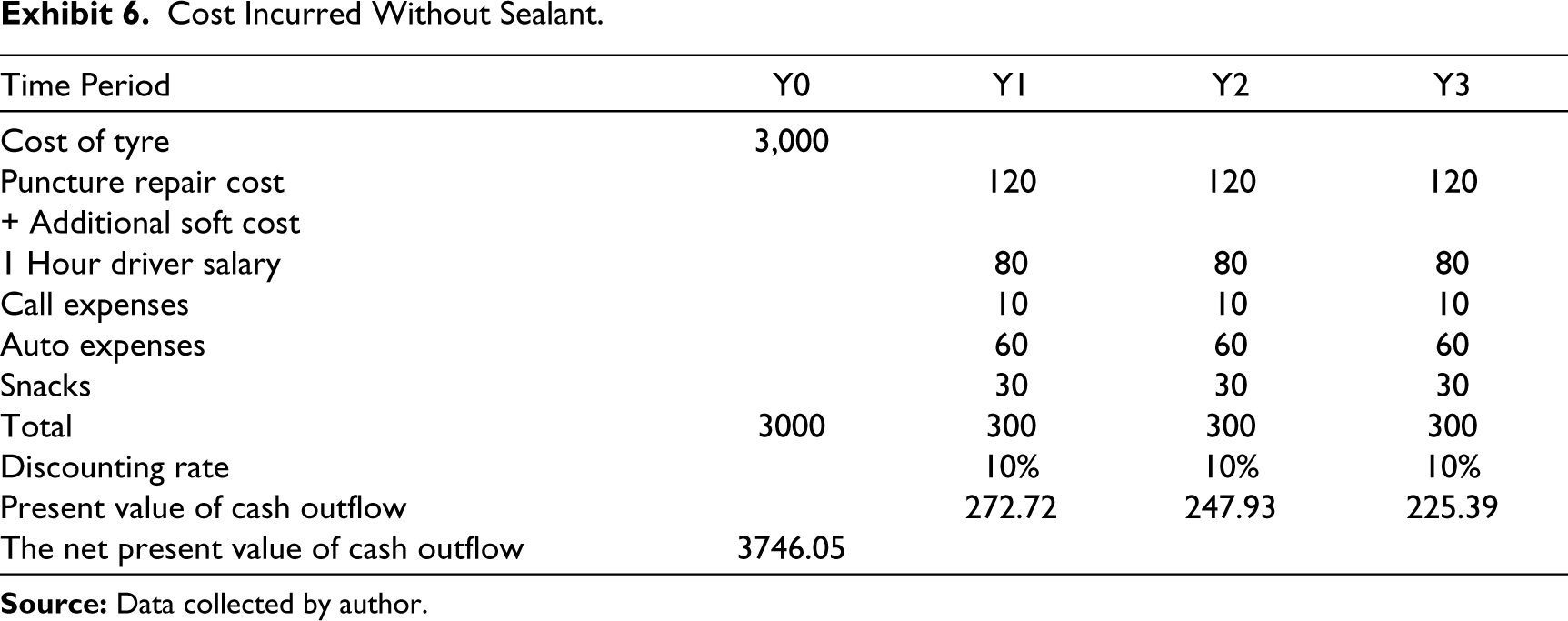
To check the rationality of the money to be saved after using sealant, the researcher had conducted a survey and calculated net present value for 3 years of the cost incurred to an individual with and without sealant.
Footnotes
Declaration of Conflicting Interests
The author declared no potential conflicts of interest with respect to the research, authorship, and/or publication of this article.
Funding
The author received no financial support for the research, authorship, and/or publication of this article.
Appendix
Cost Incurred Without Sealant.
| Time Period | Y0 | Y1 | Y2 | Y3 |
| Cost of tyre | 3,000 | |||
| Puncture repair cost | 120 | 120 | 120 | |
| + Additional soft cost | ||||
| 1 Hour driver salary | 80 | 80 | 80 | |
| Call expenses | 10 | 10 | 10 | |
| Auto expenses | 60 | 60 | 60 | |
| Snacks | 30 | 30 | 30 | |
| Total | 3000 | 300 | 300 | 300 |
| Discounting rate | 10% | 10% | 10% | |
| Present value of cash outflow | 272.72 | 247.93 | 225.39 | |
| The net present value of cash outflow | 3746.05 |