




Abstract
Functionalism has been the dominant theoretical model used in social sciences to explain the religious expression of prison inmates. However, not all their religious behaviours can be explained by one single paradigm. The objective of this research is to understand the complexity of religiousness in prison and present the need for new interpretative approaches that encompass the polyhedric nature of this phenomenon. The methodology applied is hermeneutic and qualitative. Two modules from the same prison were selected and a focus group was formed for each module. The focus group sessions revolved around the inmates’ religious beliefs, attitudes, and practices and how they are manifested within the prison context. The results demonstrate the functionality of religiousness in prison as an effective mechanism for adapting to a highly stressful medium and for alleviating the destructuring effects of the prison regime. The application of a constructivist hermeneutic approach as a complement to functionalism also highlighted a new type of religious expression that springs from the prison subculture, namely ‘prisonized religiousness’, a concept defined as a transcendental spiritual revival of subjective revitalization which enables inmates to create a new identity.
Introduction
There is a widely held stereotype within society today that prison is a hostile or at least unfavourable medium for the emergence and expression of religious behaviours, beliefs, practices, and so on. There are even certain prejudices within academic circles (Camp et al., 2008) in which the validity and significance of religious expression in prison is relativized. With this in mind, one of the objectives of this research is to cast these prejudices aside and expand our knowledge of this phenomenon by proposing new perspectives for interpreting religiousness in prison. This article seeks to complement other scientific research in Spain that offered a rigorous explanation of the diagnosis and significance of religious expression in prison (Gallizo, 2009; Griera and Clot-Garrell, 2015a; Mantecón, 1996; Martínez Ariño et al., 2015; Rodríguez Blanco, 2009).
At a wider, international scale, the study of religion in prison has always been a question of enormous interest. Research contributions vary from the classical studies by Hirschi and Stark (1969), the review of the literature by Johnson et al. (1997), the study of how spirituality is lived out in prison, to the impact on attitudes and behaviours of religious representations contextualized within the prison world (Baker and Booth, 2016; Beckford, 1999; Dubler, 2013; Hicks, 2008; Jahn, 2015; Mears et al., 2006; Rostaing et al., 2015; Wilson, 2016). In any case, prison remains a social space that arouses interest in religious belief as expressed by people who have been deprived of their freedom (Morag and Teman, 2018).
In this research, we are particularly interested in studies that highlight the role played by religious values as socialization factors (Clear et al., 2000; Dodson et al., 2011; Hewitt, 2006; Jensen and Gibbons, 2002; Schaefer et al., 2016), the role played by religious instruction in the rehabilitation of prisoners (Hodge, 2003; Ross, 2021), and the personal support that prisoners encounter in religious practices (Stansfield et al., 2017). These varied approaches highlight the widely diverse forms of social and religious expression that can arise within penitentiary establishments.
It is true that the sociological analysis of religious expression in prison necessarily involves an analysis of the interaction between religious behaviours and their social context. This also enables us to establish a series of socioreligious types within prison communities and varying degrees of compliance with the requirements of religious rituals (García Martínez, 2000). Although as Griera et al. (2015) made clear, in recent decades, the Catholic Church has lost some of its visibility and its leading role within attention to inmates’ religious needs. Nonetheless, the interaction between prison and religion remains constant and meaningful, above all with the arrival of new religious actors, such as evangelical churches, Islam, and other religious confessions. In fact, and as reflected in the specialized bibliography, religious visibility is not only accepted but also promoted by the prisoners themselves (Béraud et al., 2013; Clear et al., 2000; Kerley et al., 2005; Maruma, 2001; Sarg and Lamine, 2011). The increasing religious diversity in prisons has also been confirmed (Becci, 2011; Becci and Knobel, 2013; Beckford, 2013; Beckford et al., 2005; Furseth, 2000). Without forgetting that the visibility of the religious experience can take a wide range of forms in relation to the different methods followed by prison inmates to adapt to life behind bars (García Martínez, 2008).
Due to its inherent bureaucratic inertia, the institutional dynamic of prison has a series of disturbing effects on the emotional lives of prisoners (Moreno, 1995; Rostaing, 2007). They undergo a continuous process of depersonalization as they find themselves immersed in a total institution (Goffman, 1992) like prison, a highly formalized organization that administers a set of routines with formal mechanisms of constant control under a regime of incarceration.
This suffocating totality experienced by the prisoners results in a need to find some form of ‘rationalizing discourse’. In this sense, being deprived of one’s freedom necessarily involves a series of hardships in addition to serving the sentence handed down by the court; these come in the form of harsh, unpleasant living conditions (Caballero, 1986; Valverde, 1988). The inmates find themselves in a position where they need to develop mechanisms to adapt to what is a very inhospitable medium. These include the social construction of a particular prison ‘ethos’ (Berger, 1971), in this case made up of religious components. It is precisely here that the ‘prison religious discourse’ comes into play, providing prisoners in a plausible way with absolute, meaningful explanations which enable them to construct a solid experience of their own personal dignity in the face of an often overwhelming situation over which they have no control.
The functionality of religious expression in prison
Religion is defined as a form of social expression based on a cultural system of beliefs, symbols, and rituals of a sacred nature, which are shared by a group and provide a final meaning and a feeling of belonging (Durkheim, 1993: 25–32). Within the theoretical framework of structural functionalism (Merton, 1992; Parsons, 1998), religious representations within the prison context are described and analysed as a set of processes in which social and cultural structures are in constant systemic interaction. The religious behaviour of the inmates within this specific social system (i.e. prison) is viewed as a functionality that helps maintain ‘prison order’.
In this way, the social subsystem of religion in prison helps the prisoners concerned to adjust to or fit into the general social system of the prison by activating the function of normative stability and adaptation. The adaptation function is the most important here in that it provides a mechanism for positive readjustment to a situation of constant deprival of freedom, often for many years, with the objective of optimizing possible benefits of life in prison and minimizing its most dehumanizing effects. In this way, what Daggett et al. (2008) referred to as ‘a desire for integration’ takes place; in other words, in addition to acceptance of an undesired situation, value is also placed on improving social interaction with other inmates (Rostaing et al., 2015). In other words, for religious inmates, normalized religious practice in prison enables them to continue observing collective rites in a sustained, long-term manner. Liturgical celebrations provide a new moral legitimacy for the present moment in as much as the prisoners wish to leave behind their previous errant behaviour, that is, their criminal past (Demerath and Hammond, 1969; Jang and Johnson, 2001; Kelly et al., 2015). This enables what Clear and Sumter (2002) refer to as ‘healthier adaptation’ to the functioning of the prison institution in effective compliance with prison regulations, so favouring the religious inmate’s adaptation to institutional life (Johnson et al., 1997). This pragmatic attitude is undoubtedly a recurring feature in the religious manifestations of prison inmates (Dammer, 2002).
The phenomenology of religion in prison – behaviours, attitudes, values, and beliefs – provides prisoners with the tools they need to help them adapt to such a complex social medium as a penitentiary facility. Indeed, a relationship has been observed between religious practice and a reduction in breaches of the prison regime (Kerley et al., 2005; O’Connor and Perryclear, 2002; Sumter, 2006). Religious rituals provide the inmates with routines that enable them to cope better with their subjective experience of time in prison, so giving them a ‘certain peace of mind’ (Dammer, 2002: 41). From this perspective, religious practice provides the inmates with a ‘new source of rules and values’ that makes it easier for them to restructure their lives (Sarg and Lamine, 2011: 101), so finding the social support that they need immediately in the midst of a hostile environment (Weaver and Campbell, 2015).
Nonetheless, and given that religious expression in prison is a complex, multifaceted phenomenon, on occasions the penitentiary institutions themselves make utilitarian use of religious rituals, which are seen as a modus operandi for adaptation to the prison rule system or as an element of discontinuity or break from prison routines. Within this ‘institutional pragmatism’ approach, one can sometimes observe that religious expression is promoted as a means of legitimizing the established order with the minimum cost (Füredi, 2004) and of curbing possible conflicts (Adelantado, 1992; Jiang and Winfree, 2006); something that Crewe (2011) described as ‘soft power in prison’. Indeed, penitentiary administrations as a whole show a favourable predisposition towards the role that religion can play in prison life; although this can be understood as an institutional expectation that seeks the ‘maintenance of social order’ (Griera et al., 2015: 5). The management of the prison is also aware that religious practice can have a complementary function in the rehabilitation of inmates (Gallego et al., 2010), an especially important objective given that one of the immediate aims of the authorities is to try to reduce or eliminate troublesome conduct within the prison facility (García and Sancha, 1987; Valverde, 1988).
As regards the psychological functions of religious expression in prison, these have been widely studied in the specialized bibliography. These functions include the optimization of their psychological state (García Martínez, 2008; Kinney, 2006; Maton, 1989), mitigating the loss of dignity caused by the dehumanizing dynamics of prison life (Clear and Sumter, 2002), or the therapeutic role that religion can play (Duwe and King, 2013). All of this enables us to establish a series of positive relations between religious values and perceived psychosocial well-being, in terms of cognitive coping strategies (O’Connor and Duncan, 2011). In other words, when faced with difficult situations in life such as the deprivation of one’s freedom, an intense need for religious experience – beliefs, practices, and so on – arises as a mechanism for alleviating the pain (Becci, 2011). This religiousness becomes a highly positive factor for strengthening and consolidating one’s psychosocial equilibrium, so helping prisoners to overcome traumas and depersonalization dynamics, uncertainty regarding their immediate future, the outcomes of pending trials, or the anguish inherent in a minutely regulated daily life.
In this case, the functionalist theoretical framework is an effective analytical tool for studying the effects of the religious practices of the inmate population as a powerful factor of internal cohesion in ‘prisoner society’. Said theoretical model explains the functionality of religious expression in a prison context and its contribution to the maintenance and organization of the different immediate desires and expectations of the prisoners. As we have seen, religion in prison has a wide range of varied functions, for example, as a mechanism to help the individual adjust to the prison regime and as a strategy for adapting to the surrounding environment. While from the perspective of the prison authorities, its functions include institutional utilitarianism, conflict reduction, and stress management.
Need for new interpretative approaches from a constructivist perspective
Nonetheless, and in addition to the above, there is also a significant sector of the inmate population that develop their own socioreligious ‘ethos’, which cannot be explained by functionalism. Complementary theoretical approaches must therefore be developed as regards the comprehensive interpretation of a phenomenon that is intrinsically varied and diverse (García Martínez, 2010).
We believe that, in this new situation, the constructivist model offers better ways of explaining the emergence of other forms of religion in prison. The principles of the model highlight how the subject interacts with the object of knowledge (Piaget, 1988) and that this process is carried out as part of a constant social interaction (Vigotsky, 1994) in which emphasis is placed on the significance for the subject himself or herself (Ausubel et al., 1983).
In said model, the subjects become involved in the dynamics of social construction in which reality is presented on the basis of multiple constructions which depend on the meaning that people bestow on it in its particular context.
In addition to the classical European sources regarding the application of the constructivist approach (Jonnaert and Masciotra, 2004; Soulet, 1983) in which the narrative variations refer to expectations as to improvements in living standards, it is also important to highlight various Latin American authors who have been applying this model in their research. We would like to emphasize, among others, different aspects in the broad-based treatment and approach to the phenomenon of religion in Latin American prisons: the different types of religion (Algranti, 2012), in which there is a ‘reinvention’ of religion in prison contexts (Brardinelli and Algranti, 2013; Navarro and Sozzo, 2021), continue to be fertile ground for the occurrence of religious conversions (Scheliga, 2005) in conditions in which inmates are denied basic human rights (Andersen, 2012). Others highlight the rise and wide acceptance of evangelical movements in prison (Marín Alarcón, 2016; Scheliga, 2005), where the prisoners often organize themselves into their own evangelical-pentecostal blocks (Manchado, 2022). These authors also found that, in these cases, the prison authorities adopted quite a permissive approach to religious expression as part of a strategy for social control inside prisons in various Latin American countries such as Chile, Argentina, or Brazil.
For constructivists, it is individuals who give meaning to our experience of life. This is the subjectivist epistemological perception of reality (Von Glasersfeld, 2013). This is where we must situate the concept of ‘prisonized religiousness’, as the resignification of religious identities within the parameters of a search for greater dignification of the conditions in which the prisoner lives. This entails a meaningful construction by the inmates themselves of their own particular form of religious expression within the limited confines of the prison and its internal rules. Within this framework, we can apply, as a complement to the functionalist model, new hermeneutic approaches (a constructivist model) that capture the intrinsic complexity of religious expression in prison, in the sense of a meaningful interaction with the social context of prison life and a resignification of their religious experience. In fact, their religious beliefs are shaped by their constant interaction with the prison as a social medium.
Methodology
We believe that the application of constructivism as a hermeneutic tool that helps us understand all the dimensions (theological, ritualistic, experiential, ethical, and social) of religious experience in prison could be very useful for identifying and assessing the different cognitive, emotional, and social dimensions that make up the religious experiences of prison inmates. With this in mind, the main question we will be addressing in this research can be summarized as follows: What is the significance for the inmates of religious phenomena in prison beyond the conventional functionalist view?
The information was gathered using the focus group technique. This technique enables highly meaningful information to be gathered via the hermeneutic analysis of the ad hoc narratives and discourses in which the members of the focus group express their opinions. This enables the arguments and ideas they present about a particular issue to be explored in greater depth (Prieto and March, 2002). We believe that a focus group is a very useful qualitative technique when it comes to tackling a subject – the complexity of religion in prison – to which access is difficult and about which there is little specific information. The aim is to collect the full diversity and meaning of religious expression in a prison environment through a group dynamic (Morgan, 1988). This is possible given that the different subjective opinions and attitudes on any particular issue can be revealed in interaction with other people (Kitzinger, 1995), and that, as García Calvente and Mateo Rodríguez (2000) point out, the focus group expresses the whole set of significant interactions that occur within the group, so favouring the emergence of a series of narratives and opinions in relation to the issue being studied that provide information of high subjective validity.
For these purposes, we selected a penitentiary in northeast Spain (anonymized) and two modules within that jail. This prison can house up to 1050 inmates, who are either serving a sentence handed down by a court (convicts) or are being held in custody awaiting trial. It has 10 modules, an admissions unit, an infirmary, and an open section for prisoners on day release. This is a penitentiary institution for the execution of sentences, with a medium-security level, housing respect modules. It is located on the outskirts of the city and accommodates inmates with a generalist profile (covering all types of criminal offences).
Attendance at religious services in prison is regulated by the Church-State Agreements in the case of the Catholic Church through the Catholic prison chaplaincy and by legislative frameworks that regulate the assistance provided by other Christian confessions, such as the Evangelical Church, the Adventist Church, and the Philadelphia Evangelical Church (Spanish Romani church). The Catholic Church, through penitentiary chaplaincies, is present in all prisons in Spain. Evangelical and/or Protestant denominations are present to a lesser extent, though with a growing trend. The motivation of all churches is primarily pastoral, including religious services, educational activities, and social assistance programmes.
The prisoners are allocated to a particular module on the basis of the particular stage of their court proceedings and the crimes they have committed. Module number 3 is characterized by a low level of confinement, housing prisoners with negligible rates of reoffending, short sentences for sexual and drugs-related offences, and a desire to reintegrate into society. Module 9 is characterized by a high degree of confinement, high levels of reoffending, long sentences, violent crimes (homicide and armed robbery), and much less interest in rehabilitation.
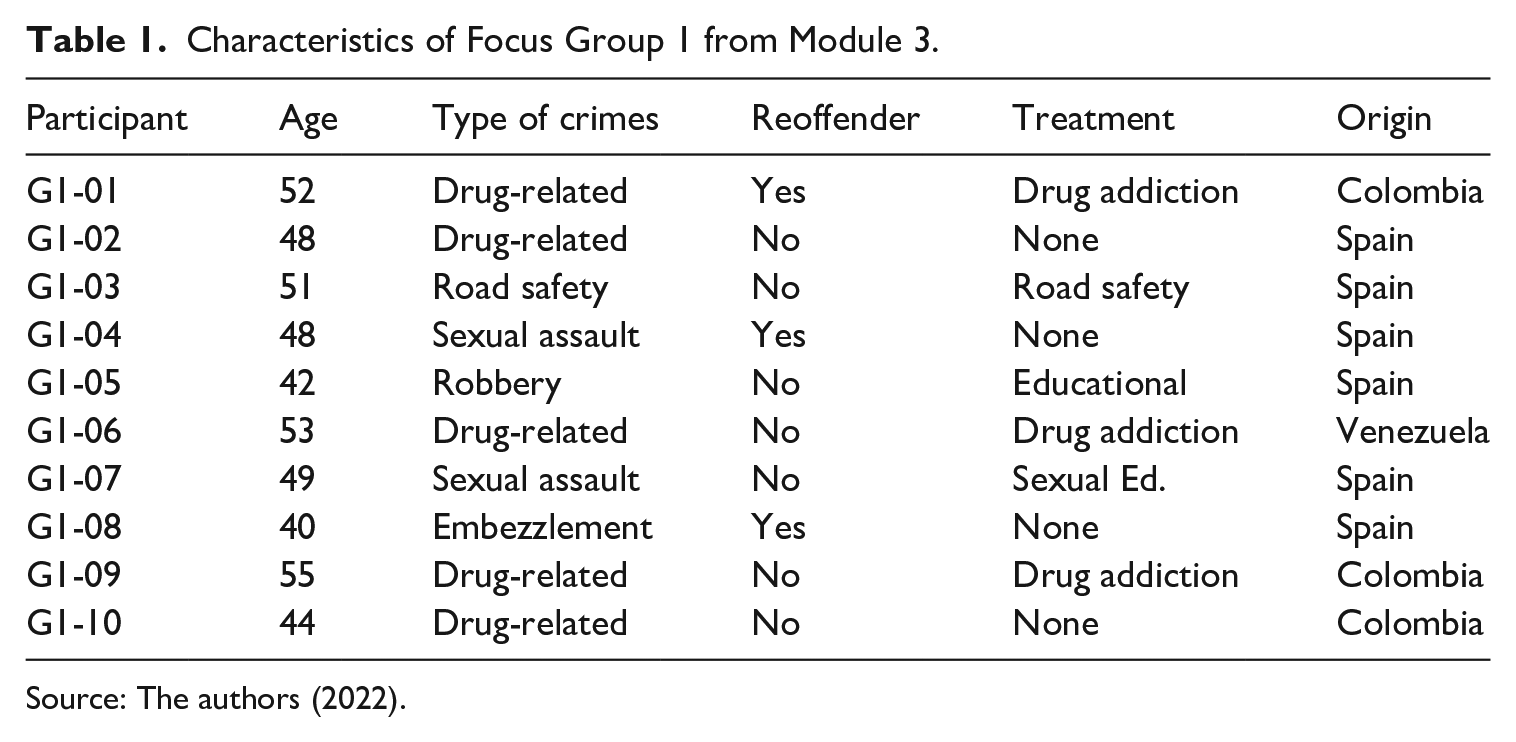
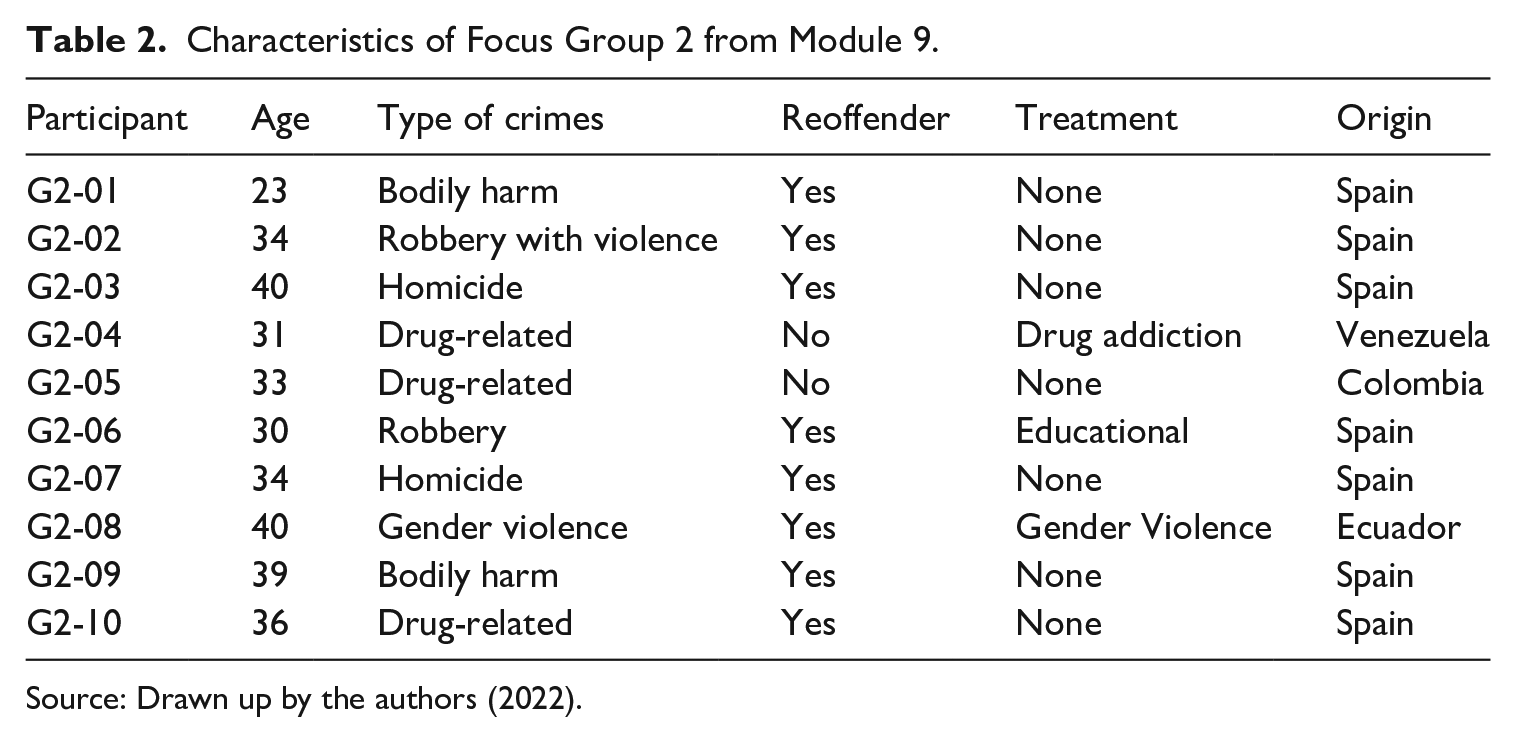
A focus group was formed for each module. Focus Group 1 was made up of prisoners from Module 3 (see Table 1) and Focus Group 2 from Module 9 (see Table 2). The reason for forming two groups was to observe whether there were any significant differences with regard to their opinions and experience of religious practice in prison.
Characteristics of Focus Group 1 from Module 3.
Source: The authors (2022).
Characteristics of Focus Group 2 from Module 9.
Source: Drawn up by the authors (2022).
This form of Catholicism could be classified as a form of religious expression that springs from the people and takes the form of a group of beliefs, celebrations, and rituals in harmony with the patterns established by the institution of the Catholic Church. These inmates show high levels of sacramental practice (attendance at mass) and devotion to saints and the Virgin Mary.
The selection criteria for the participants were based on our desire to observe any significant differences between the two groups in terms of their perception and experience of religious behaviours in prison. The selection criteria were as follows: regular attendance at Sunday liturgical celebrations for inmates from Module 3 and regular Bible reading for inmates from Module 9.
We chose Module 3 because it was the place where the Sunday worship was held. One Catholic chaplain attends to the needs of prisoners from all 12 modules. The prisoners attend voluntarily, most starting very soon after their arrival at the prison. The members of Focus Group 1 were selected at random after inviting them to participate in group activities. Module 9 is different in the sense that it does not have a space set aside for religious activities. A general invitation was issued to the prisoners in this module to participate in the focus group debate. This explains why there was greater variability in religious attendance within Focus Group 2. Attendance at mass was more irregular due to their more frequent breaches of prison rules and the resulting punishments (disciplinary measures), such as solitary confinement, in which participation in such activities is not permitted. In fact, it can be described as a ’Catholic-Evangelical continuum’, that is, a very blurred Catholic identity (characterized by occasional attendance at liturgical celebrations) alongside a growing interest in biblical narratives, which are interpreted in light of their existential realities.
Each focus group was made up of 10 prisoners together with a moderator and an observer. The two groups were held over the same period: from October to December 2022. Six sessions of 1 hour each were held for each group.
While, in principle, any member of the inmate population can exercise their right to attend a religious service on Sunday, it is the prison authorities that ultimately decide whether or not to approve each of the requests submitted by the inmates to the Regulations and Administration Board. In other words, the prison administration reserves the right of admission to these religious celebrations which the inmates must request in advance; this is because it involves transferring inmates from different modules within the prison complex. This means in short that their participation is ‘regulated’ by the prison authorities.
The typical profile of the members of Focus Group 1 was as follows: inmates aged 40 to 55, traditional religious socialization, Latin American origin, with no previous prison record, normally with high expectations or desires for social integration. Focus Group 2 from Module 9 showed high levels of prisonization, with high levels of reoffending and return to prison, and medium-to-long sentences. The inmate profile was younger, between 25 and 40 years old, of Spanish origin, and with a succession of failures in their family, school and employment history, and so on. In general terms, they were less predisposed to rehabilitation and rejoining society.
The inmates in Focus Group 2 showed evident deficits in terms of the dynamics of religious socialization, in which the elements of dogma and the rituals typical of religious institutions are much less clear. However, they showed more interest in biblical texts, and free, individual reading of the Bible was a common religious practice.
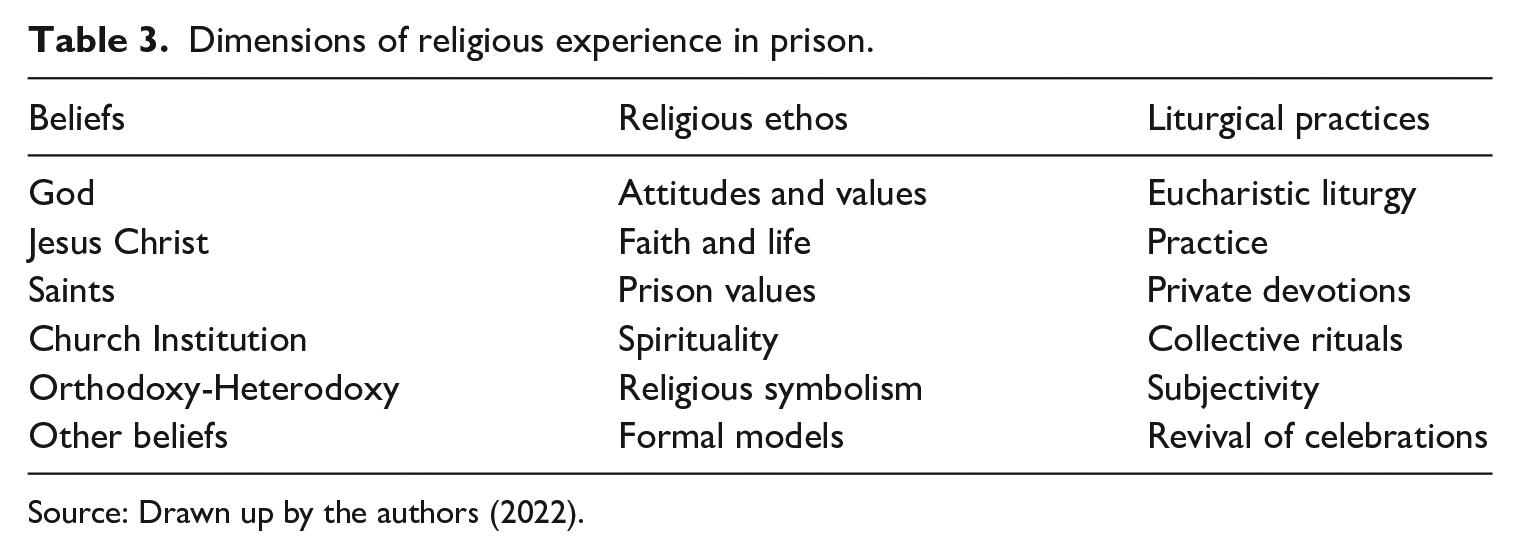
In both focus groups, the moderator had the same script with the subjects to be discussed in the group sessions. The three main subject areas were religious beliefs, normative religious ethos, and liturgical practices (see Table 3). We selected these three dimensions because liturgical beliefs and practices are associated with less institutionalized profiles, while religious ethos is more typically linked to inmates with longer prison terms, leading them to re-signify their religious identities from a constructivist perspective.
Dimensions of religious experience in prison.
Source: Drawn up by the authors (2022).
The group sessions were recorded with the prior consent of the inmates. We then transcribed all the interactions that emerged from the discourses of the participants in the two focus groups in relation to the specific subjects being discussed in each dimension (Table 3). At the same time, these dimensions were regrouped with other lower levels of meaning. We then interpreted the contents of each category in a critical way by incorporating a constructivist approach that complements and goes beyond the functionalist explanations normally put forward in this field. The decision to organize two separate focus groups in different prison modules made it easier for us to segment the discourses and identify the different socioreligious representations.
Results
Socioreligious profile and low levels of prisonization (Group 1)
The results for Focus Group 1 reveal an inmate profile with low levels of assimilation to the rules that regulate ‘inmate culture’, as might be expected in that for most it is their first experience of prison. The group dynamics highlight prisoners with a conventional approach to religion, in this case Catholicism, in other words, with regular attendance at mass and a close identification with the institutional frameworks of the church: ‘For me, Mass is very important. It gives me peace and makes me feel better’ (G1-02). This person has a receptive profile open to conventional forms of religious expression in prison within the parameters established by the religious institution, that is, the Catholic Church.
These inmates are sufficiently socialized within the traditional framework of popular religion with its socioreligious customs (feast days, celebrations, etc.). They rarely or never find themselves involved in conflict situations inside the prison. Their criminal records are typically made up of minor offences, for example, robbery, but interestingly they also include inmates who have committed sexual crimes. One member of the group had this to say: ‘when I go to Mass, it reminds me of when I was little. Everything was so much easier than it is now, with no problems or hassles’ (G1-03). Inmates with profiles of this kind who display more formalized types of religious expression, with higher levels of religious practice, are much more likely to show higher levels of acceptance and compliance with the prison regime. These inmates are often subject to fewer disciplinary measures from prison officers: ‘Since I’ve been going to the chaplain’s, I’m not beating myself up so much and I think about things more before I do them’ (G1-01).
When deprived of their freedom, many people who were believers, but perhaps without a strong, regular commitment, embrace religion much more actively, as part of a strategy to adjust to a context that they perceive as hostile. Their attendance at Sunday Mass provides a framework of normative references in their process of adaptation to the prison environment: ‘to be able to listen to the word of God in the service makes me feel a better person, perhaps better than I really am’ (G1-03). The religious discourses of the inmates point to a wide range of psychosocial adaptations, including a subjective sense of emotional well-being.
Within this group of religious prisoners, the ones that most stand out are the older inmates from social contexts in which working-class religiosity is a characteristic feature. Most were socialized in a traditional form of Catholicism, as found, for example, in Latin American countries. In fact, a higher proportion of those that attend mass come from these countries as compared to inmates from Spain. The celebration of the Eucharist evokes memories of their home countries:
I have always prayed to Diosito (a diminutive form of Dios or God). In my country I always went to church with my family, although all that seems a very long way away now. When I go to Mass, it takes me back to a really happy period in my life. (G1-09)
We should also highlight the uniqueness of by far the most important religious festival held behind bars: the celebration of Our Lady of Mercy, the patron saint of prisoners. In this case, this saint has been appropriated to some extent by the inmate population as a protective figure: ‘Our Lady of Mercy is our patron saint; she is the saint of prisoners because she understands the suffering of the people who most need her’ (G1-09); ‘She, the Virgin Mary, loves all her children, and in particular those of us who matter least to society (…). She is like a beacon that lights up the shades in my darkness, as she loves me just the way I am’ (G1-06). This devotion to the Virgin Mary is associated with maternal protection and effective mediation. She is one of the great ‘prison icons’ in the symbolic universe of incarcerated people.
Self-esteem and adaptation to the prison regime (Group 1)
Regular taking of the sacraments can help improve the inmate’s self-esteem. Participation in liturgical acts gives the inmate an extra lift in terms of ‘humanization’; in other words, it guarantees them an unrestricted experience of their own personality within a new socioreligious framework that provides them with the necessary privacy: ‘There’s nothing official about it. It’s not something you do to reduce the length of your sentence. I do it to feel that Jesus forgives me. He’s my buddy’ (G1-03).
The discourses of the prisoners reveal that religion is used for disciplinary purposes by the prison administration, so as to promote respect for the prison regime and defuse possible conflicts: ‘I’m sure that they, the prison officers, notice who goes to Mass and who doesn’t go. While we are in the chapel, we don’t get our wires crossed (sic) and we avoid getting into trouble in the module’ (G1-02). From this perspective, it could be argued that de facto the religious and penitentiary institutions share the same purpose, in that taking the sacraments entails positive reinforcement in terms of respect for prison rules.
In short, the religious axiology that can be discerned in the interactions of this group has its own particular characteristics: very subjective, pragmatic value judgments, obstructed by the dynamics of prison life. Obviously, this causes prisoners to take ad hoc decisions shaped by their own immediate interests, where the acceptance or not of religious rules will depend on whether or not they meet their own specific needs: ‘while the man above (God) doesn’t let me down, I do my duty to him every Sunday’ – regular attendance at Mass – G1-09.
Religion as a mechanism for adapting to the prison environment and managing stress (Group 1)
The religious activities of the inmates allow them to develop a whole host of religious attitudes and motivations of a clearly functionalist nature. This functional religious reactivity evolves into a powerful mechanism for personal adaptation that helps reduce anxiety and defuse certain anomic situations that the inmates sometimes find themselves in: ‘God is like the father I never had, but now I feel that he protects me and cares for me’ (G1-04). This vision of God is similar to the ‘Bon Dieu’ in the sense of an archetype of the caring, understanding Father. There is also a certain colloquial familiarity with God, as reflected in the words of a member of the focus group: ‘God and I are friends. He always gives me a second chance. He’s my buddy (sic)’ (G1-04). This shows how the normative stability provided by religious experience contributes above all to the acquisition of the necessary subjective psychosocial equilibrium during their time in prison.
The process of psychosocial adaptation is evidenced in their experience of calm and peace: ‘within these walls built by man, the Word of Jesus, which has no walls or frontiers, enters in with all its force and brings me a sensation of peace that I really need’ (G1-10). These ‘therapeutic effects’ provided by regular attendance at the Sunday Eucharist help alleviate the harsh rigours of imprisonment. They can also help regulate mental imbalances and cushion the destructuring effects that prolonged confinement inevitably entails.
In addition, collective forms of religious expression strengthen the social cohesion of the group by consolidating certain processes of a societary nature that contribute to the emergence of shared feelings of belonging and social cohesion: ‘It is good to meet up with fellow inmates. We are from different modules and we don’t see each other during the week, only when we meet up in the chapel’ (G1-09).
These socioreligious representations of a group nature help to strengthen their collective consciousness of an ‘us’, the prisoners, against ‘them’, the prison officers, so increasing their sense of safety and self-protection: ‘when we go to the Pater (Catholic chaplain), we feel safe; they (the prison officers) respect us more, and they don’t mess with us’ (G1-07).
Broadening the epistemological framework: Prisonized religiousness (Group 2)
As regards Focus Group 2, 1 we should begin by highlighting quite a special, noteworthy feature. In discussions on the practice and significance of religion in prison, the ideas they put forward as regards their religious beliefs and practices did not fit well within the functionalist explanatory model applied in the previous group. It is important to bear in mind that the focus group from Module 9 was made up of inmates that were serving their full sentences with no access to benefits or reductions, due to their high levels of reoffending.
Socioreligious profile associated with high levels of prisonization
The discursive spectrum of this group of inmates indicates a general position of reluctance to get involved in all kinds of official or group-based religious expression. Many complain about what they see as the institutional continuity between the penitentiary system and the ecclesiastical system. They also show greater disengagement with the rituals demanded by official religious institutions (e.g. fasting during Lent): ‘I believe in God, the slammer king (sic), who knows what it is to suffer, to be unjustly condemned and put to death’ (G2-09); ‘The system couldn’t stand him because he stood up against the powerful, against the lawmakers of that time’ (G2-10). From the perspective of this group of inmates, this ‘prisonized God’ appears stripped of all attributes of power and superiority. In the image of God projected by the prison subculture, he represents a sort of ‘Absolute outsider’, who does not conform to the canon law system imposed by the Church.
These prisoners, who are completely immersed in the rules and forms of behaviour imposed by prison culture, normally manifest a low sense of belonging to the established Church and a religious value system that is highly dependent on more subjective interests and circumstances that go beyond the parameters established by the institutional orthodoxy of confessional religions.
Religious ‘ethos’ in prison contexts
The discourses manifest a favourable view of religious identity as an integrating mechanism that provides structure and improved cohesion to ‘prisoner society’ and breaks beyond the formal frameworks typical of institutional religions. They offer an individualized reinvention of religious expression contextualized within prison subculture and subject to its rules and customs: ‘In our lonely prison lives, our greatest treasure is God himself, no less, the friend who never lets you down, our most dearly loved one’ (G2-08); ‘in this world of darkness, he has given us light, he has calmed our fears, he has given us lasting hope’ (G1-01). The contributions to this focus group are dominated by religious sentiment in detriment to the more formalized languages typically used in institutional religion. Indeed, there is a semantic change when it comes to defining God as a ‘Dios taleguero’ or ‘Slammer God’ who springs from and pertains exclusively to the prison environment.
In this way, they present an alternative system of values that breaks away from established ones. It is not that they lack a religious axiology. Instead, what we have is a different normative structure that has little in common with the conventional structure offered by the ecclesiastical institutions. This is because this new set of values emerges within a contextualized process, in which the tension rife in the prison environment acts as a stimulus. One inmate put it like this:
Jesus who taught us that love is more beautiful than hate and that hate is the saddest thing on Earth. Help us Lord, once again (…). Please give me the strength to withstand the calvary of prison, to make sure that drugs do not control me or make me their slave. I want to be a free spirit. I want freedom. (G2-10)
Their socioreligious narratives highlight that they are normally very wary of the normative demands of religious institutions, and they are stubbornly opposed to the traditional socializing dynamics typical of established religions. One inmate, with a university degree, complained that ‘the Church in Spain has always been at the service of those in power’ (G2-06).
The analysis of the discourse of Focus Group 2 reveals a form of semantics that is highly contextualized within the prison environment. The language – words, concepts, and representations – used by these prisonized inmates reflects a lexical appropriation of religious morals that explain their own personal reality: ‘drug money is cursed money, it is the money of Satan’ (G2-03). Others express an overriding need for protection: ‘Oh Lord, let the trial go well for me (the trial of an inmate on remand). Help me to handle everything properly and not dig myself into a hole’ (G2-07). In short, a sociolinguistic form of expression that is very familiar, emotional, and personalized and reflects the circumstances in which they find themselves.
The discovery of religion in prison and extreme personal situations
Religious experiences in prison are related with personal situations in which those concerned are pushed to the limit. They are at extremely complex times of their lives in which uncertainty becomes chronic in the midst of prison regimes based on a routine, depersonalized life. Many of them have already spent over 10 years in jail:
the days spent behind bars weigh so heavy, they are so bitter, with so much suffering… The only thing that consoles me is the Love of God. It’s what keeps me going, if not I’m sure I would have given myself a huge treat (using drugs). Someday, I know I’ll find what I’m looking for, with God’s guidance. (G2-07)
In situations of real personal emergency, their negative perception of their immediate reality can reach levels that are difficult to bear and their psychological resistance capacity is stretched to the limit. In such cases, the resort to a religious way of life is the only way out:
religion is the life of man, the path that leads to God, thanks to which man becomes more just (…). I want to change my life. I don’t want to keep going over the same things again and again. Christ is the solution, he doesn’t lie, like others. (G2-05)
When asked about more institutional aspects of religion, the members of Focus Group 2 stated clearly that in their case, their experience of religion is part of a process of ‘privatization’:
Sometimes I hide in such a deep hole but I can’t find the way out, as if I was getting used to the dark. That’s when He comes to me, because he is everywhere where men are suffering. He’s in prison. (G2-03)
The identity of the believer is understood as an emotional and personal adhesion to the object of belief (God), without this being linked in any way to some particular religious confession. We could highlight the sense of religious ‘appropriation’: ‘I have “my” religion. I don’t need any others’. The emotional perception of the divine figure: ‘God is inside my being. He’s the inner driving force of my life’ (G2-10); and the fact of having severed their links with group or assembly-based religious traditions: ‘The Lord is with me and I’m with Him. I don’t need anything or anyone else. You don’t have to belong to a Church to follow the right path’ (G2-05).
Revitalization through religion and prison subculture (significance of the Bible)
One of the central themes of the discourses were the repeated references to reading from the Bible. The interest that the inmates show in the Bible is one of the most representative hallmarks of prisonized religiousness: ‘For me, the Bible is what gives me strength to live. It has helped me become a better person. It is the word of life, never of death’ (G2-07); ‘Reading the word of God shows me the road I have to take and to leave behind the bad ways of drugs and my dodgy, depressing life. It is God’s Law, real justice’ (G2-04).
From this perspective, and throughout the different interventions, the direct or indirect references to biblical texts highlight how meaningful they are in the lives of the inmates. This enables us to identify a key category – bible reading – which provides rules of behaviour for inmates subject to the everyday tensions of prison life: ‘There are times when you think that nothing is worthwhile, that everything around you is rotten… but something always comes up that you can believe in. Someone you can trust. Then I feel stronger because I don’t feel alone’ (G2-04). Narratives of this kind represent a ‘personal catharsis’ that encourages the emergence of sentiments of spiritual quest, which undoubtedly improve their adaptation, in terms of perceptions and emotions, of their own existential reality.
One of the key factors explaining this phenomenon is the teaching capacity that the inmates attribute to the Bible. The prisoners are trying to find definitive, immediate answers to a series of key questions: Why are they in this situation? What is the meaning of their life so far? What is the purpose of suffering? and so on. In short, they are striving to find some absolute, ultimate references that enable them to transcend and/or cope with the circumstances of being deprived of their freedom for a long period, hence the reference to the leading role played by the Bible as a factor in the revitalization of prisoners through religion.
Discussion and conclusion
The results of this research reveal that prison is indeed a fertile social space for the emergence of a whole series of religious experiences for the inmate population (García Martínez, 2008). In other words, for some people, entering prison involves a reorganization of their immediate expectations, together with a notable increase in their religious activity as compared to their previous lives. This is because prison, a penitentiary establishment with an extremely formalized system of organization and operation, can also be defined as a social space that hosts an extremely complex socioreligious ecosystem (Becci and Knobel, 2013; Beckford, 1999; Martínez Ariño et al., 2015; Maruma, 2001; Mears et al., 2006).
The results obtained from the agreements reached on the basis of the free interaction of the members of each one of the two focus groups point to the existence of two socioreligious categories with their own separate profiles. Although the groups share some common features, above all in relation to the interest in and/or favourable predisposition towards religion in prison as a factor that can help prisoners cope with the hardships of a system that deprives them of their freedom. Nonetheless, certain special characteristics were observed in each group. Focus Group 1 offered a vision and representation of religion that falls within the established canons of the religious institution, the Catholic Church, itself; by contrast, Focus Group 2 offered a more subjective, more personalized perception of the structural elements of the religious experience, in terms of the resignification of religious identity within the prison subculture – prisonized religiosity. Although the comments cited here are the views of particular individuals, they broadly reflect the general outlook of the group.
From this widely diverse hermeneutics of religion in prison, a certain association can be observed between what could be described as ‘tension thresholds’ and religious reactivity; in other words, the atmosphere of depersonalization creates the conditions in which the incarcerated person develops, with a greater or lesser degree of formalization, a jumbled, disjointed set of religious experiences. This is why medium or moderately high levels of tension in the prison can affect the inmate’s receptiveness and predisposition towards religion within the specific context of a prison. In situations with moderate tension thresholds, we observed a type of socioreligious expression that was adapted to the orthodox canons of the institutional framework of religious confessions. By contrast, in contexts with high levels of tension, a religious phenomenon specific to prison life, referred to here as ‘prisonized religiousness’, emerges in which religious identities in constant contact with the prison subculture are formed.
There is a broad, extensive body of knowledge regarding the functionality of religion in prison as a mechanism for the adaptation and personal well-being of the inmate (Becci, 2011; Daggett et al., 2008; Weaver and Campbell, 2015). Within this functionalist line of thought, the inmate is in theory better adjusted to the role assigned to him by the bureaucratic system of the prison, which classifies him as a ‘good inmate’. This type of religious expression can, perhaps unintentionally, legitimize and provide a solid foundation for the maintenance of order within the prison walls. We could even talk about the ‘colonization’ by the prison authorities of the celebrations of the liturgy. From this perspective, it is easier to understand why, in Spain, the General Organic Law governing Penitentiary Institutions (1979) devoted an entire chapter (Chapter IX) to attendance at religious celebrations: ‘the Administration will guarantee the religious freedom of the inmates and will provide the resources to enable them to exercise this freedom’ (Art. 54). It is possible to claim therefore that liturgical activities, backed by the established set of rules, can help prisoners develop a degree of normalized interaction with the prison administration, accepting de facto the purposes and objectives of the prison as a bureaucratic institution.
Although the functionalist model explains the psychosocial functions that religious expression in prison entails for the inmate in terms of the emotional well-being that it engenders and as a palliative against anxiety (Clear and Sumter, 2002; Dammer, 2002; Kelly et al., 2015), this model is patently insufficient to explain the inherent complexity of religious expression in prison.
This explains why there is an increasing demand for an epistemological broadening of this phenomenon, due to the great diversity of socioreligious expression in the different groups with religious identities in prison (Griera and Clot-Garrell, 2015b). From this hermeneutic, constructivist perspective, the different discourses by both Focus Group 1 and Focus Group 2 showed a significant association of two relevant factors: levels of prisonization and receptiveness to institutional religious models. Our data indicate that Focus Group 1, made up of inmates who refused to interiorize the forms of behaviour imposed by the prison subculture, seemed favourably disposed to the official normative models typical of religious institutions. By contrast, in Focus Group 2, where the prisoners had significantly higher degrees of prisonization, religion was associated with an adaptation to alternative models arising from the prison subculture that transcend the framework of established institutional religion. The results of our research therefore show the existence of different religious narratives and discourses within the prison context that go beyond the functions that have traditionally been attributed to religious expression in prison.
From this new perspective, the concept of religious experience is broadened as a resignification of personal identity, in other words a constructivist approach that goes beyond the functionalist model in which, as pointed out by Becci and Roy (2015: 17), the penitentiary institution regulates religious activity on the basis of the objective of maintaining order inside the prison, what could be regarded as the ‘standard view’.
This highlights the insufficiency and/or limitations of the functionalist theoretical framework. Within the discourses and narratives of the prisoners in Focus Group 2, it is possible to observe and identify prisonized religiousness, a religious phenomenon specific to prison life. It is associated with the construction of a socioreligious ‘ethos’ typical of inmates who have interiorized the different aspects and components of prison subculture.
Within this constructivist approach applied to the study of religious expression in prison, we could cite among others the contributions made by Becci (2012, 2015) in relation to the resignification of the religious phenomenon within the prison context as a result of the interaction of the prisoners with their own situation of confinement and lack of freedom, or the deep meaning obtained from practising yoga in prison, which for the inmates recreates spiritual experiences of a holistic nature (Griera and Clot-Garrell, 2015b).
On the basis of this framework for explaining prisonized religious expression, the religious experience lived out within the bosom of the group undoubtedly enhances peer-to-peer social interaction as a result of shared religious experiences. They adopt forms of behaviour that do not fit into the protocols of established formal religions, and instead fall within what Becci and Knobel (2013) identified as ‘grey areas’, made up of manifestations that run parallel to or outside standard liturgical canons. This is what we call ‘prison religious groupings’ in which the different ways of celebrating their religion and applying their religious values emerge freely and creatively, giving rise to specific religious symbolism that reflects the prison subculture, in the sense of an expression typical of prisonized religiousness. In fact, the differences between the groups are evident as regards their respective perceptions and the significance of the religious experience for the prisoners who are most subject to the prisonization process (Focus Group 2), in the sense that it strengthens the internal cohesion and identity of the group itself, above and beyond the administrative structure imposed by the prison. In other words, the expression of their religious beliefs as a group enables them to recover their personal and social self-esteem, by adopting attitudes of resistance against the ‘system’. This dynamic of ‘religious groupings in prison’ enables the inmates to reassess and accept the roles ascribed to them by the prison regime, albeit on a temporary provisional basis.
Religious groups can be a source of innovation and creativity typical of the prison subculture that transcends the times and spaces established by the prison administration. One example is the reading and commentary of passages from the Bible in small groups created ‘ad hoc’ in the module or cell.
The components of prisonized religiousness seek the activation of personalization dynamics and of the ‘redignification’ of the inmates themselves, together with an evident redefinition of their religious identity, which is very far removed from institutional religion. In any case, there is an important need to construct new categories and to systematize new discourses that provide structure for these emerging manifestations of religious experience, in this case, specific to the prison context. This would involve discarding a reified notion of religious experience (Beckford, 2009), in that the inherent dynamism of prisonized religiousness is consubstantial with its wide diversity of forms, which prevent it from being classified within a single formal model.
In terms of the limitations of this study, we should highlight the fact that our research is limited to just one prison and the selected sample group is made up above all of male prisoners of Spanish origin. There is also the fact that there is no control group. This means that although our results have a high degree of subjective validity, they are not sufficiently statistically representative to enable them to be automatically extrapolated to other prison contexts. Further studies will definitely be required to help understand religious expression in prison and its epistemological significance in much greater depth.
In short, although this form of religious expression contextualized within processes of intense prisonization does not fit within the parameters of institutional and/or conventional religion, it does, however, maintain an intrinsic legitimacy, as does any religious phenomenon worthy of its name. In any case and invariably, the tension or even contradiction between the two kinds of religiousness observed in prisons, that is, traditional and prisonized religiousness is a constant feature in the prison environment. The balance lies somewhere between the search for the transcendental and magic utilitarianism, and between the quest for the Divine and the need for anchors in life that guarantee a meaning to the senseless lack of meaning of being deprived of one’s freedom. 2 Our research reveals that the canonical forms of religion are not the only valid indicators of religiousness, and that other forms of religious expression can arise from the prison environment or from prison subculture, which we refer to as ‘prisonized religiousness’.
Footnotes
Acknowledgements
The author(s) would like to thank all the people interviewed and the public authorities who facilitated access to the prison.
Funding
The author(s) received no financial support for the research, authorship, and/or publication of this article.

Notes
Author biographies
Address: Facultad de Ciencias Sociales y del Trabajo, Universidad de Zaragoza, C/. Violante de Hungría, 23, Zaragoza 50009, Spain.
Email:
Address: Facultad de Ciencias Sociales y del Trabajo, Universidad de Zaragoza, C/. Violante de Hungría, 23, Zaragoza 50009, Spain.
Email: