



Abstract
The traditional religions of Taiwan’s Indigenous people (Austronesian speaking) are very diverse. The 16 officially recognized ethnic groups differ markedly in notions of deities, spirits, ancestors, classes of beings, and ritual groupings. This article attempts to use Philippe Descola’s concept of ontology to understand their differences. I investigate how Indigenous people perceive their world through the two basic mechanisms of body and intentionality to infer similarities and differences between themselves and nonhuman beings. Three modes of identification result: animism, analogism, and totemism. Their traditional religions are often regarded as animism, rather than typical of societies identified with analogism or totemism. However, I will explore these groups’ distinguishing ontological characteristics. By demonstrating the process of diversification through the religious changes since the 1950s, a new understanding of their impacts on different combinations of ontology will be obtained. This can avoid the critique that structuralist and ontological approaches ignore contemporary changes.
Introduction
Taiwan was originally inhabited by indigenous peoples who spoke Austronesian languages. They were very different in terms of language and culture from the Han Chinese who immigrated to Taiwan in large numbers in the seventeenth century. Taiwan’s Austronesian languages retain the common traits of ancient languages and have a high level of diversity, therefore, it is regarded by linguists as the homeland of Austronesian peoples, who successively migrated to islands in Southeast Asia and Oceania (Bellwood, 1991; Blust, 1984–1985). Thus, the Austronesian people in Taiwan have a prominent position in academic research (Diamond, 2000: 710). Their traditional religions are also very diverse but it is difficult to conclude that they have common origins. They differ markedly in concepts of deities, spirits, ancestors, classes of beings, and ritual groupings between ethnic groups; there is also variation internally and inter-area. This diversity is characteristic of Taiwan’s Indigenous religion and also a treasure trove for religious study.
The territory of Taiwan is only about the same as the Netherlands, the Indigenous people living here face the same natural environment and history, and their economic production models are similar. So, why are there so many religious differences among them? When Fox (1988) compared the rituals of Austronesian people in East Indonesia, he mentioned that because of the lack of unified political hegemony between regions, the phenomenon of linguistic diversity occurred among small groups in order to distinguish themselves. Taiwan Indigenous peoples also have similar geographical and historical factors, but this article will focus on the dynamic process of diversification, rather than discussion of its factors. In this way, we can more closely examine their contemporary changes. So how do we understand their inner differences? How were these differences produced in the process? How can we further study and classify them?
This article attempts to use the analytical concept of ontology (Descola, 2005) to understand the differences among Taiwanese Indigenous traditional religions, investigating how they perceive the world around them through the two basic mechanisms of body and intentionality. How do they infer physical and intentional similarities and differences between themselves and nonhuman beings (natural phenomena, animals, plants, spirits, deities)? Furthermore, through the different types of continuity (similarity) or discontinuity (difference) of subjectivity (intentionality) and body (physicality) they perceive between human and nonhuman beings, Descola divides them into four modes of identification: the first mode regards the intentionality (souls) of the two as continuous but the bodies are discontinuous, and is called the animistic regime. The second is that certain beings in the world share a set of physical and internal attributes that seem to cross the boundaries of species, what Descola calls totemism. The third type is that the entities of the universe are divided into different forms, usually arranged hierarchically, forming a dense analogy network, which is called the analogy system. The final way to identify, which Descola calls naturalism, is that the difference between humans and nonhumans lies in mind and subjectivity, while the exterior of the two still maintains a material continuum.
‘This typology of models should thus be taken as a heuristic device rather than as a method for classifying societies into rigid compartments’ (Descola, 2024: 9). 1 Thus, by what characteristics can the traditional religion of Taiwan Indigenous peoples be construed as animism, analogism, and totemism? Although Taiwan is not included in the typical discussion of Melanesian and Polynesian totemism (also Austronesian speaking) (Mosko, 2004), by using their ethnographies, I attempt to reexamine and define the concept of animism, analogism, and totemism, which have been restored in recent years, and add comparative thinking and religious theory dialogue with the ethnographies of Amazonia, Siberia, and Southeast Asia (Århem, 2016; Descola, 2024) rather than treating animism as an erroneous epistemology as E.B. Tylor (1994 [1871]) did (Bird-David, 1999). As Sprenger (2016: 32) observes, world religions and animism are interrelated, but current reflection on animism in Southeast Asian studies is still limited. The same situation exists in Taiwan studies.
From the seventeenth century, external politics and religion caused Taiwan’s Indigenous religions to undergo substantial changes; however, to this day, traditional religions retain some different and distinguishable traits. From 400 years ago, Han belief (Taoism and Buddhism) had a particularly heavy impact on the Indigenous people living on Taiwan’s Southwestern Plains, such as the Siraya. During Japanese colonial rule (1895–1945), many rituals connected to millet and headhunting disappeared, transformed, or went underground. Following the departure of the Japanese in 1945 after the end of WWII, Christianity followed the new Nationalist regime into Indigenous villages in the 1950s. Then, in just 10 short years, more than one-quarter of the Indigenous people became Christians, forming the special phenomenon of collective conversion. The religion that had once been cohesive in the villages gradually became the source of conflict between people.
In the 1980s, Indigenous people began to be aware of the threat to the survival of their culture. Ritual and belief became the center of cultural revitalization, ethnic group identity, and the name rectification movement. The rituals that had disappeared in the 1960s began to appear in stage performance or in villages once again. In recent years, Indigenous ritual has, moreover, become heritage that is protected, and related tourism promoted, by government policy. This article will include these contemporary changes in the theoretical discussion.
Today, 16 Indigenous tribes are recognized by the State. They are the Atayal, Truku, Sediq, Bunun, Kanakanavu, Hla’alua, Paiwan, Rukai, Saisiyat, Tsou, Amis/Pangcah, Kavalan, Pinuyumayan/Puyuma, Yami/Tao, Thao, and Sakizaya; please see Map 1.
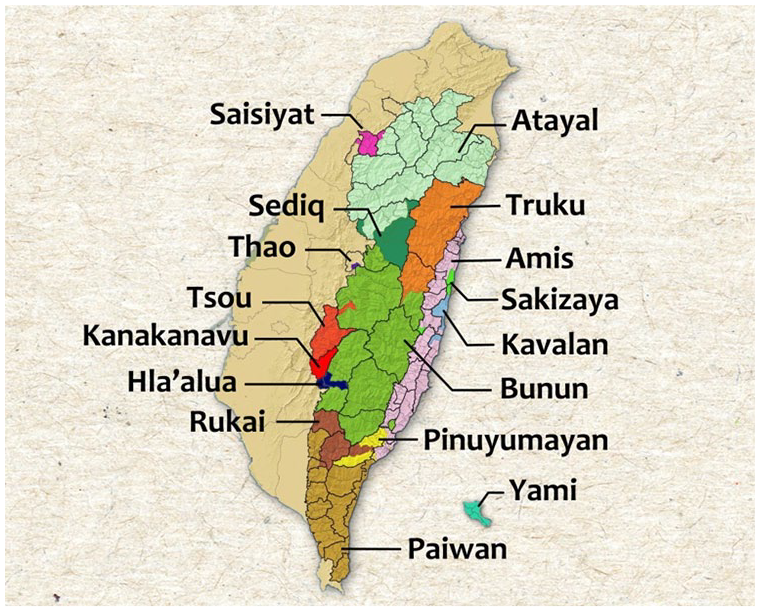
Distribution of 16 Indigenous groups recognized by the government. 2
Officially, they are classified into “mountains” and “plains” Indigenous peoples according to law. However, this is a political classification. The standard is based on the degree of Sinicization in the Japanese colonial period and the degree of control by the colonial government in the area the Indigenous people lived, not based on the actual elevation of their residence. Colonial power was mainly concentrated in the northern basin. Around 1900, military violence was used to enter the traditional territory of the Indigenous people, and this classification was gradually formed. This political difference between mountains and lowlands did not correspond to geographical distinctions, unlike the Southeast Asian highlands, which were relatively free from the control of the political center (Scott, 2009).
Moreover, some other ethnic groups hope to gain Indigenous status through restoration of traditional rituals. The total Indigenous population is around 584,000, 2.5% of Taiwan’s total population. Around 60% live in Indigenous townships and make a living from farming while also hunting and gathering. The remaining 40% live in cities and work mostly in manufacturing. Most of today’s Indigenous people are Christian, with only certain ethnic groups continuing to hold or restoring large-scale traditional rituals such as the Tsou’s mayasvi (war ritual) that offers sacrifice to the heavenly deity Hamo, the deity of war I’afafeoi, the deity who controls life Posonhifi, and the spirits of enemies whose heads were taken in headhunting. The quinquennial maleveq of the Paiwan worships the natural deities and ancestors to pray for a good harvest and good fortune. A special ritual is the pasta’ay in which the Saisiyat worship another ethnic group’s spirits of the legendary little people (ta’ay).
Also, some villages still have shamans conducting collective rituals, with traditional religion still quite active, such as Lidaw village of the Northern Pangcah/Amis, Kulalao and Tjuabal of the Paiwan, Puyuma and Tamalakaw village of the Pinuyumayan, Saviki of the Tsou, Dahdah, Buluk buluk, Uaasik of the Bunun, Itathao of the Thao, and PatoRogan of the Kavalan (Hu and Liu, 2010: 16).
The analysis of this article is based on my participant observation of Pangcah/Amis and Kavalan rituals starting in 1993, as well as the cross-ethnic group work network formed by the Shamans and Ritual Performances in Contemporary Contexts Research Group established by Hu Tai-li and me at the Institute of Ethnology, Academia Sinica in 2007. Through this network, I participated in shaman rituals of the Paiwan, Bunun, and Tsou people. I also conducted interviews with elders, hunters, and shamans for this article in 2023. In addition, a large number of Japanese and Chinese documents accumulated since 1915 are used.
The cosmology and ritual world of Taiwan’s Indigenous peoples
There are three main types of creation cosmology. The first is that deities directly become humans or they create humans, such as the Amis/Pangcah, Tsou, and Paiwan. They believe that humans are similar to deities. The second type of human is created from natural objects (stones, bamboo, or trees). When the world was created, everything had life, not just humans, similar to the concept of ‘immanence of life’ mentioned by Fox (2005 [1987]: 8649). The inner vitality of human beings is similar to that of natural objects, and they have animistic characteristics. Most Indigenous peoples think this way. The third believes that the human body is the entire universe, and creation is split from the body of death, such as the Saisiyat and Northern Paiwan. Human beings, like the universe, are divided into densely interconnected networks.
How to continue this world after creation is, however, the most serious question. The Pangcah/Amis state that their ancestors of origin (a sister and brother), who survived the flood, continually gave birth to frogs and snakes. However, these situations no longer occurred when they learned rituals from a deity or the sun (Liu, 2021: 532). In Bunun legend, some people became monkeys, wild boar, and fruit stones. People have to conduct rituals to thank heaven (dehanin), otherwise they will continue to transform into animals. This means that for them, religion is about the distinction between people and alterity (animals, plants, natural beings, and deities) and itself is a kind of notion of person/personhood and a way of identification. Most Indigenous people believe that the difference between humans and animals or things is that humans have the intention of performing rituals to thank heaven or deities (emergence of morality). In addition, the external form of humans can easily turn into animals or other things. That is to say, there is no obvious boundary between humans and nonhumans in appearance.
Apart from this connection to human reproduction, their rituals are also closely connected to the millet people grow. Even the Yami/Tao, whose main staple is taro, regard millet as a sacred crop with a soul. This is a common feature of the religions of Taiwan’s Indigenous people, and differs from other parts of Asia where religious ritual revolves around rice (or around rhizomes in Oceania). Also, in contrast to the shamanism of the Indigenous people of Siberia for the purpose of obtaining prey (Hamayon, 1990), the importance of seed sowing and harvesting rituals is far greater than that of hunting rituals for Taiwan’s Indigenous people.
In recent years, new archeological digs in Tainan have discovered that the religious objects associated with mixed farming of millet and upland rice have a history of at least 5000 years (Tsang et al., 2017). It can be speculated that the shifting cultivation and hunting religious patterns originated long ago and continued for a long time, until rapid changes after Han Chinese settled on the Western plains in the seventeenth century and began to grow wet-rice.
Overall, there are two kinds of motivation and objective for performance of rituals by Indigenous people: The Bunun and Atayal, Truku, and Sediq emphasize that people need to conduct rituals to show gratitude to the spirits or ancestors and obey taboos or they will receive punishment in the form of disaster, poor harvest, failure to catch prey, inability to headhunt with success, death, and disease. They are closer to standard animism as defined by Descola (2005). Rather differently, the Kavalan, Pangcah/Amis, Tsou, Kanakanavu, and Paiwan believe that ritual-making has a positive effect on the growth of crops, and they carry out complicated rituals that follow crop growth. This group is more complex, some are a combination of animism and analogism, and some are totemism. Let us continue with the differences between Indigenous people and make a typological comparative classification.
Literature review on classification of Indigenous religion
The Japanese scholar Masuda (1958) noted the relationship between the family life, spirit view, and ritual of Indigenous people. After interviewing members of six ethnic groups (Atayal, Saisiyat, Bunun, Tsou, Paiwan, and Amis), he felt that there is no inevitable relationship between the three: large families (or clans) do not necessarily worship ancestors. Although Indigenous people believe in ‘animism’, the spirits in their concept disappear. Furuno (2000 [1945]) stressed the important connection between Indigenous peoples’ religion and millet farming rituals.
Li (1982 [1962]) discussed the interactive effects and reflections of social structure and religion. His analysis found that the kinship and male age sets of the Pangcah/Ami are hierarchical and, in terms of religion, there are class differences between deities and between shamans, leading him to speculate that the Pangcah/Ami social organization and religion are integrated into a single system. Another structural system is the Atayal. Their social organization is loose with no hierarchy and they have a very general view of the supernatural. Huang (1985) divided Indigenous people into two types according to politics, economy, religion, and kinship, similar to the ‘chief’ and ‘big man’ of Sahlins in his research in Oceania. Chief type politics, economy, religion, and kinship are all hierarchical, including the Paiwan, Rukai, Pangcah/Ami, Puyuma, and Tsou. The ethnic groups similar in type to big man systems, such as the Bunun, Atayal, and Yami/Tao, instead attach importance to egality and individual ability.
In my view, however, the structures of religion, politics, economy, and kinship of Taiwan’s Indigenous peoples are not necessarily uniform; religion sometimes serves a check and balance role. For example, in Kavalan, Puyuma, Sakizaya, and Pangcah/Ami society, each domain tends toward a separation of powers to avoid over-centralization of power. Their fishing and hunting grounds are not owned by the clan or nobles, but are shared by all the men of the community. In fact, the time and direction of men going hunting or fishing, or the location of traps are often determined by mi’daw (bamboo divination). If a boat fails to catch fish, divination will be used to find the direction where fish are; here there is a tendency to decentralize religion, kinship, and economy. The construction of this decentralized society is similar to what Errington (1990) called the ‘exchange archipelago’ in Southeast Asia adjacent to Taiwan.
Hu (1991: 370) also cast doubt on this method of classification. She was aware that politics, economy, and kinship cannot be simply correlated with religion. For example, the genealogy of Pangcah/Amis deities has generations but no hierarchy. The Yami/Tao have an equal rights society but they have the deity high above, and they pray to the deity of heaven for a good harvest of millet and flying fish. For this reason, she changed the typology by the characteristics of belief to distinguish between ethnic groups that have the concept of deity and groups that do not. These two broad categories are then subdivided into subgroups that emphasize ancestral spirits, and groups that emphasize alien spirits and the concept of heaven (Hu, 1991: 367).
Varieties of animism among Indigenous peoples
I will use Descola’s concepts of varieties of animism from comparing Amazonia and Southeast Asia to understand Taiwanese Indigenous animism: standard and distributed animism. Ontological analysis helps us see the differences. I treat religious difference as a spectrum concept and magnify it to look at the differences among Taiwan’s Indigenous people in detail to consider what their differences are and how they are interrelated, and also to explore how others (natural objects, flora, fauna, spirits, deities, and ancestors) are perceived and objectified. How do people who establish relationships with these alter and what relationships are established?
The first is standard animism: the Atayal, Truku, and Sediq generally fall into this category. Their cosmology is similar: Human beings sprang out of big stones, they were not arranged by a deity but were directly produced from natural objects. They don’t have a concept of deity. The human souls are called utux/lyutux and live in the head and chest. Only with utux can people survive, and utux is eternal. The human soul after death is also called utux and will go to the Western sea and cross the bridge to the residence of the ancestral spirits. Originally, the terrain around humans was all plains, but because humans violated the incest taboo, utux brought tsunamis, earthquakes, and storms, creating a world with high mountains and valleys (Government-General of Taiwan Provisional Investigation Committee on Taiwan Traditional Manners and Customs, 1996 [1914]: 22–24). There is no utux in domestic animals, but wild boar, deer, monkeys, bears, goats, and other wild animals have utux, while grass, trees, and birds do not (Government of Taiwan Provisional Investigation Committee on Taiwan Traditional Manners and Customs, 2012 [1918]: 73–75). During the sowing ritual and land reclamation, the tribesmen would plant a branch with buds in the soil. After returning home, they would wait for a dream, and only when the dream predicted auspiciousness, they would go to the site and pour rice wine on the ground as an offering to utux, signaling the making of an agreement with the land spirit (Wang, 2023: 90).
Today, Atayal, Truku, and Sediq still live in the mountains and mostly cultivate high-economic value crops (tea, fruits, and vegetables), however, hunting has always continued. It is considered as traditional culture and a way for men to pursue their Indigenous self-identity; they still maintain a close relationship with the forest. However, for example, Sediq hunters 3 still use the inherited lubuy maduk (hunting charm bag) for hunting. They will pull out tail hair from prey in the bag to ‘summon’ the prey’s utux, with no animal sacrifices required. Although many people have converted to Christianity today, the concept that prey is given by animal utux still persists. Many other hunters mentioned, ‘I caught too many animals! I’ll be seriously ill in middle age’. Hunters believe that there is a causal relationship between the human and animal life, so they no longer set traps (Wang, 2023: 334, 400). In this practice, the special concept of the limited number of human and prey lives is embodied. If a person takes more than the amount of prey that can be obtained in a lifetime, he must give back his life to utux (being seriously ill means that his life is about to be returned). There is still a reciprocal predation relationship between humans and prey, which are seen as equals.
From these phenomena, I conclude that Atayal, Truku, and Sediq perceive that humans and most nonhuman beings have individualized utux (souls, spirit, and interiority). The inner nature of humans and nonhuman beings has a continuous relationship, but different in shape. Unlike the Indigenous people of Amazonia and Malaysia (Chewong), who regard the body as a garment, the Atayal people regard it as the ‘dwelling’ of the soul (Ingold, 2000: 187). Moreover, utux does not necessarily have a physical form, but is a free spirit like Århem (2016: 17, 21) said and will occupy a substance, place, or certain organisms. Most people cannot actually see utux, only shaman (hmgup) with double vision can see. Utux is omnipresent and is the main attribution of the Atayal, Truku, and Sediq in explaining social and natural phenomena. So how is utux present? If someone has an accident or becomes ill, it is often considered to be a violation of taboos or social norms (gaga), and the result of being punished by utux, and a ritual must then be held. This means that, through events such as accidents or illness, the Atayal describe the existence of utux for themselves and objectify it.
Perspectivism is very common among humans, animals, and utux, who do not see themselves as others see them, yet see others differently than they see themselves (De Castro, 2012: 47). This helps us see the animistic qualities. For example, the informant explained that rituals for utux must be performed at night and outdoors, because they have to correspond to the opposite time and place of utux and people (daytime), and only a small amount of sacrifice is needed (it means a lot to utux). Wild boar cannot be used as sacrifice because it is the dog of utux. Also, during the healing ritual, when the shaman summoned the patient’s soul, she sang: ‘Here we eat glutinous rice, you eat frogs there; here we eat rice, you eat four-legged snakes there; here we eat sorghum, and there you eat snakes. Come back quickly!’ (Wang, 2023: 91).
The Atayal, Truku, and Sediq have no clans. Instead, they have voluntary groups (which can be freely joined and withdrawn from) for hunting, sharing hunting grounds, and prey, forming a gaga group. This group must obey common taboos and perform rituals together. As well as blood and marriage relatives, the gaga also includes friends. The Atayal, Truku, and Sediq believe that they will be punished by utux if they violate the taboos of the gaga group.
As well as utux in some Atayal areas, there is mahuni (witchcraft) that has been stigmatized. Atayal hunters depend on the ornithomancy of a kind of wild bird (sisil) (Simon, 2018), not to raise birds but to domesticate their spirits. Those who know how to ma-huni (use an evil and domesticated spiritual bird) will, it is said, eat people’s hearts and hide among people, being unrecognizable. Sudden, incurable, and strange illness, for which no cause can be found, are often attributed to mahuni. The Atayal used dream divination by a hmgup (shaman) to identify the witch, who would be killed or driven out.
After Christianity entered villages in the 1960s, adherents also called it gaga, believing that God was the chief of utux or the earliest one. Therefore, God had primacy. When taboos are violated, the shaman is no longer asked to offer utux sacrifices (as compensation), but the person instead prays to God and repents him/herself, taking responsibility without affecting others (Wang, 2023: 184). The relationship between gaga and utux and people thus transformed into an individual one and no longer a collective one. The prayers recited with hunting charms have also become a call to the demiurge for giving with gratitude and awe. The prey spirit (utux) no longer answers the call of the hunter and has no more intention or agency.
The combination of distributed animism and analogism
The second typology is a combination of animism and analogism, such as that of the Kavalan, Thao, Siraya, and Tsou. These groups still retain some animistic characteristics; in particular, their relationship with prey is still equal. Due to changes, the number and types of spirits began to proliferate, and deities and spirits moved from blurred boundaries to higher levels, a hierarchy emerging. The highest are deities who dominate, with humans in the middle. Through sacrifice to powerful spirits and deities, such as ancestors, natural deities, crop deities, and so on, humans pray for rain or sunny weather and a good harvest.
Taking the Kavalan’s PatoRogan
4
village as an example, they maintain a horizontal relationship with animal spirits and also a vertical hierarchical relationship with ancestor-deities. The relationship between men and prey has gradually changed due to the government’s ban on hunting, forest clearance, and contact with Han Chinese religion and Christianity. This has had a great impact on the basic characteristic of attributing subjectivity to nonhuman beings. First, how do men establish a relationship with their prey? When a young Kavalan man starts to learn how to hunt, his father shows him how to spaw do saliman (offer sacrifice to an animal spirit to keep it ‘alive’ after being caught) to ensure a successful next hunt. Saliman is the name for the spirit of large prey after death. It can refer to an individual animal spirit, or it can also be regarded as a plural whole. After the young man catches his first animal, he will take it back to the village alive. After removing the skin and flesh, he puts the clean skull into a basket placed in the corner of the kitchen, which already contains the skulls of the animals hunted by his father. Then, his father cuts the heart and liver of the still-bleeding animal into small pieces and pours some rice wine on the ground, directly facing the prey’s head and murmuring:
5
yau a aisu qaya si, qaqeRas ika kaput su haw, If you (saliman) are here, ask your friends to come too!
qalisimpu ka tazian aimu ta qawasan ku.
You all gather in my basket zau aisu samasang ay mawtu nialan ku si, All the prey I’ve caught before qaqeRas ika kaput su, Please go and call your friends
nayau si mazemun pa imu tazian.
Then there will be a lot of (people) here.
These spells establish the causal relations between a hunter, soul of the game kept in the kitchen, and the game he hopes to catch during a future hunt. Men ‘feed’ the animal hunted through rituals, hoping that its soul/spirit (dazusa) will then gradually take up residence inside the skull. The hunter expects that the spirit of the game will ‘go back to its home to call its relatives and friends’. If another animal’s soul responds to this call, its body will follow. A hunter can get confirmation of the efficiency of his newly ‘domesticated’ spirit during the next hunt. A saliman does not exist by itself, like the sun or the moon, but through learning from interaction between the hunters and animals; it is a relational being that becomes the objectification of the hunter’s desire and intent (Liu, 2009: 196–197).
For Kavalan people, animals are regarded as humans, in addition to having souls and intentions (this interiority is conceived in analogy with humans which is typical animistic characteristics). The key point is also that both will become hungry and have the physiological need for food (the continuation of a food chain). This means that after death, the duality of soul/body and interior/exterior is still inseparable. They believe that after death, although the body has disappeared, the soul will continue to wander around in search of food, and people who are ‘bumped into’ will get sick. Who should feed the animal spirit defines the social category of the person. Social relationships are built by feeding animal spirits. When the prey has just died, the hunter shares its most precious parts (heart and liver) with the animal spirit as a sacrifice; the hunter only takes the remaining parts. This is not asymmetry or incompatible, it is an equal exchange. Kavalan people treat animals as the same kind, eating and sharing with them; the body (meat) is the contribution of the animal. In order for the animal spirit to continue to have food, it has to bring the spirits of its companions. At the same time, the hunter must continue to hunt and bring the body of the prey back, otherwise the animal spirit will be ‘hungry’ and ‘bite’ (asking for food) him.
In the past headhunting era, after obtaining the enemy’s head, a deer hunting ritual would be held to give back the dead enemy’s life (in place of the person who took the head) as symbolic paying off of debt. There was an equivalence relationship between the lives of hunters and deer (Liu, 2013). Furthermore, according to the legend of the Kavalan, a deer once metamorphosed into a girl’s lover and went to help her work in the fields, the pair talking and laughing with each other. One day, her father secretly went up the mountain and saw many deer footprints on the edge of the field. He raised his gun and shot him to death. When the daughter arrived, she was so devastated that she stabbed herself with the deer’s horns and committed suicide. The ritual of returning from headhunting and this legend both reflect that men and deer are identical on the inside. They are both human beings, but their appearance (living body) is different, meaning the discontinuity of a species, which is also the characteristic of animism.
In the 1990s, competition among hunters intensified as a result of the reduction of prey due to forest clearance. These new hunting conditions were directly connected to the way the Kavalan accepted the Han’s Toligong (Earth deity) and adapted them to their own needs and concepts in the competition for game. Unlike the Han people, for whom Toligong are related to agriculture and wealth, for the Kavalan, a Toligong is a mountain spirit in charge of game. They also think that Han people are more powerful than Kavalan because the power of their Toligong exceeds that of their own spirits. That is why ambitious hunters began to use Toligong to help them compete with other hunters’ saliman. The ambitious hunters have to pay a Han shaman (tangi) to ‘invite’ a Toligong to come. When the hunter has chosen his hunting territory for the year, he must find a big living tree at the entrance of the mountain. Then he hangs creepers on its branches before the tangi performs the ritual using rice wine, incense, and betel nuts to ask the spirit to take up residence in the tree. The Toligong here still need a residence just like animal and human-headed spirits. However, the Kavalan people do not build residences for those spirits, such as temples, shrine, or statues. Instead, they find ‘natural’ lodges for them, such as Ingold (2000: 173), who emphasizes the concept of dwelling, in which people and their spirits are an intrinsic part of the environment or the world.
The hunter cuts an ear off the first game animal of the year that is caught before letting it go. When the animal is caught a second time, it indicates that the ‘contract’ with the Toligong is over. This is a message sent by the spirit to the hunter, saying there is no more game in the mountains. The Toligong will not ‘give’ game anymore to the hunter, who has to call a shaman to release it from the tree. Kavalan think a Toligong that was not freed after breaking the contract will ‘come back’ for revenge. He will ‘ask’ the hunter to ‘give a life back’. The death of a man who spat blood before dying was explained in these terms (Liu, 2009: 201–202). To sum up, in the face of changes, the Kavalan people began to add mountain spirits and used the concept and method of animism. However, there began to be a hierarchy among these spirits, similar to Descola’s (2024) subdivision of variant types in animistic regime: the emergence of distributed animism.
In the 1970s, most Kavalan converted to Catholicism, and the priests rejected and banned animism, insisting on monotheism. Missionaries forbade Kavalan followers from collecting animal heads and practicing the saliman ritual. As a result the Kavalan began to conceive of ‘killing’ the saliman. They started to throw animal skulls into the sea to ‘drown the spirits’. This act informs us how the Kavalan conceive of the saliman: they live on the land and cannot be ‘killed’ there. That is why they have to be taken out of their territory, to the sea, where they are ‘destroyable’. Furthermore, the ‘killing’ of the saliman embodies a contradiction between the people’s daily behavior as Christians and the persistence of animism in saliman. In fact, they still believe in the existence of saliman. At the same time, although the ‘skull/dwelling’ of saliman disappear, some Kavalan still think they continue to ‘bite’ people (make them ill), including the hunter himself (Liu, 2009: 206).
The Kavalan people maintain a horizontal relationship between men and animal spirits; on the contrary, their collective rituals of female shamanism focus on grains and ancestor-deities in order to establish a vertical hierarchical relationship. The universe of the Kavalan people was created by the Goddess Muzumazu who lives in the sky. She saw that Siagnau, a man on earth, was poor and had nothing to eat, so she came down and taught him how to grow upland rice; 6 they were the ancestors of mankind. Siagnau, however, was too lazy to farm and fed his son crabs, killing him. So every year afterwards, the Kavalan people would take harvested grains and prey 7 to the homes of the female deity’s successor (mtiu female shaman) to pray for health (well-being), rain, and a good harvest. The concepts of ancestral spirits and deities of the Kavalan (Muzumazu) overlap, with the ideal that the originating ancestor is a deity with the highest position and authority. The Thao (Pacalar) and Siraya (Taichu/hiang) have the same type of ancestor-deity. This mixed symbiosis of animism and analogism has only low-level hierarchical deities and two groups: men (age sets) and women (shaman group), as shown in Figure 1.
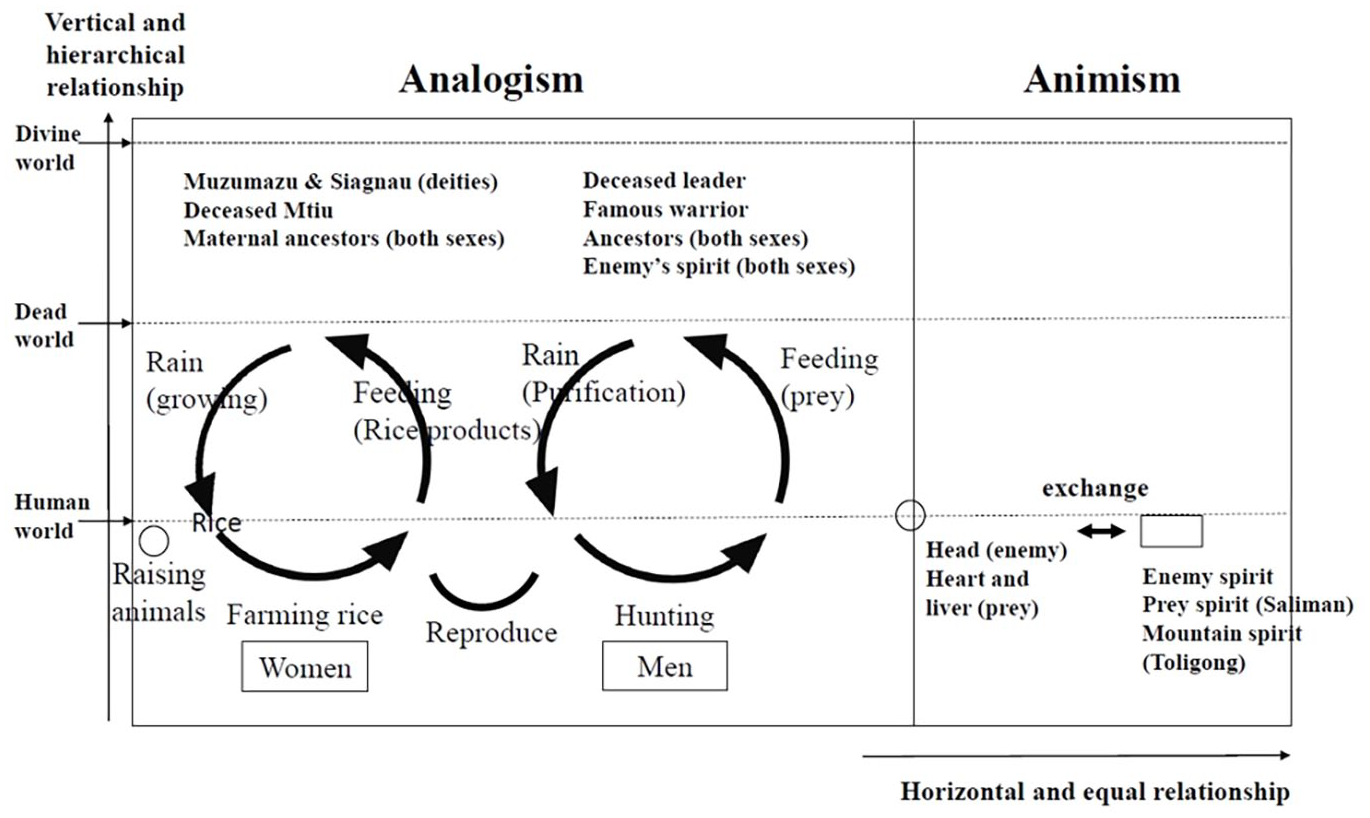
Combination of animism and analogism.
The relationship between people on the left side of the picture: rice, and the environment is through an intermediary alter (ancestor-deity). If people want to have staple food (pray for rain and plant growth), they do not directly communicate with the rice spirit. Women use rice products and meat of prey hunted by men as sacrifices to pray for all the things (including life itself) passed down to future generations by the ancestors and deities. The relationship between man and deity here is different from the direct relationship between man and animals and their spirits. The entire universe or system glues the heterogeneous parts (men and women, hunting and farming, heaven and earth) together through deities and sacrifices, and this has the characteristics of analogism emphasized by Descola (2013: 41).
The Kamavanan 8 (hundred-pace snake) as a totem
Totemism has brought the special bond between humans and animals to the center of religion, art, and social organization, garnering interdisciplinary attention for hundreds of years. In recent years, the study of totems has also turned to the ontological aspect. Through the ethnography of the totemism of Taiwan’s Indigenous Paiwan and Rukai people, I aim to contextualize my discussion both within the recent literature on totemism and the more comparative context of insular Southeast Asia.
Paiwan society has hierarchical classes, divided into chiefs, nobles, and commoners. At the head of the nobility is the chief, and these positions are inherited through consanguinity. In addition, there are shaman and warrior classes, who rely on accumulation of merit to obtain rewards and titles from the chiefs, elevating their status above that of ordinary people. Chiefs, nobles, and commoners each possess different essences, and only those with the same essence can intermarry. The Paiwan people do not have clan but operate as a house society under house names. Using the ethnography of the Piyuma 9 village from the Raval subgroup as an example, their authentic legends (tjautsiker) passed down through generations suggest that only chiefs and nobles were born from the hundred-pace snake (Kamavanan), indicating common ancestry. Kamavanan is a proper term, and its root mavan means real, which means the most real. Both the literal meaning of Kamavanan and tjautsiker emphasize the reality of the affinity between the hundred-pace snake and humans. This is not because the Paiwan people lack insight, but that they understand reality from different perspectives (De Castro, 2012: 45). From an ontological definition (Descola, 2005), certain individuals (chiefs and nobles) perceive and share an intrinsic characteristic (blood) with a totemic species (snake).
The hundred-pace snake is the progenitor of the chief’s family and is the deity (tsemas) responsible for safeguarding the villagers. It resides at the root of the kalavas tree beneath the village, a location it has been in since the beginning. People must perform rituals there to express gratitude to Kamavanan for protecting their lives and village, and to implore it for continued protection (Hu, 2011: 16). Ordinary people should never kill a hundred-pace snake, especially as it is a strict taboo for the chief’s family. This totem animal not only divides the village into two endogamous groups (the chief, nobles, and the commoners), it is also the life protector (deity) of the whole community. This means that its totem system is combined with kinship and religion.
The black triangle pattern on the body of the hundred-pace snake is called vetsik, and the snake pattern tattooed on the body of the chief class is also referred to as vetsik. Only chiefs and nobles have the right to adorn themselves with this pattern. Through the logic of analogy, nobles paint their body in the form of a snake. Furthermore, within their household, the pillars with carvings of ancestors feature heads that resemble the pointed heads of hundred-pace snakes (Hu, 2011: 12). The motivation behind the deliberate use of the hundred-pace snake pattern by these nobles reveals that the Paiwan people do not differentiate between nature (the hundred-pace snake) and humans; instead, they make them as belonging to the same category. They believe that the inherent nature (interiority) and physical appearance (physicality) of both the hundred-pace snake and the chief are synonymous, there is continuity between them. This perspective reflects the characteristics of totemism as proposed by Descola (2005).
In 1950, a Christian medical team from the United States arrived in the village to evangelize. Villagers recounted that the hundred-pace snake suddenly emitted a cry, and shortly thereafter, the tree in which it dwelled was struck by lightning and withered. This event led everyone to believe that the snake had died, prompting them to successively convert to Christianity (Hu, 2011: 16–17). The villagers held the belief that Jesus, whom they embraced, surpassed the hundred-pace snake in greatness, especially considering that the tree where the snake lived was struck by lightning and perished. Consequently, people amalgamated these occurrences and abandoned their belief in the totem.
Hundred-pace snake, Mountain Hawk-eagle, 10 and water: combination of totemism and analogism
In addition, I briefly compare the totem system of Piyuma village and the neighboring Kulalao
11
to learn more about its variations. On the contrary, Kulalao continues to uphold traditional religious practices and holds an important position in contemporary Paiwan culture. The totem animals of Kulalo include the Mountain Hawk-eagle (qadris) flying in the sky. The entire universe develops upward, displaying a blend of totemism and analogism. There is no myth in Kulalao about a chief being born from a hundred-pace snake. Instead, there is an authentic legend (tjautsiker) that a person will turn into a hundred-pace snake after death, then transform into a Mountain Hawk-eagle, and finally turn into water and rise to the sky through a bamboo tube. Elders narrated:
When the Hundred-pace snake grew up, it became shorter, started to grow wings, and began its metamorphosis into a Mountain Hawk-eagle. When I looked at it in a few days, I found that it had disappeared [meaning it had flown away]. (Hu, 2011: 24)
Another fictional story (mirimiringan) describes the feathers of the Mountain Hawk-eagle transforming into a beautiful woman, wearing the costume of a chief and marrying a man of the same class as the chief (Hu, 2011: 34).
Furthermore, the informant said that the triangular pattern on the chief’s body is the same as the black triangular pattern on the hundred-pace snake and the feathers of the Mountain hawk-eagle. The head of the ancestor statue in the house of the chief of Kulalao is marked with the triangular feathers of a Mountain hawk-eagle. This means that there are continuous analogies and superpositions between ancestors, the chief, the hundred-pace snake, and the Mountain Hawk-eagle. There is a high degree of identification between the four. They are all regarded as the same species and form a special social class. They are highly respected and own hunting grounds and land rights. Other common people and nobles are of different classes, and their social hierarchy is formed through this discontinuity.
The Paiwan people often say that if you see a hundred-pace snake in the human world, it is actually a person from the spiritual realm (the chief or ancestor), which means that the hundred-pace snake is the incarnate of ancestors. When people from the spiritual realm see people in the world, they are also hundred-pace snakes, which means that people become the incarnation of snakes. The Paiwan people also describe how after a hundred-pace snake fatally bites a person, it will spin, squirm, and make a sound, as if it is singing and dancing a warrior song and dance (zemian) for headhunting sacrifices. In comparison, the Paiwan people’s headhunting song and dance formation imitates the movement of a hundred-pace snake, rotating left and right (Hu, 2011: 32–33). In these divergent perspectives, the snake is viewed as a human, and the human being is regarded as a snake, they often exhibit a mutual subjectivity toward one another.
In addition to its totemic characteristics, Kulalao also encompasses elements of animism and analogy. They perceive that the people, animals, mountains, rivers, flowers, plants, and trees in the world are all created by the demiurge Naqemati. When this deity created life (nasi), he or she gave each person and thing different spiritual power (luqem) and luck (spi) (Hu, 2011: 182). Fox used the concept of immanence of life: ‘The cosmos was violently quickened into life and all that exists is thus part of a living cosmic whole’ (2005: 8649), however, the Paiwan people do not believe that the spiritual power (luqem) of everything is the same. Paiwan chiefs have more powerful luqem (the combined power of strength, toughness, good luck, and intelligence). This differential distribution of cosmic power (potency) among living creatures is the basis of the social hierarchy of nobles and common people. Luqem is inherited, but it can also be increased in power through rituals conducted by a shaman (puringau/marada).
People seek to acquire spiritual power (luqem) from Naqemati, deities, and ancestors by slaughtering pigs, especially in human growth rituals, healing rituals, for the whole village and house, for headhunting (prior military service today), for hunters and hunting tools, for property (beads, cars, and motorcycles), and so on (Hu, 2010: 31–33). This spiritual (luqem) practice is also very common in insular Southeast Asian societies, such as the sumange’/sumanga in the Sulawesi region of Indonesia (Errington, 1983: 546; Tsintjilonis, 2004). Furthermore, the Paiwan Kulalao system is very similar to the analysis of Lévi-Strauss (2002 [1962]: 34–37) of the totem system and manido system of Canada’s Ojibwa. However, the Kulalao people regard the creator and the founding ancestor in mythology as deities. The combination of the Paiwan people’s totem and deity systems is as follows (Figure 2). The totem axis is closer to the realm of ancestors and deities.
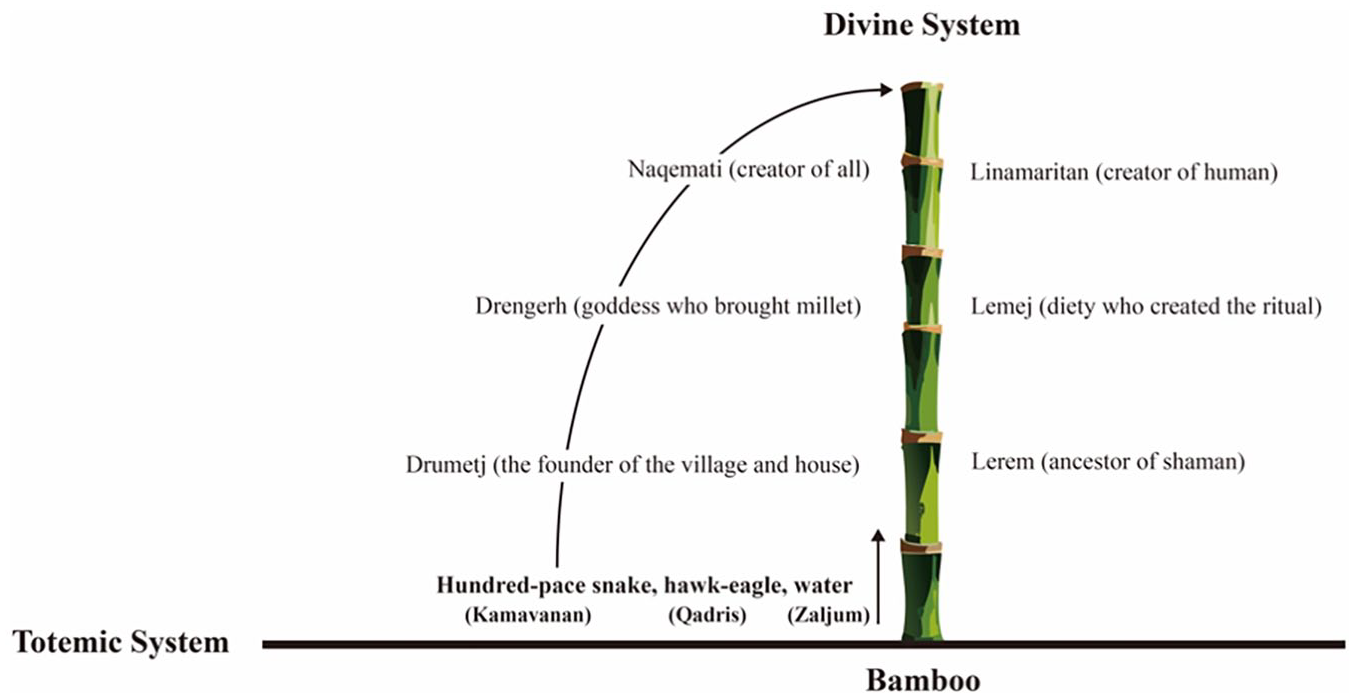
Combination of totemic system and divine system.
Conclusion
Combining the above discussion of the three ontological regimes, we have a new understanding of the impact of ontological combinations caused by changes (such as shifts in livelihood patterns toward rice cultivation and changes in hunting practices, as well as encounters with Christianity or Taoism). Most ontologies are predominantly mixed; analogism seems more adaptable to integration with various types of ontologies, resembling a transitional type of synthesis. This makes me consider whether the four ontologies are systematic concepts with clear barriers or a combination of characteristics, but this combination is neither closed nor random. If it is the latter, we can see the differences in people’s choices and actions. In this way, we can get a closer look at the dynamic changes inside each ontology.
Taiwanese Indigenous people engage in animal husbandry, but they refrain from using domestic animals as sacrifices (instead of humans for equal life exchange) to the spirits of prey or related intermediaries (spirits or deities). Usually, the pigs and chickens raised are given human spirits (ancestors), the importance of ancestors increases, and they even become deities. The number of other deities and spirits does not increase much in relation. What makes Taiwan’s Indigenous practices unique is the ‘raising’ of both human and animal souls. The soul is more important than the body, but the body and soul are inseparable. Logically, if you call the soul, the body will follow. This is the way hunters obtain prey and human heads. Moreover, even after the body dies, the soul retains the physiological needs of the body and continues to need to eat and dwell. So, social relationship bonds are maintained through the act of feeding. Finally, when in contact with polytheism, the types of spirits increased, as in the case of the Kavalan in the 1970s, and a hierarchy among spirits also emerged. After coming into contact with monotheism after the 1950s, as in the Atayal’s case, the relationship between humans and spirits is no longer collective. The responses of the Paiwan and Kavalan peoples to the boundaries between deities, ancestors, and spirits are similar. The delineation between them is clearer, resulting in a decline in the status of spirits, and there is even the idea that spirits will die. However, this death is different from the animism of the past and no longer brings life. In the process of contact and change, the traditional religion of the Indigenous people was not necessarily fragile and did not completely collapse, nor did it necessarily conflict with the foreign religious system, causing it to be inevitably defeated by world religion. Instead, many comprehensive types coexist. In addition, Christianity and school biology education bring in natualism.
Footnotes
Acknowledgements
First of all, I would like to thank Dr Chi Wei-Hsian for inviting me to participate in the planning of the ISSR conference; and Dr Inger Furseth for her suggestions for revision of my article. This article commemorates the late Dr Hu Tai-li, who inspired my interest in the religion of Taiwan’s Indigenous people. I also thank the hunters and mtiu (shamanesses) of the Kavalan for kindly sharing their experiences, and the puringau/marada (shamanesses) of the Paiwan for their patient explanations. Finally, my deepest appreciation is also extended to Dr Philippe Descola for encouraging me to engage more deeply in comparison of the Indigenous peoples of Taiwan to arrive at the notion of Austronesian totemism.
Funding
The author(s) disclosed receipt of the following financial support for the research, authorship, and/or publication of this article: This research received a grant from the National Science and Technology Council in Taiwan (Project: The ontology and sensory ecology of ritual plants among the Pangcah of Taiwan. NSTC 112-2410-H-001-073-MY2).

Notes
Author biography
Address: Institute of Ethnology, Academia Sinica, 128 Academia Road, Section 2, Nangang, Taipei, Taiwan.
Email: