




Abstract
Anthropologists have made strides in theorizing non-human subjectivity in cosmologies but, emphasizing animals, they underestimate the importance of botanical beings. Pangcah rituals and taboos cannot be separated from plants. Through ritual action, they divide plants into three categories: the first is cereals that have deities and soul, which are the center of animistic and shamanic rituals. These spirits will stick to people (like the substance of cereals) asking for food or aggressively make people ill. The second type is leaf vegetables forbidden to eat before and during rituals. They are regarded as unmarried females and have sexual connotations. The third includes ‘enveloped’ plants (beans and bamboo shoots) that are eaten only during rituals. From the important position of plants in the Pangcah lifeway and cosmology, this article explores the Pangcah ontology and analyzes the mediating role of sensory experience played in the people–plants–spirits encounter.
Introduction
In recent years, climate change and the COVID-19 pandemic have hindered the import and export of goods by countries around the world, which has forced people to face the issue of food crisis and the problem of existence in the wake of damage being inflicted on the global and local environment. As a result, drought-tolerant, high-temperature-resistant, and highly adaptable indigenous plants and the way of perceiving the environment by indigenous peoples have become a popular research topic and offer a possible solution (Descola, 2005; Filoche, 2018; Ingold, 2000; Posey, 2000).
This article focuses on Taiwan’s indigenous Pangcah/Amis people who self-identify as a ‘grass eating people’. They eat more than 200 kinds of wild vegetables and have a high ability to recognize plants (Wu, 2000). When Pangcah engaged in upland field farming, before selecting a piece of land to cultivate, they first ate plants from the area to better understand the new environment and, for that purpose, chose edible wild vegetables rather than specifically planting vegetables. Today, Pangcah parents still take their children into the forest and fields to learn how to pick plants from a young age. This is not just about learning knowledge; it is personal showing, experiencing the environment through touch, smell, and taste, a kind of education of attention (Ingold, 2000: 21–22); it also nurtures feelings for plants as a kind of education of affection (Miller, 2019: 90–91). To this day, generation after generation has passed down a lifestyle (semi-gathering) in which existence is not only dependent on monetary transactions.
The Pangcah belong to the Austronesian language family. The term Pangcah means ‘person’ or ‘people’, including the human essence of animals, certain plants, and other beings. The population numbers around 215,000 people, mostly living on the coast and rift valley plain in eastern Taiwan. The Tropic of Cancer passes through this area and the climate spans tropical and subtropical, giving it a rich and diverse ecological environment.
In the 1920s, under Japanese colonial rule policies, the Pangcah gradually moved from the swidden cultivation of millet to the fixed farming of paddy rice. In the 1970s, the areas where these people lived started to undergo urbanization and industrialization; in the 1980s, many residents moved to metropolitan areas where they worked in the manufacturing sector. Today, only a handful of households still farm in these indigenous communities. Paradoxically, more industrialized villages such as Lidaw, where the fieldwork for this article was conducted, are special cases and shamans (makawasay) continue to hold complicated farming-related rituals, which include a wide range of plants and related ecologically sustainable knowledge and are still intimately interdependent with environment. Therefore, this article focuses on Lidaw village, which borders an urban area in Hualien County, where plant-related rituals have not only continued uninterrupted but also become an element of national cultural heritage (Lee, 2020). This demonstrates the ability of such rituals to change, adapt, and remain important creative instruments to regenerate the social structure and organization of village today. The social life and rituals of Lidaw are still inseparable from plants.
In recent decades, anthropologists have made great strides in theorizing non-human subjectivity in cosmologies (Descola, 2005; Gibson, 1986; Kohn, 2013), focused on animals and the metaphor of predation, with plants mostly overlooked (Rival, 2012: 69). We have underestimated the importance of botanical beings in worldview. Therefore, this article will explore ritual plants.
I have participated in observation of collective rituals in Lidaw village since 2006. These long-term materials are the foundation of the ethnography of this article. In June to September 2020, I conducted intensive interviews with shamans and chiefs about rituals related to plants. I also collected plants with a Pangcah botanist from a neighboring village and engaged with her farm’s seed conservation project.
What is particularly intriguing is how the Pangcah use rituals to categorize plants, with cereals planted in fields as important staples, unlike Europeans who view them as vegetables. They are the center of the shamanistic rituals focus, the objective being to facilitate their growth. Vegetables are divided into two groups, those that should be eaten during ritual periods and those that cannot. Leaf vegetables must not be eaten. If an individual violates this taboo (paysin), they are considered to be ill (adada) and an obstruction to the growth of the cereals. In contrast, the beans planted on the edges of fields and bamboo shoots and rokec (heart/tender stems) are the only vegetables that can be eaten during a ritual period.
This article will ontologically analyze the perception and practices of the Pangcah with regard to the differences and similarities between people and plants and then classify them in this way (Descola, 2005: 163–180). What kind of mutual connections do humans, plants, and ecology establish under this classification through the naming system and organization of different group, gender, and ritual actions? What agencies are distributed to these three types of plants? What kinds of beings constitute their worlds? This article will attempt to understand this categorization of ritual plants beyond systems, structures, and order (Douglas, 2003 (1966): 39). The aim is, from the important position of plants in the Pangcah lifeway and cosmology (Rival, 2012; Schulthies, 2019), to explore the Pangcah ontology (Descola, 2005; Ingold, 2000) and analyze the mediating role of sensory experience played in the people–plants–spirits encounter in the hope of providing a new perspective (Daly and Shepard, 2019: 14; Shepard, 2004).
Same names for people and plants: the sustainable cycle of life
Shaman Sra explained that the invocations in the healing ritual (mipohpoh) go like this: deity (Hailan) became the sky, earth, sun, and moon and the world then had light. Then, the goddess Matiting molded a human figure but this body (tiring) alone wasn’t enough. Breath had to be blown in to give it a soul (adingu) and these two had to be brought together through Kakumudan to achieve a state of well-being. Putal, who is a good story teller, once told me that in the early days of the universe when the solar cycle became normal, Kakumudan gathered the deities to dance in celebration and made them the deities of different plants; for example, Tomicmic planted hair and it became twitch grass, and Halawhaw stepped out and his legs became bamboo. All plants appeared at this time. Kakumudan saw that the animals had no food so turned some plants into their food. These plants later became wild plants eaten by people and used to make clothes or build houses.
From this myth and ritual practice, the Lidaw people perceive that plants, like people, originated from deities (homology) and both have souls. Soul is the vital essence which brings life to things. Humans and plants both have souls inside. They have similar interiorities and dissimilar physicalities. Lidaw people’s representations can be placed in restored Animism in the four ontologies of Descola (2005: 176). People, animals, and plants live in the same cosmic biosphere; as well as having the predation relationship in the food chain, humans rely on plants for other living needs.
Furthermore, in this world, the Pangcah use plants to name people, villages, and social groups, with a tendency to attribute plant qualities to people. This is an identification method used by the Pangcah for perceiving themselves and plants, expressing that they are a single entity. For example, my good friend Panay dreamed of her deceased great grandmother Daya last year. This name originated from Dayan (Taiwan Elderberry), a common medicinal plant used as an anti-inflammatory or to numb pain. After family discussion, Panay decided to give her newborn this name; she observed whether the name was suitable and didn’t make the baby unwell (representing smooth breathing); otherwise, she would have asked a shaman to change its name. This naming process involved incorporating plant into human being and vice versa, breaking down the wall between exterior and interior, human and plants, culture, and nature. It means the Pangcah do not regard plants as an external natural world; there is a state of existence shared by both.
The number of Pangcah names is limited 1 and they are reused in a cycle. This naming method that gives the name of someone who has returned breathing (soul) to a baby who has just started to breathe establishes a kind of soul (life entity) cycle balance. It is the beginning of a new cycle of time and life. In the process, ancestors, future descendants, and plants are linked in a closed circuit and regarded as a whole. Here, I do not believe that the relationship between people and environment is as Rappaport (1968) assumed: there are self-regulating properties which are inherent in the ecosystem concept. The person and plant names of the Pangcah have household as the cycle unit, and their interaction with the environment is one the scale of the household unit and not a chimerical system. Lidaw’s terminology of kinship has also grandparents and grandchildren both called vaki. By terminology, Lidaw people only distinguishes his or her parents’ generation by sex, and Ego peers use age distinction. Plants are also distinguished by sex, and space considerations are added.
Such as a person might be named after a plant that grows close to home (loma’) where they are born, boys are often named Icep (betel palm, Areca catechu L.), the fruit of which both men and women often chew. It is widely believed that one continues to chew the fruit after death and it has become an important oblation in rituals. In contrast, cereals planted in a way that radiates outwards from the family home to the fields (omah) include Havay (millet, Setaria italica (L.) P.Beauv.), Panay (upland rice, Oryza sativa L.) and Tipus (paddy field rice, O. sativa L.), all of which are names given to girls, so this category is predominantly feminine in character. Plants found in the fields, such as wild vegetables, are often used as girls’ names, one example being Samah (field sowthistles, Sonchus arvensis Linn.). Clans (ngasaw) are more widely dispersed than families and often named after trees that have grown in mountains for many years. For example, after a forest is burned, the first thing to grow back is the rorang tree (Paper Mulberry); hence, a famous clan is named Ma
In the Pangcah language, the word for ‘planting’ is pa-
In summary, Pangcah use locations where plants grow to indicate the status and identity of people, expressing an understanding and analysis of their relationship with plants and environments. At the same time, this also indicates that the closeness, clustering, and similarity between people and plants is an integral part of the ecosystem and environment, as with biotope in ecology. This is very different to the way in which Westerners separate people from nature, representing unique cultural superiority and, through human consciousness, an attempt to assert control over nature (Ortner, 1974: 72) or make a dichotomy between culture and nature (Descola, 2005; Ingold, 2000: 47). Furthermore, what kind of plants are people? Vice versa. We will look at the first category of ritual plants.
Millet as a child: caring for and feeding by women
In Pangcah society, plant-related rituals and taboos are not only a link in subsistence production relations; they are also a way by which villagers perceive themselves and multiple plant varieties and establish ideal interactive relationships. If we look at annual rituals, then the entangled and interconnected nature of survival strategies for plants, animals (pigs, fish, birds, insects), ecology, landscapes and people become much clearer (see Table 1).
Annual cycle (before 1920 and 2020).
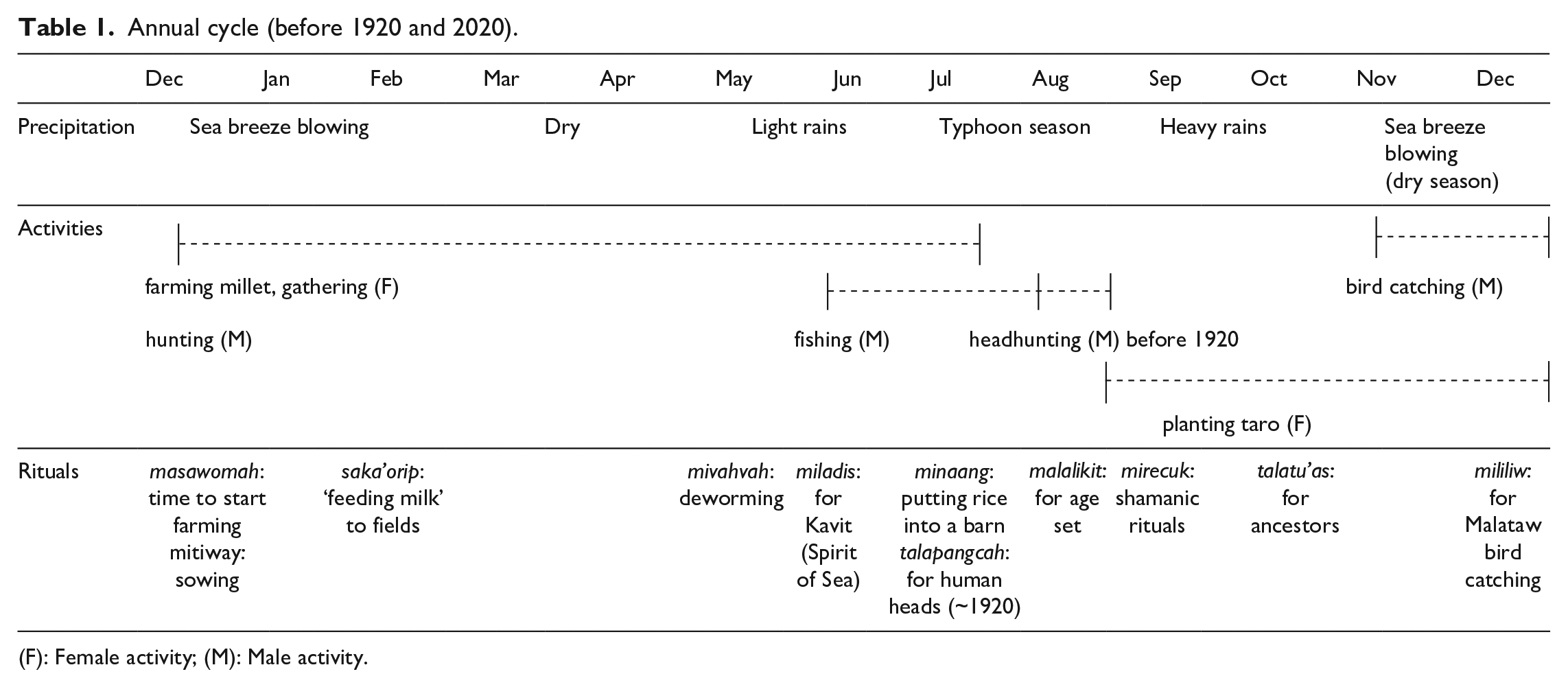
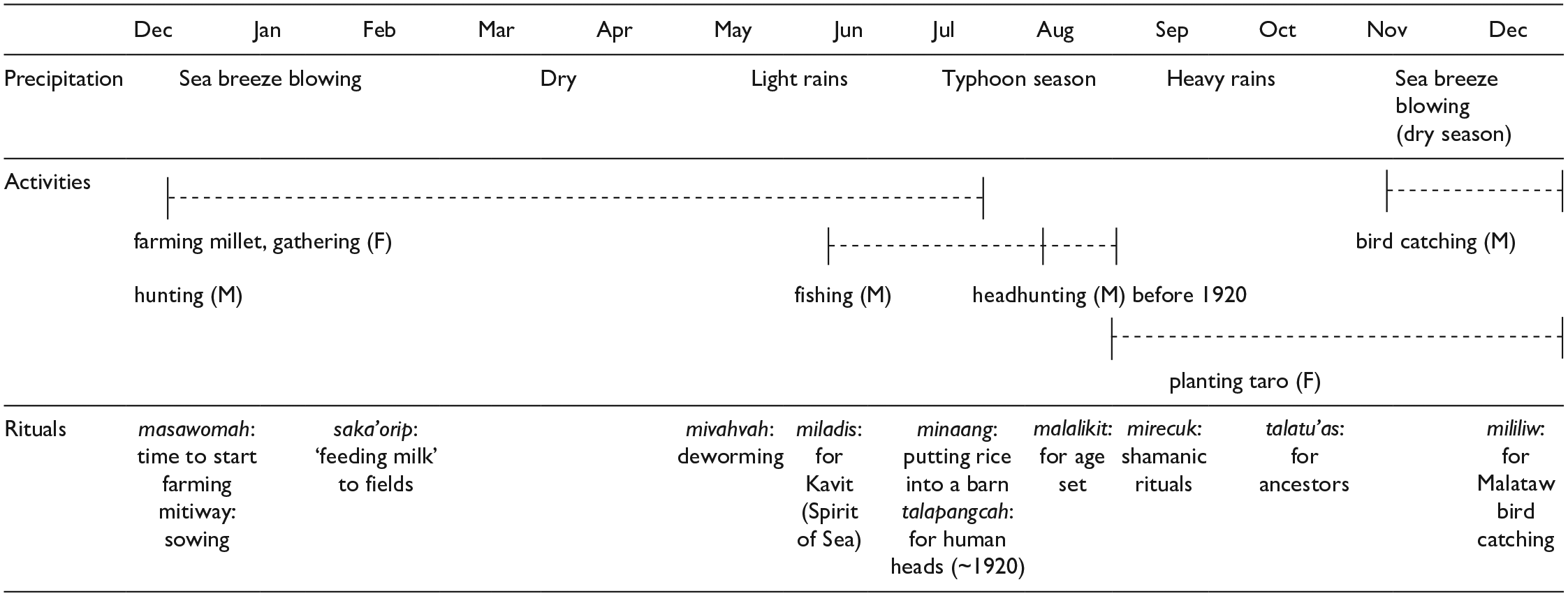
(F): Female activity; (M): Male activity.
In contrast to the shamanism of the indigenous people of Siberia for the purpose of obtaining prey (Hamayon, 1990), Pangcah shamanism has more of a collective focus on cereals: millet, upland rice, and paddy rice. Looking at the bottom of the Table 1, more rituals are connected with farming than hunting and fishing. Whether in continental Asia or the islands of Southeast Asia, these cereals are not only the objects to be controlled by politics but also the center of religions. However, the aspect of religion is often ignored by political anthropologists (Scott, 2017). In recent years, new archeological finds in Taiwan have discovered that the Austronesian ancestors of the Pangcah engaged in the mixed farming of millet, upland rice, and broomcorn as long as five millennia ago (Tsang et al., 2017). This type of farming and headhunting was continued by the Pangcah into the 1920s. For example, Lidaw’s population remained approximately 550 people, which to a certain degree emphasized ecological balance over the long term. Even today, many of the myths and rituals of the Pangcah revolve around millet, which they imbue with religious and feminine characteristics.
One of the myths still sung about in Lidaw village relates how, in remote antiquity, the deities Kakomodan Sapaterok and Foday Hafus descended to Earth with their son Sera and daughter Nakaw where they lived in Tawrayan raising pigs and chickens. One day other deities passed by while hunting deer and cast a greedy eye over their animals, but Kakomodan was unwilling to part with them and declined their offers. Incensed, the deities called on the deity of the Seas to inundate their home; during the flood, Sera and Nakaw safely floated to the peak of Mount Langasan in a wooden mortar (dodang). From this time, the era of the deities ended; ‘Anthropocene’ began and discontinuity of the world appeared. In the previous ontology, there was no distinction between humans and deities; they lived in the same universe and lived the same lives.
Shortly after the flood stopped, Nakaw fell pregnant and her face and ears became swollen. Using a finger, she dug a small grain from one of her ears and threw it to the ground where it soon started to bud and bear fruit. This is the origin of millet (havay). Later, Sera and Nakaw had five children. One day, the family gathered to see what millet tasted like, lighting a fire and placing the millet in a ceramic pot to cook. Unexpectedly, the millet expanded in size so much it broke the pot. As a result, Nakaw cut one grain in half and cooked using just one half; this time the pot did not break, enabling the family to enjoy a delicious meal. The viscosity of millet today can be traced back to the way ancestors cut it before cooking.
Although Sera and Nakaw had a stable life, they were constantly worried that because they did not fully understand the various rituals relating to millet, it might one day disappear. As a result, they ask the deities and their ancestors to teach them the ritual to thank the grain deity for their bounty (Government of Taiwan Provisional Investigation Committee on Taiwan Traditional Manners and Customs, 2009 [1914]: 3–5).
In this myth, the Pangcah were aware that millet was different from other plants, magically increased in volume when cooked and was delicious. It could also feed the population and ensure increasingly large families (descendants) were free from hunger. As such, the Pangcah were happy that their ancestors had been able to convert a plant into a life-giving foodstuff.
In this myth, the millet was brought by the goddess ancestor, a clear sign of female power (Lappé and Collins, 1982). When the goddess was pregnant, gave birth, and created life, she gave away part of her body and unexpectedly created a staple that provides the sustenance people need to survive. Here, the female character is depicted as the giver of life and provider of food. Then, women are responsible for taking care of this child: millet. Although men are also involved in farming, as an interviewee Quak said, ‘Men are responsible for ‘defensive’ work, such as catching birds and weeding in the fields’. Millet/rice farming is considered as an activity for women, a gender-differentiated category.
In the past, when dealing with the blood lumps and placenta of a mother after birth, the people of Lidaw regraded them as plant seeds and they would be buried in the ground behind the house. No dirty things would be discarded at this spot to avoid affecting the child’s growth. At the same time, the idea of child/seed was also associated with the work in the fields of women. To this day, the people who store millet and sow seeds are always women, representing their guarantee of the reproduction of the offspring for millet.
On the third day of the time to start farming (masaomah), men and women took out their hoes and banged them on the ground (misalalal). By sexually teasing each other during this process they sought to ‘improve’ the growth of millet/rice. A ritual saka’orip was held in February when the millet was about to start growing and utilizing the metaphor of breastfeeding (pacucu to omah). With this ritual, the Pangcah hoped to ‘nurture’ and fertilize the land with female body substance and that millet or rice and their spirits will continue to grow. The mitiway (sowing ritual) prayer also details the appearance of more generic grain deity Kasiuwasiuw (Panay, 2013: 42). Her body is stuck to the ground (nabuyay) in a half-squatting, half-kneeling position (tusulaw) and finally bears fruit (wulisangay). This shamanic invocation clearly anthropomorphizes Kasiuwasiuw and describes the ‘visible’ and existing appearance of the deity for their people: as with human beings, this is a process that involves growing from a baby to crawling on the ground and gradually standing on two feet. Apart from communicating with millet and the deity of cereals through ritual songs, sharing food is also a ritual performance method for attending and cherishing the millet-child.
Sharing food with cereal plants
Starting from dusk on 28 December annually, shamans go to every house to carry out the ritual of sowing (mitiway). This year, around 65 households took part. During the ritual, shamans ask the deities to slide down (seli-seli) from Heaven and help the crops grow, to which end they are first invited to partake of dulun (rice cake), icep (betel nut), and epah (wine). When the ritual is completed, the family will dine together, representing the sharing of food by people, ancestors, and spirits. These ritual practices perceive Kasiuwasiuw as a ‘living being’ who needs to consume food as with people and animals (despite existing as a non-human being most people cannot see). When the shaman ‘faces’ Kasiuwasiuw during the ritual, she holds rice cake in her hands and says, ‘pangangisa-nigisal i tamuwan . . .’ (‘You (the spirits) take a bite, I take a bite’). Feeding satisfies the desire of the millet spirit and Kasiuwasiuw and helps them grow. Therefore, the villagers need to hold a ritual to ask the deities to help the crops grow and this benefit both sides; it provides a harvest to feed people, and the people then use those crops to ‘feed’ the deities, thereby maintaining their mutually sustaining and reciprocal relationship. Prior to the 1940s, this was a major event and families would slaughter one of their pigs raised by females as part of the celebration (Government of Taiwan Provisional Investigation Committee on Taiwan Traditional Manners and Customs, 2007 (1912)), but today the farming deities have become ‘vegetarian’. The pig sacrifice has been replaced by an ancestor-related ceremony.
These offerings/food are not a kind of gift, as they will not produce a debt to be repaid. They are also not a kind of tribute. They are more like as Gibson (1986: 182) said of the Buid people of the Philippines, the ‘sacrifice is used to establish a relationship of contiguity between the human and spirit world’. However, Miller (2019: 116) questioned ‘the role of nonhumans in commensality is less understood, either as eaters or as foods being eaten’. Here, millet is both eaten and eater, and is also passive and active. Horticulture displays, as stated by Descola’s (1993: 111) dialectic exchange/negotiations, such as manioc allows people to eat it, but the precondition is humans help it grew and guarantee its descendants can reproduce.
A senior shaman Pah once reminded me to be very careful when taking photographs because millet is the most sensitive of all the plant spirits. She has female intelligence, human nature, spiritual eyes, spiritual ears, and spirituality. To avoid making her angry, during the ritual, voices were kept low and only good things said to avoid annoying her and causing her to leave, which would result in a poor harvest.
In addition, despite the changes in crops planted and the arrival of global markets, rituals related to millet have not disappeared from Lidaw village. Today, such rituals are also organized more closely together and are thriving events, where the dulun (rice cake) continue to grow in size. In the past, when millet was planted, there was one ritual period each year from the end of December to the end of July. However, when the planting of paddy rice began to focus on volume, a second period was introduced from August to early December. Figure 1 shows the two cycles of collective rituals held each year.
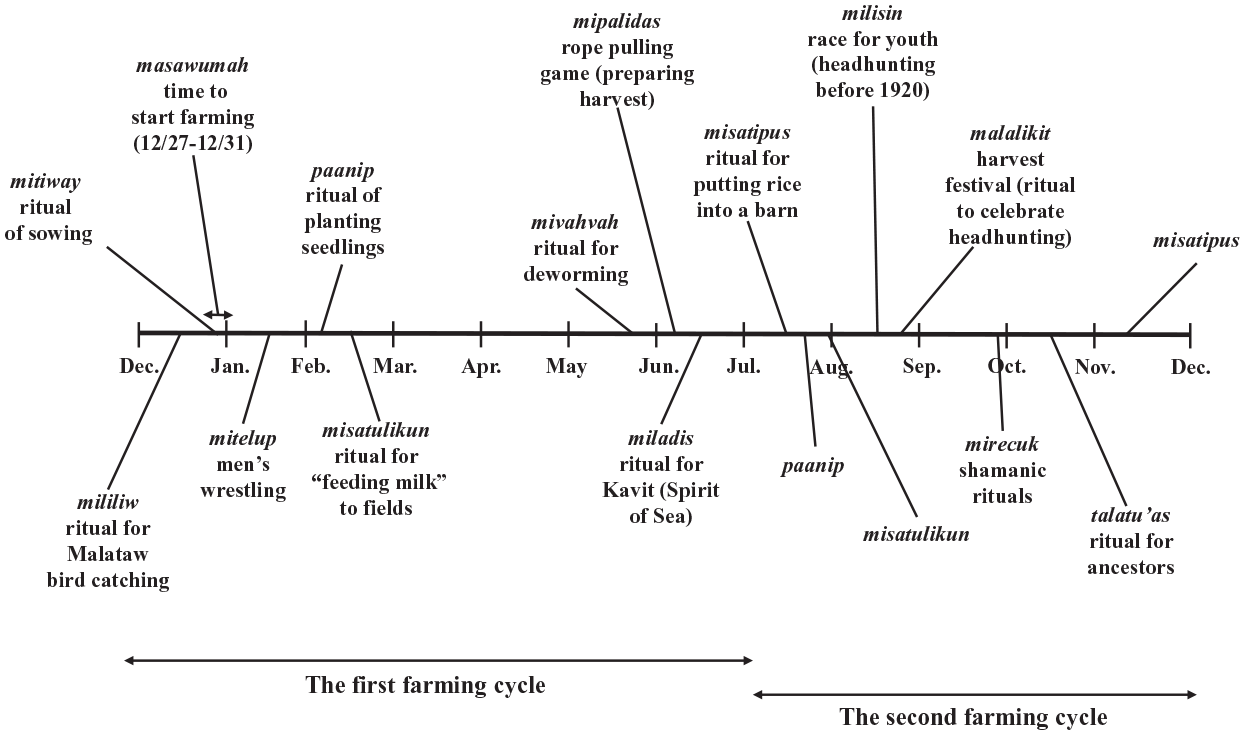
The ritual transformed into two cycles.
Lidaw animistic beliefs are cohesive with their new capitalized society. Indeed, rituals became even more secular and changed to two time periods to accelerate the speed and volume of cereal production. In just one century, there has been a huge change in Lidaw economic production, but what is perhaps most intriguing is why, when most Pangcah, and even Indigenous villages across Taiwan have stopped holding agricultural-related rituals, Lidaw village continues to do so? Unlike the claims of materialists that changes in production modes inevitably lead to changes in the superstructural levels of society such as religion, material changes and rituals have more complex interactions (Biersack, 1999: 11). Besides, shaman Sera suggests that people are subjectively willing to continue such social relationships (idealism). I believe that the special explanation of the sensory characteristics of millet in the myth, viscosity, and deliciousness is the key to understanding the continuation of the mediating people–plant–spirits encounter. This engagement with cereal plants are both pragmatic and ideological, multisensory, and multiscalar, reflecting what Lévi-Strauss (1962) termed the ‘science of the concrete’.
Power and danger: the stickiness of cereals embodies the relationship between humans and deities/spirits/plants
Today, although cereals have lost their central position in terms of economic production, their importance in rituals has not been impacted. Indeed, not only have millet/upland rice products not been replaced; their irreplaceable nature has been highlighted even more (Hu, 2004: 191). Rituals still need sticky upland rice to make large dulun (rice cake) despite the fact that both the raw material and the dulun can be purchased for cash. Millet and upland rice are now used exclusively in rituals. For example, during important talatu’as (ancestral rituals), each family has to give the shaman not only a certain amount of cash but also a large dulun. The shaman explains that the dulun is a necessary oblation when praying to the deities and ancestors because people recognize it as a delicious food both of them ate and it therefore represents a feast of taste as emphasized in myths. After the ritual, the dulun is shared with all participants and they are given a piece to take home with them so they are symbolically free from hunger. As such, it is an auspicious and symbolic food.
The special feature of dulun (rice cake) is its stickiness. The layered feel of viscosity also appears in the process of today’s rituals. On the day of the ritual, women get up early to prepare dulun, by first cooking upland rice that was placed in water the previous evening. This is then made into balls that are just starting to become sticky. When these are divided into smaller dulun, they start to feel sticky to touch (miruhepit). This viscosity can be experienced by different senses (touch, taste) and triggers in people a sense that they are experiencing a ritual atmosphere that ‘approximates to’ that of their deities/ancestors. In this way, the sticky sensation reduces the distance between the two worlds and brings them together. The two worlds (deity and people) separated by the flood in myth are joined again and become a universe.
Even more important, this common plant/oblation/food stickiness is used to ‘feel’ the exchange or interaction between people, plants, ancestors, and deities. It also facilitates communion and negotiation with the deities/spirits and thereby serves as an embodiment of the relationship between the three.
For the duration of the ritual, villagers believe ‘people’s bodies are with deities/spirits from another world’. Reciting an invocation during the seed sowing ritual (mitiway), the shaman calls on the creators of humanity Dongi (goddesses), deities of wine-making, betel nut, root and shoot growth, farming, and the Sun as well as deceased shamans and the ancestors of those performing the ritual. The shamans inform these deities, according to a fixed hierarchy, that the villagers are about to plant seeds and ask them to physically follow (malhakulun) like the intimacy of mother–daughter (spirits–shamans) (maluwiluw
However, the connection between people and deities can also be ‘dangerous’, representing a process of negotiation. It is believed that in the past, the deity of cereals Kasiuwasiuw held a wooden stave in his hand ready to strike down anyone perceived to be discourteous during the ritual. Moreover, if there were too few offerings, he released pests to damage crops (Government of Taiwan Provisional Investigation Committee on Taiwan Traditional Manners and Customs, 2007 [1912]: 27). When the ritual concluded, I often saw participants follow the shaman, jumping and shaking their bodies as they left. The main reason is a fear that when the ritual ends, the deities and spirits could ‘stick to’ (misikeh) the bodies or clothes of participants and return home with them. Villagers believe that being so close to or intermingling (malipasaw) with spirits causes discomfort and illness (siwa).
Furthermore, Lidaw villagers’ reaction to trying to drive away a spirit ‘stuck to them’ shows them the objective existence of such invisible forces as deities and ancestors and is something of which they are genuinely fearful. Indeed, during the healing ritual (mipohpoh), shamans hit the body of the patient from head to foot with a banana leaf in the hope of detaching any ancestral spirits that have affixed themselves (Liu, 2013: 132). When an illness is more severe, an individual has just been discharged from hospital or a house has just been finished, a pig is slaughtered and a ‘sweeping’ ritual (miasik) is conducted, during which the patient or house is touched with a pig knuckle to ‘kick away’ the ancestral spirits or other spirits (Kawas) that cause illness. In the viscous sensory experience, we see the Lidaw people do not regard Kasiuwasiuw or ancestral spirits as sacred; they jointly meet them for negotiation through the shamans.
Organic network of human and plant spirits: a sensory ecology
The Pangcah have a special feeling represented by the viscosity of the cereals in rituals. Other than the existential proprioceptive sensation proposed by Sartre (1943: 690–708), villagers also feel the coexistence of animism. As part of the ritual, they use the viscosity of the grain to assail the boundary between the self (human body) and others (spirits/plants) and in so doing seek to bring the two closer together (like a daughter and mother). However, getting along also brings with it danger. At the same time, viscosity informs people of their limits and that for living things to grow successfully, the power of humankind (to sow seeds) is not enough on its own. It also requires the holding of rituals to stick the deities (seek help by negotiation) and the assistance of others (deities of Sun, Agriculture and Life, etc.). This viscosity does not use human will to forcibly change environment or the supernatural, but is more an act of dependence and cooperation. People are, therefore, social and religious beings. After the ritual is completed, the shaman uses physical movement to separate people and spirits. This maintains a clear delineation and is the only way to ensure people do not fall ill (encounter danger) which simultaneously highlights the different properties of human beings, ancestors, and deities.
The viscosity of cereals also provides an important organic network in rituals, what Shepard (2004: 255–256) refers to ‘a sensory ecology’. During rituals, the boundaries between nature (sun), plants (millet, upland rice), people, ancestors, and deities are lifted so they can mutually connect to one another and exist physically in the same universe, thereby conveying power and the needs of life. This is very similar to the former shamanic rituals of the Siona Indians of Colombia observed by Langdon (2017), but without the cross-species transfiguration. The Pangcah use their experience of communal meals to share feedback on eating plants (transformed by people into delicious food), fixing them together. As part of this process, there is interaction and negotiation through the sense of taste and touch, which denotes that it has more than a symbolic meaning. In short, as a special classification of ritual plants, cereals are not only used for food or offering, nor are they only used as a symbol for humans to project their own intentions. They are the beings that people must cooperate and coexist.
Forbidden leafy greens: odor, taste, sexual hints, and ecological considerations
The second category of plants in Lidaw village differentiated through rituals includes vegetables (dateng), which individuals are forbidden from eating before participating in rituals. In this context, the vegetables referred to are wild vegetables growing in the fields or planted leafy greens. An elder noted that the rules used to be much stricter, with participants expected to fast (manamet) for the duration of rituals as this ensured the body was purer, making it easier to get close to the spirits. Because the things individuals eat mean they give off an odor, during rituals they are required to follow strict food taboos. Villagers make a point of banning the consumption of wild vegetables and fish with strong odors because they give off a bad odor (angcoh) which keeps the spirits away. By the same sensory logic, when the rice starts to blossom in May, it attracts locusts, birds, and mice, and so the village holds a deworming ritual (mivahvah) to drive away the pest and poverty spirit (Takenawan). In this period, the consumption of wild vegetables and fish with strong odors is encouraged in order to ‘drive them away’.
This explanation by the elder and ritual practice indicates an organic network of interactions between plants, animals, the human body, and spirits, mediated by sense. The link between the elements in the fishing, gathering, gardening, and agricultural cycle is manifest through specific sensory experiences. In this example, ritual plant use reflects a high level of interaction between ecology and the existing religious framework.
Senior shaman Sera explained that food taboos can also be understood as an attempt to avoid the intermingling (malipasaw) of different categories. Picking wild vegetables and planting vegetables are primarily undertaken by women and so falls within the female social categorizations. Related to this, food taken home is used to self-delineate (Schlegel, 1977); these plants equate to female self-identity. Let’s look at a traditional song with sexual hints that women sing to their lovers before marriage. This song is nicknamed the find-a-son-in-law trilogy (the Pangcah matrilocal practice). In the first part, the young woman sings about men competing to go up the mountain to chop wood which they leave at her door. She will choose the most hardworking. Then, she sings of going to pick wild vegetables: let’s go pick wild vegetables! When will someone taste me? (female body equals wild vegetables). The woman and vegetable combine as one hints of the hope that someone will come close to her. In the third part, the woman cooks wild vegetables at home and invites the young man to dine, singing cooking wild vegetables! When will my beloved eat me?
In the song, the vegetables embody the woman, with eat/bite used as an expression of sexual sensory stimulation. Also, during the ritual period, fish cannot be eaten, whereas fishing is undertaken by men as male social categorizations. Before the end of the ritual, these two categories of food (female/male) cannot be eaten at the same time because they mix in the body. This kind of taboo that avoids entering the human body will cause connection made me think of what Héritier (1994) calls the incest taboo of two sisters (secondary type of incest).
How the Pangcah treat the relationship between cereals and leafy greens in a paddy agro-ecosystem? Leaf green types of wild vegetables are grown in special changing ecosystems and impacted by artificial farming and climate (Hsiao et al., 2013). Although, strictly speaking, these are not real ‘wild vegetables’ compared with grains planted in the fields, villagers consciously and deliberately keep them, allowing certain wild vegetables to grow with the crops after the soil is turned, or consider it a joint cultivation cycle in which they act as fertilizer. Currently, when the fields are left fallow in autumn and winter, villagers allow more than 30 types of wild vegetables to grow there.
On the third day of the period of ‘rituals to start farming’ (masaumah), shamans who stopped eating leafy greens in September collectively hold a ritual to lift food taboos (pawatawad) to again adapt to the taste of daily foods. The main activity in this ritual is to eat leaf mustard, coriander (Coriandrum sativum), and Cardamine flexuosa/microzyga (Aits and Tung, 2010: 40–41). C. flexuosa is one of the top five weeds commonly grown in the paddy-paddy agro-ecosystem (Hsiao et al., 2013: 117). These three plants represent the lifting of the food taboo. When eaten raw, they taste very spicy not unlike wasabi. Leaf mustard and C.flexuosa share certain qualities as both belong to the Brassicaceae family. From the notable spiciness shared by these three plants, it is clear that their sensory aspect is an important reason they are used to lift the taboo.
Indeed, the villagers do not consider wild vegetables that grow in the new paddy field ecology to be weeds and so seek to root them out or use pesticides to eradicate them. As a result, aquatic micro-organisms, snails, and insects can coexist which maintain a biologically diverse ecology. Because wild vegetables that grow in the fields are very good at adapting to new ecology and environment, and have fewer pests and diseases and so do not require chemicals or fertilizer, they are given the collective name ‘healthy vegetables’. This method of cultivation (actually it’s the Pangcah worldview) is also less polluting for the soil. In addition, the picking by women also assists the branching out and growth of wild vegetables. In fact, whereas most farmers do everything they can to eliminate these unremarkable weeds (wild vegetables) in their fields, they play an important differentiation role (man and woman) in the rituals of the Pangcah. At the same time, this is also a local natural resource on which they rely as part of daily life, one that also has an important position in the agro-ecosystem in terms of maintaining multi-species existence. As a result, people, the environment and other species are better able to coexist peacefully.
Only allowed to eat ‘enveloped’ plants: mysterious and invisible
There are three main types of vegetables (dateng) that can be eaten during rituals and these make up the third category: red beans (rara’), heart/tender stems (rokec), and bamboo shoots. Most beans are grown on fences around the edges of fields and it is the seeds inside the pod that are consumed. Rokec refers to the ‘heart’ or tender stems of plants that are eaten. Examples include sugarcane that used to be grown in the fields, wild Japanese silver grass (hinapelo’, Phragmites australis) close to the mountains, Formosan Sugar Palms (rokec no falidas, Arenga tremula (Blanco) Becc.) that also grows in the mountains, and Margaret rotang palm (rokec no o’way, Calamus quiquesetinervius Burret). Finally, bamboo shoots can be eaten and are also tender shoots.
A young shaman called Panay explained that because all the parts of plants that are eaten are wrapped up or hidden, they retain a certain mystery and should be differentiated from leafy greens that cannot be consumed by being placed in the separate categories of ‘sacred’ (inside) and ‘secular (outside)’. Certainly, because these parts of the plant are ‘invisible’ to the human eye, they are not only imbued with a religious like sense of mystery; I believe they also serve as a spatial metaphor for an ‘invisible world’. In other words, the use of these plants symbolically denotes another real world that belongs to the spirits.
The ritual context makes this characteristic easier to understand. When compared with leafy greens easily obtained from fields close to home, this type of plant grows in the border area between fields and mountains (the boundary between humankind and spirits), or even further away in mountains where there are no people (spirit world). For villagers, gathering plants in these areas during rituals differentiates between the heterogeneous and transitional nature (border area) of ritual space and daily living space. In this way, these plants can be used to indicate the special time and location of rituals. Moreover, the parts of these plants that can be eaten all exist in a ‘transitional stage’ (liminality) (Turner, 1967), so, for example, before the Formosan sugar palm and Japanese silver grass flower, before bamboo shoots grow out of the ground and sprout leaves, and before the beans start budding.
Pangcah call their shaman si-kawas-ay, which semantically indicates a person who has spirits (Kawas). At the end of September, shamans must ‘embark on a journey to visit’ their spirits. For a ritual period that lasts up to 3 months, shamans only eat these ‘enveloped’ plants, to maintain their ‘transitional state’ and ‘physical purity’ while also ‘indicating’ that their bodies exist in a state together with the spirits. The body of the shaman serves as a medium through which people and spirits communicate; it is also a political symbol (Lindenbaum, 1972). It symbolizes not only the supernatural imaginings (the source of illnesses) of the Pangcah, but also their understanding of the surrounding environment, space, multiple species, and among those the current situation of people.
Furthermore, gathering and eating these types of plants involve creating a different utopia, a space that reveals all truth, akin to the analytical concept of heterotopia developed by Michel Foucault (1984). Moreover, it is in this special ritual space that the symbols of animism are regenerated. However, these are not used as posited by Foucault in ‘primitive’ societies and specially reserved for individuals facing ‘crises’, such as boys and girls going through puberty, menstruating women, and seniors, thereby forming a special form of crisis heterotopia. In contrast, the ‘crisis individuals’ isolated in crisis heterotopia in Lidaw village are not people at all but Kawas (spirits) or human souls (adingu) ‘imprisoned’ (led astray) by Kawas. Moreover, these locations have not completely disappeared as part of the process of modern globalized society as suggested by Foucault; they still correspond to the way Lidaw villagers organize and manage village and mountain activity spaces today.
Conclusion
As well as having people, the Pangcah see the cosmos as having beings cohabiting such as plants, animals, the sun, moon and stars, mountains, rivers and ocean, and deities. Cereals that have deities and soul and provide the major source of subsistence for both humans and animals are higher in the hierarchy, followed by deceased shamans and ancestral spirits. Through breathing/soul and rituals, these beings mutually encounter and circulate. The Pangcah seek to establish mother–daughter relations with grains for stability. The second type is leaf vegetables that have no soul, people don’t need to ask for deities to make them grow, they fend for themselves, and have relative autonomy. They are regarded as unmarried females and have sexual connotations. This classification shows the method of perceiving the environment is similar to hunting and gathering societies as emphasized by Ingold (2000). The relationship of people and plants and people and people (kinship) is the same. The Pangcah use the third type of eating plant to reveal the real space in which beings coexist through time. These three types of plant are controlled, converted, and circulated by the eating or not and sensory experience.
An ethnographic analysis of this article from the ontology would deepen understanding of the representations of life, planthood, and personhood of the Austronesian peoples in Taiwan. It would also allow us to ‘think again about our own ways of comprehending human action, perception and cognition, and indeed about our very understanding of the environment and of our relations and responsibilities towards it’ (Ingold, 2000: 40).
It is generally believed that the gathering of these vegetables predates agriculture or was a means of living prior to industrialization. Moreover, although this activity continues today because it is not part of modern progress or represents a low level of production and does not cause inequality (original affluent society) (Sahlins, 2004 [1974]; Testart, 1982), it is often overlooked (Tsing, 2015). Today, the Pangcah do not plant crops, but pick wild vegetables from the fallow fields. In addition to gathering from their own fields, most also wander around the local landscape searching for ‘secret clusters’ where the wild vegetables they like to eat grow in large numbers. However, such areas are threatened by the industrialization of agricultural land and urban expansion. Gathering wild vegetables during rituals is more than a childhood memory or a matter of parents teaching their children how to identify plants, topography, or ecology. It is even more about teaching the skills they need to survive, as well as cultivating in them a sensibility and reverence for environment, as well as the ability to reflect on its changes and overall ecosystem in the wake of industrialization and capital markets.
Pangcah wild vegetables also come with important common picking rights (use rights). After the sedentary cultivation of paddy rice, land also started to become private property, capital, and commodities. However, even when these wild vegetables grow on privately owned land, the villagers continue to believe that because ‘no one planted them’ (paloma’), anyone who finds them has a right to pick them. This indicates that each individual should be able to survive in ‘nature’, as with the legend of Kalang who was framed by his stepfather, but learned survival skills by studying the plants eaten by wild animals. A more recent interpretation of gathering wild vegetables is that it enables villagers to survive without money. The collection of leafy ‘wild’ vegetables continues the myth emphasizing the importance of sharing the resources that are necessary to face the basic needs of life. This is different from the logic of appropriation of capitalism in which many of the basic needs of life were gradually privatized and appropriated by a handful of people (Descola, 2015).
However, even after Pangcah became involved in global markets, they did not start to view wild vegetables, considered life necessities, as something to be appropriate individually. There was a gradual expansion of gathering for the purpose of selling in the 1990s, and, in recent years, the fact that wild vegetables do not cause toxins or fertilizer pollution has seen them become a new market favorite. However, even within this different life combination of people, wild vegetables, ecology, and rituals, individuals are not as alienated from environment and maintain a non-commercial dependence on and connection to plants.
Footnotes
Acknowledgements
I would like to acknowledge in particular the invaluable contribution of Lidaw Village chief Quak. He patiently explained plant and ecological knowledge and took me to the mountains and fields. Two shamans, Sera and Pah, also allowed me to take part in rituals; explained the ritual process and invocations in detail; and continually reminded me to obey taboos. Successively I thank ethnobotanist Dongi Kacaw (Wu SY) for letting me visit her farm to see her hard work on native plant preservation. Finally, appreciation is also extended to the anonymous reviewers for their theoretical suggestions.
Funding
The author disclosed receipt of the following financial support for the research, authorship, and/or publication of this article: This research received a grant from the Ministry of Science and Technology in Taiwan (MOST 108-2410-H-001-080-MY2).
