




Abstract
The presented text builds upon 4 years of applied research intended to support the transformation of a Czech Catholic diocese into a more participative organisation, internally and externally. This process allowed us to see different positions in the relationship between the religious and the secular within the highly secularised Czech Republic. In some places, the religious and the secular appeared incompatible. Elsewhere they influenced each other and intermingled. And still, in other places, the religious escaped horizontal opposition to the secular and differentiated itself vertically as a transcendental other. In all cases, it was evident that we cannot consider the religious and the secular as categories which define mutually competitive worlds. This definitional opposition is disappearing, and the terms are losing clarity as well as the capacity to organise the lives of Western subjects. We suggest using Dalferth’s differentiation of R-secularity and D-secularity as a tool to gasp this shift.
Introduction
Anthropology has made a fundamental contribution to our perception of both modern religion and modern secularity, portraying them as specific cultural and historical constructs resulting from theoretical and political efforts dating back to at least the fifteenth century (Asad, 1993, 2003; Dubuisson, 2003; Sullivan et al., 2015). Despite recent discussions about the ‘liquidation’ of religion/church (de Groot, 2017) or hybridisation of the religious and the secular (Ammerman, 2014; Pfadenhauer, 2016; Pollack, 2014), transcending boundaries between both realms, the epistemological problem is that we, as social scientists, too often continue to approach the religious and secular as incompatible, competitive realms existing horizontally. From this point of view, ‘the secular has created the space for itself by disciplining the worldly reach of religion, and the religious sometimes pushes back against this disciplinary effort’ (Dalferth, rephrased by Robbins, 2020: 161).
In this article, we revise this conceptualisation based on our involvement in an initiative led by a Czech Roman Catholic diocese intended to achieve a more participative church. Our applied 4-year research project subsequently supported this process. In 2019, when we immersed ourselves for the first time in the specific environment of the Diocese of Pilsen, we soon began to see the horizontal religious-secular opposition 1 as inadequate – at the macro-level of the universes of meaning (Berger and Luckmann, 1966), at the mezzo-level of public institutions, and at the micro-level of the construction and reflection of people’s selves.
We use our ethnographic data to highlight the new secular and religious configurations in a society that might be called highly secularised but also, in a way, postsecular (e.g. Nešpor, 2018). Our research suggests that in our field, the definitional opposition of secular-religious loosens, leaving the religious relatively free to find a place in the secular/postsecular society. We therefore suggest a new way for social theory to reflect this development and move away from the paradigm of secular-religious competition (Stolz and Tanner, 2017). 2
How secular or postsecular is Czech society?
In terms of individual religiosity measured according to self-reported adherence to a religious/spiritual tradition, Czech society is among the most secularised in the world. Only 13% of the population declared an affiliation to a church or other religious organisation in the 2021 national census. 3 Pollack (2003), Meulemann (2004), and others explain this as a consequence of the strictly enforced secularisation of communism. Voas (2008) simply describes it as the consequence of a relatively early secular transition. Historians and sociologists point out that the Catholic Church was not part of the national revival process; thus, it was rejected in the out-of-church movement at the end of the First World War (Froese, 2005; Hamplová and Nešpor, 2009).
Hamplová and Nešpor (2009), as well as Vido et al. (2016), consider the description of Czech society as ‘atheist’ (resulting from the high numbers of non-religious people in self-reporting censuses) as inadequate. According to them, this characterisation masks the diversity of anti-clerical and anti-church positions, apatheists, and the widespread privatised beliefs in ‘something transcendental’. They show that the interest of Czechs in all kinds of ‘alternative’ spiritual ideas and practices is growing without affecting their secular identification.
Among scholars, the secularity of the Czech state is a similarly contested issue. As in most European countries, Czech legislation distinguishes between privileged, registered Christian churches and Jewish communities, on the one hand, and the remaining religious groups, which can legally function as associations, on the other hand (Tížik, 2023; Tretera and Horák, 2017). Some registered churches have special rights to run schools; teach religion in public schools; administer marriages; send chaplains to hospitals, prisons, and the army; and maintain confessional secrecy. 4 They also remain partly financed by the state. 5
However, the state’s financial contribution has been gradually diminishing due to the adoption of a restitution law in 2012; the complete economic separation of the state and churches is to be achieved by 2042. The Act on Property Settlement with Churches and Religious Societies (Act No. 428\2012 Coll.) 6 was passed after 20 years of passionate debate. It was finally enacted not because of an agreement on the importance of churches’ social role but rather because of a consensus on neoliberalism, anti-communism, and constitutionality as crucial values of Czech society, which brought together both proponents and opponents of church restitution (Frantová and Haas, 2023).
The implications of the restitution process for religious-secular relationships may be interpreted in multiple ways. On the one hand, it reinforced the churches’ autonomy and economic power. On the other hand, as the state’s financial support has begun to vanish, churches have been forced to seek new methods of cooperation with secular society. Some churches or dioceses have chosen a strategy that prefers co-funding from non-church sources whenever possible. This strategy requires close collaboration with non-church funding sources, adapting to their norms and values, and proving the project’s relevance to non-church audiences. The religious character of projects or services adapted for secular funding thus may be hard to identify (Spalová et al., 2023).
The intertwinement of the religious and the secular, observed during our fieldwork, would give reason to classify the Czech situation as postsecular. However, the Czech Republic corresponds to neither the Western nor Eastern models of postsecularism. So far, it has not witnessed any remarkable return of religion to public life. 7 Moreover, religious pluralism is considerably lower there than in comparison to Western democracies, 8 and explicitly religious voices which would otherwise aspire to be heard in public discussions are rare (Habermas, 2006, 2008). Finally, the alliance of state and church power cannot be compared to the situation in Eastern Orthodox countries, Catholic Poland, Hungary, or even Slovakia (Backford, 2012; Nešpor, 2018; Stoeckl and Uzlaner, 2019).
Instead, we can observe a qualitative change in the religious and secular relationship. There are shifts in how people understand such categories and their boundaries blur. The Czech situation would fit Arie Molendijk’s conclusion that ‘the emergence of the postsecular refers to very real phenomena, the most important being the intertwinement of the secular and the religious in sometimes new forms’ (2015: 110). In addition, if we think about Czech postsecularity, we must understand it as ‘intra-secular rather than anti-secular’ (McLennan, 2010: 19).
Dalferth’s provocative conceptualisation, which Stoeckl and Uzlaner (2019) would rank among the postmodern currents of postsecularity thinking, seems to be the most suitable for Czech society. Building on the empirical research of apatheism in East Germany, Slovenia, Estonia, Czech Republic, and the Scandinavian countries, Dalferth (2010: 335) claims that a ‘postsecular society is the one in which religion may or may not be present and practised, but in which this fact is of no particular importance to the political or any other (non-religious) sub-system of society’. The condition for such a postsecular society is a state’s indifference to religion or non-religion; this question has become irrelevant to their self-understanding. Even if this is not an entirely accurate description of the current Czech state, there are surely trends in that direction. 9
If we accept Dalferth’s description of Czech society as postsecular, it raises several questions: How can we situate the religious within this society? Dalferth points out that in the history of the West, the religious and secular (he uses the terms ‘horizontal’ or ‘R-secularity’) were constructed as a contrasting binary between two realms of human life and activity (holy vs profane; ecclesial vs political). This contrast is still well embedded in the social sciences’ approach to the religious. However, the distinction between the divine and the secular (‘vertical’ or ‘D-secularity’) has been no less important: ‘Here the basic idea is that there is a fundamental contrast between God and the world. The world is created but not divine’ (Dalferth, 2010: 326). From a religious point of view, this contrast introduces a more positive view of the secular world, understood as creation depending on the creator.
We find it useful to view the realities in our field through the prism of this vertical secularity. In a postsecular (i.e. religiously indifferent) society, the vertical contrast is more easily discerned than the horizontal one. When the boundaries of the religious and the secular blur on the horizontal dimension, the religious as a transcendental, divine state in contradistinction to the created world can become more discernible. To the extent that we are not trained and accustomed as social scientists to notice, take seriously and include these transcendental realities in our frames of analysis, this project became a self-transformative undertaking.
The secular and the religious in the diocese of Pilsen
In religious terms, a considerable diversity of situations is present within Czech society, with the Diocese of Pilsen having several particular features. Situated in the western part of the country bordering Germany, the Diocese of Pilsen represents a region where the Roman Catholic Church seems to play an even more marginal role in society than usual (Havlíček and Klingorová, 2020). According to the 2021 national census, the number of people claiming allegiance to some church in this region lies well below the average, just about 8%, with the majority identifying as Catholics (Czech Statistical Office, 2022). In addition, diocese officials estimate even far fewer people – just around 1% – regularly attend masses.
The precarious position of the Catholic Church can also be expressed in economic terms. Eight Czech and Moravian dioceses acquired approximately 121,000 hectares of forests, fields, or meadows combined in the restitution process. However, the second youngest of the dioceses, established in 1993, regained just the second-lowest share – under 4% (Pelikán, 2022). As one of the consequences of the Church’s marginal role, the number of parishes has been steadily declining as they are being merged. Currently, just 66 are spread across more than 9000 km2 (see Picture 1). Except for cities, parish priests must typically administer a vast area where only a few dozen people join them on Sundays (see Picture 2).
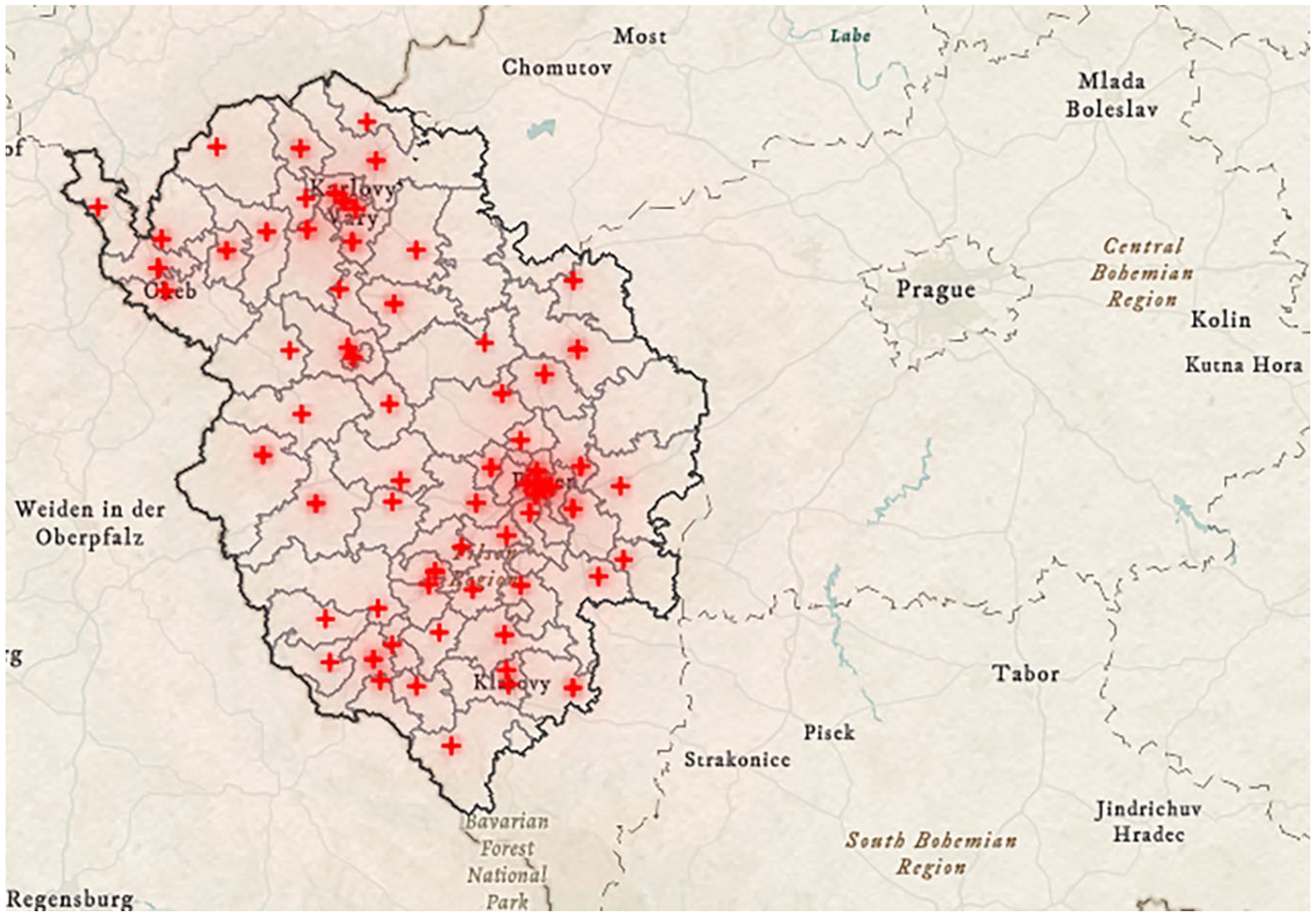
Diocese of Pilsen and its parishes. Each red cross represents the seat of a parish church.
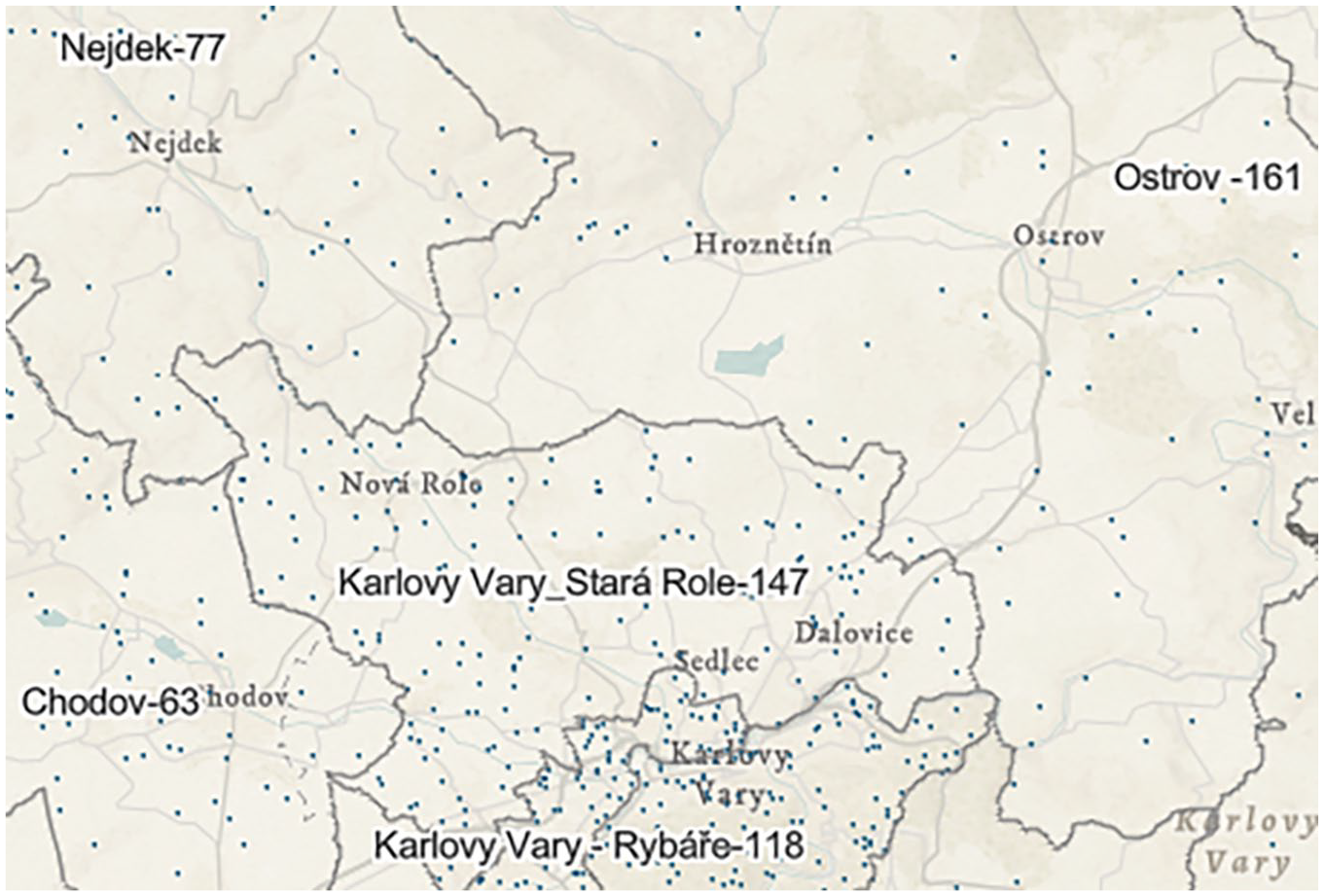
Sunday mass attendance in selected parishes. Each blue dot represents one person; the sum can be found next to the parish’s name. 10
The particulars of our ethnographic field can also be studied from the perspective of churches seeking their position within society. Zdeněk Nešpor (2018) recently evaluated the Czech situation as being at a crossroads between the Eastern churches’ longing for power and the Western churches’ adoption of the vicarious (Davie, 2002) position, transforming themselves into providers of multiple services to the churched and unchurched audiences.
The Diocese of Pilsen favours the latter position. Its leadership envisions the Church as an institution open to non-church society, functioning as a ‘field hospital’, to reference Pope Francis’s metaphor (e.g. Spadaro, 2013). As bishop Tomáš Holub claims, the Catholic Church should be ‘one of the elements of civil society, which is extremely important in a democracy’ (Danda, 2019). It is supposed to be actively present in secular contexts at both local and diocesan levels, not hidden behind defensive ramparts and focusing on preserving its diminishing power. The bishop’s reasoning seems to surpass the dichotomy of horizontal secularity; such an approach is essential not only because of the opportunity to evangelise people but also because of the need to support the democratic secular society.
The bishop’s effort to make the diocese more participative is not just directed outside the Church. When we began our research, Tomáš Holub was in his third year in office and was formulating a ‘mission’ for the diocese to adapt to the current conditions and concentrate weakening forces towards a common goal. He used the Jesuit principle of tantum quantum (insofar as) to discern where to invest limited energy and sources: ‘Do a certain activity insofar as it leads people to meet the living God’. 11 One of the mission’s four pillars is a ‘real parish’ capable of securing the liturgy, community life, charity, and missionary work.
Some reforms related to the bishop’s mission have already been introduced: The priest must meet regularly with the parish economic and pastoral councils; for important decisions, he must seek their opinion. The bishop also regularly meets with economic and pastoral councils consisting primarily of laypeople, including several women. So far, the bishop’s effort has focused on questioning the top-down approach and cultivating internal participation. However, building on tools already existing within the Czech Catholic Church, the processes he is initiating have met obvious structural limits. The parish councils have only counselling authority, and all the formal power remains concentrated in the hands of the clergy.
Methodology
Inspired by the bishop’s vision, we signed a memorandum of cooperation as concerns the research project and, in January 2019, entered the field. Several questions guided us: How does the Church manoeuvre its position in a largely apatheist Czech society? What can the Church offer the secular world? What expectations and demands does society have of the Church?
We explored structures and processes inside the Church and the church communities as well as their spheres of contact with the ‘outside world’, which we operationalised as inside and outside participation, respectively. Our objective was to discover how the ‘religiousness’ of the church communities was articulated in different situations and how it shifted in relation to participation.
We created the main corpus of data by conducting and analysing 12 180 qualitative interviews. Among our interlocutors were priests from 59 out of 66 parishes, the bishop and his closest colleagues, ordinary members of parishes, and members of various church groups. There were also people from the municipalities, state-funded institutions, non-profit organisations, and farmers and foresters interacting with the church land. From the church schools, we interviewed headmasters, chaplains, teachers, parents, and students from all four schools located in Pilsen. Formal interviews were supplemented with informal ones – both individual and collective.
Interview topics consisted of the following:
memory – construction of the group’s identity and meaning in historical narration;
service – definition of church services, for whom it serves, how it is financed, and with what values it is connected;
positioning – activities within the church and society, society-church relation;
participation – decision-making mechanisms and how they relate to communication with the secular;
public space care – importance and management of restituted public spaces;
economy – structure of finances, management of properties;
ecology – environmental aspects of church activities, economy, and service; and
future – economic and pastoral plans for the coming years.
Moreover, we conducted 20 workshops intended to support participation. Their design arose from the needs and interests of our research partners, and they covered themes such as sustainable agriculture and forestry, media coverage of a church construction project, communication flow in the parish, spiritual guidance for believers and non-believers, and more.
Last but not least, we wrote hundreds of pages of shared fieldnotes about our observations, reflections, and feelings. As individuals more or less identified as church members, we naturally have our own wishes and imaginations about what the Church should be like. Our general inclination is towards the abovementioned vicarious service position, where the Church remains religious for religious people but is also inspiring and useful to those outside of it. As it was often clear that our politics is to open the Church to the outside world, we were sometimes understood by communication partners as agents of the bishop or/and progressivists undermining the traditional order, which in some cases led to a refusal of cooperation. On the other hand, our double identification – with the Church and with the scientific world – often helped us in the field: we were trusted not to misinterpret theological or spiritual concepts and experiences, yet still seen as professionals in the (secular) scientific field.
In the field: contested participation
The first months of research revealed that the bishop’s promotion of participation does not seem to be a high priority for most of the various church communities in the diocese. Interlocutors usually discussed the bishop’s initiative as something much less pressing than the urgent economic issues stemming from the restitution process. The priests described the tiny percentage of Catholics as the main obstacle to even beginning a discussion about such a topic: ‘With whom would I possibly talk about this? The four 80-year-old mass visitors?’ was a common sentiment.
Priests further described how restitution increased the prominence of economic agendas. They now have more property to administer in addition to the churches, chapels, and other estates already in their possession. Actually, they would more likely prefer to delegate their economic responsibilities and autonomy back to the bishopric if they could.
However, as much as these socioeconomic circumstances seem to play a vital role in embracing participation as something of value for the parish, we found it relates to the differences in the construction of secular and religious categories as well.
In the next section, we present three empirical cases:
A parish where the religious is constructed as something discontinuous to the secular;
A parish where a different way of constructing the religious-secular opposition leads to greater inside and outside participation; and
A church school which invites secular parents and students to participate in forming its religious identity.
Chříč: the religious and secular as incompatible
The village of Chříč can be found northeast of Pilsen. At first glance, nothing suggests it differs from surrounding, sparsely populated settlements, their declining services and community life and dependence on car commuting. However, upon closer inspection, one can notice a few exceptions.
Most noticeable are the recently restored brewery and school. The brewery (see Pictures 3 and 4) is operated as a social enterprise and serves as the centre of community life; the school is the only one in the region embracing alternative pedagogy outside bigger cities. These two institutions were established by a married Catholic couple who relocated to the village from the Czech capital, Prague. Other such migrants soon followed and participated in developing the surrounding area’s rich cultural and community life.
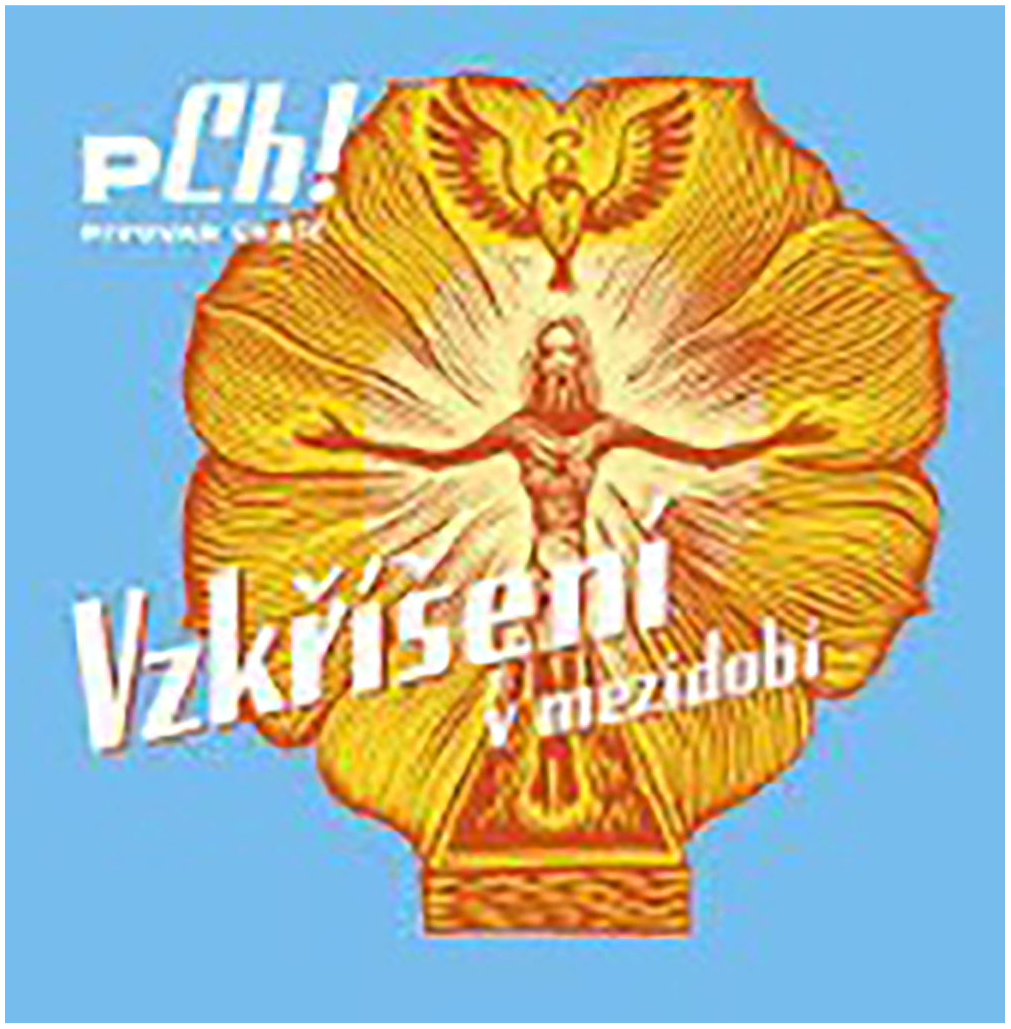
Labels for craft beer produced at the Chříč brewery, inspired by Catholic symbolism: ‘Resurrection in Ordinary Time’.
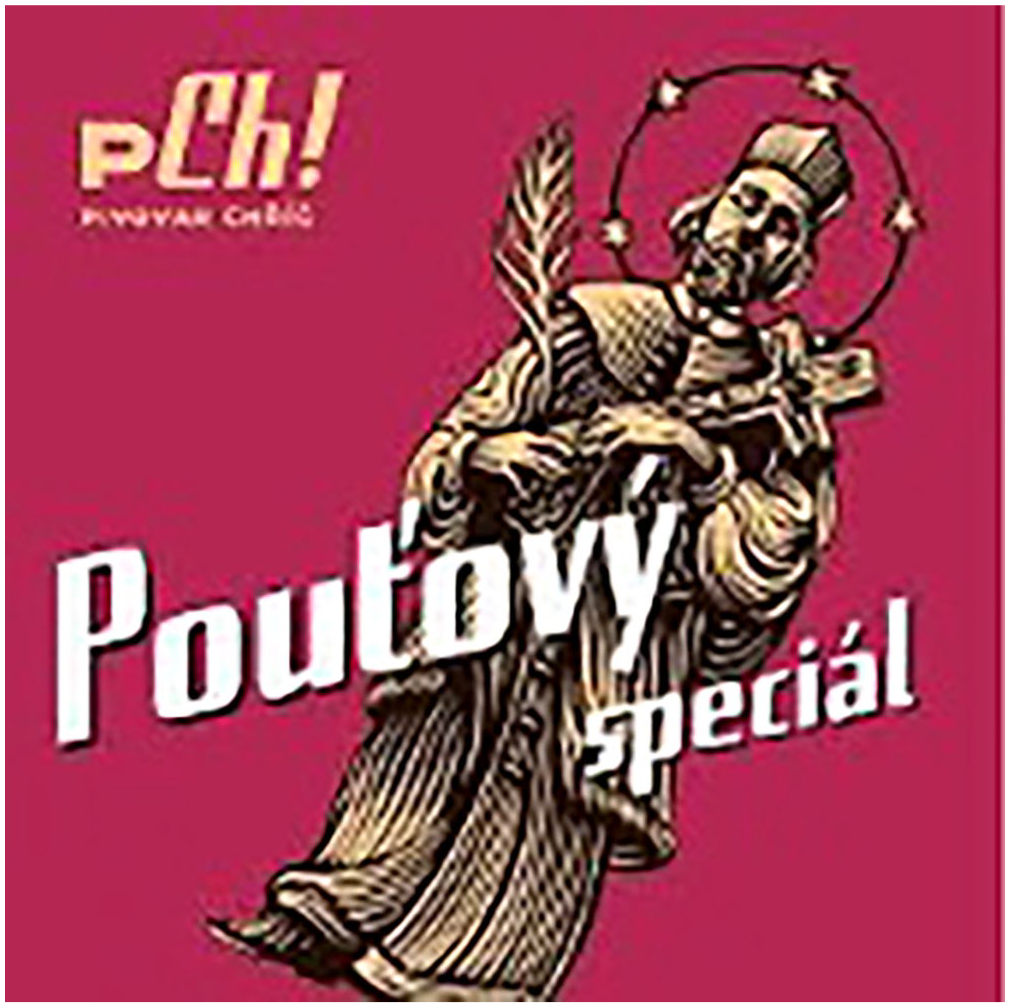
Labels for craft beer produced at the Chříč brewery, inspired by Catholic symbolism: ‘Saint John’s Feast Special’.
When we interviewed the local non-governmental organisations (NGOs) and public institutions, we learned that the local parish virtually does not participate in these activities except for parish administrators allowing the use of the parish’s property. Even though some of the most active locals are also parishioners, they have these agendas separated.
When we approached those ‘members of both worlds’, they responded that their initial activity and enthusiasm towards supporting the parish to participate more in public life faced so many obstacles that they eventually abandoned these efforts. One recent newcomer from the regional capital (Pilsen) and a member of the parish council shared with us his experience:
I come from a background in the non-profit sector, let’s say more managerial. And from that perspective, it doesn’t work here… I believe the education of priests is to blame. They really can’t manage or lead a project or a team. (…) They would also like to reach out to the outside but just don’t know how. They’re supposed to be the clergy, yet they’re suddenly expected to do something else. (…) After the restitution, priests have become even more burdened with managerial functions, and they don’t know how to handle it because nobody told them that it’s normal to set deadlines and to fulfil tasks within those deadlines or to articulate the issues well.
The priests have a crucial role in parish decision-making as they must approve every action, which requires effort on their part, such as signing contracts or grant applications. According to our interlocutor, leading the parish to economic autonomy, participating with the outside world, and managing the parish as a team towards common goals are outside the priests’ skill sets. They are taught to serve a mass or say a prayer, to be a cleric in a sense that does not include such competencies:
I would like to invest more in this because I believe I could do more for the parish to open it up. But for me, it’s a great uncertainty at this moment to be employed by the parish because I’m afraid that the priest will just send me to redo bulletin boards, and he has the authority to do so as the superior.
Our interlocutor describes how the structural setting prevents him from engaging further in the parish. The extensive power of priests who are ill-prepared to deal with the secular world presents too much risk. In addition, the priests are often moved around the diocese, so rapid change can easily come in the parish course. Therefore, the charitable and prosocial activities of the Chříč civic society are not a model that the local church could adopt or participate in within its current configuration. From the perspective of the interlocutor, it is a consequence of broader church settings. He sees the priests as victims of education within the system where the religious realm does not overlap with the secular, not due to active opposition but more out of habit. Religious and secular are neither competitive nor mutually defining realms here, they are simply disconnected. The individuals trying to navigate them both should be ‘plural in their minds’ (Berger, 2014: 28).
Cheb parish: the religious and secular intertwined
Cheb, a town close to the German border, hosts a parish that is not particularly larger than others – out of 30,000 locals, just less than 200 find their way to the church regularly. However, it represents an example of what the bishop believes the diocese’s future should look like. The parish’s position as a model for others to follow was recently formalised, as its priest, Petr Hruška, has become pastor general.
The parish’s identity can be described as open, transcending traditional hierarchies and distinctions and adapting to secular language and practices. Strongly distinguishing himself from clericalism, Petr Hruška has actively endorsed the participation of the laity; many things are discussed within the parish community, including economic strategies and the content of Sunday sermons. However, the parishioners’ interpretation of the Christian mission is mainly oriented outward towards public service, similar to Pope Francis’s discourse. This service is religious in essence; faith is seen as its driver.
Nonetheless, as became particularly apparent during the COVID-19 pandemic, recipients of charity and other services are not defined in religious-secular terms – activities are not narrowed down to fellow Catholics. Moreover, several parishioners, including the priest, are well-integrated into civil society and cultivate ecumenical relationships. They (co-)organise cultural events and demonstrations, or they take part in commemorating the region’s pre-WW2 German and Jewish history.
How the parish responded to the restitution process is characteristic of its identity and practice, reflecting its ability to go beyond religious and secular categories. In financial terms, restitutions have not changed much. For years, the economic strategy has depended primarily on donations from within the community despite subsidies from the diocese. Moreover, the parish gained a relatively modest share of estates with no promise of substantial revenues in the foreseeable future. As a result, parishioners were not encouraged to see the restitution process as an opportunity to acquire more economic autonomy from secular society.
At first, the parishioners did not understand the management of the newly acquired property as something that might enrich their existing practices either. Above all, and similar to other parishes, it was seen as a burden in both external and internal senses. For example, negotiating with the municipality about plots in an area intended to become a large industrial zone represented an inconvenient matter that threatened to spoil good mutual relations. In internal terms, Petr Hruška plainly stated that he perceives the roles of priest and property manager as being in conflict: ‘I offer half of my salary to someone to take care of the management of our property. (…) I don’t want to do it. I can’t do it. I won’t do it’.
However, the perspective gradually changed when parishioners started to think about their assets in terms other than economic, that is, as an extension of the means to serve and cultivate connections with secular society. Negotiations on what to do with fields, forests, and meadows have become creatively implemented into the parish’s existing discourses and practices, and social and environmental arguments have become an essential part of discussions. In cooperation with our project and their secular partners, they began to accentuate creation spirituality and deliberate what it means to be a good caretaker of the land. They decided to revitalise the overgrown surroundings of the dilapidated pilgrim site, the Church of St. Anne (see Pictures 5 and 6), and they offered the parish’s property for use as an outdoor kindergarten. As a result, property that should have served as a tool to become more independent from secular society has actually made the ties between the religious and the secular more robust thanks to the specific setting where these economic processes took place. Petr Hruška described the shift in two other examples:
We inherited from the past, willy-nilly, and for me more and more willy, (…) two immense burdens. And gradually led us – at Maria Loreto much earlier and at St. Nicholas more recently – to see it as two great pastoral opportunities. (…) I probably wouldn’t have discovered those opportunities if they hadn’t been thrust upon us, if I hadn’t inherited this and if the people around me hadn’t persuaded me that it is a historical responsibility to continue somehow to manage and use it.
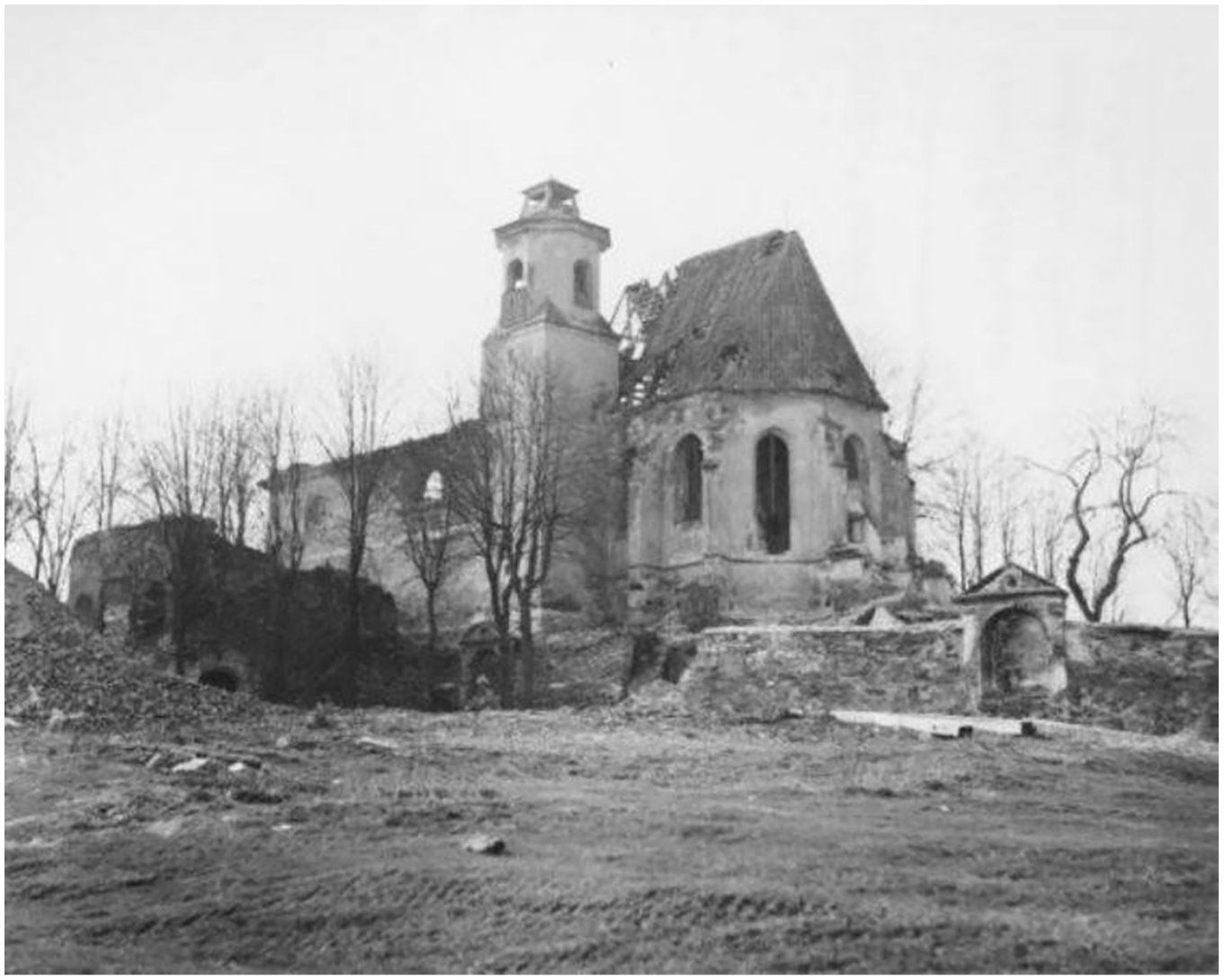
The dilapidated pilgrim Church of St. Anne before its final demolition in 1967.
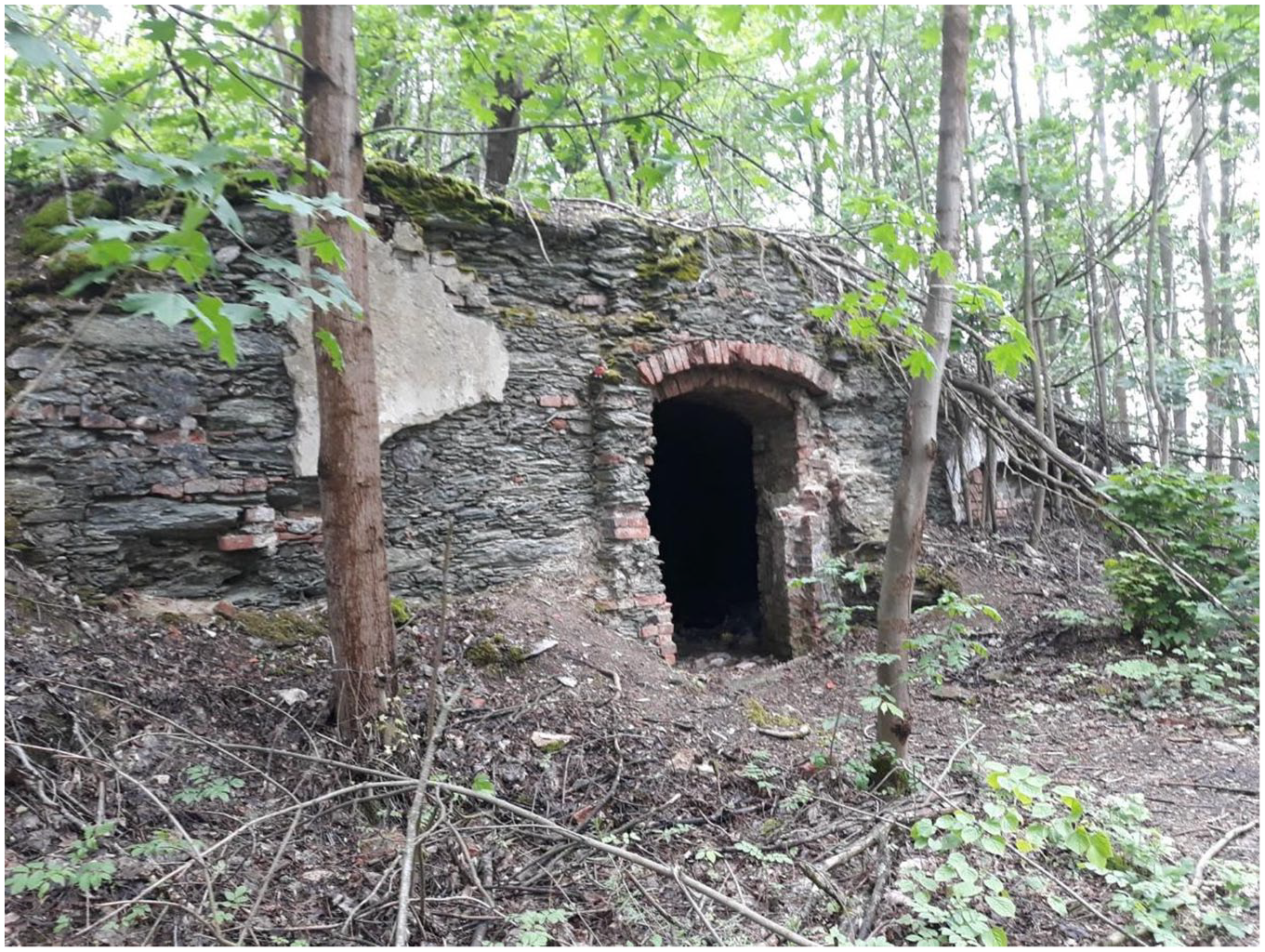
The dilapidated pilgrim Church of St. Anne in its current state.
Our research, therefore, has revealed the importance of power when reflecting upon the relationship between the religious and the secular. In the religiously indifferent environment of Cheb, the Church does not seek to maintain or even regain its former power. Inwardly, the parish’s rejection of clericalism has resulted in a situation where the religious ceases to be exclusive. Outwardly, the religious-secular dichotomy is overcome through service. Cheb’s example also reveals that participation within the parish and participation in secular society are closely intertwined. In this regard, challenges such as the COVID-19 pandemic or restitutions have, in the end, come to be perceived as opportunities to develop both levels of participation and further integrate the religious into the secular. Moreover, especially concerning processes instigated by restitutions, the emphasis on viewing the properties as part of the world created by God reinforced the parishioners’ thinking in terms of vertical secularity.
Church gymnasium: religious as vertical other
The Pilsen church gymnasium 13 was founded shortly after the fall of communism as a grassroots initiative started by a Christian teacher. Her chief motivation was to provide an alternative to the post-communist educational system. Although the bishopric played an official role as a founder, the institutional connection was loose during the founding period, embracing mainly legal patronage and symbolic support. Only recently has the Pilsen diocese turned to its schools and inquired as to how their Christian founding manifests within their practice.
Most students and staff in the gymnasium are non-confessional. The secular setting is, therefore, their primary modus operandi. Nearly 98% of the school budget comes from state subvention. Activities, such as the structure of lectures, closely resemble those in state schools. The only exceptions are a weekly mass in the school chapel before classes (which is scarcely visited even among Christian pupils) and events related to graduation and the beginning and end of the school year, which take place in a nearby church (see Picture 7). There is also an opportunity to attend religious teaching from the school chaplains, who otherwise teach compulsory religious studies once a week at every grade.
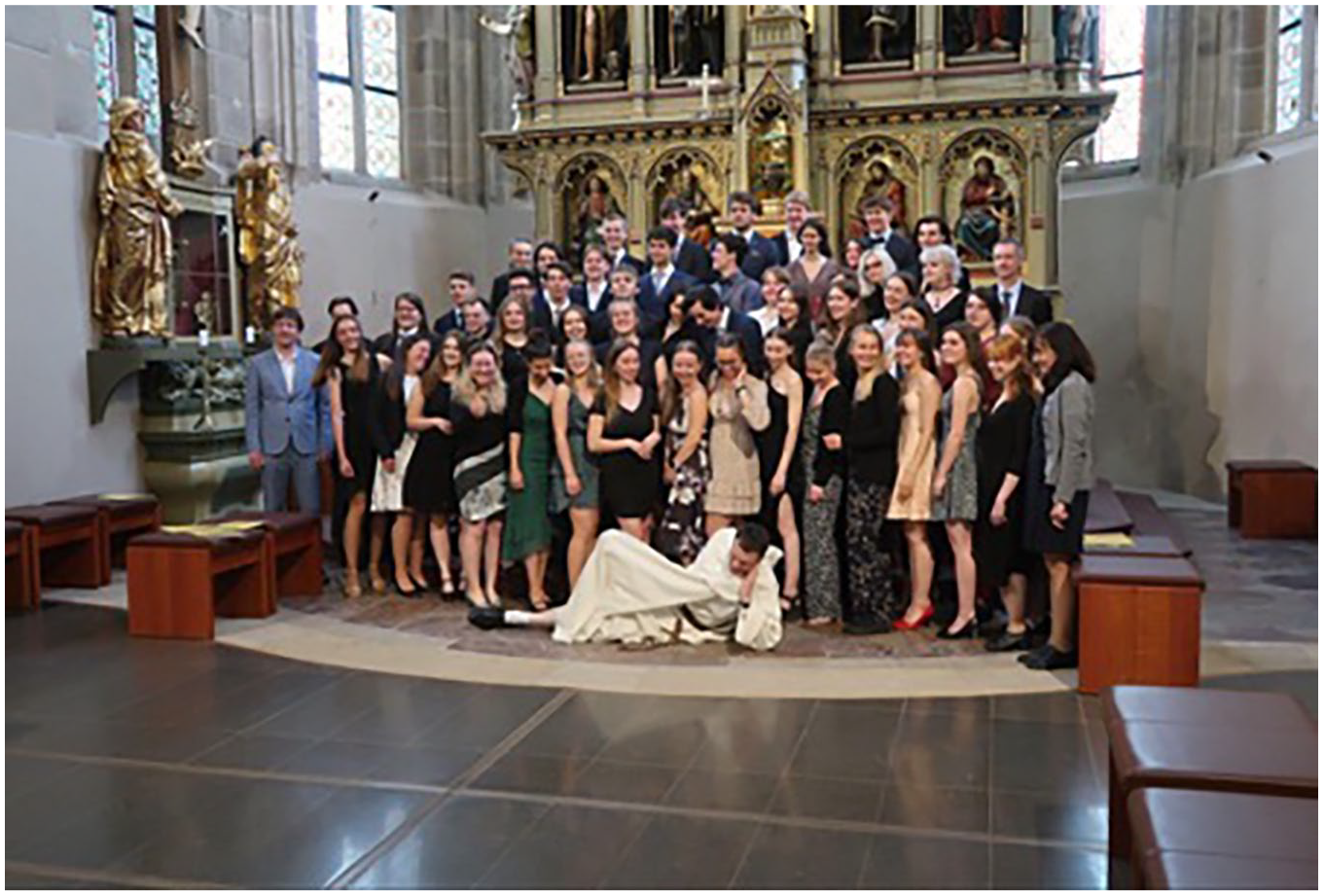
Group photo taken in the church during the graduation ceremony with the school chaplain at the front.
The task the diocese set out and asked us to participate in was to define what makes a school Christian, ecclesiastical, and how to support this characteristic systematically:
I think it gets to those students through our attitudes and values. I don’t feel like anyone is going around beating them over the head with a Bible because we’re a church school; I really don’t. Maybe the only thing is a cross on the wall instead of the president. (…) That’s what I think is the ecclesiastical nature of our school, togetherness, which is here between us and which is hard to describe. We can call it friendship, love, respect or collegiality – even with students.
As with the quote above, uttered by a long-time teacher who identifies with the Catholic Church, other teachers often presented the school’s religious identity as implicit – found more in values than in any specific Christian or church agendas. A respectful approach towards students and the overall community spirit of the school were presented as examples of such values. Teachers want to offer students a faith that is applicable and liveable, even under secular circumstances. The position of the church school in society was, in their telling, that of a guardian of humanistic values or a counterpart to a performance-appreciating environment, choosing among secular values those in accord with Christianity and standing behind them.
The students’ perspectives appear similar: when referring to their favourite feature of the school, they often mention the community and collegial spirit that stretches across the grades and even includes teachers. However, they did not necessarily associate this with a Christian identity; on the contrary, those from secular settings were glad that Christianity was not ‘pushed too much’ at the school. For the Catholics, on the other hand, the school represents a rare safe space where they are not ostracised or ridiculed for their beliefs. Overall, students described the school as a highly tolerant environment that welcomes various identities. During classes, they felt encouraged to discuss and to be critical. They often mentioned this spirit of tolerance as a benefit compared to the other five gymnasiums in Pilsen.
Even the bishopric refrains from calling for a more assertive pursuit of the religious. When we witnessed challenging discussions in which some Catholic parents wished to introduce religious teaching and conduct prayers in the classrooms, the bishop and his colleagues were usually the ones to oppose them. They defined the school as an institution not intended for evangelisation – if pupils left the school saying that Christianity was not completely useless or crazy, it was fulfilling their mission.
The equilibrium between the religious and the secular is thus maintained by the significant retreat of religion on the horizontal level, relinquishing symbolism and a specific cosmology. The approach to the secular as something that is not in direct opposition to the religious, but rather exists on a common God-created-level allows school actors to accept ‘secular principles’ as sufficiently sanctified for a religious school. The religious shifts form horizontal opposition to the vertical one, representing the general idea of transcendence to the created world (D-secularity). The school can then offer Christian symbolism and conceptualisations as options intended only for a small portion of those interested. The school can thus enrich the secular realities of the students via religious means, which is in sync with the aim of some teachers not to exclude pupils from the everyday world but to offer them a certain way of navigating through it.
Conclusion
The opportunities and limits of the church’s transformation
In conclusion, we want to summarise the findings in two steps: First, we will list the observed opportunities and limitations for transforming the Church into a more participative institution, both inside and outside. We will then contextualise our insights to sketch a picture of non-oppositional concepts of the religious and the secular.
The example of the Cheb parish demonstrates the importance of servant and caretaker spiritualities as specific interpretations of Christianity – promoted by the local bishop and Pope Francis – leading parishioners to participate in the life of secular society. To become servants of as many people as possible, they adapt to the needs of secular society, and they do not necessarily confront the people they serve with their inner motivations. Still, it would not be feasible without an appreciation of secularity as the basic condition in the life of the people in Cheb. This appreciation allows for the merging of the religious and the secular. Appreciation of secularity as a condition sine qua non is even more visible in church schools. Here, the religious occupies only the limited space of facultative offers.
The participative church needs materialised structures. In some areas of the Pilsen diocese, people invested a lot of energy to develop structures intended to support internal and external church participation. On the diocese as well as the parish levels, authorities endorse the participation of laypeople in decision-making. Moreover, in Cheb, the parish developed a vast structure of mostly non-confessional volunteers. The model of shared and dispersed responsibilities was established to overcome the habitual clericalism often subconsciously maintained by both clergy and laity. The global Synod on Synodality, begun in 2021 by Pope Francis, also helped strengthen the inner structures of participation.
In economic matters, the bishopric supports the autonomy of the parishes, providing them with expert help. The restitutions-related economic, social, and ecological agendas can provide powerful motivation and opportunity for outside participation. Still, they can also be seen as a burden and as having little to do with the Church’s mission. Creation spirituality, which would let Christians see their role as caretakers of the landscape as a core part of their mission, is rare, as is cooperation with actors in nature protection. Despite society and the church agreeing on the church’s position as a steward of heritage, the position of property manager remains more contested or unexplored.
Regarding the limits of church participation, we also witnessed the conceptualisation of the church as a place designated for religious people to communicate with their God through sacraments. Extra (secular) agendas should not dilute this mission of the Church. As the sacraments can be served exclusively by the clergy, the participation of the laity is only possible for marginal tasks. In this setting, participation structures are more or less formal. Parish councils, where people discuss who will sweep the church and redo the bulletin boards, are not attractive to people who want to realise their potential or participate in decision-making. Outside participation here is limited to the occasional invitation to bless a new fire truck or a similar event. But such opportunities rather petrify the clericalism and do not encourage religious-secular dialogue.
In other places, we saw outside participation and service to the neighbour as a means of intertwining the religious and the secular. These activities enable the emergence of new forms of communal life, such as environmental education projects supported by the parish or the school where non-religious parents want to be introduced to general spiritual topics by the chaplain (see Molendijk, 2015). The question remains as to the positioning of the religious and the secular during this intertwinement.
The religious and the secular revised
To see the emerging patterns of the religious and the secular and their relationships, we first analysed the situations where the Church and society are separated and, second, where they are well connected. As in the previous section, we move from the macro-level of universes of meaning (lived ideologies), which provide the matrix for individual identities, to the materialised structures of (public) institutions.
In places like Chříč, the religious and secular are situated in horizontal opposition, which can be theoretically seen as competitive (in reality, the secular is omnipresent in the Czech Republic, and the separated religious is marginal). The religious establishes a separate world which tries to maintain a complete symbolic universe. The individual Christian is expected to create an identity exclusively in reference to religious cosmology, avoiding secular ideas and conceptions as disruptive, dangerous, or simply false. These religious bubbles are supported by clericalism, serving as both ideology and structure. For local secular people, such worlds represent a marginal and alien curiosity that directs all its energy towards internal operations and does not interfere with the surrounding society.
The restitutions of church properties could have reinforced such parallelism. Some actors understand them as an unrepeatable opportunity to build institutionalised structures, enabling religious people to live more fully in the religious world: to buy and manage church hospitals, kindergartens, schools, banks, social services, farms, and housing complexes. Such a world would ensure autonomy from the secular realm. If this scenario should develop to a large extent, the Czech Republic would probably approach the Eastern model of a church longing for power, as described by Nešpor (2018). According to Stolz and Tanner (2017), proponents of secular-religious competition, the restitutions of the properties could be a case whereby the resources enhance the growth of the religious world. But the theory of secular-religious competition counts on the assumptions that (a) the world is becoming increasingly secularised and (b) that religious and secular providers can be easily discerned. This, however, is not the case in the Pilsen diocese.
In places where the Church and society have become well connected, as in Cheb or in schools, the religious is not in competition with the secular. Individuals can and must create themselves in relation to secular universes of meaning and in relation to their understanding of Christianity. But it would be insufficient to describe this phenomenon as the individual privatisation of religion, with its ‘heretical imperative’ of choice (Berger, 1979). It is a choice that is deeply collective and institutional. It is the choice of the Cheb parish to step out of the religious world and serve all people in need, adapting to their (secular) universes of meaning. It is the choice of the bishopric to manage church schools according to secular norms of pluralistic, religiously neutral education. In both places, they keep the doors of the religious dimension ready for those willing to use them.
However, the religious is not present in the secular, quotidian lives of Cheb parishioners or church school actors only as a possibility to facultatively and temporarily enter another dimension. They realise their lives and identities in secular structures, but they identify their possibilities to live values of compassion, solidarity, and respect for creation and otherness. For them, it does not matter whether these values are classified as religious or secular.
In summary, according to our observations in the Pilsen diocese, the horizontal opposition between the secular and the religious is vanishing. These modern categories are losing their capacity to organise the life of Western subjects (Huss, 2014). Even proponents of religious worlds are no longer sure what in their lives should be classified as religious and what as secular. On a horizontal dimension, from the R-secularity perspective, the religious and the secular are becoming intertwined; the boundaries blur and cease to be essential for individuals as well as institutions. Instead, we see an increasing number of references to the religious as a radical Other, transcending all creation, putting the churched and non-churched people on the same level. Churchgoers and non-churchgoers can both experience the gratitude for the Creation; churched and unchurched parents can try to define the spiritual values of the church school. Anna Fedele (2020) describes spirituality as a lingua franca for both religious and secular people. In her analysis of gendered criticism of institutionalised (patriarchal) religion, spirituality becomes the space in-between where the religious and the secular can meet and merge. We can add that the reference to vertical transcendence (D-secularity) without engaging the horizontal opposition (R-secularity) makes spirituality the field of ‘entente’.
It is essential to mention the bishop himself encourages people to leave the R-secularity perspective and embrace that of D-secularity. This vertical religious-secular opposition is difficult to identify, name, or conceptualise. It seems to resist institutionalisation. It also generates creativity, resulting in new forms of communal life. We, as anthropologists, thought we should not have left this shift unnoticed.
Footnotes
Funding
The author(s) disclosed receipt of the following financial support for the research, authorship, and/or publication of this article: We thank the Technology Agency of the Czech Republic for co-financing our project ‘Society and church in the process of restitution of church properties: How to support participation’ (TL02000132).

Notes
Author biographies
Address: Faculty of Social Sciences, Charles University, U Kříže 8, 158 00 Praha 5, Czech Republic.
Email:
Address: Faculty of Social Studies, Masaryk University, Joštova 218/10, 602 00 Brno, Czech Republic.
Email:
Address: Faculty of Social Sciences, Charles University, U Kříže 8, 158 00 Praha 5, Czech Republic.
Email: