




Abstract
The Tomb of the Patriarchs in the divided city of Hebron is a major site of pilgrimage for all three monotheistic religions, a space of contention, and an epicenter of the Israeli–Palestinian conflict. This article examines the mobility of pilgrims and tourists of various religious traditions within and around the site and their efforts to construct and deconstruct overlapping and often conflicting narratives of sacred space. Thus, Moslem foreign pilgrims from the Middle East and South Asia are motivated by their wish to pray within the site, viewing the political reality of division as an uncomfortable barrier to the experience of sacredness. In contrast, Christians, mostly Protestant tourists, occupy a liminal position expressed and sometimes overcome through the bodily practice of performance of several varieties. Finally, Palestinian solidarity groups attempt to deconstruct Hebron’s sacred geography, by focusing solely on the city’s violent and contested present as a site of immobility and emptiness.
Introduction
The Tomb of the Patriarchs (hereinafter: ‘the TOP’) in Hebron has been a site of convergence between political ownership, sacred geography, and personal encounter with the sublime since biblical times. The structure above the Machpela cave, known to Muslims as the Ibrahimi Mosque, is a major site of pilgrimage for all three monotheistic religions a ‘Lieux de mémoire’ (Nora, 1989) of multiple meaning. According to the book of Genesis, the cave and adjoining field were purchased by Abraham from Efron the Hittite as a tomb for his wife Sarah (Genesis, 23: 8–19) and according to Jewish mystical sources is also the burial place of Adam and Eve and the gateway to paradise (Zohar, 1: 88).
The current building, probably constructed by King Herod in the first century, has been converted several times, serving as a Byzantine basilica, a mosque, a crusader church, and then a mosque again (Sharon, 1986). After the city’s occupation by Israel in 1967, a centuries-old ban on the entrance of non-Muslims to the building was lifted, making the structure open to all visitors. Shortly afterward, Jews began settling within Hebron, and the adjacent town of Kiryat Arba was established (Billig, 2015). Since the 1994 massacre of Palestinian Muslims in the cave by Baruch Goldstein, the site has been divided into two exclusively Jewish and Muslim spaces, with each side allotted 10 days a year to control the entire TOP building.
In 1996, the Israeli–Palestinian Hebron Accords divided the city into a large Palestinian area (H1) and a smaller Jewish-controlled area containing the TOP and the Jewish enclaves (H2). The complex division of the city has created a landscape of uneasy and restricted mobility, with multiple barriers, checkpoints, and fenced communities, maintained by a large and highly visible military presence. Palestinians are not allowed to move freely in the vicinity of the cave and through the city’s former main artery, Shuhada Street. Israelis are only allowed movement in H2 and are forbidden from visiting the sacred sites on the Palestinian side.
Despite being a site of contention and violence, Hebron is a major attraction for both pilgrims and those interested in religious history. According to the site’s authorities, recent statistics have shown that the number of tourists to the site has doubled between 2017 and 2018 amounting to approximately 700,000 visitors annually (Zuriel Hollander, personal communication). In addition to Jewish tourists, many of the visitors are Evangelical Christians from the global south, with a growing number of visitors from the Eastern European Orthodox churches. In addition, many Muslim groups from Turkey, Indonesia, and Central Asia visit Hebron. In 2018, almost 55,000 visitors from Muslim countries with no diplomatic ties with Israel arrived including 37,000 Indonesians and 14,000 Malaysians (Ahren, 2019). According to the tour guide Peter, approximately 2500 Central Asians arrived annually prior to the coronavirus disease (COVID)-19 pandemic.
This article is concerned with the making of sacred geography in Hebron and the TOP through the mobility of pilgrims and tourists. While all tours concentrate in the space of Hebron’s old city, different groups chose different routes and overlay their movement with a variety of narratives. How do these differences in movement and performance impact the sacred and profane cityscape of Hebron? To what extent do these overlapping movements collide? The answers provided here employ Lefebvre’s (1991) concept of space production, namely, the ways in which societies deploy and represent space to serve their ideological, social, and financial needs. While Lefebvre is concerned mostly with the production of space by the modern state, others have written about the ways in which sacred space is produced and negotiated through the practice, movement, and performance of tourist bodies (Edensor, 2001; Holloway, 2003) or other agents (Elazar, 2018).
Following Levi Strauss, Lily Kong notes that ‘the sacred is a value of indeterminate signification, in itself empty of meaning and therefore susceptible to the reception of any meaning whatsoever’. The sacred is thus tied up with, and draws meaning from, social and political relationships (Kong, 2001: 213; Smith, 1987: 54–55). As the New Mobilities Paradigm suggests, ‘places’ and ‘people’ should not be perceived as ontologically separate but rather as categories emerging through dialectical interaction: ‘places traveled to depend in part upon what is practiced within them … many such performances are intermittently mobile “within” the destination place itself’ (Hannam et al., 2006: 13). The fluidity of space construction is particularly true with regard to sacred sites and routes (Gale et al., 2015), constructed through ‘movement freighted with meaning, experienced through the body and senses’ (Maddrell, 2019: 138).
Accordingly, in this article, we examine several varieties of movement through the city of Hebron and the narratives they entail. Virtually all tourism to Hebron revolves around the TOP, the city’s most famous and sacred landmark, and yet tourists move through the site and the city in largely divergent ways. While some groups engage with the city’s religious past and ignore its conflicted present, others focus exclusively on the site as a focal point for violence and conflict, challenging Hebron’s religious symbolism.
As a shared sacred site, Hebron is unique in importance and scope of movement. Several other shared sites exist in the region such as Samuel’s tomb north of Jerusalem. According to Reiter (2009: 174), the significantly easier coexistence of Muslim and Jews in Samuel’s tomb can also be ascribed to a small number of visitors and to the site’s relatively marginal importance compared with the TOP. Furthermore, Reiter (2009: 175) notes the TOP’s history of struggle and usurpation differs from Samuel’s tomb, where Jews and Muslims worshiped freely prior to 1948. Marking the other side of the spectrum is the Temple Mount, a site of singular religious and political importance for both Muslims and Jews exemplifying the nature of sacred space as ‘a one-dimensional axis’ (Hassner, 2003: 14) – a space impossible to divide, substitute or exchange. Pilgrims and tourists from various traditions ascend to the Temple Mount regularly. However, compared with the TOP, both movement and non-Muslim religious practice are highly restricted.
Literature on Hebron is primarily focused on the Israeli–Palestinian conflict (Feige, 1995, 2001; Nueman, 2018) expressing support for the Jewish presence in the city (Auerbach, 2009; Schlissel, 2017) or solidarity with Palestinian residents and criticism of the Israeli military presence (Kasis et al., 2016; Yang, 2020; Yiftachel and Roded, 2011). With a few exceptions (Lecoquierre, 2019) very little has been written regarding the TOP as a site of contemporary pilgrimage.
Mobility through the TOP and its surroundings is categorized here as vertical, horizontal, and circular. As Maddrell and della Dora note ‘Vertical surfaces … mark the limits that oppose and distinguish two worlds’ (2013: 1111). In Hebron, sacredness is created by restricted mobility expressed through the vertical division between the space of the building and the cave beneath its surface. Like the Holy of Holies in the Temple in Jerusalem, the actual burial place of the Patriarchs is off limits to all visitors, creating the hidden axis around which all sacred space in Hebron revolves. Thus, for many of Hebron’s foreign pilgrims, visiting the TOP is motivated by what Eliade (1959: 43) described as the drive of religious man to move toward the sacred center of the world. Pilgrims move vertically inward and upward beyond physical, mental, and bureaucratic barriers to a space near or directly above the original cave. The vertical division of space defines the site as one of inaccessibility and enhances its sacred and otherworldly status.
Mobility within the building is defined through the horizontal division of the building into Jewish and Muslim areas. Horizontal movement is strictly regimented according to the visitor’s religious identity, with Christian tourists allowed to enter both sides of the site. Those who enter the site are asked to proclaim or reaffirm a religious affiliation that will define the limits, scope, and nature of their movement. Accordingly, some visitors choose to conceal or carefully maneuver their own identity while others fervently reaffirm it. Such divisions mark the TOP as a uniquely ‘religious’ space in which religious classifications, maintained by the secular authorities, override categories of nationality and citizenship.
Circular movement in and around the city of Hebron serves to undermine sacred space while constructing the city’s landscape as a space of contention and conflict. It thus aims to catch and focus the tourist gaze (Urry, 1990) on the restrictions of Palestinian movement within the city as the founding symbol of the Palestinian struggle. Accordingly, the age-old Herodian building standing at the center of the city’s old town is presented as the emblem of Israeli political power and the root cause of the city’s division and immobility.
Hebron is also host to large-scale movement that is beyond the scope of this article: Jewish and Christian Evangelical groups walk from the TOP westwards to the Jewish neighborhoods and ancient cemetery in an attempt to construct the story of Hebron as an integral part of the Zionist project – a linear narrative of exile and resurrection (for the relationship between the settler movement and Christian Zionism, see Elazar and Billig, 2021). Such movement and its implications for the construction of sacred and national space will be discussed in a forthcoming article.
Methodology
Based on participant observant ethnographic fieldwork conducted in and around the TOP in Hebron between 2019 and 2022, there were 20 visits to Hebron including observations of groups and individuals moving in and around the site and the city. At the height of the COVID-19 crisis, the TOP was closed off to visitors, directing much of our efforts toward interviews and analysis of online information. Twelve interviews with Israeli and Palestinian tour guides, and five members of the Jewish community in Hebron visitors of a variety of religious backgrounds. Interviews were conducted in various places in the West Bank as well as online and were focused primarily on the meaning ascribed to the sites visited and to movement throughout Hebron. The age range of those interviewed was 30–76 years; 70% were male and 30% were female.
In addition, we conducted a website discourse survey in 2020 focusing on attitudes of tourists to the TOP. Based on 392 statements in a large variety of languages and professionally translated into English, 112 of which were found on Tripadvisor and 280 on social media. Finally, we have also made extensive use of online material, in particular impressions of visitors to Hebron between 2015 and 2022, posted on the website Tripadvisor as well as online documentation made by several Christian groups on their visit to Hebron and posted online. Qualitative materials were analyzed and categorized by both researchers separately and later discussed to produce the core ideas expressed in this article.
This article deals with both pilgrims and tourists following the claim made by Turner and Turner that ‘a tourist is half a pilgrim if a pilgrim is half a tourist’ (1978: 20). Indeed, as other scholars have noted the two categories are often difficult to differentiate clearly. Smith (1992) has argued that pilgrimage and tourism may be placed on both sides of a single spectrum, while others prefer the term religious tourism (Collins-Kreiner and Kliot, 2000). Thus, the Muslim groups described below are clearly pilgrims whose main motivation is to be physically present within the TOP. Participants in Breaking the Silence tours would usually be categorized as tourists, although solidarity tourism may take on the form of a secular pilgrimage (Margry, 2008). Finally, various Christian groups are much more difficult to define, often displaying the full spectrum of Protestant ambivalence toward the concept of pilgrimage and sacred space.
Moving inward: past the checkpoint to the sacred center
George Greenia has observed that ‘for Judaism, Christianity and Islam, travel is part of their foundational myths of God’s stamp on history and His requirements for living in it’ (2014: 9), noting that Abraham, the prophet most closely associated with Hebron, was ‘summoned to pilgrimage’ from Ur to the land of Canaan. In Islam, pilgrimage to the holy city of Mecca is a core religious obligation. Muslim pilgrimage in Israel/Palestine is to a large degree focused on the land’s history as the scene of ancient mobilities, ‘the land of Prophets (Ard al-Anbiya) … where all the Prophets passed’ (Lecoquierre, 2019: 73). Pilgrimage revolves around ‘maqāmat’, a derivative of the word ‘qama’ (standing), a maqām signifies ‘the place where a person lived or passed and thus where they “stood” at one moment’ (Lecoquierre, 2019: 15).
According to Muslim sources, Hebron has been visited by the most significant figures in Islam: Abraham, ‘the friend’ (El Khalil) for whom the city is named, and Muhammad himself who is said to have visited the tomb during the Isra, the night journey to Jerusalem (Vitullo, 2003). The story of the night journey is an emblem of vertical movement to and from the land, a space embodying the potential of human transcendence and the relationship between heaven and earth. Accordingly, Hebron is considered by some Islamic scholars as the fourth holiest place to Islam, an identification leading to the creation of extensive Muslim praise literature for the city (Fadail al Khalil) during the Mamluk period (Frenkel, 2011).
As a focal point of the Israeli–Palestinian conflict, traveling to Hebron can be challenging. The city experiences periodical outbursts of violence, the tourist infrastructure is limited and for those who wish to move between both sides of the divided city, movement through military checkpoints may be slow. But for many pilgrims, the long trip to Hebron despite the varied obstacles is a fulfillment of what Gale et al. has been described as the pilgrim’s interest in ‘physical proximity to and sensory engagement with sites, routes, and objects (to sense and interpret anything that might give meaning to the journey)’ (2015: 6). Such movement toward a site of pilgrimage may be viewed through Turner’s understanding of sacred sites as a peripheral center, ‘located beyond a stretch of wilderness or some other uninhabited territory, in the “chaos” surrounding the ordered “cosmicized” social world (…) the pilgrimage is a paradoxical conceptualization that emerges as a “centre out there”’ (1973: 211–214).
Interest in praying and reciting verses within the inner space of the TOP is particularly strong among groups with a Sufi orientation, mostly from South and Southeast Asia, who emphasize the importance of visiting ziarat: sites and shrines of voluntary pilgrimage (Bhardwaj, 1998). This point of view was expressed in conversation with members of a British-Pakistani group, adherents of the Naqshbandi Sufi order on their way from David’s tomb in Jerusalem to Hebron. An enthusiastic pilgrim named Abu Elhassan noted his feeling of elation at being in ‘the land of the prophets’, adding that arrival to the region felt like a movement of return: ‘We feel at home. We feel we are returning to the roots of Islam’. Abu Elhassan explained his faith that reciting the opening Sura of the Quran and the Sura Al-Ikhlas (Sincerity) three times in specific sacred sites guarantees the prayer’s heightened effectivity.
Relating pilgrimage to Hebron with a feeling of moving toward ‘home’ in the mythical and spiritual sense, is not unique to Muslims and can be found among both Jews and Christian pilgrims to the city. Several Tripadvisor comments on Hebron are titled in that vein, such as ‘going back to where we came from’ 1 (Jewish visitor from New Jersey) and ‘Hebron – the place where it all began’ (Christian visitor from Tennessee). 2 The idea of a site of pilgrimage as ‘home’ may seem paradoxical: as Feldman has noted ‘Unlike spaces of home, pilgrims’ (2014: 107) sense of place is not home; it is marked by impermanence, by not dwelling’. In this case, the movement toward ‘home’ indicates a longing for an authentic and untouched reality. In the TOP, the term ‘home’ signifies movement along a vertical axis, from the mundane world inward toward the unseen and unreached core. Such returning home implies ‘the believers’ imaginary of some moment of creation and whose aesthetics reflect the pilgrims’ centering through ongoing ritual practice’ (Bajc et al., 2007: 323).
According to Mirjam Lucking, most visitors from Indonesia belong to Sufi orders strongly inclined toward pilgrimage to sacred sites. While the religious incentives are strong, the political context and meaning of visiting Israel and the West Bank make mobility to Hebron a complex issue. Indonesian Tourist agencies offering pilgrimage tours try to playdown contemporary political borders and the fact that visiting the sacred sites in the region requires entering through Israel: Muslim travel agencies refer to the country by substituting it with ‘Jerusalem’ (Lucking, 2019: 208). While Lucking (2019: 204) argues that Indonesian tourists are interested in ‘taking sides’ by supporting Palestinian claims to the holy sites, Palestinian solidarity is not the focal point of Indonesian pilgrimage, which revolves around performing pilgrimage rites at the Al Aqsa Mosque, Hebron and the Nabi Musa shrine near Jericho. By emphasizing ‘the land of the prophets’ as the destination and avoiding the term ‘Israel’, the movement of Indonesians constructs the land as a religious-Muslim space, laying beneath the mundane political divisions of the Israeli–Palestinian conflict.
The need to move alongside the present while seeking the sacred past, becomes even stronger upon arrival at Hebron Several of the reports written by Muslim visitors, refer to the security checks as an unfortunate but worthwhile annoyance – a barrier to be surmounted, beyond which lays a space of peace and tranquility.
As one visitor noted:
The outside getting into Al-Khalil (Hebron) is a bit difficult with barriers to get through. Definitely worth a visit to pray. Don’t worry about the Israeli security, you slowly become custom to it unfortunately. Just be happy that you are in one of the holiest countries for all Abrahamic religions.
3
A similar sentiment is expressed by Muslim visitor from the United Kingdom:
Yes, there are minor security checks … but this is well worth the visit of one of the most important Prophets in the Islamic faith … There is an immense amount of peace here, very difficult to describe … There is a sadness attached to the place as it has been divided up by conflict. However, this does not detract from what is still visitable.
4
Some visitors viewed attempts to politicize their visit to Hebron with hostility as starkly contrasted with the nature of the sacred space: ‘The tour was to see the holy site … not one to listen to whether the Palestinians had a cause or not. The entire sanctity of the trip was destroyed’. 5 even visitors whose experience with the Israeli military was negative emphasized the sanctity of the site ‘We offered some prayers during a three hour visit and left with great memories. The only disturbance was entering the mosque through metal guarded gates with rude and impolite army guardsmen’. 6 Another noted that the ‘The environment is very tense and we went very carefully’ but concluded that ‘There was an incredibly beautiful peace and energy inside’. 7
The references to the site’s peacefulness are evocative of Maddrell’s work on pilgrim’s experiences of a religious past on the Isle of Man:
The beautiful carved stone generates an aesthetic-spiritual experience in this particular place, with its assemblage of historical sacred artifacts which engender a spiritual atmosphere in the present, as well as creating a virtual bond, across time, to the forebears of faith in this place (2019: 139).
Similarly, the experience of entering the inner space of the TOP and standing beside the huge cenotaphs above the cave, serves as a link between the past and present, between contemporary worshipers and their spiritual ancestors.
For some, the relatively difficult access to the site actually generates greater religious meaning. Much like Ellis’ description of a ‘legend trip’, Hebron’s distance and contested status add to the meaning of the pilgrimage, containing ‘a vital element of risk allowing the visitor to become an active participant in a continuing social drama’ (2001: 9; and on the importance of hardship, see also: Scriven, 2014). As noted by Peter, an Israeli guide of Russian speaking groups, the conflict itself, embodied in the image of the heavily militarized landscape is sometimes viewed by group members as lending an aura of importance to the site: ‘If everyone wants Helen, she must be beautiful: If everybody is fighting for Hebron, it must be important’. Accordingly, pilgrims felt a common sense of achievement upon arrival in Hebron due to the city’s remoteness and precarious location. Peter noted similar tactics of constructing the sacred space of Hebron and attempts to minimize the significance of the present employed by Russian Orthodox groups who regarded discussions of politics and the Israeli–Palestinian conflict as antithetical to what Peter defined as ‘an experience of holiness’.
In, out and around: liminality, embodiment, and performance
Unlike the Muslim pilgrims described above, for many mainstream non-Zionist Protestant groups, physical proximity and a sensory experience of sacred sites are of marginal importance (Feldman, 2007; Hutt, 2014). While Hebron served as a major destination for Christian pilgrimage in the Middle Ages (Limor, 1998: 122, 237; Limor and Reiner, 2014: 251), early Reformation theologians rejected the idea of pilgrimage leading some to claim that a Protestant pilgrim is ‘an apparent oxymoron’ (Coleman and Eade, 2004: 45; Mazumdar and Mazumdar, 2004: 395). However, as several scholars have shown, Protestant attitudes toward the Holy Land are more complex. According to Kaell, Protestantism does emphasize ‘grace not place’ and yet Evangelical travel is ‘saturated with notions of place and place meaning’ (2014: 77). Emphasis on the religious and political significance associated with the Biblical past is particularly prevalent among Christian Zionist groups (Elazar and Billig, 2021).
In general, Christian groups visiting the site occupy a complex liminal position. Christian visitors who are not permitted by the site’s authorities to conduct collective prayers within the building but are encouraged to pray in the open space surrounding the site. The restriction is not strictly enforced and some smaller Christian groups do spend part of their visit in prayer and even singing. At the same time, their ‘liminality’ enables them the exclusive right of moving horizontally between the two sides of the building. Such liminality is an essential part of Protestant theology of space, focusing on the horizontal movement of journeying as a transformative experience rather than on arrival at a specific sacred focal point, ‘implicit to a belief in the immanence of God who can be found in the everyday and surrounding world’ (Maddrell and della Dora, 2013: 1109).
As Edensor has argued, tourism is ‘a series of staged events and spaces, and as an array of performative techniques and dispositions’ (2001: 60). This is particularly true of pilgrimage ‘an activity that is focused on performances in specific places … an embodied mobility’ (Scriven, 2014: 249). Embodiment in this context is expressed through performance as a means of space construction, as ‘places themselves are part and parcel of events, not separate from them’ (Coleman and Crang, 2002: 10). Feld and Basso note the confluence of space and religion as a ‘fundamental form of embodied experience the site of a powerful fusion of self, space, and time’ (1996: 9). Thus, performative practices shape and are shaped by space, particularly by ‘places of power’ such as pilgrimage sites (Irving, 2015: 96). What follows is a discussion of the mobility and performativity of Christian groups within the TOP and its immediate vicinity.
Performance and ambivalence
Mistakenly, we arrived at the TOP on the prophet Muhamad’s birthday, 1 of 10 days a year when the site is open only to Muslim visitors. A Christian group from Rochester Minnesota was standing on the lawn outside the building. The group leader was discussing the Biblical story of Abraham’s purchase of the cave and field as an act of faith: ‘Abraham was putting his money where his mouth is … In this land, they don’t care what you think, they care what you do’. Much like Muslim perceptions of the land as an arena of movement and transience, the guide presented Hebron as a site celebrating Abraham and Sarah’s voyages to and from the land and an arena of performative mobility; the public act of purchasing the cave and field being a display of faith intended to promote the monotheistic message. Accordingly, the guide described the meaning of Abraham’s presence in the land as universal and geopolitical in nature, being ‘placed by God on this land bridge connecting the fertile crescent with Egypt’. Thus, Hebron was portrayed as a station along an ancient travel route, inconsequential in and of itself but with the potential for disseminating God’s word.
In keeping with the tendency of most Evangelical tourists to remain largely exterior to the conflict (Kaell, 2014), the guide’s description of the purchase of the cave was unrelated to the issue of Jewish ownership in the past or present. His narrative of history contained seemingly few present-day implications; information regarding the political situation in Hebron was partial, rather inaccurate, and generally deemphasized. He seemed unaware of the fact that the site had been exclusively Muslim for several centuries prior to 1967, erroneously claiming that it had been divided into Jewish and Muslim sections by the Ottomans and made no mention of Hebron’s recent history. Describing the city today he noted briefly that Hebron has some sort of special status, adding laughingly: ‘It’s not complicated at all!’.
The group’s time on the lawn ended with a performative recitation of several verses in Hebrew, beginning with the declaration of faith ‘Hear O Israel the Lord our God the Lord is one’ (Deuteronomy, 6:4). The verses were read out load by the guide and repeated enthusiastically by group members. After the recitation, the group’s minister and several group members we spoke with seemed only mildly disappointed that they could not enter the building. Several participants noted that their tour was above all an opportunity to witness and learn about the physical landscape of the Bible, such as archeological remains of first-century houses. The Minister added that while it was ‘still the promised land’, Christianity had consciously discarded the concept of sacred space after the destruction of the temple in 70 CE, replacing the territoriality of the land with faith in Jesus. ‘That’s why we’re not fighting for this place’, he added, thus further distancing himself from Hebron’s contentious present.
The roughly outlined and inaccurate overview of Hebron’s history and the recital of verses reveals the nature of performance and space production and contrast between the spiritual nature of mobility and the idea of sacred space. The declaration of faith and connection with Abraham the traveling preacher, was coupled with an act of distancing: an assertion that the political situation is ‘complicated’ and largely irrelevant to the group’s experience and that fighting for space runs contrary to Christianity. The willingness to stand beneath the TOP without entering is a means of constructing the site as a place in the world, historically significant but essentially a place like all others.
The act of dressing up
The liminal status of Christian groups is exemplified by the need to cover the body in different ways on both sides of the cave. Thus, female visitors entering the Muslim side are requested to wear a form of hooded raincoat. To a lesser extent, men are encouraged (although not required) to put on skull caps upon entering the Jewish side. Tripadvisor reports made by non-Muslim visitors often deal with the need to comply with Muslim authorities regarding the dress code. One English visitor expressed her uneasiness regarding the need to cover her body:
As we entered the mosque, the women in our party were approached and offered blue cloaks which I assume was intended as a modesty garment but given we were already dressed modestly, had the effect of broadcasting that we were not Muslim.
8
Another noted she found the experience to be demining:
No matter how well you are covered up, as a woman, you may still be asked to don a blue or brown hooded cape thing before entering the Muslim side. It’s polyester and in this heat, you’ll feel like exploding after 6 minutes, so you may want the visit to be short. It feels very ‘Handmaid’s Tale’ and was the least pleasant part of the whole experience.
9
The act of covering up did not necessarily incur resentment and was often seen as a comical and harmless part of the visit, articulated to a Biblical Tours group by their guide with the words ‘The women are going to have to put on a little Star Wars costume here’. 10 Likewise, Raed, a Palestinian tour guide noted that the moment of entering the Mosque and wearing the raincoats is always met with laughter, actually serving as a sort of comic relief within the rather grim reality of Hebron.
For the site’s Muslim authorities, covering the body serves to reinforce the site’s sacredness and exclusivity. For non-Muslim visitors, the costume is often perceived as a mark of liminality and foreignness creating a sense of discomfort and artificial movement, and marking the site firmly within the grip of a foreign religious tradition. Such ambivalence and discomfort are a reminder of the way in which sensory experiences ‘are all evident in various participants’ embodied-emotional-spiritual experiential accounts’ (Maddrell, 2019: 140). In this case, walking through the space of the mosque may be seen as a form of ‘involuntary performance’, generating a sense of self-awareness among the tourists, within a carefully managed stage (Edensor, 2001: 77). The act of dressing up is thus associated by some tourists with oppression (as conveyed by the mention of the series The Handmaids Tale). Such feelings seem inseparable from the physical sensation of movement with polyester clothing on a hot day, leading many of the groups to spend a relatively short time within the TOP interior.
As Feldman suggests ‘Performances may be a way of resisting the hegemonic order imposed on space, but they may also be used to assert the right of the powerful to public or contested space’ (2014: 111). Indeed, the act of covering the body in the TOP sometimes serves as a means of identification, indigenization, and strengthening of the political order. On one visit, a small group of Pentecostal Nepali church leaders, together with a Ghanaian minister of a community of foreign workers in Tel Aviv, arrived at the building’s Jewish side. This group’s movement through the site was marked by its strongly performative features. Each of the visitors stood at the center of the synagogue area to be photographed wearing a prayer shawl and skull cap, articles made available by the site’s authorities for the use of Jewish visitors.
The flaunting of Jewish symbols was clearly aimed to emphasize both the visitor’s Christian Zionist identity and the Jewish nature and ownership of the space. The zeal and enthusiasm with which the visitors adorned the prayer shawls and head coverings caused confusion among the Jews in the synagogue; as they were being photographed, two Hasidic Jews were arguing loudly about whether these extremely foreign-looking visitors were indeed Jewish.
The wearing of a Jewish costume was followed by an enthusiastic sermon, delivered by the Ghanaian minister outside the building and broadcast on Facebook Live. Unlike the minister from Minnesota, the Abraham of the Ghanaian minister’s sermon was not one of mobility and transience but of virtue and heritage. The sermon focused on the virtues Abraham passed down to Isaac and Jacob and to the entire people of Israel. Stressing the Jewishness of the city he concluded that, ‘Salvation only comes through the Jews’, adding fervently that ‘you can’t separate Jesus from his people!’.
Deconstructing sacred space
Scholarly writing on the secularization of space often focuses on agents such as the state or business establishment, working in opposition to religious followers (Chen, 2017: 531). In the case of Hebron, the sacred-secular divide is negotiated through the movement of tourists, following different and conflicting trajectories of mobility and space. Thus, if sacred sites are arenas of conflict (Eade and Sallnow, 2000), in Hebron the conflict occurs between the sacred and the profane and is expressed through the movement of tourists and pilgrims within the larger space of the city.
Movement is often seen as a fundamental aspect of Western citizenship with walking perceived as a core feature of being human. At the same time speed and slowness are central to the politics of movement as ‘being able to get somewhere quickly is increasingly associated with exclusivity’ (Cresswell, 2010: 19–23). Indeed, the mobility of some sometimes serves to highlight the immobility of others. Thus, if the larger-than-life images of the biblical patriarchs and matriarchs are the essence of Hebron for many Christian and Muslim groups, it is the Goldstein massacre and the division of the city that serve as the focal point for Palestinian solidarity tourism aimed at revealing the hardships of living under Israeli rule, particularly in the realm of mobility (Kasis et al., 2016). While the TOP remains the axis around which all tours of the city revolve, movement is oriented to follow the complex militarized demarcation lines between the Palestinian and Israeli controlled parts of the city. The tours’ ‘moorings’ (Hannam et al., 2006) are the checkpoints and barriers spread out along the city’s main arteries. Indeed, some tours and many individual tourists focused on solidarity, choose to refrain from entering the TOP itself.
Raed, a Palestinian tour guide from Bethlehem, noted that his group members rarely comment on the city’s aesthetic features, history, or religious practice since ‘most of the time they think of the conflict’. Raed’s tour begins in the Palestinian-controlled part of the city and moves Eastwards to the Israeli side. Walking through the Palestinian-Israeli divide, they pass the Avraham Avinu synagogue and Jewish enclave, to catch a rooftop view of the city in a building held by the international organization Christian Peacemaker Teams. While the organization was initially founded by several Protestant churches and identifies as Christian, its agenda is focused on social and political justice, ascribing no particular religious meaning to the city or to the TOP. In the background provided on Hebron on the organization’s website, the site’s history, and religious meaning are hardly mentioned with the exception of the rather withdrawn statement that ‘The Old City of al-Khalil is one of the oldest historically populated areas in the region and home to the Ibrahimi mosque, an important religious site for Islam, Judaism, and Christianity’ 11 The organization’s goal is to decrease ‘incidents of harassment and mistreatment’ of Palestinians. 12
Raed’s tour is largely focused on the relative emptiness of the area surrounding the TOP, particularly the Shuhada street and old retail market, often perceived as a symbol of the conflict and of the artificial division of the city and the subsequent limitations on Palestinian mobility. Movement down Shuhada Street is narrated with stories of its past as a bustling market, an image starkly contrasted with present-day silence and the long row of locked shop fronts (Kelly, 2016: 734). By moving through the strangely empty spaces leading to the TOP an image of the conflict is constructed with the sacred site itself as the root cause of violence and usurpation. While walking, Raed also shares information from the Hebron rehabilitation committee, a Palestinian organization, active in renovating abandoned property in the old city and encouraging residents to move back into the area (Sherwood, 2015).
In Hebron, the slowness of movement plays a central part in the social construction of the city’s space. To convey the feeling of immobility Raed deliberately takes his groups through three to four checkpoints, some requiring a 15–20-minute wait in line. As Raed noted, moving through the checkpoints exemplifying the stark reality created by the conflict, conveying the feeling of movement through a broken urban landscape.
Movement through checkpoints is a central feature of solidarity tourism. The goal of experiencing restricted mobility is to ‘make tourists aware of their difference – not sameness from Palestinians in terms of access, mobility and privilege’ (Kelly, 2016: 731). While Raed does spend some time with visitors in the TOP, his guiding is primarily focused on recent history and the friction between Israeli and Palestinian residents of the city.
Daniel, a young Palestinian tour guide and Christian minister from Bethlehem, noted that the groups he guides ask to discuss a broader array of topics – politics, religion, and other aspects of life in the region. Yet, much like Raed’s experience, Daniel has found that it was quite rare to hear references to a spiritual experience among tour participants and that interest in the TOP is limited. Indeed, Daniel feels the need to actively encourage his groups to enter both the Muslim and Jewish sides of the building.
Efforts to challenge the sacred space of Hebron are a central feature in the tours conducted by the Israeli organization ‘Breaking the Silence’. 13 The tours begin in the adjacent Jewish settlement Kiryat Arba at the grave of Baruch Goldstein, perpetrator of the 1994 massacre, thus framing the movement of tourists firmly within the context of the Israeli–Palestinian conflict. Beginning with Goldstein’s tomb reconstructs the space of the TOP, shifting from a site of religious significance to a scene of ethnic violence and tragedy.
After Goldstein’s tomb, tour participants are driven into Hebron, to the parking lot beneath the entrance to the TOP. During the short drive from Kiryat Arba, guides emphasize restricted movement and the fact that most Palestinian are not allowed to move on the road connecting the two locations (Amiran, 2017) Significantly, groups do not enter the TOP, rather moving westwards toward the Jewish neighborhoods. The reason for avoiding the site is a point of some contention. According to the vice chairman of Breaking the Silence Nadav Weiman, in the past tours would conclude by allowing participants some free time to enter the building privately in addition to ‘many historical explanations about the site throughout the tour’. However, in recent years the soldiers guarding the site have been ‘holding the groups at the entrance to the cave, placing all sorts of restrictions on them to prevent them from entering’. In contrast, in an interview with Hebron’s Jewish community spokesman Noam Arnon, Arnon described the refrainment from entering the site as an intentional act of hostility toward the city’s religious past. Likewise, Amiran (2017), notes that while mentioned, the Jewish historical connection to the city serves as ‘mere background … the tour is completely immersed in the present and fear of the future’ (See also: Clarke, 2000: 17).
Like other solidarity tours, a highlight of the BtS tour is the movement through the old retail market and Shuhada Street, emphasizing the feeling of the city’s stagnation and oppression. The tour’s last stop is the most recently contested Jewish compound and the center of a protracted legal dispute regarding ownership, alternately known as ‘Beit Hashalom’ (house of peace), the ‘house of dispute’ or simply ‘the Brown House’. Thus, the circular movement of solidarity groups mentioned above does not discard the city’s religious center, but rather moves around it, thus reframing and re-narrating Hebron’s spatial construction (Figure 1).
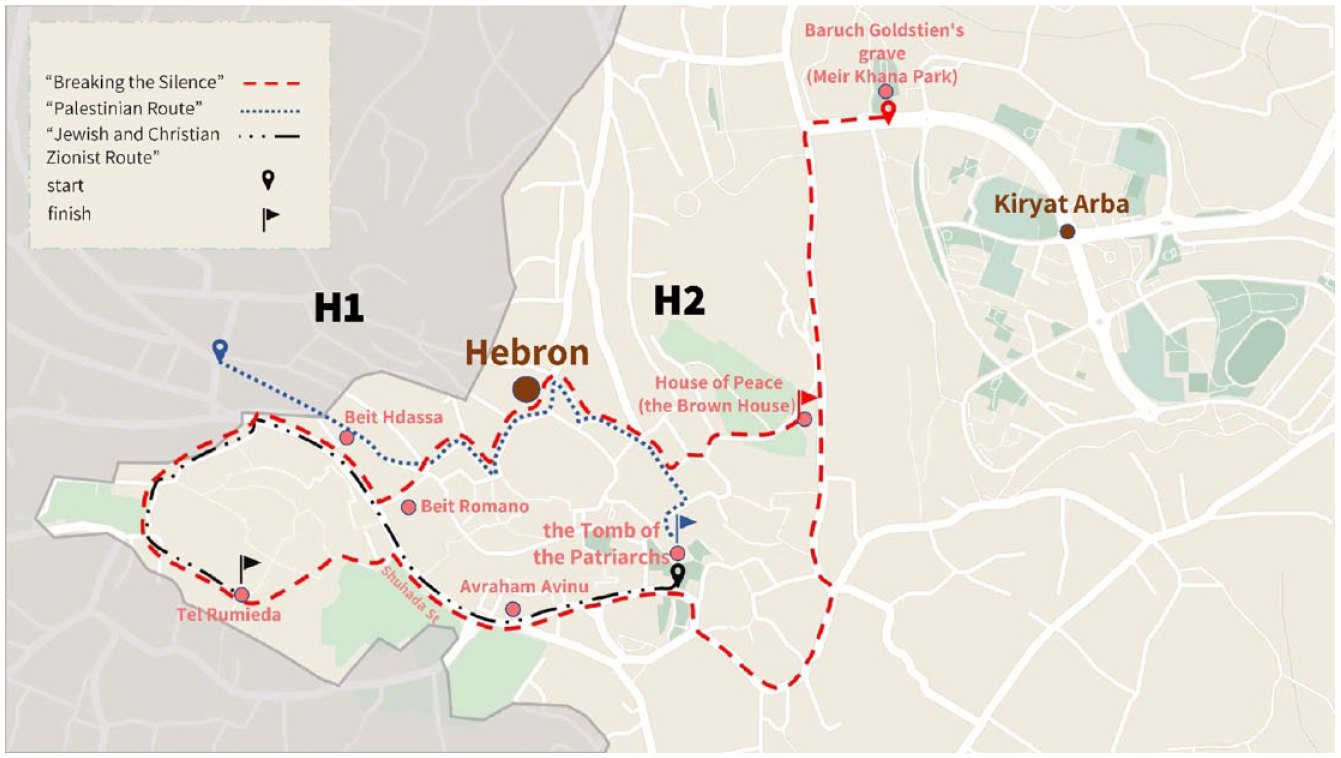
Map designed by the authors: walking narratives of Hebron.
Conclusion
The fluidity and continuous creation of spaces theorized as the New Mobilities Paradigm are strongly evident in the deeply contested city of Hebron, a space continuously divided, defined, conceptualized, and negotiated. The TOP, the center of sacred space in Hebron is a site laden with memory of mystical union, ethnogenesis, and violence. Thus, space construction in Hebron is based both on spaces engaged and on those avoided: the mundane and empty urban landscape for many of Hebron’s pilgrims and the TOP itself for some solidarity tourists. Here, however, we have attempted to portray a conflict not between Israelis and Palestinians but rather between pilgrims, both Christian and Muslim, who strive to move inward to the locus of Hebron’s heroic and legendary past and those who view the continuous creation of sacred space as a tool of political control and a threat to the secular nature of the state.
Accordingly, while the groups of tourists described above arrive at the same location, they each create very different spaces. For some, Hebron is primarily a location of an axial vertical nature, a doorway to the divine, reminiscent of Muhammad’s night journey to heaven. In line with the New Mobilities Paradigm, the phenomenological experience of the Muslim pilgrimage described above is shaped by the nature of mobility, in this case, the need to overcome security barriers and check points. Thus, pilgrimage is ‘a journey to recollect, travel that reactivates a mythic knowledge still buzzing softly as a background to consciousness, an implied structure on which the chaos of daily life can fumble about secure’ (Greenia, 2014: 11). Places of pilgrimage have been defined as storied places (Feldman, 2014) where pilgrims not only relate to the memory of the past but also attempt to create their own memories. Movement toward the core of memory at the heart of the TOP is a drive to experience the serene and peaceful environment associated with the patriarch’s relationship with the divine and to associate with the site’s axial nature. Accordingly, the movement of pilgrims may be seen as an attempt to break through to the sacred space, moving from the troubled present to the tranquility of the mythical past. The Tripadvisor reviews recounted above acknowledge the cumbersome and sometimes upsetting elements of the experience but emphasize the eventual triumph of memory, experienced within the TOP, over the harsh reality of the margins. Indeed, one may argue that the embodied experience of moving inward is largely created by the sites’ heavily guarded nature and that the feeling of peacefulness emerges through the contrast with the friction in the city at large.
For others, movement in Hebron commemorates the horizontal movement of Abraham – a migrant preacher moving across the Fertile Crescent. It is a Hebron created by performance, with the sacred site serving as mere background. Christian performance, both wanted and unwanted, is an expression or a reaction to liminality, created, in turn, by the horizontal division of the TOP between Jews and Muslims. For some, it is a means of expressing distance both from the idea of sacred space and from the present-day conflict. For others, hiding the body and controlled movement within the site, strengthens feelings of foreignness and estrangement. Finally, some groups consciously employ performance as a tactic enabling an escape from liminality – a means of choosing sides and constructing a Jewish narrative of Hebron, its past and present.
Finally, Hebron is also home to tourism aimed at circumnavigating and deconstructing sacred space, narrating the city as a focal point of profane violence. For BtS and other solidarity groups, the movement is focused on the spatial markers of conflict, beginning with the violence of the 1990s and ending with the prospect of a future dispute. For the Palestinian-led groups, conflict is experienced through the sluggish and cumbersome movement eastwards, from H1 to the TOP and the Jewish enclaves. Moving on the visible surface surrounding the TOP, constructs the violent conflict as the true reality of the city, negating the multilayered past hidden beneath the ground of Hebron’s ancient landmark.
Footnotes
Acknowledgements
The authors acknowledge and appreciate the financial support provided by the Eastern R&D Center, Ariel University and the Israeli Ministry of Science and Technology.
Correction (May 2024):
This article has been updated to adjust the order of the first author’s affiliations.
Funding
The author(s) disclosed receipt of the following financial support for the research, authorship, and/or publication of this article: This work was supported by The Authority of Research and Development, Ariel University; Israeli Ministry of Science and Technology [Grant Number 3-15748].

Notes
Author biographies
Address: Ariel University, Ramat Hagolan 65, 4070000 Ariel, Israel.
Email:
Address: Ariel University, 4070000 Ariel, Israel.
Email: