




Abstract
More than 25 years after the previous survey, the state of religion in Italy in 2017 was surveyed. This time a more challenging mixed methodology was used following both quantitative (with 3238 questionnaires administered according to criteria of statistical representativeness) and qualitative (with 164 in-depth interviews, in various Italian locations) criteria. For over half a century, there has been talk of secularization and the end of religion. What is being recorded all this time, actually, is a decline in religious practice. Meanwhile, there has been an expansion of a kind of religious area that goes beyond Church membership. There is also talk of uncertain faith meaning that a troubled and reflexive kind of belief continues to exist. At present, a new conceptual category is emerging more and more, that of Church as religion, meaning that the Church itself has become religion and begun to replace the content of faith.
Introduction
Anne-Sophie Lamine (2018) invited scholars to revisit the thinking of John Dewey (1934) with a view to applying it to religion as factual experience. Dewey is not a specialist in the field of religion (Comel, 1959), but some of his concepts relating to intersubjectivity, experience, aspirations, ideals, emotions, rationality, and values, in particular the process leading to value judgements, might be applied theoretically and empirically in a fruitful manner to the area of religion. Dewey’s pragmatism, attentive to doing, places particular emphasis on interaction and transactions. This is all part of what he calls the quest for certainty (Dewey, 1929).
Lamine (2018: 669) notes that ‘an examination of doubt, knowledge and certainty is important both for understanding religious beliefs as a quest for certainty and for interrogating non-religious certainty about what religious belief is. Dewey (1929) points out that ‘the search for certainty is a search for a peace that is guaranteed, an object that is unqualified by the risk and shadow of fear that action casts’ (Dewey, 1929: 81). One might, with Bernstein (1983), speak of a kind of ‘Cartesian anxiety’, something he drew from Descartes’ Meditations (2006), in particular, from the need to make use of methodological doubt as a premise to freeing oneself from false opinions, created as a result of one’s formative processes. This operation is aimed at finding a solution to establish a certain science.
Now, the central point of the sociological approach consists of a shift from experience (the fundamental basis of religiosity and spirituality) to the narration of memories and life stories, that is, ties to the community. This way, belief is expressed in the following three ways: forms of experience and self-construction, forms of self-transcendence and forms of connection with others and nature. Nancy Ammerman (2006) and Meredith McGuire (2008) made a seminal contribution to the understanding and interpretation of experiential and self-construal forms as the first mode of belief, by insisting on the notion of lived religion, which includes religious practices as well as acts of sharing, connecting and contemplating. In effect, it meant living an experience while also referring to religious norms. However, Dewey (1934) made a distinction between religion and the religious, in a way akin to that of Simmel (1997 [1906, 1912]), who, before him, made a difference between religion as an organized form and religiosity as a disposition of mind and feeling. William James (1902) too needs to be mentioned because he was the first to speak of personal religion as opposed to institutional, constituted and ritual religion.
In conclusion, echoing Simmel (1997 [1906, 1912]), there seem to be three vital areas of religiosity (rather than religion-institution): the relationality of individuals with external nature, of subjects with their future destiny, and social actors with the surrounding human world. All this, however, is suffused with uncertainty. According to Lamine (2018: 680), ‘religious identity includes doubt’. It is precisely uncertainty that features as the prevailing character of a soft, vague, indecisive, suspended, unstable, precarious, indeterminate religiosity, not easily ascertainable or definable, except as uncertain faith.
Twenty-five years after the previous research regarding religiosity in Italy, the results of which were published by Cesareo et al. (1995), this new survey, carried out in 2017 on the same topic, presents a significant novelty: the approach chosen has not been exclusively quantitative, involving the administration of a questionnaire to a statistically representative sample of the entire Italian population, but it also included a set of 164 subjects appropriately chosen from all over Italy, following criteria close to the overall demographic reality, even if we make no claim of statistical representativeness or of the generalizability of the results. It should be noted that, during the qualitative survey, we did our utmost, at methodological level, to maintain an acceptable degree of procedural rigour, by choosing the interviewees on the basis of three levels of educational qualifications (compulsory school certificate/middle school certificate, senior-secondary-school diploma, university degree), of gender (man, woman), residence (small towns, medium municipalities, large cities), geographical distribution (north, centre, south, and islands) and age (young people, adults, the elderly).
In addition, we decided to experiment a completely open interview, without any predefined questions and specific themes to be addressed by the interviewees; in short, we left them completely free to introduce, express, and collocate themselves at will through spontaneous autobiographical narratives (as far as possible). In short, there was also the risk that the investigation might yield no data regarding religious experience. But this was not the case, to a large extent. For almost half of the qualitative sample, that is, 78 cases, the interviewers tried to obtain narratives, reflections, interpretations, and evaluations unsolicited by means of direct or indirect questions on the topic of religiosity.
However, for the remaining 86 subjects interviewed, a double modality was applied within the same interview. The first part was managed freely by the interviewees in terms of content while the second part contained prompts based on some concepts stimuli proposed by the interviewer to solicit answers, which, in order, regarded everyday life and feast days, happiness and sorrow, life and death, God, prayer, religious institutions, and Pope Francis.
This way, we have tried, on one hand, to collect what are known as natural data that the most recent sociological literature in the field of the qualitative approach has long hoped for and, on the other hand, we have striven to trace once again the pathway of focused interviews (Potter, 1996, 2002), which have already produced a long series of more than reliable results at scientific level. The intention was to propose a pathway of mixed methods capable of leveraging diversified solutions, in the belief of favouring a better understanding of the sociological phenomenologies being examined.
The mixed solution does not concern only the model of the interview, defined from time to time as UNI (i.e. uniform in its total availability to manage the interlocution by the interviewee), or MIX (in its dual possibility: first of completely open speech and then of content guided by some specific questions, suggested by the interviewer to focus the interview on socio-religious issues).
Theories
For several decades, specialists of religious phenomena have striven to discuss secularization, the death of God, the end of religion, or – on the contrary – religious revival, the return to God, expansion of the influence of religion (Yang, 2011).
Following the various waves of empirical research and sociological theorizations, at first, raised doubts regarding the concrete possibilities of the persistence of religion, to emphasize, later, an alleged revival of religion (Stark and Bainbridge, 1985), founded on some empirical and rather impressionistic observation, unconfirmed by more rigorous inquiries, it seems difficult, today, to deny that religion as a fact is still of central interest to the greater part of the world’s population.
Yet, it is by assuming post-secular religion as a reference point that actual trends can be identified and future developments imagined. Habermas (2012) addresses the question of the role of religion in the contemporary age, speaking of a post-secular reality that does not cause religion to disappear but rather to open itself up to dialogue recurring to a plurality of exchanges. This way, the German sociologist avoided that the most exacerbated forms of secularism might gain the upper hand and extend the dominance of reason to all sectors of society.
After the wave of secularization, social scientists studying the phenomenon of religion are becoming far more cautious about the use of certain data, which even today attribute importance either to the hypothesis of secularization or to that of religious revival (Kepel, 1991; Micklethwait and Wooldridge, 2009). If we examine other hypotheses which at international level, in the field of sociology of religion, are frequently under discussion, we can see that in many cases they are not applicable. Any effort to verify these hypotheses has failed in general: Thomas Luckmann’s theorization regarding ‘invisible religion’ (Luckmann, 1967) attracted the attention of a certain number of sociologists, even though it has not always led to scientific consensus. His idea that Church religion has been replaced, fundamentally, by a series of topics such as ‘individual autonomy, auto-expression, auto-fulfilment, mobility ethos, sex and familism’ has developed in parallel to the theory of secularization. We must ask if we are faced with an absolute novelty or whether, on the contrary, Luckmann’s ‘modern religious themes’ are simply the sedimentation of pre-existing, more or less subterranean channels, long incorporated into traditional religious modes, and surfacing for reasons that are not only contingent.
The lack of research in this regard and the great weight of social control found in some particular historical and geographical contexts may be among these reasons. Furthermore, Luckmann believes that the relative instability of the modern sacred cosmos depends on the various social strata within which it is active, as proof of its internal incoherence and disarticulation. He reminds us that traditional, customary religious themes are re-ordered within the orbit of the secular and the private, especially by the young and urban dwellers. So, Durkheim’s prediction of a wholly individual religion seems to becoming true.
A significant overcome of the thesis on secularization is that attributable to Ulrich Beck (2010), who failed to understand the perspective put forward by Luckmann very well, quoted it only a couple of times and inappropriately. Having misunderstood the Luckmannian idea of ‘invisible religion’, he considered it the mere emergence of new religious movements, improperly called ‘invisible or implicit religions’. The latter expressions are not found in the work of Luckmann, who, moreover, is not even listed among the 19 authors considered by Beck as main referents for secularization theory.
Beck advanced a new interpretation of the diffusion of religion as experience of a personal God. Whoever wishes to escape hierarchies, dogmas, practices, official beliefs, ideological evaluations and the authoritarianism of structures stabilized over time, builds his or her own way of being religious (or non-religious). These relate, nevertheless, to the religiosity proposed by Churches, movements, groups, communities, and organizations – and come to terms with the truths claimed and propagated by the various religious denominations. The option of a personal God that derives from this seems particularly functional to the individual needs of social actors grappling with multiple, complex, risky, and unpredictable problems, which do not always find adequate answers in the recipes proposed by historical, traditional, consolidated religions.
This opens up a scenario that permits us to catch sight of a kaleidoscope of variations on the religious theme, not necessarily in conflict with each other or even with the classical models, which remain, nevertheless, in the background, representing a wide-ranging horizon, where systems of socialization continue to operate with more or less effective results. Even though the latter seem to be diminishing in their scope, they remain influential, even after many years and in existential key circumstances.
The historical precipitate of all this is the return to a sort of polytheism according to the interpretative key of religious individualism resulting in a dual-orientation, favouring both the religious solution and its negation, without renouncing the quest for transcendence. Death, however, escapes this kind of consideration and is not included in the list of what is believed to belong to the ‘ultimate meaning’, attributed to the private, individual world. For Beck, moreover, religious individualization presents itself as a paradox, since religion promotes memory, strengthens ties, fosters collective identities, and spreads strongly socializing rituals. It is from religion itself, however, that individualization takes its cue, insofar as it is founded on the faith of the individual subject and his/her freedom of choice.
The very promise of eternal life as means by which to defeat physical death is defined by Beck as a disturbing, isolating invention, at the same time, as a sort of test that leads to eternal life or not, according to the type of life lived. It should be emphasized, however, that the individualization of religion when and if it leads to religiosity of a personal God is not only very different from individualization in religion, though it might create problems for institutionalized religious forms, unless the latter were to seek solutions of compromise, adaptation, conciliation.
To make his reading of religious reality even more explicit, Beck proposes 10 fundamental theses that are well suited to the topic of diffused religion (Cipriani, 2017): first, the diffusion of religious faith is directly proportional to the presence of reasons of uncertainty along existential pathways; without going in the direction of the disappearance of religion, a new anarchic mode of religion appears on the horizon, which fails to respect its usual, existing norms; the individualization of religion is connected to that of society as a whole: families and classes and social milieu; institutional images lose relevance, giving way to new words and new symbols; while religious practice declines, new, more fluid, liquid, elusive forms are amplified as Bauman (2000) would say; there is a privatization of religion but, at the same time, it recovers ground within the public space (Casanova, 1994); the so-called religious truth is transformed both at institutional and individual level; individualized religion retraces the same symbolic pathways as those belonging to the sphere of institutional religious in an evidently substantial continuum; the personal God comes at the end of an itinerary that has been institutional, traditional, almost without interruption with the past; the future presents various scenarios, including an aversion towards individualized religion, the affirmation of religion in the public sphere (Habermas, 2006) and a perspective inclusive of all other religions, recognizing their contribution, and accepting a continuous, open comparison.
This way, religions acquire a degree of universal citizenship never experienced before. The greater diffusion of religions then legitimizes the expression itself of ‘religious universalism’ and confirms the tendency towards cosmopolitanism.
Beyond theories of secularization, the concept of diffused religion suggests a different point of view. According to José Casanova (2017: VII), ‘in a certain way, the concept of ‘diffused’ religion serves as a suitable reactive, almost as an antidote, to the two central tenets of theories of secularization and of the theories of modernity on which they are based. The first is the supposed radical break and binary distinction between ‘tradition’ and ‘modernity’. The second is the theory of clear and rigid differentiation between ‘secular’ and ‘religious’ spheres. The concept of ‘diffused’ religion is meant to diffuse and blur distinctions between boundaries, including the temporal boundary between traditional religion and secular modernity, and the spatial one between ecclesiastical religion and modern secularity. Indeed, according to the author, ‘diffused religion’ is the space where tradition and modernity, religion and secularity all meet and blend in an undifferentiated manner. The picture he seeks to portray is that of an incontrovertible historical precipitate where modernization, secularization, and persistence of religion all co-exist. In this sense, diffused religion, and diffused secularization appear as two sides of the same coin’.
The term ‘diffused’ is to be intended in at least two ways. First of all, it is ‘diffused’ in that it involves vast sections of the population and goes beyond the simple limits of Church religion; sometimes, it is, in fact, in open contrast with Church religion when it comes to religious motivation. Second, it is diffused, since it has proved to be a historical and cultural result of the long-standing presence of a religion in a country (e.g. like Roman Catholicism in Italy) and of its socializing and legitimizing action. The premise for present-day ‘diffused religions’ has been laid down over the centuries.
It is precisely the strength of tradition, practice, family, and community involvement which make adherence to the prevalent religion compelling and almost insurmountable. Where socialization within the family does not succeed, other activities move in, carried out in a capillary manner by rabbis, priests, pastors, imams, monks, and lay religious workers.
Values widely shared among many societies can be considered forms of dissension with the established religious institution. Therefore, various societies show a peculiar tendency towards civic freedom and ethical pluralism. In terms of attitudes and behaviour, people appear to disagree with official religious teachings. Although a specific religious perspective is dominant within many contexts, people prefer a different system of values, though not so very different as regards religious doctrine. It is like a separate sphere which promotes models of freedom and open discussion, not always in line with institutional religious views. Thus, a public space is created where religion is not the only reference point, and other perspectives come into play, building, somehow, a means of defence against religious influence and religious socialization.
Uncertain faith as questioning
According to Pace (2017: 17), the most relevant point
in the results of the research conducted by Cipriani is precisely the emergence of a lexicon of the religious survival tactics of the group of people interviewed. A valuable socio-linguistic material that not only complements what emerged from the analysis of the data produced by the standardized questionnaire administered to a nationally representative sample, but also adds a new dimension to the analysis itself. The original contribution of the research lies precisely in the felicitous attempt to give voice to numbers and percentages, to permit those we reach to speak through a playfully impersonal interview, and discover the everyday vocabulary that accompanies them when they think, act, reflect and question themselves about religion, belief and practice, feelings of belonging and experiences that echo differently from the official sounds and voices that resonate, sometimes cacophonously, in everyday life. It is as if we gain insight into individual tactics of invention and reinvention of a religious language that is widespread indeed, though no longer as familiar and taken for granted as it might have appeared in research conducted between thirty and twenty years ago. Are we experiencing a fourth wave of secularization? Or rather, are we facing a clearer and more distinct, provisional Cartesian, post-Catholic or post-Christian morality? Or, again, are we in the presence of a kind of belief convinced of its own uncertainty, which no longer recognizes itself in the principle of authority that should guarantee absolute truth, but which no longer appears to do so? Or in the presence of relative forms of belief? In any case, it is a different kind of belief, of course, from the kind that entrusts its certainties in an institution that once exercised a monopoly over the religious sense of living and dying and that now appears no longer able to define the symbolic boundaries of believing. Nowadays there are too many symbols circulating freely within the field of religion; there are multiple competing offers, and individual tactics which tend to design a new middle ground between belief and unbelief.
In the empirically ascertained experience of uncertain faith, there is constant toing-and-froing between belonging and detachment, belief and non-belief, faith, and doubt. Perplexity keeps cropping up and questions the self and the world around it, the present and the future. The past is evoked more often than not. The religious experiences one has had are not always satisfying. One keeps asking questions without finding adequate answers. One finds oneself within the realm of hesitation and insecurity. And drastic and definitive decisions fail to be taken.
One wonders about the consistency and quality of the groups of ‘intermediate’ believers, with their uncertain location and doubtful faith (Garelli, 2020: 30), easily recognizable by their peculiar resistance to imposed attributions. There are sociological ensembles that need no further classificatory operations: on one hand, those who feel distant from God, on the other hand, those who unequivocally express their closeness to divinity. Between these two opposite modalities, although still differentiated internally, we find groups of people who differ for various reasons and considerations, but who are united by the rate of their indecision, indeterminacy, changeability, adaptation, mobility, and mutability of the hypotheses forwarded and the theses sustained.
This phenomenological set makes this kind of flexibility its peculiar note, to the point of making it an intergenerational constant, also given the withdrawal from the public scene of many agencies of socialization which in the past acted as guarantors of a certain level of continuity and homogeneity, beyond contingent variations. One thinks of the traditional forms of family that perpetuated (or still perpetuate) religious affiliation, from one century to the next, among Catholics or Waldensians, among the Orthodox or Pentecostals, among Jews or Sikhs, among Islamists or Hindus.
One can speak of a kind of ‘religion on the move’ (Hervieu-Léger, 1999), based on community, culture, emotion, and ethics, but also on the figure of the pilgrim (who moves from one church to another) and of the convert (who leaves one religious denomination for another). They do not take over completely, as has also been argued, but can be added to the numbers of traditional believers and atheists. Each of these characters is the emblem of what tends to be a sociologically recognizable group, though some situations are difficult to read, especially when each creates a Church to suit himself/herself, establishing times and ways, motivations and consequences that can be implemented according to his or her agency, that is, in an ‘agential’ religion or non-religion where choices are singular, both in an individual sense and as a fact out of the ordinary. The result is a minimalist type of religious practice or its absence, together with a conscious or unconscious probabilism of belief or non-belief and an immanent utilitarianist view of life. These departures from the usual grooves require rather refined tools for sociological ascertainment.
Jacques Ellul (1980), in his text La foi au prix du doute (i.e. faith at the price of doubt), acutely grasped the impasse of contemporary religiosity, which finds itself in a kind of blind alley between belief as a collective fact and faith as an individual experience. The difference is that while believing means maintaining fixed and absolute points of reference, having faith entails continuous questioning. In actual fact, it is based on the word (even with a capital letter and thus the Word par excellence, i.e. God) and needs a hermeneutic, that is, an interpretation, that is by no means easy and immediate. However, if the various beliefs already possess pre-packaged answers to everything, in the case of faith there do not seem to be many answers. On one hand, that particular belief, dogma and exclusive ownership of a God predominate, on the other hand, the need to investigate, understand and find solutions on one’s own prevails.
An approach like this belongs to a broader horizon concerning the whole of the society of our century. To André Malraux, who affirmed that the ‘21st century will be religious or it will not be’, Ellul responded appropriately, overturning his interlocutor’s formula by saying that ‘the 21st century will be religious and, therefore, it will not be’ (Ellul, 1980: 166), as if to sustain the non-dogmatic nature of the religious act, whereby religion would always and remain connoted only by a strong spirit of research and questioning (questionnement).
Methods
Quantitative tools and qualitative analysis
Our research into religiosity in Italy aimed at corroborating the results of the qualitative analysis carried out by using sophisticated quantitative tools such as to make a significant contribution to the whole study, in terms of mixed methods (Amaturo and Punziano, 2016; Johnson et al., 2007; Mauceri, 2017, 2018). Here, therefore, as in the past, on the occasion of another qualitative field research (Schiattone, 1993), the Institute of Computational Linguistics of the National Research Council (based in Pisa), now named after Antonio Zampolli and directed by Simonetta Montemagni, intervened in this regard. In particular, Andrea Cimino, Felice Dell’Orletta, and Giulia Venturi applied to the texts of the 164 interviews conducted a recently developed analytic programme (Dell’Orletta et al., 2014), called T2K (Text to Knowledge), which is a platform for the automatic extraction of linguistic and domain-specific information from documentary corpora. It provides a structured organization of the knowledge extracted and indexes the texts analysed (Figure 1).
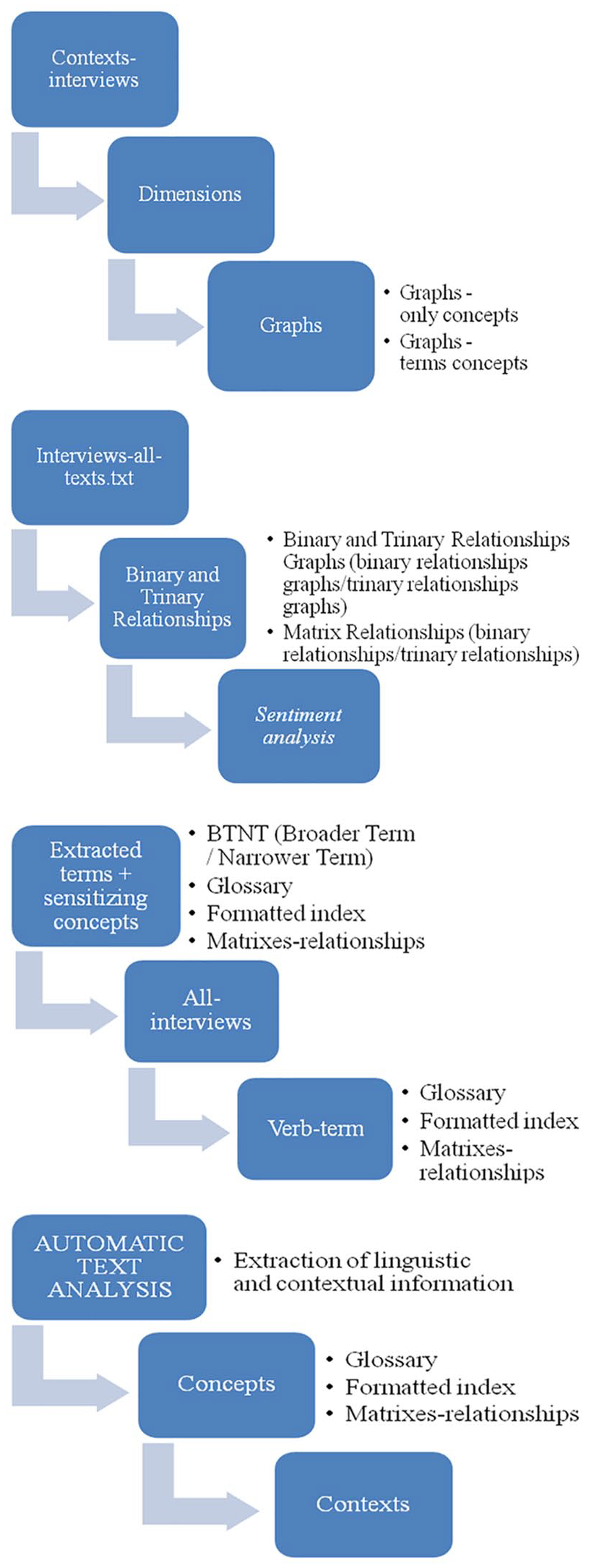
Automatic text analysis: Text-to-Knowledge (T2K).
Content analysis as investigation
Another important operation was carried out, under the direction of Maria Paola Faggiano, providing for an analysis of the content as investigation (Faggiano, 2016; Krippendorff, 1980; Losito, 2002), and applied to the texts of the qualitative interviews carried out. In practice, a survey form similar to a semi-structured questionnaire was prepared (designed with an ‘ideal transcription’ in mind in which all the topics and aspects connected with the interview track were touched on), and first tested on a small nucleus of transcribed texts. The tool, in its tested and definitive version, was subsequently applied with the intent to classify all the interviews, to capture recurring patterns, values, and social representations. The interviews in these terms were ‘disassembled’ and ‘reassembled’ to meet the purposes of the study. The overall report assumed a predominantly discursive character (whereby it is possible to cite numerous and interesting excerpts from the interviews), in consideration of the already mentioned aspect of the partiality of the numerous variables considered (in some columns of the matrix a few dozen of the cells were filled) (Figure 2).
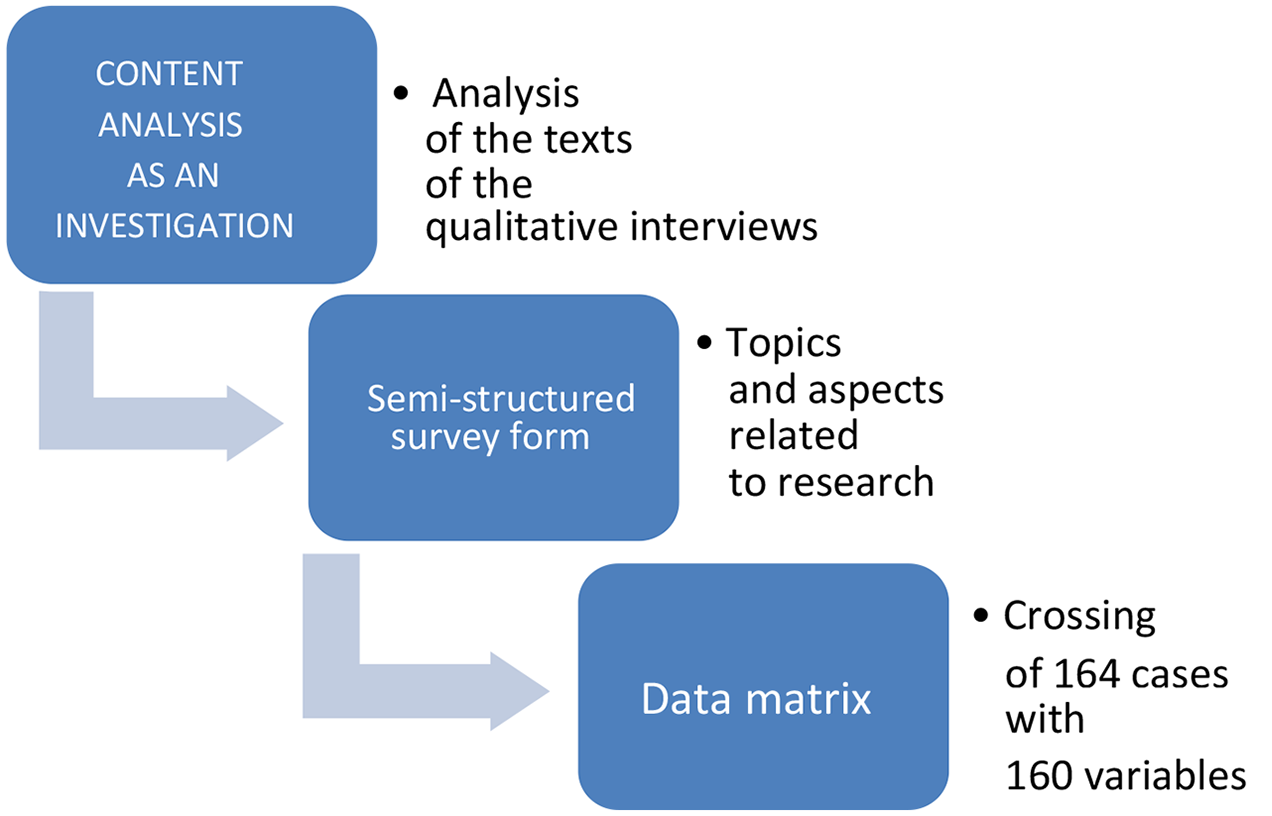
Content analysis as investigation.
Results
Analysis of discursive dynamics
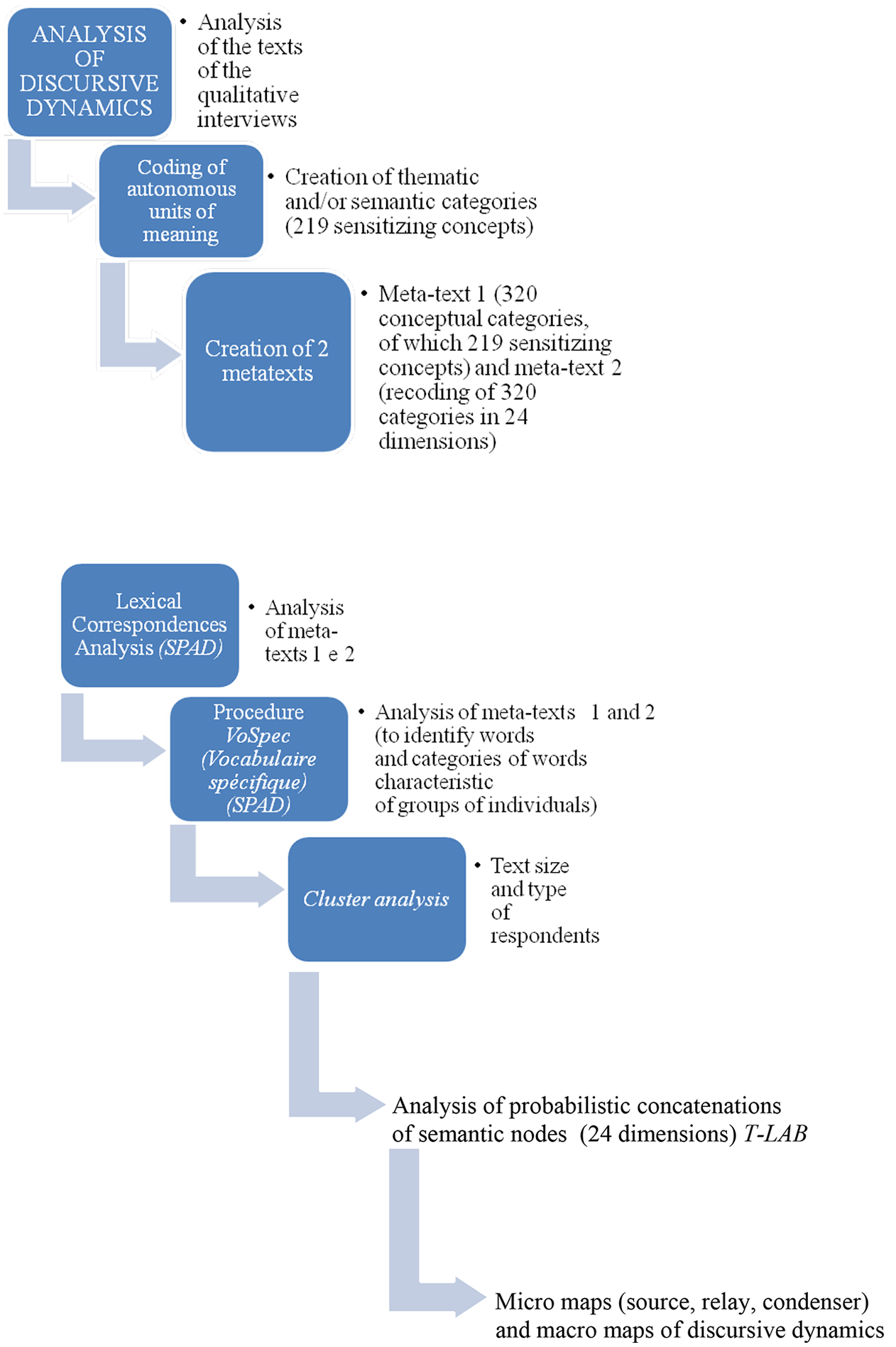
The discursive dynamics detectable in the qualitative interviews have been analysed, to discover and highlight significant flows of direct connection between the terms used, in particular among those identified as relevant concepts (sensitizing concepts; Blumer, 1954) for the investigation. The researchers worked on the transcripts of the interviews by codifying the autonomous units of meaning under thematic and/or semantic headings that, substantially, corresponded to the set of sensitizing concepts identified jointly by the participants in the research project (Piccini, 2020).
This set was supplemented by some additional categories considered relevant and based on the analysis of total occurrences regarding the corpus of the interviews. This way, a first metatext consisting of a complex of 320 conceptual categories was drawn up.
Subsequently, a second metatext was constructed, by recoding the conceptual categories according to 24 conceptual macro-dimensions. Lexical Correspondence Analysis was applied to both versions of the corpus (Piccini, 2020: 15, 21) and the VoSpec procedure (Vocabulaire Spécifique de groupes d’individus, which, in fact, in this case, provided not a specific vocabulary but a specific dictionary) based respectively on the following variables: type of interview, gender, age group, educational qualification, territorial location, size of the municipality of residence, country of origin, the employment status, and marital status of the interviewees.
Using this same information, a cluster analysis was conducted to permit the conduction of the VoSpec analysis and interaction with the textual dimensions of the responses and the type of interviewees. Correspondence analysis and clustering procedures availed themselves of the SPAD (Système Portable pour l’Analyse des Données) software.
In particular, a Lexical Correspondence Analysis (ACL) was applied to the textual data as well as a Correspondence Analysis (AC), a technique developed within the context of the Analyse des Données by the French school of Jean-Paul Benzécri (1973), which availing itself of a factorial procedure identifies dimensions underlying the data by summing up the relationships existing between the original variables consisting of the words (or categories of words) present in the corpus under examination. These dimensions are called factors, while the original variables are called active variables.
The Lexical Correspondence Analysis permitted us to represent the associations between words and texts graphically on planes delimited by two factorial axes. SPAD, on its part, made it possible to make an association between extra-textual variables and the text, for example, those relating to the socio-demographic characteristics of those who produced the text. It also permitted us to relate to these the characteristics of the texts themselves, found by means of the lexical forms or thematic categories present in the corpus.
Subsequently, using the customized settings of the T-LAB software, the Analysis of the Probabilistic Concatenations of Semantic Nodes was carried out (Maranda, 1990, 1995) on the version of the corpus encoded in 24 dimensions, identifying roles and semantic activities of the different nodes.
Based on all this information, micro-maps were drawn centred, respectively, on the source, relay and condenser nodes characterized by the highest semantic activity (work, family, faith). Finally, a map was prepared that represents the overall discursive dynamics of the interviews graphically (Figure 3).
Analysis of discursive dynamics.
Content quantitative analysis
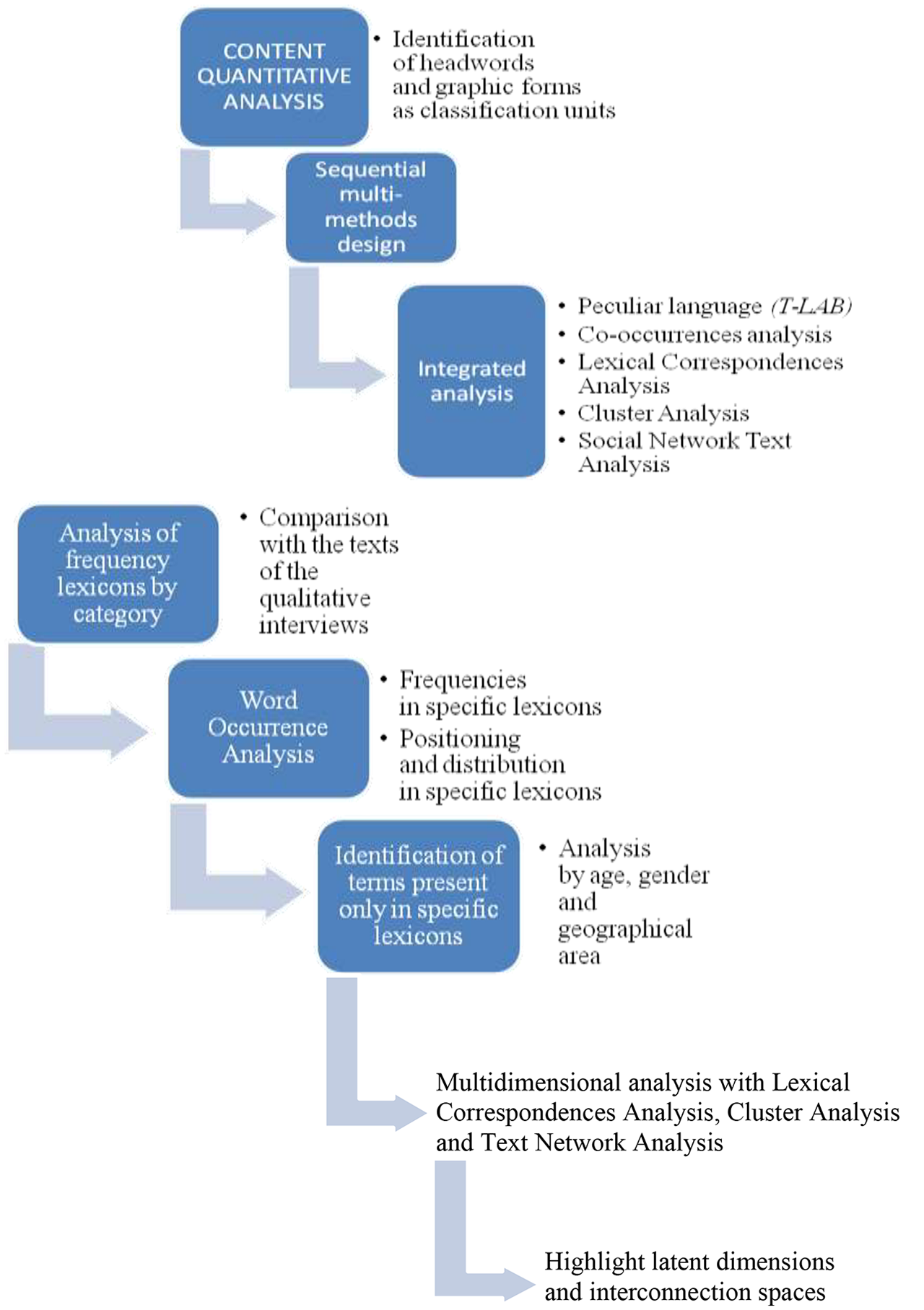
Gabriella Punziano coordinated a group (composed of Amalia Caputo, Augusto Cocorullo, Cristiano Felaco and Barbara Saracino) to work on the textual material generated by the 164 qualitative interviews, favouring a framework for the analysis of the quantitative content (Amaturo and Punziano, 2013) and choosing to focus on minimum units of sense and meaning (lemmas and graphic forms) identified as units of classification capable of developing a sequential multi-method design.
The texts of the interviews were collected and organized in a personalized dictionary subjected to operations of pre-treatment, cleansing, lemmatization, lexicalization, normalization, and segmentation. Consequently, the textual data thus organized were used as a basis for an integrated analysis pathway passing from the evaluation of the Peculiar Language to the Analysis of Co-occurrences, to the Analysis of Lexical Correspondences, to Cluster Analysis, to end with Social Network Text Analysis.
The first phase of analysis was dedicated to the reconstruction of the peculiar language present in the interviews, to identify possible significant differences between the lexis used by the interviewees and, therefore, identify the concepts emerging within the narratives. In this regard, the lexical frequency for each category analysed (by gender, age, educational qualification, territorial location, type of municipality of origin, occupation, number of children, marital status) was investigated with the help of the T-LAB software and compared with the general corpus. Thus, the sum of all the individual texts was assumed as a comparative standard by which to evaluate the variations in the different subsets generated by the categories considered.
Particular attention was paid to the analysis of the occurrences of individual words: the forms most frequently found in specific individual lexicons and, subsequently, how and according to what collocation the lexical items were distributed within the specific lexicon on the whole. Any of the terms present in the specific lexicon only, therefore typical of that particular category of subjects, were highlighted (Figure 4).
Content quantitative analysis.
Evidence from empirical research: a discussion
One of the most interesting novelties is the evident emergence of spirituality that slowly and gradually is taking over from traditional forms of religiosity. Some Italian sociologists of religion have opened a new chapter of the sociology of spirituality which dwells specifically on subjective spirituality a form that prescinds from religious structures. On the heels of this abbrivium have come the revisitation, reworkings and new proposals of Giordan (2004, 2006, 2007, 2016; Giordan and Woodhead, 2015), Palmisano and Pannofino (2019), which establish a lively dialectic between the terms in question.
Spirituality is based, primarily, on a deep feeling accompanied by reference values and the behaviour they induce. It manifests itself especially but not exclusively in adherence and dedication to forms of volunteerism, new modes of prayer or forms related otherwise to the supernatural.
The term spirituality (or other related words) occurs in the qualitative interviews about 9% of the time with 99 occurrences compared to the concept of religion with 1109 occurrences. In addition, those who manifest more spiritual than strictly religious orientations seem to be more open to religious denominations other than their own (due to socialization and education received). The phenomenon shared by those who choose spirituality is the tendency to dispense with religion as an institution. However, in some cases, there is also a tendency to consider God as an entity not linked necessarily to any specific religion.
Another original characteristic that emerged quite evidently from the qualitative survey is the presence of a kind of ‘value religion’ that closely resembles the ‘golden rule’ (Ammerman, 1997) of ‘treating others as you want to be treated’. On this principle, various people claimed orienting themselves and deciding what to do. There were 428 indications regarding specific values that constitute essential references for the 164 respondents. These are in order, the following: family, justice, solidarity, reception, and sharing; then follow, at a certain distance: work, friendship, love, education, culture, tradition, religiosity, devotion, and freedom.
Most of the results emerging from the qualitative analysis correspond to what was obtained, during the same period, in 2017, from 3238 questionnaires (Garelli, 2020). For example, when it came to belief in God, out of 164 respondents, 75 have no doubt about the existence of a supreme being, 27 did not believe in its existence, 13 had doubts, 10 vacillated, 7 could not answer, 11 had contrasting opinions, and 21 were unable to make their position clear. All told, about half claimed they believed firmly, less than one-fifth said that they did not believe at all, while all the rest swayed between various possibilities.
Everyday life is the focus of experience and thus lends itself to providing significant indications concerning religious matters as well, but this emerges mainly with regard to feast days since 14.2% of the 164 respondents take communion during Sunday mass and 22% attend Sunday mass weekly: it should be noted that the same percentage was found in the sample of 3238 respondents surveyed using the questionnaire (Garelli, 2020: 67).
An unexpected result concerns rates of happiness considered satisfactory by 154 out of the 164 people interviewed. The main sources of joy were the birth of a child, relationships with others and the religious experience. However, suffering was also present in almost 70% of respondents’ responses. Nonetheless, in the case of both happiness and sorrow, the references are more emotional, psychological, moral and social than physical.
Taking into account the fact that the survey took place before the coronavirus pandemic, perceptions of life appeared to be of considerable interest, generally oriented towards seeking a solution to all kinds of problems or more towards evaluating one’s existence on the basis of the benefits to be gained. The former solution concerned about half of the respondents while the religious perspective of life was limited to one-seventh of the respondents. However, when it came to death, more than half of the respondents (58.3%) believed that religion helps to maintain a certain peace of mind regarding it, which was not the case for the rest of the respondents (41.8%). For what happens after death, 35.4% claimed believing in the existence of another life, but many more expressed no opinion about it (41.4%).
Another important indicator of religiosity was prayer, practised weekly by 26.1%, monthly by 26.6%, annually by 20.5%, and never by 26.8% of the interviewees. This confirms an orientation more favourable to prayer than to attendance at mass, which was weekly (as mentioned above) for 22%, once or more monthly for 15%, once or more times annually for 33%, and never for 30% of the respondents. Significantly high is the frequency with which Muslims pray.
Based on the data collected in the qualitative interviews, the relationship with the religious institution is the most problematic overall aspect. Numerous critical reflections were voiced against people, rules, behaviour, and organizations of a religious nature. Thirty-five percentage claimed being members of a Church or denomination, 26.9% expressed perplexity, and 31.5% assumed positions of opposition. After all, the Church itself is seen as a religion in itself, meaning that the bearer of the message seems to become the message.
Moreover, the classification that Cardinal Carlo Maria Martini made back in 2013, using the metaphor of the tree, is largely confirmed: there are the sap Christians, who stand at the center of the tree and thus receive its necessary nourishment... There are the pith Christians, who stand around, attend the church, and make financial contributions for its needs, however, they do not collaborate stably... Third, the bark Christians, who live marginally to the Christian community, although professing to belong to it... Next is the category of those who in the botanical image might be called the moss around the bark; although they have been baptized... they have drifted away... Finally, some people do not belong to any kind of Church.
Furthermore, according to Garelli who refers precisely to Martini’s metaphor, there ‘emerges a national scenario in which four profiles of adherence to Catholicism prevail: first, the “covinced and active Catholics” who currently represent 22.5 per cent of the population; second, the “convinced but not always active Catholics”’, who seem to be identifiable today in 29.8% of subjects; third, the largest group (involving 43.6% of cases), consisting of those who declare themselves mostly ‘Catholics by tradition and culture’; finally, a small number of Catholics (about 3.8% of the population) that we might define as particularly ‘selective’ or ‘critical’, who identify only with certain ideas of Catholicism’ (Garelli, 2020: 54).
Finally, but certainly not least in the eyes of the interviewees, there is the figure of Pope Francis, defined by one interviewee as an ‘aperitif Pope’ but by others considered problematic and disliked by a certain part of the Church hierarchy because of his attempts to reform the Church and many customs, modes of behaviour and language. Based on the procedure of sentiment analysis, those who expressed a positive attitude towards Pope Francis were 33.2% of the sample, 46.4% were neutral, while 20.3% were negative. However, the overall judgement of Bergoglio, obtained by means of a different procedure, was positive in 69.7% of the cases, ambivalent in 22.2%, and negative in 8.1%. In general, the total number of those in agreement exceeded the total number of those who dissented.
Conclusion and future prospects
Some researchers, experts in qualitative analysis, have worked on qualitative data by applying the indications of the constructivist grounded theory, based on the model proposed by Kathy Charmaz (1995, 2000, 2003, 2005, 2008, 2011, 2014; Charmaz and Bryant, 2007). The construction procedure of the theory (Quagliata, 2020) started with a first elaboration – line-by-line coding, based on a list of 219 ‘sensitizing concepts’, chosen by all the researchers involved in the project after a long discussion – of the most recurrent encodings summed up into provisional categories and related properties. To this material were added the ‘memos’ (a type of document that permits one to record ideas, insights, interpretations or progressive understanding of the material in the research project), elaborated by the interviewers who supported, enriched and oriented the subsequent levels of analysis.
During this phase of the elaboration of the core categories, five founding nuclei emerged, which permitted adherence to the theory (Cipriani, 2020) whereby ‘Pastoral Care’, ‘Rhetorics of Compassionate Humanitarianism’, ‘Prisoners of Despondency’, ‘Embracing the Faith’, and ‘Beyond Everything’. ‘Pastoral Care’ told of the values and styles of behaviour of mutual care that respondents enact with respect to those whom they recognize as their peers: family, friends, a community of belonging (the town, the church as temple). The ‘Rhetorics of Compassionate Humanitarianism’ reported on the unconsciously biased orientation towards the other (understood as the one who is ‘outside the clan’), perceived as different and dangerous, and, at the same time, it told of the effort made to welcome and accept the needy that characterized the interviewees. The ‘Prisoners of Despondency’ constituted a ‘core category’ related to the perception of a general state of crisis. This category interrelated doubt, lack of confidence, criticism, disaffection and detachment with respect to the functioning of society, the deviances of the Church as an institution, the precariousness of the world of work, the corruption of politics, and the indoctrination of the Roman Catholic religion. The category ‘Embracing the Faith’ gave voice to practising believers, who consciously adopted a lifestyle guided by Christian precepts and lived the faith as a dogma, in a passionate, convinced, and non-debatable way. Those who embraced the faith nourished their religiosity through prayer; participated in Eucharistic celebrations to get in touch with God’s word; sought the intimate need for confession; and loved Pope Francis, who, in addition to being recognized in his role as pontiff, won the hearts of the faithful by the power of his example. The ‘Beyond Everything’ group revealed the existential dimension that characterized this part of the research sample. This ‘core category’ accommodated the different sensitivities and beliefs (often mutually discordant and antithetical) regarding issues of life, death, illness, suffering, and the afterlife. The name given to the category is intended to emphasize the fact that beyond everything (experiences, studies, ideas, opinions, positionings, beliefs, actions, scepticism about the existence of God) the respondents defined death as a passage to a better life, where it was necessary to have faith in the Kingdom of God. One will be rewarded for one’s suffering and reunited with loved ones.
According to Charmaz (2014), the focus is on the co-construction of meanings, on the very process of shared co-construction and, therefore, on the fact that the emerging theory is generated by the analysts and the subjects of the study themselves. With the emergence of categories, the level of abstraction increases and the relationships between them are highlighted, which accumulate to give rise to an integrated central theoretical structure, which constitutes the core of the final emerging theory (Figures 5 and 6).
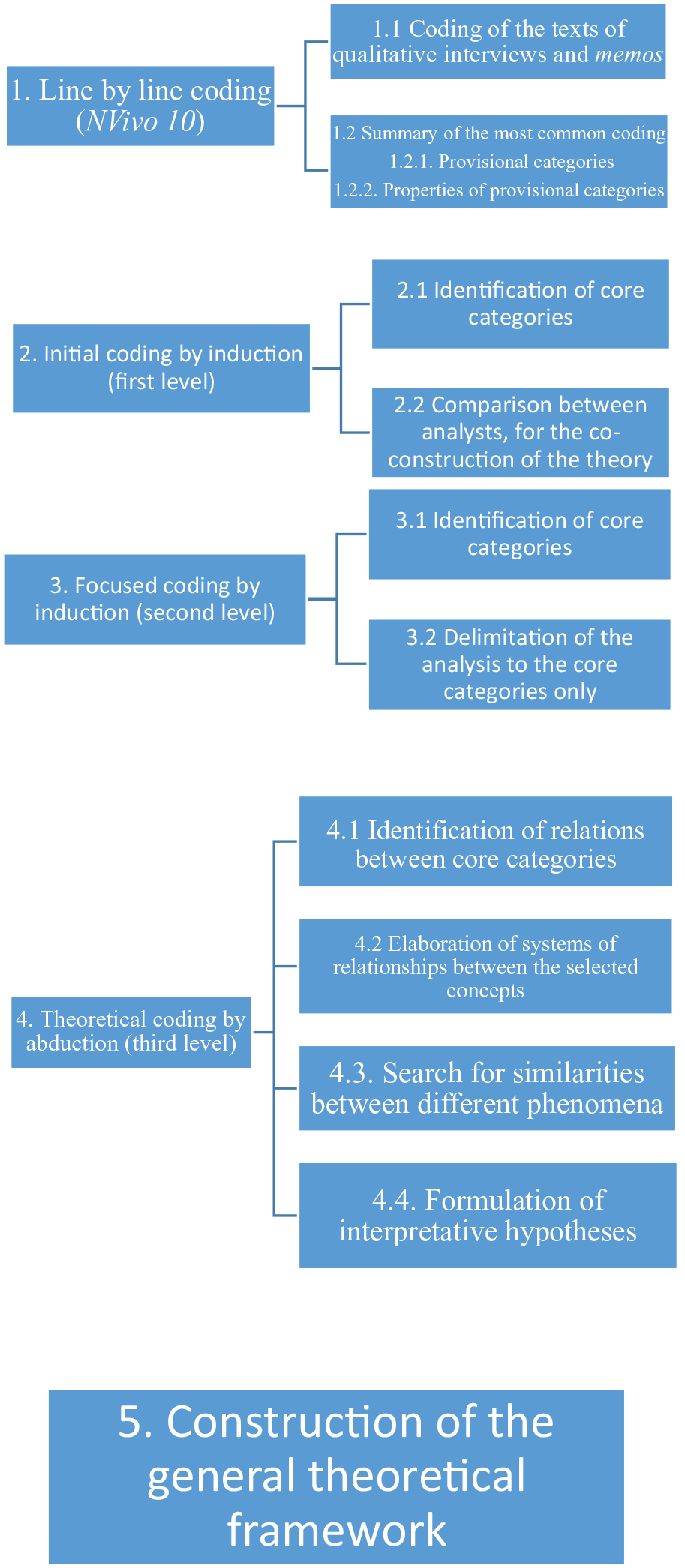
Grounded theory approach.
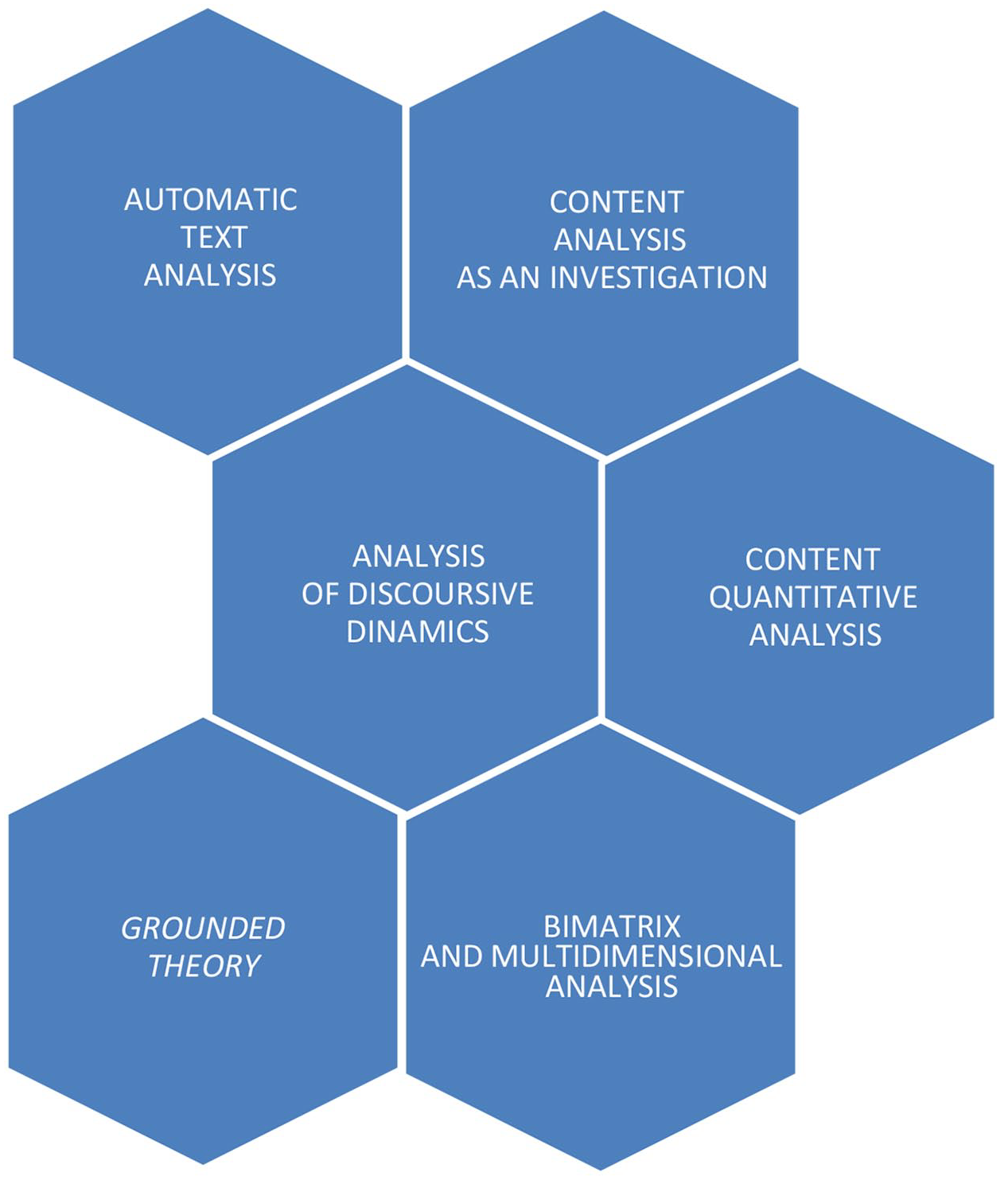
General synopsis of the research.
In the end, some predictions about the coming trends of religiosity in Italy can be summarized in the following formulations:
the area of uncertain faith will broaden, tending to exceed that of more secure faith, that is, that of militant and practising believers (the fact that the number of cultural and uncertain believers has surpassed that of orthodox and active believers is a novelty);
the gap between bearers of uncertain faith and supporters of more secure faith is destined to increase, but not to a particularly pronounced extent (in short, the two blades of the scissors will not reach their maximum opening);
the Church as religion (i.e. looking at religion more as an institutional fact than a fact of faith) will retain its basic structure, despite foreseeable new events that may undermine it (Diotallevi, 2017);
regular religious practice will undergo further decreases, progressive but slow (even given the current low rate, that is, 22%, as shown by both the qualitative and quantitative results, instead of the previous 31.1%, ascertained through questionnaires);
non-belief will expand (it was 18% in 1991, and grew to 24% in 2017, according to the quantitative research carried out), but its growth will tend to dwindle in size and speed;
spirituality will also receive new impetus from the ever-increasing focus on self-determination, do-it-yourself and increased freedom of thought and action. This is confirmed by the quantitative results too:
it is precisely in the group of traditional or classical spirituality, the one most akin to the major religions, that one finds the largest number of people whose spiritual desire appears to be growing over the years. Moreover, it is observed that a greater need for spirituality is felt – with time – more by women than by men (and this at every age), and more by residents in the regions of the South and Islands than in other parts of the country. (Garelli, 2020: 179)
Values will retain their centrality, both in the field of religion and within the broader social sphere, and above all, they will accentuate the subjective dimension of morality, intended as an option reserved for the individual. This kind of outcome is more or less the same in Garelli’s (2020: 52) survey where ‘even the unbelievers or the “unchurched” have values and views of reality to be defended and promoted’.
Belief in God will be less and less univocal in form and content, giving rise to ample room for research and experimentation aimed at providing answers to fundamental questions about the meaning of life but also of death and after death. From a quantitative point of view,
‘convinced and active’ Catholics are far more likely to believe in God in a certain (74%) rather than in an uncertain way (18%), while, by way of contrast, Catholics by tradition and culture (‘selective’ Catholics too) express a more doubtful or intermittent (59%) than a sure (22%) form of faith. (Garelli, 2020: 59)
The frequency of prayer will not undergo either significant increases or decreases but will tend to maintain a certain stability, capable, in any case, of making up for the crisis of association with the Church as religion. In the quantitative research, too, we find ‘a “positive balance” in favour of prayer, represented both by people’s greater propensity to pray than to attend religious ceremonies and by the fact that recourse to prayer is far more habitual and frequent than participation in community worship’ (Garelli, 2020: 74).
The figure of the Roman Catholic Pontiff will still have its centrality and reliability. The same is evident in quantitative data:
the first basic finding (as it turned out) is the prevalence of positive judgments over the more doubtful or problematic ones, regarding the pontiff who with his lively presence in the Church and society, challenges both individual and collective consciences (Garelli, 2020: 155)
but much will depend on the characteristics of Pope Francis’ successors, who are unlikely to repeat his exploits at behavioural and decision-making levels.
All told, it is worthwhile to overcome the old conception, typical among the sociologists of the second part of the last century, who spoke, not without critical implications, of the religion of the Church (or Church religion). Therefore, a new solution is advanced, precisely on the basis of the data acquired, which turns the idea of the Church itself into an idea of religion. In other terms, it seems legitimate (and empirically legitimized) to use the expression ‘Church as religion’, precisely because that is how it is conceived at a widespread level, according to the findings of the interviews, especially the qualitative ones.
The ‘Church as religion’ appears to be marginal when it comes to everyday life. Nevertheless, its relationship with faith is primary, while values, the emotional dimension and even evil remain in an essentially ‘equal’ relationship with it, without, however, the Church exercising primacy as a precise source of faith. The religious institution has, it seems, become a kind of premise of faith precisely because its teaching, that is, its catechesis, points to the elements to which faith can refer. Despite these functions, the Church does not occupy a prominent place within the network of explicit references provided by the interviewees (Cipriani, 2020).
Due to a strong critical attitude towards the ‘Church as religion’, there has been a quest for new, freer, and less formalized forms of spirituality. The ‘Church as religion’ has been challenged because it has presented, especially in recent times, strong flaws in its credibility at moral level, particularly in connection with the issue of paedophilia involving members of the clergy.
Footnotes
Acknowledgements
The author would like to thank Franco Garelli for making available data from his quantitative research on religiosity in Italy.
Funding
The author(s) disclosed receipt of the following financial support for the research, authorship, and/or publication of this article: this research was supported by the Italian Bishops’ Conference.

Availability of data and materials
Author biography
Address: Dipartimento Scienze della Formazione, Università Roma Tre, Via del Castro Pretorio 20, 00185 Roma, Italy
Email: