




Abstract
Utilizing the theoretical framework of artification, this study analyzes the transformation of Sufi dance from a traditional religious practice to a staged artistic performance. Ethnographic observations and case studies conducted between 2018 and 2023 have identified four ideal types of discourse surrounding Sufi dance, ranging from traditional discourses to total artification, where religious meaning is displaced by artistic and aesthetic purposes. The article also examines the methods of teaching spinning movements, Sufi workshop audiences, and marketing strategies used by artists to gain recognition in both religious and artistic fields. Finally, the study explores the tension between traditional authority and dancers’ professional careers outside Sufi institutions. This research illuminates the complex dynamics of competition and cooperation that shape the relationship between art and spirituality within the Sufi tradition in contemporary France.
Introduction
The dance of the whirling dervishes, known as semāʿ, 1 is originally a ritual practiced during Dhikr 2 sessions, where Muslim Sufis sing prayers and litanies to commemorate God. Practitioners of semāʿ, referred to as SemaZen, rotate around themselves in a circular geometric pattern believed to represent a cosmic movement (Geoffroy, 2010). This dance was introduced by Jalal al-Din Rumi and Shams-i Tabrizi in the thirteenth century and was later established as a ritual by Rumi’s son, Sultan Walad, for the Mevlevi Sufi orders in Turkey. Over time, the dance spread to other Sufi practices worldwide and gained significant notoriety as a symbol of Sufism and spirituality in the late twentieth century.
While most classical Mevlevi groups strive to uphold the traditional and intimate nature of whirling dervish ceremonies, new variations of semāʿ have emerged that prioritize music and choreography, which are no longer confined to their religious settings. These new expressions are presented to larger audiences as part of cultural performances and folklore. This evolving art form has found its way into respected institutions such as museums, musical stages, and theaters and is increasingly gaining media attention as a representation of world cultural heritage. 3 Performers who were previously referred to as dervishes now identify themselves as artists, choreographers, and dancers. As a result, the role of semāʿ has shifted from a strictly religious practice to a recognized art form.
Employing the theoretical framework of artification, which refers to the process by which cultural practices and activities are redefined as art (Shapiro and Heinich, 2012), this study analyzes the strategies used by Sufi dancers, artists, and entrepreneurs to legitimize their performances in both artistic and religious domains. This research investigates how they negotiate the tensions between the artistic and religious aspects of the whirling dervish tradition as they navigate the changing cultural landscape of contemporary France.
Literature review: the impact of ‘Global-Rumi’ on European Sufism
The globalization of Rumi has significantly impacted the contemporary Sufi market and the tradition of whirling dervishes. Sociologists and historians have noted his growing popularity in Western culture, observing a pattern where a prominent Persian poet gains popularity every century among Western readers. Hafiz was popular in the 1800s, Omar Khayyam in the 1900s, and Rumi in the 2000s (Axworthy, 2016). Shobhana Merin Xavier argues that the popularity of these Oriental poets reflects the alignment of their ideas with the cultural and political sensibilities of their time. Hafiz represented Romanticism, Omar Khayyam embodied the aesthetic movement, and Rumi expressed contemporary ideals of universality through his poetry that invokes themes of love and peace (Xavier, 2023b). However, scholars have noted that the construction of Rumi’s image and translations have been selective (Irwin, 2019). Both Simon Sorgenfrei’s research on ‘American dervishes’ and Shobhana Xavier’s study on whirling dervishes in Canada highlights the impact of Rumi’s globalization on the Western interpretation of Sufism. These studies reveal that interpretations of Rumi, tailored to Western culture and themes. They often obscure his Persian and Islamic origins, causing tension between traditionalists who defend his Islamic identity and modernists who favor a more secular interpretation (Sorgenfrei, 2013; Xavier, 2023a). The de-Islamization of Rumi’s work has sparked debates on cultural appropriation and highlighted issues of cultural hegemony, power dynamics, and stereotypes in Western representations of Islam (Piraino, 2023; Piraino and Sedgwick, 2019). These findings emphasize the importance of a culturally sensitive approach to the study and practice of Sufism in the West.
Despite the growing presence of whirling dervishes in Western countries, with an active network extending across France, Germany, Italy, Canada, Switzerland, and the United States, few social science scholarships have been published on this phenomenon in the West. The literature on Sufi dance and whirling dervishes often focuses on historical approaches related to the Turkish Mevlevi order. Much attention has been given to the spinning element of the Mevlevi practices, both within and outside of private gatherings (Ambroso et al., 2006; Feldman, 2022; Fremantle, 1976; Lewis, 2008). Some researchers investigate the various forms of semāʿ and modifications observed within neo-Mevlevi groups (Akyürek, 2021), while others explore the presentation of spinning outside Mevlevi gatherings and its evolution into a touristic attraction in Turkey and Egypt (Pietrobruno, 2019; Vicente, 2019).
Despite extensive research on Sufism in France, which focuses on the institutional configurations of Sufi orders and their transplantation in the country (Bisson, 2007; Nabti, 2007; Piraino, 2023), the phenomenon of Sufi dance in France has received limited scholarly attention. This study aims to address this gap in the literature and provide insights into the cultural and aesthetic aspects of contemporary Sufism.
Artification as a paradigm to study art
Artification, a neologism introduced by Roberta Shapiro and Nathalie Heinich in 2012, refers to the process whereby activities and objects are transformed into art. It provides a theoretical framework and methodological tools for analyzing the social construction of art. Artification’s relevance lies in its seeking to transcend the question ‘What is art?’ and instead ask ‘When is art?’ (Goodman, 1976). Similarly, in the study of religion, anthropologists and pragmatics sociologists propose to move beyond ‘What is religion?’ to ‘When is religion?’ and study this domain as a form of ‘religioning’ (Nye, 1999) in which actors contribute to the definition and the modification of religious practices and, consequently, the invention of tradition (Hobsbawm, 1995). Artification can be seen as a paradigm that questions what happens in a person’s brain that modifies their perception of an object or activity and defines it as art, considering the context, how, and why.
Shapiro (2019) delves into the concept of artification and identifies 10 microprocesses that collectively form the macro-process of artification. These processes involve displacing objects or practices to suitable artistic settings, renaming them as artists, shifting categories, establishing institutional support, differentiating functions and presentations, redefining time, creating legal and patronage structures, adopting aesthetic norms, and intellectualizing the art through critical analysis and commentary. Artification encompasses a series of interconnected steps that recognize and elevate an object or practice to the status of art. The author also observes that the artification process encounters resistance from individuals and activities that resist changes for practical or ideological reasons, citing concerns over authenticity or opposition to commercialization (Shapiro, 2019).
The application of artification paradigm to Sufi dance aims to explore if the artification process is influencing Sufi activities and, if so, to what extent. Moreover, it raises questions on the limits of applying the artification paradigm to all Sufi activities. Artification offers a pragmatic approach that combines the sociology of social and cultural transformation with issues such as legitimacy, identity construction, displacement of borders, and field conception and structures. Considering technological and institutional developments, changes in lifestyles, commercialization, mobility, and conflicts, artification proves to be a fruitful paradigm for analyzing contemporary Sufi activities.
Methodology and data collection
The methodology for this study involved a combination of case studies, ethnographic observations, and interviews. Between 2018 and 2023, I participated in seven Sufi and dance workshops, with four teachers leading the activities in various locations across France. The workshops were selected based on their popularity and public accessibility. Ethnographic participant observations were conducted during the sessions to document the behaviors, emotions, and expressions of the participants during the whirling dance. The content analysis involved evaluating the language and terminology used in the workshops and performances, including the titles of the events and the promotional materials.
The methodology employed in this study facilitated an exploration of the whirling dervish phenomenon as it is experienced and practiced in France, providing insight into the social, cultural, and religious factors that influence its popularity and interpretation. It also allowed for a nuanced understanding of how the whirling dance is being transformed from a religious ritual to an artistic and therapeutic practice, and the implications of this shift for the broader field of Sufism and Islamic culture.
Sufi workshops organization and multifunctional significance
The Sufi dance workshops and performances examined in France took place in diverse locations and represent an expanding business sector. Some events were sponsored by cultural organizations such as associations, museums, and festivals, where artists were invited to conduct workshops or perform as part of their programs. In other instances, the dancers themselves organized and rented spaces like theaters, cultural institutions, or yoga centers. The workshops were available to all audiences and did not require any religious affiliation. Depending on the size and capacity of the space, the number of students varied between 10 and 30 people per session. The workshops were offered in two formats: short training sessions lasting 3–4 hours, or multiday retreats ranging from 2 to 7 days, with a social experience within a group setting. In addition to training, some actors propose a variety of items and accessories for sale, such as Sufi skirts, shoes, jewelry, candles, dervish icons, calligraphy paintings, books, perfumes, and rose water.
When analyzing the program of workshops and performances, a combination of religious and aesthetic language becomes apparent in the nomenclature that describes whirling dervishes. Workshop titles often feature phrases like ‘Sufi dance retreat’, ‘Sufi dance artistic residency’, ‘Contemporary Dervish’, and ‘Spiral workshop’. Furthermore, there is a blending of terms from different traditions and practices, with Dhikr being associated with Mantra and Yoga practices. In addition, there is a focus on dance as a means of connecting with nature and promoting self-awareness. While Sufism is referred to as a philosophy or spirituality, the Islamic context is frequently omitted, and some religious terminology, such as ‘God’, ‘Allah’, or ‘Islam’, are avoided.
The function and meaning of the Sufi dance may vary depending on the situation, location, and audience. For instance, whirling may have profound significance and serve as a religious devotion when practiced within Sufi orders and Dhikr sessions. In a church, synagogue, or interfaith meeting, the dance may represent an appreciation for ‘the other’ and serve as a form of confessional alterity. It becomes an expression of Islamic universalism. However, in a secular environment or non-religious event, the performance of the whirling dance loses a crucial part of its religious significance, becoming an aesthetic expression of Eastern culture and civilization.
Through typography, the French language distinguishes between two different versions of Islam. The lowercase of ‘islam’ is used to refer to the Muslim faith, dogma, and practices, while the uppercase ‘Islam’ represents Islamic civilization, which is a geopolitical category encompassing a large region extending from the Middle East to Southeast Asia. This term refers to societies that have been historically dominated by powers claiming to be Muslim (Guidi, 2021). This differentiation in typography plays a pivotal role in how Sufi dance is presented and perceived, whether as a religious expression or merely as a cultural practice.
The multifunctional terminology used in the promotion of Sufi dance workshops and performances in France plays a significant role in facilitating the artification of whirling dervishes. By utilizing a combination of religious and aesthetic language, these workshops are often viewed as a choreographic representation of Islamic culture and civilization, rather than simply a religious ritual. The distinctions made in the French language between the Muslim faith and Islamic civilization further contribute to this narrative. This suggests that the artification process can sometimes overshadow the religious significance of Sufi dance, as it becomes more closely associated with artistic expression and cultural heritage.
From the religious to the artification: four approaches to sufi dance
This study analyzes the diverse approaches to teaching Sufi dance proposed by four instructors in France. Each case study represents an ideal type of adaptation of Sufi dance.
The first approach, exemplified by Dervish Omar, is the Islamic traditional approach. Dervish Omar follows the Naqshbandi Sufi tradition and emphasizes the Islamic origins of whirling dervishes. He performs in both traditional Sufi settings and on secular stages, often accompanied by the Sufi musical group ‘Dervish Spirit’. This group was created by Enris Qinami, an Albanian musician, and is supported by Hajj Abdelhafid Benchouk, a French Algerian Naqshbandi Muqaddam 4 and the founder of the ‘Sufi House’ 5 as well as the co-director of the ‘Sufi festival of Paris’. 6 In all his presentations, Dervish Omar emphasizes the Islamic origins of whirling dervishes and stresses the significance of belonging to a Sufi Silsila 7 and having a Shaykh. 8 He presents himself as a dervish and asserts the authenticity of his practice due to its roots in traditional Sufism.
The second type, represented by Ali Alexandre’s workshops, is the therapeutic new age approach, blending elements of different religious traditions with whirling. Ali Alexandre’s workshops integrate Christian and Jewish litanies, yoga mantras, and Shamanic traditions alongside Sufi Dhikr and sophrology. Ali Alexandre advocates for a universal approach that transcends all traditions, offering participants a diverse range of practices to choose from and empowering them to identify the most suitable for their needs. This approach aligns with Piraino’s definition of the New Age movement, where the spiritual seeker is encouraged to ‘pick and mix’ from different religious contexts and construct his part of the truth and meaning (Piraino, 2021).
The third type, as exemplified by Rana Gorgani, is partial artification. In her workshops, she simulates rituals found in Sufi gatherings, incorporating traditional instruments, recitations of Dhikr, and Sufi teachings presented through poetry and stories. Besides simulating Sufi rituals and incorporating traditional elements into her workshops, Rana Gorgani’s approach goes beyond mere replication. She actively fosters technical training in whirling while encouraging artistic creativity and expression. Being a renowned professional dancer in France, Rana holds a prominent position as a representative of feminine Sufi dance. Her performances on various stages and media platforms have played a crucial role in popularizing Sufi dance as both a cultural and spiritual art form. Rana merges artistic and ritualistic elements to create an approach mixing art and religion.
The fourth and final type, exemplified by Joseph Gebrael’s workshops, is the total artification of Sufi dance. Joseph’s approach focuses on artistic expression. In his workshops and performances, he combines whirling with contemporary dance, allowing participants to use their bodies to express themselves artistically and emotionnaly. Participants in his workshops learn the technical aspects of whirling as well as the fundamentals of contemporary dance, giving them a well-rounded education in both styles.
Joseph’s approach represents an innovation from the conventional and ritualistic methods of Sufi dance, opting instead for a contemporary and artistic interpretation.
These four categorizations provide a sociological perspective to examine the diverse degrees of artification (Figure 1). The traditional approach is deeply connected to religious narratives, illustrating how established social norms and religious traditions influence the artistic representation of Sufi dance. However, the New Age approach reflects a contemporary pursuit of universality, involving the renegotiation of religious boundaries and a growing emphasis on individual spiritual experiences. The partial artification approach highlights the process of cultural adaptation and reinterpretation, wherein certain traditional religious aspects are retained while others undergo artistic transformation. The total artification approach emphasizes the increasing autonomy of artistic expression, prioritizing creative innovation, and reflecting broader societal shifts toward individuality and secularization.

Barometer comparing the positions of the approaches of Sufi dance in France between religious and secular discourses.
The barometer above provides insights into the positioning of the four approaches concerning religious and secular discourses. These positions are not fixed but can be influenced by various factors, including the audience’s characteristics and the prevailing political climate. For instance, traditional performers may dynamically adjust their positions toward a more universalist or secular discourse when interacting with an audience that lacks familiarity with their religious background or beliefs. This adaptation illustrates the complexity of sociocultural interactions and the role of audience reception in shaping the expression of religious and cultural elements in artistic forms. This analysis sheds light on how artistic representations are influenced by societal dynamics and the negotiation of religious and secular identities in France.
Methods of teaching between technicity and spirituality
Overall, each of these diverse approaches brings its unique perspective, offering participants an opportunity to explore Sufi dance from a variety of angles. Each teacher has their teaching method and approaches to spinning. Some adhere to traditional dervish positions, while others use creative movement to express their originality.
The teachings of Dervish Omar and Rana Gorgani, rely on certain norms such as spinning in the left direction, beginning with the Sufi salutation, and progressing through traditional movements with the right hand lifted to the sky and the left hand pointing downward (Figure 2). Ali Alexandre advises participants to turn freely without proposing any technical exercises, while Joseph Gebrael suggests a variety of exercises of body expression without focusing on conventional positions. Participants are encouraged to move their heads, hands, and bodies freely to explore their expressive emotions artistically.
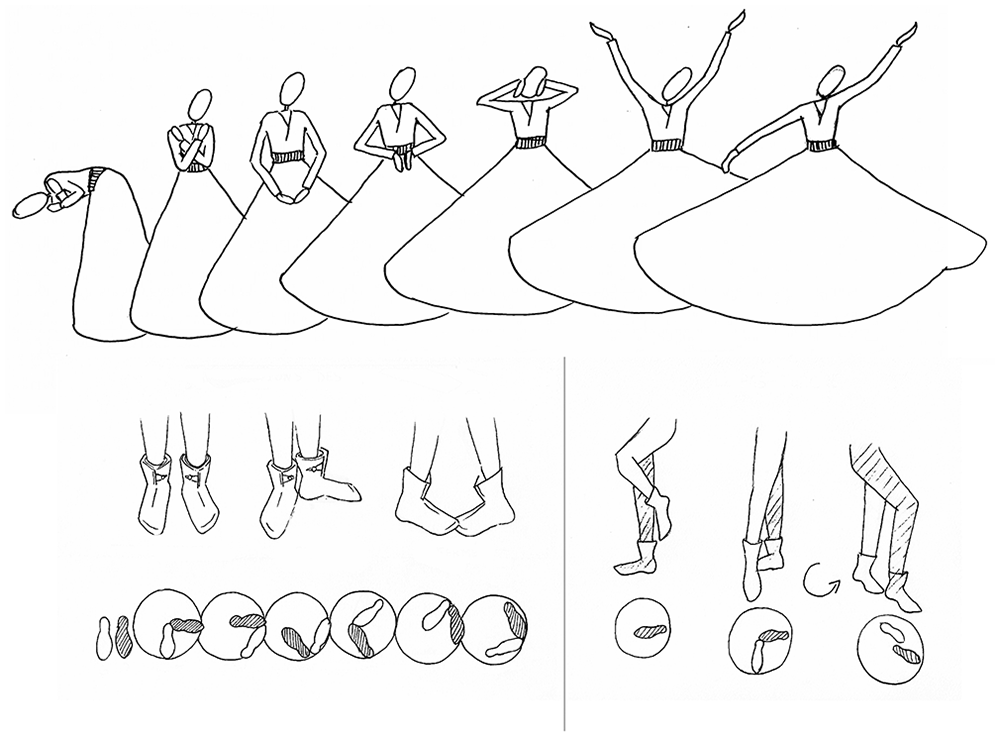
Hand and footsteps postures in Gorgani teaching.
The lessons consist of both individual and collective exercises. Rana Gorgani, Dervish Omar, and Ali Alexandre begin with immersion in Sufi rituals and Dhikr, while Joseph Gebrael starts with silent meditation and exercises inspired by yoga. The trainers provide various exercises and sound approaches to activate ears’ sensitivities and correlate the body with sounds. The diversity of music and sounds used aids the dancers in developing rhythm, attention, and harmonic aptitude. In Rana Gorgani’s courses, there is occasionally an introduction to learning the Daff instrument.
Rituals involve a holistic embodiment of the body, indicating a deep and immersive spiritual experience. For instance, in Rana Gorgani’s dhikr sessions, she utilizes exaggerated head movements and the flowing of the hair to convey a sense of ecstatic devotion, illustrating the emotional and expressive aspects of the ritual experience (Figure 3).
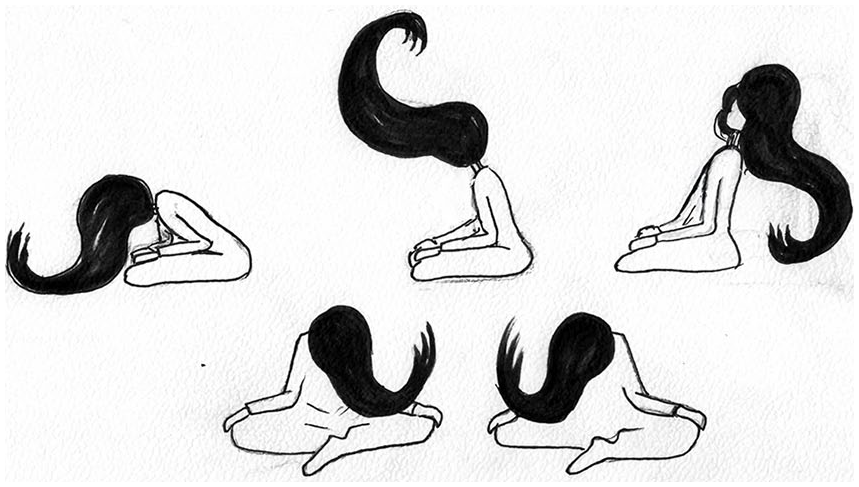
Women flowing hair in Rana Gorgani Dhikr sessions.
These diverse approaches to Sufi dance workshops in France reveal the complex intersection of religious, spiritual, cultural, and artistic elements. Each teacher’s method reflects a distinct understanding of the role religion, spirituality, and creativity play in modern society.
Marketing strategies used by artists and auto-entrepreneurs
The worlds of art and religion, much like any other social sphere, are characterized by competition and domination. Bourdieu’s fields theory suggests that actors within these spheres must develop various strategies to position themselves, gain legitimacy, and achieve recognition (Bourdieu, 1992). In the case of whirling dervishes, traditional Sufi performers and self-employed entrepreneurs both employ a range of marketing strategies to find their place in an eclectic network. Here, I will explore some of these strategies and their implications.
One commonly utilized strategy is collaboration with actors from other creative fields, such as other dancers, musicians, therapists, visual artists, and photographers. By working together, artists can reach a broader audience and increase their visibility. For example, pianist Joanna Goodale has collaborated with whirling dancers like Sahar Dehghan, Aya Annika Skattum, and Ziya Azazi in her concerts, blending traditional Sufi music with Bach’s classical music. Such collaborations between diverse actors exemplify a microprocess of artification, causing a displacement of social categories and modifying the character of the action. By collaborating with musicians who use both sacred and profane music, Sufi dance transforms the way it is expressed and presented.
Another strategy employed by artists is the mixing of multiple artistic media to highlight their originality and creativity. For example, Alexia Traore combines whirling dance with calligraphy, video projection, and painting, presenting herself as both a dancer and a visual artist. In addition to her choreographed performances, she also paints whirling abstract circles on canvas and the carpet she uses for her dance performances.
Double identification is another strategy used by some artists to reinforce their originality and professional legitimacy. For instance, Kawtar Kel presents herself both as an artist-choreographer who creates original performances 9 and as an art therapist who practices helping relationships through artistic mediation. She also suggests whirling movements in her art therapy classes.
Finally, some artists highlight their affiliations with renowned organizations to boost their notoriety. Rana Gorgani, for example, promotes herself as an ambassador of Sufi dance and supports this nomination through her affiliation as a member of the International Council of Dance at United Nations Educational, Scientific and Cultural Organization (UNESCO). She has also been a guest on numerous French television documentaries and media platforms.
Overall, these marketing strategies used by artists and self-employed entrepreneurs in the Sufi whirling dervish community demonstrate the microprocesses of artification in action. However, these strategies also raise questions about the role of traditional Sufi dance in contemporary society and how the increasing popularity and commercialization of this practice affect its perception and meaning, both for insiders and outsiders. These strategies also raise questions about the impact of the commercialization of Sufi dance on its authenticity and cultural significance. Anthropological analysis can shed light on these issues, helping us understand how the microprocesses of artification are transforming traditional practices and their meanings. As Sufi dance becomes more visible and popular, it is crucial to critically examine its relationship with religious and cultural traditions.
Competition between professional and traditional legitimacy
The question of legitimacy is critical to any spiritual or professional practice. It is crucial to note that legitimacy is not a given, but rather a constructed process where actors in the spiritual or professional domain build their legitimacy through actions and discourse. These are inscribed within a system of meanings, social organizations, and policies.
Based on my fieldwork on Sufi Dancing in France, I observed two major strategies that actors use to affirm their legitimacy and justify their merit and authenticity. The first strategy is professional legitimacy, which hinges on the accumulation of social, cultural, economic, and symbolic capital to acquire a dominant position in the artistic field. This strategy demands a diversification of activities and a continuous focus on marketing. Actors’ legitimacy increases through the accumulation of various projects and their collaborations with recognized cultural and artistic institutions. This accumulation of experiences and projects grants these actors a ‘professional identity’ as artists or therapists. Some of these dancers have the legal status of ‘intermittent spectacle’ 10 and work with production companies and theaters, while others operate their associative structures.
The second strategy Is traditional legitimacy, which is founded on invoking symbolic authority, such as spiritual permission from a Sufi master, or highlighting the dancer’s cultural and ethnic background. The connection with a Sufi institution may also be employed to delegitimize and condemn the activities of individuals who do not have this traditional affiliation. This strategy aligns with the ‘traditional domination’ category elaborated by Max Weber, where legitimacy derives from the belief in the sanctity of traditions, customs, and the weight of history (Weber, 2014). For instance, ‘Dervish Omar’ often uses his Sufi affiliation to defend his authenticity and legitimacy. He claims to have received the transmission from both the Naqshbandi and Mevlevi Sufi traditions. According to him, belonging to a Sufi Silsila and receiving spiritual permission is an important condition for being a Sufi dancer. The authorization, either verbal or written, is given by a master recognized by the Sufi communities. Dervish Omar emphasizes the importance of the spiritual path and immersion in a traditional culture to truly understand Sufi Dancing.
However, the question of accessibility arises when it comes to Sufi workshops. Dervish Omar offers workshops to a wide range of audiences, including non-Sufis and non-Muslims, which may challenge the traditional legitimacy strategy. He defends this position by quoting his Sheikh Nazim, who ordered him to make Sufism accessible to everyone. He distinguishes between studying whirling dance and teaching it, stating, ‘A non-Sufi or non-Muslim can study Sufi dancing, but they will always be at the beginning level. Workshops are an occasion to taste Sufism and start the spiritual and Sufi path’.
Overall, the strategies employed by Sufi dancers to assert their legitimacy reveal a complex process of construction and negotiation of meaning, social organizations, and policies. The question of accessibility poses a challenging issue regarding the traditional legitimacy strategy and how to reconcile it to make Sufism accessible to all.
Conclusion
In conclusion, the artification of Sufi dance in France is a complex process involving a range of actors and discourses. This article aims to comprehend how the artification process occurs and how legitimacy is constructed by the individuals themselves. The ideal types of actors modeled – from the traditional Sufi dancer to the total artification of Sufi dance – represent the different levels of artification that take place in the field.
Applying Shapiro’s 10 microprocesses of artification to the contemporary practice of Sufi dance in France revealed the extent to which this practice has transformed a traditional religious ritual into a form of artistic expression. Each of the 10 microprocesses identified by Shapiro was evident in the Sufi dance performances observed in France. Sufi dance has been transformed from a religious practice into an art form, with new categories, institutional frameworks, and aesthetic norms.
However, there are several questions to consider. First, how does the artification of Sufi dance impact the way it is perceived and received by audiences? Does it increase its accessibility, or does it detract from its spiritual significance? Second, how does the artification of Sufi dance intersect with issues of cultural appropriation and commodification? Can it be considered a form of cultural exchange or is it a form of exploitation and appropriation? Finally, what are the implications of the artification of Sufi dance for the broader field of spiritual and religious practices? Does it represent a trend toward secularization and individualization, or a fusion of diverse spiritual and cultural traditions? These questions encourage further anthropological investigation into the complexities of the artification of Sufi dance in France and beyond.
Future research could delve into how the artification of Sufi dance is experienced and interpreted by different stakeholders, including Sufi practitioners, audiences, art institutions, and religious authorities. Further inquiry could shed light on the cultural, political, and economic factors that shape the artification process of Sufi dance in France and other contexts, and how these processes are influenced by global and local power dynamics. Finally, this research invites scholars to engage in interdisciplinary and cross-cultural conversations about the place of spirituality and art in contemporary societies.
Footnotes
Funding
The author(s) disclosed receipt of the following financial support for the research, authorship, and/or publication of this article: This study is part of a Ph.D. in anthropology that I’ve been preparing since 2019, at the École des hautes études en sciences sociales (EHESS–Paris), entitled ‘When Sufism Goes Art: Investigating the Artification of Sufi Dance and Islamic Art in Contemporary France’, under the direction of Alexandre Papas and Farid El Asri. I am deeply grateful for the funding received from the Institut d’éthnologie méditerranéenne européenne et comparative (IDEMEC-CNRS) and the Bureau Central des Cultes, as part of the project ‘Soufisme en France / Soufisme de France’ (2020–2022), and my associated laboratory: Centre d’études turques, ottomanes, balkaniques et centrasiatiques – Cetobac.

Notes
Author biography
Address: École des Hautes Études en Sciences Sociales (EHESS), 54 Boulevard Raspail, 75006 Paris, France.
Email: