




Abstract
A religious organization’s choice of activities is shaped not only by theological goals but also the capital available to it. Prior research has shown how economic and religious capital influence Protestant missionary organizations’ repertoires of activism but has largely ignored the role of social capital. Using the most recent data on transnational American Protestant mission agencies, this study aims to fill this gap. Using a Bourdieuian field approach and multiple correspondence analysis, the study finds that linking and bonding social capital both shape whether an agency generalizes rather than specializes in specific ministry activities. Both bonding and bridging social capital, in turn, prompt a more other-worldly than this-worldly ministry orientation, but this is a pattern most characteristic of Evangelical agencies, suggesting an intersection between religious identity and organizational network size. The study concludes by discussing the implications of these findings for interorganizational collaboration and resource use.
Due in part to the growth of organized transnational Protestant mission activity from the United States since the end of the Second World War, a growing body of research has begun studying these activities in terms of why some religious organizations adopt some of these and not others (Bok, 2020b; Schnable, 2015), how such organizations frame and justify these activities (Kniss and Campbell, 1997; Nelson, 2019; Schnable, 2016), and the international impact these activities have (Heist and Cnaan, 2016). Much of this research focuses only on one or two activities types, however, especially those associated with humanitarianism and/or evangelism. In contrast, Bok’s (2020a) recent study shows how multiple activity types are often symbolically interrelated into repertoires of religious activism. These repertoires vary in terms of whether agencies generalize or specialize in their ministries and whether they adopt a more other-worldly or this-worldly orientation. In addition, these repertoires are not determined solely by theological goals but, rather, are contingent on the type and volume of capital available to them.
By drawing on the most recently available data on transnational American Protestant mission agencies from 2016, this study’s main research question concerns what role social capital plays in shaping agencies’ repertoires of ministry activism. In addition, the large gap between this and the last available data (back in 2008) also allows for the examination of a secondary empirical question: to what extent are agency repertoires still structured along the same primary symbolic orientations that characterized them during and before 2008? In investigating these questions, this study contributes to the scholarship on field theory, religious organizations, and their forms of activism in two main ways. First, it includes and tests measures of bonding, bridging, and linking social capital at the organizational level. Second, it incorporates recent scholarship that has highlighted the importance of acknowledging diversity within American Conservative/Evangelical Protestantism.
The capital that shapes activism
Field theory and religious organizations
Social actors operate within a competitive field of struggle in Pierre Bourdieu’s field theory. Their social positions within this field are, in turn, shaped by a combination of the type and volume of capital they possess (Bourdieu and Wacquant, 1992: 97). Based on these positions, actors tend to adopt specific ‘position-takings’, which are the strategies they use to ‘defend or improve their positions’ (Bourdieu, 1983: 312–313). For Bourdieu (1986), economic, social, and especially cultural capital play important roles in shaping social actors’ positions and therefore position-takings.
Recently, some have begun applying Bourdieu’s field theory to the study of organizations, especially in the nonprofit sector. Much of this research has focused on secular organizations (e.g. Franssen and Kuipers, 2013; Gerber and Childress, 2017; Greenspan, 2014; Rivera, 2012), although a few have done similar research on religious organizations (e.g. Bok, 2020a; McKinnon et al., 2011). Applying this approach to mission agencies, for instance, Bok’s (2020a) study found that from 1969 to 2008, incumbent mission agencies’ ministry activities tended to cluster into repertoires that varied in terms of a this-worldly versus other-worldly orientation as well as whether their activities were dispersed across a variety of different activity sectors (generalism) or largely concentrated within individual sectors (specialism). Some agencies even adopted a ‘disaffiliating’ profile, in that what these agencies had in common was their deliberate exclusion of specific activity sectors from their repertoire. Mapping positions to position-takings, Bok (2020a) also found that agencies that were Evangelical and not denominationally affiliated – markers of objectified and institutionalized forms of religious capital – were more likely to engage in activities with an other-worldly orientation. Agencies with higher levels of economic and embodied religious capital were also more likely to generalize.
While this and other studies using field theory focus especially on the importance of economic and cultural or religious capital, less attention has been given to social capital. This gap in the literature is even more pronounced at the organizational level. Even as an increasing number of studies have sought to examine social capital in organizations, ‘organizational social capital’ tends to be conceptualized not at the meso-level but rather as the social capital of individuals within organizations (e.g. Andrews and Mostafa, 2019; Arregle et al., 2007; Kemper et al., 2013; Son, 2016). Even studies on social capital that have been framed as meso-level research between organizations (see Tyler and Kramer, 1996: 7) tend to refer to the trust that exists between individuals from different organizations (e.g. Burt and Knez, 1996; Zucker et al., 1996). As Schneider (2009) observes, of the fewer than 10 percent of articles written in prominent nonprofit journals that engage with the theoretical concept of social capital (e.g. Nonprofit and Voluntary Sector Quarterly, Nonprofit Management and Leadership, and Voluntas), more than half ‘discuss ways that nonprofits develop social capital for organization members, not the role of social capital for organizations themselves’ (2009: 644). While the social capital of individuals in organizations is certainly a key dimension of organizational behavior and success, social capital also has important meso-level dimensions and implications that exist ‘independently of the people involved and based on that organization’s history and reputation’ (Schneider, 2009: 644). In contrast to the social capital of individuals within organizations, organizational social capital refers to ‘trust based networks among organizations … that an organization can use to further its goals’ (2009: 644).
Alternative approaches to conceptualizing social networks were considered for this study but ultimately were less useful for organizational networks, especially those of mission agencies. One approach considers the impact of social networks in terms of ‘network externalities’, in that a certain practice or product gains utility for the adopter as the number of other adopters in one’s network increases (DiMaggio and Garip, 2012; Katz and Shapiro, 1985). For instance, among individuals, divorce might appear increasingly attractive as the number of other divorces in one’s network increases since this increases one’s pool of potential mates (Aberg, 2009). The problem with applying this to ministry-oriented organizations is that international ministries are aimed at an international audience. The utility of adopting certain organizational behaviors is therefore measured not by what direct benefits they bring to agencies themselves but rather on their perceived or anticipated impact on their international target audiences.
A second approach considers the influence of networks in shaping behavior through social learning processes. Information about new and innovative practices or products is conveyed through networks, consequently leading to a higher chance of adoption (Kohler et al., 2000; Liu et al., 2010; Young, 2009). For instance, having networks in a new city can help a person find affordable accommodations and more preferable work opportunities (Garip, 2008). Granovetter (1983: 202) argues that ‘weak’ social ties are associated with better access to information from ‘distant parts of the social system’. With mission agencies, however, all the primary activity sectors have existed for decades if not centuries, even if the specific forms they take may vary over time. Agencies’ decisions to engage in certain activity sectors or not are therefore based not on their ‘newness’ in the field of missions.
Social networks may also exert normative pressure on those within the network to adopt certain behaviors (DiMaggio and Garip, 2012: 97; Kohler et al., 2000: 10; Young, 2009). Adoption in this case is a function of conformity due to normative pressures from others in the network. While this study does consider normative pressures, such forces are more likely to come from supra-organizational mission associations than peer organizations, and the discussion to follow describes membership in such associations more as a form of linking capital. As DiMaggio and Powell (1983: 152) argue, normative pressures in organizational fields derive mainly from professionalization, for instance through ‘professional networks that span organizations’. In the organizational missions field, mission associations provide these networks.
The forms and mechanisms of organizational social capital
The literature on social capital often distinguishes between ‘bonding’ and ‘bridging’ capital. The former is typically associated with homogenous network ties between social actors from the same or similar social groups, while the latter is linked to heterogeneous network ties between people from different groups (e.g. Coffé and Geys, 2007; Ellison et al., 2014; Kanas et al., 2009; Lee, 2020; Putnam, 2000; Woolcock and Narayan, 2000). While bonding capital tends to be focused on the ‘needs and interests of group members themselves’ (Wuthnow, 2002: 670), bridging capital has been linked more often to the development of civic responsibility. ‘Bridging’ together people from heterogenous groups helps surmount ‘divisiveness and insularity, and encourages not only tolerance but cooperation that may be useful for addressing large-scale social problems’ (Wuthnow, 2002: 670).
Some scholars have also recently discussed a third form of vertically oriented social capital, either treating it as a subtype of bridging social capital or its own distinct form. Wuthnow (2002: 670) labels it ‘status-bridging capital’, which refers to ‘networks that span vertical arrangements of power, influence, wealth, and prestige’, in contrast to ‘identity-bridging capital’, which is horizontally oriented. Schneider (2009) and Passey and Lyons (2006) distinguish the concept from bridging capital altogether and refer to it instead as ‘linking social capital’, in that it links together entities on different hierarchical levels. For the sake of clarity between concepts, I adopt this latter term in this study.
A common operationalization of bonding social capital in organizational research has been to focus on summations of individuals within organizations (see Passey and Lyons, 2006: 484). At the meso-level, however, bonding social capital instead refers to network ties developed between organizations of the same type, such as the partnerships formed between women’s voluntary organizations based on gender similarities, organizational focus on activities or clients, scale of focus, and so on (Foster and Meinhard, 2005). Bridging social capital, in turn, refers to ties between organizations that differ. Finally, the vertical networks that comprise linking social capital refer to the broader interorganizational associations in which organizations hold membership.
How do these forms of social capital serve to shape the structure of mission agencies’ repertoires of activism? Specifically, where does social capital fit into the larger picture of this-versus-other-worldly and generalist-versus-specialist orientations? In his seminal work, The Division of Labor in Society, Durkheim (2014 [1893]: 201–222) argued that the division of labor develops in response to a confluence of the following three factors: moral density, physical density, and social volume. Moral density, which refers to the mutual acting and reacting of people toward one another in the process of their interactions, can only occur when they are in close proximity to one another (physical density), which is further catalyzed by an increase in the total number of people involved (social volume). Applied to the study of organizations, the more agencies are concentrated in close geographic proximity, the more likely they will rely on one another in what Durkheim (2014 [1893]: 143–150) called organic solidarity. Whether in its bonding or bridging forms, social capital, conceptualized in terms of proximal network ties, should therefore have a negative association with a generalist approach to ministry. Agencies with few ties to other agencies are less able to engage in a division of missional labor and specialize in only one or two activity sectors, and vice versa.
Where bonding and bridging social capital are likely to diverge in their effects is in agencies’ adoption of this-worldly or other-worldly orientations. In his work, The Sacred Canopy, Berger (1967) observed that religion is a ‘world-building’ enterprise, involving both the construction and maintenance of a sacred nomos or cosmos. As a socially constructed world, religion’s sacred cosmos is precarious and requires strong plausibility structures (or ‘social bases’) in order to maintain its credibility. Plausibility structures, in turn, are strongest in situations of religious monopoly as opposed to pluralism (Berger, 1967: 48–50). While Christian mission agencies share core theological commonalities, there are notable subcultural variations even within Protestantism, as reflected in its multitude of denominations. This suggests that across Protestant traditions, bonding rather than bridging capital will contribute most to the maintenance of robust plausibility structures. Furthermore, the most direct way in which this occurs is through other-worldly activities. Other-worldly activities build sacred canopies for the uninitiated while reinforcing those of the faithful. In contrast, this-worldly activities operate, by definition, in the material world, even for those for whom such activities hold great religious importance. Their contribution to world-maintenance therefore is only indirect. While bonding capital does not preclude this-worldly activism, the mechanisms involved in world-maintenance processes suggest that it will tend to promote more other-worldly than this-worldly orientations.
In contrast with these processes, the hierarchical relationships found in linking social capital are more likely to normatively constrain agencies to an established set of principles or mission goals that are maintained in a top-down fashion. In contrast to social network theories that focus on normative pressures and coercion, however (DiMaggio and Garip, 2012: 97), such hierarchical ties operate as a form of capital through the resources they provide to their members or withhold from those they choose to exclude or expel. If agencies are to benefit from their membership in larger missionary associations, for instance, they must adhere to the principles of these associations in order to remain as members. As a result, depending on these foundational principles, agencies’ linking capital is more likely to align with the ideological orientations of the association. An association such as Missio Nexus, for instance, which identifies itself with the Great Commission, a theological missional mandate commonly associated with evangelism and discipleship, will likely prompt its members to adopt a more other-worldly orientation in their activities. Given that a missionary association also serves to coordinate collaborations between member organizations, linking social capital in this form may also promote a move away from generalism and more toward specialism as agencies can avoid ministry overlap with fellow member agencies.
One final point to note, however, is that social capital does not operate in isolation in shaping organizational field positions. Identity-based groups are likely to ‘create identity-based resource pools, and the organizations resulting from those pools will also be limited … when it comes to who can participate and in some cases who can be served in the outreach’ (Scheitle, 2010: 44). Within American Protestantism, Evangelicalism has long been associated with a strong, distinctive subcultural identity that distinguishes itself not only from secular mainstream culture but also other forms of Christianity (Smith, 1998). Compared to non-Evangelical forms of Protestantism, Evangelical agencies are therefore more likely to develop more bonding (as opposed to bridging) capital. Charismatic or Pentecostal agencies may similarly rank highly in terms of bonding capital, given their tendency to focus more on developing ties with ingroup than outgroup members (Blanchard et al., 2008: 1600; Clark and Stroope, 2018: 243).
Data and methods
Data for this study were obtained from the latest 22nd edition of the Mission Handbook, a catalog of Protestant mission agencies in the United States that maintain overseas ministries. Each edition of the Handbook is published in hard copy using data collected from organizational surveys. This edition’s surveys were conducted in 2016. Although not an exhaustive listing of all such organizations, the agencies featured in the Handbook reflect established trends in organized American religion that other scholars have documented over the last half-century, such as the high concentration of organizational resources for global Christianity from North America (Wuthnow, 2009: 94), the decline of denominational mission boards and the rise of nondenominational organizations (Wuthnow, 1988), and the dominance of Evangelicalism in the expansion of the nondenominational ‘parachurch’ sector (Lindsay, 2007; Scheitle and McCarthy, 2018).
This study employed the use of multiple correspondence analysis (MCA), which is a form of descriptive visual analysis that inductively illustrates relationships between multiple categorical variables simultaneously in a low-dimensional geometric space (Blasius and Greenacre, 2006: 5). The dimensions (or axes) that best fit the data are the ‘principal axes’ that maximize the proportion of variance explained in the data (Greenacre, 2007: 60). These axes might therefore be considered analogous to the primary factors identified in a factor analysis. Since these dimensions or axes are also deliberately perpendicular, each axis describes a different, orthogonal form of variability in the data, which is useful for identifying symbolically differing orientations in agencies’ repertoires of activism.
Along these axes, variable categories that are positioned within close geographic proximity to one another in the low-dimensional space are similarly distributed and reflect an empirical association between them. This method is of particular utility when the dependent variable is not a single outcome (e.g. the likelihood of engaging in a specific combination of variable categories) but, rather, the relational structure of multiple variables simultaneously (see Hjellbrekke, 2019: 31). This advantage of using MCA fits this study’s secondary goal of identifying organizational repertoires of activism, in terms of what some agencies do (e.g. their this-worldly or other-worldly orientations), to what degree they do it (e.g. generalizing or specializing), and even what they deliberately avoid doing (e.g. disaffiliating). A more straightforward use of factor analysis and regressions would therefore be insufficient in this case; such an approach would not, for instance, be able to identify that agencies that dedicate most of their resources to evangelism have a similar other-worldly orientation as those that focus mainly on publishing Christian literature. It would be impossible for an organization to expend the majority of its resources simultaneously on both these ministry activity sectors, no matter how symbolically similar they may be. MCA, in contrast, can identify the similar dimensionality of these two activity sectors while still explaining a maximal proportion of variance in the data.
This study used the same operationalizations from Bok’s (2020a) study of incumbent mission agencies for the main active variables – that is, the variables measuring the proportion of an agencies’ primary ministry activities that fall within one of six activity sectors: Education & Training, Evangelism, Mission-Related Support, Publishing & Resources, Radio & Television, and Relief & Development. Every variable corresponding to each of the six sectors was coded into one of three categories: no, minor, and major engagement. Agencies whose primary activities did not fall within a specific sector were coded as having no engagement in the sector. Agencies were coded as having minor engagement if half or less of their primary activities fell within a given sector and major engagement if more than half of their primary activities were within that sector.
With respect to the supplementary variables, where Bok’s (2020a) study only distinguished between ‘Evangelical’ and ‘non-Evangelical’ religious identities based on Steensland et al.’s (2000) religious classification typology, this study incorporated the insights from the recent but growing literature that has highlighted the importance of accounting for diversity within Conservative or Evangelical Protestantism (Clark and Stroope, 2018; Garneau and Schwadel, 2013; Smith, 2000: 15–18). Accordingly, I collected data from the 22nd edition of the Handbook that indicated agencies’ responses to the organizational survey question that asked about the ‘doctrinal or ecclesiastical stance’ of their organization, with ‘Evangelical’, ‘Charismatic’, and ‘Pentecostal’, being among the possible options (Newell, 2017: 670). While ‘Fundamentalist’ was also an option, there were too few agencies that adopted this identity for comparison and they were consequently excluded from analysis, leaving 658 agencies in the final sample.
While Pentecostalism typically refers to a set of historically specific Protestant denominations, such as the Church of God in Christ and the Assemblies of God, Charismatic Christianity is less stringently defined, in that the concept extends also to Catholics and mainline Protestants from non-Pentecostal denominations who consider themselves to be Charismatic (Pew Research Center, 2006). Nevertheless, research on American Protestantism typically groups together Pentecostals and Charismatics on account of their tendency to share certain characteristics such as speaking in tongues and a strong emphasis on the ongoing influence of and revelation by the Holy Spirit (e.g. Garneau and Schwadel, 2013; Pew Research Center, 2006; Woodberry and Smith, 1998). Accordingly, I combined into a single category those agencies that identified with one or both of these labels. The final religious identity variable thus comprised ‘Charismatic/Pentecostal’, ‘Evangelical’ (but not Charismatic or Pentecostal), and ‘Other’ categories. The third ‘Other’ category can also be thought of as mostly (but not completely) comprising Steensland et al.’s (2000) ‘Mainline Protestant’ category.
I employed three measures for social capital. For bonding and bridging capital, I created a count (for each agency) of other agencies within a 50-mile radius that shared the same or had different religious identifications, respectively. Each count was then recoded into three categories bounded by the 33rd and 67th percentiles to facilitate the identification of vertical or horizontal MCA trends in the categories. While there is no guarantee that agencies will interact with one another even when in closer geographical proximity, it is telling that within the missionary community in the United States, there are well-known geographical hubs of mission agency concentration. Where mission agencies choose to locate themselves is therefore not independent from where other, especially similar, agencies are located. Colorado Springs, for instance, has long been a stronghold for Evangelical organizations; in this study’s sample alone, 25 out of 29 agencies in Colorado Springs identified as Evangelical.
For linking social capital, I considered whether agencies had an affiliation with the mission association Missio Nexus. Although the Handbook also included data on other missionary associations, such as the Association of Lutheran Mission Agencies, Association of North American Missions, Consortium of Christian Relief and Development Associations, and Fellowship of Missions, fewer than 3 percent of the agencies in the sample belonged to any one of these associations, resulting in too few cases for comparison. On one hand, the focus on a single association means that this study’s findings on linking capital will likely be conditioned by the association’s priorities and vision, especially with respect to this-worldly or other-worldly orientations, as discussed earlier. Any analysis of its potential effects would therefore be incomplete without a recognition of such a potential contextual effect. On the other hand, the fact that mission associations are driven by such priorities is not a design flaw but an intrinsic feature of such religious organizations. Indeed, treating all mission associations as a unitary whole with respect to this-worldly or other-worldly orientations would be as methodologically problematic as assuming that Charismatic or Pentecostal and Evangelical agencies are identical in their missionary strategies and goals.
Results
The MCA produced 12 potential dimensions or axes that structured agencies’ engagement in the various activity sectors. However, only the first two orthogonal axes had above average variance rates – that is, both axes were the only ones that explained an above average proportion of variance in the data (Table 1).1 Their modified variance rates, which are the recommended rates to consider in MCAs (Greenacre, 2007: 148–150; Le Roux and Rouanet, 2010: 39–40), cumulatively accounted for 53.7 percent of the variation in the data and were used for interpretation of agencies’ repertoires of ministry activism.
Eigenvalues and modified variance rates.
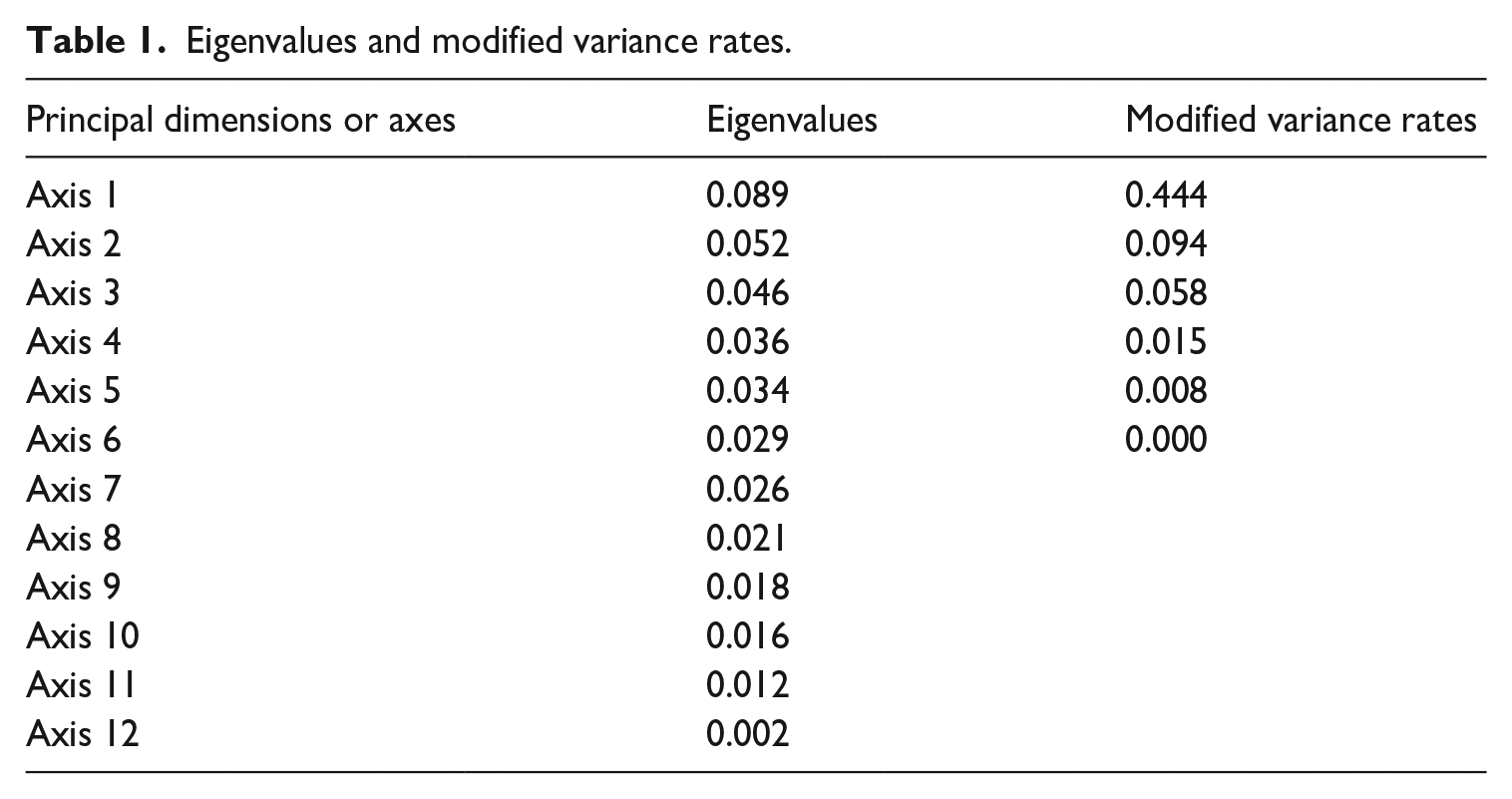
Table 2 depicts the active variables corresponding to the six activity sectors and their respective categories. Categories that provided above average contributions to the variability of the data along each axis had their respective contributions highlighted in bold and were used for interpreting their respective axes.2
Active categories comprising mission agencies’ organizational repertoires.
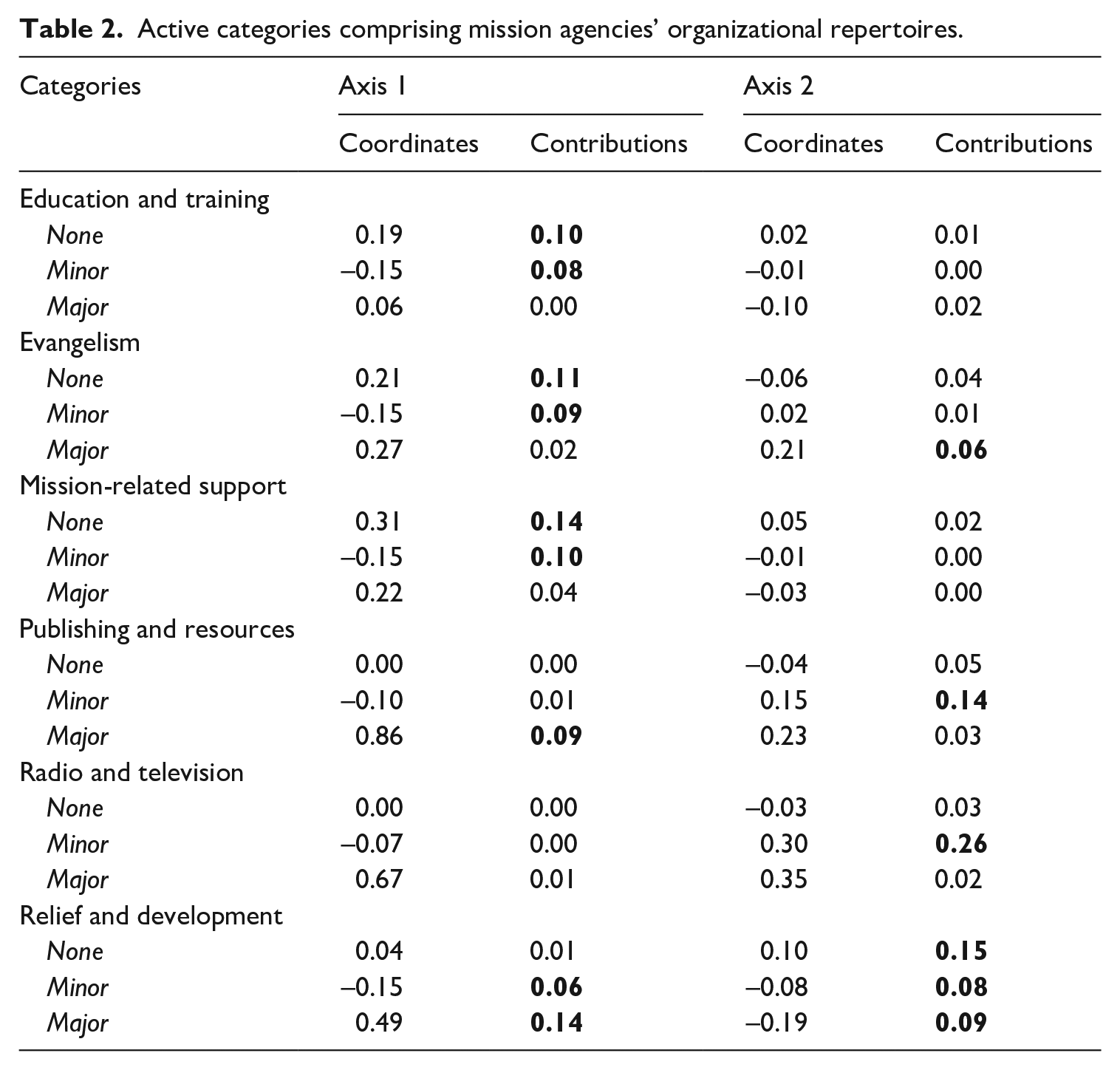
The structuring of the activity sector categories for the 2016 data largely reflected the symbolic dimensions found in Bok’s (2020a) study. This study similarly used the ‘+’ suffix to represent major engagement in the various activity sectors, ‘–’ to represent no engagement, and the absence of any suffix to indicate minor engagement. Figure 1 shows all the activity sector categories providing above average contributions to the variability in the two axes as well as the religious identity and social capital variables. Just as with previous years, the horizontal axis (Axis 1) differentiates activity sector engagement according to the distribution of agency resources. As shown, the minor engagement categories (Education & Training, Evangelism, Mission-Related Support, and Relief & Development) cluster horizontally on the left of the graph, describing a more generalist orientation. No engagement categories (also in Education & Training, Evangelism, and Mission-Related Support) appear to the right of the vertical axis, representing a disaffiliating orientation. Finally, major engagement categories (in Publishing & Resources and Relief & Development) are located to the far right, illustrating specialist orientations. The vertical axis (Axis 2), in contrast, distinguishes other-worldly categories (Evangelism+, Radio & Television, Publishing & Resources), including the absence of humanitarian-type activities (Relief & Development–), from this-worldly categories (Relief & Development and Relief & Development+).
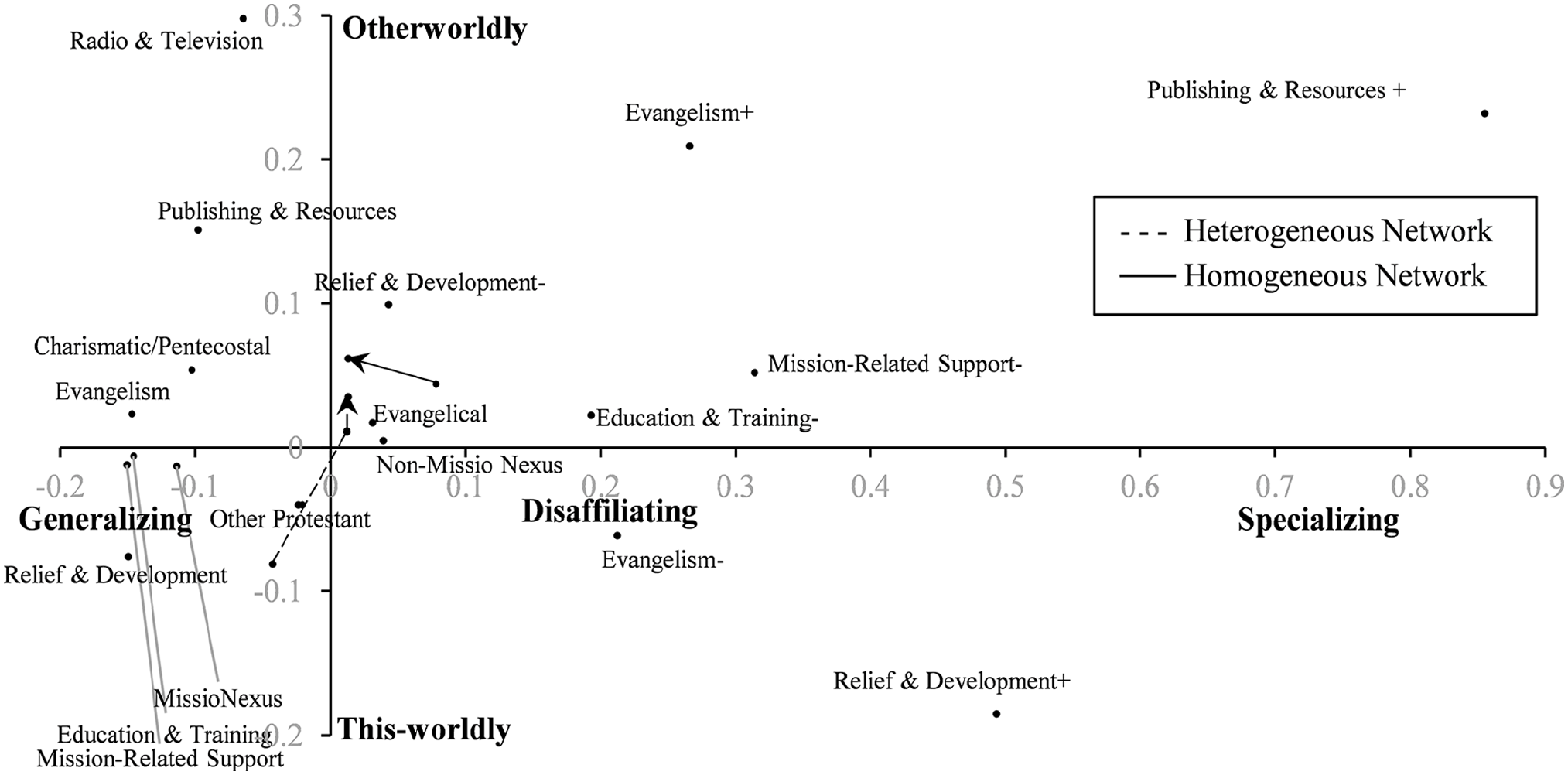
Map of categories with above average contributions to axes 1 and 2.
Homogeneity tests were run between the categories of the religious identity and social capital variables in order to identify statistically significant deviations between them (see Le Roux and Rouanet, 2010: 86 for calculating homogeneity test statistics). Table 3 show the test statistic scores for the variable categories along axes 1 and 2, with those indicative of significant deviations at the 0.05 level highlighted in bold. In combination with Figure 1, the results show that, as with the prior 1969–2008 study (Bok, 2020a), agencies that are neither Evangelical nor Charismatic or Pentecostal are more likely to adopt a this-worldly orientation. However, there were significant horizontal differences between Charismatic or Pentecostal and Evangelical agencies. While the former were far more likely to generalize, the latter were characterized mostly by their disaffiliating tendencies. In other words, true to their subcultural reputation of being highly distinctive from the rest of American religion (Smith, 1998), Evangelical agencies were characterized more by what they excluded from than what they included in their repertoires.
Test statistics for significant deviations between variable categories.
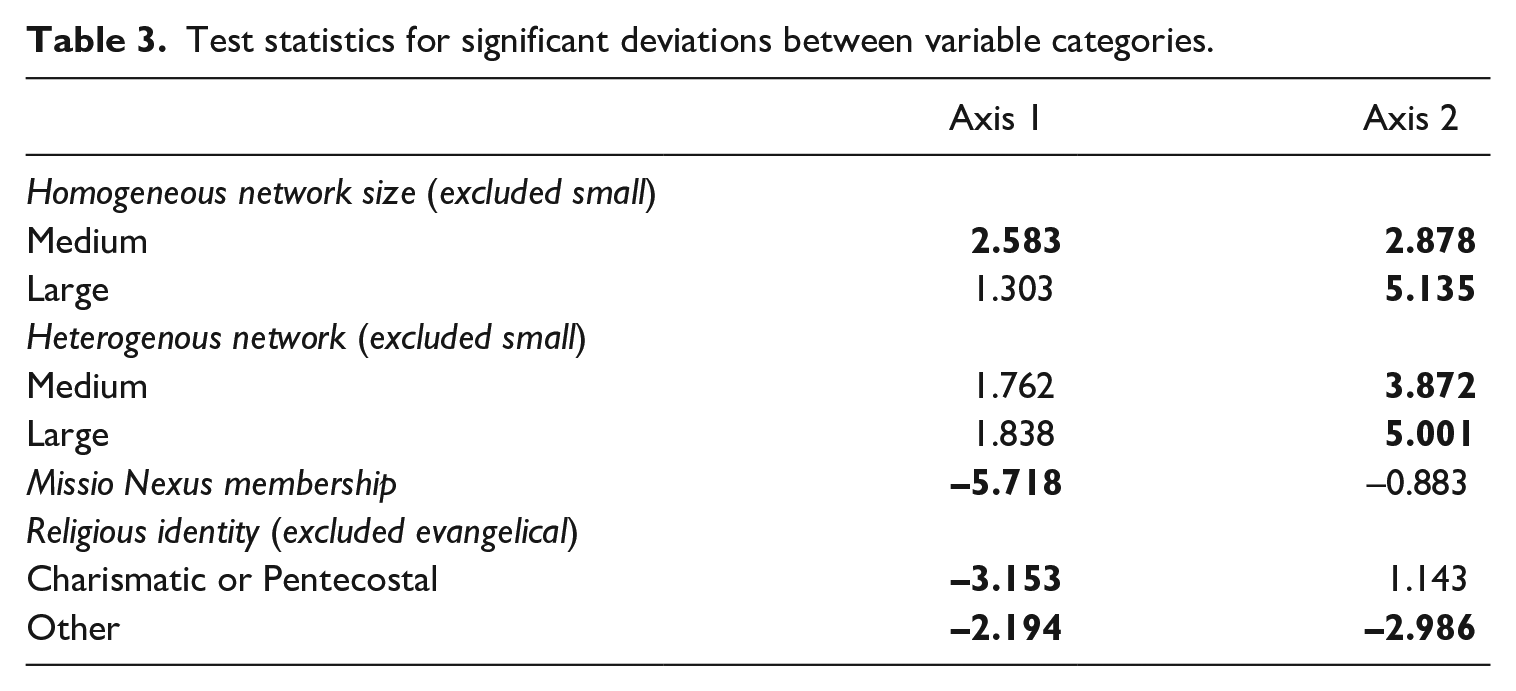
The potential structuring effects of bonding, bridging, and linking social capital were also reflected in Figure 1, with solid and dotted arrowed lines representing the progression from small to large network sizes for bonding and bridging social capital, respectively. The only significant horizontal differences social capital made were between agencies with small- versus medium-sized homogenous networks (bonding social capital) and between agencies with and without Missio Nexus memberships (linking social capital). The former differences show that when agencies are located near to no or few sibling agencies with shared identities, they tend to generalize. This surprisingly also applied to Missio Nexus agencies, suggesting that when agencies are part of a larger consortium of organizations that are presumably united by common underlying mission goals, instead of dividing the labor of transnational mission work, they widen rather than narrow their organizational repertoires of ministry activities. The structuring of this- versus other-worldly orientations in activity sectors, in turn, also proved interesting and were only partially as hypothesized. Agencies with larger proximal networks of both bonding and bridging types were more likely to adopt other-worldly orientations. In contrast, membership in Missio Nexus left virtually no imprint on agencies’ this-worldly or other-worldly orientations.
While Evangelical agencies were characterized by higher levels of bonding capital than both Charismatic or Pentecostal and Other Protestant agencies, they also tended to have higher levels of bridging capital. Evangelical agencies thus are rooting themselves in places populated not only by other Evangelical agencies but also non-Evangelical ones. What Smith (1998) found with respect to Evangelical individuals thus also appears to apply to Evangelical organizations – both have the cultural tools to be distinctive and engaged. Their distinction is reflected in their close geographic ties with other evangelical agencies. Their engagement, however, is with those who do not share their same Protestant identity.
The results concerning social capital also raise the question of potential endogeneity. While religious identity, which is closely associated with beliefs, has long been assumed to influence behavior, at least as early as Weber’s (2002 [1905]) seminal work on the Protestant Ethic, the theoretical links between organizational social capital and repertoires of activism may not come across quite as intuitively. As with any other cross-sectional research, this study’s focus on a single time point places methodological limitations on generating conclusive statements about causality. To explore the plausibility of reverse causality, I first retroactively examined each agency’s address across earlier Mission Handbook editions and identified which had relocated across state boundaries at some point in their life histories (i.e. a major geographical translocation) as well as which of these had at some point adopted one or more of the activity sector categories associated with other-worldly or generalist orientations (e.g. switching from no or major engagement in evangelism in a prior Handbook edition to minor engagement in the next edition). For these agencies, I then individually compared these two time points against each other. If the adoption of the activity sector categories preceded a major relocation, it might suggest that agencies were more likely to seek out networks based on their organizational repertoires than the converse. As it turned out, however, across each of the various other-worldly and generalist activity sector categories, the majority moved before adapting their respective activity sector repertoires (a mean of 74.0 percent of cases). While these observations alone do not offer a sufficient substitution for longitudinal research, they cast doubt on the plausibility of reverse causality between social capital and choice of ministry activities.
Discussion and conclusion
In comparison with earlier findings about mission agencies from 1969 to 2008, 2016 data from the most recent edition of the Mission Handbook revealed that mission agencies’ repertoires of activities are still primarily structured along two dimensions that describe the degree to which agencies generalize or specialize and the extent to which their activity sectors are oriented toward this-worldly or other-worldly ends. Based on these similar dimensions, this study complements Bok’s (2020a) study by introducing an account of the role of social capital in influencing agencies’ organizational repertoires of ministry activities. The study found that both bonding and linking forms of social capital were associated with generalism in these repertoires, with agencies that have linking social capital but only low levels of bonding capital being more likely to generalize. If there is anything surprising here about bonding capital, it is that the same does not hold true for the converse. Having large homogenous networks does not necessarily encourage specialization. Bonding capital might free agencies from the pressure of having to provide every type of religious ministry service for their anticipated target audiences but is insufficient to turn agencies into specialists. Agencies that do specialize likely do so for other reasons, for instance, the constraints imposed by low levels of economic capital or lack of experience in the missional field (Bok, 2020a).
The effect of linking capital appears counterintuitive at first glance, in that it was expected to encourage a more other-worldly orientation as well as specialization. This study found that the linking capital associated with membership in Missio Nexus instead promoted generalism in activities. This result importantly sheds light on the operations of missionary associations, or at least of those such as Missio Nexus. While missionary associations might provide resources in the form of mentoring, shared learning, the sharing of new and innovative ideas or strategies, advocacy for a common discipling mission, and even opportunities for cooperation (see, for example, Missio Nexus, 2020b), they do not fulfill the role of coordinating a rationalized division of missionary labor between agencies. Member agencies may partner with fellow association members but toward the fulfillment of tasks and goals that overlap between themselves. Furthermore, the absence of a significant impact on whether agencies adopt this-worldly or other-worldly repertoires suggests that despite their ideological principles, missionary associations may function in more administrative and bureaucratic capacities. While Missio Nexus may have a formal expectation that member agencies are committed to discipling the nations, there is little pressure dictating how they do so.
These results are insightful for a literature on religious organizations that has traditionally focused more on congregations and denominations (e.g. Meyer et al., 2011: 242–245; Spickard, 2004; Wuthnow, 2009; Wuthnow and Offutt, 2008) and only more recently on religious nonprofits (e.g. Bush, 2011, 2017; Scheitle, 2010; Schnable, 2015, 2016). Missionary associations differ from other hierarchical sources of linking capital, such as governments. On one hand, the unequal distribution of power in organizational linking capital remains, for instance in the ways that Missio Nexus (2020a) reserves the authority to revoke membership from agencies that fail to meet its standards. But unlike governments, who may use their hierarchical positions to grant or deny governmental contracts to nonprofit organizations (Schneider, 2009: 654), missionary associations function less as top-down coordinators of, in this case, transnational missions and more as interorganizational facilitators, providing lateral collaboration opportunities between members.
Bonding social capital did contribute to a more other-worldly than this-worldly orientation but so did bridging social capital, albeit to a lesser degree. However, while these parallel patterns may seem puzzling at first glance, they make sense when considering how they intersect with religious identity. Only Evangelical agencies had a tendency to maintain medium to high levels of both types of capital although they were and are under no obligation to do develop either. In so doing, they are making the best of both homogenous and heterogenous worlds, generating the plausibility structures and world-building and maintenance activities that go along with them in the process.
By distinguishing Charismatic or Pentecostal from Evangelical agencies, this study also revealed that the former are much more likely to generalize. In this way, just as denominations tend to generalize to provide as many services as possible to a narrower denominationally specific population (Scheitle, 2010: 44), Charismatic or Pentecostal agencies do likewise, except that their audiences extend beyond just Pentecostal denominations to include Charismatics of varying denominations. Evangelical agencies, in contrast, distinguish themselves through their higher tendency to disengage from certain activity sectors such as Relief & Development.
Prior research on mission agencies suggested the potential for coordination among generalist agencies that are currently trying to ‘do it all’, so as to minimize the degree of overlap in their ministries (Bok, 2020a). This study’s introduction of social capital measures contributes to but also complicates this discussion in three ways. First, while the evidence suggests that proximity with agencies of a similar religious identity reduces the pressure on an agency to generalize, it is not enough to promote a rationalized, collaborative model of specialization and mutually divided labor. Second, in addition, it may be difficult for agencies with different religious identities to collaborate. In Figure 1, Charismatic or Pentecostal agencies were the most polarized, being located furthest away from the center of the distribution compared to Evangelical and Other Protestant agencies. From an organizational perspective, their generalist tendencies may not bode well for them in the long run as they incur larger overhead costs for a limited target niche (Scheitle, 2010: 44). While large denominations may be able to weather such costs, smaller, nondenominational Charismatic agencies likely will not, and by the next edition of the Mission Handbook, some of these agencies may have shut their doors.
Third, these observations notwithstanding, collaboration that does exist takes different forms. The linking social capital afforded by membership in Missio Nexus explicitly facilitates collaboration between member agencies, yet such agencies had a tendency to generalize in their activities, suggesting that their collaborations do not include a mutual division of missional labor. Whether this strategy proves inefficient is a matter for future research, and one which also highlights the fact that the data used in this study lacked information on other associational memberships. It is possible and even likely that how linking social capital operates will vary between mission associations. Future research should focus on in-depth qualitative work on other mission associations to better understand their influences on their member organizations.
Footnotes
Acknowledgements
The author would like to thank the anonymous reviewers and editor for feedback or comments, Julia Atkinson, Michael Gannon, and Brittany Stack for their assistance in the data preparation, and Chrissy Klenke for her assistance in creating a system to reliably calculate geographical proximities between mission agencies.
Funding
The author disclosed receipt of the following financial support for the research, authorship, and/or publication of this article: The data collection from the 22nd edition of the Mission Handbook was funded by the Jack Shand Research Award from the Society for the Scientific Study of Religion.

Notes
Author biography
Address: Department of Sociology, University of Nevada, Reno, 1664N. Virginia Street, Reno, NV 89557, USA.
Email: