



Abstract
Drawing on ethnographic field research in Chukotka, Russia, this article explores ideas and practices connected with the Arctic tundra vegetation that speak to its place in Chukchi spirituality and cultural milieu. The ethnographic focus is on a Chukchi remembrance ceremony with other social contexts of human–plant interaction offered as comparative examples. Contributing novel insight for the considerations of sentient landscapes and ceremonial engagements with plants, the article turns to the Chukchi eco-spiritual relationships in the beyond-the-human world. It suggests that the vegetation cover is not merely an assemblage of fungi and plants, but an organismal membrane through which the tundra communicates and acts, while also facilitating integrations between the human and beyond-the-human worlds.
Introduction
‘We invite you to film and participate in Inyn’yir. Tell your students that we observe this custom, tell others how we enact it, tell everyone that we do this’, said the master of ceremony while getting ready to leave her balok – a small, seasonal-use cabin. We are at Akkani, a Chukchi village near the northern end of Russia’s Pacific coast that was forcibly closed by the Soviet authorities in the 1960s and is currently being used by its former residents and their descendants as a subsistence camp and cultural nest (Yashchenko, 2020). We had arrived there moments ago by boat, together with several Chukchi families from the village of Lorino located across the bay. For everyone in our group, July is the start of a busy foraging season. In the coming weeks, women and girls will be covering vast distances in pursuit of the tundra greens, spending long hours processing the day’s harvest. Men and boys will maintain a continuous watch for walruses; at each sighting, they will sprint down the tall steep slope to jump into their boats, and – in the case of a successful hunt – give all the collective strength demanded to land ashore bodies of animals weighing up to 900 kilograms. With some exceptions, gendered specialization of the main harvesting activities is consistent in the contemporary Indigenous communities of Chukotka. But the Inyn’yir ceremony, to which we have just gratefully accepted the invitation, will be attended by the children and adult women and men of different ages.
Our Chukchi teachers describe Inyn’yir as ceremony of gratitude, reconciliation, and remembrance. Its aim is to show respect to the spirits, care for them, appease them, and gain a favorable standing in their disposition toward one’s hopes, plans, and general well-being. Communicating in Russian, Chukchi people discern between the living and the dead using words that are equivalents of ‘present’ and ‘absent’, respectively. For example, when asking about an elder from another village of whom one has not heard in a long time, it is common to ask ona est’ [is she present]? If the person has passed away, the answer that follows is yeyo net [she is absent]. In the context of the Chukchi worldview, being ‘absent’ means not inhabiting the world in a living human form. The spirits of the deceased, however, are omnipresent and are especially responsive around the physical sites of their lived lives. The absent are not the sole presence in the spirit realm. Similar to the neighboring Inuit (Inupiat of Alaska and Ypiget who live on both Chukotkan and Alaskan sides of the Bering Strait), Chukchi live in a richly ‘nonempirical environment’ (Burch, 2013), where the inhabitants whom outsiders may regard as mythical, metaphysical, or magical are encountered (or avoided) regularly, and where direct interaction with some of them, including the spirits of the absent, is part of the everyday life (Bogoras, 1901–1904; Kavry, 2017; Kerttula, 2000). The absent are pleased to receive the foods and other treats they enjoyed as living humans. Similar to what Waldemar Bogoras (1901–1904) observed in his landmark monograph, based on the field research in the late 1800s, in addition to reindeer and other locally harvested products, Chukchi are fond of trying new foods, both, while living and after crossing into the spirit world. Be it a roulade of walrus that has been fermenting over months (Yamin-Pasternak et al., 2014) or a can of peaches in syrup, only after a morsel representative of the meal is tossed ‘to the spirits’ can the living begin to eat.
Inyn’yir is more elaborate than the everyday offerings. That day in July was the opening of the foraging season for the master of ceremony and the accompanying Lorino families, who had returned to Akkani after the winter in the main village. Some of the older residents of Lorino were born in Akkani, and a number of families have kin relations with the deceased that called this place home. A brief ethnographic account of a contemporary Inyn’yir ceremony, this article zooms in on the interaction with the spirit world, facilitated through the small openings made in the vegetation cover of the tundra. We compare the use of those openings with other Chukotkan contexts of treating and talking about the tundra vegetation cover. We believe that collectively such actions reflect a worldview, where the tundra vegetation cover is not merely an assemblage of individual plants, but a whole organismal membrane that connects and facilitates contacts between the worlds discussed herein.
Methods and materials
Our ethnographic field research in the region of the Bering Strait began in the summer of 2000 and has since been continuously emerging as a synergy of professional interests of a cultural anthropologist (Sveta) and visual artist (Igor), who deeply treasure our working and personal relationships with people on the Chukotkan and Alaskan (Russian and US, respectively) sides of the Bering Strait. The long-existing social ties, shared cultural heritage, and history of trade, cooperation, and conflict connecting the past and present communities of this region are a subject of a rich body of scholarship (e.g. Bemuth, 2019; Krupnik and Chlenov, 2013; Krupnik and Vakhtin, 1997; Nelson, 1983 (1899) Ray, 1975; Schweitzer and Golovko, 1995, 1997). Over the last two decades, our community involvement in the Bering Strait has included field research, assisting youth and elder groups in facilitating visits between Chukotka and Alaska, and collaborative production of exhibitions and other educational resources. Our research and outreach has focused on different aspects of Indigenous foodways, spirituality, regional histories, and human–environmental relations (e.g. Dudarev et al., 2019; Kazmierski, 2019; Mason, 2019; Pasternak and Yamin-Pasternak, 2019; Yamin-Pasternak, 2007a, 2007b, 2007c, 2009, 2011; Yamin-Pasternak et al., 2014, 2017).
The Inyn’yir ceremony in Akkani that we describe from the firsthand experience is similar to the verbal accounts of this ritual we have encountered elsewhere in the region. The sites of our research and cultural learning in the Bering Strait region include the coastal villages and towns of Enmelen, Nunligran, Sireniki, Novoe Chaplino, Provideniya, Lorino, Lavrentia, and Uelen (Chukotka) and Shishmaref, Savoonga, Gambell, Little Diomede, and Nome (Alaska); reindeer herder camps in Chukotka (where herders seasonally migrate with their animals); and hunting, fishing, and gathering camps, which residents of the coastal municipalities on both sides of the Bering Strait use seasonally for subsistence and recreation (Akkani is one of such sites). Although phone service and Internet capabilities continue to be far more limited in this part of the Arctic than in many other regions of Russia and the United States, in the recent years, our connectedness and communication with families on both sides of the Bering Strait has been substantially enriched by the growing possibilities to converse and exchange messages over the web. As members of the teaching faculty at the University of Alaska Fairbanks, every semester, we have students who are from the Bering Strait communities taking our courses. We serve as mentors to a number of those students and regularly work with them in organizing events and exhibitions. Throughout all our academic undertakings – including the writing of this article – we keep in close touch and consult our community-based mentors on ethnographic accuracy and interpretation of what we share with students, colleagues, and the public.
Inyn’yir, July 2017
As we were stepping out of the balok, having filled our backpacks with whatever we could help haul over to the ceremonial site, all the other season’s arrivals to Akkani were heading in the same direction. Akkani sits on high ground above the sea, close to the farthest northeastern end of the Eurasian continent. The ceremonial site is located on the edge of the tundra-facing side of the former village. Directly in front of us is a mountainous endless landscape in its seasonal color green. To the left and behind us is a cluster of the summer-use baloks, built mostly of scrap lumber that typically gets repurposed through the lives of multiple projects spanning the Soviet and post-Soviet times. To the right of us is the sea – a direction into which the hunters in presence continue turning to look out for walruses, affectionately commenting that they cannot help themselves but to be ‘always at work’. There is a bench that will be used as a small cutting table. The ground in front of it is quickly taking on a look of a picnic spread. There is reindeer meat, apples, bread, and few deli-like items representative of the typically humble inventory of a Chukotka village store. Of the drinks, there is fruit juice – an expensive product (generally, prices on store-bought foods in this part of the world represent the most expensive retail on the planet), a small bottle of vodka, and a thermal carrier filled with reindeer broth. There is a bag of loose tobacco and about a dozen packs of cigarettes of different brands, of which most had to be purchased well ahead of time, either while vacationing in another part of Russia, or with the help of a daughter or son returning home to Chukotka while on break from university studies. Portions of each type of food are being cut into tiniest possible morsel-size pieces. This far from the Ecuadorian Amazon, we are thinking of Eduardo Kohn’s (2013) ‘form’ and how in the world beyond ‘being inside form is effortless’ (2013: 163). Once each morsel is transferred to the spirits, it will effortlessly take on the form needed to signify abundance and satisfaction.
The master of ceremonies makes a cluster of small openings in the vegetation. Each opening is roughly 20 cm in diameter, only as deep as to expose the topsoil immediately below the vegetation. She is using the reindeer antler that is a designated sacred object. Normally kept above the home entrance, the antler was taken down and brought along for the purpose at hand (Figure 1). ‘Don’t cross over [into the direction of the open tundra beyond the hole cluster that was created moments ago], the spirits are still hungry, they might grab you!’ Those words are meant for Sveta, who without realizing has stepped into a precarious territory and is now being cautioned by unison of kind, concerned voices. She swiftly steps back. Her apologetic gaze is met with expressions of affection. The ambiance is soothingly tranquil.
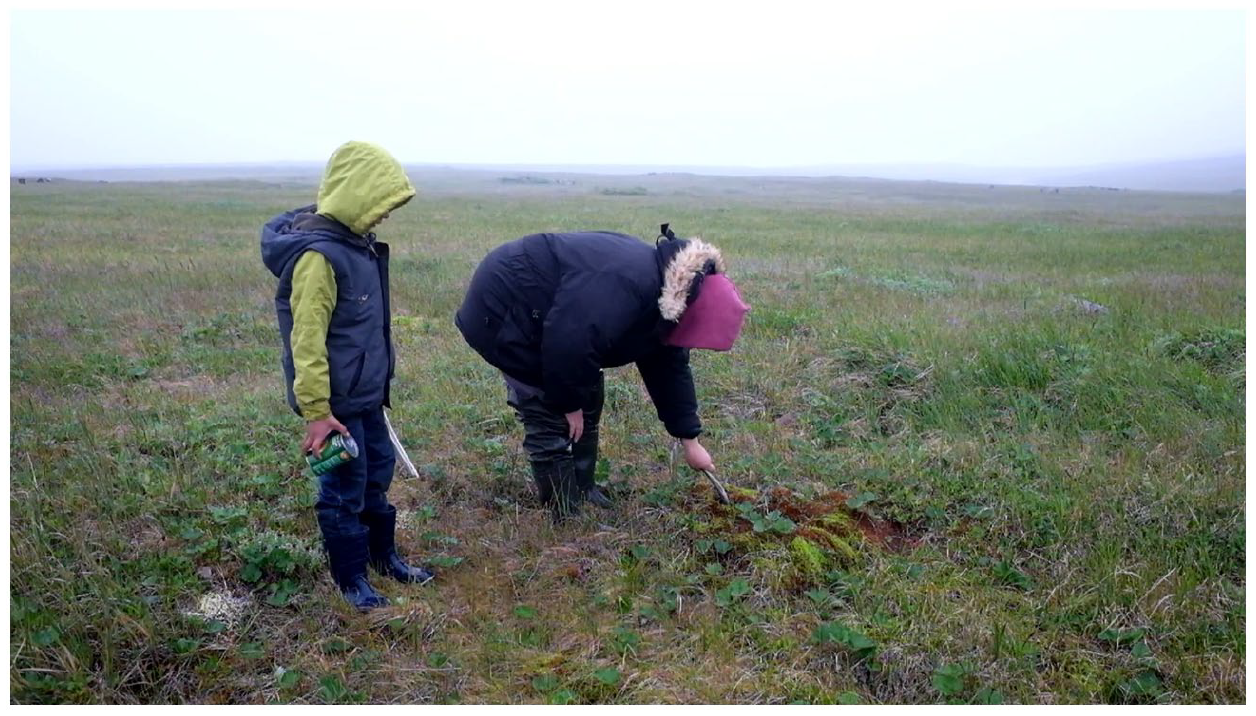
Initiating Inyn’yir. Akkani, Chukotka, July 2017. Photo by Igor Pasternak and Sveta Yamin-Pasternak.
Facing in the direction of the spirits while looking down the vegetation holes, the master of ceremonies starts an incantation in Chukchi. She then becomes the first one to place a sample of each represented food and drink into each of the openings. Her own children and other participants are standing by her side with the packs of cigarettes, each prepped for a convenient extraction of a single cigarette to be placed into a hole (Figure 2). Others in attendance begin conversing about various loved ones, some who passed away recently and some who left long ago. ‘Good thing I was able to find this brand of tobacco, [late relative’s name] would not forgive me otherwise’. ‘Good thing my daughter brought [from St. Petersburg] the cigarettes [late relative’s name] liked; the village store didn’t have them’. One by one, every person present takes a turn placing the goods inside the vegetation openings. The food and drink menu is given to all. The individually favored brands of tobacco products are added when a particular living relative is looking to please a certain dearly missed loved one. Commensality with the spirits is part of the ceremony. Once all that was to be shared with the spirits has been offered, we all start reaching for whatever foods we like. A sip of vodka is optional for the living, some do partake and some abstain – either way is fine. Sampling reindeer broth, on the contrary, is a must. The master of ceremonies is going around to make sure that everyone drinks from the soup thermos that is being passed from person to person. Whether their recent ancestors are from the tundra or from the coast, Chukchi are passionate about reindeer, and amid a rather flexible menu, reindeer broth is an essential component at Inyn’yir. She is also adamantly insisting that everyone drinks the fruit juice: its recognized status as a cost-prohibitive store-bought item is a proper way to let the spirits know that no expense is being spared.
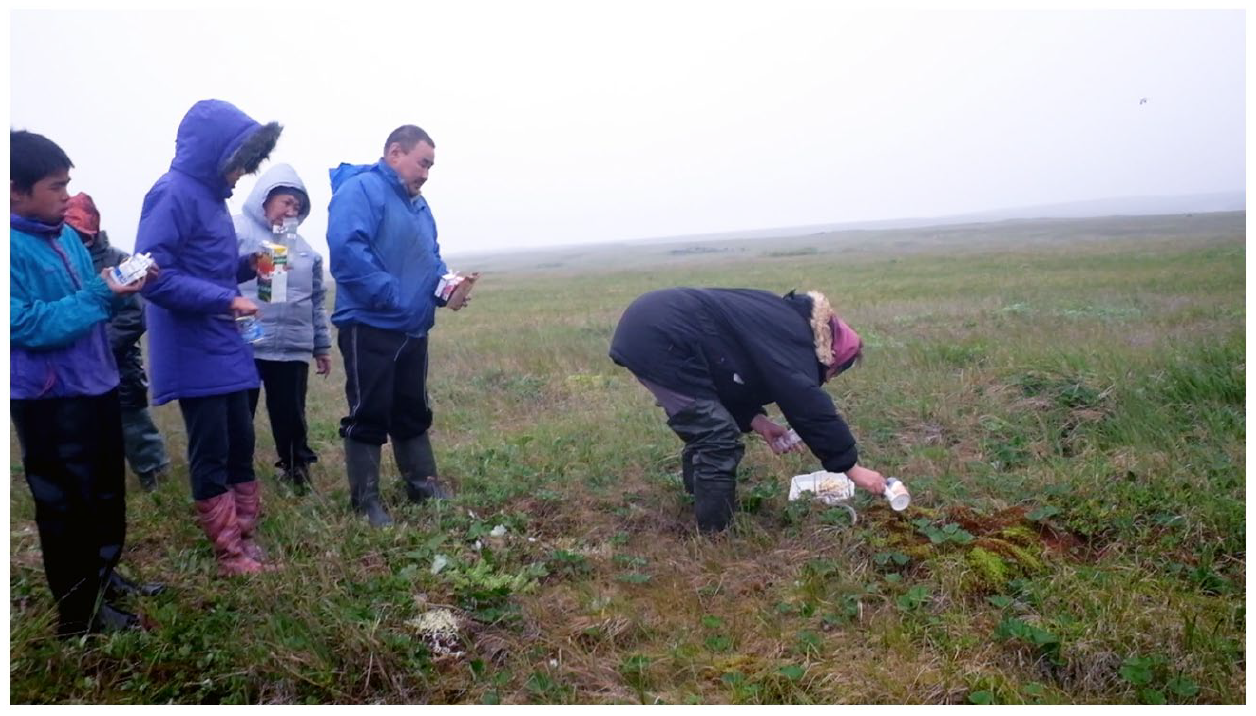
Inyn’yir, living participants taking turns making offerings to the spirits. Akkani, Chukotka, July 2017. Photo by Igor Pasternak and Sveta Yamin-Pasternak.
Soon enough it is time to wrap up. Our picnic spot is packed clean. Using the same reindeer antler, the master of ceremonies patches up the portal holes stretching the clusters of the vegetation that were pulled apart at the start. The morsels of food and tobacco remain inside the holes. It is now safe to move into any direction, and in the coming days, the women will walk vast distances harvesting the leafs of Rhodiola rosea, Rumex arcticus, Salix arctica, Honckenya peploides, and other greens that will fill the barrels used for a sauerkraut-like fermenting process. Some plants will get pickled and canned, some will be taken back to the village and placed in a freezer. If the year is good, mushrooms (predominantly Leccinum and Lactarius species) will become the main target later in the month and share the tundra splendor with the berries of Vaccínium vítis-idaéa, Vaccinium uliginosum, Rubus chamaemorus, and Empetrum nigrum (Yamin-Pasternak, 2007a, 2007b, 2007c). The stakes are high: winter is long and the window to harvest all the coveted provisions for the much-treasured dishes is small (Dudarev et al., 2019; Yamin-Pasternak et al., 2014). Every day is ‘a day that feeds a year’ (Yamin-Pasternak, 2009: 42).
Thinking with the tundra cover
Inyn’yir is just one of the many kinds of interactions Chukchi have with the absent loved ones and ancestors, whose spirits, in turn, are among the many kinds of dwellers in the beyond-the-human world. Sharing food, drink, and tobacco with the spirits is a daily near-routine practice for many Chukchi (and the neighboring Yupik of Chukotka, see Oparin, 2012). It has also become important for the Chukotka residents who are not Indigenous and have embraced aspects of Indigenous spirituality. Spiritually, the Inyn’yir ceremony we described is special because of the social and historical context surrounding its enactment: a seasonal return to an ancestral site, important culturally and economically (with regard to hunting and foraging for the tundra fungi and plants). Like many other seasonally used ancestral sites, Akkani is entangled within a complex Soviet and post-Soviet history that involves forced relocations, adaptation, and resilience in the face of the colonialist forces, and continuity and revitalization of practices connected with the Indigenous spirituality, cultural expression, and worldview (Holzlehner, 2011; Yashchenko, 2020). Ritualistically, Inyn’yir stands out among other acts of remembrance in the elaborateness of the menu being offered, as well as in the delivery mechanism: the offerings are placed in the openings made temporarily in the green cover of the tundra; when they are closed, the ceremony is complete. As a contribution to the Social Compass issue on plants and spirituality, our discussion zooms in on these ephemeral, manually created portals. By considering the vegetation through which the ‘present’ Inyn’yir participants transfer offerings to the ‘absent’, we encourage a direction (not quite a turn, but a curve) in ethnobotany and broader human–environmental interests in social sciences that pays attention to the groundcover as a whole. We do so by asking how the actions and ideas involving the groundcover, in various contexts including the Inyn’yir ceremony may reflect the eco-spiritual function of arctic vegetation in the Chukchi ontology.
Literature on human–environmental interactions, representative of the ‘ontological turn’ (Kohn, 2015) in anthropology and sibling fields of the social science is becoming more richly inclusive of the beings and relations in the world ‘beyond the human’ (Kohn, 2013). While the ways in which human–animal relationships are configured in this world have been somewhat of a privileged focus (Cassidy, 2012), plants and mushrooms have been gradually entering the spotlight (Kohn, 2013; Tsing, 2015; Yamin-Pasternak, 2011). Simultaneously, ethnobotanical investigations detailing the culinary, medicinal, and other uses of plants are being productively enriched with insight on broader practices and beliefs surrounding their role in society and culture (Schulthies, 2019; Turner et al., 2020). Researchers working in high latitude regions have been attentive to both, the ethnobotanical knowledge of Arctic residents (Jernigan et al., 2017; Turner et al., 2020) and the sentience of the tundra and sea as the home environments of the Indigenous societies, interacting amid the ever-connected human and beyond-the-human worlds without necessarily distinguishing between the two (Anderson, 2000; Ingold, 2000). Our attempt to contribute to this growing body of scholarship is in recognizing a vital cultural space, where the tundra vegetation cover is a whole. In turn, the proper actions within that space allow a safe subjecting of this whole to various kinds of ‘partitioning’ (Schulthies, 2019), through the harvest, processing, storage, sharing, and consumption of tundra plants. Geologically construed as the top layer in the stratigraphic positioning of the tundra soils that also performs a range of biological and ecological functions, in a Chukchi eco-spiritual realm, the vegetation layer is a phytocommunicative (Schulthies, 2019) membrane of the sentient organism that is the tundra. Its botanical, ecological, and aesthetic (visual, olfactory, and tactile) forces are jointly deployed to facilitate the eco-spiritual relationships that define it as a place and space and set the guidelines for the customs and norms of behavior.
It is our observation that people who have never visited the Arctic tend to imagine the tundra’s tactile qualities as those resembling an unpaved ground in their home region or another familiar place. They envision a grass field that is vaster and has mountains; a savanna that is continuously green; a forest without trees with only short plants as groundcover. Even when they have seen photos and are somewhat botanically aware, they cannot fathom the corporeal hospitality of the tundra, mediated by the multi-sensory coziness and a particularly tactile softness of the malleable carpet of lichens, mosses, and sedges. Ethnographers working in the high North relate an invigorating array of metaphors and poetics that capture the love and enchantment of the tundra dwellers with the snow-free summertime expanses of earth, engulfing the perimeter of their village or that of a reindeer herders camp (Kerttula, 2000; Skvirskaja, 2012; Vitebsky, 2005). The vegetation cover is not the sole agent of this aesthetic experience, but a key constituent nevertheless. It makes moving in silence possible, each footstep being cushioned by the interwoven softness and buoyancy, as if walking on a plush carpet. The fast summertime greening, saturated by copious waves of flowers, by August (early autumn in the high North) transform into gammas of gold and scarlet and activate the visual engagement that dissolves the barrier between the empirical and nonempirical. Unobstructed by trees, it transcends the optical sensing of physical distances between the topographic features, gradients of the slopes, and elevations at mountain peaks. A macro-mode close-up shot of a digital camera can reveal dozen-some specimens represented in an area the size of one’s palm. It is this seamless cooperation of density and softness that make the physicality of puncturing through the vegetation layer (such as to create the portals for the performance of Inyn’yir) feel like one is separating the yarns of a woolen fabric.
In a seminal ethnography of Chukotka, Anna Kerttula describes a range of Indigenous–Newcomer interactions that speak to how people in the two groups relate differently to their shared physical surroundings (Newcomers being the umbrella name for the Chukotka residents who are not Indigenous and in most cases are Russian, Ukrainian, or Byelorussian, but can also be of other ethnicities present in the former Soviet Union). One of the significant data points for Kerttula’s (2000: 124) assertion that ‘the tundra to the Chukchi was by definition “pure”’ is in how Chukchi react to the impact of the all-terrain track vehicle – vezdekhod, used as the main motorized transportation in Chukotka: On every trip made to the tundra, people pointed to the muddy pools of melted permafrost and complained ‘ Look at all the tracks, they’re everywhere! Why can’t these drivers [all Newcomers] stay in the same ones? They drive anywhere they want without thinking about the effects. Look at how the tundra is weeping!’ Use of the word ‘weeping’ is significant: the tundra was a spiritual being and was actually weeping to see the lack of respect and the offensive behavior of the Newcomer drivers. It should be noted, however, that once a vezdekhod had torn up the tundra, the huge mud pools created by the melting permafrost made it impossible for drivers to follow the same track without getting irretrievably stuck: they were forced to make new tracks in order to avoid getting mired in the mud of the old ones. With each new track came new pools of water and new symbolic tears. (Kerttula, 2000: 124–125)
Let us also consider this interaction: Andrei looked down at the young Chukchi woman, Iuliia, from the top of the vezdekhod . . . The driver had stopped to make tea and give the passengers a much-needed rest from the bone-breaking ride of this tanklike vehicle. Although his consciousness had been numbed by the ordeal, Andrei immediately became fixated on Iuliia’s feet in their house slippers. Finally overcome by curiosity, the city-born Russian spoke up: ‘Why are you wearing house slippers on the tundra? House slippers are to be worn at home’. Iuliia retorted ‘Why not? Isn’t the tundra my home?’ (Kerttula, 2000: 22)
Due to the long-time interest in ethnomycology (Yamin-Pasternak, 2007a, 2007b, 2007c, 2009, 2011; Yamin-Pasternak and Pasternak, 2018, 2020), our own time on the Chukotka tundra over the past 20 years has included lots of mushroom hunts with our local hosts. On a bountiful year, tundra provides a plethora of mushrooms that (over the past half-century, especially, as part of the absorption of Slavic cuisine into the local foodways) Chukchi people gather abundantly, regularly filling a 5-gallon bucket on a single outing. Each time a mushroom comes out of the ground, the resulting opening is quickly patched up with the adjacent turf and moss. This variably interpreted practice is adhered to by pickers around the world: some uphold it is a conservation strategy (believed to help future mushroom proliferation); for others, it is part of an aesthetic of keeping their stumping grounds ‘pristine’; others implement it in order to hide the evidence of a productive mushroom spot from the ever-competing eye of other hunters. For the Chukchi mushroomers, taking this step is consistent with how they care for the tundra vegetation cover. Be it in a context of an explicit communication with the spirit world or a ubiquitous day of summer gathering activities, people of the tundra keep the floor of their home ‘pure’ (Kerttula, 2000: 124), tears-free, and cozy for the soft silent stepping of the house slippers.
Conclusion
In his trailblazing classic on spirituality and plants, Frederick Simoons (1998) posits that ‘contrary to what many cultural materialists believe, basic human concerns were the prime movers in determining the ritual role that plant species came to play, and that techno-environmental, medical, and nutritional were quite secondary in that matter’ (1998: 304). Our aim has not been to place secondary to anything the gastronomically valued tundra mushrooms and plants that are harvested prolifically during the summer months in Chukotka and enthusiastically consumed at meals throughout the year (Dudarev et al., 2019; Jernigan et al., 2017; Yamin-Pasternak, 2007a, 2007b, 2007c, 2009; Yamin-Pasternak et al., 2014). Yes, procedurally, Inyn’yir follows Simoons’s order: enacted at the opening of the foraging season at Akkani, this ceremony that relies on the organismal wholeness of the tundra vegetation precedes the collection of individual specimens and the commonly targeted subsistence species of plants. But it is not that former is more important. Rather, by facilitating the spirits’ welcome, the former is helping make the latter safely allowable.
Arctic-focused scholarship has been at the forefront of the transformative ideas on landscape sentience, which is said to be compelling people to ‘act and move on the tundra in such a way that they are conscious that animals and the tundra itself are reacting to them’ (Anderson, 2000: 116). We also have been shown that principles of Indigenous spiritualties which guide the human–environmental interactions are shared in regions as diverse as the Amazon and Arctic (Brightman et al., 2014). Thus, trans-globally, ‘How forests think’ (Kohn, 2013) is how tundra thinks. Placed-based ethnography sheds further light on the ‘how’ by adding a new ‘what’ that helps enrich and advance the ‘how’ in our understanding. What we have sought here, as part of making good on our promise to ‘tell others’ about the fact, process, and social contexts of Inyn’yir, is to offer a thought on the anatomy of the tundra sentience, with the vegetation cover of the tundra performing the functions of a vital organ.
Footnotes
Acknowledgements
Our deepest gratitude is to our hosts and teachers at Akkani, Chukotka, for treating us like family and honoring us with a trusted responsibility to participate in Inyn’yir and share widely the fact and details of this affective, humble, and profoundly enlightening ceremony. Efforts of Claire Alix, Frédéric Laugrand, Lionel Simon, Cédric Byl, and the two anonymous reviewers who provided helpful and encouraging comments during the double-blind peer review are much appreciated.
Funding
The author(s) disclosed receipt of the following financial support for the research, authorship, and/or publication of this article: This article draws on field research conducted in the Bering Strait region between the years 2000 and 2020, during which the authors received funding from the United States National Science Foundation Arctic Social Sciences Program; and through the Urgent Anthropology Fellowship, founded by Dr George Appell and awarded in 2018 to Sveta Yamin-Pasternak through the joint auspices of the British Museum and Royal Anthropological Institute of Great Britain and Ireland.
Author biographies
Address: Department of Anthropology and Institute of Northern Engineering, University of Alaska Fairbanks, PO Box 757720, Fairbanks AK 99775-7720, USA.
Email:
Address: Department of Art and Institute of Northern Engineering, University of Alaska Fairbanks, PO Box 757720, Fairbanks AK 99775-7720, USA.
Email: