




Abstract
Explanations for the rise of the religiously unaffiliated have regained attention from sociologists in light of recent declines in religiosity. While the secularization thesis has seen revisions across disciplines, few studies link lower levels of religiosity with greater Internet use. This article draws from Charles Taylor’s widely regarded account of secularity and his concept of ‘the buffered self’ to argue that individuals who use the Internet more frequently are less religious. Using data from the Baylor Religion Survey (2017), I find that with higher levels of Internet use, individuals are less likely to pray, read sacred texts, attend religious services, consider religion personally important, or affiliate with a religious tradition. Greater Internet use is further associated with being an atheist, while other media activity such as watching television is not similarly linked. These findings ground Taylor’s theoretical work by specifying empirically measurable, contextual conditions that explain recent declines in religiosity.
Introduction
The secularization thesis has enjoyed renewed attention in recent decades, prompting scholars across disciplines to reconsider its place in the social sciences as they seek to explain declines in religiosity. As researchers have shown, one of the most well-documented trends in the sociology of religion has been the increase in the religiously unaffiliated, or ‘nones’ as they are more popularly known (Baker and Smith, 2009; Kosmin and Keysar, 2008; Putnam and Campbell, 2012; Woodhead, 2017). The Pew Research Center has conducted numerous studies on nones and their recent growth, finding that 23% of the American population (approximately 74 million adults) report no religious affiliation (Smith and Cooperman, 2016). In the United Kingdom, the rise of nones has occurred rather drastically (Bullivant, 2017; Woodhead, 2017), thus forcing scholars to reconsider different connections that may account for their growth and the collective social implications that may result.
Though the list of possible explanations has not been exhausted, scholars have proposed mechanisms that may account for recent declines in religiosity. In the American context, some argue that current upticks in nones can be explained by an aversion to conservative politics (Hout and Fischer, 2002; Putnam and Campbell, 2012). Taking a more global perspective, Norris and Inglehart (2011) attempt to explain religious decline in postindustrial nations with their existential security hypothesis. As they maintain, affluent Western nations with relatively high existential security see declines in religious adherence, whereas underdeveloped nations retain traditional religious views that provide security and comfort in the face of life’s perils. As their argument runs, religious participation thus declines in the West while remaining active elsewhere.
Since much of the scholarship on religion has focused on formal religious organizations and their members, nones have until recently received scant attention. By concentrating on formal religious organizations, scholars have mostly neglected important developments in Eastern, non-monotheistic, or spiritual belief systems. Indeed, Heelas et al. (2005) attribute religious decline in part to an increased fascination with spirituality, and Houtman and Aupers (2007) argue that ‘post-Christian spirituality’ has expanded in numerous countries while traditional religious observance has decreased, particularly among younger birth cohorts (Bengtson et al., 2013).
So why are young generations less religious than older ones? Wuthnow (2010) finds that young adults are more likely to experiment with a wide variety of religious and spiritual beliefs as they pragmatically navigate the complexities of their social environments. Similarly, McClure (2016) has shown that young adults who spend more time on social networking sites are more likely to customize their beliefs in syncretistic fashion and endorse practicing multiple religions simultaneously, independent of what their religious tradition teaches. In thinking about the effects of technology, Downey (2014) and McClure (2017) have also separately discovered that increases in Internet use correlate with decreases in religious affiliation. Twenge (2017) has similarly furthered these connections in her book iGen, though her research focuses more on the post-Millennial birth cohort than it does on specific technology measures or the effects of Internet use.
In their broader context, studies on the decline of religiosity transpire against a larger theoretical backdrop where scholars have sought to assess the place of the secularization thesis in the twenty-first century. On one hand, the traditional secularization thesis, which posited a weakening of religious authority in the modernizing world, has been resurrected with the ascension of nones and the simultaneous decline of religious institutions worldwide (Bruce, 2002; Chaves, 1994, 2011; Norris and Inglehart, 2011; Yamane, 1997). But these arguments still confront both the ‘new paradigm’ (Warner, 1993), ‘multiple modernities’ (Eisenstadt, 2000), and the desecularization thesis, which together maintain that religion is alive and well in the modern world (Berger, 1999; Casanova, 1994; Stark, 1999). Given these tensions, some scholars have pushed for the adoption of the phrase ‘post-secular’ to describe the current religious landscape (Gorski, 2012; Gorski and Altınordu, 2008). With these debates in mind, this article contends that Charles Taylor’s (2007) A Secular Age provides some useful theoretical vocabulary to explain the present situation, despite its omission of quantitative studies and the curious absence of any discussion of technology and its effects. Thus, in what follows, I aim to (1) explicate Charles Taylor’s concept of ‘the buffered self’, (2) relate this concept to technology by discussing the Internet’s purportedly secularizing effects, (3) state relevant hypotheses, (4) introduce the data and methods used for this study, (5) highlight main results, and (6) conclude with a discussion that connects Internet use to lower levels of individual religiosity. Ultimately, the shifting contours of religion cannot be properly understood without paying attention to the technological gears which have so massively altered modern social life.
The buffered self in Charles Taylor’s theoretical lexicon
Offering a widely acclaimed history of ideas approach to the secularization debate, Charles Taylor’s (2007) A Secular Age examines the place of the secularization thesis in the twenty-first century. Over 800 pages long and spawning numerous commentaries and books of its own (Calhoun et al., 2011; Smith, 2014; Warner et al., 2010), Taylor’s (2007) tome begins with a simple question (p. 25): ‘why was it virtually impossible not to believe in God in, say, 1500 in our Western society, while in 2000 many of us find this not only easy, but even inescapable?’ Given its length and complexity, it is surprising that few empirical studies are cited and that quantitative measures in the sociology of religion are shortchanged. In fact, such studies may be especially useful in answering Taylor’s question. Aside from these notable shortcomings, Taylor deposits a rich theoretical vocabulary and introduces the concept of the ‘buffered self’. For Taylor, this concept helps clarify the place of the secularization thesis in the social sciences and explain recent declines in religiosity.
Framed abstractly, Taylor’s buffered self-accounts for many social realities of our day, including disengagement from larger institutions and social organizations. Properly defined, Taylor (2007: 42) writes, ‘The buffered self is essentially the self which is aware of the possibility of disengagement. And disengagement is frequently carried out in relation to one’s whole surroundings, natural and social’. As a result, Taylor contends that buffered individuals determine their lives without ever sensing a need to consult higher authorities or adhere to institutionally imposed doctrines. As for the fate of religion, this means that modern individuals, according to Taylor, are increasingly less likely to affiliate with religious organizations because such institutions provide little explanatory value or social capital outside of what self-sufficient individuals can obtain on their own. Commenting on this phenomenon, Bilgrami (2010: 152) writes, What Taylor calls the ‘buffered self’ is a self that is not open to normative demands from any site external to itself, an inevitable consequence of the fact that a world conceived as brute does not, in any case, contain anything that could make those demands.
This conception of self stands in direct contrast to the ‘porous self’, which Taylor (2007: 38) argues was characteristic of pre-modern persons who felt ‘vulnerable, to spirits, demons, [and] cosmic forces’. Thus, modern individuals, who feel no obligation to obey the dictates of larger religious or social institutions, are buffered selves.
In explaining the rise of this modern cultural consciousness, Taylor carefully points out that the buffered self did not emerge in a vacuum. Historically, certain conditions had to change to make the buffered self possible. Taylor (2007: 239) describes these changes as an ‘anthropocentric shift’ that contributed to a new ‘social and civilizational framework which inhibits or blocks out certain of the ways in which transcendence has historically impinged on humans, and has been present in their lives’. Though the rising tide of individualism has been well documented (Bellah et al., 1985; Madsen, 2009), Taylor argues that declining religiosity is more a product of a collective social imaginary, or ‘an immanent frame’, than an aggregate supply of individual decision-makers who have rationally decided to disaffiliate from their religious organization. While these outcomes are historically contingent and not inevitable byproducts of modernity, Taylor illustrates that the immanent frame in which all Westernized individuals today are situated produces an unreflective background that accounts for declining religiosity. Commenting on Taylor’s sweeping account of these historical events, Warner et al. (2010: 15) write, ‘We cannot make sense of the decline of religious practice (where this has occurred), the compartmentalization of religion as private, or even declarations of doctrinaire atheism without reference to these changes’.
But what, exactly, motivates these changes? Taylor’s account of secularization begins as far back as 1500 and marches onward to the present, stopping to reflect on cultural developments as varied as the paintings of Hieronymus Bosch, Matthew Tindal’s Providential Deism, Nietzschean philosophy, and the expressive individualism characteristic of the late twentieth century. Despite these speckled references, rich theoretical vocabulary, and attention to historical detail, however, Taylor says little about the technological forces that have shaped modern life, and he conspicuously avoids quantitative, empirical studies in his analysis.
Internet use and its (secularizing) effects
Despite Taylor’s sweeping comprehension, the potentially secularizing forces of modern technology receive little attention in his work, particularly Internet technology and the widespread ramifications of the ongoing digital revolution. Outside Taylor’s corpus, several studies attempt to specify more precisely the possible connections between technology and religion. In seeking to explain the religious outcomes of Internet adoption, scholars first looked to the Internet as either a force that strengthens religion or one that erodes its institutional and moral hold over adherents (Armfield and Holbert, 2003; Goh, 2005). Today, however, researchers aim to understand more complex interactions between technology and religion (Cheong et al., 2012). For example, Heidi Campbell, whose work covers this terrain extensively (Campbell, 2017a, 2017b; Campbell and Garner, 2016), shows that studies in ‘digital religion’ have undergone several changes as researchers endeavor to keep up with evolving technologies and new religious developments. Moving from a descriptive era to periods of categorization and theory, the field of digital religion now largely grapples with how religious actors ‘negotiate their online and offline lives, and how this informs a broader understanding of the religious in the contemporary society’ (Campbell, 2017b: 17).
In the lives of many religious believers, one of the negotiations taking place is whether digital technologies afford opportunities to accomplish their religious or spiritual goals. For many, the Internet is understood as a tool that can strengthen religious identity and provide solidarity with fellow adherents. Religious minorities, in particular, can benefit from Internet technology as it offers communicative means for otherwise isolated believers to connect with members of their religious group (Campbell and Golan, 2011; Golan and Stadler, 2016). Similarly, Singh (2014) has found evidence of young British Sikhs using the Internet to deepen their faith, discuss religious issues with each other online, examine different Sikh practices, and stay networked with others who share their faith.
Second, many religious believers turn to the Internet for information about their religion or their congregation’s daily activities. The young British Sikhs studied by Singh (2014) used the Internet this way, as do Singaporean religious leaders from a variety of faiths including Taoism, Catholicism, Hinduism, and Protestantism (Kluver and Cheong, 2007). Many of these trends have continued even as the field of digital religion has evolved. For instance, Bunt’s (2018) work shows that technology-embracing Muslims use the Internet to gather and share information representing a wide range of conservative and progressive views, even while transforming traditional religious structures and notions of authority in the process.
Third, some religious believers and professionals recognize the Internet’s potential as a proselytizing aid. For example, Bergen (2017) observes that some converts to radical Islam first find contact with ISIS through virtual recruiters, and Năstuţă (2012) finds that New Religious Movements similarly use the Internet as they seek to grow their memberships. As Năstuţă (2012: 70) concludes, the Internet has produced ‘a religious market that favours individuals and small religious communities to compete against established religions’. At the same time, established religious actors within larger organized traditions have harnessed the power of digital technologies to extend their reach and interact more personally with their adherents. As Fischer-Nielsen (2012) shows, Lutheran pastors in Denmark have responded to a perceived creeping secularism by recognizing the need to interact with parishioners digitally and not just disseminate information unilaterally.
Other scholars seeking to connect religious patterns with technology show that increases in Internet use come at the expense of affiliating with religious organizations. Using data from the General Social Survey (GSS), Downey (2014) argues that increases in religious non-affiliation from 1990 to 2010 can be partially explained by increases in Internet use. Other researchers (McClure, 2017) contend that Internet use facilitates a ‘tinkering mentality’ that encourages individuals to experiment with different religious ideas but which also weakens the institutional hold religious authorities have retained over their members. In a similar vein, to explain how Internet technology and religion may interact, Fischer-Nielsen (2012: 117) draws explicitly from Taylor’s understanding of secularization:
Secularization . . . as a general condition of religious choice, is more difficult to show empirically. Taylor (2007) described how the historical development in Western societies since the Reformation has led to a situation where religion – and certainly not any specific kind of religion – can no longer be taken for granted. This does not mean that people stop being religious in a broad sense . . . but that religion becomes more of a personal choice, which also entails an acknowledgement of other religious and non-religious alternatives.
Given these assertions, this article seeks to concretize Taylor’s concept of the buffered self by specifying empirically which practices contribute to lower levels of religiosity. One major contender, as the previous review and foregoing hypotheses illustrate, is that greater Internet use acts as a buffer against the imposition of religion and its normative demands.
Hypotheses
As such, the following seven hypotheses will be examined: Internet use will be negatively associated with religious attendance (H1), frequency of prayer (H2), reading sacred texts (H3), considering religion personally important (H4), and considering spirituality personally important (H5). At the same time, Internet use will be positively associated with being religiously unaffiliated (H6) and being an atheist (H7).
Data and methods
Data from the 2017 Values and Beliefs of the American Public survey were collected with the help of the Gallup Organization. Designed by a research team at Baylor University, this survey constitutes the fifth wave of what is alternatively labeled the Baylor Religion Survey (BRS). Initially, Gallup mailed out 11,000 survey letters, including an invitation letter, return envelope, and a $1 USD cash incentive on February 2, 2017. The sample for the study was selected using an Address-Based Sample methodology and the latest Delivery Sequence File of the United States Postal Service. The complete survey and return envelope package were sent to those addresses that had accepted the invitation, and respondents completed and returned the questionnaires by March 21, 2017.
The final sample contains 1501 respondents (13.6% response rate) and compares favorably with the 2016 sample of the GSS on numerous measures. For example, when the data are weighted, the average age of respondents for the BRS is 48.8, compared to 47.6 on the GSS. Both samples contain a slight majority of females, with 52.0% females on the BRS and 54.8% females on the GSS. As for education, the BRS has fewer respondents with less than 8 years of schooling (1.4 vs 4.1, respectively), but both samples are similar in the percentage of respondents who hold a college degree (32.7 for the BRS and 31.2 for the GSS). About half of both samples are currently married, and 28.0% of the BRS respondents report that they never attend religious services (compared to 25.0% on the GSS). Furthermore, to this researcher’s knowledge, the BRS is unique insofar as it asks extensive questions about religiosity as well the respondent’s Internet use and practices.
Dependent variables
This study draws from several dependent variables that measure religious behaviors, self-rated importance of religion and spirituality, and the religious identities of respondents. Regarding religious behaviors, the BRS asks respondents about their religious attendance: ‘How often do you attend a religious service?’ With the following options (coding in parentheses), respondents could answer the following: Never (0), Less than once a year (1), Once or twice a year (2), Several times a year (3), Once a month (4), 2–3 times a month (5), About once a week (6), or Several times a week (7). Respondents were also asked about their frequency of prayer: ‘About how often do you spend time praying outside of religious services?’ For this question, respondents could answer the following: Never (0), Only on certain occasions (1), Once a week or less (2), A few times a week (3), Once a day (4), or Several times a day (5). Similarly, the BRS asks respondents about their reading habits as they apply to sacred texts. The question on the survey asks, ‘Outside of attending religious services, about how often do you spend time reading the Bible, Koran, Torah, or other sacred book?’ Respondents could answer in one of the following ways: Never (0), Less than once a year (1), Once or twice a year (2), Several times a year (3), Once a month (4), 2–3 times a month (5), About once a week (6), or Several times a week (7).
Other measures consider how personally important respondents believe religion or spirituality to be, how they affiliate with religious organizations, and how they identify their belief in God. Allowing for respondents to distinguish between religion and spirituality, the survey consecutively asks, ‘How religious do you consider yourself to be?’ And, ‘How spiritual do you consider yourself to be?’ Depending on whether the question pertains to religion or spirituality, respondents could then reply the following: Not religious/spiritual (1), Slightly religious/spiritual (2), Moderately religious/spiritual (3), Very religious/spiritual (4), or I don’t know (excluded from analysis). The survey also asks respondents about their religious affiliation. Following Steensland et al. (2000) and Dougherty et al. (2007), I use a religious tradition schema to categorize respondents into one of the seven binary groups. Those who have no religious affiliation (or nones) = 1, whereas all other religious groups = 0. Finally, the BRS measures how respondents identify or describe their beliefs about God. The survey asks, ‘Which one statement comes closest to your personal beliefs about God?’ Several possible answers are listed including the following: I have no doubts that God exists; I believe in God, but with some doubts; I sometimes believe in God; I believe in a higher power or cosmic force; I don’t know and there is no way to find out; I do not believe in God; and I have no opinion (excluded). I recoded these variables so that being an atheist (i.e. saying I do not believe in God) = 1 and all other responses = 0.
Independent variables
The primary independent variables used for this article draw from questions on the survey that inquire about technology use. The BRS asks, ‘On average, how many hours per day do you spend using the Internet, for any reason?’ Answer choices include the following: Zero/None (0), 1 hour or less (1), 1 to 3 hours (2), 3 to 6 hours (3), 6 to 9 hours (4), 9 to 12 hours (5), and more than 12 hours (6). A similar question asks about watching television (including Netflix and streaming services) and includes the same answer choices.
Other independent variables in this article tap into the basic demographic features of the American population. The analyses that follow control for age (measured continuously, 18 years and older); race (non-White = 0 and White = 1); gender (male = 0 and female = 1); education ranging from eighth grade or less (1) to a postgraduate or professional degree (9); total annual household income before taxes ranging from USD10,000 or less (1) to USD150,001 (7); and place of residence (large city = 1, a suburb near a large city = 2, a small city or town = 3, a rural area = 4). A fifth don’t know option was excluded from analysis, and the previous answers were recoded so that urbanites = 4, suburbanites = 3, small town residents = 2, and rural residents = 1. I also accounted for marital status as a binary variable (married = 1) and political party, measured continuously ranging from Strong Republican (1) to Strong Democrat (7).
Analytic approach
The seven hypotheses put forward in this article seek to determine the possible effects of Internet use on religiosity. My contention that Internet activity acts as a buffering agent and is thus associated with lower religious participation and affiliation is tested through a series of methodological steps. Furthermore, by controlling for other types of media engagement (i.e. watching television), the results that follow should distinguish between Internet use and other screen types, technological habits, and practices.
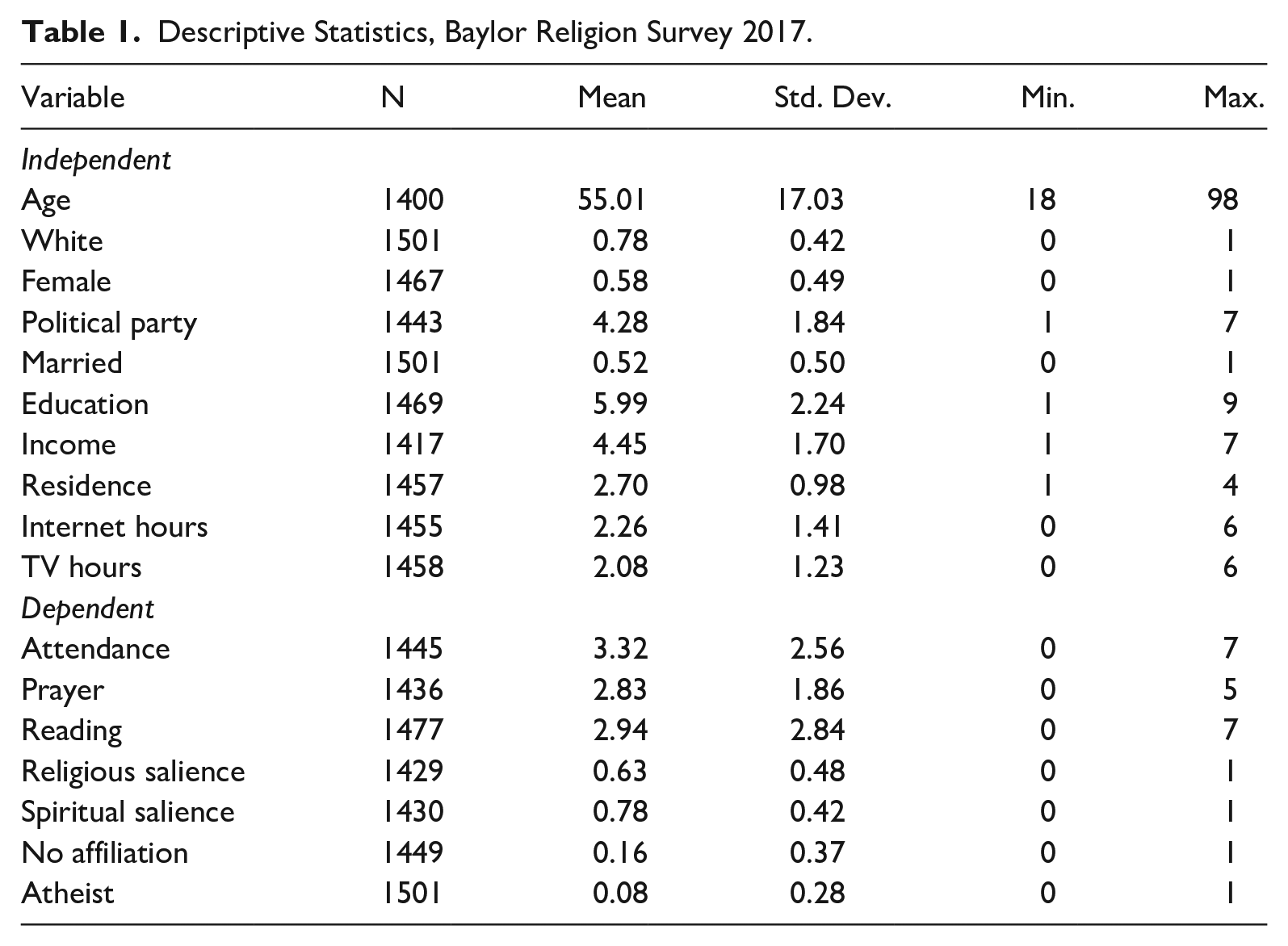
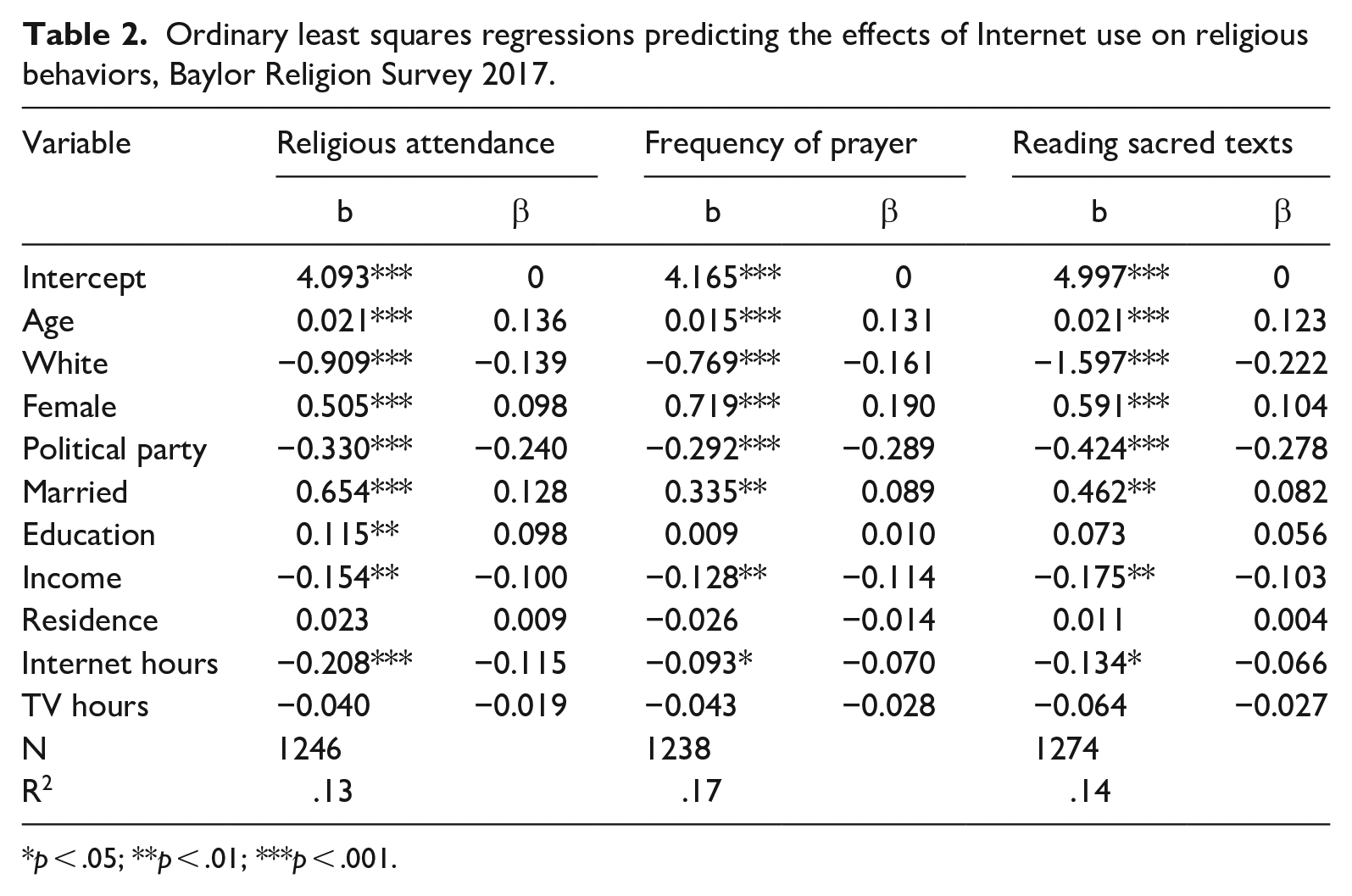
Table 1 provides descriptive statistics of the key variables used in this article. In Table 2, I run ordinary least squares regression models to predict the effects of Internet use on various religious behaviors. The outcome variables in Table 2 include religious attendance, frequency of prayer, and reading of sacred texts such as the Bible, Koran, or Torah. Accordingly, if my first three hypotheses are correct (H1, H2, and H3), the measure of Internet use should have a statistically significant, negative effect on these religious outcomes.
Descriptive Statistics, Baylor Religion Survey 2017.
Ordinary least squares regressions predicting the effects of Internet use on religious behaviors, Baylor Religion Survey 2017.
p < .05; **p < .01; ***p < .001.
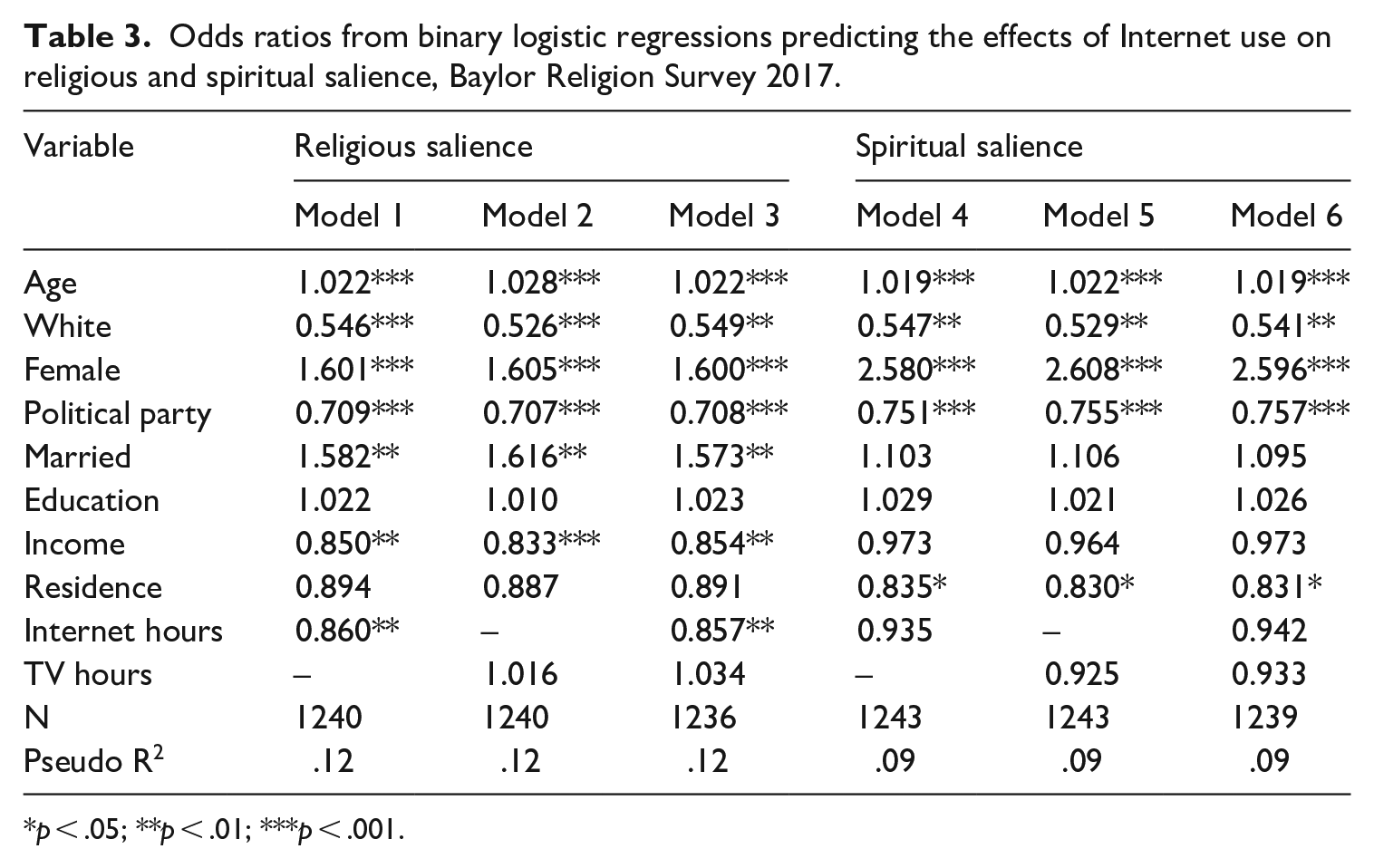
In Table 3, I run two binary logistic regressions that predict the effects of Internet use on religious and spiritual salience. Salience is an important construct that asks respondents to consider how religious and/or spiritual they are. Distinct from religious behaviors, salience taps into an important sense of self-identification and therefore detects how respondents construct their sense of self in relation to religious and spiritual dimensions. Typically, while most respondents conflate religion and spirituality and find little distinction between the two (Hill et al., 2000), the inclusion of two dependent variables in Table 3 – the first measuring religious salience (H4) and the second spiritual salience (H5) – allows for a more nuanced approach. For analytical purposes, binary values are assigned to the responses so that individuals who are not or slightly religious = 0 while those who are moderately or very religious = 1. Similarly, respondents who are not or slightly spiritual = 0, whereas others who are moderately or very spiritual = 1. Table 3 also includes models that separately test the effects of Internet use (Models 1 and 4) and television viewing (Models 2 and 5), while other tests predict the effects of Internet use and television viewing in the same model (Models 3 and 6).
Odds ratios from binary logistic regressions predicting the effects of Internet use on religious and spiritual salience, Baylor Religion Survey 2017.
p < .05; **p < .01; ***p < .001.
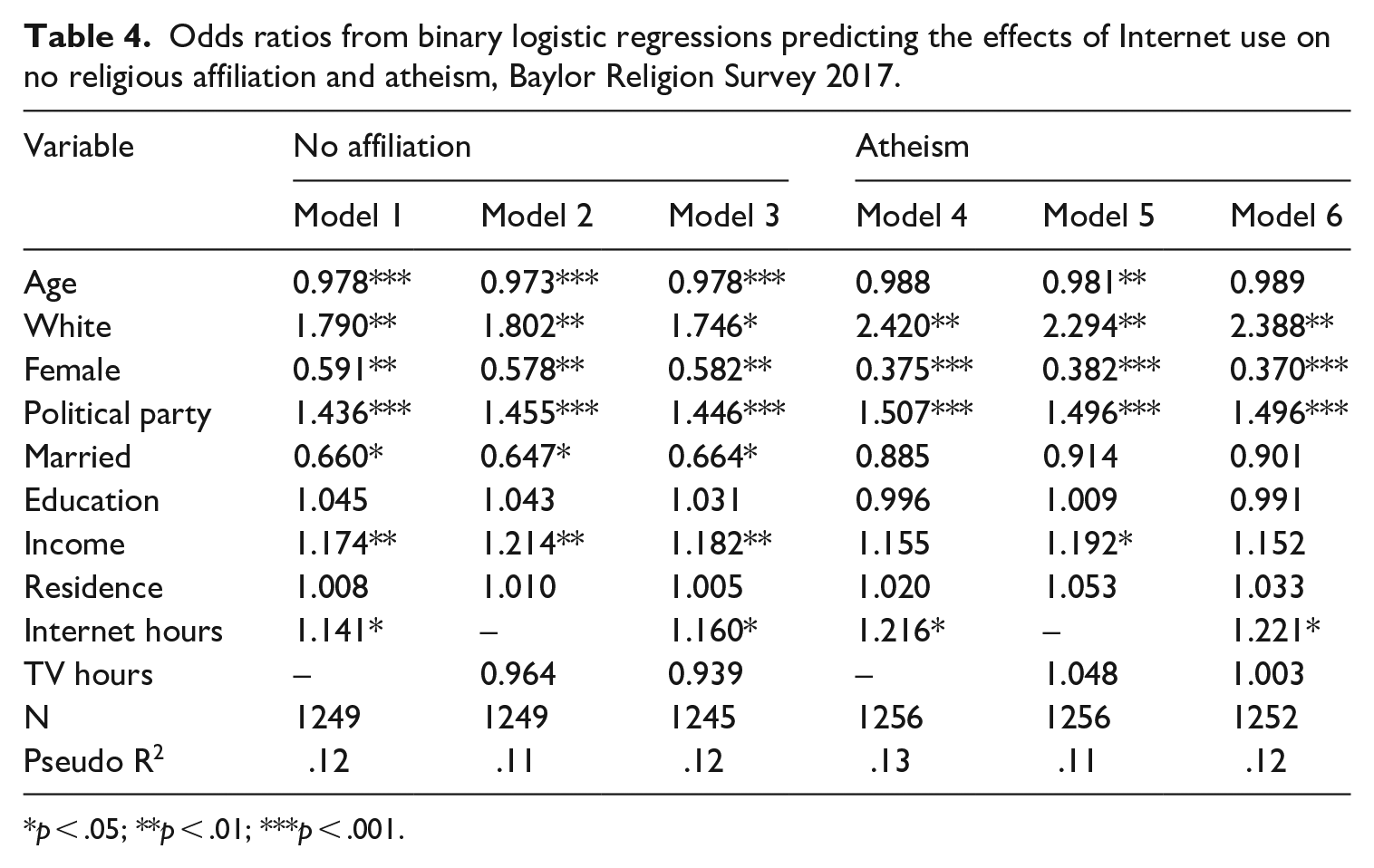
Finally, Table 4 shows results from binary logistic regressions that aim to determine whether Internet users are statistically more likely to eschew religious affiliation or belief in God. Accordingly, Models 1–3 in Table 4 predict the odds of being religiously unaffiliated and test my hypothesis (H6) that Internet users are less likely to be religiously affiliated. Models 4–6 investigate whether Internet users are statistically more likely to be atheists (H7). As with Table 3, Models 2 and 4 separately test the effects of watching television on these religious outcomes and are included with the purpose of determining whether Internet use is distinguishable from other types of media consumption and technology use. Taken together, these hypotheses and the methodological steps explained here intend to concretize Taylor’s concept of the buffered self. In this age of secularity, according to Taylor, what are the practices and daily routines which crowd out feelings of transcendence? Does greater Internet use impact one’s religious behavior and affiliation? Are heavy Internet users less likely to consider religion or spirituality to be personally important, and do they feel protected from those ‘cosmic forces’ that traditional religious affiliation has held at bay (Taylor, 2007: 38)? The results that follow should help answer these precise questions.
Odds ratios from binary logistic regressions predicting the effects of Internet use on no religious affiliation and atheism, Baylor Religion Survey 2017.
p < .05; **p < .01; ***p < .001.
Results
As the results from Table 1 reveal, the respondents in this study constitute a random sample of the US population. When the data are unweighted, respondents in the BRS are on average 55 years old. Furthermore, 78% of the respondents are White, 58% are female, and 52% are married. Concerning political party identification, 31% of respondents identify as independent, with a roughly equal distribution between Republicans (30%) and Democrats (39%). In terms of education, the average respondent holds a 2-year associate degree from a (community) college or university, though 21% report having a 4-year bachelor’s degree. Regarding technology use, the average respondent spends approximately 3.9 hours per day using the Internet, while she or he spends 3.5 hours per day watching television.
Concerning the dependent variables, 25% of respondents say they never attend religious services, and on the other end of the spectrum, 25% indicate that they attend about once a week. Regarding personal prayer, 27% say they pray several times a day, but 34% reveal that they never pray or do so only on certain occasions. As for religious and spiritual salience, more respondents claim that they are moderately or very spiritual (78%) than religious (63%). Finally, 16% of respondents on the BRS claim no religious affiliation, and 8% are atheists who say they do not believe in God.
Results from the ordinary least squares regression models in Table 2 suggest there are significant associations between religious behaviors, demographic traits, and technology use. With regard to religious attendance, several findings confirm previous research in the social sciences. For example, older individuals, females, and married persons are more likely to attend religious services, whereas Democrats in the United States and wealthier individuals are less likely to attend. Non-White minorities and those with greater levels of education are also more likely to attend religious services. As for technology and media, Table 2 shows that greater Internet use is linked with lower religious attendance, but there are no significant effects associated with watching television. Keeping in mind that the data are cross-sectional and cannot detect causal changes over time, nearly the same demographic and technological effects are connected to frequency of prayer and time spent reading sacred texts. Thus, while there are no significant associations between television viewing and religious behaviors, higher levels of Internet use are associated with lower levels of religious attendance, frequency of prayer, and the amount of time people spend reading sacred texts.
In Table 3, several independent variables have a statistically significant effect on religious and spiritual salience. For example, for each year of increase in a respondent’s age after 18 years, individuals can be predicted to have a 2% increase in considering religion or spirituality important in their lives, which may contribute to substantial differences between young adults and older generations over time. Racially, Whites and non-Whites are shown to have varying levels of religious and spiritual salience, with Whites being generally less religious or spiritual than non-Whites. Similarly, females have 60% greater odds of considering religion important than males, and they are over 2.5 times more likely than males to consider spirituality important. Apart from those variables which have significant effects across all models, some results reveal associations on religious salience but not spiritual salience. For example, married persons are statistically more likely than non-married persons to be religious, but they are not any more likely to report being spiritual. Similarly, increases in income can be shown to have a significant effect on one’s religious salience but not whether she or he considers spirituality to be important. Likewise, as for technology and its effects, increases in Internet use have a negative association with one’s sense of religious salience but not spiritual salience. As Table 3 indicates, for every unit of increase in Internet usage, individuals have 14 % lower odds of considering religion personally important in their lives, but the same is not true of Internet use and spiritual salience. At the same time, watching television appears to have no association with religious or spiritual salience. In brief, then, while there may still be substantial overlap between religion and spirituality in the eyes of many Americans, the impact of certain predictor variables – namely, marital status, income, and Internet use – are here shown to have significant associations with religious (but not spiritual) salience.
Table 4 displays the odds ratios and significant effects of certain variables on claiming no religious affiliation (Models 1–3) and declaring oneself an atheist (Models 4–6). In line with previous findings, one’s age, race, gender, and political party are shown to have statistically significant effects on whether or not one claims religious affiliation or states that they do not believe in God. As Table 4 reveals, older adults, non-Whites, and females are all less likely to be religiously unaffiliated or identify as an atheist. Furthermore, while Democrats are more likely than Republicans to be a none or an atheist, not all variables in Table 4 have statistically significant associations across the board. Being married, for example, is associated with one’s religious affiliation but not one’s (dis)belief in God. Finally, when Internet use and watching television are examined, Table 4 shows that Internet use has a positive association with being religiously unaffiliated and with being an atheist. While the data should be interpreted cautiously, the current models show that for every unit of increase in Internet use, respondents can be predicted to have 14%–16% greater odds of being a religious none (Models 1 and 3), and respondents have 22% greater odds of being an atheist (Models 4 and 6). Watching television, however, has no apparent effect on these religious outcomes.
Discussion and conclusion
The purpose of this article is to assess the possible impact of Internet technology on specific religious behaviors and identities. The research question behind this undertaking is relatively simple: Since the Internet has drastically altered social institutions in general and daily routines in particular, how might it impact the way people practice religion or integrate religion and spirituality into their personal identity and sense of self? Framing such questions, of course, requires a theoretical starting point. To that end, this article draws heavily from Charles Taylor (1992, 2003, 2007), who has extensively articulated the ‘modern social imaginaries’ that shape both what we do and how we understand our place in the world. As Taylor contends, the modern ‘buffered self’ emerges from this background and learns to navigate social complexities with less regard for organized religious practices or identities. This is the secular age that Taylor (2007) artfully describes and the context in which recent technologies have emerged. Surprisingly, however, Taylor fails to mention technology or consider how it has revolutionized modern social life. Also noticeably lacking in The Secular Age are quantitative studies that can corroborate the trends and patterns which Taylor traces in his history of ideas approach. This article, therefore, spotlights a Taylorian concept – the buffered self – and grounds this abstraction in specific practices that can be empirically tested. To recap, the results lend support to six of the seven hypotheses put forward in this article:
Internet use is negatively associated with religious attendance (H1), frequency of prayer (H2), reading sacred texts (H3), and considering religion personally important (H4), but there is no association between Internet use and spiritual salience (H5). At the same time, Internet use is positively associated with being religiously unaffiliated (H6) and being an atheist (H7).
Naturally, these findings prompt a further round of questions. What is distinctive about Internet use that makes it negatively associated with these religious behaviors, especially considering that other practices such as watching television apparently have no effect? How could activities and routines as mundane as surfing the Internet weaken the importance that individuals place on religion and spirituality? Furthermore, why is the Internet, though still a relatively recent technology, a possible culprit and player in a nearly two hundred-year-old debate on secularization?
Putting to bed these questions will require further work, but even so, researchers can look to previous studies and pay attention to Taylor’s accomplishments in The Secular Age to put forward some provisional answers. First, despite being a relatively recent technology, the Internet is distinctive in its meteoric rate of adoption. Rivaling the television for rate of diffusion (Putnam, 2000), the Internet now commands more user time and attention than television. As the results from this survey indicate, the average consumer spends approximately 3.9 hours per day on the Internet and 3.5 hours watching television. Thus, whatever the effects of the Internet may be, they will likely become more pronounced as this technology becomes ubiquitous. Furthermore, as the findings in this article suggest, Putnam’s (2000) concerns that the television is largely responsible for declines in civic engagement may now carry over to the Internet.
Second, one might object that Internet use by itself cannot weaken religious or spiritual salience because the Internet is just a neutral tool incapable of producing such change. While flitting from one webpage to another may be a mundane occurrence for many, scholars have persuasively shown that the Internet embeds certain values and assumptions that may be contrary to religious customs (Goh, 2005; Tufekci, 2018; Twenge, 2017). Perhaps, runs another objection, time-related practices displace other social practices, not how individuals construe the importance of religion and spirituality in their lives. Here too, however, Taylor suggests otherwise, for he reminds us that secularization is not merely a ‘subtraction story’ where religious authorities gradually fade out. Rather, ‘the interesting story is not simply one of decline, but also of a new placement of the sacred or spiritual in relation to individual and social life’ (Taylor, 2007: 437). Put differently, while religious institutions might lose some of their momentum in the modern world (Chaves, 1994), something must fill their place, and Taylor, along with other scholars, argues that secularization occurs today alongside self-directed spiritual quests (Heelas et al., 2005; Houtman and Aupers, 2007; Huss, 2014). Applied here, this may explain why Internet use is associated with lower levels of religious salience but not spiritual salience.
Third, the fact that the Internet is a relatively new technology does not preclude its possible secularizing or deinstitutionalizing effects. Using GSS data, Downey (2014) has already shown that the rise of nones, which began in the early 1990s, occurs alongside the diffusion of the Internet. The results in this article indicate that increases in Internet use are associated with 22% higher odds of not believing in God, even after controlling for numerous demographic variables. Explained by way of Taylor’s lexicon, Internet technology may act as an insulating, protective buffer against the conditions which make belief in God more likely.
These points aside, there are limitations to this project that require further mention and which point to profitable areas of inquiry for future researchers. First, the main independent variable used in these analyses measures Internet use, but this measure undoubtedly captures a variety of online activity and differs from user to user. Some people depend on the Internet for their work, others use it for leisure, and many toggle back and forth between the two. Are these web activities uniform in their effects? While I have chosen to analyze the broadest, most inclusive Internet variable found in the BRS, future researchers may wish to disentangle the effects of using the Internet for work and leisure or investigate the effects of time spent on social networking sites.
Second, beyond the issues present for the key independent variables, there are problems with studying the religious outcomes analyzed in this article. Across most religion surveys in the West, variables are geared toward measuring organized, Abrahamic faith traditions and are less useful if researchers want to study spirituality, New Age beliefs, Eastern religions, or other contemporary religious movements. All too often, quantitative researchers miss the complexities and ‘cross-pressures’ (Taylor, 2007) that attend religion and spirituality in an age of ‘multiple modernities’ (Berger, 2014; Eisenstadt, 2000). At the same time, philosophers like Taylor would do well to consider the many quantitative studies that track declines in religiosity as well as the various theoretical contributions that have been made in the last several decades. Especially fruitful in this regard are birth cohort studies that seek to understand longitudinal changes (Bengtson et al., 2013; Twenge, 2017). The fact that the data from this study are cross-sectional thus represents another limitation to this article, and future researchers may wish to conduct studies that can explain the religious differences of birth cohorts independent of other technological factors.
Third, it is possible that religious behaviors and identities predict Internet use rather than vice versa. Some researchers have shown that religiosity diminishes Internet addiction for certain populations (Charlton et al., 2013), and subsequent analyses with the data in this paper indeed show that religious nones use the Internet more than other religious groups. Does Internet use contribute to religious disaffiliation, or are nones spending more time online for other reasons? Perhaps both are true, but researchers may wish to locate or launch longitudinal projects that are sensitive to temporal ordering and causation.
As the Internet cements itself as the defining technology of the age, it will undoubtedly demand the attention of more researchers who wish to know not only what it does for us, but to us. Apart from some notable exceptions, mainstream sociologists in the United States have been rather late to the party and have failed to explore the many ways the Internet impacts social and especially religious life. This is fruitful territory to explore, however, and as social life is increasingly mediated through online platforms, scholars would benefit from paying more attention to how the Internet facilitates unforeseen consequences. As this article makes clear, higher levels of Internet use are associated with lower levels of religiosity. By acting as a buffering agent, the Internet insulates and individualizes, blocking out the structures that make belief in God more plausible and the communities that make affiliating with religious groups more likely.
Footnotes
Acknowledgements
An unpublished version of this article appears in McClure PK (2018) Modding my religion: Exploring the effects of digital technology on religion and spirituality. PhD Dissertation, Baylor University, USA. My committee – Paul Froese, Chris Pieper, James Roberts, and Lindsay Wilkinson – deserve much credit for their guidance. I would also like to thank the editors of Social Compass and the three anonymous reviewers for their valuable feedback.
Funding
The author(s) received no financial support for the research, authorship, and/or publication of this article.

Author biography
Address: Department of Sociology and Human Services (Office: Carnegie 113), 1501 Lakeside Drive, Lynchburg, VA 24501, USA.
Email: