




Abstract
In sociological discussion the relationship between traditional religion and alternative spirituality has been variously defined on the basis of two main theoretical positions which perceive them as either mutually exclusive – according to the ‘spiritual but not religious’ formula – or as interdependent. This debate, mostly taking place in Northern Europe and the United States, does not take into account the specific characteristics of other geographical areas such as Southern Europe. The aim of this article is to fill this gap in empirical research by presenting data from a sample survey and interviews with young people in various Italian cities. A qualitative/quantitative analysis of the data shows, on one hand, that alternative spirituality is defined under the cultural influence of traditional religion, which is to say Catholicism functioning as an exemplary model of reference and, on the other hand, suggests broadening the focus of reflection to the religion-spirituality-secularism triad, interrelated fields competing to shape young Italians’ beliefs and practices.
Introduction
The concept of spirituality has a millennia-old tradition during which its semantic value has changed several times. In the earliest Christian texts, spiritualitas indicates what is opposite to the body and matter. Later Mediaeval Scholastic theology embraced a variety of meanings related to appropriate Christian behaviour or whatever fell within ecclesiastical jurisdiction. In subsequent centuries it acquired the sense of the essence of true religion as distinct from what belongs to the temporal sphere. From this point on, the concept tends to identify the subjective, interior dimension of religiosity as distinct from the institutional, public dimension of organized religion (Huss, 2014).
This last shift is the one used today, in contemporary religious studies debate, where the ‘religion’ and ‘spiritual’ categories denote separate, antithetical domains (Heelas and Woodhead, 2004), in accordance with the widespread ‘spiritual but not religious’ formula. However, this distinction is not unanimously accepted (Hunt K, 2003). Indeed, it is at the centre of a lively controversy between those who claim that spirituality is nothing but a dimension of religion (for example Glock’s 1973 position) and those who assert that it is replacing religion (Roof, 1994; Zinnbauer et al., 1997; Wuthnow, 2000; Partridge, 2004; Possamai, 2005). In the opinion of those who insist on separating the two concepts, contemporary spirituality – variously defined as ‘alternative’, ‘non-institutional’, ‘non-Church’, ‘feminine’ and ‘new Age’ – seems free from the moorings of religious traditions, not being a dimension of religion so much as a new kind of religion designed to cultivate the deeper self according to the personal-research paradigm whose genealogy may be traced back to Troeltschean mysticism and the cultic milieu (Campbell, 1972).
This new modality of religious experience has earned its own conceptual space and an ample selection of terminological labels defining its multiple facets, progressing – to give but few examples – from ‘holistic’ to ‘engaged’, from ‘embodied’ to ‘natural’ spirituality (Moberg, 2012).
In this growing literature, however, a limitation can be seen in the tendency in various places of empirical research to focus on the United States and Northern European contexts, ignoring other geographical areas, for example, Southern Europe. The present article will consider the Italian case (which has so far been little studied) examined through a sample survey and interviews directed towards young people in various cities, revealing the emergence of partially different tendencies from those just described. The survey was carried out in Italian 1 among a random sample of 1,450 young people between 18 and 29 years old (divided into two groups: 18-24 and 25-29) living in Italy, representative of geographical areas, the size of their commune of residence and gender (Garelli, 2016). It was conducted by the demoscopic GFK-Eurisko Institute of Milan. 2 The questionnaire consisted of 50 questions about the main religious dimensions (belief, practice, belonging, experiences), focussing particularly on the themes of atheism, the plausibility of believing and of religious and spiritual socialization. In tandem, during 2014 and 2015, 144 interviews were carried out among university students from various faculties in two Italian cities (Turin and Rome) having very different socio-cultural variables. In this way, the leading actors were enabled to make their voices heard so that we could understand in greater depth our quantitative data focussing on statistically insignificant – but rich in the lived experiences of the young people involved – data.
Based on analysis of the data we have gathered, we shall show that the spiritual dimension, in Italy, is not altogether independent of institutional religion but rather, seeing that the latter is the fundamental cultural model of reference for those undertaking a spiritual-type itinerary. Thus the Italian case is interesting because of the contribution it can make, on one hand, to the theoretical debate about the link between the fields of spirituality and religion and, on the other, to the unifying relationship between spirituality and laicism/atheism – an aspect upon which it would be worthwhile to dwell some more. As suggested by our survey data, the borders between spirituality, the cultural influence of the organized Church and lay (or openly critical of faith) positions are porous, to the extent that it would seem to be more profitable to talk about respective areas of overlapping than three separate domains. This takes into account the fact that the contemporary category of spirituality should not be unilaterally understood as the result of progressive separation from the Church, and therefore as an effect of a long period of historical processes of secularisation, but also as a project of modern secularism and laicism. Since at least the 1800s, spirituality has followed a path in parallel with Western rationalism, both united by the idea of lay, personal, pragmatic and immanent seeking for truth, and distinct from the ecclesiastical hierarchy’s dogmatism and traditionalism (Van der Veer, 2009). In the following pages we shall analyse the attitude of young Italians towards religious faith with particular emphasis on the nexus between all these elements. Sections 2 and 3 are based on the survey (See Note 1). Section 4 analyses the interviews that we carried out with young people. The survey findings are discussed in Section 5. Section 6 is the conclusion.
Are young Italians attracted by spirituality?
In order to understand the relationship between young Italians and spirituality, one of the questions we asked our sample for this research was: ‘Do you consider that you have a spiritual life, that you cultivate values of the spirit?’. Analysis of replies illuminates a universe which has not been examined previously in Italy. First of all, it turns out that the essence of spiritual life, values of the spirit and the relationship between religion and spirituality are quite complicated topics, on which there is little or no reflexivity. The high proportion (about 15%) of interviewees who admit they are not very clear about the subject makes their distance from it evident. As far as the others are concerned, even though almost a quarter (24%) don’t know what to make of spirituality, and a similar portion (23%) interpret it as a quest for harmony and wellbeing, it is still true that a relative majority (30%) claim to have a religious and spiritual life which they experience personally. For these last, spirituality is an intimate, interior and personal quest in which they invest their creativity. Only for a small segment (9%) does spiritual life coincide with religious life according to the principles of their religion and faith in God, accepting the mediation of the Catholic Church even in their most intimate and spontaneous relationship with the sacred.
To make sense of these positions, an in-depth examination of the religiosity of our sample would be useful. It would reveal that, although not many young people experience spiritual life according to the principles of the Catholic Church, the tendency to cultivate a spiritual life generally intensifies parallel with an increase of faith in God and attendance at ceremonies: 37% of non-believers, 24% of believers with some doubts and 14% of believers with no doubts do not have a spiritual life; the proportions are 44% of those who never go to Mass, 20% of those who go annually and 6% of those who go every week. These trends suggest that most Italian young people, like their parents by the way, position their spiritual quest mainly within church religion, although undertaking an itinerary which they consider ‘personal’ – in line with what Berger (1980) terms ‘the heretical imperative’; which is to say, the cultural necessity to tailor faith because only in this way can it be authentic, satisfying the aspirations and identity which the individual believes she/he has. In other words, when one speaks about spirituality, young people as a rule think about Catholicism’s expressive forms, without referring to other horizons or meaningful paths. This tendency to subjectivise faith has been a fact of life for some time in the Italian Catholic context where there has been a breakdown of the official system of beliefs accompanied by a decoupling of individual practices (such as prayer) from collective ceremonies (Cesareo et al., 1995).
Convinced that it is not possible to understand spirituality without positioning within the socio-cultural environment where it interacts with religion, we develop the abovementioned tendencies by studying them through the lens of Italian Catholicism. The data we possess confirm that spirituality is mainly cultivated within Catholicism. Many observations concerning different types of Catholics 3 in Italy are recorded in Table 1. First of all, a consistent proportion (30%) of young people who associate spirituality with church religion are ‘convinced and active Catholics’, to which we can add another 26% who, remaining within the Catholic milieu, personalise their spiritual quest according to their nature. Further confirmation of the ‘religious-spiritual’ bond comes from ‘Catholics by tradition and education’. Among them 32% share the self-definition ‘I am religious and spiritual in my own way’, whereas 29% of those who claim not to have a spiritual life do so because of lack of interest in any form of spiritual quest, within or outside Catholicism. On the other hand the proportion of those who do not have a spiritual life increases to 42% among the ‘no religion’ group, the most likely to interpret spirituality as a general seeking after harmony and wellbeing.
Typology of religion and spirituality (%)
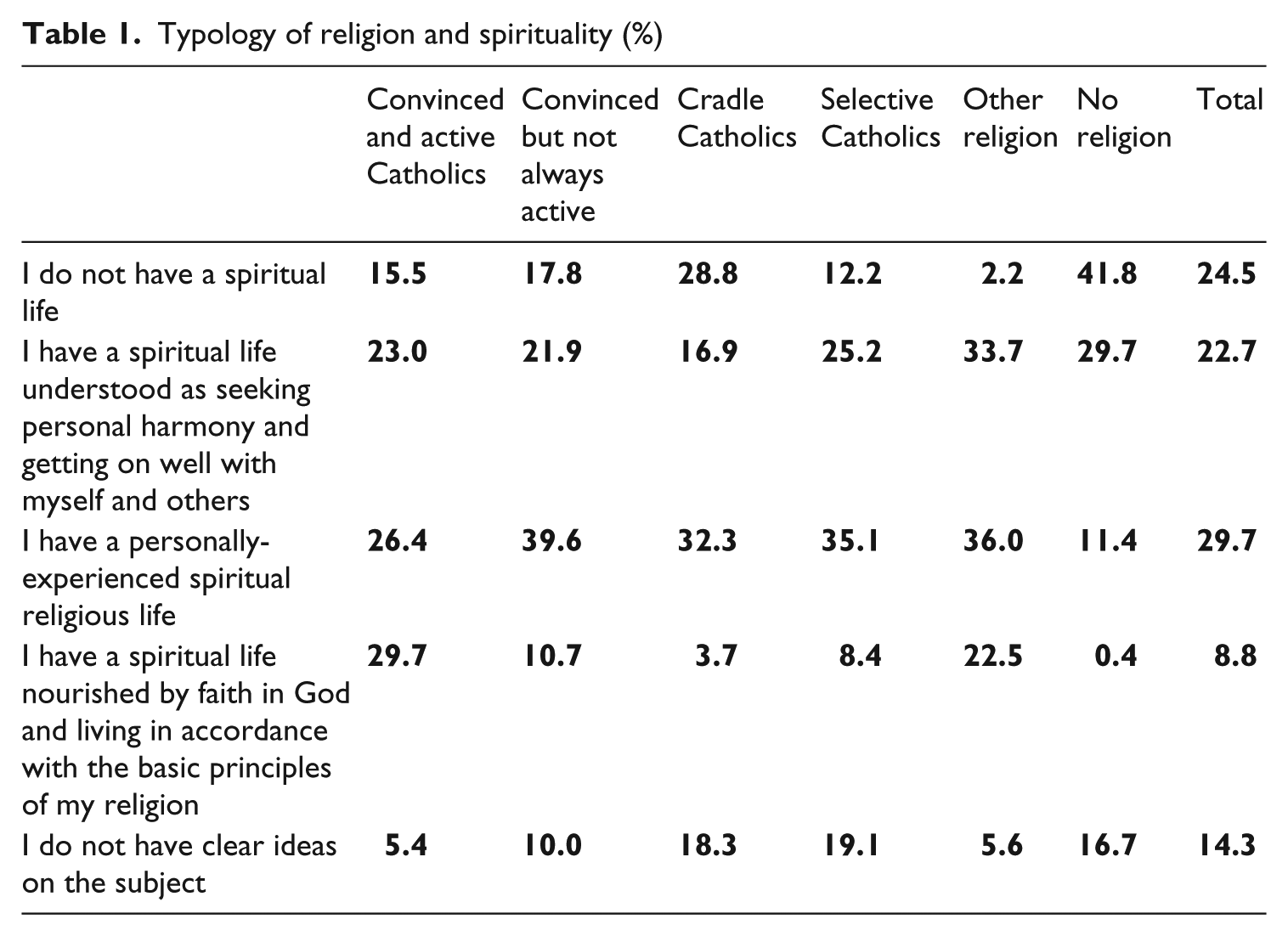
Unexpectedly, a considerable proportion (15.5%) of ‘Convinced and active Catholics’ declare themselves to be distant from a spiritual life. We may theorize that – differently from ‘Catholics by tradition and education’ who reject spiritual life because they are not even interested in official, prevailing models of religiosity – this group refuse the spiritual label because they are worried about potential confusion with the New Age fashions which the Catholic Church warns against. 4 But it is also possible to conjecture that, albeit ‘Convinced and active Catholics’, they are not interested in the intimate, emotive, spontaneous and mystical aspect of relationship with the sacred which the interviewees classify under spirituality.
Which young people most use the language of spirituality to describe their existence? To answer this question we shall focus on three crucial socio-demographic variables: gender, employment situation and geographical area. They are illustrated below, the space dedicated to each corresponding with the importance of the analysis findings.
Gender
Since 1970 surveys on Italian religiosity have shown women to be the hard core of the Catholic faithful (Garelli et al., 2003; Cartocci, 2011; Garelli, 2014). Our data (Table 2) confirm that, even among youth, more women than men experience a spiritual life which is mainly cultivated in the nursery of Catholicism.
Gender differences in spirituality (%)
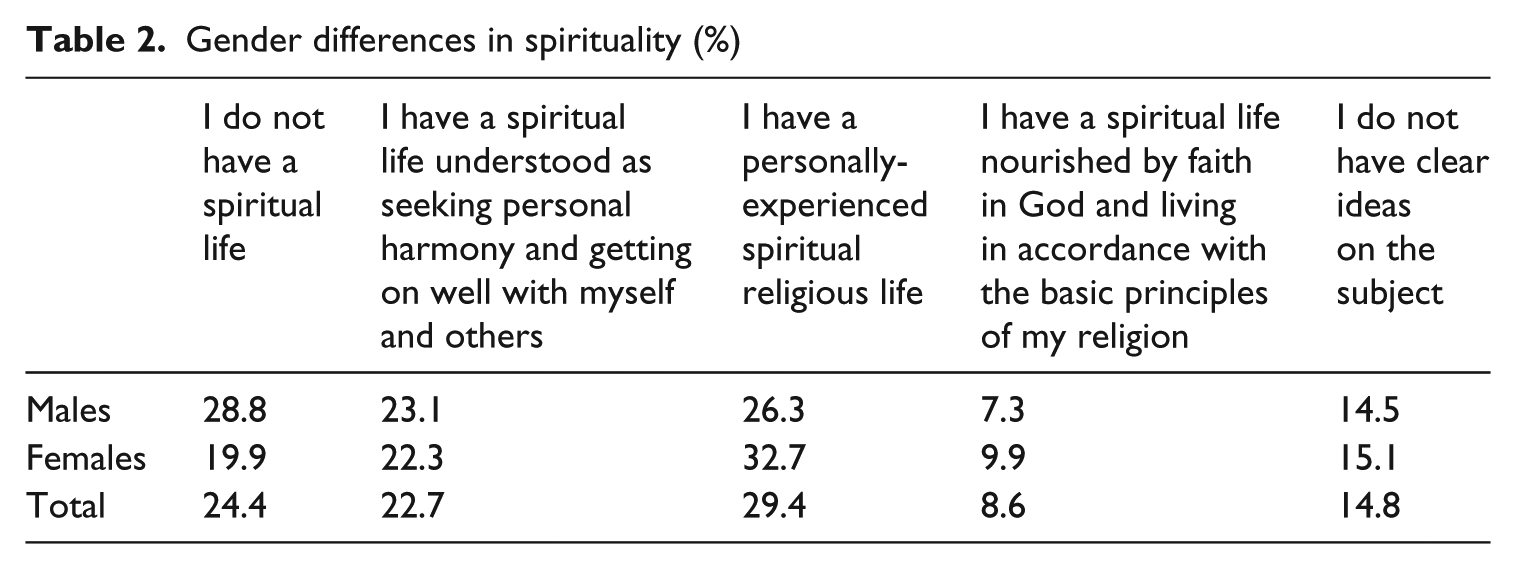
However, the same data, surprisingly, reveal that gender is not a discriminating factor among those who unify religion and spirituality. We would have expected that more females than males would have opted for total agreement between the two (which is common praxis in the Catholic Church); yet girls and boys equally (10% vs 7%) share this view. Nor does gender discriminate among conceptions of spirituality which do not explicitly refer to religion: the same proportion (about 23%) of girls and boys understand spirituality as seeking harmony and wellbeing.
Discontinuity with the past turns out to be even more disruptive when one considers another datum which does highlight an important gender difference: women more than men (32.7% vs 26.3%) admit that they experience religious and spiritual seeking in a personal way. This fact induces us to apply even to Italy the designer-religion concept, a variant of the better-known ‘tailor-made religion’. According to the author who coined the expression (Rountree, 2004), designer-religion develops through women’s creative aptitude to build or (re-)invent the sacred. This innovative tendency, which Rountree discovered when studying a group of neo-Pagan women, has also been traced in traditional churches, especially in the US, through the birth of feminist liturgical movements and innovative ritual groups concerned with adapting liturgies to women’s tastes (Procter-Smith and Walton, 1993). Thus we may assume that designer religion, for Italians girls, means a personal re-working of the Catholic faith.
Can the above tendencies be considered as signs of the ‘female-style’ secularisation process – a novelty in Italy – spoken about by certain authors (Segatti and Brunelli, 2010; Crespi and Ruspini, 2014)? We cannot deal with such a complex question 5 here, but our investigation should offer at least one other revealing element of female religious transformations. Comparison between current research and that carried out some years ago (Garelli, 2014) reveals that whereas in 2007 there was a marked difference (36% versus 30.5%) between males and females who believed in God without any doubts, today women are more aligned with men (32% versus 30%).
This scenario casts new light on the possible future of Catholicism in Italy. If further research should confirm that young female Italians are not more inclined than their peers to accept and live in accordance with church-religion principles, it will be necessary to revise the traditional image of Catholic Italy which perceives women as the guardians of religious transmission.
Employment situation
Analysis of the relationship between employment situation and spiritual life (Table 3) reveals that, age being equal, those who are engaged in study and/or work are more likely to cultivate a spiritual life than those who are unemployed.
Employment situation and spiritual life.
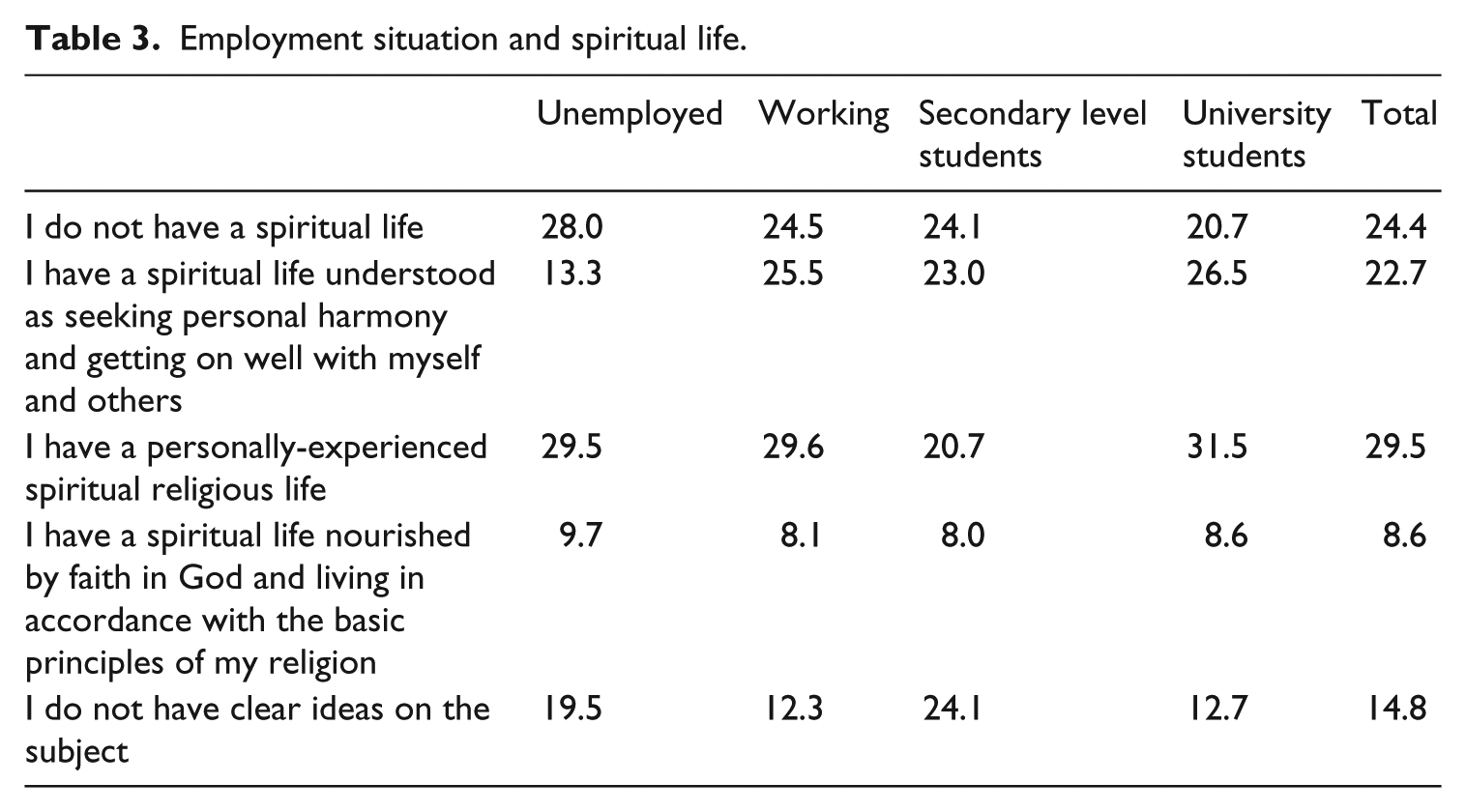
This difference persists even in the way of understanding spirituality: whereas 25.5% of working people see spiritual life as seeking harmony and wellbeing, only half of the unemployed share this vision – proving their distance from such an abstract and unattractive conception of the spirit in a climate of precariousness. The personal turning point in the way of experiencing religiosity/spirituality comes not only with age but also with the acquisition of a critical-reflexive attitude in one’s Weltanschauung: 31.5% of university students claim to have a religious and spiritual life lived in a personal way against 21% of secondary-school pupils. These data do not definitively prove that study and/or work trigger the desire to lead a spiritual life because (as is clear from the debate) there are numerous reasons (for example, peer-pressure, socio-economic class, media exposure) testifying that professionals are more interested in spirituality than others.
Geographical area
With regard to geographical area, the research confirms a number of already-familiar tendencies in Italians’ several religiosities, contributing to validate the image of a distinctly Catholic South where the ‘no religion’ category is proportionately much less numerous than the national average.
This picture confirms that for young Italians, as for their parents, religion and spirituality are not only compatible, but also overlapping domains. For this reason, far from being antinomian categories, there is no discontinuity between them. This means that, for most young people, faith itineraries are marked by a strong personalisation impulse (both in tune with the individual’s affirmation of liberty of choice – which less and less accepts normative answers from outside – and responding to the experience of diversity and pluralism), but always within official religion. Only a limited group, in the process of seeking autonomy from institutions, crosses the borders of the space defined by the institutions themselves and ventures into the offers of alternative spiritualities.
The holistic milieu of young Italians
In international literature alternative spirituality – often termed New Age and, more recently, the holistic milieu – is linked with phenomena such as esotericism, Spiritism, astrology, and also oriental traditions (yoga, shiatsu, tai-chi, reiki, aromatherapy, reflexology, acupuncture) which promise to facilitate contact with the inner self by means of harmonization of body, mind and spirit. The ‘holistic’ adjective reminds us of the promise which these practices combine to smoothen the process of connection with the ‘inner self’ and the ‘deeper self’ (Heelas and Woodhead, 2005).
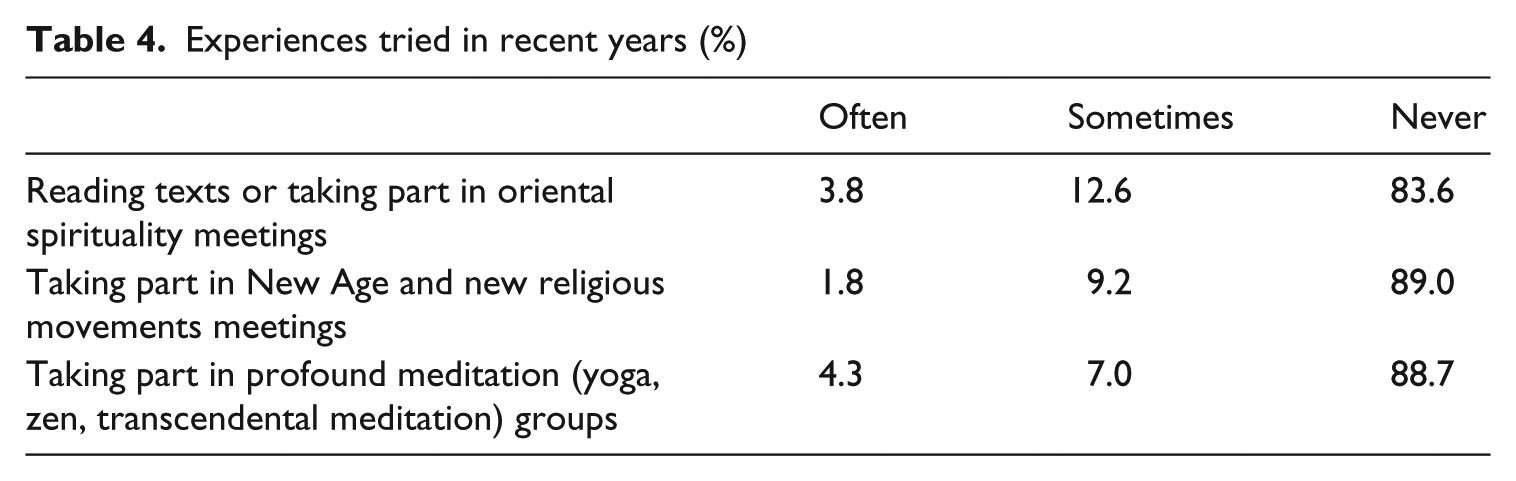
In order to find out about the presence of a holistic milieu in Italy, we asked our sample of young people whether, in the years immediately preceding the survey, they had taken part in specific activities belonging to (according to the literature) the field of non-mainstream religiosity: meeting devoted to Oriental spirituality; seminars on New Religious Movements or New Age; meditation, yoga or zen sessions. The data gathered do not portray a spiritual revolution: in Italy, those who have experimented with these practices or who take part regularly are a limited sector of the youth population. Despite some media which speak about an esoteric epidemic, we are not facing a popular phenomenon – which, by the way, is admitted by 70% of young people when they state: ‘seeking alternative religiosity involves a very small proportion of my circle of friends’.
Having said this, however, we cannot ignore the data which reveal considerable involvement in this milieu (Table 4): 16% of young people have attended Oriental spirituality meetings; 11% have taken part in New Age or new religious movements’ workshops; 11% have participated in meditation, yoga or zen groups. More relevantly, these percentages are a definite increase compared with the past. Since 2007 (Palmisano, 2010) the frequency of meetings about Oriental spirituality has increased by 5 percentage points, that of New Age and new religious movements seminars by 7 percentage points and of meditation, yoga and zen groups by 6 percentage points. The increase is particularly clear if we focus on an analysis of the hard core, those young people who claim to have taken part in all the surveyed activities: in 2014 the ‘fully involved’ were 7% (as opposed to 1% in 2007). On the other hand, those who have tried at least one of the three activities mentioned are 19% (15% in 2007).
Experiences tried in recent years (%)
But such involvement does not permit us to confirm the idea that these young people have abandoned religion in favour of the spirituality inherent in New Age, zen or transcendental meditation, to give but a few examples. The offers of the holistic market and the reasons motivating young people to venture into it are so various and differentiated that it is not possible to consider them, for this reason alone, spiritual seekers, new agers or potential converts. Nor can we be sure that they attribute an exclusively spiritual value to their attendance: it is well-known that it is mainly secular aims – health, cultural interest, the need to be social and the desire to escape the boredom of everyday life – that trigger these experiences. Ever more so because the religious and philosophical principles grafted onto this kind of offer are rarely made known to the practicants and in any case it is likely that during the Westernization process they end-up being domesticated. As Bruce (2002) reminds us, the supporting principles of many meditative forms of Hinduism and Buddhism are re-interpreted in a western way: that is to say emptied of their striking heritage in order to appear on the market in vague, imprecise, ready-to-use forms, as has happened to the concepts of cosmic consciousness and reincarnation.
Furthermore even data about the holistic milieu reveal that in Italy religion and (alternative) spirituality – far from being mutually exclusive categories – overlap. Although it is mainly young people who are not affiliated to a church religion or who attend very irregularly who are attracted to the holistic milieu, there is nevertheless a small segment of spiritual seekers who go to church every week and pray every day. These tendencies deserve to be studied and understood more deeply: it is now the time for Italy to initiate ethnographic research allowing the contextualisation of the data presented here in the framework of the practices and social interactions which characterize the holistic milieu.
Cultural influence of religion outside the Church
The hypothesis of compatibility between the domain of religion and that of spirituality, with regard to Italian youth, seems to be strengthened partly by a qualitative analysis of the data available to us. The analysis focusses mainly on the answers which a sample of 144 young people gave to the question ‘Have you got a spiritual life?’, and we divided into four distinct ideal-type profiles: ‘Neither religious nor spiritual’, ‘Religious and spiritual’, ‘Spiritual seekers’, ‘Spiritual atheists’.
The Italian-language questionnaire uses two distinct terms (viz. religione and spiritualità) when referring to the fields of religion and spirituality. In spite of the fact that no explicit definition of either term is presented to interviewees, in both the questionnaire and interviews ‘religion’ is associated with the Church and institutions and ‘spirituality’ with the sphere of personal religious experience.
About a quarter of our interviewees may be included among those who demonstrate indifference towards the sacred sphere or who have developed an openly hostile attitude towards faith and religion in general. They reflect strongly polemical reasons, in the words of the ‘Neither religious nor spiritual’, which echoes and updates the anti-religious polemics born in the modern age with Illuministic, materialistic and atheistic criticism, portraying religion as obstructing human freedom, as illusion or as an irrational view of the world destined to be put to flight by scientific thought: I’m not interested in spirituality. I have never had a religious experience. I like to think of myself as an infinitesimally small grain of sand free from every belief with no power to change the universe. When I disappear I will turn into dust. Nothing more. I detest the idea of an other-worldy life (26-year-old male). I haven’t got a spiritual life and I have no intention of developing one. I don’t think I need to believe in anything outside myself. I believe that one is responsible for one’s destiny, and has no need to believe in God to have a full, happy life (25-year-old male). Scientific progress [Higgs boson] has proven the non-existence of a superior being. The fact is that the various religious denominations are having trouble keeping up with the times and social change (25-year-old female).
If their critical distance from faith and religion clearly denotes the ‘Neither religious nor spiritual’ group, in the other three interviewee profiles openness towards the spiritual dimension is accompanied by individual cultivation of relationship with religion, focussed specifically on their interpretation of Catholicism. This continuing harking back to the dominant religion among ‘Religious and spiritual’, ‘Spiritual seekers’ and ‘Spiritual atheists’ points to two crucial aspects. The first concerns the fact that the debate about spirituality in our interviewees is implicitly based upon a prototypical concept of religion (Paden, 1991), that is to say a specific religious model, Christianity and, more likely, Catholicism – the religion into which our interviewees were born and which informs their most familiar religious-cultural horizon. In the interviews, the theological concepts related to the sacred sphere, the conception of the divine and the transcendent thus reflect the patterns of Catholicism into which our young people were socialised throughout their lives. The second – directly connected – aspect indicates that the construction of spiritual identity, even for those who distance themselves most from the traditional Catholic system of beliefs and practices, is not detached from, but is rather built in relationship with Catholicism. Institutional church religion therefore remains in the background as a religious and cultural model, as an expressive lexicon, serving both those for whom it is a positive reference in their self-definition and those who use it as a polemical target. 6 We shall see in more detail how this relationship with Catholicism is defined among the three ideal types who give space to the spiritual dimension.
The first group is made up of the ‘Religious and spiritual’ group, about one-third of the sample: I have a spiritual life which I cultivate through my religion, weekly attendance at Mass, parish meetings, the Rosary and the Sacraments (25-year-old female). My spiritual life is staying close to God, who is almighty, omnipresent and can be reached at any moment through prayer. He is the one you thank for the good things that happen to you and you blame for the things you consider wrong. He doesn’t get offended! He loves everybody and He forgives (23-year-old female). I see God as a father. You don’t always believe in Him. You have to doubt yourself and find the answers for yourselves. But you know that He will always be there. And you find him in the church, always waiting (28-year-old female). I have a precious image of God, which I first saw in icon. Two people embracing, one of whom is Jesus. The icon is called ‘Jesus and his friend’ and this is my most intimate image. ‘My’ God is a friend who embraces me, supports me, and listens to me but, since we are friends, reciprocity is essential. I too must dedicate time to Him, listen to Him, stop and simply remain in his presence (26-year-old female).
These answers reveal an intimate and personal relationship with the divine, a faith which is nourished by lived experiences with emotional undertones, rather than been supported by a predefined doctrinal and dogmatic system. This kind of spirituality can be seen in the framework of traditional religion which presupposes its beliefs and values reflecting the concept of spiritualitas in its ancient meaning, which is to say an interior Christian faith distinct from – but not opposed to – faith as an institutional, public dimension of organized church religion (Huss, 2014). Although the words ‘Religious and spiritual’ may seem very different from ‘Neither religious nor spiritual’, both groups of youths talk in a way which presupposes Catholicism and church religion as their conceptual and cultural model of reference when reflecting upon their conception of the world and their spiritual identity.
The ‘Spiritual seekers’ are more open in their definition of their relationship with the sacred compared with traditional symbolism, with results which highlight the ongoing mystical tendency in various streams of contemporary spirituality (Lynch, 2007), eclectically constructing beliefs with variegated origins and reflexively re-interpreting Catholic theologically categories: God is not a single definite entity but rather a natural expression of cosmic equilibrium and the planet Earth. Identifying the divine in an anthropomorphic image is reductive and ‘self-centered’. As I see it, the divine is contact with everything, with the delicacy and natural beauty which for centuries we have been ignoring and destroying (23-year-old male). Mine is spirituality, not religion. It cannot be labelled because it is not conventional religion. I don’t believe in the God of religion (27-year-old male). I think that alternative spiritualities are quite widespread because they are not based simply on venerating a God but also on being mentally and physically healthy both in this-world and in possible next worlds (28-year-old male).
The last group of interviewees, the ‘Spiritual atheists’ is made up of young people who exhibit a clear desire to have spiritual experiences but are a long way from religion. They aspire to a spiritual life whose contents adopt markedly heterogeneous – and often ill-defined – outlines, characterized by ethical spirituality (Palmisano, 2010; Ammerman, 2013) where moral values tend to free themselves from the religious framework in which they were originally formed (Turner, 2012). The resulting lay spirituality indicates a this-wordly, immanent orientation directed towards valorisation of ‘seekership’ as a fundamental moment of an individual’s spiritual and identity path. In this itinerary emphasis is placed on the capacity to ask existential questions rather than on the answers obtained by this research: A spiritual life? Yes, I try to help other people as much as possible to do good – or at least not to do evil (29-year-old female). I have a spiritual viewpoint but not in a strictly religious sense. By spiritual I mean that I base my existence on values of sympathy and understanding. I act in such a way as to cultivate the spirit of values which improve existence, directed towards individual, spiritual wellbeing (24-year-old female). I do not believe in God, at least not in the God as a transcendental entity as portrayed by traditional religion. I believe, however, that there exists a set of values and principles upon which I base my moral choices. And this for me is God. I have my spiritual life even though it is not connected with a specific faith. I draw enjoyment and the spiritual from everyday life, reading books and taking part in cultural and charitable initiatives, which are a first-class spiritual gymnasium (29-year-old female). I have my spiritual life. I do not follow God or practise any doctrine. I cultivate it with things that happen to me for which I cannot find a logical, rational explanation (26-year-old male). I often ask myself whether it is possible, today, to believe still in God as presented by the Church. So I prefer to believe in something which is ‘mine’ and ‘non-defined’, even if that is God (24-year-old male).
Discussion
The debate informing contemporary sociology on the nexus between religion and spirituality is symptomatic of the problem preliminary to the definition of both camps. Rivers of ink have flowed defining religion, which divide a functionalist approach–what religion does–and a substantive approach–what religion is–(Bruce, 2009). Concrete linguistic usages of the concept of religion in both scientific and popular language suggest an alternative viewpoint. Paden’s (1991) perspective applying the prototype theory to this subject, elaborating it in a psycho-linguistic and cognitive context (Rosch, 1973), is particularly illuminating. According to this theory, a prototype is an example around which the members of a given category arrange themselves, based on their degree of greater or lesser similarity to it. Thus a prototype is a typical example gathering to itself the greatest number of characteristics to be found in a conceptual category. In light of this point of view, the definition of religion recurring in specialist and popular language seems to point to a category which functions as an exemplary prototypical model.
In our interviewees’ answers Catholicism constitutes the prototype of religion. Those who are mainly critical of faith (the ‘Neither religious nor spiritual’ youth), those inhabiting a church-religion environment (‘Religious and spiritual’) and those developing spiritual but not strictly religious positions – all elaborate discourses with a common reference to Catholicism as an exemplary religious model, whether explicitly or implicitly. This model supplies the repertory of theological and doctrinal concepts which, in line with the individual interviewee’s ideological position, is adapted polemically against the Church or religion in general, or within a traditional religious framework or, finally, towards a spiritual itinerary which – at least partly – liberates itself from religion ascribed by birth.
The affiliation of a member to a prototypical category permits greater or lesser degrees of closeness to the exemplary model (Lakoff, 1987): if on the one hand religion and spirituality can be understood as mutually exclusive and contradictory according to the ‘Spiritual but not religious’ formula, on the other hand they may overlap and may therefore be considered as open categories with regard to their characterising elements (Saler, 2008). The resistance of Catholicism as an exemplary model in our interviewees’ discourse denotes the – if not religious, at least cultural – influence of traditional religion in this respect and, therefore, the ‘family resemblance’ (Wittgenstein, 1958) between the notions of religion and spirituality when viewed on the level, not of their respective theoretical definitions but that of the way such terms are used empirically in the language of religious actors.
An analogous consideration can be carried out concerning the specialist language of sociology of religion. Scholars have amply underlined and recognized the novelties introduced by contemporary spirituality: for example, the centrality of the dimension of research aimed at discovering and fulfilling the inner self (Wuthnow, 2000), pragmatic and inner-worldly orientation (Hunt HT, 2003) and the creative composition of beliefs and practices by means of DIY and eclecticism (Barker, 2008). Nevertheless, a historical-comparative perspective may help to relativize the novelty and special quality of the phenomenon by interpreting it through its relationship with Eastern and Western historical and cultural conditions producing modalities of religious expression and organization comparable with those of the present (Gruzinski, 1999). For example, the globalisation and religious syncretism of Hellenism in the fourth century BC generated DIY phenomena not unlike those of New Age spirituality. In the East, spirituality has traditionally been seen as subjective, individual experience and as a research itinerary based primarily upon direct experience rather than dogmatic adherence to a doctrinal system. Buddha’s life, as narrated in the sacred texts, supplies an influential model of this kind of spirituality which traces modern patterns of relating to the sacred in Western culture.
A scientific definition of religion, therefore, is influenced by the socially informed point of view from which researchers observe the object of their study, and this point of view in tune with popular categories of religion is not exempt from being affected by the prototypical model of the culturally prevailing religion. This debate makes it imperative for us to inquire into the historicism of the abstract, formal notion of religion, investigating the Western and Christianized roots of its definition (Bergunder, 2014).
The hitherto little-studied Italian case helps to problematize the religion-spirituality nexus: even though a minority of our sample of young Italians seem directed towards alternative paths, the positions of the majority portray a religious identity where traditional religion and new spirituality are mutually and closely intertwined. Traditional religion offers the reference model of young Italians’ spiritual perspective, whereas spirituality supplies a repertory of critical arguments used to distance themselves from, or re-elaborate in a personal way, their relationship with institutional faith and religion. The critical attitude towards the traditional theological monotheistic conception of God as a transcendent, anthropomorphic object of veneration is eloquent in this regard. Our interviewees, albeit holding heterogeneous personal convictions, agree on deconstructing this image of the divine inherited from Christian religious culture and in drawing a different picture where the influence of mystical, pantheistic doctrines re-interpreting the God of Christianity as cosmic energy, as sacralised nature, with which they can relate directly and personally without the mediation of Church hierarchy.
Conclusion
The main limitation of the debate about contemporary spirituality can be imputed to the fact that most empirical research focuses on the United States and Northern Europe, neglecting other geographical areas such as, for example, Southern Europe. This imbalance has caused the distinction – reigning in religious studies – between religion and spirituality as separate, antithetical dominions. But this is, in our opinion, only one of the possible relations between the two fields. We assert that the ‘country variable’ – socio-cultural characteristics – influences the form adopted by spirituality as well as its relationship with religion. Recent research, although scarce, on how spirituality is understood and lived in Southern European countries demonstrates that these two categories interact in different ways and even overlap. The anthropologists Fedele and Knibbe (2013) show that many Catholics join alternative spirituality without ever abandoning the Church: this conclusion is based on ethnographic research carried in France, the Low Countries, Greece and Portugal. Women especially, while maintaining some connection with Church religion, try out the holistic milieu in seeking spiritual experiences which will satisfy their expressive needs and encourage a positive view of processes concerning their bodies (for example, celebrations in honour of menstruation, delivery and the menopause).
The Italian case contributes to the idea, already put forward by Fedele and Knibbe (2013) for Southern European countries, that religion and spirituality are contiguous and harmonious, rather than separate and contradictory, categories. But it does not simply show that the spiritual dimension is anchored in institutional religion; it demonstrates how religion and spirituality interpenetrate because, as we have said above, church religion is a basic cultural model of reference for those who undertake a spiritual itinerary. The positions of young Italians engaged in spiritual itineraries outside organized churches, and even those of ‘Neither religious nor spiritual’ youth, are critically and reflexively built on the basis of the dominant cultural model of Church religion: they refuse the latter’s authority and doctrinal dogmatism, but it is certainly still the reference prototype as far as religion and theological conceptions are concerned.
The second finding is that religion, spirituality and secularism are not always reciprocally exclusive fields, either analytically or empirically, but subject to the porous borders in the construction of beliefs and individual practices. As we have seen, even non-believers and atheists, while rejecting belief in any concept of the divine, undertake individual research paths which they consider as spiritual. The existence of porous borders between spirituality, church religion and secular (or openly critical of belief) positions is such that it would seem to be more productive to talk about their relative areas of overlap rather than three distinctly separated domains. These findings solicit us to re-interpret the classic religion-spirituality dichotomy in a trio of interrelated, non-mutually-exclusive terms for religion-spirituality-secularism.
With regard to future research, we believe that in order to understand the reciprocal influence of these three fields, ethnography will be decisive: because of its militant methodological role, it adopts a revelatory function which other sociological approaches find more difficult to accept. Being interested in practices, in what the social actors ‘do’, it is often able to show how things ‘really’ are, apart from actors’ emic discourses. Ethnographic studies of alternative spirituality groups would allow us to go beyond discourses produced by spiritual practitioners (often reflexive and aware of the criticisms which are often levelled against spirituality) and, by studying practices and social interactions, to explore whether the dynamics which can be found in these groups are really different from those which characterize churches or, on closer examination, are on a continuum with them.
Footnotes
Author Note
Stefania Palmisano wrote Sections 2 and 3; Nicola Pannofino Sections 1 and 4. Discussion and Conclusion were a collaboration between the two.
Funding
This research received no specific grant from any funding agency in the public, commercial or not-for-profit sectors.
Notes
Author biographies
Address: Department of Cultures, Politics and Society, University of Turin, Lungo Dora Siena 100, Torino, Italy
Email:
Address: Department of Cultures, Politics and Society, University of Turin, Lungo Dora Siena 100, Torino, Italy
Email: