




Abstract
Religion and religiosity are rarely the main focus of economic research; although, some studies have already shown the importance of religion for economic development. Previous research has also provided some evidence that religiosity matters in the process of formation of economic attitudes. Economic attitudes and culture in general affect social institutions and economic development, especially in the periods of institutional change. This article provides some additional evidence that religiosity has had an impact on economic attitudes in post-communist countries. Thus, religion shall be taken seriously as an explanatory variable when it comes to evaluation of transition process and its outcomes.
Even if revolutions, such as the one that ended communist rule in the Central and Eastern Europe, rapidly change political and economic regimes, the change in people’s attitudes usually comes at a slower pace. Political, economic and social attitudes shape the process of transition and institutions of the new regime. Religion appears to be particularly persistent under communist rule and capable of influencing those attitudes. Even though communist governments fiercely opposed religion and religious organizations, religion seems to be alive and well in post-communist countries. The question remains, however, how much influence it still has over people’s attitudes.
Anti-religious position is one of the particular characteristics of communist regimes. Religion represents a challenge to the totalitarian claims of the communist movement. All countries under communist rule have experienced oppression of religious organizations and believers. Despite the severity of communist measures, religion has survived; in some countries it has even strengthened, other countries have experienced religious revivals in the post-communist period. Religion could have influenced the post-communist transition in different ways, although the effect is not always apparent.
Post-communist transition is a specific case of institutional change. Institutions are always in flux; however, the transition is typically an open-end process where the new institutional arrangement is to be found by trial and error. The post-communist transition has been different. The expected outcome was for the former communist countries to mimic the Western institutions governing the political and economic system. Plainly said, these countries have been expected to adopt representative democracy as the new political regime and the market economy based on private property as the new economic arrangement.
In a centrally planned economy of communist regimes most of the productive property was supposedly under the control of the state. Despite the various nominal forms of ownership, such as collectives or cooperatives, the ultimate control of resources should have been in the hands of central planning agencies. In reality, however, actual property rights were often distributed among different agents at various levels of planning bureaucracy and production managements. The actual operation of the command system was often not unlike a market system with various informal bargains and black market prices.
The operation of the centrally planned economy fostered a specific set of socio-economic attitudes. People would often disregard the nominal ownership of resources and relativized theft; takings from ‘the common’ were often not regarded as immoral. Personal initiative was risky and thus avoided. Work morale deteriorated as it was not rewarded. Formal institutions that were perceived to hinder useful activities were disregarded and replaced with informal institutions of the black markets and mutual self-help. Entrepreneurship was driven underground.
The aim of the post-communist transition has been to change the framework in which economy operates. The new economic regime was envisioned to be based mostly on private property that would be well defined and protected. The market economy was expected to fix allocation of resources and restore proper incentives for labour and entrepreneurship.
Although the basic idea was clear, the vision of the final stage of transition has always been vague. Moreover, the right method of transition has been much disputed in the process. Both the formulation of the goal and the method were shaped by politics and limited by culture. Attitudes of the people became relevant to the newly established democratic government. Those attitudes were shaped by many factors, including religion.
The purpose of this article is to provide some additional evidence on the effect of religiosity in the formation of economic attitudes in post-communist Central Europe. Previous research has already established the role of religion in the post-communist region. This article employs previously unused data to verify this relation. It deals with a relatively homogeneous sample of Western Christian countries in the Central Europe and thus allows focusing on particular effects of different aspects of religiosity.
Central European countries comprise an interesting material for analysis. On one hand, they are homogeneous in terms of the dominant religion, they have similar historical experience and comparable geographical position. On the other hand, they differ in the actual religiosity, the communists had employed different strategies in those countries and the course of the post-communist transition also differed. Thus, the analysis avoids some of the problems encountered with nations of diverse religious and historical background; yet, the diversity is sufficient to provide interesting results.
The outline of the article is the following. The first part provides the theoretical background that motivates the present research; it surveys previous literature on the subject, provides an overview of the situation in the individual countries, and describes empirical strategy used in the article. The second part presents the data and some interesting relations among them. The third part contains the statistical analysis. The final part discusses results and concludes the article.
Theoretical background and previous research
Previous research of religion, economy and economic attitudes
The connection between religion and economic performance dates back to the well-known contribution of Max Weber (1905) on the role of Protestant ethics in the rise of capitalism. The issue has been a part of a broader debate on the relation between religion, and culture in general, and economic outcomes (Beugelsdijk and Maseland, 2011; Williamson and Mathers, 2011; Guiso et al., 2006). Economic attitudes are among the possible explanatory elements linking religion to economic outcomes.
Over the past decades, several articles – both theoretical and empirical – have been devoted to examination of the famous Weber’s thesis. There are diverse theories about the mechanism through which religion affects economic life. Weber suggested the religious ethic of Protestants as the chief element in the rise of capitalism and subsequent economic growth. Others, like Becker and Woessmann (2009), claim that human capital, especially higher literacy among Protestants, account for the economic changes studied by Max Weber. Blum and Dudley (2001) provide an explanation that combines human capital with network effects resulting from higher trust among Protestants; such an explanation partially supports Weber’s thesis, as it refers a particular code of ethics, although it does not focus on the work ethics. Authors like Stulz and Williamson (2003) and Berggren and Bjornskov (2013) show how religion affects institutional settings.
Economic attitudes provide a possible link between religion and economic performance. It is evident that, beside political process, economic attitudes play a major role in determination of economic institutions and outcomes. Inspired by Weber, several authors have examined different religions and their ethics. Bulgakov (2008 [1909]) discussed specifics of Russian Orthodoxy and he notes the similarity in preferences for labour and asceticism in both Protestantism and Orthodox Christianity. Novak (1993) criticises Weber for his interpretation of the Protestant ethic, which he contrasts with the Catholic or Christian ethic, and analyses Catholic social doctrine to show its compatibility with capitalism. Putnam et al. (1993) suggests that hierarchical religions, such as Catholicism and Eastern Orthodoxy, discourage horizontal ties and formation of trust. 1 Finally, Lal (2001) describes how Western Christianity fostered liberalism and individualism.
A specific focus on economic attitudes, which is also adopted in the present article, has been introduced by Guiso et al., (2003). It focuses on the relation between religion and economic attitudes at the individual level. If there is something intrinsic to a certain religion with regard to economic performance, it should manifest itself at this level. A cross-country analysis does not allow separating those characteristics of religion that are absorbed in nations’ culture or institutions. The religious structure of a society may simply be correlated with other historical factors. Furthermore, the cross-country analysis largely ignores the intensity of religiosity. Guiso and his co-authors show that religious beliefs are associated with economic attitudes conducive to higher income and growth. These effects are not uniform across different religions and majority-minority status matters as well. Western Christianity seems to be more positively associated with growth-promoting attitudes than any other religion; although the ranking between Catholicism and Protestantism is not clear.
The same strategy has been applied specifically to the post-communist countries (Minarik, 2014a). The analysis shows that despite many decades of communist rule, religion still influences economic attitudes in the post-communist societies. Although the results do not perfectly correspond to previous studies, generally, the impact of religion is similar in post-communist countries and the rest of the world as captured by Guiso et al., (2003). Religion appears to be conducive to transition from centrally planned economy to free market and economic attitudes of religious people regardless of their denomination seem rather favourable to economic activity. Still, even in the post-communist region it appears that Western Christianity is more compatible with the free market economy than Orthodox Christianity and Islam.
An older study of this kind by Giorgi and Marsh (1990) focused specifically on the work ethic. Using data from the European Values Survey, Giorgi and Marsh studied the link between Protestantism and work ethic, as suggested by Max Weber. They conclude that although individual religiosity matters to some degree, the majority religion is of more importance. Indeed, the work ethic was endorsed most strongly by atheists according to the survey data. Even when controlling for personal religiosity, the Protestant cultural link does not disappear.
Arrunada (2010) revisits the problem, but distinguishes between work ethic and social ethic. They both are relevant for economic performance; although, they are not the same and the distinction helps accounts for the difference between Catholics and Protestants. While Weber has suggested that the prosperity of Protestants is due to their work ethic, Arrunada shows that there is no significant difference between Catholics and Protestants in this respect. However, Protestants differ in their social ethic, which enhances their mutual social control, support for institutions and dealings outside the close circles of family and friends; thus the Protestant values may indeed promote capitalism and economic growth.
Religion under communist rule
There is a good reason to believe that the post-communist countries are different from the rest of the world. It is also reasonable to believe that religion may explain the differences in the transition among the post-communist countries, at least to some extent. Communist regimes of the former Soviet bloc were authoritarian (if not totalitarian) regimes. Their governments controlled not only politics and the economy, but every aspect of human life. As we focus on the formation of attitudes, it is important to note that the regime had strong control over education, culture and leisure time activities and all these areas were actively used to indoctrinate people with the communist ideology.
As we focus on religion, it is important to note that the communist ideology is atheist. In all the countries of the Soviet bloc, governments sought to undermine and eventually destroy churches and religious organizations. These were often forced to operate clandestinely and focus on their survival more than anything else. The potential of churches and religious organizations to influence attitudes was relatively small compared to countries of the Western world.
The position of churches differed across the Eastern bloc. In Poland, the Catholic Church enjoyed very prominent status in the society and the communist regulation was less oppressive compared to other countries of the Eastern bloc. The Church had a historical position of an ‘opposition church’ against the occupation of Poland by Protestant (and secularised) Prussians, Orthodox Christian Russians, Nazi Germans and the communist Soviet Union. The unique position of Polish Church is well described in the literature, along with the sources of its strength – the unity of church and nation, centralised and disciplined hierarchy, wide popular support maintained through Marian devotion, pilgrimages and processions, and starting from 1979 the Polish Pope John Paul II (Casanova, 1994; Davies, 2001; Diskin, 2001; Weigel, 2003).
Communist oppression of religion was probably most severe in Czechoslovakia among the Central European countries. Religious situation was diverse there. Similar to Poland, Slovak Catholicism relied on traditional popular forms of devotion and the Church was a vehicle of opposition. In the Czech Republic, especially Bohemia, a long history of tensions between Catholics and various Protestant groups had led to high level of secularization well before the communists took power. Unlike in Poland, the Church could not openly confront the communist government. The Church virtually split during the communist era: part of the Church operated under control of communists, while extensive underground Church had formed parallel structures independent of the communist regime (Balík and Hanuš, 2013).
East Germany is a well-known anomaly. Secularization of East German society had begun long before communism as a result of Reformation, wars of religion, the ‘cuius regio, eius religio’ rule and the 19th Century socialism and Kulturkampf. The communist repression of religion was only the final blow to East German religiosity (Froese and Pfaff, 2005).
In Hungary, religious groups failed in their role of opposition to the communist rule. The dominant church was the Catholic Church; although, Calvinists were an important minority. Both churches strongly opposed the communist rule in the first years despite severe oppression. However, they both gave in – first the Reformist Church and after the failure of the 1956 revolution the Catholic Church as well. Thus, the position of churches was significantly compromised at the end of communist rule (Froese, 2001; Gautier, 1998).
Slovenia presents a different story. The church faced radical secularization in the first period of communist rule; however, it began to recover before 1989. Zrinščak (2004) reports a decrease in restriction of religious expression in the later periods of the communist rule in Yugoslavia. While the first decades of communist rule were marked by secularization, in 1980s the trend was reversed.
Religion in transition
Despite the tough oppression and unfavourable conditions, religion survived the communist era. In some countries, religious groups have even gained in the struggle against the communists (Greeley, 2003). In other countries, churches and religious organizations were quickly rebuilt and they have restored their activities in educating people on their doctrines and as well as directly influencing countries’ politics (Froese, 2004).
Religious situation after the fall of communist regimes differs across countries of Central and Eastern Europe (Minarik, 2014b). In Poland, the Catholic Church had to redefine its role in the post-communist society. Formally, the Church has retreated from the political battles. However, the impact of Catholicism is still strong in politics, especially regarding education, family and morality. The Church has maintained significant mass support demonstrating itself in very traditional ways such as frequent church attendance and participation in pilgrimages.
The Church in Slovakia seems to have troubles finding an appropriate role in the post-communist period. Its voice was not very resolute against the authoritarian regime that emerged in the 1990s and it has failed to command popular support in political battles such as the 2015 referendum on the definition of marriage. On the other hand, church attendance remains relatively high.
Czech Republic and East Germany are well-known for high rates of disbelief and agnosticism. Religion is highly privatised and politically marginal and unlike in other Central and Eastern European countries there is no sign of religious revival in the post-communist period. Hungary also experienced a decline in religious activity and disaffiliation in the 1990s; this is not a surprising outcome with regard to the compromised position of churches.
On the other hand, Slovenia experienced a true religious revival. It has been mentioned above that religious participation started to increase already in 1980s. The growth stalled in the 1990s, likely due to the tension between the Catholic Church and the society as the Church attempted to impose the ‘Polish model’ in the 1990s (as described by Greeley, 2003). However, the growth has continued in the new millennium (Minarik, 2014b) even despite the controversial regulation of religious market and financial scandals of the dominant Catholic Church.
Attitudes in post-communist transition
In communist countries, attitudes were shaped by living conditions more than education or propaganda. Kohak (1992) describes the personal traits that characterised the best adaptive strategy to survive under socialism: First, the absence of distinctive personality, and avoidance of any initiative and responsibility; second, the absence of the distinction between illusion and reality, which erases the concept of honesty; and third, disbelief in any ideals. All these characteristics are quite the contrary of what is needed in a free market society. Schwartz et al., (2000) confirm the observation of Kohak that values adapted in communist countries to make life bearable. Furthermore, they show that the values in the East have not converged to those in the West in the first decade following the collapse of the communist regimes – not even among students who have lived a considerable part of their lives after the revolution.
Similar results appear in other studies. Alesina and Fuchs-Schündeln (2007) examine the effect of communism on people’s preferences using the data from a survey of households in East and West Germany (the German Socioeconomic Panel). They conclude that East Germans are much more pro-state than West Germans, the difference is attributable to the communism and it will take one or two generations for the attitudes to converge. The effect of communism can be explained directly by indoctrination as well as indirectly as the communist rule made East Germans poorer and thus more dependent on government redistribution. The differences in socioeconomic attitudes are also reflected in election results. On the other hand, Van Hoorn and Maseland (2010) find the different values of East Germans mostly favourable for the market economy.
Much research has been done based on the data from the European Values Study. Arts et al. (2003) compare socio-economic justice norms and beliefs in Eastern and Western Europe. They point to the fact that people in the post-communist countries favoured introduction of market economies while also endorsing many socialist norms and beliefs of the previous era. At the same time these people wanted both freer economy and rewards for the hard work and just and egalitarian social structures. Eastern Europeans supported socialist justice principles and government intervention more strongly than Western Europeans. Arts et al. also predict convergence of attitudes as a result of economic convergence and faster modernization in the East.
Working with the data from the World Values Survey, Tufiş (2010) gives support and more content to the differences between Eastern and Western Europeans noted above. People have different understanding of what market economy is and should be in different parts of the world. In post-industrial societies and to a lesser extent also in developing countries, there is a clear negative correlation between support for the market economy (defined by support for competition and private property) and support for state interventionism (defined by attitudes towards income equality and responsibility for personal welfare). In Western post-communist countries, there is no correlation between these two positions, and in Eastern post-communist countries it is positive. Also, the attitudes have changed over time in response to the economic shock caused by the transition. Thus, situational reaction is an important factor to consider on top of other factors. 2
Empirical strategy
The empirical strategy is adopted from the previous studies (Guiso et al., 2003; Minarik, 2014a). The purpose of this strategy is not to examine the different countries but to identify the common impact attributable to religion across the countries. The data are pooled cross-sections of individuals from different countries. Country and time effects are controlled for to eliminate the impact of country-specific characteristics and the changes through the transition. This is done with country-year dummy variables included in all regression. Thus, the impact of religion is evaluated within time and country. As in the previous studies, this approach probably results in underestimating the effect of religion if the values reported in the survey are understood as absolute levels rather than marginal preferences; on the other hand, the effects we observe may be attributed to religion with greater certainty.
On top of the analysis of pooled data, individual countries are examined using the same method. Again, such analysis does not allow identification of those aspects of religion that are absorbed in the nation’s culture; although, it presents the differences in the impact of individual religiosity across the different countries.
To pre-empt the latent variable critique, the results should be interpreted as correlations rather than causal effects, even where causal language is used later in the text. The choice of dependent and control variables is limited compared to previous studies due to availability of data; still they provide valuable results.
Data
The International Social Survey Programme (ISSP) is a continuing annual program of cross-national collaboration on surveys covering topics important for social science research started in the early 1980s. It has carried out representative national surveys on different issues in a cross-section of countries. Different modules (questionnaires) are used repeatedly allowing study of the dynamics in social variables. So far there have been three waves of the survey focusing on religion – in 1991, 1998, and 2008. The analysis in this article uses the cumulative dataset aggregating the data from all three waves. 3 However, since some questions have not been included in the latest survey and as we are interested in the post-communist transition, the analysis only covers the first two waves of 1991 and 1998.
For the purpose of the present study, only the Central European post-communist countries were kept in the dataset. i.e., the Czech Republic, East Germany, Hungary, Poland, Slovakia and Slovenia. The survey was not administered in the Czech Republic and Slovakia in 1991; otherwise the countries were surveyed in both waves. The dataset for the analysis below consists of 12,296 individual respondents. However, data may be missing for some questions and respondents; thus, regressions in the following section are usually based on a smaller number of observations.
Measuring religiosity is a problematic task. An individual’s religious life has many facets. His or her involvement may range from mere faith to active participation in a religious organization. Affiliation with a particular denomination may manifest itself in various degrees from simple declaration of belonging to a group, through participation and donation of time and material resources, to a formal position in the group. However, if we do not want give up quantitative research in religion as such, we have to accept the measures that are available.
Several measures are employed in this study, as well as in the previous research, that represent different aspects of religiosity. The most basic aspect of religiosity is belief in God. In the present analysis, it is determined by the answer to the question ‘Which best describes your beliefs about God?’ with four valid answers ‘I don’t believe in God now and I never have’, ‘I don’t believe in God now, but I used to’, ‘I believe in God now, but I didn’t use to’, and ‘I believe in God now and I always have’. The former two responses are coded as disbelief, the latter two as belief.
The literature shows that the early years of education obtained at home have a significant impact on future world-view. Unlike the World Values Survey (used in previous studies), the ISSP survey does not ask about this directly. As a proxy measure, we use the response to one the following questions: ‘And what about when you were around 11 or 12, how often did you attend religious services then?’ or ‘When you were a child, how often did your mother attend religious services?’ or ‘When you were a child, how often did your father attend religious services?’ If in any of these question the respondent stated frequency once a month or higher, we coded this as raised religiously. Only 72.5 % of those raised religiously in the sample do believe in God.
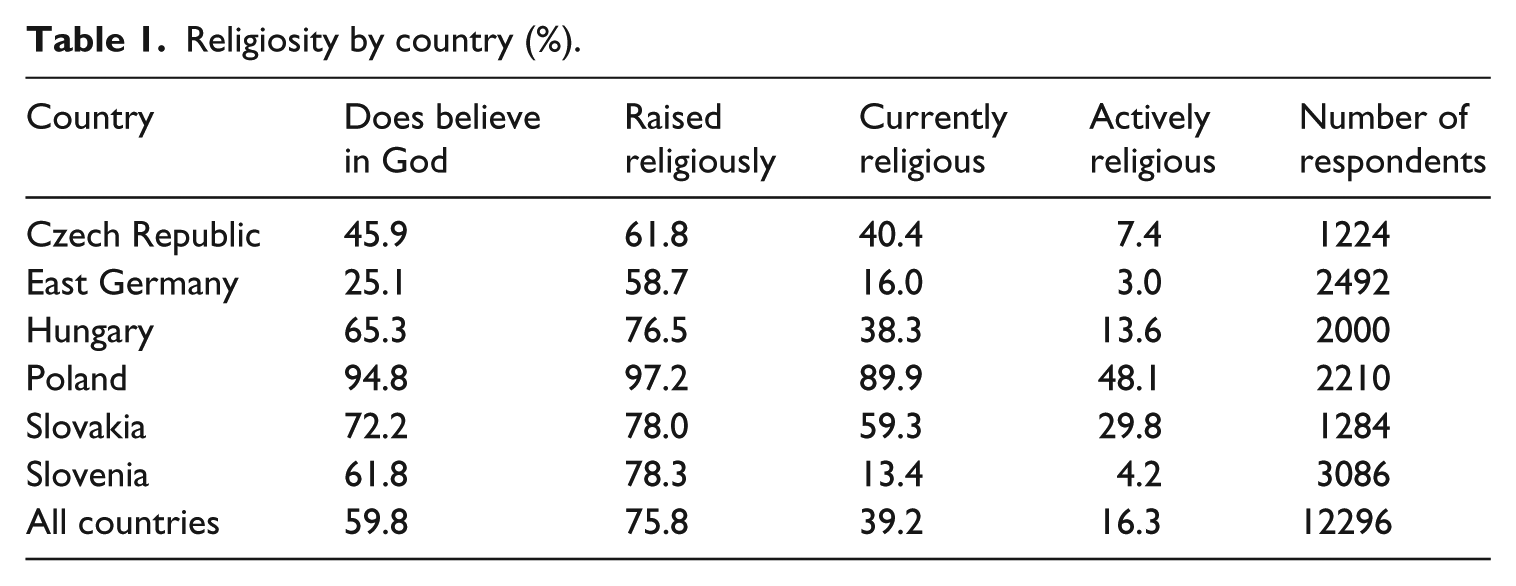
Participation in religious activities also differs among individuals. We distinguish two levels of participation in this study based on the question ‘How often do you attend religious services?’ ‘Currently religious’ are those individuals who attend at least once a year; ‘actively religious’ are those who attend at least 2–3 times a month. Religiosity measured by these four criteria across the different post-communist countries is summarised in Tables 1 and 2.
Religiosity by country (%).
Distribution of respondents by religious denomination and country (%).
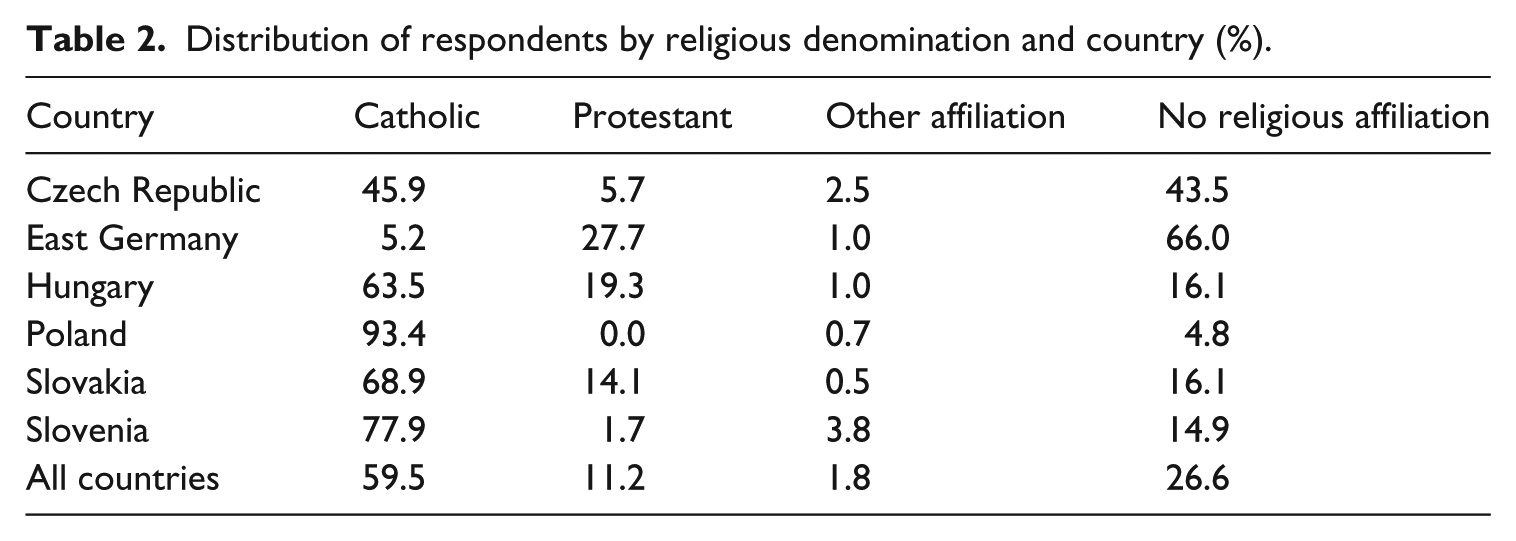
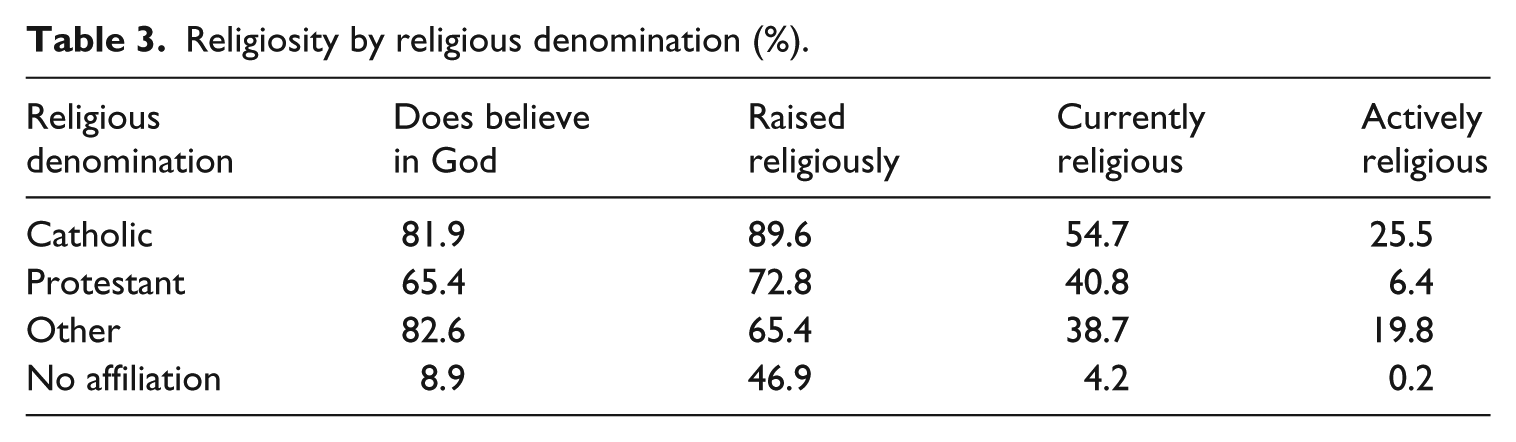
Religious affiliation is understood as a matter of self-declaration. The specific wording of the question aimed at eliciting respondents affiliation slightly differs across countries; although, the meaning is the same. Note that religious affiliation is a completely different measure from the previous four. Some people do believe in God but do not claim to belong to any religious denomination (2.5 % of the sample). At the same time, there are people who do not believe in God claim to have a religious affiliation (13.8 % of the sample). Table 3 shows how affiliation relates to different religiosity measures.
Religiosity by religious denomination (%).
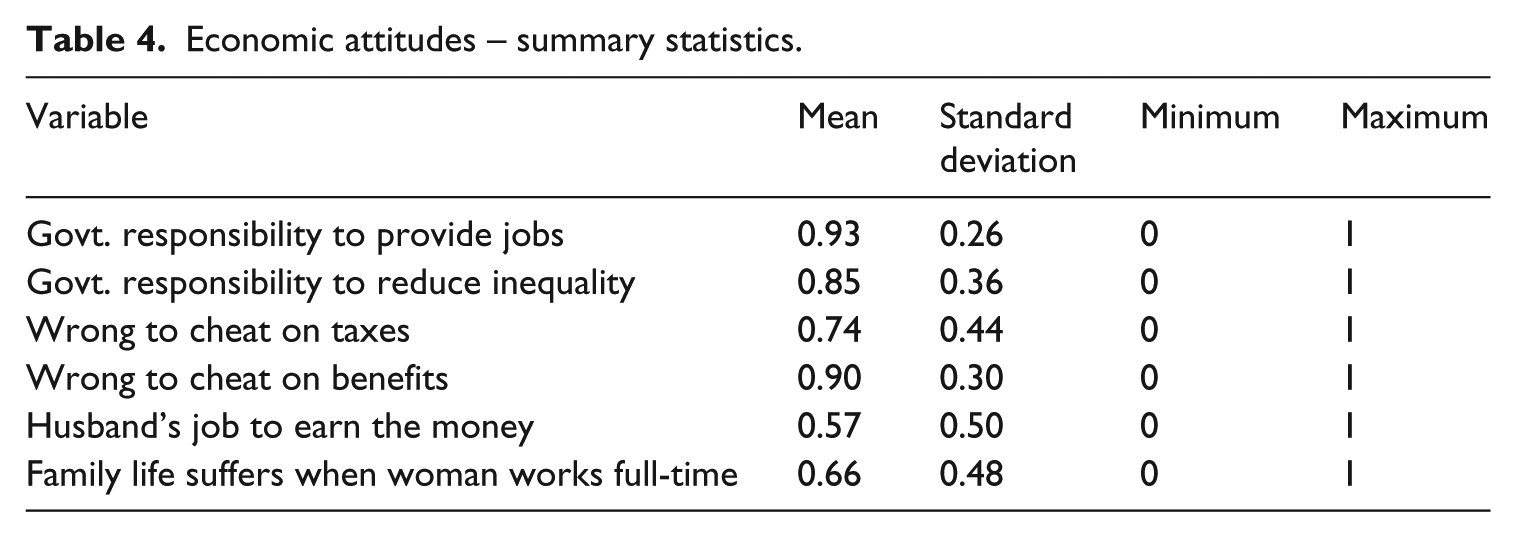
Quantitative research of economic attitudes is not less risky than quantitative research of religion. Combining these two topics in a cross-country perspective also leads to severe constrain in data availability. Six variables included in the ISSP module on religion have been selected that are economically relevant. They concern government responsibilities regarding labour and income equality, honesty with regard to taxes and benefits, and attitudes regarding female participation in the labour market. Summary statistics are provided in Table 4.
Economic attitudes – summary statistics.
First two variables concern attitudes towards the responsibility of the government to provide jobs and to reduce income inequality. The values are defined as positive (definitely/probably should, coded as 1) or negative (definitely/probably should not, coded as 0) answer to the question ‘On the whole, do you think it should or should not be the government‘s responsibility. . . to provide a job for everyone who wants one?’ and ‘to reduce income differences between the rich and poor?’ respectively. The latter question may represent both the opinions about the role of the state in economy and about redistributive justice.
There are two variables concerning honesty in dealing with the government with regard to taxes and benefits. The responses may represent attitudes towards the state and its role in economy; although, less directly than with the previous two questions. The values are defined upon the response to the following questions: ‘Do you feel it is wrong or not wrong if a taxpayer does not report all of his or her income in order to pay less income taxes?’ and ‘Do you feel it is wrong or not wrong if a person gives the government incorrect information about himself/ herself to get government benefits that he/ she is not entitled to?’. Answers ‘Wrong’ and ‘Seriously wrong’ are coded as 1, answers ‘Not wrong‘ and ‘A bit wrong’ are coded as 0.
Another two variables concern the attitudes regarding women participation in the labour market. It has been previously shown that religion has impact on peoples’ attitudes in this area (Guiso et al., 2003); also communist regimes strived to increase women participation in labour force and replace family education with state schooling from an early age. The variables are defined upon agreement or disagreement with the following statements: ‘A husband‘s job is to earn the money; a wife‘s job is to look after the home and the family’ and ‘All in all, family life suffers when the woman has a full-time job’. Agreement is coded as 1, disagreement as 0, indifferent responses were treated as missing.
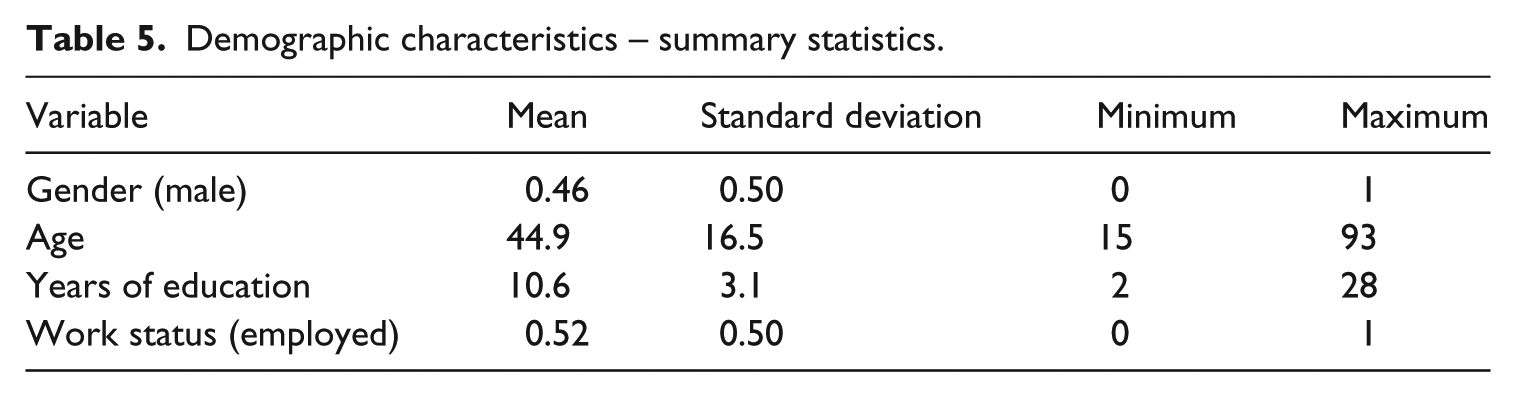
Finally, the choice of control variables is informed by the previous research. All regressions are controlled for gender, age, education and work status. The work status separates employed respondents from the rest of the sample such as unemployed, retired or students. Summary statistics are provided in Table 5. There might exist correlation and even causal relation between religiosity and the control variables in post-communist countries. For example, religious people had often been denied higher education by the communists. It is also known that religiosity increases with age and this is also true in post-communist countries (Minarik 2014b). This may lead to underestimation of the effect of religiosity.
Demographic characteristics – summary statistics.
Empirical results
General results on religiosity
The estimates of the impact of religiosity are presented in Table 6. Logistic regression is used to estimate the effect of the explanatory variables; the table presents odds ratios. The excluded group is made up of people who believe in God but who were not raised religiously and currently do not participate in any religious activity. The effect of atheism can be viewed as the opposite to the effect of belief; that is, a significant coefficient on atheism represents a significant effect of religious belief. Effects of different measures of religiosity should be read cumulatively as the different aspects may cumulate. For example, the correct estimate for a person that believes in God, was raised religiously and goes to church once a week (that is, she is currently religious and actively religious) can be obtained by multiplying the three odds ratios (the products are also reported in Table 6).
Religion and economic attitudes (logistic regressions, odds ratios reported).
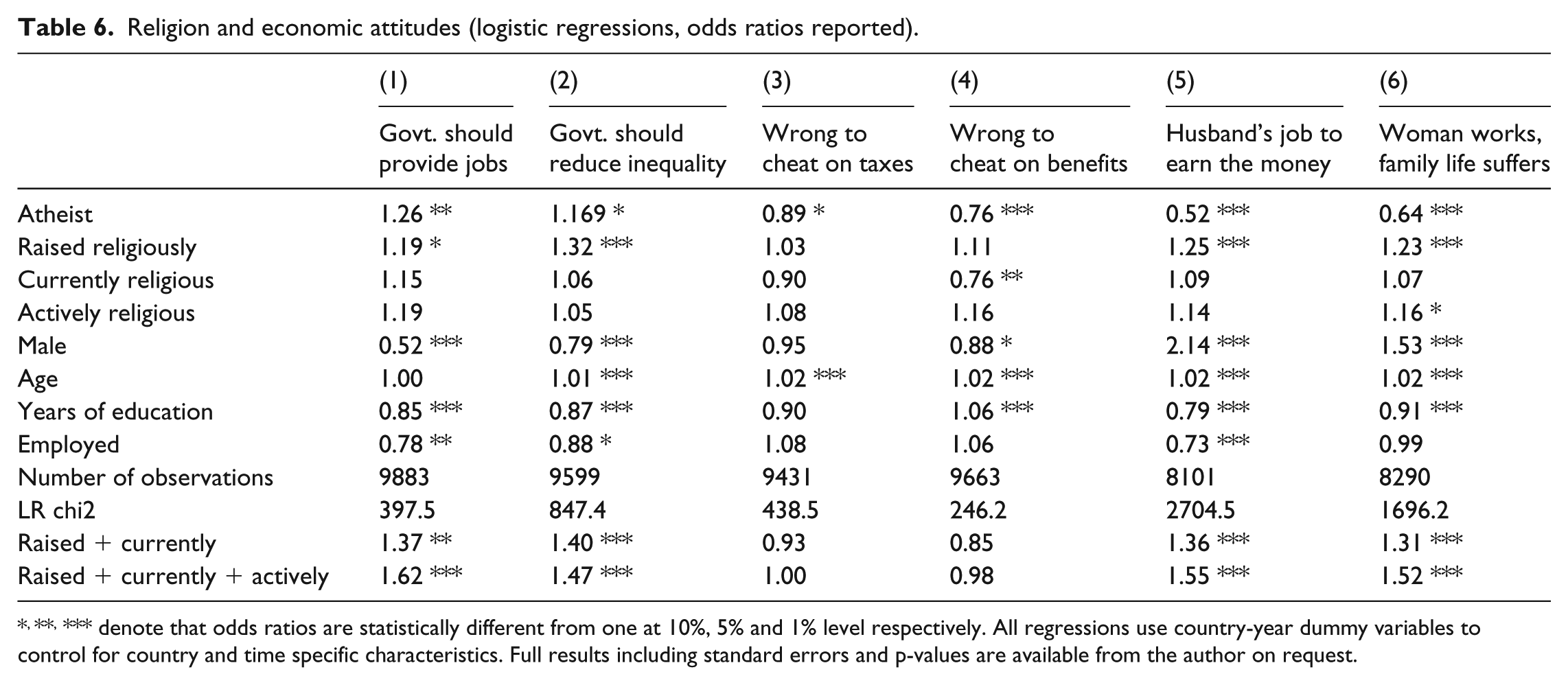
, **, *** denote that odds ratios are statistically different from one at 10%, 5% and 1% level respectively. All regressions use country-year dummy variables to control for country and time specific characteristics. Full results including standard errors and p-values are available from the author on request.
Obviously, religiosity does have certain effect on social attitudes. Although, the effect of religion appears to be quite complex. The first two questions reflect the position on the role of the government. Non-believers are more likely to see employment and income equality as responsibilities of the government. However, religious upbringing works in the same direction as atheism.
Belief in God and religiosity also seem to affect the attitudes on honesty in dealing with the government. Atheists are less likely to see dishonesty as wrong. Interestingly, occasional religious participation appears to promote dishonesty regarding government benefits (the effect is also negative with taxes, although it is statistically insignificant).
The effect of belief and religious upbringing is most pronounced when it comes to women participation in labour market. The odds of believers having the anti-women-participation attitudes are double of those of atheist. Religious upbringing works the same way as well as active religious participation (although, the effect is statistically insignificant or barely significant).
The effect of religiosity in different countries
The effect of religion differs across the Central European countries. Results from regression based on the data from individual countries are presented in Table 7. The results show that the effect of religiosity is not uniform across the countries. Non-believers are significantly more statist in the least religious countries (Czech Republic and East Germany), while the belief in God works the opposite direction in Poland. Also other aspects of religiosity appear to have different effect in Poland.
The impact of religion in different countries (logistic regressions, odds ratios reported).
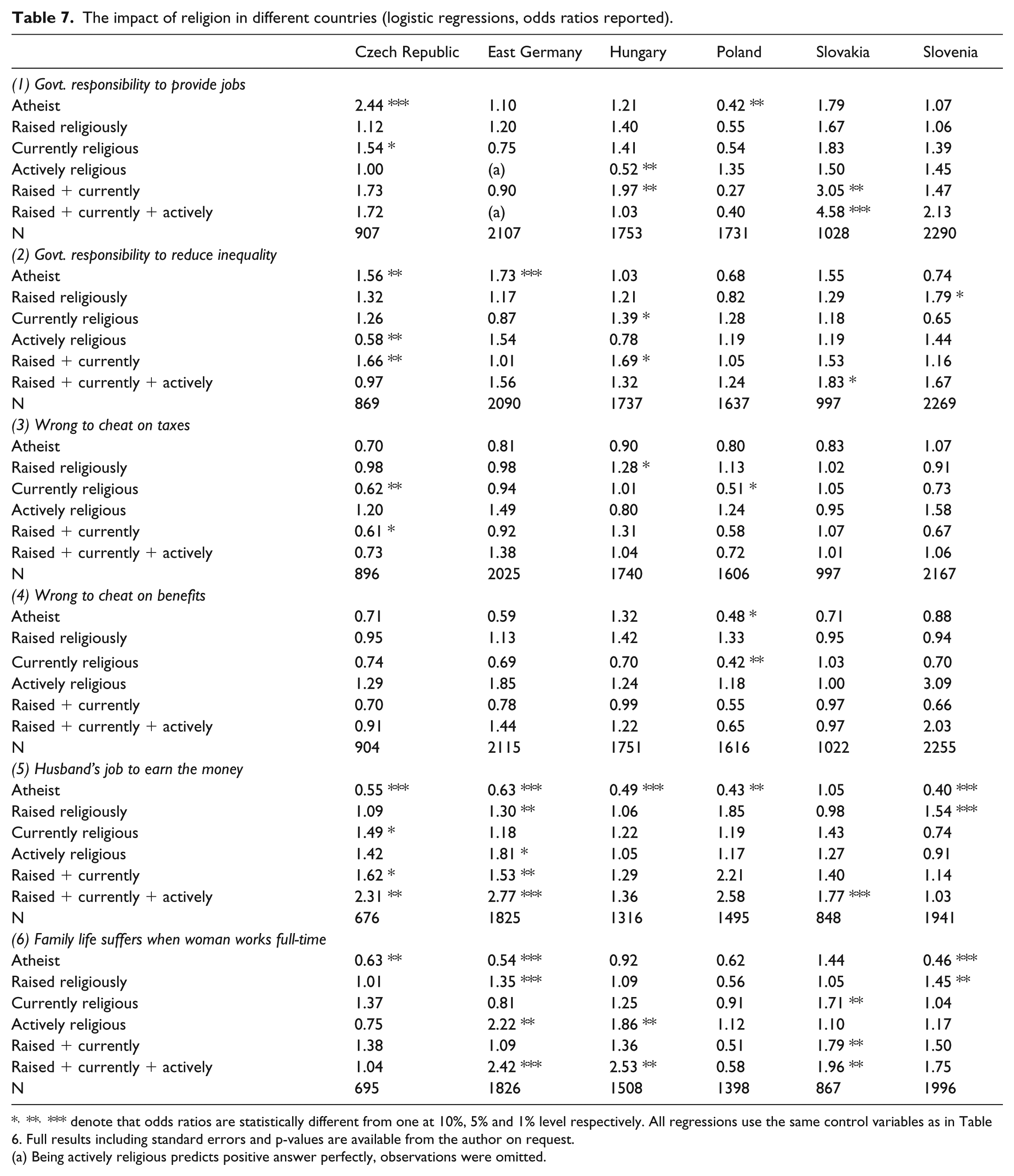
, **, *** denote that odds ratios are statistically different from one at 10%, 5% and 1% level respectively. All regressions use the same control variables as in Table 6. Full results including standard errors and p-values are available from the author on request.
(a) Being actively religious predicts positive answer perfectly, observations were omitted.
With regard to honesty in dealing with the government, the effect of religiosity does not differ much across the countries. Interestingly, the occasional participation in religious services particularly decreases honesty in both Czech Republic and Poland. The positive effect of religious belief is most pronounced in Poland, but missing in Hungary.
The effect of religiosity on individuals’ views on female participation in the labour market is also quite consistent across the region. Notably, unlike in other countries, religious belief does not significantly alter these views in Slovakia; although, religious participation does. Again, the effect of religious practice is significant in the least religious countries, Czech Republic, East Germany and Hungary.
Results on particular denominations
Although religiosity may be interesting as such, most research focuses on the effects of different religions. Table 8 presents the estimates from logistic regressions with individual denominations. Decomposition of the effects of religion leads to an observation that they are mostly attributable to Catholicism. Participation in Catholic religion leads to more statist attitudes, especially with regard to the role of the state in income redistribution. Occasional religious participation in the Catholic Church also fosters honesty in dealing with the state. Relatively low number of other religionists makes it difficult to come up with statistically significant results.
The role of religious denominations (logistic regressions, odds ratios reported).
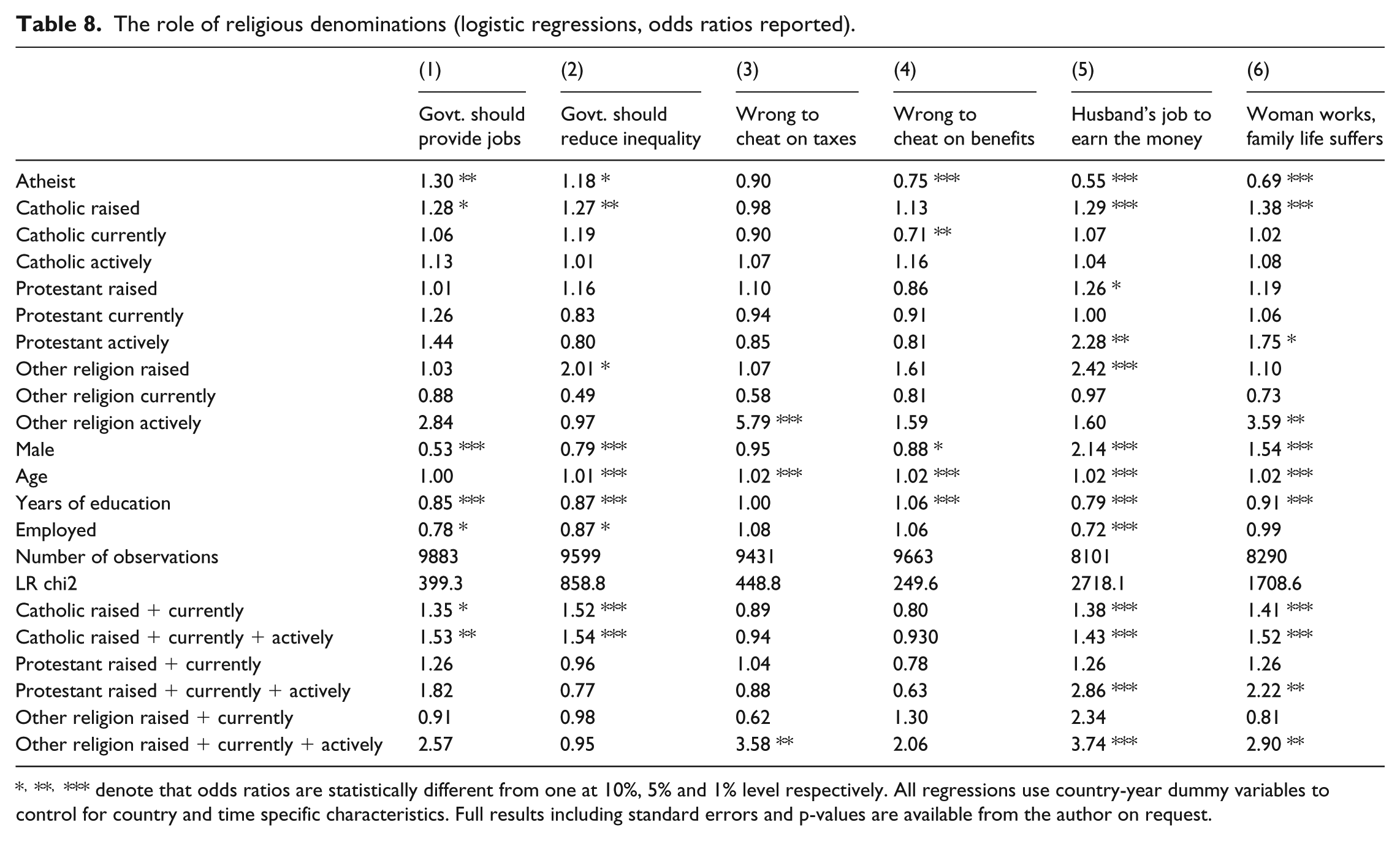
, **, *** denote that odds ratios are statistically different from one at 10%, 5% and 1% level respectively. All regressions use country-year dummy variables to control for country and time specific characteristics. Full results including standard errors and p-values are available from the author on request.
Again, the results are more interesting with regard to women participation in the labour market. Significance of the belief in God is confirmed. The effect of Catholicism is concentrated in religious upbringing; participation in Catholic services does not have any effect. The results are different with Protestantism. Similar to Catholics, religious upbringing fosters anti-women-participation attitudes. However, these attitudes are also strongly associated with active participation in Protestant churches. Similarly, in other religions (i.e. other than Western Christianity) the effect is associated with religious upbringing and active participation. Religious education at home fosters the attitude that it is husband’s job to earn money and active participation leads to the attitude that family life suffers if woman works full-time.
A comment on control variables
The effect of control variables in both regressions is mostly significant, thus justifying the selection of these variables. With regard to gender we observe that males are less statist and somewhat less honest in dealing with the state (although the effect is barely significant); and masculinity is associated with the attitudes against women labour force participation. With increasing age people are more statist and against women employment; increasing level of education works exactly the opposite direction except for honesty in dealing with the state. Employed people are less persuaded that the state should be responsible for provision of jobs and income redistribution and they are less likely to see earning of money as husband’s job. Generally, these results are in line with the previous research.
Further, the analysis used country-year dummies to separate the within time and country effect of religiosity. 4 These represent the differences among countries and the changes in time net of other variables used in the regressions, that is, religiosity and selected demographic variables. The coefficients are very diverse; this result documents the diversity of average national attitudes among the countries as well as the development in time. Interestingly, the development in time also varies in direction among these countries. Unfortunately, the coefficients do not provide any guidance for interpretation of the differences.
Discussion and conclusion
The purpose of this article is to provide additional evidence on the effect of religion on economic attitudes in the post-communist countries. The results confirm the importance of religion in post-communist economies. Even if religion underwent a period of tough oppression under the communist regimes, it has not lost its influence over people’s attitudes. The findings support the general observation about persistence of religion and its impact on social affairs. It would require a different kind of study, and it is a suggestion for a further research, to compare the impact of religion under communism and in the West.
The results are generally consistent with the previous studies. Namely, religious belief decreases demands on the government, while religious upbringing and participation make people more statist (consistent with findings of Minarik, 2014a), and religiosity promotes pro-social attitudes such as honesty (consistent with findings of Guiso et al., 2003). The results on religiosity and women participation in labour force are also in line with the results of Guiso et al. (2003), although in the post-communist countries the effect is more due to the religious upbringing than participation. Regarding the different denominations, the effect of Catholicism on the attitudes towards the state in post-communist countries confirms the previous results of Minarik (2014a). The results on women participation in labour force are also consistent with the findings of Guiso et al. (2003), although the effect of Protestantism is more pronounced in our sample.
It must be stressed here that the approach used in this article ignores any elements of religious origins that are already absorbed in the national culture. Thus, the effect of religion on economy at the national level can be even more significant. The analysis of individual countries provides some suggestions about the differences. However, an attempt to interpret these differences from the presented results would be a mere speculation. They could be attributed to various historical, political, cultural as well as religious factors. Especially in case of post-communist countries, the evolution of attitudes would have reflected the political and economic changes and their impact on individuals’ lives. Again, situational reaction must be considered on top of other, long-term factors. However, a different kind of analytical approach is needed to provide a meaningful interpretation of the differences between the countries.
Despite the limits of the presented analysis, it is clear that religion is relevant in formation of attitudes in the post-communist countries. Thus, it should not be ignored in socio-economic research. Even if religion is not a policy variable, as it cannot be adjusted to improve the economic situation, it should be taken into account as a relevant factor in evaluation of the effects of economic policies.
Footnotes
Funding
The author received no financial support for the research, authorship, and/or publication of this article.
Notes
Author biography
Address: JE Purkyně University, Department of Economics and Management, Moskevská 54, CZ-40096 Ústí nad Labem, Czech Republic.
Email: