




Abstract
Do women and men with stronger spiritual beliefs, experiences, and practices tend toward more or less ambivalent sexism and self-stereotyping? To shed more light on this issue at the intersection of religion and gender, we will analyze a survey of 379 Swiss university students, both women and men, to establish whether a positive or negative relationship between holistic spirituality and gender essentialism is empirically more plausible. Our data show a gender gap: women express stronger spiritual beliefs and they report on more spiritual experiences and practices than men. We also find, inter alia, associations between religious orientation and holistic spirituality as well as spiritual beliefs and ambivalent sexism for both women and men; yet, stronger spiritual beliefs are correlated with less self-stereotyping for men but with more self-stereotyping for women. In sum, our results tend to support a positive relationship between holistic spiritualty and gender essentialism.
Introduction
This article combines research on holistic spirituality and gender essentialism and explores how both phenomena are interlinked. In the introduction, we first examine the field of New Age and holistic spirituality, followed by a discussion on the relationship between gender, holistic spirituality, and gender essentialism. We refrain from formulating hypotheses because the link between holistic spirituality and gender essentialism is under-researched and the literature provides arguments for both positive and negative relationships. Our survey-based study has an explorative character and aims to help solve the question as to what link between holistic spirituality and gender essentialism can be empirically supported. To explore this link, a survey among Swiss students was used. In Switzerland, Catholics and Protestants make up the biggest part of the religious breakdown of the Population, but over the last 40 years the religious landscape changed drastically and secularism spread: In some (mostly urban) cantons about 40 percent of people state that they do not follow any religion (Swiss Federal Statistical Office, 2016a). Despite this apparent trend towards secularism, many people in Switzerland have embraced ‘New Age’ or instances of a holistic spirituality since the 1960’s, possibly due to a combination of structural and cultural changes of society and a retreating of the two large Christian churches (Sanchez and Stolz, 2000: 534). In this regard, Switzerland might be similar to other Western countries where we can observe a spread of ‘post-Christian’ spiritualities (Aupers and Houtman, 2007). While every country has its unique religious composition and history, the findings from this study could also illustrate the relationship between holistic spirituality and gender essentialism for young, well educated people in other secular western countries.
New Age and holistic spirituality
Since the 1980s, phenomena summed up as ‘New Age’, ‘Post-Christian Spiritualties’ or ‘Holistic Spirituality’ have increasingly attracted the interest of sociologists of religion and religious studies (Crowley, 2011: 3). While some researchers claim that the terms are only a ‘potent emblem’ that can mean everything and nothing, denoting a collection of cultural products not necessarily related to a religious component (Bowman and Sutcliff, 2000:1f., for an overview see Kemp, 2004: 180f.), others state that at least some elements that ‘fall under the broad conceptual umbrella that is the New Age’ (Farias and Lalljee, 2008: 277) can be seen as providing a meaning system that presents an alternative to traditional church religiosity (Doktór, 1999: 261). In the Western world, this new form of spirituality can also be seen as a ‘third option’ (Aupers and Houtman, 2007: 307) to institutions supplying answers, such as traditional Christian churches and science.
There are some difficulties with agreeing on the terms used and with defining them (Berghuijs, 2014: 38). Challenges arise when attempting to determine a specific target group of people affiliated to this new form of spirituality and to develop functional and valid operationalization of the relevant features (Doktór, 1999: 215; Berghuijs et al., 2013: 777). Nevertheless, many authors point out that, despite the heterogeneity and diversity that make this New Age spirituality difficult to define, there are some key concepts that form an ideological consensus. This ideological consensus can be seen as a form of ‘meta-ideology’ uniting these widely varying practices and expressions as one worldview while allowing the application of different symbolic systems, practices, attitudes, and experiences (Berghuijs et al., 2013: 777; Aupers and Houtman, 2007: 306).
One of the key concepts is the view that we malfunction because we have been indoctrinated ‘by mainstream society and culture’ (Heelas, 1996: 18) and that the salvation from this alienation lies in personal growth, in reconnecting with the ‘true’, ‘natural’, and ‘authentic’ self–consisting of a ‘divine spark’ connecting the self with everything (Aupers and Houtman, 2007: 307). This concept, which can be seen as ‘a great refrain, running through New Age’ (Heelas, 1996: 18) is often called ‘sacralization of the self’ or ‘self-spirituality’ (Berghuijs et al., 2013: 777). There is also the belief that all religions have the same initial spiritual core, a tendency towards syncretism, and the idea of holism, which can be seen as a strategy to solve the problem of departmentalization of life in a differentiated society (Knoblauch, 2009: 126; Berghuijs et al., 2013: 777).
Several researchers point out the growth and increasing significance of this form of spirituality: studies show that two to five percent of the population in Western countries can be seen as regular, highly committed and active participants, ten to twenty percent of people claim they are ‘spiritual and not religious’, and between twenty and forty percent believe in ‘some sort of a spirit or life force’ or see ‘God as something within each person rather than something out there’ (Sointu and Woodhead, 2008: 259; Aupers and Houtman, 2007). Also in Latin American countries, this form of spirituality is becoming more popular (Carozzi, 2007: 341).
In the following sections we will use the term ‘holistic spirituality’ to refer to a certain set of beliefs, attitudes, and practices that can be measured.
Gender and holistic spirituality
Recently, the intersection between holistic spirituality and gender has been increasingly attracting the interest of researchers (Fedele and Knibbe, 2013: 2). Here, the focus is often on the ‘gender puzzle’ in holistic spiritual activities, particularly in references to The spiritual revolution: Why religion is giving way to spirituality by Heelas and Woodhead (2005), where the authors find that women make up about 80 percent of the participants in the holistic milieu of the small English town of Kendal. Since then many studies have demonstrated that women participate more frequently in religious activities than men and attempted to find explanations for this gender gap (Aupers and Houtman, 2007; Bruce and Trzebiatowska, 2012; Crowley, 2011; Fedele and Knibbe, 2013; Höllinger, 1999; Manevska, 2009; Houtman and Mascini, 2002; Sointu and Woodhead, 2008).
Some scholars examine the question of whether participation in the holistic spiritual milieu can be seen as an empowerment of women. For example, it is argued that the holistic milieu offers additional career opportunities and therefore more options for financial independence and the chance to create a community to share experiences of anger, fear and frustration and to find a better way of dealing with the ambiguous position women have in society (Crowley, 2011: 85; Fedele and Knibbe, 2013: 9). Furthermore, it is stated that the importance of authenticity and expression of the ‘true self’ can be seen as a subversive possibility to go beyond the traditional female ‘living life for others’ to an understanding of ‘living life for yourself,’ which is said to already exhibit emancipatory potential (Sointu and Woodhead, 2008: 269). These positions see holistic spirituality as something that is either not open to attack by the ‘classic’ critique of ‘religion as the antithesis of modernization’ and its components such as democracy and (gender) equality (Aune, 2015: 124) or they question the ‘axiom that secularization accompanies gender equality and sexual liberty’ (Longman, 2018: 3) as such.
As far as gender and the question of empowerment is concerned, it is interesting to examine attitudes toward gender among holistic spiritual men and women. There is still a lack of in-depth research on attitudes toward gender and holistic spirituality to date (Ančić and Jugović, 2014: 95). Some argue that holistic spirituality makes it possible to question gender and identity. Also, in a study from the UK, women engaged in a ‘new form of feminism’ tend to more often describe themselves as ‘spiritual’ compared to the UK female population and ‘since the 1970s, feminism has been associated with alternative spiritualities’ (Aune, 2015: 126), which could lead to the presumption that spirituality and an understanding of gender equality might go hand in hand. In this view, certain practices like Women’s Circles can be understood as ‘sites of sisterhood, solidarity, and dissent, cultivating a new type of femininity grounded in both affirmative and more oppositional forms of emerging feminist consciousness’ (Longman, 2018: 1), seen like this such practices at least ‘contain feminist potential’ (Longman, 2018: 13).
Others state that within the holistic spiritual milieu and literature there is a lively ‘essentialist fantasy’ (Crowley, 2011: 164) that is close to ‘difference feminism’ (Crowley, 2011: 165; Pike, 2004: 202). Crowley (2011: 163) points out that in the spiritual discourse about womanhood, we often see a gender essentialist position where women are viewed as more spiritual, closer to the earth and the cycles of nature, better equipped to teach and help others, and as having a better understanding of the interrelatedness of life due to ‘inherent feminine qualities’ such as empathy, patience, and nurturance. While within this discourse men or patriarchy are often seen as the ones who have ruined the world, which women can then fix using their ‘special powers,’ there is a lack of research on ‘male holistic spirituality’ to date (Crowley, 2011: 164).
Also some researchers state, that the career opportunities available in the holistic spiritual milieu are often either about emotional or physical care, thus reinforcing concepts of ‘typically female’ occupational fields (Sointu and Woodhead, 2008: 269).
If empowerment is understood as something that enables people to obtain an awareness of the fundamental changeability of social institutions and realities such as gender because they are viewed as a social, collective, and constantly reproduced construction, it would stand in opposition to the fixed concepts of gender essentialism. So, to examine the question of whether holistic spiritualties can be seen as a potential site of empowerment, questions about prevalent beliefs about gender need to be asked. Given the growth of holistic spirituality in Western countries highlighted by researchers such as Aupers and Houtman (2007), it would be interesting to examine what attitudes towards gender are prevalent among people close to holistic spirituality. We are aware that examining gender essentialism by using the research category ‘gender’ defined as binary is reinforcing gender dualism by rendering invisible other identities. Nevertheless, we think this type of research is important to find out more about the concepts of gender, spirituality and the link between the two, as knowledge about these concepts can help to further understand and deconstruct these. The same shall apply for the concept of ‘The West’, which we understand as a collection of contractionary concepts constructed in a binary setting related to power structures.
Research questions
Against this background, we will attempt to answer three research questions. First, we will analyze whether we can confirm the gender gap in holistic spirituality as suggested in previous research. Second, we aim to shed more light on the relationship between measurements of basic religious orientations such as atheism, agnosticism, traditional religiosity or post-Christian spirituality and our operationalization of holistic spirituality. Third, we will examine the relationship between gender, the level of holistic spirituality and two measurements of gender essentialism: ambivalent sexism and self-stereotyping.
Data and variables
In this section, we will first describe how we collected the data for the present analyses as well as our sample and the main dependent and independent variables. Tables 1 and 2 give an overview.
Overview of combination of items determining religious orientation.
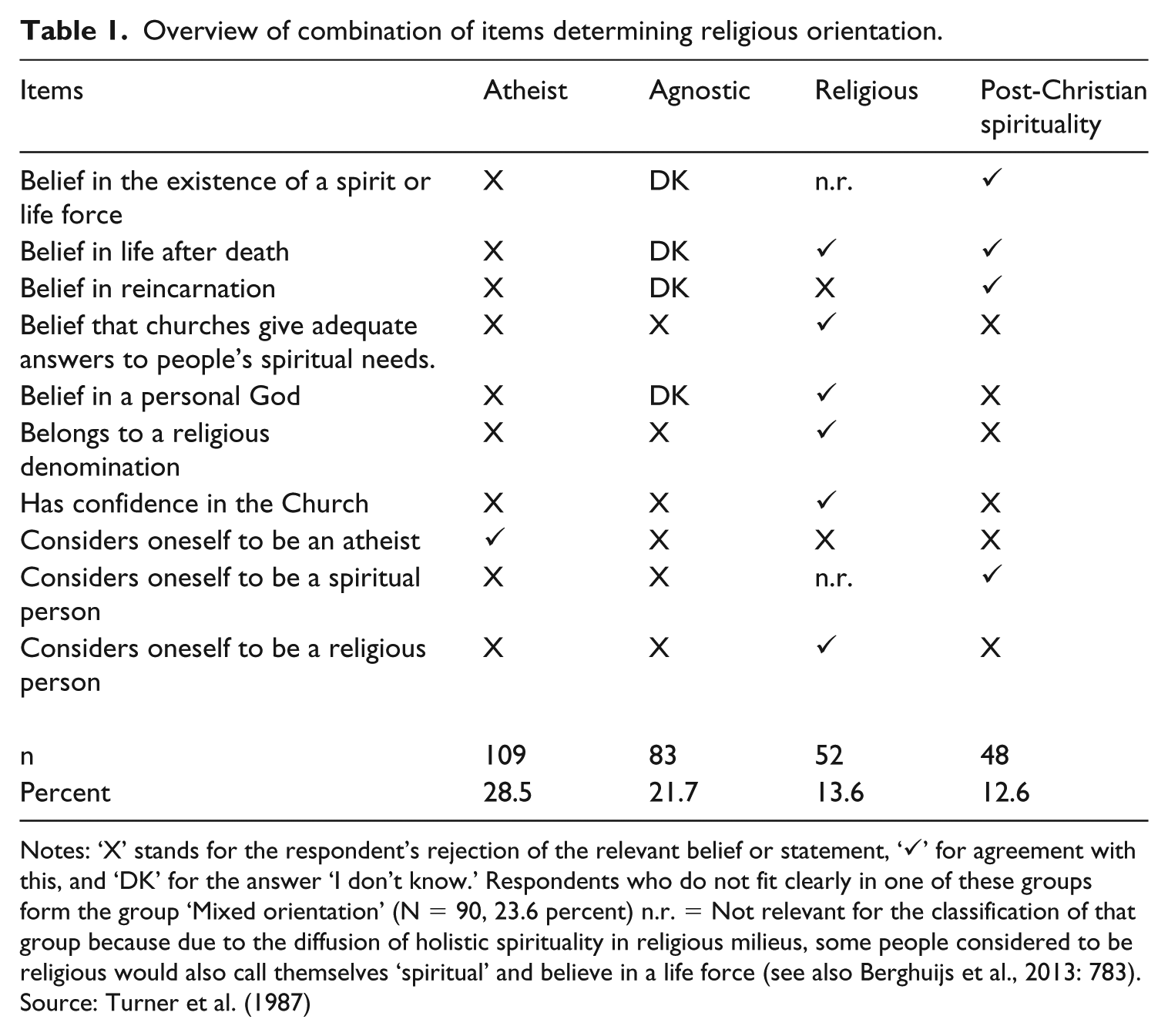
Notes: ‘X’ stands for the respondent’s rejection of the relevant belief or statement, ‘✓’ for agreement with this, and ‘DK’ for the answer ‘I don’t know.’ Respondents who do not fit clearly in one of these groups form the group ‘Mixed orientation’ (N = 90, 23.6 percent) n.r. = Not relevant for the classification of that group because due to the diffusion of holistic spirituality in religious milieus, some people considered to be religious would also call themselves ‘spiritual’ and believe in a life force (see also Berghuijs et al., 2013: 783).
Source: Turner et al. (1987)
Overview of dependent and independent variables.
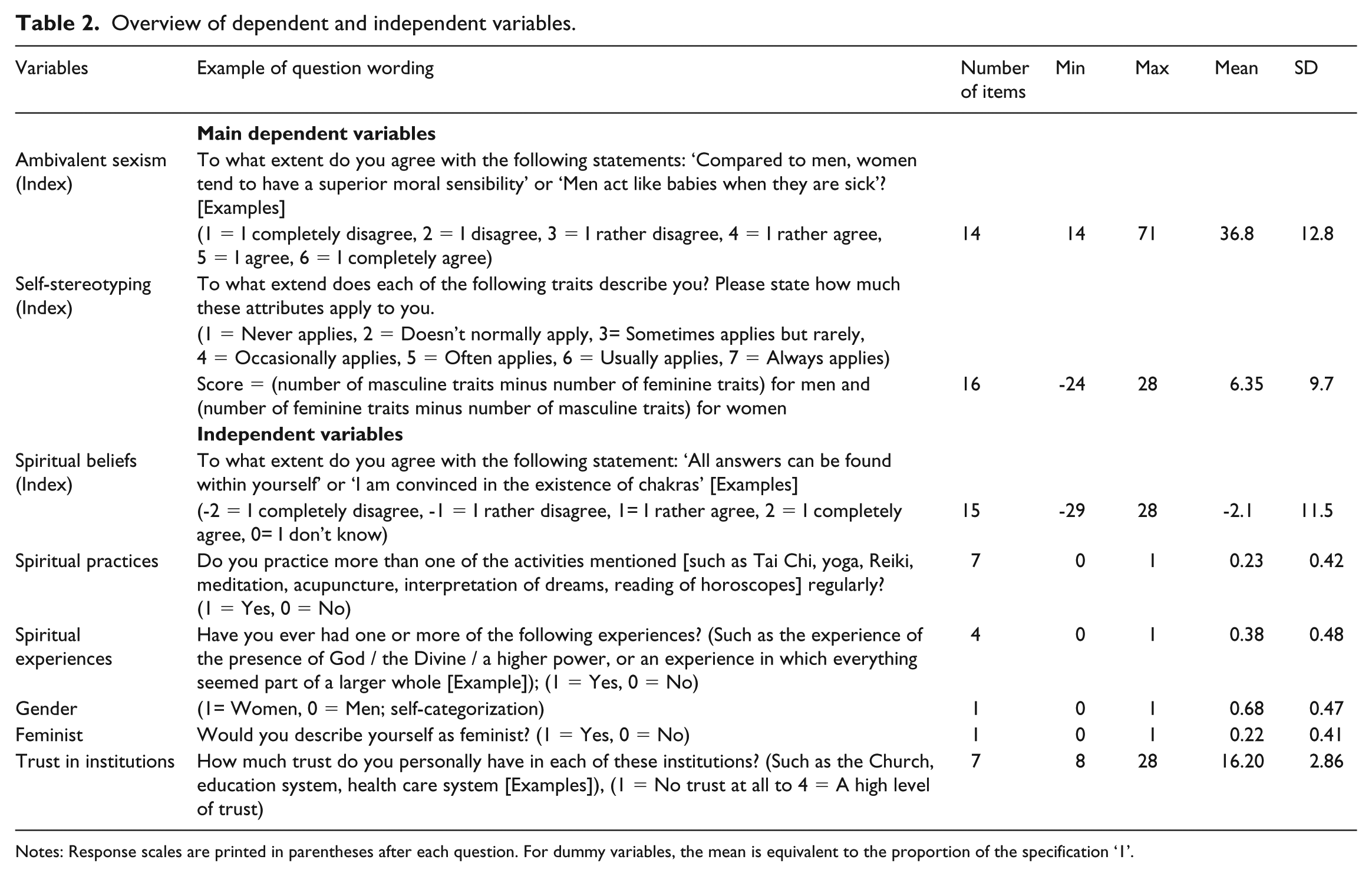
Notes: Response scales are printed in parentheses after each question. For dummy variables, the mean is equivalent to the proportion of the specification ‘1’.
Sample and survey
To examine the relationships mentioned, we will rely on a non-random sample of students from two Swiss universities (a university and applied university training students to be teachers). The data were collected using a paper-and-pencil survey after lectures and an online survey in December 2015. The 379 respondents were asked to fill out a questionnaire about personal attitudes. This included questions on spirituality, gender essentialism, and socio-demographics. Overall, 68 percent of respondents identify as female, 31 percent as male and four respondents (one percent) chose not to state their gender or identified as ‘other’. The mean age is 22, and 88 percent of respondents are currently taking Bachelor’s courses. Further, 22 percent describe themselves as feminists. Students from 36 different courses of study are included in our sample but mainly students of psychology (19 percent), geography (14 percent), biology (11 percent), or members of the applied university (13 percent). This sample is a convenience sample of a privileged and homogeneous sub-group of society. As it is our aim to find out more about the fundamental correlation between holistic spirituality and gender essentialism, we do not necessarily need a representative population sample but it would be desirable to examine this correlation in the future with this type of sample.
Description of variables
Our dependent variables are two different measurements of gender essentialism: the degree of self-stereotyping and the level of acceptance of ambivalent sexist statements. The ‘ambivalent sexism inventory’ (Fiske and Glick, 1997) allows us to measure attitudes toward gender and gender roles which legitimate inequality between gender in a sometimes subtle and not only negatively connoted way. Instead of measuring the ‘traditional’ and ‘open’ forms of sexism (which focus on the role of a woman as the wife, mother and supporter of her husband’s career and the role of a man as the breadwinner and head of the family), an attitude which is less openly stated in Western industrial nations, the ‘ambivalent sexism inventory’ is used to capture the constructs of ‘hostility’ and ‘benevolence’ towards one gender (Mays, 2012: 280). Agreeing with statements such as ‘Compared to men, women tend to have a superior moral sensibility’ or ‘Men act like babies when they are sick’ indicates an essentialist and homogeneous worldview about gender. We use items from the German versions of the ‘ambivalent sexism inventory’ against men and women and cover all the relevant subcategories of this construct (Werner and Collani, 2004; Kohler and Schneider-Düker, 1988). The items form a reliable additive scale with Cronbach’s alpha at 0.90. 1
Several existing studies show the relationship between essentialism and stereotyping as well as self-stereotyping (Coleman and Hong, 2008: 37; Haslam et al., 2002). The correlation between self-stereotyping and gender essentialism can be explained through the stable, unchangeable and context-independent view of gender which postulates a certain amount of homogeneity within one gender category that goes hand in hand with an essentialist view of gender. Identification with a social category viewed as homogeneous can encourage the acquisition of ‘typical’ group attributes as part of the self-conception because ‘people come to perceive them more as the interchangeable exemplars of a social category than as unique personalities defined by their individual difference from others’ (Turner et al., 1987: 50; Coleman and Hong, 2008: 39). In a (sub-)population without societal expectations about how gendered bodies and personalities should behave and which attributes belong to certain groups, we would expect that ascribed personal traits are equally distributed among members of the population.
Following the logic and function of the Bem Sex-Role Inventory (BSRI) (Bem, 1974), we measure self-stereotyping on a seven-point scale by asking respondents how well they are described by certain attributes that stand for socially ascribed ‘typically’ female or male personality traits. The numerical answers for the female and male attributes are added separately to create a masculinity and femininity scale. Since the BSRI consists of only positively connoted attributes and it has been criticized for containing attributes which have changed considerably in terms of social evaluation over the past 30 years, we used attributes from a refined measurement instrument presented in Berger (2010). Cronbach’s alpha for the masculinity scale is 0.72 and for the femininity scale 0.64. Subtracting the number on the masculinity scale from that on the femininity scale for men and vice versa for women gives a common metric for all respondents. A higher score indicates a stronger identification with what are typically perceived as attributes of one gender category.
Independent variables
To explain the affinity to holistic spirituality as well as to define comparison groups based on religious orientation, we use items of the World Values Survey (WVS) which were proposed by Aupers and Houtman (2007) to measure post-Christian spirituality (based on self-designation and a combination of attitudes about broad religious concepts). Although this construct of post-Christianity only shows a low Cronbach’s alpha at 0.42, these items can be used to explain and examine Berghuijs’ (2014) measurement of holistic spirituality and to form comparison groups of ‘atheists,’ ‘agnostics,’ ‘traditional religious,’ ‘post-Christian spiritualists’ and ‘undecided.’ See Table 1 for an overview of the seven relevant items, how they are combined for the grouping, and the internal consistency of the scores. Respondents are classified in these groups based on their response behavior. In the context of Switzerland, we classify respondents as ‘traditional religious’ if they agree with monotheistic worldviews.
Just as the definition of spirituality is argued about, so is its operationalization. A common approach is to select the target group on the basis of the individuals’ agreement with statements viewed as typical of a spiritual worldview (Berghuijs, 2014: 163). Many such ‘spirituality scales’ have been developed, with various advantages and disadvantages. In the present study, we use Berghuijs’ (2014) multi-dimension approach which has been developed, adopted, and inspired ‘by the writings of a wide range of authors’ (Berghuijs, 2014: 95) and which maps the typical expression of spirituality in beliefs, experiences, and practices. Thus an attempt is made to ‘guard against preconceptions and vague meaning in this research field’ (Salander, 2012: 17) and to avoid problems such as overlapping with other relevant constructs (e.g., quality of life or well-being) which could lead to tautological correlations (Berghuijs, 2014: 39). Since Berghuijs (2014) presents a large number of items, we choose a selection of 26 items, ensuring inclusion of all relevant components of holistic spirituality. 2
Spiritual beliefs are measured as an additional index of agreement with 15 statements 3 with holistic spiritual content. Spiritual experience is a binary coded variable which has a value of 1 if the respondent has had at least one of the four spiritual experiences mentioned such as the experience of realizing that everything is part of a larger whole, and 0 otherwise. Spiritual practices is also a binary code variable where 1 means that the respondent regularly practices at least two out of seven activities which are common in the spiritual milieu, such as Reiki, meditation, or dream interpretation.
The items form additive scales with Cronbach’s alpha at 0.86 for beliefs, 0.51 for experiences, and 0.42 for the measurements of practices.
Self-designation as a ‘feminist,’ trust in institutions such as the Church, faculty affiliation, and completed Bachelor are further variables that will be included in the data analyses as control variables.
Results
In a first step, we analyze whether there is a gender gap by examining the association between gender and religious orientation regarding spirituality measured using our variables spiritual beliefs, spiritual experiences, and spiritual practices.
Before presenting the multivariate results, we would like to point to the remarkable spread of holistic spiritual beliefs, practices, and experiences in our student sample: 48 percent of respondents agree with the statement that there is some form of life energy or spiritual power, more than half of them believe in a deeper meaning of life, and more than a third feels attracted by nature-based religions. Furthermore, 28 percent of all respondents believe in the existence of angels or other invisible beings. On average, respondents agree to six of the 15 spiritual beliefs statements, and 32 percent of them agree with at least every second statement. Twenty-three percent of respondents perform at least two of the spiritual practices mentioned and over a third of them have had at least one of the spiritual experiences listed (see appendix).
Table 3 shows the results for ordinary least square regression models for belief and binary logit models for experiences and practices. As suggested in previous research, women tend to express stronger spiritual beliefs and are more likely to have had spiritual experiences and to perform spiritual practices. This confirms the gender gap in spirituality. The effects, however, are only statistically significant for spiritual beliefs and spiritual practices and non-significant for spiritual experiences. It must be emphasized that in a bivariate regression model, only including the variables gender and experiences, we also find a statistically significant effect of gender on the likelihood of spiritual experiences; consequently, the gender effect is weakened if we check for respondents’ religious orientation. In other words, if we take religious orientation into account, responses by women and men become more similar. This suggests that differences in religious orientation between women and men explain part of the gender effect for spiritual experiences. If we look at the model for beliefs in Table 3, women have a score that is on average seven points higher on the belief scale than the score for men. With respect to spiritual practice, computing average marginal effects – the mean effect across all individuals – reveals that the probability of women reporting on conducting spiritual practices is 24 percentage points higher than for men.
Multivariate regression models for spiritual beliefs, experiences, and practices.
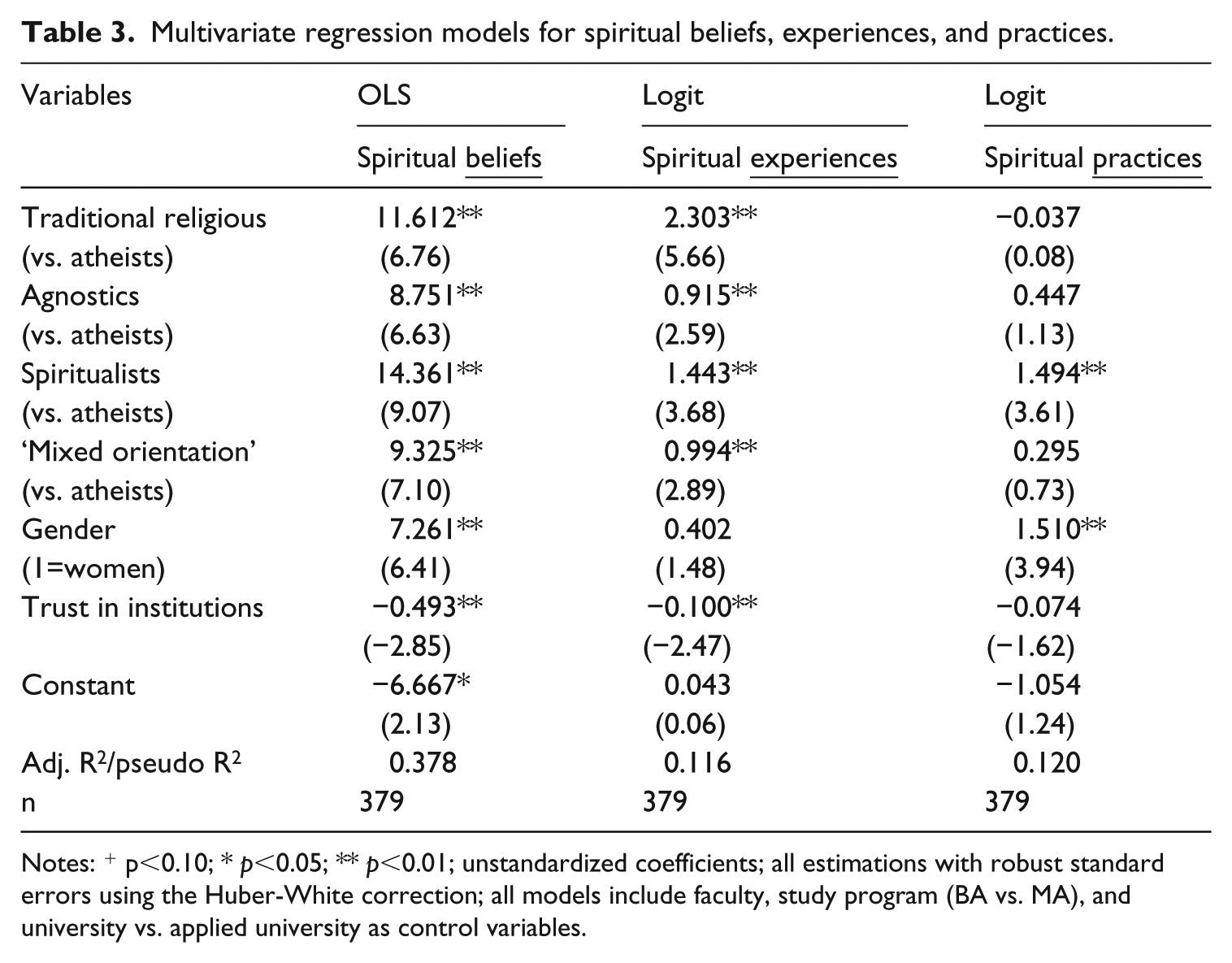
Notes: + p<0.10; * p<0.05; ** p<0.01; unstandardized coefficients; all estimations with robust standard errors using the Huber-White correction; all models include faculty, study program (BA vs. MA), and university vs. applied university as control variables.
Further, our data indicate that compared with ‘atheists,’ all other groups – ‘agnostics,’ ‘traditional religious,’ ‘mixed orientation,’ and ‘post-Christian Spiritualists’ – show stronger spiritual beliefs and are more likely to report on spiritual experiences and practices. All effects are statistically significant at least at the five percent level, except in the model on practices where only the differences between ‘post-Christian spiritualists’ and ‘atheists’ is statistically significant. Expressed in terms of average marginal effects, post-Christian spiritualist respondents have a probability of performing spiritual practices that is 23 percentage points higher than for atheists. Regarding spiritual experiences, the probability is 47 percentage points higher for religious respondents, 18 points for agnostics, and 29 points for post-Christian spiritual respondents compared to atheists.
An additional finding which is noteworthy is that respondents who place more trust in institutions, including the Church, have lower levels of spiritual beliefs and are less likely to report on a spiritual experience or performing a spiritual practice. This should not be interpreted as causation because trust might undermine spirituality, and, at the same time, spirituality might affect trust levels.
In a second step, we analyze how spiritual beliefs, experiences, and practices affect ambivalent sexism as well as self-stereotyping of the respondents. The results are shown in Table 4. We estimate separate models for the independent variables beliefs, experiences, and practices, as these concepts are correlated with each other (e.g., r = 0.460 for beliefs and experiences), and in separate models we gain a better understanding of their main effects and of their interaction effects with gender on sexism and stereotyping. The main effect of spiritual beliefs in Model I shows for men that there is a positive correlation between spiritual beliefs and ambivalent sexism. The main effect of gender reveals that women express lower levels of ambivalent sexism than men. This difference between women and men is highly statistically significant. The interaction effect between gender and spiritual beliefs shows that the positive correlation between spiritual beliefs and sexism is lower for women than for men. In other words, stronger spiritual beliefs are positively associated with sexism for both groups but the positive association is much stronger for men than for women. This is also confirmed in separate models for men and women.
Multivariate regression models for ambivalent sexism and self-stereotyping.
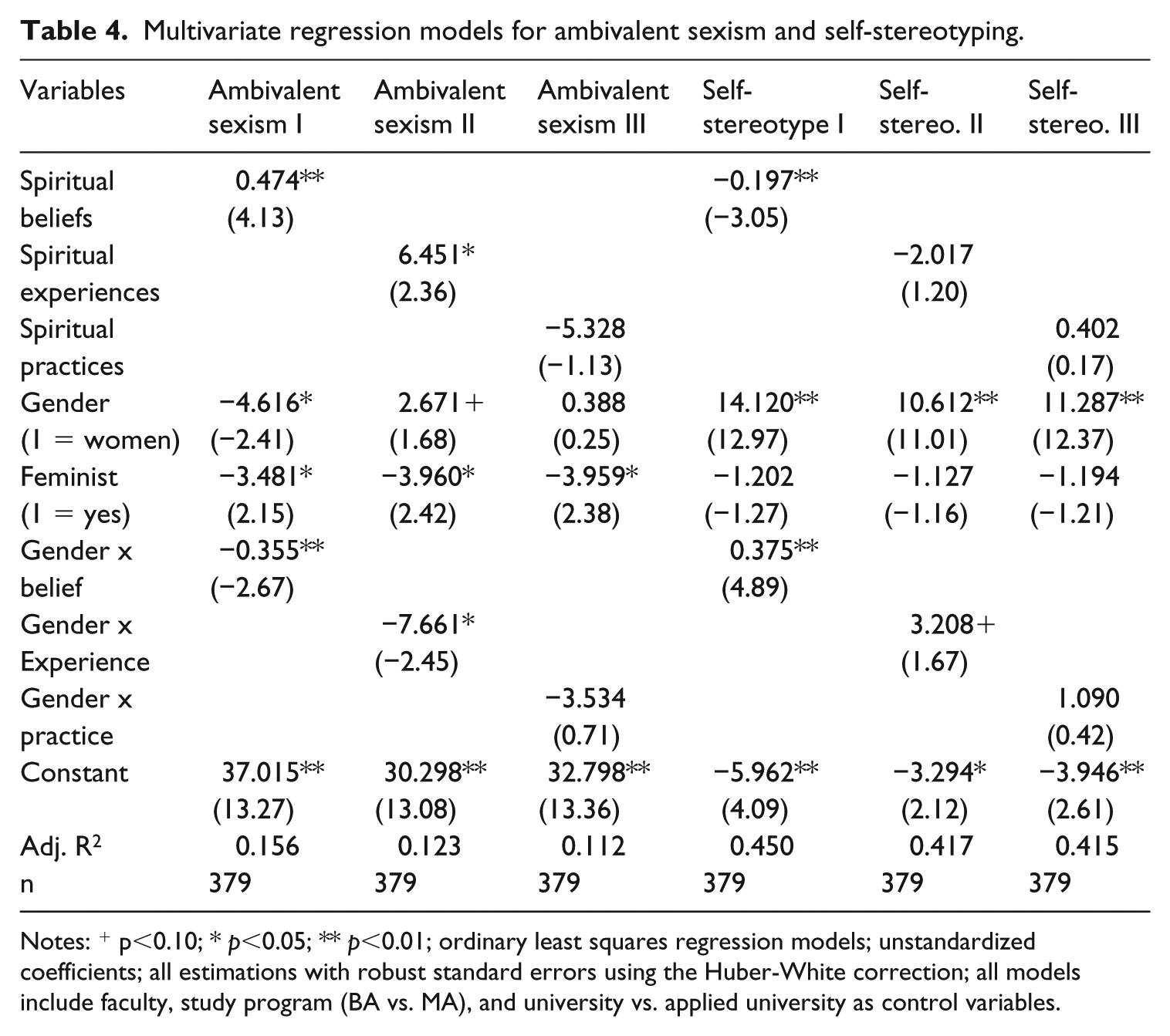
Notes: + p<0.10; * p<0.05; ** p<0.01; ordinary least squares regression models; unstandardized coefficients; all estimations with robust standard errors using the Huber-White correction; all models include faculty, study program (BA vs. MA), and university vs. applied university as control variables.
We find a similar pattern for spiritual experiences (see Model II in Table 4). For men, stronger spiritual experiences increase sexism (while sexism is generally lower for women than for men). The correlation between spiritual experiences and sexism is weaker for women than for men. Further, if we estimate a separate bivariate or multivariate model for women, we do not find a statistically significant correlation between spiritual experiences and ambivalent sexism for women. Thus, looking only at women there is no significant association between spiritual experiences and sexism. Further, with respect to spiritual practices, in Model III we do not find any correlation between practice and sexism for either women or men. Spiritual practices do neither significantly decrease, nor increase ambivalent sexism.
Looking at the models on self-stereotyping in Table 4, we see that in general women show higher levels of self-stereotyping than men. Based on our operationalization, this means that women ascribe to themselves fewer masculine attributes than men ascribe to themselves feminine attributes. This difference is remarkable, indicated by the effect size of over ten points on the self-stereotyping index and high t-values in the regression models. With respect to spiritual beliefs (self-stereotype, see Model I) we observe that stronger beliefs are correlated with less self-stereotyping for men (positive main effect of beliefs), but with more self-stereotyping for women (negative interaction effect for beliefs). However, if we exclude extreme responses, i.e., the five-percent lowest values on the self-stereotyping index, the effect of spiritual beliefs is insignificant for men but still significant for women. The extreme responses refer to respondents who ascribe themselves almost all stereotypic characteristics of the opposite sex.
We find the same pattern for spiritual experiences (self-stereotyping, see Model II), yet only the interaction effect for women is weakly statistically significant at the 10-percent level. Women who had spiritual experiences express more self-stereotyping than men. We do not find any statistically significant effects for spiritual practices (see Model III).
Whether respondents describe themselves as feminists significantly reduces the degree of ambivalent sexism but does not affect self-stereotyping in the models shown in Table 4.
Discussion and conclusion
Against the backdrop that both positive and negative correlations between holistic spirituality and gender essentialism are suggested in the literature, this article explores which direction is empirically more plausible. We rely on common measurement instruments for the concepts under consideration and base our analysis on a student sample from two Swiss universities. First, we find a wide distribution of holistic spiritual beliefs, practices, and experiences in our sample. Although our sample also contains a higher share of individuals classified as atheists or agnostics than is found in the general population (Swiss Federal Statistical Office, 2016b), beliefs in spiritual entities and the sacralization of the self seems to be popular among students. This is in line with findings presented by Sanchez and Stolz (2000) who show that people in Switzerland – especially young people – show a great interest in holistic spiritualties. This indicates that Switzerland might not be as secularized as it seems at first glance. It has to be reiterated that respondents were not aware that the survey is about topics such as spirituality when they were approached by the researchers. Therefore, sample selection in this respect is less likely. Second, in line with previous research, there is a clear and significant gender gap in spiritual beliefs, experiences, and practices in our sample. All three are more common among women than men. Third, we find clear evidence that spiritual beliefs and experiences are more frequent and likely for individuals with the religious orientations ‘traditional religious,’ ‘agnostic,’ ‘post-Christian spiritualists,’ and ‘mixed orientation’ compared to the group of ‘atheists.’ With respect to spiritual practices, we only find a statistically significant difference between ‘post-Christian spiritualists’ and ‘atheists.’ Fourth, there is a positive association between spiritual beliefs and ambivalent sexism as well as spiritual experiences and ambivalent sexism. This holds for women and men alike but the link is significantly stronger for men. Further, women generally express less ambivalent sexism but more self-stereotyping than men. Yet regarding self-stereotyping, we find a negative correlation with spiritual beliefs for men and a positive one for women. Overall, we find a positive correlation between the affinity to holistic spirituality and gender essentialism. Beside this general tendency, we also find that the link between holistic spirituality and gender essentialism differs to some extent for men and women; with respect to self-stereotyping, there is a negative relationship for men and a positive one for women.
This could mean that for men – in contrast to women – a preoccupation with spirituality can be empowering regarding their self-conception but that at the same time stands in relationship with a stronger ambivalent sexism. This finding could be linked to the discourse about womanhood and femininity within the spiritual scene and literature. Here ‘mainstream’ masculinity is seen as something negative, from which spiritual men take distance, and femininity as something beneficial which is encouraged (Crowley, 2011: 164).
Our findings do not support the hypothesis that holistic spirituality – as we measured it – can solely be seen as a means of empowerment regarding gender attitudes. Regarding the ‘Spiritual Turn’ (Aupers and Houtman, 2007) in Western societies, our findings suggest that the spread of holistic spiritualties does not automatically go hand in hand with the struggle for gender equality that feminists fight for.
This study does not suggest that all forms of (holistic) spirituality lead to gender essentialism. Future research should be based on different samples, for example from the general public including various social classes and ethnic groups, in different country contexts. It should also consider different operationalizations and measurements of spirituality and gender essentialism in order to establish how robust our findings are. Longitudinal data could clarify the question of causality: whether spirituality causes gender essentialism or vice versa. We are aware that the relationships between spirituality, religion, and gender attitudes are complex and that the general patterns occurring in ‘large-scale’ surveys might not fully reflect the heterogeneity regarding the link between holistic spirituality and gender essentialism (see for example Longman, 2018). For instance, our measurement of ‘feminism’ is very simple and a refined measurement as well as deeper insights into the relationships between feminism, spirituality and ‘lived religion’ (Aune, 2015) are needed. Clearly, our exploratory quantitative research which is based on standard measurement instruments has to be complemented by qualitative in-depth research.
Notwithstanding limitations, we believe that our study can contribute to answering the question of whether a positive or negative relationship between holistic spirituality and gender essentialism is more plausible. Our results support the literature arguing for a positive link. Our study is also a response to the recent call in the literature to engage more in research on the intersection of religion and gender (see Avishai et al., 2015). We hope that this exploratory research paves the way for more qualitative and quantitative research on this intersection with a special focus on the correlation between holistic spirituality and gender essentialism in the future.
Footnotes
Appendix
The exact question wording regarding spiritual beliefs, experiences, and practices was as follows (partly translated from German):
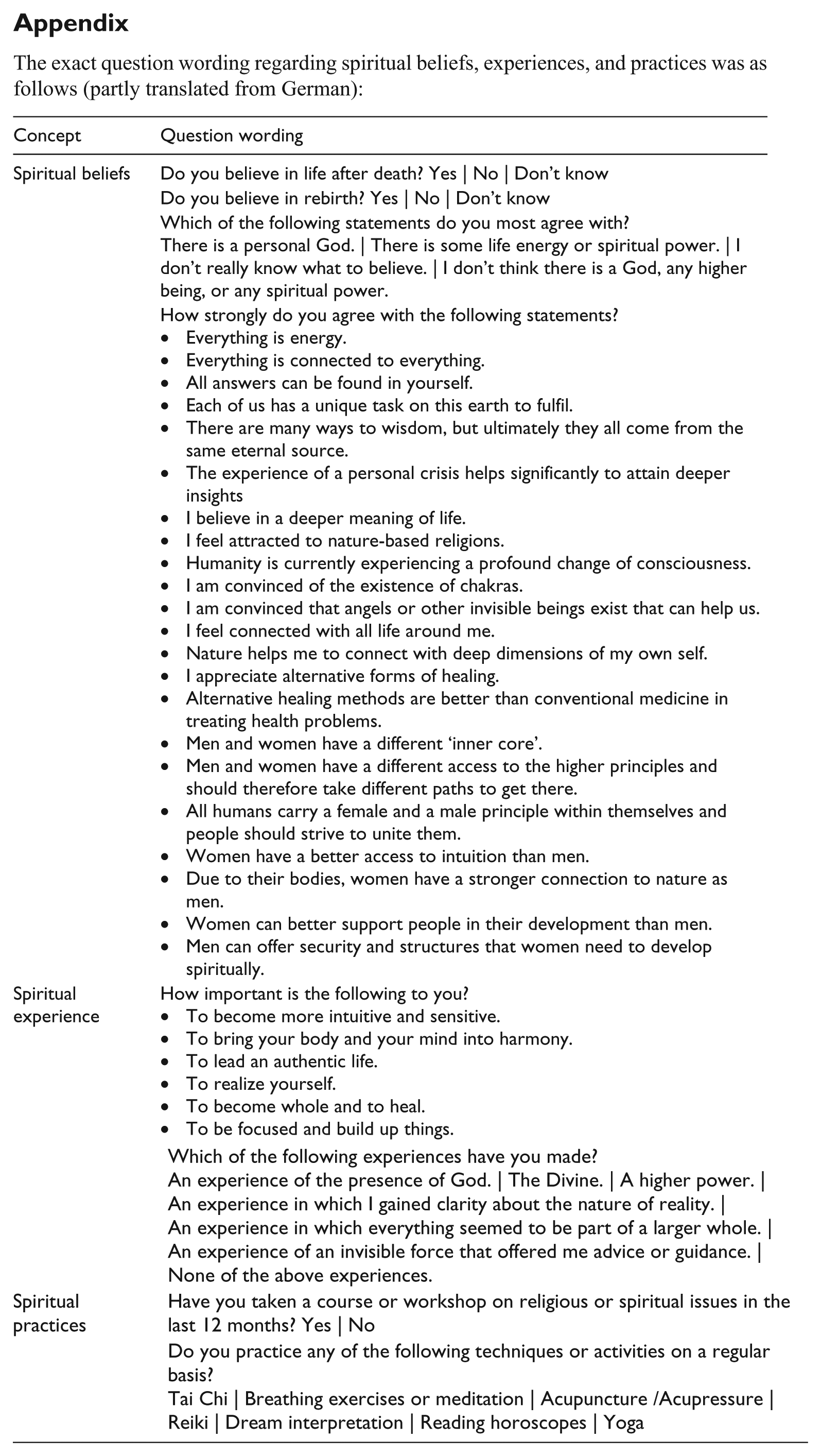
| Concept | Question wording |
|---|---|
| Spiritual beliefs | Do you believe in life after death? Yes | No | Don’t know |
| Do you believe in rebirth? Yes | No | Don’t know | |
| Which of the following statements do you most agree with? |
|
| How strongly do you agree with the following statements? |
|
| Spiritual experience | How important is the following to you? |
| Which of the following experiences have you made? |
|
| Spiritual practices | Have you taken a course or workshop on religious or spiritual issues in the last 12 months? Yes | No |
| Do you practice any of the following techniques or activities on a regular basis? |
Funding
This research received no specific grant from any funding agency in the public, commercial, or not-for-profit sectors.
Notes
Author’s biographies
Address: Department of Social Sciences, University of Basel, Rheinsprung 21, 4051 Basel Switzerland.
Email:
Address: Department of Sociology, Social Sciences Building, University of Warwick, Coventry, CV4 7AL, UK.
Email: