




Abstract
The number of Lutheran chaplains in Danish public institutions (hospitals, prisons, the military) has grown substantially in the last few decades. This article presents the results of a recent study of Lutheran (Church of Denmark) chaplains. The material studied is a collection of legal documents and media, a population survey of 300 chaplains, and 34 qualitative interviews. On the basis of this comprehensive body of data, we argue that even in a country as secular as Denmark there are numerous interactions between the religious and the secular, and that the secular state facilitates these interactions. We also argue that the secular public institutions actively reshape the religious landscape because they require a certain kind of religious specialist that focuses on helping patients, prison inmates, and soldiers to cope with hardship and existential issues.
Introduction
Denmark has one of the world’s most secular societies. Although Statistics Denmark documents that 77 percent of the population (2016) are officially members of the Evangelical Lutheran Church of Denmark, and that many of the remaining 23 percent are members of various religious communities, Danish society is so secular that the American sociologist of religion, Phil Zuckerman, has called it a society without God (2008). Church attendance is low, with fewer than 2 percent attending weekly, and 10 percent attending monthly (Christensen, 2017). Apart from attendance, surveys show that people in general feel that God and religion have little importance in their life (Halman and Pettersson, 2003). Therefore, it is quite surprising that the number of chaplains at Danish universities, prisons, and hospitals has risen in recent decades. Also, the importance of chaplains in the military has clearly increased, and since the 1980s, new positions have been established for chaplains on the street and for emergency responses (Kühle et al., 2015). This article examines and discusses what this growth may tell us about religion in Denmark, and in a broader perspective, about religion in secular societies.
Chaplains have recently become an important topic of sociological research through the work of American scholar Winnifred Sullivan, among others. In Sullivan’s words, chaplains exist ‘at a particularly interesting and focused interface between church, state, society, and a rapidly changing religious terrain’ (2014: 50). Research on chaplaincy has primarily been carried out in the United States and the United Kingdom (Swift et al., 2015) and American sociologist of religion Wendy Cadge has speculated whether ‘chaplaincy as a social phenomenon is less widespread in Europe’ (Cadge et al., 2017: 229). However, research on chaplaincies in Europe is now surfacing as a distinct field and the present study of Lutheran chaplains working in four sectors (healthcare, prisons, the military, and the social sector), conducted in Denmark in 2013–2015 (Kühle et al., 2015) aims to contribute to this emerging literature.
Research on religion in public institutions has proliferated in recent years, and is increasingly engaged in comparing different institutions and different countries (Michalowski, 2015). In the introduction to a recent thematic section of the Journal for The Study of Religion on public institutions, the editors Cadge, Griera, Lucken, and Michalowski emphasize that religion in public institutions may teach us a lot about the state. Quoting John Bowen, they write: ‘it’s through participating in the social life of these institutions that most residents and citizens encounter the “state”’ (Cadge et al., 2017: 227). We argue that in secular societies, public institutions may also constitute a primary place for (face-to-face) encounters with religion. Paying attention to how religion is conveyed by these institutions is crucial, and although chaplains are not the only conveyors of religion in public institutions, they are prominent. Current research has focused on the ‘external’ institutional dimension (barriers, path dependencies, etc.); we suggest that attention should also address the ‘internal’ (theological) challenges, and how religion is challenged, negotiated, and changed through institutional processes.
In the Danish context, chaplaincy is almost exclusively Lutheran. Most representatives of other religions working in hospitals and prisons do so without a formal agreement with the state/institution, and therefore are not chaplains as defined by the British legal scholar Norman Doe, as a minister of religion appointed through ‘a collaborative process between the State and religion’ (2011: 206). Only one hospital imam, one prison imam, and a few part-time prison employees with duties similar to those of the imams may be considered chaplains, according to Doe’s definition, but for clarity, and because of the individual character of their employment, they are not included in our discussion.
The important question of the impact of the different institutions on chaplaincy may be addressed by focusing on the work and ideas of Lutheran chaplains at different institutions. This article explores similarities and differences in the different models of chaplaincies at hospitals, prisons and military, and the way in which they negotiate working in secular institutions with increasingly religiously diverse and non-religious persons. This forms the basis for our discussion of what the position of chaplaincies in public secular institutions may tell us about religion and secularity in contemporary societies.
Research on chaplaincy in public institutions
Jim Beckford and Sophie Gilliat-Ray’s study of religion in prisons in England and Wales (1998) provided many sociologists of religion with an introduction to the study of religion in public institutions. Beckford and Gilliat-Ray identified an area in which religion existed, but had previously been little noticed, and their research led to the emergence of a new field of research, which has since been broadened. With Beckford and Gilliat-Ray’s focus on how Church of England chaplains had important roles as facilitators, ‘making it possible for other faiths to practice their religion’, and brokers ‘acting as an intermediary’ for freedom of religion for minority faiths, the management of religious diversity became a central interest for the sociology of religion (Martínez-Ariño and Griera, 2016).
Chaplaincy studies is a well-established discipline with its own journals (Chaplaincy Today, Journal of Healthcare Chaplaincy, The Journal of Pastoral Care and Counseling, Journal of Pastoral Care), conferences, and associations that aim to support and develop chaplaincy as a profession. In 2015, A handbook of chaplaincy studies was published with the intent to ‘contribute to the self-understanding of the profession and its ways of interpreting the needs and contexts of those it seeks to serve, the development and refinement of good practice, and the derivation of sound guiding principles, core knowledge and critical theory’ (Swift et al., 2015: 25). Research on chaplains has identified a number of special characteristics of chaplaincies, which are noted by scholars across institutional and national contexts. First, the chaplains negotiate space within a secular institution. In an insightful introduction to Religious Diversity in European Prisons, Irene Becci utilizes Erving Goffman’s work on total institutions to describe the (prison) chaplain as, a third type of person: the chaplains and ministers or other religious actors occasionally intervening to offer some form of spiritual care. Strictly speaking, they are indeed a different type of personnel – since they are under a double authority, partly that of the prison and partly that of their religious community – and they often position themselves closely to inmates. (2015: 7)
The image of the chaplain as an intermediary is also familiar in the healthcare sector, where chaplains often see their work ‘as one of “translation” between the life world of the patient and the world of hospital medicine’ (De Vries et al., 2008: 23). This coexistence and occasional competition is often noted. In French prisons, chaplains struggle to find their ‘right place’ in the division of labor, while ensuring a position ‘on another level to that of the psychologist’ (Rostaing et al., 2015: 70). Similarly, Grace Davie describes the role of the military chaplain as a role ‘replete with ambiguities’ (2015: 43). The chaplain is faced with a choice to 1) ‘soft-pedal one aspect of the role’, that is, to either become a soldier or a priest, rather than both, or 2) rationalize the tension and pretend it does not exist, or 3) compartmentalize different personas in different contexts (2015: 46). Overall, chaplaincy across institutions is full of paradoxes and dilemmas.
Second, chaplains are often assigned the task of managing increasing religious diversity. In the European model of denomination-specific chaplaincy (cf. Michalowski, 2015: 42), a chaplain, typically from the state church, facilitates access to resources and acts as a mediator for members of minority faiths who do not have their own chaplains. Beckford and Gilliat-Ray’s study critically assesses this model. Two decades on, Beckford remains critical of the British model, although he acknowledges that an ‘American ideal of “equal respect for all faiths” has gradually found acceptance in prisons’ (2015: 22). However, little has changed on the ground. Rather than prompting a new kind of chaplaincy, Hindu, Muslim, and Sikh chaplaincies have been created as mirror images of their Christian counterparts.
The American model of chaplaincy seems to take a different form. In her book A ministry of presence, Winnifred Fallers Sullivan explores United States’ chaplains as ‘chaplains who do not necessarily routinely publicly identify themselves with a particular religious community but who do their work rather within secular institutions caring for persons with whom they may not share a common religious creed or practice’ (2014: ix). Sullivan argues that chaplaincy is changing the religious landscape from being denominationally dogmatic to offering a spiritual and existential ethics, in what the chaplains themselves call ‘a ministry of presence’. In order to cater to the spiritual needs of the individual in a religiously diverse society such as North America, the chaplains must adapt to the needs of the individual users and the institutions in which they work: ‘If one listens to current users of the concept, a ministry of presence may seem to refer to the simple physical presence of the minister – the minister’s or chaplain’s willingness simply to “sit with” a client without anxious expectation’ (Sullivan, 2014: 175). Sullivan argues that the specific American constitutional separation of church and state has facilitated this development. The disestablishment prohibits official coercion in religious matters, but at the same time, the care the chaplains offer ‘is increasingly understood to be authorized, even mandated, by the free exercise clause of the First Amendment’ (2014: 24).
Third, chaplains in different institutions assume different tasks and identities, depending on the institution in question. Martínez-Ariño and Griera suggest that three factors account for the differences they find in their comparative study of prisons and hospitals in Spain: first, the specific configuration of the public/private distinction at each institution; second, the level of congruence between the institution’s function and the role that religion plays; finally, contextual factors beyond the institution also inform the differences (Martínez-Ariño and Griera, 2016: 52–53).
Chaplaincies are changing as a result of secularization and pluralization, as well as being under pressure from policies and reductions of welfare services associated with new public management. These changes may result in the growth of chaplaincy, the introduction of chaplaincy to new domains, or the development of multi-faith chaplaincies. However, none of these changes can happen without the work of the chaplains themselves. In their research on healthcare in the United States, De Vries et al. (2008: 2) argue that professionalizing chaplaincy causes a major change, where chaplaincy is shifting from volunteer work by clergy with a formal commitment to a congregation, to a full pastoral presence at an institution.
Changes emerge locally, and take different forms depending on institutional and national contexts. The context we examine is Lutheran chaplaincy in Denmark, a small northern European country with a population of 5.7 million.
Methods
We used several methods when investigating the work of chaplains in different sectors (healthcare, prisons, the military, and social welfare). First, we collected legal and official documents from the institutions, the church, and state legislation, to identify the main tasks assigned to chaplains at each institution. Second, we sent out a survey, customized to the chaplains in the four sectors. Most chaplains also work as parish ministers in the Evangelical Lutheran Church of Denmark, but the survey was sent to all chaplains regardless of how much they worked as ministers (N=305). The survey focused on their daily tasks, their relationship to their institutions and to the church, and their views on religious trends among their ‘congregation’. With 209 responses, our response rate was 69 percent (between 64 and 78 percent across the sectors). Finally, we conducted 34 semi-structured interviews with chaplains working in the above-mentioned sectors. The interviews followed up on questions in the survey, and explored ideas and rationales behind the chaplains’ daily work.
Chaplains in secular Danish public institutions
A starting point for understanding Lutheran chaplaincy is the state–church relationship and the historical development of the universal welfare state. The Danish political scientist, Tim Knudsen (2003) argues that the development of the Nordic welfare states owes to the post-Reformation state appropriation of the church, which transformed local pastors into state officials. This enabled the effective communication of regulations and needs between the state administration and the population. The northern monarchies were among the first early modern states to reach even the most remote parts of their realms. Equally important, it made the pastor the central actor in a range of local administrative domains. He supervised the education of the adult peasant population, and was a key figure in the administration of the local municipalities. Geographically, the municipalities followed the parish structure until 1970. Other relevant domains included education (the pastors supervised schoolteachers and were permanent members of all school boards until 1933), healthcare (the pastors registered epidemics and births), social security (the pastors supervised the poorhouses), and even infrastructure (the pastors participated in coordinating and planning roads and constructions). Knudsen concludes that the religious infrastructure of the Lutheran church, and the pastor as public servant, were very important for the development of a secular welfare system. Although he acknowledges this historical development, church historian Per Ingesman argues that the state may also be seen as a tool in the hands of the church. From this perspective, the church used the state to realize a truly Christian society (Ingesman, 2000: 72). Today, the Lutheran church remains a state church in the sense that pastors are employed and salaried by the state (partly through church taxes). The Minister of Ecclesiastical Affairs is the executive head of the church, and the Queen is the formal head of the church (Kühle et al., 2018: 88).
Chaplaincy in the public institutions in Denmark
Cadge et al. define public institutions as ‘those institutions that need to follow state regulations, are publicly accountable, and are supported (totally or partially) with state funds’ (2018: 227). According to this definition, public institutions in Denmark include the military, prisons, all hospitals, educational institutions from primary schools to universities, most media providers, and the Lutheran church (Nielsen and Kühle, 2011; Kühle et al., 2017). According to Doe’s definition, stated earlier, all pastors in the Church of Denmark are chaplains. Therefore, to clarify, we define a chaplain as a minister of religion appointed through a collaborative process between state and religious organization, in order to serve at a secular public institution.
It is worth emphasizing that the concept of a chaplain does not translate easily into Danish. A number of words exist for pastors in the military (literally, ‘field pastors’, ‘navy pastors’, and ‘flight pastors’), in prisons (literally, ‘prison pastors’) and in hospitals (literally, ‘hospital pastors’). There is no single concept equivalent to the generic term ‘chaplain.’ The closest generic terms translate literally as ‘function pastor’ (funktionspræst), ‘special/particular’ pastor (specialpræst) or ‘uncommon’, even ‘odd’, pastor (særpræst). These three terms, which are used interchangeably, were little used before 2012. Figure 1 shows the use of the three generic terms in all national daily newspapers. Although chaplaincy is a little-covered topic in the news, interest in it has grown over time. Since 2013, these terms gained popularity, yet specific terms such as ‘prison pastor’ or ‘hospital pastor’ remain more commonly used. Recently, the term funktionspræst became the official term on the webpages of the ten dioceses of the Church of Denmark, and in educational programs for chaplains in the church. Therefore, this study is also a study of the genesis of chaplaincy in Denmark over the past couple of decades.
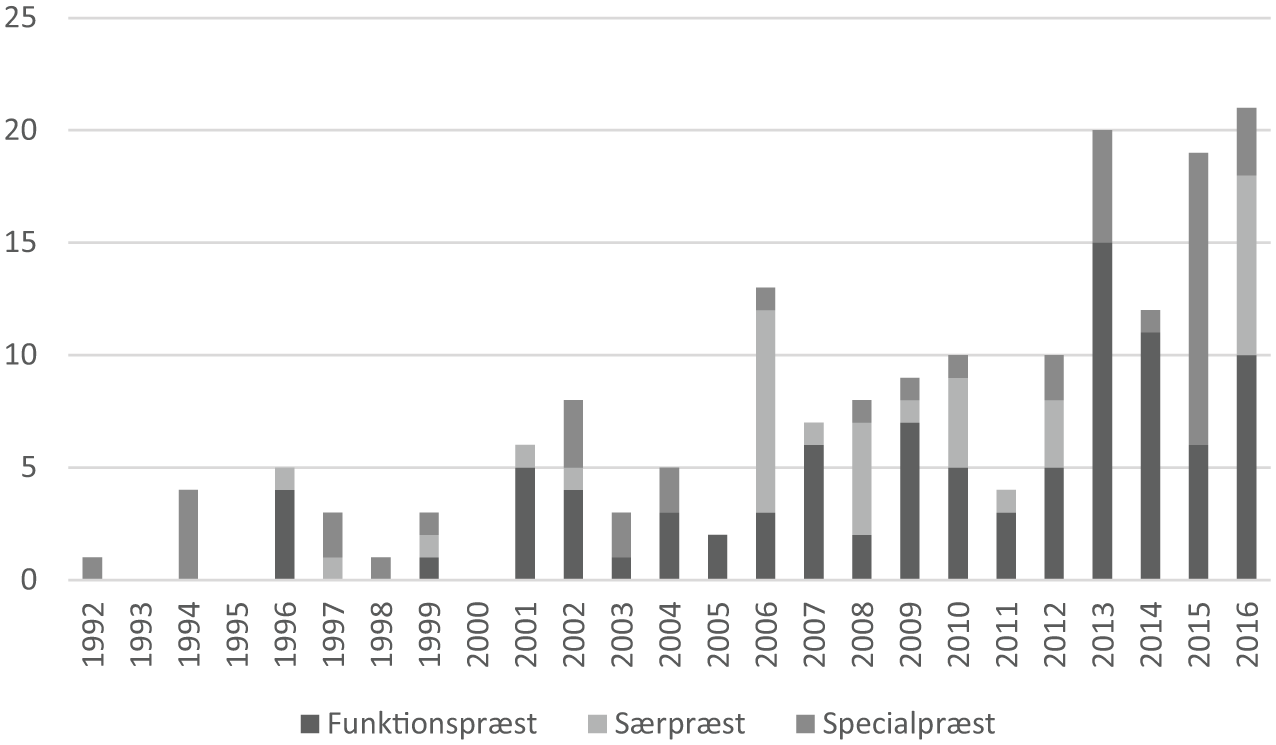
Mentions of chaplains in Danish newspapers, 1992–2016
It is no coincidence that the dissemination of the concept of ‘chaplain’ has been slow. The congregation is the most important unit of the church, and the calling of a pastor to a congregation is a crucial part of the self-understanding of the Church of Denmark as a local church with democratically chosen parish councils at its core (Nielsen and Kühle, 2011). The chaplain challenges this model, and in the 1960s and 1970s there was considerable resistance to, and even out-right rejection of the idea of chaplaincy (Kühle et al., 2015: 33).
Before 1980, there were relatively few chaplains in Denmark, most of which were in the military, and they were not full-time chaplains. They were ordinary pastors on call if needed by the military, but they were rarely used. There was also a small number of hospital and prison chaplains, but their positions were established by historical precedent, rather than contemporary needs. The pastors were primarily parish ministers serving those hospitals, prisons, and garrisons that happened to be located in their parishes.
In the 1980s, the number of Danish chaplaincies began to increase. The reasons seem to be both theological and economic: the dominant dialectical theology, which prescribed no public role for the Church, came under pressure, and the funding scheme for the Church changed, to allow for more flexibility. A particular increase was associated with the establishment of a number of hospices since the turn of the millennium, each of which has a (Lutheran) chaplain.
The number of chaplains in hospitals and prisons, has increased four- to seven-fold since the 1970s (Table 1), and the number of university chaplains has doubled. Military chaplaincy has decreased in numbers, but increased in relevance, owing to the rise in military engagements in international conflicts since the 1990s (Kühle et al., 2015: 157). A number of new pastoral positions, such as street chaplain, have also been established. These chaplains work among the homeless, addicts and prostitutes helping with practical matters and providing pastoral care. These chaplains often work in, or closely with institutions, and some have received funding from local authorities for their social activities (Kühle et al., 2015: 60). Overall, the distinction between chaplains and other new, non-traditional pastoral positions is often blurred, as in Danish, the same term (funktionspræst) is used for both. The funding for the different sectors is also varied, and at times somewhat blurry.
Growth in Lutheran chaplaincy (both full-time and part-time positions).
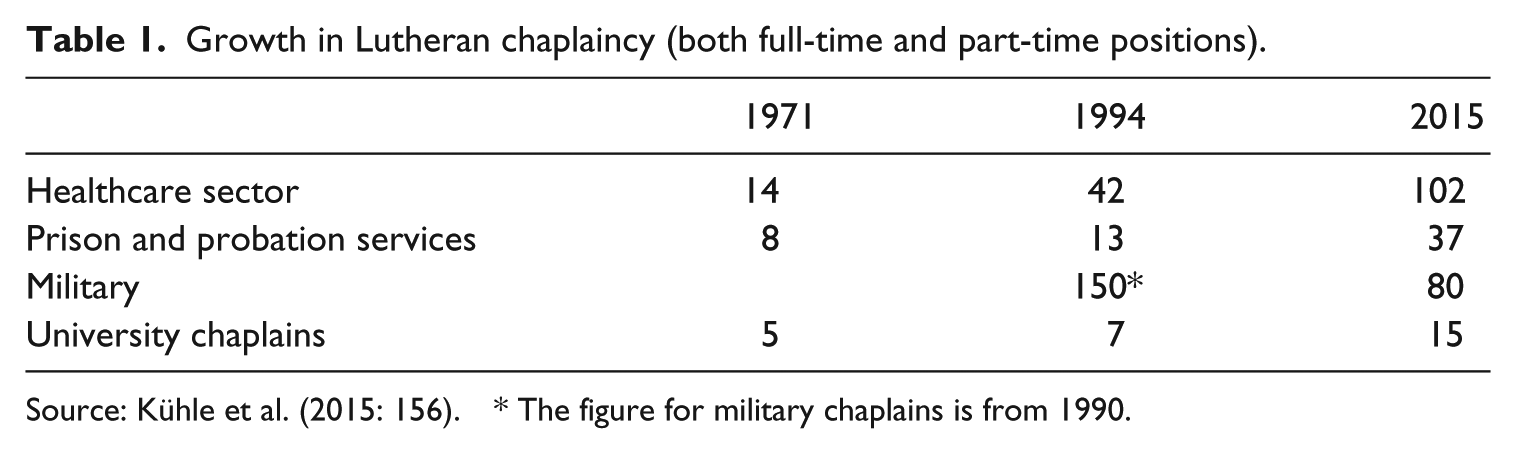
Source: Kühle et al. (2015: 156). * The figure for military chaplains is from 1990.
In the prison sector, seven persons are employed by the Prison and Probation Service (all in closed prisons), whereas the rest (in open and remand prisons) are employed by the Church. The Church employs all military chaplains, but when a chaplain is abroad, the Ministry of Defense reimburses the salary of the chaplain to the diocese. In the healthcare sector, all chaplains are employed by the Church, but employment processes are clearly collaborative. A few university chaplains are partly funded by the university, but overall, collaboration between universities and chaplains appears weaker than in the hospitals. The historical circumstances of the state–church system may explain why there is no clear funding model for the chaplains, but it may also reflect the fuzziness of the aims and objectives with respect to who gains most from the chaplaincies: the church or the institution.
The chaplains’ tasks
In the last decade, chaplains have requested more explicit descriptions of their tasks, and these now exist for healthcare, prison, and military chaplains. The lists of tasks are the result of more or less formalized negotiations between the chaplains and the sectors in which they work. The lists provide a general overview of both the kind of tasks assigned to chaplains, and what the institutions expect. Instructions are most formalized for prison and military chaplains. The documents we describe next are available only in Danish, but we have made a literal translation of their titles to indicate their content. The tasks of the prison chaplains are described in Instructions for the Ecclesiastical Service for Inmates by the Minister of Ecclesiastical Affairs and the Prison and Probation Service (2004), with minor differences among different types of prisons highlighted (closed, open, remand) (Kühle et al., 2015: 73–74). The tasks of the military chaplains are described in A handbook for military chaplains (2008), with no distinction made among the several branches of the armed forces (Kühle et al., 2015: 76–77). The tasks of hospital and hospice chaplains are described in two documents, the Report on the Work of Hospital Chaplains (2013) and Standard of Hospital Chaplains (no date) (Kühle et al., 2015: 68–70). Table 2 shows the tasks mentioned in these documents, in the order that they appear.
Chaplains’ tasks.
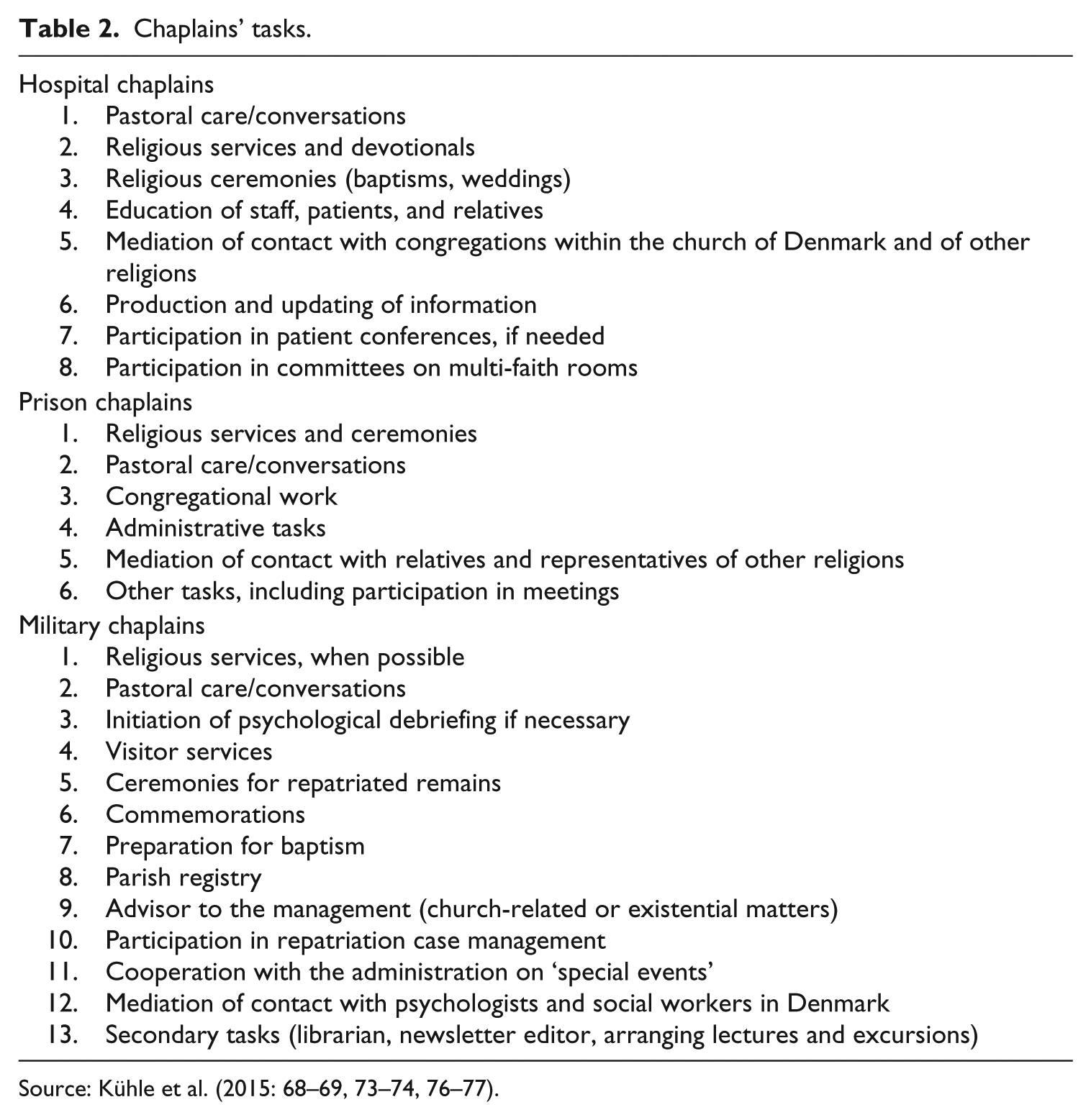
Source: Kühle et al. (2015: 68–69, 73–74, 76–77).
The descriptions of the tasks are primarily similar across the sectors. Yet, although religious services and conversation/pastoral care are tasks of all chaplains, the importance accorded to them in the documents differs from sector to sector. Religious services are mentioned first for prison and military chaplains, but second for hospital chaplains. All three types of chaplains are responsible for establishing contacts with relevant groups and organizations outside the institutions. At hospitals, these are mainly religious minority organizations, or a patient’s specific congregation within the Church of Denmark. The responsibility of acting as a mediator for religious minorities is also among the duties of the prison chaplains, but not of the military chaplains. However, the latter are responsible for contacting psychologists and social workers. In general, military chaplains have many specific tasks that none of the others have. These include preparation for baptism, and advising management. To sum up, the chaplains have ‘classical religious tasks’, conducting services and rituals, and pastoral care, and ‘administrative or secular tasks’, including maintaining the parish registry and facilitating contacts outside the institution.
What the chaplains actually do
In all three of the above-mentioned sectors, religious services and pastoral care are important. Table 3 shows the amount of time the chaplains spend on various tasks.
Tasks and activities for chaplains in different institutions.
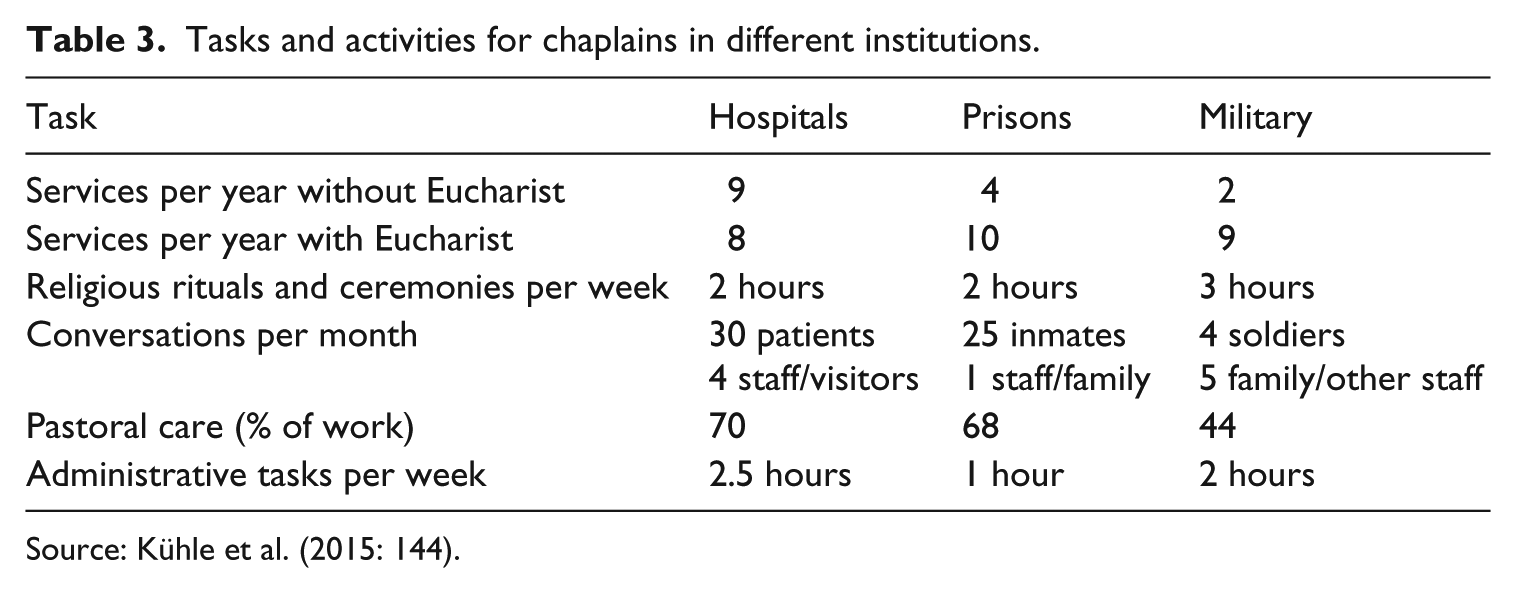
Source: Kühle et al. (2015: 144).
All figures are median figures, as the variance is significant. For instance, some chaplains report more than 100 conversations per month. Overall, the chaplains conduct between 11 and 17 services per year, although not all include the Eucharist. There is some congruence between the priority of the tasks outlined in the various documents, and in the answers, the chaplains have given. Military chaplains spend more time on religious services and less time on pastoral care than hospital chaplains, which aligns with the priority given in the documents. On the other hand, the military chaplains perform the fewest ceremonies of the three types of chaplains.
One of the tasks of Lutheran chaplains is addressing the needs of religious minorities. In the questionnaire and interviews, we asked how extensive this is. We were advised against including this question in the survey sent to the military chaplains. They are obligated to be available to people of all faiths, and would consider such a question as testing rule compliance.
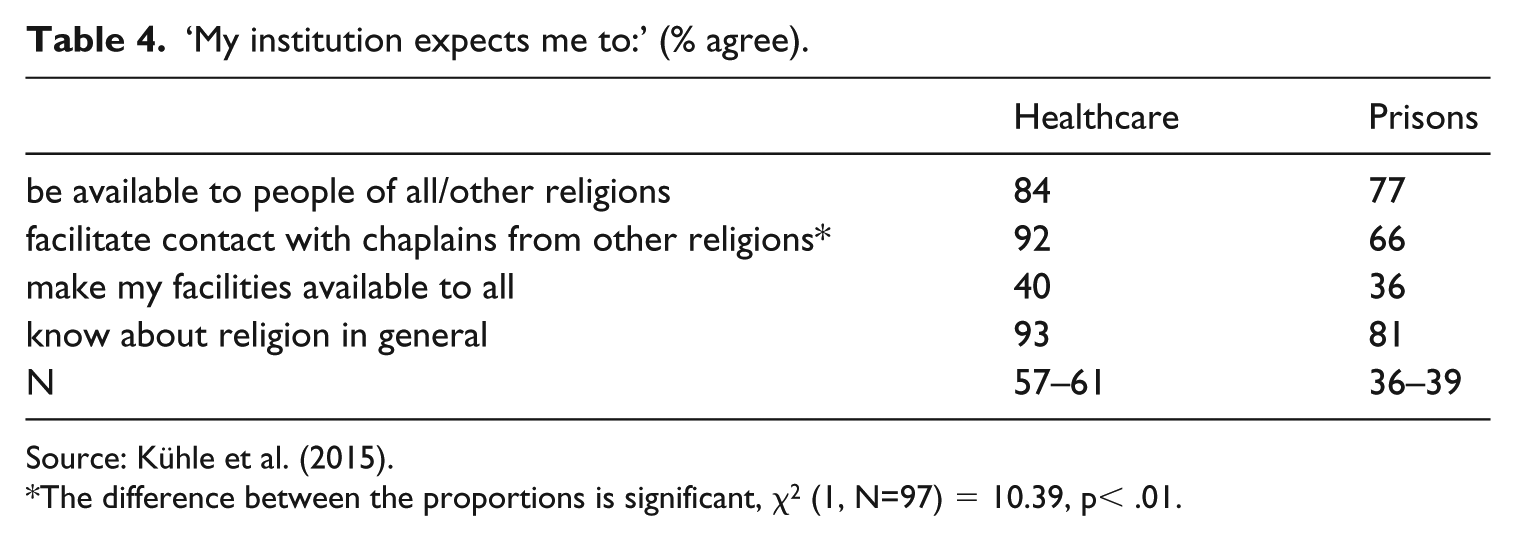
Table 4 shows that chaplains find that their institutions have certain expectations of them, regarding availability, interfaith mediation and knowledge. Most find they are expected to facilitate contacts within and outside the institution, and that the institutions expect them to know about religion in general.
‘My institution expects me to:’ (% agree).
Source: Kühle et al. (2015).
The difference between the proportions is significant, χ2 (1, N=97) = 10.39, p< .01.
The expectations of chaplain availability is particularly interesting, and the interviews helped us to qualify the capacities in which chaplains are expected to be available. A chaplain at a remand prison explained how the Catholic priest associated with the institution has never held a service at the prison: And he has not requested it [. . .] but sometimes there is someone who asks for a Catholic priest, and then I have called him. It is much more difficult with the imam. We try, but I feel bad about it. It is a problem that prisons have no contact with imams. Yet at the same time, it is really more about me thinking it’s needed, because even if we have Muslim inmates, I think I have only had one request for an imam. And I have delivered Qurans once in a while. (Thomas, chaplain at remand prison)
This is a typical account of their tasks and reflections. Although the task of negotiating religious diversity is assigned to chaplains by their institutions, their obligation to all patients, inmates, or soldiers, regardless of their religion is not regarded as ‘imposed from above’. They generally want to be of service to everyone at the institutions, and provide administrative help, pastoral care, and religious services based on people’s needs. Another prison chaplain explained that he has improvised a devotional service for a Russian Orthodox inmate, playing a CD of Gregorian chants and adding a few readings from the Bible, in an attempt to develop something that appealed to the inmate. A third prison chaplain told us that she has turned the Sunday service into a ‘faith mass’, with only a few readings from the Bible, but an extensive focus on prayer and communion, and in one of the largest prisons in Denmark, the chaplain has turned the Sunday service in a more meditative direction.
A month ago, we changed the service, giving it a more meditative touch. The inmates have been very enthusiastic. When do they experience silence? Rarely. And when do we experience silence together? Very rarely. But I have changed the sermon, for instance, I am now using paintings to give it a meditative feeling, and after the sermon we sit in total silence for a few minutes before the musician starts playing something meditative. And after that we have the Eucharist. (Paul, prison chaplain)
This sort of approach is different from the way chaplaincy is carried out in the military, where everything is a little less innovative, and follows the procedures in the handbooks and guidelines mentioned above. The services are conducted similarly to those found in parish churches, and there is little room for, or interest in, changing or adapting the way rituals are conducted. All military chaplains agreed that they do not create spontaneous rituals, in contrast to both hospital and prison chaplains. This is probably due to the fact that in 2012 there was public outcry over a chaplain blessing the soldiers and their weapons before their tour of duty in Afghanistan. This was perceived as religiously sanctifying war, and criticized for turning the mission into a religious war between Christianity and Islam. The hospital chaplains reported the most frequent use of spontaneous rituals, and they mentioned actions such as lighting candles, singing, and praying together, which suggests that they are among the chaplains who do the most to adapt to the needs of the people they meet. All chaplains accommodate their work to ‘their’ institutions, but the institution clearly determines the extent to which chaplains may improvise and innovate.
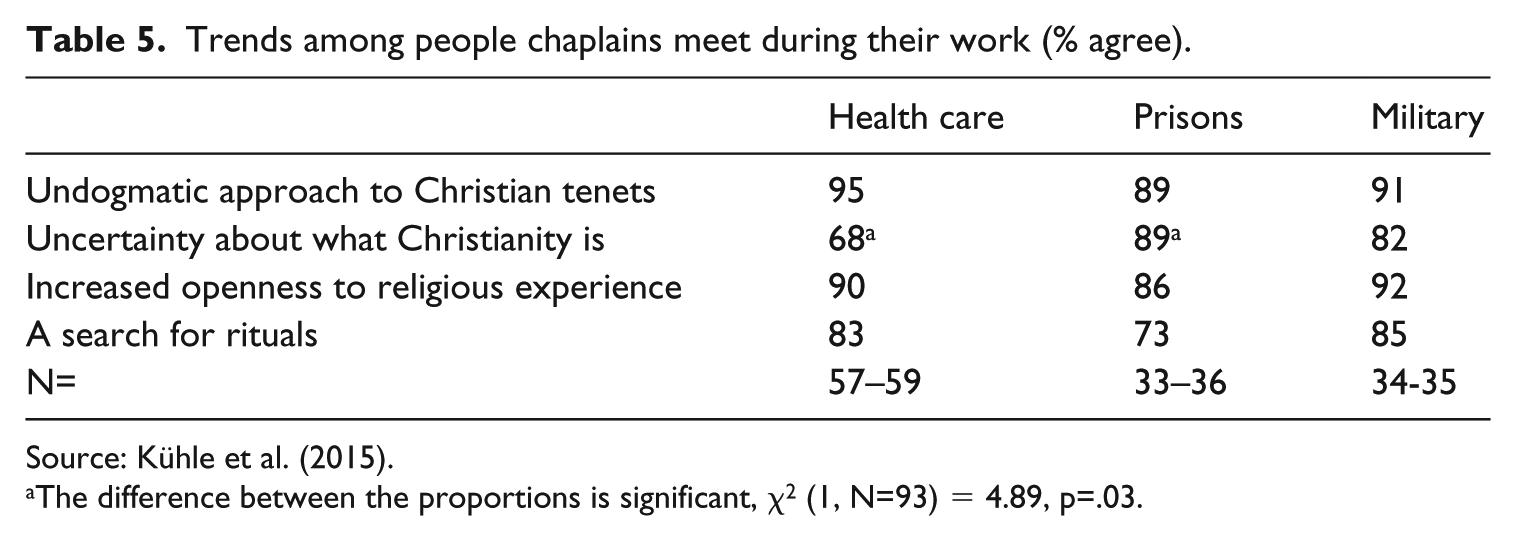
Compared to ordinary parish ministers, chaplains spend relatively little time on religious services. Chaplains use most of their time in conversation with individuals. The official documents use an uneven terminology regarding these talks: in the document regulating the tasks of the hospital chaplain they are named conversations, in the documents of the prison chaplains the term used is pastoral care, whereas both terms are used by the military. From our interviews it is evident that the chaplains regard the conversations as pastoral care. They provide people, who find themselves in unusual and precarious circumstances, with the means to cope with those circumstances, whether they are patients suffering from illness, inmates suffering from guilt, or isolation, or soldiers suffering from anxieties or traumatic experiences. The ambiguity embedded in the duality of conversation/pastoral care also allows the chaplains to approach people, who consider themselves to be secular. This is probably necessary as the chaplains find the people they meet to be undogmatic and insecure with regard to religion and Christianity but open-minded and in need of rituals as shown in Table 5.
Trends among people chaplains meet during their work (% agree).
Source: Kühle et al. (2015).
The difference between the proportions is significant, χ2 (1, N=93) = 4.89, p=.03.
Sullivan argues that American chaplains avoid proselytizing. This is also the case with the Danish chaplains. In several interviews, chaplains emphasize that they do not want to take advantage of their situation to preach the gospel. For Paul, the prison chaplain mentioned above, it is important to address each person individually: ‘You cannot just sit and talk about Matthew, Mark, Luke, and John or what you want from the Bible if you do not care for the entire human being, and help him or her if they have a problem. That would be deeply unchristian.’ He thinks that it is more Christian to take each individual seriously in and of themselves even if it means never using an explicit Christian or religious vocabulary. For many chaplains, the story of Jesus walking to Emmaus with his doubting disciples (Luke 24:13–35) provides a useful reference for this approach. Another chaplain, Allan, explains that pastoral care means to be a companion through a person’s personal hell [. . .] there is always three present in the pastoral care conversation: the confidant, me, and God. There is power in that conversation. It is not just me and him or her, but something more, but I do not necessarily tell that to people.
Although Allan mentions ‘hell’ in this regard, it does not necessarily have anything to do with the eschatological concept of Hell, and he is careful to not impose a proselytizing or even explicitly Christian narrative on people. The Danish anthropologist Hanne Bess Boelsbjerg shadowed hospital chaplains during their work, and described how these pastoral care conversations develop, and how the vocabulary is (intentionally) left vague, so the patients may interpret them along religious or secular existentialist lines as they see fit (Boelsbjerg, 2013). 1
Discussion
If Lutheran chaplaincy in Denmark is related to the three central characteristics of previous research identified – negotiating a place for religion in a secular institution, the obligation to cater to members of other religions, and formatting chaplaincies according to the institution in question – it is clear that the Danish model of chaplaincy fits the overall model of chaplaincies described by research in other countries. The chaplains navigate religion in secular institutions, address the needs of members of both minority and majority religions, and, although tasks are similar across institutions, chaplains also accommodate their practices to the institution in question.
Sullivan argues that chaplaincy is changing the American religious landscape from denominational and dogmatic to a spiritual and existential ethics where the chaplains have become the specialists in what she calls ‘ministries of presence.’ Although the American religious landscape is very different from the Danish one, we would nonetheless argue that the Danish chaplains are also espousing such a ministry of presence. Ministries of presence address high levels of religious diversity in public institutions, where the presence of one chaplain ‘to fit the all’ comes out as particular helpful in the eyes of the institution. Our results (Table 4) clearly shows that most Danish chaplains are asked to take this approach.
However, in the Danish context chaplaincies of presence is not only expected to bridge religious or denominational gaps, but importantly also the religious–secular divide. Adapting the practices of the chaplain happen without much discussion or criticism from the church, partly because of the century-long partnership between state and church, partly because of the liberal theological tradition, where dogma and church attendance have been less important, and partly because the non-hierarchical structure of the church enabled local practices to develop without scrutiny.
When chaplains meet people in the pastoral-care context of public institutions, a certain type of vocabulary is used, which is deliberately ambiguous, lending itself to interpretation from both Christian (Lutheran) and secular existential (and thereby also acceptable to other religions) perspectives. The chaplains are adamant that what they do is formed by their Protestant Lutheran theology, even if explicitly religious claims or statements are absent. Their presence, that is, their conversations or pastoral care, is one of their main tasks, and the institutions select chaplains based on their ability to do this. Given Denmark’s low levels of church attendance, we may rephrase John Bowen’s words slightly, iterating that it is by participating in the social life of these institutions that most residents and citizens encounter both the state and religion. This also means that the existence of a ministry of presence depends less on the ‘wall of separation’ of the US Constitution than Sullivan thinks, because we find the same development in Denmark, which has a close relationship between state and church. In fact, the Protestant legacy may explain this more than the church–state relation does. However, this suggestion calls for further research. Also, if secular public institutions are central sites of face-to-face encounters with religion, and these institutions shape or form religion in certain directions, then secular public institutions become central producers of religious change.
Conclusion
In the last four decades the importance and relevance of chaplains in Danish public institutions has clearly increased. This is surprising, as Denmark is often perceived as a very secular society, notwithstanding the strong church–state system. Yet chaplains are skilled in navigating secular landscapes. Despite the differences between US and Danish contexts, in Denmark we find a ministry of presence similar to the situation identified by Sullivan. Furthermore, religion is re-formulated in its encounter with certain forms of institutional logic. Therefore, the Danish ministry of presence is unlike its American counterpart, shaped by the secular predisposition of the Danish population. From this perspective, the growth in number and in importance of chaplaincies in secular Danish public institutions is paradoxical, given the secularity of Danish society, yet it expresses the ongoing working relationship between church and state in a society characterized by increasing levels of religious diversity.
Footnotes
Acknowledgements
We would like to thank the students, who have contributed to the project by writing essays, and masters’ theses, which added to our knowledge of the field.
Funding
This project was commissioned and funded (EUR 30,000) by FUV (Folkekirkens Uddannelses- og Videnscenter). The project involved a number of short-term employees (Sivert Urstad, Stig Asboe, Signe Bønlykke, Anette Dam). This project developed from Kühle and Christensen’s long-standing interest in religion in public institutions, which is documented by the NOREL project, ‘Religion in the public sphere in the Nordic countries’, among other things (see Furseth I (ed) (2018)) Religious complexity in the public sphere. Comparing Nordic countries. Palgrave).
Notes
Author’s biographies
Address: Department for the Study of Religion, Jens Chr. Skousvej 3, School of Culture and Society, Aarhus University, 8000 Aarhus, Denmark.
Email:
Address: Department for the Study of Religion, Jens Chr. Skousvej 3, School of Culture and Society, Aarhus University, 8000 Aarhus, Denmark.
Email: