




Abstract
This article discusses important issues concerning the place of non-engagement and indifference in the studies done on secularism, and answers the following questions: how is it possible to be indifferent to religion in multicultural cities? Can non-engagement in religious conflicts be a solution to the life in such contexts? This article is based on a study carried out with 200 French and German teenagers that is grounded on a mixed method, i.e. research cross group interviews and quantitative questionnaire. The data analysis was realized within the frame of sociological phenomenology. The author distinguished three types of indifference: cognitive indifference, existential indifference and protective indifference. Those three types of indifference form a paradox in the secularization process because they are spreading out in multicultural societies among which religious plurality and its inherent conflicts are omnipresent.
Introduction
Studies on secularism as a social trend regard religion as a social sphere and tend to focus mainly on activist groups and individuals who convey a clear and detailed conception of their values and opinions concerning the place of religion in society. 1 This kind of research can provide valuable indicators of the evolution of secularism in society. 2 However, when it comes to Western society, we know that this kind of anticlerical or antireligious activism concerns only a minority of individuals. 3 We can take France and Germany as interesting examples in so far as the place of the religious institution in the public life differs fundamentally in both countries. For example in France, classified as one of the most atheistic countries in the world, only 29% of French people consider themselves atheist. 4 The majority of the remaining 71% reside in what Voas has called the ‘muddled middle’. 5 We can observe a similar situation in the Eastern part of Germany known as the country with most non-believers in the world. For example in 2008, 10% of the West German population declared that they did not believe in God, compared to 53% in East Germany. 6
Yet the complexity and variety of religious attitudes present within this broad category have rarely been the focus of comprehensive, qualitative studies. At the heart of secular identity, religious indifference is an attitude the social sciences have largely failed to make sense of so far. Interested above all in ‘hot’ religion, effervescent and conflictual, sociologists have long cast aside what one might call the ‘soft side of religion,’ 7 paralleling in this way the approach of the media. 8 There would seem to be a clear division in our western societies between, on the one hand, a religion of engagement and strong identity, and on the other hand, a religion of doubt and weaker identity.
The purpose of this article is thus to analyze the relationship between these two dimensions of religion, in its contemporary reality. Through the study of a population of French and German adolescents generally indifferent and non-engaged in religion but living in circumstances of religious plurality, we will try to understand their relationship with religious engagement and conflict. In order to develop our subject, we will first seek to understand religious indifference from a theoretical point of view and position it in the field of secular studies. Following that, we will describe three models of indifference within a population of French and German adolescents, these models are of great importance and help to understand the reaction to religious conflicts, expressed in non-engagement.
‘Indifference’ in the field of secular studies
Indifference has been at the heart of philosophical debate since the skeptics made the concept a key component of their philosophical reflections. Advocating epoché (the suspension of judgement) and adiaphory (abstaining from decision), Pyrrho of Elis – at least in the writings left by his disciples – identifies indifference to the senses, reason, and the rhetoric of the Sophists as the gateway to ataraxia (tranquility), the culmination of a happy existence (Robin, 1944). One will note the stark contrast with contemporary models of happiness. These, whether drawn from the philosophy of engagement of thinkers such as Sartre or Jankélévitch (Sartre, 1976; Jankélévitch, 1986), or from the modern doxa of engagement and authenticity (Ehrenberg, 1998), tend instead to condemn indifference. Between philosophical acceptance and condemnation, one can thus clearly see the sociological relevance of indifference that seems to find in religion a prime outlet to express itself.
Scientific interest in religious indifference falls more generally within the field of secular studies, an area of research that has been undergoing significant development. Recent examples include the creation in 2005 of the ISSSC (Institute for the Study of Secularism in Society and Culture) at Trinity College (Hartford), as well as the NSRN (Non-religion and Secularity Research Network) in 2008 by the Universities of Oxford and Cambridge. Overall, the researchers active in this domain have been particularly interested in atheism, anti-religion, and the discussion of secularization theories. 9 Indifference has been and remains a marginal topic, addressed in scientific literature only obliquely, if at all. What does it mean to be indifferent to religion?
Providing a suitable response is not easy. Indeed, how does one define an attitude that is by nature negative, soft, described by Voas as being ‘fuzzy’ (Voas, 2009)? An attitude that is in apparent contradiction with the Western model of the enlightened citizen, entrusted and expected to make informed decisions? We will attempt later to address these questions, but before conceptualizing the notion of indifference, it is important to shed some light on its history, and briefly examine the origins of the inquiries that have been made into religious indifference. One of the most important milestones in the history of religious indifference dates from the last century, when Pope Pius XI wrote his encyclical ‘Mortalium Animos.’ In his letter, issued in 1928, the Pope condemns such ‘indifferentism’ as a modern error. What we find here, in fact, is a church that is shaken: accustomed to its long struggle against atheistic activism, it is yet ill at ease in the face of religious indifference. And decades later, the question remains a central issue for the Catholic Church. But if the notion of ‘indifferentism’ seems particularly tied to theology, that has not prevented certain sociologists from applying the concept themselves (i.e. Willaime, 1998: 17). For our purposes, we will avoid using the suffix ‘ism’ and speak instead of religious indifference, in order to distance ourselves from the theological dimension of the concept. In addition, behind this attitude there does not seem to be any structured school of thought, as might be suggested by the idea of indifferent-ism.
We will therefore attempt to define religious indifference sociologically. In scientific literature, indifference tends to be mentioned alongside other concepts that are presented as being more or less equivalent. Yet Henri Desroche, another French sociologist of religion, called into question precisely this practice back in 1965: ‘Atheism, antitheism, irreligion, non-religion, non-belief, heathenism, indifference, non-practicing belief, non-believing practicing, laicization, laïcalisation, profanation, secularism, secularization, etc., etc. So many terms, so many attitudes that overlap each other all the less given that each contains its own variables and ambiguities’ (Desroche, 1965: 3–4). The challenge is thus to distinguish indifference from these other categories that, while inhabiting the same semantic field, differ fundamentally in the realities they describe. A number of large quantitative surveys were among the first to be confronted with the typification of non-religion (we can cite, for example, the European Value Survey, the World Value Survey, the American Religious Identification Survey, the Religion Monitor). In these, the various subsets that Desroches outlines were long combined into one broad category generally called ‘Nones,’ comprising all of the individuals surveyed who described themselves as ‘without religion.’ However, as Cragun et al. noted, the attitudes blended together here can be strikingly divergent (Cragun et al., 2012: 106). Today, the categories being employed are becoming more refined as the number of ‘Nones’ continues to grow. But if indifference has emerged as a relevant category, it still lacks a clear definition. In these large quantitative surveys, all individuals who do not express an opinion with regard to religion are simply put together in a category labeled ‘indifferent’ (i.e. Smith et al., 2003: 131).
More recently, in an article that takes up data from the Religion Monitor, Gert Pickel has put forward indifference as an explanatory category, though he stops short of defining it: ‘Thus the population of Europe exhibits a high degree of heterogeneity ranging from the religious to the secular or religiously indifferent’ (Pickel, 2013: 11). If we can be pleased about the growing role of indifference as a phenomenon in the field of secular studies, the lack of any precise definition is regrettable. The work of Pascal Siegers (2010) offers what is likely the most thorough definition and application of the concept in quantitative survey analysis. Using data from a survey titled ‘Religious and Moral Pluralism’ (RAMP), an international research project, the German sociologist differentiates various forms of religion and non-religion: these are church religiosity, believing without belonging, atheism, religious indifference, and alternative spiritualities. As Siegers writes, ‘Weaker forms of unbelief probably have greater importance for religious orientations in Europe. These embrace agnosticism as well as religious indifference. The latter means that individuals simply have no opinion on religious questions. They do not feel concerned with religious issues and questions, and religion has no relevance for their lives’ (Siegers, 2010: 390). His study of 11 European countries brings him to conclude that in most countries, religious indifference is the modal class. The only exceptions are Italy, Poland, and the Netherlands. The Netherlands is the only country where atheists outnumber indifferent people; and overall, it turns out that about 60–70% of Europeans do not have firm religious beliefs (Classes III and IV)’ (Siegers, 2010: 407).
Indifference is thus the prevailing attitude in the majority of countries studied. Confirming its importance, certain articles have aimed to provide a more theoretical and historical perspective on indifference. In their article titled ‘The Triumph of Indifference: Irreligion in British Society,’ Samuel Bagg and David Voas go so far as to describe indifference as one of the keystones to understanding secularization (Bagg and Voas, 2009). It is a position that aligns the two authors with Steve Bruce, who presented similar conclusions in his classic work God is Dead. For Bruce, rather than the conscious and developed irreligion of the intellectual elite, indifference is the matrix of secularization for a large part of the population: to understand the mass of the population it is not self-conscious irreligion that is important. It is indifference. The primary cause of indifference is the lack of religious socialization’ (Bruce, 2002: 240). We can glimpse here the distinction put forward by Kosmin between hard and soft secularism (Kosmin and Keysar, 2007: 3). Under his system, atheism, as an affirmation of the nonexistence of God, would be placed on the hard side of secularization, whereas indifference would be placed on the soft side. Neither confrontational nor critical, this attitude signifies a disinterest in religion that Bruce attributes to a lack of religious socialization. It is a revealing assertion, and one confirmed by the body of research done on secularization in Europe. 10 Yet, we still struggle to grasp precisely what it means to be indifferent. The complexity of the issue no doubt explains why the research and studies presented here have focused above all on the factors that influence indifference, while offering only a basic definition of the concept itself: someone who is indifferent is someone who is uninterested in religion.
It is this observation that brings British sociologist Lois Lee to strike the notion of ‘religious indifference’ from the study of non-religion. For Lee, when it comes to indifference, what seems to be a lack of interest is often nothing but a difficulty to articulate one’s beliefs (Lee, 2012a): ‘These [the non-religions] can include empirical phenomena such as atheism, agnosticism and a position which is, problematically, called ‘indifference to religion’ despite clearly involving some engagement with or knowledge of religion. To expand briefly on this latter case, we can compare indifference to religion with ignorance of religion, which is a true form of non-engagement and would not be included in this sociology of non-religion’ (Lee, 2012b: 138). In Lee’s eyes, then, even non-religion requires a kind of engagement and awareness on the part of the individual. We will defend the opposing thesis, however: that non-engagement is the essence of non-religion. At the heart of the matter, after all, is the attitude of the individual toward engagement. Indifference here is not only a form of non-engagement with religion, but also with anti-religion and anti-clericalism, which is what brings us to propose a way out via a phenomenological approach. Such an approach would seem most apt to tease out the characteristics of indifference as it relates to engagement, and particularly religious engagement. Because these issues tend to be most present – and their effects felt most sharply – in large, multicultural cities, we will explore the various forms of indifference to religion in environments of religious plurality.
Methodology
Conducted between 2006 and 2009, the research presented here is rooted in a ‘mixed-method’ approach, at once qualitative and quantitative (Tashakkori and Teddlie, 2003). Our investigative method is qualitative at its core, with an added quantitative component to allow testing any theories that may be suggested by the qualitative data.
Altogether, 207 students were interviewed in 36 French and German schools. These establishments were chosen according to three criteria:
- Socioeconomic enrollment: in each region, we aimed to have access to establishments with significant socioeconomic diversity, with students from privileged, underprivileged, and socially mixed backgrounds.
- Environmental diversity: we aimed, in the regions where it was possible (Alsace, Baden-Württemberg, and Brandenburg), to have access to at least two rural establishments and two urban.
- Academic diversity: this point concerns Germany, which has no standardized secondary school model (except in certain regions which have introduced the Gesamtschule). In each region, we thus aimed to have access to at least one Hauptschule (for technical training), one Realschule (general instruction), and one Gymnasium (humanities instruction).
The following table presents the research sample:
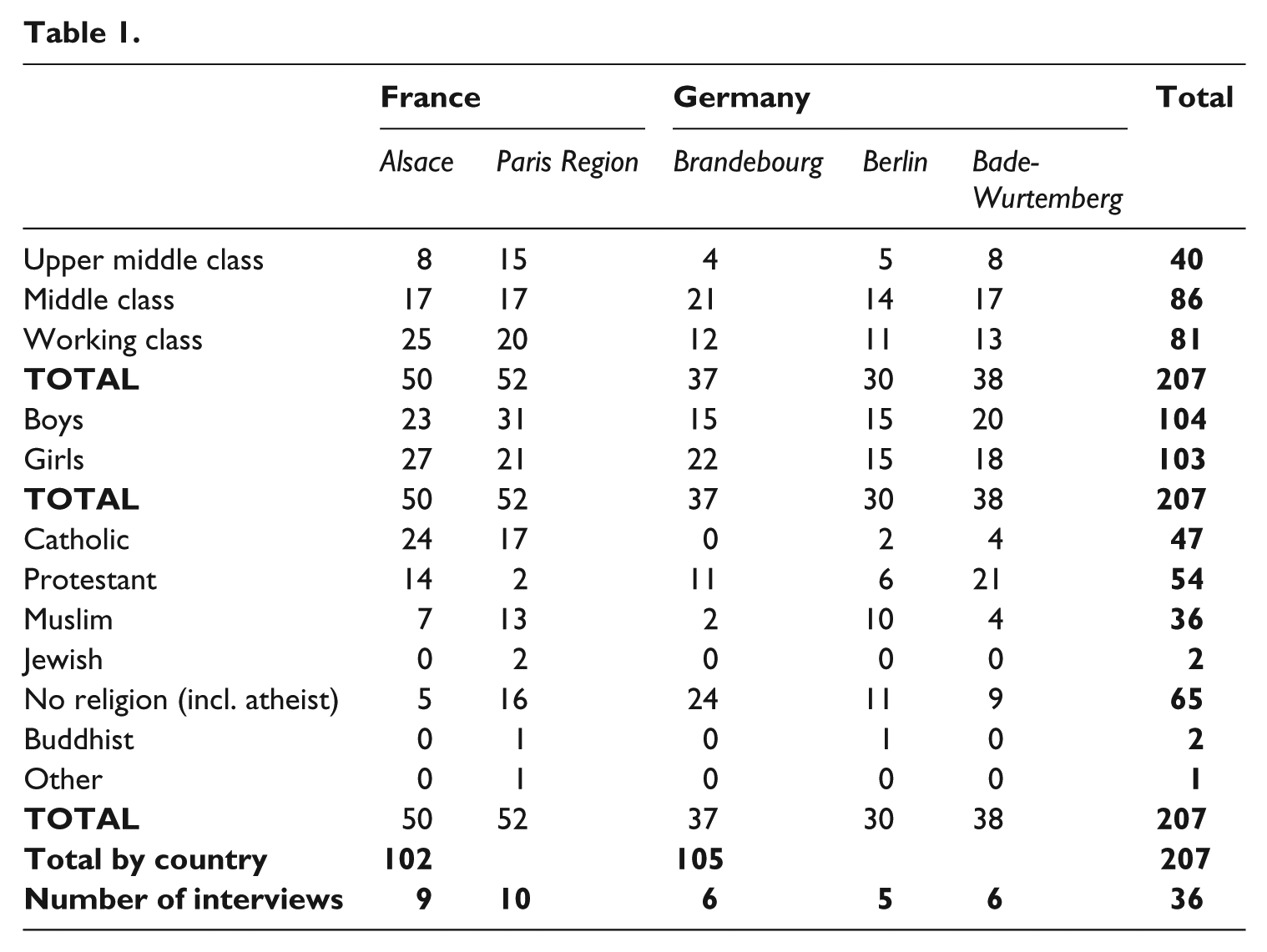
The qualitative side of our study is based on a two-part interview process, specially designed to be casual, as well as entertaining for teenagers. The first part of the interview aimed to foster a relaxed atmosphere conducive to sharing broad-based knowledge – rather than simply academic – through a collective interview with a peer group (six middle school students from the same class). Conducted at school, these group interviews were based on a board game composed of various features that called upon participants’ visual knowledge (by means of photo elicitation) and mental mapping (Pink, 1996). The adolescents were for example presented with a selection of 26 photos representing symbols, figures, believers, and places of worship from the eight religions examined in our study (Christianity, Judaism, Islam, Buddhism, and Hinduism, as well as the religions of the ancient Greeks, Romans, and Egyptians). For the second part of the interview, the students were split into two groups of three: while one group filled out the questionnaire for the quantitative survey, we proposed to the second group a discussion centered on their relationship with religion and religious otherness. To encourage conversation, we made use of various vignettes (Danic et al., 2006).
In this article we will accord only limited importance to these three indicators, to concentrate instead on national differences. Qualitative data have been analyzed though the Grounded Theory method (Corbin and Strauss, 2004), with the help of ATLAS.ti, a software program. Finally, we wish to specify that we used a phenomenological approach based on Alfred Schütz’s work The structures of the life-world to analyze the data obtained (Schütz and Luckman, 2003 [1975]). In Schütz’s words, sociologists study the ‘natural attitude’ of social actors and build their interpretation upon the form of ‘constructs of the second degree’, ‘namely constructs of the constructs made by the actors on the social scene’ (Schütz, 1954: 267). In this research, we focused on the indifference attitude as it has appeared in the discourse of teenagers. We want here to point out that this is clearly a limited analysis of indifference attitude. Thus, an ‘attitude’ as Schütz defines it, expressed itself also in action and experience. Developing that reflection with a methodology focused on ‘non-verbal’ data would be of great interest.
We will concentrate more specifically on adolescents living in large, multicultural cities in France and Germany. This type of environment would seem ideal for analyzing precisely how the encounter between indifference and religious engagement is experienced in everyday life; indeed, the religious pluralization of larger cities can force individuals who do not share the same belief system to mix and come into contact with each other (Luckmann, 1991[1967]: 20).
Indifference and religious engagement: a phenomenological approach
The questions to be asked are the following: what happens when an individual is indifferent to religion? What is reflected in the attitude of an adolescent who, when questioned by a sociologist, states, ‘I don’t care’? A group of German researchers have proposed a useful approach to the subject, based on their study of religiosity in eastern Germany. In the introduction of the collective work Atheismus und religiöse indifferenz, the authors distinguish two types of indifference, which they define in the following terms: ‘religious indifference’, from an existential perspective, signifies detachment (Gleichgültigkeit), disinterest, the lack of concern for religious issues. Religious indifference from a cognitive perspective grants no meaning to religious issues. Even more, with this form of indifference, the individual does not distinguish what is interesting from what is not. Within this framework, available choices are un-interesting (Gleich-gültig: Gärtner et al., 2003: 12).
These forms of indifference represent two complementary aspects of a single phenomenon. In order to distinguish between them, it may be helpful to ground our discussion in the ideas of Austrian social scientist Alfred Schütz, and his theoretical framework centered on ‘structures of relevance’ (Schütz and Luckmann, 2003). For Schütz, relevance is the appearance of something in one’s consciousness, which in this way becomes relevant. This phenomenon does not occur randomly, or at the whim of one’s consciousness, but rather obeys socially and biographically constructed ‘structures of relevance.’ These structures define and direct the constitution of an individual’s experiences and actions, and consequently organize his stock of knowledge in a specific manner, within a particular society. Alfred Schütz identifies three kinds of relevance. The first is thematic relevance, whereby a particular theme appears in one’s consciousness according to the context of what is experienced; the second is interpretational relevance, which gives meaning to this experience; and the third is motivational relevance, which frames the theme within structures like ‘because,’ or ‘in order to,’ thus anchoring it within the individual’s personal history (Schütz and Luckmann, 2003: 252). Using the model of Schütz then, one can view religious indifference as the difficulty or inability of religious themes to appear relevant to the consciousness of an individual. If we consider the French and German individuals in our study – those for whom religion is not a central element of their stock of knowledge – religious indifference would therefore be placed at the core of what Schütz calls their ‘natural attitude,’ as something ‘taken for granted.’
At this point, a paradox emerges: to what do we owe such religious indifference in a society of religious plurality? In a society in which religion is not only visible but extensively covered in the media in its most earnest and conflictual forms? How can one remain indifferent in this situation? We propose to address the question by taking up the distinction between cognitive indifference and existential indifference. We will then conclude by exploring the possibility of ‘chosen indifference’.
Cognitive indifference and religious engagement
Cognitive indifference arises when a social phenomenon – such as religion – is not subjected to specific typification. Religion, in that case, finds no expression in daily life, and does not structure the biography of the individual. If we look at adolescents, we could say, generally speaking, that the topic of video games suggests a universe loaded with meaning, structured by relevance and anchored in their lives by concrete experiences. On the other hand, among the same population, the topic of religion in general, or else a particular aspect (Ramadan, the kippah, etc.) might suggest nothing of the sort. This is an example of cognitive indifference – just as one could imagine ‘video game indifference’ among older generations. We can study the conditions in which this cognitive indifference emerges with the help of our student interviews. In the following extract from the interviews, for example, we find two young atheists (Priscille and Céline), a Muslim (Bijet), and a Catholic (Laure) seeking the meaning of Easter for Christians: [Paris. Priscille, middle class, atheist; Laure, middle class, Catholic; Céline, middle class, atheist; Bijet, middle class, Muslim] B.M.: What does Easter represent for Christians? Priscille: I was about to say something stupid. B.M.: Go on ! Priscille: The Three Wise Men… I don’t know… No, yeah, that’s right! Laure: No, the Three Wise Men, that’s Christmas. Céline: No, but wasn’t there something with eggs? Bijet: Yeah B.M.: And do you have an idea? Priscille: I’ve heard things about it! Laure: Now, with the eggs, it’s possible it’s when Jesus, they’re around the table, and he says, ‘this is my body’ and all that. B.M.: And what’s the connection with the eggs? Laure: Well, since people give each other eggs, I don’t know. Priscille: In Spanish we did it… Isn’t that where he brings orange blossoms, wheat, things like that… Bijet: Some gifts, whatever. Priscille: Maybe I’m thinking of the galette des Rois, or the Chandeleur.
It would seem clear, first of all, that it is difficult to conceive of an individual for whom the theme of religion evokes absolutely nothing. Even in the case of an individual that quantitative surveys would classify as ‘indifferent’ to religion, the individual’s stock of knowledge harbors a minimal level of thematic relevancies, certain vague particulars which structure the theme. In the extract above, with the opening question placing Easter in the context of Christianity, the four adolescents begin to deploy what ‘Christian’ knowledge they have: about Christmas, Jesus, Easter eggs, the galette des Rois (king’s cake), the Chandeleur (Candlemas). We may note that the semantic field representing indecision is ubiquitous: ‘I don’t know,’ ‘maybe I’m thinking of,’ evidence that the interpretive relevance framing this knowledge does so only loosely. Thus, Easter does not suggest a universe of precise meaning, but is rather part of the general category of ‘Christianity.’ This cognitive indifference reflects very clearly what has become a major sociological evolution among certain French and German youth: the ex-culturation of Christianity from their stock of knowledge. 11 We may now explore what effect religious engagement and religious conflict have on this kind of indifference.
Over the last several years, and particularly since 9/11, a considerable body of literature has developed in the field of sociology of religion and interethnic relations. Much of this has focused on the polemic nature of religion in general, and particularly among youth, with researchers especially seeking the link between religious engagement and acceptance of the other (Sirin and Fine, 2007; Béraud and Willaime, 2009; Hemming et al., 2014). Interesting as they may be, though, these studies have given little attention to the dimension of indifference. Given the theoretical framework that we have developed, it would seem interesting to investigate the polemic – or, on the contrary, pacifying – effect that religious indifference may have. We will firstly explore the encounter of cognitive indifference and religious engagement. In other words, what happens when an adolescent, whose stock of religious knowledge is but minimally structured, is confronted with religious engagement. Indifference appears as an important factor in the detachment from these issues. Let us take the example of the position on the Islamic veil taken by the interviewed teenagers. An element typical of the kind of confrontation with religious engagement that adolescents will have when living in a multicultural environment, the veil poses no problem to adolescents who are indifferent.
[Mannheim. Tugba, working class background, Muslim.] Tugba: I don’t care, it wouldn’t bother me if someone wears a headscarf or not… It’s the same to me. [Strasbourg. suburbs. Margot, middle class, Catholic; Cécile, upper-middle class, atheist.] B.M.: The law says that you don’t have the right to wear conspicuous religious symbols. Everyone is on… equal footing. For you, is it better that way? Cécile: I don’t really care. B.M.: Do you feel the same way? Cécile: Yeah, if they want to wear headscarves, they can.
This kind of position is all the more interesting given that for many adolescents, the Islamic veil represents the limit of acceptance of the other. 12 However, in the presence of cognitive indifference, the veil does not arouse any particular problems, whether it be in France or Germany. As a form of non-engagement with religion in general, and with symbols demonstrating religious engagement in particular, it would seem that cognitive indifference is more of a pacifying attitude than a creator of conflict. We can now turn our attention to existential indifference.
Existential indifference, the impossible conflict and non-engagement
Existential indifference allows one to situate indifference as one of the ways of being of an individual. For French anthropologist Albert Piette, it is even what distinguishes Homo sapiens sapiens from other species (Piette, 2003: 351). Existential indifference is in this way an ‘immediate capacity of detachment’ that allows the individual ‘to not know, to not want, to not draw the consequences’ (Piette, 2003: 351). In this regard, religious indifference may be placed within a wider anthropological context, where it can be found at the heart of the states of consciousness that inhabit the individual on a daily basis. One must thus be wary of assuming intensity when, in fact, the individual often grasps reality in a ‘minor mode’.
13
As Alfred Schütz explains, in daily life, ‘the man on the street’ possesses no ‘clear and distinct’ knowledge.
14
If it is relatively difficult to see this indifference ‘at work’ in peer conversation, one may note the prevalence of indecision and confusion in the verbal expression of our interview subjects. We have already seen this above, in the extract about Easter, and it is visible as well in the following response from Gaspard, a young, middle-class atheist from Paris (responding to the question, ‘Is religion important for you, or not that much?’): Well, for me . . I’m not religious, I would say . . . But I’m not . . . I don’t hate religion . . . I’m not for or against . . . You see, I’m atheist. It doesn’t bother me.
This existential indifference to religion thus superimposes itself on cognitive indifference. It can be explained by the intrinsic nature of human consciousness, but it is also reinforced here by the specific theme of religion. In addition to this ‘anthropological’ indifference, then, we assert that religion is subject to a specific form of indifference. The development of social differentiation has led to a multiplication of the forms of ‘expert knowledge.’ As Alfred Schütz explains, ‘the sedimentation of differentiated knowledge in the collective stock of knowledge results in the invisibility of certain areas of knowledge for everyone (jedermann: Schütz and Luckmann, 2003: 405). Consequently, the theme of religion, which had long occupied an important place in individuals’ stock of knowledge, now holds but one place ‘among others’ in the same stock. Instead of being a socially relevant theme for all, it has become a theme relevant for some. The role of the family is of course fundamental in this process; above all, existential indifference characterizes adolescents who have experienced little religious socialization. The normality of non-religion among these adolescents hinders their very understanding of religious engagement. In other words, it becomes strange to be religious. We find strong indications of this attitude throughout the interviews conducted, especially in the adolescents’ use of the word ‘bizarre,’ or ‘komisch’. A bizarre situation or element of knowledge is one that is not routine, that is outside the world of one’s daily life. And one may note that the term ‘bizarre’ is above all used by interviewees to qualify religious engagement. An element is bizarre when it is generally situated beyond the sphere of ‘what is taken for granted,’ and it is of no interest to these adolescents until it erupts before them, and they no longer have any choice but to attempt to give it meaning.
Religious engagement is bizarre because it forces indifferent adolescents to face the fact that their existential indifference to religion is not the norm for everyone. The following narrative from Audrey, a Catholic, in which she recounts her visit to an Evangelical church with her sister, attests to adolescents’ frequent feeling of disorientation when they encounter the ‘otherness’ of religious engagement.
[Paris. Audrey, working class background, Catholic.] And in fact . . . like, when you come, the pastor has to remove the evil that’s in us, and . . . like, I don’t know, it’s so weird, because, I don’t know, I just didn’t like it, because he was crying out, people were holding their heads . . . It was so bizarre.
Here we are at the heart of the paradox of religious indifference in a religiously plural society. Existential indifference to religion, due to its very nature, collides with religious plurality without provoking any specific conflict. Existential indifference feeds on an anthropological capacity to be indifferent, matched and reinforced by a system of ignorance specific to religion. These phenomena, together, explain the possibility of this paradox.
Protective indifference; between indifference and neutrality?
The above distinction between cognitive and existential indifference must not distract from the fact that the two phenomena are deeply intertwined. Their convergence allows one to explain the development of religious indifference in two ways: firstly, through the particular structuring of an individual’s stock of knowledge, and secondly, by way of anthropology. Opposite religious engagement, this position of indifference thus reflects a non-ideological culmination of the secularization of individuals’ consciousness. One question remains, however: is it possible to imagine an individual who has chosen an attitude of religious indifference?
This question emerges from the following observation: in their indifference, many adolescents demonstrate a certain reflexivity, which implies both religion having some relevance in their stock of knowledge, and their possessing a kind of expertise, be it minimal, about the issue. Beyond the question of cognitive and existential indifference, then, one might wonder if it’s still a matter of indifference at all. We may note, firstly, that this type of attitude is primarily an attitude toward engagement, but also – and above all – the possibility of religious conflict. Among both French and German adolescents, as we can see in the examples below, a pattern emerges along the lines of, ‘I don’t care, as long as there’s no violence.’
[Brandenburg. Hadi, atheist; Jonhatan, Protestant; Benjamin, atheist] B.M.: Do you find that there are a lot of different religions in Germany? Hadi: No, not really. Jonhatan: For me, everyone can do what they want. As long as they get along, I don’t care. [Paris. Raphaël, middle class, atheist] [Concerning the prohibition of conspicuous religious symbols in schools] Raphaël: Well, since the school system is secular, theoretically, there shouldn’t have even been this law, but then, if they want to practice their religion at school, as long as they don’t cause trouble, or stir shit up saying, ‘Yes I’m an Arab and proud of it,’ there’s no problem.
This indifference embodies the kind of relationship with religion favored by certain adolescents in large cities. We are quite close here in fact to what Georg Simmel calls ‘the right to distrust’ in his essay ‘The metropolis and mental life’: ‘Indeed, if I am not mistaken, the inner side of this external reserve is not only indifference but more frequently than we believe, it is a slight aversion, a mutual strangeness and repulsion which, in a close contact which has arisen any way whatever, can break out into hatred and conflict’ (Simmel, 2002). Is this ‘right to distrust’ really indifference? Isn’t there a paradox in defining indifference as ‘choosing’ not to be interested in something? The notion of ‘neutrality’ would in fact seem preferable, as neutrality ‘claims the opportunity to not take a position; indifference is simply a lack of interest in the issue supposed to require taking a stand’. The principal difference between existential indifference, as described above, and protective indifference, at issue here, is the question of relevance. In the first case, religion has no relevance, whereas in the second it is quite relevant indeed. Thematically, first of all, because religion appears as a routine topic in the consciousness of the youth being studied; interpretatively, because these youth then give it meaning: religion is something potentially dangerous, so I’m not interested; and motivationally, because this meaning is placed within a personal ‘choice’ that runs counter to that of the majority.
Confronted with the reality of religious plurality, these adolescents exhibit a certain distance, which may, on the outside, resemble indifference. But the phenomenological characteristics of – and the intentions embedded within – this attitude are more akin to neutrality. Protective indifference would thus seem to confirm Simmel’s reflections on big city life: a certain reserve is necessary in order to ensure healthy cohabitation, and avoid conflict.
Conclusion
We have distinguished three types of indifference by means of theoretical and empirical analysis and by using phenomenological tools of investigation. The advantage of this method is to be able to approach indifference through individuals’ relationship with religion – as represented and expressed by the French and German adolescents in our study – rather than defining religious indifference a priori, as in the large quantitative surveys mentioned above.
We firstly distinguished cognitive indifference, which describes the effect of indifference on the ‘stock of knowledge’ of an individual. In other words, we have sought to describe what happens when an individual struggles to call upon religious knowledge to resolve situations in daily life. We demonstrate that being indifferent to religion gives rise to a rather liberal position on conflict about religion. This indifference leads to non-engagement in religious conflicts, not by choice, as with the attitude of protective indifference, but due to ignorance and disinterest.
Secondly, we have described existential indifference, which emerges thanks to a dual process. The first part, which is anthropological, explains that at any precise moment, an individual cannot have full and total consciousness of an experienced situation. This anthropological observation is then reinforced by a second process specific to the sphere of religion in a secularized society. Religion is placed within a system of ignorance, as it becomes one expert topic among many. This is an aspect, which has been all too often neglected in analyses on the effects of secularization on individuals’ relationship with religion. ‘The return of religion,’ with its extensive coverage in the media, can prevent one from seeing and perceiving the existential indifference to religion that characterizes a part of the adolescents studied. This indifference poses important ethical questions concerning city life in general, and religious teaching in particular. This ambivalence of indifference, which both protects the individual from conflicts and prevents recognition of otherness, is perfectly described by Fran Tonkiss in an article dealing with indifference to contemporary politics of recognition: ‘While the politics of difference frequently rests on a language of recognition, there is a prosaic but crucial urban freedom in having, to put it another way, ‘people look past you’. Such anonymity is surely a partial and often a privileged right. For those whose relation to the possibility of indifference is insecure – in urban contexts where racial hatred, sexual harassment and homophobic violence are never ‘indifferent’ to questions of otherness – the ethics of indifference is deeply ambivalent.’ (Tonkiss, 2003: 308)
Finally, the third and final type of indifference, that I called ‘protective indifference’ describes an attitude of disinterest toward religion in a multicultural society. Here an individual may consider religion as thematically relevant but chooses to remain disinterested. One finds here an attitude close to that which Guy Bajoit calls ‘apathy,’ in keeping with the classic typology of Hirschman. In a situation of conflict, Hirschman reminds us that the individual has the choice between various attitudes: loyalty, exit, and voice (Hirschman, 1970). Guy Bajoit adds to this triad apathy, which ‘denotes rather a form of resignation’ (Bajoit, 1988: 326). Without accepting the utilitarian paradigm of Hirschman or Bajoit, it would seem that apathy – which we call here protective indifference – indeed constitutes a possible way out from religious conflicts.
We finally wish to address some of the limits of the research. The age cohort on which the study is based (teenagers) and the chosen countries (France and Germany) avoid any generalization. Further research on another age cohort and other (non-western) societies will be necessary to gain a broader comprehension of religious indifference.
To conclude, we may assert that religious indifference is one of the paradoxes emerging from secularization and pluralization in western societies. In the case of France and Germany, as these countries become increasingly multicultural, their societies are confronted with the existence of individuals and religious groups building their identities upon religion. In parallel, secularization — as ‘the progressive autonomization of societal sectors from the domination of religious meaning and institutions’ – has led to the growing power of religious indifference in the daily life of individuals, particularly among the youngest generations. Indifference thus becomes, without necessarily being perceived, a central mode of management of religious conflicts in French and German society.
Footnotes
Acknowledgements
We want to address special thanks to Christopher Bradley for the translation, to Olga Michel and Hubert Knoblauch for the tough but fair reading, and all my colleagues and family for the support.
Funding
This research received a Graduate Research Allocation from the University Strasbourg.
Notes
Author biography
Address: University of Strasbourg, École Supérieure Européenne de l’Intervention Sociale, ESEIS, 3 rue Sédillot, 67000 Strasbourg, France.
Email: