




Abstract
In the Scandinavian countries of Denmark, Norway, and Sweden, as elsewhere in Europe, governance of religious diversity has become a matter of renewed concern. A unique aspect of the Scandinavian situation is the hegemonic status of the respective Lutheran Protestant majority churches, usually referred to as ‘folk churches’, with which the majority of the population associates, alongside a prevalence of high degrees of regional secularism. As such, the majority churches have played a key role as both instigators and organisers of several interfaith initiatives, and have thereby come to interact with the public sphere as providers of diversity governance. Based on country-level studies of policy documents on majority-church/interreligious relations and field studies, this article sets out to explore the prompting and configuration of majority-church-related interfaith initiatives concerning church–state relations and the governance of religious diversity.
Introduction
In the Scandinavian countries of Denmark, Norway, and Sweden, as elsewhere in Europe, the governance of religious diversity has become a matter of renewed concern. Due to demographic changes and an increased level of immigration and religious diversity from the 1970s onwards, along with a growing number of secularised citizens who have questioned the constitutional amendments on the majority churches, several reforms and regulations in the field of faith and worldviews have since been implemented in the Scandinavian countries (cf. Schmidt, 2011). 1 A unique aspect of the Scandinavian countries is the hegemonic status of the respective Evangelical Lutheran national majority churches, usually referred to as ‘folk churches’, within the respective countries, which has often given rise to descriptions of inherent religious homogeneity across, and within, the region. Whereas interfaith initiatives have arisen as a direct result of an increase in religious diversity, the majority churches have, despite growing religious variety and the questioning of the majority churches’ hegemonic status, in diverse ways and at different societal levels, continued to play a key role as both instigators and organisers of several interfaith initiatives. Due to the unique combination of a high level of secularisation and the hegemonic role of the majority churches, the Scandinavian countries offer a distinctive example for exploring the processes of governance of religious diversity. As the ‘interfaith sector’ in the three countries has unfolded along quite different paths, interfaith initiatives make an excellent arena for exploring how governance of religious diversity is influenced by national and, what sociologist of religion Tuomas Martikainen (2013) terms, ‘pluricentric’ governance networks.
The aim of this study is to explore the governance of religious diversity in Scandinavia by comparing the setting, initiation and configuration of contemporary interfaith initiatives in three countries that are often taken to be very similar. 2 Without ignoring the similarities that do exist between the three countries, we ask how interfaith initiatives become an instrument in governing religious diversity and how initiatives are formed by and inscribed in country-specific pluricentric governance networks. Drawing on Torfing (2012: 1), governance networks are defined as ‘networks of interdependent actors that contribute to the production of public governance’. Based on ideas of ‘how to govern through “regulated self-regulation”’ (Torfing, 2012: 3), governance is here understood as the result of negotiation between and institutionalisation of networks of different actors. Martikainen (2013) argues that the religious field is no longer governed through classical bureaucratic state rule, where the sovereign state dictates the subjects. Instead, religion is governed through a multitude of networks in which a large number of interdependent actors – including the state – interact to produce ‘a common good’. By deploying a pluricentric analytical perspective on the cooperative relations between the numerous actors involved in Scandinavian interfaith initiatives, this study moves the analysis beyond a narrow focus on church–state relations in its inspection of power relations within the multi-religious field in contemporary Scandinavian society. Thereby, it seeks to highlight how various interfaith actors manage religious diversity in their efforts to facilitate peaceful co-existence in an increasingly multicultural and multi-religious landscape. Thus, the study pays specific attention to the ways in which the three Scandinavian countries, through different forms of legal and financial governance, (attempt to) shape the respective interfaith fields. All three Scandinavian countries have implemented regulations of their faith communities such as formal recognition on application and different models of funding. The different approaches reflect the three countries’ diverse institutionalisation of religion and secularity, while they also reflect distinctive notions of national identity. This way the three countries’ diverse interfaith topographies must be seen in relation to their respective church and interfaith histories, which produce what we call three distinct trajectories of interfaith work: a Norwegian top-down, yet very liberal, route with a strong emphasis on equality between all faith and worldview groups; a more pragmatic Swedish approach with less state interference, and a Danish civic grassroots form of self-organisation.
The study is based on analysis of policy documents, interviews and ethnographic field studies within the sphere of interfaith initiatives in each of the three countries. The Norwegian study is based on participant observation conducted at and around interreligious initiatives in Kristiansand and Groruddalen in Oslo during 2015 and 2016, plus 26 interviews with people active in various interreligious forums, and informal conversations with local citizens and journalists. In Kristiansand, the case study focused on a locally run Norwegian interfaith network, Forum for Religious and Life Stances in Kristiansand (Forum for Tro og Livssyn (FTL)), whereas the empirical focus in Groruddalen in Oslo was on a variety of different faith groups involved in interfaith work. In the case of Sweden, the study centred on five different interreligious groups in the south of Sweden. Here, 27 interviews with initiators, participants and officials were carried out, along with participant observation at 30 meetings. All empirical material was collected during the period 2010–2017. In the Danish case, the data material was collected during the period 2015–2017 and consists of participant observation in 13 different interfaith activities, including a church festival, a dialogue course and shorter meetings. In addition, 15 qualitative interviews with organisers of interfaith initiatives were conducted, together with more than 30 informal conversations with organisers and participants during fieldwork. In all three countries, the documents collected are official policy documents and legislation, web pages, and other forms of material by the groups.
The (inter)religious landscapes in Scandinavia
The interfaith field in Scandinavia is largely characterised by cooperation between religious communities, the state, municipalities and various dedicated individual actors. This suggests a blurred line between the state and civil society, which several other studies have also found (Beckford, 2010; Furseth et al., 2017a; Griera, 2012; Griera and Forteza, 2013; Halafoff, 2011; Nagel, 2015; Weller, 2009). These pluricentric governance networks create direct links between the state, municipalities, and religious actors. While this article will not touch directly on the role of municipalities, it does indicate the ways in which the connections between the state and religious actors are beneficial due to different funding models and a distribution of legitimacy.
Changing church–state relations
The respective Evangelical Lutheran majority churches have hegemonic status in Norway, Sweden and Denmark, but the relations between the state, majority churches, and other faith communities differ significantly, affecting the establishment of interfaith initiatives. During the last few decades, all three Scandinavian countries have deliberated and, in the case of Norway and Sweden, implemented significant changes in church–state relations. In Sweden, a separation between the state and the majority church became a reality in 2000, whereas in Denmark a similar attempt proved futile. In Norway, the majority church officially ceased to be the Norwegian state church on 1 January 2017.
Despite the separation of the Church of Sweden from the state, the majority church still enjoys a privileged position in comparison to other religious groups in the country. It is expected to function as a folk church with mandatory cross-regional representation and congregational responsibility that encompasses not only its own members, but everyone living in the parish. The majority church is de-centralised, and the congregations have a high degree of independence. On 27 May 2016, the Norwegian Parliament (Stortinget) passed a new bill that established the then-Church of Norway as an independent legal entity rather than a branch of the civil service. While the church remains state funded and integrated into the state administration with a special constitutional role, it is largely self-governing in doctrinal matters and clergy appointments. The Church of Norway, and its Danish counterpart, both serve as the ‘people’s church’ as their members, in principle, encompass the entire people, but the church is not compelled to be a state church as delineated in both countries’ constitutions. Despite a constitutional promise of autonomy, the Evangelical Lutheran Church of Denmark (Den Danske Folkekirke) is still formally connected to the state. As a religious organ, the majority church is decentralised, as there is no central church council. Instead, the bishops have regional jurisdiction while local congregations enjoy a high degree of influence on local issues.
A growing multi-religious landscape
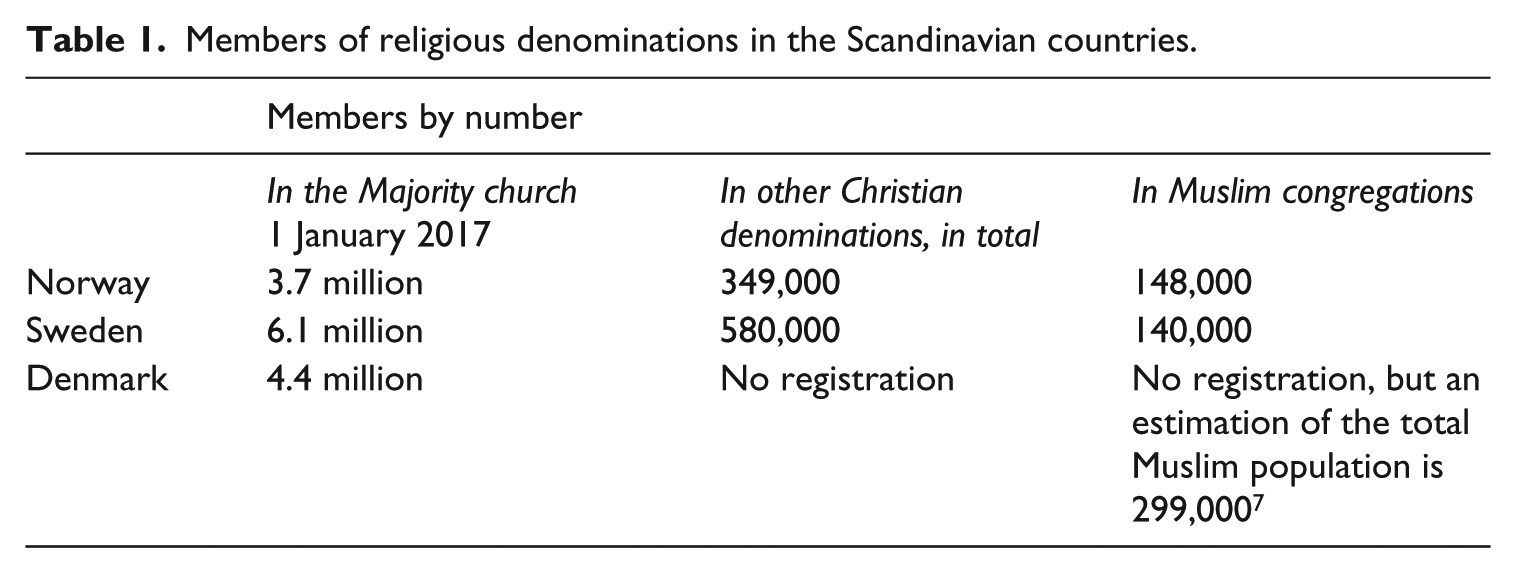
Even as the majority churches in the Scandinavian countries continue to represent the greater part of the populations in terms of membership rates in each of the countries, these numbers are now declining. In 2017, 72% of the inhabitants of Norway were members of the Church of Norway, 61% of the inhabitants of Sweden were members of the Church of Sweden, and 76% of the Danish population were members of the majority church. 3 In all three countries, the membership rates have decreased during the last few decades. 4 The reason for this is a combination of an increased number of immigrants with other religious backgrounds, an increase in members leaving the church, and a decrease in the christening of new-borns among the majority population.
Outside the majority churches, there are small, but not insignificant, minority religious denominations. In Norway, the Catholic Church of Norway and members of Islamic congregations constitute the second largest religious ‘groups’ with, respectively, 152,000 and 153,000 members each, a total of 2.9% of the population each. 5 In Sweden, the so-called ‘free churches’, such as Protestant-Evangelical denominations, form one of the largest religious minority groups outside the majority church and today comprise approximately 330,000 members. The Muslim organisations attract about 140,000 members, but, if we count everyone with citizenship and a Muslim family background, about 4% of the Swedish population could be counted as Muslims. Approximately 140,000 belong to the Orthodox and Eastern churches, and 110,000 to the Catholic Church. The other religious organisations in Sweden are far smaller. The Swedish Humanist Association (Humanisterna) has about 5000 members.
The membership rates in other minority faith communities is uncertain in Denmark as no registration takes place, but people with a Muslim background constitute 5.2% of the population (around 299,000 people) (Jacobsen, 2018: 210). Hence, Muslims constitute the second largest religious group, whereas for historical reasons the Catholic Church, with almost 45,000 members and the Jewish community, consisting of around 5000–6000 people, are both considered important faith groups. Other religious groups, such as Hindus, Buddhists and Orthodox Christians, are very small in numbers. With some success over the last few years, The Atheist Association, founded in 2002, has encouraged members to leave the majority church (Table 1). 6
Members of religious denominations in the Scandinavian countries.
Scandinavian interfaith trajectories
In Norway, contemporary organised interreligious initiatives surfaced during the 1980s and have been built upon a long tradition of consolidation of Christian networks together with, and outside, the majority churches, dating back to 1902 with the Norwegian Dissent Council (Norsk Dissentering) (Furseth et al., 2015: 144). Grassroots-level demands for better means of communication across ethnic, cultural and religious lines intensified from the 1970s to the 1990s as the increasingly multicultural society, usually referred to as ‘the new Norway’, was repeatedly brought to the fore in negative media coverage and political debates. In this process, individual activists played key roles in instigating various interreligious dialogue initiatives based on their personal commitment and networks among religious representatives in their local communities.
Soon after, the Jewish Community, the Buddhist Society and a preliminary version of the Holistic Association joined bilateral and multilateral dialogue forums. These dialogue forums preceded the foundation of the Islamic Council of Norway (Islamisk Råd Norge). This involvement eventually resulted in the initiation of the Muslim umbrella organisation, the Islamic Council of Norway, because the Church of Norway’s Council of Ecumenical and International Relations (Mellemkirkelig Råd) in 1993 called for a dialogue partner to represent as many Muslim communities as possible (Brottveit et al., 2015: 26). The national Council for Religious and Life Stance Communities in Norway (Samarbeidsrådet for tros- og livssyn (STL)), which represents 14 different faith and live stance communities, was launched in 1996 as a result of tensions relating to the introduction of the primary-school subject ‘Christendom, Religion and Life Stance’.
Meanwhile, in Denmark, interfaith initiatives especially progressed and increased in numbers within the last 15–20 years. Without a national interfaith body, the field is diverse and changing and often locally based. Many interfaith initiatives are bilateral, and are primarily seen between Muslims and Christians. Overall, the majority church and associations like Danmission, a Danish mission association with close ties to the majority church, together with publicly visible faith groups such as Jews, Catholics and Muslims, dominate the Danish interfaith field (Galal, 2015). Yet, several grassroots initiatives are emerging from below. The Islamic-Christian Study Centre (Islamisk Kristent Studiecenter) has been a pioneer since its establishment in 1996, while the Faith in Harmony Forum (Tro i Harmoni) constitutes an example of a current multilateral interfaith initiative, with Christian, Jewish, Muslim, and Buddhist members. Some Muslim organisations, such as the Ahmadiyya Muslims and the Gülen-informed Dialogue Forum (Dialogforum), have also addressed interfaith dialogue as a key element in their respective activities, as has the Muslim Council of Denmark (Dansk Islamisk Råd). Contrary to Norway, the different atheist associations do not participate in interfaith initiatives.
The formation of interfaith initiatives in Sweden has been quite different from the process in Norway and Denmark. One of the first interfaith initiatives, the Cooperation Council for Jews and Christians, was formed in 1979 (Ahlstrand, 2008: 65). During the 1980s, this cooperation also came to include Muslims (Aneer, 1999: 257–260), and during the 1990s, the Church of Sweden initiated a number of projects aimed at Muslims (Alwall, 1999: 16ff). On a national level, there is currently only one organised interfaith initiative, and that is the recently founded Swedish Interreligious Council (Sveriges interreligiösa råd, in short: SIR), which was established in 2010. SIR comprises 18 representatives, 5 Christian, 3 Muslim, 2 Jewish, 2 Buddhist, and one each from the Bahái, Sikh, Hindu, Mandee, Alevi, and the Mormon communities. 8
The state and interfaith work
The degree to which public authorities are involved in interfaith work is related to current societal challenges as well as to models of church–state relations and secularism. The authorities’ interest in addressing (Muslim) radicalisation, terrorism and the potential for reducing religiously motivated conflicts, on the one hand, and their appeal for social cohesion work on the other has created a market for issue-specific interfaith initiatives, which is predominant in Denmark but also present in Sweden (Otterbeck, 2010) and Norway (Liebmann, 2018). Not only do the authorities have an interest in preventing potential conflicts and extremism from arising, they also tend to encourage moderate forms of religion and formations of moderate and liberal citizens (Furseth et al., 2017a; Galal, 2015; Griera, 2012; Liebmann, 2017; Martikainen, 2013). In other words, issues of securitisation and media framing tie in with interreligious dialogue, especially regarding the governance of minority religion and the conduct of citizenship (see Liebmann, 2018). However, the close ties between religious actors and public authorities pose several dilemmas, and they may indeed come to restrict the critical voices and agencies of minority religious actors (Furseth et al., 2017b; Liebmann, 2017).
The separation of church from state in both Norway and Sweden emphasises that no religious institution per se has a privileged position with respect to the state, which, again, strengthens the state’s need for direct links to all faith communities. In this way, the religious umbrella organisations come to take up a position that is reinforced by the separation of church and state. These formal infrastructures assist the state in ‘partnering with’ religion (Furseth et al., 2017a). However, in Denmark, the public authorities generally refuse to ‘partner with’ religion to any great amplitude. In the extent to which they do encourage religious partners to speak with each other as a way of countering religious conflicts and extremism, they, in effect, lean on the majority church to pursue the role of dialogue partner with the other faith communities. Paradoxically, the Danish authorities reject their own involvement by claiming secularism, while supporting that the church remains a state church. This paradox illustrates the countries’ different approaches to secularism. While the Norwegian state conveys a much higher degree of acknowledgement of minority religious beliefs and practices, the Danish state generally considers religion a legitimate, but private, matter that has no relevance in the discussion of society’s political issues (Christoffersen et al., 2012).
The different approaches to governing through interfaith initiatives find their parallels in the general political attitudes to cultural diversity and immigration. To a large degree, Sweden has developed a multicultural integration policy, understood as the embracing of difference (in contrast to assimilation) that emphasises the forging of societal solidarity by overcoming diversity (Kivisto and Wahlbeck, 2013: 2). Norway has largely followed the Swedish idea of multiculturalism, while Denmark has never subscribed to any form of multiculturalism, but increasingly emphasised assimilation (Brochmann, 2016).
Legal and financial governance of the multi-religious field
Norway, Sweden and Denmark all share some sort of official registration of faith communities, and many of the communities receive public funding. In all three countries, religious groups can register as faith communities to obtain certain privileges beyond those of non-religious organisations. As the Scandinavian countries are all highly structured in terms of religion, an inspection of the ways in which the diverse religious forums participating in interfaith activities are governed in and by each of the three states helps to understand how the legal and financial aspects constitute the formal governance of interfaith initiatives. The differences between the three countries not only reflect the states’ diverse positions towards their majority churches and religious minorities, but also mirror more general patterns of country-specific political management of religious diversity.
In Norway, faith communities have, since 1969 (and worldview communities since 1981), been afforded financial support from the state and municipalities proportionate to the expenditure on the Church of Norway, calculated per member. In the 2012 constitutional amendments, state support for minority and majority religions even became constitutional (Schmidt, 2011: 145–146). As of the 2000s, the Norwegian state has led an ‘actively supportive faith and worldview policy’ (Stmeld nr 17, 2008 [2007]: 18), such as providing annual subsidies for most faith and worldview communities. 9 This structural funding is substantiated with reference to the ‘common good’ that the existence of such organised diversity is taken to constitute for society in general. Faith and worldview organisations are understood to contribute to the upholding of vital societal values through the management of rituals pertaining to crucial life events, participation in and enrichment of debates on faith, worldviews and ethics, and the establishment of (Norwegian) citizens’ belonging and identities (cf. NOU, 2013: 17–25).
As soon as the state and the Church of Sweden were separated in 2000, the state granted the majority church status as a recognised faith community. However, all other religious groups in Sweden are obliged to apply for recognition in order to obtain privileges such as the right to perform legally valid marriages and to get assistance from the tax authorities in collecting membership fees. 10 To obtain state grants from the Swedish Authority for Government Support to Faith (Myndigheten för statsbidrag till trossamfund, in short SAG), religious associations are additionally compelled to uphold and strengthen ‘the fundamental values on which society is based, to be stable, and have their “own vitality”’. 11 SAG was established in 2000 as a direct response to the separation between the state and the majority church but, 12 from 1972 onwards, religious associations have been able to apply for financial support through The Swedish Free Churches Board of Cooperation (Sveriges frikyrkoråds samarbetsnämnd). 13 However, The Swedish Interreligious Council (Sveriges interreligiösa råd, in short: SIC) did not receive any financial support from the state until 2015. 14 As a consequence of the Swedish development, the religious funding system frequently leads to the inclusion of primarily SAG grant-holding organisations into various interfaith forums as these forums require an ability to guarantee the seriousness of the included associations (Nordin, 2014).
In Denmark, all faith communities other than the majority church are regulated as associations, charities or private institutions (Christoffersen and Vinding, 2012: 12). Thus, churches or religious communities outside the majority church do not receive any subsidies from the state. However, they do get personal and company tax reductions if they have been granted so-called recognition (Christoffersen and Vinding, 2012: 98). As in Sweden, such recognition includes the right to perform legally valid marriages, but in Denmark the state does not provide any assistance in collecting membership fees. Recognition is granted on the basis of an application in which the faith community sets out its basic doctrines, rituals and organisational structure, a minimum number of members, a sound economy, and a religious leader(ship). 15
As illustrated above, Norway not only facilitates the most extensive financial state support for religious groups and organisations in Scandinavia, but the state also enables the most equal religious system because the majority church and various minority religions are supported in equal measure. As such, Norway stands out as the Scandinavian exception in being the most liberal country on minority religions when recognising faith communities that do not afford any fixed definition of ‘faith community’, minimum membership requirements or formal advisory committees, leaving local county governors to handle applications for state recognition of religions (Kühle et al., 2017). In contrast, the legal procedures in Sweden and Denmark are centralised, albeit with the significant difference that recognised faith communities in Sweden are afforded financial and administrative support by the state. Thus, the differences between the three countries’ governance structures of faith communities are distinctive, not least when it comes to their influence on interfaith initiatives.
Top-down interfaith initiatives at a national level
The differences in legal and financial governance structures in faith communities find their parallels in governance through interfaith initiatives. As argued, all three countries share a variety of interfaith forums. There are, however, differences in their relation to the state and their internal organisation, just as the role of the respective majority churches differs. In the following, a distinction between top-down initiatives most common at the national level and civic grassroots and mainly local initiatives is presented.
The national interfaith organisations in Sweden and Norway tend to use the same models as ecumenical movements, and the two countries have both formed top-down and national structures (cf. Furseth et al., 2017b). Norwegian STL and Swedish SIC both work as interest bodies that lobby the state and local governments. In addition, they conduct dialogue meetings within their own ranks and represent their communities on various multilateral interfaith bodies at the national level. In fact, Denmark is the only one of all the Nordic countries (including Iceland and Finland) that does not facilitate a national interfaith body. Particularly in Norway, the organised interfaith initiatives enjoy a profound public voice. From their inception during the 1980s, interfaith initiatives in Norway have been concerned with special-interest politics centred on equality between minority religions and worldview communities versus the now secular Norwegian state and the majority church, the Church of Norway (Brottveit et al., 2015: 7ff.). 16 Thus, STL was launched in 1996 as a result of tensions relating to the introduction of the primary-school subject Christendom, Religion and Life Stance. The presentation of the new subject saw intense scrutiny of, on the one hand, the removal of the exemption rule and the unconventional subject on Life Stance knowledge and, on the other hand, the preservation of central elements from the previous subject, Christendom, which led to the formation of an alliance between the Norwegian Humanist Association (Human-Etisk Forbund), the Islamic Council of Norway (Norges Islamiske Råd), the Jewish Community, the Buddhist Society and a preliminary version of the Holistic Association (Holistisk Forbund). Eventually, the foundation of STL became a reality (Brottveit et al., 2015: 15; Furseth et al., 2015: 145). Today, STL constitutes a nationally well-known interest group partaking in mainstream, accepted forms of multicultural religiosity (Liebmann, 2017). 17
In Sweden SIC was founded in 2010 on behalf of the Archbishop of the Church of Sweden. The aim of the council is, at a national level, to gather religious leaders in Sweden, and ‘create conditions for interreligious cooperation’ (internal documents). Other aims of the council are ‘to highlight the role of religion in creating peace and consensus in society, to be a voice in the public conversation about ethics and spirituality, and constitute a voice against anti-Semitism, Islamophobia and other religious hostility’ (internal documents). 18 Yet, it was not until 2015 that the Swedish state actively supported this initiative by assigning the council an annual grant for 3 years. Contrary to the grassroots initiation of Norwegian STL, the Swedish majority church has played a much more significant part in both initiating and upholding the national interfaith body, SIC. With the financial support from the state SIC has, however, become less dependent on the Church of Sweden. The Swedish Council of Churches is today one of four religious umbrella organisations in the board of SIC. 19 The Church of Sweden is thereby presented as one of several Christian denominations.
From the perspective of the Danish state and its secular self-understanding of being ‘preoccupied with its own non-religiousness in an almost religious way’ (Iversen, 2006: 90), the majority church and other religious forums play a crucial role as the architects of interfaith initiatives. Insofar as these initiatives address what are taken to constitute current issues of general societal concern, the state financially supports their activities. However, the funding opportunities are legitimised by specific societal problems addressed by the respective activities, such as lack of integration and religious radicalisation, rather than through cross-religious dialogue by, and in, itself. As such, the Danish state does not perceive itself as a dialogue partner in respect to interfaith work, thus leaving participation in cross-religious initiatives in the hands of, among others, the majority church. One consequence of this strategy is that interfaith initiatives are left with no incentive to force the diverse organisational bodies into one representative organ since they cannot get the state’s attention on this matter. 20
Majority churches as intermediary actors
Whereas Norway has applied a top-down model, Denmark has – as suggested – adopted civic grassroots forms of self-organisation. While the Norwegian top-down approach does not privilege one specific faith community over another, it seems that the grassroots based initiatives in Denmark and Sweden place the majority churches in prominent positions on this matter.
In Sweden, most of the interfaith initiatives occur at a local level, although some do exist at a regional level (Nordin, 2017b). Interfaith work also seems to gain a high level of support from the local churches, as 30% of congregations in the majority church recently declared that they see themselves as engaged in some form of interreligious dialogue (Nordin, 2017a). 21 Among Muslim congregations, about 30% participate in religious dialogue groups and more than 80% are positive about such cooperation (Borell and Gerdner, 2013). If not initiated and run by the Church of Sweden, it is often part of interfaith initiatives at the local level. However, the imbalance between the participating forums’ degree of establishment, organisational form, leadership maintenance, financial and other resources, and access to facilities affect and complicate cooperation between them (Nordin, 2014; 2017b). For example, in most of the studied local interfaith initiatives, the representatives from the majority church participated as part of their job, while the representatives from other religious denominations did so on a non-professional basis.
In Denmark, the role of the majority church is no less influential than in Sweden. Without a central national interfaith body, the majority church takes on a leading role in instigating and participating in interfaith activities. Based on a historically strong and non-hierarchical infrastructure (Nielsen, 2012), the church retains flexibility in decision-making, a tradition for including different theological positions, and a willingness to undertake pragmatic and issue-specific work, while also functioning as a source of funding and fundraising. This internal freedom and pluralism provides a basis for supporting various interfaith initiatives. Key actors are the dioceses, the local congregations, and activists. One actor at the diocese level is the Committee for Church and Encounter with other Religions of the Evangelical Lutheran Church of Denmark (Folkekirke og Religionsmøde), which includes 9 out of 10 dioceses as partners. The aim of the committee is to strengthen relations between the majority church and minority religions and support what are taken to be successful and fruitful interfaith encounters. Another body, the Intercultural Christian Centre Denmark, is a network among local Danish churches, migrant churches and Christian non-governmental organisations (NGOs) that is based on collaboration at the level of congregations.
Since 2006, the Committee for Church and Encounter with other Religions (Folkekirke og Religionsmøde) has supported the Christian–Muslim Dialogue Forum (Kristent-Muslimsk Samtaleforum), which is a network of Christian and Muslim leaders in Denmark. This initiative was a direct response to the cartoon controversy (Christensen and Vestergaard, 2016), which erupted in Denmark in 2005 and the initiative exemplifies the issue-specific character of many Danish interfaith activities (see also Galal, 2015). This issue-specific tendency is also reflected in the particular cases taken up by individual members of the majority church, but the approach, in effect, also comes to decide which issues are to be addressed. Thus, while the 2005 cartoon controversy instigated a dialogue with Muslims, the Copenhagen shootings in 2015 involving an attack on the synagogue led to the foundation of The Jewish–Christian–Muslim Forum (Jødisk Kristent Muslimsk Forum) initiated by the current Bishop of Copenhagen, Peter Skov-Jakobsen. 22 The Jewish–Christian–Muslim Forum was founded through a collaboration between religious leaders of the three religions with the purpose of fighting religiously motivated hate crimes and protecting freedom of religion, including that of religious minorities (Skov-Jakobsen, 2015). Thus, the majority church’s instigation of interfaith initiatives is based upon, and motivated by, current challenges within both Danish society and the majority church itself.
Financially, The Ministry for Ecclesiastical Affairs (Kirkeministeriet) supports The Committee for Church and Encounter with other Religions (Folkekirke og Religionsmøde), while its different activities are usually funded by several partners, such as the dioceses, the ministry and other organisations. Additional funding from the ministry is typically secured on the recommendation of the dioceses. The financial side is thus closely connected to the infrastructure of the majority church and the religious landscape and the initiatives’ ability to address issues of general concern to Danish society. Once again, the issue-specific character of the Danish interfaith scene is essential; interfaith initiatives are not primarily motivated by a general need or interest in supporting a multicultural or religiously diverse society, as is the case in both Norway and Sweden.
Conclusion
Based on an analysis of the routes and relations between the states, majority churches and interreligious arenas in Scandinavia through policy documents, and supported by field studies within each of the countries, this study has explored the region’s governance of religious diversity and found both similarities and differences.
Two different models of governance of religious diversity through interfaith initiatives have been identified: top-down versus civic grassroots forms of self-organisation. Whereas Norway has a top-down model with a trajectory of institutionalised equality between all faith and worldview groups, Sweden’s top-down model is more moderate as it also equates faith groups but with a less institutionalised and more pragmatic governance. On the other hand, the Danish model of civic grassroots forms of self-organisation implicitly encourages the majority church and civil society forums to initiate dialogue with religious minorities, de facto entrusting interfaith initiatives to other stakeholders than the state, and thereby establishes a pluricentric governance network. The two different models’ tendencies are in accordance with the different national political attitudes to cultural diversity and immigration, where Sweden and Norway follow a multicultural integration policy that emphasises the forging of societal solidarity by overcoming diversity whereas Denmark accentuates assimilation instead of multiculturalism.
Across the three countries, the recent arrival of neoliberal politics has financially supported the outsourcing of responsibility to civil society organisations, indirectly motivating religious associations to participate in solving problems regarding an issue such as integration. Interreligious forums and initiatives fit well into this setting. In this vein, religion is governed through networks of interdependent actors who interact to produce ‘a common good’ (Martikainen, 2013). As argued above, the emphasis on cultural and religious diversity as a ‘common good’ in Norway marks a shift in the relationship between the majority church and minority religions (Schmidt, 2015: 224). 23 This shift needs to be seen in relation to ‘governance networks’, through which religion is regulated and managed via webs constituted by the state and a number of (other) interdependent actors, such as municipalities, religious communities, NGOs and moral entrepreneurs, who interact to produce what is taken to constitute a common good. Yet, the two models of top-down and civic grassroots forms of self-organisation seem to offer the minority groups different positions. In the Norwegian top-down model the minorities are, as communities, given an equal voice, while the civic grassroots forms of self-organisation provide the majority church with a stronger voice, somewhat marginalising the religious minority groups as communities and giving preference to certain voices and perspectives. One could add that the marginalisation of religious group belonging is in accordance with the Danish celebration of a particular secularism and integration politics. On this basis, it may be argued that the Swedish model nurtures the most complex pluricentric network by supporting a variety of actors, including both groups and individuals.
Footnotes
Funding
The Norwegian case study is part of the collaborative research project ‘Engaging with Conflicts in Mediatized Religious Environments’ (CoMRel) funded by the Norwegian Research Council’s SAMKUL programme with funding ID: 236920/F10. The Danish case study is an element of ‘Interfaith dialogue for change’, which is a subproject of the collective project ‘The Organized Cultural Encounter’ funded by the Danish Council for Independent Research with funding ID: DFF-1319-00093.
Notes
Author biographies
Address: Roskilde University, Universitetsvej 1, Postbox 260, 4000 Roskilde, Denmark.
Email:
Address: Roskilde University, Universitetsvej 1, Postbox 260, 4000 Roskilde, Denmark.
Email:
Address: Department of Literature, History of Ideas, and Religion, University of Gothenburg, Box 200, 405 30 Gothenburg, Sweden.
Email: