




Abstract
Religious change continues to be a controversial topic that involves both theoretical and methodological issues. As to the European context, the main dispute is between secularization and individualization theory, especially considering the ‘believing without belonging’ thesis. This article will tackle this dispute given these three choices: firstly, we assume that cohort replacement is the main driver of religious change; secondly, religious tradition has to be taken fully into account to explain religious change; thirdly, we consider religiosity as a complex phenomenon that requires a multidimensional approach. Results from a multilevel multiple responses model based on EVS (European Values Study) data show that practice is declining across cohorts in all the countries whereas trends for belief and self-definition diverge only for Eastern Orthodox countries. Depending on the interpretation, such exception seems supporting rather than undermining the ‘believing without belonging’ theory.
Introduction
Not surprisingly, religious change continues to be a controversial topic for sociology and social sciences. On the one hand, religious change is the preferred ground for theoretical debate: in the European context, the main dispute is between secularization theory and individualization theory. Both secularization and individualization are umbrella terms that include many specific theories. Secularization ranges from macro-theories concerned with modernization processes (Bruce, 2003) to micro-theories connected to existential security (Norris and Inglehart, 2004), all of them predicting the same outcome at the individual as well as the aggregate level. Individualization is also an umbrella term, and in this context we deal with the well-known ‘believing without belonging’ theory (Davie, 1990; 1994) that claims a widening gap between stable – or even increasing – private and intimate religiosity and decreasing public religiosity.
On the other hand, social science scholars have developed competing methodological strategies in order to assess religious change. In this article, we will tackle the issue of religious change in Europe given the three following strategic choices. First, on the basis of a large body of literature, we assume that cohort replacement is the main driver of religious change: it is the socialization process that makes every new generation so different from the previous one, thus contributing to overall societal change. On this assumption, we consider change as a sequence of cohorts and not as a sequence of periods. Second, we assume that religious tradition is something to take fully into account to explain religious change; such a tradition, which is defined by the religious denomination prevailing in any given country, defines the homogeneity, rather than the heterogeneity, of different countries and shapes the different paths of religious change. In accordance with this view, we focus not on single countries but we cluster them according to the prevailing religious denomination. Lastly, religiosity is a complex phenomenon that requires a multidimensional approach to be fully developed. This general statement is even more fitting in the context of the present study, which focuses on two competing theories: secularization theory and the ‘believing without belonging’ thesis. At the core of the latter, in fact, there is the idea of diverging trends for different dimensions, so that a multidimensional framework is necessary to assess it.
A multilevel multiple response variables model is applied to the first four waves of the European Values Study (EVS) involving 32 countries and considering three dimensions: practice, belief and self-definition. On the one hand, the results show how practice is declining across cohorts in all the countries, even if some differences in level remain between Roman Catholic countries – with higher church attendance – and the countries with other prevailing denominations (Protestant, Mixed, Eastern Orthodox). On the other hand, belief and self-definition trends diverge only for Eastern Orthodox countries: since the ‘50s cohort, the decreasing trend has slowed in all countries, but in Eastern Orthodox countries we witness a possible revival of religious belief. This result is consistent with two different interpretations: while the first one supports the ‘believing without belonging’ theory the second one refers to other processes possibly connected to the communist past of most of the Eastern Orthodox countries.
The following sections are devoted to the illustration of the theoretical debate and to the specification of the measurement model (sections 1 and 2). Thereafter, the research questions are introduced, together with data and models used to answer them (sections 3, 4 and 5). Finally, the results are extensively presented and then discussed in the conclusions (sections 6 and 7).
Theoretical debate
Speaking about European religiosity means speaking about secularization (Bruce, 2002; 2003; 2011; Casanova, 1994; Gorski and Altınordu, 2008; Pollack, 2008; Voas, 2009). The core of secularization theory links processes of modernization and religious decline: it essentially states that processes of modernization will have a negative effect on the stability and vitality of religious communities, practice, and convictions (Pollack 2008). The concept of secularization can also be viewed as the decline of the extent to which people engage in religious practice, express their beliefs, and behave in various aspects of life under the influence of such beliefs (Bruce, 2002). Both modernization and secularization are the battlefields of theoretical and empirical debates still far from concluded.
The notion of modernization comprises a plurality of different meanings. It refers to the mix of industrialization, democratization, urbanization, rationalization, cultural diversity, expanded education, and increased prosperity that characterizes contemporary Western societies’ (Voas and Chaves, 2016: 1522). Ruiter and van Tubergen (2009) provide a clear overview of the mechanisms underlying the broad concept of modernization and its link with secularization processes. They identify three different mechanisms. 1) Modernization of ideologies, meaning the mechanism whereby the more traditional religious worldview decays (it refers to increased educational and scientific development). 2) Modernization of social ties, that is, the diminishing strength of ties leading to less control of religious communities over their members (Kelley and De Graaf, 1997). 3) Modernization of economies, which leads to greater financial, social and political security for the population, reducing the need for religious reassurance (Norris and Inglehart, 2004). ‘Modernization’ has therefore become the label for this mix of interrelated social transformations hypothesized as undermining religiosity (Fairbrother, 2014).
Also on the side of secularization, some theoretical specification is needed. Being an all-embracing phenomenon, secularization involves several aspects. According to Casanova (1994), there are three main processes underlying the broad concept. The first is the ‘differentiation between Church and State’, which can be considered the cornerstone of secularization theory. The second is the ‘privatization of religiosity’, meaning that religions in modern world tend to be relegated to a marginal – private – role and their exposure to be less and less public. The third meaning is the ‘decline of religiosity’ which basically means an overall decline of the individual religiosity.
As said, secularization theory is considered the theoretical ground for religious studies. It is also true that other schools of thought have tried to challenge this theoretical hegemony. It is possible to identify the antagonists of secularization theory as the ‘economic market theory’ (Finke and Stark, 1988; Stark and Iannaccone, 1994) and the ‘individualization theory’ (Davie, 2000; Hervieu-Léger, 2001; 2003; Luckmann, 1967; Luhmann, 1982).
Adherents of the ‘economic market theory’ interpret religious change as a consequence of the religious freedom and pluralism thus presuming compatibility between religion and modernity (Stark, 1999; Stark and Iannaccone, 1994). In regard to the European context, this approach has been heavily criticized (Halman and Draulans, 2006; Voas et al., 2002) and there is a widespread consensus that is more suitable to interpret the American context rather than the European one (Chaves and Gorski, 2001; Pollack and Pickel, 2007).
The ‘individualization thesis’ states that European religion is not declining but is changing. The relation between individuals and religion has emancipated itself from the strong medium of religious institutions: religious preferences and practices are shifting from institutional forms of engagement to more private and intimate ones. Religious sensibility and demand for the sacred are not diminishing in modern societies, but they often take different forms. Therefore, this process of religious individualization does not mean that individual religiosity is weakened; ‘instead, it becomes multifaceted, syncretistic, and alienated from church’ (Pollack and Pickel, 2007: 605).
Starting from this general idea, Davie (1990; 1994; 2000) goes further by emphasizing the considerable gap between passive belief (relatively high) and active membership (still declining), a situation captured in her much-quoted phrase ‘believing without belonging’. The general idea is that ‘in Western societies a growing number of people uphold religious beliefs without formal attachment to a Church’ (Aarts et al., 2008: 16). This thesis has been largely discussed and tested by many scholars, with a prominent contribution made by Voas and Crockett (2005) who provided the useful idea of two different interpretations of ‘believing without belonging’. The strong version of the theory holds that ‘with the exception of a handful of atheists, Europeans continue to believe in God and to have religious (or at least ‘spiritual’) sensibilities: the proportion of believers is high and has changed little in recent years’ (Voas and Crockett, 2005: 12). This kind of supernatural belief remains high and robust, whereas religious practice is lower and has declined more quickly (Voas and Crockett, 2005). In the weak interpretation of the theory, conversely, belief ‘is allowed to be non-Christian, vague, and even non-religious’ (Voas and Crockett, 2005: 12) and may correspond to what Stolz et al. (2016) define as alternative spirituality. In this work we focus on the core tenets of European Christianity and so ‘believing without belonging’ is intended in its strong version.
Multidimensional measurement of religiosity
In the previous section, we provided a brief outline of the various theories concerning religion and religiosity. We particularly focused on the two most debated theories (secularization and individualization) when dealing with religious change in Europe (Pollack and Pickel, 2007). The two theories foresee different connections among religious dimensions: while secularization theorists argue for an overall decline of all the religious dimensions, individualization theorists, and especially the supporters of ‘believing without belonging’ theory, assert a decline of institutional forms but a stability – or even an increase – of individual religiosity.
Religion is normally difficult to conceptualize and operationalize because its supernatural, practical, ritual and normative aspects are closely interrelated. A useful starting point to define religion is provided by Bruce (2011: 1): ‘beliefs, actions, and institutions based on the existence of supernatural entities with powers of agency (that is, Gods) or impersonal processes possessed of moral purpose […] that set the conditions of, or intervene in, human affairs’. If one instead follows the working definition by Norris and Inglehart (2004), it is possible to switch from a general definition of ‘religion’ to a more useful definition of ‘religiosity’. According to them, the concept of religiosity refers to the concrete ways, empirically observable, by which individuals or groups express the various dimensions of their religion (Norris and Inglehart, 2004). This plural construct is precisely what best describes the concept of religiosity: a highly multidimensional concept.
The issue of the measurement of religiosity has been a hot topic for sociologists of religion since the birth of the discipline. With a relevant contribution also by psychologists, many contributions tried to find the most complete way to deal with this issue (see, for example, Glock, 1962; Hilty and Morgan, 1985; King and Hunt, 1969). This results in a plenty of scales, typologies and categories which try to comprise all the different dimensions supposed to underlie the idea of religiosity. Some authors suggest that many of the inconsistencies which emerged are because the absence of theoretical a priori agreement (Thung et al., 1985) while others pinpoint that the choice is not between right and wrong approaches but it is a matter of explanatory purposes (Roof, 1979). Starting from this, we opt here for a parsimonious model which distinguishes between practice, belief and self-definition (Billiet, 2002; Voas, 2007; 2009). The focus on these three dimensions gives us two very desirable advantages. Indeed, these three dimensions are ‘presumably universally present across religions and cultural contexts’ (Saroglou, 2011: 1320) and are fully consistent with the theoretical debate we want to address.
Religious practice is the most thoroughly investigated dimension in sociology because of its social and collective nature and its high degree of availability and comparability. ‘Religious behaviour – such as prayer or attendance at services – may be an exacting standard, requiring a commitment of time’ (McAndrew and Voas, 2011: 3). There are numerous reasons for focusing on religious practice: it measures the ritualistic dimension of individuals, and it is suitable and widely used to detect strong forms of religiosity. Also methodologically, ‘the associated question to tap (church attendance) is relatively simple to formulate and easy to understand for respondents’ (Biolcati-Rinaldi and Vezzoni, 2014: 2), and it is present in every international survey (Brenner, 2016: 566).
The dimension of religious beliefs concerns a mix of dogma or truth of faith which must be accepted and recognized to adhere a transcendent value (Pace, 2007). These beliefs are a sort of ‘autonomous knowledge’ very different from rational or empirical knowledge. This dimension regards the supernatural aspects of religion: for example, belief in God, in the afterlife, or in a transcendent order. It is important to clarify that, for the purposes of this study, we focus on the specific kind of transcendence driven by religious theology, not on a general transcendence like supernatural energies or any kind of superior force (Nicolet and Tresch, 2009).
The religious self-definition is intended as the set of attitudes identifying membership of a group or a religious institution. In this sense, religious belonging may overlap with the notion of civil religion first postulated by Rousseau and well investigated by Robert Bellah (1967). Religion can thus be part of the notion of national identity and can be considered a permanent or semi-permanent characteristic akin to nationality or ethnicity deriving from family, community or cultural heritage (McAndrew and Voas, 2011; Voas, 2014). The focus on self-definition as something that extends beyond practice may also be rooted in the notion of vicarious religion put forward by Davie (2000; 2001). According to her, modern religiosity has shifted from a culture of obligation to a culture of consumption. Hence, it is plausible that individuals continue to perceive themselves as members of their Churches but use them only for the occasional offices and regard membership as part of national just as much as religious identity.
Of course, despite being universally present, the relevance and the meaning of one or the other dimensions varies widely among the various religions and also within Christianity different meanings for different dimensions can be found. Roman Catholicism is theologically and historically focused on the Holy Scripture and on the figure of the Pope and this results in a much-institutionalized religion, with a strong and clearly defined social and ritual dimension in which individuals’ self-exploration is essentially left aside. The principal differences between Roman Catholicism and Eastern Orthodoxy relate mainly to liturgical and ecclesiastical tradition instead of being substantiated in the theological pillars. Orthodox Christians consider the Church to be a whole enlightened by the Holy Spirit and so there is no need for a single higher authority. Eastern Orthodoxy therefore shares the strong social and ritual dimension with Roman Catholicism, but it is based on community and tradition rather than on the institutionalized Church. Whereas Eastern Orthodoxy is considered as schismatic from Roman Catholicism, Protestantism originated in the sixteenth-century Reformation and it is considered heretical. There are many differences concerning the theological, traditional and substantial aspects of the doctrine. Protestantism is based upon the so-called ‘Priesthood of all believers’ and a strong emphasis is placed on the Holy Scriptures whose interpretation is the duty of each believer, who must establish a personal relationship with God. Protestantism should thus be considered an individual religion, where the ritualistic and collective dimension, formal belonging and social dimension, are no longer suitable to grasping the real essence of the religious experience.
Research questions
As stated in the previous section, all theories about religiosity are multidimensional in nature. Hence religion has to be seen as a multidimensional concept where different dimensions are interrelated. The emphasis on these dimensions is the key to better understanding, testing and interpreting the main theoretical approaches to religiosity. Compared to the unidimensional approach, which is still useful for evaluating specific phenomena, the multidimensional approach may yield fuller understanding of European religiosity. For the purposes of this research, we relied on the three dimensions most involved in the debate on European religiosity: practice, belief and self-definition. The aim of this research was to give a clear assessment of how these dimensions are related and how and whether their trends show a common pattern or whether they differ. We thought it was useful to perform such an assessment considering religiously homogeneous countries, so we decided to focus on European Christian countries and their core of Christian religious tenets.
The first step was to determine how the three dimensions are correlated. Given the comparative framework, these correlations must be evaluated both between individuals and between countries, trying to avoid both the ecological fallacy and the individual one. In fact, it is likely that countries and individuals showing high levels of belief also show high levels of practice or self-definition, and vice-versa. However, this should not be taken for granted, especially if we look at individuals. As previously seen, part of the debate on religiosity concerns precisely this issue. Accordingly, the first research question was:
RQ1: How correlated are the dimensions (practice, belief and self-definition) at the country and individual level?
As stated, the research consisted in building the trends for three different dimensions. To account for time, we used cohorts, and this decision has clear theoretical foundations: cohort replacement has been considered the main mechanism behind religious decline (Voas, 2009; Voas and Chaves, 2016) because ‘the religious changes we observe in Europe occur largely across rather than within generations’ (Voas, 2009: 161). The time differences should be thus mainly explained because of cohort and not age or period effects. ‘The mechanism that produces cohort effects is straightforward: we are socialized by the religious environment of our upbringing, and members of each successive cohort […] are less likely to have been raised in religious households and are therefore less likely to be religious as adults’ (Voas and Chaves, 2016: 1531). This leads directly to the second research question:
RQ2: Do the three dimensions of religiosity show different trends moving from the oldest to the youngest cohort?
In the methodological section, we briefly described the three main European Christian doctrines, underlining some theological pillars that could condition the meaning and interpretation that they give to the different dimensions. Religious practice, for example, is the foundation of Roman Catholicism, whereas it is not a strong precept for Protestantism. Hence, ‘Roman Catholics are required to attend church weekly, whereas Anglicans are not, and so it is possible to be a religious and compliant Anglican while attending church less often than a Roman Catholic’ (McAndrew and Voas, 2011: 5). Also religious belief – in its dogmatic meaning – may be prevalent for an institutionalized denomination and less for an individualistic one. Statements like the first can thus be extended to all the dimensions. Given these considerations, the third research question can be expressed:
RQ3: Are the trends different or the same for each of the Christian doctrines?
Data and variables
The research was based on the four waves of European Value Study (EVS) dataset, a large-scale, cross-national, and longitudinal survey research programme on basic human values (EVS, 2011). The European Values Study started in 1981 and has been repeated every nine years in an increasing number of countries. The fourth wave in 2008 covered no less than 47 European countries/regions. Compared to other international surveys, the European Values Study covers a wider observation window and contains a richer set of indicators about religiosity. From this huge dataset, we chose a subsample of 32 Christian countries that participated in at least two waves of the survey. The resulting sample therefore comprised 135,645 individuals.
Dependent variables
In our analysis we worked on three different dependent variables measuring three different dimensions of religiosity, namely religious practice, belief and self-definition.
The way to measure religious practice is fairly standardized, and it basically refers to church attendance (Biolcati-Rinaldi and Vezzoni, 2014; 2015; Fairbrother, 2014; Immerzeel and van Tubergen, 2011; Norris and Inglehart, 2004; Ruiter and van Tubergen, 2009; te Grotenhuis et al., 2015; van Ingen and Moor, 2015; Voas and Doebler, 2011). Throughout this article, the attempt is to focus on Christian tenets in their dogmatic meaning. Consequently, in order to measure the precept of regular practice for Christianity, we started from the item ‘Apart from weddings, funerals and christenings, about how often do you attend religious services these days?’, and we built a dummy variable recoding ‘more than once a week’ and ‘once a week’ into ‘Weekly Church attendance’ and coding it as 1. The other response categories were coded as 0. 1
Also for belief we intended to measure the strong and basic tenets of Christianity. In trying to disentangle the real core of Christian belief from a more general and spiritual ‘I know there is something out there’, we relied on a set of items asking ‘Which, if any, of the following do you believe in?’ We coded as 1 a person answering ‘Yes’ to all the items concerning ‘God’, ‘Heaven’ and ‘Hell’, 0 otherwise. There are clear theoretical and methodological reasons for this choice. Theoretically speaking, beliefs in God, Heaven and Hell represent fundamental convictions that Christian people are supposed to believe in (Billiet, 2002). Also methodologically, it is quite reasonable to use these three items. Relying on the work of van Schuur (2003), it is possible to see them as ordered and suitable for measuring a latent trait, i.e. religious belief. ‘Belief in God’ and ‘belief in Hell’ represent the higher and lower bounds of a scale while ‘belief in Heaven’ is located in the middle of rank. Using them makes it possible to focus on Christian belief in the strictest sense and avoid generic spirituality. 2
Religious self-definition is a very interesting indicator to study, for two reasons. Firstly, it is useful for testing how individuals perceive themselves beyond practice. Secondly, we wanted to include an item which is seldom used as a proxy for religious belief (i.e. Voas 2009). For the purposes of this work we rely on religious self-definition as the result of an identity-building process that does not depend on participation, agreement with the doctrine or even official membership (Voas, 2007). The starting point was the item ‘Independently of whether you go to church or not, would you say you are …’. We recoded the answer ‘a religious person’ as 1 and the other two possible answers (‘not a religious person’, ‘a convinced atheist’) as 0.
Independent variables
For the purposes of the analysis, we relied on two main independent variables: cohort and religious tradition.
The definition and operationalization of cohorts was quite straightforward. We referred to the year of birth divided into decades, starting from those born before 1930. Due to small numerosity of the last available cohort (born after 1990, n=741), we aggregated it with the one born after 1980. For the purposes of the analysis, 458 observations were excluded due to missing values.
The aim of the research was to assess the trends of three different dimensions of religiosity among Christian countries. There are reasons to believe that the religious tradition can have a strong impact on these trends, given that different meanings of the different dimensions may be found among the three main Christian doctrines. In considering the religious context, we treated Christian tradition as a country variable and we built it summarizing the individual information gathered with the question ‘Which religious denomination?’ Countries with an unclear situation (sharing high percentages – 25% or more – on two different denominations) were coded as ‘mixed’ (Table 1). The classification we obtained is consistent with the one by Norris and Inglehart (2004), except for the Mixed countries (Estonia, Germany, Latvia, Netherlands) that they coded as Protestant.
Individual religious denomination and country religious tradition (row percentages).
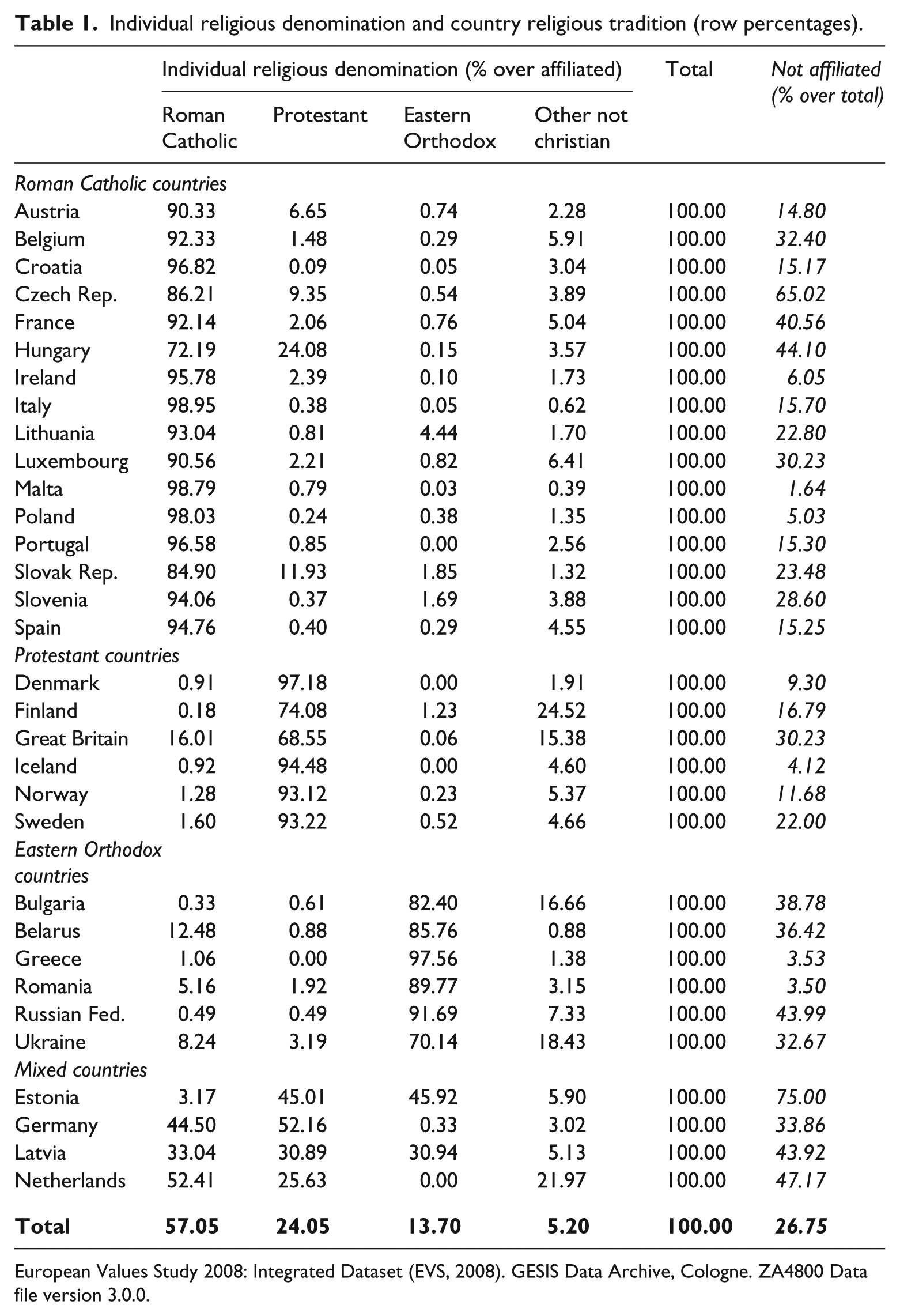
European Values Study 2008: Integrated Dataset (EVS, 2008). GESIS Data Archive, Cologne. ZA4800 Data file version 3.0.0.
In addition to these main independent variables, we relied on Gender (Male=0, Female=1, dichotomous) and Survey wave (‘1981-1984’, ‘1990-1993’, ‘1999-2001’, ‘2008-2010’, categorical) as control variables.
Methods and modelling strategy
Multilevel modelling is the most suitable approach with which to analyze relations between variables defined at different levels and to take account of the heterogeneity of religious trends between different countries. For this research, a particular kind of multilevel model was used. Models of this kind, called multivariate multilevel models or multiple response variables models, basically represent simultaneous measurements of distinctive but not unrelated outcome variables. The three outcomes (practice, belief and self-definition) must be modelled simultaneously and their correlation explicitly considered. We did this by using a multivariate multilevel model whereby the three outcomes (at fictitious level 0) were conceptualized as nesting within the individuals at level 1 which were nested within countries at level 2.
Given the three outcomes binary, we used a multilevel model in which the dependent variables were related to the predictor variables through a logit link. The unexplained differences between individuals were treated as a Binomial distribution, and a covariance structure was specified to allow correlations between the outcomes. This kind of technique deals efficiently with missing observations: as long as at least one of the three outcome responses is observed, it is possible to include that case in the analysis (Deeming and Jones, 2015).
As a workflow, we drew upon a step-by-step modelling. We built three different models of increasing complexity in order to answer the three research questions. In order to answer the first, we basically referred to the so-called null model, i.e. a model with no predictors where the constant term is allowed to vary between countries. In so doing, we could estimate the correlation coefficients between the three dependent variables reported for the two different levels (individuals and countries) where the lower-level correlations were net of the effect at higher levels. Model 1, instead, was the null model supplemented by the 2nd order polynomial term for cohorts with survey wave and gender as control variables. With this model, we were able to answer the second research question. In this model the coefficient for the first grade polynomial term was allowed to vary between countries in order to take the different slopes of country trends into account. Finally, with model 2, we were able to answer the third research question. This model was basically model 1 supplemented by fixed effects for the different Christian traditions (Protestants as reference category) and an interaction term between cohorts and religious traditions 3 .
Results
Like the modelling flow, also interpretation of the results will follow a step-by-step procedure.
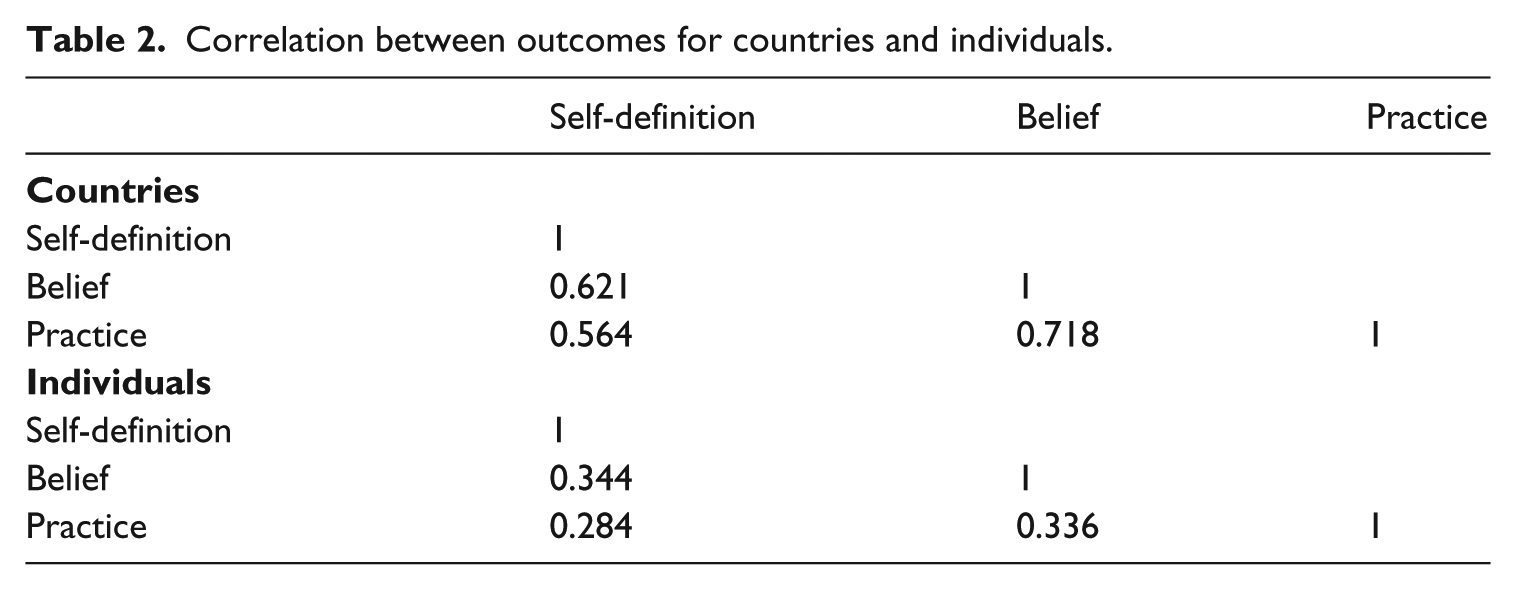
The starting point will be evaluation of correlation coefficients obtained from the null model. Table 2 displays the correlations between the three outcomes at each level. Bearing in mind that individual-level correlations are net of the effect at country level, it is not surprising that all correlations are positive, so that there is a general tendency for all the three religious indicators to go together. The highest correlations are the ones at country level, where all of them are between 0.564 and 0.718. At the individual level, there is also a tendency for the three outcomes to go together, but the coefficients are weaker and between 0.284 and 0.344. The lowest coefficients are those between practice and self-definition and this is true at both individual and country level. By way of a brief summary, there is general tendency for the three dimensions of religiosity to go together, and this is particularly marked at country level. At the individual level, the three dimensions seem to be less interrelated.
Correlation between outcomes for countries and individuals.
In answering the second research question, we must first consider the coefficients for both terms related to cohorts (first and second grade) resulting from Model 1 and reported in Table 3. Bearing in mind that these coefficients are conditional on gender and survey wave (to control for period effects), it is quite clear that all of them are negative and significant for the first grade of the polynomial term and this means a general decrease on the three outcomes. The slope of the decrease does not vary greatly among the three outcomes but in the case of the second grade of the polynomial, some differences are present. This term is significant for all the three outcomes, with a larger coefficient for belief (being quadratic, also small differences can have a quite strong impact). Inspection of the constant shows that the indicator measuring self-definition is the bigger one, meaning a higher ‘starting point’, whereas the other two show lower values. The common story behind this is a general decrease but with some differences. Self-definition starts higher than the other two, which start very close. Religious practice and self-definition decrease almost linearly between every cohort, whereas the trend for religious belief, which has a quite strong quadratic component, may also reverse and become positive in the youngest cohorts.
Model 1 estimation. Log-odds coefficients.
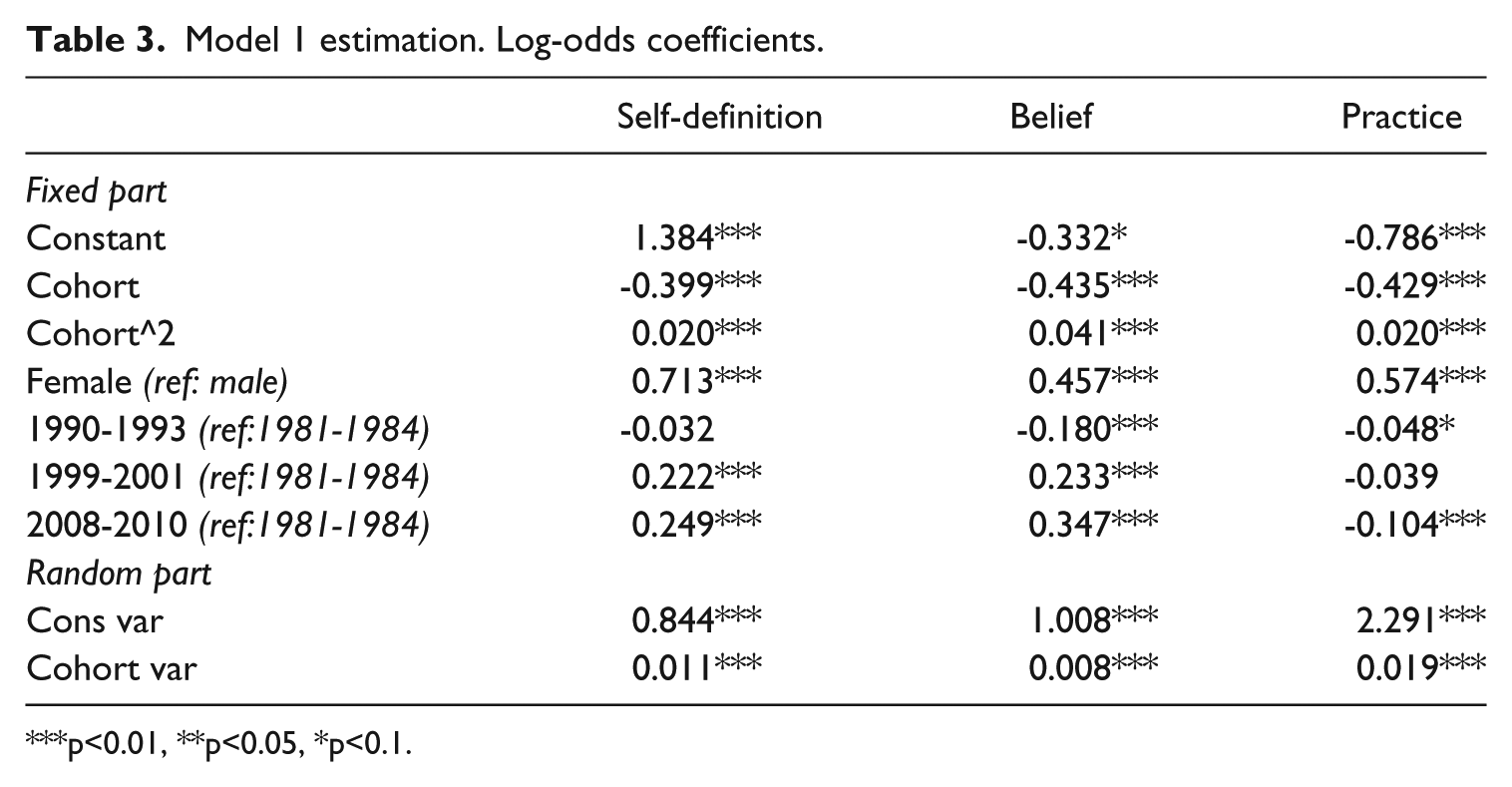
p<0.01, **p<0.05, *p<0.1.
These results can be seen better by plotting the predicted probabilities. This basically means computing the probability of being a believer, church-goer and defining oneself as religious associated with each cohort, setting the other variables at their mean. The results are graphically shown in Figure 1.
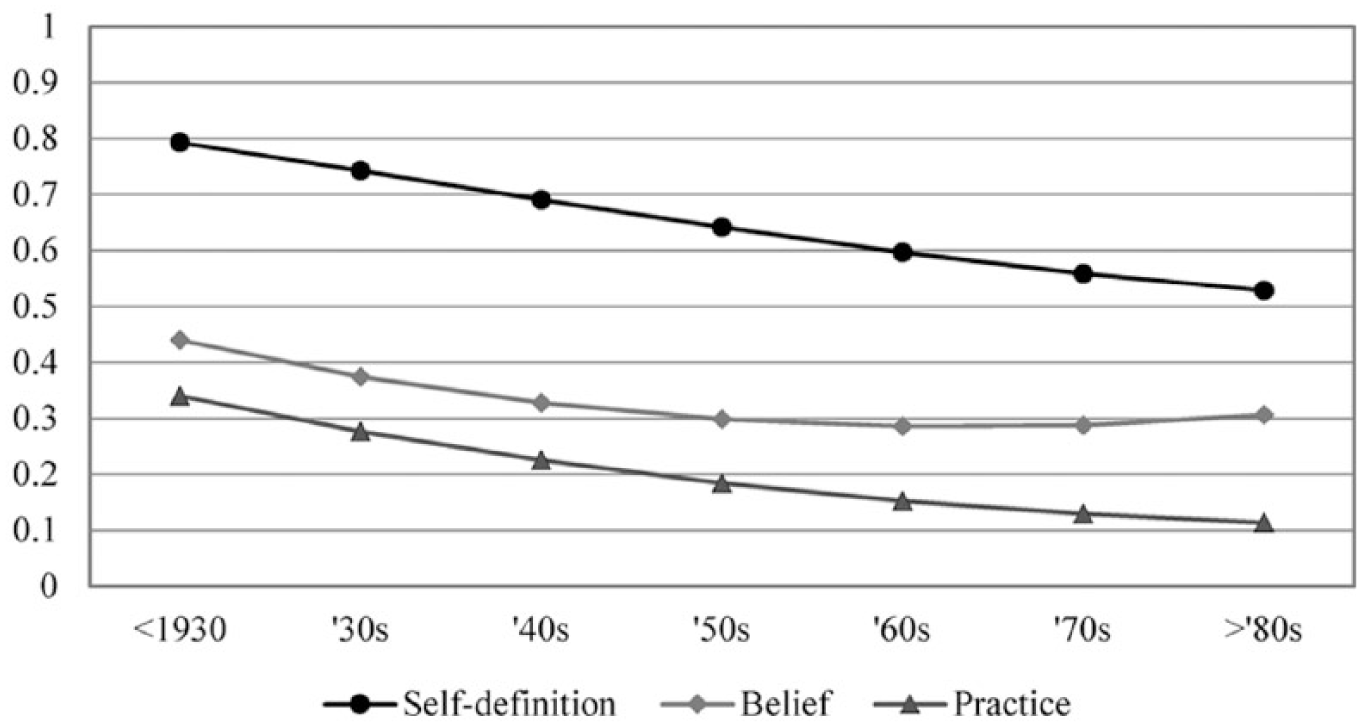
Predicted probabilities by cohort.
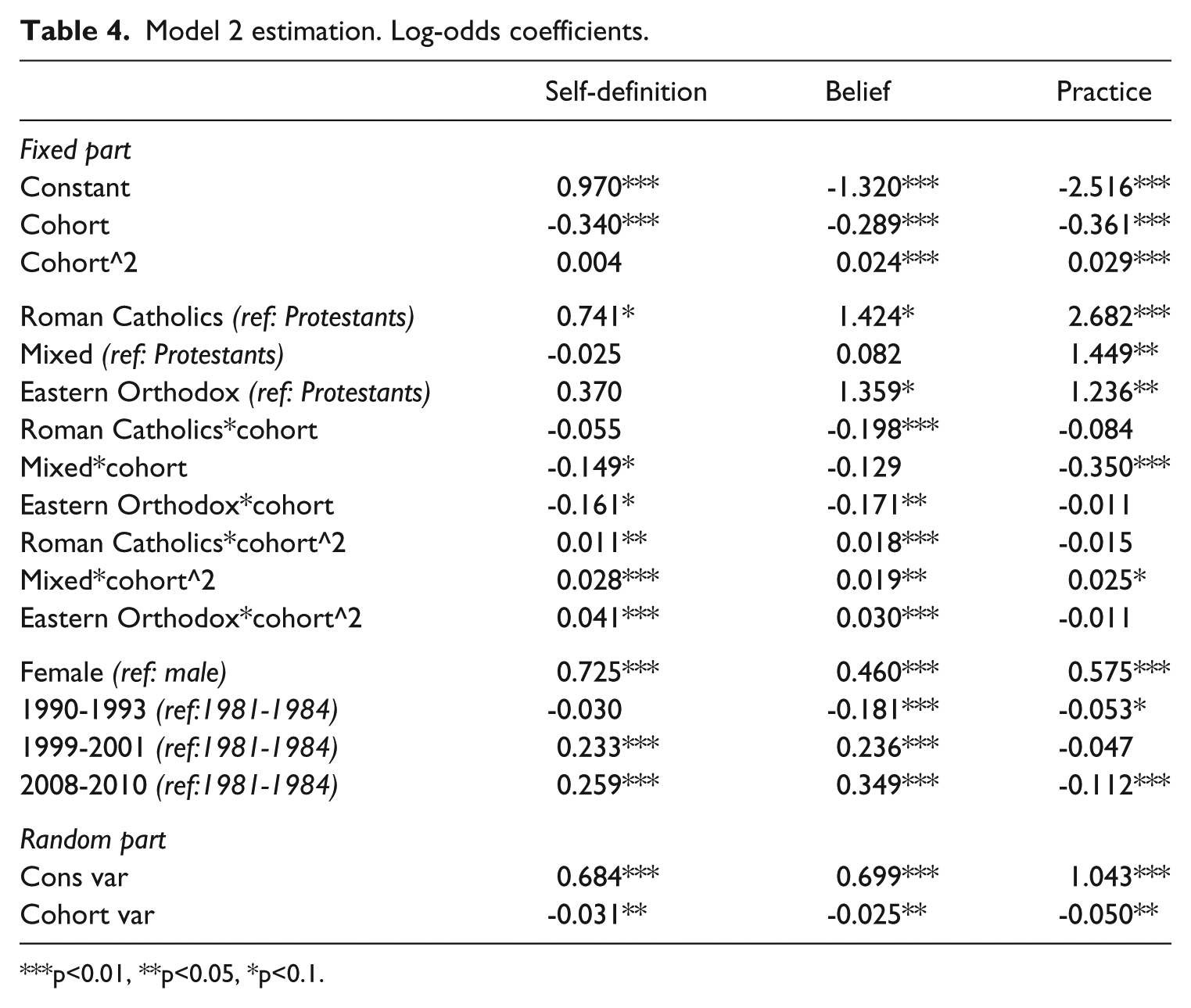
As previously stated, in order to answer the third research question we supplemented model 1 with fixed effects for Christian traditions (Protestants as reference category) and with interaction effects between traditions and cohort. As before, we start by looking at the coefficients (Table 4) and then move to the graphical representation of the predicted probabilities. The first three coefficients (constant, cohort and cohort^2) partially confirm what we found in model 1. There is a general decrease in the three outcomes but with different starting points, higher for self-definition and lower for belief and practice. Moreover, the overall quadratic term is significant for belief and practice while non-significant for self-definition.
Model 2 estimation. Log-odds coefficients.
p<0.01, **p<0.05, *p<0.1.
The inspection of the fixed effects coefficients for Christian traditions reveals similar starting points for self-definition among non-Catholic countries. As to belief, Catholic and Orthodox countries share a higher starting point compared to the other traditions. The differences are more significant for practice, where Catholic and Protestant countries start from the highest and lowest point respectively, while Orthodox and Mixed countries lie somewhere in the middle. The coefficients for the interaction terms (revealing the differences in slope and shape with the general coefficient) show instead the most interesting results, especially if we look at the quadratic component. They are almost not significant for practice, meaning weak differences in the shape of the trends between the different traditions. They are instead significant if we look at self-definition and belief, meaning a marked U-shaped trend for these latter.
As before, the situation can be better described by looking at the plots for predicted probabilities reported in Figure 2.
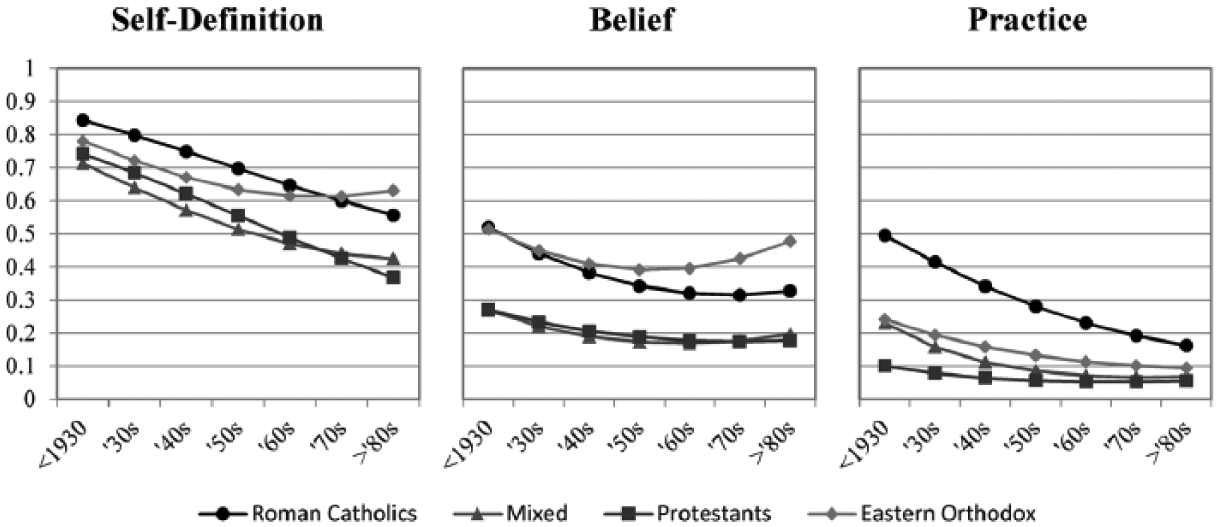
Predicted probabilities by cohorts and denominations.
Starting from self-definition it is possible to see that the four traditions almost share the same very high starting point (somewhere between 0.7 and 0.85) and start to decrease at the same rate. Starting from the ’50s cohorts, something changed for mixed countries and especially for Orthodox countries. The slope of the trend starts to decrease and the trend itself becomes slightly positive for Orthodox from the ’60s cohorts. Regarding belief, Roman Catholics and Orthodox Christians share an almost common starting point (around 0.5). Also in this case something changed from the ’50s cohorts: the slope starts to decrease for Roman Catholics and Eastern Orthodox until it becomes positive for Orthodox Christians and almost flat for Roman Catholics. Protestant and mixed countries display basically the same trend, slightly decreasing until the ‘50s cohorts and stable afterwards. Practice is the output showing the clearest trend for each tradition. Starting from different points (around 0.5 for Roman Catholics, 0.25 for Orthodox Christians and mixed countries and 0.1 for Protestants), each tradition shows a clear decrease toward a quite common point around 0.1 (0.2 for Roman Catholics).
Discussion and conclusions
Starting from the first research question, what we found are different associations between the three outcomes if evaluated at different levels. The correlation between each of them is quite strong at country level. What indeed requires caution is assuming, on the other hand, that the three indicators are coherent among individuals. What we found were positive but weaker coefficients, supporting the choice to adopt a multidimensional framework.
What we did in answering the second research question was computing time-trends for the three items. As said, cohorts were chosen to consider time. Model 1 shows a substantial and constant decline in practice and self-definition but something different for belief. The latter shows the same declining pattern for the older cohorts (up to the ’50s cohort) whereas the slope flattens in the younger ones. Theoretically speaking, secularization theory still seems to be the appropriate framework, but our data show that, at least in the youngest cohorts, the share of people holding religious belief breaks the descending trend. Decomposing these trends between the different Christian traditions can surely help in scrutinizing them thoroughly.
Research question three precisely aims to do this. From the side of practice, our results confirm the theoretical expectation of secularization theorists. For each Christian tradition, we observe a general decline of religious practice. The only trend appearing almost flat is the one for Protestants, but this is clearly due to the very low level of religious practice in these countries. The patterns for self-definition show a common decrease starting from a very high rate. For Orthodox countries, something changed from the ’50s cohorts, when the trend starts to flatten (or even to increase). The trends for belief confirm what we found in model 1. After a general decrease for the first cohorts, starting from the ’60s cohort something seems to change: the trends for Mixed and Protestant countries start to flatten – this may be interpreted as a sort of ‘pavement’ or ‘bottom’ effect – and the same applies to the Roman Catholics even if the overall level is higher. The exception is represented by Orthodox countries, where the trend starts to increase.
It is possible to note that similar results (diverging trends for attendance and beliefs for Orthodox countries) were found at least for some of the countries considered here (Borowik, 2002; Greeley, 2003; Molteni, 2017). These results are open to different interpretations. Some studies highlight how the belief revival in many Orthodox countries would be characterized by the mixing of traditional forms and new forms of religiosity (magic, occultism, elements of eastern religions) (Borowik, 2002; Pollack, 2003). Such a religious bricolage would be the result of the individualization process and it goes hand in hand with a decreasing church attendance.
Other studies advance an alternative interpretation that is skeptical about the full development of an individualization process in Orthodox countries and that looks instead at the recent history of the Eastern European nations. Orthodoxy would function as a tool to rebuild a political, cultural and national identity after the traumatic communist period (Borowik, 2006; 2007) and thus religious believing would be functional to national belonging. After the collapse of the Berlin wall, Orthodox tradition gave the chance to leave the communist past behind and to reconstruct a memory: ‘It seems that religious revival is above all a return to tradition, to Orthodoxy as a tradition of Russia, Belarus and Ukraine. It is possible to understand it as a test of the reconstruction of memory, the search for a way to reconnect the severed links to the past’ (Borowik, 2002: 505; see also Titarenko, 2008: 251). Younger cohorts, less involved with the Communist past, took advantage of such opportunity. According to this alternative interpretation, national identity comes to overlap with religious identity (Borowik, 2002: 505), so that the divergence between believing and belonging would be the outcome of a process opposite to that of individualization.
Our results do not allow definitively choosing between the two interpretations, but the implications for the conclusions are clear. We did not find any results supporting the ‘believing without belonging’ hypothesis in Europe, with the exception of Eastern Orthodox countries: even this case can be interpreted in a way inconsistent with the individualization theory.
Before concluding, some notes of caution should be given. Firstly, throughout the whole article we dwell upon the debate between secularization and individualization theory because this is the core battleground for sociologists of religion dealing with the European context. However, there is no doubt that the market approach should not be discarded a priori: introducing it in the debate can certainly help to better understand the evolution of European religiosity. Secondly, the operationalization of the three items is only one of those possible. Although well thought-out and well tested, this choice is only one option among many but represents an appropriate way to embed this work in the debate concerning European religiosity. Thirdly, the use of Christian traditions as a country variable may reflect something more than the real theological pillars. For example, the Orthodox countries are almost all the former Communist countries, whereas the Protestant countries are basically the North-European ones. When using these high-level variables, especially if they ‘cluster’ the countries, it is not easy to disentangle the real mechanisms behind. In addition, when we focus on the differences between clusters of countries, it becomes impossible to explain the heterogeneity and the peculiarities within the clusters, losing inevitably important details.
Footnotes
Acknowledgements
Part of this work was carried out at the EUROLAB at GESIS – Leibniz Institute for the Social Sciences. The authors would like to thank Malina Voicu, Markus Quandt and Spyridoula Nezi as well as David Voas, Kelvyn Jones, Malcolm Fairbrother, Frank van Tubergen and Simone Sarti for their insightful comments and suggestions.
Funding
This research received no specific grant from any funding agency in the public, commercial or not-for-profit sectors.
Notes
Author biographies
Address: Università degli Studi di Milano, Via Conservatorio, 7 - 20122 Milan, Italy.
Email:
Address: Università degli Studi di Milano, Via Conservatorio, 7 - 20122 Milan, Italy.
Email: