




Abstract
Since 1895, the Population and Housing Census of Mexico has included the variable ‘religious affiliation’, and this helped to affirm the monopoly of the Catholic religion. In the new millennium, the dynamics of religious diversification of recent decades required a change of design in order to capture the new situation, making religious minorities visible in a way that would propitiate a culture of pluralism. To this end, a team of researchers worked together to capture the diversity of religions in Mexico for the 2010 census. In this article we shall describe: a) the methodological strategies developed to improve the census classifier, and a critique of its achievements in capturing the diversity of religious affiliations and memberships in Mexico; b) the need to combine a quantitative approach to religious affiliation with qualitative approaches to religious self-identification in order to describe and analyze religious deinstitutionalization and individualization tendencies, applying questionnaires to representative samples of the population.
In recent years there has been a tendency in Mexico for reconfiguration of the country’s religious field (Bastian, 2008). In 1950 Catholics accounted for 98.21% of the population, by 2010 it was 82.6% (De la Torre and Gutiérrez, 2014). Religious diversity does not correspond to a single tendency: on the one hand, since the 1970s there has been a growth of other religious options, led mainly by Evangelical and Pentecostal Christian denominations and those professing no religion; on the other hand, the hegemony of the Catholic church has been diminished through the growing tendency towards deinstitutionalizing and the subjectifying of belief experienced by Catholics themselves (especially the young) who show less and less interest in the coercive and obligatory character of the church. (See Católicas por el Derecho a Decidir, 2014; IMDOSOC, 2014).
With regard to their beliefs, and the ways in which they practice their religiosity, Mexicans incorporate heterodox beliefs and practices that come from other doctrinal frameworks, which may be spiritual or secular, to create their own mixtures; but although it might seem paradoxical, Catholicism, as well as being the religion of the majority, has kept its vigour due to the social weight its traditions have in festive customs (De la Torre et al., 2014). In this way, Catholicism keeps up the structure of traditional collective links, which in turn are ‘formative of social and political action’ (Bastian, 2008: 34).
Taken as a whole, religious diversity requires a revision of the national census categories, as well as an evaluation of their usefulness in making the wide variety of groups that make up religious diversity in Mexico visible. It is also necessary to try other methods that make it possible to get beyond exclusive affiliations to a particular religion, and allow us to approach the trajectories of religious mobility and seeking, which erode fixed and static borders of identity, and open up the possibility of finding multiple belongings to religion. This calls for refining and combining methods that allow us to accede to the dynamics of believer identification and understand them, with their impact on the reconfiguration of the religious field.
Religion in the Population Censuses of Mexico
The census is a fundamental resource for determining the principal tendencies towards religious diversity, and for providing the necessary conditions for pluralism. 1 Mexico is one of the few countries in the Americas that includes a question about religious affiliation in its national census (and has since 1895).
The question on religion was included in the census as part of a policy of national integration. The state had officially embraced a plan for cultural mestizaje, a plan aimed at eliminating caste-like divisions in order to add the indigenous population to the idea of the ‘average man’, that is, the mestizo citizen. In this regard, Catholicism was a method for national inculturation (Florescano, 2001). In Mexico, the original goal of including the variable differs from that of immigrant-receiving countries seeking information on the religious traditions that immigrants bring, i.e. the recent migration of Muslims to Europe or of Asian and African immigrants to Australia, which has led to a need for a multicultural integration policy (Bouma, 2015; Bouma and Hughes, 2014). Nowadays, the tendency towards religious diversification, not only in Mexico but across Latin America (Pew Research, 2014), is modifying the original purpose of the census, changing it from an instrument designed to build unity to one that measures religious diversity. This creates a challenge in terms of redesigning the census question and redefining its scope.
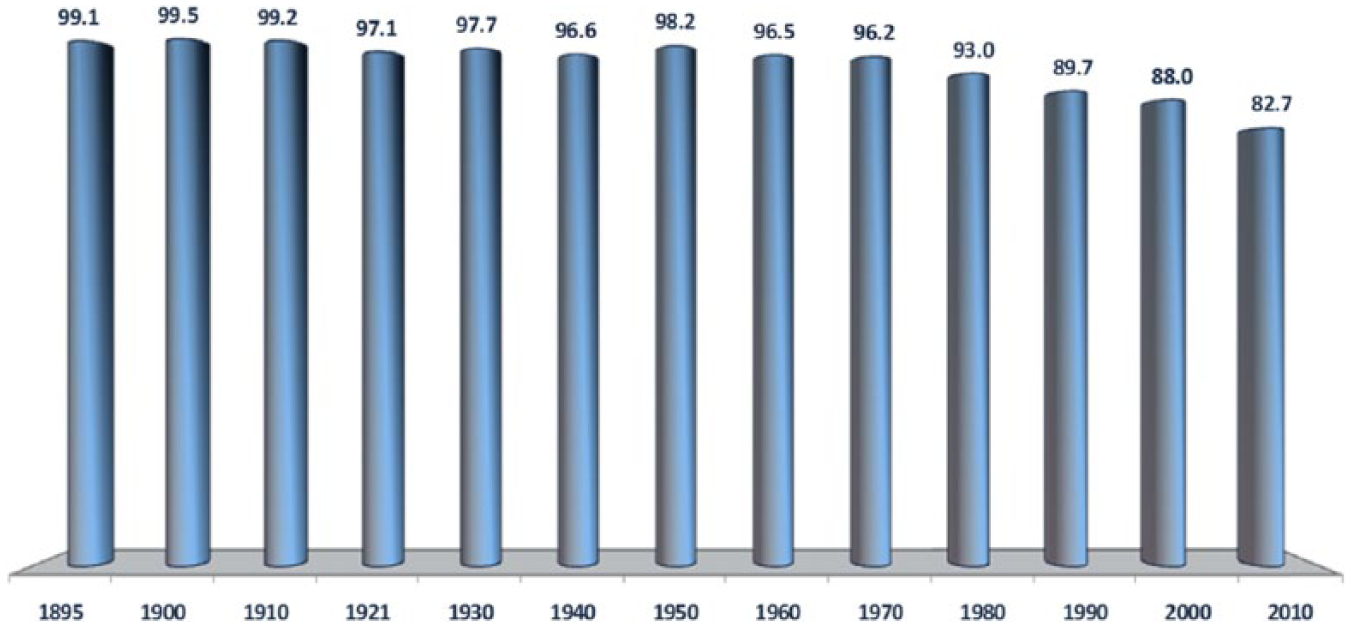
Percentage of Catholic population in Mexico, INEGI 1950–2010.
However, though Catholicism in Mexico has ceased to be a monopoly, it continues to be a majority. Non-Catholic denominations have grown, but they are still minorities.
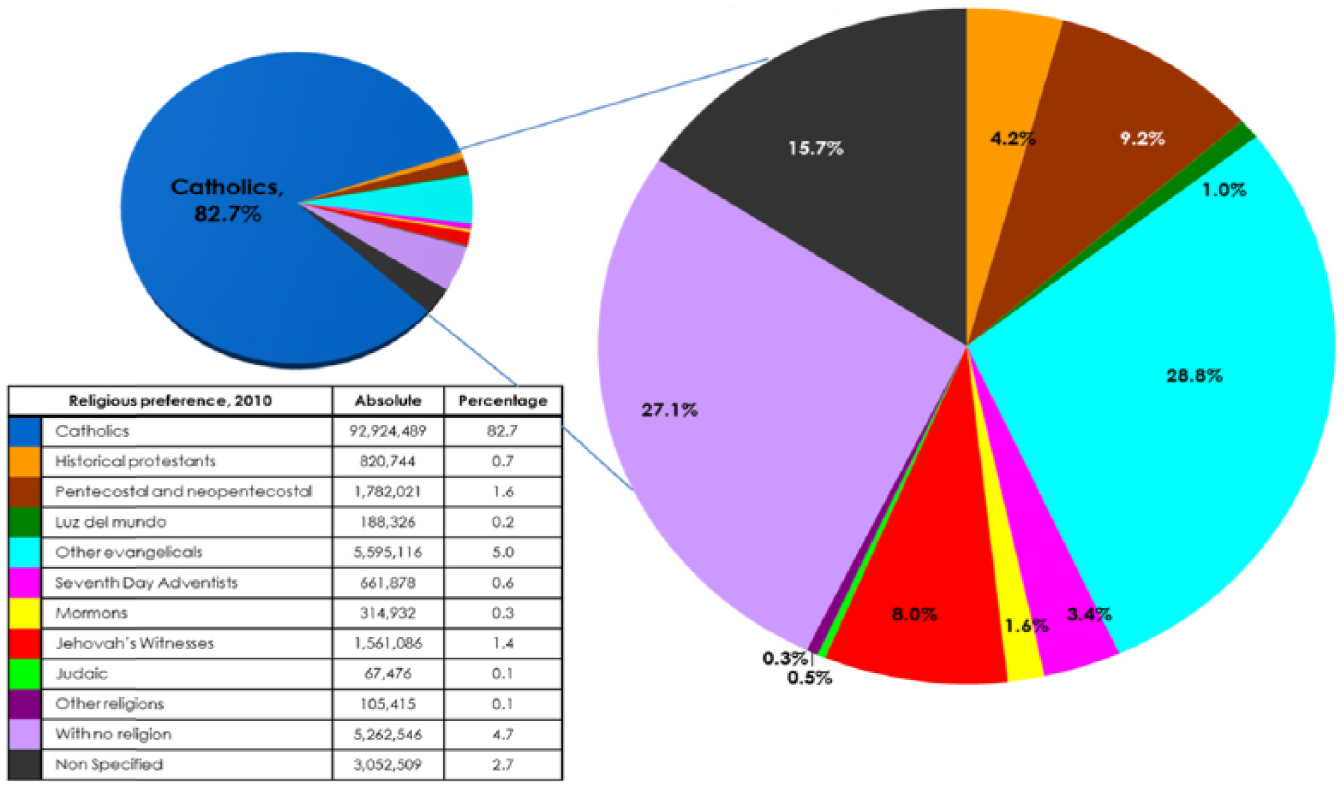
Distribution of the ‘non-Catholic’ religious preferences, Mexico 2010.
Religious diversification is due to a large extent to the dynamics of missionary work by Evangelical churches aiming for conversions. Since the 1980s, the decline in the number of Catholics has accelerated, especially in the states of the South of Mexico, in the border areas, in regions with higher rates of marginality, and on the outskirts of big cities. 2 This was caused by an increase in the Protestant, Evangelical, Pentecostal and Paraprotestant populations, and of those professing no religion (De la Torre and Gutiérrez, 2007).
For many years, information provided by the census was not very significant for analysis of religious change because of the limited range of confessional options given in the pre-established answers of the questionnaire. In fact, due to its hegemonic position in the culture of the nation, Catholicism is not homogeneous. Census figures are never just numbers: they provide a basis for access by religious groups to spaces in the public sphere by virtue of their importance in society, and they are included in narratives on disputes between minorities and the majority (Mafra, 2013: 13). For decades, census data fortified the quasi-monopolistic status of the Catholic Church, and this secured it privileged treatment in various political negotiations.
From the nineteenth century until 1990 there were few options for answering the question about religious affiliation in the census: if not ‘Catholic’, it had to be ‘Protestant or Evangelical’, ‘Jewish’, ‘Other’ or ‘None’. In addition, although the State is secular and has been since the Constitution of 1917, churches had no legal standing until the 1990s so there was no official record of the burgeoning of religious organizations occurring as the twentieth century progressed. In 1992, when the State recognized the legal existence of religious associations, hundreds of both Catholic and non-Catholic associations applied immediately for official recognition by the Department of Religion (Dirección de Asuntos Religiosos). To date, there are over seven thousand religious associations on the register, about half of which are Roman Catholic. 3
Given the evidence for growth in the number of options for religious affiliation, the National Institute of Statistics and Geography (INEGI), in charge of general censuses of population and housing, redesigned the questionnaires for the year 2000 and set a question on religious affiliation that kept the previous options of ‘Catholic’ and ‘None’ but registered other possibilities with an open question addressed to the head of each household. For the 2010 census the question was redesigned again, making it open, and individual as well, which made it possible to register multi-religious households better.
The census is an instrument for fostering a culture of pluralism and non-discrimination against minorities. Government agencies working for equal and respectful treatment of stigmatized minorities, such as the National Commission to Prevent Discrimination, CONAPRED (Comisión Nacional para la Prevención de la Discriminación) and the Office of Religious Affairs, responsible for improving conditions of equality in religious diversity and of making the religious minorities living in the country more widely visible, took part, along with the authors of the present study in redesigning the National Catalogue of Religions 2010, so as to classify the enormous variety of answers to the census question. The register of associations, the various academic studies made of religious groups, most of them case studies, and the record of unclassified answers from the previous census were very useful in this exercise.
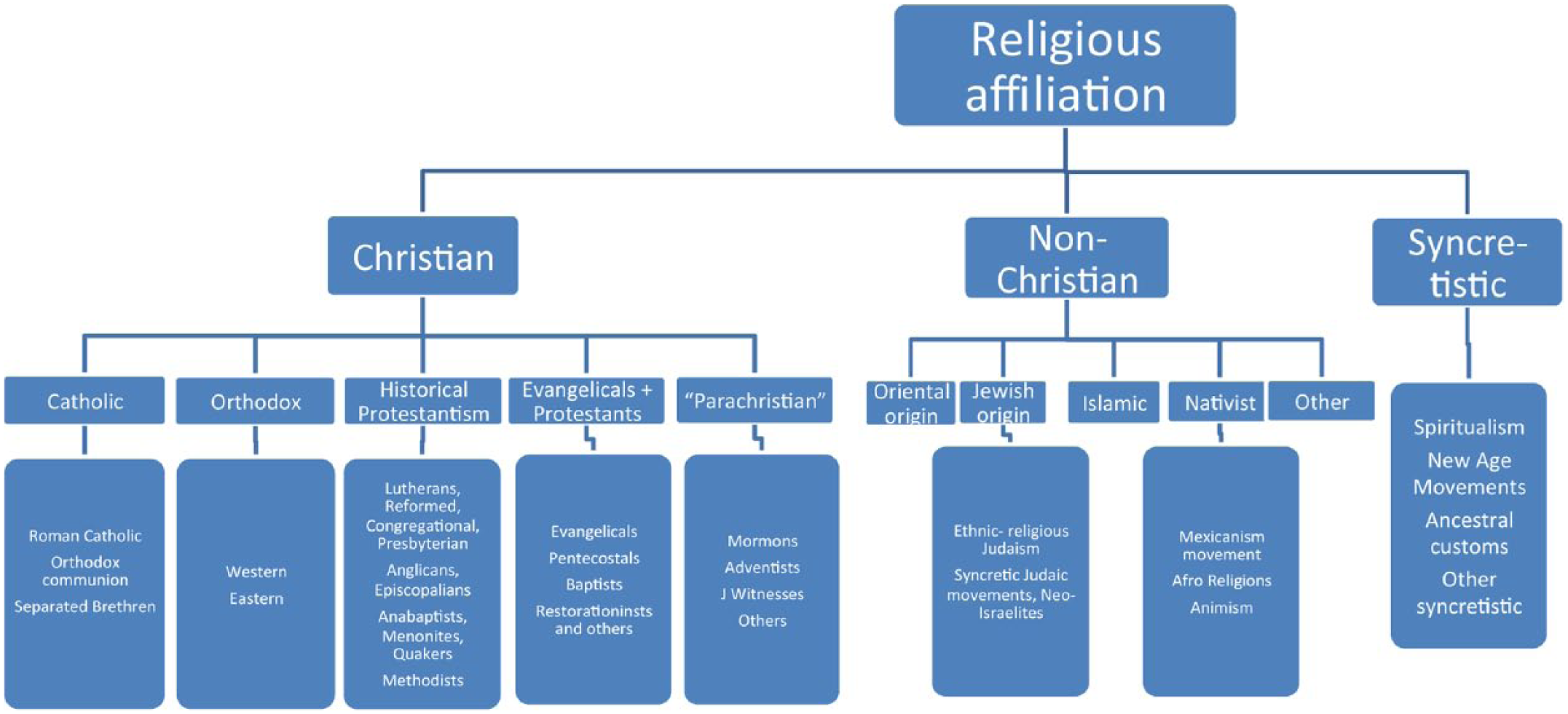
Scheme for classifying religions of the nation, 2010 census.
Some of the challenges requiring a solution during this process were: a) the need to reduce the ambiguities of the ‘unclassified’ categories, which we did by making a list of possible answers about religious identity that might give the greatest certainty possible to its classification; b) the elimination of discriminatory terms based on identification by negation on the basis of the criterion of the majority (for example, ‘non-Catholic’, ‘biblical non-evangelical’), terms carrying a stigma (such as ‘tribal religions’ and use of the word ‘sect’); c) inclusion of terms of self-identification used by religious groups and believers, whenever possible.
Census data 2010: Scope and limits
We will proceed to present the main features of the various protagonists, on the basis of the categories supplied by the 2010 census, both to provide a panorama of religions in Mexico and to evaluate the scope and the limits of the modifications to the census, following a path of criticism and constant improvement of national statistics.
Ethnic religiosities and spiritualities within the category ‘no religion’
A special endeavour was to make visible the preferences people had for spiritualities, religious movements and ethnic traditions of various types that were concealed under the category ‘no religion’. This group has maintained an absolute percentage growth since the census was first started in Mexico. In 2000 it reached a figure of 3.52%, and in 2010 it grew to 4.68%, representing 5,262,546 people. There are various truths behind this census figure. First, analysis of its spatial distribution, through cartography, revealed how in absolute terms this group is concentrated numerically in the big cities of the country, where there are lower rates of marginalization and better levels of quality of life. We can infer that among those who declare themselves to have ‘no religion’ can be found Mexicans with an urban lifestyle and access to basic services, with a high rate of education; people who declare themselves more frequently to be separated from religion and tradition, who have an affinity for atheism or agnosticism, or are spiritual seekers rejecting religious affiliation (Gutiérrez, 2007, 2014). However, analysis of the maps of distribution in terms of percentages showed us another aspect of the phenomenon: the greatest percentages were found in the municipalities of south-eastern states with larger indigenous populations and high indices of marginality. The distribution of this census group is polarized between two sociodemographic types: while 51% live in urban areas of 100,000 inhabitants or more, 22.8% live in places with less than 2,500 inhabitants. The same tendency of polarization is seen in other indicators: although the average number of years at school for this group is 9 (the same as the national average), 40.8% had not completed their basic education; 366,483 speak a native language and of these, 68,007 do not speak Spanish (INEGI, 2010b). They are a marginalized population of indigenous ethnicity who, according to previous ethnographic studies, tend not to identify their practice as ‘religious’ but as part of their ethnic customs (INEGI, 2005). This polarization of sociodemographic characteristics has two consequences: the first, which is taxonomic, has to do with the need to provide more precise options of classification for this group that would distinguish the specificity of practitioners of ethnic customs from agnostics or atheists also in the category of ‘no religion’. The second is about interpretation of the nature of religious change in our country: the growing numbers of those who respond ‘no religion’ cannot be interpreted unequivocally as empirical evidence for the advance of modernizing processes, as suggested by the sociological theory of secularization in the sense of a growing loss of importance of religion in social life (Dobbelaere, 1981; Wilson, 1985).
The current possibility of being able to distinguish the openly atheistic or agnostic group within the category of ‘no religion’ is a decisive advantage, as is the possibility of making practitioners of indigenous or nativist (or traditional or ‘customary’) religiosities visible for the first time through the category ‘indigenous religions’. However, in 2010 this category received only 17,585 ticks. This figure from the census is underrepresented (01º.17%) considering that the country has ten million indigenous speakers of sixty-two living languages. Mexico is both multi-ethnic and multicultural, but this is frequently denied under the dominating ideology of a mestizo nation combined with Catholicism. We consider that the addition of this category is a big step forward, one that will feed back positively into the social recognition and legitimacy of these practitioners.
Behind the ‘Catholic’ category: Ethnic and syncretistic popular religions
Many religions of ethnic or popular origin have been rendered invisible since they were amalgamated into the syncretism proper to Catholic religiosity. Catholic evangelization of the Mexican indigenous population did not succeed in abolishing the ancient religions, which were maintained through the roles and responsibilities indigenous people assigned in their own religious celebrations and rituals. In this regard, they were relatively autonomous and priests were not involved. Ethnic expressions of religion such as these came to be known as folk Catholicism. The census classifier of 2010 recognized them for the first time. Such is the case of various devotions or folk cults (which reached 5,627 affiliates, and which probably include believers in cults like that of folk saints La Santa Muerte, Santo Malverde, Niño Fidencio) as of Spiritualism (26,780), and religions of Afro roots, including Santería and Candomblé (7,204), previously identified as being ‘of tribal origin’. The new classification contributes to their growing social recognition and legitimacy.
Categories were also included to cover spiritual movements like New Age (5,534 affiliates), Buddhism (14,062) and Hinduism (1,930). Although the last two are millenarian religions, they are found in Mexico because of new religious movements, such as Soka Gakkai and the International Society for Krishna Consciousness (ISKCon).
Behind the ‘Pentecostals’, ‘Evangelical’ and ‘Protestants’ categories: Dealing with different identity models and visibilities in the census
There is no doubt that the most dynamic sector of religious change in Mexico is that of the Evangelical Christian. In the 2010 census these large categories have more female (53.2%) affiliates (INEGI, 2010b), a fact that is related to the advantages these religions offer to women through their prohibition of alcohol (Garma, 1998 and 2004; Martin, 1990), and other features that explain their significant presence among the marginalized population of the country: the schooling index of the faithful is 8 years, and 44% never finished their basic education. But these large categories cover a multitude of organizations whose analysis requires more precise classifications: there are 4,328 religious associations in this group, amounting to 98.5% of all Non-Catholic religious societies registered in the country.
As with the categories revised above, it was a priority for the National Classifier to open options within these large categories, where there is a great range of denominations, such as ‘Baptists’, and ‘Assemblies of God’. This task continues unfinished as many believers identify themselves through generic answers like ‘Christian’, ‘Evangelical’ ‘Protestant’ or ‘Pentecostal’. Considering these cases, where not even the terms used by religious groups and believers makes it possible to ascertain the specific congregation they are affiliated with, one should ask a self-critical question about the conditions that make it possible for some denominations to be seen and be precisely and clearly registered in the application of the census. The ‘Survey of Residentiality and Territorial Patterns of Non-Catholic Cult Centres’ conducted in 2009 to a representative sample of people attending Non-Catholic religious services in Guadalajara (the second largest city in the country), 4 came up with information indicating that a fundamental factor in making them visible is the identity model, linked to strategies of territoriality, that the various religious congregations have developed among their members (Gutiérrez et al., 2011; De la Torre and Gutiérrez, 2015). In facing the tendency towards urban territorial segmentation and dispersion, the churches give different weights to residential proximity in their various models of building a community and forming a religious identity. They combine their models of territoriality with different modalities of belonging: the closer members live to the temple, according to a model of complete coverage of the territory, the greater their identification and exclusive sense of belonging; the farther away, the more multiplicity. We have come to appreciate that there is a tendency to recreate territorial religious communities, which in turn strengthen exclusive membership of a single church. For example, the Mexican Pentecostal church ‘The Light of the World’ which has developed a parochial type of territoriality, with the highest residential concentration of their believers, creates an exclusive identity, expressed in the fact that 95% of the surveyed declared themselves members of the church by its name. But we have also seen new organizational modalities that tend to create inclusive and generic identities, no longer of belonging but making reference to an imagined community of Christians, Evangelicals or Pentecostals, one that proceeds in a dynamic way in segmented spaces, making the religious services the unique reference point for the identity of those attending them. A good example in our study was the Pentecostal oriented ‘Assemblies of God’: those who attend a centre of worship of this group do not identify themselves as belonging to this denomination in particular: only 7.9% say they belong ‘to the religion that is practiced in this place’, while 65% identify themselves as Evangelical Christians, and 23.7% just as Christians. A small percentage of 2.6% say they are Evangelical Pentecostal Christians.
Therefore, in this critical exercise we must recognize the existence of certain limits to the taxonomic efforts of the religious scholar or the bureau of statistics: the membership of a church with a strong and exclusive model of identity has more probabilities of being well counted, than that of a spiritual movement or a transversal modality of religion (which traverses the categories of belonging) such as Pentecostalism (De la Torre and Gutiérrez, 2007: 328). In designing the classification, we chose to list only the organizations that were officially registered in order to obtain the number of affiliates per municipality according to the census. We thus learned that a church with a strong identity like ‘The Light of the World’ has 188,326 members, while the Assemblies of God known all over the world have just 26,626, but the precision of the two figures needs to be evaluated in function of the identity model used. Among the consolidated religions with a strong identity model we can mention the churches that come under the census category ‘biblical different from evangelical’ (also known as Para-Christians) which includes the Jehovah’s Witnesses, Seventh Day Adventists and the Church of Jesus Christ of Latter-Day Saints.
On the other hand, it is not surprising that other churches with an interdenominational orientation and a non-exclusive identity model like the Universal Church of the Kingdom of God, which promotes consumption rather than affiliation, should not appear among the main associations reported by the census, even though this transnational church has had a great impact through using television for its missionary work, and currently has huge temples in the principle cities of the country. 5
‘Unclassified’: Always one step behind
In spite of the efforts made to improve the census procedures, unclassified answers grew from 0.86% to 2.72% in 2010. From a self-critical perspective this figure should dominate our efforts to be constantly improving the measurement of religious affiliation in Mexico, as it speaks to us of the intensity of the dynamics of religious change, which we are by definition, always one step behind.
Varieties of believers under the skin of belonging
The limitation of using census data is that they simply report the answer to a single question about religious affiliation. 6 Census data do not attend to the socio-religious aspects that allow different types of believer and practitioner to be distinguished within the classification of Catholic. Another limitation is that often the Catholic category covers various identifications with ethnic multi-religiosity, the Charismatic movement (a Pentecostal version of Catholicism), alternative spiritualities (like New Age and Neo-Nativisms), or magical and esoteric cults. One challenge is to demonstrate the different types of Catholic, with varying degrees of commitment. Often based on opinion polls, surveys have given us the figures for religious behaviours other than those of belonging, so we can reach the plurality under the skin of the Catholic confession.
One way to account for this heterodoxy is through surveys disaggregating identification from belonging (Campiche, 1991). The recent project ‘Believing and Practicing in Mexico, a Comparison of Three Surveys of Religion’, 7 started originally from a theoretical concern about the particularity of processes of religious modernization, following the model of sociological studies of religion interested in the current tendencies of late modernity: towards de-institutionalization and subjectivization. However, according to Lemieux et al. (1983), one should also capture the changes in continuities, and not just the breaks, as reality in Mexico is distinguished by an extraordinary vitality of traditions and a continuity of belief, and by collective practices linked to popular Catholicism. Our survey design is based on the methodology of religious self-identification proposed by Roland Campiche (1991) to capture the believers’ identifications with the imaginary of the transcendent, with ethical and civic values, with sexual morality, and with attitudes towards religious tolerance and devotional practices. We will give examples of the principal tendencies detected through the data from Guadalajara (Jalisco), and then provide an exercise of statistical analysis to distinguish different configurations that exist within Catholicism. 8
In Guadalajara (the hard-core of national Catholicism) there is a definite tendency for the majority to identify with Catholicism (86.5%). Belief in God is also conclusive: only 3.5% do not believe in God, while 67% agree with the Christian/Jewish imaginary of the beyond, expressed in a belief in ‘heaven and hell’ or in the ‘last judgment and resurrection’. Almost half of the population conceives of God as the Holy Trinity.
The population of the city shows very high rates of commitment to its church: 52% fulfil the precept of attending mass weekly, and over 80% consider that the religious celebration of rites of passage is very important. 43% pray regularly. This is also a society that keeps up tradition through the practice of popular religion, with about half of its members going on pilgrimages to sanctuaries (43.5%) or making votive rituals to virgins and miracle-working saints (41.8%). Also, over half believe in miraculous images (58%).
But surprisingly, while the city continues with traditional Catholicism, there is a definite opening to faith becoming something more subjective and less institutionalized. There is a growing tendency to incorporate new beliefs and to experience new religious practices, generally in an inclusive way, by combining these with the others. An increase is observed in the proportion of the population who believe in imaginaries that come from the New Age global spirituality, such as the idea of God as ‘vital force or energy’ (38.5%), or the inclusion of topics that come from Eastern frames of meaning for conceiving of the life beyond, such as belief in reincarnation (15.5%) and karma (30.3%). 13% practice yoga or meditation. 10% take part in ceremonies to align ‘planetary’ chakras and charge themselves and the place with energies at solstices and equinoxes. 8% participate in neopagan ancestral dances or sweatlodges.
The greatest dissent with institutional authority is found in the opinions of Catholics with regard to sexual morality: 55% approve of divorce; nearly a third approve of homosexuality (29.3%); and although abortion is approved of by only 19%, over 60% do not condemn it, as they consider that their position would depend on the circumstances of each particular case.
This survey shows a replacement of the ecclesiastical institution as teacher of values (only 4.8% consider the church to have the principal responsibility for teaching these), by the family (at 86.5%). In line with the tendency towards religious individuation and de-institutionalizing, we observe a growing acceptance of religious diversity and of tolerance towards changing religion: almost 40% would go to a religious ceremony different to their own, and over three quarters would support or at least respect someone in the family who changed their religion (76.3%).
The Mexican majority does not fit into ‘believing without belonging’, the category used by Davie (1994) to identify the English and the French; neither does it correspond to the idea of an ‘indifferent believer’ (as religion is an important part of most people’s lives), which is said to characterize people in Spain these days (Mardones, 2005); and it does not even match the individualistic classification of ‘do it yourself religion’ that French sociologists have found useful for explaining the phenomenon of empty churches (Hervieu-Léger, 1993, 1996). The data point to a re-composition, with changes of belief and values; and a permanence in the Catholic tradition in terms of following collective ritual practices of Mexican religiosity. The term ‘Catholic in my own way’, which has served to personify people in Chile having ‘a postmodern culture [which] has guaranteed the renewal of ancient values in the new conditions …’ (Parker, 2008: 337), might seem appropriate for characterizing Mexicans as well, although it marks a tendency towards individualism that does not correspond to religious culture in this country. Many Mexicans keep up collective patterns of practicing their devotion through fiestas, religious ceremonies and rituals, predominantly of popular Catholicism, which are more heterodox than orthodox. In much the same way as explained by Campiche (2010), we believe that the features of religious individualization, de-institutionalizing and the permeability of worlds of belief observed in the context of Mexico should not induce us into believing that there are as many beliefs as believers, or to forget the strength of tradition when we observe innovative features.
Conclusions
Mexican census statistics are a very valuable and reliable resource for analyzing the tendencies towards a diversity of religious affiliations, as well as an essential ingredient for decision-making in public policy areas. They can lay the foundations for the exercise of religious freedom and also guarantee secular freedoms such as non-religious public schools, gay marriage, legal abortion, legal marijuana, the recognition of different families models and assistance for domestic violence victims. In recent years, these freedoms have been the cause of social tension due to the uncompromising positions of certain Christian churches (including Catholic conservatives). Going one step further, Mexican public policy based on the recognition of the location, size and growth of different religious groups, all of which must be reliably calculated. This public policy would strive to provide equal access to services such as health, education and respect for diversity in order to integrate ethnic and religious minorities historically rendered invisible or stigmatized due to ignorance. In addition, a public policy of this kind would promote social harmony among different believers and a pluralistic culture. This social and political dimension is the most important and thus continuous efforts to improve the census, making it more precise and more useful, become a means to this end. There must be active communication between the organization in charge of national statistics, citizens and experts, so as to constantly update the measurements and classifications, as religious change has been so dynamic.
Economists and demographic experts have a major influence on the census design. For these consultants, the challenges of Mexico are associated with poverty and emigration, challenges that they believe require purely economic solutions. As a result, the religious variable has been viewed with mistrust, with some experts proposing that the question be removed as an ‘ideological variable’. This further limits the possibility of adding another question about religion, a question that goes beyond mere religious affiliation. The ‘in my own way’ identifications of believers traverse affiliations, and do not operate parallel to non-institutional spaces (as happens in Western Europe), they should therefore be complemented by specific surveys into the recomposition of religious identities, that would allow attention to be focused on subjective reconfig-urations of beliefs, values and relgious practices. Survey exercises have shown the importance of attending to processes of religious subjectifying and individualization in the context of an increasing de-institutionalization. Further, these exercises show us the importance of attending to the historical specifics of local contexts and in this way focusing on the dimension of popular and traditional practices and beliefs, which continue to play a fundamental role in the construction of collective life and serve as local anchorages in the face of the contemporary expansion of cultural flows.As we lobby for continual improvement of the census data on religion, we are also in favor of a national survey on religious reconfigurations that would supplement the census data and provide insight on the dynamics of religious and social change beyond mere religious affiliations.
Footnotes
Acknowledgements
Special thanks to Wendy Gosselin and Nicholas Barrett for the English translation from the original Spanish version, to Verónica Briseño for her assistance in the elaboration of figures and to Gabriela Gil for the editorial review.
Funding
This research received no specific grant from any funding agency in the public, commercial or not-for-profit sectors.
Notes
Author biographies
Address: Calle 5 de Mayo # 321, Zapopan, Jalisco, México, C.P 45150.
Email:
Address: España 1359, Colonia Moderna. Guadalajara, Jal., 44190, México.
Email: