




Abstract
As an additional – and less familiar – key performance indicator of secularization, this article offers a meta-analysis of over-time quantitative data about private prayer in modern Britain, mostly derived from national cross-sectional sample surveys among adults. Despite the fragmentary nature of the evidence and its methodological challenges, with consequent variability in results, the direction of travel is clear. Self-reported regular (weekly or more) private prayer has declined from one-half to one-quarter of the population over the past half-century, while the proportion never praying has risen from one-fifth to one-half. There have been parallel falls in belief in prayer and its efficacy. Gender, age, and ethnicity are the main secular attributes impacting prayer behaviour, relatively higher levels of which also correlate with above average religiosity, belief in God, and churchgoing and with being Roman Catholic or non-Christian. Prayer statistics thus corroborate other indicators which suggest that secularization in Britain has been a progressive, rather than sudden, process.
Introduction
Prayer is a central feature of religion, characteristic of virtually all religious and spiritual traditions, and a bridge between the worlds of religious belief and religious behaviour. Indeed, for William James (1902: 464) it was ‘the very soul and essence of religion’. Despite, or perhaps because of, its definitional ambiguities and evolving nature (Woodhead, 2015), it has long been the subject of theoretical and empirical scholarship beyond the realms of pure theology, with a conspicuous renaissance of interest since the 1980s. Especially notable contributions have been made by psychologists (Francis and Evans, 1995; Francis and Astley, 2001; Breslin, 2006; ap Siôn and Francis, 2009; ap Siôn, 2010: 32–129; Spilka and Ladd, 2013; Ladd, 2016) and sociologists (Giordan and Woodhead, 2013, 2015). Although these academic studies have extended to Great Britain, their focus has been somewhat concentrated, notably on the personality and other correlates of prayer among children and young people, investigated by Leslie Francis and members of his research group 1 , and latterly on adult requests for intercessory prayer, particularly examined by Tania ap Siôn (2010: 141–290) 2 . Moreover, few of these studies have been of a longitudinal nature, measuring change over time, a conspicuous exception being the inclusion of six statements about prayer in replicated four-yearly surveys of secondary school pupils at two East Anglian state secondary schools between 1974 and 1994, which revealed a diminishing commitment to prayer over these two decades, for example a reduction from 55 percent to 39 percent in those thinking praying was ‘a good thing’ (Kay and Francis, 1996: 205).
In comparison with these highly focused studies, the frequency and nature of prayer have not featured significantly, if at all, in more mainstream debates among sociologists and historians about the extent, pace, and chronology of secularization in modern Britain. These have revolved around a relatively small number of key performance indicators (KPIs) of institutional and personal religious attachment. Typically they have embraced measures of church attendance, church membership (notoriously difficult to compare across denominations on account of variable criteria of, and ages of entry into, membership), and a handful of ‘orthodox’ beliefs. Even Steve Bruce, the most persistent contemporary advocate of the secularization thesis, has largely overlooked the evidential potential of prayer. His enticingly-titled seminal article ‘Praying alone?’ (2002) does not address the issue of prayer at all; rather, it is a response to those, like Grace Davie, who have viewed secularization as a manifestation of a wider disinclination to associate and participate in voluntary organizations, in line with Robert Putnam’s Bowling Alone (2000). Robin Gill’s much earlier sociological essay ‘Who prays?’ (1973) was likewise somewhat deceptive, since it was as much about public worship as private prayer.
As the present author has argued and demonstrated in other writings 3 , secularization in Britain is most meaningfully considered on the basis of a much larger basket of KPIs, with 25 proposed as core measures of personal religious belonging, behaving, and believing during the past half-century 4 . Here, in further pursuit of this empirical goal, we assemble over-time quantitative data about one of these KPIs, private prayer, from sample surveys among adults, who have mostly been selected to constitute representative cross-sections of the national population or specific sub-sections thereof (occasionally, more self-selecting samples are mentioned). All the sources have been identified from the British Religion in Numbers database, to which readers are referred for additional methodological or bibliographical detail about the national-level polls 5 . In the interest of economy, survey years, populations and agencies alone are recorded here 6 . The surveys mostly deal with the claimed frequency of private prayer but sometimes illuminate other aspects. Apart from Tearfund’s major (albeit underreported) study of adult Britons and regular churchgoers (White et al., 2007), surveys were of the omnibus variety, with the prayer content of each accordingly minimal and, to an extent, superficial. Another in-depth enquiry into prayer among churchgoers, by the Teal Trust, was less robust in its methodology (Preston, 1999).
Sample surveys are not without their limitations, of course, and it is important to understand these at the outset, in order to avoid over-reading the results. Some, such as sampling error, are generic while others are more peculiar to investigations into religion. In the case of prayer, evidence for Britain before the 1980s is decidedly patchy (Field, 2015: 65; Field, 2017: 122–123) and even thereafter most surveys were non-recurrent, with a consequent dearth of time series for which sampling methodology, fieldwork agency, and question-wording were held constant. Differential formulation of questions can lead to subtle variations in the way in which respondents interpret and answer them. Thus, some questions about the prevalence of prayer did not clarify whether they were concerned solely with prayer in private or permitted prayer during the course of public worship to count, also. Other questions allowed meditation or contemplation to be included alongside prayer; surveys which specifically enquired into both prayer and meditation showed that the latter was much less widely practised than the former. Prayer frequencies were not necessarily standardized and cannot always be retrospectively collapsed to enable strict comparisons to be drawn. Additionally, some enquiries resorted to vague periodicities such as ‘regularly’ or ‘occasionally’, which have no fixed meaning, while others offered prayer only in times of crisis as a response option. The compound effects of non-standardized questions on prayer were illustrated in two different ones posed to separate sub-samples (one via face-to-face interview, the other via self-completion questionnaire) in the 2008 BSA; there was a 10-point difference between the two in the proportions registered as either ever or never praying.
However, by far the most important methodological consideration is that prayer behaviour is self-reported in sample surveys and cannot be independently verified. Almost certainly, as has been found with other forms of ‘virtuous behaviour’ which can be more objectively corroborated, such as churchgoing or charitable giving, these claims will have been overstated, either sub-consciously or deliberately, and perhaps often from a sense of guilt. Such exaggeration is likely to have arisen especially in reply to the ‘how often do you pray?’ type of question (whereas the more specific ‘when did you last pray?’ may have elicited slightly more accurate recall). On such matters, there is still a tendency for people to reply aspirationally, in terms of what they think they should be doing or believe that society expects them to do.
Prayer research, 1945–1980
The first sample survey concerning private prayer was conducted by MO in the London borough of Hammersmith in 1944–1945 (Mass-Observation, 1947: 53–61). Results were inadequately reported, but it was established that women were far more likely to pray than men and, to a lesser extent, the old than the young. MO was further struck by the fact that one-quarter of believers in God never prayed or did so only in church, with a similar proportion of doubters, agnostics, and atheists claiming to pray occasionally, a situation still obtained in Hammersmith in 1960 (Harrisson, 1961: 258). When MO conducted a nationwide investigation into religion in 1948, its sole question about prayer dealt with the incidence of formal family prayers or grace in the home, not with individual private prayer. The latter subject was only indirectly addressed by GP in 1950, which asked adult Britons whether anybody in the household apart from children prayed regularly, 48 percent of respondents answering in the affirmative and 41 percent in the negative. It was therefore left to Geoffrey Gorer (1955: 452–453) to publish the first direct evidence about claimed prayer frequency, albeit based on a self-selecting and demographically skewed sample of readers of The People (a tabloid Sunday newspaper) in England in 1951. Just under half (44 percent) of his sample reported praying daily, rising to 58 percent of females and 71 percent among over-65s; the identical number prayed exceptionally (including only in peril or grief) and the remainder never. A majority (58 percent) also stated that they had taught their children to say prayers.
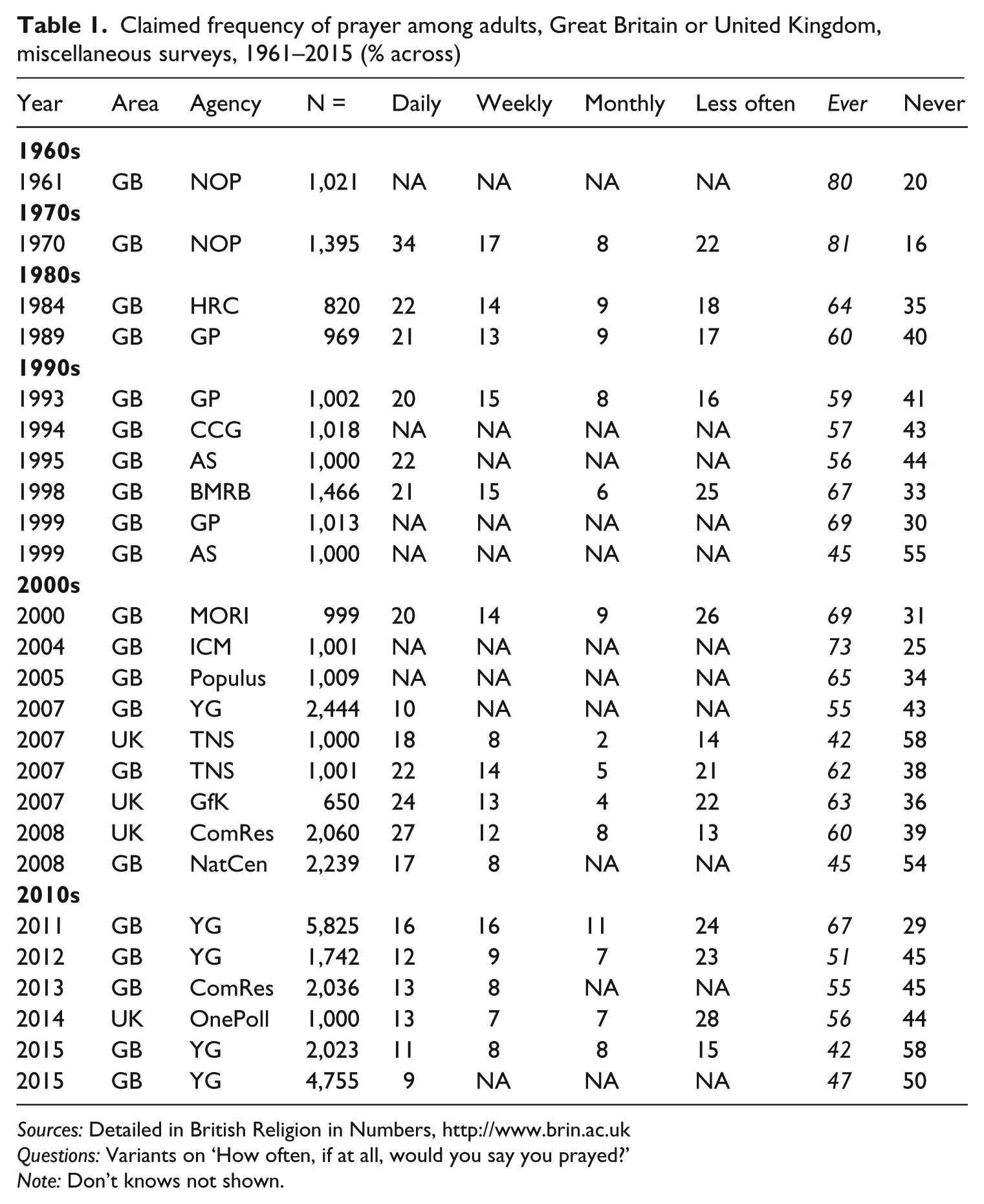
Throughout the 1950s, GP contented itself with probing other aspects of prayer. In 1950 it enquired whether its interviewees personally believed in prayer, 69 percent saying they did and 19 percent not. Four years later, GP’s topic was a belief that God answers prayer, 53 percent replying with an unqualified affirmative and a further 18 percent with a qualified affirmative; just 12 percent (disproportionately non-churchgoers) denied that God answered prayer and 17 percent were undecided. Even stronger was the commitment demonstrated by 86 percent of adults in another poll by GP in 1957 to teaching children to say prayers. That this may not have reflected their own private devotion was implied by the GP survey in England in 1963–1964 which revealed far fewer, 43 percent, admitted to praying regularly themselves. However, according to NOP in 1961, four-fifths of Britons seem to have prayed at some time, the situation remaining unchanged in 1970, when half claimed to pray at least weekly (Table 1). The latter finding was mirrored in three local studies in the West Midlands in the 1960s (Hinings, 1967: 62; Hinings, 1975: 117; Nelson and Clews, 1971: 20, 31–32, 38, 62), and possibly even exceeded in a south Norfolk village and market town (Varney, 1970: 75, 77). The potential utility of another local study of prayer, in Falkirk in 1968-1970, is somewhat undermined by its lack of a proper cross-section of population (Sissons, 1973: 198–200). A national survey, by RSL in 1963, of a sample of persons recently bereaved of a primary relative did not appear to suggest that the experience of bereavement significantly drove up levels of prayer (Gorer, 1965: 31–33, 165–166).
Claimed frequency of prayer among adults, Great Britain or United Kingdom, miscellaneous surveys, 1961–2015 (% across)
Sources: Detailed in British Religion in Numbers, http://www.brin.ac.uk
Questions: Variants on ‘How often, if at all, would you say you prayed?’
Note: Don’t knows not shown.
The 1970s were a lean decade for prayer research. NOP’s is the only known extant national poll exploring the full spectrum of prayer frequency, although ORC did discover in 1972 that 28 percent of adults claimed to have said a prayer on the day prior to interview. An unpublished survey undertaken by Queen’s Road Baptist Church in one area of Coventry in 1978, but conceivably not fully representative, returned a figure of 32 percent for daily prayer, with 40 percent of residents praying occasionally and 28 percent never. More statistically robust was a sample of Leeds inhabitants interviewed by the University of Leeds in 1982, among whom 29 percent never prayed, with 27 percent praying daily, 11 percent at least weekly, and 33 percent infrequently (Krarup, 1983: 64–66).
Prayer frequency since 1980
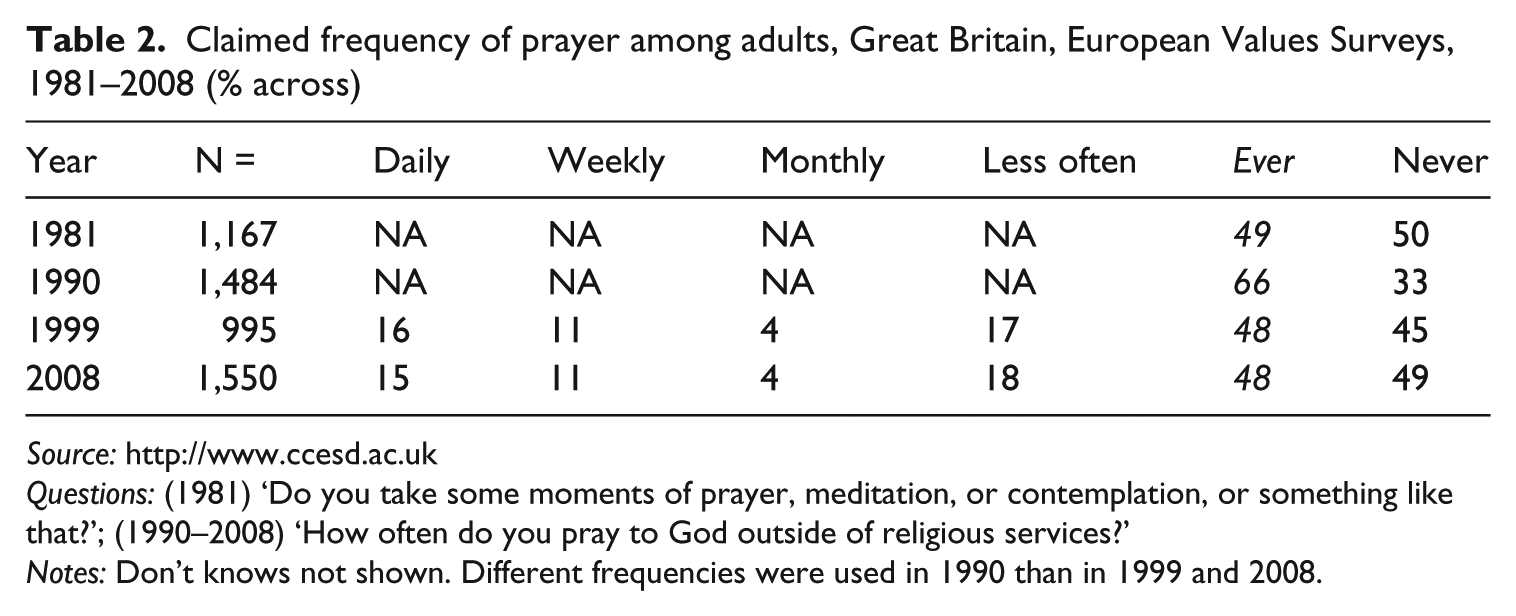
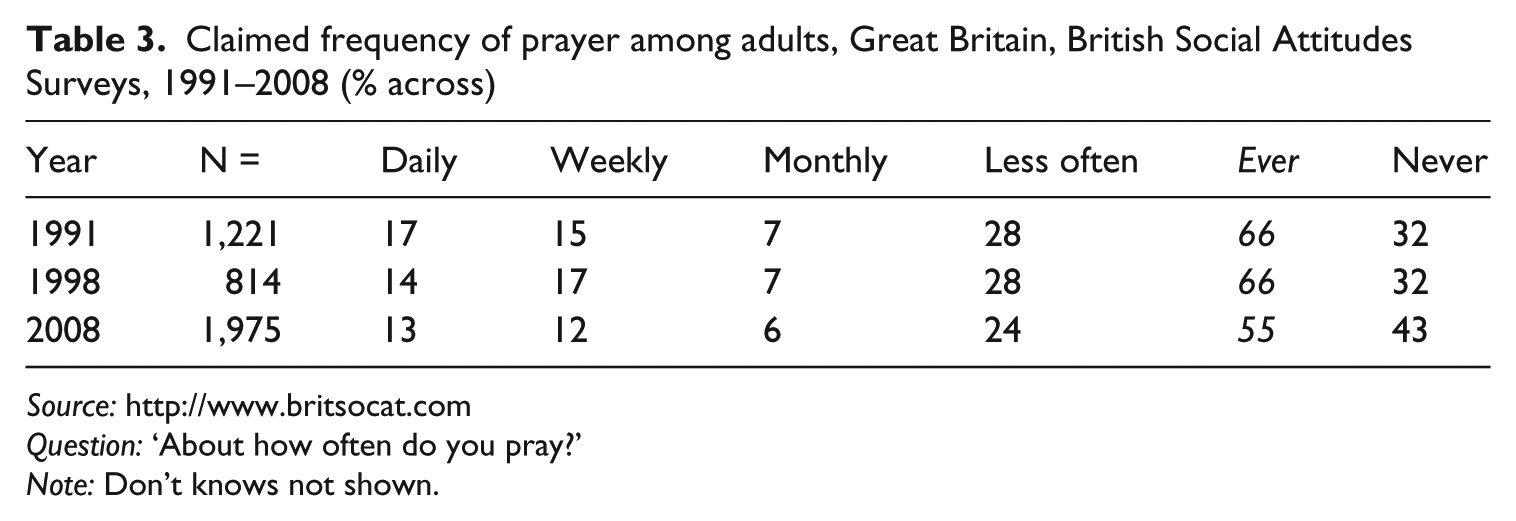
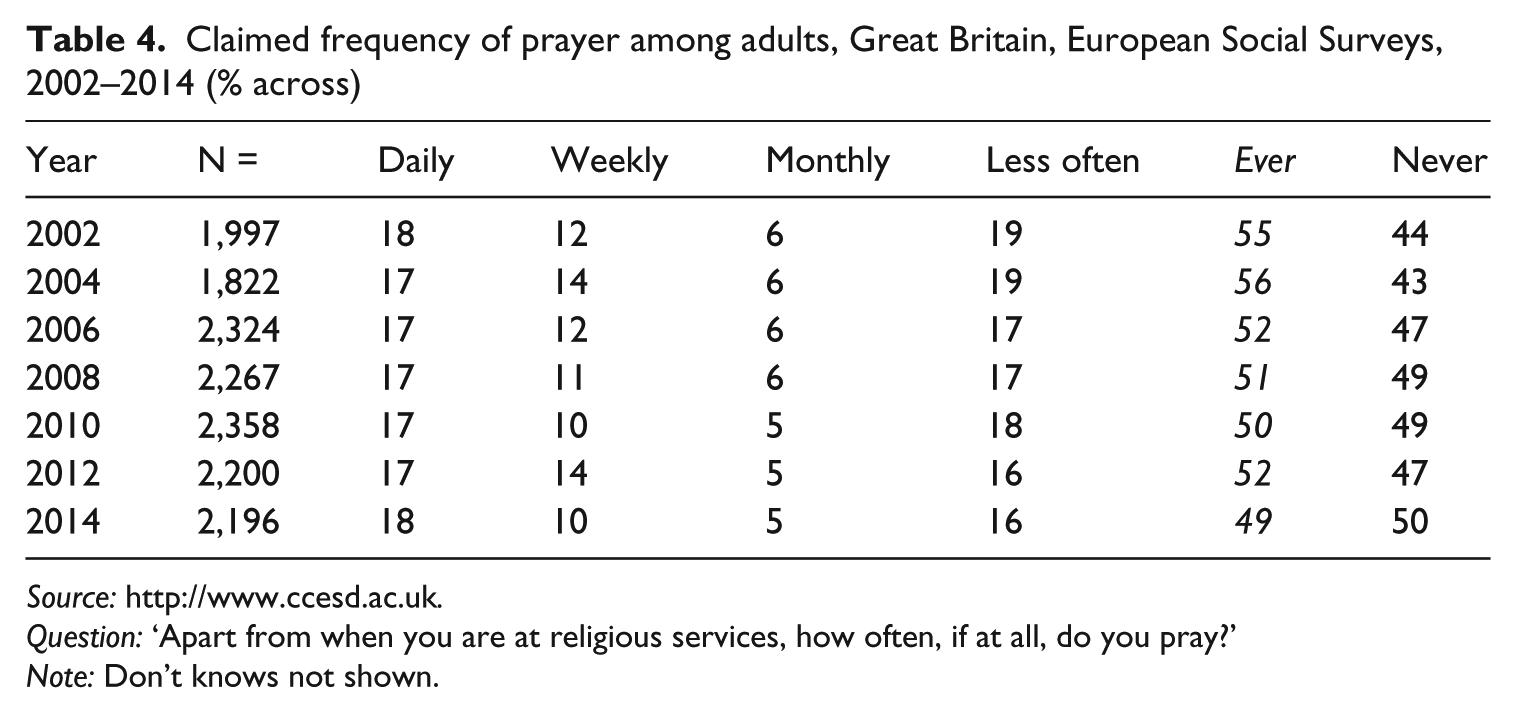
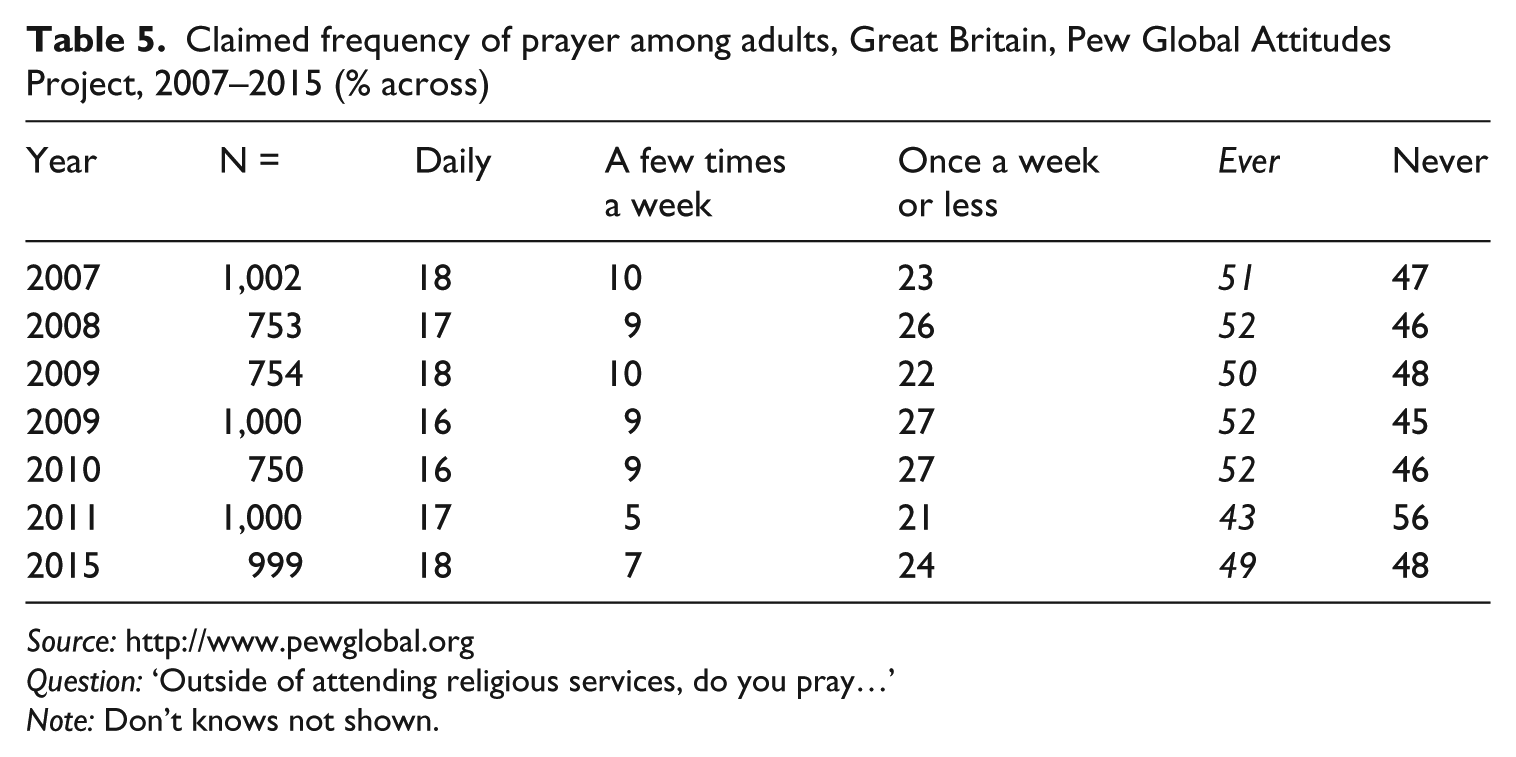
National polling on the frequency of prayer is more plentiful from the 1980s. In addition to 23 miscellaneous (and non-recurrent) surveys (Table 1), there are time series for EVS (Table 2), BSA (Table 3), ESS (Table 4), and Pew (Table 5), making a grand total of 44 data points. These topline figures will be briefly reviewed in this section, while in the ensuing two sections we will examine, respectively, the demographic and religious correlates of prayer frequency.
Claimed frequency of prayer among adults, Great Britain, European Values Surveys, 1981–2008 (% across)
Source: http://www.ccesd.ac.uk
Questions: (1981) ‘Do you take some moments of prayer, meditation, or contemplation, or something like that?’; (1990–2008) ‘How often do you pray to God outside of religious services?’
Notes: Don’t knows not shown. Different frequencies were used in 1990 than in 1999 and 2008.
Claimed frequency of prayer among adults, Great Britain, British Social Attitudes Surveys, 1991–2008 (% across)
Source: http://www.britsocat.com
Question: ‘About how often do you pray?’
Note: Don’t knows not shown.
Claimed frequency of prayer among adults, Great Britain, European Social Surveys, 2002–2014 (% across)
Source: http://www.ccesd.ac.uk.
Question: ‘Apart from when you are at religious services, how often, if at all, do you pray?’
Note: Don’t knows not shown.
Claimed frequency of prayer among adults, Great Britain, Pew Global Attitudes Project, 2007–2015 (% across)
Source: http://www.pewglobal.org
Question: ‘Outside of attending religious services, do you pray…’
Note: Don’t knows not shown.
Taking the proportion of people admitting to never praying, it will be seen that this has greatly increased from the one-fifth or fewer found in 1961 and 1970, approaching or occasionally exceeding one-half in most surveys from the late 2000s or early 2010s. The data are somewhat erratic, even inconsistent, but the general direction of travel seems clear. These fluctuations doubtless reflect the effects of the range of methodological issues and limitations already discussed. In particular, prayer occurring solely in moments of crisis had the potential materially to skew the overall results. Where separately identified, the number of respondents falling into this category was usually substantial, for example, 19 percent in 1961 (NOP), 31 percent in 1970 (NOP), 12 percent in 1982 (University of Leeds), 16 percent in 1990 (EVS), 31 percent in 1990 (NOP), 17 percent in 2000 (MORI), and 18 percent in 2004 (ICM). When, in 1999, GP asked ‘if you were in a personal crisis of some kind, would you be inclined or not inclined to turn to God for help?’, four-fifths of professing Christians said they would be so inclined. There would obviously be a case for regarding those who pray only at times of crisis as, effectively, never praying and counting them among the ranks of non-prayers. This has not been followed in reporting the statistics here, but it should be borne in mind that their inclusion in the aggregate group of people who pray artificially inflates the totals in that column which, in reality, is probably lower than the half shown for most recent years.
At the other end of the spectrum, there has been some diminution in the number claiming to pray at least daily (a category which, in most surveys, is the sum of two distinct options – several times a day and once a day). Putting it at its most extreme, when first reported in 1970, one-third of Britons prayed daily, by 2015 (YG) it was about one in ten. Even if we take the most optimistic figures for the early 2010s, the proportion is mostly not above one in six. In general, fewer have prayed on a weekly (subsuming several times a week and once a week) than on a daily basis. If we accept the categories of daily and weekly prayer combined as a working (and probably, given the expectations of most faiths and denominations, generous) definition of what constitutes regular prayer, then there has been a fall from one-half in 1970 to plus or minus one-quarter today. This is fairly consistent with the decline in households where an adult prayed regularly, from 48 percent in 1950 (GP) to 21 percent in 2004 (YG), 73 percent at the latter date containing no adult who was deemed to pray regularly. Factoring in monthly or more prayer adds a few more percentage points to the cumulative number, but it is notable that, when asked by YG in two polls in 2013 to choose from a list of religious devotions those which they had experienced or practised in private during the preceding month, no more than one-fifth selected prayer.
Demographic correlates of prayer
Many surveys have disaggregated by demographics responses to questions on prayer frequency, although these breaks have rarely been formally published. The principal demographic correlates of prayer are reported below, mainly for the post-Millennium era (earlier years are also available). To simplify presentation, breaks are given, wherever possible, for the combined categories of daily and weekly prayer.
Gender
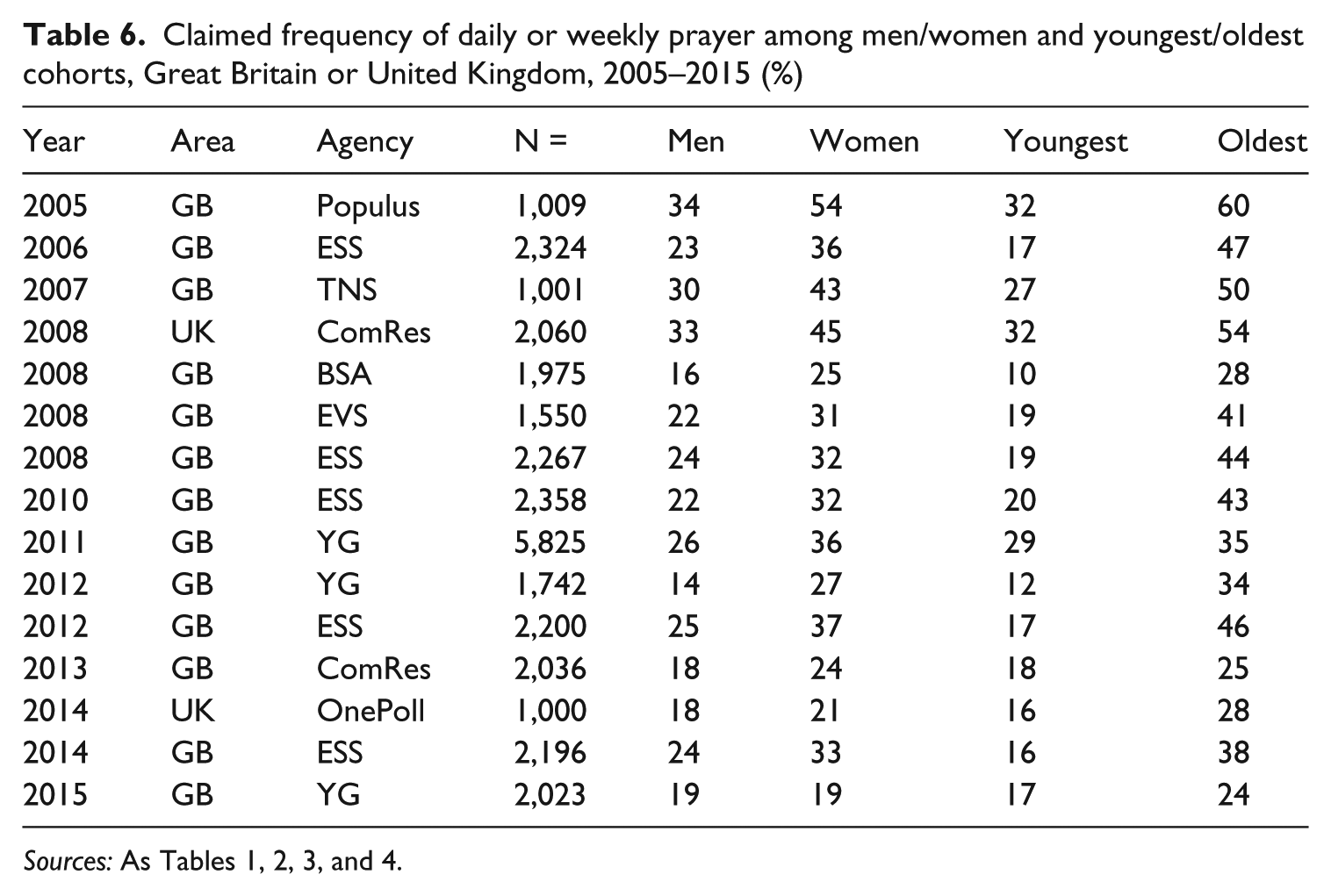
As MO discovered in Hammersmith in 1944–1945, women are more likely to claim to pray than men. This is in line with the gender split for all principal religious indicators (Trzebiatowska and Bruce, 2012). As late as 2005, the weekly prayer gap between the sexes was still a full 20 points, but it seems to have been narrowing since and (exceptionally) had closed completely in YG’s 2015 study (Table 6). Taking self-reported monthly or more prayer, the gender gap in two YG surveys from 2013, each with a sample of 4,000, was 10 percent and 7 percent, respectively.
Claimed frequency of daily or weekly prayer among men/women and youngest/oldest cohorts, Great Britain or United Kingdom, 2005–2015 (%)
Age
Prayer frequency increases with age, mostly in a linear fashion. The effect is illustrated in Table 6, which shows daily or weekly prayer for the youngest and oldest age cohorts in each survey. Standardized cohorts were not used, but the youngest column represents adults aged under 25 or under 30 and the oldest column those over 55, 60, or 65 (the highest figures in this column relating to over-65s). It will be seen that the gap between cohorts is even greater than between the sexes, although there are signs that regular prayer among both youngest and oldest cohorts is falling. Monthly or more prayer by over-60s in two YG enquiries in 2013 was only 4 percent and 3 percent above the British mean. A Populus poll of 15,000 over-50s in 2008 documented that, of those with a religious affiliation, 35 percent were praying less often than earlier in adult life against 18 percent more often and 46 percent about the same amount. That instance apart, genuine British longitudinal panel data on prayer are not available, so it is difficult to say whether this erstwhile effect did or did not exhibit a tendency for people to take up prayer as they aged. However, it seems unlikely that this would often have been the case since research into other KPIs concluded ‘Britons do not get more religious as they get older’ (Crockett and Voas, 2006).
Marital status
Breaks by marital status are rarely available for non-recurrent surveys, but they are a routine feature of BSA and ESS. Taking the latest survey for each, for 2008 and 2014 respectively, it seems that the lowest frequency of weekly or more prayer is reported by the never married (one in five) and the highest by the widowed (two in five). As the former group is disproportionately young and the latter preponderantly old, this trend is presumably tracking the age pattern, noted above. An additional refinement, only found in a 2015 YG study, is that among couples living as married, weekly prayer slumps to 11 percent, suggesting that cohabitation may be especially associated with alienation from religious practice.
Ethnicity
Non-whites (both Christian and non-Christian) pray far more than white people. In two 2013 YG polls, the latest data available, two-fifths of non-whites prayed at least monthly, double the number of whites. In two sub-samples from the 2008 BSA, 63 percent and 59 percent of non-whites prayed weekly or more compared with 20 percent and 19 percent of whites. In a special 2010 BES sample, private religious activities (such as prayer) during the previous year were reported by 93 percent of ethnic minorities affiliating to a religion, with 82 percent practising weekly or more.
Social grade
Regular prayer tends to be slightly more prevalent among non-manual grades (ABC1 in market research classification) than manual workers (C2DE). In YG surveys the difference for weekly or more prayer was five points in 2011 and two in 2015, but only one point for monthly or more prayer in 2013. A more granular analysis by ComRes in 2008 and 2013, distinguishing four groups (AB, C1, C2, and DE) proved somewhat inconclusive, apart from revealing sharp drops in weekly or more prayer in each group during the intervening five years.
Highest educational attainment
Breaks are only occasionally available from non-recurrent surveys but routinely from BSA and ESS, albeit the latter is problematic because qualifications have had to be rendered into an international common denominator framework. Results are not wholly consistent, but weekly or more prayer is typically at its highest among those with no formal qualifications. They are disproportionately elderly and thus this peak in praying is largely explained by an age effect. In some of the most recent surveys, degree holders also exhibited an above-average frequency of regular prayer. In fact, in two 2013 YG polls they were the educational category with the biggest self-reported rate of monthly or more prayer, respectively four and two points over the norm. This trend perhaps reflects the impact of the huge expansion in student numbers since the 1990s, which has especially brought more women and ethnic minorities into higher education, both groups with a greater predisposition to prayer.
Party choice
In five surveys examined for 2008–2014, no pronounced association was found between regular prayer and support for the three main political parties (Conservative, Labour, and Liberal Democrat).
Wellbeing
A relationship between predisposition to pray and personal wellbeing might be posited for one of two reasons: those least content with their lot might disproportionately resort to prayer in the hope of improving their situation or those most content with their material blessings might feel the need to express gratitude to God for them. ESS enables the occurrence of weekly or more prayer to be plotted against satisfaction with life as a whole and with happiness, both measured on scales of 0 to 10. Scores of 0-4 have been taken as indicating dissatisfaction with life or unhappiness and of 6-10 as denoting satisfaction or happiness (5 being neutral). Differences in regular prayer between persons who are dissatisfied and satisfied or unhappy and happy are negligible for all years (and completely non-existent in 2012) and in inconsistent directions. Either both reasons are operating, and cancelling each other out, or the correlation between prayer and wellbeing is weak.
Geography
Disaggregations by region and home nation need to be treated with caution because of small cell counts involved in conventionally-sized national (British) cross-sections of 1,000 or 2,000 interviews. The unusually large YG sample of 6,000 in 2011 revealed weekly or more prayer to be highest in Scotland (39 percent, six points more than in a System Three survey of Scots in 1987). The next highest level in 2011 was in London, at 35 percent, boosted by immigration (not least of ethnic minorities) in recent years, which has also significantly uplifted churchgoing rates (Brierley, 2013); however, the figure had dropped to 27 percent in YG’s 2015 poll in the capital. The lowest rate of weekly or more prayer in 2011, at 25 percent, was in Wales, historically a highly religious (and Nonconformist) nation – in 1990 NOP discovered 39 percent of Welsh people prayed regularly. Monthly or more prayer in the two large-scale YG surveys in 2013 was highest in London, with Scotland reduced to the norm in the January investigation and to bottom position in June.
International
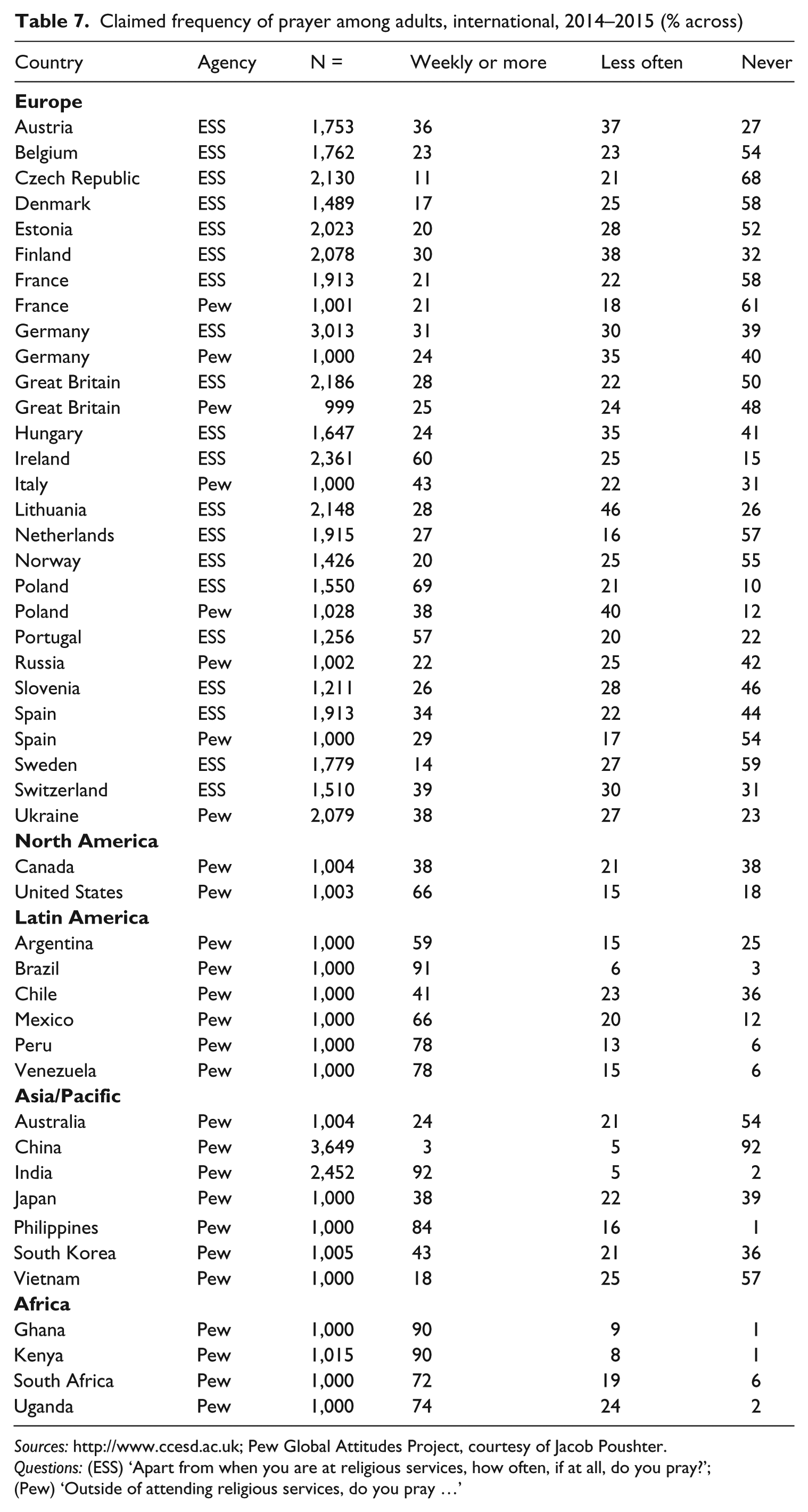
Comparative statistics on prayer frequency from Britain and other countries are available from BSA (through the International Social Survey Programme religion module), EVS, ESS, and Pew, also from studies by ICM in 2004 and the Bertelsmann Foundation’s Religion Monitor in 2008 and 2013. Table 7 collates collapsed data from the latest ESS and Pew surveys, covering 42 nations between them, although it should be noted that they differ slightly in prayer frequencies, Pew not differentiating between once a week and less often. Additionally, Pew results for Muslim majority countries are not shown since the question was only posed to non-Muslims, given that Muslims are obligated to pray five times each day. Britain is positioned more than two-thirds of the way down the international rankings in terms of weekly or more prayer, with the United States, African and Catholic majority or plurality nations generally all returning higher figures, and Scandinavian countries, Communist or ex-Communist states, and those with anti-clerical traditions (notably France and Spain) having the lowest.
Claimed frequency of prayer among adults, international, 2014–2015 (% across)
Sources: http://www.ccesd.ac.uk; Pew Global Attitudes Project, courtesy of Jacob Poushter.
Questions: (ESS) ‘Apart from when you are at religious services, how often, if at all, do you pray?’; (Pew) ‘Outside of attending religious services, do you pray …’
Religious correlates of prayer
Religious affiliation
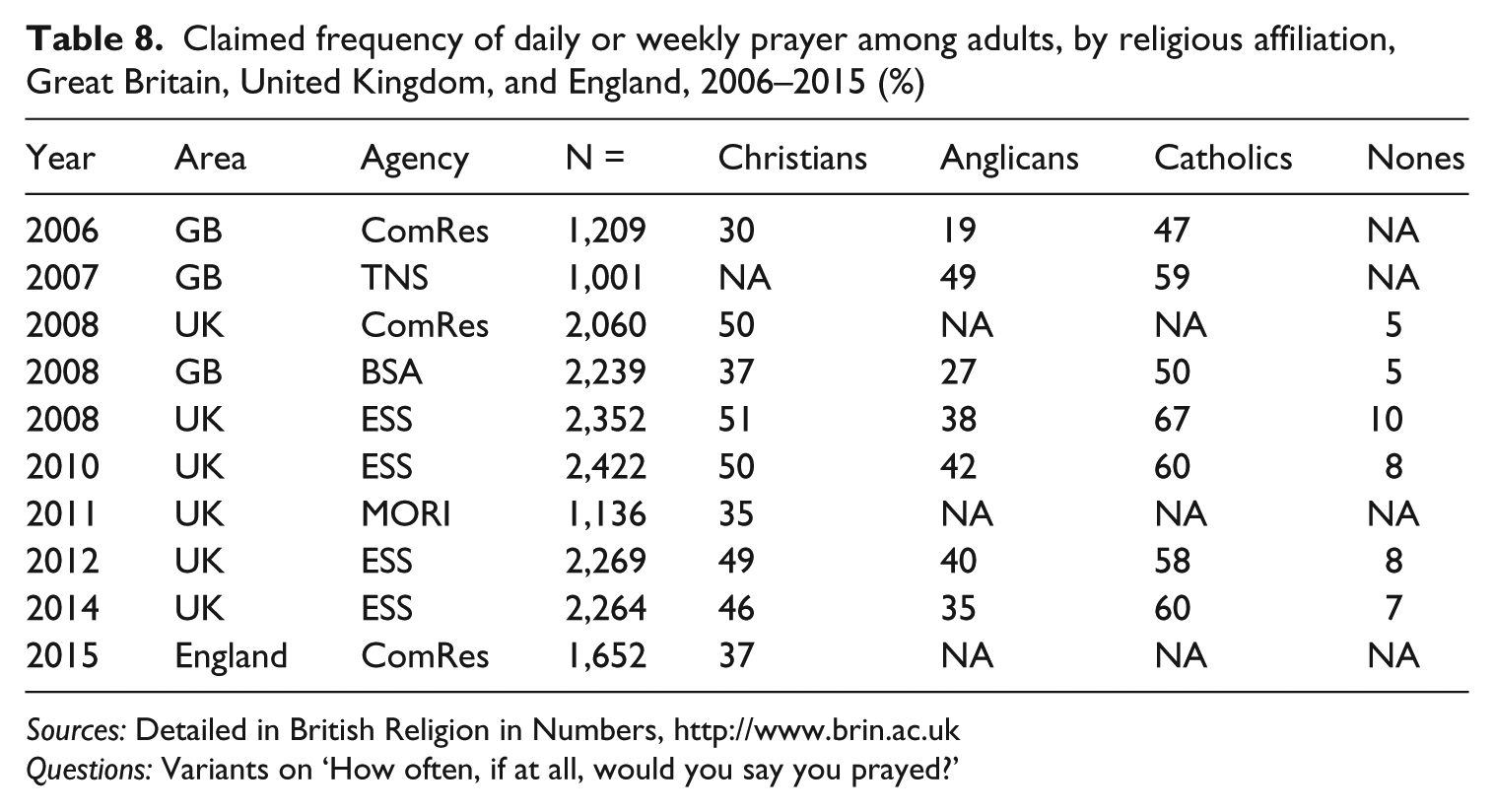
Breaks of prayer frequency by religious affiliation are less common than might have been anticipated, and in most national cross-sections cell sizes are too small to be meaningful for all denominations apart from Anglicans and Catholics (Table 8). Christians overall pray more often on a weekly or more basis than the population as a whole, but it is generally a plurality. The Christian average is depressed by Anglicans (many of whom are nominal in their allegiance) but lifted by Catholics, who are the most devout Christians, one-half or more praying daily or weekly, according to Table 8, albeit three YG polls in 2013 suggested fewer (two-fifths) had prayed within the past month. Catholics have traditionally exhibited a high incidence of daily prayer, one-half in England and Wales and Scotland in two GP surveys in 1977–1978 and two-thirds of Mass-goers in England and Wales in 2008 (Von Hügel Institute). Among non-Christians, at least half of Muslims were found to pray daily by ICM (2004), Populus (2006), and MORI (2009), invariably five times a day; as was the case with Sikhs in the British Sikh Report (2014). Hardly any religious nones pray (Tables 8, 10).
Claimed frequency of daily or weekly prayer among adults, by religious affiliation, Great Britain, United Kingdom, and England, 2006–2015 (%)
Sources: Detailed in British Religion in Numbers, http://www.brin.ac.uk
Questions: Variants on ‘How often, if at all, would you say you prayed?’
Religiosity
People who describe themselves as religious are far more likely to pray than those who do not. This is best illustrated through ESS which enables the occurrence of daily or weekly prayer to be analysed according to a religiosity scale from 0 to 10, somewhat collapsed for present purposes (Table 9). It will be seen that virtually all the very religious engage in regular prayer while practically none of the not at all religious do so. The same effect is not visible when self-assigned spirituality is invoked. For example, in two YG polls in 2013 reported prayer during the previous month was not much more than the average level (of one-fifth) for self-identified spiritual persons, whereas it was three times the mean for those describing themselves as religious or as both religious and spiritual. Therefore, prayer is not a defining characteristic of the much publicized category of ‘spiritual but not religious’ (SBNRs).
Claimed frequency of daily or weekly prayer among adults, by self-assessed religiosity, United Kingdom, European Social Surveys, 2002–2014 (%)
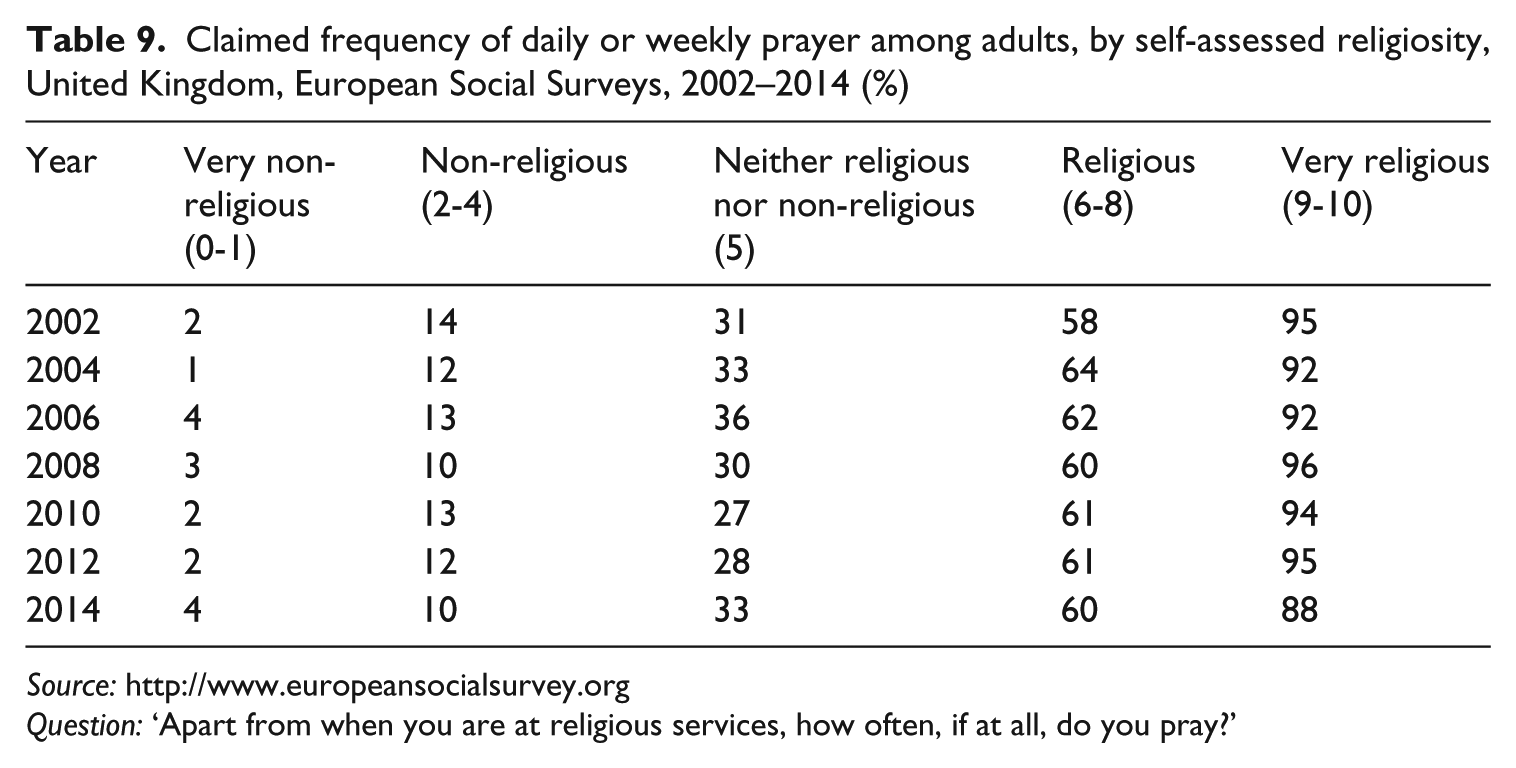
Question: ‘Apart from when you are at religious services, how often, if at all, do you pray?’
Belief in God
People who believe in God are much more likely to pray than disbelievers. In OnePoll’s 2014 survey, 37 percent of believers prayed weekly or more often against just 3 percent of disbelievers. In two YG polls for 2013, 55 percent of definite believers in God or a higher power had prayed during the previous month compared with one in five probable believers (the same as the national average); no definite disbelievers prayed in this period. In another YG poll, in 2015, lack of belief in God was the main reason (given by 51 percent) for not praying.
Religious attendance
Frequency of daily or weekly prayer increases in direct relationship with reported attendance at religious services; the more regular the churchgoing, the more frequent the private prayer. This is especially evident in the ESS series (Table 10) but is also confirmed in non-recurrent surveys such as the 2007 Tearfund study (White et al., 2007), which included a sample of regular (at least monthly) churchgoers as well as a national cross-section. Investigation of prayer among church attenders was pioneered in the 1990s by Leslie Francis and associates in an elusive search for a significant correlation between prayer and personality (Francis, 1996; Francis and Astley, 1996; Francis and Daniel, 1997; Bourke et al., 2002); and by the Teal Trust (Preston, 1999) whose self-selecting respondents were disproportionately Protestant and in church leadership positions, limitations which also restrict the usefulness of more recent online surveys conducted by the Evangelical Alliance (2014: 16–18). Churches Information for Mission adopted a more census-based methodology in 2001 among attenders at services in five mainstream Protestant denominations, asking about time spent in private devotional activities such as prayer, meditation, or reading the Bible alone; 73 percent claimed to engage in these at least weekly, rising to 81 percent among Baptists (Gelder and Escott, 2001: 23). The latest sample survey, by ComRes in England in 2015, ascertained that 98 percent of regular churchgoers pray at least weekly, although this figure included prayer as part of public worship as well as in private.
Claimed frequency of daily or weekly prayer among adults, by religious attendance, Great Britain, European Social Surveys, 2002–2014 (%)
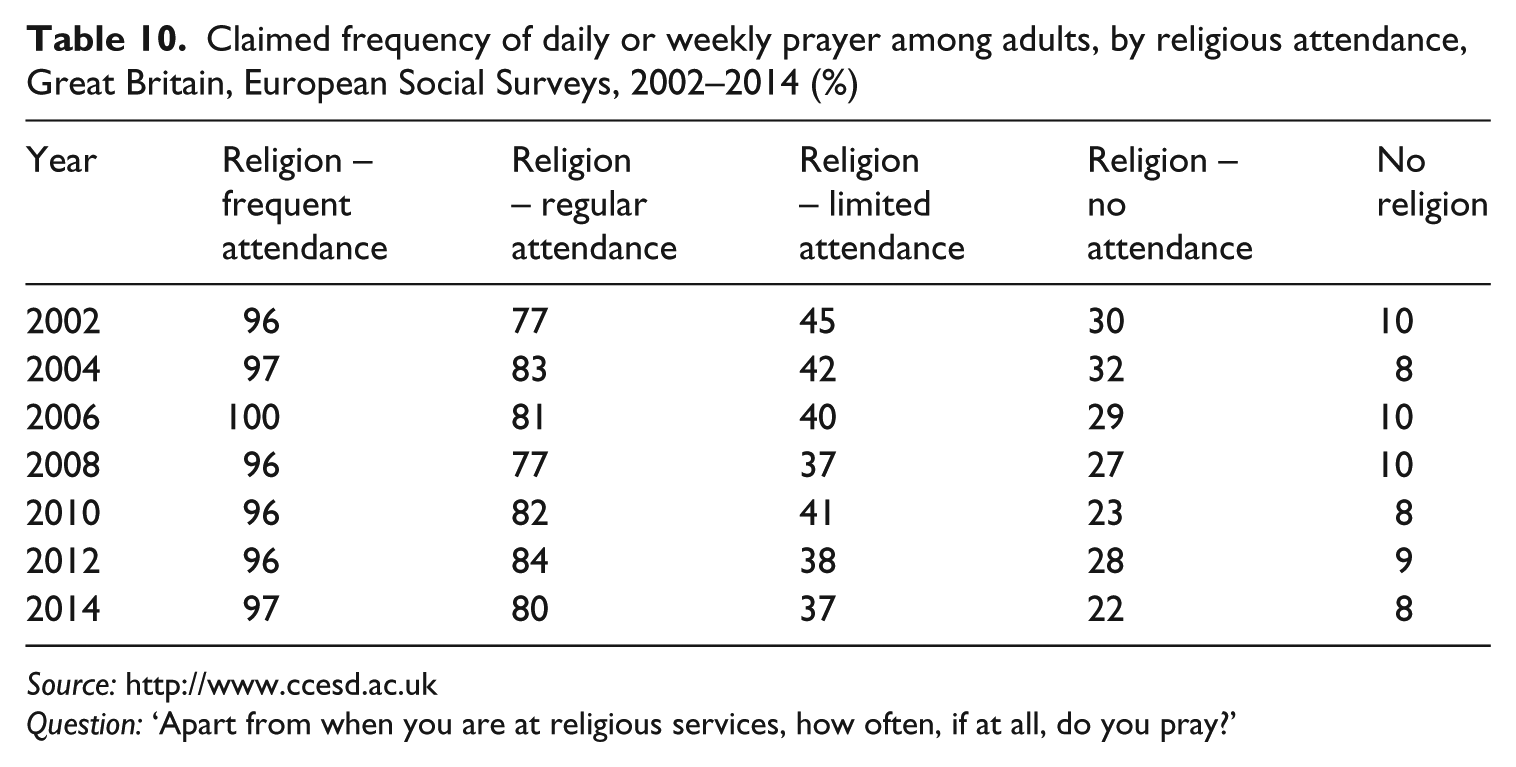
Source: http://www.ccesd.ac.uk
Question: ‘Apart from when you are at religious services, how often, if at all, do you pray?’
Other aspects of prayer
Although prayer frequency has been the principal focus of sample surveys, a few other dimensions of prayer have been illuminated. They by no means constitute a coherent corpus of prayer research but are summarized here for the sake of completeness.
Importance
Relative to other facets of faith, prayer has been deemed of lesser significance. In ORC’s 1968 poll, ‘praying to God’ was judged the most important part of religion by only 12 percent, and in ISR’s 1987 replication it was 11 % on both occasions, ‘what you believe’ and ‘what you do to other people’ were considered far more important. Viewed in isolation, prayer has sometimes been accorded greater significance, with, for example, 62 percent of the community in the Diocese of Carlisle in 1993 agreeing ‘it is important to say my prayers’, 64 percent in Cullompton in 1994, and 53 percent in Greater Manchester and West Bridgford in 2002. Churchgoers naturally returned higher figures, with 47 percent of respondents to the Teal Trust’s 1998 survey describing private prayer as vital and a further 30 percent as important. Nevertheless, by 2007 only 28 percent of a national cross-section by TNS acknowledged personal prayer as very or quite important to them, double the number who said the same thing about meditation; 59 percent stated that prayer was not at all or not very important.
Efficacy
Belief in prayer has declined, from 69 percent in 1950 (GP) to 37 percent in 2004 (YG, a plurality of 47 percent disbelieving). ‘An awareness that you are receiving help in answer to prayer’ was reported by minorities in 1986 (GP, 25 percent), 1989 (GP, 34 percent), and 2000 (ORB, 37 percent), but very few had this experience constantly. According to YG, a similar number of Britons now believe that prayer works (2012, 31 percent) or can be answered (2015, 29 percent) – a huge drop on the 71 percent who informed GP in 1954 that God answers prayer. Slightly more (38 percent) told ComRes (2013) prayer can heal people. Belief in the efficacy of prayer is inevitably higher among those who actually pray (57 percent for TNS in 2007, 60 percent for YG in 2015), albeit TNS found the biggest single impact (80 percent) to be making individuals feel better. It is also higher among regular churchgoers, with majorities in 1993 (MORI), 1998 (Teal Trust), and 2007 (TNS) recording the positive differences made by prayer in their own lives, although 54 percent in 1993 (MORI) recalled an instance when they had prayed without any result.
Subjects
Perceived efficacy of prayer will obviously relate to the subjects of prayer. These were initially investigated by MO in 1944–1945, who noted ‘a tendency to claim to pray unselfishly’, particularly about family and friends. More ‘selfish’ topics, such as ‘for success in one’s job’ (44 percent) and ‘for relief from money problems’ (38 percent) were likewise seen as less appropriate in ORC’s 1968 poll than praying ‘for the life of a sick friend or relative’ or ‘for help for other people’ (84 percent each), or for peace (86 percent), similar results being obtained in 1987 (ISR). In the 2007 Tearfund study, the top subjects were ‘family and friends’ and ‘thanking God’, both for adults who prayed (68 percent and 41 percent, respectively) and for churchgoers (81 percent and 64 percent). The list for praying Britons in 2015 (YG) was headed by ‘for a loved one’ (69 percent), ‘to give thanks’ (56 percent), ‘for help’ (55 percent), and ‘to find peace or calm/to feel less stressed’ (50 percent). Asked hypothetically by ICM in 2012 and 2013 what they might pray for, ‘a family member’, ‘healing for another’, and ‘peace in the world’ scored highly, the second poll causing controversy when the Church of England tried to ‘spin’ its findings to suggest that four-fifths of adults believed in the power of prayer (Field, 2013).
Form
The overwhelming majority of Britons use their own words when praying but about one-third employs set prayers as well, or as an alternative, according to the University of Leeds (1982) and GfK (2007). The Lord’s Prayer remains the most common formulation, 82 percent in England in 1996 (GP) asserting they could recite it as a result of learning it at school, church or Sunday school when a child, or from a parent (in that order of influence). Three-quarters of Britons still claimed to know all the words of the Lord’s Prayer in 2012 (YG), and certainly nine-tenths got the opening right when tested in 2004 (YG).
Time and place
The home had once been the locus for family prayers, whether at mealtimes or otherwise, but the practice had greatly lessened by the post-war period. When MO investigated in 1948, it discovered that 14 percent of households said grace and 9 percent formal prayers. The figure was still 12 percent for regular grace in 2008 (BSA), with a further 13 percent claiming to say it occasionally. Otherwise, the University of Leeds (1982) discovered prayer was a solitary activity which mostly occurred at home, the latter confirmed by GP (1989). Before going to bed was the commonest time of day for saying prayers, according to GP (1989), with 17 percent in 2007 (MORI) always or usually praying before going to sleep and 64 percent never.
Public discourse
On at least three occasions in recent years, prayer has become a matter for public debate in Britain. In 2012 a row broke out about the fairly widespread practice of local councils beginning their formal meetings with prayer, prompting YG to run three polls in quick succession. Although 55 percent personally felt that councils should not hold prayers as part of their meetings, with just 26 percent supportive, all three surveys returned a majority in favour of councils being able to do so, if they wished. The next year, Channel 4 television received a less charitable reaction when it resolved to broadcast the Muslim daily call to prayer (adhan) throughout Ramadan, 52 percent judging the broadcaster wrong against 26 percent who defended it. The broadcast proved the biggest single cause of complaint about Channel 4 for the whole of 2013. The hostile reception, of course, said less about prayer than prevailing public opinion towards Islam. It contrasted with the somewhat more sympathetic, or at least indifferent, response when, in 2015, Digital Cinema Media banned the screening (before the latest Star Wars film) of a Church of England advertisement celebrating the Lord’s Prayer, even though it had been approved by the British Board of Film Classification. According to YG, 35 percent approved of the advertisement, 25 percent disapproved, and 39 percent were neutral.
Conclusion
The article has investigated public reactions to private prayer in modern Britain through a meta-analysis of over-time quantitative data, mostly derived from national cross-sectional sample surveys among adults. This is a difficult subject to research, partly because of the relative paucity of data, especially for the decades immediately following the Second World War, but mainly because it is not amenable to independent scrutiny and is especially susceptible to frequency over-reporting by respondents, not least when prayer solely in moments of crisis (which effectively amounts to never) is counted. There is no standard adjustment which can correct for such overstatement of people’s prayer behaviour and attitudes, and the potential for retrospective exaggeration or prospectively aspirational answers needs to be constantly borne in mind. Nevertheless, a few tentative conclusions can be reached.
Self-reported regular (weekly or more) private prayer has declined from one-half to one-quarter of the population over the past half-century, while the proportion of Britons never praying has risen from one-fifth to one-half. There have been parallel falls in belief in prayer and its efficacy, with prayer tending to be regarded as of lesser importance than other aspects of faith. Gender, age, and ethnicity are the main secular characteristics impacting prayer behaviour, as they do with other religious indicators, although the effects of gender and age appear to be lessening. Relatively higher levels of prayer activity also correlate with above average self-declared religiosity, belief in God, churchgoing and with being Roman Catholic or non-Christian. In comparative terms, Britain comes very far down the international rankings for prayer frequency, although its performance is superior to Scandinavian countries, Communist or ex-Communist states, and those with strong anti-clerical traditions (notably France and Spain).
As one of a balanced basket of 25 KPIs of religious belonging, behaving, and believing, prayer thus testifies to a progressive secularization of Britain occurring during the past half-century. All 25, apart from belief in an afterlife, exhibit over-time decrease relative to population. The pace of decline has been neither even nor consistent across these measures but it has not been sudden. No single period or event, such as the mooted ‘religious crisis’ of the 1960s, appears to have produced an across-the-board sharp spike in secularization. Although, to the consternation of its leading proponent (Bruce, 2011), it may no longer be fashionable to believe in the theory of secularization (or its teleological, causative, explanatory, and predictive properties), its quantitative reality in Britain (both historical and ongoing) seems hard to gainsay, notwithstanding the arguments of British secularization-refuters (Field, 2017: 223–229). Hopefully, we have demonstrated that, with due regard to methodological issues, prayer can be a further lens through which to view secularization as process, and parallel meta-analyses will become available for other countries in due course.
Footnotes
Acknowledgements
The author is indebted to the following individuals who have provided results for particular surveys: Ben Clements (University of Leicester), Jacob Poushter (Pew Research Center), and Primavera Quantrill (SPCK). Pew and SPCK further gave permission to use the 2015 data which they commissioned. Dr Clements also read and commented upon an earlier version of this article and made helpful suggestions, as, indeed, did this journal’s two anonymous reviewers.
Funding
This research received no specific grant from any funding agency in the public, commercial or not-for-profit sectors.
Notes
Author biography
Address: 35 Elvetham Road, Edgbaston, Birmingham, B15 2LZ, UK
Email: