




Abstract
This article deals with the recently revealed paradox that contemporary Muslims score higher on Protestant work ethic than contemporary Protestants. The author tests whether this phenomenon is supported by World Values Survey (WVS) data. According to Inglehart’s theory of post-materialist shift, work ethic should be stronger in the developing societies where there is a lack of existential security. The author also tests whether the effects of the Protestant work ethic extend beyond the religious population of Protestant countries. The multilevel models built on 25,437 respondents in 55 countries show no significant difference in work ethic between Muslims and Protestants. Living in a historically Protestant society does not increase work ethic, but being religious in a Protestant society does. As countries develop, work ethic is likely to decrease. This poses further questions about the universal features of religious ethics and the non-religious factors explaining the economic progress associated with the Protestant work ethic.
Introduction
The concept of work ethic refers to ‘commitment to the value and importance of hard work’ (Miller et al., 2001: 2). Work ethic can also be defined as a sum of ‘beliefs about the moral superiority of hard work over leisure or idleness, craft pride over carelessness, sacrifice over profligacy, earned over unearned income and positives over negatives towards work’ (Andrisani and Parnes, 1983: 104), which reaches ‘the complete and relentless devotion to one’s economic role on earth’ (Lessnoff, 1994). In sociology, work ethic research started with Weber’s ground-breaking (1958) work on the Protestant work ethic (PWE), understood as a driving force for industrialization, economic growth and capitalism development in north-western Europe and North America. Since 1904–1905, when The Protestant ethic and the spirit of capitalism was composed, the PWE hypothesis has been tested in ‘endless exegesis’ (Delacroix and Nielsen, 2001: 509) against national, cross-national and subnational samples (see Becker and Woessmann, 2009; Hayward and Kemmelmeier, 2011). The results were mixed; some studies supported the hypothesis and some rejected it (cf. Arslan, 2001: 324; Hayward and Kemmelmeier, 2011: 1417). However, the PWE started to be commonly used in the literature to explain the economic success of Protestant countries solely by the religious affiliation of their citizens.
There are doubts whether the PWE is a genuinely Protestant phenomenon or whether it has become something universally shared (Modrack, 2008: 7). According to some authors, a common interpretation of the PWE thesis has developed, which says that ‘the rise of industrial capitalism was facilitated in predominantly Protestant countries and occurred earlier there as a consequence [of Protestantism]’ (Delacroix and Nielsen, 2001: 510). However, the common interpretation is not well supported by data. One of the alternative explanations of the economic success among Protestants is the growth of literacy and education as a key factor promoting social capital (Becker and Woessmann, 2009). In Weber’s theory, literacy and the PWE were linked. In empirical research, there is debate concerning the priority of factors and the relations between those parts of the PWE hypothesis.
Several authors follow Weber (1958: 181) in saying that work ethic has ‘escaped from the cage’, meaning that it is ‘no longer Protestant’ (Norris and Inglehart, 2011: 169; Ray 1982: 135). According to them, Protestantism may foster economic values associated with capitalism not as ‘personal piety, churchgoing habits, and adherence to the Protestant work ethic’ but as a cultural ethos affecting believers and non-believers alike (Norris and Inglehart, 2011: 161). This position is supported by studies reporting that Protestantism as a culture positively affects the economic well-being of individuals, but that there is no similar effect due to being a religious Protestant (Hayward and Kemmelmeier, 2011).
Along these lines, Weber notes that the cultural consequences of Protestantism were to a great extent unforeseen and that they could stand in contradiction to the initial aims of Church reformers (Weber, 1958: 27), even though the ideas at the heart of the PWE focused on ‘earning more and more money, combined with the strict avoidance of all spontaneous enjoyment of life’ (Weber, 1958: 53). In theory, a strong work ethic does not by itself translate into economic prosperity. This corresponds to the fact that work ethic is strong in many developing countries (McCleary and Barro, 2006). To cause economic growth, work ethic should be able to facilitate both the search for profit and the rise of literacy among believers (Becker and Woessmann, 2009: 582).
In practice, some studies show that ‘when values are measured properly, the Weber thesis is confirmed by the data’ (Van Hoorn and Maseland, 2008: 4) and that people in historically Protestant societies tend to have a strong work ethic (Hayward and Kemmelmeier, 2011: 1412). In other studies the conclusion is that contemporary Protestant societies put less value on work ethic than contemporary Muslim societies. Norris and Inglehart (2011: 169) argue that ‘any historical legacy, if it did exist in earlier eras, appears to have been dissipated by processes of development’. Some other studies show that today, people in Protestant countries believe less than in other countries that hard work brings success in life (Arslan, 2001; Furnham et al., 1993).
The original PWE hypothesis compared the ideas of the Reformation and the Catholic tradition (Delacroix and Nielsen, 2001: 512; Weber, 1958). In this article I investigate a less explored aspect – the comparative work ethic between Muslims and Protestants. The research problem is whether contemporary Muslims embody the features of the Protestant work ethic more than contemporary Protestants do. On the one hand, the influential study on the WVS data by Norris and Inglehart (2011) came to a positive answer to this question, but their analysis was based on OLS regressions, which as a method may exaggerate the impact of social factors over individual factors (Raudenbush and Bryk, 2002: 137–138). On the other hand, a later multilevel study on waves 2–5 of the WVS showed that respondents in Protestant countries still tended to support pro-capitalist values, despite the decreased religiosity and post-materialist value shift (Hayward and Kemmelmeier, 2011: 1417).
Weber’s ideas have been extended to conceptualize an Islamic analogue in order to explain economic behaviour in Islamic countries (Ahmad and Owoyemi, 2012; Ali, 1988; Awan and Akram, 2012; Delacroix and Nielsen, 2001: 512). The Islamic work ethic (IWE) is in several ways similar to the PWE, focusing on hard work and commitment to it (Modrack, 2008: 8). However, the IWE also emphasizes cooperation in work and stresses not individual achievement but the good of the community (Ali, 1988: 577; Modrack, 2008: 8).
Another factor in the comparison between Protestants and Muslims is the post-materialist value shift and its effect on work ethic. In the literature, the alleged decline of the PWE in north-western Europe and North America is linked to the increasing security of living achieved in highly developed countries and a growing demand for non-materialist qualities in work there (Inglehart, 1997: 28). Once the individual’s survival is guaranteed by the welfare state, post-materialist values gain strength, promoting the individual’s self-realization and subjective well-being (Inglehart, 1997: 76). In developing countries, the traditional work ethic remains strong, as it is believed to directly boost the individual’s wealth and living conditions.
The rest of this article is structured as follows. First, common and specific features of the Islamic and Protestant work ethics are outlined. Second, the research hypotheses are presented. Third, I explain the sample, variables and methods used. In the last part, I present the results and discuss them with reference to individual and social factors of a socio-economic and religious nature.
Islamic and Protestant work ethics
Historically, the PWE was compared with the Catholic, not Islamic, work ethic, even though Weber compared Islam to Calvinism in his work (Sukidi, 2006). The purpose of this section is to compare the PWE and IWE so as to shed light on what ‘work ethic’ implies in these two religions.
The following components of the PWE have been defined in the literature: hard work, careful use of time, leisure avoidance, asceticism, personal honesty and faith in the reward of a just God after life (Furnham, 1990; Jones, 1997). After analysing seven available scales, Furnham (1990) came to the conclusion that the PWE consisted of five dimensions: belief in hard work, leisure avoidance (neglecting pleasures), religious and moral beliefs, independence from others, and asceticism. These dimensions were criticized for the inclusion of ‘moral and religious beliefs’, thereby departing from Weber’s original thesis (Modrack, 2008: 5); as a result, four basic dimensions of the PWE were left: belief in hard work, leisure avoidance, independence from others, and asceticism. These dimensions at least partly overlap with the Islamic work ethic. Both the PWE and IWE contain values that could be claimed to be universal to work ethic, such as praising hard work and honesty or blaming laziness (Modrack, 2008: 7; Rice, 1999: 349).
The existence of an IWE was proposed to explain the spiritual roots of economic behaviour and values of Muslim believers (Ahmad and Owoyemi, 2012; Ali, 1988; Awan and Akram, 2012) in line with the conjecture of Confucian (Lim, 2003; Williams and Sandler, 1995), Orthodox (Zabaev, 2007–2008) and other versions of religious ethic. The concept of the IWE is particularly attractive for investigation. On the one hand, the importance of work is high in modernizing economies, many of which are predominantly Islamic. On the other hand, Islam is popular across the world and in regions with a varying degree of prosperity. For many years, economists have been tackling the puzzle as to why Islamic countries have not rapidly modernized in the last 50 years, given that Islamic doctrine as such is not opposed to economic progress (Kumar and Rose, 2009; Kuran, 1997: 58; McCleary and Barro, 2006: 69–70; Rodinson, 1966; Wang and Yang, 2011). Other popular concepts proposed to explain the economic trajectories of Islamic countries by the religion-driven ‘moral filter’ (Rice, 1999: 346) are the ‘Islamic finance’ that prohibits interest rates, sharing risks, gambling, etc. (Iqbal, 1997; Warde, 2000) and ‘Islamic marketing’ as a form of ethno-consumerism (Sandikci, 2011). The IWE has been tested on several samples: in Egypt (El-Kot and Burke, 2014), Iran (Chanzanagh and Akbarnejad, 2011), Malaysia (Ahmad and Owoyemi, 2012) and the United Arab Emirates (Yousef, 2000).
The principles of the IWE are based on the Qur’an and Sunnah, the core of Islamic studies today. A scale of the IWE was first proposed by Ali (1988), and its principles have been summarised by several authors (Ahmad and Owoyemi, 2012; Ali, 1988; Ali and Al-Owaihan, 2008) in terms of a number of domains (see Table 1).
Domains of Islamic work ethic.
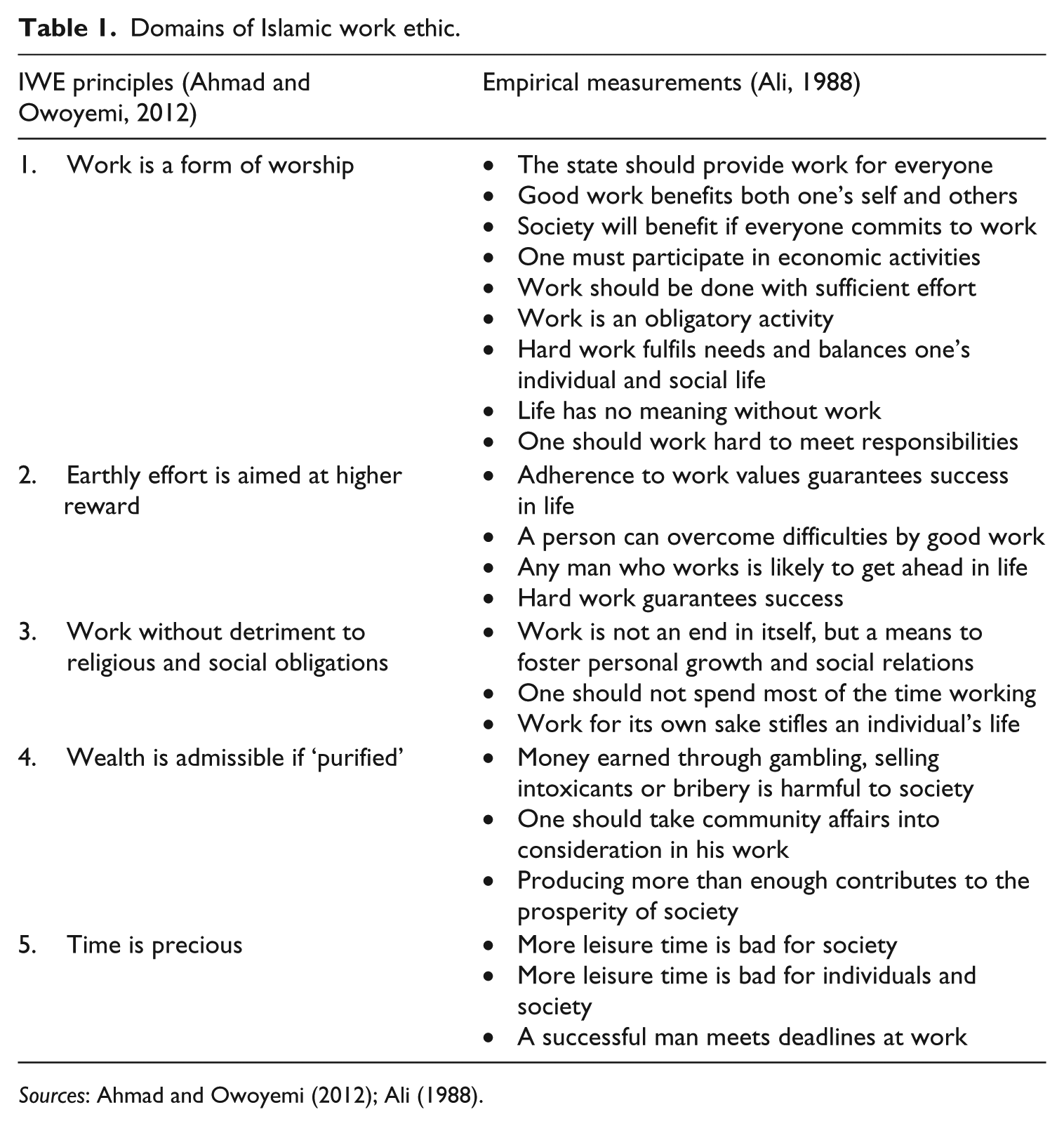
Sources: Ahmad and Owoyemi (2012); Ali (1988).
According to some authors, Islam focuses more than Protestantism on religious practice and community life and less on the abstract moral principles of the work ethic (Susokolov, 2009: 38–41). Others, in contrast, explicitly liken the Islamic ethos to the Protestant ethic (Warde, 2000: 45–46). In fact, many principles are comparable. As in the Protestant ethic, time is highly valued in the IWE, and believers should not waste it. When earned by hard work, leisure is also considered good (Ahmad and Owoyemi, 2012: 121). Personal qualities praised in both the IWE and the PWE are honesty, diligence, sincerity and the pursuit of perfection. Condemned are laziness and work for the sake of pride or boasting. However, work in Islam is also considered a source of self-respect and independence.
There are also differences between the IWE and the PWE. A specific feature of the IWE is the position of work among other responsibilities: ‘a third of their day [should be devoted] to work, a third to sleep and rest and a third to prayer, leisure and family and social activities’ (Ahmad and Owoyemi, 2012: 122). Wealth is welcome on condition that the solidarity tax is paid, no moral rules have been broken and the circulation of wealth is not stopped (Rice, 1999: 348). Living on rent is allowed, but the money should be spent or reinvested, not accumulated. In contrast to the PWE, the IWE includes a demand for cooperation and collaboration at work (Rice, 1999: 350–351). In addition, work intentions are important, i.e. being just to other members of the religious community (Chanzanagh and Akbarnejad, 2011: 918–919).
In general, Islam, like Protestantism, promotes hard work as a form of religious worship, which should either lead to a greater reward after life (IWE) or serve as a means of obtaining the certainty of salvation (PWE). Both religions emphasize the value of time, blame laziness and explain poverty as ‘almost disbelief’ (Islam) or ‘lack of mercy’ (Protestantism). However, excessive accumulation of wealth is condemned in the IWE if it is not purified by social commitment. Work in Islam should be balanced with religious and social activities, which contrasts with the Protestant idea of vocation. In the PWE, ‘the Calvinist, as it is sometimes put, himself creates his own [conviction of] salvation’ through asceticism and systematic self-control, which are the only means of attaining certainty of grace (Weber, 1958: 115). The IWE, in contrast, promotes hard work as a means to fulfil the individual’s needs and to benefit the community.
Hypotheses
My hypotheses are based on the theory of a post-materialist value shift (Inglehart, 1997). Post-materialist values – the priority of self-realization and participating in public life over physical and economic security – reflect the transition from industrial to post-industrial society and an increasing quality of life (Inglehart, 1997: 223–224). Conservative values of hard work are more likely to be supported in developing countries where religion is a common source of security. It should be noted in this respect that Islam is more conservative than Christianity as far as social issues are concerned (Alexander and Welzel, 2011; Furnham et al., 1993: 193). To control for the level of country development (and the affluence of many Protestant societies), one can use the Human Development Index (HDI), which includes not only gross national income, but also literacy and life expectancy. Therefore, two hypotheses can be proposed:
H1: Muslims are more likely to demonstrate a stronger work ethic than Protestants;
H2: Both Muslims’ and Protestants’ work ethic will be lower in countries with a higher HDI.
A rival hypothesis comes from Weber’s idea that the development of capitalism was facilitated by the cultural effect of Protestantism while pro-capitalist individuals could be not religious at all and the successful pursuit of wealth was becoming ‘associated with purely mundane passions’ (Weber, 1958: 182). Therefore:
H3: In historically Protestant societies, both religious and non-religious people will demonstrate a stronger work ethic than in other societies.
Data and methods
This study uses data from waves 4 and 5 (1999–2000 and 2005–2008) of the World Values Survey’s 5-wave aggregated data file (World Values Survey, 2009). This file contains data from 144,054 respondents from 75 countries across all continents, from the poorest to the richest countries. In addition to the European countries represented in the European Values Study and European Social Survey, the WVS covers many Islamic countries. 1 I use two waves of the WVS since such a design provides additional countries to the sample. As a rather stable phenomenon, work ethic is believed not to change significantly over the decade between two waves. Respondents’ data was chosen for analysis according to two criteria: first, that their religious denomination was either Muslim or Protestant; second, that they had answered the question whether work is as a duty to society.
Every person who had answered this question and declared their identification as Muslim or Protestant was included in the sample, regardless of their being ‘religious’ or not (this was a separate control question). Types of religious behaviour were not distinguished, because they vary across religions and lie out of the focus of this paper. Due to missing values, some countries had to be excluded from the sample (see Appendix). In the case of two available indicators of education, income or social class, I used the one with fewer missing values. Individual cases with missing variables were also deleted. The resulting sample includes 25,437 respondents from 55 countries; 30% of the outcome data comes from wave 4 and 70% from wave 5. Among the respondents, 61% were Muslims and 39% Protestants (see Table 2).
Descriptive statistics of the outcome sample (n=25,437).
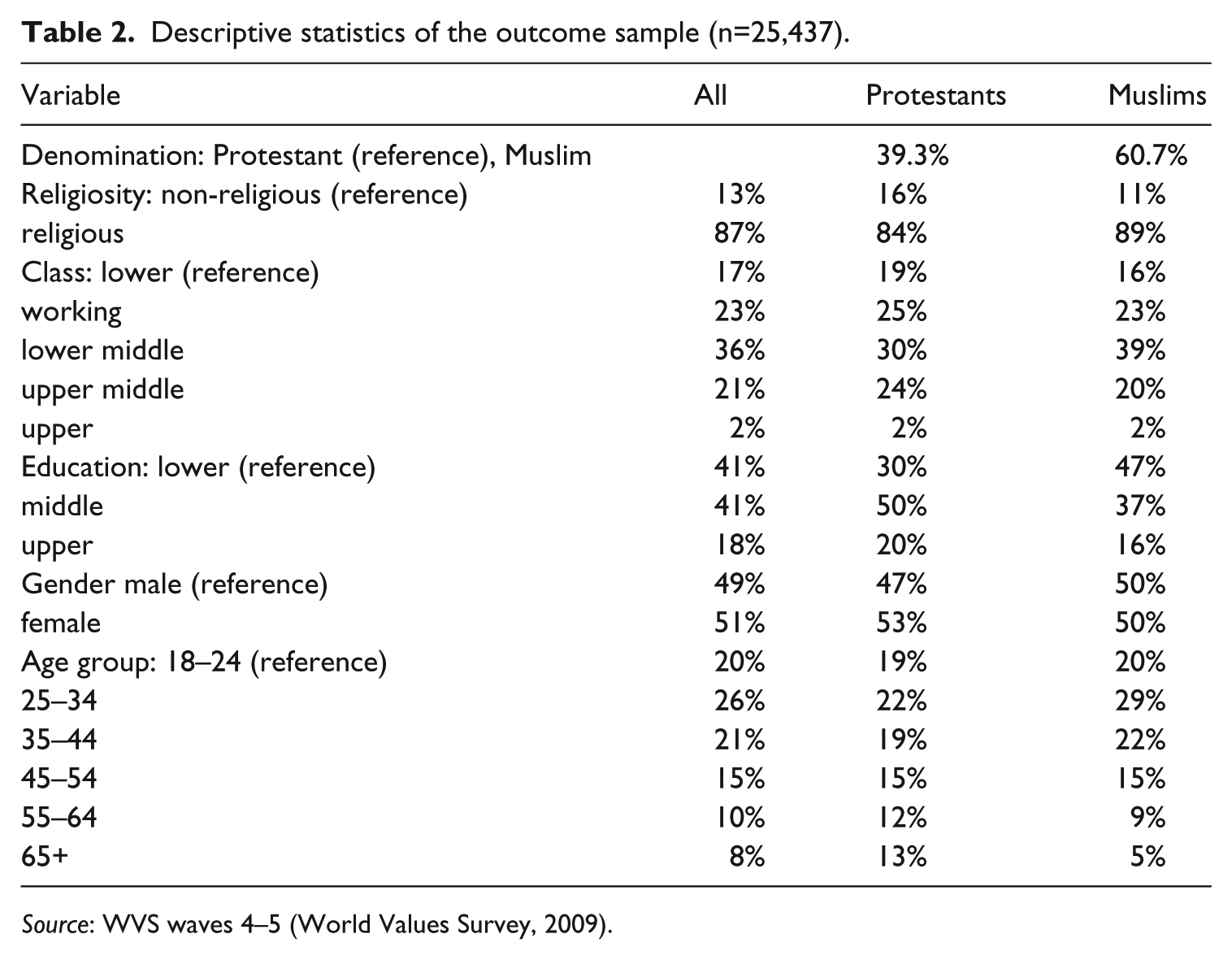
Source: WVS waves 4–5 (World Values Survey, 2009).
A limitation of this sample is that neither Protestants nor Muslims are monolithic religious groups. Most Muslims are Sunni (87%); 13% are Shia (Hackett et al., 2012). Protestants also consist of different groups. For this analysis, respondents who stated their religion as anything other than ‘Muslim’ or ‘Protestant’ (e.g. ‘Shia’, ‘Sunni’, ‘Evangelical’, ‘Lutheran’ or ‘Anglican’) were excluded from the sample.
The dependent variable is a measure of the work ethic ‘Work is a duty to society’, initially designed to measure the PWE (Norris and Inglehart, 2011). This question is the key measure among all the WVS measures of work ethic, as shown by confirmatory factor analysis (Duelmer, 2011). The ‘work as a duty’ variable is a 5-point scale measure ranging from 1 ‘Agree completely’ to 5 ‘Completely disagree’; here it was inverted and rescaled from 0 to 4, where 4 was ‘Agree completely’. The majority of respondents chose ‘Agree’ or ‘Agree completely’, with a mean = 3.09 (SD = .96). To overcome the problems of non-normal distribution, I recoded the variable as a 0–2 scale where 0 meant ‘Agree completely’ (39%), 1 ‘Agree’ (42%), and 2 ‘Disagree or Don’t know’ (19%) (see Figure 1).
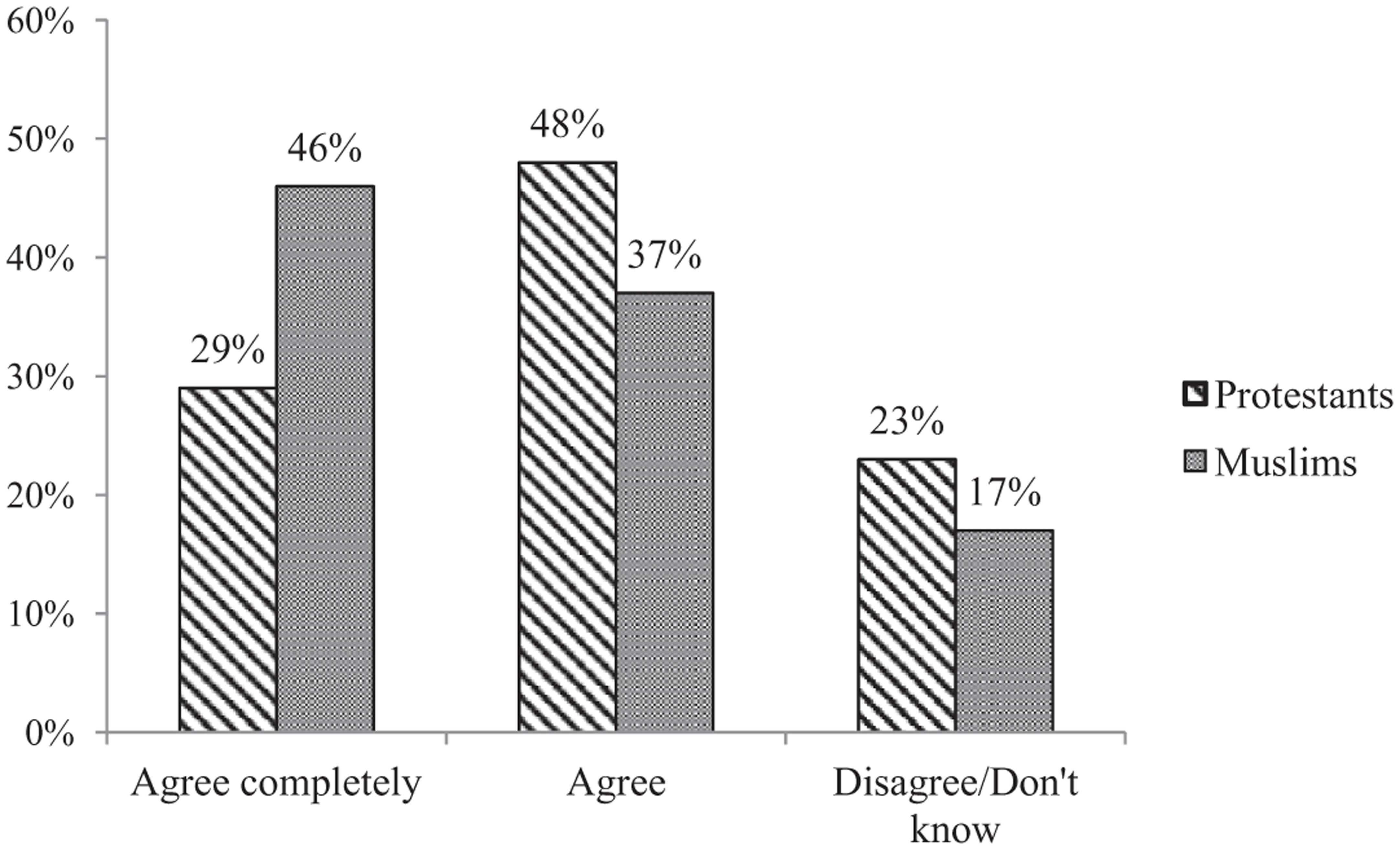
Work is a duty to society, recoded, among Protestants and Muslims.
The independent variables on the individual level (level 1) are religious denomination and personal religiosity. Since hypothesis 1 refers to a comparison between Protestants and Muslims, only these two categories are important. I recoded religious denomination into a dummy variable, with Protestants as the reference category. Following previous research on work ethic in the WVS (Duelmer, 2011), I picked the self-categorization variable as an informative indicator of the religiosity of the respondent. I recoded the original three categories: ‘A religious person’ (87%), ‘A non-religious person’ (12%) and ‘A convinced atheist’ (<1%) into a dichotomous variable (see Table 2 above).
On the country level (level 2), two variables are important. First is the type of religious culture as defined by Norris and Inglehart (2011). The authors distinguish five types: Protestant, Catholic, Orthodox, Muslim and Eastern. All the countries are classified according to these types (see Appendix). This variable accounts for the cultural effect of religion on all the people inhabiting the country. Second is the HDI introduced in order to account for country development. In developed societies, defined as those having an HDI of .900 or higher (Duelmer, 2011: 321), work is treated as a source of self-realization and less as a duty. HDI levels are strongly correlated across years. I use the figures for 2012 (see Appendix).
Control variables are traditional in work ethic research (Becker and Woessmann, 2009; Duelmer, 2011; Hayward and Kemmelmeier, 2011; Norris and Inglehart, 2011) and include the individual’s gender, age, social class and education. The interaction effects of these variables with level-2 variables may be significant, but they lie out of the scope of this research.
Since both individual and societal factors affect an individual’s work ethic, it would be incorrect to apply OLS regressions, which may lead to the erroneous rejection of the null-hypothesis (Duelmer, 2011: 337). Neither countries nor individuals are completely independent; in such a situation, multilevel analysis offers a viable alternative.
For the ordinal response variable of K categories, logistic regression is used and the model has K-1 thresholds (δ’s). This model estimates logit predictions (η) for the K-1 comparative probabilities (k) of the response being at or below a given category for specific individuals (i) in specific groups (j) (O’Connell, 2010). Fixed effects in logistic regression estimate the logit of probability that an individual’s work ethic will be below or equal to each category (strong or weak work ethic). A logit of zero corresponds to the odds ratio of 1 (no effect); a positive logit means here a higher probability of a strong work ethic; a negative logit means a lower likelihood of a strong work ethic. In the ordinal response models, proportional odds are most often assumed, i.e. the slope is constant at thresholds for each level-2 group but the intercept is unique (O’Connell, 2010). To get from logit to the predicted probability πkij, the following formula is used:

where ηkij is equal to ln [ P(Rij <=k)/ P(Rij >k) ] (O’Connell, 2010)
Next, hypothesis 2 was tested by looking at the interaction of the effects of HDI and religion. Last, to test hypothesis 3, I compared the effect of cultural Protestantism on the individual’s work ethic as moderated by the religious self-categorization of the respondent.
Findings
The models were constructed in a similar way. First, I fit the null model, the analysis of variance of ‘work as a duty’, which shows the size of between-country variance and serves as a benchmark for comparison with multilevel models. 2 Then, I added independent variables and controls with random coefficients. If the chi-squares for the effects are insignificant, non-significant variance components are dropped. Last, the types of religious culture were introduced, to compare the effect of cultural Protestantism on the individual’s work ethic as moderated by the religious self-categorization of the respondent (for the types of religious culture by country, see Appendix). The results of this analysis are provided in Table 3.
Work ethic among Muslims and Protestants (multilevel analysis).
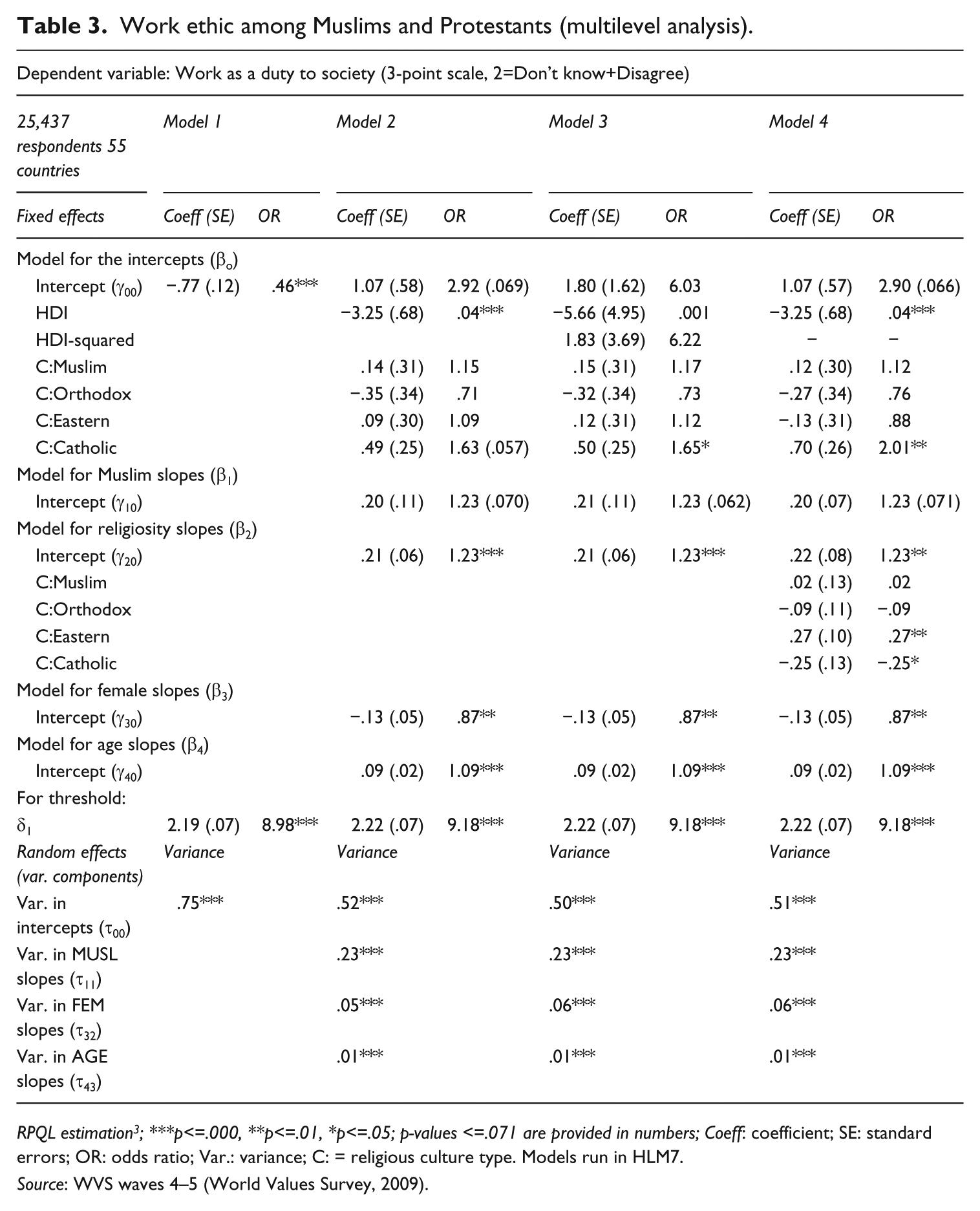
RPQL estimation 3 ; ***p<=.000, **p<=.01, *p<=.05; p-values <=.071 are provided in numbers; Coeff: coefficient; SE: standard errors; OR: odds ratio; Var.: variance; C: = religious culture type. Models run in HLM7.
Source: WVS waves 4–5 (World Values Survey, 2009).
Fixed effects in Model 1 can be used to estimate probability predictions that a respondent will score at or below level 1 (all responses will necessarily be at or below level 2=‘Disagree/Don’t know’). A logit of –.77 corresponds to a lower probability of having a strong or very strong work ethic. With no explanatory variables in the model, the average cumulative logit prediction for R ij <=0 is -.77 and it increases across the threshold to -.77+ 2.19 = 1.42 for R ij <=1. Transforming these predicted cumulative logits to cumulative probabilities along equation (1), we get P (R ij <=0) = .32 and P (R ij <=1) = .81, which corresponds to the proportion of people agreeing that work is a duty to society. There is also substantial variance between the countries in the logits estimated in this model (τ00 = .75, p<=.000).
In Model 2, the individual-level effect of being Muslim and the country-level effect of religious cultures were not statistically significant. The lower the HDI, the more likely individuals are to have a strong work ethic. Personal religiosity matters and it has the same positive effect across countries. Age and gender have different effects across countries. Education levels and social class were not statistically significant.
In Model 3 HDI-squared is added to the equation. Its effect is not significant and the effect of HDI is non-significant either. The effect of being Muslim (as opposed to being Protestant) is non-significant but the effect of Catholic culture (as opposed to Protestant culture) is significant, i.e. Muslims and Protestants living in historically Catholic countries are more likely to have a stronger work ethic, all else being equal.
Model 4 presents the results of the interaction between being religious in various religious cultures. The main effect of being religious remains significant in interaction, which means that in historically Protestant societies (reference category) religious people are more likely to believe in hard work than non-religious ones. The interaction effects are statistically significant for being religious in Eastern cultures (this includes Buddhism, Confucianism, Hinduism, etc.) and in Catholic cultures. However, if in Eastern cultures religious people are more likely to believe in hard work (which may be a contextual, regional effect), in Catholic cultures both religious (+.70) and non-religious Muslims and Protestants (.70+(-.25)=.45) are likely to have a strong work ethic. The effects of Eastern and Catholic cultures may be due to the selection of countries in the sample.
Discussion
This article investigated the reported paradox that historical Protestants today have a lower work ethic than Muslims. From previous studies it was unclear whether modern-day believers have a higher work ethic because of their religious beliefs or because of economic insecurity. This study tested three hypotheses on work ethic among modern-day Muslims and Protestants living in 55 countries.
The first hypothesis was that Muslims were more likely to have a higher work ethic than Protestants. From Table 3 we see that the effect of being Muslim, although directed towards a higher probability of a strong work ethic, does not reach statistical significance in all three of the relevant models. Thus, there is no significant evidence of a stronger work ethic among Muslims in this sample. More comparative data are required to verify this conclusion.
The second hypothesis supposed that both Muslims’ and Protestants’ work ethic would be lower in countries with a higher HDI. The models provide support for this; both for Muslims and Protestants, a higher HDI leads to a significantly lower probability of demonstrating a strong work ethic. The interaction between being Muslim and HDI level was not, however, statistically significant; i.e. for an average Muslim or Protestant, living in a developed country is likely to result in a weaker work ethic if it is understood as ‘a duty to society’.
The third hypothesis linked historically Protestant societies with the idea of the PWE spreading its influence among both the religious and the non-religious population. Contrary to expectations, religious people in historically Protestant societies in this sample demonstrate a higher probability of a strong work ethic. Moreover, non-religious Protestants are statistically not different from religious Muslims or Orthodox believers in the probability of having a strong work ethic.
These findings are open to various interpretations. For example, it might be concluded that hard work bears a religious value for Muslims since good work is believed to be rewarded ‘in the hereafter’. McCleary and Barro (2006: 53) point out that the pleasures of heaven and the suffering of hell are depicted in more graphic detail in Islam than in Christianity, which makes them ‘quite real for the believer’. Alternatively, a lower work ethic among non-religious Protestants could be explained not only as a search for self-realization in work (Inglehart, 1997), but also as a lower marginal preference for working harder as compared to the present state (Van Hoorn and Maseland, 2008: 8).
Religious belief is a major source of a sense of security because traditional religions emphasise the importance of hard work as a way to survive in an unsafe world. In post-industrial societies, the welfare state steps in, new values of self-realization come into play, and work as a duty to society, with its ‘collectivist imprint’ (Duelmer, 2011: 337), loses its general appeal. Thus, the role of work ethic as promoted by religions is different in traditional and modernised societies.
An important question in this context is whether there is a gap between the discourse and the behaviour of modern Muslims, as is suggested by other research. Does the existence of the concept of an ‘Islamic work ethic’ in itself affect the attitudes to work ethic of Muslim respondents? As noted by Kuran, proponents of the view that the Islamic ethic bears no relation to economic success refer to the fact that ‘widely held Islamic precepts were often circumvented’ and that there is a ‘well-documented divergence between word and deed’ (Kuran, 1997: 67). Sandikci (2011: 254) points out that ‘while ethical and religious principles seem to be articulated loudly by Muslim business owners, to what extent words and deeds correspond needs to be empirically assessed’. Likewise, Warde (2000: 156–157) points to numerous ‘moral hazards’ impinging on Islamic finance rules. Various scholars admit that the gap between discourse and economic behaviour can be wide enough for individuals to circumvent rigorous Islamic ethical demands.
The results show that the likelihood of having a high work ethic is statistically the same among contemporary Muslims and Protestants, all else being equal. On average, country development affects work ethic to a much greater extent than any type of religious culture or Muslim/Protestant identity. However, being religious still matters for work ethic in our times; this study indicates that religiosity is significantly correlated with a strong work ethic among Protestants, but not among Muslims.
The prospects for further research lie in different directions. First, since religiosity is still positively linked with work ethic, its determinants can be studied in detail for major denominations, taking into account the level of country development and the religious behaviour of individuals. Second, the analysis presented here could be replicated on a bigger sample including more categories of Protestants (e.g. Lutherans, Anglicans). Third, identification of the determinants of work ethic would benefit from a more representative sample of countries across the world. The sample of this study covered 55 countries; a more inclusive representation of world regions might contribute to obtaining robust results with relevant contextual variables.
Footnotes
Appendix
Acknowledgements
I am grateful to Eduard D Ponarin, Elena Prutskova, Vladimir Kozlov and other members of the Laboratory for Comparative Social Research (National Research University Higher School of Economics, Moscow and Saint-Petersburg) for their comments. I would also like to thank the two anonymous reviewers for their comments and suggestions. Any opinions or claims contained in this article do not necessarily reflect the views of the National Research University Higher School of Economics.
Funding
This article is the result of a research project implemented at the Laboratory for Comparative Social Research, National Research University Higher School of Economics; it was prepared within the framework of a subsidy granted to the National Research University Higher School of Economics by the Government of the Russian Federation for the implementation of the Global Competitiveness Program.
Notes
Biography
Address: Laboratory for Comparative Social Research, Higher School of Economics, Myasnitskaya, 22-510, Moscow, 101000, Russia
Email:
References
Supplementary Material
Please find the following supplemental material available below.
For Open Access articles published under a Creative Commons License, all supplemental material carries the same license as the article it is associated with.
For non-Open Access articles published, all supplemental material carries a non-exclusive license, and permission requests for re-use of supplemental material or any part of supplemental material shall be sent directly to the copyright owner as specified in the copyright notice associated with the article.
