




Abstract
Drawing on participant observation, pastor interviews, congregant focus groups, and the website content of an emerging congregation in Seattle, this article explores the ECM (Emerging Church Movement) as a religious subcultural movement utilizing Smith et al.’s (1998) subcultural identity theory. The study views the ECM movement as a unique religious subculture and locates it along the two dimensions of distinctiveness and engagement. The results of the field research indicate that the ECM as a subcultural religious movement is both disengaged from the dominant society and indistinct from other religious subcultures. The implications of these findings for the future directions of the movement are discussed.
‘I have a big view of God. I prefer to use expansive language instead of inclusive. Inclusive implies there is something left out, something wrong. I also don’t see the sacred/secular divide … there are not two worlds.’ (Apostles’ Abbess, personal interview)
Introduction
The Emerging Church Movement (ECM) has received a lot of attention recently. It has been hailed as both the future of Christianity and an indication of Christian decline. The ECM is known for its young congregants (20s–30s), its innovative worship practices, effective incorporation of technology, irreverence, and ease with popular culture (Wollschleger, 2012). The roots of the ECM in the US can be traced back to the Gen-X churches of the late 1980s and the ‘church within a church’ model used by megachurches in the early 1990s to reach youth and young adults (Gibbs and Bolger, 2005; Wollschleger and Killian, 2014). There is broad agreement that the ECM grew out of the efforts of existing Evangelical churches and denominations to reach out to younger populations (Kimball, 2003; Gibbs and Bolger, 2005; Jones, 2008) through either special youth ministries or generational churches, but it was not until the late 1990s that the emerging church as a movement coalesced as a result of a conference of young church leaders hosted by the Leadership Network (Gibbs and Bolger, 2005; Driscoll, 2006; Jones, 2008). This conference created the ‘conversation’ that has evolved into the Emerging Church Movement. Given the nature of the movement and how it has spread, it is not possible to provide an accurate figure for the number of ECM congregations (see Wollschleger, 2012, for a discussion of this). However, some scholars have offered helpful estimates. Bielo (2011) finds that there are over 700 communities in the US alone, and Packard (2012) notes that there are local Emergent Village communities/networks – online communities of people interested in and involved in the ECM that are help to organize followers and diffuse ideas, theology, and information on practices (see Packard, 2012; Wollschleger, 2012) – in over 60 major cities in the US and around the world (see also Marti and Ganiel, 2014).
Most of the early literature on the movement consists of books by, on one hand, its proponents and leaders and, on the other hand, its detractors (Carson, 2005; DeYoung and Kluck, 2008). Although some of these writings are illuminating and informative, the former group tends to portray the ECM as they believe it should be, selecting stories, themes, and examples to suit their ideals (see Jones, 2008), while the latter tends to choose elements, stories, and examples that best embody what they see as dangerous or theologically deficient in the ECM (Carson, 2005; DeYoung and Kluck, 2008). Both sides exhibit personal, organizational, and theological vested interests in their respective apologies for and indictments of the movement.
In their research, Gibbs and Bolger (2005) interviewed 50 leaders of the ECM in the US and Great Britain. From these interviews they identified, somewhat diffusely, nine key patterns that define the ECM: [E]merging churches (1) identify with the life of Jesus, (2) transform the secular realm, and (3) live highly communal lives. Because of these three activities, they (4) welcome the stranger, (5) serve with generosity, (6) participate as producers, (7) create as created beings, (8) lead as a body, and (9) take part in spiritual activities. (Gibbs and Bolger, 2005: 45)
While theirs is an insightful, informative, and well supported study, it is limited in that it relies on the voices and opinions of the emerging leaders that were interviewed. Thus it lacks perspective on the day-to-day functioning of emerging congregations, and one would be hard pressed to describe an emerging congregation in terms of organizational practices and how these practices are different from or similar to those in other religious movements.
Recent scholarship on the ECM is beginning to fill these gaps. Bielo (2011) sees the ECM as a response to modernity and focuses on three essential practices/defining features of the movement; he argues they are missional, ‘ancient-future’ oriented in their worship, and driven by narratives of deconversion from mainstream evangelicalism. Packard (2012) focuses on the ECM from the perspective of organizational sociology. He argues that the ECM is intentionally an anti-institutional organization, i.e., the DNA of the movement is resistance to institutionalizing forces. Marti and Ganiel (2014) view emerging Christianity as a religious orientation built on a continual process of deconstruction, and the ECM as ‘the institutionalizing structure, made up of a package of beliefs, practices, and identities that are continually deconstructed and reframed by the religious institutional entrepreneurs’ (Marti and Ganiel, 2014: 30). Wollschleger (2012) discovered that while the ECM is often thought to be a monolithic movement, it is best described as a spectrum that encompasses distinct types of congregation. At one end of the spectrum are the ‘emerging’ congregations, which seek to embody a new way of ‘doing church’ in a post-modern context. At the other end are ‘relevant’ congregations, young conservative evangelical congregations that have adopted practices associated with the ECM but not the movement’s unique ideals and beliefs.
Drawing on a case study of an ‘emerging’ congregation that involved participant observation, pastor interviews, and participation in congregant focus groups, this article seeks to fill a gap in the burgeoning social scientific literature on the ECM by analyzing it as a religious subculture and locating it within the subcultural identity theory of religious movements.
Religious movements: Sect-to-church revival cycle and subcultural identity theory
Scholars working from a religious economies approach have focused on the importance of tension between the religious group and the world in order to explain religious movement dynamics. Following Troeltsch (1931 [1912]) and Niebuhr (1929), they distinguish between two ideal types of religious group, churches and sects, primarily based on their level of tension with the dominant society (Stark and Bainbridge, 1985; 1987; Finke and Stark, 1992; Stark and Finke, 2000). Churches display a relatively low level of tension with the dominant society, whereas sects display high tension. This model is dynamic over time: higher levels of tension lead the group to demand both more exclusive and more extensive commitments of its members (Stark and Finke, 2000), making sects stricter and costlier for the members. Costlier groups are said to be better able to mobilize their congregants (Iannaccone, 1992; 1994; Stark and Finke, 2000) and become successful.
With higher levels of average commitment among their members, sects begin to attract new members and grow. Yet, there is an endogenous limit to such expansion. As they grow, these successful sects often experience a reduction in their tension with the dominant society as they accommodate members with more diverse preferences. This secularization creates an unmet demand among adherents with preference for a high-tension religion, often resulting in a sectarian revival movement aimed at recovering the ‘true’ religion, i.e., high-tension religion (Stark and Bainbridge, 1985; 1987; Finke and Stark, 1992; Stark and Finke, 2000). In this approach to religious groups’ dynamics the focus is exclusively on tension. Religious groups with high tension can thrive and grow, whereas religious groups with low tension will experience decline. However, as noted by Smith et al. (1998), this approach fails to explain the success of liberal religious movements.
In their study of American Evangelicalism, Smith et al. (1998) show that the evangelical movement came out of Fundamentalism and involved an intentional lowering of tension between conservative Christians and modern American society. Rather than limiting its growth, this, in part, was a key to the movement’s success. Instead of applying Sect–Church theory, Smith et al. (1998) analyze religious movements as distinctive subcultures (see also Wellman, 2008). Working from a Subcultural Identity theory, Smith et al. (1998) argue that there are two factors that explain religious movements: their relationship to society and their relationship to other religious movements/groups. Variation along these two dimensions, rather than in level of tension, is what explains religious movement strength and vitality vs. weakness and stagnation.
Smith et al. (1998) demonstrate that religious movements can be either engaged or disengaged with the dominant society. However, religious movements do not just operate in relation to the world but also in relationship to each other. Movements can be either distinct or indistinct from other religious groups. In order for movements to be strong and vital, Smith et al. argue, they need to be both distinct and engaged. They show that both Fundamentalism and evangelicalism offered a distinctive religious identity, whereas mainline Protestantism generally did not, and that the evangelical movement and mainline Protestantism engaged with the world, whereas Fundamentalism did not. Smith et al. credit mainline Protestantism’s ‘engagement-without-distinction’ (1998: 148) and Fundamentalism’s ‘distinction-without-engagement’ (1998: 149) for their loss of religious vitality. Whereas, [e]vangelicalism appears, indeed, to construct and maintain its collective identity largely by its members drawing symbolic boundaries that create distinction between themselves and relevant outgroups. It also appears that evangelicalism strategically renegotiates its collective religious identity by reformulating the way its constructed orthodoxy engages the changing sociocultural environment it confronts. For example, issues which in previous decades animated evangelical sensibilities – antimodernism, anticommunism, anti-Catholicism, sabbatarianism – have gradually been replaced by new, more culturally ‘relevant’ issues: moral relativism, social decay, homosexual rights, etc. (1998: 144)
Thus, evangelical success can be explained through its engagement with modern society and its distinction from other religious movements within a pluralistic religious economy. Distinctiveness has to do with movement identity, while engagement has to do with the movement’s relationship to society. Specifically, in the case of American evangelicalism, Smith et al. (1998: 121) note that engagement and conflict vis-à-vis outsiders constitute a crucial element of what we might call the ‘cultural DNA’ of American evangelicalism. The evangelical tradition’s entire history, theology, and self-identity presuppose and reflect strong cultural boundaries … a zealous burden [sic] to convert and transform the world … and a keen perception of external threats.
It should be noted that engagement in this model is not just interaction but rather intentional action to convert, transform, and change the outside world since this is what leads to the positive subcultural group benefits: religious groups grow stronger through the tension and conflicts with outsiders, ‘which fortify their own identities and their members’ commitments, unity, participation, and resource contributions’ (Smith et al. 1998: 116).
This subcultural identity schema of engagement and distinction provides a useful framework for an evaluation of the ECM as a religious movement. By following Becker’s (1998) advice to create a table in which all the possible combinations of variables are included (even those left unexplored), these two dimensions of subcultural identity from Smith et al.’s (1998) study of evangelicalism in America combine into four possible cells. Smith et al. (1998) discuss religious subcultural movements in three of these cells. Evangelicalism is distinct from other movements and engaged with the world. Liberal, mainline Protestantism is indistinct from other religious subcultures but engaged with the world, whereas Fundamentalism is distinct from other religious subcultures but disengaged from the world. This leaves one cell in the conceptual grid unpopulated; the indistinct and disengaged cell. Based on the findings from this research project, this unpopulated cell in Smith et al.’s framework is where the ECM as a religious subcultural movement belongs, because it is making an intentional effort to transcend the ‘Modern’ categories of sacred/secular and liberal/conservative.
Two dimensions of subcultural identity.
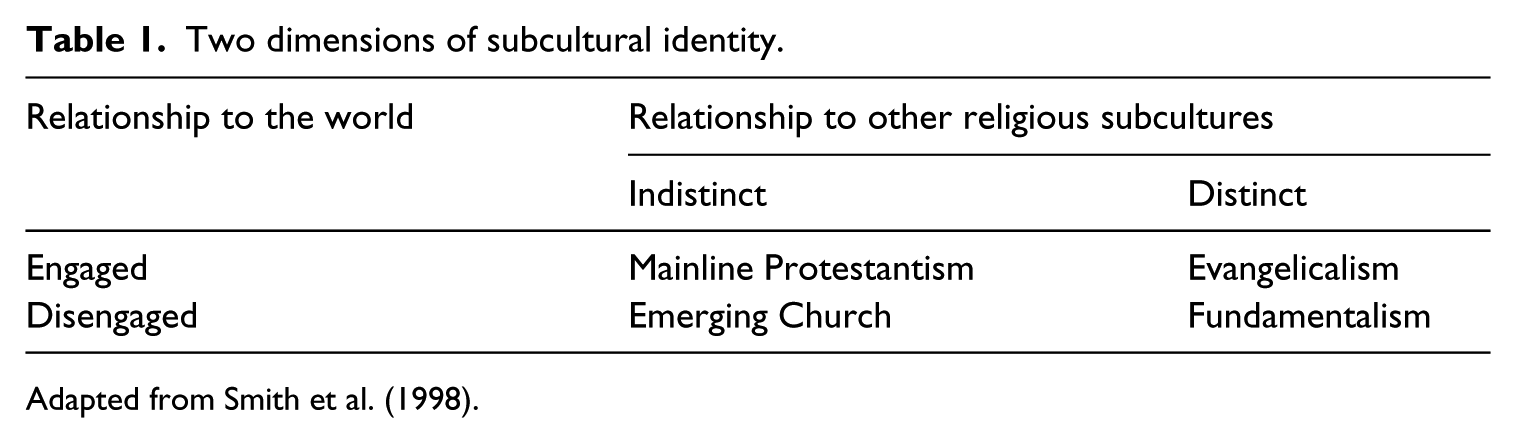
Adapted from Smith et al. (1998).
An emerging congregation: Apostles
The Church of the Apostles, as a congregation, has been featured in nearly every major study of the ECM, both by scholars (Gibbs and Bolger, 2005; Wollschleger, 2012; Marti and Ganiel, 2014) and by movement leaders (Jones, 2008; 2011). The pastor of Apostles has been in the core group of movement leaders since early in the movement’s history and is in fact credited with coining the term ‘ECM’ (Gibbs and Bolger, 2005; Wollschleger, 2012). Additionally, one of the board members of Emergent Village (an important ECM organization and website) is a regularly attending member. During the time I spent at the Church, Apostles regularly hosted visitors from all over the country – researchers, seminarians and congregational leaders – all of whom were there to learn how church was ‘done’ at Apostles. Apostles is as close to the core of the movement as possible and while generalization may not be possible from this case, it is fair to say that in studying Apostles I have had my finger on the pulse of the ECM movement.
Located in the city of Seattle, WA, Apostles has been an emerging church since its founding. The pastor of Apostles moved to Seattle from Chicago specifically to plant an emerging church. As a denominational researcher, she had noticed a change in how people were ‘doing church,’ and was involved in some of the earliest conversations among emerging leaders. In fact, she is credited with being the first person to refer to the movement as the Emerging Church (Gibbs and Bolger, 2005; personal interview). The congregation started out in borrowed space, then moved to rented space, and is currently housed in a remodeled Lutheran church building. At one point in its history the congregation rented a storefront space, which it ran as a coffee shop/tea house, and it ‘did’ church in that space with no boundaries between the congregation and the outside world – customers went in and out during services, sometimes stopping to participate for part or all of a service.
The congregation now views itself as a contemporary urban abbey. It has four community houses, in which a handful of members live and practice their own distinct spirituality. The pastor is referred to as the Abbess, and the assistant pastor is the Community Architect. The congregation has about 150 members, who attend about twice a month on average, though on any given Saturday night there are only 50–60 in attendance at the main worship service. This congregation has been recognized as an important exemplar of the ECM and the pastor was a co-founder of a local network of emerging pastors and leaders. Apostles is well known for its hospitality and, consistent with its reputation, gave unlimited access for the purposes of this research.
The congregation meets in an old church building, which it had renovated to meet its unique needs, mainly to reduce the barriers between the congregation and the community. Thus, it removed the slanted floor and pews and turned the recessed altar area into a giant closet. There is now a hard, level floor, ideal for multiple uses. The sanctuary of the Abbey is a central component of its outreach to the community; all the ‘stuff’ used during services can be readily folded, collapsed, and wheeled or shifted into another massive closet at the far end of the sanctuary.
Perhaps the best way to describe the aesthetic principles of the Apostles is that they are local and practical. The layout of the sanctuary changes by liturgical season and even sometimes by the week, adapting to meet the needs and highlight the themes of each unique liturgy. There are icons, with buckets of sand in front of each to place candles in. Notably, the icons were painted by members and built out of old doors or cobbled together with recycled lumber. The music used for worship is global, including ancient hymns, contemporary praise, and songs from contemporary secular artists, almost all of which is rearranged by congregation’s musicians. At Apostles, there is no consistent preaching; here, the sermon is called ‘Reverb,’ which, as it is more of a response to the Scripture reading, tends to be ‘abductive’ 1 (Sweet et al., 2003) rather than inductive or deductive. These are stories that arrest you, and echo the Scripture. The work of thinking, connecting, and applying is left to the listener. I have heard Reverb that consists of poems, stories from personal experience, and readings from contemporary authors like Annie Dillard. When there is a sermon, it tends to be short and personal, yet full of metaphor.
Methods
I attended Apostles as a participant observer for a period of about 18 months, from the early spring of 2009 to the fall of 2010. This attendance included worship services, small group meetings, meals and parties at congregants’ homes, theology pub nights, and church government and annual meetings. I conducted a one-on-one interview with the senior pastor, as well as group interviews/focus groups with 4–6 congregants; I spent a good deal of time interacting with congregants in and after worship services and group meetings; and I performed content analyses of the church websites, written materials, and sermons.
In anticipation of future comparability and replicability, the field research was structured around Pitchford, Bader, and Stark’s (2001) agenda for field research on religious organizations. Data was gathered on the group’s organizational history and context, mobilization, organization, governance, and outcomes. Pitchford, Bader, and Stark (2001) provided a structure that shaped observations in the field as well as the questions included in the pastor interview and focus group meetings (although in both of these there was room to follow new topics introduced by the research participants). The pastor interview schedule focused on the background of both the pastor and the congregation, the definition of the Emerging Church and an explanation of how its congregation was ‘emerging,’ as well as on what makes its congregation different, why it decided to become an Emerging Church, the vision and mission of its congregations, its plans for the future, and a description of its relationship with the community. There was also a question concerning politics and how political issues were handled in the congregation.
The focus group schedules focused more on why congregants chose the congregation, their past religious involvement, their perception of what made the congregations different from others, what they understood the term Emerging Church to mean, how political issues were handled in congregational life, and the level of involvement of members in the running of the congregation. Although the observations were framed by theoretical concerns and by the Pitchford, Bader, and Stark (2001) framework, all the data were analyzed systematically using principles from grounded theory (Suddaby, 2006): data analysis started with open coding, in which data elements were labeled and categorized, followed by selective coding focusing on key concepts (Strauss, 1987).
Findings
In her interview, the Abbess (the lead pastor) reiterated a couple of points in response to different questions: that Apostles intentionally sought to move beyond the ‘modern’ categories of liberal and conservative, and that they wished to overcome the sacred/secular divide imposed upon reality by modernism (personal interview; see also Wollschleger, 2012). In many ways this perspective is emblematic of what it means to be ‘emerging,’ to be part of a ‘post-modern’ religious movement (Gibbs and Bolger, 2005). This perspective was actually embodied in the life and organization of the congregation in multiple ways and these categories correspond neatly to Smith et al.’s (1998) dimensions of subcultural distinction. The division between sacred and secular marks the distinction between church and world that Smith et al. identify as part of ‘engagement.’ The categories of liberal and conservative are the fault lines along which religious subcultures maintain distinction from one another. At least, this was the case with evangelicalism and its relationship to Fundamentalism and mainline Protestantism as described by Smith et al. (1998). If this is in fact the case, then it creates an interesting finding that has some important implications for the future of the ECM.
Disengaged: Transcending the sacred/secular division
One of the hallmarks of Apostles is its consistent effort to reduce the barriers between the congregation and the community. This was noticeable on my first visit to the congregation as a participant observer, when the worship space was dominated by a large blue steel trapeze; at one end was the altar and facing it at the other end was the trapeze. The seating was arranged so that half the chairs were on either side of the worship space and the two sides faced in towards each other. Everyone in attendance thus had the altar on one side of their peripheral vision and the trapeze on the other. The Reverb that day focused on shared space with the community and included journal readings by leaders reflecting on the process of developing community and focusing on the messiness of shared space, and the idea of being part of the neighborhood – not just the congregation. They read these entries while seated on the trapeze, which had been set up for a masquerade ball being put on by – and for – an arts group in the neighborhood. As the worship service ended, congregants mingled in an almost surreal scene – men and women dressed in risqué masquerade outfits while caterers and servers made their way into the sanctuary carrying cases of wine and hard liquor.
Not every service was this bizarre, yet this was a synecdoche (see Becker, 1998) of the congregation’s relationship with the local community. Apostles is focused, missionaly, upon being a good neighbor, i.e., an organization that is a responsible member of the community. Located in an artistic neighborhood, it has created an arts program that offers low-cost/high-quality programming, with space available for local events. Apostles literally shares its space with the community: it has studios for the visual arts, recording, and even dance. The arts program was created as a separate organization headed by a member of the congregation. Congregational sponsorship of this program is never mentioned or advertised. There is no bait-and-switch, and most people in the community are under the impression that an arts center inhabits the old church building and the congregation just rents space from them on Saturday evenings. And the congregation wants it this way. They want the community to use their space, without seeking to transform the community. They want to provide the community with a service without proselytizing. They want to blur the boundaries between congregation and community. Ultimately, they just want to be good neighbors.
This blurring of the boundaries between congregation and community is an important part of the group’s collective story. In both formal congregation meetings and informal discussions amongst themselves congregants often recalled with fondness their previous worship setting – the coffee shop across the street. This collective memory was usually referred to in the context of future renovation plans for the Abbey building and in discussions concerning the congregation’s vision for the future. Often with a sense of wistfulness, members invoke the memory of when the congregation rented a retail space and ran a tea and coffee house.
This shop was open every day and was also where the congregation held all of their meetings – worship, group, and congregational government meetings. The shop remained open throughout all of these, thus allowing community residents and customers to come and go, interact, and participate as they liked. This participation might include giving input during congregational government meetings, asking questions during worship services, or just observing over a cup of coffee and a newspaper. This blurring of the boundary between congregation and community is the part of the story that is recalled wistfully and is used to frame how the group plans to use their Abbey – they hope one day to run a full-service, pay-as-you-can restaurant with a glass wall on the street level. This kind of informality, openness, and distrust of authority is similar to that found in social movements populated by the independent left in America, such as the Occupy Movement, the Direct Action Network in Seattle in 1999 (see Murphy and Pfaff, 2005), and the environment and peace movements generally.
This desire for community/congregation interaction was not simply a collective story consigned to the past. In addition to shaping the conversations about their future, it guided how they ran the church government meetings and was readily apparent as an organizational value. I was in attendance at an important annual congregational meeting, at which matters of vision and the church’s future direction were on the table for discussion. The meeting was really a dinner with a ready supply of beer and wine, during which the Abbess, a few elders, and the accountant took turns addressing those in attendance. During the meeting, a middle-aged man who was not a congregant walked in (the doors were open), helped himself to a beer and some food, sat down, and began to participate freely. He was given full attention by the congregants, and his input was respected and considered. At another meeting in which there was a vote to move the main worship service from Saturday night to Sunday night (a controversial topic), the results of a congregational survey were read and discussed by those present, and all took part in this conversation prior to voting. They asked me – as a researcher who studies congregations – for input in the discussion, and even more surprisingly I was invited to vote on this crucial and contested proposed change in the life of the community (I abstained).
This blurring of the community and the congregation can be seen as part of an intentional strategy, drawn from the Emerging Church’s collective identity as a post-modern church, to transcend the categories of sacred and secular. Quite consciously, Apostles makes an effort to repudiate the differentiation of social spheres that Berger (1967) identified as the hallmark of secularized, post-Reformation religion. Thus, using Smith et al.’s categorization, Apostles can be understood to be disengaged from the world. This is not to say that it has retreated from the world like Fundamentalists, but rather it makes no effort and has no desire to transform the world like evangelicals and mainline Protestants (Smith et al., 1998). The desire to transform is the key part of engagement as defined by Smith et al. (1998). Thus, while Apostles may appear to be engaged with the world because it has low boundaries to outsiders and runs an arts center for the community, it does not meet the criteria for engagement because there is no effort to transform the community. It is both ‘in the world’ and ‘of the world,’ seeking not to change it but just to exist in a responsible, just, neighborly manner. It does not use the world as a negative reference group against which it should mobilize – which is the crucial element of engagement for religious subcultural identity and movement success (Smith et al., 1998); rather it seeks to dissolve the very boundaries between church and world. In essence, Apostles seeks to be in the world without changing it.
Indistinct: Transcending liberal vs. conservative
In addition to blurring the lines between the sacred and the secular, Apostles seeks to transcend the categories of liberal and conservative – mostly with regard to theology and, in particular, the way it intersects with political and social issues. This is important for the purposes of this article because the liberal/conservative distinction is a key component of the way in which religious movements create and maintain their subcultural identity in relationship to each other (Smith et al., 1998). For instance, the pastor related how, one Saturday night, a member who is currently planting an Anglican Mission in America (a conservative Anglican movement) church was at the front, preaching for Reverb, while in the back on the table were pamphlets and copies of the upcoming diocesan (gay) pride liturgy, which the pastor and worship leader had created. The Abbess was very proud of the congregation’s ability to have people worshipping together on a regular basis who might otherwise be separated given their affiliations and personal positions on key religious fault lines: on the one hand, a seminarian and church planter for a conservative movement with strong views against homosexuality, and on the other hand, clergy and congregants who had worked together to create the gay pride liturgy celebration for the episcopal diocese of Seattle.
This is not always an easy balance to achieve; the Abbess described a major conflict that had arisen in one of the community houses due to the volatile combination of an openly gay woman and a woman freshly out of a fundamentalist background who could not yet reconcile herself to the other’s orientation. While this situation led to one woman leaving, the Abbess noted that people from the left and the right were not only worshipping together but living together as well.
These are not isolated incidents. Apostles contains individuals on the fringe of Christianity: artists, musicians, intellectuals, and graduate students. A large proportion of members grew up with troubling personal experiences in conservative evangelical homes; for them, an Emerging congregation is either the last stop before exiting the faith altogether or the first effort to return to church after a period of absence. This pattern is so prevalent that the Abbess of Apostles remarked that she often considers her congregation a ‘half-way house for those in recovery from conservative evangelicalism.’ In addition to the post-evangelicals there were a number of young adults who still identified as conservative and evangelical, along with a handful of older congregants who were life-long liberal mainliners. Somehow, Apostles seemed able to hold this apparently disparate group of worshipers together. 2 From a subcultural identity perspective, this should be problematic for movement vitality because it is through maintaining the distinction between one’s subculture and others that there is an increase in the attachment to and strength of in-group ties; without the negative reference group provided by the liberal/conservative split, this is difficult to do (Smith et al., 1998; see also Wellman, 2008).
In addition to its willingness to try to transcend the liberal and conservative fault line, Apostles seeks to blur lines with regard to its denominational and even religious tradition affiliation. Before, during, and after the research I had multiple interactions with people outside the congregation who reported knowing that it was a Lutheran (ELCA) congregation. I also had multiple interactions with people who just as firmly knew that it was an Episcopal congregation. Many people – especially the evangelicals I spoke to – knew it as an Emerging congregation. This apparent identity confusion was not limited to those outside of the congregation. I spoke to one of the older members of the congregation – a woman who managed a shelter for abused women and therefore had non-traditional work hours – who was a lifelong Episcopalian. She had first attended because it was the only congregation in the diocese that had its primary worship service in the evening (she also confessed to liking the energy of the younger members of the congregation). I met a middle-aged couple who were Lutheran, and it was through their ties to the ELCA that they found Apostles. There were also evangelical college kids in attendance, who knew it as an Emerging Church that used a liturgy, which they thought was cool and edgy.
When I asked one of the assistant pastors about this – a young seminarian with long dreadlocks and an easy, sociable way, set on planting his own congregation once he graduated – he responded by smiling, shrugging his shoulders, and saying ‘the best way to describe us is: we are bi-denominational and emerging’ (personal interview). As a congregation Apostles is firmly embedded in the ECM (it started as an intentional Emerging Church plant led by a former, self-described, Lutheran bureaucrat), but it was also listed as a congregation in both the Episcopal diocese and the ELCA synod. Somehow it managed not only to hold together liberals and conservatives but also to maintain multiple denominational/religious tradition affiliations.
Using Smith et al.’s (1998) categories, Apostles can be labeled as indistinct, because not only does it make no effort to distinguish itself from other religious subcultural groups, but it actively seeks to transcend the boundaries between liberal and conservative while at the same time holding multiple identities and congregational ties to denominations and traditions.
Discussion
While it is not really possible to generalize from a single case to the whole population of emerging congregations, it is worth noting that this case, Apostles, has been held up by movement insiders as an ideal type, as typical of the movement (Gibbs and Bolger, 2005; Jones 2008; 2011; Wollschleger, 2012; Marti and Ganiel, 2014). Apostles is close to center of the movement as a congregation, both in terms of its creative use of liturgy (Gibbs and Bolger, 2005) and in terms of the connectedness and centrality of the pastor to the network of emerging pastors. There is thus reason to believe that Apostles is in some way indicative of the movement as a whole. Additionally, Gerring (2007) in his discussion of types of case study and their uses and generalizability says that such a ‘typical’ case can be used for generalization to the whole. Thus, while I recognize that generalizability is not perfectly possible, in the following discussion I will act as if it is, as if Apostles is a synecdoche of the Emerging Church Movement (Becker, 1998).
Apostles, then, offers us an interesting glimpse into the religious subcultural identity of the ECM. Its commitment to radical, personal authenticity is expressed in how it views not only the liberal and the conservative as false dichotomies, but also the sacred and the secular as falsely dichotomized (Wollschleger, 2012). As a post-modern movement, it seeks to transcend what it sees as outdated and false categorical dichotomies. Thus it actively works as a congregation, as the local embodiment of the emerging movement, to blur the boundaries of the sacred and the secular, to repudiate the differentiation of social spheres that has been identified as a central component of secularized, post-Reformation religion (Berger, 1967). It also works to transcend denominational identities by actively maintaining two such identities as a congregation along with its subcultural movement identity. Additionally, it seeks to hold together both liberal and conservative people and perspectives: if liberal and conservative beliefs and practices were placed at opposite ends of a pole representing the range of possible expressions of the Christian faith, emerging congregations would not see themselves in the middle, but rather at both ends at the same time.
From a subcultural identity perspective this indicates that the movement may not be able to sustain vitality for the long term. Smith et al. (1998) argue convincingly that the evangelical movement succeeded because it was able to carve out its own space in the religious movement field by maintaining distinctions between evangelicalism and its competition – Fundamentalism and mainline Protestantism. Additionally, it maintained a certain stance toward the world, a mission to engage and change the culture. Both of these factors worked to create negative reference groups, against which members of the movement could compare themselves as well as their ‘enemies’ in the battle for the culture. In addition to mobilizing resources and participation, and making movement identity a salient part of life, this worked to create stronger in-group ties – all of which served to vitalize the movement.
As the case of Apostles demonstrates, the ECM does not seek to engage the world in the same transformative way as evangelicals or even mainline Protestants do; it simply seeks to be in the world. Nor does it work to maintain boundary distinctions between religious subcultures, preferring to take a ‘big-tent’ approach to Christianity and faith issues (see McLaren, 2006). Thus, working from a subcultural identity theory we would expect the future of the movement to be limited. Without the ability to mobilize resources and participation, the movement itself will dissipate and the congregations will need to find other sources of identity, perhaps by re-emphasizing denominational ties or shifting to the poles of the liberal/conservative split. Smith et al. (1998: 97) note that ‘religious groups that have difficulty constructing identity distinction in a pluralistic environment will grow relatively weaker.’ This is especially the case for the ECM, as emerging practices are increasingly becoming co-opted by more mainstream or traditional congregations that are seeking to attract young adults.
Yet, this begs the question of how the movement was able to mobilize in the first place. The evidence suggests that it may have relied on the modern/post-modern division, using ‘modern’ Christianity as the negative reference group against which to mobilize (Marti and Ganiel, 2014). This was not at all apparent in the congregational life of Apostles, though it does appear in the movement literature (Jones, 2008). Jones, a key movement insider and leader, speaks almost victoriously about the rising sea change in Christianity, fully expecting the post-modern movement to be its future. Interestingly, this book is itself written as a defense against prominent detractors, especially pastors and theologians within Christianity. The book indicates a clear sense of being ‘embattled’ among the ECM leaders, and it was designed to serve as a call for increased mobilization. While this feeling of being ‘embattled’ should have led to positive outcomes for the ECM, movement insiders have told me that the opposite has happened, that the movement has lost momentum. They argue that while the movement was under attack by mainstream leaders it was also in danger of being co-opted by other elements in mainstream Christianity – namely publishers and other commercial organizations.
Central to the emerging ‘conversation,’ as the movement is often referred to by insiders, has been the annual emerging conference. In my interview with her, the Abbess at Apostles told me that at the 2008 emerging conference, movement leaders and pastors realized they had been ‘branded.’ There is a new publishing division in a major Christian press devoted to ‘emerging’ books, and at this annual gathering they were given tote bags with an ‘E’ on them. In fact, the publication of Jones’s book was itself evidence of the co-optation of the movement; i.e. the recognition of publishers and other commercial enterprises that there was a new, growing market niche. The Abbess stated that in response the ‘Emerging’ leaders are reacting to being ‘branded’ by seeking to ‘re-identify themselves as local and unique expressions of their denomination rather than as Emerging Churches’. From a subcultural identity perspective this response is not surprising, as it signifies the recognition that as a movement they had become mainstream, and mainstream Christianity was the only negative reference group that they had to mobilize resources and identity against.
Given these findings, the future of the movement looks bleak. Working from the subcultural perspective, I would agree with the assessment made by McKnight (2007) that, ultimately, the ECM will dissipate and that emerging congregations will re-emphasize their denominational identities and bring the resources and emerging religious orientations (Marti and Ganiel, 2014) they have developed through movement participation back into the local branches of their denominations. Maybe it is too soon to tell but there are early indications of this in the case of Apostles. As a congregation it has fewer than 200 members and draws only 50–60 members per week to the primary worship service. This suggests that the church may have quickly reached its peak and has little chance of growing from here. Recently, after the period of this research, the Abbess moved on to work at the diocesan level and the congregation issued a ‘call’ for a new pastor through the normal, institutional, denominational mechanisms. Perhaps the ultimate importance of the ECM will be as an experiment in new forms of Protestant Christianity rather than as a model for a new religious movement. This prediction fits with recent findings. Samson (2011) finds that the religious landscape of post-evangelicalism is no longer dominated by a unified emerging movement but rather is composed of a set of fractured movements that includes the Emerging Church.
Finally, the results of this research suggest a reconsidering of Smith et al.’s (1998) categories. In terms of a Church’s relationship to the secular world, they identify two possibilities, engagement and disengagement, and look at how mainline Protestantism and evangelicalism are both engaged with the world – i.e., seeking to transform it – while Fundamentalism is disengaged from the world. I would argue that while both evangelicalism and mainline Protestantism engage with the world, they do so in very different ways. Evangelicalism seeks to transform the world in all possible ways – from culture to politics, whereas mainline Protestants often seek to transform the world only through their political actions. This, however, is outside the scope of my findings (but see Wellman, 2008). What I can argue empirically is that the ECM is not interested in transforming the world; it is simply interested in being a good neighbor and at most existing as a visible manifestation of the future kingdom without seeking to change, modify, judge or transform people, institutions, or organizations around it. This co-existence is very different from the transformative engagement of evangelicals and mainline Protestants, as well as from the absolute retreat of Fundamentalism from all aspects of modernity. Fundamentalists have sought to exit the world, whereas the ECM seeks to be in the world. This seems to me to be a qualitatively different category of disengagement, and should lead to an expansion of the theoretical model for our understanding of the ways in which religious subcultures can interact with the secular world.
Conclusion
Two important results for the sociology of religion derive from this article. First, it provides a theoretical analysis of the interesting case of the ECM, and second, it applies and expands an important theoretical perspective. The application of Smith et al.’s (1998) subcultural identity theory to the case of Apostles has allowed us to identify the movement space of the ECM. The ECM as typified by Apostles is both disengaged from the world and indistinct from other Protestant subcultures. This has important implications for the future vitality of the movement; implications that can be tested and used to modify, improve, or verify the explanatory power of a subcultural identity approach to religious movements. This case has also allowed us to modestly expand the application of subcultural identity theory through the analysis of a case that fits in the previously blank conceptual cell of the theory: that of the disengaged and indistinct movement.
It is worth noting that any religious movement cannot inhabit this space in the conceptual grid for too long. The very set of group dynamics that define it – disengaged and indistinct – ensure a loss of vitality and ultimate decline for the group. Congregations that find themselves part of a movement occupying this space will probably be forced to migrate toward the other cells. This may be by opting out of a movement, joining a denomination or switching denominational affiliation, or reemphasizing the denomination or religious tradition from which they originally came. This will most likely reinstate a healthy distinction from other groups and possibly signal a re-engagement with mainstream society.
The work of social scientists, especially those doing qualitative research, is often criticized for being too descriptive and too vague in it implications, for not providing anything of substance in terms of actual prediction. This application of subcultural identity theory does not just provide an opportunity for the description of an interesting case. Rather, it makes interesting predictions that can be tested in the future, that the ECM as a movement will not last long and that congregations that identify as ‘emerging’ will begin to shift their identity towards the denominations and/or religious tradition from which they originally emerged.
Footnotes
Funding
This research received no specific grant from any funding agency in the public, commercial or not-for-profit sectors.
Notes
Author biography
Address: Sociology Department, Whitworth University, 300 Hawthorne Road, Spokane, WA 99204, USA
Email: