




Abstract
Research has demonstrated race differences in the acceptance and occurrence of cremation (International Cemetery and Funeral Association [ICFA], 2005). However, there has not been an attempt to explain these differences sociologically. Two phases of research were conducted to investigate race differences in the acceptance of cremation. In phase one, using a representative sample of university students at a university in the southern United States (N=510), racial differences in the acceptance of cremation were examined. Quantitative results suggest that African Americans are less accepting of cremation than whites, yet the specific mechanisms that produce this difference remain unclear. In the second phase of this study, qualitative interviews (N=17) were used to further investigate the robust race difference. African Americans report both social as well as religious reasons for greater adherence to traditional burial customs. Higher levels of cohesion and religiosity, combined with a history of oppression among African Americans, are considered within a Durkheimian framework as mechanisms that contribute to the difference in attitudes.
Introduction
Research suggests that when it comes to funeral arrangements, African Americans are less likely than other groups to choose cremation rather than burial (International Cemetery and Funeral Association [ICFA], 2005). Existing research has not directly attempted to explain this difference. The goal of this project is to explore differences in race-specific attitudes concerning cremation. It is hypothesized that African Americans will be less accepting of cremation than whites. This project consists of two phases. In phase one, we explore this difference using a survey of college students at a southern university in the United States (N=510). Preliminary quantitative analysis is performed on a number of measures typically related to race differences.
In addition to the survey analysis, a second phase of the study examines race differences qualitatively, using in-depth interviews of additional respondents from the university population (N=17). Here, we examine how different cultural histories are manifested in different attitudes toward cremation. In particular, an attempt is made to interpret the findings in the context of Durkheim’s work. Religion has a salient role in funeral ceremonies among the African American community. Historically, funerals were part of the oppression and victimization of African Americans resulting from the slave trade. We hypothesize that social cohesion, and religion as a manifestation of it, are stronger entities for the African American community than for whites. Therefore, African Americans will be less accepting of non-traditional burials. Furthermore, we argue that both higher levels of religiosity and greater involvement in community events such as funerals are a result of a history of disadvantage and oppression. This shared history has played a great role in binding African Americans and protects traditional practices.
Cremation
In 2005, of all deaths in the United States, 32.28% resulted in cremations. This figure is an increase from 14.90% in 1985 (Cremation Association of North America [CANA], 2007). The Wirthlin (2005) study conducted telephone interviews to investigate attitudes regarding cremation. 1 The two main reasons for choosing cremation over burial are financial savings and preservation of land. A basic cremation costs between $1,200 and $1,400, approximately 75% less expensive than the average burial (Wirthlin, 2005). According to a 1990s study, those preferring cremation are less likely to have a service in a church or funeral home and are more than three times as likely to hold a memorial service (Prothero, 2001). Kearl (2004) argues that the increase in cremations is more complicated than financial or land savings. While entertaining factors such as geographic moves away from family plots and a general disconnection with family histories, he ultimately theorizes that with increased life expectancy, people have greater opportunity to live a full life and achieve satisfaction. Kearl suggests that the choice of cremation may reflect a decision to let one’s accomplishments during a long life provide a more fitting memorial than a gravestone marker (2004).
Regarding the racial gap in attitudes toward cremation, according to the 2005 Wirthlin report, 46% of Americans prefer to be cremated. Preference for cremation is lower for African Americans (20%) and for Baptists (29%). Higher percentages of whites (28%) than of African Americans (13%) have experienced cremations (e.g., of loved ones). Baptists are reportedly hesitant to consider cremation due to the manner in which the body is destroyed in the process. One of the reasons provided by African Americans for not selecting cremation is the importance of the funeral within the African American community coupled with their misconception that cremations are not accompanied by a funeral service. The rate of cremation is also much lower in the southern United States. In Tennessee, for instance, the rate is 8% (2005). Trends suggest a declining, but persistent, racial gap in cremation acceptance. A 1970 survey found African Americans five times less likely to be cremated, while a 1990 survey found them only two times less likely (Prothero, 2001).
The Durkheimian context
Émile Durkheim spent much of his career refining his concept of social integration and the impact it has on the individual in the context of social life. As Descartes built a duality on mind/body, Durkheim (1965 [1915]) built a duality around the notion of the individual versus society. He believed in society as the highest of orders. Durkheim suggests that the level of social integration manifests itself in the collective conscience of the social group or community. Durkheim (1938 [1895]) describes religion and education as institutions which influence individuals in social ways not always recognized, but which are constraining in terms of individual behaviors and choices. He explains that institutions such as families, schools, and religions are representations of a given society’s values. Once the norms of a particular society or community are internalized, the individual feels a connection with the group and, depending on the level of social cohesion, acts in congruence with that society’s values: ‘If, in time, this constraint ceases to be felt, it is because it gradually gives rise to habits and to internal tendencies that render constraint unnecessary; but nevertheless it is not abolished, for it is still the source from which these habits were derived’ (1938 [1895]: 6).
In Suicide, Durkheim (1951 [1897]) chooses the act of suicide to shed light on the importance of societal-level influences on individual behavior. Using geographic units such as countries and regions, Durkheim demonstrates that demographic groups have very stable suicide rates. He persistently asserts that the level of social integration of the group is the underlying variable explaining suicide rates: ‘suicide varies inversely with the degree of integration of the social groups of which the individual forms a part.’ (1951 [1897]: 209). The more integrated and cohesive a social group or community, the less likely individuals are to stray from the common practices and behaviors of that collective.
Durkheim (1965 [1915]: 62) defines religion as ‘a unified system of beliefs and practices relative to sacred things, that is, things set apart and forbidden – beliefs and practices which unite into one moral community[,] called a Church, all those who adhere to them’. The second part of Durkheim’s definition suggests that religion is a collective inseparable from the Church (1965 [1915]). It is the second part of this definition that is more relevant here, as the integration of social groups is manifested in the collective activity of the Church.
Two theoretical approaches are relevant for explaining the underlying mechanisms that inform the relationship between religion and enhanced general well-being (Bjarnason, 1998). More closely related to Durkheim, the religious community approach ‘emphasizes the integrative and regulative nature of closely knit religious communities’ (Bjarnason, 1998: 742). This approach highlights the ways in which the structure of religious communities contributes positively to the welfare of churchgoers (Bjarnason, 1998; Ellison and George, 1994; Welch et al., 1991). The religious beliefs approach, on the other hand, relies on the social psychology of religion, specifically the positive correlation between religious beliefs and increased individual well-being (Berger, 1967; Bjarnason, 1998; Ellison et al., 1989; Pargament et al., 1990; Williams, 1994). Bjarnason theorizes that adolescents raised within a close-knit religious community are more grounded and have a higher sense of self-worth (Bjarnason, 1998). According to Durkheim (1951 [1897]), a person’s sense of well-being is circumscribed by his or her level of connection to a social group that shares the same goals, beliefs, and tradition. Bjarnason, Thorlindsson, Sigfusdottir, and Welch (2005) later apply the Durkheimian framework to adolescents in Iceland, observing alcohol consumption among youths who are close to their immediate and extended family members, and who may also live within a religious family. The authors hypothesize that the extended family network provides adolescents with a strong base from which to develop into confident and secure adults (2005).
We argue that Durkheim’s work on suicide and religion plays an important role in the investigation of social group adherence to traditional practices. From this perspective, religiosity and community cohesion are factors which will essentially inform racial differences in the acceptance of cremation.
Race differences in religion
A long history of scholarship suggests that the African American Church 2 is a prominent feature of African American life (Davis et al., 1941; Dollard, 1937; Johnson, 1934; Powdermaker, 1939). In his landmark study, Caste and Class in a Southern Town, John Dollard (1937) argues that the African American Church serves as the center of social activity. The African American church contains networks of social relationships (Powdermaker, 1939). Winter (1997) argues that, as the African American Church developed, a sense of social community formed, irrespective of denominational differences. African Americans view their Church as fulfilling a need for community which crosses the lines of denomination, doctrine, and practice (Williams, 1971).
Research indicates that African Americans evidence a higher degree of religious participation than whites (Taylor et al., 1996). For instance, 52.3% of African Americans attend some form of religious service at least twice a month, compared with 43.25% of whites; 29.8% of African Americans consider themselves to be ‘very religiously minded’; 38.5% of African Americans have read religious material, compared with 23.3% of whites; and 80.1% of African Americans feel that religious beliefs are very important, compared with 51.5% of whites (Taylor et al., 1996).
Hunt and Hunt (2001) suggest that African Americans and whites are equally religiously involved in the rural South, African Americans are more religiously involved than whites in the urban South, and African Americans are less religiously involved than whites in the urban North. Their study suggests that, overall, African Americans are more likely to be members of a church or church group and that they attend church more frequently. The authors group attendance into three categories: weekly, intermittently (once a month to less than weekly), and infrequently (non-attendance to several times a year. Overall, the percentages were similar for both races on weekly attendance (30%), but higher percentages of African Americans attended intermittently (32% compared with 21%) and lower percentages attended infrequently (37% compared with 49%) (2001). According to a study by Barnes (2009), African American Church attendance has remained fairly stable since 1995.
African American churches consume a substantial amount of their congregation’s free time (Ellison and Sherkat, 1995). The African American Church is a central aspect of the African American community and its social, economic, and political development (Drake and Cayton, 1993; Frazier, 1969; Morris, 1984; Woodson, 1939; Young, 1932) because it holds the distinction of being among the few institutions controlled, built, and financed by African Americans (Frazier 1969; Nelsen and Nelsen, 1975; Drake and Cayton, 1993). This places the African American Church in a unique position to fulfill the needs of the African American community. Historically, social conditions (i.e. persecution and limited opportunities) led African Americans to give increased importance to their church within their communities (Chaves and Higgins, 1992). Unlike whites, African Americans were blocked from many institutions so they used the church, a readily accessible organization for most members of the African American community, as an institution to fight racial oppression (Lincoln and Mamiya, 1990). African American congregations are more likely to support programs dealing with issues directly related to the communities in which the congregants reside (Tsitsos, 2003).
By denomination, African Americans identify as 52.1% Baptist, 11.7% Methodist, and 6.3% Catholic (Taylor and Chatters, 1991). Chatters, Taylor, and Lincoln (1999) found that females, older adults, more educated individuals, and married individuals have higher levels of religious involvement. African Americans in the South were more religiously involved than their counterparts in the Northeastern, North Central, and Western United States.
African and African American slave funeral customs
An important aspect of cultural beliefs about death pertains to the relationship of the body to the soul. The Cartesian conception of separating the mind, or soul, from the body is uniquely a Western idea (Scheper-Hughes and Lock, 1987). For members of many African nations, cremation is adamantly contested due to the belief that the body is inseparable from the soul. Funeral customs and beliefs are influenced by both traditions and beliefs about the spirit and body as well as by Christianity. Reducing the body to ashes is not only viewed as disrespectful, but also counters beliefs in immortality: Traditional Africans conduct their lives and perform their rituals within the framework of the belief that the ancestors govern the social and religious lives of their living relatives. The ancestors, who are the dead forebears of the family, are always held in deep reverence, both the dead and the living being part of the family. The living retain sentimental and emotional ties with the dead and depend on them for their well-being. The spirit of the deceased is believed to continue to influence the lives of the living relatives with blessings or curses, depending on how he was treated by the living. It is therefore incumbent upon surviving families to properly send off the relative who is joining the ancestors. (Owiredu, 2005: 288)
Africans typically believe that the body must be respected. This is why there is so much reverence for the body during the funeral in terms of caring for it and commenting on how good it looks. This admiration reflected the mourners’ respect for the body (Owiredu, 2005). Certain African cultures, such as those in Namibia (Watkins, 2005) and South Africa (Molyneux, 2005), believe that communication with ancestral spirits is an important activity among the living. They believe that the spirit will be lost if the body is cremated, and therefore view the practice as taboo. In Ghana, this notion of respect for the body is combined with aspects of Christianity. Earth burial is viewed as respectful to the body, as Jesus was buried before being resurrected. Generally, cremation is not seen as respectful to the body by African Christians due to the belief in the resurrection of Christ (Owiredu, 2005).
In the era of slavery in America, slave funeral traditions further emphasized the importance of the body. For instance, the body had to be buried facing west. Slaves also took great pride in funerals as a way to express their respect for the dead and their belief in the social justice that would be experienced in the afterlife. Having experienced such dramatic oppression in life, they believed that the afterlife would not only provide reconciliation for the injustices they had suffered but also lower the stature of their oppressors (Genovese, 1976).
The funeral was also a reification of the community for African American slaves: The funeral has figured prominently as a religious ritual, a social event, and an expression of community. However much the concern with the celebration of death may have arisen from immediate circumstances, it drew upon a history. The slaves cared passionately about their funerals and demanded that they be elaborate. (Genovese, 1976: 201, quoted from Powdermaker, 1939)
Death and funerals in the African American community
Death and dying have always been prominent, even defining, features of the African American community. Holloway (2003: 2) suggests ‘that African Americans’ particular vulnerability to experiencing an untimely death in the United States intimately affects how black culture both represents itself and is represented’. Even during the era of slavery, accounts by both slaves and whites suggest that slaves were not dissuaded by whites from holding funerals as long as they did not interfere with work. Funerals were often held at night for this reason. Slaves also preferred night funerals because they allowed attendance by friends from neighboring farms and plantations. It was thought by whites that benevolence toward the holding of funerals reduced the likelihood of rebellion.
In one way or another, however, whites missed the point. The significance of proper funerals for slaves lay not in [the opportunity for] conspiracy, but in the extent to which they allowed the participants to feel themselves a human community unto themselves. To that extent the slaves decisively negated the mythical foundation of the slaveholders’ world (Genovese, 1976: 195).
This idea that the recognition and building of the black community centered around funeral customs is elaborated by Holloway (2003: 59): No matter how much the customs among mourners have changed, either through the influences of white culture or as a result of the increased urbanization and education of blacks, the pervasive quality of black mourning customs is their use as a builder of community.
Historically it was believed that the soul of the deceased would return to the mother country only if the body was given a proper burial and ceremony. Therefore, elaborate funeral ceremonies were common (Wright and Hughes, 1996). Touching and viewing the body of the deceased recalls West African funeral traditions and represents a display of respect. In the United States, viewing the body also serves as recognition of the racialized violence experienced by African Americans. Holloway describes the funeral of Emmitt Till, when his mother wanted everyone to see his lynched body. She also describes the sacred experience two sisters shared as they plaited their deceased grandmother’s hair at a funeral home. This belief, coupled with the often violent circumstances of African Americans’ deaths, placed the funeral director, often doubling as a minister, in a pivotal role in the black community and within the personal affairs of the bereaving family (Holloway, 2003).
The current study
Given the aforementioned research, we expected that African Americans would be less accepting of cremation than whites. In the first phase of this project, we examined race differences in the acceptance of cremation from a quantitative perspective. We hypothesized that religiosity would play an important role in the race difference. In the second phase of this project, in-depth interviews were conducted in order to more fully understand attitudes toward cremation.
Method – phase one
Participants
The data come from a convenience sample of general education classes of a university in the mid-southern United States. We feel that the selection of a sample of university students is an important feature of this project. While the age of university students may seem limiting in a study exploring death, we assert that this population serves as a quasi-experimental control for factors such as social class, education level, and life stage, which generally confound race differences. These respondents are of similar age and in similar stages in life. If race differences are manifest among respondents at a similar life stage, this is further evidence of the salience of race.
Our sampling frame comprises the total enrollment for 20 targeted general education classes (N=792). From this frame, 606 students completed the survey – a 77% response rate. Thirty-five respondents older than 25 were removed to restrict the analysis to students at the same stage of the life-course. Another 34 cases were deleted from the analysis for reporting a variety of races and/or ethnicities other than white or African American. Finally, 28 additional cases which had missing information on variables were removed. Allison (2002) suggests deletion as an appropriate method of handling missing values.
The final sample therefore consists of 510 university students. The sample is 30.6% African American (N=156) and 69.4% white (N=354). The respondents are, on average, approximately 20 years old (M=19.54, SD=1.5 years). The sample consists of a high percentage of freshmen (45.6%). The African Americans were not significantly different from the whites on any of the demographic variables, such as gender and class (analysis not displayed).
Measures
Cremation acceptance
The cremation acceptance scale was created for this study. The scale measures the extent to which an individual is accepting of cremation as a possibility. The respondents were asked their level of agreement with the following statements:
Being buried in a family plot is important to me (reverse-coded).
When I die, I expect to be buried with my family (reverse-coded).
Cremation is something I’ve considered.
I don’t care whether I’m buried or cremated.
The response set for these items was: 1 = strongly disagree, 2 = disagree, 3 = undecided, 4 = agree, and 5 = strongly agree. The scores for the first two items in the scale were coded in reverse prior to scale computation. For example, strongly agreeing with ‘When I die, I expect to be buried with my family’ (a score of 5) would be recoded (to a score of 1) before summing the scale score. For the computation of the scale score, each respondent’s item scores (once the scores for items 1 and 2 had been reversed) were summed and divided by the number of items constituting the scale. This computation returned scale scores to the same metric as each item. Higher scores represent higher levels of cremation acceptance reported by respondents. For example, accounting for reverse coding, a scale score of ‘4’ means that the respondent, on average, ‘agreed’ with the cremation-acceptance items. A final scale score of ‘2’ means that the respondent, on average, ‘disagreed’ with them. The scale has a possible range of 1 to 5. The Cronbach’s reliability alpha for this scale in this sample is 0.73. Nunnally (1978) recommends that scales used in basic research have reliability of about 0.70 or better.
Cremation consideration
Respondents were separately asked whether or not they had ever considered being cremated, instead of buried, after they died (Yes = 1, No = 0).
Cremation exposure
Respondents were asked to report the number of extended family members who had been cremated. This measure was recoded into a dummy variable (1 = at least one person cremated, 0 = no one cremated in extended family).
Religiosity
Religiosity was measured using a three-item scale computed using the same method and response set as the cremation acceptance scale. The following items were used for this scale:
I have firm religious beliefs.
I consider myself to be a religious person.
Regular church attendance is important.
The scale has a possible range of 1 to 5. The Cronbach’s reliability alpha for this scale in this sample was 0.86.
Religious denomination
Respondents were asked to report their religious denomination. The number of cases in each category was typically small. One of the largest categories of response was the Baptist denomination. This measure was recoded into Baptist or not (1 = Baptist, 0 = other than Baptist). Several analyses were performed to explore relationships among the cremation variables. The analyses (not displayed here) did not produce any substantive results.
Results – phase one
Descriptive analysis
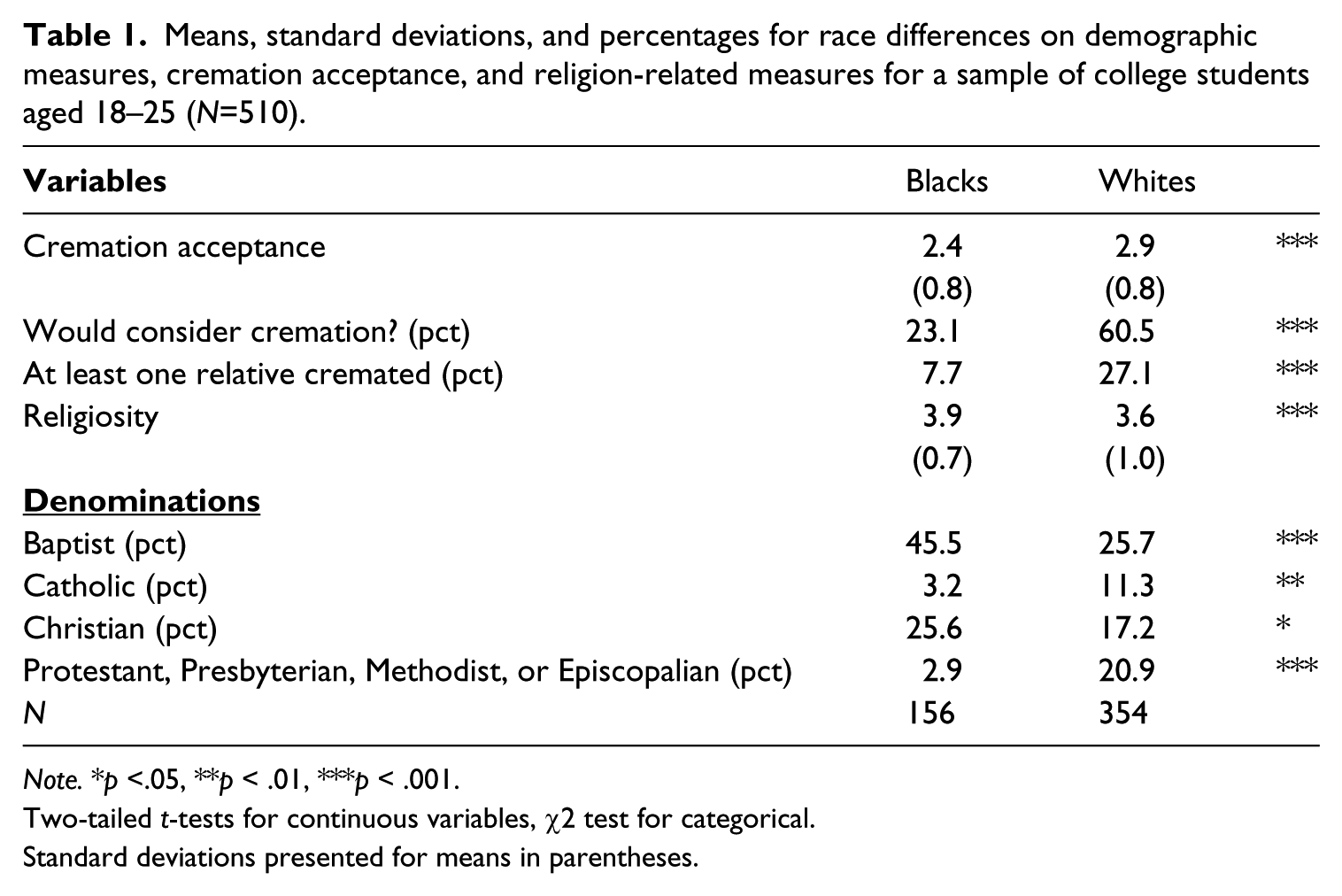
The bivariate analyses for race differences on cremation and religion-related variables are displayed in Table 1.
Means, standard deviations, and percentages for race differences on demographic measures, cremation acceptance, and religion-related measures for a sample of college students aged 18–25 (N=510).
Note. *p <.05, **p < .01, ***p < .001.
Two-tailed t-tests for continuous variables, χ2 test for categorical.
Standard deviations presented for means in parentheses.
African Americans scored significantly lower on the cremation acceptance measure. This finding was not surprising. On the binary question which indicated if the respondent would consider cremation, a significantly lower percentage of African Americans reported considering cremation (23.1%, compared with 60.5% for whites (χ2(1) = 60.5, p < .001)). The average level of religiosity for African Americans was significantly higher than for whites (M = 3.9, SD = 0.7, compared with M = 3.6, SD = 1.0). Religious denominations were measured in the survey with check boxes representing major denominations in addition to a write-in Other category, which allowed respondents to indicate a denomination not included in the list. For the sake of brevity, only the major categories are displayed. The modal denominational response was Baptist for both African Americans and whites. Higher percentages of African Americans reported being Baptist (45.5%, compared with 25.7% (χ2(1) = 19.6, p < .001)) or Christian (25.6%, compared with 17.2% (χ2(1) = 4.82, p < 0.05), while higher percentages of whites reported being Catholic (11.3%, compared with 2.3% (χ2(1) = 8.81, p < .01)) or Protestant, Presbyterian, Methodist, or Episcopalian (20.9%, compared with 2.9% (χ2(1) = 29.0, p < .001)).
Regression analyses
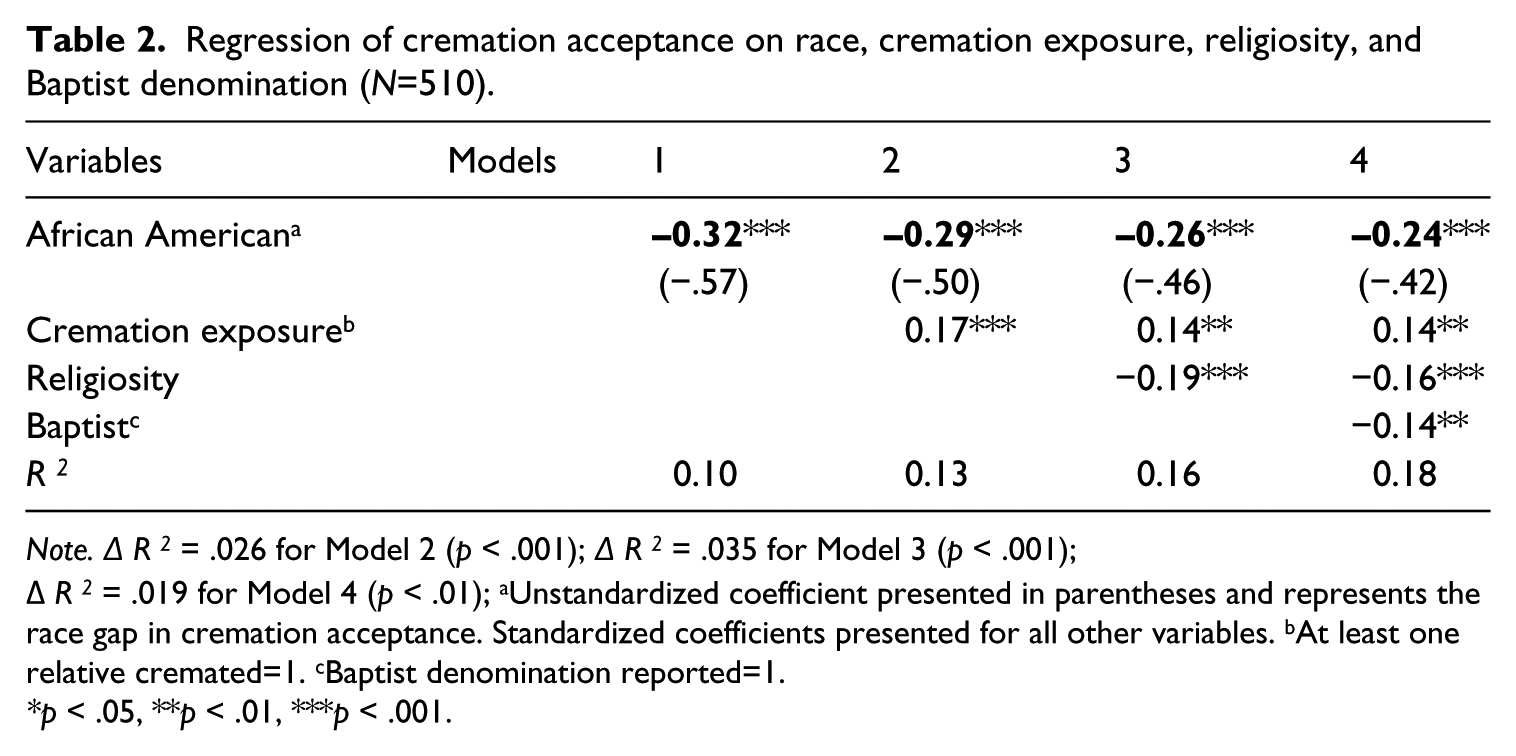
In order to examine the racial difference in cremation acceptance and consideration, two regression analyses were performed. The first analysis consisted of an ordinary least squares regression, regressing cremation acceptance on race, cremation exposure, and religion-related variables. The results of this analysis are displayed in Table 2. The bolded coefficient in each model for the African American variable represents the standardized difference in cremation acceptance for African Americans compared to whites. The coefficient in parentheses represents the unstandardized coefficient or the mean difference for African Americans on the cremation acceptance scale. While certain predictors may be significant, the analysis was designed to examine how the addition of the predictors in Models 2–4 impacts on the size of this mean difference. Significant reductions in the mean race difference resulting from added variables suggest that the predictor contributes to the explanation of the racial gap in cremation acceptance. Predictors could contribute significantly to the explanation of variation in cremation acceptance but contribute little to explain the racial gap.
Regression of cremation acceptance on race, cremation exposure, religiosity, and Baptist denomination (N=510).
Note. Δ R 2 = .026 for Model 2 (p < .001); Δ R 2 = .035 for Model 3 (p < .001);
Δ R 2 = .019 for Model 4 (p < .01); aUnstandardized coefficient presented in parentheses and represents the race gap in cremation acceptance. Standardized coefficients presented for all other variables. bAt least one relative cremated=1. cBaptist denomination reported=1.
p < .05, **p < .01, ***p < .001.
In the first model, cremation acceptance was regressed on the African American variable (African American = 1, white = 0). The African American variable represents the difference in cremation acceptance without accounting for any control variables. The difference was statistically significant and represents a negative association between being African American and cremation acceptance (B = −0.57, p < .001, see Model 1, Table 2). Model 1 explained 10% of the variation in cremation acceptance (R2 = 0.10, p < .001).
Exposure to cremation was entered into the regression in the next model (see Model 2, Table 2). Having had a relative cremated was positively related to cremation acceptance (p < .001). The entry of this measure reduces the gap in acceptance slightly (B = −0.50, p < .001) and Model 2 explained approximately 13% of the variation in cremation acceptance (R2 = 0.126, p < .001). Having had a relative cremated predicted cremation acceptance to a statistically significant degree. However, the racial gap in cremation acceptance was not reduced substantively. The lion’s share of the gap was not impacted by this predictor.
Religiosity was the next variable of interest entered into the equation (see Model 3, Table 2). There was a significant negative relationship between religiosity and cremation acceptance (p < .001). The racial gap in acceptance remained only slightly decreased (B = −0.46, p < .001) and Model 3 explained approximately 16% of the variation in cremation acceptance (R2 = 0.161, p < .001).
In the final regression, Baptist denomination was entered into the model (see Model 4, Table 2). Initially, the other predominant denominations were also included in the model. These denominations were entered as a series of dummy variables in various orders. These denominations (Catholic, Christian and Protestant, Presbyterian, Methodist, and Episcopalian) were not significant; nor did they contribute to the explained variation in cremation acceptance (results not displayed). In order to remain parsimonious, the models included only the Baptist variable. The Baptist measure was negatively associated with cremation acceptance (B = −0.42, p < .001), but only slightly reduced the racial gap in cremation acceptance. Model 4 explained approximately 18% of the variation in cremation acceptance (R2 = 0.18, p < .01).
Logistic regression – predicting likelihood of considering cremation
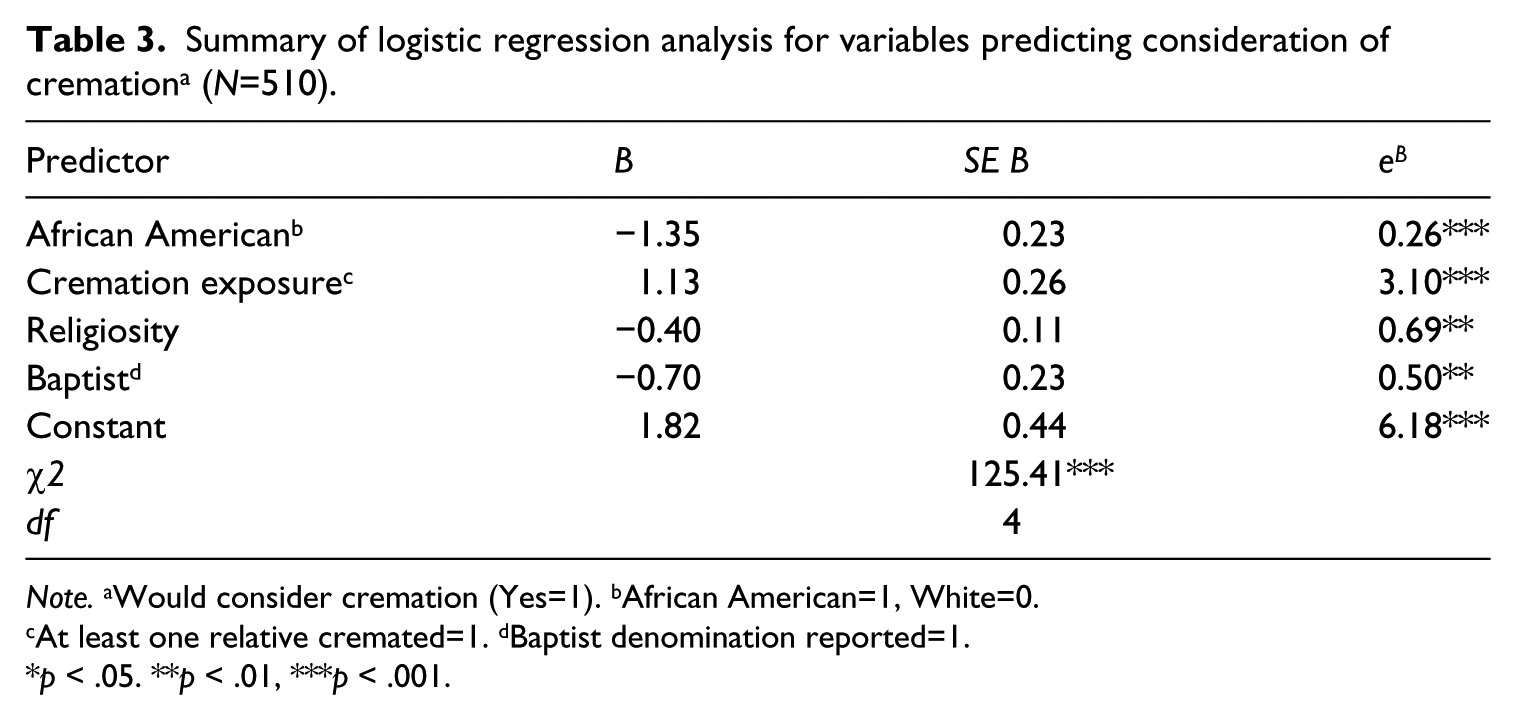
In the last series of analyses, a logistic regression was performed on the binary measure that indicated whether a respondent had ever considered being cremated (Yes = 1, No = 0). The model predicted the relationship between race and consideration of cremation while controlling for having had a relative cremated, level of religiosity, and whether or not the respondent reported a Baptist denomination. The results of this analysis are displayed in Table 3. African American respondents are 0.26 times as likely to have considered cremation as whites. Interpreting this likelihood using whites as the reference, whites are almost four times as likely to have considered cremation as African Americans (Odds Ratio = 3.72, p < .001). The odds of considering cremation also increase to almost three-to-one in those having a cremated relative (Odds Ratio = 3.10, p < .001). Again, using the binary measure of cremation consideration, Baptists are less likely to consider cremation (Odds Ratio = 0.495, p < .01), as are the more religious, generally (Odds Ratio = 0.69, p < .01).
Summary of logistic regression analysis for variables predicting consideration of cremation a (N=510).
Note. aWould consider cremation (Yes=1). bAfrican American=1, White=0.
At least one relative cremated=1. dBaptist denomination reported=1.
p < .05. **p < .01, ***p < .001.
The quantitative analyses confirm a lower acceptance of cremation among African Americans on every level. However, the gap in cremation acceptance between blacks and whites is not reduced by the available measures. This suggests that typical explanations for racial differences in attitudes are not at play. In order to further investigate this gap from a qualitative angle, open-ended interviews were conducted.
Interview analysis – phase two
One important aspect of these results was the fact that the variables included in the models did not sufficiently explain the racial gap in cremation acceptance. While religiosity and denominational differences predict acceptance of cremation, these concepts are less significant in explaining the racial gap. For instance, a high percentage of African Americans reported being Baptist. Both African American and white Baptist denominations report very high levels of religious participation. In their study of an all-white Southern Baptist congregation in Texas, Dougherty, Bader, Froese, Poison, and Smith (2009) found that 77.8% of participants reported attending religious services weekly and 96.8% reported attending two to three times each month. Controlling for the Baptist denomination contributed very little to reducing the racial difference in acceptance of cremation in the quantitative results. This suggests that the racial gap in cremation acceptance is not merely attributable to higher levels of religiosity or adherence to Baptism among African Americans.
Interview results
Among those interviewed for this study (N=17), not one African American preferred cremation over burial. The reasons given for the preference for burial were informative and produced several themes which support our interpretation that the race difference results from the greater social cohesion among African Americans. The social aspect of attendance at African American churches was repeatedly mentioned in the qualitative responses. One African American described her memories of the social interactions, at the church and beyond, with her community members:
Now, did you all get together pretty regularly?
Yes.
I mean like extended family and everyone?
Yes. It is a time to be together at church functions, school functions or just at other people’s homes because, growing up in a rural area, that’s all you have and every chance you get you want to socialize.
Everybody went to church – you know, you had to. From the time I could remember being able to speak [I] had to remember [my] Christmas poems and different things and recite those at the holidays before the whole membership and sing in the choir … all of the [social] functions [took place] through the members of the church.
Well, I can remember [that] my mother … liked to talk after church. Church was all day and I’m telling you, we would be hungry and ready to go home and she would still be there talking[. It] was a time for grownups to socialize and to get to know their neighbors and their acquaintances and … everyone would bring food to the church and share and eat and everything. Everything went on at the church.
Another African American described the social role of religion and funerals in her family:
Was religion a big part of your life growing up?
Yeah. My mother’s a preacher. You can’t separate that from who I am. I’m a preacher’s kid.
Is religion a family activity for you?
For me it is.
Do you have friends at church?
Yes. They’re my most meaningful friends.
Were the funerals religious services?
Yeah, all of them.
Did your family get together before, during, and after?
Yes. We had food at the wake, food at the family home, food everywhere, and people do things to help the family, like mow the lawn, cook whole meals, do the laundry. You always have people in your house doing something.
For the whites interviewed, church was not as integrated into their lives, but most had some memories or involvement. For instance, three white respondents described their lack of persistent connection to the church:
It was never really a big thing. We went to church. I can remember going to church for … maybe … a few months. Then just stopped. … I was real little. … We were never really, you know, every Sunday my whole life.
They tried to make me go to church when I was a kid … When I guess I was ten – something like that – they tried to make me go to church then. I didn’t want to do that.
And what was the religious sect, the affiliation of the church?
It was Baptist, so they were Baptist. Ultra-conservative Christian.
Right. So do you attend church now?
No.
White respondent 3:
Did your family emphasize religion growing up?
No, it wasn’t a big deal at all.
Did they ever take you to services?
Yeah, but I don’t remember what it was like; we did go a lot. …
How often?
Probably three Sundays a month. We went pretty often. It just slowly stopped.
Do you attend church now?
No.
Would you like to?
Sometimes, but I’m just too busy.
For other white respondents, the church was more related to religious beliefs than to community.
White respondent 4:
Is church a social thing, something to do with friends?
It can be. I don’t look at it as mainly a social thing.
What’s the most important thing people do at church?
Worship God.
Should you do anything else there besides worship God?
Fellowship.
What do you expect to get out of going to church?
Hopefully going to heaven.
Several of the African Americans suggested that burial adhered to tradition. For instance, when asked her reasons for preferring burial, one African American said: I guess because of tradition. I have never seen any of my family cremated. They all have been buried. I’d rather be buried than cremated. I don’t know. I just, I don’t know, follow tradition.
Another African American also mentioned tradition when asked why he preferred burial: I don’t know. I guess that’s just the traditional way. That’s the way it’s said to be done … a traditional burial.
Conversely, whites did not mention tradition explicitly. Rather, whites were more likely to express more practical, less social aspects of death when asked about cremation. The following two quotes were from white interviewees:
At one point I said I wanted to be cremated and it was important to me. I thought, ‘I don’t have any use for my body. Why not cremate it?’ And at this point it’s not super important to me how I’m buried. I’ll be dead. It won’t matter so much to me.
I like the idea of being cremated, personally, so I would not have any problem with that. I mean, you can’t bury everybody. It’s just not reasonable. There’s just too many people. There’s what, how many billions in the world now? So yeah, I’m in full support of cremation.
In discussing the unusually low suicide rates in Protestant England, Durkheim (1951 [1897]: 161) states that ‘respect for tradition is known to be general and powerful in England: it must extend to matters of religion as well as to others. But highly developed traditionalism always more or less restricts [the] activity of the individual’. Insofar as the African American community is more cohesive and traditional than the white community, in terms of both religion and other spheres of social life, we hypothesize that African Americans will be less inclined than whites to break from traditional funeral ceremonies and opt for cremation. Furthermore, the African American respondents are sure they do not want to be cremated, but do not have a particular reason beyond tradition. We argue that the unknown factor affecting individual cremation attitudes is the African American’s greater sense of community and traditionalism.
One of the most salient themes emanating from the interviews was the symbolic nature of the funeral and the body being present. The presence of the body at the funeral functioned as a form of closure. This theme corroborates the Wirthlin report (2005), in which it was found that African Americans do not perceive cremations as being preceded by funeral ceremonies. One African American described a relative’s funeral thus: My aunt’s funeral was arranged by my mom, and her funeral was the grandest I’ve seen by far. She owned a daycare center and my mom rounded up people who are now adults with their own kids who were some of her first daycare kids. It was very emotional. These grown people came from all over to pay their respects and sing their ABCs in her honor. And we dressed my grandmother and did her makeup, nails, and hair for her funeral. It was a really nice way to say our final goodbyes.
Three other African Americans described the significance of the burial as closure:
Have you ever thought about cremation for yourself?
I don’t think so. It’s just creepy, to have some person’s ashes just sitting in your house. A funeral is closure, and there is not so much with cremation. Keeping the ashes is strangulation – you holding onto the death and the loss. Get rid of the ashes and let go.
The closing of the coffin represents closure for the family, it is symbolic – a way to say goodbye.
Do you think it’s religiously important to be buried?
Kind of, but burying a person helps you to move on. I think it’s a release. At the funeral the person is still above ground like the living. So the burial’s the conclusion. The burial is always a conclusion to me because that person is finally gone and below the ground. Burying is letting go. There is some spiritual significance to burial.
The above statements point to the social aspect of closure represented by traditional burial. One respondent’s quote mentions the funeral as a way for everyone to say goodbye. Other African American interviewees also mentioned the burial as having a sense of closure, but did so implicitly and in reference to their own bodies.
I guess you would always know where your body is – like a certain spot. I don’t know. Ashes could be lost or destroyed or vacuumed up in the carpet or something. I mean, I don’t think anyone would want an urn of me, like ‘Here’s an urn of [name of respondent].’
Maybe I could understand getting cremated. In a certain way I don’t feel like I would want anyone to have my ashes in … an urn or whatever you call it. I kind of feel it’s sort of disrespectful. I [would] just rather be put in the ground like most people.
The Wirthlin Report (International Cemetery and Funeral Association [ICFA], 2005) suggests that Baptists prefer burial because they fear the destruction of the body and African Americans want to see the body at a funeral. These are the reasons suggested for both demographic groups’ low cremation rates. However, while the findings of this study do not rule out these reasons, there is need for further understanding.
As suggested by the research on the role of the church in the African American community, the African American Church operates as a center of social activity, social networking, and community outreach (Dollard, 1937; Powdermaker, 1939). This community institution developed in the African American culture and occurs beyond denominational lines (Winter, 1997). Chaney (2008) further asserts that congregants of the African American Church describe the church as providing a family-like connection. Therefore, it is our contention that it is the community cohesion among African Americans that leads them to retain their traditional burial beliefs.
Discussion
This study highlights the importance of acknowledging community in studies of African American religiosity and traditions. Given the history of racial oppression of the African American community, Holloway (2003) suggests that funerals have always been a critical part of African American culture due to the often unfortunate circumstances of death in the African American community. For African Americans, religiosity may reflect engagement with the community more than engagement with the church as such.
For whites, religiosity may or may not translate into more interaction and integration with the community. Therefore, it is our interpretation that the religious institutions of African Americans instill and are a prominent vessel of greater community cohesion. In other words, African Americans recognize, or reify, their families, friends, and communities at church and through the institution of religion. Emerson and Yancey (2008) point out that it was not until the end of the Civil War that churches serving exclusively African Americans began to increase dramatically as a result of unequal treatment within interracial congregations. They suggest that for African Americans, the church became connected to and representative of ‘the cultural hub of an independent black culture and society’ (2008: 304). While research suggests that African Americans have smaller social networks, their networks are more inclusive of kin and extended family, with whom African Americans have more frequent contact (Ajrouch et al., 2001). Future studies of race differences in burial practices should include measures of social cohesion in the form of network structure and density.
The integration of Durkheim as a theoretical framework is a useful tool for understanding race difference in customs. As stated earlier, Durkheim suggests that the level of social integration manifests itself in the collective conscience of the social group or community. Durkheim (1938 [1895]) describes religion and education as institutions which influence individuals in social ways that are not always recognized by them, but that constrain them in terms of behaviors and choices. In this particular study, we argue that the constraint to maintain traditional burial practices is, for African Americans, also very difficult to articulate on an individual level because it is a collective characteristic. Whites, on the other hand, feel less constraint because their sentiments regarding these traditions are not as common and their sense of community is not as strong. Whites envision religion more through the lens of religious beliefs. African Americans, to a greater extent, experience religion more as community reification, irrespective of denomination. The historical significance of race has produced a level of cohesion which is manifested in the persistence of funeral traditions.
The findings of this study should be interpreted with consideration of several limitations. One limitation of this study is the context in which the data were collected. Research has suggested that in the South, both whites and African Americans demonstrate higher levels of religiosity and religious attendance than in other parts of the US. In addition, as stated by Bjarnason (1998), measurements are often limited by researchers’ ‘unique conceptual schemes’. This is also a limitation for the present study design in relation to the religion-related measures. Also, the findings of this study are limited to a sample of university students. These respondents may not have fully developed their stance on matters related to burial and cremation. However, we argue that the salience of these race differences at this life stage demonstrates the persistent salience of race in American society. Too often, it is assumed that race is no longer significant due to changing economic conditions. Participation in university is not indicative of cultural uniformity among whites and African Americans. Future studies of race differences in traditions would greatly benefit from the inclusion of specific quantitative measures of social cohesion in the form of social network and social support measures.
Footnotes
Acknowledgements
The authors would like to acknowledge Wade Rittenberry for his initiation of the development of the cremation attitude scale. The authors would also like to acknowledge Mandy Loorham, Travis Glandon, and Holly Hickman, who were involved in the earlier stages of data collection. The authors would further like to thank Dr. Terri LeMoyne, Associate Professor of Sociology at the University of Tennessee at Chattanooga, and Susanna Buchanan for their thoughtful comments on this manuscript. Finally, the authors would like to acknowledge Caroline McDonald-Harker for her careful translation from French of sections of the manuscript.
Funding
This research received no specific grant from any funding agency in the public, commercial or not-for-profit sectors.
Notes
Author biographies
Address: Department of Sociology and Anthropology, Mount Royal University, 4825 Mount Royal Gate SW Calgary, Alberta, T3E 6K6, Canada
Email:
Address: Department of Sociology, University of Texas at Austin, College of Liberal Arts Building 3.306, Mailcode A1700, Austin, TX 78712, Texas
Email: