




Abstract
The aim of this study is to compare how the Catholic Church’s involvement in politics under authoritarian rule in Spain and Poland impacted on religiosity in those countries after the transition to democracy. The Catholic Church was a key political actor during the Franco regime in Spain and communist rule in Poland. However, the nature of its political involvement in each case was quite different: while in Spain the Catholic Church legitimized the Franco regime, in Poland it was one of the main actors opposing communist rule. The authors use data from the Polish General Social Survey covering 1991–2008 and several surveys carried out by the Spanish Centre for Sociological Studies (CIS) between 1975 and 1995. Results confirm that the political involvement of the Catholic Church had different impacts on subsequent religious practice in each country. In Spain secularization was especially intense during the political transition in the late 1970s, while in Poland after the 1990s there was only a moderate shift toward secularization.
Introduction
There is extensive empirical evidence demonstrating that in 20th-century Europe institutional religion and religiosity in their various manifestations sharply declined (Halman and Draulans, 2006: 37; Voas, 2009). Although it is clear that the advance of secularization in many European societies greatly contrasts with the vitality of religious life in the United States and other cultural and geographic areas (Berger et al., 2008), it should also be noted that comparative studies (Pickel, 2009) have revealed that the progress of secularization varies greatly within the European continent as well. While Western European countries such as the United Kingdom, France and the Netherlands have become profoundly secular (Halman and Riis, 2003), in Southern Europe, particularly in Spain and Portugal, secularization is still a new phenomenon, although researchers have been surprised by its intensity in those countries (Requena, 2005). Furthermore, in some Central and Eastern European countries (Russia, Ukraine) a religious revival was observed in the years following the fall of communism (Tomka, 2011). In contrast, other post-Socialist countries such as the Czech Republic, Estonia and the former German Democratic Republic have maintained very low levels of religiosity after the fall of the Iron Curtain (Bruce, 1999b; Hamplová and Nespor, 2009). Finally, in Ireland and Poland religion continues to occupy an important place in the lives of a large part of the population (Hirschle, 2010; Marianski, 2011).
This great variety in the process of religious change in Europe represents a challenge for comparative analyses. Müller (2009: 66) suggests that researchers in the field of sociology of religion must identify national (regional) differences concerning the developement of religiousness and the general trends behind particular processes. One analytical strategy employed to this end consists in reducing the heterogeneity of the cases studied and limiting the number of possible intervening variables included in the study (Need and Evans, 2001). Following this strategy, our study focuses on analysing how the Catholic Church’s involvement in political conflicts during the 20th century influenced subsequent religious behaviour in post-Francoist Spain and post-communist Poland. Specifically, we are interested in identifying how the different roles played by the Church in the political processes in Spain during the Franco dictatorship and Poland under communist rule influenced the levels of religiosity after those countries went through democratic transitions. The comparative analysis between these two countries is especially interesting given their long Catholic traditions, the position of the Catholic Church as a key political actor in both countries and their recent history, which was marked by imposed authoritarian systems.
Theoretical background
In the field of religious studies the secularization paradigm offers a broad framework for the interpretation of the relationship between the political and religious spheres and the interdependence between state and institutional religion. Indeed, the various theories that compose this paradigm all indicate that the increasing division and specialization of many areas of human activity, known as differentiation, has been one of the crucial factors in religion’s loss of social significance in modern Europe (Bruce, 2002; Tschannen, 1991). One of the consequences of differentiation is that Churches cease to be instruments for legitimizing political power and exercising social control. At the same time, the State no longer provides an institutional structure that regulates and sanctions church adherence, thereby opening this sphere to the free choice of individuals. According to Peter Berger (1967), modernization is not only a structural phenomenon that leads to a ‘demonopolization’ of religious traditions, but it is also a cognitive process that implies a diversification of the religious world views available to individuals. In more plural contexts, religious ideas and attitudes are harder to maintain because their plausibility is more easily questioned. In other words, diversity of religious interpretations and the freedom of choice reduces the number of shared certainties since, as Bruce (1998: 170) suggests: ‘a chosen religion is weaker than a religion of fate because we are aware that we choose the gods rather than the gods choosing us’.
However, the thesis that religious pluralism is a threat to the plausibility of religious belief has been challenged by a number of authors. Perhaps the most relevant theoretical alternative to secularization has been proposed by the theory of religious economy or the religious market (Iannaccone, 2005; Stark and Iannaccone, 1994). According to this theory, supply-side factors, notably denominational competition and the state regulation of religious institutions, shape levels of religious involvement. It also assumes that the demand for religions is constant and diversified. Plural and competitive religious markets have a higher capacity to satisfy existing expectations and demands and to stimulate religious involvement. The strict separation of Church and State and freedom of worship are sine qua non conditions for free and fair religious competition and, indirectly, for the mobilization of religious activism among the public.
The last three decades have been marked by a heated debate between proponents of the two theories. Despite its undeniable simplicity and coherence, the religious market approach has considerable difficulty in explaining the diversity of patterns of religious change outside the United States, particularly in Europe (Bruce, 1999a). For example, empirical studies indicate that in Western European countries in which the current level of religious plurality is comparable to that of the United States, religiosity continues to decline (Chaves and Gorski, 2001). This model is also incapable of providing a plausible explanation for the complex changes in the religious sphere that have occurred in Central and Eastern Europe since the collapse of communism (Pollack and Pickel, 2009).
On the other hand, the ability of the theory of secularization to explain complex processes of religious change has also been questioned. For instance, modernization in other continents has not sparked secularization in the same way that it has in Western Europe (Berger et al., 2008). Moreover, despite continued modernization, some regions have seen religious change stabilize or even experienced a religious revival. Many have suggested that rather than losing its social significance, religion is becoming more individualized (Davie, 1990). Defenders of secularization have responded by indicating that it is not a universal principle, but rather more of an outline explaining a set of specific historical processes that have occurred in Western Europe since the Reformation (Herbert, 2003). Despite these criticisms, secularization can provide variables which allow us to better comprehend and explain processes of religious change in geographical and cultural contexts beyond Western Europe (Bruce, 2002). It should be noted, however, that the process of secularization has not progressed uniformly; it is a nonlinear phenomenon that is often interrupted by parallel processes and events (Pickel, 2009). Therefore, any analysis of historical changes in religiousness should take into consideration the historical, political and socio-cultural particularities of each country.
One of the most interesting proposals within the secularization paradigm is David Martin’s (1978; 2011) historical comparison of religious change in traditionally Christian countries. The author describes different patterns of religious change shaped by three factors: whether or not the religion is Catholic, whether or not there is a religious monopoly, and whether or not social mobilization occurs due to conflict with external or internal oppressors, although these three factors are not necessarily independent. According to Martin, wherever Catholicism is the majority religion, the Church becomes a key political agent due to its religious monopoly. In contrast with traditional Catholicism, dependence on political power (as is the case among Scandinavian Lutheran Churches or the Anglican Church) or the decreased role of the clergy and decentralization (as occurred among people of dissident denominations like the Puritans) weakened the position of Protestant churches as social and political actors.
Variations in religious change among predominantly Catholic societies are mainly determined by the role of the Church in political processes (Martin, 1978). First of all, modernization and the emergence of new ideologies during the Enlightenment were, as might be expected, opposed by the Church. Conservative and traditionalist political movements were, therefore, natural allies of the Church. If these movements stay in power, repressing the forces of modernization, opposing the political regime also implies defying the institution of the Church, developing anti-religious and anti-clerical postures due to the lack of alternatives and the political and ideological polarization of society. In a different possible development, the establishment of right-wing authoritarian systems can give rise to an inverse process of institutional differentiation which accentuates the interdependence between the Church and State, mobilizes a significant segment of the population through religious coercion and develops practices that could be described as ritual conformity. The degree to which religiosity is inflated through coercion becomes apparent when the political pressure diminishes as a result of political transitions. In fact, the relaxation of political and religious coercion becomes the pre-condition for a substantial decrease in religious behaviour and an indifference to religion felt by a substantial part of the population (Wilson, 1998). Given this background, the transition from an authoritarian state legitimized by the Catholic Church to a new political and legal framework which guarantees the separation of Church and State and the freedom of conscience is a strong secularizing factor.
Due to the monopoly religious position of Catholic Church and the key role of Catholicism in the definition of national identity, the process of secularization in traditionally Catholic countries presents different patterns when instead of internal political conflict the religiously homogeneous society faces an external threat. In this context, the Church’s predisposition to involve itself in secular spheres and take part in the political process does not lead to increased internal division and antagonism; quite the contrary, it produces greater social cohesion and integration. In such cases, religion is a fundamental part of the national ideology and imbues the opposition movement with symbolic significance. External oppression reduces any internal antagonism that exists between the Church and liberal ideologies, secular intellectual elites or workers’ movements. Therefore, if the separation of Church and State is imposed externally, it does not lead to a reduction in the spheres of influence of ecclesiastic institutions; it does just the opposite, allowing the religious component of collective and individual life to extend (Martin, 1978).
However, political transitions also imply a change in the position of the Church in countries in which Catholicism was identified with the ideology of national liberation. In the new political context, liberal and secularizing currents arise, or are revived, that demand greater limits on the real or symbolic influence of the Catholic hierarchy. The process of political modernization and the emergence of secularizing ideologies clash with the efforts of the Catholic Church to maintain its central position in social life. Although the memory of the Church’s opposition to the former regime allows its prestige to endure even after the political change (Martin, 2011), as the new system stabilizes, the unifying function of Catholicism and its symbolic attraction gradually diminish and eventually it is no longer able to slow down the religious change associated with modernization (Bruce, 1999b).
Political changes in Spain and Poland and their impact on the religious sphere
Catholicism became identified with national identity in Spain and Poland relatively early (Casanova, 1994). Whereas the differentiation processes that followed the Reformation relegated most ecclesiastic institutions to the margins of public life, in Spain and Poland the Catholic Church remained a central actor in the political lives from the Middle Ages until the recent political transitions in the late 1970s and early 1990s, respectively. However, geo-political factors in the two countries have caused the specific nature of Catholicism’s role to differ greatly.
Throughout the modern history of Spain, internal political conflicts have often been interpreted as conflicts between the Catholic faith and its enemies (Casanova, 1994). In the 20th century, the attempts to separate Church and State undertaken during the Second Republic and the Catholic Church’s ties to the military insurgents in 1936 were symptoms of a profound social rift. As soon as the Franco regime was imposed in 1939, it began to instrumentalize religion, creating a national Catholic ideology based on the idea that Catholicism was for centuries the crux of Spaniards’ national identity (Box, 2010). The Catholic Church acquired considerable influence over large swaths of the public sphere and private life, including a monopoly on teaching religious doctrine and providing moral direction. Although in the 1960s and 1970s the ideological pressure had already started to diminish, the death of Franco in 1975 and the subsequent transformation of the political system in Spain substantially changed the relationship between the Catholic Church and the State. When religious pluralism and freedom of worship were established, Catholicism lost its status of state religion. Although it maintained certain privileges over other religions (for example, funding for educational and pastoral activities), the political and social influence of the Catholic Church substantially diminished (Casanova, 1994; Linz, 1993).
In Poland the identification of Catholicism with national identity was consolidated after the country was partitioned by the three neighbouring empires in the late 18th century. Throughout a 19th century marked by constant attempts to recover Polish sovereignty, a religious model was created which fused patriotic and nationalistic elements with Catholic doctrine and symbols (Mach, 2000). In the late 1940s the imposition of a totalitarian communist regime led to a forced social, economic and cultural transformation in Poland (Varga, 1995). The fact that it was a foreign power that imposed the totalitarian regime activated traditional measures of resistance. As in the 19th century, Catholicism became a crucial element in the definition of national identity, as well as in the ideal image of national unity, the Church being its principal guardian. Furthermore, the Catholic Church was the only civil institution that maintained a degree of autonomy from the institutions of the regime. This situation converted the Church into a space in which civil society developed, further reinforced by its open and inclusive attitude towards all the currents of political opposition, regardless of their ideologies (Mach, 2000).
The political transition that started in 1989 created a new situation for the Catholic Church in Poland. Institutional and political change created the foundation for a liberal democracy with a multi-party system and guarantees of freedom of association and worship. In contrast to the Spanish Church, which limited its participation in public debate during and after the transition period, the Polish Church became an important actor in the consolidation of the democratic system, intervening in the creation of its ideological foundations throughout the 1990s (Anderson, 2003). Given its situation as the majority religion and its strong political position, the Polish Church obtained rights similar to those of the Spanish Church (Krukowski, 2002).
Viewed from the perspective of the theory of secularization, political transformation, democratization and the establishment of a non-denominational State first in Spain and later in Poland put both countries back on course to sustained modernization (Varga, 1995: 233), defined by the progressive expansion of individual rights and ideologies in the political sphere. The political transition placed both Churches in the same institutional position within the framework of a democratic State; however, the paths that these two institutions have travelled are quite different. Therefore, using David Martin’s historical and comparative perspective, we can hypothesize that the process of secularization in Poland and Spain will be different.
In the case of Spain, the Church took part in an internal conflict that reflected a deep social divide. During the Franco dictatorship Catholicism was an instrument used to legitimize the authoritarian regime, which allowed the Church to maintain and reinforce its privileged position. Given Spain’s recent political and religious history, it can be expected that the Spanish would have detached themselves from Catholicism as political coercion was relaxed, as the Church lost its privileged political position and as the Catholic religion disappeared from the symbolic centre of society. In other words, upon analysis we expect to find that after the disintegration of national-Catholicism, the secularization of Spanish society led to a steep decline in the social significance of the Church, as well as a sustained loss of religiosity among Spaniards.
On the other hand, because the political conflict in Poland was linked to foreign oppression, the Catholic Church played more of a unifying role for Polish society. The Church’s opposition to communism and its identification with national liberation not only were national survival strategies, but also served to counteract the advance of the secularization that was being forced on the country. Therefore, it would be expected that the Church’s high prestige and the level of religious mobilization in Poland maintained Catholic religiosity at high levels during the early years of political transition and that, later, political and ideological pluralization and nationalist demobilization provoked a gradual decrease in religious practice.
Sources of data and methods of analysis
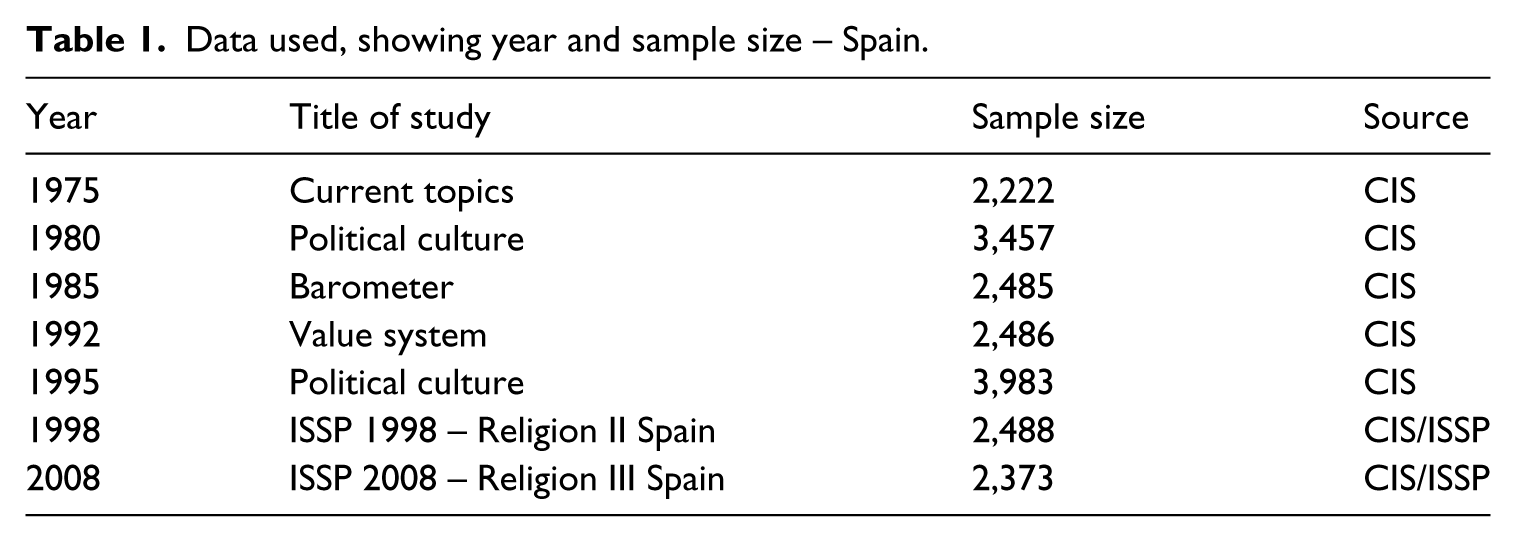
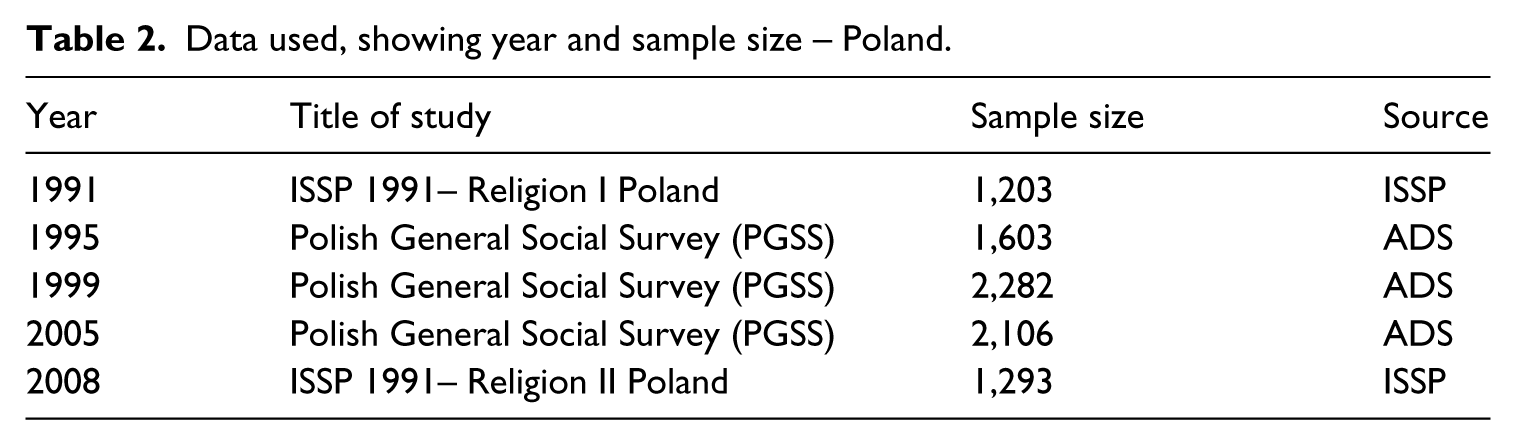
Given that the objective of this work is to compare the level of change in religiosity in Spain and Poland over time, the analyses will centre on estimating the period effect – that is, the magnitude of change observed between given points in time (Hagenaars, 1990). The information is taken from a series of cross-sectional data based on sample surveys. The data about Spain come from studies carried out by the Centre for Sociological Research (CIS) and cover the 1975–1995 period. In addition, in order to reconstruct the patterns of religiosity in Spain, retrospective data were used from surveys carried out for the International Social Survey Programme (ISSP) in 1998 and 2008. The data available for Poland cover the period from 1991 to 2008 and come from the Polish General Social Survey (Polski Generalny Sondaż Społeczny – PGSS), with the exception of the 1991 and 2008 studies, which were carried out within the ISSP 1 . The data sources were selected with the aim of creating a new comparative framework, so for each country four points were selected, separated by approximately regular intervals (between three and seven years).
Data used, showing year and sample size – Spain.
Data used, showing year and sample size – Poland.
The main method of analysis consists of estimating a series of logistic regression models in the data set for the indicated periods, using the year in which each of the studies was carried out as a reference point. The magnitude of the effect is estimated by comparing each reference point to the following point, maintaining other variables constant. The effect estimates are presented as average marginal effects (AMEs), which express the average variation in the probability of occurrence of the analysed phenomenon induced by a marginal change in an independent variable for each individual in the sample (Bartus, 2005). An appealing aspect of this measure is that it can be compared with similar models across different samples (Mood, 2010).
For theoretical as well as methodological reasons, the present analysis is based on religious practice, understood as taking part in mass. On the one hand, religious practice is one of the most conspicuous aspects of any religion, and it can be interpreted as a ‘ritual for maintaining the institutional creed’ (Pérez-Agote et al., 1993: 243). This makes it ideal for measuring change in church-oriented religiosity. On the other hand, using religious practice is relevant from the methodological point of view because, being the most visible aspect of religiosity, it is the easiest to research through surveys, producing the most reliable information relating to change over time. 2 This study identifies as practising Catholics those people who go to mass at least once a month, which is the criterion normally used in studies on religiosity (Müller, 2009).
In order to separate the effect of the change in political context from other structural factors, the regression models included a series of control variables representing age, sex, education and the size of the municipality in which the people surveyed resided. The secularization thesis predicts that urbanization and a general increase in the level of education are crucial factors in the diminishing social significance of religion (Wallis and Bruce, 1998). Indeed, the transformations in the general level of education and the processes of urbanization in Spain and Poland throughout the second half of the 20th century could be considered major determinants of religious change in both countries. In addition, there is extensive empirical evidence that age and sex continue to determine the differences in levels of religious participation in modern societies (Tilley, 2003).
Empirical findings
General trends before and after the political transitions
The reconstructions of religious patterns presented in Figures 1 and 2 3 indicate that throughout the 20th century there were changes in levels of religiosity in both Spain and Poland. Throughout the period analysed the proportion of practising Catholics was significantly higher in Poland than in Spain. 4 In the period from 1945 to 1950 the percentage of practising Catholics in Poland was 20 points higher than in Spain. Over the following 30 years, the difference continued to increase, reaching 25% in the five-year period from 1971 to 1975. In Spain, during the period from 1931 to 1975 the proportion of practising Catholics diminished from 70% to 58%. It should be noted that between 1931 and 1955 the percentage was relatively steady at 70%, with the exception of the five-year period from 1941 to 1945, in which there was a slight increase to 74%. This upturn could be considered a reflection of the political context of the post-war period in Spain, which was marked by the sacralization of public and private life and an increase in political repression. It is not until after 1955 that the percentage of practising Catholics gradually diminished, dropping to 60% in the following decade.
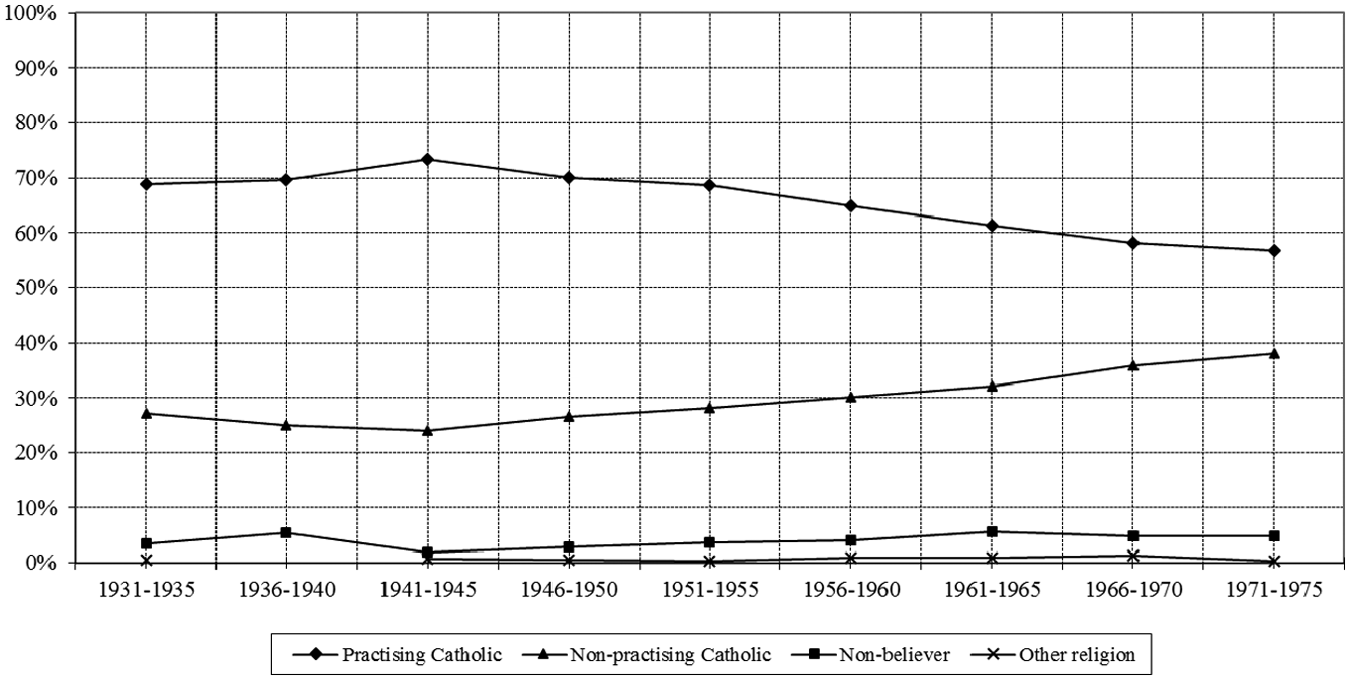
Religious change in Spain – backward projections.
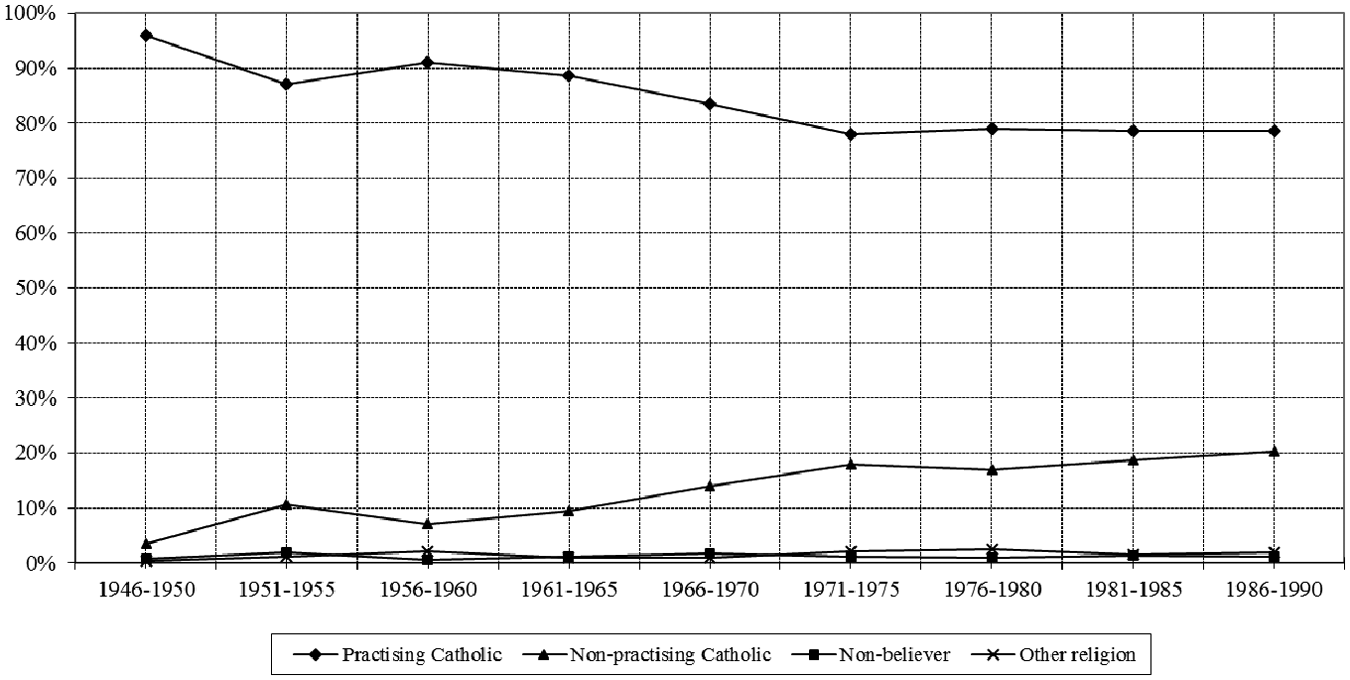
Religious change in Poland – backward projections.
Just as in the Spanish case (but in the opposite direction), the backward projections for Poland reflect the impact of ideological and political repression on religiosity during the Stalinist period. From 1951 to 1955, during the surge in political and religious persecution, there was an 8% decrease in the proportion of practising Catholics, followed by a slight recovery in the following five-year period. In the latter half of the 1970s, there was a decrease in religious practice, which continued in the ten years from 1975 to 1985, with a more than 10% drop. However, in the following years, until the end of the 1980s, the percentage of practising Catholics remained stable.
The change in the patterns of religiosity in Spain, which could already be detected in the 1960s, increased in the second half of the 1970s. The data from the CIS surveys presented in Figure 3 indicate that from 1975 to 1995 the proportion of practising Catholics reduced from 58% to 40%. At the same time it must be noted that religious change did not occur uniformly. Periods in which religious change was especially intense were followed by phases of relative stability. In the first few years after the end of the Franco dictatorship there was an especially sharp change in the level of religiosity among the population: from 1975 to 1980 the percentage of practising Catholics decreased from 58% to 48%. During the 1980s, this percentage dropped even further, to 42% of the population. And while secularization continued in the following ten-year period, it did so more gradually. In Spain, the decrease in the practising Catholic population is linked to an increase in the percentage of non-practising Catholics and an increase in non-religious people. In the period covered by this study, the proportion of non-religious people (atheists, agnostics and people indifferent to religion) increased from 2% to 14%. In short, the data suggest that democratization, the establishment of religious freedom and the change in the institutional position of the Church accelerated the processes of secularization that had begun in prior decades.
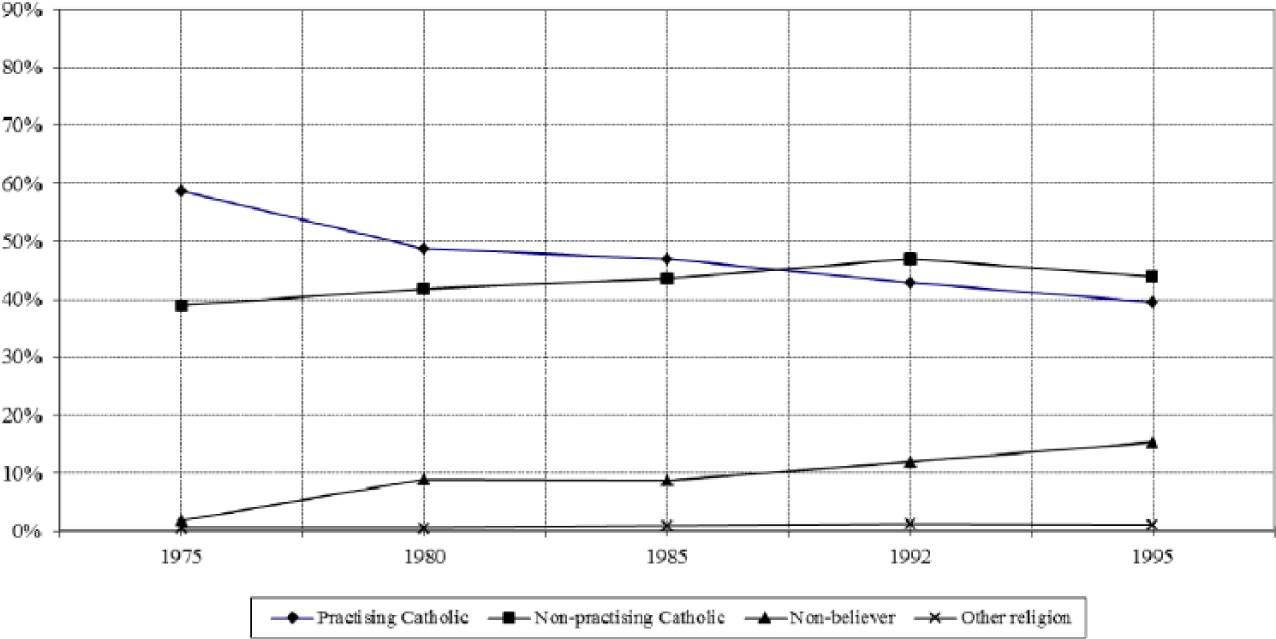
Change in the proportion of practising and non-practising Catholics in Spain 1975–1998.
Religiosity tended to decrease in Poland (Figure 4) during the 1990s, the most intense period of political and economic change, in clear contrast to the phenomenon of religious revival that occurred in some of the ex-Soviet Bloc countries (Gautier, 1997; Tomka, 2011): in the last decade of the 20th century, the percentage of practising Catholics decreased from 78% (in 1991) to 70% (in 1999), the greatest change occurring in the last five years of that decade. Furthermore, the data indicate that during this period religious change involved not only a relative decrease in religious practice among Catholics, but also an increase in the number of people who did not identify with any religion. In the first few years of the 21st century, the percentage of practising Catholics stabilized; it began to fall slightly in 2005, from 70% to 67% three years later.
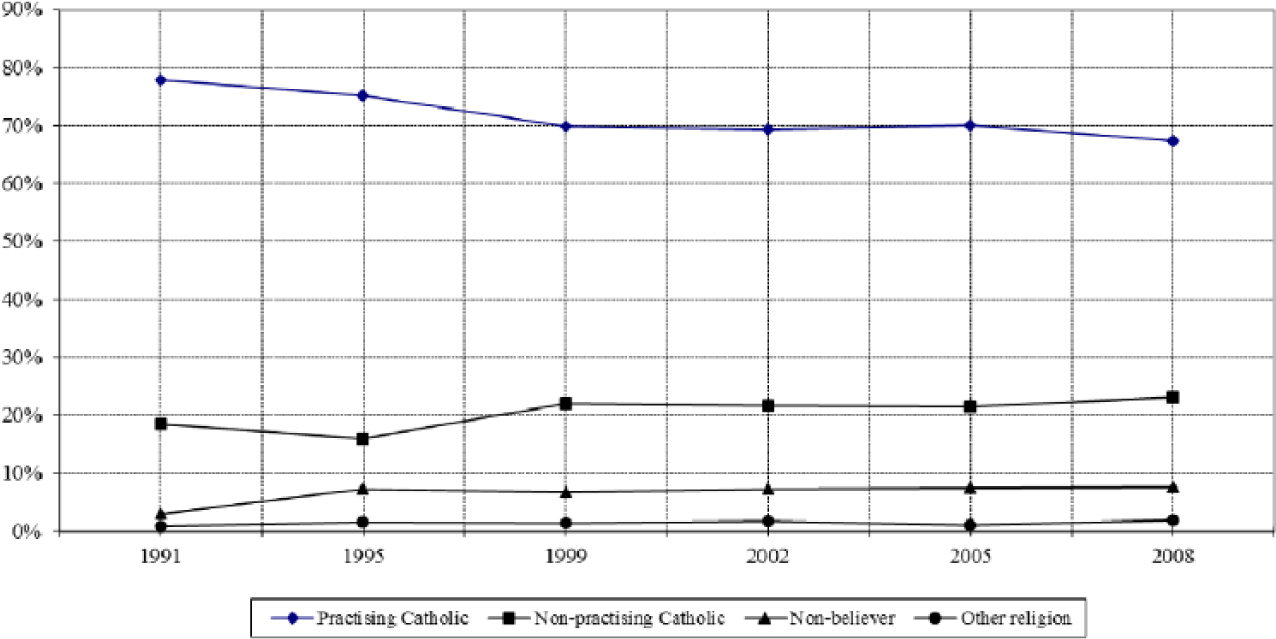
Change in the proportion of practising and non-practising Catholics in Poland 1991–2008.
Multivariate analysis of the period effect
The results presented so far in this study have been primarily based on a bivariate analysis, which has allowed the general tendencies of religiosity to be identified. However, the descriptive and explicative capacity of this exercise is limited because it does not allow the effects of political change at specific historical moments (period effect) to be analytically differentiated from other determinants that intervene in religious change. In order to overcome this limitation a series of statistical analyses were carried out based on a logistic regression for each country in which the magnitude of change in religious practice was estimated, using the years in which the studies were carried out as reference categories for each model. The models include sex, age, education and the size of the municipality of residence as control variables. The distribution of the variables included in the model is presented in Table 3.
Descriptive statistics for the dependent and independent variables included in the logistic regression models.
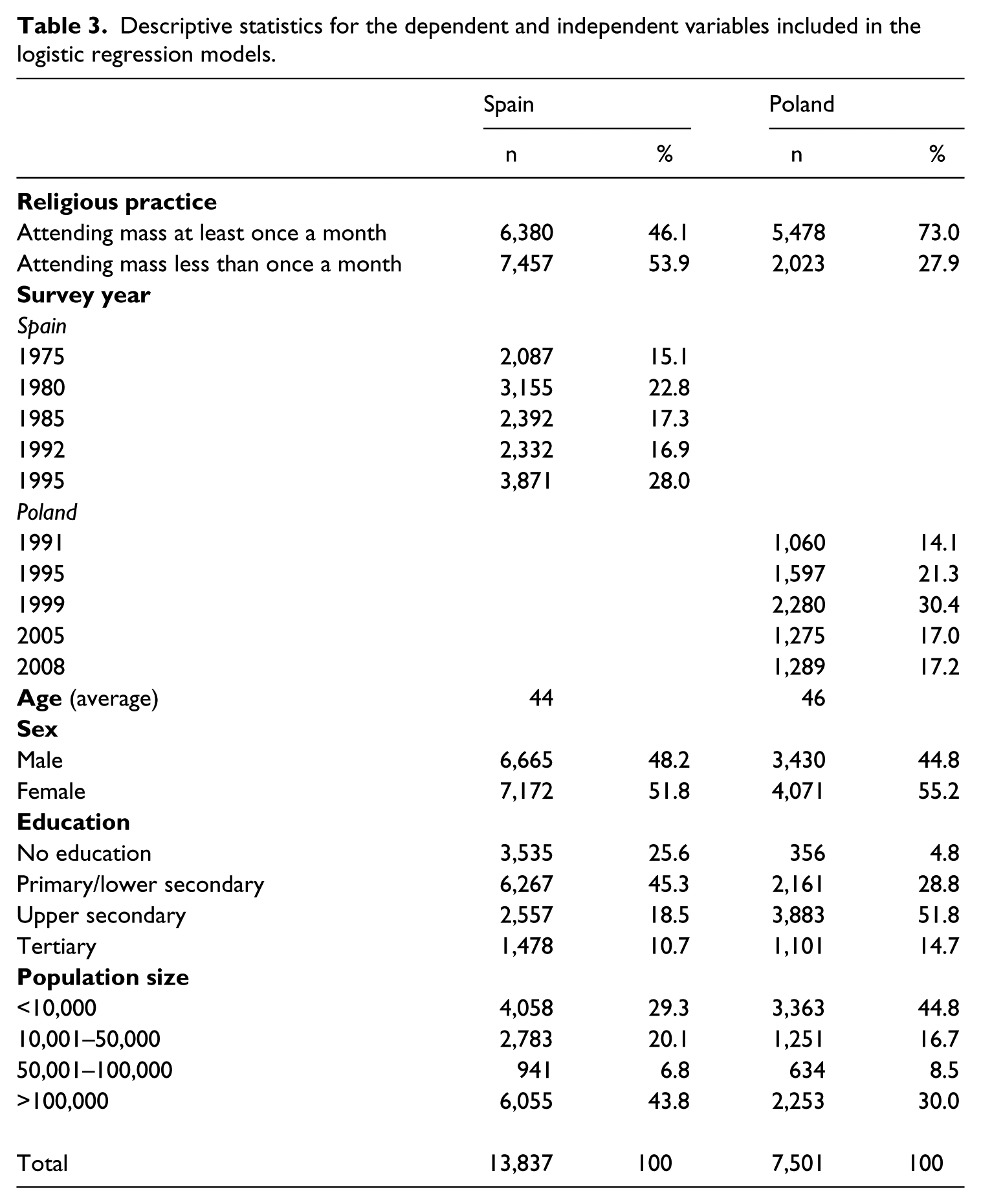
Table 4 represents the group of average marginal effects (AMEs) for Spain, estimated from the logistic regression models. The bold values represent the relative variation in the probability of attending mass at least once a month from the following year in the study. The results of the analysis show that if the effects of cohort, education, size of municipality and sex are maintained constant, in the period from 1975 to 1980 there was a statistically significant variation in religious practice. During this five-year period the probability of attending mass regularly, measured in terms of AMEs, diminished by 9% in the entire population when holding all other factors constant. The results reveal that democratic transition, the decreased power of the Church in the public sphere and the establishment of freedom of worship further stimulated the processes of secularization that had already been observed in prior decades. The period effect of political change is clearly confirmed if we compare the results for the period between 1975 and 1980 with the results obtained for later intervals. The period effects diminish very clearly over time, from a yearly rate of -2% in the period 1975–1980 to -0.6% (1980–1985), -0.5% (1985–1992) and -0.3% (1992–1995).
Probability of attending mass at least once a month in Spain. Average Marginal Effects after logistic regression.
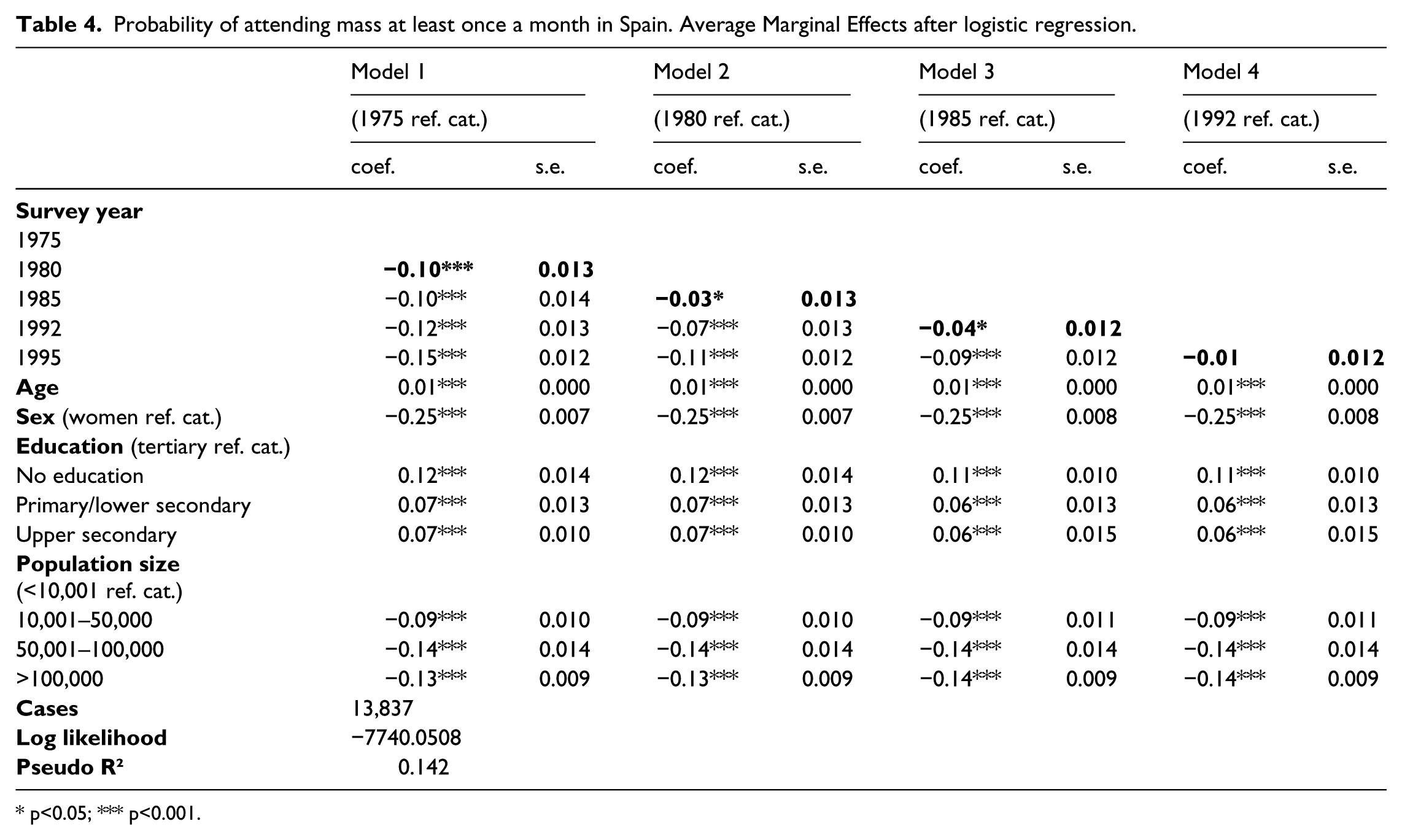
p<0.05; *** p<0.001.
Our data indicate that the effect of the political and social changes in Poland on levels of religiosity followed a different pattern. The AME estimates presented in Table 5 indicate that in the period immediately following the fall of communism there was no variation in religious behaviour if we hold other factors constant. In the first half of the 1990s, there were no statistically significant variations in religious behaviour. These data contrast with the estimates for the second half of the same decade, in which the probability of attending mass declined by 8%. From 1999 to 2005 there was some stability in Polish religious practice, although it continued to drop after 2005.
Probability of attending mass at least once a month in Poland. Average Marginal Effects after logistic regression.
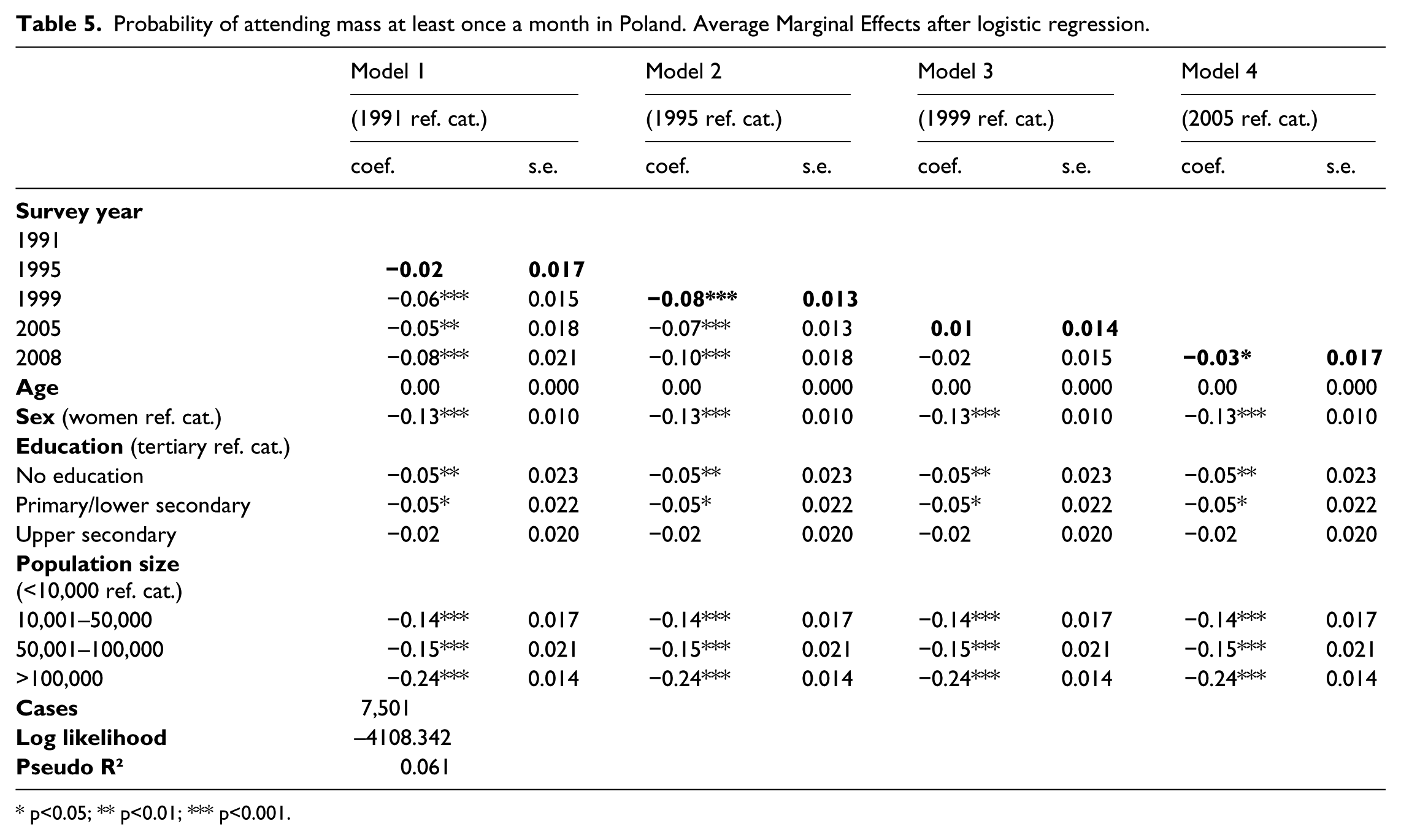
p<0.05; ** p<0.01; *** p<0.001.
Discussion and conclusions
This work compares the religious changes that occurred during and after the political transitions in Spain in the second half of the 1970s and Poland at the start of the 1990s. The working hypotheses were based on a theoretical perspective framed by the secularization paradigm proposed by David Martin (1978; 2011): the involvement of the Catholic Church in internal or external conflicts is a crucial factor in the evolution of religious beliefs and behaviour. First of all, we expected a strong decrease in religious practice in Spain in response to the transition from the Franco dictatorship to democracy. Second, we predicted a weaker change in Poland in response to the transition from totalitarian communism to liberal democracy.
The analyses of the data available reveal sharp differences in the patterns of change in the levels of religiosity in the two societies over time. The backward projections of Spanish and Polish religious practice indicate that these differences are historical, reflecting the position of the Church and the role of Catholicism in the political processes of both countries. In Spain, a relatively strong presence of irreligious attitudes can be observed even during periods in which political and religious repression by the Franco regime was most intense, that is, in the 1940s and 1950s, periods in which about a third of the population did not attend mass with regularity. In contrast, religious practice was deeply rooted in a large part of Polish society. The high percentage of non-practising Catholics in Spain (at least when compared with Poland) can be interpreted as a reflection of the underlying social rupture caused by internal social and political conflicts. On the other hand, the religious homogeneity and high levels of religious practice in Poland maintained throughout the communist period confirm the function of Catholicism as part of the ideology of national unity and the position of the Catholic Church as a unifying institution.
The results of the multivariate statistical analysis confirm that political transition established a new social and political context in both countries. Given the different positions of the Catholic Church within the political systems of the two countries during the authoritarian era, considerable differences can be observed in the effect of the changing political context caused by the democratic transitions in Spain and Poland. The logistic regression models used in the Spanish case, in which the influence of other possible determining factors is controlled for, reveal a significant decrease in religious practice during the first five-year period after the death of Franco, confirming our starting hypothesis. In other words, the period effects, which affect the entire population regardless of possible variables related to other contextual factors, are more intense in historical moments in which the Catholic Church breaks its ties with the political regime and a non-denominational democracy is established. In the Spanish case, this decrease in religiosity accentuated the process of secularization that had begun at the end of the 1950s and has persisted until today (Requena, 2005).
Analyses of the effect of the political and social transformation on religiosity in Poland reveal a more ambiguous and complex pattern of social change. In the period just after the fall of the communist system, there were no significant variations in levels of religiosity in Poland, which concurs with the hypothesis of the persistence of the Church’s prestige and influence in the early stages of the transition. However, by the second half of the 1990s there was a significant decrease in regular religious practice. The variability in Polish patterns of religious practice is explained by the tension between religious and secular political orientations that arose after the democratic transition and was related to the role of Catholicism and the ethical model defended by the Church in the new Polish political system. The Church became one of the agents in the process of consolidating the democratic system and intervened in the configuration of its ideological foundations throughout the 1990s. The confrontation between the religious and secular ideological currents was particularly intense in relation to the reform of the law regulating abortion, the role of religious education in the public school system and the formulation of the new constitution in 1997 (Borowik, 2002; Mach, 2000).
The Catholic Church’s involvement in Polish public debate during that period caused discontent and opposition in many sectors of public opinion and led to an increase in anti-clerical attitudes (Mach, 2000). Public opinion polls indicated that at the beginning of the political transformation in Poland more than 90% of society accepted the Catholic Church’s involvement in the public sphere; but as the process of political and social change advanced, there was an increase in the percentage of people who had a negative view of its involvement in political life (Burdziej, 2005). Nevertheless, since 2005 there has been a slight decrease in the levels of religious practice. In summary, the fluctuations in the levels of religious practice in Poland and Spain during the democratic transition indicate that the process of religious change was closely linked to the tensions that arose from the creation of a new state model – tensions that were considerably greater in Poland than in Spain.
In conclusion, it can be stated that these are two different political and social dynamics: the ideological polarization in Spain clearly contrasts with the strong religious cohesion in Poland. One of the keys to understanding these differences is the role played by the Catholic Church in the political processes of the last few decades. While in Spain the relationship between the authoritarian regime and the Church was characterized by mutual dependence and collaboration, in Poland Catholicism was a crucial component of the ideology of national unity and resistance to an external threat; the Church was the principal (and in some periods the only) institution that supported and assisted the development of political opposition movements. These are the reasons why democratization has had a very different impact on religiosity in the two societies. In Spain, the establishment of freedom of worship had a significant influence on the intensity of the secularization process. In contrast, in Poland the prestige of the Catholic Church and the central position of Catholicism in the national imaginary persisted in the first few years following the democratic transition. However, in the new political and social context of a sovereign State under the rule of law that guarantees the basic liberties of its citizens, the unifying role of the Church weakened. In other words, after the 1990s a new process of differentiation began between the Church and Polish society.
Footnotes
Funding
The authors would like to acknowledge the support of research grant (25.102.462-M.481) awarded to Mikolaj Stanek by the Spanish Centre for Sociological Research (Centro de Investigaciones Sociologicas).
Notes
Biographies
Address: Department of Sociology II (Social Structure); UNED, C/ Obispo Trejo s/n, 28040, Madrid, Spain
Email:
Address: Colégio de S. Jerónimo Largo D. Dinis Apartado, 3087 3000–995, Coimbra, Portugal
Email: