




Abstract
Catalonia is simultaneously the most secular region in Spain and the region that places the greatest priority on actively managing religious affairs. Moreover, parties comprising the Catalan Left have been particularly assertive in pushing for legislative proposals to reduce the privileges of the Catholic Church and the general presence of religion in the public sphere. This article examines the sources of Catalonia’s exceptionality in religious matters, with a focus on the entanglements between religion and nationalism in the region. Drawing on survey data, legal documents, transcripts of parliamentary debates, media reports, and historical studies, the author argues that counter-state understandings of nationhood have figured centrally in the rapid secularization of Catalonia’s populace, the Catalan government’s proactive approach to religious governance, and the Catalan Left’s insistence on church–state reform at both the regional and national levels. This analysis speaks to broader questions regarding religion, secularism, and nationalism in stateless nations.
Introduction
Three principal features of Catalonia distinguish it as exceptional within Spain in regard to religious matters. The first is that, by virtually all measures, Catalonia’s general populace is the most secular in the country. With respect to religious identification and practice, Catalonia resembles northern European nations more so than Spain, Portugal, or Italy. Second, Catalonia’s government has prioritized religious affairs more than any other regional government in Spain. Specifically, it has established its own Directorate General of Religious Affairs, signed bilateral agreements with religious and secularist organizations, and developed its own legislation for regulating places of worship (Griera, 2016). No other regional government has been as involved as Catalonia’s in documenting, regulating, and accommodating religious diversity. Third, parties comprising the Catalan Left have been particularly assertive in pushing for legislative proposals to reform church–state relations at the national level. Drawing on survey data, legal documents, transcripts of parliamentary debates, media reports, and historical studies, this article explores the sources of Catalonia’s exceptionality with respect to religious affairs. My analysis engages with broader questions regarding religion, secularism, and nationalism in stateless nations.
Religion and counter-state nationalism
Bruce (1996) has noted that religion tends to be undermined by processes associated with modernity ‘except when it finds some major social role to play other than mediating the natural and supernatural worlds’ (p. 96). One such role is that of defending national identity and culture. The religious dynamics characteristic of contexts like Poland, Greece, and Ireland attest to the power and influence religious actors may reap through their involvement in defending national religious traditions against rival ideologies viewed as foreign impositions (Halikiopoulou, 2011; Martin, 1978). The fusion of religious and national belonging augments the valorization of religious identities and symbols by the observant and non-observant alike (Demerath, 2000), and helps sustain religion’s persistence as a form of cultural identity and heritage in secularizing contexts (Hervieu-Léger, 2000). By the same token, developments that undermine the link between religion and nation where it once existed, such as indignation at ecclesiastical abuses, may accelerate secularization by complementing gradual religious erosion with active political rejection, and by depriving religious institutions of a key pathway for extending their raison d’être beyond the religious sphere (Requena and Stanek, 2013).
When analysing the relation between religion and nationalism, it is critical that scholars be attentive to whether the form of nationalism in question is state-framed or counter-state. Whereas state-framed understandings of nationhood conceive the nation as congruent with the state, counter-state understandings such as those characteristic of Catalonia and other stateless nations are ‘conceived in opposition to the territorial and institutional frame of some existing state or states’ (Brubaker, 1998: 300). The degree to which religion becomes fused with counter-state understandings of nationhood depends, in large part, on whether religious difference serves as a marker of (sub)national distinction. In Canada, for instance, the preponderance of Catholicism among the majority in Quebec and Protestantism among the broader Canadian majority has contributed to articulations of nationhood that foreground Quebec’s Catholic heritage (Burchardt, 2017; Zubrzycki, 2016).
To be sure, the absence of clear denominational differences separating populations with contrasting visions of the nation does not necessarily preclude religion from serving as a marker of (sub)national distinction, as differences in religiosity (i.e. doctrinal interpretation or devoutness) may play an equally important role in this respect. This is particularly evident in the case of Islamic radicals associated with ISIS, al-Qaeda, and other groups that appeal to fundamentalist interpretations of Islam when justifying their counter-state political projects and aggression against fellow Muslims (Mahood and Rane, 2017). Under most circumstances, however, the absence of denominational boundaries separating groups with distinct visions of the nation tends to mitigate the significance of religion as a marker of (sub)national distinction.
In Spain, the overwhelming preponderance of Catholicism as the religion of the majority in territories with long-standing counter-state understandings of nationhood, such as Catalonia and the Basque Country, has impeded religion from becoming a core part of (sub)national identity, symbology, and discourse (Burchardt, 2017). Instead, other cultural markers, most notably language and also folk traditions, have taken on greater prominence as markers of (sub)national distinction. Dynamics of ‘cultural defence’ (Bruce, 1996; Martin, 1978) have consequently played little role in stemming the tide of secularization in these regions, as such dynamics centre mainly on language and other aspects of culture. Indeed, the traditional centrality of Catholicism to Spanish identity and the historical proximity of the Church to repressive political regimes have damaged the image of Catholic institutions and accelerated secularization, especially in minority nations. As explained below, this is critical for understanding the relatively high levels of atheism and agnosticism in Catalonia, as well as the virtual absence of references to religion in current nationalist discourse.
Atheism, agnosticism, and other forms of secular identification are not the only responses to religion that may be buttressed by counter-state nationalism in contexts where the state has historically had strong ties to a particular faith. Counter-state understandings of nationhood may also motivate conversion to rival traditions or experimentation with ‘new-age’ spiritualities. 1 During the 1970s and 1980s, for example, a number of activists involved in Andalusia’s struggle for (sub)national autonomy gravitated towards Islam, as the region’s Islamic heritage facilitated claims to cultural distinctiveness and special political rights amid Spain’s democratic transition. Idealized representations of interreligious coexistence (convivencia) during the period of al-Andalus also provided a historical basis for challenging exclusionary understandings of the nation advanced as part of Franco’s ‘National Catholicism’. This is key for understanding the expansion of the Islamic Murabitun movement, a Sufi-inspired movement of converts, in southern Spain (Dietz, 2004; Verkaaik, 2013).
In addition to influencing religiosity in stateless nations, counter-state understandings of nationhood may impact political and institutional approaches to governing religious affairs. Although such understandings have accelerated secularization and the decline of religion as an element of personal and collective culture in Catalonia, they have simultaneously contributed to the emergence of a relatively active and interventionist political approach to regulating religious issues. As argued below, the entwinement of religious governance with the politics of counter-state nation building has played a crucial role in generating impetus for the establishment of Catalonia’s legal and institutional architecture for managing religious affairs (cf. Griera, 2016).
Religious indicators in Catalonia
Catalonia’s high degree of secularity vis-à-vis other Spanish regions is evidenced by a multiplicity of indicators. Just 51% of Catalans currently identify as Catholic, a proportion substantially lower than the national average of 67%. Of those who identify as Catholic in Catalonia, 73% report ‘almost never’ attending church, compared with 63% of Catholics in Spain and 42% of Catalans identify as atheists or non-believers, compared with 27% of Spaniards as a whole (Figure 1).
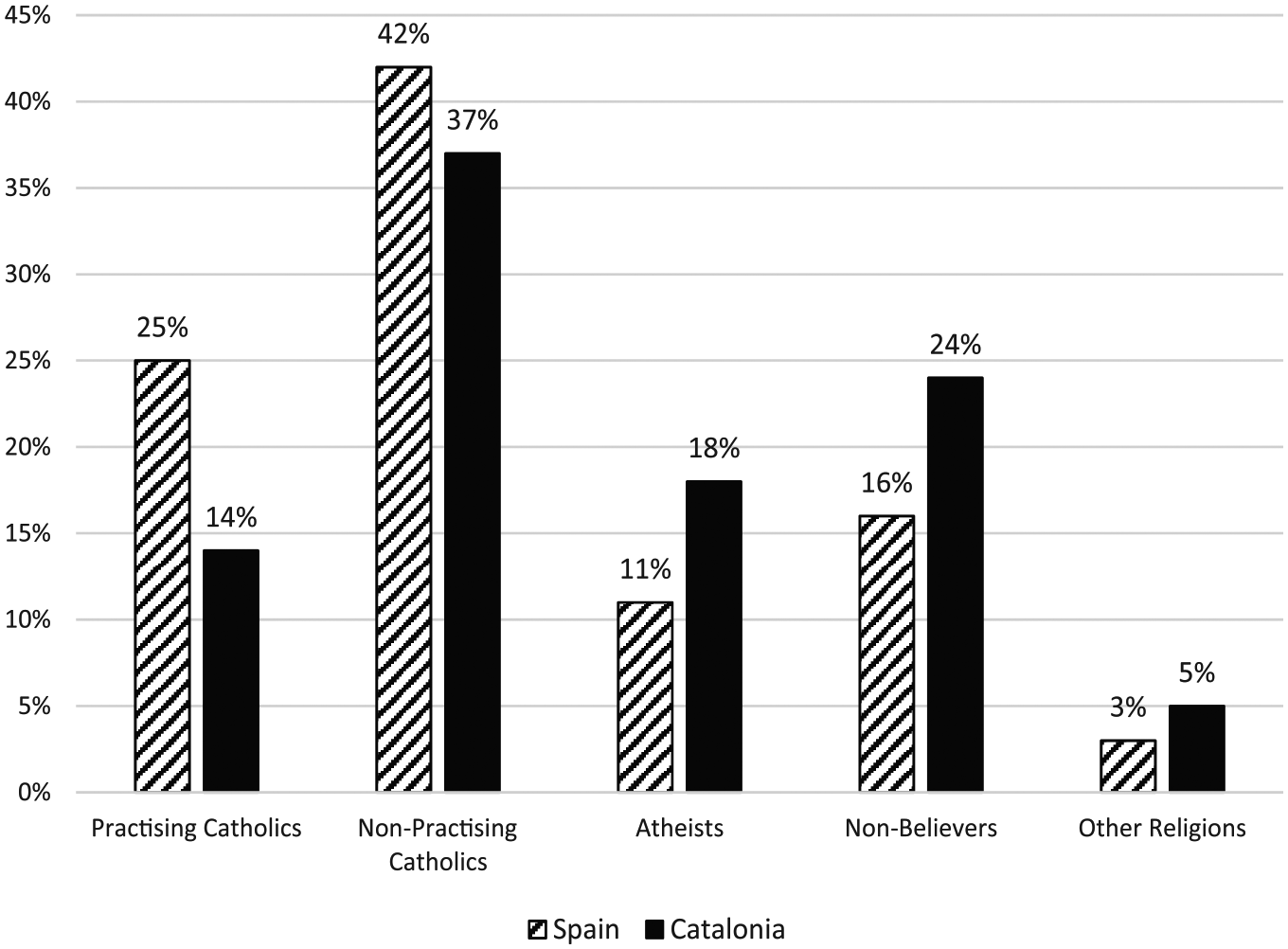
Religious identity in Spain and Catalonia.
As illustrated by the logistic regression model presented in Table 1, the negative relation between residence in Catalonia and Catholic identification remains significant, even when controlling for size of municipality, age, education, and socioeconomic status. Hence, secularism in Catalonia is not a simple story about Catalans being more urban, younger, more educated, and of higher class standing than other Spaniards.
Logistic regression model for Catholic identification in Spain (N = 27,009).
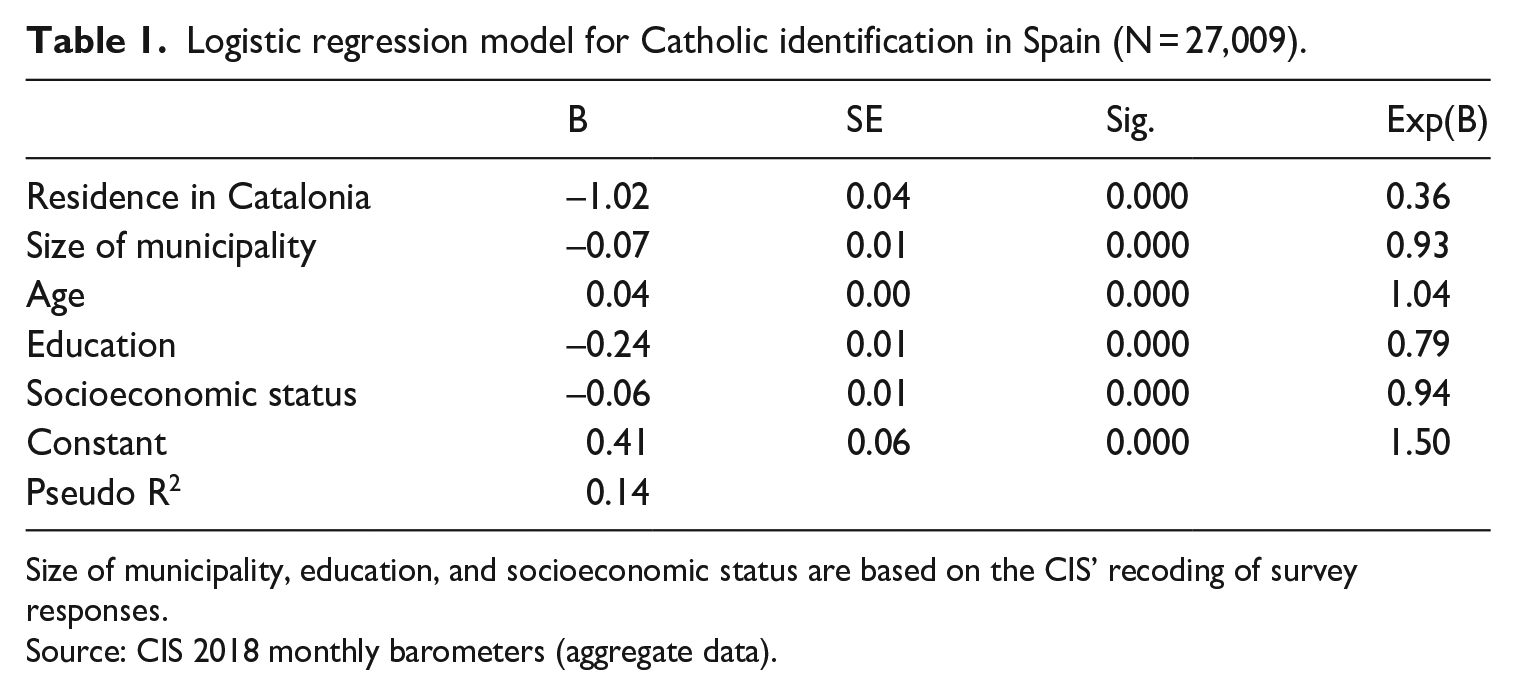
Size of municipality, education, and socioeconomic status are based on the CIS’ recoding of survey responses.
Source: CIS 2018 monthly barometers (aggregate data).
In the Spanish public-school system, parents have the option of signing their children up for classes on Catholicism or a secular alternative. The proportion of parents who choose the Catholic option is lowest in Catalonia. For the 2016 to 2017 school year, 18% of public primary school students in Catalonia were registered for courses on Catholicism, compared with 57% in Spain as a whole. Just 10% of Catalan secondary school students were registered for courses on Catholicism, compared with 45% of Spanish students (Ministerio de Educación y Formación Profesional, 2018). 2
Inhabitants of Catalonia are also the least likely in Spain to direct a portion of their taxes to the Church. When paying taxes, Spaniards have the option of allocating 0.7% of their taxes to the Church, other social purposes, both the Church and other social purposes, or the general budget. 3 In 2017, just 19% of Catalan taxpayers allocated a percentage of their taxes to the Church, compared with the national average of 34% (Agencia Tributaria, 2018). It is important to note, however, that although a relatively low proportion of Catalan taxpayers allocate taxes to the Church, the region as a whole is one of the largest contributors to the Church via tax assignments due to the relatively high earnings of its populace, especially in the Barcelona metropolitan area.
Perhaps the most striking indicator of the depth of secularism in Catalonia is the high proportion of civil weddings among marrying couples. In 2018, fully 91% of weddings in Catalonia were civil, while just 8% were Catholic. The Spanish averages, by contrast, were 79% civil and 19% Catholic. 4 The low proportion of Catholic weddings in regions across the country is indicative of the strong secularizing trends among Spanish youth and the decline of Catholic familial tradition.
Secularization in Catalonia
Secularization in Catalonia is rooted, in part, in the specificities of its industrial development. Like the Basque Country, Catalonia industrialized prior to other Spanish regions, setting in motion various developments associated with modernization and secularization, including social and structural differentiation, migration and urbanization, and rising individualism. During the late nineteenth and early twentieth centuries, the emergence of an urban elite critical of the monarchy and its ties to the Church, as well as the large concentration of workers in Barcelona and its surrounding metropolitan area, contributed to the rise of powerful anarchist, communist, and socialist movements that promulgated staunchly anti-clerical ideologies (Balcells, 1996; Dowling, 2013; Pérez-Agote, 2012). Early incarnations of anti-clericalism in Catalonia thus had a significant working-class dimension and were basically divorced from questions of (sub)national autonomy.
The ascension of Franco to power following the Civil War (1936–1939) and his regime’s forceful inculcation of Catholic identity, traditions, and values via ideological state apparatuses had a ‘levelling’ effect of sorts. While clandestine anti-clerical organizations persisted, they were severely weakened, and levels of religiosity in Catalonia became increasingly similar to those in the rest of Spain. According to a survey conducted in 1978 – 3 years after Franco’s death – 91% of inhabitants of Catalonia and the Balearic Islands identified as Catholic, a percentage roughly equivalent to the national average at the time. The proportion of the populace that identified as non-practising Catholics in the two regions (34%) was only slightly above the national average (31%). 5
As illustrated in Figure 2, the proportion of both Catalans and Spaniards identifying as Catholic has declined significantly since Spain’s democratic transition in the late 1970s. This decline, however, has been more rapid in Catalonia, especially since the 1990s. Both national- and regional-level factors account for these trends. At the national level, scholars have signalled strong cohort effects as crucial for explaining the decline of Catholic identification and practice throughout Spain. Generations born from the 1950s (and especially the 1960s) onwards tend to be significantly less religious than earlier generations, as they came of age during or after the transition. They were thus exposed at an early age to narratives condemning the Church for its support of the dictatorship (Requena and Stanek, 2013). They also had greater contact with alternative worldviews and values as a result of maturing during a period in which Spain was more open to the outside world (Pérez-Agote, 2012).
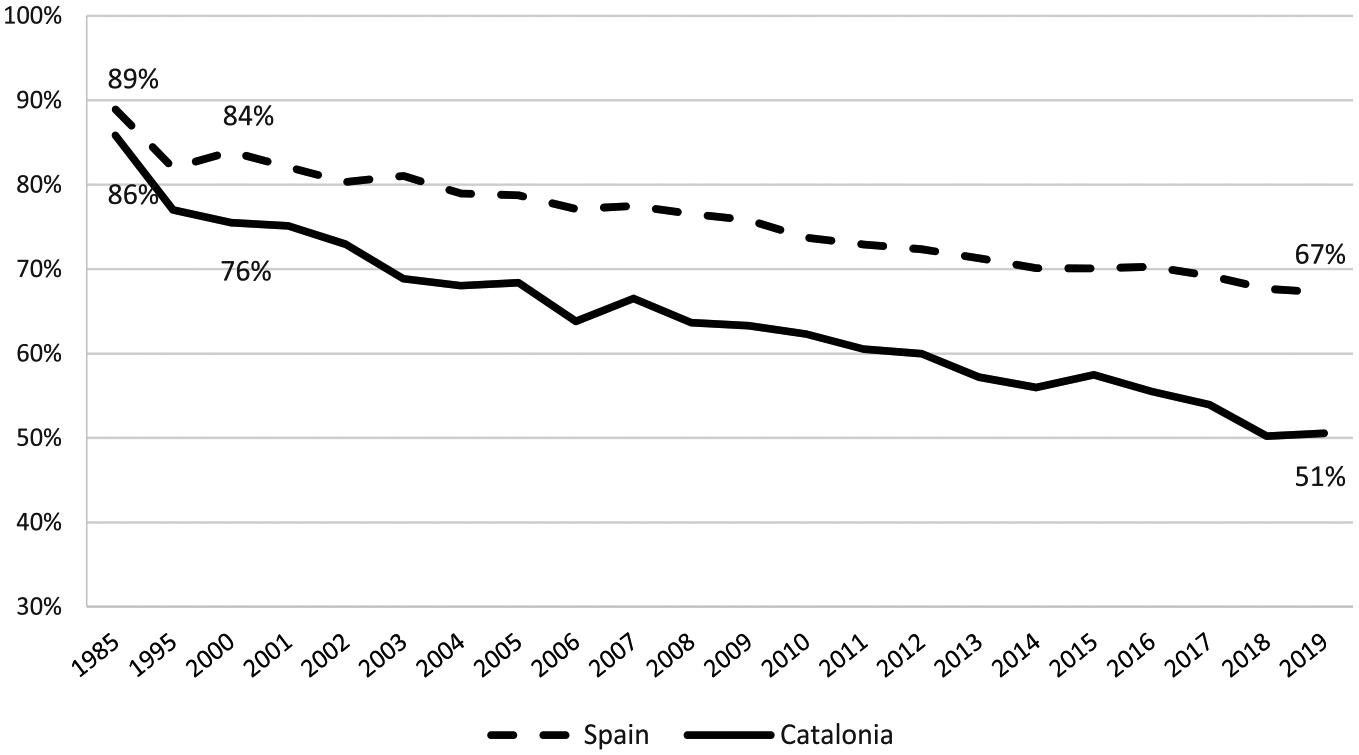
Proportion of Catalan and Spanish populations identifying as Catholic.
It might be argued that bitterness towards the Church is particularly potent in regions like Catalonia and the Basque Country due to Franco’s severe repression of (sub)national identity in the two territories and the perceived complicity of the Church in this process. Although there may be a kernel of truth to this argument, it is important to note that a number of Catholics in Catalonia played an important role in defending and preserving Catalan culture during the dictatorship. The Abbey of Montserrat and Catholic publishing houses such as Nova Terra and Estela supported the publication of both religious and non-religious texts in Catalan. Catholic actors also promoted pro-Catalan religious associations and gave refuge to political dissidents (Guibernau, 2004). Towards the end of the dictatorship, Catalan Catholic leaders were among the most vocal proponents of democratic transition, and several prominent Catalan politicians during the post-transition period had strong ties to Catholic movements and orders (Costa, 1993). The presence of progressive elements within Catalan Catholicism mitigated anti-clerical sentiment and facilitated the emergence of an influential Christian democratic party whose political offshoots remain a significant part of the political landscape.
For these reasons, the strong secularizing trends characteristic of Catalonia likely have less to do with vehement anti-clericalism and rejection of ecclesiastical institutions per se, and more to do with general perceptions of Catholicism as conservative, outmoded, and quintessentially Spanish. Spain’s democratic transition afforded greater space for the expression of Catalan (sub)national identity, facilitated claims for political autonomy, and generated enthusiasm for the development of a more modern and plural nation. Counter-state nationalist mobilization and the rejuvenation of Catalan identity have subsequently buttressed the general distancing of the Catalan populace from Catholicism, as well as other traditions viewed as prototypically Spanish, such as bullfighting. 6
The connection between national and religious identification in Catalonia is evidenced by survey data showing that just 45% of inhabitants in the region who describe themselves as ‘only Catalan’ or ‘more Catalan than Spanish’ identify as Catholic, compared with 68% of those who describe themselves as ‘only Spanish’ or ‘more Spanish than Catalan’. Inhabitants of Catalonia who feel equally Spanish and Catalan fall somewhere in the middle, with 55% self-identifying as Catholic (Table 2). Similar patterns may be found in the Basque Country and, to a lesser extent, in Galicia.
National identity and religious identification in Catalonia.
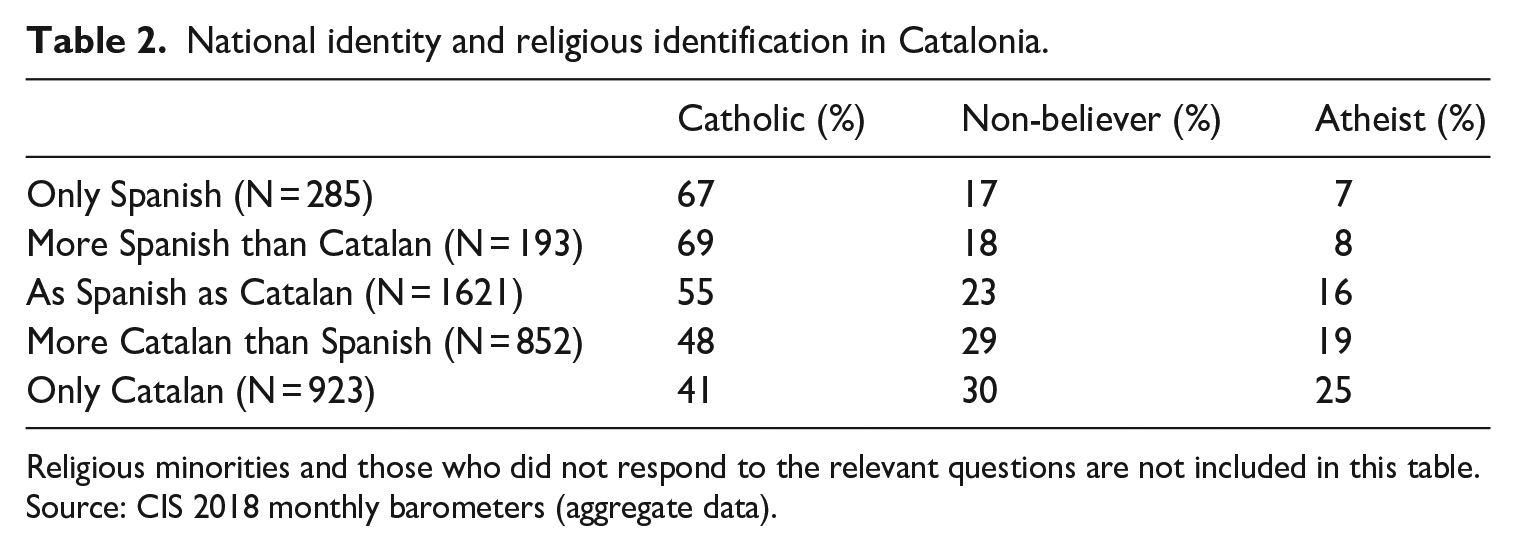
Religious minorities and those who did not respond to the relevant questions are not included in this table.
Source: CIS 2018 monthly barometers (aggregate data).
The relation between (sub)national and religious identification in Catalonia is complicated somewhat by the fact that Catalans lean more to the Left than most Spaniards (Figure 3). Moreover, those who feel more Catalan than Spanish tend to be more affluent and less ideologically conservative (Miley, 2006).
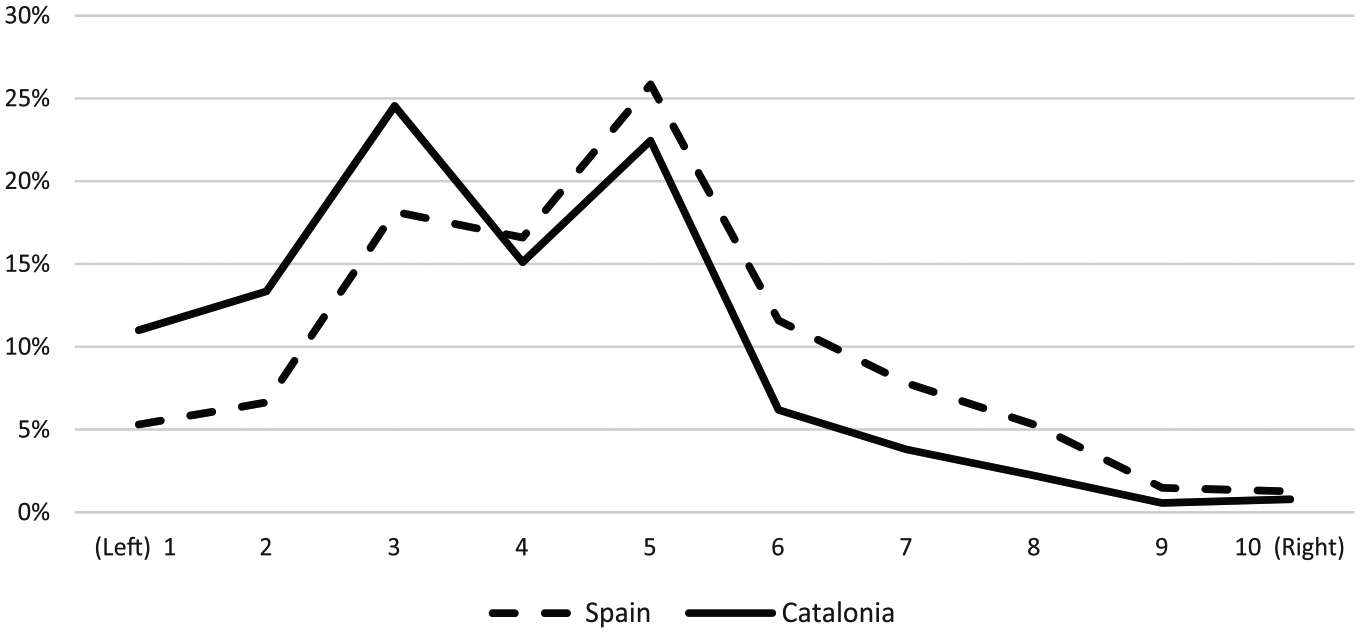
Ideological self-positioning in Catalonia and Spain.
Throughout Spain, there is a strong association between ideological self-positioning and religious identification, and Catalonia is no exception in this regard (Figure 4). The precise nature and direction of this association is somewhat ambiguous insofar as Catholic identity could plausibly be understood as either a cause or consequence (or both) of ideological conservatism.
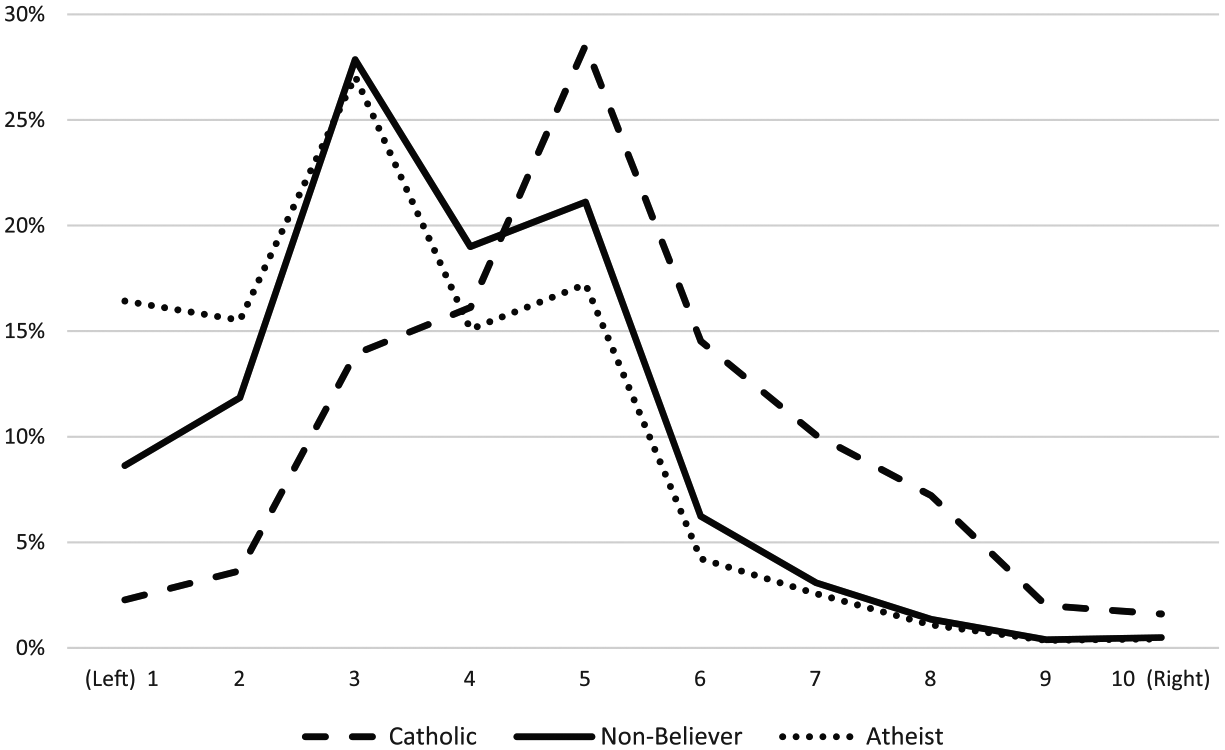
Ideological self-positioning and religious identity in Spain.
Although Catalans’ general ideological leanings have likely contributed to their secularity, the regression model presented in Table 3 and the predicted probabilities plot presented in Figure 5 demonstrate how, even if we control for ideological self-positioning and a host of other variables, including age, sex, education, and socioeconomic status, the relation between (sub)national and religious self-identification remains significant. The model presented in Table 3 provides rough insight into the general profile of Catholics in Catalonia. Specifically, they tend to feel more Spanish than Catalan, and to be more ideologically conservative, older, female, less educated, and of lower socioeconomic status.
Logistic regression model for Catholic identification in Catalonia (N = 3004).
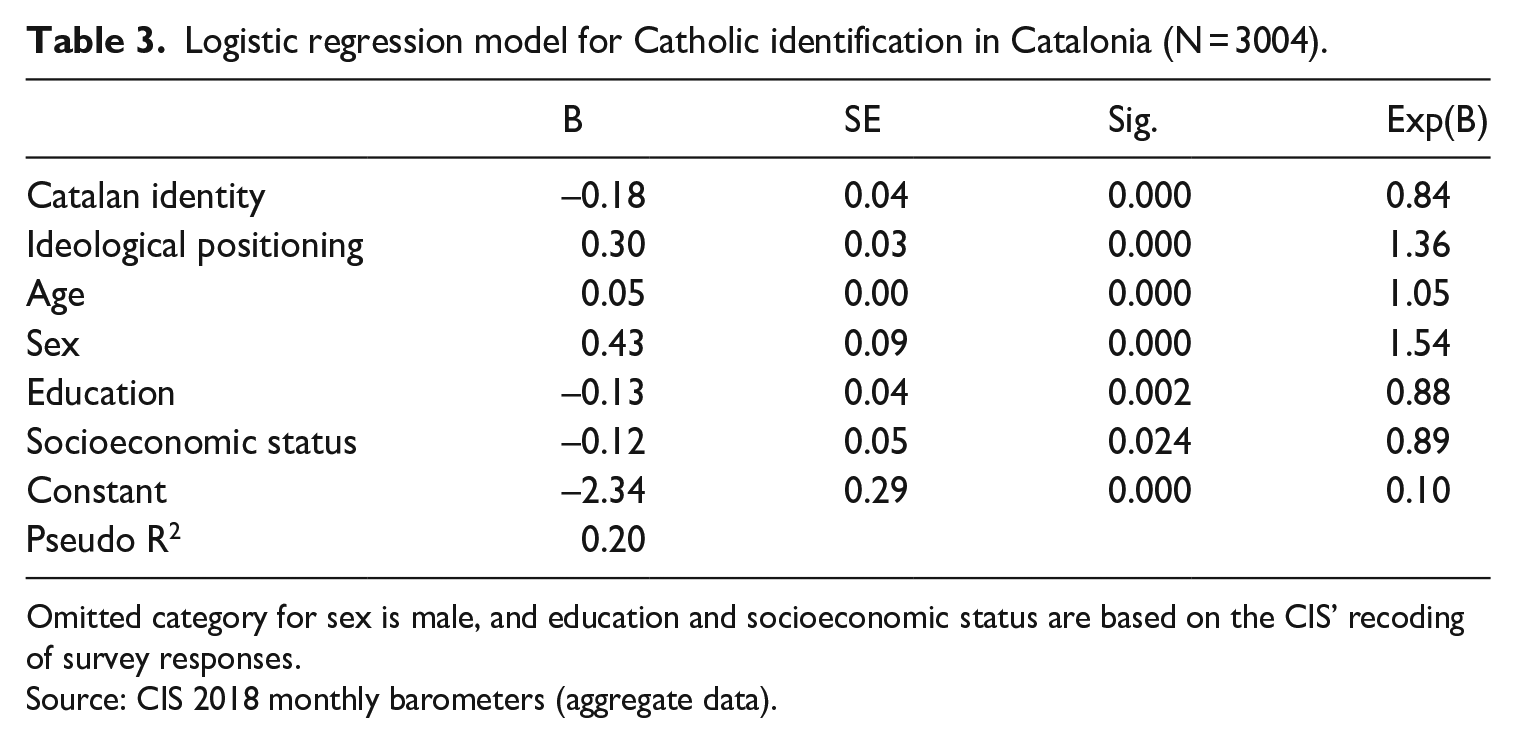
Omitted category for sex is male, and education and socioeconomic status are based on the CIS’ recoding of survey responses.
Source: CIS 2018 monthly barometers (aggregate data).
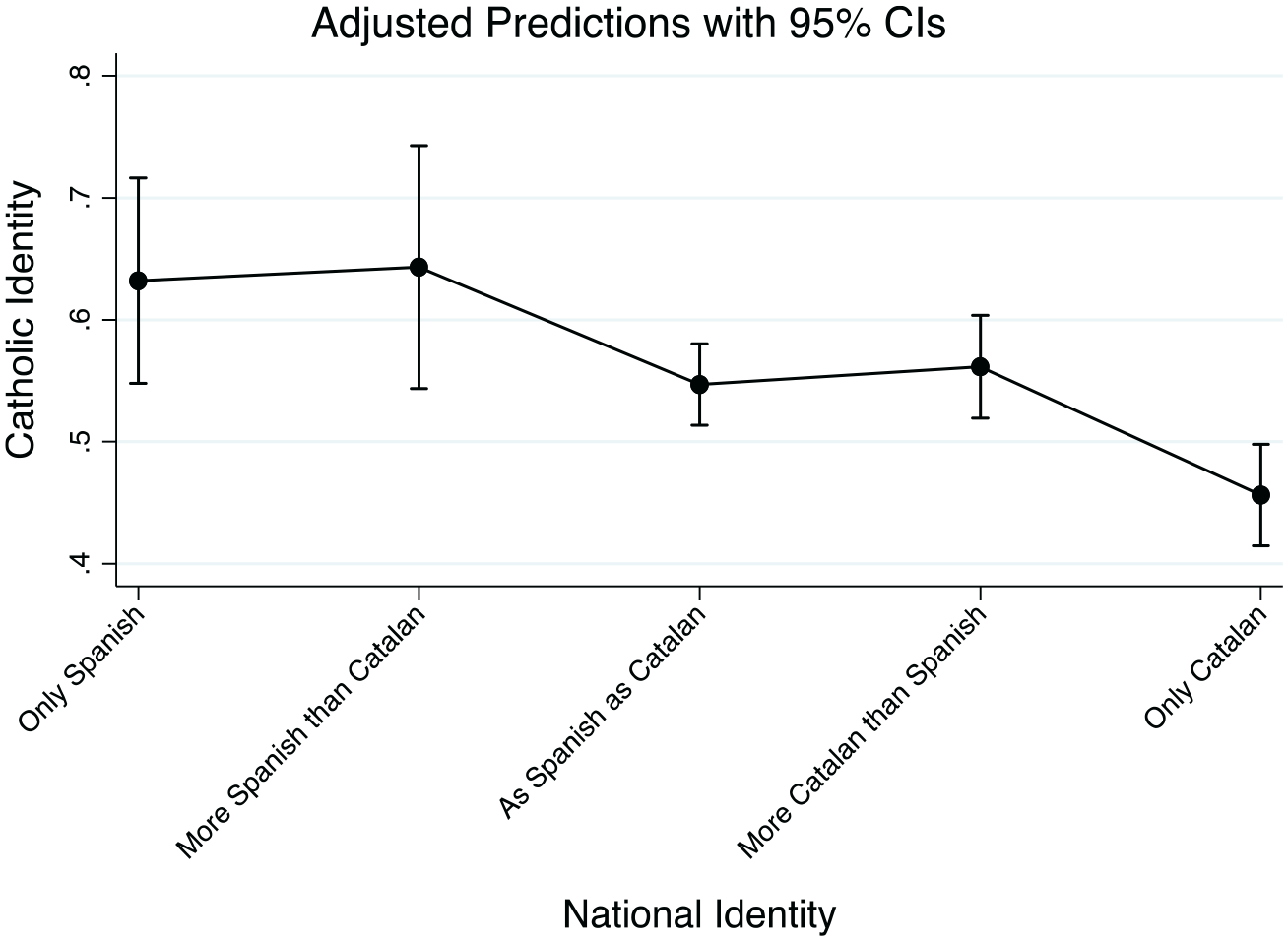
Change in the predicted probabilities of identifying as Catholic among Catalans with different national identifications.
Despite strong trends towards secularization, Catholicism’s deep historical enculturation in Catalonia has facilitated its persistence as a ‘diffused’ or ‘ambient’ faith embedded in the sensory environment and present as a cultural backdrop for public engagement (Cipriani, 2017; Engelke, 2013). The official calendar remains structured around Catholic holidays and commemorations of local patron saints. Public celebrations tied to Catholic tradition still attract a multitude of participants, old and young. Cathedrals and other religious structures remain the centrepiece of the built landscape of Catalan cities and towns. Religious symbols, such as the nativity scene, are displayed in emblematic public squares and thoroughfares, typically without major objection. An important question looking ahead is whether Catholic symbols and traditions present in the public sphere have become sufficiently ‘culturalized’, or divorced from their confessional moorings, to remain acceptable in the eyes of a populace whose ties to Catholicism and the Church continue to dissipate (cf. Astor et al., 2017; Joppke, 2018).
Counter-state nationalism and religious governance
Although religion has declined as an element of personal culture in Catalonia, the Generalitat (Catalonia’s government) has prioritized the governance of religious affairs more than any other regional government in Spain. Catalonia’s 2006 Statute of Autonomy, which establishes its self-government rights, includes an entire article (#161) on ‘relations with religious entities’. The article, the likes of which are not present in other such statutes in Spain, entitles the Generalitat to ‘exclusive competency over matters of religious entities that carry out their activities in Catalonia’, as well as ‘executive competency in matters related to religious freedom’ (Boletín Oficial del Estado, 2006: 27298). Authority over religious affairs is thus seen as integral to the right to self-govern.
As mentioned above, Catalonia is the only region with its own Directorate General of Religious Affairs (DGAR). The DGAR, a sub-section of the Department of Justice, was initially established in 2000 as the Secretariat for Relations with Religious Confessions. Its creation responded to a popular campaign aimed at securing the Vatican’s nomination of bishops of Catalan origin to fill new vacancies in Catalonia, as well as pressure from Protestant organizations to for a regional interlocutor to mediate questions of religious accommodation (Griera, 2016). More generally, establishing the DGAR has served to enhance Catalonia’s self-governing capacity by bolstering its ability to regulate religious affairs and to chart its own approach to religious governance (Astor, 2014). It has also facilitated efforts to incorporate religious minorities into the (sub)nationalist fold (Burchardt, 2017).
The DGAR’s first major initiative was to commission a database and map of religious minority communities. Motivation for the project, which was initially launched in 2001 and continues to be updated, derived from deepening processes of religious diversification generated by rising levels of immigration beginning in the 1990s, as well as concerns about national security sparked by 9/11 in the United States. According to Griera (2018: 49), the initiative was also connected to (sub)nationalist aspirations and the desire to construct ‘a specific and singular imaginary of Catalonia’.
The DGAR offers subsidies to support religious activities and defray the operational expenses of religious associations. Moreover, it has administered and established a series of bilateral conventions with the Church, entities representing religious minorities, and secularist organizations. These agreements have addressed a variety of issues, including religious accommodation in public institutions, the promotion of Catalan language instruction and cultural orientation for foreign clergy, and the designation of religious interlocutors and regular forms of consultation. At a ceremony in 2009 celebrating the signing of several multi-year conventions with various religious entities, the Vice President of the Generalitat and head of the DGAR, Josep Lluís Carod-Rovira, cited the agreements as reflective of a model of ‘positive secularism (laïcitat positiva) a la catalana’ (Agencia, 2009).
What though does ‘positive secularism a la catalana’ entail exactly? How does it depart from the broader Spanish approach to religious governance established in the Constitution and subsequent legislation pertaining to religion? The policy of establishing cooperative agreements with religious federations is, after all, part and parcel of Spain’s ‘cooperative model’ (Astor, 2014). Is the act of giving the Catalan approach a special name then simply symbolic politics devoid of substantive content? The controversial 2009 Catalan Law on Centres of Worship, which I analyse in the following section, is perhaps the Catalan initiative that has challenged the prevailing institutional and practical modus operandi most.
The 2009 Catalan Law on Centres of Worship (LCW)
The LCW was conceived towards the end of the 2000s as a response to the proliferation of anti-mosque campaigns in Catalonia and the demands of municipal authorities for clearer regulations regarding the establishment of mosques and other temples serving religious minorities. 7 Municipal authorities commonly found themselves at a loss regarding how to act in the face of anti-mosque mobilizations, fearing that failure to concede to popular pressure would result in electoral losses. The ambiguity of regulations pertaining to licensure left a number of municipal governments with an excess of discretion for deciding whether to authorize proposals to establish new mosques or to enlarge existing ones. A principal objective of the LCW was to shield municipal authorities from popular pressures by giving them recourse to regional-level legislation that provided straightforward and unambiguous guidelines. Local officials would thus be better positioned to claim that decisions regarding authorization were out of their hands (Astor, 2017).
Had their objectives been purely pragmatic, Catalan legislators might have sought a more minimalist solution, such as adding stipulations regarding places of worship to existing regulations pertaining to urban planning, as has more typically been the case in Europe. Such stipulations would have been less conspicuous and perhaps less controversial. The impetus for enacting an entirely new law, however, was linked to the symbolic politics of counter-state nationalism.
Catalan nationalism was on the rise when the LCW was conceived due to outrage generated by efforts among conservative elites to challenge the constitutionality of the 2006 Statute of Autonomy. By developing a law on places of worship specific to Catalonia, the DGAR – then headed by the Catalan Republican Left Party (ERC) – sought to amplify Catalonia’s distinctiveness and consolidate its autonomy with respect to religion, culture, and urban planning. The LCW’s preamble thus referenced the Catalan Statute of Autonomy and emphasized the Generalitat’s exclusive competency over Catalan religious affairs. The law established a new ‘activity licence’ pertaining solely to places of religious worship. 8 It was the first (and remains the only) regional law in Spain that directly regulates the establishment of religious temples.
The entanglement of counter-state nationalism and religious governance was on full display in the presentation of the LCW to the Catalan Parliament in 2008. The ERC’s Carod-Rovira described the law as a ‘pioneering project, the first [law] in Europe that specifically regulates the conditions of centres of worship’. He added that the LCW demonstrated Catalonia’s status as ‘an advanced country’, and that like previous Catalan laws it would serve as an example for other regional parliaments to follow (Diari de Sessions del Parlament de Catalunya, 2008: 4). The proposed law, he contended, embodied the values of solidarity, justice, and social cohesion, and protected religious freedom. He concluded by praising the inclusive, plural, and democratic process by which the law was drafted, mentioning input received from diverse civic and religious organizations.
The most vehement pushback came from Church leaders and conservatives, who deemed the LCW militantly secularist and an affront against Catalonia’s Catholic heritage. The spokesman for Catalan bishops criticized the law for failing to acknowledge the ‘very diverse realities of churches, synagogues, mosques and other centres’ (Astor, 2017: 131). The mantra of Catholic organizations in Catalonia and elsewhere in Spain has been that ‘equity is not synonymous with equality or uniformity’, given the importance of Catholicism to Spanish identity, history, and culture. 9
The drafters of the LCW did include an exemption for religious buildings listed in Catalonia’s ‘Registry of Catalan Cultural Patrimony’ so as to ensure against the closure of old churches unable to comply with the law’s technical requirements. This, however, did not satisfy conservatives, who viewed the LCW as an aggressive attempt to undercut the privileged status of Catholic institutions and a dangerous precedent for future legislation. To contextualize their disgruntlement, Catholic churches had historically been exempted from most ordinary municipal licencing and regulatory requirements. This is precisely why there was no clear precedent for regulating places of worship catering to religious minorities. Forcing Catholic churches to comply with the LCW thus represented a major break from tradition. From the perspective of the ERC and other parties on the Left, however, the law was a step towards a more secular, neutral, and just framework for regulating religious affairs.
Aside from the LCW, there have not been any other major regional legislative initiatives that aim to reduce the privileges of the Church or to push church–state relations in a more secularist direction. As will be explained below, the ERC and other parties associated with the Catalan Left have been more active in promoting church–state reform at the national level. A key development that has mitigated secularist militancy among the Catalan Left has been the formation of independentist coalitions that transcend traditional Left/Right ideological lines. Since 2015, the exigencies of forming a viable independentist bloc have led the ERC to develop strategic pacts with conservative independentist parties descended from the Democratic Convergence of Catalonia, a conservative party that historically has had strong ties to the Church and Catalan Christian democrats. Militating for secularist church–state reforms would jeopardize the viability of the independentist bloc in the region.
The Catalan Left and national church–state reform
At the national level, the Catalan Left has been less restrained in asserting its vision for an alternative model of religious governance. Until very recently, the ERC and other parties comprising the Catalan Left were at the fore of essentially all proposals to reform national legislation pertaining to church–state relations during the post-transition period. These proposals centred primarily on reducing the privileges of the Catholic Church and the general presence of religion in the public sphere.
In 2006, the ERC presented a law to replace the 1980 Organic Law on Religious Liberty (LOLR) in the Lower Chamber of Parliament (Congreso de los Diputados). The law’s main objectives were to promote greater equality between different religions – especially the Catholic Church and minority confessions – and to ensure a stricter separation between church and state. For example, a provision was included stating there should not be ‘any type of confusion between religious and state functions’, and that ‘the principle of secularity must be respected’ in state ceremonies (Article 5.2; Boletín Oficial de las Cortes Generales, 2006b). That same year, the United Left Party (IU) and the Catalan Greens (ICV) proposed an ‘Organic Law on the Liberty of Thought, Conscience, and Religion’, which included a provision prohibiting the state from subsidizing any type of ideological or religious group, a measure that indirectly challenged Spain’s Concordats with the Vatican (Boletín Oficial de las Cortes Generales, 2006a). Both proposals expired without a vote.
In 2008, the ERC, together with the IU and ICV, proposed another law to replace the LOLR, this time with the title ‘Organic Law on Liberty of Ideology, Religion and Worship’. While the proposal did not entail any provision expressly prohibiting state subsidies for religious groups, it did include a measure requiring such subsidies to comply with various national, regional, and local regulations (Article 5.2). It also entailed an article prohibiting politicians and civil servants from attending religious ceremonies in their capacity as public officials (Article 4.2), among other measures aimed at enforcing a stricter separation between church and state (Boletín Oficial de las Cortes Generales, 2008). The proposal was roundly rejected by a vote of 330 to 7 with 13 abstentions.
In drafting these laws, the ERC, IU, and ICV were of course aware their proposals had no real chance of approval. Their aim, however, was to open up dialogue on a topic that had largely been left unaddressed since Spain’s democratic transition. Their efforts were not entirely futile. Shortly after the rejection of their 2008 proposal, President José Luís Rodríguez Zapatero and the Spanish Socialist Party (PSOE) took up the issue in earnest and appeared to be making strides towards a reform of the LOLR. Nevertheless, Zapatero elected to drop the proposal in 2010 after determining he lacked sufficient backing. Upon learning of Zapatero’s decision, the ERC’s Joan Ridao remarked,
We are going to continue being a supposedly non-confessional state in which everyone knows that, apart from the privileges authorized by the essentially pre-constitutional Concordat (with the Vatican), there is a species of freeloader – a luxurious tic – that is the Catholic Church, which costs us nearly six billion Euros a year (Garea and Galarraga, 2010).
Despite its various failures at reforming the LOLR, the Catalan Left has not abandoned its efforts. In 2013, a parliamentary group called Agreement for the Progress of Catalonia (Entesa), which included the Catalan Socialist Party, the ICV, and the Catalan United and Alternative Left Party, re-introduced a revised version of the Law on Liberty of Ideology, Religion, and Worship, this time to the Upper Chamber of Parliament (Senado). In defending the proposal, Joan Saura Laporta of the ICV emphasized the importance of a clearer separation of church and state, going so far as to quote Pope Francis as defending the principle of secularism. He added,
We could say as well that the principle of secularism means, evidently, the independence of politics and religious teaching, and I want to manifest in this chamber that in Spain I believe there are some words that certain social sectors and politicians still do not understand. ‘Federalism’ is one of them. For determinate sectors of Spanish society, federalism is a rupture when [in actuality] federalism is unity. And the other is secularism. Many people think that secularism is anticlericalism, but secularism has nothing to do with anticlericalism. (Diario de Sesiones del Senado, 2013: 6955)
In juxtaposing the issue of federalism and regional autonomy with that of secularism and the separation of church and state, Saura Laporta rendered explicit the connection between counter-state nationalism and secularism. Although the secularist orientation of the ERC and ICV cannot be reduced to their counter-state nationalism, the former has been reinforced by the latter. Following the debate, it was decided not to consider the proposal further.
The most recent effort at reform came in 2017, when the ERC submitted a motion to the Lower Chamber of Parliament urging the government to consider replacing the LOLR with a new law guaranteeing liberty of ideology, religion and worship. The initiative’s ‘Statement of Motives’ cited the importance of becoming a secular society for the purposes of freedom, equality, and state neutrality (Boletín Oficial de las Cortes Generales, 2017). The motion was approved by a single vote after an initial tie but has not been discussed since.
Aside from introducing proposals to replace the LOLR, the Catalan Left has advanced several other motions aimed at promoting a stronger separation between church and state, and at curtailing the privileges of the Church. In 2009, the ERC, IU, and ICV presented a non-legislative motion calling for the removal of religious symbols from public schools. In 2012, Entesa called for the abolition of a controversial legal procedure called ‘immatriculation’, which the Church had been leveraging to claim ownership over properties that many considered public patrimony (e.g. Cordoba’s iconic Mosque-Cathedral; Astor et al., 2019). Efforts to secularize and reclaim Catalan and Spanish cultural heritage represent a new strategy for severing the link between nation and religion.
Parties comprising the Spanish Left (e.g. PSOE and Podemos) have recently become more vocal in calling for church–state reforms, particularly with respect to reconsidering Spain’s Concordats with the Vatican and the inclusion of religious courses as part of the public-school curriculum. The positioning of the Catalan Left on church–state relations thus appears to be gaining steam among parties with a larger national following.
Conclusion
In this article, I have argued that counter-state nationalism may serve as a powerful force contributing to secularization in contexts where the majoritarian religion bears strong historical ties to a central state viewed as oppressive or unresponsive to (sub)national claims. The general distancing of a large proportion of the Catalan populace from traditions understood as quintessentially Spanish is critical for comprehending the widening gap between Catalonia and Spain with regard to Catholic identity and practice. Counter-state understandings of nationhood have also been central to the priority political elites have placed on developing a legal and institutional architecture for managing religious affairs specific to Catalonia. At the national level, the Catalan Left will likely continue to push for reforms that call for a reduction in the privileges of the Church, a stricter separation of church and state, and greater limitations on the role of religion in public life. The extent to which parties like the ERC militate for church–state reform at the regional level, however, will depend critically on coalitional strategies surrounding the issues of political autonomy and independence.
Footnotes
Acknowledgements
The author would like to thank Jörg Stolz, the anonymous reviewers, and Andrea Peña-Vasquez for their helpful comments and assistance with previous drafts of this article.
Funding
The author(s) received no financial support for the research, authorship, and/or publication of this article.
Notes
Author biography
Address: Department of Sociology, Universitat Autònoma de Barcelona, Avinguda Eix Central, Edifici B, 08193 Bellaterra, Spain.
Email: