



Abstract
The author aims to examine the perceptions and practices of the state and different Islamist groups with regard to religious education in Egypt from the 1970s onwards. The rise of Islamism in Egypt has created strife between the ruling elites and dissident Islamist groups, as both sides seek to capture the religious discourse and control religious socialization through mass education. This strife has resulted in the emergence of alternative Islamic educational areas such as private Islamic schools and Al-Azhar schools. The Mubarak government in Egypt seeks to institutionalize a discourse in state religious education. The reactions of moderate and radical Islamist groups to such efforts have produced important, unintended consequences that may be seen to have undermined the legitimacy of the regime.
Introduction
Since the 1970s, Islamism in Egypt has taken the form of both a hegemonic world-view and a societal project. 1 The country has been witnessing the reinvention of Islamic culture and identity as part of a ‘communal defense’ (Keddie, 1998: 702–709) – a reaction against state authority, the West, and the deteriorating socio-economic conditions in Egypt. This discordant political environment has played an important role in the formation of the tensions between the state and Islamists in the field of religious education. This article aims to examine the Islamist reaction in the field of the contentious structure of religious education in Egypt by elaborating on Islamic discourses and institutions.
Within the framework of a power struggle between Islamism and the state in Egypt, a study of Islamist views and practices with regard to religious education may be seen as revealing of the Islamist reaction. Education can be considered to be the battleground for controlling knowledge and acquiring ideological dominance through discursive and institutional means (Cook, 2001: 399; Starrett, 1998: 11). In the Egyptian case, the control of religious knowledge has turned into a power struggle between the Mubarak government and the Islamist opposition, which has resulted in unintended perceptions and practices. These perceptions and practices constitute the core of the analysis of religious educational discourses and institutions in this article.
For this analysis, three months of field research were carried out in Cairo between April and June 2005. During this time I was affiliated to the Department of Politics at the American University in Cairo (AUC). Twenty-five semi-structured interviews were conducted with university students, educational experts, teachers, and parents. The snowball method was used for sampling. I focused mostly on 10 university students and 10 professors and high school teachers, and, to complement my field research, I also interviewed parents and educational experts. Twenty-two interviewees represent the moderate or radical Islamist middle and upper-middle class of the pious Muslim majority in Egypt. In the absence of a significant secular middle class (those who do exist are mostly not apparent in the public sphere), the moderate or radical Islamists are predominant with their religious values, thoughts, and practices in the Egyptian education system. The remaining three interviewees are upper-class members of the small secular community in Cairo.
I will begin this article with a brief discussion of the conceptualization of religious educational discourse and institutions with respect to the notion of power struggle. Second, I will tackle the Egyptian state’s discourse and the variety of ways it is perceived by Egyptian Islamists. These varying perceptions may be seen to represent certain differences within the opposition. Third, a focus on different Islamist perceptions – moderate and radical – will serve to illustrate a range of the Islamist reaction. Last, I will touch upon the alternative Islamist mass educational institutions in which Islamist ideas and proposals articulated in discourse are able to be put into practice.
Conceptualization of religious education in the context of power struggle
During the 1990s, the Minister of Education in Egypt, Kemal Bahaeddin, took measures in an attempt to curtail Islamist movements in schools. First, he sought to keep the hours and workload of religious courses to a minimum in state schools. Second, teachers who were believed to be affiliated with the Muslim Brotherhood were purged. Last, an attempt was made to ban the headscarf in state schools (Herrera, 2000). These steps sparked angry reactions from Islamist groups. Such groups had, however, already started to permeate state schools or established alternative educational institutions such as Al-Azhar and private Islamic schools so as to provide their students with a different type of socialization (Herrera, 2000; Sullivan and Abed-Kotob, 1999). 2 The religious education delivered in these schools aims to ensure the authority of Islamist opposition groups over education and its texts, a form of control that may be seen as detrimental to state authority. As Starrett argues, Islamists lay claim to an authority, independent of the state, over the interpretation of Islamic scriptures and the transmission of Islamic culture (Starrett, 1998). This authority undermines ‘one of the basic foundations of the state’s moral legitimacy: … the responsibility to provide children and youths with trustworthy religious guidance’ (Starrett, 1998: 5). It is this claim which in effect compels the Mubarak government to circumscribe and maintain surveillance over Islamic schooling.
Besides taking measures at an institutional level, using religious educational discourse as a tool, the Mubarak government has also attempted to capture public religious discourse in order to rally mass support among Islamists and to appease their demands. These attempts aim to inculcate particular values, norms, and identities in students in order to guarantee a certain moral socialization and mass mobilization. However, as Aziz Talbani argues, while the state tries to legitimize and maintain its power through the control of discourse, opposition groups resist the state by creating their alternative discourses (Talbani, 1996).
Starrett argues that each attempt to capture religious educational discourse and to put in place new religious educational policies in the above-mentioned power struggle reinforces the prevalence of Islam in both the public domain and education (Starrett, 1998: 219). Most of the interviewees in my field research claimed that the Egyptian education system should be more Islamic (Aşık, 2008: Chapter IV). They frequently complained that religious education in state schools was insufficient.
Throughout the interviews, Egyptian Muslim society was often depicted as religiously ignorant, deviant, morally decadent, and lacking in a coherent Muslim identity. The reflection of this general perception of the interviewees in public opinion allows Islamic discourse to occupy a central position in the education system as well as in society at large. As a result, Islamic discourse is entrenched at the heart of the power struggle. This central position, which is subsequently reinforced by the power struggle itself, may be seen as contributing to the reproduction of Islamic symbols and values (Starrett, 1998). Ultimately, this mutual and ongoing reinforcement is conducive to the development of a religious sphere out of which various Islamist discourses are able to emerge.
The state discourse on religious education
In the face of the abundance of Islamist messages, thoughts, and expectations, the Mubarak government appears to have been compelled to reduce mass support for Islamist groups by appeasing the Islamic demands of the pious majority. Therefore, the Egyptian government has placed itself in a sort of competition with Islamist opposition groups and their ideologies, which call for an enhancement of Islamic identity and tradition through religious educational discourse. This competition has brought about the proliferation of Islamist discourse in two ways: objectification and functionalization.
Starrett argues that two processes have altered Islam to make it useful as a political instrument. The first is the process of ‘objectification’, in which Islam becomes the object of knowing, besides praying and sacrificing. Starrett notes that ‘knowing Islam means being able to articulate the religion as a defined set of beliefs such as those set down in textbook presentations’ (Starrett, 1998: 8–9). The second process explained by Starrett is ‘functionalization,’ which reifies and systematizes existing religious discourse to fulfill the strategic and utilitarian duties of state policy. He argues that the Islamic sacred texts have been transformed into politically useful products for mass mobilization (Starrett, 1998).
According to Starrett, the regime produces a particular religious educational discourse by objectifying and functionalizing certain notions of Islam in order to pursue a state policy in religious politics. The major notions employed by the state discourse are: obedience and loyalty to God, and peace and tolerance in Islam. The first notion is emphasized by the state discourse in order to be able to create and maintain social order. Al-Attas, one of the pioneers of the Islamic intelligentsia, claims that the educational purpose of Islam is the recognition and acknowledgement of the proper places of things in the order of creation. This, he argues, leads to the recognition and acknowledgement of the order created by God (Al-Attas, 1985: 180). He states that a Muslim ‘must know his place in [the] human order, which must be understood as arranged hierarchically and legitimately into various degrees of excellence based on the Qur’anic criteria of intelligence, knowledge and virtue’ (Al-Attas, 1985: 187 (emphasis in original)).
The notion of obedience has been reinterpreted by the Egyptian state. It has become analogous with the notion that people must abide by the religious ideas and policies propagated by the state; young Egyptian minds are allegedly empty of ‘true Islamic culture.’ In its religious educational discourse the state implies that the Islamist reaction results from ignorance of religion and mistaken ideas. In this context, the state articulates itself as the sole representative of ‘true Islam’ and defends the idea of leaving religious matters to the ulama 3 under the control of the Mubarak government. Therefore, the notion of ultimate obedience is objectified and utilized in the state discourse through religious education so as to replace the principle of obedience to God with the principle of obedience to the state.
The second notion, peace and tolerance in Islam, is strongly promoted by the regime in the state’s religious educational discourse. This may be seen as deriving from the Mubarak government’s continual trouble with ‘Islamic fanaticism’ and terrorist activities carried out by radical Islamist groups. The Mubarak government considers radical Islamist activities as serious threats to its legitimacy. In turn it attempts to use religious education as a tool against Islamist opposition movements and terrorist activities. For that reason, the state has integrated various Qur’anic verses and Islamic stories into teachings about peace and tolerance in Islam in the official curriculum. For instance, in a 10th-grade school textbook it is emphasized that ‘Islam has never become a religion of war or violence’ (Al-Liqani et al., 2004: 32). Similarly, the state discourse in religious education is full of accusations of ‘Islamic fanaticism’ and ‘Islamic terrorism,’ which are portrayed as the implications of political Islam. In this way, ‘Islamic terrorism,’ or more generally political Islam, is presented as inimical to ‘true Islam,’ which is promulgated by the state discourse under the auspices of the ulama affiliated with Al-Azhar.
Furthermore, it may be seen that the terrorism of violent Islamist groups has damaged economic stability in Egypt. These radical groups have mostly targeted historical sites, night clubs, pubs, and video clubs that are full of Westerners, tourists and ‘West-toxicated’ native people. Securing such places has become important because tourism is one of the major financial resources of the country. Any bombing of tourist locations diminishes national income, and in turn damages the maintenance of the regime. As a consequence, the Mubarak government seeks both economic and political stability by propagating a particular religious educational discourse in the face of political Islam.
Alternative Islamist discourse on religious education
When considering Islamism in Egypt, it would be an over-simplification and generalization to speak about a single alternative Islamist discourse. Despite this, among my interview sample group of 22 people, all of whom display some level of sympathy with Islamist values, some similar responses and reactions were to be expected. These similarities were especially evident when it came to several basic arguments, such as the insufficiency of religious education and the consequent ignorance of Muslim people in the country. The interviewees’ opinions diverged most clearly when our discussion focused upon their personal suggestions, solutions, and desired policies for religious education. It was during such discussion that I encountered remarkably varying alternative Islamist discourses, which represent different thoughts and values. In line with this outcome I will initially portray a general picture of alternative Islamist discourse. Later on, I will broach certain divergences within this alternative Islamist discourse.
The interviewees displaying Islamist tendencies criticized the state on the grounds of its failure to provide education with a sufficient and correct Islamic character. The criticism in alternative Islamist discourse may be conceptualized by an understanding of the terms jahiliyya (state of ignorance), inhiraf (deviance), and fitna (sedition). Of these three terms, jahiliyya constitutes the basis for the arguments in this discourse. Islamist interviewees frequently pointed out that a state of ignorance is the underlying reason for inhiraf and fitna as well as all the other problems in Egypt. The Islamist interviewees were specific regarding their perceptions both of the extent of Egyptians’ ignorance and of the reasons for it.
Jahiliyya is not a pre-Islamic but a modern condition, characterized by ignorance of Islamic truths and precepts. Esposito argues that ‘the classical historical designation of pre-Islamic Arabia as a society of ignorance (jahiliyya) was appropriated to condemn modern [Muslim] societies as un-Islamic or anti-Islamic’ (Esposito, 1995: 128). Sayyid Qutb, one of the most important figures of the Muslim Brotherhood, accused Egyptian society of ‘living in a jahiliyya, or a state of ignorance similar to that which predated the coming of Islam’ (Sullivan and Abed-Kotob, 1999: 43). One of my interviewees, an Islamist professor at Cairo University, criticized Egyptian society for being in a state of jahiliyya as a result of inadequate religious education in state schools. She complained that Egyptian Muslims do not know how to apply Islamic precepts and ideas in their daily lives in line with the requirements and circumstances of the contemporary world. People in Egypt, the professor argued, worship and carry the Qur’an with them, but are ignorant of the kinds of knowledge it includes. She articulated that Egyptian people need more adequate religious education to develop a greater understanding of Islamic tradition.
Most of the interviewees complained that religious education is ignored in state schools. They were not satisfied with the amount of time (two to three hours a week) devoted to the religious courses in state schools. They also said that many students in Egypt do not care about the religious courses, and they can easily pass the exams with minimal effort. Additionally, the grades given for religious courses in the Egyptian mass education system are not taken into account in calculating the official CGPA of the students in secondary schools. In Egypt, there is no general university entrance examination at the end of secondary education. Students’ CGPA and yearly final exam scores are the only factors determining which university placement they are offered.
According to the Islamist interviewees, the alleged insignificant position of religious education in state schools is one of the major reasons for jahiliyya. In this respect, jahiliyya is based on a sense of failure at society level, which is defined as a failure of the state and Egyptian society to maintain Islamic culture and uphold an Islamic way of life that can stand up to the West (Abdo, 2000: 6). Islamist religious educational discourse supposes a ‘Western cultural invasion,’ 4 a threat to Islamic identity and the moral character of Egyptian Muslim society as a result of jahiliyya. In this sense, religious education was highlighted as one of the most important aspects of the communal defense of Islam against the ‘Western cultural invasion.’ The ideas of revitalizing religious education and subsequently strengthening the Islamic character of education and society against this cultural invasion are at the heart of the debates on religious education in the Islamist discourse. Along the similar lines, Dr Suleiman Abd Rabou Muhammad asserts that, although Egyptian state schools incorporate religious education, they are ‘non-productive, and … cannot constitute a strong defensive line that would protect children from deviation and non-Islamic behaviors’ (Suleiman Abd Rabou Muhammad quoted in Cook, 2000a: 487). For that reason, religious education is viewed as a moral remedy for jahiliyya.
At this point, the conceptualization of inhiraf can be seen in the alternative Islamist religious educational discourse. As a result of jahiliyya, young Egyptians are claimed to have deviated from ‘true Islam’ and become vulnerable to the negative impact of ‘Western cultural invasion.’ This deviance is discussed in two crucial issues: moral decadence and a lack of identity among young people. The discourse draws a direct correlation between an insufficient emphasis on religious education and the painful and lingering questions of identity and morality. It emphasizes a need to reinforce the moral character of Egyptians by giving children moral lessons from the Qur’anic verses and sunnah. One of the interviewees, a researcher in an educational center, stated that:
Islam is the nature of human being. It means not lying, being respectful to others, being moral, and being a hard worker. This is the essence of Islam and should be the focus of religious education, but now we are far away from this point.
Since Islamic morality is seen as the backbone of Muslim society, it is believed that no social institution – whether family, educational, legal, economic, or political – can function properly unless it is based on a strong Islamic morality. Therefore, Islamic morality is considered to be the sole guide, something that must be taught to young people in order to maintain the well-being of society. Islamists argue that the perceived insufficiency of religious education has left Egyptian youth lacking in Islamic morality. They believe that young Egyptians are morally decadent and unaware of how to deal with Western culture and science.
Islamists perceive the morality problem as the major reason for the identity crisis among Egyptian youth. All interviewees touched to a greater or lesser extent upon the issue of identity crisis. Islamist discourse defines it in terms of a cultural dualism (between the Western and Islamic cultures) that is believed to paralyze the minds of Egyptian youths and leave them in jahiliyya, eager to adopt a Western lifestyle and consume Western products unthinkingly. This cultural dualism is accused of harming the integrity of Egyptian Muslim society and disorienting people, especially the young. This sense of cultural confusion and identity crisis was stressed by a political science student at the AUC:
With globalization, we are witnessing the invasion of American culture, which young Egyptians desire and internalize on the one hand; but on the other hand, they try to sustain their traditional Islamic identity, so we come to face the various confusions and conflicts in our culture.
In fact, one aspect of Egyptian culture urges young Egyptians to focus on Islamic knowledge and traditional identity, while the other aspect provides them with a new identity emphasizing information technologies, 21st-century science, and new global ideas. Eight of the ten university students who were interviewed had a strong Islamist stance and a Western lifestyle at the same time and admitted to the existence of a certain identity crisis amongst Egyptian youth. These difficulties are further complicated for students who study at foreign schools in Egypt, where the division between secular education and religious teaching is even more pronounced. When I started to conduct the interviews at the AUC (a private American University, which is believed to be one of the most secular educational institutions in Egypt), I came across many Islamists. These Islamist students were exposed to Western culture more frequently than the students of other schools. A political science student at the AUC vehemently accused the US involvement in Egypt’s political and cultural affairs of damaging the country’s Islamic character. He touched upon the identity crisis experienced by the students of foreign schools, saying:
The American schools in Cairo have a subtle political aim: to leave all Egyptians without a coherent identity. The graduates of these schools feel neither completely American nor Egyptian. But, Islam and Arabic are the backbone of our culture, and we are deprived of learning them in private foreign schools.
These views make clearer how fitna is conceptualized as a threat to the political and moral integrity of Muslim society. The cultural dilemma between being a pious Muslim and desiring to lead a Western lifestyle is perceived as putting ‘the seeds of fitna’ into Muslim society in Egypt. However, the representatives of the Islamist perspective among the interviewees argue that society can provide Egyptian youth with a coherent Muslim identity and establish a ‘healthy’ relation with Western civilization at the same time. They note that this can be achieved provided that the process reconstitutes the integrity of the Islamic character of society through an ‘ideal’ Islamic education.
Divergence within the alternative Islamist discourse: the radical Islamist perception of Islam and religious education
The alternative Islamist discourse emphasizes the re-formation of religious education as adequate moral instruction, such instruction being intended to solve the above-mentioned cultural dualism and strengthen Islamic morality and identity in Egypt. However, there are Islamist discourses which propose different approaches that go beyond the matter of moral instruction. Within the above-mentioned alternative Islamist discourse there is a radical branch that expresses extremist ideas, such as the Islamization of the whole national education system (Hoodbhoy, 1991: 69). Radical Islamists propose the idea of taking out all secular subjects and methods from the educational structure in order to overcome the cultural dualism and jahiliyya.
Ali Abdel-Haleem Mahmud, one of the representatives of the radical Islamist discourse, proposes an ‘ideal’ Islamic education (Islamic tarbiyah), in order to prepare Muslims to live in harmony and unity (Mahmud, 1998: 16). He concludes that in Islamic educational theory Islamic tarbiyah ‘is concerned with the molding of mankind in a way that covers all aspects of life; spiritual, mental and physical’ (Mahmud, 1998: 11). Prominent Muslim scholars further argue that Islamic education strives to produce a complete human being, including the rational, spiritual, and social dimensions of the person (Mahmud, 1998; Al-Attas, 1985; Al-Faruqi, 1981). Hence, the radicals offer an all-encompassing and authentic Islamic education system (Islamic tarbiyah), which, in effect, leaves no room for the simultaneous existence of Western/secular and Islamic educational institutions and notions.
In the radical opinion, the main obstacle to Islamic tarbiyah is the dominance of Western educational and scientific notions (Akhavi, 1994). This Western domination is condemned because it undermines the all-encompassing and unified character of Islamic tarbiyah and strips Egyptian Muslim society of its Islamic character (Baker, 2003: 35–41). S. Ali criticizes this sort of Cartesian split by saying that the ‘reliance on foreign models of education, which deny Islam as a dominating educational philosophy,’ creates a dichotomic education system, and disintegrates the unified character of Muslims (Ali, 1984: 99). In this perception, it is also implied that modern science and technology is a kind of obsession as the sole indicator of human progress and development. As Osman Bakar argues, this obsession brings about the decline of the moral and spiritual values of Islam, and eventually results in social disaster (Bakar, 1999: 229–236).
As a result, the spiritual development of a Muslim person is separated from the rational and temporal aspects of that person. Radical Islamists articulate that making the Qur’an the basis of education and the major source of science is the only means of terminating this dichotomist educational structure and give a strong Islamic character to all parts of the national education system. A professor at Cairo University, a radical pioneer among the Islamic intelligentsia in Egypt, stated:
We want an education system which is peculiar to Islam, but the current Egyptian education system is under the influence of anti-Islamic, Western methods and ideas. We should do away with this Western education system, and establish a Muslim paradigm to create a genuine education system which is based on Islamic principles. Many scholars in this faculty lecture with reference to Western sources like positivism or Marxism. Why don’t we lecture from the Islamic paradigm; why don’t we take the Qur’an as the source of knowledge in social sciences?
Here, the radical Islamist discourse shifts from the idea of moral education to the issue of the Islamization of schools and modern scientific education in Egypt. Muslim scholars argue that an indigenous Islamic science can emerge, provided that Muslim scientists analyze their data with reference to Qur’anic concepts (Al-Faruqi, 1981: 3). This so-called Islamic science is based on a sole and sacred textual authority, the Qur’an, which cannot be debated, disputed, or interpreted in non-Islamic ways.
Although drawing criticism in many respects, the viability of Islamic sciences such as Islamic international relations, Islamic medicine, and Islamic sociology is frequently debated at the every level of Egyptian academia. For instance, I had an opportunity to hear a Master’s thesis presentation in a political science class at the AUC on how to build an international relations perspective based on the Qur’an. The Master’s student was seeking to establish particular connections between the Qur’anic terms and the concepts of modern international relations. The main idea behind her proposal was to build an authentic and single Muslim perspective, which can be offered to Muslim societies for international relations on the road to ummah (a single, unified, and completely Muslim nation).
The interesting point here is that there is an obvious relation between the above-mentioned radical Islamist religious educational discourse and political Islam. For instance, the policy of establishing an Islamic paradigm in international relations is based on a social project, the goal of building a single, unified, and completely Muslim nation immune from Western culture. Islamic tarbiyah may be viewed as a part of this social project, which threatens the Mubarak government. In the radical Islamist discourse, the regime is condemned as a tyranny serving the Westernization and secularization of the education system. Having waged a war against the regime, the radicals accuse the state educational institutions, and sometimes even the whole Egyptian society, of impeding the foundation of an ‘ideal Muslim society’ (Ibrahim, 1996: 61–64).
The radical Islamist idea of education has inevitable repercussions on the clash between Islamists and the Copts in Egypt. The Copts, the Christian minority group, comprising approximately 10% of the total Egyptian population, have their own congregational schools, which follow the official curriculum. Even though these schools are affiliated with Coptic churches, and most of the teaching staff is Copt, an average of 80% of their total student population is Muslim on account of their reputation for the providing high-quality education. In the radical Islamist discourse, however, the Copts and their schools are depicted as the ‘agents of colonial powers’ and are believed to undermine the Islamic character of the education system. According to this understanding of Islam, there is no place in Egyptian society for Coptic Christians and their schools.
Not all Islamists have radical understandings of the West, Christianity, and Islam. During the interviews, an educational expert, representing moderate Islamism, defended the idea that moral issues such as tolerance and sympathy should be stressed in religious courses in schools. In his opinion, even religious classes should occasionally be conducted alongside Christians in order to develop a mutual understanding between the two religious societies in Egypt. 5 He went on to say that students should learn the commonalities between Christianity and Islam, and how to show tolerance to each other. He said:
Democracy lessons should be added to the curriculum. Using time efficiently, respect for others, good governance, human rights, fighting extremists and negotiation skills should be taught, because it is a prerequisite of being a society.
Another interviewee with a similar ideological orientation, a history student at university, denounced radical Islamism and accused the Muslim Brotherhood of being a terrorist organization. She claimed that ‘The Muslim Brotherhood is very popular in Egypt. Why? Because, they proclaim that the Copts are our enemy, but Christian and Western culture is a part of Egyptian culture. You cannot draw a clear-cut boundary between them.’ However, the striking point in this interview was her apparently contradictory thoughts about Islamism. On the one hand, she criticized the teachers affiliated with the Brotherhood for spreading the above-mentioned radical thoughts among students in both Islamic and state schools. On the other hand, she advocated the idea that the Egyptian education system, as well as the whole of Egyptian society, should be more Islamic. This discrepancy brings about the question of who may actually be considered ‘Islamist’ in Egypt, following a re-definition of the alternative Islamist discourse on religious education.
In my study, the most revealing point was the significant differences between moderate and radical Islamist discourses in terms of their images of, and references to, Western culture and modern secular education. The moderate Islamist discourse appears to stress a more conciliatory and pluralistic way of establishing ‘ideal’ religious education as moral instruction, of which Coptic Christians are considered an integral part. The radical Islamist discourse, however, puts forward the idea of an Islamic purification process of the whole education system as a part of its project for society, which rejects the state and the Copts as anti-Islamic elements in society. 6 This divergence is central to this study, because it denotes the possibility of different perceptions within the alternative Islamist discourse.
Alternative Islamist educational areas: private Islamic and Al-Azhar schools
There is a notable proliferation of Islamic welfare institutions in Egypt (mostly led by the Muslim Brotherhood). The growth of Islamic schools is a part of this development. While Islamic welfare institutions provide their followers with another life-world as an alternative to the regime (Wickham, 1994), Islamic schools provide their students with a different Islamic socialization and religious education from state schools. The popularity of Islamic schools among Egyptian people has been rising for several decades. This has simultaneously diminished the legitimacy of the state (Sullivan and Abed-Kotob, 1999: 125). The shift of legitimacy and popularity from the state to such non-governmental organizations has played an important role in breaking the state monopoly on the national education system of Egypt. It has paved the way for the emergence of different types of Islamic school as alternative educational institutions. Private Islamic schools (hereafter referred to as PIS) and Al-Azhar schools are two of the major alternative education systems taking precedence over curricular religious education. These Islamic schools are the places in which an unintended socialization process occurs through the inculcation of different Islamic values and norms, and the propagation of different Islamic identities.
In Egypt, PIS started to be established in the 1970s in order to provide religious socialization for modern, urban Muslims (Herrera, 2000: 226). By 1996, they numbered approximately two hundred and at the end of the 1990s, PIS were concentrated not in the Upper-Egyptian (southern) governorates of Minia and Asyout, which are generally claimed to be the cradle of radical Islamism, but in the north of the country: 56% in Greater Cairo (Cairo, Giza, Qalubeyya), 28% in Alexandria and Delta, and only 16% in Upper Egypt (Herrera, 2000: 106). There are primary, preparatory and secondary stages of mass education in PIS. At each level, PIS add Islamic courses (such as Islamic studies, memorization and recitation of the Qur’an, history of Islam, Islamic ethics) to the official curriculum 7 in order to render their education more Islamic. Under the jurisdiction of the Ministry of Education, however, PIS are required by law to follow the same curriculum and system of examination as all other private and state schools. PIS, like other private schools, are not allowed to use alternative textbooks and other educational materials without the permission of the Ministry 8 (Herrera, 2000).
However, PIS present an intensive and particular Islamic atmosphere and Islamic moral landscape to their students as an alternative to the state. Daun argues that ‘if they [parents] feel that Islam does not have a proper place in the state-run schools, they enroll their children in non-formal and civil sphere Islamic arrangements for moral training’ (Daun et al., 2004: 16). Pious Muslim parents expect the Islamic moral training provided at PIS to spawn a younger generation who have a sound Islamic identity and way of life, and who are immune to the ‘ill-effects of Western cultural invasion.’ Operating with such an aim, PIS actually create a duality between the state schools and themselves in the Egyptian education system. In this duality, the moral landscape formed by religious education has become a battleground where the Mubarak government and alternative Islamist groups vie for political power.
In the 1990s, the clash between the Mubarak government and PIS crystallized as Islamic extremism and terrorist attacks reached their peak. The Mubarak government has since placed strict surveillance over PIS, accusing them of being the cradle of Islamic extremism and thus constituting a serious threat to national security (Herrera, 2000; Cook, 2000b; Hammond, 1998). Although Al-Azhar has the most fundamentalist reputation, Egyptian secular people rather highlight PIS as a breeding ground for fundamentalist and terrorist organizations. Here, it is noteworthy to mention the financial contribution from Saudi Arabia to the foundation and operation of PIS, because Egyptian citizens who have earned large incomes by working as expatriates in Saudi Arabia fund the majority of PIS. With regard to the inflow of Saudi Arabian money to PIS, my three secular-minded interviewees believe that the influence of Saudi Arabian radical Islamist ideas, associated with Wahabbism, over PIS in Egypt is inevitable. They criticized PIS for hanging Saudi Arabian flags on their walls instead of the Egyptian flag, as part of an accusation that the Egyptian state is blasphemous. Economic and political processes in Egypt deepen the cleavage between the Mubarak government and PIS, which in turn weakens state control over religious education despite state attempts to maintain surveillance over PIS.
The other alternative religious educational institution, the Al-Azhar education system, 9 may be considered to be more important than PIS thanks to its educational network, if not to the quality of its education. The educational levels of Al-Azhar schools range from kindergarten to higher educational institutions. Notably, the number of students enrolled at each level of Al-Azhar schools is increasing at a higher rate than that of any other type of school in the Egyptian education system. Given that Al-Azhar schools are increasingly popular and command a broad educational network, they may be seen to hold a considerable amount of power – a fact which causes the Mubarak government much unease. In spite of all the restraining attempts of the Egyptian government, the student population of Al-Azhar schools has been growing disproportionately, as indicated in Table 1.
Number of students in state and Al-Azhar schools
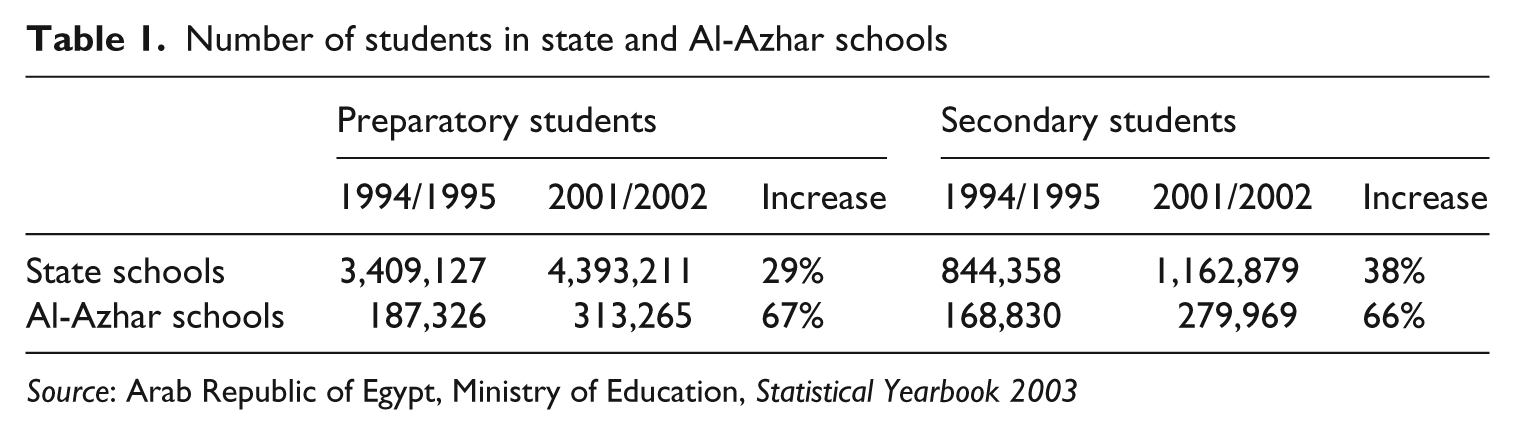
As the rural and urban population increases, the scarcity of state schools has become more apparent but this gap seems to be filled with Al-Azhar schooling due to its broad educational network and its popularity. This popularity stems from its religious appeal and from the fact that Al-Azhar schools offer financial support, free accommodation opportunities and school materials. For Al-Azhar students, this kind of support is a vital condition, when the extent of urban and rural poverty in Egypt is taken into consideration. Considering the extensive educational body of Al-Azhar in this context, the impact of socio-economic factors on the Egyptian education system can be understood more easily.
Due to Al-Azhar’s broad educational reach and historical omnipresence, Egyptian rulers have regarded it as an important source of legitimacy and power. It is not uncommon to observe the Mubarak government seeking the approval of Al-Azhar sheikhs in religious matters, especially those relating to state policy. In this respect, the previous governments have mostly recognized the supremacy of Al-Azhar. This is evidenced by the governmental decree of 1994 declaring that the state recognized Al-Azhar as the absolute authority in matters of faith in order to guarantee public order and social morality (Rahman, 1982: 104; Hatina, 2003). However, political leaders have maintained surveillance over Al-Azhar institutions and sheikhs in order to ensure the elimination of active religious opposition against the regime. Through various reforms and political initiatives by governments since the Nasserist period (Zeghal, 1999: 376), Al-Azhar has turned out to be dependent on government patronage. Despite the contemporary criticism of this dependency by its student groups and teaching staff, who hark back to Al-Azhar’s ‘golden age’ of autonomy and fiscal independence, Al-Azhar’s administration is assigned by the government and serves in accordance with state policies and interests. As a result, the ulama of Al-Azhar are occasionally denigrated by radical Islamists for acting as pawns of the ‘anti-Islamic’ Mubarak government (Zeghal, 1999). From the radical Islamist perspective, the ulama of Al-Azhar are no longer qualified to lead the community of Muslim believers. Some Islamists have gone so far as to advise Egyptian Muslims not to pray behind ‘the official ulama’ or in mosques where they preside (Ibrahim, 1996: 12–13).
In spite of radical Islamist criticism, Al-Azhar schools are still believed to be the bastion of Islamic schooling in Egypt, not because of the quality of education provided by these institutions, but because of their Islamic atmosphere. 10 Like those of PIS, the organizational structure, curriculum, and aims of Al-Azhar schools are patterned within the official guidelines, but the internal dynamics of these schools are determined through informal processes in classrooms. For instance, teachers are eager to inculcate certain Islamic values beyond the scope of the standard curriculum. Furthermore, the Islamic community outside of schools has a considerable impact on and control over the socialization and education of young people.
A point of much interest is the combined teaching of modern and Islamic sciences in Al-Azhar schools, especially in its university. Cochran notes that an Al-Azhar sheikh in the early years of the 20th century explained that the main aim of Al-Azhar was to train students to become authorities on theology and the sacred law of Islam, jurists, and priests. Both female and male Azharites used to go out to various towns and rural communities of Egypt, as well as to other countries, to expound the sacred law covering all matters of daily living (Cochran, 1986: 14–15). However, with the various educational reforms, beginning in 1961 (Tibawi, 1972: 120), Al-Azhar University has metamorphosed into a modern institution with the addition of secular scientific faculties. 11 For Azharites, adding modern secular faculties to the body of Al-Azhar has meant being able to compete with the secular scientific education system, and to train a class of professionals (doctors, engineers, lawyers, and teachers) with a solid knowledge and morality of Islam. While modern secular sciences are perceived as complementary, teaching Islamic sciences alongside them is supposed to offer a certain Islamic morality to Azharite students and academic staff. This is seen as an important factor contributing to the spiritual and moral well-being of Muslim society in the face of Westernization.
Along similar lines, moderate and radical Islamists have proposed the integration of Islamic sciences into the curriculum of secular scientific state education. An interviewee, a professor at Al-Azhar University, strongly defended the intervention of Islamic spirituality and morality into education as the panacea for so-called social disaster and decadence:
Egyptian society is undergoing a moral decadence. Now, the education system in Al-Azhar is not very good. However, if students took correct and sufficient Islamic education alongside scientific courses in Al-Azhar University, they would not cheat people in hospitals, building construction, and the like, because they would know Islam very well, and would have a fear of God.
Beyond the training of ulama, therefore, the major benefit of Al-Azhar schooling is believed to be the dissemination of Islamic culture, morality, and virtues in all fields of social life, and the strengthening of the moral character of Muslim society.
In consequence, on the one hand, PIS and Al-Azhar schools have developed a parallel system, carving out a space for Islamic education alongside the secular scientific one in modern mass schooling. However, this parallelism, in particular cases, turns into an integration, or even purification as a result of the Islamization of the epistemology and methodology of the whole secular scientific education system. On the other hand, regardless of Islamists’ expectations, this parallel education system is perceived by the regime as a threat to its political power, because the former constitutes an oppositional element constraining the sphere of the latter’s political and educational activities.
Conclusion
In this article, I have tried to examine the perceptions and reactions of the Egyptian state and Islamists with regard to the contentious plurality in the religious educational discourse and institutions of Egypt. In particular, I have focused on the Islamist perception and its reaction to the state, which is important to an understanding of the duality between the state and the individual. In fact, it is state policy itself that is generating alternative life domains and institutions which interfere with state ideology and institutions. In that sense, education is producing many contradictory and unintended consequences, so it seems necessary to rearticulate the role of the state in society, and thereby initiate a new conceptualization of the relationship between authority and citizens in the context of the Islamic revival in Egypt.
The religious educational framework, which functions as the engine of the ideological clash between the state and Islamists, may be seen to create unpredictable and controversial perceptions and reactions within Islamist groups. On the one hand, the clash between the state and Islamists indicates that human agency causes unpredictable results, which are subversive with regard to the legitimacy of the regime. On the other hand, Islamic tradition and knowledge are always open to different ways of understanding and practices. In the political as well as in the educational sphere it seems that human agency itself is full of significant dissonance and conflict in the face of the state. I have tried to emphasize this dissonance in the context of the existence of different and even contesting pluralities within the Egyptian Islamist discourse on religious education through a binary categorization of moderate and radical Islamists.
While the radicals express their thoughts in line with the mainstream ideology of the Muslim Brotherhood, the moderates seem to embrace Western culture and lifestyle, stressing the importance of liberalism and tolerance. This demonstrates that it is not possible to deal with a single perception of alternative religious Islamist discourse, because symbolic representations in Islamist discourses denote a variety of meanings according to the different Islamist circles. This variety may be read as a result of different interpretations of the historical past and Islamic tradition of Egypt, the West, and the Muslim world amongst Islamists. Consequently, individuals are active social agents who are capable of interpreting and forming the cultural and political structure. Therefore, it is not plausible to argue about a single Islamism or Islamist group, but about the existence of different ‘Islams’ and ‘Islamisms,’ which are produced, preserved and articulated in religious educational institutions and discourses in Egypt.
Education, therefore, not only causes the emergence of multiple agencies that contest the state’s authority, targets, and ideology, but also creates new and unpredictable possibilities for the reproduction and dissemination of Islamic knowledge and tradition. The struggle between the ruling elites and dissident Islamist groups to capture the religious discourse and control religious socialization blurs the separation between the religious and secular. For example, at first glance, the Mubarak government’s religious educational discourse in opposition to the rise of Islamism might be considered to be in favor of the secularization, or more accurately, the de-Islamization of the society. However, the government’s curricula are full of Islamic concepts and values. Although the government aims to attenuate Islamist reaction in this way, its policy eventually contributes to the proliferation of new and different Islamist ideas. In this blurred picture, the dichotomy between the religious and the secular becomes even more ambivalent in Islamic schooling, where Islamic and natural/social sciences are taught simultaneously. Regardless of the reasons that motivate Islamists, the secular and modern seem to be combined unequally with the religious and traditional as instruments within an Islamist vision of the world in Al-Azhar schools and PIS. Hence, it is necessary to redraw the boundaries between the religious and the secular in the context of religious educational discourses and practices in contemporary Egypt.
Footnotes
Acknowledgements
I would like to express my gratitude to my advisor, Aykan Erdemir, for his academic guidance. I also owe many thanks to Bahattin Akşit, Recep Boztemur, Elisabeth Özdalga, Mustafa Şen and Özlem Tür for their contribution and support. Finally, I feel indebted to Maja Stolle, Figen Uzar, Çağatay Topal and Çetin Çelik, who commented on drafts of this article. I would also like to thank Ejaz Akram for facilitating the visiting researcher position and the fieldwork opportunity at the American University in Cairo.