




Abstract
The author presents a selection of important results from a new representative population survey on the attitudes and experiences with various forms of heterodox (also sometimes called non-institutionalised, “eclectic” or “esoteric”) religiousness, conducted in the Russian Federation in 2006 – the first survey in this country to have focused specifically on this kind of religiousness. The author shows that heterodox religiousness appears to have become the dominant form of religiousness in contemporary Russia and involves a larger proportion of the population than traditional Christian religiousness.
In this essay, a selection of important results from a representative survey on the attitudes and experiences of the Russian population towards certain forms of heterodox religiousness will be presented. 1 The survey was conceived, prepared and evaluated by the author and conducted by the leading Russian polling organization Levada-Centre in September of 2006. It included 1,600 people in 266 towns and city districts (in 128 communities and 46 regions), where a representative cross-section of the Russian population was given a questionnaire with about 30 thematic and about 20 socio-demographic questions. The selection procedure for the population sample was developed by the Levada-Centre.
This was the first large-scale survey conducted in Russia with an emphasis on the population’s opinions concerning esotericism or heterodox religiousness in Russia. In the present-day academic discourse such worldviews and movements supporting them are considered a non-institutionalized form of religiousness (see e.g. Luckmann, 1967; Wunder, 2005). This article will not go into detail on controversies surrounding various terms used to identify this kind of religiousness. The debate about the slight nuances in meaning of such terms as “mysticism”, “occultism”, “esotericism”, “New Age”, “cults”, “sects”, “new religious movements” or “alternative religions” is still ongoing (Faivre and Hanegraaff, 1998; Jurkevič, 2001; York, 2001; Bochinger, 2005).
All these systems of interpreting the world have in common that they were not developed within the framework of publicly recognized systems of knowledge, which in the case of Russia would be scientific materialism and Orthodox Christianity. They also stand in opposition to the dominating norms of the society that are reproduced by the institutions of knowledge transfer established by the state (education system) or supported by it (Russian Orthodox Church). For this reason such systems of interpreting the world will be characterized here as heterodox religiousness or heterodox knowledge, in the sense of a kind of symbolic, socio-cultural, non-scientific knowledge. Such kinds of knowledge represent a heterodoxy because their carriers and agents are placed in a marginalized position against the social and public norms and value systems propagated by the society’s main institutions.
“Heterodox religiousness” should be understood as opposite not only to “Orthodox Christianity” but to all systems of knowledge that to a certain extent enjoy an orthodox position in today’s Russian society, including worldviews of natural sciences, Orthodox Christianity, other Christian Churches and Islam. This is obviously a convention, but it is useful for the delimitation of the research object. Since this convention is not yet universally accepted, the term “heterodox religiousness” in the title of this article is used inside quotation marks.
1. Methodology
The few surveys conducted in Russia before 2006 that touched on the subject of esotericism had, in the author’s opinion, a number of methodological weaknesses or did not pose most of the research questions addressed in this survey. The few questions on esotericism were mostly embedded in surveys that were concerned with other topics—for example, with traditional forms of religiousness. Also, many questions were translated word for word from surveys conducted in Western countries, which were unsuitable for the Russian population, since some terms carry different meanings in different cultures and political systems.
In developing the questionnaire used for our own representative survey, we tried to take into account the insights and experiences of as many surveys as possible that had at least one question potentially belonging to the area of esotericism. In the surveys we consulted, we found that there were great differences in answers to similar questions. For example, belief in God varied between 45 per cent and 79 per cent, belief in magic between 6 per cent and 45 per cent and belief in reincarnation between 3 per cent and 26 per cent. Interestingly, the year in which the survey was conducted was not significant in these variations, but rather the institution that conducted the survey. The number of people who agreed with different aspects of esoteric and religious worldviews depended strongly on the way the question was phrased and on the context in which the question was put. Irwin (1999: 280–1) once pointed out that, in surveys concerning the “paranormal”, context influences the answers decisively.
For example, two surveys with a focus on “religion” were conducted in Russia as part of the international ISSP programme in 1991 and 1998. These surveys should be viewed critically since most of the experts charged with developing the questions were obviously of the opinion that religiousness meant mainly traditional forms of belief based on Christianity. They seemed to have been only superficially familiar with modern esotericism or considered esotericism something that was at best of doubtful value and at worst mere superstition. In 1991, as part of the ISSP survey, they asked whether people believed in God, life after death, Heaven and Hell or religious miracles. No questions were asked on esoteric beliefs. The survey conducted in 1998 also enquired whether people believed that “talismans bring good luck”, whether “fortune-tellers can predict the future”, whether “mental healers have powers from God” and whether “horoscopes affect the future”.
Similar questions were asked in another survey conducted in Russia in 1998, which in part dealt with religiousness in the population. This was conducted as part of the international World Value Surveys programme by the polling organization ROMIR. Questions were asked on whether people believed in God, in life after death, in Heaven and Hell, and in the existence of a soul and how often they attended church and/or prayed. Questions showed a strong Christian bias. Not least, the questions concerning the respondents’ attitude towards non-Christian religious phenomena were phrased rather unfortunately. Hardly any astrologer would claim that horoscopes affect the future, which is why the question whether “horoscopes affect the future” is already erroneous. If somebody believes in the powers of faith-healers, that person does not necessarily ascribe to faith-healers “powers derived from God”, etc. All in all, one can agree with Süss (1999: 20) that the experiences of “new believers” need to be assessed by scientists as fully valid religious experiences and not as inferior to Christian beliefs.
Another essential weak point of these international surveys is the fact that English or German questionnaires were simply translated word for word into Russian. As Sinelina (2001) has pointed out, in Russia a question regarding a person’s “belief” in supernatural phenomena is useful only in ascertaining this person’s atheistic convictions, as the term “belief” used in connection with such phenomena allows different interpretations and is ambiguous, which leads to confusion in the respondents and uncertainty in the results of the survey. In fact, the word “believe” has a different connotation in Russian (in this context a negative connotation) than in English or German. In Russia, it is associated with things that do not exist in reality, because if they really existed one could learn about them and not just “believe” in them. Furthermore, many Russians, even years after the fall of communism, find it difficult to reveal their actual opinion to someone they do not know (an interviewer) on something that was for years “officially” unacceptable. For these reasons questions need to be phrased more carefully than they were in these early surveys.
The above-mentioned considerations are confirmed by two field studies that were conducted by Western scientists in Ukraine and Russia, which for this reason alone are interesting from a methodological point of view. For example, Dunlop (2005: 6) says on the topic of research problems in post-Soviet countries: “I faced a research challenge—spirituality and the search for ultimate meaning formed part of a person’s private identity […] it was culturally unacceptable in […] Ukraine for a stranger to question people about their private beliefs.” She also sums up the common attitude among the population concerning questions of religiousness and esotericism: “One seeker student told me, ‘Well, generally speaking, I am a believer, but I am not religious” (Dunlop, 2005: 11). These experiences are fully congruent with our own field study experiences. Turunen (2005) also reported great problems in conducting her interviews on people’s systems of spiritual orientation because of the use of theoretical research approaches that had been developed in the West. While preparing her field research she assumed that the people asked would answer the question “Are you a believer?“ directly and unproblematically. She also thought she would not have any problem assigning respondents to groups. This, however, was not the case. She had to differentiate between “conventional” (orthodox) religiousness and “unconventional” (heterodox) religiousness and stresses that the latter is much stronger in Russia. She also emphasises that in Russia belief is referred to as an “opinion” and that because of this, the phrase “I think” rather than “I believe” is used when speaking of beliefs (Turunen, 2005: 256).
These experiences are very important and were taken seriously while planning and phrasing the questions for this survey. Our approach consisted in phrasing the questions more broadly and more neutrally than they usually are in Western countries and at the same time avoiding where possible a Christian connotation. Here are some examples:
Instead of “Do you believe?” we asked “What do you think?” We phrased it as a question of opinion instead of as a question of belief or knowledge. However, we regarded the expression “Can you imagine?”, used by the Freiburg Institute for Frontier Areas of Psychology and Mental Health in their representative survey of the German population on the supernatural, as too broad (imprecise).
Instead of “God” we asked about a “higher power, for example God, providence, etc.”.
Instead of “punishment for sins” we asked about “a higher justice that rewards or punishes what people do, whether in this life or later”.
Instead of asking about “angels” we asked about “beings like angels, demons or ghosts”.
Instead of whether “fortune-tellers can see the future” we asked whether “there are individuals with an ability to foretell the future that as yet has not been understood by science”.
Instead of whether “faith-healers have powers from God” we asked whether “such healers, magicians or shamans exist who can really heal people from sicknesses that cannot be healed through the use of conventional medicine”.
Instead of whether “talismans bring good luck” we asked whether “lucky charms or protective amulets can have a real effect”.
Instead of whether “horoscopes affect the future” we asked whether “there is a connection between Zodiac signs and a person’s character, as is assumed in horoscopes”.
From this short comparison it can easily be seen how much more precise our survey was than the few earlier surveys on esotericism.
A block of 19 questions on various typical ideas that are present in the most common heterodox religious worldviews in Russia today made up the core of our questionnaire. The question of trust in science was phrased positively and not as a negation, as is suitable for esoteric worldviews (a test of “pole reversion”). The question of the divinity of Jesus Christ was seen as a test of traditional religiousness. Instead of using the foreign words “astrology” or “telepathy” we preferred describing these phenomena. To avoid raising uncertainties in the people we asked, we avoided over-defining the questions and making them too complex. We left out phrases like “other than the placebo effect” (with reference to the ability to heal) and “with the exception of political and weather forecasts” (in connection with foretelling the future), so as not to give the person questioned the impression that their ability to understand the question or “common sense” was being underrated by the interviewer.
In this block of 19 questions, we preferred to use an answer scale common in Russia that had also been used in earlier surveys. Instead of the “I agree completely”, etc. answer scale, we used “yes—probably yes—difficult to say—probably no—no”. A distinction was made between “yes” and “probably yes” so that not only people with strong beliefs would be included but also people with a tendency towards a certain belief. A mere “yes” could discourage many people and push them into the undecided group, which would result in a huge loss of accuracy in the results. For this last group we used the answer “difficult to say” instead of “don’t know”, to better suit the wording common in Russian. We also used this phrasing to avoid giving the impression that the question was about actual knowledge. People who take the phrase “I don’t know” literally might choose this answer for almost every question, because it is a characteristic of esoteric worldview systems that nobody really knows or can prove whether certain abilities and things really exist.
Furthermore we asked:
about experiences of occurrences that can be explained only in terms of supernatural forces (we used an open question here, so that we could see what occurrences the person questioned considered “supernatural”);
about experiences of things that are unexplained or have not been accepted by science as real phenomena (the phrasing of the question was similar to the that of the first question but it differed from it in content);
whether in the respondent’s opinion the majority of people believe in supernatural phenomena;
about the sources of information that had most influenced the ideas on supernatural forces and phenomena of the respondent;
about experiences of the heterodox religious subculture;
about the reasons for seeking such experiences (if they had taken place);
for a subjective evaluation of the effectiveness of these experiences (if they had taken place);
about the number of people with whom the respondent frequently and closely communicated who had had experience of the heterodox religious subculture.
We distinguished between the five most common forms of experience of the heterodox religious subculture. These were: the reading of esoteric literature, the use of alternative healing methods, visits to faith-healers, visits to astrologers or magicians and the practice of yoga or meditation. These questions are interesting because they provide insight beyond the dimension of belief into the range of actions based on heterodox religiousness—insight into the relevance of the respective beliefs on people’s lives.
In the area of “traditional” religiousness, we used questions on the self-assessment of personal religiousness and on attitude towards the predominant Church used in earlier surveys. Since the level of church attendance in Russia is extremely low, we left out questions about this. Based on the considerations mentioned above, instead of asking how often a person prays, we asked about how often a person thinks about God or a higher power.
Despite certain new or modified phrasings, we ensured the comparability of this survey with other surveys, in particular through the questions on the self-assessment of religiousness, on attitude towards the predominant Church, on prayer (“How often do you think of God or a higher power?”), on God, on life after death (“Does man have a soul that can exist independently from the body, for example after death?”), on angels, magic and telepathy, on the retribution of sins, on astrology, reincarnation and fate (“Are good and bad luck influenced by supernatural forces or laws?”), on UFOs, talismans, predicting the future, faith-healers and the psychokinetic movement of objects and on the possession of holy images, icons or other religious and spiritual symbols.
Demographic questions were part of the standard programme of the polling company we commissioned and included the variables: sex, age, marital status, educational level, place of residence, administrative district, community size, income, political orientation and other standard social distinctions.
2. Selected results 2
The majority of people questioned agreed with 13 of the 18 elements of the heterodox worldviews we asked about; three were rejected by the majority and with regard to the other two, proponents and opponents together were in the minority. Table 1 lists the elements of esoteric worldviews studied in the survey, ordered by their decreasing acceptance in the population.
Attitude towards elements of heterodox religious world-views included in the survey (%) 3
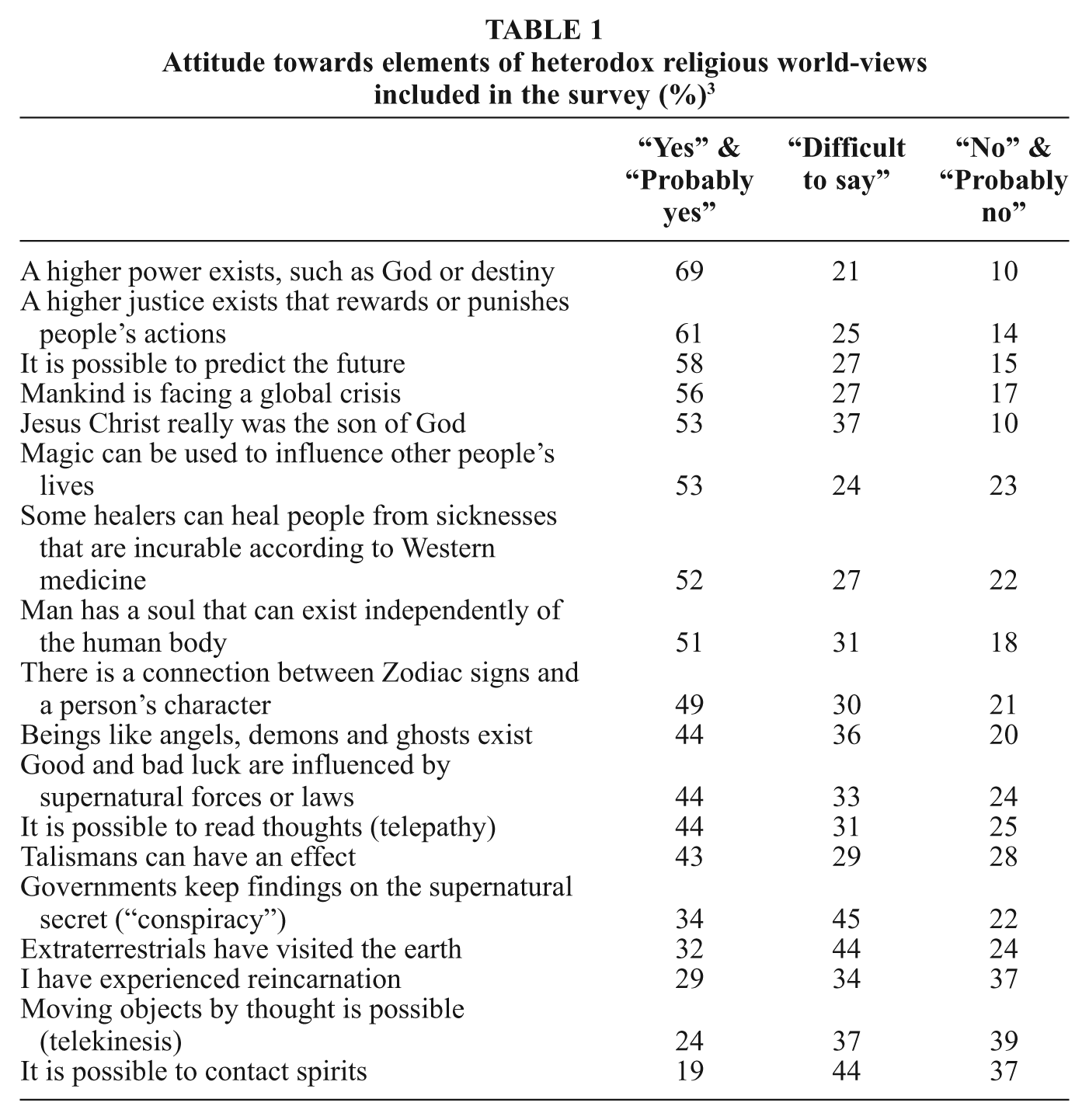
This table allows the conclusion that even those ideas that are rejected or viewed with scepticism by a majority of people are held to be true by a relatively large minority. This confirms the fundamental hypothesis of this survey: that esoteric worldviews are common in Russian society.
The establishment of personal contact with the heterodox religious subculture constitutes the experiential dimension of belief in heterodox religious worldviews. It has been researched in less depth by the academic community than the dimension of belief itself. A short overview of the literature on this subject was provided by Yamane and Polzer (1994). In Western countries, experiences with alternative healing methods are the most common personal, practice-oriented application of heterodox religiousness (Höllinger, 1999: 56). In Germany, 11 per cent of people have been treated by a faith-healer, with a subjectively perceived success rate of 58 per cent (Andritzky, 1998). In Austria, the success rate is as high as 76 per cent (Obrecht, 2000).
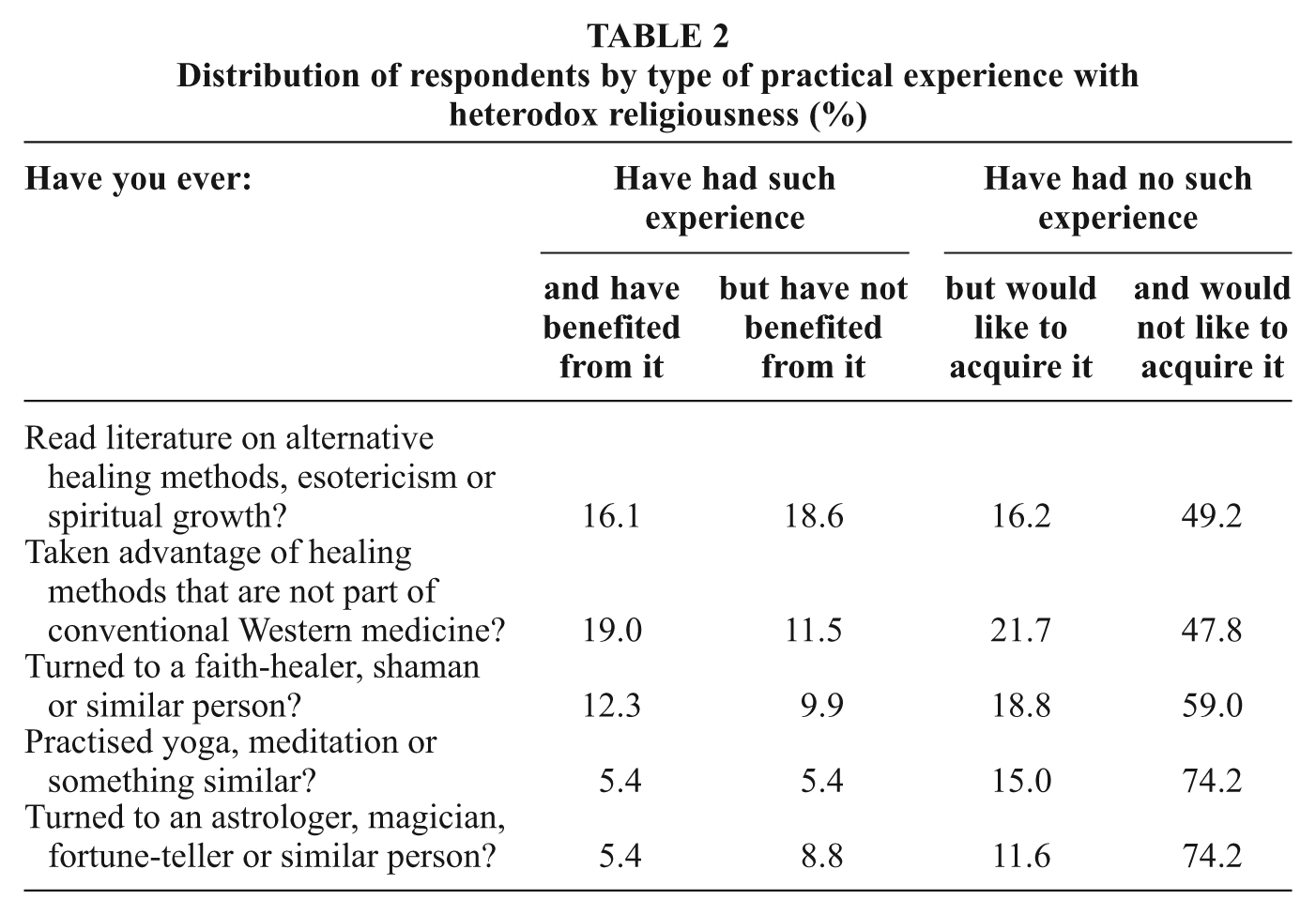
According to our results, in Russia over 22 per cent of people have been to see a faith-healer, with a subjectively perceived rate of success of almost 56 per cent. Furthermore, almost 35 per cent of the adult population have read some kind of esoteric literature and about half said that they had benefited from the advice found in it. Table 2 summarizes the self-evaluation of respondents’ religiousness and belief in elements of the heterodox religious worldviews that were part of the survey.
Distribution of respondents by type of practical experience with heterodox religiousness (%)
In the academic community, it is often assumed that the spiritual gap left by institutionalized religions following the decline of their importance in society is partially filled by alternative forms of belief in the supernatural. If this hypothesis were correct, then it would be expected that traditional Christian religiousness and new esoteric religiousness are correlated negatively. The results from research conducted by Emmons and Sobal (1981), which analyzed a Gallup poll from 1978, speak for this hypothesis. They came to the conclusion that the connection between “traditional” religiousness and belief in “religious paranormal phenomena” (e.g. angels, demons, life after death) was positive, but the connection between “traditional” religiousness and the belief in “non-religious paranormal phenomena” (e.g. ghosts, extrasensory perception, clairvoyance) was negative.
Orenstein (2002) arrived at a different conclusion in his research in Canada. He found a strong positive correlation between “traditional” religiousness and “paranormal” beliefs, especially in those people who, although religious, did not attend church regularly (since the Church denies legitimacy to “paranormal” beliefs and thereby suppresses them). McKinnon (2003) agreed with him in general, but added that “paranormal” beliefs had a replacement function, though rather for the participation in rituals (church attendance) than for the traditional forms of religious belief as such. A French survey showed that the belief in esoteric phenomena is greater in those people who refer to themselves neither as “practising Christians” nor as “non-denominational”. According to the results of that survey, “non- or occasionally practising Catholics” were most likely to believe in esotericism (Boy, 2002). This phenomenon—that people who believe in traditional religious worldviews but are not bound to an institutionalized religion or, more precisely, those without a well defined system of convictions believe in esoteric worldviews more than others—has repeatedly been attested to in France and is stable (Boy and Michelat, 1986). In Switzerland, according to Campiche (2004), those who are undecided on their own religiousness are also most likely to take part in “para-religious practices”. In the results of a survey conducted in Finland, “general Christian religiousness” was also positively correlated with “quasi-religious systems of belief” like occultism (Björkqvist et al., 1994). Kääriäinen (1999) found similar connections in Russia, although his attempt at explaining it by the fact that Russians know little about religion is not convincing.
In our survey, of those people who thought of themselves as “not religious at all” only a small proportion believed in esoteric phenomena. Contrary to this, those people who thought of themselves as religious and identified with a certain religion not only believed strongly in traditional religious worldviews but also had the strongest belief in esoteric worldviews (with a few exceptions, notably aliens and conspiracy theories). Interestingly, of those people who saw themselves as religious and connected with the Orthodox Church, only about 90 per cent believed in God and 75 per cent in the divinity of Jesus Christ. This speaks in favour of the general observation that people’s beliefs are not organized logically nor are free of internal contradictions. Therefore, researchers need to be especially careful when interpreting any findings in this field.
The question whether there is a difference between those people who feel connected to Orthodox Christianity and those who feel connected with some other religion concerning their belief in esoteric worldviews, cannot be answered because of the small number of people in the latter group. The answer category “other religion” was not subdivided into Islam, Buddhism, etc., since the number of people in these subgroups would have been even smaller, given the size of the sample used in the survey.
2.1 Heterodox religiousness and gender
It is well known from studies in the field of the sociology of religion and religious studies (for example Randall and Desrosiers, 1980; Kecskes and Wolf, 1996; Kecskes, 2000; Ahrens, 2000) that there are large gender-specific differences in religious views, beliefs, church attendance, etc. For Russia, Kääriäinen (1999) was able to document that women are generally more religious than men, a distinction that Greeley (1994), however, sees as applicable to older people only. This begs the question whether such gender-specific differences can also be proven for “esoteric” religiousness and, if so, for which elements of “esoteric” religiousness this difference is the most marked. Gender-specific disparities concerning attitude towards esoteric phenomena have already been proven in several studies. For example, a number of representative surveys were conducted in France between 1982 and 2000, where women generally, and over the whole period, embraced esoteric worldviews more commonly than men (Boy and Michelat, 1986; Boy, 2002).
Orenstein (2002) came to the same conclusion in Canada. Clarke (1991) observed that in New Zealand women believed significantly more than men in telepathy, astrology, faith-healing, reincarnation and foretelling the future; a larger proportion of men, however, believed in extraterrestrials. The same pattern, especially concerning belief in extraterrestrials was found in the United States by Newport and Strausberg (2001). An international survey of students showed that in many countries women are more religious than men and also are more open to esotericism (Höllinger and Smith, 2002). In their experiences with esoteric practices, female students in Austria showed a significantly higher average involvement than males (Höllinger, 1999). In another study, conducted in Austria, women made up 82 per cent of the clients of faith-healers (Obrecht, 2000). In the early 1990s, an especially large number of men in Russia were observed to have turned to religion for the first time. It is, however, possible that this happened because most women were already religious before the fall of Communism (Greeley, 1994).
When looking for explanations for these findings, one can find several hypotheses in the academic literature. An overview of publications on this question can be found, for example, in Stark (2002). He himself ascribes the lower level of belief in men to their higher readiness to assume risk, interpreting “non-believing” as a kind of risky behaviour. Höllinger (1999: 59–60) is of the opinion that the gender-specific division of labour existing in almost all cultures has contributed to the development of different personality traits in the two sexes. The responsibility for organizing production, for technological innovation and for administrative functions has strengthened logical-rational thinking ability in men while responsibility for taking care of children and for their emotional welfare has preserved in women the emotional-intuitive perceptiveness that was originally prevailing in all people. This, however, raises the question whether people who are emotional and intuitive rather than logical and rational show higher values of the acceptance of esoteric phenomena, irrespective of their gender. In this connection, Höllinger and Smith (2002: 242–3) conjectured that because women’s behaviour was often marked by sensitivity and intuition while men were more orientated towards rationality and logic and since access to spiritual experience and esoteric/occult phenomena is more easily attained by people with sensitive and intuitive personality, it can be assumed that women are more open to religion and esotericism. Obrecht (2000: 211) saw the reason for the higher percentage of women among the clientele of faith-healers in their “higher readiness to complain” as well as in their higher sensitivity to physiological symptoms, which, according to him, can be derived from the statistically proven higher rate of doctor visits among women. He refutes the idea that women are more susceptible to magical worldviews. Although one needs to be careful when considering some of the statements and presumptions quoted in this paragraph, these attempts at explaining gender-specific differences seem to us to be quite useful in formulating hypotheses.
In our survey, we found that all elements of esoteric worldviews with significant statistical differences in gender showed higher approval by women than by men (see Table 3). When it comes to the relevance of these convictions to personal actions (reading special literature, seeing a faith-healer, turning to an astrologer, etc.), women were also clearly ahead of men, the only exception being yoga and meditation.
Statistically significant differences in belief in the elements of heterodox religious world-views included in the survey, by gender
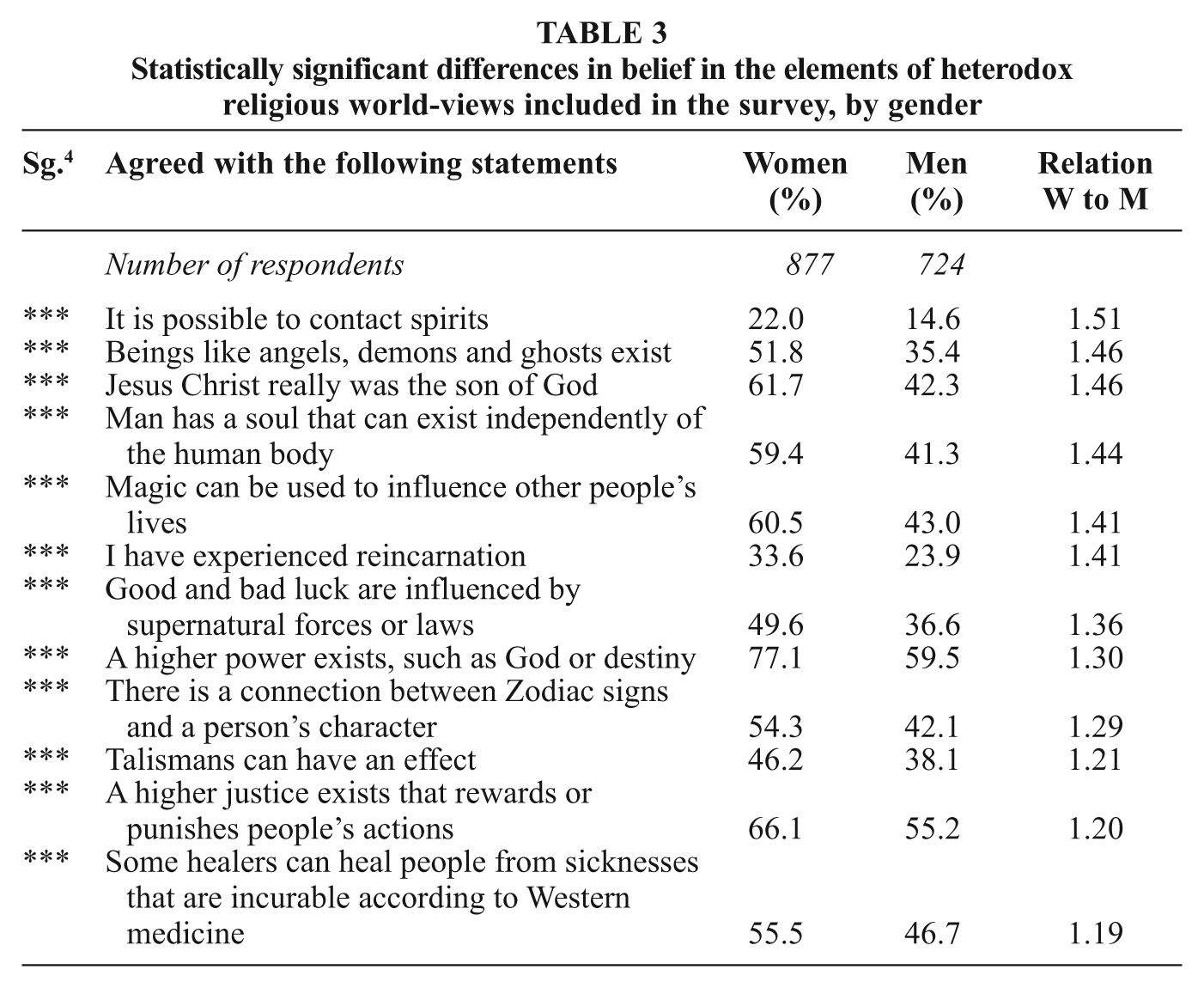
When analysing the elements that women more often agree with than men, we observe that women tend to support those esoteric worldviews that assume the existence of the supernatural or certain laws and forces that go beyond the physical world. Things that can theoretically exist under a purely scientific worldview or under the assumption that there are some laws of nature that have not been yet discovered and for which therefore the presumption of supernatural forces is unnecessary, are supported equally by men and women.
One should, however, be wary of accepting these observations as facts. For example, the Finnish scientist on religious studies Turunen (2005) found that in Russia, men are less likely to openly declare their beliefs or worldviews than women. In extensive one-on-one interviews, however, she got the impression that men were not opposed to esoteric phenomena. The low values for men that have appeared in studies do not necessarily mean that they believe less. It is certainly possible that men, especially because of the traditional gender roles and “idealized picture” of how a man or a woman is “allowed” to be, could feel uncomfortable in an interview situation if they had to declare in front of a stranger their private attitude towards esoteric phenomena or their belief in supernatural forces. Russian society “allows” women to have such ideas about supernatural forces. In future studies, an interdisciplinary co-operation with psychologists would be desirable to better deal with such gender-specific matters.
2.2 Heterodox religiousness and age
A raft of authors have presented results from studies that point towards a correlation between age and different forms of religiousness. For example, Argue, et al. (1999), in the United States, Bibby (1983), in Canada, and Hamberg (1991) and Donahue (1993), in Sweden, found that “traditional” Christian religiousness was generally higher among older people. Kääriäinen (1999) was able to confirm this for Russia as well. In contrast, research that at least in part focused on the “paranormal”, like that of Newport and Strausberg (2001) in the United States, Clarke (1991) in New Zealand, Doktor (1999) in Poland, Campiche (2004) in Switzerland, Boy and Michelat (1986) in France and Orenstein (2002) in Canada, showed that belief in different esoteric worldviews is especially common among younger people and students. According to Furman (1997), in Russia in the early 1990s, 16–17 year olds believed almost 50 per cent more commonly in extrasensory perception, “Eastern wisdom” and UFOs and almost three times as commonly in reincarnation than the average of all respondents. Kääriäinen (1999) pointed out that so-called “seekers” (who can often be equated with those who believe in esotericism) are concentrated in the 18–39 age group. Höllinger and Smith (2002) came to the same conclusion for 25-to-40-year-olds in Austria. As a general observation concerning age, it can be thus stated that there is a negative correlation between belief in esoteric phenomena and age (see also Emmons and Sobal (1981) regarding the late 1970s in the USA).
These results, however, beg the question whether there really is a correlation with age or whether it is a generational matter, since “New Age” is often seen as a fashion or generational phenomenon (Bruce, 2002: 81). A generational occurrence is where the same people do not believe less in esotericism as they get older but rather people born in different times and who have experienced a different kind of socialization believe in esotericism to a different degree and that this belief remains stable over time. In France, for example, a representative national survey in 2000 showed that people younger than 49 generally believed more in esoteric phenomena. It was assumed that this was more a matter of age than of generation and that the same people believed less in esotericism as they got older (Boy, 2002). This assumption was, however, refuted for France because belief among those born in the same period was stable over time (the survey has been conducted regularly since 1982—see Boy, 2002). The conclusions of Argue et al. (1999), from a study in the United States, also argue against the age hypothesis.
The research of Greeley (1994) and Furman (1997) speaks for the generational theory, at least in Russia. According to Greeley (1994), there is a U-curve in the age distribution of believers. This means that young people have beliefs similar to their grandparents and dislike the religious scepticism of their parents, who grew up under stable socialism. Furman (1997) is of the opinion that religious development in Russia follows a pendulum motion and that since the end of communism there has been a return to the intense religiousness of pre-revolutionary times. This would explain why 16-to-20-year-olds and the over 60s are, according to his data, the most religious and the middle age group is less religious (Furman, 1997: 292). At the same time, however, he says that esoteric beliefs are more typical of younger people. If we still assume a generational hypothesis, this would mean in this case that only the generation born after 1976 and therefore socialized after the fall of Communism (that is, people who were under 30 in 2006) should be especially strong believers in esoteric worldviews.
In order to verify how far the data from our study confirms the trends suggested by earlier studies or offers new explanatory patterns, we analyzed the statistically significant differences in the rate of adherence to certain beliefs among four aggregated age groups. We defined the age groups in the same way as the polling organization: 18–24, 25–39, 40–54 and over 55. This seemed prudent, since 24 is the age in Russia today at which most people have completed academic training and at which families are generally started. The age break of 55 was chosen because women retire at this age (men generally retire at 60).
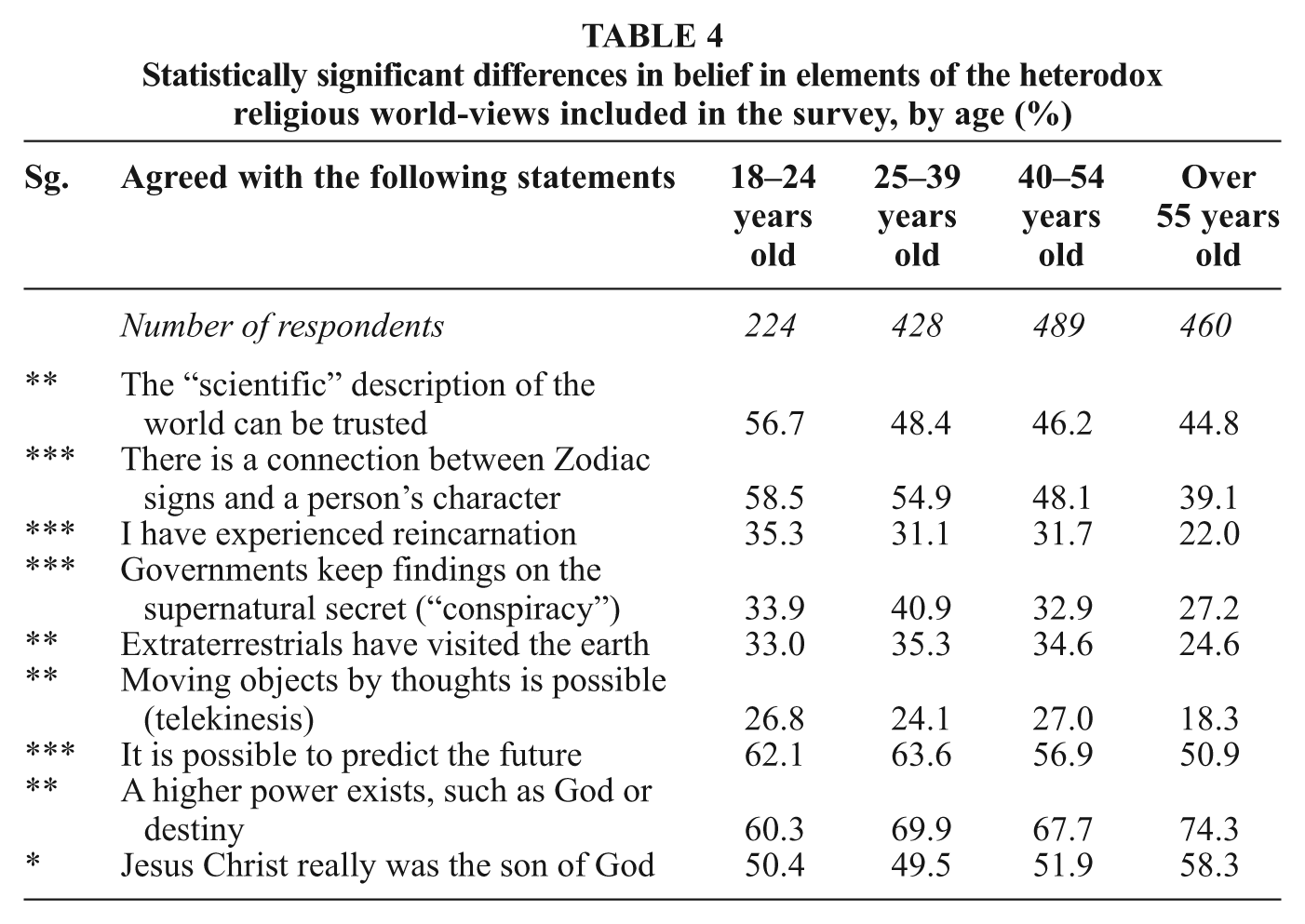
Considering the results from this study (see Table 4), it could be confirmed that older people believe less than younger people in “scientific” descriptions of the world or in astrology, reincarnation, conspiracy theories, extraterrestrials and the ability to move objects through the power of thought, and that the future can be foretold, while they believe slightly more commonly in the existence of God and the divinity of Jesus Christ. The youngest Russians, on the other hand, have experienced fewer things that require a supernatural explanation. They make less use of alternative healing methods and consult faith-healers less often, which can be explained by their better health. The older people questioned practised yoga and meditation substantially less often. This is perhaps because these belong to the heterodox religious practices that are less familiar to older people.
Statistically significant differences in belief in elements of the heterodox religious world-views included in the survey, by age (%)
2.3 Heterodox religiousness and level of education
It is often assumed that there is a contradiction between scientific knowledge and religion, as well as between scientific knowledge and certain forms of esotericism (for example belief in astrology), and that attitudes towards some elements of religiousness depend on people’s level of information and education. This begs the question whether there is a correlation between level of education and belief in certain elements of esotericism and how much this belief varies by level of education (though, according to Francis (1998), there is no correlation between intelligence and religiousness). Numerous studies have dealt with the question whether there is a correlation between level of education and the propensity to share various religious and esoteric worldviews. The results are somewhat contradictory but it is possible to formulate two hypotheses.
On the one hand, one can hypothesize that there should be a negative correlation between level of education and belief in heterodox religious phenomena, since educated people are more likely to know and share the worldview presented by the modern natural sciences and this worldview leaves little room for the supernatural. Accordingly, people with a higher level of education would be less receptive to esoteric views of the world. The data from Albrecht and Heaton (1984) supports this hypothesis. He found that in the United States there is a negative correlation between level of education and religious beliefs and practices and the importance that religion has for the individual. Kääriäinen (1999) argued something similar for Russia. In Switzerland level of education correlates negatively with participation in “para-religious practices” (Campiche, 2004). Greeley (1994) points out that immediately after the fall of communism in Russia, there were fewer “new [religious] converts” among people with a high level of education than among other parts of society. In his study on Russia, level of religious belief correlated positively with level of education for young people and negatively for older people (Greeley, 1994: 271).
On the other hand Goode (2002), for example, has shown through different data from the United States that there is a negative correlation with level of education only for those elements of esoteric worldviews that are also contained in traditional religious teachings (for example, the existence of angels or God). Theoretically it could therefore be possible that precisely those people with a high level of education see the paradigms offered by traditional religions as too “simple” and because of this they look for “science-like” explanations for the world, which esotericism offers in abundance. And in fact, in a study conducted in France, the belief in esoteric elements correlated positively with level of education. Only those people who had a “higher scientific education” were an exception (Boy and Michelat, 1986). Furthermore representative surveys in France showed that people with an especially low and an especially high level of education, that is, people who had had only compulsory schooling and those who had obtained a PhD, believed in esotericism less than people of other educational levels (Boy, 2002). In the United States there was a positive correlation between level of education and belief in spiritual healing but at the same time there was a negative correlation between level of education and confidence in astrology (Newport and Strausberg, 2001). According to Kääriäinen (1999), belief in traditional religious ideas in Russia is correlated negatively with level of education, and belief in esoteric ideas is correlated positively. Furman (1997) generally agreed with this.
Similar results exist on experience with esoteric practices. For example, the experiences of meditation of young women in Germany correspond positively with level of education (Nüchtern, 2000). Among people who consulted faith-healers in Austria the percentage of people with a high level of education was especially high as well (Olbrecht, 2000). Höllinger and Smith (2002) differentiated between esoteric practices even further and said that spiritual experiences with esoteric practices correlated positively with level of education, while contact with faith-healers, fortune-tellers and astrologers correlated negatively.
In our survey in Russia, the connections between level of education and agreement with different elements of esotericism becomes most clear when the level of education is divided into three categories (see Table 5). For the elements where we found a statistically highly significant correlation, the differences occur among those with the lowest level of education, that is, whose schooling ended at the ninth class of secondary school, which in Russia is the lowest level of education, at the age where compulsory education ends.
Statistically significant differences in belief in elements of the heterodox religious world-views included in the survey, by educational level (%)
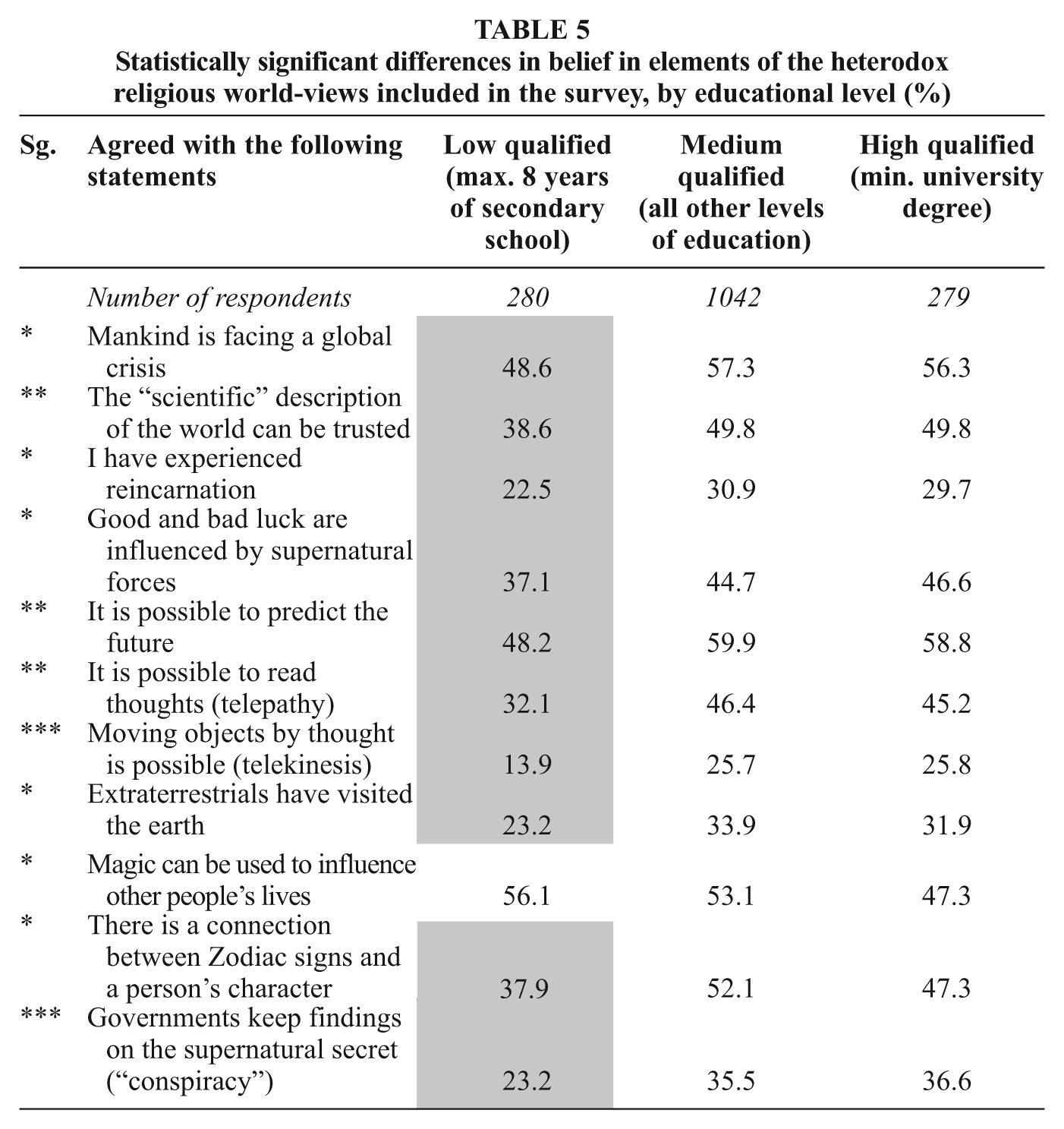
These results confirm the general observation of authors of other studies that there is a statistically significant connection between the level of education of people and their agreement with certain esoteric beliefs. Based on our survey, the hypothesis that highly qualified people believe more in esoteric worldviews can be neither confirmed nor discounted. Our sample, however, shows that it is the people with the lowest level of education that believe the least in esotericism. Clarke (1991) came to a similar conclusion.
Most of the people in the group “secondary school diploma or less” are older people. Therefore the difference in the level of belief in esoteric phenomena among less educated people could be a result of the age effect, which has already been dealt with. In order to better judge the influence of the level of education, further tests were performed.
The group “under 25 years of age” was not tested, since almost all the people in that group are “medium qualified”. In the group of 25-to-39-year-olds no statistically significant differences were found between people with medium and high qualifications. In the group of 40-to-54-year-olds people with medium qualifications believed significantly more often in the effectiveness of magic and talismans than people with a higher education. People with high qualifications, however, believed more often in telekinesis and telepathy. Here the influence of education becomes apparent: people with higher qualifications seem to see “science-like” phenomena as more believable and people with middle-level education see phenomena that are purely “intuitively” explainable as more believable. Among older people who were questioned there were too few with a higher education to make any reliable conclusion. The middle-educated elderly believe in various “esoteric” elements more often than the low-educated.
Concerning the relevance to action, the share of people who had experiences that could be explained only in supernatural terms rises with an increased level of education, as does the share of those reading esoteric literature and practising yoga and meditation. This confirms the evidence generally available from Western countries mentioned above, that a higher level of education makes people turn more readily to the practical dimension of heterodox religiousness. However, it could not be confirmed, for example, that people with a higher level of education less often turn to faith-healers and astrologers.
3. A tentative categorization of the Russian population by type of religiousness
On the basis of the data obtained, we tried to divide the entire sample into groups of people by the type of religious ideas thought to be true. The number of ideas from “religiousness of a traditional kind” and “religiousness of a heterodox kind” respondents agreed with was calculated and used as a value for a “scale of religiousness” for each of the two kinds of religiousness. This seemed the only useful way of proceeding, since cluster analysis and other standard statistical multivariate methods (Backhaus et al., 2000; Bahrenberg et al., 2003) did not yield any useful results.
In the “traditional religiousness” category, belief in the soul, God, higher justice, angels and Jesus was included. The “heterodox religiousness” category comprised the beliefs in foretelling the future, telepathy, telekinesis, spiritual healing, talismans, magic, astrology and contact with spirits. To be categorized as “religious” in either a traditional or a heterodox way, a person needed to believe in at least half of the items in the appropriate category. To be counted as “unreligious”, a person would need to discount belief in any of the ideas mentioned, since those who believe in something are by definition not “non-believing”.
Since there were more elements in the “heterodox religious” category than in the “traditional religious” category and since “traditional religious” beliefs are more deeply rooted in Russian culture as well as more strongly dogmatized by the Orthodox Church, we made the threshold for “believing” vs “non-believing” more restrictive for “traditional religiousness” than for “heterodox religiousness”. By doing so, we could at least in part compensate for the differences in properties of the two types of religiousness.
So, to qualify for the “religiousness of a traditional kind” category, the person asked had to agree with at least four of the five corresponding concepts. For “absence of traditional religiousness”, lack of agreement with all of the five ideas was necessary. To qualify for “religiousness of a heterodox kind”, a person had to have at least four of the eight “heterodox” beliefs and for “absence of heterodox religiousness” at most one of them.
Based on this, the data from the survey allows the grouping of the people questioned shown in Table 6.
An experimental categorization of the Russian population: “traditional” vs “heterodox” religiousness
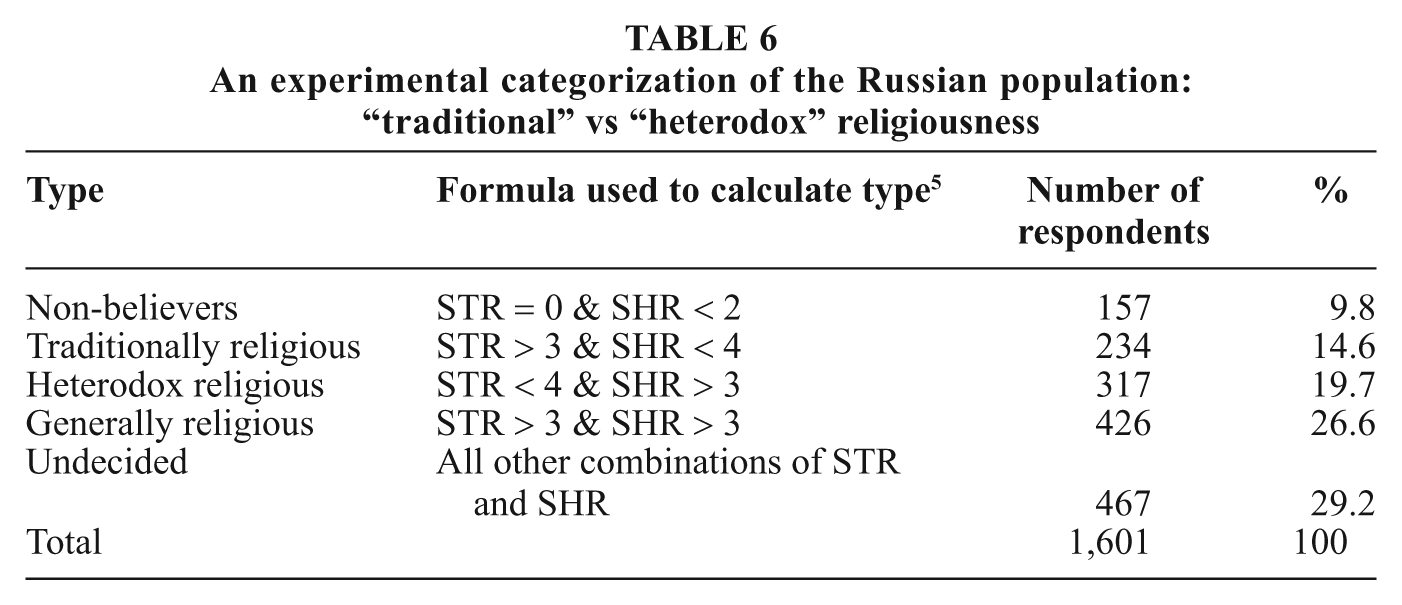
There are different ways to interpret these results. For example the number of convinced non-believers is low (less than 10 per cent). Traditional religiousness is adhered to by about 15 per cent of the population, while about 20 per cent of the population are heterodox religious. Another 27 per cent show both traditional and esoteric religiousness and about 30 per cent of the population do not have any well-defined religious views. These results can be viewed as an important confirmation of the hypothesis that in present-day Russia, heterodox or “esoteric” religiousness has become the dominant form of religiousness and involves at least 45 per cent of the population, compared with 40 per cent for traditional (Christian) religiousness and 10 per cent for scientific materialism.
4. Conclusion
Russia follows the general pattern observed in Western countries: many elements of “esoteric” or “heterodox” religious worldviews are widely held in the population and possess relevance to practical actions.
Women and people with a high level of education are especially likely to get involved in this “heterodox” kind of religiousness.
As for the controversial relationship between “heterodox” religiousness and Orthodox Christianity, which is traditional for Russia, most people adhere to both. However, there are more people involved only in the “heterodox” religiousness than are involved only in Christian religiousness.
Given the importance of “heterodox” religiousness, a new methodological approach is offered for use in future studies dealing with it.
Footnotes
Acknowledgements
The author gratefully acknowledges the financial support provided by the Deutsche Forschungsgemeinschaft (DFG) to the research project that led to the findings presented here.