




Abstract
The tourism industry is seen as having great potential, but tourism development and tourism activities may increase energy consumption and environmental pressure. Based on the provincial panel data of China from 2000 to 2017, we calculate the energy and carbon emission performance by using the non-radial distance function (NDDF) and further investigate the impact of tourism industry agglomeration on energy and carbon emission efficiency by combining the panel fixed effect model, mediation effect model and quantile regression. Our research results show that there is an inverted U-shaped relationship between tourism industry agglomeration and energy and carbon emission efficiency, and tourism industry agglomeration can improve energy and carbon emission efficiency at present. At the same time, the impact of tourism industry agglomeration on energy and carbon emission efficiency has regional heterogeneity. The industrial structure upgrading plays an important role in the process of tourism industry agglomeration. In addition, with the improvement of energy and carbon emission performance, the impact of tourism industry agglomeration is also different. These findings suggest that policymakers should promote tourism industry agglomeration to realize energy conservation and emission reduction. The Chinese government should focus on the tourism resources and advantages of different regions and formulate differentiated regional policies to improve ecological performance.
Keywords
Introduction
Alleviating environmental degradation and achieving sustainable economic growth are important issues facing all countries in the world.1–4 China's economy has made remarkable achievements after the reform and opening up. China's GDP grew from 367.87 billion yuan in 1978 to 9030.95 billion yuan in 2018, with an average annual growth rate of 9.4%, which is known as the “Chinese miracle”. However, China's rapid economic growth has also brought serious energy consumption and environmental pollution. For example, economic growth and urbanization have created a huge energy demand,5,6 and climate change is caused by carbon dioxide emissions.7,8 China's energy consumption and carbon dioxide emissions have also attracted wide attention from the international community. Furthermore, in September 2020, the Chinese government pledged to achieve carbon neutrality by 2060. To achieve this ambitious goal, the Chinese government must plan energy conservation and emission reduction measures as soon as possible.
Tourism is one of the most promising industries since the twenty-first century,9–11 and also supports the economic development of many countries.12,13 For a long time, tourism has been an important driver of economic growth and employment, especially in developing countries like China.14,15 The development of tourism mainly relies on local cultural resources and natural resources and has little direct connection with industrial production and pollution emission. Figure 1 shows the total revenue and proportion of China's tourism industry. We find that China's tourism revenue is very considerable, and the contribution of tourism to economic growth keeps rising. For traditional resource-based cities, tourism development is often conducive to economic structure transformation and green economic development. There are many resource-based cities in China, which develop their economies by using abundant fossil energy. However, with resource exhaustion and environmental pollution, urban economic transformation and development are under great pressure. Therefore, tourism has become an important means for the transformation of these cities. A typical case is Jiaozuo in Henan province, which is called “coal city”. Since the twenty-first century, Jiaozuo has made great efforts to develop tourism and successfully realized the transformation from a traditional resource-based city to a green city. Similar cities include Datong in Shanxi Province and Panzhihua in Sichuan Province. Therefore, it is feasible to realize green economic development by relying on tourism.

Tourism income and trends in China.
The energy consumption and pollution emission of tourism have been widely concerned.16,17 Due to the correlation effect, the tourism industry and its related industries such as entertainment, hotel and business have formed an obvious agglomeration effect. Intuitively, TOUR may be conducive to improving EEI, because tourism itself has relatively low energy consumption and carbon emissions. But in practice, this is not the case and tourism is no longer seen as a “smoke-free” industry. 18 Tourism also contributes to energy consumption and carbon emissions, which is an important cause of climate change. 19 First of all, the construction of tourism facilities directly produces energy demand. At the same time, tourism development can indirectly drive the development of transportation, catering and accommodation, which needs a lot of electricity and coal to provide power and bring a negative impact on the ecological environment.20,21 Moutinho et al. point out that tourism accounts for 5% of total carbon emissions, and only transport accounts for 75% of total carbon emissions. 22 Geneletti and Dawa (2009) studied the adverse impact of tourism on the ecological environment by combining geographical information systems and remote sensing images. 23 Zhang and Liu (2019) used the data of 10 Northeast and Southeast Asian countries from 1995 to 2014 to find that tourism development would lead to environmental deterioration. 24
These works of literature are devoted to analyzing the current situation and causes of energy consumption and carbon emission of tourism, to provide policy suggestions for the green development of tourism. However, previous studies mainly considered the energy consumption and carbon emissions of tourism, largely ignoring the role of industrial agglomeration, and there are few studies on the relationship between TOUR and the energy environment. With the increasingly obvious trend of tourism industry agglomeration in China, TOUR will produce more benefits, and the impact of TOUR on energy and the environment should be paid more attention to. Based on this premise, we seek to contribute to the debate on the relationship between the tourism industry and energy consumption and carbon emissions. Initially, the TOUR may have a complex positive or negative effect on energy consumption and carbon emissions. Therefore, this paper argues that TOUR may have a dual impact on energy and carbon emission performance in China, which is reflected in the empirical experience as a nonlinear effect. This study attempts to supplement relevant research and aims to explore the energy and environmental costs brought by China's tourism industry development from the perspective of industry agglomeration, to provide a new reference for scientific understanding of how to achieve green development of tourism.
In sum, the purpose of this study is to explore the relationship between TOUR and EEI, analyze the possible nonlinear effect and influence mechanism, and put forward targeted policy suggestions based on this. Compared with existing studies, the contributions of this study are as follows. Firstly, our research contributes to a better understanding of the impact of the tourism industry. There is no consensus on the impact of tourism development on energy consumption and carbon emissions. On the basis of measuring EEI, this paper verifies the existence of a nonlinear relationship from the perspective of industrial agglomeration. Secondly, traditional single-factor indicators such as carbon emission intensity and energy intensity have limitations, because they ignore the substitution effect of capital and labor on energy, which may lead to bias in empirical results. Therefore, we use the non-radial directional distance function (NDDF) to integrate capital, labor, energy, GDP and carbon emissions into a unified analytical framework. Thirdly, regional heterogeneity is included in the empirical analysis, which provides an important reference for tourism in different regions. The results show that due to the obvious differences in economic development, geographical location and ecological environment among different regions in China, there are regional differences in the influence of TOUR on EEI. Therefore, different regions should formulate differentiated measures for tourism development.
Literature review
Agglomeration economy
Economic agglomeration mainly refers to the relative concentration of economic activities in spatial units, and an industrial agglomeration is an important form of economic agglomeration, such as manufacturing industry agglomeration25,26 and service industry agglomeration. 27 The new economic geography thinks that the proximity and concentration of various economic activities in space can reduce the production cost and form the obvious effect of scale economy, and the increasing return to scale is the foundation of economic agglomeration. 28 Economic agglomeration emphasizes the influence of geographical proximity on productivity, so the influence of economic agglomeration is considered an externality. 29 Many studies have also verified that economic agglomeration is conducive to promoting economic growth.30,31 Due to the existence of the economic agglomeration effect, many regions in the world have also emerged with some characteristic development models, such as industrial clusters32,33 and city clusters.34,35 However, some scholars found different conclusions.
In fact, the impact of economic agglomeration or industrial agglomeration on the ecological environment is uncertain, which can also be summarized as the positive or negative externality of agglomeration. On the one hand, economic agglomeration often leads to the optimization of industrial structure and the improvement of resource utilization efficiency, thus improving the ecological environment.36,37 Fang et al. found that manufacturing agglomeration reduced haze pollution in the region and surrounding cities due to the existence of the technology spillover effect. 26 On the other hand, the negative externalities of economic agglomeration may also worsen the ecological environment. Cheng used spatial simultaneous equations to find that industrial agglomeration increased environmental pollution, and environmental pollution was not conducive to industrial agglomeration. 38 At the same time, due to the free rider and “race to the bottom” effect of industrial agglomeration, industrial agglomeration can also worsen the environmental quality and energy efficiency of neighboring areas.39,40 Based on the above analysis, we believe that the impact of economic agglomeration or industrial agglomeration on energy and environmental performance may be complex, and differences in sample objects and data selection lead to different conclusions.
Agglomeration of the tourism industry refers to the spatial agglomeration of tourism elements, commodities and services in specific places. 41 Energy and carbon emission performance refers to the energy utilization degree and carbon emission efficiency under the specific technological level.42,43 From the perspective of TOUR, this effect may be different from that of other industries’ agglomeration. The tourism industry itself has less pollution emissions and energy consumption, so TOUR can bring about the upgrading of the industrial structure. For example, TOUR promotes industrial transfer and changes in leading industries, thus improving EEI. However, when TOUR reaches a certain degree, its crowding effect may gradually appear. It is impossible for an area to attract tourism unlimitedly, especially the development of related industries such as transportation, catering and accommodation, which can directly lead to a lot of energy consumption and environmental pollution. Of course, this can also be explained by the positive and negative externalities of TOUR, the superposition of which may lead to more complex effects.
Clearly, the industrial structure is critical to energy consumption and carbon emissions,44,45 which is also closely related to China's special institutional background. Since the promotion of government officials is directly linked to regional economic performance, local governments spare no effort to mobilize resources to develop the economy. Thus, local governments give priority to industries that can generate GDP and tax revenue, such as steel, coal and chemical industries. However, most of these industries are characterized by high energy consumption and high pollution, which bring negative impacts on the ecological environment. The process of industrial agglomeration brings about the change of industrial structure, 46 especially in the tourism industry, which is clean and produces good economic benefits. At the same time, the cross-industry comprehensive characteristics of the tourism industry drive the development of other industries, conducive to the optimization of the industrial structure. Existing literature has confirmed the positive impact of industrial structure upgrading on energy conservation and emission reduction, 47 so TOUR may also indirectly affect EEI through the upgrading of industrial structures.
The impact of tourism on energy and the environment
Due to the important role of tourism in global economic development, some scholars have begun to discuss the impact of tourism development on energy and the environment. The first group uses foreign tourism data to study the relationship between tourism and the environment.47–49 Robaina-Alves et al. used LMDI analysis to analyze the influencing factors of carbon emissions in the tourism sector of Portugal and found that tourism activities were the most important influencing factors, and energy structure, carbon intensity and energy intensity were also important. 50 Khan et al. used data from 34 high-income countries in three continents (Asia, Europe and the United States) from 1995 to 2017, and found a one-way Granger causality from tourism to greenhouse gases. 51 The study also found tourism in Asia can increase greenhouse gases, and tourism in Europe can reduce them. Nepal et al. used data from Nepal to find a one-way causal relationship between tourist arrivals and emissions in the long run, but not in the short run. 52
The second group studies the relationship between tourism and the environment based on Chinese data.18,53,54 These studies mainly calculate the carbon emission of tourism and its influencing factors. Zha et al. combined the environmental input-output (I-O) model with structural decomposition analysis and found that most of the carbon emissions of China's tourism industry come from some key upstream industries, and there are significant differences in the carbon emissions of tourism subsectors. 55 Zhang and Zhang used the vector error correction model to find that there is a long-term equilibrium relationship between tourism, economic growth, energy consumption and carbon emissions, and these four variables affect each other. 56 Tang used the coupling coordination model to analyze the coupling relationship between tourism and environmental system, and found that the harmonious development of tourism and environmental system is a dynamic process. 14
Through the literature review, it can be found that energy conservation and emission reduction of tourism have attracted much attention, but few studies focus on the role of TOUR, and the environmental effect of TOUR in China is still far from enough. China's tourism industry is in the stage of rapid development, large and small tourism industry clusters have emerged, such as Hexi Corridor, Yangtze River Economic Belt and the Yellow River Economic Belt. With the regional economic integration and the formation of the whole region tourism, the trend of TOUR will be more and more obvious. Therefore, how does the process of TOUR affect energy and carbon emission performance? Or, can TOUR realize energy conservation and emission reduction? What are the influencing channels? From the current research, these problems have not been discussed in depth. Answering these questions is helpful to scientifically understand the energy and environmental cost of tourism industry development and has practical significance to promote the green development of the tourism industry. Based on this, this paper calculates the index of TOUR and EEI of each province in China, and empirically investigates the effect of TOUR on EEI.
Methodology and data
NDDF
The measurement of energy and carbon emission performance can be divided into single and total factor indicators. Single factor indicators mainly include energy intensity and carbon emission intensity,22,57 but the single factor index ignores the influence of capital and labor input. Referring to Lin and Du, 43 we use the NDDF to calculate EEI.
Suppose there are N provinces, each of which is a Decision-Making Unit (DMU). Then, the production technology can be defined as:

Following Zhou et al.,
58
we can define NDDF as follows:


Regression model
Referring to existing studies,64–66 we establish the following linear model and nonlinear model:



Where,
The independent variable is the tourism industry agglomeration (TOUR), which reflects the agglomeration degree of the tourism industry in space. As for the measurement of industrial agglomeration, location entropy is widely used, 40 which is also common in the study of tourism agglomeration. 41 Therefore, this study used location entropy. The dependent variable is energy and carbon emission efficiency (EEI), which are calculated using the NDDF. Following Zhou et al., 70 the industrial structure upgrading (IS) is expressed by the share of the added value of the tertiary industry to the added value of the secondary industry. For the selection of control variables, population size is represented by population density (POP), and economic growth is represented by real per capita GDP (GDP). The first two variables mainly control the impact of the scale effect. Considering the existence of the environmental EKC curve,71,72 we also include the quadratic term of GDP. Technology is represented by patents (TEC), which is similar to Xie et al. 73 In addition, we use the proportion of the urban population to represent urbanization (URB), 74 and use the proportion of total import and export trade to GDP to control the influence of economic opening (OPEN). 75
Data
The research samples of this paper include the panel data of 30 provinces in China from 2000 to 2017. Due to the lack of data, the samples do not include Tibet, Hong Kong, Macao and Taiwan. Tourism revenues and employment data come from statistical yearbooks 2001–2018 at the provincial level. Data of energy consumption data are from the China Energy Statistics Yearbook2001–2018. GDP, capital, population, foreign trade and urbanization rate are from China Statistical Yearbook 2001–2018. Descriptive statistics of the data are shown in Table 1.
The statistical description of variables.

Before the empirical analysis of the data, we test the correlation and multicollinearity of each variable. As shown in Table 2, correlation coefficients between variables are mostly less than 0.7. On this basis, we calculated that the mean value of the variance inflation factor (VIF) is 4.73, and the VIF of each variable is also less than 10. In sum, the multicollinearity problem can be ignored.
Correlation coefficient matrix.

Empirical results analysis
Empirical results of fixed effects model
Table 3 provides the results of the fixed effects model (See columns (1) and (2)). First, we test the linear relationship between TOUR and EEI. The results show that the coefficient of TOUR is significantly positive, indicating that TOUR can increase EEI. This is similar to existing studies, many of which found that tourism development can improve environmental quality.76,77 TOUR is positive while TOUR2 is negative, and both of them are statistically significant (See columns (3) and (4)), indicating that there is a significant inverted U-shaped relationship between TOUR and EEI. The influence of TOUR on EEI has changed from positive to negative. According to the mathematical meaning of the coefficient, the inflection point is roughly TOUR = 2.426. At present, most of the samples are still on the left side of the inverted U-shaped curve, and TOUR is conducive to improving EEI at this stage. In the short term, TOUR can optimize industrial structure, reduce energy consumption and carbon emissions. However, in the long run, TOUR will also drive traffic and economic activities, which is not beneficial to energy conservation and emission reduction. This result is contrary to economic intuition, but some studies have found that tourism aggravates environmental degradation because it increases its contribution to GDP and ecological footprint. 78
Main regression results.

Notes: t-statistics in parentheses; ***p < 0.01, **p < 0.05, *p < 0.1.
The results of control variables are in line with expectations. The coefficient of POP is significantly positive, because population agglomeration contributes to the sharing of energy saving and emission reduction facilities, and also brings about the human capital effect. The coefficient of GDP is significantly positive, indicating that economic growth can improve EEI. Interestingly, when the quadratic term of GDP is included, the first term of GDP is not significant, and the quadratic term is still significantly positive. This result indicates that GDP has a stable promoting effect on EEI. The coefficient of TEC is not significant. China's technological innovation may partially offset the energy-saving and emission-reduction effects of technological progress, as it aims to expand its production scale. The coefficient of URB is negative and statistically significant, showing that URB is not conducive to improving EEI. The coefficient of OPEN is significantly positive because economic opening can bring in foreign technology and capital, thus improving energy efficiency and environmental quality.
Robustness check
This paper uses the following two methods to test robustness, as shown in Table 4. First, in the empirical analysis above, we randomly choose the lag three periods, which may affect the robustness of the results. Therefore, we use the lag one and two-phase of the TOUR, and find that the coefficient of TOUR is still significantly positive (See columns (1) and (3)). Meanwhile, TOUR is positive and TOUR2 is negative, so the inverted U-shaped curve still exists (See columns (2) and (4)). It is worth noting that the coefficient of the lag term is getting larger, which indicates that the positive influence of TOUR is more obvious. Second, we change the estimation method and use the instrumental variable method. By using the lag one period of TOUR as the instrumental variable and using the two-stage least square method (IV-2SLS), the coefficient of TOUR is still significantly positive. Moreover, an inverted U-shaped curve exists between TOUR and EEI. Therefore, the empirical results are robust
Robustness check.

Notes: t-statistics in parentheses; ***p < 0.01, **p < 0.05, *p < 0.1.
Regional heterogeneity
Tourism resources, industrial agglomeration and environmental conditions are different in different regions of China, which may lead to regional heterogeneity in the impact of TOUR. To test the heterogeneous influence of TOUR, we divided the whole sample into eastern, central and western regions, and the results are shown in Table 5. It can be found that the coefficient of TOUR is significantly positive in the eastern and western regions, but the coefficient of TOUR in the central region is positive but has no statistical significance (See columns (1), (3) and (5) of Table 5). This result shows that TOUR is beneficial to improving EEI in eastern and western regions, but does not have a promoting effect on EEI in central regions. Sun et al. found that the green efficiency of tourism in the eastern and western regions is significantly higher than that in the central region because the eastern and western regions are rich in tourism resources and have strong policy support. 79 In fact, the TOUR in the central region is significantly lower than that in the eastern and western regions, and the tourism is not competitive. However, the development of tourism in the eastern and western regions makes a high contribution to economic growth. At the same time, the eastern region has strong economic strength and developed technology. In recent years, a series of policies have been introduced to inject vitality into tourism. For example, Shanghai proposes to develop urban tourism, and Zhejiang proposes to develop “Internet + tourism”. The western region has good national cultural resources, tourism advantages can be fully transformed into energy conservation and emission reduction power.
Empirical results of regional heterogeneity.
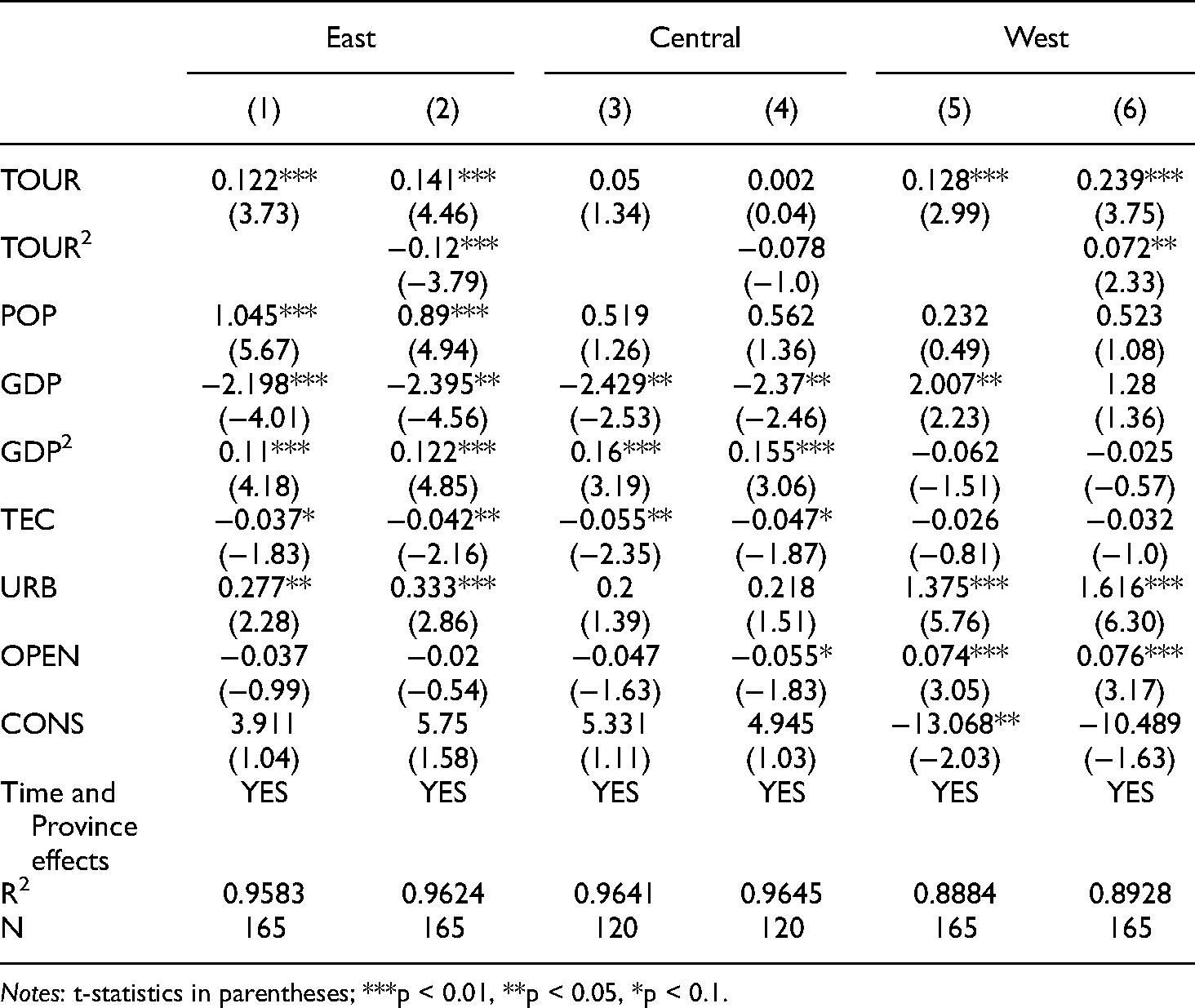
Notes: t-statistics in parentheses; ***p < 0.01, **p < 0.05, *p < 0.1.
In addition, the nonlinear relationship between TOUR and EEI in different regions is also different. There is an obvious inverted U-shaped relationship between the TOUR and EEI in the eastern region, while there is no nonlinear relationship in the central region (See columns (2) and (4)). The primary and secondary terms of the TOUR in the western region are both significantly positive (See columns (6)), indicating that the TOUR in the western region has an obvious positive effect. The western region is in an important period of rapid economic development, and energy consumption and environmental pollution are relatively serious. TOUR can significantly and continuously promote regional energy conservation and emission reduction.
Influence mechanism analysis
According to the above theoretical analysis, the positive impact of industrial structure upgrading (IS) on EEI is obvious, and it may act as an intermediary variable between TOUR and EEI. Therefore, we use the mediating effects model to check whether IS acts as a mediating variable.
The results show that the coefficient of TOUR is significantly positive (See columns (1) of Table 6), showing that TOUR can improve IS. After the inclusion of IS, the coefficient of TOUR has decreased (See columns (2) of Table 6), but it is still statistically significant. It can be seen that IS acts as an intermediary variable between TOUR and EEI. Meanwhile, the first term of the TOUR is significantly positive, while the second term is not significant (See columns (3) of Table 6). Therefore, the impact of TOUR on IS is linear. TOUR can not only improve EEI, but also directly promote IS and indirectly improve EEI. Besides, the inverted U-shaped relationship between TOUR and EEI still exists after industrial structure upgrading is included (See columns (4) of Table 6), which verifies the significance of the mediation effect. This result is similar to that of Yang et al. 80 and Tang et al. 81 Because tourism includes many clean sectors, it can offset the energy consumption and carbon emissions of some high energy consumption and high pollution industries, thus promoting the upgrading of industrial structure.
The mediation effect.

Notes: t-statistics in parentheses; ***p < 0.01, **p < 0.05, *p < 0.1.
Quantile regression
The impact of TOUR may be different under different EEI, and the analysis of this impact can help us to better formulate targeted recommendations. Quantile regression can effectively avoid the adverse effects of extreme values and better demonstrate the marginal effects of explanatory variables under different conditions. Therefore, we use quantile regression to discuss the influence of TOUR, as shown in Table 7.
Quantile test results.

Notes: t-statistics in parentheses; ***p < 0.01, **p < 0.05, *p < 0.1.
The results show that the coefficient of TOUR is significantly positive at all quantiles. Liu et al. found that the energy and environmental performance was different in different decimal points, leading to significant changes in its influencing factors. 82 With the improvement of quantile, the coefficient of TOUR first increases and then decreases, so the positive impact of TOUR first increases and then decreases. In those areas where energy consumption and carbon emission are relatively serious, the positive development of the tourism industry is more obvious. In areas with higher EEI, the ecological environment has higher requirements for industrial development, and TOUR has less impact space.
Conclusions and policy implications
Conclusions
Industrial agglomeration has become an important trend of industrial development. Although the existing studies have discussed energy consumption and carbon emissions in the tourism sector, they have looked at static and single industry perspectives and the TOUR is often ignored. Meanwhile, there is no systematic explanation of the influencing mechanism of TOUR, and no consensus has been reached on whether tourism development can achieve energy conservation and emission reduction. The reason lies in the diversity of research samples and data, as well as the inconsistent selection of indicators. This study discusses the impact of TOUR on EEI from the perspective of industrial agglomeration. The main conclusions are as follows.
Firstly, the study focuses on the important role of TOUR on EEI. Compared with high energy consumption and high pollution industries, tourism is an industry with less energy consumption and pollution emission. However, as the tourism industry gathers, tourism-related transportation and construction industries will also develop, thus increasing energy consumption and carbon emissions. The full-sample regression of the two-way fixed effects model shows that TOUR can improve EEI, which has a time lag, and there is an obvious inverted U-shaped relationship between them. Thus, although TOUR can improve China's energy and carbon emissions performance, but disorderly tourism expansion is not entirely beneficial. It is necessary to fully pay attention to and verify the nonlinear effect of TOUR and provide a meaningful reference perspective for future research.
Secondly, this paper emphasizes the regional heterogeneity of TOUR on EEI. The analysis of the whole sample can only reflect the overall impact of TOUR, but the results of sub-samples in different regions may be different. Due to the obvious differences in tourism development, resources and environment in eastern, central and western, it is necessary to investigate the impact of regional heterogeneity on TOUR in an empirical study. The results of panel fixed effects in the sub-regional show that the influence of TOUR has regional heterogeneity. Specifically, TOUR in eastern and western regions is conducive to improving EEI, while it is not obvious in central regions. Meanwhile, the nonlinear relationship between TOUR and EEI is also different in different regions. Different regions in China are at different stages of development, and there are differences in industrial base and tourism resources, so the impacts of TOUR are also different. Therefore, in the process of developing the tourism industry, the government should pay attention to the conditions and environmental conditions of different regions and formulate targeted development plans.
Thirdly, the influence mechanism and marginal effect of TOUR on EEI should also be fully considered. The TOUR may change the regional industrial structure, and the change of industrial structure will also affect energy consumption and carbon emissions. Meanwhile, the impact of the TOUR may vary in regions with different EEI. The empirical results further test the above arguments. The results of the mediating effect model show that IS is an important influencing mechanism for TOUR to influence EEI, and TOUR indirectly improves EEI by improving IS. In addition, according to the results of quantile regression, the influence of TOUR is in the process of dynamic evolution with the change of EEI. This result suggests that policymakers can rationally arrange the tourism industry according to the energy and environmental conditions of different regions, thus providing power for regional industrial transformation and upgrading and green economic development.
Policy implications and contribution
The research results and steps of this paper are as follows:
Step 1. The panel fixed effect model and Equations (4) and (5) are used to find that there is a significant inverted U-shaped relationship between TOUR and EEI, but the impact of TOUR on EEI is regional heterogeneity. Step 2. The mediation effect model and Equations(4) to (9) are used to find that TOUR affects EEI by changing regional industrial structure. Step 3. Combined with quantile regression and Equations (10) and (11), it is further found that the impact of TOUR is different at different quantiles.
The conclusions and empirical evidence are of great academic and practical contributions. The academic contributions may include the following. (1) This study provides a new perspective for an in-depth understanding of energy consumption and carbon emissions in the tourism industry. The impact on the TOUR is still in its infancy, especially the dual impact of tourism industry development on energy conservation and emission reduction has not been fully paid attention to. This paper is helpful to enrich relevant studies and provide some references for the follow-up investigation on the green development of the tourism industry. (2) Regional heterogeneity and influencing mechanism are brought into the research framework to distinguish the impacts of TOUR in different regions and comprehensively investigate how TOUR affects EEI. Therefore, the research framework of this paper not only focuses on the overall impact of TOUR on EEI, but also emphasizes the internal logic that causes this result, thus contributing to the existing knowledge system.
In addition, the practical contributions of this paper can also be summarized in the following aspects. (1) China's tourism industry is undergoing a transition from high-speed growth to high-quality development, and more tourism industry clusters will be formed in the future, so more attention should be paid to the pressure of tourism industry agglomeration on resources and the environment. At present, tourism industry agglomeration is still beneficial to energy conservation and emission reduction, so it is necessary to take tourism development as the engine of regional green economic growth, and then continuously improve the quality of tourism development. Of course, the crowding effect brought by tourism industry agglomeration cannot be ignored. (2) Different regions should implement differentiated development measures. The eastern region should provide favorable policy support and an institutional environment to build a high-quality demonstration zone for the tourism industry. The central region can accelerate the speed of tourism industry agglomeration and give full play to its positive influence. For the western region, it is necessary to seize the important opportunities of the current tourism development, which can promote environmental protection through tourism industry agglomeration. (3) Local governments should attach importance to the decarbonization and pollution of tourism, especially the related effects of tourism industry agglomeration on other industries, such as transportation and hotels, which may indirectly cause environmental pollution. Therefore, the use of clean energy is very necessary for the process of tourism development.
Limitations and future research directions
There may be some limitations to this study. First, this study mainly investigates the influence of TOUR on energy and the environment from the macro level. More microdata should be published so that the research perspective can be applied to the tourism enterprise level. Besides, more influencing mechanisms should be found, especially the spatial effect of the tourism industry can be further brought into the analysis framework. Future studies can try to use policy assessment methods and spatial models for analysis.
Footnotes
Acknowledgements
The authors thank the editors and reviewers for their comments.
Declaration of conflicting interests
The author(s) declared no potential conflicts of interest with respect to the research, authorship, and/or publication of this article.
Funding
The author(s) disclosed receipt of the following financial support for the research, authorship, and/or publication of this article: This work was supported by the National Natural Science Foundation of China, (grant number Key Program, No 72133003).
