



Abstract
Fuzzy graphs (FGs) contain dual-nature characteristics that may be extended to intuitionistic fuzzy graphs. These FGs are better at capturing ambiguity in situations in reality involving decision-making than FGs. In this paper, we address decision-making problems based on intuitionistic fuzzy preference relations (IFPRs) by utilizing Signless Laplacian energy (SLE), intuitionistic fuzzy weighted averaging (IFWA), and intuitionistic fuzzy weighted averaging geometric (IFWAG). The paper suggests an approach that makes use of intuitionistic fuzzy graphs (IFG) and IFPR to optimize batteries for electric vehicles. Electric vehicles (EVs) performance, range, and efficiency are all dependent on battery technology. Research and technological developments may help remove adoption hurdles and increase public interest in EVs. Producers of batteries and automakers are investing in recycling and cost-cutting measures for manufacture. With the use of carbon nanotube electrodes, battery power may be increased tenfold beyond existing capabilities. In a procedure called group decision-making, experts evaluate and choose the best options based on present standards. This method provides crucial data for well-informed decision-making by capturing ambiguity and uncertainty in real-world decision-making. The strategy improves decision-making and maximizes profits, giving investors a useful foundation for choosing environmentally friendly electric vehicle batteries.
Keywords
Introduction
The concept of fuzzy set (FS) is attributed to Zadeh. 1 The goal of Atanassov's 2 1986 study was to clear up any remaining ambiguity regarding membership levels within them. FS originally represented the degree of membership, a set attribute, using the range [0,1]. Atanassov, however, expanded on this idea by introducing the degree of non-membership, providing a more sophisticated interpretation of FS membership. A member's non-membership level (the extent to which it doesn't belong) in an FS cancels out the membership levels of other members, producing a stable overall image. This is because most, if not all, membership functions are autonomous and show relationships. Atanassov's et al. 3 study of Intuitionistic fuzzy sets (IFSs) generalizes FS by incorporating a hesitation margin, enhancing its applications. An IFG was included in the notion of a FG by Parvathi and Karunambigai. 4 As for the usefulness of FG and IFG applications, Imran et al. 5 propose innovative topological indices (TIs) such as the Zagreb index, and Sombor index in the IFG framework. Additionally, it contrasts these indices characteristics and upper boundaries. In their exploration of dominance in intuitionistic fuzzy influence graphs (IFIGs), Rehman et al. 6 define terms such as walk, path, minimum strong fuzzy influence pair domination number, and strength of influence pair. To enhance model analysis, the Technique for Order of Preference by Similarity to Ideal Solution (TOPSIS) and VIekriterijumsko KOmpromisno Rangiranje (VIKOR) approaches are applied. In their exploration of complex t-intuitionistic fuzzy graphs (CTIFGs), M. Kaviyarasu et al. 7 emphasize the flexibility and potential efficiencies of CTIFGs as a strong tool for studying complicated interactions in a variety of applications, especially in the rubber processing industry's wastewater. Zare Ahmadabadi et al. 8 investigate supply chain resilience (SCR) in Yazd province's tile and ceramic industries. It employs a methodical methodology and meta-synthesis method to discover 33 characteristics that influence SCR, such as strong supplier connections, lean manufacturing, technical adaptability, and IT infrastructure deployment. Gutman 9 talked about the concepts of graph energy and how they relate to the overall electron energy in certain compounds. In relation to the total electron energy of certain molecules, Balakrishnan 10 investigated the concept of graph energy. The energy of a FG was examined by Anjali and Mathew, 11 who also identified the boundaries of superior and inferior graph energy. The concept of a fuzzy graph's Laplacian energy was first proposed by Sharbaf and Fayazi 12 Basha and Kartheek 13 utilized their comprehension of a FGs Laplacian energy to translate the Laplacian energy of an IFG.Among the most well-known and unmatched IFS perceptual extensions is IFG. Being an IFS perceptual extension, IFG is among the best-known and unmatched. The use of IFSs in multi-criteria decision-making (MCDM) is examined by Voskoglou et al.14–18 with a particular emphasis on how well they handle uncertainty in universal set components and a framework for enhancing efficiency in emergency departments using simulation and fuzzy multi-criteria decision-making. It demonstrates the potential of this approach to improve patient flow and service quality in healthcare settings. Akram et al. 19 establish a triangular interval-valued fermatean fuzzy number (TIVFFN) for fractional transportation problems (FTPs) with unknown parameters. A novel approach is suggested, measured for precision and accuracy, and compared to current methods. Falehi 20 carried out recent IFPR with success using a variety of techniques. Some novel concepts on extended FG designs and their effects on decision-making were introduced by Akram et al.21,22 Furthermore, to choose the best alliance partner, Ramesh et al.23,24 integrated the TOPSIS technique with IFG in their group decision-making process. Atheeque et al.25,26 use q-Rung Orthopair fuzzy graphs (q-ROFGs) for group decision-making, estimating authority weights using internal and impartial evidence. They introduce address ambiguity and compare models.
Yager 27 presented geometric aggregation operations, which are based on Atanassov's Intuitionistic fuzzy sets (A-IFS). A few of these operators include intuitionistic fuzzy hybrid geometric (IFHG), intuitionistic fuzzy ordered weighted geometric (IFOWG), and intuitionistic fuzzy weighted geometric (IFWG). To handle cases involving several attributes in decision-making, these operators were utilized. Furthermore, Xu 28 contributed to the subject by creating operators for aggregating intuitionistic fuzzy values, such as intuitionistic fuzzy ordered weighted averaging (IFOWA), intuitionistic fuzzy hybrid averaging (IFHA), and intuitionistic fuzzy weighted averaging (IFWA). Xu conducted a detailed investigation of these operators’ properties. A specific operator called the dynamic intuitionistic fuzzy weighted averaging (DIFWA) operator was developed by Yager and Xu.29,30 This operator was created to handle situations when attribute values are collected at different times, coupled with a related process. For the purpose of making multiple attribute decisions, He et al. 31 created intuitionistic fuzzy geometric interaction averaging (IFGIA) operators. Tian et al.32–34 proposed a new ranking method for linguistic interval-valued Atanassov intuitionistic fuzzy numbers (LIVAIFNs), overcoming existing limitations. It also introduces a new aggregation operator (AO) called NLIVAIFWA, which can overcome the drawbacks of existing methods. The paper also discusses the properties of the NLIVAIFWA and AO constructs a novel group decision making (GDM) method based on it. Akram et al.35–37 develop the notion of a complex q-rung picture fuzzy set (Cq-RPFS), which is an extension of q-rung orthopair picture fuzzy sets (q-RPFSs) that addresses ambiguity and periodicity. It addresses aggregation operators, and MCDM issue solutions, and compares the method to other models. Intuitionistic fuzzy analysis shows the tremendous progress made in the last several years in both the theoretical and applied components. These kinds of fuzzy graph studies spark our ideas about IFGs and their uses. This article provides an answer for both IFWAG and IFWA. The SLE measure tells us the relative weights of each decision matrix, which we utilize to handle requests for unclear information. All of the SLE's weights (loads) are summed to meet the requirement for the weight (load) vector. The optimal choices are selected by rating the options using the IFWAG and IFWA.
The paper has been structured as follows: Section 2 explains the basic ideas of intuitionistic fuzzy graphs and the associated IFWA and IFWAG. A flowchart detailing steps I and II for handling intuitionistic fuzzy graphs is included in Sections 3 and 4. It also includes a numerical solution for the SLE of these graphs, which is based on IFWA operators in scenarios involving decision-making. The section is finalized with the conclusions.
Motivation, highlights, and focus of the study
In this subsection, we discuss the scope, motivation, and uniqueness of the proposed work.
This article includes IFGs, SLE contributing to theoretical graph features, energy spectrum analysis, and structural insights that support practical applications and complicated system decision-making processes. Their capabilities to model both membership and non-membership within uncertain environments, along with the structural insights provided by IFG and SLE distinctly elevate the decision-making processes compared to traditional fuzzy approaches (Pythagorean, Picture, and Hesitant fuzzy sets).The use of IFWA and IFWAG operator techniques provides a versatile and effective framework for managing difficult decision-making scenarios that are marked by uncertainty and imprecision. The main objective is to establish a strong connection between the proposed algorithm and group decision-making challenges. The suggested technique is motivated by the use of an electric car battery selection strategy. The present study closes the existing research gap and offers a broad range of options for selecting input data. Due to its constraints, we are able to address issues that include ambiguity and uncertainty. When employing suggested operators and intuitionistic fuzzy numbers (IFN), decision-making approaches will yield better and more beneficial results.
Preliminaries
We review a few fundamental terms associated with fuzzy graphs.
An IFG with the nodes set V and the pathways set E, Gi = (Ѵ, Ε, µ, ν) is defined as a FG. ν is a FNMF and µ is an FMF stated on V × V. Next, we specify ν(ui, uj) by νij and µ(ui, uj) by µij so as to
➢ 0 ≤ µij + νij ≤ 1, ➢ 0 ≤ µij, νij, πij ≤ 1,
where πij = 1 − (µij + νij).
An IFG has a well-defined IFAM. A(Gi) = [aij], where aij = (µij,νij), gives G = (V,E,µ,v). It is noteworthy that the values of νij and µij indicate the strength of the non-membership link and membership bond, respectively, between vi and vj.
In Figure 1, an IFAM is


Intuitionistic fuzzy graph.
A non-membership values matrix (NMV) and a membership values matrix (MVs) can be utilized to characterize an IFAM. To enable us to illustrate this matrix as
A(Gi) = [(Aµ(Gi)), (Aν(Gi))],
Specifically, Av(Gi) represents the intuitionistic fuzzy non-membership matrix, whereas Aµ(Gi) represents the intuitionistic fuzzy membership matrix.
The Eigen roots of an IFAM are represented as (Y, Z), where Z represents the latent roots of Av(Gi) and Y represents the latent roots of Aµ(Gi).
Authorize D(Mi), given by [dij], to be the degree matrix of an IFG and permit A(Mi) to be an IFAM. Next, the definition of IFG's IFLM is
SL(Mi) = D (Mi) +A(Mi).
MV and NMV elements are present in one of the two matrices and may be used to represent an IFG's SLE.
SL(Mi) = [(SL (µij)), (SL (νij))].
Examine an IFG Gi = (V,E,µ,v) where αi and βi are the latent roots of A(Mi), an intuitionistic fuzzy adjacency matrix. An explanation of IFG's SLE is given below:
SLE(Mi) = [SLE(Aµ(Mi)), SLE(Aν(Mi))],
Aµ(Mi) and Av(Mi) have latent roots αi and βi, respectively, and A(Mi) of an IFG has membership and non-membership matrices Aµ(Mi) and Av(Mi), respectively. SLE(Aµ(Mi)) and SLE(Aν(Mi)) further yield the membership matrix Aµ(Mi) and non-membership matrix Aν(Mi) of the SLE of IFG. The SLE of an IFG is given by the formulae for (Aµ(Mi)) and (Aν(Mi)), respectively.

Assume that Gi = (uGi, vGi) (i = 1,2,….,n) be a collection of intuitionistic fuzzy numbers. If the mapping

Assume that Gi = (uGi, vGi) (i = 1,2,….,n) be a collection of intuitionistic fuzzy numbers. Should the mapping

Utilizing SLE and IFWA within the frame work of IFG for facilitating group decision-making
IFPRs are used by decision-makers to evaluate choices in pairs in order to arrive at the most accurate ranking conclusion while reducing the influence associated with mental errors and restrictions on them. As a result, decision-makers now prefer to use IFPRs to express their opinions. The indeterminate indication of an IFG may be measured using the SLE. As an IFG in the adjacency matrix (X × X), each IFPR is quantified using the SLE measure. In order to increase our confidence in the grades we acquire, we often consider the intuitionistic preference relation's vagueness grade to be as low as possible when using the GDM approach.
Algorithm
To determine the group decision making problem (GDMP) based on IFPR, ώ = (ώ1,ώ2,…,ώn) should function as an unpredictable authority loading vector, with ώm > 0,m = 1,2,…,.n, and with
The Signless Laplacian has been identified by using the adjacency matrix A(Mi).We compute the degree of the matrix D(Mi) and give the signless Laplace matrix calculation formula. Figure 2

Diagram showing the algorithm's flow for the selection process.
SL(Mi) = D (Mi) + A(Mi).
Determine the SLE(Mi) by using the following equations.

Utilizing the formula, determine the weight ώr a by using the SLE of the authorities er.

Using the formula, determine the IFWA or IFWAG

The score function is used to calculate the score values.

Utilizing the function Ψ(Ai), determine the net degree of preference of the choices, as indicated by.
24


Flow chart
Application: battery selection strategy
Electric and hybrid vehicles are linked to green technologies and a reduction in greenhouse gas emissions because of their low emissions and advantages in terms of fuel economy. However, recent analyses demonstrate that electric vehicles increase greenhouse emissions due to their excessive power requirements, especially in nations where renewable energy sources are scarce. This leads to a net increase in greenhouse emissions throughout the European continent. Limiting the dispersion of electric waste materials in the environment requires significant investment and the development of recycling technologies, in addition to managing the chemical and electrical components of automobile batteries and their waste flow. Reviewing the whole life cycle of battery units in electric and hybrid automobiles is crucial, since there has been a surge in the manufacturing of these vehicles globally in recent years, along with a rise in the manufacture and consumption of battery technology. Because of the constantly increasing sales of electric and hybrid cars throughout the continent, it is important to update regulations. Electricity from a battery pack powers one or more electric motors in battery-electric vehicles, which emit no pollutants from their exhaust and operate entirely on electricity instead of gasoline. When compared to filling up with gasoline, charging these automobiles can be done almost anywhere, at any time, and typically for a lot less money. The effective electricity-based charging mechanism of electric vehicles results in reduced operating expenses as compared to vehicles powered by gasoline or diesel. Transporting electric cars is both economical and environmentally beneficial when they are powered by renewable energy sources, such as solar panels. Yours may minimize the environmental impact of charging your automobile by choosing sustainable energy sources for your home's electricity. Expert's assessments of the options may be erroneous and inconsistent when making judgments under pressure. To this difficulty, the intuitionistic fuzzy concept provides a workable solution.
An individual is aiming to invest in one of the top electric car battery technologies (ECBT), such as Battery Technology A (BTA, f1), Battery Technology B (BTB, f2), Battery Technology C (BTC, f3), or Battery Technology D (BTD, f4). The selection of a battery technology is influenced by three key factors: Energy Storage Capacity (e1), Safety Features (e2), and Cost (e3). Lacking comprehensive knowledge about the electric car battery technology market, they are seeking expert advice to formulate the optimal investment strategy.
The requirements are categorized into three aspects:
- Energy Storage Capacity (e1), - Safety Features (e2), - Cost (e3).
In order to determine the most suitable electric car battery technology, a decision must be made based on a preference relation, a commonly utilized approach for establishing the ranking of alternatives. This method involves decision-makers indicating their preferences for the offered alternatives or criteria. Under the assumption that preferences are represented as IFN, each cell in the matrix represents the intuitionistic fuzzy preference value for each alternative, denoted as membership degree and non-membership degree, where membership degree indicates the degree to which the alternative meets the criteria and non-membership indicates the degree to which the alternative does not meet the criteria. Similarly, these matrices provided a comprehensive comparison of the four battery alternatives, enabling us to make informed decisions based on their intuitionistic fuzzy preferences. The following definition may be used to understand the idea of the Intuitionistic Preferences Relation (IFPR).
The IFAM is elucidated in Figure 3.


Energy storage capacity (e1) related to IFG (M1).
The IFAM is elucidated in Figure 4.

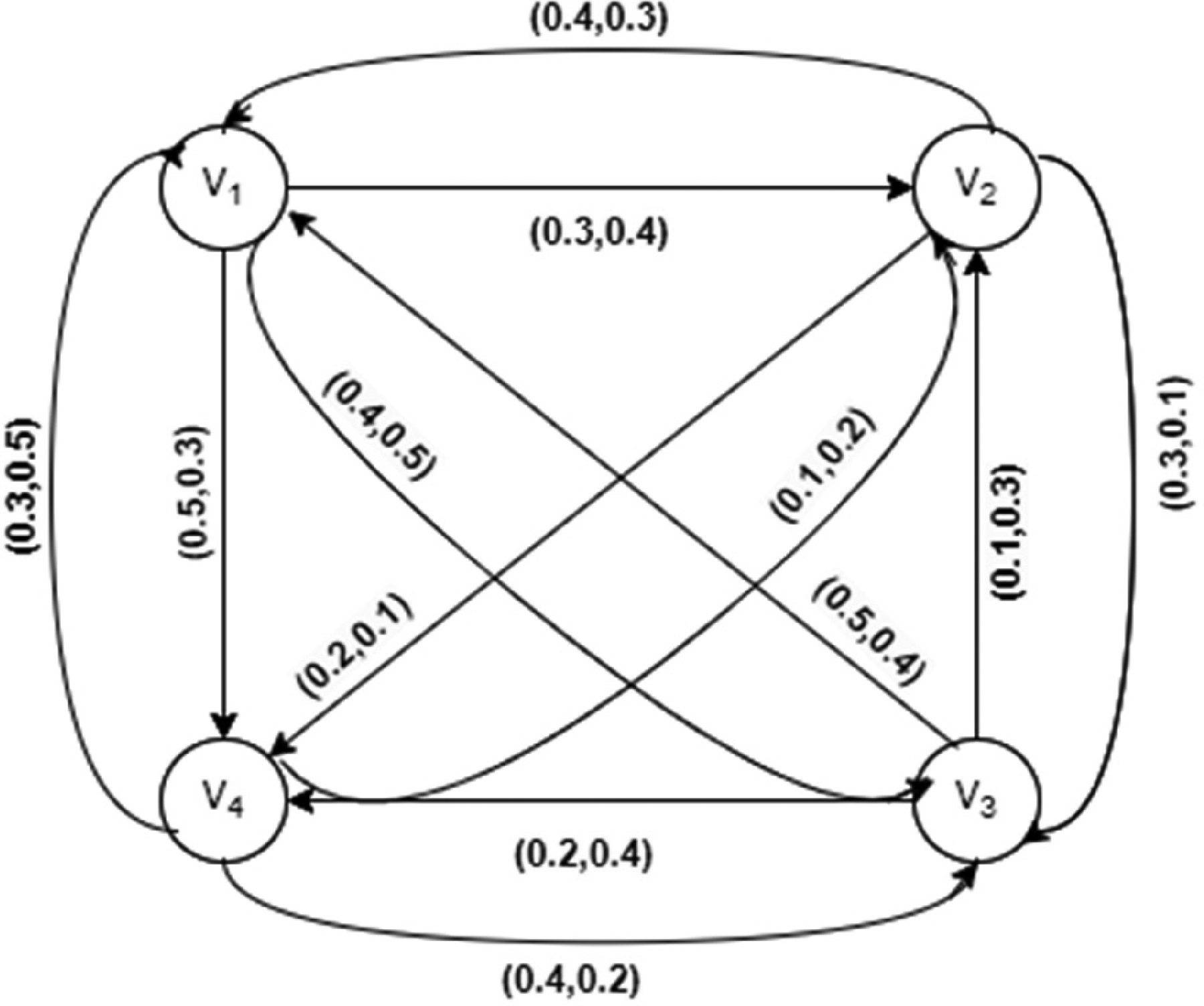
Safety features (e2) related to IFG (M2).
The IFAM is elucidated in Figure 5.


Cost (e3) related to IFG (M3).
The IFGs associated with the factors that follow can be observed in Figures 3, 4, and 5. These are energy storage capacity (the battery's capacity directly affects the EV's range, or how far it can travel on a full charge), safety features (ability to prevent accidents and save lives) and cost (which makes up roughly 30–40% of the total cost of the vehicle)
Source of M1's Signless Laplacian IFAM A(M1) is
SL(A(M1)) = D(M1) +A(M1)

Source of M2's Signless Laplacian IFAM A(M2) is
SL(A(M2)) = D(M2) +A(M2)

Source of M3's Signless Laplacian IFAM A(M3) is
SL(A(M3)) = D(M3) +A(M3)

Algorithm
Figure 3 and A(M1) give us
SLE(M1) = (1.6811, 2.5360).
Figure 4 and A(M2) give us
SLE(M2) = (1.7206,5.5000).
Figure 5 and A(M3) give us
SLE(M3) = (1.8744,2.4782).



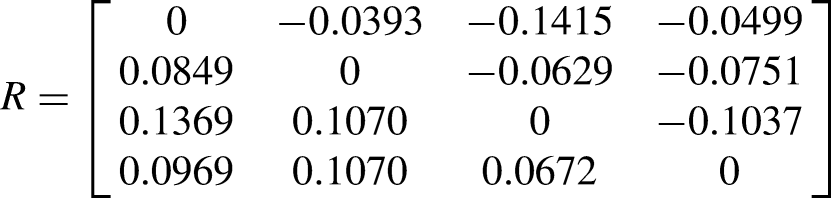
Ψ(A1) = −0.5494,
Ψ(A2) = −0.2269,
Ψ(A3) = 0.2774
and
Ψ(A4) = 0.4989
Therefore
From figure 3 and A(M1) we get


and
Therefore
Q1 = (0.2427, 0.3667),
Q2 = (0.2778, 0.3872),
Q3 = (0.3787, 0.2841)
and
Q4 = (0.3667, 0.2332).
W(Q1) =
W(Q2) =
W(Q3) = 0.0946,
W(Q4) = 0.1335.
Since W(Q4)
Currently, the most advanced electric car battery technology is D(f4), followed by C(f3) and A(f1) in the middle, and B(f2) in the lowest advanced technology. After giving it some thought, the decision-maker concludes that, out of the four technologies listed, electric car battery technology D is the most advantageous choice for anyone wishing to purchase batteries for an electric vehicle. This preference is in line with the algorithm's result, which ranked electric vehicle battery technology D(f4) highest.
Discussion and symmetrical analysis
The determination of the “optimal” battery choice in the case study relied on several key parameters, including energy storage capacity (such as energy density and cycle life), compliance with safety standards, and cost considerations. A group decision-making framework helped integrate these factors, ensuring a comprehensive assessment of the various battery options. This systematic approach ultimately supports informed decision-making for selecting the most suitable battery technology for the intended application. Conducting a more strict sensitivity analysis provides valuable insights into the robustness of decision-making under variations in weights and preferences. By employing appropriate methodologies and focusing on critical criteria, decision-makers can gain a better understanding of how changes influence outcomes and ensure a more reliable decision-making process. Key assumptions regarding preference relations, such as the linguistic terms (like good, average, and bad) for the decision-making process involving expert and decision-maker inputs. The decision-making framework captures accurate preferences, ultimately enhancing the reliability and quality of the decision outcomes. This study uses the recommended aggregating processes to investigate the battery selection strategy's results. Table 1 shows the ranking of the options using the IFWA, IFWAG aggregation operators and procedure-II. 19 Both the operators and the recommended algorithm are well-performed since they yield the same results. These operators show the symmetry in the results and provide us with a good, optimal answer to the problem of decision-making.
Results generated with the suggested aggregation operator.

By using the IFWAG in procedure-I, it is accurate to use the same ranking order. In all other cases, the ultimate best choice stays the same. It is a representation of the suggested operators validity, adaptability, authenticity, and symmetry.
Comparative analysis
The same results were seen using the two working methods in a similar manner. Using SLE and operators, the study aims to build models that enhance the participation of IFWA in decision-making analysis. While maintaining the same ranking results, the suggested models are more adaptable and comprehensive. A metric known as “time consumption” shows the best method. Thus, compared to Procedure II algorithms (see 20), our technique produces results a bit faster, it was shown that working processes-I were more effective and understandable. The methodology was rated
Description of the abbreviations

Conclusion
This paper addresses every aspect of the practical battery selection issues by putting out a novel approach to the strategy within the IFG framework. The solutions to some GDM issues may be impacted by the disregard for the links between characteristics in an unpredictable setting. In an effort to address these drawbacks, we developed a novel method for SLE and IFWA using the IFG information, in which the IFN took the decision-makers judgments into account. Decision-makers assessments were expressed through the IFN, and the information's ambiguity and incompleteness were successfully resolved. Aggregation operators such as the IFWA and IFWG are available during the period. We created a significant GDM method for IFG based on these operators. Additionally, a real-world example of investing in batteries was provided to show that the suggested operators are feasible. The suggested method could successfully address a number of complex issues in the battery selection process, including giving decision makers a comfortable environment for assessment, encouraging a relatively high degree of consensus among decision makers, and fully evaluating the weights of decision makers. Thus, this research offered a more useful and effective method for really choosing the best battery for vehicles. Going forward, given the superiority of the new IFNs, research can expand their use to include other aggregation operators such as power mean, Dombi's, Heronian, Bonferroni, and so on. Researchers that work in supply management, environmental science, decision analysis, GDM analysis, and information aggregation should find value in our findings. Promising topics for further research include the methodological developments for GDM analysis.
Footnotes
Acknowledgments
The authors are highly thankful to the editor-in-chief and reviewers for their valuable comments and suggestions for improving the quality and representation of the manuscript.
Contributions
The contributions of all authors are equal. All authors have read and agreed to the published version of the manuscript.
Declaration of conflicting interests
The authors declared no potential conflicts of interest with respect to the research, authorship, and/or publication of this article.
Funding
The authors received no financial support for the research, authorship, and/or publication of this article.
