




Abstract
Among the components of high-tech ships, the structural complexity of the propeller profile requires a high degree of flexibility in the CNC polishing machine. In addressing this requirement, the study formulates the flexible optimization problem pertaining to research on the propeller CNC polishing machine. A comprehensive analysis is undertaken to scrutinize the geometric features of the propeller and the phenomenon of polished contact. The propeller profile-polishing head dynamic contact mechanism is revealed, and the contact force characteristics of propeller polishing are obtained. It is suggested that the propeller configuration-process-polishing machine structure coupling mechanism be explored under the influence of polishing contact force. Subsequently, a dynamic model of the propeller CNC polishing process is formulated. Based on the above model, a simulation of the motion personification and structural flexibility of the propeller CNC polishing machine is proposed to obtain dynamic personification and flexibility rules. Integrating polishing contact force characteristics with dynamic personification and flexibility rules, the dynamic flexible collaborative optimization principle of the propeller CNC polishing machine is revealed. On this basis, multi-objective optimization modeling and solving are carried out, forming a new method for the flexible optimization design of propeller CNC polishing machines.
Introduction
To promote the development of cutting-edge navigation technology, in-depth research and development of high-tech navigation ships has always been the focus of academic and industrial circles. The continued attention on this subject is driven by the imperative requirements for future ocean exploration, resource development, environmental protection and related domains. Among the various components of high-tech ships, the propeller assumes a pivotal role. The geometric configuration parameters, surface quality, and mechanical properties directly affect the propulsion efficiency, stability, and noise level of the ship. These factors all have a significant impact on navigational accuracy. Notably intricate in structure, marine propellers typically feature a configuration of space curved surfaces, necessitating the utilization of multi-axis linked CNC machine tools for precision shaping, 1 as shown in Figure 1. After the milling and shaping of the propeller, to improve its anti-fatigue and anti-corrosion capabilities in seawater, the surface needs to undergo polishing treatment.

Multi-axis linkage processing site of marine propeller.
For a long time, the polishing of marine propellers has relied mainly on manual polishing, leading to problems such as low efficiency and difficulty in ensuring precision. In recent years, computer numerical control (CNC) polishing technology has gradually gained traction and application. However, the motion functions and mechanical characteristics of many CNC polishing machines for propellers require refinement. Therefore, to enhance the precision and efficiency of propeller polishing, it is essential to develop CNC polishing technology and equipment for propellers. Additionally, the cost of manual polishing in the process of marine propeller maintenance is continuously rising, especially with the complex structure of propellers, leading to high labor intensity and low efficiency in manual polishing. This hinders the ability to expand production scale, and enterprises urgently require high-performance CNC polishing machines for propellers. To promote the development of the shipbuilding industry, it is imperative to improve the comprehensive performance of propeller polishing machines. Therefore, researching optimization design methods for CNC polishing machines capable of adapting to the complex geometric features of workpieces holds significant scientific and engineering value.
Analysis of current research status and development trends
Since the early 1980s, propeller polishing equipment has undergone a series of developments. In the early stages, polishing mainly relied on manual operations and simple semi-automatic equipment, which were inefficient and had poor consistency. The application of basic CNC technology was still limited. The subsequent phase of technological expansion witnessed the widespread use of fully automatic CNC polishing machines. The maturation of CNC technology improved processing efficiency and precision and introduced multi-axis control technology to accommodate complex geometries. Entering the mature and diversified stage, CNC polishing machines have focused more on high precision and intelligence levels, integrating advanced sensor technology and real-time feedback control. Additionally, they possess flexible manufacturing capabilities, quickly adapting to blades of different specifications and shapes, thus enhancing production flexibility and responsiveness.
Various polishing techniques are applied to the polishing of propeller blades. Manual polishing offers high flexibility and is suitable for small batch production, but it is inefficient and difficult to ensure polishing quality and consistency, relying on the experience of the technicians. Mechanical polishing (semi-automated) is more efficient than manual polishing, with partial automation improving consistency, but it has limited precision and ability to handle complex shapes, requiring manual intervention. Chemical polishing is suitable for handling complex shapes and can uniformly remove material, but the use and handling of chemicals are complicated, with a significant environmental impact. Electrolytic polishing is efficient and can achieve a high level of smoothness, but the equipment and process are complex, and its applicability is limited. CNC polishing controls the polishing process through CNC programming, achieving high precision and consistency with a high degree of automation, significantly improving production efficiency and adapting to complex geometries. It has become an important tool in modern propeller blade processing, greatly enhancing polishing quality and production efficiency.
The CNC polishing machine for propellers is a specialized equipment for processing special components. Its research and development necessitate a comprehensive consideration of intricate geometric features, mechanical properties, and the intricacies of the propeller polishing process. Moreover, it entails a profound understanding of machine tool structure design, kinematics, and optimization principles. The development approach of the CNC polishing machine for propellers based on modern design methods is shown in Figure 2. To design a CNC polishing machine for propellers that excels in performance, it is imperative to undertake theoretical research employing a perspective of multidisciplinary coupled optimization. Therefore, this paper delves into the developmental dynamics within this specialized domain.

The development approach of propeller CNC polishing machine.
From the CNC process flowchart of the propeller polishing machine, it is evident that the development of the propeller polishing machine primarily focuses on two aspects: the contact force during polishing and the polishing process itself. A kinematic analysis, strength analysis, and modal analysis should be conducted on the designed CNC propeller polishing machine. The results of these analyses should be compared with the design requirements. If the results meet the design requirements, the design work is complete; if not, the design of the CNC propeller polishing machine must be revised.
Research status of processing contact force characteristics
In the process of polishing a propeller, the polishing contact force between the polishing head and the propeller blade surface significantly influences processing precision. To enhance the quality of propeller polishing, it is necessary to conduct in-depth research on the mechanism and mechanical characteristics of the polishing contact force. Currently, there have been some achievements in the research on processing contact forces, providing valuable references for the research on contact force characteristics in propeller polishing.
Research on contact force characteristics based on the “theory-simulation” method
The theoretical analysis of contact forces is rather complex, so many scholars adopt a combined approach of theoretical modeling and simulation calculations for research. Mehmet 2 neglects the consideration of continuity constraints in interface material properties. Based on the singular integral equation technique, an analytical method was developed to study the contact force characteristics between a moving rigid punch and a system with a functionally graded coating/homogeneous substrate. Comparative simulations were conducted using ANSYS software. To analyze the surface contact mechanics characteristics of point grinding parts, Chao et al. 3 established a fractal contact mechanics model of point grinding parts by combining theory and simulation, with the solution and analysis conducted using MATLAB software. Chi et al., 4 regarding the contact mechanics characteristics of workpiece grinding, developed a fractal contact mechanics model applicable to engineering practices. The model incorporates point grinding texture direction, axis, contact length, and roughness amplitude. The model is programmed and solved using MATLAB software. Michael et al. 5 apply contact mechanics theory to model and analyze the contact area, determining the contact area charts for multiple points along a designated polishing path. These charts are utilized to plan the polishing path. Simulation results demonstrate the effectiveness of this polishing path planning method based on contact mechanics theory.
Research on contact force characteristics based on the “theory-experiment” method
Based on the theory of contact mechanics, studying the characteristics of processing contact force combined with experiments is also an area of concern for scholars. Liang et al. 6 employed precision grinding and polishing machines and grinders to carry out surface processing on Al2O3 ceramics. The study delves into the impact of diverse grinding conditions, including varying grinding disc speeds, grinding disc/grinder wheel mesh, grinding wheel feed rates, and grinder transverse translation speeds, on the ceramic surface quality and mechanical properties. Liu et al. 7 aimed at issues of plastic deformation and fracture on the surface of the workpiece after ultrasonic processing, and constructed two mechanical models: one is the concentrated force of point contact, deriving expressions for displacement, deformation, and stress at any point within the elastic half space; the other is the stress and displacement deformation expression generated by the distributed normal pressure in the contact area at any point. Chen et al. 8 conducted a theoretical study on the contact mechanical properties, tracking stress variations in the diamond coating throughout the drilling process. Mehmet et al. 9 studied the dynamic contact force characteristics of an isotropic elastic coating bonded to a homogeneous substrate by indenting the coating with a sliding rigid punch of cylindrical profile, which moved at a stable subsonic speed. An analytical method based on singular integral equations is proposed to ascertain the contact stress.
Research on contact force characteristics based on the “theory-simulation-experiment” method
A complete study of contact force characteristics from the aspects of theoretical modeling, simulation calculation, and experimental verification, constitutes a prominent research focus among scholars. Wang et al. 10 are based on the idea of researching correction coefficients for elastic-plastic contact force in main-shaft-type grinding and polishing processes, utilizes the Hertz-Mindlin contact model in the EDEM system for simulation, and conducting comparative analysis with experiments. Yang et al., 11 based on the analysis of contact mechanics, use fractal theory to establish the contact stiffness model of asperities in each deformation stage of the workpiece surface. Experimental assessments of the normal contact stiffness under prevalent milling and grinding conditions accompany the model. Subsequently, simulation analysis was conducted using this model. Wang et al. 12 uses the size of the roller polishing abrasive block, the drum speed and the processing position as evaluation indicators that affect the size of the contact force, and use the Hertz-Mindlin non-slip contact model to conduct simulation calculations, studying the relationship between the roller polishing abrasive block and the friction force obtained by simulation and experiment. The study investigates the normal contact force characteristics between the rolling abrasive block and the workpiece obtained from simulation and experiments. Subsequently, a contact force calculation formula between the rolling abrasive block and the workpiece is established, incorporating the contact object's ball-to-radius ratio and speed ratio coefficient. Liu et al. 13 predict the dynamic characteristics of the main spindle system during the design phase, a spindle/tool holder interface contact stiffness analytical model is established based on fractal theory and multiscale contact mechanics properties. Numerical simulations are conducted, and the correctness of the model is validated through experiments.
In summary, machine tool design experts have paid more and more attention to the impact of polishing contact force on workpiece processing quality. Due to the complex and changeable propeller surface, the changes in contact form and force during the polishing process are also more complicated. This complexity results in difficulties in controlling and improving the polishing precision of propellers. Therefore, it is necessary to study the contact force characteristics of propeller polishing and its impact mechanism on the polishing process.
Research on contact force characteristics of propeller polishing
The impact of polishing contact force on the quality of workpiece processing has been increasingly valued by machine tool design experts both domestically and internationally. Due to the complex and variable surface of the propeller, the contact form and force conditions during the polishing process are also more complex, making it difficult to control and improve the polishing accuracy of the propeller. Therefore, it is necessary to study the characteristics of the polishing contact force of the propeller and its influence mechanism on the polishing process.
Zhou et al., 14 to further improve the surface integrity of propeller blades, estimated the mechanical stresses induced by the milling process through contact mechanics and geometric transformations within the parts. An analytical model for the generation of residual stresses caused by the milling of complex surfaces was established. Xiao et al. 15 proposes and applies an on-machine contact measurement (OMCM) method for abrasive belt grinding equipment to improve the accuracy of the propeller blade profile. Zhu et al. 16 presents a method for rapid contact force prediction of propeller blades based on a classical mechanics model, directly calculating the cutting force through elementary function integration. Cheng et al. 17 designs a flexible mechanism that actively adjusts the output contact force through an electronic proportional pressure regulator to achieve effective compensation for propeller blade grinding.
Research status of propeller polishing process and equipment
The research and development of propeller CNC polishing process and equipment by universities or scientific research institutions mainly involves targeted design and analysis of polishing equipment. This is based on the geometric structure characteristics of the propeller, polishing process, kinematics and dynamics knowledge. Substantial progress has been achieved through long-term efforts, laying a solid foundation for the study of optimization design methods for CNC propeller polishing machines.
Research on propeller polishing process
With the continuous development of the shipbuilding industry, the requirements for propeller polishing process are becoming increasingly stringent. Wang et al. 18 focus on marine propeller, conducting polishing experiments on the propeller surface using robots and lightweight polishing tools. The study applies the orthogonal experimental method to rationally configure various process parameters. Ultimately, the rationality of robot polishing for the overall ship propeller is validated through the polishing processing results. Yin et al. 19 carried out research on the robot abrasive belt grinding method of the integral propeller, obtained a suitable processing plan, and solved the interference problem between the blades during the grinding of the integral propeller. Zhang et al. 20 propose a dynamic adjustment method for the grinding tool position to avoid collisions between the contact wheel and the propeller blade chassis during the processing. Correspondingly, relevant experiments are conducted to validate the proposed method's correctness. Hou et al. 21 established a relationship model between grinding processing parameters and process targets based on the support vector machine regression method. The study proposes a grinding control strategy for sanding belts based on grinding dwell time and contact pressure. Additionally, a sanding belt grinding and polishing trajectory planning method based on the second-order tangent method is introduced, enabling comprehensive blade grinding and polishing in a single clamping. Xiao et al. 15 proposed a machine contact measurement method to improve the surface precision of main thrust propeller blades with free-form surfaces. Experimental verification using abrasive belt grinding equipment demonstrates the efficacy and practicality of this method. Hou et al. 22 proposed an effective method based on the second-order tangent principle for grinding propeller surfaces. This is corroborated through processing experiments conducted on a developed five-axis CNC abrasive belt grinder, substantiating the method's practicality and effectiveness.
Kinematic analysis is the foundation and key to the development of CNC polishing machines for propellers. By studying the motion characteristics (position, velocity, acceleration) of CNC polishing machines and their components, it helps to optimize the motion path, reduce processing time, and energy consumption. Guo et al. 23 proposed a double-sided collaborative processing method for propeller blades, using two symmetrically distributed XYZ-3RPS hybrid machine tools to process both sides of the blades simultaneously, achieving single clamping. By deriving the inverse kinematics formula, the performance of double-sided collaborative processing was analyzed. He et al. 24 studied the precise motion control problem of hybrid grinding and polishing machines for blade finishing, based on the motion coupling phenomenon of parallel mechanisms. The inverse kinematics solution of the parallel mechanism was corrected, improving the accuracy of the solution. Wang et al. 25 proposed a kinematic analysis and optimization method for blade grinding with a six-axis CNC belt grinder, considering the machine's load capacity and servo drive capability, and validated it on an actual CNC machine.
The generation of tool paths is a crucial step in the polishing process. Efficient and precise tool paths ensure optimal contact between the tool and the propeller surface during polishing, thereby improving surface smoothness and overall polishing quality. The generation and post-processing of tool paths directly affect the machining accuracy, efficiency, cost, and quality of CNC polishing machines. To address the issue of insufficient precision in traditional single-side propeller machining, Wang et al. 26 designed a dual-side collaborative machining method combining symmetrical processing and studied its tool path planning algorithm. Duan et al. 27 established a tool posture optimization model considering the impact of deflection errors caused by cutting forces to better control the precision of five-axis linkage milling of complex propeller surfaces. Duan et al. 28 proposed a tool direction planning method that considers the impact of surface shape errors caused by cutting forces in five-axis machining of copper alloys, and verified the effectiveness of this method through experiments on machining propeller rotor blades.
Research on propeller polishing equipment
In order to promote the technological upgrading of key components in ship manufacturing, propeller there is a current emphasis on the development of propeller polishing equipment within the precision processing domain. Ma et al. 29 discloses an industrial robot for propeller grinding and polishing This innovation not only improves the precision of processing positioning but also significantly improves the precision and consistency of propeller surface grinding and polishing. Zhang et al. 30 provide a grinding device for propeller processing to realize grinding and polishing of propellers. The adjustment of the contact position between the grinding disc and the propeller facilitates targeted polishing at the top of the propeller. Zhang et al. 31 developed a grinding device for marine propeller blades based on a six-degree-of-freedom parallel mechanism. The device underwent structural dynamic and static analysis, precision testing, optimization of grinding allowances, and research on grinding trajectory planning. Consequently, it achieved the automation of polishing propeller blades while improving the processing precision of the propeller. Liu et al. 32 developed an intelligent robot system for milling and polishing large and medium-sized complex curved surfaces, which can mill and polish both sides of marine propeller blades simultaneously. This system successfully addressed issues such as the inconsistency and poor precision of manual polishing, thereby improving the efficiency of propeller processing. Park et al. 33 focused on researching the grinding of difficult-to-process areas in large ship propellers. By analyzing the three-dimensional structure of the propeller surface, a CNC grinding and polishing prototype system was developed, as shown in Figure 3. This system has been applied and experimentally validated in the propeller grinding system of Hyundai Heavy Industries Group Corporation in South Korea. Liu et al. 34 designed a CNC polishing machine for precision processing of marine propellers, and conducted processing function analysis and polishing experiments. The research results show that this polishing machine can effectively improve the precision of propeller polishing.

CNC grinding and polishing prototype system for large marine propellers.
The above research results have effectively promoted the development of the CNC polishing process and equipment for propellers. However, the achievement of the propeller CNC polishing process is influenced by the interplay of various factors, including propeller geometry, process specifications, and the structure of the polishing machine. To improve the precision and efficiency of propeller polishing, it is necessary to explore the kinematic laws and dynamic models of the CNC polishing process for propellers.
Research status of optimal design for CNC processing equipment
As specialized equipment for processing specific components, the research and development of propeller CNC polishing machines are still in its early stages. To enhance the polishing quality of propellers, it is necessary to research the optimized design method of such specialized processing equipment to establish technological foundations. Currently, there is limited research on the optimization design methods for CNC polishing machines for propellers. However, the research results of the optimization design method of other types of CNC processing equipment can provide valuable insights for this purpose.
Research on complete machine structure optimization design
The optimization of the complete machine structure has been long the focal point of experts in the field of CNC processing equipment optimization design. Nie et al. 35 developed a precision horizontal processing center, systematically studied the key technologies for optimizing the structural layout of the complete machine, and established a static stiffness model to optimize the static stiffness matching of the machine tool, determining the machine tool guide rail and screw models. The optimization design of various large structural components was carried out to achieve a top-to-bottom design for the complete machine structure with high stiffness and lightweight characteristics. Lei et al. 36 comprehensively considered the influence of the composition of machine tool structural component composition and joint surface parameters on the complete machine's performance, studying the dynamic design optimization method of the overall structure of machine tools based on dynamic sensitivity analysis. This method is used to optimize the spindle box, column and bed frame. Cao et al. 37 explored the structural design and manufacturing technology optimization of CNC machine tools, discussing spindle structure design first and then focusing on key structural design. Through specific case design, it presents the mechanical structure design effect of CNC machine tools and gives specific technologies optimization Strategy. Ji et al. 38 proposed a structural design optimization method that takes into account the energy consumption and dynamic-static performance of the machine tool. This method ensures the dynamic-static performance of the machine tool while reducing the energy consumption of moving parts. Li et al. 39 based on the research and development requirements of small three-axis CNC machine tools, analyzed and optimized the mechanical structure using the finite element method, and determined the moving gantry mechanical structure as the final solution. Ryota et al. 40 breaks through the traditional design concept, and developed a new structure for a flat profile grinding machine using topology and shape optimization methods. Compared with the traditional design scheme, this innovative approach increases resonance frequency by two times, achieving a lightweight structure and enhancing productivity. Liu et al. 41 conducted parametric modeling of a series of gantry machine tools, and proposed a comprehensive optimization design method that combines zero-order optimization, parameter rounding and structural re-optimization. Based on this, a lightweight structure optimization design system for gantry machine tools with functions such as parameterized design and lightweight design was developed.
Research on optimal design of functional components
Optimization of functional components is an important means to improve the working capacity of processing equipment. Representative research includes: Li et al. 42 uses resin concrete embedded with steel structures to manufacture hydrostatic guide rails for precision machine tools, with a concurrent optimization of its structural configuration. Research shows that U-V-shaped grooves on the surface of hydrostatic guide rails crafted from resin concrete significantly enhances the overall performance of the hydrostatic guide rails. Huang et al. 43 applied a concrete-based composite structure to machine tool supports, using external steel plates and internal filling of concrete to create a “sandwich” composite structure, and carried out stability-enhancing designs for the guide rails. This method was applied to a certain Optimization design of bed guide rail of horizontal processing center, and simulation results verify the feasibility of this structure.
Research on optimal design of key structural components
Improving or optimizing the design of key structural components is an effective approach to enhance the comprehensive mechanical characteristics of processing equipment, while maintaining a balance between precision and design efficiency. Therefore, this field has always been a research focus for scholars. Xu et al. 44 conducted finite element modal analysis on the machine tool bed and introduced sensitivity analysis methods to optimize the design dimensions of the bed. Post-optimization, the strain energy distribution of the first modal shape became uniform, reducing the mass of the bed. Li et al. 45 focused on the crossbeam of the machine tool, and established eight representative parameter combinations through orthogonal experiments as design schemes for the crossbeam structure. Finite element analysis of the dynamic and static characteristics of each crossbeam was performed, and their index values were obtained. A method combining entropy and fuzzy analytic hierarchy process was used to determine the weights of various evaluation indicators. The sensitivity analysis of each key parameter informed the selection of six parameters for optimization, thereby enhancing the dynamic and static performance of the crossbeam. Zhou et al. 46 conducted dynamic and static finite element analysis on the Z-axis bracket of a PCB CNC drilling machine, discovering defects in the original design. Based on this, various optimization design schemes were proposed, and the best size of the Z-axis bracket was determined through comprehensive performance comparison. Matthew et al. 47 optimized the structure of the slide table of a certain machine tool. Since the slide table moves throughout the entire working process of the machine tool, the optimization objective was to reduce its mass without sacrificing stiffness. The slide table was designed as a sandwich structure, and genetic algorithm was used to optimize this structure, considering both mass and stiffness. The slide table achieved lightweight design, and finite element analysis of the lightweight slide table showed that its strength was basically equivalent to that of the traditional slide table. Liu et al. 48 constructed an intelligent design optimization system for the feed mechanism of a CNC machine tool, using sensitivity analysis, backpropagation neural network, and genetic algorithm for multi-objective optimization of the feed mechanism. Using this system, intelligent design optimization was performed on the Y-axis feed mechanism of a precision gantry CNC machine tool, improving the dynamic and static performance of the feed mechanism, and the optimization effect was experimentally validated.
The structural optimization design method of CNC processing equipment has always been a hot topic in the industry and academia, yielding many meaningful achievements. A CNC propeller polishing machine is a specialized machine tool with its own structural characteristics and processing requirements. When developing a CNC propeller polishing machine, the following methods can be utilized: optimizing the overall structural layout to achieve high rigidity and light weight; improving static and dynamic performance using static stiffness models and dynamic sensitivity analysis methods; analyzing and optimizing key structural components through the finite element method; combining comprehensive optimization methods for energy consumption and dynamic-static performance; enhancing structural efficiency using topology and shape optimization techniques; applying parametric modeling and multi-objective optimization design methods to improve overall performance and enhance the comprehensive performance of functional components; and specifically optimizing key components such as guide rails and supports to enhance overall stability and efficiency. The propeller CNC polishing machine is a specialized machine tool with its own structural characteristics and processing process requirements. During the design phase, it is necessary not only to focus on improving its dynamic characteristics but also to emphasize enhancing its flexibility and processing precision. This requires optimization design from a multidisciplinary perspective.
Urgent scientific issues to be addressed currently
After comprehensively analyzing the current research trends, this paper summarizes that, for the structural optimization design of the propeller CNC polishing machine, it is urgently needed to address the following objective engineering and technical challenges:
There is currently a lack of systematic and in-depth theoretical research on the contact force characteristics of marine propeller polishing, which makes it difficult to determine the appropriate polishing driving force. Insufficient driving force leads to shallower polishing depth, thereby increasing the number of polishing cycles and decreasing overall efficiency. Conversely, excessive driving force poses the risk of compromising the surface quality of the propeller, hindering the scientific improvement of propeller polishing precision. A dynamic model for the CNC polishing process adapting to the complex geometric features of workpieces has not yet been established for propellers. Optimizing the motion trajectory of propeller CNC polishing proves challenging, resulting in low efficiency and precision in the coordination of each step in the polishing process. This contributes to the difficulty in improving the processing precision and efficiency of CNC propeller polishing machines. The propeller CNC polishing machine is primarily constructed empirically, grounded in the principles of strength and stiffness. The structural optimization design method for this machine is still immature, lacking a flexible optimization design theory that can adapt to the complex geometric features of workpieces. This deficiency contributes to the difficulty in further improving the processing precision and flexibility of the CNC polishing machine for propellers.
Summarizing and refining the three technical challenges mentioned above has led to the identification of critical scientific issues that urgently need resolution, as shown in Figure 4. The specific details are elaborated as follows.

Urgent scientific issues to be addressed.
Propeller profile-polishing head dynamic contact mechanism
During the operation of the propeller CNC polishing machine, a dynamic contact effect occurs between the propeller surface and the polishing head, affecting the quality of propeller polishing. To safeguard the propeller surface from damage, the propeller CNC polishing machine must process based on the material and mechanical properties parameters of the propeller. Additionally, changes in the mutual contact force between the propeller profile and the polishing head will also directly affect the polishing precision. Considering these factors comprehensively, the structural design of the propeller CNC polishing machine must conform to the characteristics of the polishing contact force to improve the precision of propeller polishing. Therefore, to grasp the contact force characteristics of propeller polishing, revealing the propeller profile-polishing head dynamic contact mechanism is a basic problem that needs to be solved urgently.
Propeller configuration-process-polishing machine structure coupling mechanism
The working process of the propeller CNC polishing machine must adapt to the geometric features of the propeller configuration. Moreover, the CNC polishing machine must be processed according to standardized process measures to improve the surface quality of the propeller; This requires a coupling analysis, involving the geometric attributes of the propeller configuration, the CNC polishing process for propellers, and the structural parameters of the propeller CNC polishing machine. Subsequently, it is necessary to rationally plan the CNC polishing motion trajectory of the propeller. Therefore, establishing a dynamic model of the propeller CNC polishing process to optimize the motion trajectory and enhance polishing efficiency is a key scientific problem that urgently needs to be solved by exploring the propeller configuration-process-polishing machine structure coupling mechanism.
Dynamic flexible collaborative optimization principle of propeller CNC polishing machine
The structural design of the propeller CNC polishing machine must conform to the contact force characteristics of propeller polishing, and the polishing process should also follow the propeller configuration-process-polishing machine structure coupling mechanism. Therefore, it is necessary to carry out multi-objective optimization for the propeller CNC polishing machine. In addition, to enhance the flexibility of the CNC propeller polishing machine by extracting the flexibility rules of manual polishing, it is imperative to undertake a dynamic anthropomorphic design of the propeller CNC polishing machine. To summarize, in order to comprehensively improve the dynamic characteristics and flexibility of propeller CNC polishing machines, revealing the dynamic flexibility collaborative optimization principle of propeller CNC polishing machines has become a key scientific problem that needs to be solved.
Based on the above flowchart, the current technical challenges in optimizing the precision and efficiency of CNC propeller polishing can be summarized as follows:
Uncertainty in Polishing Contact Force Conversion: This presents a challenge in improving polishing precision. Optimization of Polishing Motion Trajectories: Without optimizing the polishing motion trajectories, enhancing polishing efficiency remains difficult. Inadequate Structure and Dynamic Parameters of Polishing Machines: This results in insufficient flexibility of the polishing machine. Dynamic Contact Mechanism between Propeller Profile and Polishing Head: Investigating how to optimize the dynamic contact mechanism between the propeller profile and the polishing head. Coupling Mechanism between Propeller Configuration, Process, and Polishing Machine Structure: Examining the coupling relationships among propeller configuration, processing techniques, and polishing machine structure. Principles of Dynamic Flexible Collaborative Optimization for CNC Propeller Polishing Machines: Studying how to enhance the performance of CNC propeller polishing machines through dynamic flexible collaborative optimization.
These three major challenges give rise to three scientific questions:
Addressing these three scientific questions will help overcome the technical bottlenecks in optimizing CNC propeller polishing precision and efficiency, ultimately achieving the coupling optimization of propeller configuration and processing machine structure, as well as the dynamic flexible collaborative optimization of CNC propeller polishing machines.
Prospects for new research content
Based on a thorough analysis of the current state and urgent scientific issues in the optimization design research of the propeller CNC polishing machine, this paper proposes to explore the contact force characteristics of propeller polishing. Consequently, a dynamic model of the propeller CNC polishing process will be established, followed by further investigation into the dynamic anthropomorphic flexibility rules of the propeller CNC polishing machine. Thus, a flexible optimization design method for a propeller CNC polishing machine will be formulated. The structural hierarchical relationship of the research content is shown in Figure 5, and the internal connections among the four main research contents are shown in Figure 6, forming a complete theoretical system, the details are elaborated as follows:

Research content.

Internal connections among research contents.
Research on the polishing contact force characteristics based on propeller profile.
From Figures 5 and 6, the flexible optimization design method for CNC propeller polishing machines adapted to complex geometric features of workpieces can be divided into four parts:
Characteristics of polishing contact force based on propeller shape, including: the structural characteristics and material mechanical properties of the propeller, dynamic contact force characteristics between the propeller shape and polishing head, and modeling and analysis of the propeller polishing contact force. Dynamic model of the CNC polishing process for propeller configurations, including: the impact of propeller geometry on the CNC polishing process, the impact of propeller geometry on the polishing machine structure, coupling mechanisms between propeller configuration, process, and polishing machine structure, and dynamic modeling of the CNC polishing process for propellers. Dynamic anthropomorphizing of CNC propeller polishing machine flexibility rules, including: simulation analysis of the motion anthropomorphizing of the CNC propeller polishing machine, flexible simulation analysis of the propeller CNC polishing machine structure, and flexible analysis and improvement measures for the CNC propeller polishing machine. Flexible optimization design methods for CNC propeller polishing machines, including: dynamic flexible collaborative optimization principles for CNC propeller polishing machines, flexible design and optimization modeling of CNC propeller polishing machines, solving algorithms for flexible optimization models, and application and verification of flexible optimization design methods.
These four parts are interrelated. Research Content (1): Characteristics of polishing contact force based on propeller shape guides Research Content (2) and (4), and supports Research Content (3). Research Content (2): Dynamic model of the CNC polishing process for propeller configurations supports Research Content (3). Research Content (3): Dynamic anthropomorphizing of CNC propeller polishing machine flexibility rules guides Research Content (4).
Polishing contact force characteristics based on propeller profile
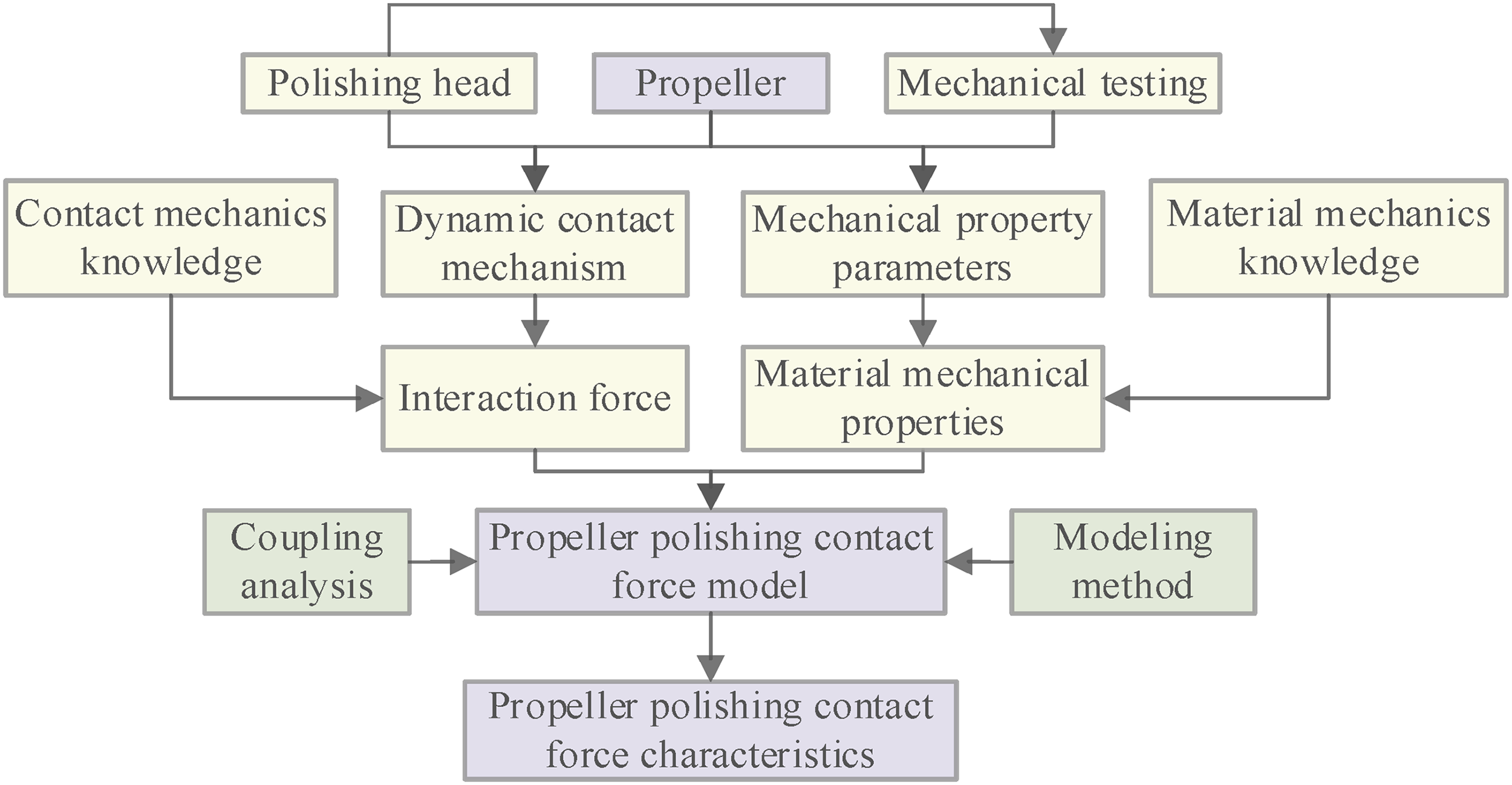
It can be seen from Figure 7, the study of propeller polishing contact force characteristics mainly involves mechanical performance testing of the polishing head and propeller: (1) Obtain mechanical performance parameters and use material mechanics knowledge to determine material properties; (2) Analyze dynamic contact mechanisms and use contact mechanics knowledge to determine interaction forces; and (3) Establish the propeller polishing contact force model through coupling analysis and simulation modeling, and derive the propeller contact force characteristics through simulation analysis.
Structural characteristics and material mechanical properties of propellers
Studying the structural characteristics and dimensions of typical marine propellers, combined with knowledge of material mechanics, aims to explore the influence patterns of the mechanical physical parameters and geometric surface parameters of the propeller on the mechanical properties during the polishing process. This study provides a theoretical basis for the dynamic contact mechanism research and mechanical mathematical modeling of propeller polishing.
Propeller profile-polishing head dynamic contact mechanism and its effects
Analyze the material mechanical properties of the propeller polishing head, study the interaction between the propeller profile features and the polishing head during the propeller polishing process, and explore the propeller profile-polishing head dynamic contact mechanism and its effects.
Modeling and analysis of propeller polishing contact force
In accordance with the propeller profile-polishing head dynamic contact mechanism and its effects, new modeling methods are explored to establish a generalized model for the contact force of propeller polishing. Formulas for calculating mechanical parameters related to polishing effects, such as contact stress and contact stiffness, are derived. This lays the foundation for the dynamic optimization of propeller CNC polishing machines. Additionally, He et al. 49 conducted a series of comparative experiments to measure contact forces in different postures using a six-dimensional force sensor, as shown in the Figure 8. This verified the accuracy of the proposed polishing force acquisition model, providing strong evidence for the method proposed in this paper.

Experimental platform.
Dynamic model of CNC polishing process for propeller configuration
During the propeller CNC polishing process, it is necessary to complete reciprocating actions such as positioning, contact, and processing. In order to improve the polishing quality, it is essential to start with the propeller CNC polishing process parameters, kinematic parameters, and polishing machine structural parameters. A dynamic model of the propeller CNC polishing process is established, as shown in Figure 9. The detailed research content is as follows:

Research on dynamic model of CNC polishing process for propeller configuration.
According to Figure 9, the study of the dynamic model of the CNC polishing process for propeller configurations involves: First, applying motion principles and polishing contact force characteristics to understand the impact of the CNC polishing process on the polishing machine structure and the process requirements for propeller CNC polishing precision. Second, conducting CNC polishing experiments on propellers to understand the influence of propeller geometry on the CNC polishing process. Based on these findings, establish the coupling mechanisms between propeller configuration, process, and polishing machine structure, and finally develop the dynamic model of the CNC polishing process for propellers.
The influence of propeller geometry on CNC polishing process
CNC polishing machines must process propellers from various orientations, necessitating compatibility between the polishing process and the propeller geometry. In this regard, this paper proposes to study the influence of propeller geometry on CNC polishing processes.
The influence of propeller CNC polishing process on polishing machine structure
To enhance the polishing precision of the propeller, the essential functional structure of the CNC propeller polishing machine should encompass all necessary polishing processes. In this regard, this paper proposes a study on the influence of the propeller CNC polishing process on the polishing machine structure.
Propeller configuration-process-polishing machine structure coupling correlation mechanism
Establishing the propeller configuration-process-polishing machine structure coupling correlation mechanism, involving combining the influence of the propeller geometry on the CNC polishing process and the influence of the CNC polishing process on the polishing machine structure, while considering the requirements of the propeller polishing contact force and polishing precision on the process.
Dynamic modeling of propeller CNC polishing process
In accordance with the propeller configuration-process-polishing machine structure coupling correlation mechanism, combined with kinematic principles, the synergistic modeling technology of the polishing process is studied. A dynamic model of the propeller CNC polishing process is established to provide a theoretical foundation for the improvement of the structure and kinematic functionalities of the propeller CNC polishing machine.
To further verify the proposed method, the research 50 referenced from the literature established a polishing motion model for airbag precession and simulated the polishing trajectory and connecting rod angle variation of large-diameter axisymmetric aspheric parts, confirming the correctness of the motion model. This further demonstrates that by establishing a dynamic model of the propeller CNC polishing process, the performance of the propeller CNC polishing machine can be improved.
Dynamic personification flexibility rules for propeller CNC polishing machine
Conducting a multidimensional comparative analysis between the propeller CNC polishing and traditional manual polishing, this study integrates a simulation analysis based on the dynamic model of the propeller CNC polishing process. Furthermore, it flexibly coordinates the processing actions and structural implementations adopted for various process measures during the working process of the propeller CNC polishing machine. Simultaneously, it takes into account the influence of polishing processing actions on the precision of propeller CNC polishing, culminating in the development of a dynamic personification flexibility rule for the propeller CNC polishing machine, as shown in Figure 10. The delineated research content is as follows:

Research on dynamic personification flexibility rules of propeller CNC polishing machine.
Motion personification simulation analysis of propeller CNC polishing machine
Each processing action of the propeller CNC polishing machine must complete a specific polishing motion trajectory, akin to a manual polishing action. This paper proposes to conduct personification simulation and analysis of the actions to realize the processing function, thereby furnishing a kinematic foundation for the flexible design of propeller CNC polishing machine.
Flexible simulation analysis of propeller CNC polishing machine structure
The key focus of the research is on the critical structure to achieve the propeller CNC polishing motion. In order to conform to the propeller polishing contact force characteristics, this paper proposes a flexible simulation analysis of the structure of the propeller CNC polishing machine. It aims at enhancing structural flexibility and furnishing technical backing for the flexible design of the propeller CNC polishing machine.
Dynamic flexibility analysis and improvement measures of propeller CNC polishing machine
Based on the simulation analysis of the motion personification and structural flexibility of the propeller CNC polishing machine, this study investigates the dynamic flexibility of the propeller CNC polishing machine and its influencing factors under the influence of polishing contact force. Building upon these findings, recommendations are put forth to improve the dynamic flexibility of the polishing machine. Subsequently, the study explores dynamic personification flexibility rules for the propeller CNC polishing machine, tailored to accommodate the complex geometric features of the workpiece. The goal is to enhance the flexibility and precision of the propeller CNC polishing process.
Flexible optimization design method for propeller CNC polishing machine
To enhance the efficiency and precision of propeller polishing while reducing labor intensity, this study proposes a new flexible optimization design method for propeller CNC polishing machines by combining the contact force characteristics of propeller polishing and the dynamic personification flexibility rules of propeller CNC polishing machines, as shown in Figure 11. The delineated research content is as follows:

Research on flexible optimization design method of propeller CNC polishing machine.
From Figure 11, the research flowchart for the flexible optimization design method of CNC propeller polishing machines indicates that the study of flexible optimization design methods should first derive dynamic flexible collaborative optimization principles from propeller polishing contact force characteristics and dynamic anthropomorphizing rules of the CNC propeller polishing machine. Then, proceed with flexible design configuration, including: optimization requirement analysis, dynamic sensitivity analysis, determination of objectives and constraints, and selection of design variables. Apply intelligent optimization algorithms to solve the flexible optimization design mathematical model, and finally, through experimental validation, case applications, and simulation analysis, determine whether the optimization performance is achieved. If it is, the optimization design is complete; if not, further research and adjustment of the flexible optimization design method are required.
Dynamic flexible collaborative optimization principle of propeller CNC polishing machine
Combining the propeller polishing contact force characteristics with the dynamic personification flexibility rules of the CNC polishing machine, the objective is to enhance the dynamic response characteristics of the polishing machine. It explores the dynamic flexible collaborative optimization principle of propeller CNC polishing machines that adapts to the complex geometric features of the workpiece, thereby establishing a theoretical foundation for the structural optimization design of propeller CNC polishing machines.
Flexible design and optimization modeling of propeller CNC polishing machine
Applying the dynamic flexible collaborative optimization principle, an improved structure is devised to design a propeller CNC polishing machine with enhanced flexibility. Optimization objectives and constraints are determined reasonably, considering the dynamic characteristics of the complete machine. Sensitivity analysis is employed to identify critical optimization design variables associated with weak links, leading to the establishment of a multi-objective flexible optimization design model.
Solving algorithm for flexible optimization model of propeller CNC polishing machine
In the framework of the multi-objective flexible optimization design model of the propeller CNC polishing machine, intelligent optimization algorithms are employed for solution finding to obtain the optimal solution. This establishes a set of flexible optimization design methods for the propeller CNC polishing machines, thereby enhancing the overall performance of the propeller CNC polishing machine.
Application verification of flexible optimization design method for propeller CNC polishing machine
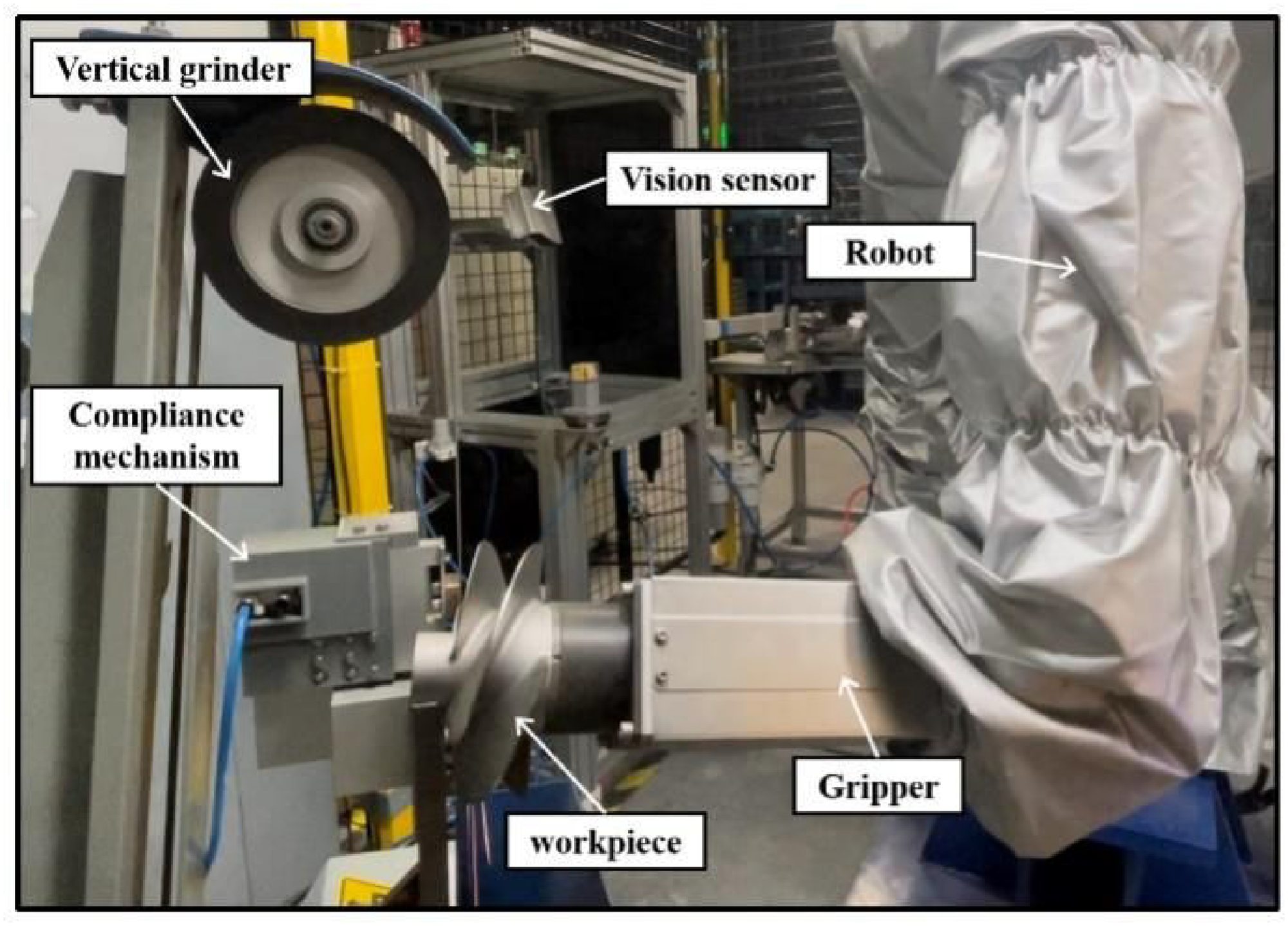
The engineering application of the adaptable optimization design approach for the propeller CNC polishing machine is executed, accompanied by a propeller CNC polishing experiment conducted within a shipbuilding enterprise to test the dynamic characteristic parameters such as rotation speed, torque, feed speed, and contact force of the propeller CNC polishing machine. The study delved into the dynamic characteristics and flexibility of the propeller CNC polishing machine following structural optimization. Through experimental testing, the efficacy of the flexibility optimization applied to the propeller CNC polishing machine was substantiated. The subsequent analysis focused on polishing precision and efficiency, ultimately contributing to the assessment and enhancement of the flexibility optimization design method employed for the propeller CNC polishing machine. Furthermore, the research 17 also indicates that by designing a flexible mechanism actively controlled by an electronic proportional pressure regulator, processing a four-blade propeller using three different workpiece models can accurately and effectively achieve the required thickness tolerance for processing. The actual experiment is shown in Figure 12. This provides strong evidence for the flexible optimization design method of the propeller CNC polishing machine proposed in this paper.
Experiment setup.
Conclusion
In addressing the intricate surface features of propellers, this study proposes a systematic investigation into the dynamic contact mode, relative motion form, and interaction forces between the propeller profile and the polishing head, aiming to elucidate their impact on polishing precision. The goal is to reveal the propeller profile-polishing head dynamic contact mechanism and to analyze the effects of polishing contact forces. Based on this, a novel mechanical modeling approach is devised to formulate a propeller polishing contact force model, which offers essential mechanical parameter information for the dynamics analysis and structural design of the propeller CNC polishing machine. Simultaneously, it establishes a foundation for the quantitative analysis of the propeller CNC polishing process.
Propose an interdisciplinary analysis of the propeller polishing contact force characteristics, polishing process measures, and the kinematic performance of CNC polishing machines. The objective is to explore the propeller configuration-process-polishing machine structure coupling correlation mechanism, and then propose collaborative modeling technology for the propeller CNC polishing process. Based on this, establish a dynamic model of the propeller CNC polishing process that includes process parameters, kinematic parameters, and structural parameters. Its purpose is to achieve the optimization of the propeller polishing motion trajectory, thereby providing new technical support to enhance the precision of propeller polishing. Simultaneously, it provides a fresh perspective for the structural analysis and improvement of propeller CNC polishing machines.
In consideration of the propeller polishing contact force characteristics and the requirements of the propeller CNC polishing process, it is proposed to integrate the similarity principle and multi-objective optimization theory to the structural improvement design of the propeller CNC polishing machine. This approach embodies a scientific concept that harmonizes structural design with the propeller CNC polishing process. Consequently, a suite of flexible optimization design methods for propeller CNC polishing machines that adapt to the complex geometric features of the workpiece is formed. The aim is to enhance the flexibility of both structure and motion in the propeller CNC polishing machine, ultimately elevating polishing precision and efficiency. This provides novel theoretical perspectives for advancing the structural optimization of propeller CNC polishing machines.
Footnotes
Acknowledgements
The authors wish to record their gratitude for all the generous supports.
Author contribution
Shihao Liu: Conceptualisation, methodology, writing—original draft preparation.
Mao Lin: Investigation.
Youjun Bai: Investigation, Writing—review and editing.
Declaration of conflicting interests
The authors declared no potential conflicts of interest with respect to the research, authorship, and/or publication of this article.
Ethical approval
The article follows the guidelines ofthe Committee on Publication Ethics (COPE) and involves no studies on human or animal subjects.
Funding
The authors disclosed receipt of the following financial support for the research, authorship, and/or publication of this article: This work was supported by the National Natural Science Foundation of China, Hainan Provincal Natural Science Foundation of China, (grant number 52365032, 520MS068).
