



Abstract
This article investigates data-driven distributed bipartite formation issues for discrete-time multi-agent systems with communication constraints. We propose a quantized data-driven distributed bipartite formation control approach based on the plant’s quantized and saturated information. Moreover, compared with existing results, we consider both the fixed and switching topologies of multi-agent systems with the cooperative-competitive interactions. We establish a time-varying linear data model for each agent by utilizing the dynamic linearization method. Then, using the incomplete input and output data of each agent and its neighbors, we construct the proposed quantized data-driven distributed bipartite formation control scheme without employing any dynamics information of multi-agent systems. We strictly prove the convergence of the proposed algorithm, where the proposed approach can ensure that the bipartite formation tracking errors converge to the origin, even though the communication topology of multi-agent systems is time-varying switching. Finally, simulation and hardware tests demonstrate the effectiveness of the proposed scheme.
Introduction
In nature, many creatures work together to accomplish a complicated and amazing task. For instance, birds keep a “V” formation to migrate, and ants preserve a separation distance to bring food. Enlightened by this observation, formation control of multi-agent systems (MASs) has attracted increasing attention with wide applications, such as unmanned aerial vehicles, 1 satellite formation, 2 and electrical power grids. 3 An essential issue on the formation of MASs is how to design an appropriate control protocol such that the states/outputs of all agents can achieve and maintain a desired geometric pattern. To solve this issue for MASs, distributed control4–7 is one of the effective approaches.
Recently, numerous distributed control results8–14 for MASs have been published. For example, Wang et al. 8 proposed a robust time-varying formation control protocol for the second-order MASs, Shi et al. 9 studied an adaptive event-triggered triggered formation control method for heterogeneous MASs, a dynamic event-triggered formation control scheme was proposed by Ge et al., 10 Pan et al. 11 investigated a multiaplyer graph and design a model predictive formation control method, the finite-time formation control for linear MASs was studied by Duan et al., 12 and some related research topics on formation control problems were surveyed.13,14 However, to the best of our knowledge, the robust formation control problem for MASs is still open to be investigated.
The above-distributed formation control schemes require the controlled plant’s accurate mathematical model called model-based control (MBC) algorithms. However, plant modeling employing the first identification principles becomes extremely difficult because the practical industrial process becomes more complex and integrated. 15 Besides, it is expensive to build a dynamics model for each agent. Furthermore, the error between a practical plant and a mathematical model is inevitable, which may deteriorate systems’ stability. Hence, a data-driven control (DDC) approach becomes an alternative way to formulate a robust control protocol for complex systems, for instance, model-free adaptive control (MFAC),15–20 model-free adaptive iterative learning control (MFAILC),21–23 virtual reference feedback tuning (VRFT), 24 iterative feedback tuning (IFT), 25 proportional-integral-derivative (PID), 26 reinforcement learning (RL)27–30, and so on.31–33 It is noted that MFAILC is an effective approach for the nonlinear system to conduct repeatable tasks. The VRFT, IFT, PID, and RL have good control performances to govern nonlinear systems with nonrepetitive missions. However, they have some implementation difficulties, such as many parameters to be adjusted, the Actor-Critic networks to be estimated, and training-testing data to be prepared.
MFAC is an attractive DDC framework 34 for discrete-time nonlinear systems with unknown dynamics by only employing measurable input/output (I/O) data. The main idea of the MFAC is to apply dynamic linearization technology to establish a series of the equivalent linear data model for the controlled systems. Since MFAC was studied by Hou et al., 17 many related approaches have been developed, including single system and multi-systems. Especially, for single system, numerous issues have been investigated, such as measurement disturbance, 26 data dropout, 35 cyber attack, 36 and data quantization. 37 As MASs, an effective consensus tracking control scheme was formulated by Bu et al. 38 The switching topologies and time-varying delays of MASs were considered by Li et al. 15 The disturbance and heterogeneous problems of MASs to achieve formation control were studied by Xiong et al. 39
In the aforementioned related DDC formation approaches, saturation nonlinearity and data quantization have rarely been considered while designing the controller. Although data quantization 37 was studied, it only considered single system. The consensus problem of MASs with output saturation 40 was investigated, but it was dependent on terminal iterative learning and only was suitable for MASs under repeatable operations. In the DDC field, especially using the MFAC concept, few results have been developed for MASs conducting formation control with sensor saturation and data quantization to the best of our knowledge. This is the first motivation for this paper.
On the other hand, in a practical industrial process, sensor saturation and data quantization are important issues. Firstly, the measurement range of the sensor is not unlimited, which is constrained by the hardware, so the sensor saturation is inevitable. Secondly, during the information transmitting process, signals of agents have to be quantized into a finite number, which is necessary for reducing the transmission burden because of the communication networks with limited bandwidth. Moreover, both sensor saturation and data quantization are hot topics of the MBC field. For example, Lin et al. 41 proposed an event-triggering consensus control scheme for MASs with quantized state information and delays. Both the quantization and saturation problems for MASs were investigated by Chen et al. 42 The prescribed performance and input quantization issues were discussed by Liang et al. 43 Quantization and attack problems were investigated by Huang et al. 44 Further details for solving quantization and saturation problems can be found in the survey papers.45,46
It is noted that most existing approaches38–46 for MASs only consider the collaborative interactions among agents. In fact, the two relationships, collaboration and antagonism, coexist among agents in natural or engineering scenarios. 47 For example, in the multi-robot systems, the relationship between a robot and its teammates is collaborative, but between it and its antagonistic alliance’s robots are antagonistic. In biological systems, a pair of genes are viewed as activators when they are in cooperative interaction and inhibitors when in competitive interactions.48–50 Hence, only discussing one of the interactions of MASs is incomplete. Altafini 51 investigated both cooperative and competitive relationships of MASs and proposed a bipartite consensus (BC) control protocol to govern two opposite alliances to achieve the opposite states, where the agents of an alliance have the same state. Inspired by this result, the BC issues have attracted numerous researchers, and many effective methods52–55 have been developed for MASs. Wu et al. 52 proposed a distributed consensus control method for MASs to perform the quantized adaptive finite-time BC tracking tasks. The parametric uncertainties, input disturbances, and quantized data were discussed for networked robotic systems to realize BC in the work of Ding et al. 53 Moreover, the designed BC control schemes for unknown dynamics MASs by employing the MFAC and the RL were studied in works of Liang et al. 54 and Peng et al., 55 respectively. Obviously, the BC problem for MASs forms the second motivation of this paper.
From the above discussions, this paper employs the dynamic linearization method to establish a series of equivalent linear data models for MASs, where only the measurement I/O data of the controlled plant and its neighborhood are necessary. Then, a quantized data-driven distributed bipartite formation control (QDBFC) protocol is proposed for unknown dynamics detected-time nonlinear MASs with fixed and switching topologies to implement bipartite formation tracking tasks under data saturation and quantization. Here, all agents can track the predicted trajectory and achieve the expected formation, even if only a few agents can directly receive the information from the leader. The main contributions and challenges of this paper are listed as follows:
Propose a QDBFC approach for unknown dynamics discrete-time nonlinear MASs with antagonistic interactions to implement bipartite formation tracking tasks by only employing measurable I/O data without requiring any prior information. Although several effective algorithms8–13 have been developed for the formation tracking problem, these methods depend on accurate dynamics, which is not essay to be established. Compared with the existing DDC approaches,38,39 the designed controller can use fewer data to guarantee the convergence of MASs because its feedback information is incomplete caused by data quantization and saturation. Hence, the proposed scheme requires less consumption of communication and computing resources. The designed protocol has a strong adaptive ability to regulate the MASs to implement bipartite formation tasks under a fixed topology and switching topologies.
The rest work of this paper is structured as follows. Several necessary preliminaries are presented in Section “Preliminary and system description”. Section “Controller development and analysis” introduces the proposed QDBFC algorithm for MASs with fixed and switching topologies and offers rigorous proof. The simulation experiments are shown in Section “Simulation studies”. The hardware testing is presented in Section “Hardware experiments”. Finally, conclusions are given in Section “Conclusions”.
Notations:
Preliminary and system description
Signed graph theory
Let


Communication topologies of MASs.
System description
A class of unknown single-input-single-output SISO) nonlinear discrete-time MASs with

The following assumptions with respect to the agent’s dynamics are fundamental conditions of the further proposed approach. equation (2) satisfies the generalized Lipschitz condition that Assumptions 1 and 2 are basic requirement of the MFAC methods, where the rationalities of them are discussed in published papers.18,34,38 Considering equation (1) satisfies Assumptions 1 and 2, then the following dynamic linear data model can be obtained. From equation (3), it is noted that

Then, the two important assumptions of the controller are given below.
For all
The objective of the proposed QDBFC approach is to develop an appropriate control protocol
For each agent

Sensor saturation
In practice, the output
In this paper, the sensor saturation is modeled as

The desired trajectory locate within the measurable range of sensors. i.e., the condition
From equation (5), it is noted that the measured input
Information quantization
Roughly speaking, the agents transmit or receive information from each other dependent on cable or wireless networks. Since the restrictions on the bandwidth of the communication channel, the measured output

In this paper, the quantizer is described as

To this end, this paper aims to design a robust control protocol such that MASs can perform bipartite formation tracking tasks, and the tracking errors of each agent can converge to the origin when
Controller development and analysis
Figure 2 shows a diagram of the unknown dynamics MASs controlled by the proposed QDBFC method, where we can see that the saturation phenomenon happens in sensor

Diagram of agent
Data-driven distributed controller design
Let




It is noted that equation (8) only employs the measured output of agent
It is noted that
Saturation issues analysis
To analysis sensor saturation issues, we define that the measured output error


Suppose that MASs are affected by the sensor saturation presented in equation (5). The relationship between the accurate and measured output gain of sensor
Quantization issues analysis
From the work of Fu et al.
57
, it is obtained that the quantization problem can be seen as a sector-bound uncertain problem, that is, the given signal
(see the work of Fu et al. 57 )
Utilize



Convergence analysis
In this part, the convergence analysis of the proposed QDBFC approach is presented as below.
For

Under the circumstances that equation (2) satisfies Assumptions 1, 2, and 3, its communication topology satisfies Assumption 4, and the measurable range of each sensor satisfies Assumption 5, apply the proposed QDBFC algorithm equation (9)-(11) for MASs to track the desired reference trajectory
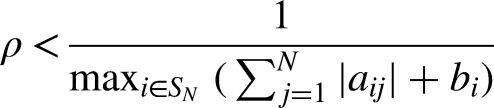
The proof comprises the following two steps.
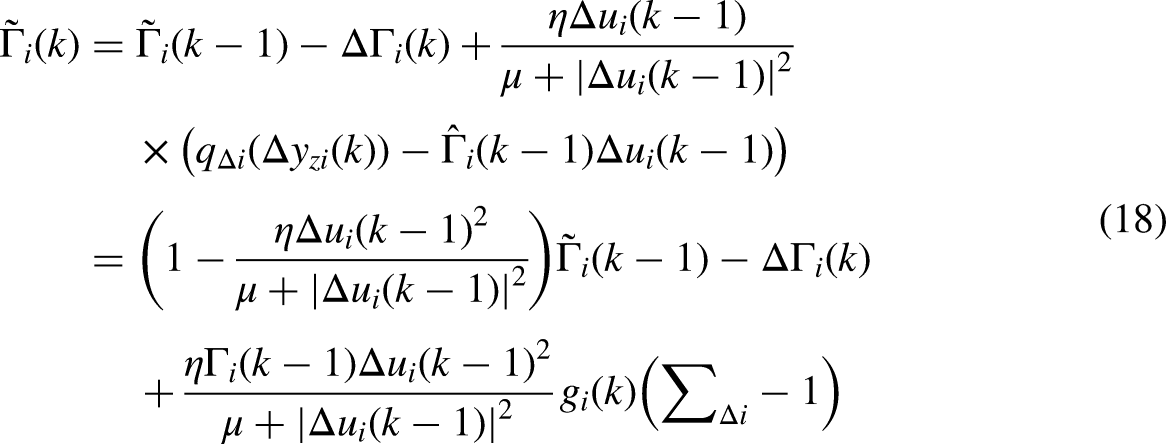






Extension to switching topologies
In this part, time-varying switching topologies are discussed. The convergence of MASs to perform formation tracking tasks is investigated.
According to the signed graph theory of Section 2, Eq (23) becomes

For the MASs satisfying Assumptions 1-5, the value of

According to equation (28), equation (26) becomes

Most of the existing consensus algorithms or formation algorithms for MASs depend on the assumption that the accurate mathematical models of the MASs are available. However, it is noted that the mathematical models are not a requirement in the proposed QDBFC algorithm. Moreover, the existing data-driven approaches38–40 for MASs don’t consider the data quantization, sensor saturation, and switching topologies problems together. Hence, compared with existing works, the design, convergence proof, and simulations of the proposed controller become more challenging.
Simulation studies
To illustrate the correctness and practicality of the proposed QDBFC approach, two examples are presented for seven agents to implement bipartite formation tracking tasks. It is noted that consensus control is a special format of formation control, when
The formation parameters of multi-agent systems (MASs)

Fixed topology of MASs
In this simulation, we select
According to the communication topology 

Tracking performances of multi-agent systems (MASs) in Example 1. (a)

Tracking errors of multi-agent systems (MASs) in Example 1. (a)
Moreover, to analyze the characteristics of quantitative communication, a contrast experiment is conducted, where the running environment of the controller consists of “Intel(R) Core(TM) i7-8750H CPU” and “32.0 GB RAM”. The corresponding results are shown in Figures 5 and 6, where Figure 5(a) shows the results of the proposed QDBFC method, and Figure 5(b) shows the results of the existing method 38 . Compared with Figure 5(a) and (b), it is found that they have similar performances. However, the total running times of the proposed QDBFC method is about 0.584s, but that of the existing method 38 is about 0.942s. Obviously, compared with the existing method 38 , the proposed QDBFC method can save the computation resources.

The outputs of the multi-agent systems (MASs) with different methods. (a) The proposed QDBFC method; (b) The existing method 38

The inputs of the multi-agent systems (MASs) with different methods. (a) The proposed QDBFC method; (b) The existing method 38 .
From the dynamics of each agent, it is noted that MASs are heterogeneous, where the dynamics models are only applied to generate the I/O data for the simulation, and in developing QDBFC method, the dynamics models are unknown.
According to Example 1, it is noted that the proposed QDBFC algorithm can address the data quantization and sensor saturation problems for MASs with fixed topology to perform bipartite formation tracking tasks. The proposed method needs lesser computation resources for unknown dynamics heterogeneous discrete-time MASs to perform bipartite formation tracking tasks than that of the existing DDC algorithms.
Time-varying switching topologies of MASs
Here, we consider the switching topologies of MASs shown in Figure 1, changed as equation (1). The dynamics of MASs and related parameters are selected as same as Example 1.
The performance of the proposed QDBFC method to govern the MASs with switching topologies, sensors saturation, and data quantization is presented in Figure 7. From Figure 7(a), we can see that several agents exchange their alliances, but the bipartite formation tracking tasks also can be accomplished. Moreover, from Figure 7(b), we can see that the tracking errors rapidly converge to zero.

Tracking test of multi-agent systems (MASs) with switching topologies in Example 2. (a) Tracking performance of MASs; (b) Tracking errors of MASs
This result verifies the effectiveness and correctness of the results in Theorem 2. It also illustrates that the proposed QDBFC approach has good robustness.
Hardware experiments
In this section, a hardware testing system is established, including three Q2-USB data acquisitions, three amplifiers, and five SRV02, shown in Figure 8. The components of the hardware testing system are produced by Quanser. Here, each SRV02 represents a agent. Moreover, from Figure 8, it is found that the construction of each SRV02 is different, so the established MASs is heterogeneous. To verify the effectiveness and practicality of the designed QDBFC method, a contrast experiment is presented in Figure 9, where the topology of MASs is set as Figure 9(a), the sample time is 0.001s, and the total running time is 10s. The initial conditions of each agent is set as

Hardware test platform with five SRVO2.

Communication topology and speed of five SRV02. (a) Topology of five SRV02; (b) The proposed scheme; (c) The existing scheme 38
Compared with Figure 9(b) and (c), it is found that the proposed method has a similar performance as the existing method. 38 Moreover, it is noteworthy that the output of the designed algorithm is more smooth than the existing algorithm, even if the sensors’ measurement range is limited and the data is quantized in the designed algorithm. Hence, the designed approach effectively reduces the computation and communication sources and has good robustness and applicability.
The above simulation and hardware tests show that the proposed approach has good robustness, ensuring the MASs reach and remain a predicted formation when MASs suffer to data quantization, sensor saturation, and switching topologies. Moreover, the dynamics of MASs are unknown, and the collaborative and antagonistic relationships among agents are coexistence, which doesn’t affect the convergence property of MASs to perform bipartite formation tracking tasks under governing of the proposed QDBFC scheme.
Conclusions
In this paper, the saturation and quantization issues for nonlinear MASs with antagonistic relationships have been investigated. An equivalent dynamic data model has been established by using the incomplete I/O data caused by limited sensors and communication requirements. A QDBFC scheme has been proposed for the MASs with fixed and switching topologies, which guarantees that the bipartite formation errors of the MASs with incomplete feedback data converge to zero. The efforts of saturation and quantization for the proposed method have been analyzed, showing that the proposed method has good robustness. Compared with existing method, the proposed QDBFC can further reduce communication resources.
Footnotes
Acknowledgments
The authors thank the anonymous reviewers for their comments and suggestions, which helped greatly improve this paper. Moreover, The authors would like to thank the help of Professor Jinjun Shan and colleagues at York University for this paper.
Declaration of conflicting interests
The author(s) declared no potential conflicts of interest for the research, authorship, and/or publication of this article.
Funding
The author(s) received financial support for the research, authorship and/or publication of this article: The research was funded by the National Natural Science Foundation of China (52005124), the Wuxi Science and Technology Development Fund Project (K20231015), the Jiangsu Province Higher Vocational College Teacher Professional Leader High-end Training Project (2023GRFX072), the Fundamental Research Funds for the Central Universities (JUSRP123061), and 111 project (B23008).
Author biographies
Juqin Wang received her MS degree in the School of Internet of Things Engineering, Jiangnan University, Wuxi, China, in 2015. She is currently an associate professor with the School of Internet of Things, Wuxi Institute of Technology. Her research interests include multi-agent systems coordination control, data-driven control, and intelligence algorithms.
Huarong Zhao received his PhD degree in the School of Internet of Things Engineering, Jiangnan University, Wuxi, China, in 2022. From 2021 to 2022, he was a visiting scholar with the Department of Earth and Space Science and Engineering at York University, Toronto, ON, Canada. He is currently a pre-appointed associate professor and postdoctoral fellow with the School of Internet of Things Engineering, Jiangnan University. His research interests include multi-agent systems coordination control, data-driven control, reinforcement learning and control, and image processing.
Hongnian Yu is a professor with the School of Computing, Edinburgh Napier University. His research covers the two main areas: 1) robotics with applications in the rescue and recovery operations, and healthcare and 2) ICT enabled healthcare including assistive technologies in supporting elderly and people with dementia, and activity recognition of elderly people. He has published over 200 journal and conference research papers. He is a member of the EPSRC-Peer Review College and a fellow of IET and RSA. He has held several research grants worth about ten million pounds from the UK, EPSRC, the Royal Society, and the European, as well as from industry. He was awarded the F.C. William Premium for his paper on adaptive and robust control of robot manipulators by the IEE Council, and has won the Gold Medal on The World Exhibition on Inventions, Research, and New Technologies, INNOVA 2009, Brussels, the International Exhibition of Inventions, Geneva, Switzerland, in 2010, for the invention “Method and device for driving mobile inertial robots”; and the 43rd International Exhibition of Inventions, New Techniques, and Products, Geneva, in 2015.
Ruitian Yang is currently a lecturer with the School of Automation, Wuxi University, Wuxi, China. He received his BEng degree in Automation from Ma'anshan University, Ma'anshan, China, in 2013, his MEng degree in control engineering from Guilin University of Electronic Technology, Guilin, China, in 2017, his PhD degree in control science and engineering from Jiangnan University, Wuxi, China, in 2022. His research interests include cooperative control of multi-agent systems and synchronization of complex networks.
Jiehao Li received an MSc degree in Control Engineering at South China University of Technology, Guangzhou, China, in 2017. He received his PhD degree at the School of Automation, Beijing Institute of Technology, Beijing, China, in 2022. He is now an associate professor at the College of Engineering, South China Agricultural University, Guangzhou, China. He is also a research fellow at the School of Computer Science and Engineering, South China University of Technology, supervised by C. L. Philip Chen. His interests mainly include mobile robotics, robot control, image processing, and information perception. He has been awarded the 2023 Elsevier World Top 2% Scientists, the Best Conference Paper of IEEE ICUS2023 and ICBIR2023. He has served the Academic Committee Member of CAA, CICC and CAAI, IEEE ICUS Program Committee Chair, IEEE ICIT2024 Session Chair, IEEE EECR2024 Organizing Chair, and the Associate Editor of Remote Sensing, IET Control Theory & Applications, Frontiers in Neurorobotics, Agriculture, and Agriculture Communications.