



Abstract
Coastal states are currently transitioning their traditional socio-economic activities into a single platform to address the emerging issues of the coast and marine environment. For countries like Pakistan, managing multiple coastal and marine activities is a significant challenge. The lack of proper management policies and an inefficient decision-making process put various types of pressure on the ecological functions of Pakistan's coastal and marine areas. The Government of Pakistan has not yet prioritized coastal and marine affairs in its policy agenda, resulting in a halt to the process of sustainable development. Moreover, a lack of financial allocation for large-scale coastal and marine projects, a shortage of trained human resources, insufficient coordination among organizations, and unstable political decisions and governance impede the sustainable delivery of the projects. This paper discusses Pakistan's coastal and marine policy targets and highlights various issues through PESTLE analysis, which encompasses political (P), economic (E), social (S), technological (T), legal (L), and environmental (E) factors that limit the advancement of sustainable coastal and marine development. This paper aims to determine the advantages of adopting marine spatial planning (MSP) in Pakistan and how its implementation can bring social, ecological, and economic prosperity. The study provides a baseline for the country's coastal and marine policymakers regarding the advancement of a blue economy through MSP.
Keywords
Introduction
The conservation and protection of marine habitats, particularly estuaries, coral reefs, mangrove forests, and other offshore ecosystems that provide a variety of social benefits, are among the top priorities on the United Nations Sustainable Development Goals agenda. Coastal and marine regions are considered the wealthiest places in the world and have received increasing attention in recent years due to the continuous growth of the human population, rapid urbanization, and increasing economic development activities. 1 Recent technological developments and economic advances have enabled humans to extract both living and non-living resources from the oceans. 2 The unsustainable development approaches and a burgeoning human population have depleted resources on land, people are more encouraged to move toward the coast for their social well-being. 3 Thus, coastal nations have adopted and implemented numerous management tools to effectively manage the various economic, recreational, and conservation activities taking place along their coasts. 4 Currently, coastal nations are transitioning from traditional sectoral management strategies to an integrated approach in which all relevant stakeholder ideas and knowledge are welcomed in the decision-making process. 1 For example, countries such as the United States, the European Union member states, China, and Sri Lanka have begun managing their coastal and marine-related activities based on the carrying capacity of their natural resources. 2 To overcome coastal and marine-related conflicts, these countries have adopted an area-based development plan known as marine spatial planning (MSP).
Marine spatial planning (MSP) has been defined as an integrated management plan in which coastal and marine regions are divided into different functional units based on their natural resource carrying capacity, with the aim of reducing conflicts between users and the environment. 5 MSP covers a wide area ranging from coastal to oceanic waters at all depths, including surface waters and the seabed. MSP can encompass internal seas, the continental shelf, exclusive economic zones (EEZs) at the national level, or any combination of these maritime zones. 4 According to Jay et al., 6 over the next 5 years, more than 40 countries are expected to complete approximately 60–70 marine spatial plans at the provincial, sub-national (territorial waters), and national (EEZ) levels. Several efforts are also being made to coordinate national policies on regional sea basins. In Pakistan, no policy documents or comprehensive studies have been conducted to examine the establishment of the MSP process. Additionally, academic research in this context in Pakistan is limited or missing.
Therefore, this paper adopted a PESTLE analysis method to address Pakistan's political (P), economic (E), social (S), technological (T), legal (L), and environmental (E) challenges that impede the sustainable development of coastal and marine areas. The presence of numerous organizations with competing agendas/objectives and inefficient political decisions in Pakistan often hinder the delivery of sustainable coastal and marine area development. The marine environment has been exploited for many years, and insufficient resource management measures have led to the destruction of important fragile ecosystems. Activities such as land-based pollution, unsustainable tourism, the extinction of commercially important fish, coral bleaching, and the introduction of invasive species are associated with poor management and are major causes of coastal and marine environmental deterioration. One of the most glaring examples is the failure to implement numerous coastal and marine development projects under the China-Pakistan Economic Corridor (CPEC) due to a lack of sound institutional arrangements and political determination. Furthermore, while Pakistan has adopted several regulations covering environmental issues, their role in maintaining the coastal and marine environment is limited.
MSP implementation in Pakistan could also provide a framework for identifying and resolving conflicts among different stakeholders who have diverse interests in coastal and marine resources. It would facilitate the identification of critical marine habitats that require conservation measures and guide the sustainable use of resources in an integrated and equitable manner. The MSP approach helps in the identification of areas that are suitable for future development while also considering environmental, social, and economic considerations. This approach (MSP) also provides guidance for managing marine-related risks, such as species conservation and mitigating environmental disasters. Additionally, MSP can enhance Pakistan's capacity to manage and monitor its coastal and marine areas, leading to better enforcement of regulations, improved data collection and analysis, and more effective decision-making. According to Smythe 7 the expansion of MSP strengthens the nation's governing network in a particular region by introducing new institutional arrangements, enhancing existing cooperation, and facilitating the growth of social capital. The adoption of MSP in Pakistan could provide a holistic and sustainable approach to the management of coastal and marine resources, leading to enhanced social well-being, economic prosperity, and the preservation of marine habitats. MSP can play a vital role in addressing the current challenges facing Pakistan's coastal and marine areas, including unsustainable development, environmental degradation, and conflict among stakeholders. It could also enable Pakistan to meet its international obligations under the UN Sustainable Development Goals, the Convention on Biological Diversity, and other relevant international conventions and agreements. The study's in-depth analysis is constrained by the limited availability of accurate and comprehensive data on marine ecosystems, coastal zones, socioeconomic factors, and the dynamic nature of policies and regulations.
The literature review Section of the paper highlights both the achievements and failures of MSP from the existing literature. This section further emphasizes the implementation of MSP in various coastal nations around the world. The methodology Section of the paper conducted, a PESTLE analysis to identify the existing issues in Pakistan that hinder and impact the sustainable development of coastal and marine areas. Moving on to Results and Discussion Section this part of the paper offers policy recommendations and insights to address the issues discussed in the sub-sections of Section 2. This Section also provides a reference for managers and decision-makers in Pakistan about the development and improvement of MSP in the Country, which has important theoretical and practical significance for future MSP in Pakistan. Additionally, this section suggests the implementation of MSP in Pakistan. Finally, Conclusion Section of the paper provides a conclusion to the study.
Literature Review
Over the last few decades, scientists, policymakers, and practitioners have published a large body of literature on the implementation and significance of MSP schemes in developed and developing countries and found that MSP is becoming a preferred planning approach for coastal and marine natural resource management. 8 MSP has been defined in various ways in the literature. For example, many coastal and marine planners and developers often ask how MSP is more suitable than existing frameworks, such as Integrated Coastal Zone Management (ICZM). According to Papatheochari, 9 the ICZM and MSP share the same goal of protecting, conserving, and providing strategic guidance at different government levels and are thus involved in any management scheme. Both concepts have common planning principles, such as stakeholder participation and the adoption of a holistic approach. 9 Given that these processes share similar aims and principles, one can be used to implement the other. 10 Some argue that by emphasizing the spatial and temporal aspects of marine management, MSP has greater potential than the ICZM to successfully address common problems, such as fragmented governance. 11 As such, the ICZM is likely to become a sub-component of MSP in many coastal states, particularly in the EU, where the adoption of the ICZM has been promoted as a key principle of MSP. 12 Until the last quarter of the twentieth Century, many marine areas were relatively sparsely used; thus, designating optimum areas for individual marine activities and MSP was unnecessary. Exceptions to this existed, such as in some heavily used coastal areas where Integrated Coastal Management (ICM) had been used to identify shipping routes, designated areas for military purposes, the introduction of aquaculture activities, conservation, and protection of marine threatened niches. Previously, ICM was used to implement administrative and coordinated plans on a volunteer basis, which meant a lack of formal support. MSP largely relies on statutory provisions. It allocates areas for fixed activities (e.g., offshore wind farms, pipelines, and aquaculture) and, to some extent, for mobile activities (e.g., shipping and fishing) and marine nature conservation to reduce conflict amongst the stakeholders. 13 Vaughan and Agardy (2019) 14 stated that MSP is a process by which marine spaces are identified and used through development decisions made by planners and developers. Marine plans under MSP are generally based on current information and species distribution, whereas MPAs are used as tools to drive future sustainable use of the marine environment.
The MSP is currently being adopted in sixty-six coastal nations, comprising four ocean basins and six continents. 15 According to Lombard et al., (2019) 16 approximately thirteen coastal nations have adopted and implemented marine spatial plans in their Exclusive Economic Zones, covering 7% of the world's territorial seas. Australia was the pioneer in adopting the MSP (Marine Spatial Planning) as a comprehensive management framework for the restoration and conservation of the Great Barrier Reef. 17 Subsequently, various European countries have made efforts to address their coastal and marine challenges by introducing MSP plans in their respective areas. The European Union (EU) has been at the forefront of making substantial progress in implementing MSP regulations, policies, and statements through political endorsements. 18 After the formulation of the MSP development plan, the UK's MSP Statement was established in 2011 to envision a secure, healthy, clean, and productive marine environment while granting Scotland, Wales, and Northern Ireland authority over marine planning. The Marine Management Organization (MMO) has been established to implement the MSP plan in the country.2,19 The Swedish Government also established its own MSP framework in 2014. 2 According to the country's Planning and Building Act, municipalities are responsible for MSP in territorial waters, and national authorities can designate sector priority areas under the Environmental Code to be integrated into municipal planning. 20 The Portugal Government proposed its National Ocean Strategy 2013–2020, which divides the Country's coastal and marine areas into three broad categories, namely, (1) natural living resources; (2) natural non-living resources; and (3) infrastructure development. 19 Within this new categorization, the Government seeks to involve itself in three different areas, namely, in promoting oceanographic knowledge, in achieving advanced scientific development in different domains, and in improving the decision-making processes in some administrative and governance aspects. In the Portuguese planning system, MSP is classified as a sectoral plan that is legally binding for the public sector but not for the private sector. 21 Oceania is also present in MSP nowadays; for example, Fiji has adopted an ecosystem-based fisheries management plan supported by the Wildlife Conservation Society that was prepared in 2009, and the development of an integrated (marine and terrestrial) management plan is underway. 22 In New Zealand, a stakeholder-driven marine spatial plan for the Hauraki Gulf was completed in December 2016. 23 In recent years, there has been a growing trend of countries adopting the MSP framework. Such as Poland and France test pilot approaches of MSP in different regions without a consistent integrated strategic plan. Although all member states of the EU must implement marine spatial plans by 2021, according to the MSP Directive, several member states, in addition to the maritime potential and relevant conflicts, do not envisage MSP yet. To be more specific, Bulgaria and Romania have started making their initial steps with transboundary planning at the regional level with one another. Croatia has not compiled a national plan yet. 15 Similarly, in Cyprus, in the absence of national marine spatial plans, a pilot plan for the District of Limassol was completed in 2015. 24 In Slovenia, maritime planning has been practiced only on a sectoral basis. The MSP Directive would be implemented in the framework of existing spatial planning legislation. 25 Although Latvia has made a step forward by completing its first draft of a national marine spatial plan in 2016 (expected to be approved by the Parliament in 2017), the same obligation of having a plan in place by 2021 applies. Lithuania adopted new spatial planning legislation in 2011 and has completed, in parallel, a pilot MSP for its EEZ through the Baltic Sea Plan project. 26 Therefore, these countries have put numerous efforts into the implementation of MSP in their respective regions.
Moreover, several important MSP initiatives have taken place in Asia. Many Asian coastal nations, such as China and Sri Lanka, have also implemented MSP schemes in their EEZ boundaries to promote sustainable development and ensure the safety of their coastal and marine natural resources. Vietnam has underway marine spatial plans in eight coastal provinces and the territorial sea in the framework of the “Coastal Resources for Sustainable Development” Project elaborated by the Ministry of Agriculture and Rural Development and the World Bank. 27 Indonesia has adopted a national Law on the Sea in 2014. 28 MSP underway is focused on the municipal level with emphasis on climate change and zoning (e.g., the plan for Berau Regency in East Kalimantan Province). 29 In Thailand, MSP is in the early stages, whereas in Trat Province (Eastern Gulf of Thailand), MSP was organized by the Department of Marine and Coastal Resources under Thailand's new Marine and Coastal Resources Promotion Act (2015). 15 South Asian countries such as India and Bangladesh refer to SEZs as an MSP, where coastal land areas are allocated for economic purposes and separately designated numerous MPAs for the protection and conservation of coastal and marine ecology. 3 The Chinese MSP approach promotes the rational allocation of marine resources and the coordination of maritime spaces for social and economic development based on its essential role in sea-use project approval, marine environmental monitoring, and marine environmental protection. 30
Despite its initial success, various scientific literature emphasizes that the MSP has failed to achieve the sustainable development goals of coastal and marine areas and favored the dominancy of elite stakeholders for the exploitation of natural resources. For instance, Collie et al., 31 used an analytical framework to study 16 cases across the world by using 42 questions on scope, objectives, type of participant involvement, monitoring and data evaluation, decision-making tools, and evaluation of measures. The study produced the following conclusions: (i) decision-making tools were not always used logically; (ii) various techniques frequently did not result in the choice of the preferred scenario; (iii) plans resulting from the approaches varied in nature. Jones et al., 32 studied 12 case studies around Europe to explore the realities of MSP by applying a qualitative empirical approach. Their findings indicated that MSP achieves sectoral objectives of national interest. It is argued that MSP works on an ad hoc basis rather than adaptive and cyclic and is prescribed on a prior basis. It follows a top-down management approach. Precedes the blue growth development and neglects ecological conservation. Domínguez-Tejo et al., 33 examined 12 cases worldwide using an analytical framework based on seven of the 12 principles of the ecosystem-based approach (commonly known as Malawi principles). The findings of this study are as follows: Multiple Spatial Planning (MSP) in the field displayed a diverse range of practices; Non-commercial, cultural, or heritage values received limited attention and were scarcely documented from a spatial perspective, in contrast to economic and environmental values; The consideration of combined impacts was found to be minimal; Environmental values, particularly biodiversity and water quality, were predominantly approached through the context of Marine Protected Area (MPA) networks. According to Clarke and Flannery, 34 MSP is a post-political planning process that dominates neoliberalism logic and pays little attention to issues of power and social inequity. The authors studied the Northeast Ocean Planning Initiative of the US as a case study and found three major issues: poor communication; fragmented form of governance; and lack of specificity loss or benefits of stakeholder non-participation and exclusion in the MSP process. Gissi et al., 29 explained that various studies have been published to identify the need for policy development regarding the protection and conservation of coastal and marine environment. However, social and governance issues are rarely represented. The authors proposed a tiered approach to include multiple response variables to address socioeconomic, environmental and governance changes within the MSP framework. Flannery et al., 35 stated that the implementation gaps in marine spatial planning arise due to its execution through post-political processes. These processes involve depoliticization modalities, such as technocratic managerialism, the illusion of progressive change, neoliberalism, and choreographed participation.
There are few numbers of studies that converge on the point that the MSP failed to achieve spatially targeted goals, supporting the neoliberalism approach in the decision-making process. The presence of such diverse situations worldwide makes these findings not surprising. MSP practices in fact are diverse. This diversity can result in deviations from the theoretical framework, as it varies depending on each specific case. In addition, numerous numbers of official documents and scientific literature prominences that the MSP provides an areas-based development strategy according to its natural resources carrying capacity. The interest in MSP has been growing among coastal planners and developers and reshaping their coastal and marine resources governance mechanism. The coastal nations have adopted MSP as an integrated planning and management approach. The MSP objective of these countries is to support the sustainable development of seas and oceans and to develop a coordinated, coherent, and transparent decision-making process while achieving a good marine environmental status as set out in their policies. Marine spatial planning of these countries enhances the effective management of marine activities, and the sustainable use of marine and coastal resources, by creating a framework for consistent, transparent, sustainable, and evidence-based decision-making to achieve targeted goals. To ensure consistency and legal clarity, countries legalized the status of MSP in their respective regions. In order to promote the sustainable growth of maritime economies, the sustainable development of marine areas and the sustainable use of marine resources, marine spatial planning should apply an ecosystem-based approach. Therefore, the Pakistani Government needs to implement the 3D MSP approach along its CPEC coastal and marine areas to streamline its policies in accordance with international standards, which will be analyzed in the following sections in detail.
Methodology
This study examines the applicability of the MSP approach in the context of Pakistan's coastal and marine areas (Figure 1). Pakistan's coastline extends to 1050 km and is rich in living and non-living natural resources 36 and divided into two geographical locations, namely, Sindh and Balochistan. Hence, this research conducts a PESTLE analysis to disclose the issues that hamper the sustainable development of coastal and marine areas. Based on PESTLE analysis findings this study further goes to give insights into how MSP implementation can help to avoid user-to-user and user-to-environmental conflict. Figure 2 shows a methodological flow chart of the present study.

Coastal map of Pakistan.

Methodological flow chart.
PESTLE Analysis
Aguilar 37 first introduced PESTLE analysis and used it to study the external factors that influence organizational behavior and improve the strategic decision-making process. The PESTLE approach helps to examine the various dimensions of the external environment, it gives a holistic understanding of the context in which research is conducted. It further allows researchers to identify future potential challenges, threats, and opportunities relevant to the research topic. Moreover, it gives well-informed conclusions and recommendations to the readers about the issue. In the context of this paper, the PESTLE analysis method is presented in Table 1 to identify issues that hinder the process of sustainable coastal and marine development in Pakistan.
PESTLE analysis in the context of Pakistan's coastal and marine resources management.

Political
According to Mazé et al., 38 political settings in the country allow coastal communities to make collective decisions based on the best available knowledge. A sound political approach should define governing structures for coastal and marine areas, provide rules that respect the values and norms of coastal dwellers, ensure stakeholder involvement in decision-making, decentralize powers, assign responsibilities, and ensure accountability in the use and management of the marine environment. Pakistan is a multiparty democratic country where several political parties are involved in the decision-making process both at the national and provincial levels. Presently, the country is running through a hybrid system, where military and political leaders make collective decisions, thus affecting the power structures of the institutional performance and governance mechanism. 39 As a result, the strategies made hybrid system regarding the utilization and management of coastal and marine resources favor the dominance of federal-level organizations, 40 they often limit the involvement of provincial and local communities, where most economic activities related to the coast and sea are controlled by leaders of political parties and retired bureaucrats. Ullah et al., 36 claim that all hegemonic groups stand together to protect their interests. Although politicians’ approaches regarding managing coastal and marine areas in the country aim to provide a long-term solution, they often fail to do so. For example, high political influence has resulted in the reclamation of land for housing and urban development along the Karachi coast, and these plans are continuing due to a lack of necessary policies and political will. The policy orientation in Pakistan regarding coastal and marine resource governance has promoted the development of a neoliberal approach. The power of targeted groups regarding the utilization of coastal and marine resources has introduced a neoliberal theme of the market mechanism, where the focus has shifted towards the privatization of marine resources.
The forms and functions of institutional management of coastal zones in Pakistan are sector-based. For instance, The coastal and marine waters are governed by three tiers of government: the Navy; federal; and provincial government. 3 The navy is also responsible for implementing national and international obligations in the territorial waters and EEZ boundary as well. 41 In addition, the Pakistan Navy also assists academic and government institutions in conducting research on ecologically important areas of the coast and marine. The organization is providing security assistance to the federal government in the implementation of MPAs. The Country does not have an overarching regulation that addresses the responsibilities of entities involved in the management of coast and marine. There is currently no administrative framework in place for the management of coastal and marine resources in the Country. As a result, no coordinated plan for the governance of coastal and marine resources has been proposed or discussed yet. These limitations have led to unplanned development activities, encroachments, and unobtainable practices for resource utilization and land reclamation. Therefore, political decisions fail to integrate various entities and define coherent policies, limiting competition between vested interests and local authorities. At the highest political level in Pakistan, various institutions have been established and given responsibility for each of the various types of sea use. This creates conflicts between various user groups due to the recurrence of the same actions by various actors and the overlap of unclear policies. These conflicts also degrade the ecological functions of the coast and marine environments, which, in turn, have an impact on the livelihoods of local coastal dwellers.
Economic
Currently, the Government of Pakistan has designated three economic zones along the coastline, namely, Karachi Port Trust (KPT), Qasim Port Authority (QPA) located in Karachi Sindh, and Gwadar Port Authority (GPA) situated in Balochistan province. The KPT and QPA ports play a key role in the economy of the country. Karachi's strategic and geographical location make it unique in South Asian countries, known as Gateway to Asia. GPA is a newly developed port located in the Arabian Sea. The port is a part of the China-Pakistan Economic Corridor (CPEC) and connects the South and Central Asian countries to China through railway tracks and roads.
Moreover, the introduction of the newly launched CPEC projects is expected to increase congestion on Pakistan's coastal waters. In CPEC most marine sectors will make more use of the sea, for example:
The number, size, distribution, and diversity of marine-related activities will grow over time, leading not to conflict with other sectors but also competition for space between various parts of the industry; CPEC is an economic development project between China and Pakistan, the economic thrust of the Country will increase shipping and port trafficking with the passage of time, resulting in increased congestion within ports and shipping lanes and pressure for new port development; The number of recreation uses of the sea will continue to grow over time; Fishing, though declining in terms of the number of vessels, will continue to exert significant pressure on the marine environment; The installation of submarine cables in the telecommunication industry will also continue to grow.
These activities will increase traffic and pollution in the coastal waters, which could have negative impacts on the marine ecosystem and the livelihoods of coastal communities. Thus, it is important to have a comprehensive plan that considers the potential impacts of these activities on the coastal environment and addresses them through sustainable management practices. The country's unclear economic policies have negatively impacted the coastal and marine natural niches, which, in turn, has affected the social well-being of coastal dwellers.
Social
The coastal dwellers in both provinces (Sindh and Balochistan) are mostly dependent on their immediate environment, which includes creek fisheries, mangrove forests, livestock, and subsistence agriculture. According to Asian Development Bank (ADB) report, 79% of the coastal population is characterized as poor, with 54% of these communities falling under the category of the poorest of the poor. 42 Additionally, the lack of knowledge and awareness about the importance of coastal and marine natural resources among both coastal dwellers and government institutions has hindered sustainable development, as it prevents informed decision-making and the implementation of effective conservation and management practices. There has been a lack of initiatives by the Government of Pakistan to raise awareness about the importance of protecting and conserving coastal and marine natural resources among coastal dwellers and government institutions. 39 The ongoing coastal and marine-related projects in the country lack educational linkages with coastal communities, and the absence of their participation in the decision-making process often leads to the failure of these projects. The rise in competition over the use of resources in particular areas through special economic zones in Pakistan has led to political infighting between prominent actors and coastal residents. 2 For Example, in Pakistan, political squabbling arises between prominent actors and coastal dwellers due to several factors linked to the management and development of coastal and marine areas. The following are potential reasons: Firstly, allocation of resources: coastal regions are rich in living and non-living resources, such as minerals, fisheries, and tourism potential. Prominent actors, like influential business groups or government officials, control these natural resources, causing conflicts with local coastal communities whose lives depend on these resources. Secondly, land use and development: coastal areas are attractive places for resident settlement and industrial development. Influential stakeholders exploit these valuable places for their benefit, leading to the displacement of local communities and the destruction of natural ecological habitats. Thirdly, governance and regulatory issues: Due to the lack of maritime laws in the country, influential actors attempt to influence the decisions in their favor. The issues arise when residents demand transparent and fair governance of the resources. These differences create conflicts and tensions amongst various groups over the unfair distribution of resources and neglect of their representation in the decision-making process. The distribution of coastal and marine areas in Pakistan highlights the socio-economic and ecological significance of these resources, as stakeholders compete for control and access to these special areas, leading to political infighting between prominent actors and coastal residents.
The existing CPEC has exacerbated grievances among the local population, whose participation and perspectives have been disregarded by the federal government. As a result, the privatization and marketization of socio-economic coastal areas under the CPEC have primarily benefited elite stakeholders, while neglecting the association, dependency, and legitimacy of the actual stakeholders. For example, according to Ullah et al.,
3
3000 acres of coastal land have been leased by the Gwadar Industrial Development Authority along the Makran Coast of Balochistan for industrial development among elite stakeholders. Additionally, these economic activities are displacing the local community and disrupting their association and dependency with the coastal and marine resources. However, the policies regarding the property rights of Pakistan's resources, including coastal and marine areas, are established by hegemonic groups or politicians, and enacted by technocratic managers. Elite stakeholders are involved in planning through a participatory process to achieve their political and social objectives. This means that elite stakeholders may use various methods to limit or exclude the influence of local stakeholders who are associated with coastal and marine natural resources
Technological
Pakistan has a limited number of human resources in the field of marine sciences to develop, implement, operate, and maintain large-scale coastal and marine-related projects. The situation is complex when it comes to delivering technological development in the required fields. Although coastal and marine-related projects are often operated or offered by government organizations, these institutions are often lacking in laboratory equipment and research capabilities, which can negatively impact the quality of technical project delivery. On the other hand, a few educational institutions such as the Lasbela University of Agriculture, Water and Marine Sciences, the Center of Excellence in Marine Biology (CEMB) at the University of Karachi, and the National Institute of Oceanography are actively involved in promoting oceanographic knowledge in the country. However, these institutions also face numerous challenges due to the lack of human resources, financial support, and advanced technologies, as well as poor coordination with international maritime organizations. No government research institution at any level is currently involved in the implementation of Special Economic Zones (SEZs) along the coastal and marine areas under the China-Pakistan Economic Corridor (CPEC). According to Ullah et al., 40 in Pakistan, developing a science-driven framework for conducting sustainable development in the initial stages of the project implementation is essential.
Legal
Laws and regulations regarding sustainable utilization of resources are primary factors that determine the treatment of coastal and marine ecosystem services. In Pakistan, national-level administrations establish the laws and policies, while local governments adopt the established strategies. 3 The existing Pakistan Territorial and Maritime Zone Act of 1976 no longer fulfills the criterion need of marine-related affairs in the country. This Act outlines the definition of territorial waters, the continental shelf, the contiguous zone, and the EEZ designated by UNCLOS 1982.3,40 The legislation also confers country rights in terms of national defense, property rights over the use of any sea area from territorial waters to EEZ, ports and shipping operations, customs, fiscal matters, marine environment, and natural resource protection. Based on the International Maritime Organization, the Pakistani Government has implemented few laws related to ocean governance under the umbrella law of UNCLOS 1982 to meet the international standards and strengthen its hierarchy overseas. These laws include the Exclusive Fisher Zone Act 1975 amended in 1978 and 1990 (for regulation of fishery), the Territorial Waters and Maritime Zone Act 1976 amended in 1997, the Karachi Port Trust Act 1886, the Marine Insurance Act 1938, the Carriage of Custom Act 1996 and the Merchant Shipping Ordinance 2001. 41 Furthermore, in 2002, the Pakistani Government approved the Maritime Policy at the national level and National Climate Change Policy in 2012. The prime focus of these two policies is to harness the resources present in coastal and marine areas of the Country and ensures the sustainable development. 3 Hence, the National Maritime Policy aims to attract national and international investment in ocean technology and rationally explore coastal and marine resources. On the other hand, the country lacks any specific maritime laws and regulations concerning the management of sea area usage and the protection of the marine environment. Protecting the coastal zone and planning the use of the sea areas are hampered by the fact that the coastal and marine areas of Pakistan are not considered part of provincial units for planning and development.
The SEZ Act 2012 of Pakistan reinforces neoliberal thinking in the country. As a result, the Act promotes social inequality and benefits the dominant groups rather than facilitating democratic and fair decision-making. Consequently, the allocation of special areas under the SEZ Act has led to a new form of resource management. Under this Act, provincial governments have been given the authority to designate SEZs within their defined territories. 3 Hence, the allocation of coastal areas for economic activities has intensified social inequality and favored the involvement of hegemonic groups. 40
Furthermore, the Government of Pakistan has established the National Environmental Policy (NEP) 2005 to address environmental issues in the country. However, the NEP 2005 failed to reduce anthropogenic impacts on coastal and marine environments due to the lack of integration among institutions at the federal, provincial, and local levels. According to Ullah et al., 2 the key challenge regarding the management of coastal and marine areas in Pakistan is the lack of proper policy implementation, poor scientific knowledge, and insufficient technological development. As a result, the laws and regulations of the country are focused on using inherently market-oriented behavior. In other words, the management of coastal and marine resources is focused on the property rights of resource exploitation, which are linked to the market's neoliberal orientation.
In summary, implementing coastal and marine plans is especially difficult given the lack of maritime laws related to the governance of coastal and marine areas. No legislation at any government level fully covers those matters relating to the country's ocean and coastal areas. These coastal and marine areas are managed and controlled through different environmental policies and acts that are enacted by federal and provincial governments. However, Pakistan lacks any integrated plan to ensure environmental preservation and marine protection.
Environmental
Pakistan's coastal and marine areas are rich in biodiversity and can provide many ecosystem services to local dwellers, including food, recreation activities, shoreline protection, and carbon sequestration. Burgeoning human settlements along the coast are putting immense pressure on marine ecosystems, as the coastal land is constantly being seized by urban and industrial settlements, and the increasing sea level rise due to global climate change has led to the decline of habitat types, including mangrove forests, coral reefs, and beaches. 40 Presently, industrial, and urban pollution is considered one of the most severe issues facing coastal areas across the world. In Pakistan, the Sindh coastline, particularly the Karachi coast, is facing numerous types of industrial and domestic waste that have accumulated over the past few decades. As a result, the Karachi coast receives a significant amount of domestic, agricultural, and industrial waste on a daily basis. 44 Karachi City, which has a population of over 18 million, produces approximately 472 million gallons (about 1,786,713,520 liters) of industrial and municipal wastewater every day, and nearly 80% of this is released untreated into the Arabian Sea. 45 The primary sources of pollution along the Karachi coast are commercial industries, power generation plants, mechanized boats, and oil refineries.43,46 Furthermore, the continuous discharge of domestic and industrial pollution into the coastal waters of Karachi not only affects human health, but also becomes a source of economic loss and ecosystem degradation. Thousand tons of oil waste are annually discharged into vicinity areas of Karachi Port Trust and Bin Qasim Port due to the absence of proper facilities.43,47 Due to the lack of proper monitoring facilities and poor treatment mechanisms, marine life such as marine fishes, the marine food web, and mangrove forests are at risk. The industrial and domestic wastes are discharged into two seasonal rivers of Karachi, namely the Lyari and Malir Rivers. These two rivers carry and dump huge amounts of municipal and industrial waste into the coastal waters without proper treatment. This untreated waste not only affects the marine ecosystem but also poses a threat to public health, as the contaminated water is often used for fishing and recreational activities. The discharge of wastewater into these rivers also leads to the degradation of mangrove forests and other coastal habitats. In addition, climate change, habitat destruction, overfishing, the introduction of invasive species, and many other forms of human activities have put Pakistan's coastal and marine areas at risk.
The dense population of mangrove forests in Pakistan is found along the Sindh Indus Delta, covering an area of 600,000 hectares, which represents 95% of the total mangrove population in the country. 47 A few patches of mangrove forest have also been documented along the Balochistan coast, including Sonmiani Hor, Kalmat Hor, and Jiwani. 48 The distribution of mangrove forests along the Sindh and Balochistan coast is decreasing each passing day due to burgeoning anthropogenic activities.36,49 Approximately 5 million of the local population are directly and indirectly dependent on mangrove forests for their social well-being. 44 The mangrove forests provide a variety of services such as food and woods for house making, fuel, fodder, medicines, and serve as a nursery and feeding ground for shrimp and fish. Mangrove trees serve as a buffer zone between land and sea, protect coastal structures from erosion, and trap sediments to lengthen the coast. 36 The threats to the mangrove forests of the Indus Delta are due to a lack of freshwater flow. Due to increasing demand for agricultural developments, the Government of Pakistan has established several dams (Tarbela and Mangla) and barrages (Guddu, Sukkur, and Kotri) in the upper areas of the country.38,44 The reduction of freshwater flow in the Indus Deltaic region has exerted numerous kinds of pressures on mangrove forests. Firstly, the stoppage of freshwater flow has increased the salinity of seawater, which is unfavorable for mangrove growth. Secondly, the flow of nutrients brought by the rivers during their course has dramatically decreased. Thirdly, the cutting of mangrove forests has caused the extinction of several fish species. Fourthly, overharvesting of the mangrove forests has increased sea intrusion, posing a severe threat to coastal dwellers and their social well-being.
Results and Discussion
Based on a PESTLE analysis in the context of Pakistan, this study suggests that the Government of Pakistan should implement an MSP framework in its national strategy as early as possible, with a strategic environmental assessment to ensure that impacts on the environment are considered. This will benefit the decision-making process and contribute to more sustainable and effective solutions. Therefore, this section provides a few guiding principles regarding the implementation of MSP to improve social well-being, enhance social engagement in the decision-making process, and ensure the protection and conservation of coastal and marine areas. The commentary under each heading for each stage is adapted as necessary to reflect the situations in both marine and coastal environments. Figure 3 demonstrates the key findings of the present study.

Research findings flow chart.
Need of MSP Development Plan in Pakistan
MSP cannot be implemented randomly because it follows a well-considered method in a logical sequence. This has been done previously, where planners and competent authorities have developed their own MSP process or adopted other existing procedures according to the needs of their geographical region. Indeed, the adoption of MSP in coastal and marine regions of Pakistan should analyze the current situation of the sea and prefer further development plans. Thus, the MSP plan would define the societal objectives for the utilization of the sea and ensure the protection of areas simultaneously. As stated in Sub-Sections of PESTLE analysis (Political, Legal, and Environmental) that the existing coastal and marine governance structures in Pakistan are not well developed. MSP can effectively help enhance and introduce the objectives of new management agreements according to the needs of the defined area. However, in MSP, the planner carefully considers the needs of other user groups to ensure equality and equity in sectorial representation. For example, the re-zoning of Australia's Great Barrier Reef Marine Park (GBRMP), modeling scenarios were shared with stakeholders to obtain their feedback. Several formal meetings were organized for the public to provide written and verbal feedback and comments. The spatial plan of the large marine ecosystem was redefined based on the feedback received, aiming to achieve ecological outcomes while minimizing social and economic negative impacts on marine users. 50 According to Agostini et al., 51 St Kitts and Nevis, have established comprehensive integrated marine zoning in the eastern Caribbean, which involves shipping, tourism, conservation strategies, and fisheries sectors. The zoning of the marine areas was developed through a participatory process that integrates science and policy, aiming to achieve inclusive marine management objectives. For instance, in 1960, the Chinese Government initiated the implementation of an integrated sustainable coastal and marine plan, but it failed to be adopted due to several reasons. Afterwards, in 1988, the Chinese government first proposed the Marine Functional Zoning (MFZ), namely called MSP. 3 Subsequently, the State Oceanic Administration, the relevant organizations of the State Council, and governments of all coastal provinces, municipalities, and autonomous regions have been involved and directed to conduct an MSP under their jurisdiction during three periods. The first generation of MSP was introduced from 1989 to 1993, the second generation was initiated from 1999 to 2004 and implemented until 2010, and the third generation was launched from 2009 to 2020 and implemented until 2020. During these periods, several changes were made to redesign the MSP schemes. 30 Figure 4 shows the spatial distribution of coastal and marine waters into different functional zones under the MSP framework. An environmental impact assessment (EIA) is carried out to indicate the possible effects of activity on ecosystems. Based on the EIA outcomes, MSP finalizes plans in the most efficient way so that the proposed plan has the least environmental impact and maximizes the benefits of the involved sectors and users.

Real MAP of MSP (source: Hadjimitsis et al., 2016). 24
Furthermore, the Government of Pakistan needs to establish a regional cluster by involving all government and non-governmental stakeholders. To bring an effective democratic process in regional clusters under the MSP scheme, Flannery et al., 52 argued that the MSP development mechanism should recognize the intricacy of the socio-spatial relationship of the community in the marine environment; improve and facilitate their meaningful involvement in the decision-making process, and create more space for debate regarding the purpose of the MSP process. To promote synergies between the cluster and the MSP process, several members of the cluster could be involved in the establishment of an MSP strategy in the country. The establishment of the MSP process in the country could incorporate climate change, analyze its effects, and suggest a proposal. The MSP proposal should aim to produce a dynamic strategic plan to sustain planning objectives supporting ocean resilience to climate change impacts. Additionally, the MSP objectives of the country should include the following principles:
Recognizing the Community Needs
Although MSP is operated at the national level aiming to achieve national development targets, it also considers the needs of the subregional and local context. However, the division of coastal and marine areas under the MSP framework may result in conflicts among users for the same area and its resources. 53 For example, the introduction of aquaculture practices and installation of offshore wind energy can cause a conflict of interest among local communities and users (recreational). Therefore, the involvement of the local communities in participatory activities for example sharing information about the use of zoning, may reduce the conflict impacts on new sea area uses and facilitate the planning operation with higher social acceptance. Consequently, before discoursing the MSP process, the Government of Pakistan needs to conduct a community-level discussion, to describe how communities can benefit from the MSP and how they will be involved in MSP planning phases. In addition, the Government of Pakistan needs to establish the MSP plans at provincial and local scales to describe the socio-ecological systems of areas on which local communities’ livelihoods are dependent. The MSP planning process needs to be organized on multiple scales so that the meaningful engagement of the local communities can be assured and, at the same time, larger-scale conflict and issues can be resolved through interplay with more local ones. According to Gilek et al., 54 social inclusion should be considered a fundamental element of the MSP agenda, and planning strategies should be adapted to the demographic needs of each area. This can be achieved by addressing issues relevant to the community during all phases of the planning process. By making changes to the MSP process based on local needs, social learning and social-ecological innovation can advance the sustainable use of marine resources. 29 Awareness programs should be implemented for local communities to raise awareness of the socio-economic and ecological importance of coastal and marine areas that hold natural resources. The knowledge and skills of local communities, including policy formulation and implementation, can benefit the MSP process. This will increase public awareness and develop community capabilities throughout the planning and implementation phases. The identification of key stakeholders in MSP planning processes would help prevent conflicts of interest among user groups of territorial waters. Engaging stakeholders lays the foundation for ocean zoning activities that support the more sustainable development of marine resources in the country. In addition, the communities should be able to learn the MSP objectives; extending its application would help to improve livelihoods and their role in the management and protection of marine resources. These initiatives would help to bring all stakeholders together in the maritime ecosystem, including maritime services activities (public and private sectors), industries, e.g. oil and gas, scientific research, renewable energy, marine biotechnologies, and many others.
Offering MSP Financial Support
The Government of Pakistan needs to recognize the importance of MSP and provide sufficient financial resources to support its implementation. According to Ehler and Douvere, 55 MSP goals cannot be achieved without adequate financial support from government organizations. Funds are insufficient and rarely available to support a long-term management intercession in Pakistan. Previously, the implementation of numerous coastal and marine planning strategies was hindered because of limited financial support, political interference, and institutional conflicts (federal and provincial), thereby resulting in the failure of several coastal and marine development projects.
However, MSP is a national-level government subject. Therefore, to achieve the goals of MSP, the Pakistani Government must allocate a special budget for MSP activities. The funds should be allocated to research, planning, monitoring, and evaluation activities related to MSP. In addition, public-private partnerships can be established to support the financing of MSP activities. The private sector could be encouraged to invest in sustainable marine development projects to promote long-term sustainability and economic growth. Furthermore, the government can explore international donor agencies that support sustainable development and the implementation of MSP. The availability of sufficient financial resources will ensure the successful implementation of MSP and the achievement of its objectives in Pakistan's coastal and marine areas. They can also use different alternative sources of revenue to ensure continuous MSP operations in the Country. For instance, they can have a special budget allocation, receive national and international-level grants from foundations, non-government organizations, multiple and bilateral donors, private sectors and the tourism, fishery, and maritime transportation sectors. Likewise, China has introduced a user fee system under its Law on the Management of Sea Use 2002 based on the principles of (i) sea use authorization system, (ii) MFZ, and (iii) sea-use fee system. 56 Revenue for MSP can also be collected from various national and international companies that have leased land to set up industries along the CPEC coastal areas by applying the sea use fee system.
Planning of Blue Economy Zones
The country's blue economy contributes approximately US$1 billion, making up 0.4% of the national GDP. Much of this contribution comes from the fishery sector, maritime revenue, and coastal tourism. However, in other technological sectors including pharmaceutical and mineral industries, energy has not yet been included in the blue economy landscape. In comparison, Bangladesh and India earned US$5.6 billion and US$6 billion, respectively. 57 The concept of the blue economy involves a wide range of industries, depending on the country's method of categorization. According to Whisnant and Reyes (2015), 58 blue economy consists of nine key industries: coastal tourism and development; fishery and aquaculture; oil and gas; seabed mining; biotechnology; renewable energy; environmental services; coastal manufacturing; and port and shipping. The Government of Pakistan needs to establish an industrial cluster along the coastal areas based on their geopolitical and socio-economic importance. For instance, Qingdao City of China has established seven industrial clusters through public-private partnerships including tourism, biomedical, petroleum chemicals, electrical products, shipbuilding, automobile, and port and shipping, based on its coastal and marine areas’ natural resources carrying capacity and geographical importance. 59 Furthermore, these maritime industrial clusters produced 332.7 billion RMB in 2018, which is 21% of the Shandong province marine economy, 4% of the People's Republic of China (PRC) maritime economy GDP, and 27.7% of Qingdao City's GDP in the same year. 60 There are two key factors that can contribute to the establishment of the Blue Economy Zone (BEZ). Firstly, the government should establish policies to provide guidance and assistance for the development of the blue economy. The policy should reflect the four aspects of BEZ's strategical position in the interest of the country: to advance maritime industrial clusters; to identify the key socio-economic and ecologically important areas of the marine; to promote educational and technological development in the field of marine sciences; and to provide political and economic opening-up policy for the development of the national marine economy. Secondly, both the federal and provincial governments should sponsor projects related to BEZ and encourage public-private partnerships. The BEZ industrial cluster should take support from the scientific and technological research community to ensure sustainable economic integration in Pakistan.
Before, initiating blue economy practices under the MSP framework in the Country, the Government of Pakistan needs to highlight the economic activities along the coast, set sectoral laws and regulations, and then map priorities, strategies, and programs. Additionally, the Country also needs to review or re-establish its following management strategies: i) national ocean policy/strategy; ii) maritime/blue economy strategy; iii) sectoral policies and management plans; iv) sea area use laws; v) regional and local development programs; and vi) renewable energy targets. According to Hassan and Ashraf 61 MSP plays a vital role in the implementation of sustainable ocean governance and achieving the goals of the blue economy. This would involve identifying the potential of the coastal and marine areas, assessing the environmental impacts, and identifying the areas where economic activities could be carried out sustainably. It will help to promote the sustainable use of marine resources, while also supporting economic growth and job creation in the coastal communities. It is also essential that the government works in close collaboration with stakeholders, including local communities, to ensure that the MSP process is inclusive and participatory. By doing so, the government can address the diverse interests and concerns of stakeholders and improve the social acceptance of the MSP process. A demonstration site for the Blue Economic Zone under the MSP framework would enable the scientific exploration and exploitation of coastal and marine resources in a sustainable manner. It would also help to create opportunities for the development of the marine industry and generate economic benefits for the country. Similar to China, where Xiamen was selected as a first demonstration site in 1994 under the Global Environment Facility/United Nations Development Program (UNDP)/International Maritime Organization and the Regional Program for the Prevention and Management of Marine Pollution in the East Asian Seas (MMP-EAS). 62
Thus, the Pakistani government should simultaneously focus on promoting the advancement of marine sciences and technology, increasing the use of marine resources, and reducing disputes between land- and sea-based users. Hence, it will strengthen the government hierarchy over sea use rights and prepare marine-related laws to reflect the sustainable ocean governance mechanism. The implementation of MSP can foster blue economy development opportunities and ensure the safety of important ecological niches of the coast and marine. MSP can indeed enhance social and economic benefits alongside the blue economy and consider potential trade-offs between economic, social, and environmental goals to achieve a balance between them. The blue economy strategic plans should aim to prolong a modern marine industrial system, implement a marine development strategy based on advanced scientific research and education, conduct scientific exploration of coastal and marine natural resources, improve the international economy, and strengthen scientific exchange and cooperation. The advancement in marine science and technological development would play a key role in the marine economy development of the Country. The adoption of MSP enables the development of a blue economy because it: identifies new sites and emerging uses of the resources following an ecosystem approach; reduces conflicts of interest; promotes multiple uses of the existing resources; increases investors’ confidence by providing transparency and predictability; filling the ocean related knowledge gap.
The Government of Pakistan should introduce and adopt new techniques and methods for exploring marine assets and protecting the environment. They should also provide training to technical personnel in marine development and raise public awareness of oceanic knowledge. These efforts will encourage the whole nation to protect and conserve coastal and marine natural resources. Therefore, the government needs to prioritize the development of oceanographic knowledge in physical, chemical, biological, geological, and management sciences. These advancements in ocean technology will provide scientific direction for the sustainable exploration of natural resources and prevention of destruction to marine ecological niches.
Marine Fishery Sector
The fishing industry in Pakistan plays a vital role in the country's economic development. The coastal and marine areas covered by the China-Pakistan Economic Corridor (CPEC) encompass distinct regions of the Makran (Balochistan) and Sindh Coasts, which are extremely rich in marine life and resources such as oil and gas. The marine fishery sector provides a wide range of employment opportunities, and many coastal residents rely on fishing as their primary profession. The CPEC project is expected to increase job opportunities and economic growth in the marine fishery sector, with a pilot project specifically aimed at promoting aquaculture activities along the coast. Sites for aquaculture practices will be allocated along the Sindh and Balochistan coastlines as required by the project. Depletion in the fishery stock is a combination of habitat degradation and uncontrolled and/or excessive fishing practices. However, on the Pakistan coast, shrimp and fish stocks are severely depleted. Landings of fish have also decreased, however, gathering specific statistics on this is difficult. The fishery stock has decreased due to growing exploitation by larger commercial fishing vessels deployed from numerous ports.
MSP is an important component in fisheries management. To improve fisheries management practices in the country and to promote a variety of mariculture enterprises to complement and protect fishermen's livelihoods, there is a persuasive need to focus on MSP activities. In addition, to reduce pressure on fisheries stock and avoid conflicts amongst the fishery community, the provincial and national-level authorities responsible for the management of coastal and marine areas should carry out spatial planning strategies to define optimal sites for aquaculture fishing to promote sustainable marine aquaculture development. They should follow the participatory approach and adhere to the principles of ecosystem-based management under the MSP scheme. Moreover, MSP in CPEC coastal and marine areas would provide a method for controlling fishing resources and allow for the implementation of essential improvement measures.
Coastal and Marine Tourism
Coastal tourism has the potential to be a significant contributor to the economy of Pakistan. However, its development has been limited due to various reasons, including security concerns, lack of infrastructure, and inadequate policies and regulations. The country has a vast coastline that offers a wide range of attractions, including beaches, mangroves, and marine wildlife. These resources can be utilized to develop sustainable tourism practices that generate economic benefits for local communities while preserving the natural environment. The development of coastal tourism would require the cooperation of various stakeholders, including government agencies, private sector entities, and local communities. However, many maritime countries have chosen coastal tourism as a conservation strategy due to its potential as an important source of revenue. Coastal tourism activities include visiting natural sites, conducting research activities, promoting sustainable economic development, and building environmentally friendly relationships among different sectors. The MSP approach can provide a framework for sustainable tourism development, which is essential for the conservation of natural resources and the protection of marine biodiversity. The ecotourism industry can significantly contribute to the economic development of the coastal communities and can provide an alternative livelihood to the local fishermen. The MSP approach can ensure that ecotourism development is carried out sustainably and that it benefits the local communities without compromising the integrity of the marine ecosystem. The apportionment of coastal ecotourism sites based on the MSP 3D approach will help to promote economically, ecologically, and culturally conservation-friendly tourism. Tourism is also an important source of foreign exchange, which can help alleviate poverty in an area. Coastal and marine tourism activities come in many forms, such as diving, snorkeling, surfing, cultural heritage, cruise, and sports fishing. Sustainable tourism activities are also considered a part of the marine economy that promotes the conservation and restoration of natural habitats, species generation, and the sustainable use of the marine environment. The sustainable promotion of coastal and marine tourism can play a significant role in the country's economy and can help fight against poverty. Therefore, proper policies and programs related to the promotion of sustainable tourism practices in Pakistan need to be established under the MSP framework. The policies related to the promotion of coastal and marine tourism should aim to maximize the benefits to the local community through engagement. Additionally, tourism policies should be aligned with the goal of supporting coastal and marine biodiversity conservation directly and indirectly, such that natural resources can be protected for the long-term sustainability of tourism and the economy.
Conservation and Preservation of Marine Habitats
The conservation of coastal and marine natural resources is crucial for ensuring sustainable development and promoting social equity, economic prosperity, and healthy ecosystem functions. The IUCN Conservation Measures Partnership (IUCN-CMP) has developed a uniform framework for conservation interventions, which includes targeted species restoration, behavior change, and enabling conditions. This framework provides a comprehensive approach to conservation planning and implementation and can be adapted to various contexts and conservation challenges. By using this framework, conservation practitioners can identify the most effective interventions to achieve their conservation goals and measure the success of their efforts. Moreover, these three conservation interventions have been further categorized into ten specific conservation actions: (1) management of coastal and land areas, (2) management of target species, (3) raising awareness and education, (4) execution and enforcement of laws and regulations, (5) improvement of livelihoods and economic prosperity, (6) planning and implementation of conservation measures, (7) policy and legal framework development, (8) monitoring and research, (9) capacity building for conservation practitioners, and (10) institutional coherence and development. These conservation actions provide a more detailed and comprehensive framework for conservation interventions and can guide practitioners in designing and implementing effective conservation strategies. 49 Adopting the IUCN-CMP typology can contribute to the development of a more coordinated and effective approach to marine conservation. 49 The introduction of these conservation measures under the MSP framework in Pakistan would help in restoring ecologically threatened areas. The adoption of MSP could also help to identify high, medium, and low-threat areas and suggest countermeasures and levels of policy implementation according to the needs of an area. Important marine ecosystems and environmental conditions need to be given special consideration, 63 considering their rarity, valuation of the resources, their role in ecosystem services, defining the availability of other socio-economic activities, and the role they play in maintaining marine biodiversity.
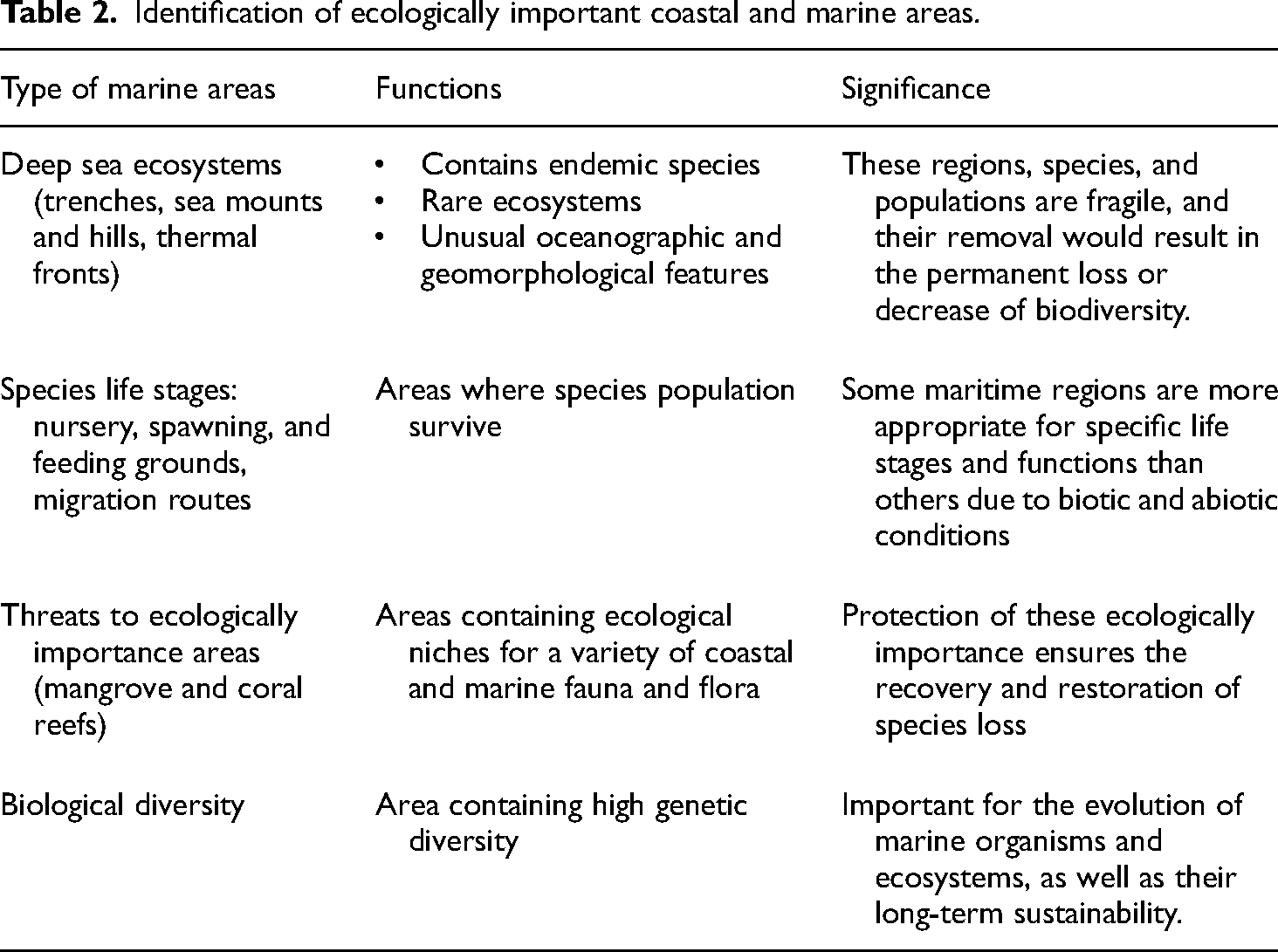
There are several other ways to identify and map ecologically threatened areas. Geographic Information System (GIS) can be used to gather data, including sensitive habitats, bioassessment, ecological values, and bioregional profiles. The use of GIS has many benefits, including improved communication and coordination among parties involved in a project. 64 Because many marine features or attributes are highly unpredictable or have clearly defined boundaries, the quantity and quality of marine features or areas can change over time. As a result, when it comes to all marine environments, the classification of the boundaries should be studied carefully, and this should be agreed upon by all participants. Furthermore, Table 2 demonstrates the functions of coastal and marine ecologically important areas.
Identification of ecologically important coastal and marine areas.
Mapping of Anthropogenic Activities
Mapping anthropogenic activities in MSP is considered an essential tool, as human activities can either affect the marine environment or disrupt ecosystem functions. While many marine activities can coexist safely in the same coastal environment, others, such as military operations at sea or sand gravel mining, and trawling, can pose challenges for other marine uses. Since activities frequently adjust in response to seasonality, species life stage changes, momentary natural or human disturbances, or legally required improvements, gathering relevant data (such as precise coordinates for defined existing activities) and mapping marine activities may need to adapt to briefer or sustained spatial variations. Major issues with marine mapping arise when aquatic resources and environmental services are reduced or affected due to overfishing or large-scale aggregate extraction. Significant disturbances can have far-reaching social and economic consequences, as well as a total shift in activity. Therefore, data on changes in human-related marine activities may need to be collected at a variety of geographical and temporal dimensions. Anglers, for example, are more likely to “follow” fish and migrate to where they move, for short periods of time. In contrast, oil production is likely to maintain a broader specified exclusion area (around offshore facilities) for many decades, while aquaculture facilities, once established, are likely to remain static across a small spatial area for a period of 20 years or more. Such spatial and temporal variations of different activities need to be considered in MSP plan development.
The data on local population activities around CPEC coastal areas will be an essential component for MSP. This data should include the location of small and larger communities, as well as their population density. This information will be crucial for evaluating economic and social well-being as a foundation for long-term population sustainability, particularly within artisanal groups that are most likely to require further economic assistance, education, health, and welfare services. The exact needs for social data will gradually emerge as the MSP work progresses, and stakeholder concerns can be addressed accordingly.
Creating MSP Team
In Pakistan, multiple organizations have authority over coastal and marine area planning, and their spatial jurisdictions overlap with other existing entities. The Pakistani government needs to establish a sole leading agency in the country to guide the MSP framework along the coastal and marine areas. Initially, the Government of Pakistan needs to clarify the legal authority of the organization involved in managing marine resources and enforcing regulations in coastal and marine areas. Secondly, before launching the MSP process, it is important to establish a multi-agency or multi-organizational working group that includes relevant stakeholders and experts from academia, civil society, and national and international agencies focused on sustainable development in coastal and marine areas. The purpose of this working group would be to bring together expertise from multiple sectors to collaborate in the MSP process. The working group should ensure that representatives from multiple sectors and stakeholders are aware of the MSP process in terms of their timelines and responsibilities. Firstly, the MSP working group needs to prepare a list of pertinent information that may be required to accomplish the MSP goals. Secondly, the MSP team along with other stakeholder groups need to list their source of information. The collected information from various sources can help to build a baseline reference for a wide range of activities such as ecosystem conservation and protection, socio-economic, and resource governing strategies. That will help in the establishment of successful MSP development.
According to Ehler and Douvere, 55 MSP adopts a multidisciplinary approach, and a team comprises sociologists, economists, geographers, a group of scientists including engineers, geologists, chemists, and physical oceanographers, and computing experts. Table 3 describes the members’ function role and their skills involved in any MSP scheme. Other governmental entities, relevant ministries, non-governmental organizations, and consultants with expertise in areas such as aquaculture, oil and gas exploration, tourism, and fisheries can also be involved in the MSP process as experts. Their contributions can provide valuable insights and knowledge to help ensure the success and sustainability of the MSP scheme.
Important roles and skills of MSP practitioners; source Ehler & Douvere (2009). 55

In addition, the leading organization should collect information on the behavior of resource users to facilitate effective management. To increase transparency and foster confidence, resource users and dependents should consult one another about their actions through monitoring and enforcement methods. Furthermore, the government-level organization can reduce pressures on targeted activities, such as fishing, by involving indigenous people in other economic activities, such as recreational and tourism activities. This can help diversify local economies and reduce reliance on resource extraction. Additionally, the federal government can provide financial compensation to local communities for limiting their access to protect resources.
Defining MSP Area Boundaries
In MSP, boundaries are divided into two types: (1) boundaries for management and (2) boundaries for analysis. 55 The planning of boundaries in MSP typically involves a political process that is directly or indirectly managed by a single unit. For example, the Great Barrier Reef Marine Park Authority (GBRMPA) manages the entire Exclusive Economic Zone (EEZ) in Australia. 17 In MSP, boundaries for management can help identify the sources that affect Pakistan's aquatic ecosystems, such as the location of fish catches, larval dispersion, sediment transportation, ocean currents, and nursery grounds. However, the management boundaries of the marine area may not coincide with the boundaries of a single ecosystem. This is because multiple ecosystems of varying sizes often exist within, and may extend beyond, the designated management area. 55 In Pakistan, fisheries administrative and management boundaries have been established, where the provincial fisheries departments of Sindh and Balochistan are responsible for the management of fishery resources within 24 nautical miles (NM). The area beyond 24–35 NM also comes under the administrative control of the provincial fisheries departments. However, the area within 24 NM is under the authority of the provincial fishery government, and boats from Sindh are not allowed to fish in Balochistan sea territories. The establishment of administrative and management boundaries for fisheries has prevented decision collisions among departments in Pakistan. Therefore, the Pakistani government should consider elaborating on administrative and management boundaries for other coastal and marine-related activities to reduce environmental and social conflicts. For example, in Germany, the Exclusive Economic Zone (EEZ) boundary is governed by the federal government, while the territorial waters fall under the administrative control of coastal states. Similarly, in Pakistan, the EEZ boundary should be governed by the federal government, and the territorial waters, which are considered an integrated part of territorial spatial planning, should come under the administrative control of coastal provinces.
Conclusion
Adopting MSP in Pakistan's national maritime policy is crucial, as it will help the government establish a balance between developing and conserving coastal and marine resources. Different processes and methods for implementing MSP have been proposed and continue to develop, recognizing the unique characteristics of the marine setting and maritime activities. Therefore, to advance marine scientific research, the Government of Pakistan needs to establish a collaboratively coordinated research mechanism. This will provide insights into how coastal and marine management can be scientifically enhanced in the future. In addition, the Government of Pakistan needs to modernize its existing infrastructure and establish new blue clusters to uplift the livelihoods of the coastal communities and reduce the impact on natural resources. In addition, the Government of Pakistan needs to modernize its existing infrastructure and establish new blue clusters to uplift the livelihoods of the coastal communities and reduce the impact on natural resources.
Footnotes
Acknowledgments
All the materials used in this research were provided by the authors.
Authors contributions
Basic idea and initial write up: 1st and 2nd Author. Data Collection and Analysis: 1st Author. Reviewing and Editing: 2nd, 3rd, and 4th Author. Preparation for Publication: 1, 5th and 6th author. Funding Acquisition: 1st Author.
Declaration of conflicting interests
The author(s) declared no potential conflicts of interest with respect to the research, authorship, and/or publication of this article.
Funding
The author(s) received no financial support for the research, authorship, and/or publication of this article

Author biographies
Zafar Ullah Jattak (Chairman, Department of Marine Sciences) is serving as an assistant professor in the Faculty of Marine Sciences, Lasbela University, Pakistan. His research interests are on “integrated management of marine resources rights and interests, blue economy development strategies, and maritime policies).
Wen Wu is serving as an associate professor in College of Oceanic and Atmospheric Sciences, Ocean University of China, Qingdao, PR China. Her research area mainly focuses on policies formulation on affairs related to marine environmental issues, marine strategic development plans, and blue economy.
Jinzhu Gao is serving as research officer in National Marine Data and Information Service, Tianjin, PR China. His research interests include maritime industries development strategies, and marine disaster risk reduction management.
Kuncheng Zhang is serving as a senior lecturer in School of Marxism/Institute of Marine Development, Ocean University of China, Qingdao, PR China. His research mainly focuses on marine functional zoning in China, and policies formulation related to marine disaster management.
Syed Hussain Murtaza is a PhD student in School of Tourism and Hospitality Management, Dongbei University of Finance and Economics, Jianshan, PR China. He is working on sustainable tourism development strategies and planning.
Mohammad Jan is serving as an assistant professor in the Faculty of Veterinary and Animal Science, Lasbela University, Pakistan. He is a PhD student in the Department of Biotechnology, Faculty of Agriculture. He is working on the role of marine fishery production on poultry production.
Aziz Ahmed (Chairman, Department of Coastal and Environmental Sciences) is serving as an assistant professor in the Faculty of Marine Sciences, Lasbela University. His research is on solid waste management and impacts of plastic pollution on marine environment.