




Abstract
Whether true inter-individual response differences (IIRD) occur as a result of resistance training on body weight and body composition in older adults with overweight and obesity is not known. To address this gap, data from a previous meta-analysis representing 587 men and women (333 resistance training, 254 control) ≥ 60 years of age nested in 15 randomized controlled trials of resistance training ≥ 8 weeks were included. Resistance training and control group change outcome standard deviations treated as point estimates for body weight and body composition (percent body fat, fat mass, body mass index in kg.m2, and lean body mass) were used to calculate true IIRD from each study. True IIRD as well as traditional pairwise comparisons were pooled using the inverse-variance (IVhet) model. Both 95% confidence intervals (CI) and prediction intervals (PI) were calculated. While statistically significant improvements were found for body weight and all body composition outcomes (p < 0.05 for all), no statistically significant IIRD was observed for any of the outcomes (p > 0.05 for all) and all 95% PIs overlapped. Conclusions: While resistance training is associated with improvements in body weight and body composition in older adults, the lack of true IIRD suggests that factors other than training response variation (random variation, physiological responses associated with behavioral changes that are not the result of resistance training) are responsible for the observed variation in body weight and body composition.
Introduction
The number of older adults ≥ 60 years of age is increasing at a dramatic rate. Worldwide, it has been estimated that the number of adults 60 years of age and older will more than double, from 962 million in 2017 to 2.1 billion in 2050. 1 In the United States (US), the number of adults ≥ 60 years of age was reported to have increased from 55.7 million in 2009 to 74.6 million in 2019, an increase of 34%. 2 Concomitant with this increase has been an increase in the prevalence of adults 60 years of age and older with overweight and obesity. For example, in the United States, the combined prevalence of overweight and obesity has been estimated at approximately 71.2% in adults 65 years of age and older, while obesity, 3 defined as a body mass index (BMI) ≥ 30 kg.m−2, increased from 25.6% between 1988–1994 to 43.3% between 2017–2018 in adults ≥ 60 years of age. 4 Not surprisingly, the economic costs associated with obesity are high. In the US, increasing costs were reported across all age groups, with the highest expenditures reported to be for adults 60–70 years of age with severe obesity, defined as a BMI ≥ 35 kg.m−2. 5
As part of a multicomponent program for healthy aging, including, but not limited to, maintaining optimal body composition and body weight, it is recommended that older adults perform strengthening exercises 2–3 times per week.6–11 However, given the conflicting results regarding the effects of strengthening exercises, i.e. resistance training, on body composition and body weight across the lifespan, Lopez et al. recently conducted a systematic review with meta-analysis of randomized controlled trials to examine such.
12
When limited to older adults ≥ 60 years of age, statistically significant improvements were found for all outcomes: body weight (
One innovative way to assess whether true IIRD, i.e. response variation, exist is to treat change outcome standard deviations in intervention and control groups from randomized controlled trials as point estimates.15,17 Justification for this approach is based on the fact that although both intervention and control groups are subject to changes in an outcome as a result of random variation and the physiological responses related to behavioral changes that are not the consequence of an intervention, only the intervention group is susceptible to variation in an outcome as a result of the intervention itself. As a result, if differences in change outcome standard deviations in the direction of benefit are larger in the intervention versus control group, one could then conclude that IIRD exist due to the intervention. After determining such, one could follow-up with tests to examine for potential factors associated with IIRD, i.e. precision medicine. In contrast, if no such differences are identified, then a search for IIRD as a result of an intervention is probably not worth pursuing. Such a result would also provide evidence to support general versus highly specific guidelines regarding an intervention like resistance training for improving outcomes such as body weight and body composition in older adults with overweight and obesity. To the best of the authors’ knowledge, no previous research has used this approach to examine true IIRD with respect to the independent effects of resistance training and changes in body weight and body composition in adults 60 years of age and older with overweight and obesity. Therefore, the purpose of the current study was to address this gap by conducting an aggregate data meta-analysis of standard deviation data to determine if true (IIRD) exist with respect to the independent effects of resistance training on changes in body weight and body composition (percent body fat, fat mass, BMI in kg.m−2, lean body mass) in adults 60 years of age and older with overweight and obesity.
Materials and methods
Overview
The characteristics of the included studies are described here in the Methods versus the forthcoming Results section of the manuscript because they were based on data collected in the previous systematic review with meta-analysis. 12 The protocol for the current study is registered in Open Science Framework (https://osf.io/qtnyu/).
Data source
For the current IIRD meta-analysis, data were limited to studies in men and women in which the mean age was 60 years of age and older, derived from a large, recent systematic review with meta-analysis of randomized controlled intervention studies examining the effects of resistance training on body weight and body composition.
12
Limited to those that included a resistance exercise training only group with a comparative control group (non-intervention, education, stretching) a total of 15 studies representing 587 men and women (333 resistance training, 254 control)18–32 from the original meta-analysis
12
were included Details of the original meta-analysis and included studies are described in the original article.
12
Briefly, five studies were conducted in the United States,18,24,26,29,32 three in Brazil,20,22,30 three in Taiwan,23,27,28 and one each in either Canada,
21
Spain,
25
Iran,
19
or South Korea.
31
Mean group ages between studies ranged from 62.8 to 70.9 years in the resistance training groups (
Data abstraction
Data from the included meta-analysis were abstracted by the first and second authors, independent of each other, using Microsoft® Excel® for Microsoft 365 MSO (Version 2203 Build 16.0.15028.20242). Information abstracted included the following: (1) original study authors, (2) year of publication, and (3) sample sizes, change outcome means and standard deviations for body weight, BMI in kg.m−2, percent body fat, fat mass, and lean body mass for both resistance training and control groups. After abstracting data, Gwet's AC1 statistic was used to assess inter-rater agreement.34,35 The first two authors then met and reviewed their coding for agreement. Any disagreements were resolved by consensus. If consensus could not be reached, the third author provided a recommendation.
Quality of meta-analysis
The Assessment of Multiple Systematic Reviews (AMSTAR 2) instrument, details of which have been described elsewhere, 36 was used to assess the quality of the included systematic review with meta-analysis. 12 The overall confidence in the quality of the meta-analysis was categorized as either “High”, “Moderate”, “Low” or “Critically low” based on previous recommendations. 36 AMSTAR2 assessments were conducted using the same procedures as for data extraction.
Certainty/strength of evidence
The original systematic review with meta-analysis included in the current study assessed for risk of bias using the Cochrane Risk of Bias Instrument (RoB2) for Randomized Controlled Trials. 37 When limited to those studies included in the current IIRD meta-analysis, a high overall risk of bias was observed for 16.7% of body weight and BMI (kg.m−2) outcomes, 50% for percent body fat and lean body mass outcomes, and 41.7% for fat mass. However, no assessment regarding the certainty of evidence was reported in the original meta-analysis. 12 Therefore, we assessed the certainty/strength of evidence using the Grading of Recommendations, Assessment, Development and Evaluations (GRADE) instrument.38,39 This instrument assesses evidence across the domains of risk of bias, consistency, directness, precision, and publication bias. 38 Quality is judged as either high (further research is very unlikely to change our confidence in the estimate of effect), moderate (further research is likely to have an important impact on our confidence in the estimate of effect and may change the estimate), low (further research is very likely to have an important impact on our confidence in the estimate of effect and is likely to change the estimate), or very low (very uncertain about the estimate of effect). 38 Assessments were conducted by the first author and reviewed for agreement by the second author. Any disagreements were resolved by consensus. If consensus could not be reached, the third author provided a recommendation.
Data synthesis
Effect size metric
For all outcomes, the original metric served as the effect size. These included body weight (kg), body fat (%), fat mass (kg), BMI in kg.m−2, and lean body mass (kg). Analysis was limited to these five outcomes because they included at least five effect sizes for pooling. 40
Traditional treatment effects meta-analysis
Prior to conducting our IIRD meta-analysis, a typical aggregate data meta-analysis of treatment effects was first performed by pooling treatment effects for each outcome from each study. These were calculated as the change outcome difference between the resistance training and control groups along with the change outcome standard deviations for each group. To maintain independence, effect size results from studies that included multiple intervention arms were pooled into one overall effect size. Results for each outcome were then pooled separately using the inverse variance heterogeneity (IVhet) model.40,41 The IVhet model has been shown to be more robust and theoretically reasonable than random-effects models.40,41 More specifically, the IVhet model, an approach that uses an estimator under the fixed effect model assumption with a quasi-likelihood-based variance structure, found that this estimator maintained correct coverage probabilities as well as a lower observed variance than the random-effects model, irrespective of heterogeneity.40,41 Non-overlapping 95% confidence intervals (CI) were considered statistically significant.
The Cochran Q statistic and I-squared (I2) statistic were used to assess heterogeneity and inconsistency, respectfully.
42
Alpha values ≤0.10 for Q were considered as statistically significant heterogeneity. For I2, inconsistency was categorized as very low (<25%), low (25% to <50%), moderate (50% to <75%), or high (>75%).
42
Tau (
To assess small-study effects (publication bias, etc.), the Doi plot was used to provide a qualitative assessment of small-study effects while the Luis Furuya-Kanamori (LFK) index was used to provide a quantitative assessment of small-study effects. 44 The Doi plot has been reported to be more intuitive than the commonly used funnel plot while the LFK index has been shown to be more robust than the commonly used Egger's regression intercept test, including when the number of effect sizes is less than 10. 44 Based on previously suggested categories, LFK values of ± 1, between ± 1 and ± 2, and > ± 2, were used to indicate no, minor, and major asymmetry, respectively. 44 In addition to pooled results, sensitivity analyses for each outcome were conducted by deleting each study from the model once to see how it influenced the overall results, including heterogeneity and inconsistency. Outlier analysis was also conducted by excluding study-level effect sizes in which their 95% confidence intervals (CIs) fell outside the pooled 95% CI.
To identify what result one might expect if a new randomized controlled trial was conducted in a population similar to those included in the meta-analysis, 95% prediction intervals (PI) were calculated for each outcome.
45
Prediction intervals are calculated from the pooled mean effect, standard error, and
IIRD meta-analysis
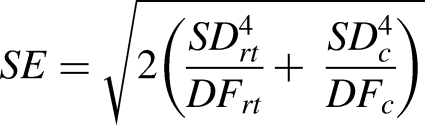
For the primary aim of this study, true IIRD between resistance training and control group standard deviations for each outcome were treated as point estimates and calculated from each study as follows
17
:

Software used for analysis
Meta XL (version 5.3), 48 the most recent user-written version of metan for Stata (version 16), 49 and the user-written KAPPAETC for Stata 35 were used for all analyses. All statistical tests were two-tailed with an alpha level ≤ 0.05 considered statistically significant.
Post hoc modifications
There were no post hoc modifications.
Results
Inter-coder agreement for data abstraction and GRADE
Prior to correcting differences, the overall combined agreement rate for data abstraction, including GRADE assessment, was 0.98 (95% CI, 0.97, 0.99). All disagreements were resolved by consensus.
AMSTAR 2 results
AMSTAR 2 results for the systematic review with meta-analysis from which this data derived is shown in Supplementary file 1. The overall agreement rate prior to correcting discrepant items was 0.77 (95% CI, 0.50, 1.0). All disagreements were resolved by consensus. Final agreement resulted in eleven of 16 items (68.75%) being rated positively (“Yes” or “Partial Yes”) while the remaining (31.25%) were rated as “No”. Globally, confidence in the meta-analysis was considered “Moderate”, with “No” ratings considered to be non-critical weaknesses.
Treatment effect results
Body weight
Baseline body weight ranged from 60.4 to 87.2 kg in the exercise groups (
Treatment effect and IIRD results.

aTE, treatment effects; bSDIR, standard deviation of individual response differences; c
BMI (kg.m−2)
Baseline BMI ranged from 24.7 to 33.7 kg.m−2 in the exercise groups (
Percent body fat
Baseline percent body fat ranged from 33.8% to 46.3% in the exercise groups (
Fat mass
Baseline fat mass ranged from 20.8 to 36.1 kg in the exercise groups (
Lean body mass
Baseline lean body mass ranged from 19.7 to 56.3 kg in the exercise groups (
IIRD results
Results for the primary aim of this study are described below.
Body weight
Pooled 95% CI for standard-deviation-based true IIRD in body weight included zero (0) (Table 1). Absolute between-study heterogeneity (
BMI (kg.m−2)
Pooled 95% CI for standard-deviation-based true IIRD in BMI in kg.m−2 included zero (0), with the mean estimate in the direction of greater IIRD in the control versus exercise groups (Table 1). Absolute between-study heterogeneity (
Percent body fat
Pooled 95% CI for standard-deviation-based true IIRD in percent body fat included zero (0) (Table 1). Absolute between-study heterogeneity (
Fat mass
Pooled 95% CI for standard-deviation-based true IIRD in fat mass (kg) included zero (0) (Table 1). Absolute between-study heterogeneity (
Lean body mass
Pooled 95% CI for standard-deviation-based true IIRD in lean body mass (kg) included zero (0) (Table 1). Absolute between-study heterogeneity (
GRADE results
GRADE results for the strength/certainty of evidence for treatment effect changes in body weight (kg), BMI in kg.m−2, percent body fat, fat mass (kg), and lean body mass (kg) are shown in Supplementary file 17. As can be seen, the strength/certainty of evidence was considered “Moderate” for what was classified as the “Important” outcomes of body weight and BMI in kg.m−2 while the “Critical” outcomes (percent body fat, fat mass, and lean body mass) were considered to have “Low” strength/certainty of evidence. The downgrading to “Moderate” certainty of evidence was based on concerns about allocation concealment and selective reporting while the rating of “Low” was based on concerns about allocation concealment, measurement of the outcome, and selective reporting.
Discussion
Overall findings
The primary purpose of the current study was to examine for potential IIRD with respect to the independent effects of resistance training on changes in body weight and body composition (percent body fat, fat mass, BMI in kg.m−2, lean body mass) in adults 60 years of age and older with overweight and obesity. The overall results consistently demonstrate a lack of IIRD for all outcomes. These findings are supported by (1) overlapping 95% CIs, (2) overlapping 95% PIs, (3) consistency in findings based on outlier analysis, (4) lack of statistical between-study heterogeneity, and (5) lack of clinically important differences based on pre-defined MCIDs for each outcome. Thus, it appears that any IIRD observed are the result of random variation (measurement error, biological day-to-day variation) and/or behavioral changes (sleep, diet, etc.), not associated with resistance training. 16 As a result, a search for potential moderators and mediators, including genetic interactions, associated with changes in body weight and body composition as a result of resistance training in older adults with overweight and obesity, may not be warranted. 15
The overall lack of IIRD found in the current meta-analysis is similar to those found in other meta-analyses that examined the effects of exercise on body weight and body composition.43,50–52 For example, in an aggregate data IIRD meta-analysis of 12 randomized controlled trials representing 1500 participants, Williamson et al., found a lack of statistically significant and clinically important differences in body weight as a result of exercise training (aerobic, resistance, both) in men and women 18 years of age and older. 43 Similar results were found in aggregate data meta-analyses of randomized controlled trials examining the effects of aerobic exercise on BMI (kg.m−2) 50 as well as fat mass and percent body fat 51 in male and female children and adolescents with overweight and obesity. More recently, an individual participant data meta-analysis of eight randomized controlled trials representing 1879 participants found a lack of IIRD for waist circumference and body weight, as well as cardiorespiratory fitness, as a result of exercise training in men and women. 52 Finally, and most notably, the authors are not aware of any previous meta-analytic research, when appropriately quantified, that has identified any exercise-associated IIRD on body weight and body composition in any age group.
While not the primary purpose of the current study, statistically significant treatment effect improvements (exercise minus control) were observed for all included outcomes (body weight, BMI in kg.m−2, percent body fat, fat mass, lean body mass). These overall findings are further supported by (1) a lack of statistical between-study heterogeneity and inconsistency, (2) lack of outliers, (3) lack of small-study effects in the direction of benefit, (4) the overall consistency of findings with each study deleted from the model once, except for body weight and BMI in kg.m−2 when the Davidson et al., 24 study was deleted, and (5) non-overlapping 95% PIs for body weight, percent body fat, and lean mass. The non-significant findings for body weight and BMI in kg.m−2 when the Davidson et al., 24 study was deleted was most likely a consequence of the large amount of weight this study contributed to the overall pooled models. In addition, this was a well conducted study that focused on abdominally obese adults in which there was a tight focus on ensuring that the negative energy balance was induced by resistance exercise only. 24
While the above findings are encouraging, the clinical importance could be questioned given that results were only considered to be “possibly clinically important” for percent body fat, fat mass, and lean mass, “very unlikely to be clinically important” for BMI in kg.m−2 and “unlikely or probably not clinically important” for body weight. In addition, overlapping 95% PI for what result one might expect if they conducted their own study in a similar population were observed for BMI in kg.m−2 and fat mass. Given the former, it may be that resistance training combined with aerobic exercise and dietary modification may be needed to achieve clinically relevant improvements in body weight and body composition in older adults. In addition, the strength/certainty of evidence based on GRADE was considered to be only “moderate” for body weight and BMI in kg.m−2 and “low” for percent body fat, fat mass, and lean body mass. Finally, the quality of the previous meta-analysis from which the current study derived was considered to be “moderate.” 12
Implications for research
With a focus on IIRD, there are several implications regarding both the conduct and reporting of future research addressing the effects of resistance training on body weight and body composition in older adults with overweight and obesity. First, it is recommended that future randomized controlled trials appropriately assess for IIRD before examining for potential moderators and mediators, including genetic interactions. Not doing so could result in (1) a waste of time and resources, (2) ethical issues, and (3) false conclusions. Applied methods for examining for IIRD in original randomized controlled trials are described by Swinton et al. 53 Second, it is recommended that original randomized controlled trials report sample sizes as well as change outcome means and standard deviations for both intervention and control groups as this will allow for meta-analysis of IIRD. This may be especially important since IIRD based on a meta-analysis has been recommended over IIRD based on the results of original randomized controlled trials. 54 Third, the longest intervention for the included studies was 24 weeks. Given the former, there is a need for studies of longer duration to determine the long-term effects of progressive resistance training on body weight and body composition in older adults with overweight and obesity. Finally, since there was a lack of data on energy intake and expenditure, future studies should account for this given that greater increases in the ratio of energy expenditure to energy intake should result in greater decreases in measures of adiposity. 55
Implications for practice
The current IIRD findings suggest that precision exercise medicine may not be warranted with respect to the effects of progressive resistance training on body weight and body composition in older adults with overweight and obesity. Rather, general exercise recommendations for resistance training in older adults may be more appropriate.6–11 For example, the American College of Sports Medicine recommends that in addition to aerobic and flexibility exercise, older adults should participate in at least 2 days per week of progressive resistance exercise at moderate to vigorous intensity, performing 1 set of 8 to 10 exercises for 8 to 12 repetitions per set of the major muscle groups. 6 The use of these more general exercise guidelines may also lend themselves to greater reach given that personalized, i.e. precision exercise, may marginalize some of the very populations (racial and ethnic minorities, the poor, etc.) given its cost as well as lack of access for populations such as the poor and racial/ethnic minorities. 56 However, the investigative team is not aware of any research that has addressed these issues when applied specifically to exercise. The former notwithstanding, it may be that community-based programs that promote resistance training in older adults may have the greatest potential for success.
While the use of precision exercise may not be warranted, it's important to understand that this does not preclude one from recommending progressive resistance training programs that will enhance long-term adherence. For example, rather than recommending that everyone use free-weights for training, one should provide other options such as machine-based resistance training equipment, elastic bands, etc., that will promote long-term adherence. This is especially true given the low participation rate of older adults in resistance training programs. 57 For example, based on National Health Interview Survey (NHIS) data, only 9.6% of US adults 65 years of age and older participated in strength training at least 2 times per week, 58 while in Australia, the prevalence was reported to be 12.0%. 59 Finally, the current treatment effect results suggest that progressive resistance training alone may not yield clinically important improvements in body weight and body composition in older adults with overweight and obesity. Thus, adhering to recommendations that include both progressive resistance training and aerobic exercise may be needed to provide clinically relevant improvements in body weight and body composition in older adults with overweight and obesity. 6
Implications for policy
Given the findings of the current meta-analysis, policies and programs aimed at increasing the proportion of older adults with overweight and obesity who regularly participate in progressive resistance training appears warranted. This is especially true given the many other benefits of resistance training in older adults, including, but not limited to, (1) reducing the negative age-related changes in human skeletal muscle, (2) improving muscular strength, power and neuromuscular function, (3) improving physical function, and thus, independence, (4) reducing injury and fall risk, and (5) improving psychosocial well-being. 9 However, it appears that maximizing benefits in older adults may best be achieved by promoting policies and programs aimed at not only increasing participation in progressive resistance training, but also aerobic and balance exercises. For example, the Move Your Way® program encourages both moderate-intensity aerobic activity as well as muscle-strengthening activity in Americans, including older adults. 60 In addition, since physicians and other healthcare professionals play an important role in encouraging older adults to participate in resistance training, the promotion of such by physicians and other healthcare professionals is recommended.61,62 For example, the Exercise is Medicine® (EIM) program encourages physical activity assessment and promotion as part of a treatment plan by physicians and other healthcare providers in the clinical setting, including referral of patients to evidence-based programs and qualified exercise professionals. 63 Furthermore, the promotion of physical activity in older adults using mHealh and eHealth technologies also hold promise. 64
Strengths and potential limitations
From the investigators’ perspective, the major strength of the current study is that it is the first study, to the best of the authors' knowledge, to appropriately examine for IIRD with respect to the effects of progressive resistance training on body weight and body composition in older adults with overweight and obesity. The results are important because they contribute to the body of literature as it pertains to IIRD, suggesting the precision resistance training exercise for improving body weight and body composition in older adults may not be warranted.
There are several potential limitations of this study that need to be considered. First, based on GRADE, the “Low” strength/certainty of evidence for percent body fat, fat mass, and lean body mass as well as “Moderate” strength/certainty of evidence for body weight and BMI in kg.m−2 warrant caution in the overall treatment effect results. Second, a MCID of 5% improvement from baseline values for body weight and body composition outcomes was used to determine clinical relevance. However, use of a different MCID would have yielded different results for all treatment effects and IIRD analyses that included such. Third, while 95% PIs have been recommended to determine what effect one might find if a new randomized controlled trial was conducted in a population similar to those included in a meta-analysis,45,65 concern about potentially poor coverage probabilities have been expressed. 66 Fourth, while sensitivity analyses were conducted no subgroup, moderator, or meta-regression analyses were conducted given the small number of effect sizes for each outcome. However, analyses such as meta-regression in an aggregate data meta-analysis are observational in nature. As a result, this would not support causal inferences. 67 Rather, these analyses would need to be tested in original randomized controlled trials. Fifth, since the current study was based on a previous meta-analysis, one inherits the weaknesses and limitations of not only the meta-analysis itself, but also the studies included. Finally, given that this was an aggregate data meta-analyses, the potential for ecological fallacy, specifically Simpson's Paradox, exists. 68
Conclusions
While resistance training is associated with improvements in body weight and body composition in older adults, the lack of true IIRD suggests that factors other than training response variation (random variation, physiological responses associated with behavioral changes that are not the result of resistance training) are responsible for the observed variation in body weight and body composition.
Supplemental Material
sj-docx-1-sci-10.1177_00368504231179062 - Supplemental material for Effects of resistance training on body weight and body composition in older adults: An inter-individual response difference meta-analysis of randomized controlled trials
Supplemental material, sj-docx-1-sci-10.1177_00368504231179062 for Effects of resistance training on body weight and body composition in older adults: An inter-individual response difference meta-analysis of randomized controlled trials by George A. Kelley, Kristi S. Kelley and Brian L. Stauffer in Science Progress
Footnotes
Authors’ contributions
GAK was responsible for the conception and design, acquisition of data, analysis and interpretation of data, drafting the initial manuscript and revising it critically for important intellectual content. KSK was responsible for the conception and design, acquisition of data, and reviewing all drafts of the manuscript. BLS was responsible for the conception and design, interpretation of data and reviewing all drafts of the manuscript. All authors will read and approve the final manuscript.
Informed Consent/ Institutional Review Board Approval
This study is an aggregate data meta-analysis of previously reported summary data. Therefore, neither Informed Consent nor Institutional Review Board Approval is required.
Availability of data
All data for this study are available from the corresponding author upon reasonable request.
Declaration of conflicting interests
The author(s) declared no potential conflicts of interest with respect to the research, authorship, and/or publication of this article.
Funding
The author(s) received no financial support for the research, authorship, and/or publication of this article
Supplemental material
Supplemental material for this article is available online.

Author biographies
George A. Kelley is a Professor in the Department of Epidemiology and Biostatistics. His research focuses on using the meta-analytic approach to examine the effects of exercise and physical activity on health-related disease. He holds a doctorate in Exercise Science.
Kristi S. Kelley is a Research Instructor in the Department of Epidemiology and Biostatistics. Her research focuses on using the meta-analytic approach to examine the effects of exercise and physical activity on health-related disease. She possesses a Master's Degree in Health Promotion.
Brian L. Stauffer is a Professor of Medicine, Division of Cardiology. His research focuses on translational cardiovascular experimentation in clinical populations and in developing and using animal models of human disease. He holds a doctorate in Medicine.
References
Supplementary Material
Please find the following supplemental material available below.
For Open Access articles published under a Creative Commons License, all supplemental material carries the same license as the article it is associated with.
For non-Open Access articles published, all supplemental material carries a non-exclusive license, and permission requests for re-use of supplemental material or any part of supplemental material shall be sent directly to the copyright owner as specified in the copyright notice associated with the article.
