




Abstract
Professor Bajram Preza was a career neurologist with a strong background in research both in neurology and psychiatry. After a period of study in Sarajevo in the immediate post-WWII period, he completed his studies in medicine and a fellowship in neuropsychiatry in Nizhny Novgorod (formerly Gorky). A highly prolific author, he holds the laurels of the first medical dissertation sustained in the University of Tirana (1958) as well as for publishing the first student’s textbook on medicine (Semiotics of nervous diseases, 1964) in Albania. He led the Clinic of Neurology in Tirana for more than three decades, while relentlessly lecturing, publishing and editing a diversity of medical papers, translations and original works that have shaped the professional education of entire generations of future Albanian physicians.
Bajram Xhaferr Preza
Bajram Preza MD (father name Xhaferr) was born on February 2, 1923, in Preza, a small hilly village near Tirana, the capital of Albania. The country received its independence from the Ottoman Empire some ten years before his birth (1912) and surnames (family names) were often misspelled, changed or re-registered. Hence in a few sources (a nominal characteristic produced from the Rectorate of the University of Tirana, 1962), he is mentioned with two family names (Preza and Kalaja) while he and his family had meanwhile dropped this second surname [1]. A normal way of depositing ancestry in the registers: initially in the Turkish administration, and thereafter in the newborn Albanian state, much of native families had this usage inherited. This might be even more understandable in our case: Bajram Preza MD was born in the hilly village of Preza whose castle is an archeological and touristic curiosity, and Kalaja is the Albanian word for castle. This phenomenon of surnames with place-name elements (or “anthropotoponyms”) is almost universal [2]. Even the town signs that lead to Preza, some twenty-four kilometers from the capital Tirana, show both the name of the small town and of its Kalaja, castle (Figure 1).

Early life and medical education
Born to a wealthy family, he had four years of undergraduate education in Torino (Italy). During the period 1946–1948, he started studying medicine in Sarajevo (at that time part of Yugoslavia). He completed his graduate studies in medicine during the period 1948–1953 in Nizhny Novgorod (at that time the city's name was Gorky, and was part of the Union of Soviet Socialist Republics [USSR]) [3]. In the last year of his stay in the Soviet Union, he completed a fellowship in neuropsychiatry.
The results of his studies in the USSR were impressive and official sources acknowledge this fact. Official documents of the Ministry of Education and Culture of Albania, while including the exhaustive list of Albanian students that were studying at that time in the Soviet Republics, mention Bajram Preza as having excellent results [4–6]. Focused mainly on psychiatry, he succeeded in upholding a final thesis to the end of his studies in the Soviet Union, entitled “Clinical study of Kleist intermediate psychosis (Rand-psychoses) and their treatment through paranephral blockades with magnesium sulfur solution of 1%”. This was probably an extension of the already famous Vishnevsky technique of lumbar / paranephral blockade with novocaine (a sort of spinal anesthesia), applied in a diversity of conditions and actually considered obsolete [7–9]. Along with the technique, it seems that modern psychiatry has dropped the notion of Rand-psychoses as well and replaced it with the term ‘cycloid’ [10].
Following this background and while back in Tirana in June 1953, Bajram Preza MD works as a treating clinician at the Clinic of Psychiatry. The Clinic of Neurology dates its foundation in September 1955, initially with thirty beds and accommodated within the premises of the State Hospital of Tirana no. 1 [11]. At that time, Soviet physicians came by to help organize the nascent Albanian medical structures. Two major medical figures contributed initially to the work of the Services of Psychiatry and Neurology: respectively Aleksandrovskii AB, and Sakharov IN. Albanian doctors, members of the newborn neuropsychiatric cathedra in the University of Tirana, underscore their important role in the first issue of Psychoneurological Works, a periodical published by this cathedra since 1959 [12]. The importance of this journal, initially aimed as an annual publication, and that had ten issues released until 1984 with original works from Albanian neurologists and psychiatrists has been discussed previously [13]. Official sources emphasize also the contribution of Russian scholars in this historical period [11]. Most importantly, Aleksandrovskii published a paper on the history of psychiatry in Albania, whereas Sakharov co-authored with Bajram Preza a manuscript on polyneuritis in the anicteric leptospirosis, with both these papers indexed in the Medline / PubMed [14, 15].
Dedicated to neurology and medicine
At the beginning of 1950, it was too early for separating neuropsychiatry into two distinct specialties, when in fact; such a separation is taking place actually since decades. However, Bajram Preza MD will lead from September 1955 the Clinic of Neurology, co-directed with Prof. Sakharov (Moscow) for the first two years. Impressively enough, Preza will lead Albanian neurology for the following thirty-five years, until 1990, while becoming for a long period as well as the Head of the Department of Neurology-Psychiatry-Neurosurgery. From September 1990 until December 1993, he kept on serving as a neurological consultant at the University Hospital Center of Tirana. Thereafter he retired and worked in his private studio in Tirana.
His dissertation with the theme "Sulfanilamide induced polyneuritis", upheld on November 1958 before a jury and a jubilating auditorium highlighted not only a big step forward to the Albanian medicine of the time. It was the first ever dissertation for scientific promotion in the field of medicine of the State University of Tirana (founded only some years before). Among the reviewers of the dissertation was the first Head of the Cathedra of Neuropsychiatry in Tirana (Professor Xhavit Gjata) and Aleksandrovskii AB, one of the Russian mentors.
The newsreel no. 18 of the Film Studio “New Albania”, November 1958, broadcasted more than one minute from the event of the dissertation, with Bajram Preza and reviewers speaking one after the other (
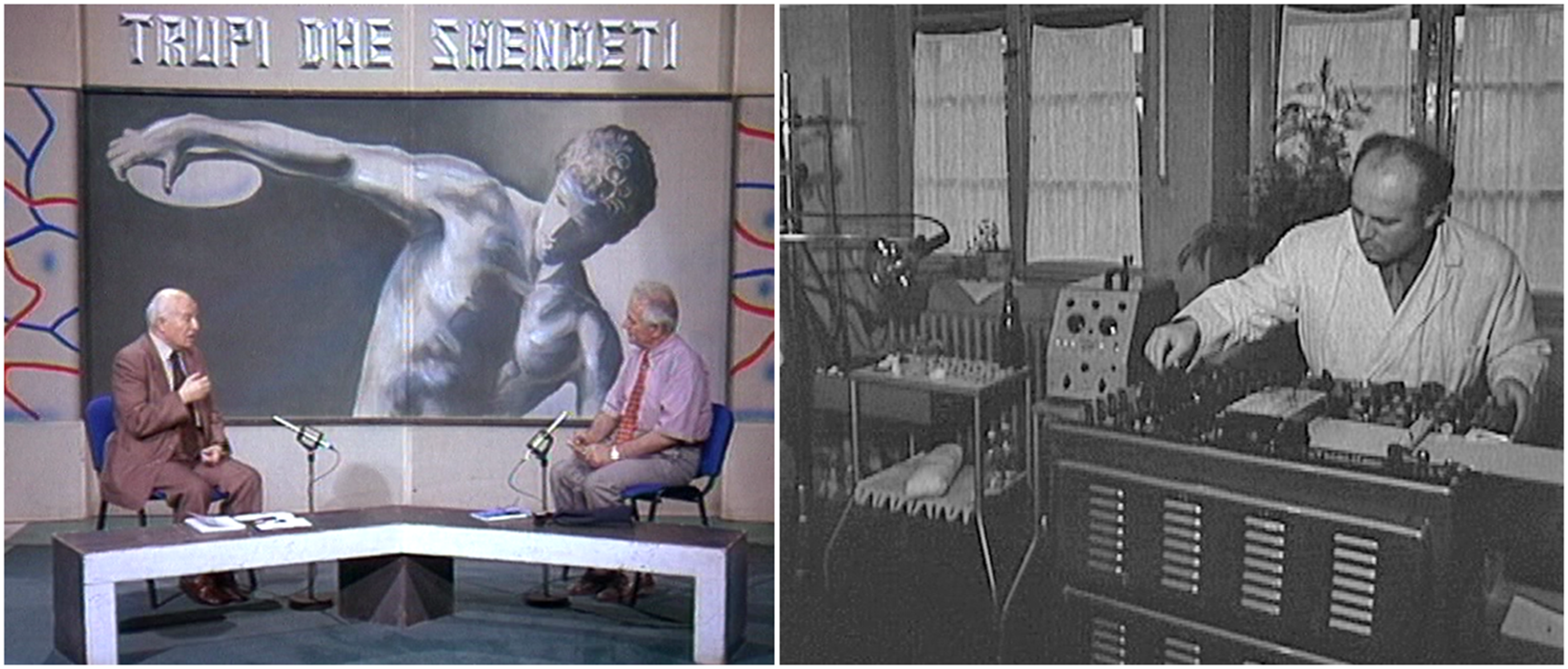
While all newsreels were commissioned from the state and used for ideological purposes as well, however, historical events (first ever dissertation on medicine; inclusion of electroencephalography in the everyday practice of the Clinic of Neurology) need to be remembered as benchmarking early phases of medical sciences in the second half of the twentieth century in Albania.
Initial years: a historical background
Apart from the international recognition and paper indexation that maybe was hard to achieve at that time due to different reasons, the academic work of Preza and his career was similar to many Albanian intellectuals in the immediate post-WWII. Having had completed graduate studies in ex-communist countries (initially in Sarajevo; thereafter Nizhniy Novgorod) Preza was strongly influenced during his initial formation from the Russian school of neuroscience. In fact, his academic work started with the translation of textbooks from Russian into Albanian, with two major books that will serve as a study basis for the students of the recently founded High School of Medicine in Tirana (1952, later integrated as a Faculty, part of the University of Tirana):
Sepp Е.К., Zucker М.B., Schmidt Е.V. Nervous diseases. Moscow: Medgiz; 1954 (in Russian) [Сепп Е.К., Цукер М.Б., Шмидт Е.В. Нервные болезни. М: Медгиз; 1954.]
Giljarovskij VA: Psychiatry. A guide for doctors and students. (in Russian) [Психиатрия: Руководство для врачей и студентов]. Medgiz, 1954.
It is highly important to consider this historical context for Preza and his contemporaries while evaluating their work: the time setting was particular, precarious and maybe unrepeatable. Communist and totalitarian regimes that had just taken the grip on the majority of Eastern European countries did actually sponsor science (and medicine of course) but professionals had to function entirely under the state ideology [16].
Albania was obviously, a case apart: the sudden break of relations with the Soviet Union severed all previous connections of Albanian postgraduate students and scholars that studied, or were studying, in the countries of the Eastern bloc. The Albanian-Russian divorce could have been a no-fault one, whose real causes and aftermath remain outside the scope of this paper; exhaustive reviews on the subject are available [17].
As for human consequences, it had an immense impact on Albania from the 50s and thereafter: a small, rural country having not more than one million inhabitants at that time, with endemic poverty and an educational and health system yet to take form. The divorce was not merely political: it really existed, as dozens of Albanian students while completing their studies in USSR engaged or married local women. Many families, as a matter of fact, broke apart [18].
In the early 60s, while leading the recently founded Service of Neurology in Tirana (at the time part of the Internal Medicine Hospital), Preza and his colleagues faced a sudden turn in the official policy: a decision obviously not theirs, taken from the high ranges of the state hierarchy. If Albania had embraced the so-called “Semashko” model of the health system (publicly owned facilities, salaried health workers, large providers of primary medical care, and a high degree of governmental administration), the time to cut the ties with the Russian model had come, although the distancing was never complete [19, 20].
Now, the Soviet and communist influences generally had spared Albania before WWII; but Russians did show interest even before the First World War in the Balkan countries, and this expanded even in the medical field [21]. It was already the year 1964 when Preza and his colleagues imported to Albania the idea of a Brain Hospital that would encompass all neurosciences (neurology, neurosurgery, and psychiatry) in a single facility, inspired by a French model [11].
Professor Preza was appointed as well Albania’s representative at the Sixteenth World Health Assembly in Geneva in 1963, and soon thereafter he would complete a six-month fellowship in Paris [22]. The positioning towards the West was thus accomplished; but this, unfortunately, would not be true for Albania, a country that remained deeply isolated for the upcoming quarter century.
Academic works
With dozens of textbooks, monographies, translated texts and hundreds of articles in the specialized Albanian and foreign journals, it is hard to draw an exhaustive list of Preza scientific production; furthermore, publication of several papers took place in periods when indexation was not complete, if available at all. Some scholars have tried to detail the history of neuroscience in Southeastern Europe but here again, Albania was among the countries with missing, or lacking data [23].
Professor Preza had four papers indexed in Medline / PubMed, but this meager indexation reflects as well the hardship of isolation that Albania endured during the period 1960–1990 [15, 24–26]. Of these four papers, three focused on the theme of polyneuritis (partially based on his dissertation) and the last one dates from 1990, when the country was tearing down the walls of isolation.
A different picture will come up while checking the index of the AJMHS (Albanian Journal of Medical and Health Sciences), initially published under the name of Bulletin of Tirana State University (Medical Series), and thereafter as the Bulletin of Medical Sciences. Bajram Preza was, a major contributor and a constant member of the editorial board while being as well the editor-in-chief of the Psychoneurological Works [13]. A search term of ‘Preza’ will produce there (https://ajmhs.umed.edu.al/home) thirty-eight contributions, among original articles, case reports, reviews and editorial contributions.
In fact, the Bulletin of Tirana State University started publishing in 1961 its Medical Series. Right in the first issue, Preza comes up with an interesting case report: A case of extramedullary tumor successfully operated [27]. Sadly enough, the second contributor of this paper, Llambi Ziçishti MD, a dedicated surgeon that served for a period as the Dean of Faculty of Medicine and Minister of Health of Albania, will be executed in 1982 during one of the many political processes that were part of the everyday life of the country [28]. An indelible sign of state cruelty that so far had spared medical doctors, at least partially.
During the period of more than thirty years that Bajram Preza led the Service of Neurology, he was a constant lecturer and mentor to students and postgraduate fellows (Figure 3).

The website of the National Library of Albania (https://bksh.al/) has indexed a large number of the textbooks, monographies and articles published from Preza. The indexation at bksh.al covers his main published textbooks, which included neurology and its semiotics, as well as an extensive work of more than 700 pages on clinical toxicology (published 1973). The database https://al.cobiss.net/ has as well indexed forty works of this author; above in the Table 1 we have included some of them.
Some of the works indexed at al.cobiss.net, with respective links.

Preza had the honor of publishing the first-ever textbook for medical students in Albania (Semiotics of Nervous Diseases, 1964). The Albanian state granted him the High Prize of the Republics on that occasion. Figure 4 shows the covers of these two books, published 1964 and 1973.

Before retiring into private activity, Bajram Preza co-authored another major textbook on Clinical Neurology (1991), which was in use for students for several years.
The title of professor, granted in 1970, was the logical culmination of a splendid academic career. Bajram Preza had as well several contributions to the international sphere; the journal Archives de l'Union médicale Balkanique, a regional publication of Balkan countries in French language and published in Bucharest (Rumania), saw him appointed as the secretary of the Albanian section of the same journal [29]. He became a member of the Academy of Sciences of Albania since 1972; a position that he held until he passed away in Tirana, on June 5, 2007. To honor his long-standing career and devotion, the Service of Neurology of the University Hospital Center in Tirana holds his name since July 2010 [30].
Footnotes
Acknowledgements
Images, where stated, are courtesy of the family. Snapshots from newsreels are courtesy of Albanian State Television and Albanian State Film Archive. The video fragment produced as supplementary file is courtesy of the Albanian State Film Archive (subtitles' translation and insertion is made from authors).
Declaration of conflicting interests
The author(s) declared no potential conflicts of interest with respect to the research, authorship, and/or publication of this article.
Funding
The author(s) received no financial support for the research, authorship, and/or publication of this article.

Supplemental material
Supplemental material for this article is available online.
Author biographies
Gentian Vyshka Graduated from Faculty of Medicine in Tirana on 1993, PhD 2007; Associated Professor 2011; Full Professor in Medicine 2016. Lecturer of Human Physiology (Faculty of Medicine, UMT, in Tirana); lecturer of Psychopharmacology (Faculty of Social Sciences); neurologist (UHC Mother Teresa, Tirana, Albania); medical consultant to ARCT (Albanian Rehabilitation Center for Trauma and Torture) and expert in Forensic Neuropsychiatry (Institute of Legal Medicine, Tirana, Albania). Author of several published books, articles and scientific presentations in national and international forums: 10 textbooks for students of medicine and dentistry; 82 full text articles; 46 oral and poster presentations in conferences during the last five years (international/national); editorial member to six journals.
Tedi Mana Academic Staff, Service of Psychiatry, University Hospital Center Mother Teresa in Tirana, Albania. Clinical Psychologist at Neuroscience Integrated Unit, Psychiatric Division, Tirana University Hospital Center Mother Teresa. Consulting on individual assistance plans, therapeutic interventions in community environment and follow-up. His main focus is in the social rehabilitation and Respect of Human Rights among in-patients with mental health conditions. He is author of many reports and training manuals regarding the Protection of Human Rights Principles in vulnerable groups, and in restricted settings/environments.
References
Supplementary Material
Please find the following supplemental material available below.
For Open Access articles published under a Creative Commons License, all supplemental material carries the same license as the article it is associated with.
For non-Open Access articles published, all supplemental material carries a non-exclusive license, and permission requests for re-use of supplemental material or any part of supplemental material shall be sent directly to the copyright owner as specified in the copyright notice associated with the article.
