



Abstract
Biofuel production relies on stable supply of biomass which would be significantly influenced by climate-induced impacts. Since the actual agricultural outputs are relatively unpredictable in the face of uncertain environmental conditions and can only be realized in the harvest season, providing useful information regarding the stability of biomass supply to the downstream biofuel industry is crucial. This study firstly illustrates a theoretical framework to explore the resultant market equilibrium and optimal conditions of agricultural and bioenergy production in the face of highly uncertain environmental risks and then employs a two-stage stochastic programming model to investigate the optimal biofuel development and associated economic and environmental effects. The results show that total welfare may not always increase because the loss of other agricultural commodities induced by climate impacts may be greater than the gains received by biofuel production and emission reduction. This study provides insights into the area where artificial intelligence monitoring system can be implemented to analyze the input data associated with agricultural activities and help the biofuel industry to improve its production possibilities.
Introduction
The extensive use of fossil fuels has resulted in climate change that has induced many phenomena such as desertification, sea-level rise, increased possibility of extreme events, and sudden shifts in land use.1–3 Since fossil fuel is non-renewable that would inevitably be depleted and the use of this resouce would result in environmental unsustainability, biofuel that reduces the reliance on fossils and mitigates climate change has been greatly developed and promoted in recent years.
While biofuel is considered an effective approach, the supply of energy crops depends on cropping decisions and thus the farming patterns will have substantial influences on the effective and efficient development of biofuel.4,5 Additionally, Since water resource (i.e. irrigation) is probably an important production input in many industries and climate change has caused the changes in regional temperature and precipitation, competition for the uncertain water resource among sectors will evitably affect the water availability in the agricultural sector,6,7 and consequently, alter the use of other production inputs, cropping patterns, and biofuel development.
This study examines the biofuel production in Taiwan which imports more than 99% of energy and has promulgated a strict environmental regulation that forbids the increase in the use of fossil use in 2015. 8 Therefore, the energy shortage can only come from renewable energy sources 9 and some advanced artificial intelligence applications that immediate point out the stability of biomass supply might be used to improve the production strategy.10,11 Taiwan is a small island situated between 21.7˚ and 25.5˚ northern latitude with approximately a total area of 36,000 km2. The total cultivated land before 2005 was about 0.83 million hectares (ha) or 23% of the territory. Since a substantial amount of cropland is released after the intensified competition of international agricultural markets, utilization of the idle land to promote biofuel production is of particular interest to the administrative authority of Taiwan.
This study aims to investigate how Taiwan's biofuel production is affected in the face of climate-induced impacts and to what extend the the monitoring system may benefit. This study theoretically investigates the potential competition of agricultural resources among consumers and suppliers and simulates the market equilibrium of cropping and biofuel production patterns. A stochastic programming with recourse model that integrates the water, agricultural, and environmental sectors to assess the net biofuel production is proposed. Various energy and emission prices are also examined to unfold the economic and environmental benefits of biofuel development.
With the completion of the objectives, this study makes several contributions. First, this study explores the new equilibrium of agricultural activities under uncertain climate impacts. With this knowledge, the government would be able to formulate a more effective policy to assist the development of biofuel. Second, the full production cycle regarding resource use, sectoral activities, and environmental risks are theoretically demonstrated and empirically validated. This framework is more comprehensive and would benefit future agricultural, bioenergy, and environmental studies.
A sustainable and reliable energy supply is a crucial driving force to improve economic growth and technological innovation. In the past, to ensure the development of society, the fossil fuel that emits a substantial amount of CO2 is intensively involved in many industries, but numerous environmental problems have also been evidenced by its use. According to the reports of the Intergovernmental Panel on Climate Change,2,12 the anthropogenic emissions of greenhouse gases is warming the earth by approximately 0.5 ˚C and at the end of 21st century, the global temperature may further increase to 1.4 ˚C to 5.8 ˚C. 13 Such a rapid shift in temperature would inevitably result in numerous adverse consequences ranging from increased desertification, sudden land shift, loss of ice cap, a rise in ocean level, and possible increased occurrences of hurricanes,12,14,15 all of which play important roles in sustainable social development. Therefore, it is necessary to explore cleaner and sustainable energy sources to alleviate such environmental problems and sustain social development.
Bioenergy is considered an attractive possibility because it reduces total emissions during the energy production and consumption cycle. 16 Conventionally bioenergy, especially biofuel, is produced by the energy crops such as corn, sweet sorghum, sugarcane, soybean, and oilseeds, 17 but such applications would result in a substantial reduction in the export of commodities and volatilize the food markets. To alleviate the fluctuation in food prices, bioenergy technology is continually evolving. Results 18 point out that it is too early to give up biofuel because the second-generation biofuels (i.e. cellulosic technology) can utilize the crop residuals into biofuel production, which reduces the requirement of energy crops and stabilizes food prices. A further examination 19 also shows that the production cost would be greatly reduced with the innovation of such conversion technologies. Unders such circumsyances, it is necessary to improve the production efficiency of biofuel industry by optimizing the resource allocation.
Additionally, there is merit to point out that biofuel production may result in a large-scale shift in cropland due to alterations of agricultural activities. 20 Since agricultural products have lower proces than other products and irrigation is generally guaranteed to secure food production, 21 the price for irrigation water, along with other agricultural inputs, is usually set up at a lower level.22,23 Based on the economic point of view, such an allocation of water resources is not efficient because the water allocations for activities yielding the greatest social benefits may not be satisfied.24,25
Since the scale of Taiwan's agricultural and biofuel production is relatively small, studies indicate that machine learning may be applied to use such a small dataset to improve decision-making process 26 and if the user interface can be designed appropriately, 27 we may be able to delineate the more efficient biofuel production strategy in Taiwan. The water resource is generally limited because of the rapid growth of the world population, 28 and thus competition in water resources becomes more severe among water-intensive sectors such as municipal, industry, and agriculture. 29
Nevertheless, climate change has resulted in numerous environmental events including changes in temperature and precipitation, all of which are likely to alter the regional water distribution and allocation. 30 Therefore, the regional supply of water resources should not be treated as constant as before because climate change has imposed uncertainty on water availability. 31 Under such circumstances, more detailed investigations concerning efficient water allocation are needed. The impacts of climate change on agriculture have long been investigated using different scales.13,32 For example, researchers 33 apply the erosion productivity impact calculator (EPIC) model to study how agricultural production responds to climate change. Additionally, a study extends this concept 34 by incorporating economic and environmental components in a reduced-form model. They showed that farmers would choose to mix crops and cultivars in the face of global warming. However, some studies 35 show that the farm-level production should be further analyzed because the net agronomic benefits are directly influenced by the sectoral agricultural activities and the overall agro-economic effects can be determined only when the whole agricultural sector is incorporated. Under such a circumstance, a number of studies14,35–40 point out that the farming decisions and consumers’ responses must be incorporated into a sectoral or national framework to determine useful market equilibrium.
As aforementioned, biofuel is an attractive approach to deal with climate change and can stabilize energy supply, improve energy security, and enhance environmental sustainability.41,42 Thus it is obvious that effective biofuel production depends on constant feedstock collection and processing, implying that the sudden shock on or changes in farming patterns of energy crops are likely to result in substantial impacts on the renewable energy supply.43,44 For this reason, to explore the efficient development path and effects of biofuel production, it is necessary to aggregate climate-induced impacts on water allocation and subsequent agricultural activities into the analysis. Thus, a stochastic framework that accommodates environmental risks should be proposed rather than using deterministic analysis that treats the endogenous risks at a constant level.
Methods
Since the model structure involves agricultural activity, energy supply, environmental management, and resource allocation, we first illustrate how they are theoretically interrelated and then propose the mathematical equilibrium model to explore analytical solutions.
Residual and competitive resource use
Figure 1 depicts the behavior and market equilibrium of water users. In general, in a region where the water resource is abundant, all the users choose to utilize water till the marginal benefit from water use decreases to zero. Under such a circumstance, the value of water is equal to zero and water users consider only the marginal benefits received from water-related activities. This behaviorial pattern actually can be applied to general resource allocation concept and thus, in Figure 2 we would discuss a more general concept regarding resource utilization in the face of market operations.
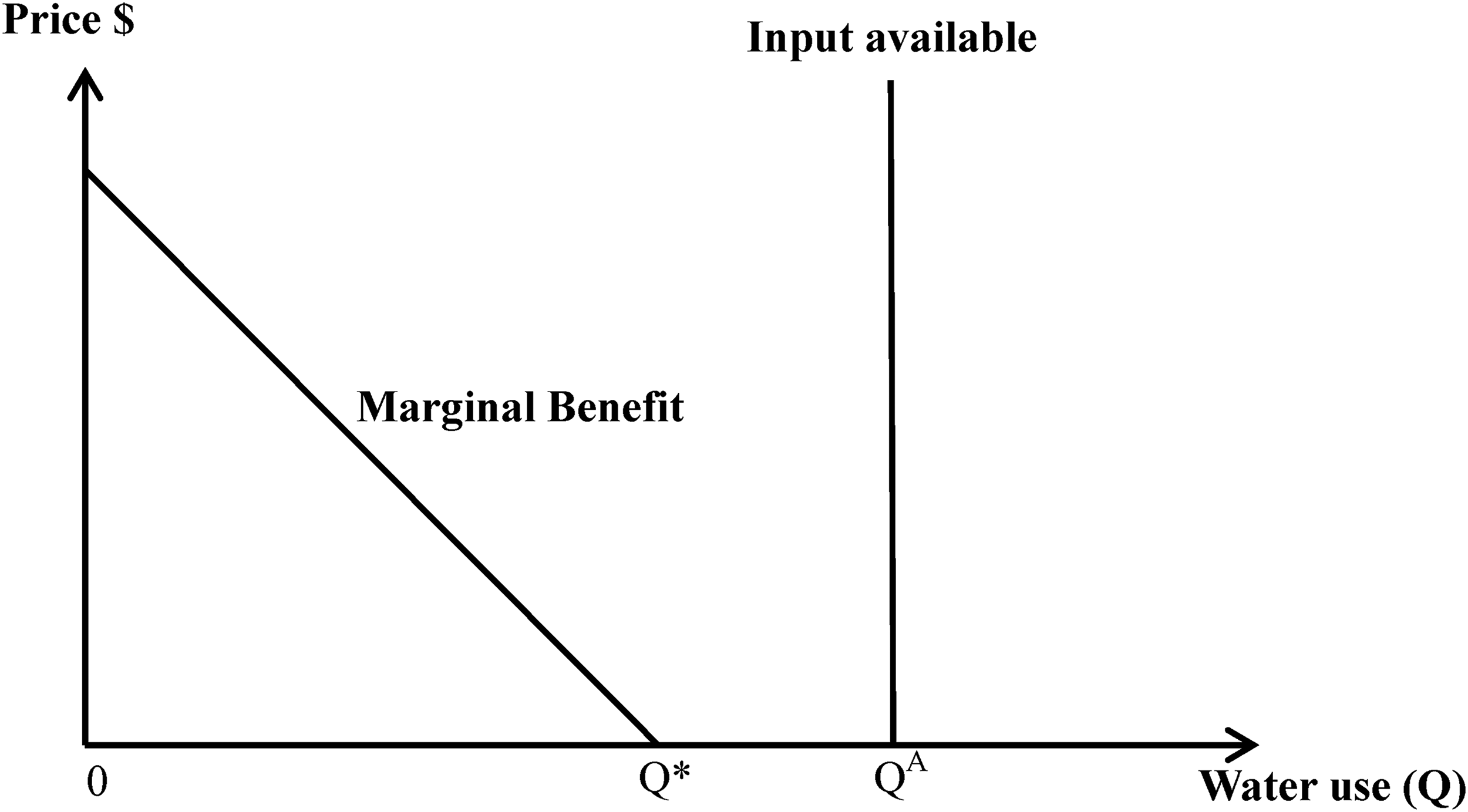
Residual water use.

Resource use under competition.
The situation of resource utilization and allocation becomes much more complex when resources are used in a competitive way. As shown in Figure 2, when the users compete for limited resources (i.e. resource price is no longer zero), they choose to use the resource until the marginal benefit from using that resource is equal to its price.
The optimal quantity of resource use is generally determined at point
Policy impacts on supply and demand
The demand and supply curves would alter in the face of supportive agricultural policies such as the commodity repurchase program. Figure 3 shows the changes in demand (

Effects of policy on commodity demand and supply.
Implementation of input-monitoring system
Figures 1 to 3 indicates how biomass supply of biofuel producers may be affected by farming decisions. To effectively produce biofuel and improve production possibilities, it is necessary to enhance the ability of predicting the stability of the input supply. Since the crop yield can only be observed at the harvest season, which is too late for biofuel prodiuer to shift their production strategy, an input-monitoring system recording immediate uses of agricultural inputs can provide useful information to biofuel producers who can subsequently adjust their production strategies would improve the overall production efficiency of renewable development.
Theoretical model formulation
The theoretical foundation of sectoral analysis has been well developed and widely applied by numerous studies including acid rain, 14 environmental assessment, 45 ethanol production, 46 climate impacts,13,36,47 carbon sequestration, 17 and policy evaluation. 30
Since bioenergy production depends on agricultural outputs, availability of production resources, and climate condition, it is necessary to integrate these components into a single model to provide a complete analytical framework. The integrated social welfare (ISW) calculated the optimatal production and resource allocation is defined in Equation (1).




Theoretical analysis
Given the nature of price endogeneity, the optimal framework allows resources to be allocated for their most efficient use, and the optimal condition of each resource involved can be illustrated by using Lagrangian and Kuhn–Tucker conditions. The first-order conditions that maximize these variables can be derived using Kuhn–Tucker conditions, which are presented and discussed in the following subsections.














Results
Biofuel production
This study uses 2010–2018 Taiwan Agricultural Data to validate the usefulness of the model, and the results are displayed in Table 1. Since the commodity productions of major commodities only slightly deviate from the observation and the simulated market prices are close to the market prices, we claim that the proposed model could be useful in biofuel and policy analysis.
Model validation.

Figure 4 shows that biofuel production is positively related to the gasoline price. At the historical high gasoline price (e.g. NT$40 per liter), total biofuel production would reach 481 million liters, and more than 300 million liters even if the gasoline price is lower than NT$30 per liter. Based on the results, we find that biofuel production is less influenced by slight climate-induced impacts on rainfall distribution and yield changes.

Biofuel production under various gasoline prices.
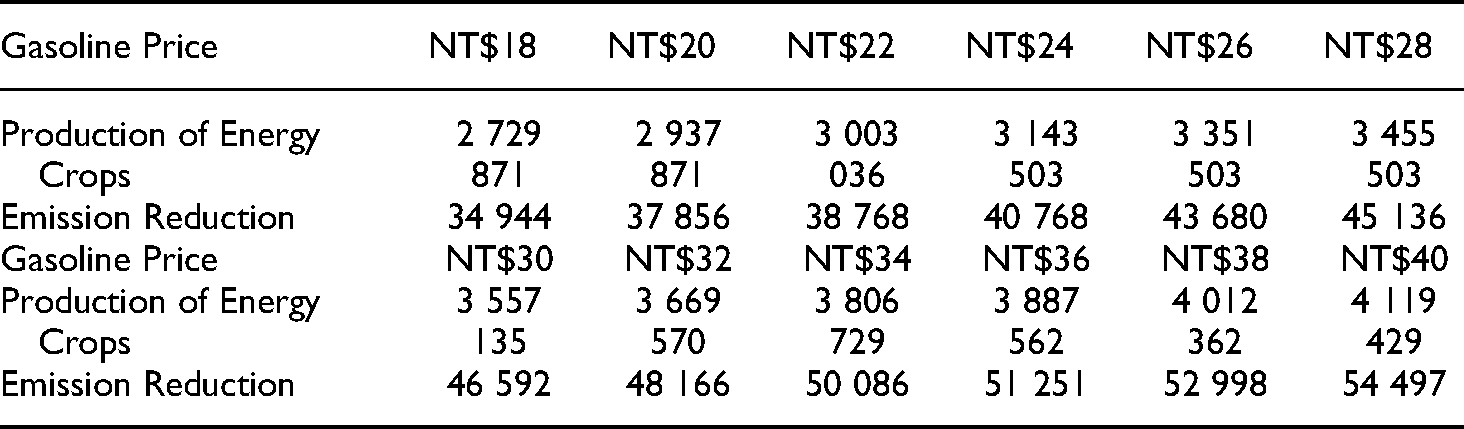
We also investigate crop production and emission reduction under various gasoline prices. Because the higher energy price would result in a higher gain in energy sales, production of energy crops would be increased. Depending on the level of gasoline price, the emission reduction would range from 35,000 tons to 55,000 tons. However, since the total resource is limited, it is necessary to investigate how biofuel promotion would alter the cropping pattern of other commodities. The results are presented in Table 2. (Figure 5)
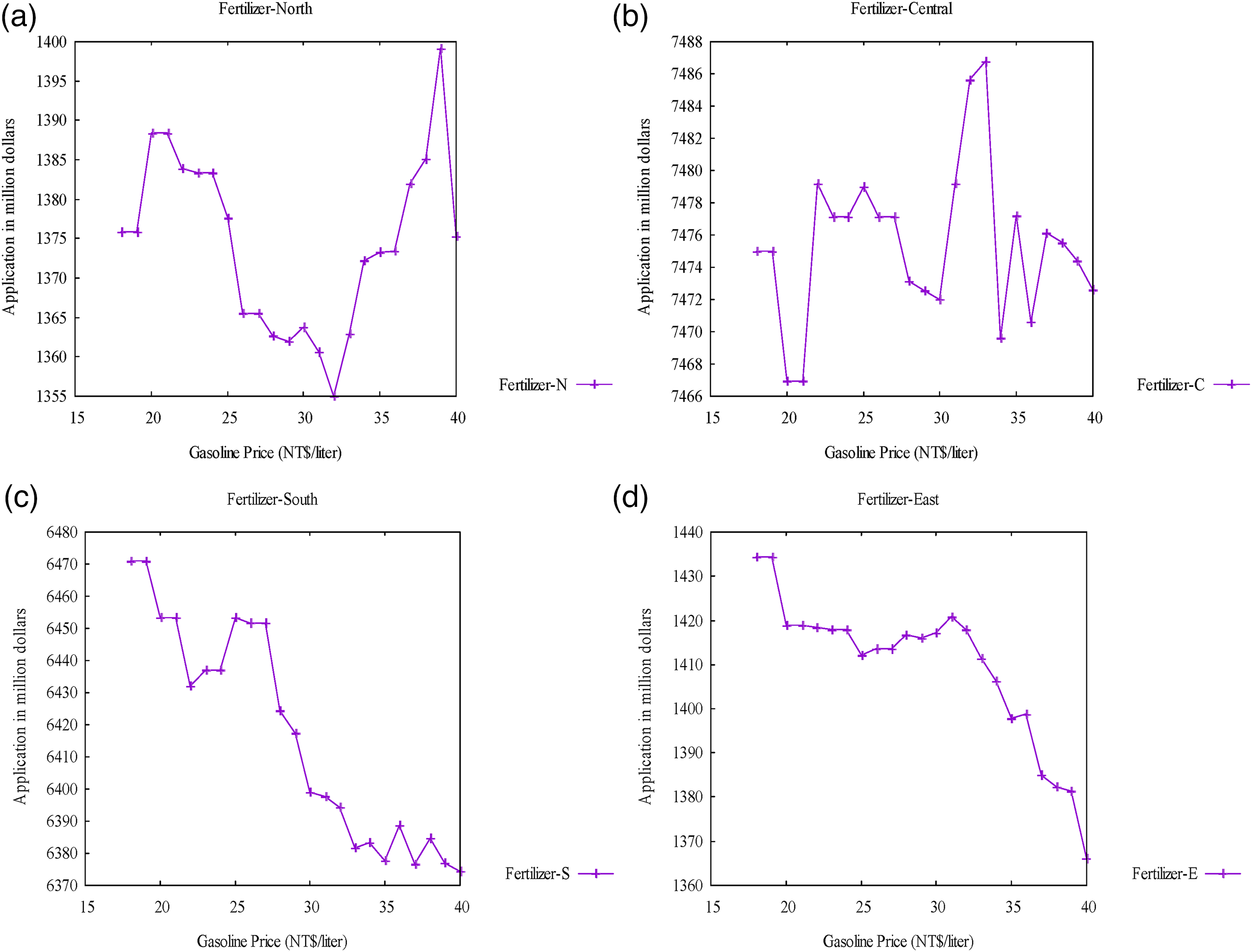
Potential changes in fertilizer use.
Results of crop production and emission offsets.
Resource allocation
Figure 6 shows that when crop yield is altered under climate impacts, regional cropping patterns would be significantly, regardless of gasoline prices. The results imply that for farmers to maximize their income, they would incorporate the climate-induced yield change into farming decisions. Consequently, the fertilizer use would change substantially. In addition, the fluctuation of fertilizer use in central Taiwan also indicates that bioenergy production is likely to result in considerable effects on farming decisions.
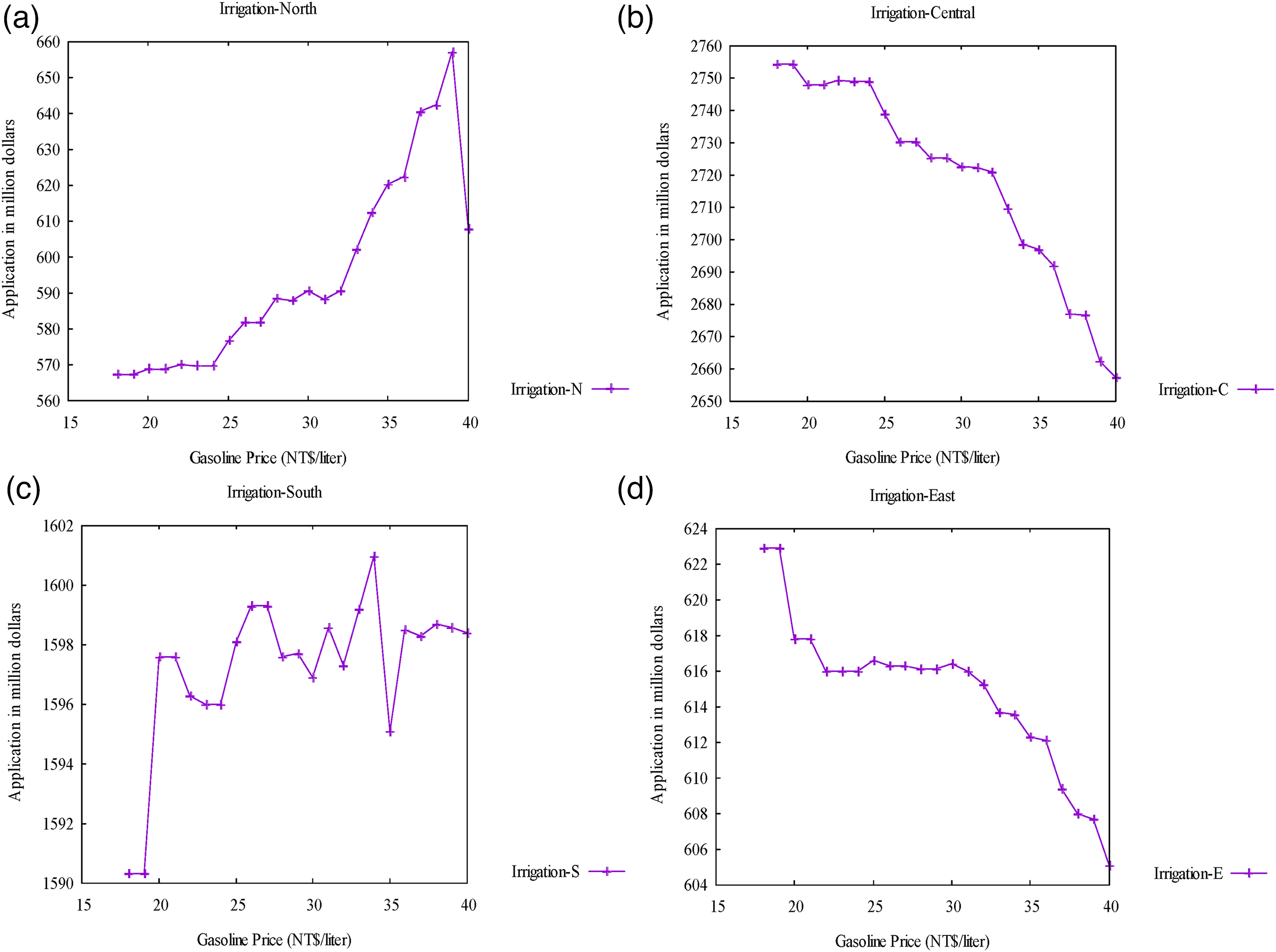
Irrigation change in different production regions.
Figure 6 investigates how irrigation alters in the face of climate impacts. The results show that in most production regions the cropping decision is likely to switch when the availability of surface water becomes uncertain. Along with the existence of profitable energy crop plantations, irrigation used for commodity crops will decline in most areas. The results indicate that energy crops that consume less water should be firstly cultivated in the north, east, and south of Taiwan to ensure that the food commodities have access to uncertain surface water.
Figure 7 displays the production and uses of sweet potatoes under different supportive prices. In the face of high gasoline prices, more land will be used to plant sweet potatoes because its demand has increased sharply while keeping the supply of edible parts constant.

Alternative uses of energy crops.
The promotion of biofuel production is an effective approach to alleviate energy insecurity and global warming, but its net effect may not be desirable when climate-induced impacts are taken into account. Figure 8 shows that the total social welfare declines when crop yield and water supply become uncertain. Under such a circumstance, the more the biofuel is produced, the higher the welfare loss could be expected. This is because conventional commodities must compete for limited and uncertain water with profitable energy crops, and thus the gains in biofuel production could be offset by the loss of other crops.
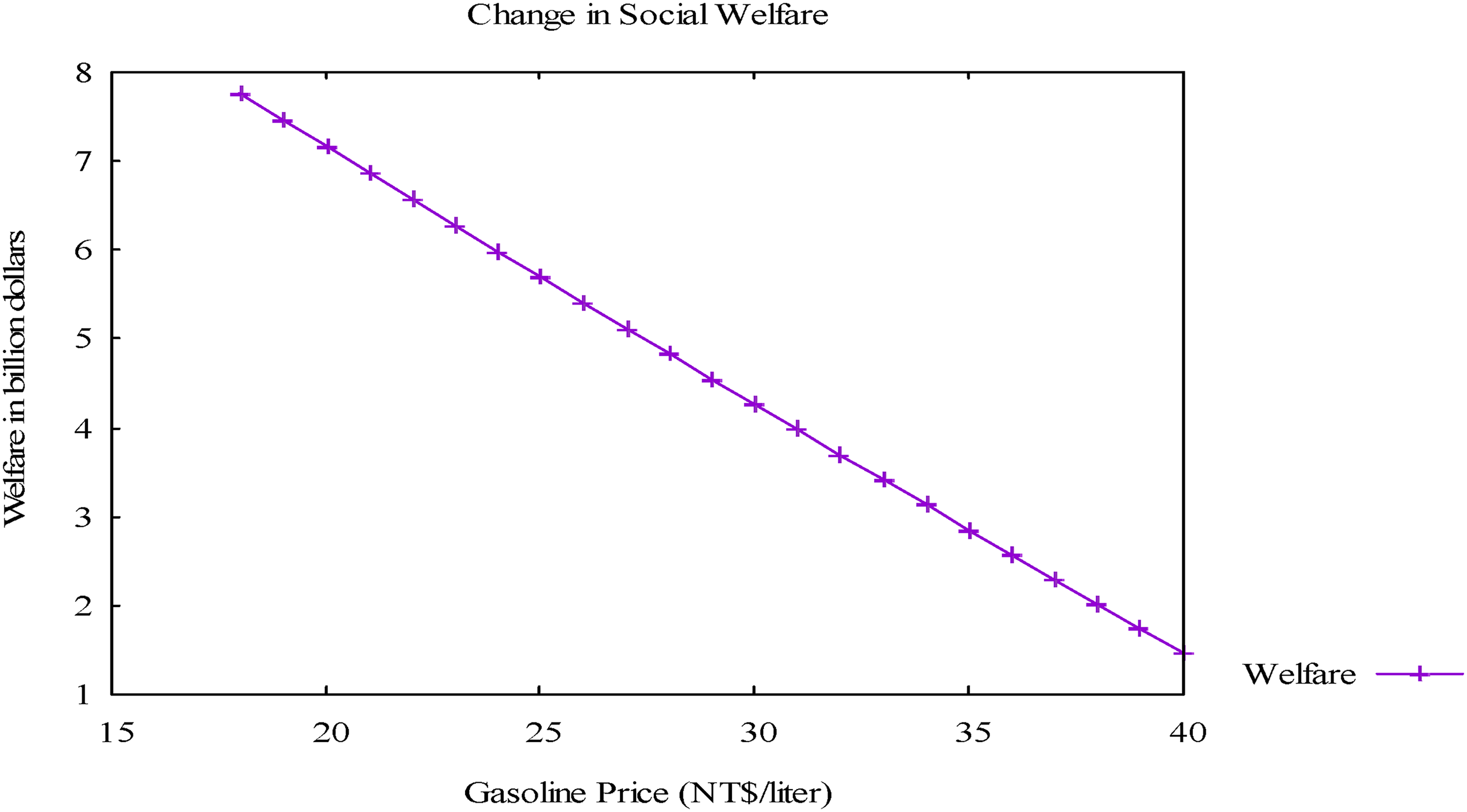
Welfare change under market operations.
Discussion
Market operations
The production of bioenergy is substantially influenced by the market conditions such as changes in gasoline prices and electricity prices. Since Taiwan is a price-taker and has no control and impact on the fuel markets, price fluctuation on these prices would inevitably result in considerable effects on Taiwan's bioenergy development. For this reason, an effective hedging strategy should be considered to stabilize the investment cost so that the profits of biofuel producers can be guaranteed. In addition, the bioenergy industry should collaborate with conventional energy providers to prevent the sudden shock in fossil fuels to alleviate the potential hurts on bioenergy production and have in-depth innovation on the conjunctive application of both fossil and biofuel energy sources. With this effort, it is likely to greatly improve the efficiency and effectiveness of bioenergy production in the face of unsystematic risks.
Establishment of the emission trade system
Another issue related to biofuel production is whether the gains from emission offset can be effectively received by the producers. Because the value attached by the emission offset is generally countable and transferrable, it is important to design a market to allow the realization of the gains. Currently, there is no such a market in Taiwan, and thus the establishment of the emission trade system would be an determinant factor influencing total biofuel production; otherwise, the incentives to biofuel producers would be greatly declined.
Uncertain climate impacts
Many studies generally use past patterns to investigate the effectiveness of biofuel production. However, climate-induced impacts such as changes in temperature, rainfall, and crop yields that directly alter farming decisions and agricultural activities should be taken into account. Since such impacts generally differ from region to region, a detailed assessment and forecasting of local climate patterns should be conducted to unfold the agricultural impacts and subsequent bioenergy development; otherwise, a great deviation of the bioenergy production could result and the development would not achieve the optima.
Technology innovation and promotion
This study investigates biofuel production, emission reduction, and resource allocation under alternative energy prices and climate patterns. However, biopower that generates electricity may also be applied. Under such a circumstance, the feedstock supply, technology switch, and technology selection would make the analysis even complicated. Additionally, the second-generation biofuel technology that consumes cellulosic materials as primary feedstock also emerges, thereby providing another branch in biofuel production. Therefore, the competition among bioenergy possibilities should be considered because the use of feedstocks and the final forms of bioenergy would be different.
Development of on-time monitoring system
In order for biofuel producers to effectively utilize their production capitals under climate impacts and uncertain biomass supply, the development of on-time monitoring system is a key because under such impacts the supply of biomass is not constant that potentially affects the production efficiency of biofuel. Thus if the on-time monitoring system can be developed to convert the input use data that is quickly available by the biofuel companies, the producers would be able to know the possible changes in future biomass supply and then adjust their production technologies and strategies accordingly.
Implications and perspectives
This study employs the stochastic framework to assess the influences of climate impacts on biofuel production and cropping decisions. The results show that biofuel production would be effectively promoted in the face of high supportive prices and such efficiencies can only be achived by constant biomass supply. However, since the farmers are likely to change farming decisions when they expect or perceive climate-induced impacts on crop yield and water distribution that is changing their expected income from harvet. Therefore, the gains from bioenergy production and emission reduction cannot be treated as a net benefit; rather, to reflect the total welfare of biofuel production, the loss of conventional from conventional commodities induced by uncertain climate impacts should be incorporated. Thus the implementation of input-monitoring system and immediate transfer data associated with agricultural activities to biofuel producers can greatly improve the production portfolio.
It is also noticed that such an analytical framework should be applied to a small economy such as Singapore, Taiwan, or Hong Kong, for whose supply has a small share of international agricultural markets. For large economies such as Brazil, Australia, and the United States, the substantial change in land use should be endogenously incorporated into the study.
Footnotes
Acknowledgments
The guest editors thank Dr Chi-Chung Chen at Taiwan's Council of Agriculture and Dr Bruce A. McCarl for their insightful comments and supports.
Author's contributions
Dr Chih-Chun Kung designed the study and simulate the programming model. Dr Binbo Zheng collected the data and performed the data analysis. Dr Hailing Li conducted the result analysis and prepared tables and figures. Dr Shan-Shan Kung summarized the results and drafted the manuscript.
Declaration of conflicting interests
The author(s) declared no potential conflicts of interest with respect to the research, authorship, and/or publication of this article.
Funding
The author(s) disclosed receipt of the following financial support for the research, authorship, and/or publication of this article: This work was supported by the Natural Science Foundation of Jiangxi Province (grant number: 20202BABL205024) and National Natural Science Foundation of China (grant number: 41861042, 42163006).
