



Abstract
Blowout is a major safety concern for well control in oil and gas well engineering and well killing is an important technical means to avoid blowout. Mastering the initial state of the wellbore is the basis to ensure well killing. The traditional gas column model cannot effectively explain the development law of wellbore pressure. Therefore, this paper is based on the actual killing conditions and the principle of gas-liquid two-phase flow. This paper establishes the physical model and mathematical model of the initial state of the wellbore annulus under overflow conditions. By means of the finite difference method and cyclic iteration calculation, the initial state of the wellbore annulus can be accurately inverted, and the calculation results are verified by an example. The results show that, when the wellhead pressure is determined, the wellbore pressure distribution and annular air phase distribution are more reasonable and the initial length of the overflow section is larger, the calculation results of the inversion method are closer to the actual engineering situation. The findings of this study can help to better understand wellbore state before killing and provide a theoretical basis for optimizing killing parameters, which is of great significance for avoiding well control safety risks during killing.
Introduction
Overflow is one of the common engineering phenomena in drilling engineering. If it is not controlled in time, it will lead to well kick, blowout and other well control safety accidents. 1 In view of the situation of overflow in the drilling process, the usual method is to shut down the well in time after discovering the overflow, and to implement killing immediately. 2 This is the most common well control measure to deal with overflow in well engineering. 3 However, in the actual killing process, there are often cases of killing failure,4,5 the main reason is that the initial state of the wellbore annulus is not clear, such as: the initial length of the spillway miscible section, the flow pattern of the spillway, gas holdup distribution and so on are unknown, which leads to difficulties in subsequent flow calculation.
Many scholars have realized that accurately grasping the initial state of the wellbore annulus is the key to analyzing the killing by discussing the variation law of casing pressure, vertical pressure and bottom hole pressure. Therefore, many scholars have carried out discussions on the initial state of the wellbore annulus. The representative researchers and research results are shown in Table 1.
The representative researchers and research results.

In summary, the current research results are mostly regular knowledge, which cannot completely solve the problem of numerical description of the initial state of the wellbore annulus. As an alternative, the simplified flow pattern assumption that the miscible section is a gas column or a uniform bubble is adopted, which is not consistent with the actual situation.
Therefore, to restore the initial state of the wellbore, a new inversion method is studied. Firstly, the physical and mathematical models of the initial state of the wellbore annulus are presented, based on which the boundary conditions are constructed, the auxiliary equations are derived. Then, the model solution method is established. Finally, the accuracy of the model is verified by field data. The general sketch of the problem under study is shown in Figure 1. The research results will significantly improve the accuracy of wellbore pressure dynamic response in the process of well killing.
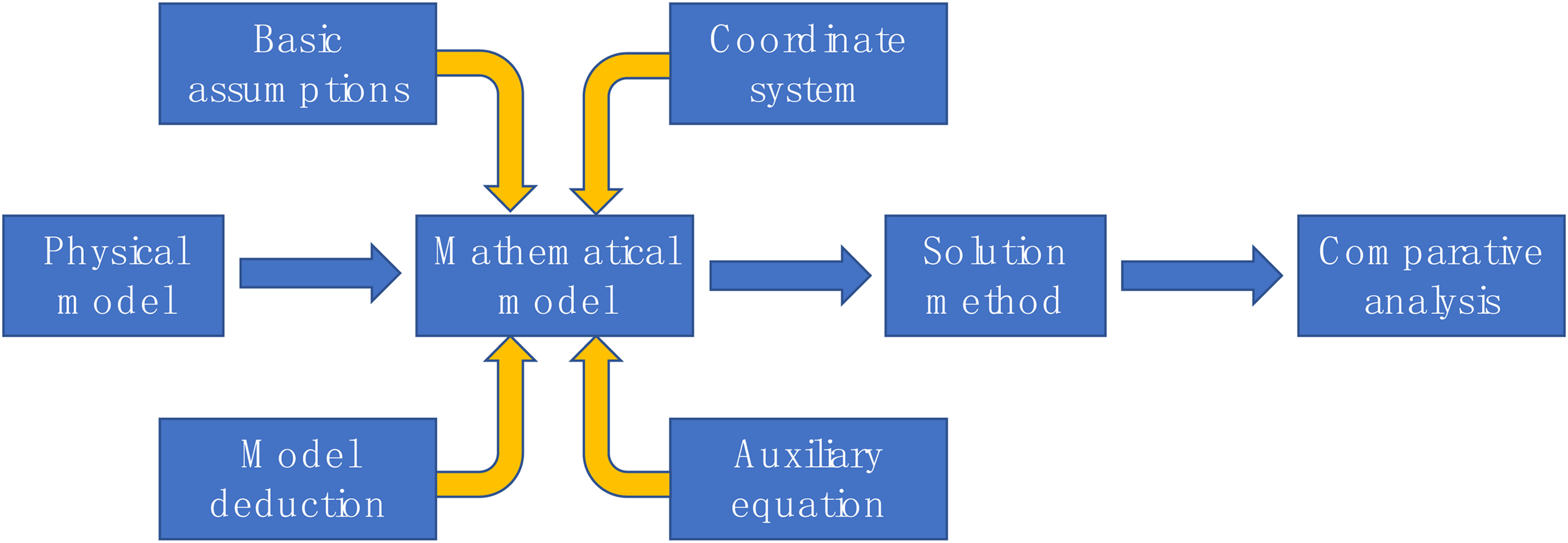
The general sketch of the problem under study.
Initial state model of wellbore Annulus
Physical model
When the well is shut down under overflow conditions, the overflow material invades the wellbore from the bottom of the well, then a miscible overflow section is formed at the bottom of the well, and the upper part is the drilling fluid column section. The physical model of the initial state of the wellbore annulus is shown in Figure 2.

Initial state physical model of wellbore Annulus.
During the process of overflow migration from the bottom to the wellhead, the volume of gas phase changes due to pressure, temperature and other factors. The overflow at the wellhead can be directly observed as the change of mud tank increment. When overflow is found and mud tank increment reaches a critical value (e.g. regulations of Chuandong Drilling Company, 16 overflow 1m3 report, 2m3 alarm, 3m3 shut-in), shut-in vertical pressure, shut-in casing pressure and mud tank increment are recorded in time.
Mathematical model
Basic assumptions
In the process of establishing the mathematical model, the following assumptions are adopted: 1) neglecting the solubility of the gas phase of overflow in wellbore annulus; 2) gas phase in overflow can be described by the real gas equation of state; 3) neglecting the compressibility of drilling fluid; 4) wellbore temperature field is linear distribution, and there is no heat exchange between gas and liquid at the same location; 5) overflow accumulates at the bottom of the wellbore in the form of bubbles.
The cartesian coordinate system
Because the wellbore is axisymmetric, based on the physical model and hypothetical conditions, a vertical-depth rectangular coordinate system is established with the wellbore as the origin, the diameter of the wellbore as the abscissa, and the depth of the wellbore as the rectangular coordinate system, and any cross-section in the wellbore is taken as the control body, as shown in Figure 3.

The vertical depth of the rectangular coordinates system.
As shown in Figure 3, D is the diameter of the wellbore, Hs is the depth of the well at the top of the overflow miscible section, Hb is well depth, H is the depth of the well at any position in the wellbore (the depth of the well at the top of the micro-element control body), H + dH is the depth of the well at the bottom of the micro-element control body in the wellbore.
Model deduction
According to the principle of conservation of mass, the mass equation of miscible phase in unit volume can be obtained as given in Equation (1).
According to the gravity equation
According to the equation of the state of real gas, the volume of the gas phase can be obtained as given in Equation (3).
The density of the gas phase as given in Equation (4).
Equation (3) and (4) into Formula (2)
Therefore, the mathematical model of the initial pressure of the wellbore annulus with respect to depth can be obtained, as shown in Equation (6).
Auxiliary equation
(1) The temperature at depth H
Assuming that the temperature in the wellbore is one-dimensional steady-state distribution, the fluid migration speed in the wellbore is relatively slow, and the convection heat transfer of fluid is sufficient in the process of flow in the wellbore, the fluid temperature in the wellbore can be approximately equivalent to the formation temperature.
(2) The gas compression coefficient at depth H
The research results show that the compression coefficients calculated by the Dranchuk-Abou-Kassem model are the most stable, and the applicable conditions are the most extensive. 17 This method is based on the Starling-Carna Han equation of state and fits the Starling-Katz chart. Dranchuk-Abou-Kassem's method 18 is mainly aimed at the situation where the simulated contrast temperature of the gas in spills is less than 1. The compression coefficients involved in this paper are calculated by using the Dranchuk-Abou-Kassem model.
(3) The number of gas moles at depth H
The total amount of overflow does not change anymore during the killing, so the gas molar number is a constant. The gas phase density in the overflow miscible section is regarded as a linear distribution along the well depth to solve the gas mole number.

After integration, the total number of gas moles can be obtained. Therefore, the number of gas moles at depth H is shown i,n Equati,on (10).
Inversion method of initial state of wellbore Annulus
Because the length of the miscible section of overflow is unknown, the mathematical model of the initial state of the wellbore annulus cannot be solved directly. Therefore, a reasonable inversion method is needed to solve the problem, that is, according to the known vertical pressure, casing pressure and mud tank increment, differential iteration and inversion are used to solve the pressure distribution in the wellbore annulus, and eventually, the initial state can be accurately grasped, as shown in Figure 4.

The flow chart of state inversion for the initial miscible phase.
After the overflow is found and the well is shut-in, wellhead characterization parameters can be mastered as shut-in vertical pressure, shut-in casing pressure, mud tank increment, drilling fluid density, etc.
First, formation pressure is calculated according to the vertical pressure of shut-in, drilling fluid density and current well depth.
Then, the length of the miscible section is set by the mud tank increment, and the total number of gas moles in the miscible section is calculated and meshed. On this basis, the iterative calculation is carried out from the bottom of the miscible section (i.e. the bottom of the well) to the top of the miscible section.
Finally, the calculated top pressure of the miscible section is compared with the sum of the casing pressure at shut-in and the static fluid column pressure at the upper part of the miscible section. If it is not equal, the length of the miscible section is adjusted to recalculate. If it is equal, the length of the miscible section is determined, and the relevant characteristics such as gas volume, gas holdup distribution and wellbore pressure in the corresponding section length are determined.
Computation and analysis
The basic data
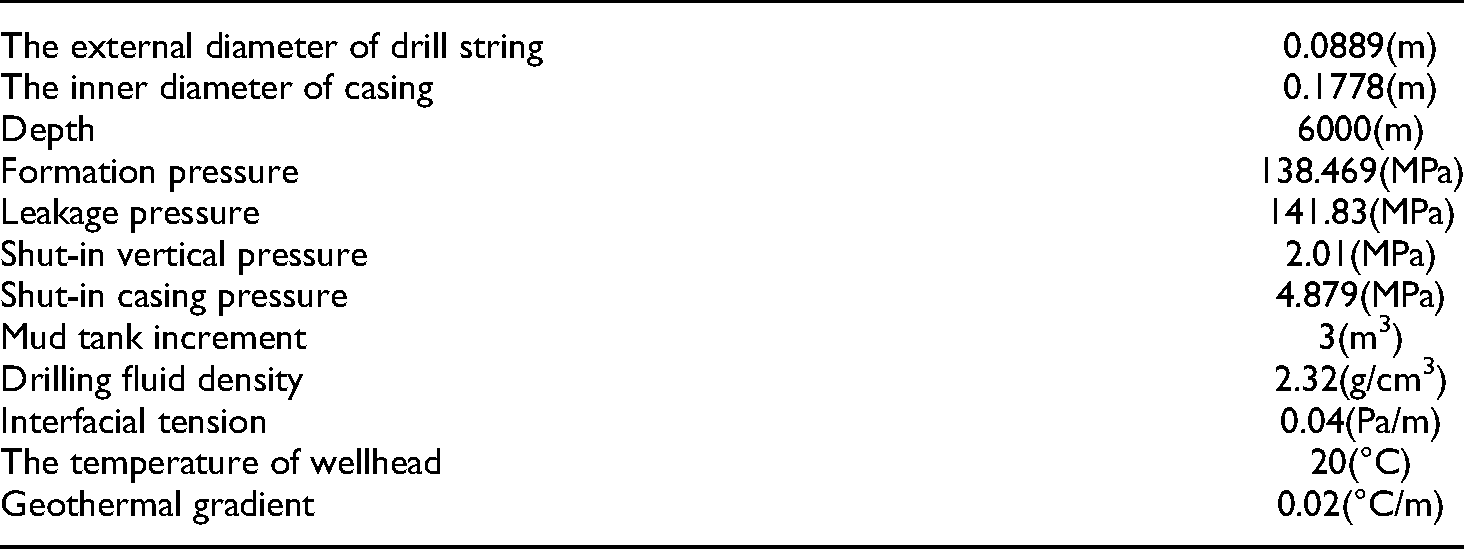
The basic data is given in Table 2.
The basic data.
Calculation results
From Figure 5, it is found that after the shut-in, the wellbore annulus can be divided into two parts: the miscible section from the bottom hole to the top of the overflow, and the single-phase section of drilling fluid from the top of the overflow to wellhead. Because of the density difference between overflow miscibility density and drilling fluid density, there is a pressure fluctuation of about 1.34 MPa at the interface between the miscible section and the single-phase section of drilling fluid.
Figure 6 shows that the bottom pressure (i.e. formation pressure) of the miscible section is 138.46 MPa, the top pressure of the miscible section is 116.80 MPa, and the wellbore pressure profile in the miscible section is linear.
From Figure 7, it can be seen that the gas compression coefficient at the bottom of the miscible phase is 1.65, and that at the top of the miscible phase is 1.59. The gas compression coefficient in the miscible phase is parabolic.
According to the equation of the state of real gas, the gas phase distribution in the miscible section of the wellbore annulus can be calculated by combining the gas compression coefficient at the corresponding calculation point (as shown in Figure 7.).

The wellbore pressure profile .
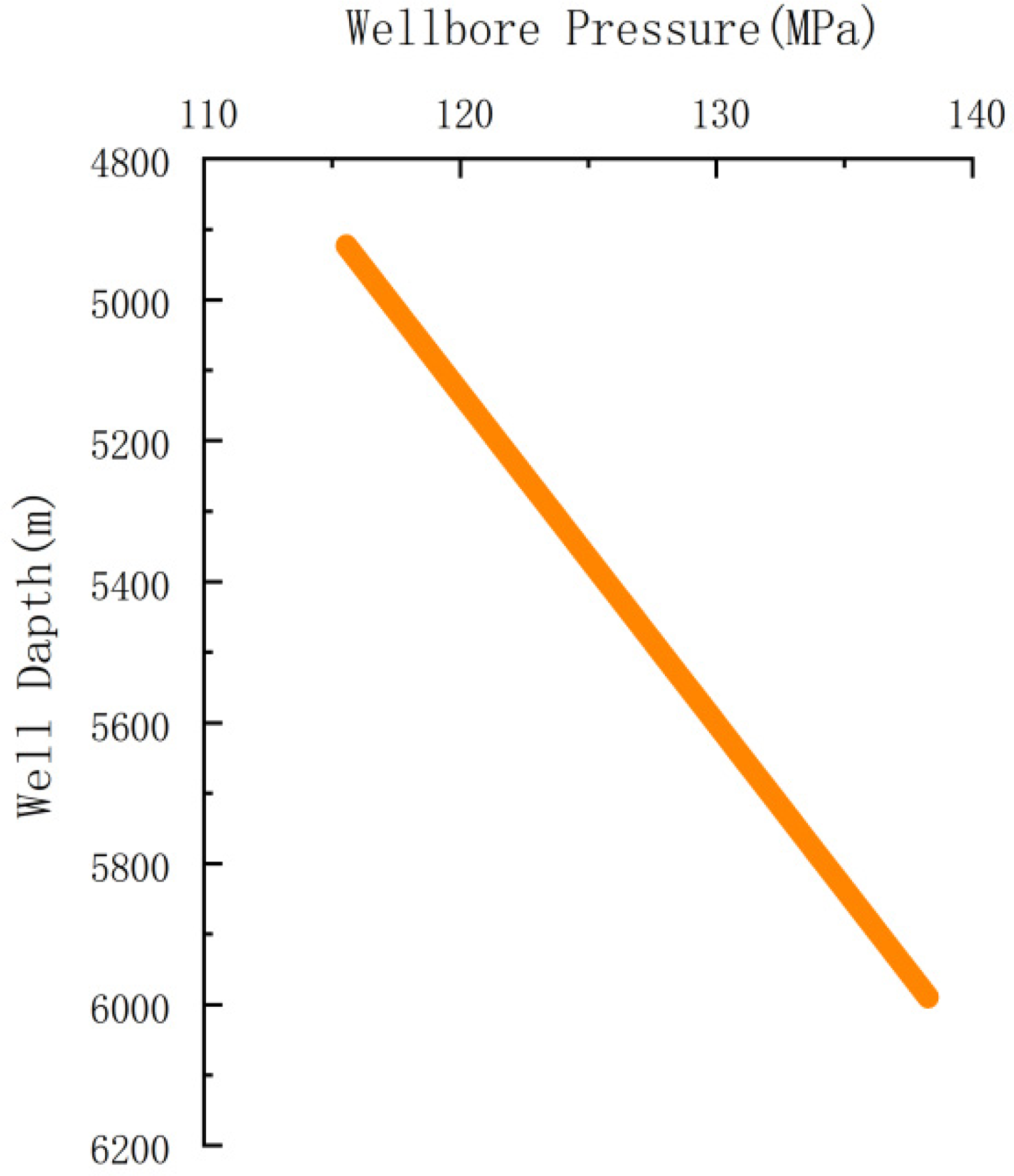
The wellbore pressure distribution in the miscible section.

The gas compression coefficient in the miscible phase section.

The gas volume and gas holdup distribution.
After the shut-in, the overflow forms a miscible liquid column at the bottom of the well. The gas volume at the bottom of the miscible section is 2.55 × 10⁻³m3, and the gas holdup is 13.68%. The gas volume at the top of the miscible phase is 2.76 × 10⁻³m3, and the gas holdup is 14.84%. The gas volume change from the bottom to the top of the miscible phase section is slight, and the volume change is 2.17 × 10⁻⁴ m3.
Comparative and analysis
Using the gas column model and the new inversion method to analyze the initial length of spills, and the comparison results are shown in Figure 9.
From Figure 9, it can be seen that the initial length of the miscible phase calculated by the gas column model is 912.70 m different from the results obtained by the new inversion method, showing a six-fold difference relationship, and the results are quite different.
The calculation results show that the initial length of the miscible phase section calculated by the gas column model is small, and the retention time of the spills in the borehole annulus is longer in the later stage of the killing cycle, which increases the uncertainties of well control safety. Therefore, compared with the gas column model, the initial state of the miscible phase obtained by the new inversion method is more reasonable.
From Figure 10, it can be seen that the main differences between the new inversion model and the gas column model in calculating the wellbore pressure profiles are as follows: 1) the top pressure of the overflow section is quite different; 2) the pressure distribution in the whole wellbore annulus is different. The main reasons for the above phenomena are the different lengths of the spillway section and the different densities of the fluid in the spillway section.

The comparisons of initial section length calculations.
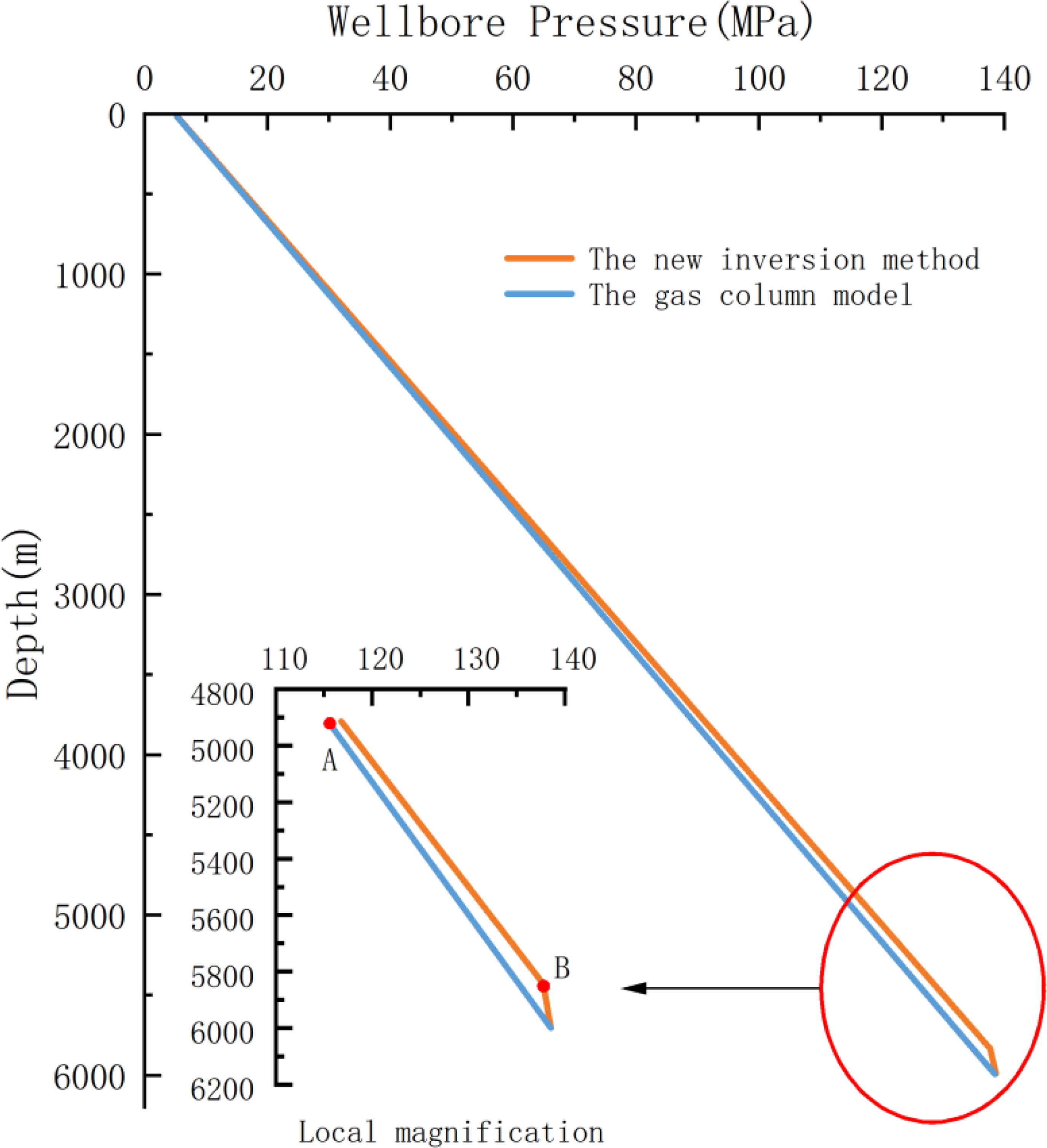
Comparisons and analysis of the wellbore pressure profile.
Under the same basic calculation data, the length of the overflow section calculated by the gas column model is 173.76 m, and the top pressure of the gas column (point B in Figure 10, well depth 5826 m) is the sum of the upper drilling fluid column pressure and shut-in casing pressure, which is 137.47 MPa. At the same well depth, the borehole pressure calculated by the new inversion model is 135.06 MPa, and the pressure difference between the two is 2.41 MPa. At the same well depth, the wellbore pressure calculated by the gas column model is 111.83 MPa, the difference between the two pressures is 4.97 MPa, and the fluid state is a single-phase section of drilling fluid. Because the location from the top of the overflow section to the wellhead is a single-phase section of drilling fluid, the differential pressure at the top of the overflow section results in the different pressure distribution in the whole wellbore annulus.
The calculation of wellbore pressure determines the accuracy of the characteristic parameters such as gas compression coefficient, gas volume and gas holdup distribution in the miscible section. Therefore, to accurately grasp the initial state of overflow in the wellbore annulus, a new inversion method is adopted to solve the wellbore pressure profile under the current overflow condition, which is more close to the actual situation than the calculation results of the gas column model.
Summary and conclusions
According to the principle of gas-liquid two-phase flow, the physical model and mathematical model of the initial state of wellbore annulus under overflow conditions are established.
The reasonable inversion method is adopted, and the initial state of overflow shut-in the wellbore annulus can be accurately mastered through finite difference and cyclic iterative calculation.
Combined with the basic data of the example, the initial state of the wellbore annulus is calculated by the inversion method and the gas column model respectively. The results show that the calculation results of the inversion method are closer to the actual situation of the project.
In this method, the overflow process is regarded as uniform gas invasion, and the coupling relationship between wellbore and formation is not considered enough. Therefore, it is suggested that the actual gas invasion rate of the formation should be the focus of the follow-up research, so as to restore a more real wellbore state.
Footnotes
Acknowledgments
This work is supported by The Project of Sichuan University of Science & Engineering (No. 2020RC18) and The Key Project of Sichuan Provincial Key Lab of Process Equipment and Control (No. GK202007). We gratefully acknowledge the financial support received.
Declaration of conflicting interests
The author(s) declared no potential conflicts of interest with respect to the research, authorship, and/or publication of this article.
Funding
The author(s) received no financial support for the research, authorship, and/or publication of this article.
