



Abstract
Rolling bearing reliability is often affected by the processing quality, however the life reliability or operating reliability do not involve the study of rolling bearing processing quality assessment. In order to avoid bearing failure caused by bearing processing quality, it is necessary to evaluate the reliability of the bearing quality assurance capability. The difficulty in reliable evaluation of bearing's quality assurance capability is how to quantify the uncertain relationships between the bearing quality and its influence factors, and then determine the weight of different influencing factors. Therefore, in this paper, a novel method for determining the weight of bearing quality-influencing factors based on bootstrap maximum entropy method and similarity method is proposed, and then the quality-achieving reliability model is established. The experimental results show that the proposed method can effectively quantify the relationship between the bearing quality and its influencing factors, and accurately assess the bearing quality assurance capability and bearing quality processing level under the condition of a small number of experimental bearings. Compared with other quality-achieving reliability method, the proposed method is more effective.
Keywords
Introduction
Rolling bearing is one of the key components of rotating machinery which sustain larger load,1,2 and is also the main vibration sources of rotating machinery during operation. Therefore, the reliability of rolling bearing is directly related to the running performance of mechanical equipments, 3 and it is necessary to establish an accurate model to evaluate the reliability of bearing.
Traditional reliability analysis usually refers to the ability or possibility of a product to perform tasks as required within a specified time, which can be generally divided into two main categories, that is, time-to-failure data-based methods and degradation data-based methods.4–9 This traditional reliability calculation mainly focuses on life reliability analysis and operating reliability analysis. To date, many researches have been performed in this field. Gao 10 proposed a prediction method of rolling bearing operational reliability based on isometric mapping and nonhomogeneous cuckoo search-least squares support vector machine. Wang 11 proposed a novel method based on kernel principal component analysis and Weibull proportional hazards model to assess the reliability of rolling bearings. Wang 12 proposed a method based on two-dimensional deep convolution neural network for rapidly evaluating bearing reliability and predicting remaining useful life.
However, the reliability of rolling bearings is often affected by their processing quality, and the life reliability or operating reliability do not involve the study of rolling bearing processing quality assessment. Therefore, in order to avoid bearing failure caused by bearing processing quality, it is necessary to evaluate the reliability of the bearing quality assurance capability.
The quality-achieving reliability refers to the probability at which the quality control level can be expected to reach a certain grade under the given conditions, which addresses the quality-achieving capability and probability from the perspective of weighted influence factors. 13 The key step in evaluating the quality-achieving reliability is to analyze the quality-influencing factors of the bearing caused by the manufacturing process, and then determine the weight of different influencing factors. Bearing quality-influencing factors evaluation comes with two challenges. One challenge is how to quantify the uncertain relationship between the quality of the bearing and its influencing factors. Another challenge is that, due to economic reasons, the number of bearings in the experimental study is so small that it is difficult to obtain objective research results.
There are many contributions to the vibration response of rolling bearings for dynamic response analysis with different parameters considered, including surface roughness, waviness, localized and distributed defects, unbalance load, rub-impact, and misalignment condition.14–19 Tadina 20 developed an improved bearing model to investigate the vibrations of a ball bearing during run-up. Guo 21 determined the friction source of the spherical roller bearing by analyzing the relationship between the geometrical characteristics of the spherical roller bearing and the kinematics, and then obtained the main factors influencing the vibration and noise of the spherical roller bearing. Finally, the main factors were analyzed by orthogonal experiment. Aktürk 22 studied the waviness of the contact surfaces of the inner and outer raceways and rolling elements of the bearing, and obtained the relationship between these factors and the vibration frequency of the bearing. Yan 23 analyzed the influence of geometric parameters, shape and position error, working condition parameters on the amplitude and frequency characteristics of ball bearing vibration according to the ball bearing vibration theory model, and used the mathematical statistics method to analyze the measurement data of the roundness, sparse wave waviness, roughness and shape error of the raceway of inner and outer ring channels of the low-noise bearing. Although the above research has obtained the analysis results of the quality-influencing factors by establishing the physical model of the bearing vibration and conducting comparative experiments, the complexity and inaccuracy of the physical model make them difficult to be used in engineering.
In order to overcome the aforementioned drawbacks, this paper proposes a new method for determining the weight of bearing quality-influencing factors based on bootstrap maximum entropy method (BMEM) and similarity method, and then the quality-achieving reliability model is established.
In nature and social phenomena, different random variables obey different distributions, and different distributions have different probability density function (PDF). Even for the same distribution, the PDF will change as the parameters change. Therefore, the PDF can be used to describe the intrinsic characteristics of a variable.
Jianbo Yu 24 used PDF to describe the similarity of the metrics that characterize the rolling bearing at different stages of operation. Jianbo Liu 25 improved the accuracy of long-term prediction by comparing the signatures from any two degradation processes using measures of similarity that form a matching matrix. Liang Guo 26 calculated the similarity between the current spectrum and the initial spectrum to determine the degree of degradation of the rolling bearing, and the purpose of the remaining life prediction was achieved.
Therefore, PDF of the bearing quality-influencing factors and the bearing vibration acceleration are established by BMEM which is a novel method that combines the advantages of the bootstrap method 27 and the maximum entropy method.28,29 The similarity method is used to obtain the weight of bearing quality-influencing factors by calculating the similarity between the PDF of the bearing quality-influencing factors and the PDF of the bearing vibration acceleration. The weight refers to the degree of overlap between the probability density curve of the vibration acceleration and the probability density curve of the quality-influencing factor, as shown in Figure 1.
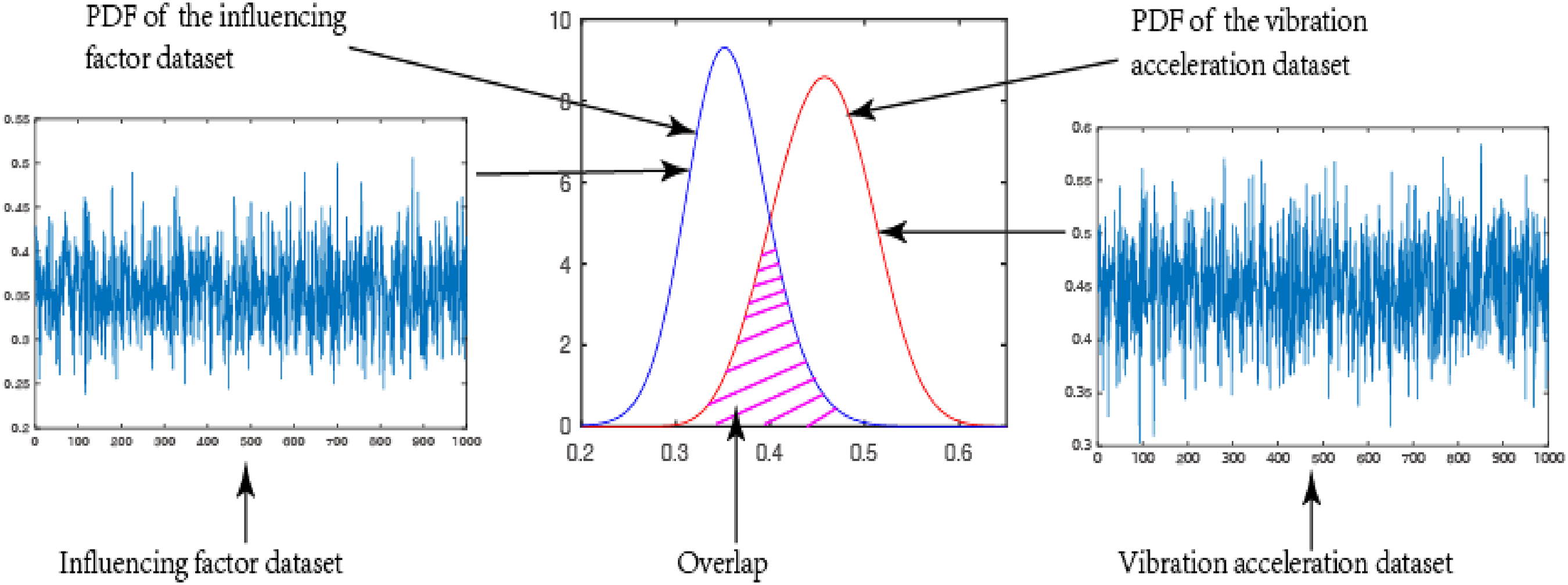
A schematic diagram of calculating the weight of bearing quality-influencing factor.
This paper is organized as follows. Section ‘Model’ establishes the quality-achieving reliability model of the rolling bearing, and introduces the BMEM and the similarity method in detail. Section ‘Experimental validation’ examines a case study. Section ‘Conclusions’ presents the conclusions.
Model
Performance data collection
According to the characteristics of the rolling bearing, the quality assessment indicator S0 and its influence factors Sv can be established by an experimental investigation method.
The vibration performance of the rolling bearing is studied as the quality evaluation indicator, and the data sequence S0 of the performance indicator can be obtained as

Assuming that there are V factors influencing the vibration performance data sequence S0, by measuring in advance, and the data sequence Sv of the vth influence factor is given by

Performance data classification
The quality of the bearing is divided into U grade, let Huv is used as the assessment standard value of the bearing quality or the influencing factors in grade u. If the measured value sv(t) of a certain parameter satisfied

Then the quality grade of the measured value sv(t) is grade u.
According to the Equation (3), the quality grading of all measured performance data can be conducted, and then the frequency Fvu of quality grade can be obtained, as shown in Table 1. The highest quality grade is 1 and the lowest quality grade is U. As the quality grade increases, the state of the bearing's quality influencing factors will improve and the bearing will be of higher quality.
Quality classifications of the measured performance data.

From Table 1, the frequency sequence of rolling bearing quality achieving and its influencing factors can be expressed as follows



Determining the PDF of bearing quality and its influencing factors based on BMEM
Let Sv be a real-valued observation sequence of rolling bearing performance, X is normalized values of Sv

The mean of the bootstrap sample can be calculated by

According to the MEP, the PDF with the least subjective bias should satisfy the condition in which the entropy reaches to the maximum, that is,
Equation (12) satisfying
In order to solve f(x), we apply the Lagrange multiplier method to Equation (12). The lagrange function L(x) is obtained as
Let 





The norm criterion for iterative convergence is given by
In order to make the solution to converge, the sample data is arranged in increasing order and divided into Q-2 group, draw a histogram, then the group median(ζq) and the frequency (Fq, where q = 0, 1, …,Q, and let F1 = Fq = 0.) of each group are obtained.
Mapping the raw data sequences x (i) dimensionlessly into interval [ − e, e], let
Then, we have




Determining the weight of bearing quality-influencing factors based on the similarity method
Let the PDF of the bearing vibration performance sequence be

The similarity can be used to evaluate the level of the vibration-influencing factors by overlapping the maximum entropy distribution curve of the vibration performance with the maximum entropy distribution curve corresponding to vibration-influencing factors. The similarity between the vibration performance and the vibration-influencing is defined by
The value of Iv can be from 0 to 1: the closer the value of Iv is to 1, the greater similarity; the closer the value of Iv is to 0, the smaller the similarity.
The weight of the influence factor Sv is given by
Quality-achieving reliability model
As we all know, the factors that affect bearing’s quality-achieving reliability are complicated. According to factor space theory, it is usually difficult to forecast the status of a complex factor. 13 The most effective approach is to decompose the complex factor into a series of simple facilitating factors and then to use these simple factors to determine the status of the complex factor. 30 Therefore, it is feasible to decompose the quality-achieving reliability of rolling bearing into a series of simple factors whose statuses are easily examined. Then, the factor status of rolling bearing can be synthesized by examining the statuses of all of the simple factors.
According to the factor synthesis method, the weight can be used to synthesize the status of the influencing factors in each grade. Therefore, the status composite value ou is given by

The maximum likelihood method is used to solve the quality influencing coefficient. Derivation of Ru to obtain the quality-achieving density function of bearing


Experimental validation
Experimental setup and performance data collection
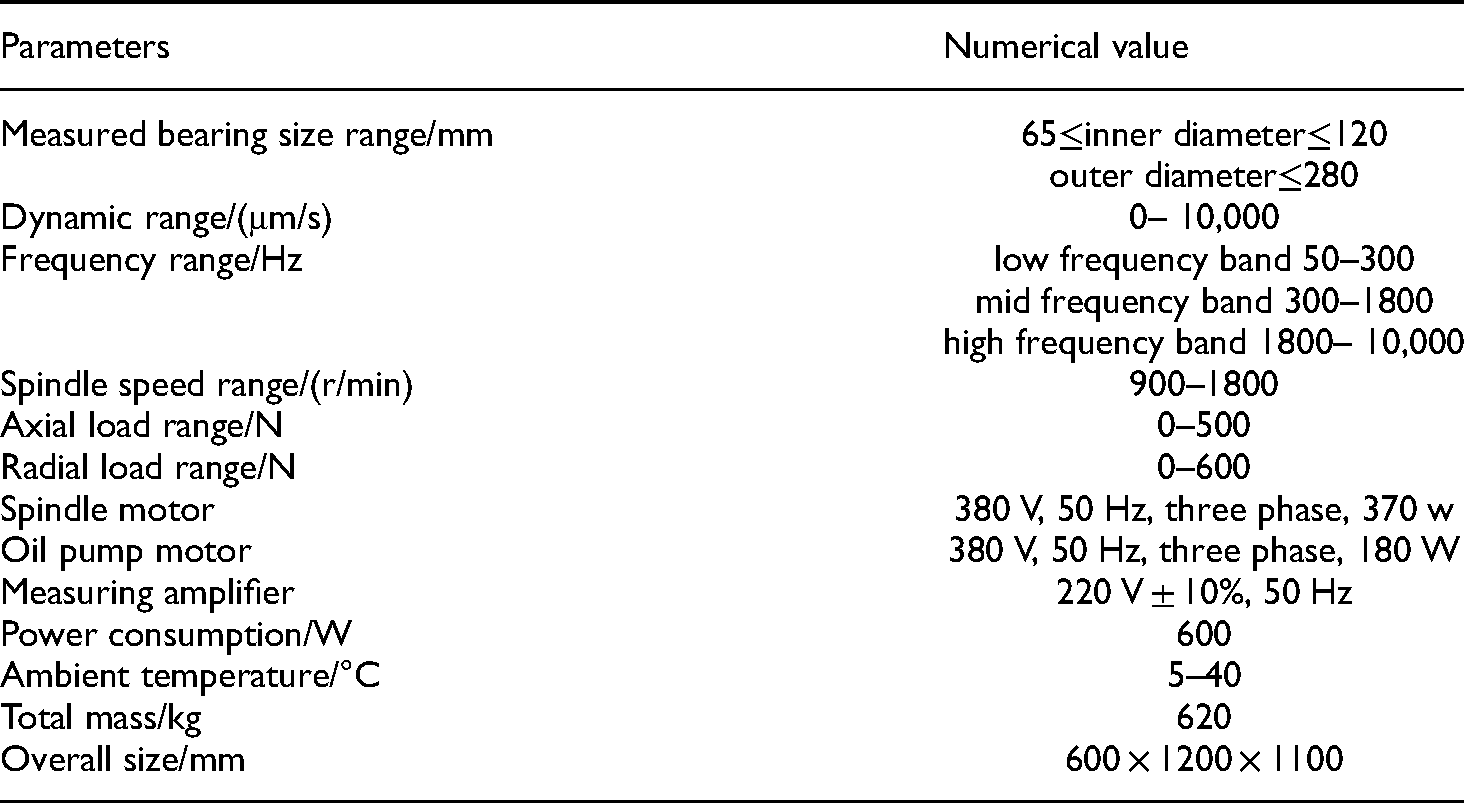
Tapered roller bearings 30306X2B are taken as the research object and the bearing vibration measuring equipment is the bearing vibration tester: BVT-6, as show in Figure 2. The detailed parameters of the bearing vibration tester are shown in Table 2. Depending on the type and size of the bearing, a finely filtered lubricating oil with a nominal kinematic viscosity between 10 and 100 mm2/s is used to lubricate the bearings, and carrying out a test run during the lubrication process to distribute the lubricant evenly. An axial load of 110N is added to the bearing, the rotation speed is kept constant at 900 r/min during the experiment. The loading position is the end face of the bearing outer ring. After applying an axial load to the bearing, start the test after a delay of more than 0.5 s, and the test time is between 10 and 60 s. The ambient temperature is 20 degrees Celsius and the relative humidity of air is less than 70%. The basic layout of the test rig is shown in Figure 3.

Bearing vibration tester: BVT-6.

Tapered roller bearing vibration measurements rig.
Parameters of bearing vibration tester.
The vibration acceleration is selected as the physical quantity to characterize the bearing vibration and the vibration acceleration level can be expressed as follows:
In this study, 30 sets of tapered roller bearings are selected and each bearing is installed (separately) on the bearing vibration tester (BVT-6) to collect the vibration data, and then each bearing is disassembled to measure the parameters of the inner ring, outer ring and rolling element, respectively. The measuring parameters and measuring instruments are shown in Table 3. Some measuring instruments are shown in Figure 4.
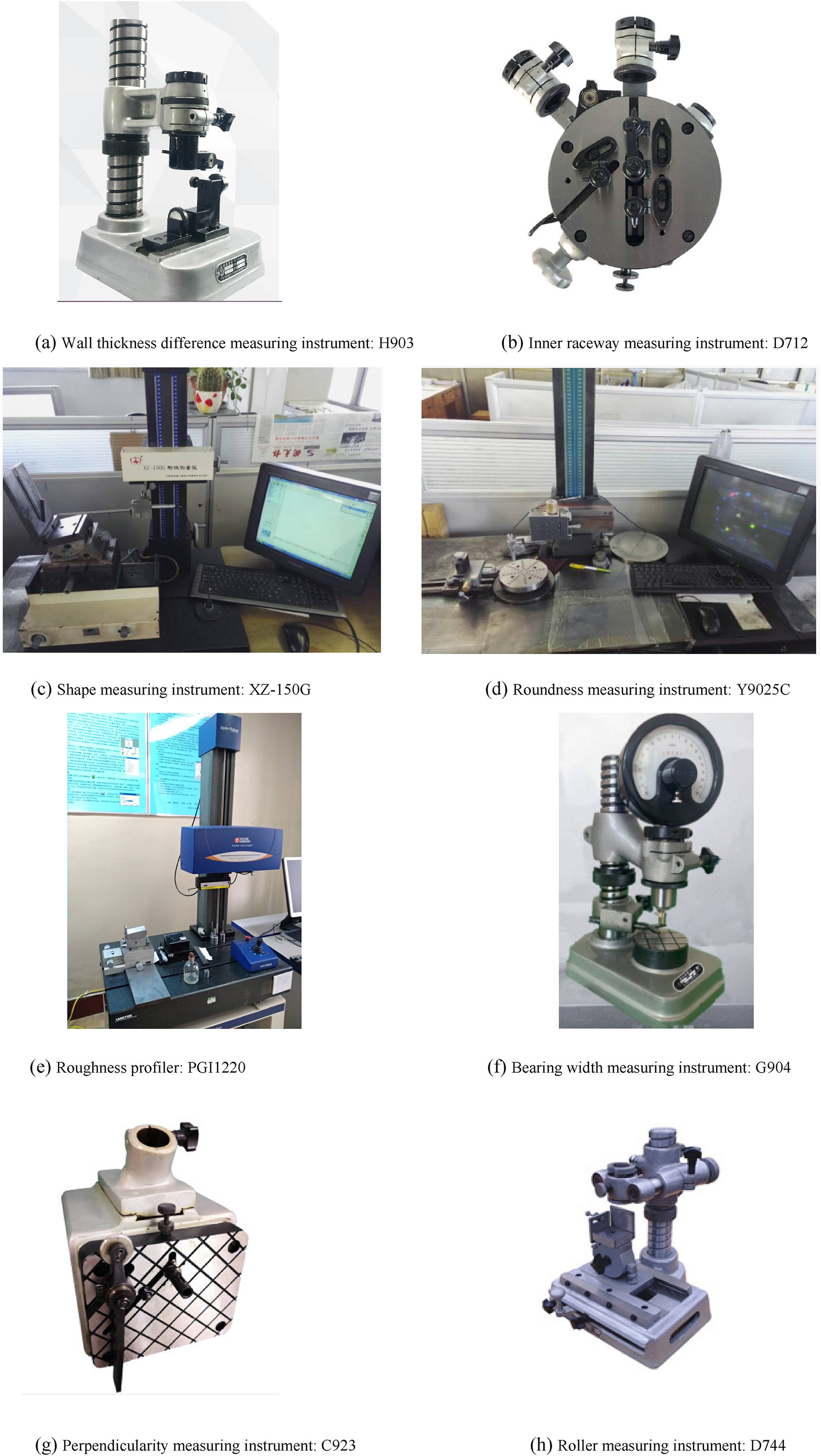
Instruments used in the measurement process. (a) Wall thickness difference measuring instrument: H903. (b) Inner raceway measuring instrument: D712. (c) Shape measuring instrument: XZ-150G. (d) Roundness measuring instrument: Y9025C. (e) Roughness profiler: PGI1220. (f) Bearing width measuring instrument: G904. (g) Perpendicularity measuring instrument: C923. (h) Roller measuring instrument: D744.
Measured parameters and measuring instruments.

H903 is a comparative mechanical measuring instrument, which is mainly used for the measurement of the thickness variation of the bearing inner ring. There are special positioning bolts on the instrument plate, the position of the positioning bolts can be adjusted according to the diameter of the tested ferrule, the positioning bolts are equipped with a disc-shaped positioning piece, and the height can be adjusted according to the requirements of the tested ferrule. D712 is also a comparative mechanical measuring instrument, which is mainly used for the measurement of the diameter and angle of the outer ring raceway of tapered roller bearings.
XZ-150G is mainly used to measure the shape of the element line and the profile of the section of various mechanical parts. In the bearing industry, it can be used to measure the element lines of various rolling elements and raceways, such as: protrusion, contact angle, radius of curvature of curved surface, and angle of reference parts. The instrument is controlled by a microcomputer, which can automatically realize the measurement cycle, automatically eliminate the installation error, and directly display the shape and parameters of the measured parts. The instrument workbench adopts closed air flotation guide rail.
Y9025C is mainly used to measure the roundness, waviness, coaxiality, perpendicularity, parallelism, flatness and other parameters of the inner and outer ring raceways and rolling elements of the bearing, and can obtain the eccentricity and phase of the parts. The instrument is equipped with high-precision air flotation spindle and air filtration system. It adopts Windows system operation platform, which can perform spectrum analysis on the surface state of parts. It is equipped with two types of sensors to meet the measurement of various diameters and apertures.
PGI1220 is a stylus optical profiler that can be used to measure the roughness and shape of plastic lenses, spherical, aspherical, free-form surfaces, infrared glass, crystals, and diffractive surfaces up to 300 mm in diameter. PGI (Phase Grating Interferometry) technology utilizes a short stylus to measure large lenses, enabling high-precision measurements.
G904A is mainly used to measure the height and parallel difference of bearing rings. C923 is a comparative mechanical measuring instrument, which is mainly used to measure the perpendicularity of the center line of the inner diameter to the reference end face. D744 is a comparative mechanical measuring instrument, which is mainly used to measure rolling element diameter and related parameters.
Vibration acceleration of the 30 sets of bearing is shown in Figure 5. From Figure 5, we can see that under the same working condition the vibration acceleration value of tapered roller bearings which belong to the same type are different. Figures 6–8 show the measuring data of inner ring, outer ring and roller, respectively. It can be seen from the Figures 6–8, although all the tapered roller bearings belong to same type, the measuring values are different for a specific parameter which influences the vibration. It can be inferred that all the measuring parameters may have an effect on the vibration of the tapered roller bearings to varying degrees.

Vibration acceleration data of tapered roller bearing.
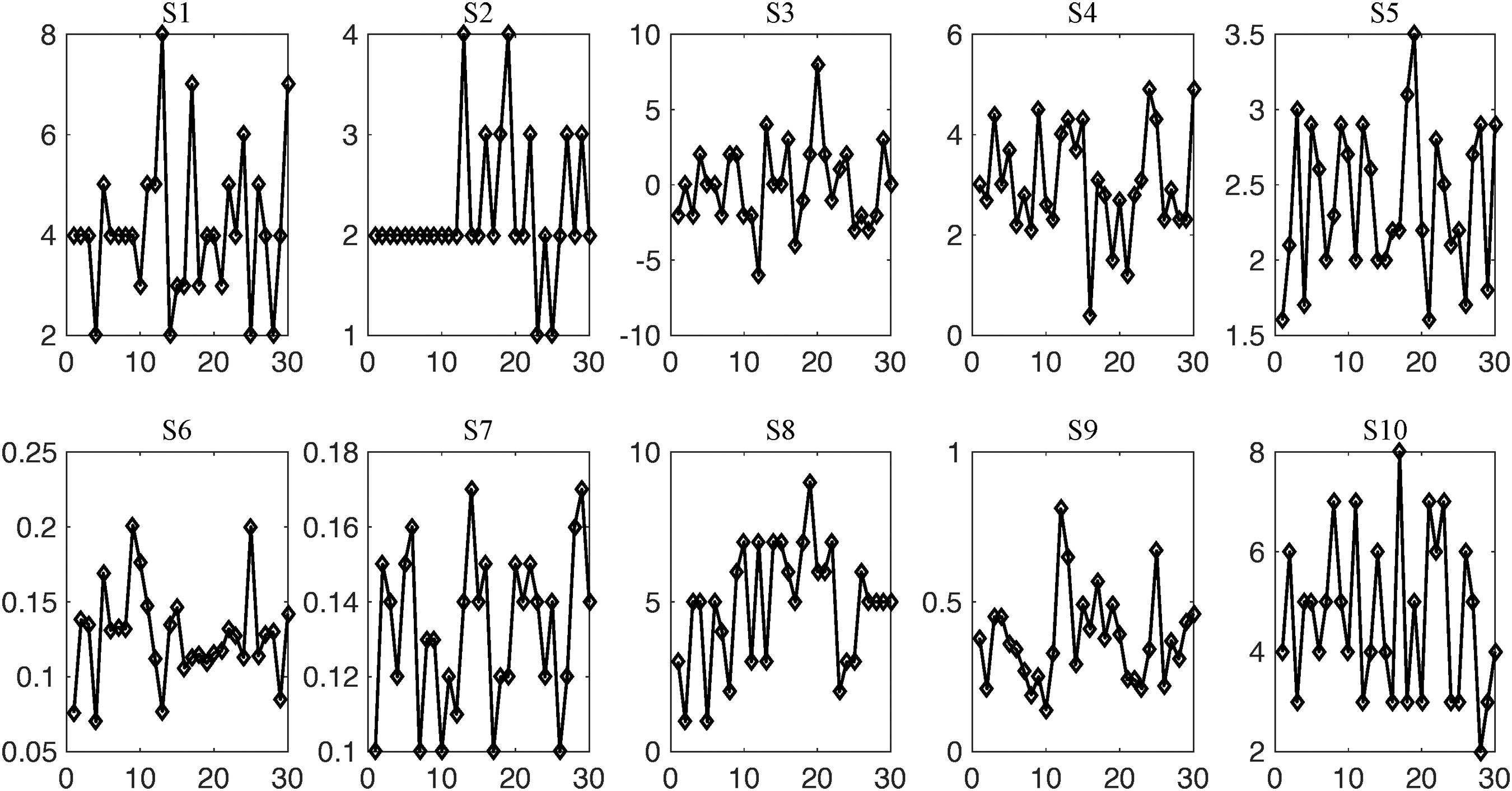
Measuring data of the inner ring.

Measuring data of the outer ring.

Measuring data of the roller.
Performance data classification
According to Table 1, the vibration acceleration data of the test bearing is classified. Take the number of bearing quality grades U = 6, that is, the bearing vibration acceleration is divided into six grades. The tapered roller bearing vibration acceleration quality classification results are shown in Table 4.
Quality classifications of the vibration acceleration.

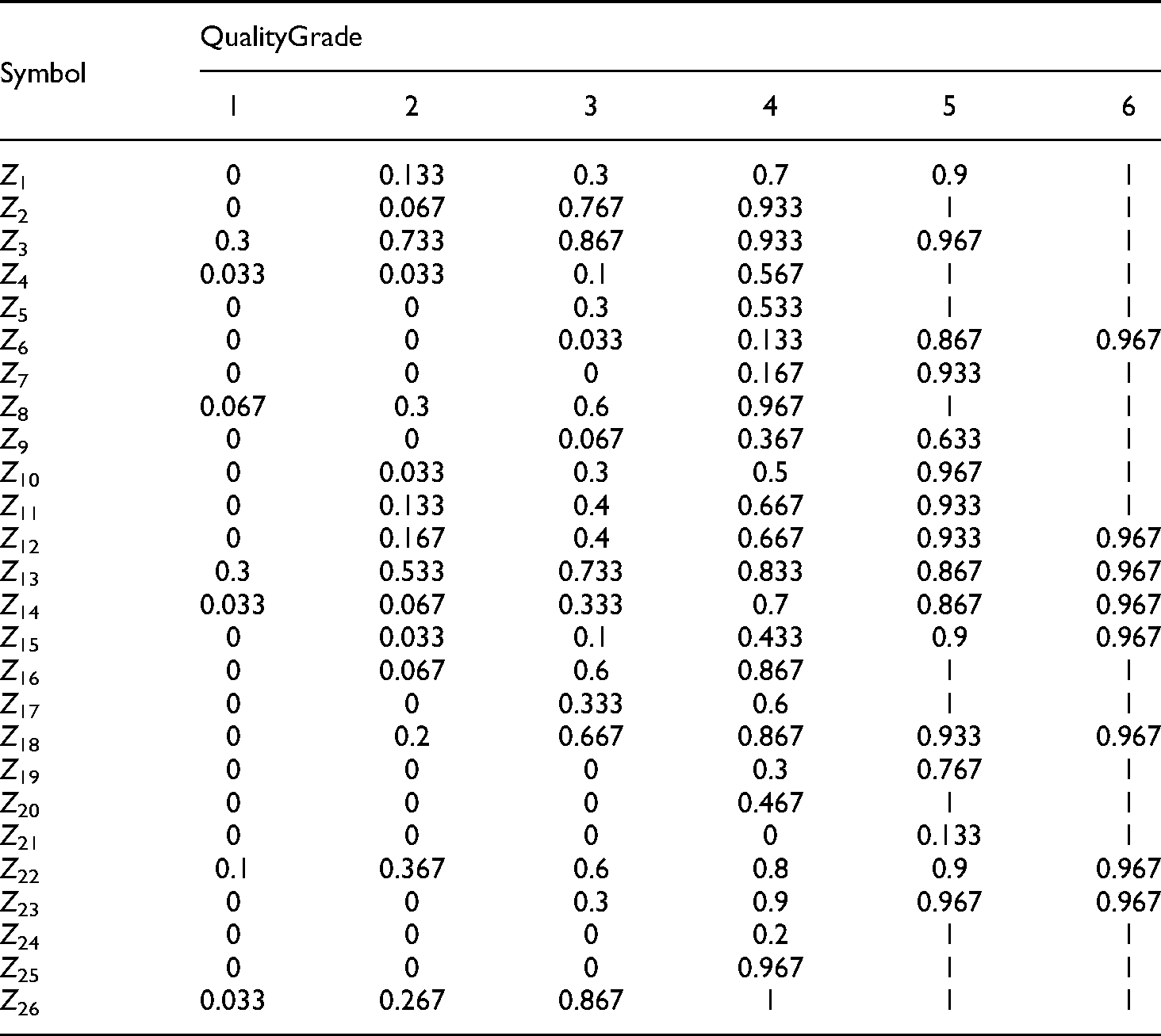
Similarly, the influence factors data can be classified. And the cumulative distributions of the quality grade of the inner ring (S1, S2, …, S10), the outer ring (S11, S12, …, S18), and the roller (S19, S20, …, S26) is obtained as shows in Table 5.
Cumulative distributions of the influence factors quality grade.
Determining the weight of bearing quality-influencing factors
The probability density curves of the vibration acceleration and all the measuring parameters can be obtained based on BMEM, as shown in Figures 9–11. It can be seen from these three Figures that all the probability density curves have difference in shape. From equation (32) and equation (33), the weights of the influencing factors can be obtained, as shown in Figure 12. From equation (34), the status composite value of the influencing factors can be obtained, as summarized in Table 6. From equation (32), the influencing coefficients can be calculated, that is a = −0.9831, and b = 0.6757. Substituting the quality influencing coefficients into the bearing quality-achieving reliability model, and then the quality-achieving reliability values of the vibration acceleration of the tapered roller bearing at different quality grades can be obtained, as shown in the Table 7.

The PDF of the inner ring parameters and vibration acceleration.

The PDF of the outer ring parameters and vibration acceleration.
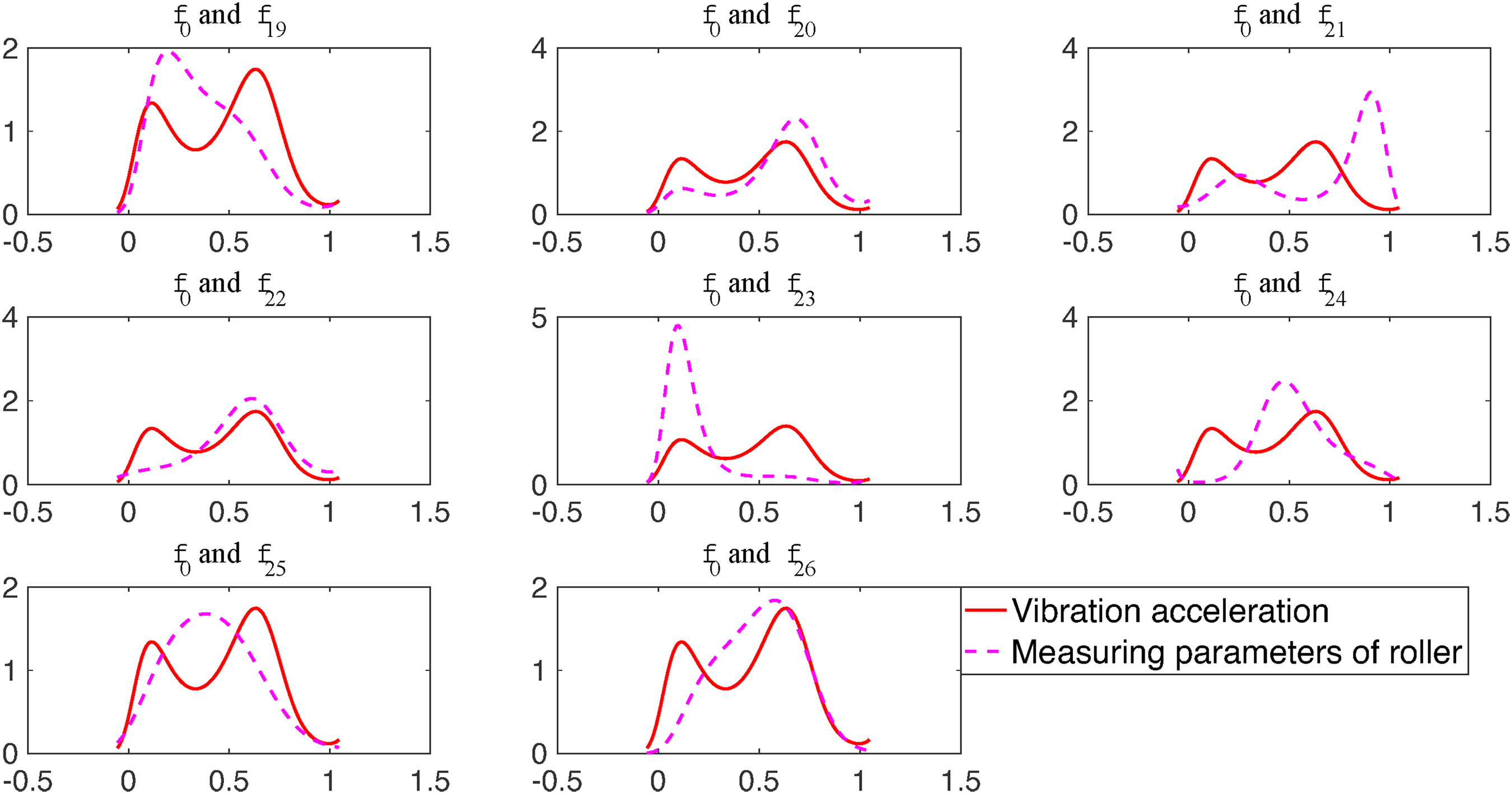
The PDF of the roller parameters and vibration acceleration.

The weights of the quality influence factors.
The status composite value of the influencing factors.

Tapered roller bearing quality-achieving reliability values.

It can be seen from Table 7 that, when the quality grade is 1, the quality-achieving reliability of the tested bearing is the lowest, and as the quality grade increases, the quality-achieving reliability gradually increases. When the quality grade is 5, the quality-achieving reliability can reach about 90.64%. Therefore, under the current processing level, the vibration acceleration value of the tapered roller bearing used in the research is generally maintained at the fifth quality grade, that is, the vibration acceleration value is 57 dB (57 dB is obtained according to Table 4.), and the corresponding bearing quality-achieving reliability is 90.64%.
In order to verify the effectiveness of the proposed method, the method in Literature 13 is used to calculate the quality-achieving reliability, as shown in Figure 13. The comparison results are in Figure 14 and Table 8. As shown, the quality-achieving reliability calculated by the method in Literature 13 differ greatly from the experimental results, the maximum of relative error is nearly 90%, mean relative error is up to 44.26%, and the relative error of the proposed method is considerably lower than the method in Literature 13. According to the results, it can be clearly noticed that the proposed method is more accurate than the method in Literature 13.

Tapered roller bearing quality-achieving reliability using different methods.

The comparison results of quality-achieving reliability of different methods.
The quantitative evaluations of different methods.

Since the bearing quality-achieving reliability is affected by many factors, and the mechanism of rolling bearing vibration is also very complex. There are many factors affecting bearing vibration, including ring raceway waviness, rolling element size difference, roughness, structure type of bearing itself, assembly clearance, lubrication conditions, installation conditions and work conditions, etc.. Only the main influencing factors are considered in the quality-achieving reliability model, so there is a certain difference between the theoretical calculation results and the experimental results.
Conclusions
In this paper, a novel method for determining the weight of bearing quality-influencing factors based on bootstrap maximum entropy method and similarity method is proposed, and then the quality-achieving reliability model is established. The proposed method is applied to investigate the experimental tapered roller bearings. The results show that the proposed method can be employed to quantify the uncertain relationship between the bearing quality and its influencing factors, and to assess the bearing quality assurance capability and bearing quality processing level under the condition of a small number of experimental bearings. The results also confirm that the proposed method is more effective than other quality-achieving reliability method.
Footnotes
Declaration of conflicting interests
The author(s) declared no potential conflicts of interest with respect to the research, authorship, and/or publication of this article.
Funding
The author(s) received no financial support for the research, authorship, and/or publication of this article.
