




Abstract
In this paper, the process of crack propagation is investigated using the extended finite element method at the mesoscale to study the drill pipe fracture mechanism. Firstly, the property of the S135 drill pipe was analyzed through physical and chemical experiments and the scanning electron microscope method. After that, a grain distribution model of the drill pipe material at the mesoscale was established by the Python scripting language on ABAQUS platform. Furthermore, the extended finite element method was applied to study crack dynamic propagation. And the distribution of stress and strain during the crack propagation were obtained at the mesoscale grain model. Finally, by the mesomechanics “homogenization” method, the stress and strain of the crack propagation model at different times were analyzed, and the influence of crack propagation on drill pipe material was obtained. Simulation results show that, although drill pipe material at the macroscopic scale is in the elastic stage, plastic zone and micro-crack propagation may also exist at the mesoscale. The proposed method in this paper studied the stress distribution in the crack tip during the propagation, which is a benefit for exploring the fracture mechanism of drill pipe.
Introduction
In recent years, with the increasing depth in petroleum exploitation and drilling, the type of S135 drill pipe is applied in deep or ultra-deep wells. Although the S135 drill pipe material is the high-strength steel, the phenomenon of drill pipe fracture is always happening, leading to a huge economic loss. So it is necessary to study the mechanical and material properties of the S135 drill pipe, and investigate its fracture mechanism. In the drilling process, under the complicated mechanics environment, such as tensile compressive load, bending load, impact load, and wall friction, down-hole drilling pipe is likely to generate micro-crack. As the service time increased, the micro-crack on the drill pipe is propagating, which will result in drill pipe fracture in the end.1–3 Currently, the research on drill pipe failures mainly focused on macroscopic mechanics and mathematical theory, including fracture mechanics and fatigue damage mechanism.4–6 Meanwhile, in order to improve the drill pipe’s working life and reduce its fracture failure, petroleum engineer always select high-quality steel material from its property parameters, such as material fracture toughness, yield ratio, and impact energy.
In the literature, the property of titanium drill pipe at different sizes have been studied in ultra-deep and deep directional drilling, and it was found that the titanium drill pipe in a representative deep directional well would reduce hook and torque loads by roughly 40%, and improve the anti-fatigue life of drill string.7,8 And the vibration model of the pipe string, which was generated by the axial and torsional coupling effect, was established. It indicated that the vibrations were the main factor in the drill string failure, and some drilling operation parameters were put forward to reduce drill failure.9–11 And the fatigue failure mechanism of the drill tool joint was also studied. The metallography study on drill tools material showed that the initial crack on the drill tools material would lead to crack growth, and some nonmetal inclusions existed in the crack fractograph. 12 Recently, there has been significant progress in the drill pipe failure. The extended finite element method (XFEM) presents high efficiency on the numerical simulation method for crack propagation. The XFEM was applied to evaluate the stress intensity factors of the semi-elliptical part through thickness crack. The study shows that the location of crack and loading have a great effect on stress intensity factors. 13 The transient responses of stationary crack under dynamic loading, and crack propagation are studied by the XFEM. And XFEM was also applied in studying the stress intensity factors and the crack growth and revealed the mechanism of the process of crack propagation.14–17 A new MsXFEM scheme is proposed to evaluate the effective macroscopic properties of heterogeneous composites, and the materials’ features at the microscale have been modeled by XFEM. 18 And some researchers have applied novel numerical models in simulating the crack propagation process.19–21
However, as the fracture mechanic characteristics of a material are all depending on its microstructure and component properties, the problem cannot only be solved at the macroscale. In order to further investigate the deformation and fracture characterization of the material, research on fracture mechanisms should be carried out at the multi-scale range, including the macroscale and mesoscale. As for the mesoscale, the propagation of crack tips is analyzed at the grain size.
In this paper, the mechanical property test on the S135 drill pipe was conducted. And according to the S135 drill pipe material experimental result, micro-cracks propagation on the drill pipe and its stress and strain distribution at the mesoscale were analyzed by using the XFEM. And then “Homogenization” method in mesomechanics was used to evaluate the influence of micro-cracks propagation on the macroscopic material properties.
Drill string material experiment research
The type S135 drill string material is tested in this paper. The predominant chemicals of the material are shown in Table 1. Carbon content of this steel material is 0.35%, and molybdenum content is 0.71%, and chromium content is 0.97%. That means this steel material has good toughness and tempering stability. And metallurgic analysis is applied in the S135 material. Firstly, the specimen was polished with metallographic sandpaper, and then made it corrosion by using aqua regia. Finally, the specimen was cleaned, washed, and dried after the corrosion process completed. A metallurgical microscope was used to analyze the structure and surface morphology of the specimen. 500 magnification metallograph of the material is shown in Figure 1. It was clear to see that the material belongs to tempered sorbite.
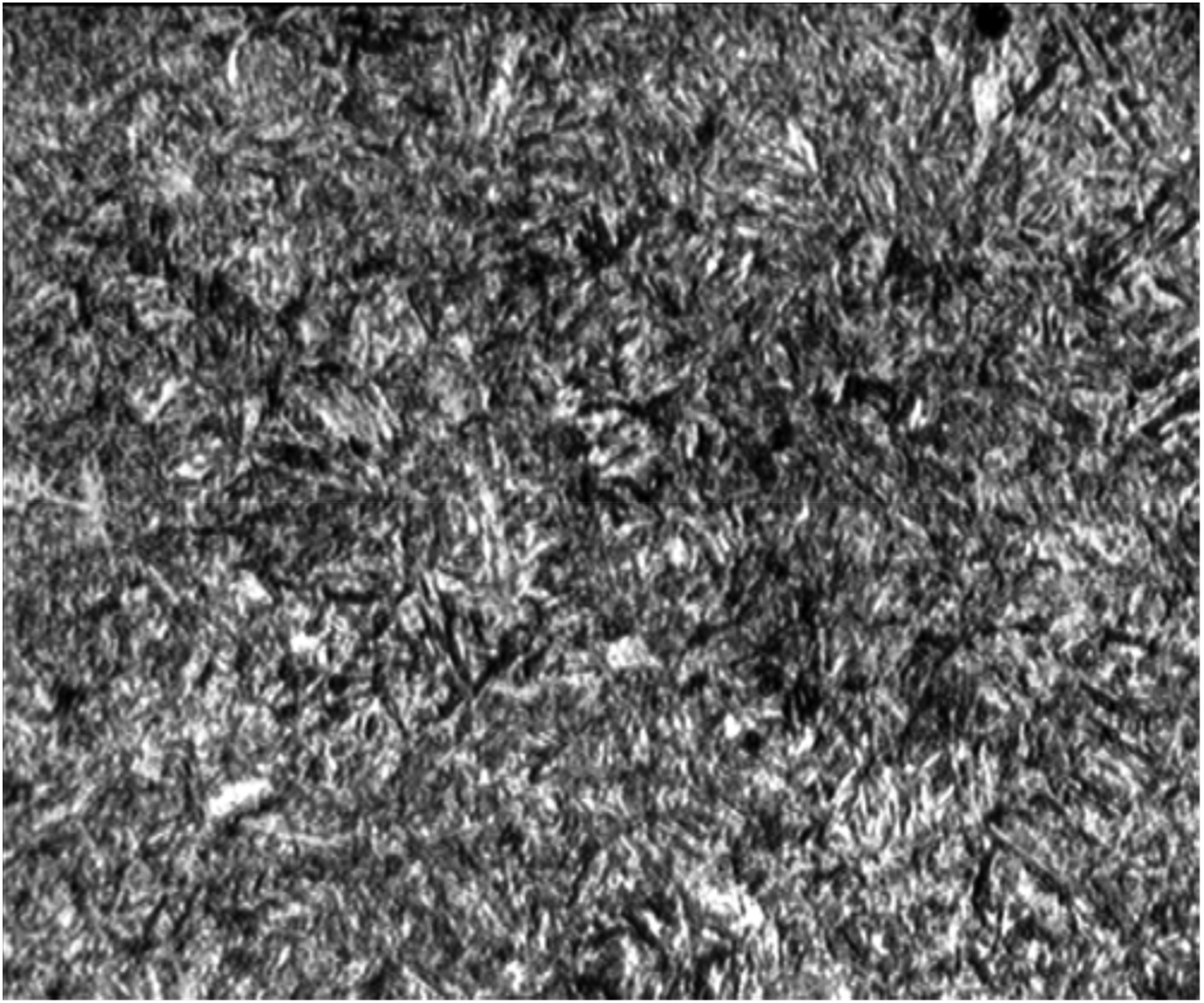
Metallographic structure of the type S135 drill string material (500×).
Chemical component of the type S135 drill string material (%wt).

According to the ISO 11960-2011, which is “petroleum and natural gas industries—steel pipes for use as casing or tubing for wells,” the tensile experiment of drill string material was tested. The stress–strain curve graph and tensile mechanical parameter of the material can be obtained, as shown in Figure 2 and Table 2, respectively. According to the result of three tested specimens, the yield strength of the S135 drill pipe material is 940 MPa, the tensile strength is 1010 MPa, the percentage reduction of area is 59.5%, the percentage elongation is 19.7%, and the yield ratio is 0.93. All the results above show type S135 material has high properties as drill pipe. Macroscopic and microcosmic fracture appearance of the specimen under tensile testing at ambient temperature can be obtained by environmental scanning electron microscope, as shown in Figure 3. The specimen appeared necking down, and then it fractured at the necking in the end. The fracture appearance showed that it was a fibrous fracture, without obvious shear lip and radial region, and it belonged to ductile fracture. From the 500 magnification metallograph of the material, there are some impurities and pores in the microstructure of the material, which leads to crack initiation.

Stress–strain curve of the type S135 drill string material.

Macroscopic and microcosmic fracture appearance of the type S135 drill string material.
Tensile property experiment of the type S135 drill string material.

Fracture mesomechanics model of drill string material
Metal is made of millions of particulate and disordered crystalline. As for the same metal material, the images of adjacent regions are all different under the electric microscope. However, for the metal material mechanic under the mesoscale, the change of mechanic characterize is beyond the computer’s analysis ability if considering the large real space. So the dual character of representative volume element (RVE) is adopted to represent these inhomogeneous and disordered material sets. 22 RVE meets the basic assumptions of continuum mechanics theory in macroscale, and then heterogeneous material can be replaced by an equivalent homogeneous medium. What’s more, RVE assures the model contains enough mesoscopic structure information in mesoscale, which can accurately characterize statistically homogeneous properties of a local continuum.
The overall analysis process of stress and strain field when homogeneous stress is applied on the boundary of RVE is shown in Figure 4. According to the relationship between strain and stress at the macroscale,
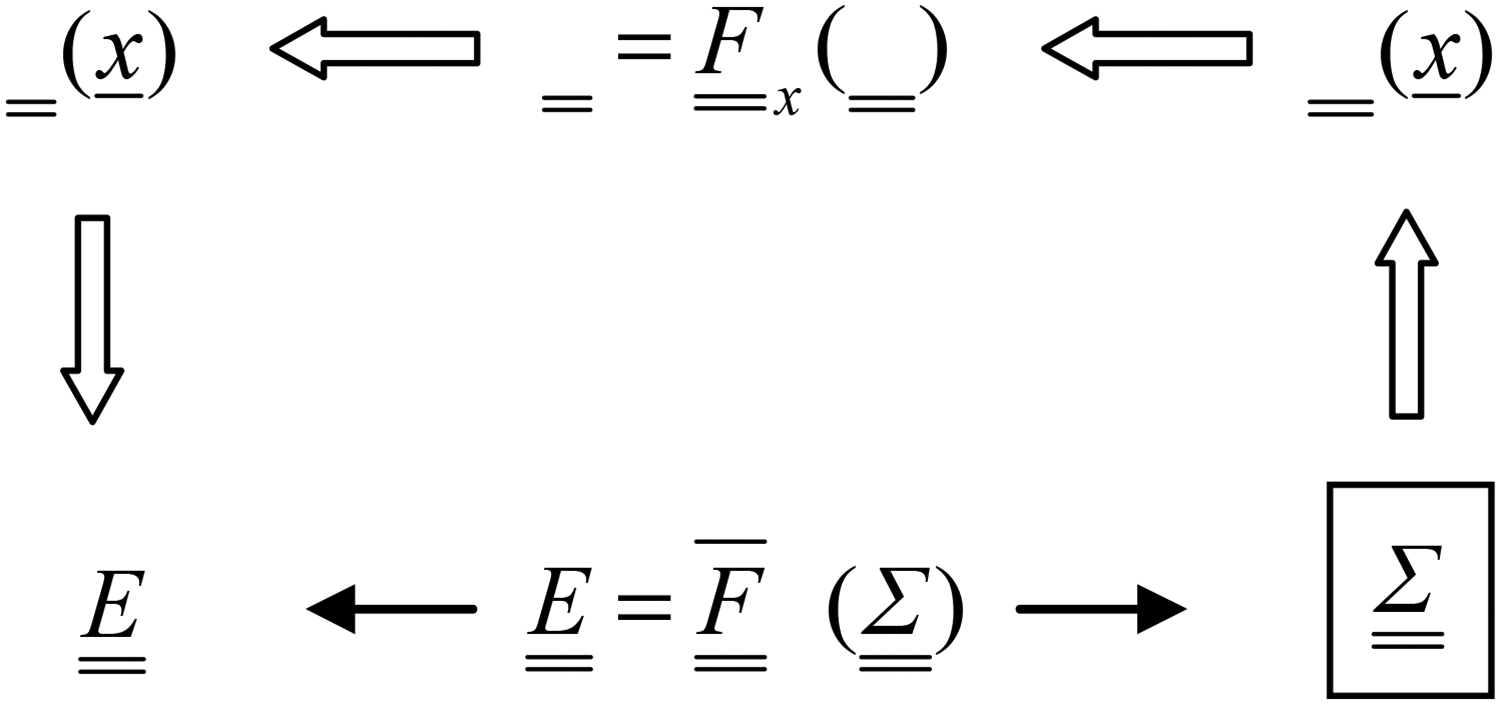
Flowchart of the mesomechanics analysis process.
Where
In mathematics, a Voronoi diagram is a partitioning of a plane into regions based on distance to points in a specific subset of the plane. That set of points is specified beforehand, and for each seed there is a corresponding region consisting of all points closer to that seed than to any other. Meanwhile, in the forming process of drill string materials, crystallization starts at the crystal nucleus and extends around. 23 Because of this great similarity, point coordinates generated by random function are used to represent crystal nucleus and Voronoi polygon is introduced to represent crystals. We use crystal to simulate RVE of mesomechanics. Then, this paper adopts Python scripting language to complete the secondary development of the modeling program to quickly create any number of crystals on the Abaqus software platform. A modeling program of quickly built any number of drill string material grains was developed by the Python scripting language on Abaqus software platform.
Based on the analysis thought of mesomechanics of macro-micro-macro, Python scripting language is used to program ABAQUS post-processor software about area-weighted averaging code, combined with overall consideration of the hierarchical relation of output database objects. Thus, the effect of micro-cracks propagation on macro-properties of drill string material can be analyzed by the homogenization of stress, strain, and displacement of each element in the model.
The modeling program was called on the Abaqus software platform. RVE model of drill string material with micro-crack containing 200 grains was established by the mechanical experiment data, and an elastoplastic material is applied in this model. And then, XFEM was adopted to establish drill string material RVE extended finite element model, shown in Figure 5.

Extended finite element model of the type S135 drill string material in mesoscale.
XFEM is a numerical technique based on the generalized finite element method and the partition of unity method. It extends the classical FEM approach by enriching the solution space for solutions to differential equations with discontinuous functions in regions affecting by
24

In Figure 5, the RVE model is a quadrate model with a length of 1 mm and micro-crack cutting through two grains. The crack size is
Crack propagation analysis
Figures 6 to 11 show the von Mises stress distribution contours of the type S135 material extended finite element model in a fracture process at the mesoscale. Among them, Figure 6 shows the von Mises stress distribution at increment 0.2016 s. At this time, the model is subjected to 50 MPa uniform external load. Because of the micro-crack, stress concentration is generated in the crack tip, where the von Mises stress is up to 967.56 MPa. That means the stress on the crack tip exceeds the minimum yield strength of S135 material, and the crack tip trends to yield and that plastic strain has been produced. However, the von Mises stress on the other region, away from the crack tip, is equal to the externally applied load. And in Figure 7, the von Mises stress on the crack tip is 969.73 MPa at 0.2516 s increment, which is very close to the von Mises stress of 967.56 MPa at 0.2016 s. At this time, the model material is in the yield stage with slowly increasing stress and gradually obvious plastic strain.
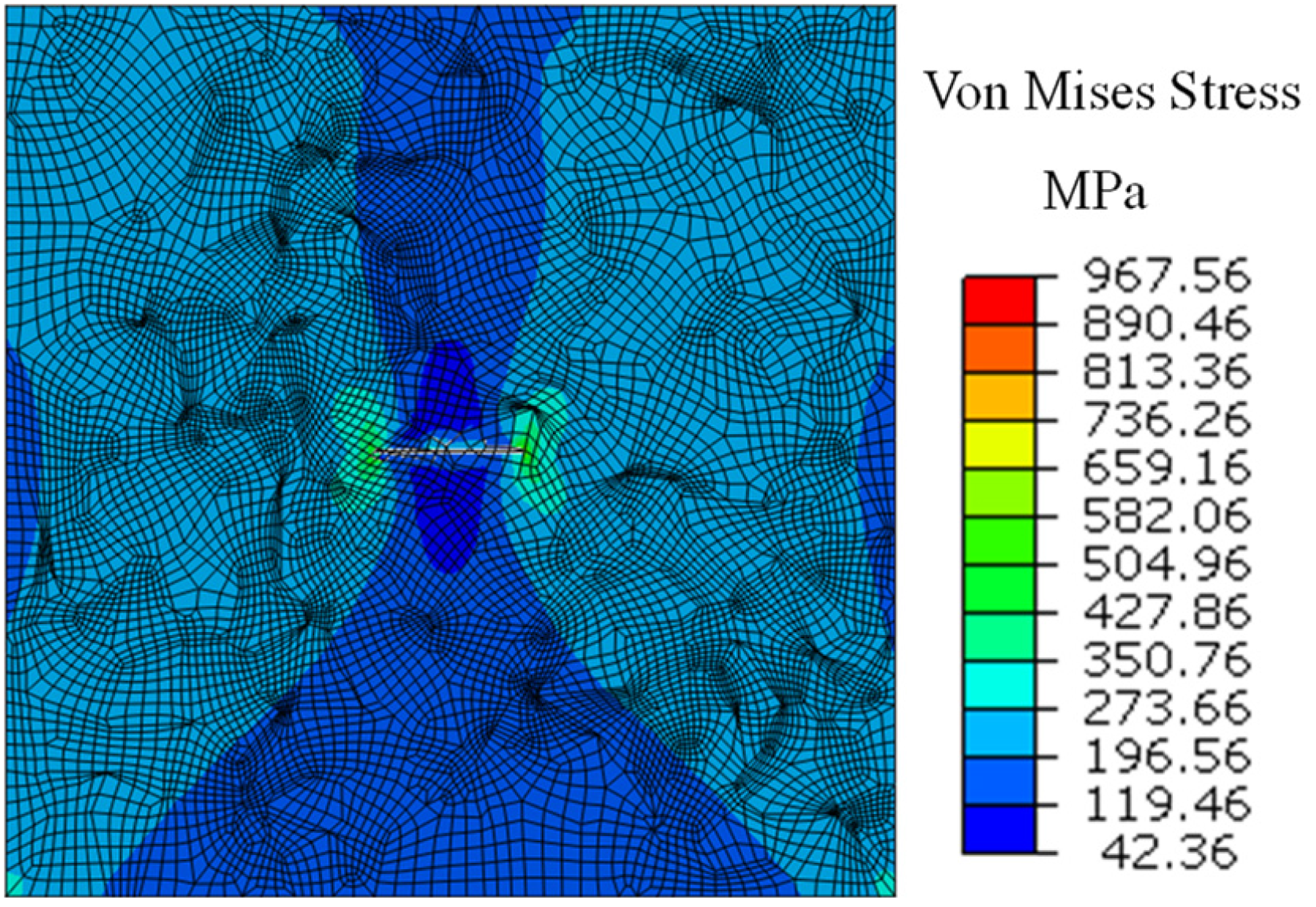
von Mises stress contour at 0.2016 s.

von Mises stress contour at 0.2516 s.

Crack shape when material is broken.
Figure 8 shows the von Mises stress distribution contour at increment 0.3016 s. The S135 type of drill pipe material is still in the yield stage at the crack tip region, accompanied by slowly increasing stress. Due to the accumulation of energy, the crack starts to propagate when crack tip stress exceeds the tensile strength of S135 material, as shown in Figure 9. Because of the new micro-crack propagation, accumulated energy is released, and in Figure 10, the maximum stress area on the crack tip decreases less than in Figure 9. And at this step, the length of crack propagation is 0.021892 mm.

von Mises stress contour at 0.3016 s.
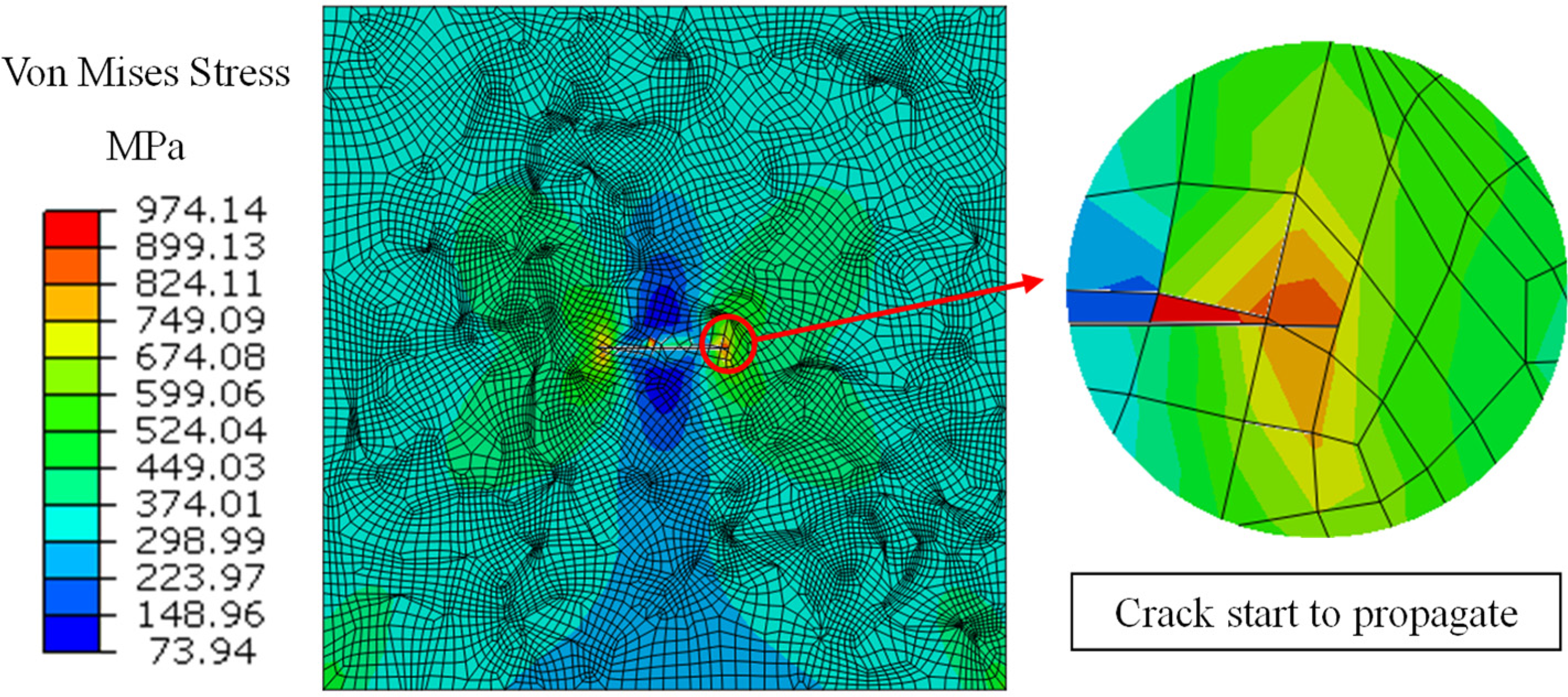
von Mises stress contour at 0.3516 s.

von Mises stress contour at 0.3547 s.
In the following simulation result, with the increasing increment step, the stress concentration on the region of the crack tip occurs constantly. The energy accumulation at the crack tip and the expansion of the maximum stress area disappear until the new crack propagation starts. In general, stress accumulation at the crack tip followed by the new crack propagation, and stress release at the crack tip, which is occurring circularly in the whole process, leading to the breaking of the model, as shown in Figure 11.
Homogenization analysis of drill pipe material properties
According to the simulation results from Figures 6 to 10, the developed post-processing code of ABAQUS is applied to calculate the area-weighted average of stress and strain at different increments of crack propagation. And the relationship between stress and strain, describing the model under tensile status, can be obtained, as shown in Table 3. It shows the value of homogenization results at different increments. Figure 12 shows the comparison of the true stress–strain curve of the S135 drill pipe material from the experiment and the stress–strain curve from the simulation result by homogenization methods.
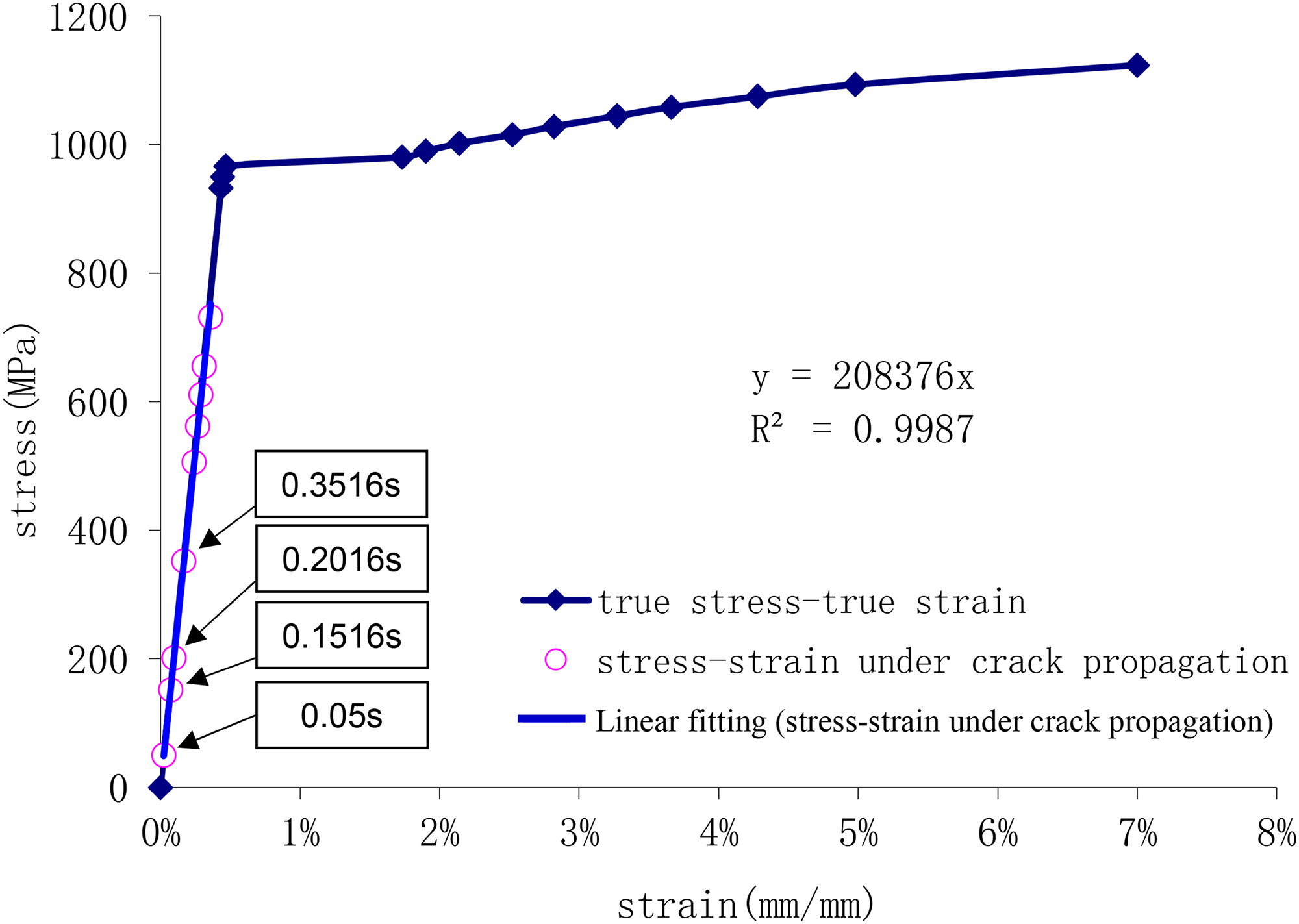
Macro stress–strain with crack propagation.
Homogenization results of stress and strain at different increments.

As the complexity of the finite element model and time-consuming in the numerical simulation, the simulation results of the area-weighted average of the stress and strain are taken within 0.7299 s increments. At 0.7299 s increments, the maximum area-weighted average of stress is 731.569 MPa, which is close to the applied load 729.9 MPa. In Table 3, compared with the value of applied loads, the area-weighted average of stress is almost the same, which shows good accordance with the mesomechanics characteristics. Meanwhile, the applied load is under the yield stress of the S135 drill pipe material 931 MPa, thus the area-weighted average of stress and strain on the material is in the elastic stage at a macroscopic scale, as shown in Figure 12. However, at the mesoscale, because of the micro-cracks, stress concentration is existed in the crack tip zone, which exceeds the yield stress of the material, and appears plastic deformation. Therefore, when the drill pipe, containing the micro-crack, is under working condition, the energy in the plastic deformation zone is continuous to be accumulated, which finally leads to the growth of fatigue crack and the drill pipe fracture. As shown in Figure 12, the elastic modulus of the drill pipe material S135 can be obtained by the linear fitting method applied to the area-weighted average of the stress and strain area of the whole model in the elastic stage. Compared with the initial set elastic modulus 2.1 × 10⁵ MPa, the elastic modulus by the linear fitting method is 2.08376 × 10⁵ MPa, which verifies the homogenization analysis method in the crack propagation.
As the whole model is in the elastic stage, the elasticity modulus of the material model in the crack propagation is the ratio of the stress and strain, which is obtained by the area-weighted average method at each increment, as shown in Table 3. Figure 12 shows the elasticity modulus of the model changing with the length of crack propagation. And the initial length of the crack is 0.167604 mm. Although the plastic deformation appears in the crack tip zone at 0.2016 s, the instantaneous elasticity modulus is not changed until the crack propagation starts at 0.3516 s. Next, the elasticity modulus of the material starts to slowly decrease with the increasing length of crack propagation. The results show that the elasticity modulus reflects the macroscopic property of the material. If the crack propagation does not happen, the elasticity modulus is a constant, even though the plastic deformation appears in the crack tip zone. So it provides a new method to investigate the material properties of the S135 drill pipe at the mesoscale.
Conclusion
In this paper, the mechanical property of the S135 drill pipe was tested by the experiment. And the extended finite element method was applied to investigate the micro-crack propagation on the S135 drill pipe material at the mesoscale, conclusions can be drawn as follows.
The crack propagation process is that at first the phenomenon of stress concentration appears at the crack tip zone, and then, the energy is accumulated in the crack tip zone, and the zone of maximum stress is increasing. Finally, the crack propagation happens at the crack tip, accompanied with high energy and stress releasing. The whole model is damaged in the circle of energy accumulation, crack propagation, and energy release at the crack tip. The material model presents elastic characteristics at the macroscale. However, because of the micro-crack, plastic deformation would happen in the crack tip at the mesoscale. The applied loads at the elastic stage, even though the plastic deformation happens in the crack tip zone, the elasticity modulus of the model is still a constant if the crack propagation does not happen. But when the crack grows, the elasticity modulus of the whole material model will decrease.
Footnotes
Declaration of Conflicting Interests
The author(s) declared no potential conflicts of interest with respect to the research, and/or publication of this article.
Funding
The author(s) disclosed receipt of the following financial support for the research, authorship, and/or publication of this article: This research was financially supported by the National Natural Science Foundation of China (No. 51974271), Key Research and Development Plan of Sichuan Province (No. 2020YFSY0038), and Open Fund of State Key Laboratory of Oil and Gas Reservoir Geology and Exploitation Southwest Petroleum University (No. PLN201911).
