



Abstract
Despite many calls to reform undergraduate science, technology, engineering, and math (STEM) education to incorporate active learning into classes, there has been little attention paid to graduate level classrooms or courses taught by graduate students. Here, we set out to understand if and how STEM graduate students’ perceptions of active learning change in the classes they take versus those they teach. We found that graduate students had taken relatively few graduate level classes using active learning and they felt that more time should be devoted to active learning in the courses they were taking. Teaching assistants felt that they were devoting the right amount of class time to active learning in the classes they taught. Graduate students also felt that they were using teaching methods in the classes they taught that were different from those they thought should be used when teaching undergraduates and were different from how they preferred to learn when taking classes.
Keywords
Introduction
Active learning (AL) techniques encompass a variety of teaching practices in which students construct their own knowledge by actively engaging with course content and each other. AL increases student engagement, learning, course grades, and reduces failure rates (e.g. Refs.1–5). Despite the preponderance of evidence related to AL’s effectiveness, AL is not yet used in all classrooms, particularly at the college level.6,7
Faculty and student perceptions and attitudes toward AL have been identified as potential barriers to AL adoption.8–14 A survey of faculty revealed that attitudes toward AL were the most important predictor of AL adoption. 10 Student perceptions of AL are also important and influence whether faculty implement such practices in their courses; concern that students will avoid their courses due to more “difficult” or involved coursework or students simply not liking the technique have prevented some faculty from implementing pre-prepared AL modules. 13
Graduate teaching assistants (TAs), have a unique position in academia, because they are transitioning from the single role of being strictly students taking courses (acquiring knowledge) to multiple roles, adding the roles of discipline experts through both discovering (researcher) and disseminating (teacher) knowledge. Because of these unique roles, graduate students are in an ideal position to inform our understanding of how teaching practices—and perceptions of these practices—develop, particularly in answering the perennial question of whether teachers teach the way they were taught. 15
There have been multiple recent studies detailing training programs, workshops, and other professional development activities designed to help TAs become more effective teachers and introducing them to evidence-based teaching practices—including active learning—in an effort to better prepare future faculty and improve undergraduate STEM education.16–21 These studies suggest that the development activities were successful in improving undergraduate success or influencing TA attitudes toward and confidence in teaching, however relatively few studies have investigated TA perceptions of active learning teaching techniques in the courses they currently teach.
Other studies suggest that course style, previous experiences as a student, previous teaching experiences, and professional development sessions influence TA perceptions of how they should teach (lecturing vs questioning students) and their role in the classroom (content expert vs guide22,23). Together these studies indicate that TA buy-in and their perception of active learning teaching methods are crucial for proper implementation of student-centered teaching practices in undergraduate classrooms and suggest that more studies are needed to fully explore TA perceptions of these practices and how they influence the TA’s teaching style.
This study focuses on graduate student perceptions of AL in both the classes they take and the classes they teach to address the following question: Do the perceptions of active learning by graduate students differ depending on their role (student vs teacher)? We have divided this over-arching question into the following sub-questions: (1) Do graduate students perceive that they have experienced or used AL as students and teachers and do they think it’s effective? (2) Do graduate students value AL differently depending on their role (student vs teacher) in terms of class time devoted to AL? (3) Do graduate students value AL differently depending on their role (student vs teacher) in terms of teaching methods (Table 1)? To answer these questions, we surveyed graduate students’ perceptions of AL in the courses they’ve taken and the courses they’ve taught. The insights we gain from this study should be used to inform the advancement of professional development for TA and non-TA graduate students.
Organization of the research questions and the data collected.

Methods
Institution
This study was conducted at a large research-focused university (basic Carnegie classification: Doctoral Universities: Highest Research Activity) in the southeastern United States. We focused on two colleges within the university: the College of Engineering (CoE) and the College of Science (CoS). The CoE consists of seven departments and the CoS of five departments (Table 2).
Demographic makeup of the respondents to the survey and of the Colleges at the time the survey was distributed.

Percent of respondents (and number of respondents) are presented. “Other” respondents were from interdepartmental degree programs within the College of Engineering. “Not reported” indicates respondents who declined to give this information.
All departments in both Colleges provide teaching assistantships to graduate students, but in some departments, there are more graduate students than assistantships, so that not all graduate students will teach as part of their graduate education. Biological Sciences (CoS), Chemistry (CoS), and Chemical Engineering (CoE) are the only departments that require all graduate students to teach for at least one (Biological Sciences) or two (Chemistry and Chemical Engineering) semesters before graduation. Mathematics (CoS) requires all graduate students to take a two-course sequence on math pedagogy and Biological Sciences (CoS) requires all graduate students lacking prior teaching experience to take a one-credit course on science pedagogy. All departments encourage but do not require, graduate student participation in orientations and workshops organized by the Graduate School. In most cases, TAs are responsible for running lab or recitation sections, but occasionally they may be the instructor of record and solely responsible for a lecture or laboratory course.
Study participants
The target group consisted of all graduate students within the CoE and CoS. Graduate students in the CoE were emailed the survey using the College’s graduate student listserv during the Spring 2015 semester. Surveys were emailed directly to graduate students in the CoS during the Fall 2014 semester using lists assembled from department websites or provided by individual departments. Surveys were available for completion for 2 weeks after they were initially sent; follow-up reminders were sent after 1 week and 1 day before the survey closed.
Survey instruments
We modeled our survey instrument after that used by Miller and Metz
24
and modified it for use at our institution by Patrick et al.
12
Since we were interested in graduate student perceptions from both their student and teaching perspectives, we combined the instrument for students—asking about AL in the courses they take—with the instrument for faculty—asking about AL in the courses they teach.12,24 To help ensure that all survey participants approached thinking about AL from the same perspective we provided Miller and Metz’s
24
definition of active learning at the beginning of each survey section: “Active learning is an instructional method in which students become engaged participants in the classroom. Students are responsible for their own learning through the use of in-class: written exercises, games, problem sets, clickers, debates, class discussions, etc.”
The student role section was presented immediately after the consent form, followed by the teaching role section. In the student section, respondents were asked how long they had been in graduate school, how many classes they had taken, how many courses had used active learning, to rank teaching practices based on how well they learned when the practice was used, and how much class time was currently and should be devoted to AL in graduate level courses. Using class time as a proxy for acceptance of AL may be a somewhat problematic metric because one can imagine a scenario in which someone might be an advocate for AL but think that only a small, but presumably a non-zero, proportion of class time should be devoted to it. It is harder to imagine a scenario in which someone who does not buy into AL would devote a large proportion of class time to it unless required to do so. Despite this caveat, we use class time as a cautious estimate of AL buy-in.
The teaching section asked similar questions but from the perspective of an instructor; that is, how respondents thought undergraduates should be taught and how the graduate students had taught or were currently teaching undergraduates, how many semesters they had taught, and how many different courses they had taught. We did not ask detailed demographic information to protect each respondent’s identity. The instrument is available in the Supplemental Materials 1. The original survey was designed for post-baccalaureate students pursuing advanced degrees (dental students) and their professors, 24 however, we did not independently validate the instrument. This project was conducted with approval of the institution’s IRB, project #E9078.
Statistical analyses
Data were downloaded from Qualtrics to Excel and partial responses were removed. We used the Wilcoxon Signed-Rank test to compare differences in paired data between respondents’ student role and teacher role perceptions. All analyses were carried out in R. 25 Figures 1 and 2 were made in R; Figure 3 was made using RAWGraphs. 26
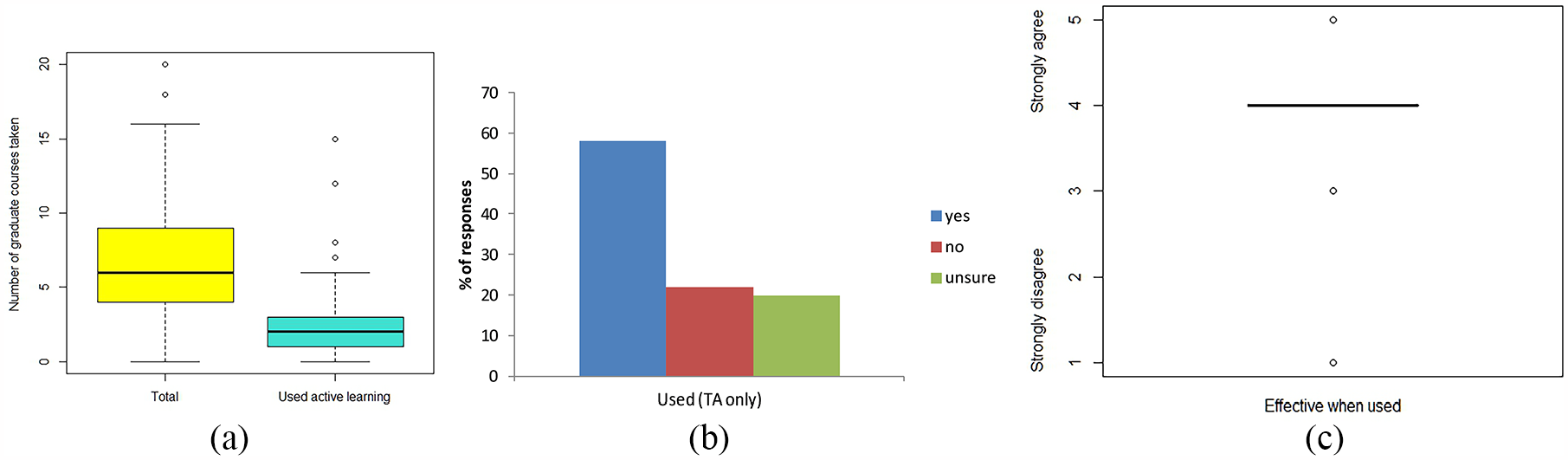
(a) Total number of graduate level courses taken at our institution and number of courses that used active learning teaching practices (N = 114). In box plots, the thick horizontal bar indicates the median, the shaded box surrounding the median indicates the interquartile range between the first and third quartiles, and the whiskers depict 1.5 times the interquartile range. (b) Percent of teaching assistants (TAs) who used active learning (N = 81). (c) Box plot of TA perceptions of the effectiveness of active learning when used (N = 81).

Box plot of graduate student perceptions of the amount of class time currently devoted to active learning (“Current”) and how much time should be devoted (“Best”) to active learning in the classes they take (“As students”) and the classes they teach (“As teachers”). Wilcoxen Signed-Rank tests indicate there was a significant difference between the “Current” and “Best”“As student” boxes (the two boxes on the left; p < 0.001) and the “Current”“As students” and “Current”“As teachers” boxes (the red boxes; p = 0.002). In box plots, the thick horizontal bar indicates the median, the shaded box surrounding the median indicates the interquartile range between the first and third quartiles, and the whiskers depict 1.5 times the interquartile range.

Alluvial plots of (a) the top (ranked first) best teaching practices for graduate students in different roles and (b) the bottom (ranked sixth) worst teaching practices for graduate students in the same roles. The vertical bars are the teaching practices; the vertical height of each bar is proportional to the number of respondents who chose that teaching method. In both (a) and (b), the first column is the preferred learning method when taking classes, the middle column is what graduate students consider to be the best way to teach undergraduates, and the last column are the teaching methods TAs were currently using. The “alluvia” or lines between columns indicate how graduate student perceptions of teaching practices differed or remained the same between roles and are proportional to number of respondents.
Results
Number of participants
A total of 42 (7%) graduate students from the College of Engineering (CoE) and 73 (13.5%) graduate students from the College of Science (CoS) responded to the survey. The majors and degree programs of the respondents were fairly representative of the overall composition of graduate students in the CoE (Table 2). Responses from Biological Sciences students were overrepresented compared to the overall composition of the CoS (Table 2) but otherwise the departments and degree programs were reasonably well represented (Table 2). Only 17 (40%) of the respondents from the CoE were currently TAs or had served as TAs in the past whereas 64 (90%) of the respondents from the CoS were or had been TAs.
Do graduate students perceive that they have experienced or used active learning and do they think it was effective?
Graduate students had taken a median of six (range: 0–20) graduate level courses at our institution (Figure 1(a)). Relatively few of these graduate level courses used AL (Figure 1(a); median = 2; range = 0–15); 26 graduate students (23%) reported that none of their graduate courses used AL. Of the graduate students who were or had been TAs at our institution, 58% reported that they had used AL in their classrooms (Figure 1(b)). Graduate students agreed that AL was effective when they used the techniques as instructors (Figure 1(c)).
Do the perceptions of active learning by graduate students differ depending on their role (student vs teacher) in terms of class time devoted to active learning?
We compared graduate student perceptions of the amount of class time devoted to AL in the classes they take (“As students” panel of Figure 2) and the classes they teach (“As teachers” panel of Figure 2). They were asked to estimate the amount of time that was currently devoted to AL in these classes (“Current”) and the amount of time they thought should be devoted to AL (“Best”) in Figure 2. As students, graduate students reported that significantly less class time was being devoted to AL (“Current”) in the classes they had taken compared to how much time they thought should be devoted to AL (“Best”; “As students” panel of Figure 2; p < 0.001). As teachers, there were no significant differences between how much time was currently or should be devoted to AL in the classes taught by graduate students (“As teachers” panel of Figure 2). Graduate students reported that significantly more AL was occurring in the classes they were teaching than in the classes they were taking (“Current” bars in the “As students” vs “As teachers” panels, Figure 2; p = 0.002). But there was no difference in their perception of the time that should be devoted to AL.
Do the perceptions of active learning by graduate students differ depending on their role (student vs teacher) in terms of teaching methods?
Interesting differences between roles were uncovered when we examined graduate student perceptions of teaching methods (Figure 3). Figure 3(a) shows the top ranked teaching method for all respondents when taking classes (left column), the best practice when teaching undergraduates (middle column), and how TAs were currently teaching (right column). When graduate students were asked to rank teaching methods by how they learned most effectively, the largest proportion of respondents ranked “Problem solving” as their most preferred learning method (indicated by the size of the vertical bar, 39% of respondents), followed by “Lecture” (19%); “Educational Games or Activities” was the top ranked learning method with the fewest respondents (6%; Figure 3(a), left column). When asked to rank best teaching practices for undergraduates to learn, “Problem solving” was again the top ranked method for the largest proportion of respondents (largest vertical bar; 33%), followed by “Group or Collaborative Learning” (22%) and “Educational Games or Activities” (19%; Figure 3(a), center column). The alluvia (colored lines indicating the proportion of respondents) between the left and middle columns show that many respondents thought that their preferred learning method was also the best teaching method for undergraduates; this relationship is particularly strong for “Problem solving.” However, in other cases such as for “Reading” and “Online learning,” respondents thought that their preferred learning method was not the best practice when teaching undergraduates. Nearly equal proportions of TAs ranked “Lecture” (26%) and “Group or Collaborative Learning” (23%) as their most used teaching methods (Figure 3(a), right column) despite thinking that other teaching methods were better (alluvia between middle and right columns, Figure 3(a)). Problem solving, which was the highest ranked for both preferred method of learning and best teaching practice, was the top-ranked teaching practice for only a third (12%) of current or former TAs (right column, Figure 3(a)).
Figure 3(b) shows the proportion of respondents that ranked each teaching method as their lowest or worst choice. Graduate students do not prefer “Educational Games or Activities” (35%) or “Videos or Online Learning” (26%; tall vertical bars in the left column, Figure 3(b)). These two methods (29% and 25% respectively), along with “Reading” (27%) were also ranked as the worst methods for teaching undergraduates (middle column, Figure 3(b)). These three methods, “Educational Games or Activities” (24%), “Videos or Online Learning” (24%), and “Reading” (17%) were also the lowest ranked (worst) methods by TAs currently teaching (right column, Figure 3(b)). Most TAs ranked “Group or Collaborative Learning” (2%), “Lecture” (1%), and “Problem solving” (2%) highly, indicated by the very small vertical bars for these methods in the right column of Figure 3(b).
Discussion
Graduate students at our institution report that active learning is effective and that more time should be devoted to these teaching techniques in the classes they take. Our results also show that graduate students simultaneously have a foot in both student and teacher worlds: their perceptions of AL in the courses they take were similar but not identical to their perceptions of how they should or were currently teaching. This work adds to the relatively shallow body of work investigating perceptions of AL in graduate students as both students and teachers.
Do the perceptions of active learning by graduate students differ depending on their role (student vs teacher)?
In short, yes. In the current study, when asked to switch from thinking about their student role to their teaching role, graduate student rankings of teaching techniques began to differ. Specifically, TAs were currently teaching differently from the way they preferred to learn and how they thought undergraduates learned best. Although not specifically examining perceptions of active learning, previous work investigating student outcomes and teaching beliefs indicates that there is essentially no difference between undergraduate and graduate TAs.27,28 Combined with our results, these findings imply that changing a person’s role in the classroom may be all that is required to change their perception of teaching and learning. The premise that we teach the way we prefer to be taught is incorrect, at least for our respondents; a similar finding has previously been reported for faculty members. 15 Our findings also suggest that overall, graduate students report positive perceptions of some AL teaching practices over more “traditional” passive teaching methods. They want more AL in the classes they are taking and think they should do more AL in the classes they are teaching. The fact that they are not doing as much AL as they want suggests that they do not feel that they have the agency to teach in the way they feel is best; not surprising given that the majority of STEM TAs teach one or two sections of a multi-section lab course. Despite their desire to increase the amount of AL in the classes they teach, overall they perceive that they are already incorporating more AL than their professors are using in graduate level classes.
Implications and recommendations for graduate and undergraduate education
Since embarking on this project, we have been asked many times “Why should anyone care what graduate students think of active learning?” Research indicates that AL is beneficial in essentially all contexts (e.g. Refs.3,4,24) and that positive perceptions, positive experiences, and buy-in are important to and predictive of AL implementation by instructors and TAs (e.g. Refs.9–11,13,29,30). More importantly, TAs are already in the classroom, teaching undergraduate STEM students in courses with much smaller student-to-teacher ratios than most lecture courses. Therefore, what they do in the classroom matters just as much, if not more, as what faculty do in larger courses. This is especially important because the majority of TAs teach in introductory level courses, often referred to as “gateway” courses because of the barrier they pose to many students.31–33 As outlined above, understanding graduate student perceptions toward various teaching strategies is one key to increasing buy-in and developing impactful professional development training in order to increase learning and retention in undergraduate courses and provide TAs with training aligned with their level of exposure to evidence-based teaching practices, which should positively influence future undergraduate education. Our findings strengthen recent calls to provide more pedagogical training to graduate teaching assistants, particularly early in their program (e.g. Refs.16,19,31). Therefore, we argue, and the evidence indicates, that one should care about graduate student opinions for the same reasons that we should care about undergraduate and faculty perceptions: because graduate students are currently in classrooms taking and teaching courses.
If undergraduate education reform progresses as advocates hope, an increasing number of students will enter graduate or professional schools having already been exposed to AL and scientific teaching practices during their undergraduate degrees.6,7 These students will likely expect that their graduate courses will take these practices to the next level and, given student responses to our survey, will also likely be disappointed that this is not always the case. As a result, we recommend that faculty reform not just their undergraduate courses, but also their graduate level courses. Although faculty and graduate students don’t necessarily teach the way they were taught (Oleson and Hora 15 and our results presented above), modeling desired teaching techniques in graduate courses can certainly only help efforts to reform teaching in the academy.
Study limitations
Possible limitations of the survey instrument, in general, are discussed at length in a previous publication. 12 These limitations include using the word “lecture” to refer to the non-laboratory portion of courses as well as the teaching method, the lack of questions assessing participation in teaching training, the lack of incentives for survey respondents, and the broad “Teaching Methods” categories. Importantly, our survey instrument has not been validated either by us or by the authors of the original instrument,12,24 so our results should be interpreted with caution.
It is also important to reiterate that these were self-reported perceptions of active learning techniques and we cannot independently verify the proportion of graduate level courses using AL, the amount of time TAs actually devoted to AL, or that respondents consistently used the definition of AL we provided when answering the survey questions. However, recent work has shown that at least some AL is implemented in the majority of STEM middle school, high school, and undergraduate classrooms in Maine 6 and university level STEM courses across North America, 7 indicating that AL is becoming increasingly prevalent. In addition, the majority of CoS faculty and undergraduates at our institution reported using and/or experiencing AL in at least some of their courses. 12 For these reasons, we are reasonably confident that most graduate students have been exposed to AL at some point in their academic careers and so have some idea of what AL is. We also acknowledge that our study took place in a single university at a single time point so our findings may not be generalizable to other contexts.
Finally, the dual roles that graduate students play could lead to potential limitations of this study and the applicability of our findings to other institutions. First, it is common, but not universal at our institution, for graduate students to teach one or more sections of a course made up of multiple sections. It is much less common for TAs to be the instructor of record, but it does occur occasionally in both Colleges. TAs who are not instructors of record likely have little control over the content covered in the course. Although in most cases TAs do have control over how they present the prescribed content, anecdotal evidence and written comments at the end of the survey suggest that TAs don’t feel that they have enough ownership of the sections they teach to present material in an active manner. Second, we did not ask TAs what types of courses they were teaching or their duties in those courses. Most TAs teach one or more sections of laboratory courses, however, some are course assistants in large lecture courses and some are instructors of record in less hands-on content-based (“lecture”-based) courses. These differences in types of courses taught could lead to very different perceptions of active learning; in the future, we recommend asking in the survey what types of courses the TAs are teaching. Third, we did not specify whether or not lab activities should be considered active learning. This could lead to inflated or reduced estimates of AL among TAs based on their interpretation of AL and labs. In the future, the survey should be revised to reflect whether lab activities themselves should be considered AL.
Supplemental Material
sj-pdf-1-sci-10.1177_00368504211033500 – Supplemental material for Roles matter: Graduate student perceptions of active learning in the STEM courses they take and those they teach
Supplemental material, sj-pdf-1-sci-10.1177_00368504211033500 for Roles matter: Graduate student perceptions of active learning in the STEM courses they take and those they teach by Lorelei Patrick, Leigh Anne Howell and Everett William Wischusen in Science Progress
Footnotes
Acknowledgements
We thank R. Seales and W. Waggenspack for facilitating the dissemination of the survey in the College of Engineering, reading previous versions of this manuscript, and many fruitful discussions of the differences among academics in various STEM fields. We are also grateful to E. Schussler and M. Chen for providing valuable comments and suggestions to the manuscript. Many thanks to the Science Education Journal Club at our institution and the S. Cotner lab for their input on previous versions of the figures and manuscript. Finally, thanks to the graduate students from both colleges who responded to the survey, without whom we would have no data.
Declaration of conflicting interests
The author(s) declared no potential conflicts of interest with respect to the research, authorship, and/or publication of this article.
Funding
The author(s) received no financial support for the research, authorship, and/or publication of this article.

Supplemental material
Supplemental material for this article is available online.
Author biographies
References
Supplementary Material
Please find the following supplemental material available below.
For Open Access articles published under a Creative Commons License, all supplemental material carries the same license as the article it is associated with.
For non-Open Access articles published, all supplemental material carries a non-exclusive license, and permission requests for re-use of supplemental material or any part of supplemental material shall be sent directly to the copyright owner as specified in the copyright notice associated with the article.
