



Abstract
In order to solve the problem of freezing damage treatment and anti-freezing design for railway tunnels in operation in the seasonal frozen area, this paper proposes a polyurethane-corrugated steel plate insulation lining, and studies its thermal insulation effect, relying on a freezing damage treatment project of an existing passenger-dedicated tunnel for on-site application. In this paper, the insulation lining is applied to the actual project and the insulation effect is verified by the field monitoring. The temperature test section was set in the anti-freezing design section. The polyurethane-corrugated steel plate insulation lining proposed in this paper is mainly composed of corrugated steel plate, polyurethane insulation layer and waterproof layer. The polyurethane-corrugated steel insulation lining is applied by using self-made rail flat battery car, door-type scaffolding, arch slide and other construction equipments. The on-site temperature test shows that the insulation effect is obvious. The polyurethane-corrugated steel plate insulation lining has the advantages of fast construction speed, good thermal insulation effect, preventing concrete from peeling off blocks, easy removal and replacement. According to the field temperature test, under the natural temperature outside the tunnel from −18°C to −22°C in winter of 2018–2020, the temperature of the interface between surrounding rock and lining of the tunnel monitoring sections are all above 0°C so that the freezing damage is eliminated from the root. Research results can provide a theoretical basis for the anti-freezing projects of tunnels in seasonal frozen area.
Keywords
Introduction
Tunnel construction in cold regions has always been one of the most urgent problems in the field of tunnel engineering all over the world. In China, which has the third largest frozen soil area in the world, the seasonal frozen soil accounts for more than 50% of the land area, the railway tunnels in seasonal frozen area are springing up in large numbers.1–4 If proper anti-freezing measures are not taken, then the tunnels will continue to suffer from freezing damage during operation, and the degree of freezing damage will gradually increase, seriously affecting the safe operation of the railway tunnels.5,6 According to the investigation, there are many forms of freezing damage that affect the operation safety of railway tunnels, such as basement overflow freezing, lining frost heaving cracking, ice hanging, invasion, peeling, falling off, and so on (see Figure 1).7,8 How to effectively control the adverse effects of freezing damage on tunnels and ensure the operation safety of tunnels in seasonal frozen area is one of the key technical problems to be studied and solved urgently.

Freezing damage in tunnel: (a) basement overflow freezing, (b) lining frost heaving cracking, (c) lining frost heave cracking, hanging ice, invasion, and (d) lining frost heaving cracking, crunching, peeling, falling off.
So far, experts from all over the world have made many studies on the treatment of freezing damage in tunnel. At present, on the basis of waterproof and drainage, the main measures of freeze-proof and thermal insulation of tunnels in cold regions can be summarized as active and passive thermal insulation measures.9,10 Active thermal insulation measures are mainly applicable to permafrost areas and seasonal frozen areas with large freezing depth, such as electric heat tracing and ground source heat pump. Electric heat tracing, or radiation heating system, is to electrify heating cables and then transfer heat energy to tunnels to convert electrical energy into heat energy. 11 This method has been used in some highway tunnel projects in northeast China. Although its construction investment is relatively low in the initial stage, it needs a large amount of operation investment in the later stage, and the problem of pollution control needs to be taken into account. Ground source heat pump is a method to obtain energy from surrounding strata, which can provide heat for tunnel entrance lining and thermal ditch. 12 But its initial construction cost is too high, and the construction process is complex. Passive thermal insulation measures, namely thermal insulation, are common methods to prevent freezing damage in tunnel. The main method is to install materials with very low thermal conductivity between the secondary lining and the primary support. When the surrounding rock is cold, the heat of the cold air zone inside the tunnel can be reduced to ensure that the surrounding rock temperature behind the lining is always above the freezing point, so as to prevent the occurrence of freezing damage. Common passive methods include installing insulated doors, laying thermal insulation layer, adding insulation mold lining, and so on. Although insulated door is convenient to install, it will inevitably affect the tunnel operation, especially in the case of high traffic flow. But in high-speed railway tunnels, it is almost impossible to close the insulated door.13,14 For the method of insulation layer, with the decrease of ambient temperature, the required thickness of the insulation layer increases; however, when the thickness reaches a certain value, the anti-freezing effect will not increase, and the insulation layer cannot be infinitely thicker. 15 The existing tunnels are mainly treated with freezing damage by adding insulation mold lining. Because of the time-consuming, heavy thickness and the risk of concrete peeling and falling off, it is not suitable for the freezing damage treatment of railway tunnels operating in seasonal frozen area. 16
Due to the limitations of traditional measures, it is difficult to achieve good freezing resistance in extremely cold areas. Therefore, relying on the frost damage treatment project of an existing tunnel, this paper puts forward a new rapid construction technology of polyurethane-corrugated steel plate insulation lining without damaging the lining structure and waterproof and drainage system. The method is innovative in terms of design and installation methods. Compared to conventional anti-freezing methods, this method has the advantages of fast construction speed, saving construction time, good insulation effect, preventing concrete from peeling off blocks, and convenient removal and replacement. In this paper, based on the freezing damage treatment project of an existing railway tunnel, the thermal insulation effect is studied through field test, and the research results can provide reference for similar projects.
Structure of polyurethane-corrugated steel plate insulation lining
The structure of the polyurethane-corrugated steel plate insulation lining proposed in this paper is shown in Figure 2.

Structural form of polyurethane-corrugated steel plate insulation lining: (a) structure diagram and (b) picture taken at the construction site.
The insulation lining is mainly composed of corrugated steel plate, polyurethane insulation layer, and waterproof layer. The insulation lining can be applied directly on the inner surface of tunnel lining.
Compared with flat steel plates, corrugated steel plates have the characteristics of large out-of-plane stiffness and high out-of-plane buckling strength, and can make steel fully utilize plastic deformation to consume energy and avoid elastic buckling. 17 The corrugated steel plate is flanged and mounted in the circumferential direction and the longitudinal direction. That is, the vertical flange is welded around the corrugated steel plate. After the flange holes are butted, the M24 high-strength bolts are used for connection (see Figure 3). As a free-form template for rigid polyurethane insulation materials, corrugated steel plate has the dual functions of safe storage and prevention of environmental moisture in the cave from entering the insulation material, and the setting of corrugated plate can effectively prevent concrete from peeling off blocks.
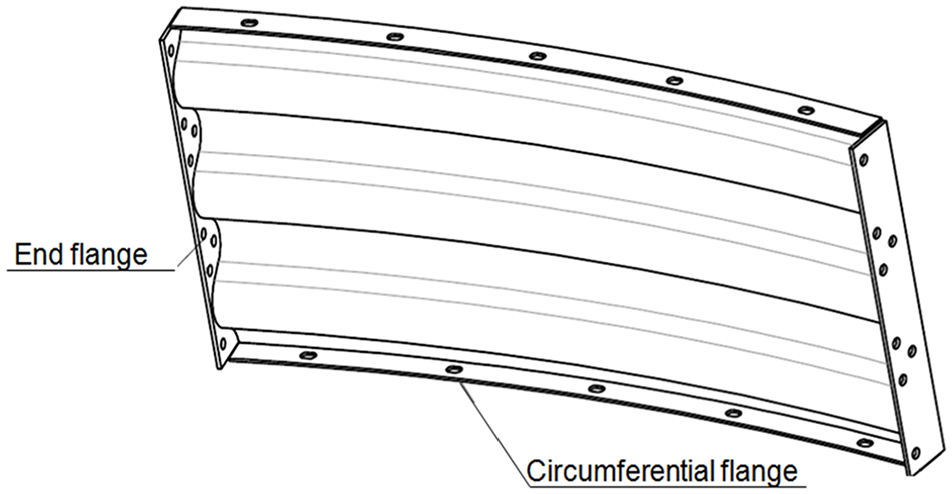
Connection diagram of corrugated steel plate.
The insulation layer is made of rigid polyurethane insulation material and self-foaming process on site. Rigid polyurethane has the characteristics of carbonized fireproof, flame retardant, high temperature resistance, small thermal conductivity, and low water absorption.
Brushing the waterproof layer on the secondary lining surface after disease treatment can effectively prevent water seepage from surrounding rock, protect the polyurethane insulation layer from water damage, improve the insulation effect, and prolong the service life.
Construction technology of polyurethane-corrugated steel plate insulation lining
Scope of application
Compared to the conventional anti-freezing technology that destroys the tunnel lining or drainage system, the installation of polyurethane-corrugated steel plate insulation lining is a permanent reinforcement of the tunnel without destroying the existing lining structure and drainage system conditions, with the elimination and eradication of disease, and it is convenient to install and remove. It is suitable for the treatment of single or several symbiotic diseases such as cracking, back voiding, insufficient strength, and leakage of water caused by frost heaving in the operation of railway tunnels in the seasonal frozen area.
Construction process
The construction process of polyurethane-corrugated steel plate insulation lining is shown in Figure 4.
(1) Dismantle and replace existing lighting lines, G wires and power cables.
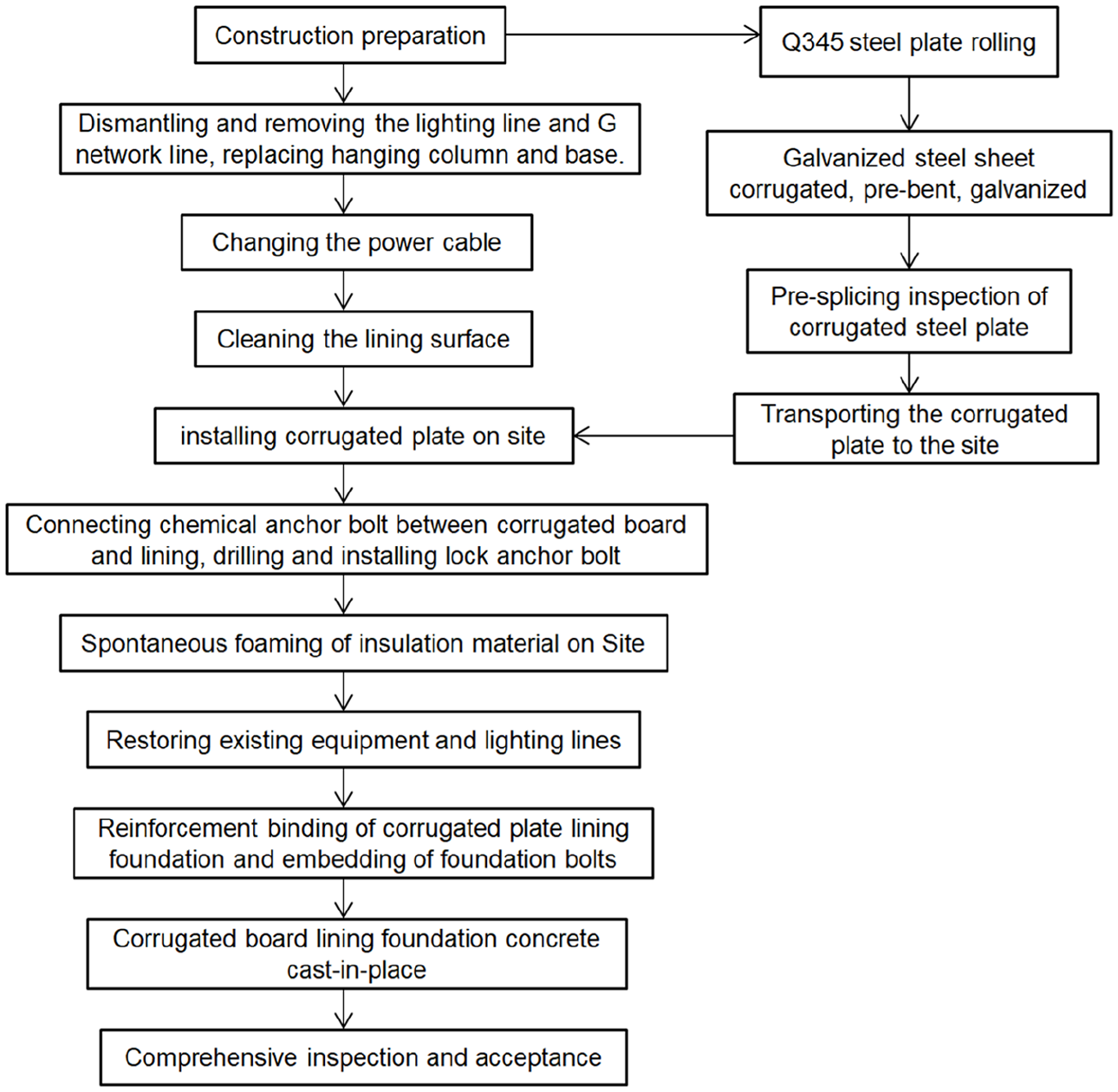
Flowchart of construction process.
There are a large number of operating facilities in the railway business line tunnel. The center line of the symmetric tunnel is distributed with contact cables, feeder lines, AF lines, reflux lines and contact net hanging columns, and reflux line bases (25 m, 2–4; see Figure 5).

G wire, lighting line, and existing equipment.
In order to ensure the installation of corrugated steel plates, the existing lighting lines, G wires and power cables are dismantled by means of artificially setting up the door-type scaffolding, and the movement is changed step by step according to the progress of the construction (recovering with the corrugated steel plate and then segment by section). For the AF lines hanging columns and reflux line bases which do not meet the safety distance, it should be replaced by lengthened component.
(2) The construction materials and tools, such as corrugated steel plate and polyurethane, are transported to the operation surface by using the self-made track plate electric vehicle for storage and use.
Before the corrugated steel plate is delivered to the construction site, the opening site is cleaned up, leveled and divided into areas to ensure that vehicles do not interfere with each other. The arrival corrugated steel plate is unloaded manually with cranes and forklifts, stacked in groups according to each ring, which can be overlapped and stacked for easy accessibility.
The corrugated steel plate in the tunnel is transported by forklift truck outside the tunnel and flat battery truck inside the tunnel. The corrugated steel plate is stored in the storage area on the trench cable at the construction face (additional protection on the side wall of the cable groove and storage material on the cover plate; see Figure 6).
(3) The self-designed door-type scaffolding matching the cross section of the business line is used as the construction platform.

Corrugated steel plate transportation and storage: (a) transportation of corrugated steel plate and (b) storage of corrugated steel plate.
The construction work platform is erected by door-type scaffolding. There are two types of scaffolding, and the dimensions are length × width × height = 180 cm × 121.9 cm × 193 cm and length × width × height = 180 cm × 121.9 cm × 91.4 cm. According to the measured size, the tie rods, pedals, etc. are modified, and the modified joints are welded firmly.
The scaffolding rack and the rail are separated by a 15 cm wide wooden board. On the one hand, it prevents the railroad from hitching between the racks and rails; on the other hand, it ensures that the spacing between the racks meets the requirements of vehicle width when the transport vehicle passes through. Skew braces are used as protective enclosures around the working platform on the top of scaffolding (see Figure 7).
(4) The corrugated steel plate is fixed by the self-made arch slide, the chemical anchor bolt and the high-strength bolt one by one, and the ring and the ring are stitched together. The gap between the secondary lining and the corrugated steel plate is filled with the polyurethane by using the foaming holes left on the corrugated steel plate (see Figure 8).
(5) The concrete is transported from the outside of the tunnel to the working surface by the self-made rail flat battery car, which is used as the base of insulation lining.
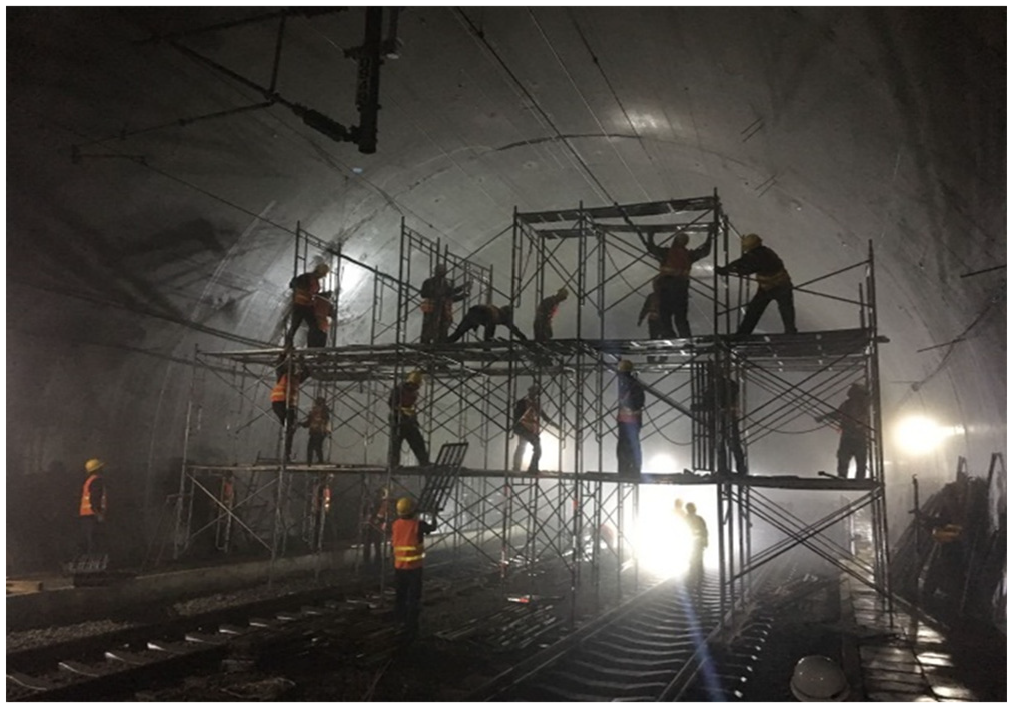
Erection of portal scaffold.
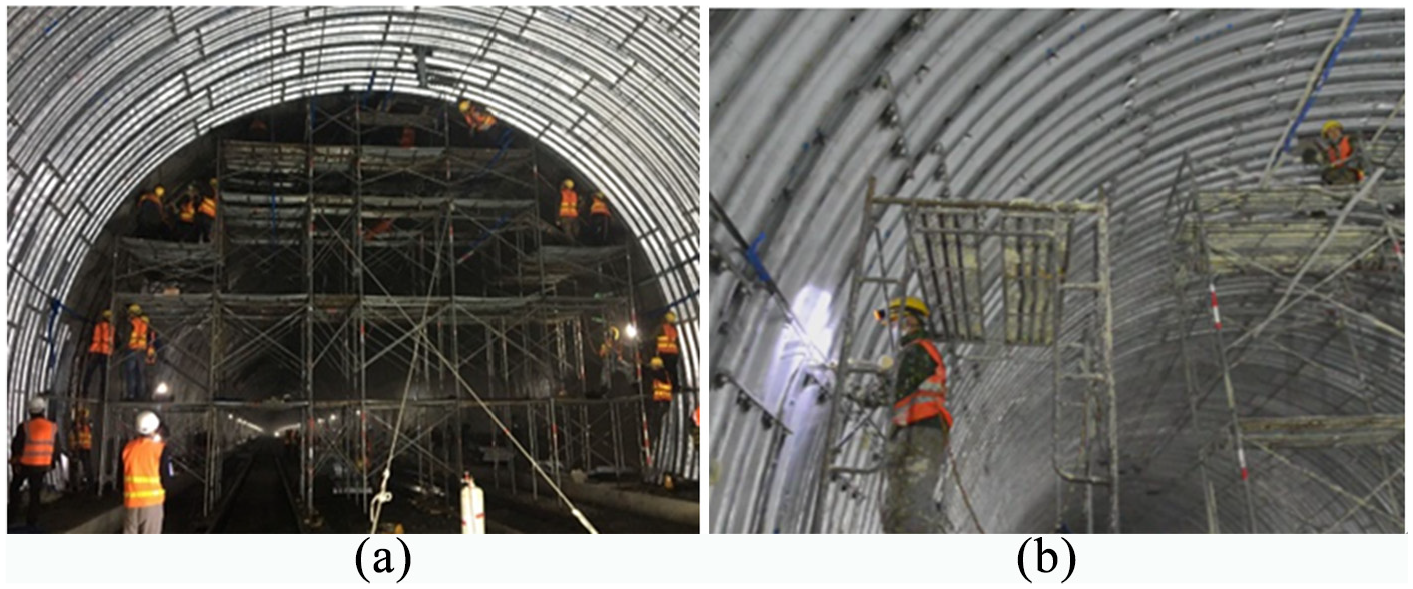
Installation of corrugated steel plate: (a) corrugated steel plate assembly and (b) polyurethane self-foaming construction.
The manpower pneumatic pick is used to chisel the bottom concrete of power cable trough. At the bottom of the original power cable trough, hand-held electric drill is used to drill every 30 cm (straight line must be guaranteed). Threaded steel is installed as the new and old concrete stubble reinforcement, and steel mesh with lining foundation is installed. The M20 anchor bolts are pre-embedded every 30 cm and welded firmly to the joint bars. After the installation of the anchor bolts and the steel bars is completed, the insulation lining base side molds (wood formwork) are installed and reinforced. The C35 18 commercial concrete is used, and the concrete tanker is transported to the outside of the wired net door, and the battery car is transported to the construction area, artificially poured, vibrated and compacted, and the flat surface is flat.
The form of polyurethane-corrugated steel plate insulation lining after construction is shown in Figure 9.

The form of polyurethane-corrugated steel plate insulation lining after construction.
Benefit analysis
As the railway tunnel is in operation, in order to ensure the normal operation of the tunnel, the construction time is that the train stops every night until the next morning, so the construction time is extremely tight. After the application of the rapid construction technology proposed in this paper, the construction efficiency is significantly improved. The initial construction speed is about 2 rings per day for each construction team. After the application of this technology, it is upgraded to 3–5 rings per day for each construction team. The actual construction period is 10 days ahead of the planned period, the cost is saved about 4.037 million yuan, and the economic benefit is obvious.
Engineering applications
Project overview
A passenger dedicated tunnel in Northeast China has a tunnel length of 3690 m, a span of 13.62 m, a height of 10.31 m, and a maximum buried depth of 283 m. The tunnel area belongs to the humid and semi-humid continental monsoon climate in the temperate zone of North Asia. The summer is short and warm, and the winter is long and cold. The annual average temperature is 4.0°C, the average temperature in January is −16.4°C, the average temperature in July is 22.9°C; the extreme maximum temperature is 36.3–37.7°C, and the extreme minimum temperature is −29.2∼–42.5°C. The maximum freezing depth is 1.92 m.
The groundwater in the tunnel area is mainly the Quaternary loose rock pore water and bedrock fissure water, and the upper part is stagnant water. The water level is generally 0.0 to 5.0 m, and the seasonal variation is 0.5–2.0 m. The annual average precipitation is 528–670 mm.
The tunnel opening is 500 m in the anti-freezing design section, the secondary lining is made of C40 reinforced concrete with a thickness of 60 cm; the remaining hole section is a non-antifreeze design section, and the secondary lining is made of C30 plain concrete with a thickness of 60 cm. The primary support of the anti-freeze design section is provided with a 5 cm thick polyurethane insulation layer and a waterproof board inside and outside the insulation layer.
Freezing damage on site
In the course of operation, there were several sections in the non-anti-freezing design section of the tunnel which have serious freezing damage to railway operation safety, such as lining cracking, seepage, bulging, void and falling blocks caused by frost heaving of stagnant water behind the lining (see Figure 10), which urgently needed effective remediation.

The lining of freezing damage: (a) lining frost heaving peeling, falling off and (b) lining frost heaving cracking.
Measures for freezing damage control
The serious damage of the tunnel is mainly considered from two aspects: water prevention and drainage and heat preservation. The main purpose of anti-drainage is to grout and seal and to add vertical blind insulation ditch for side wall. On the basis of anti-drainage, lining disease, a polyurethane-corrugated steel insulation lining is added to improve the surrounding rock temperature behind the lining to prevent stagnant water.
Design of polyurethane-corrugated steel plate insulation lining
The waterproof layer is made of a polyurethane waterproof coating with a thickness of 2 mm. Corrugated steel plate is used as safety reserve. The model is CSPD400/Q345, 19 the wave distance is 300 mm, the wave depth is 110 mm, the radius is 70 mm, and the thickness of the plate is 6 mm. The cold rolled galvanized corrugated steel plate is adopted, and the thickness of hot dipped zinc on the surface is not less than 84 μm. The size of the single corrugated steel plate is 0.954 m (longitudinal) × 1.95 m to 3.14 m (circumferential), and the weight of the single corrugated steel sheet is 164 kg to 266 kg.
The insulation layer is made of spontaneous foaming rigid polyurethane thermal insulation material, the thickness of which is determined according to the Thermal Design Code for Civil building, 20 and the thermal resistance calculation is carried out according to formula (1).

In the formula, R—thermal resistance, m2k/W; δ—thickness, m; λ—thermal conductivity, W/(mk)
The thermal conductivity of the surrounding rock in the site of freezing damage is 1.36, the thermal conductivity of the lining is 1.50, and the thermal conductivity of the rigid polyurethane insulation is 0.025.
The thermal resistance of the surrounding rock within the maximum freezing depth range is:

The thermal resistance of the lining (primary support and secondary lining) is:

Therefore, the thickness of the rigid polyurethane insulation material required is:

Considering the long-term insulation effect of the polyurethane-corrugated steel insulation lining, the extremely low temperature weather that may occur and the ease of construction, the thickness of the rigid polyurethane insulation material is 0.05 m.
Site temperature test of freezing damage remediation section
In order to test the effect of freezing damage, the temperature test section was set on the left wall of K348 + 670, K348 + 820, K349 + 020, K349 + 262 and K349 + 450 in the freezing damage remediation section, mainly testing the internal temperature of the inner environment of the cave, inner surface of the secondary lining (the contact surface of the secondary lining and the insulation lining), outer surface of the secondary lining (the contact surface between the secondary lining and the primary support) and surrounding rock(setting three measuring points from the primary support 30, 60, 90 cm), as shown in Figure 11(a). Pt100A temperature sensor with a temperature range of −200°C to +850°C was selected, as shown in Figure 11(b).
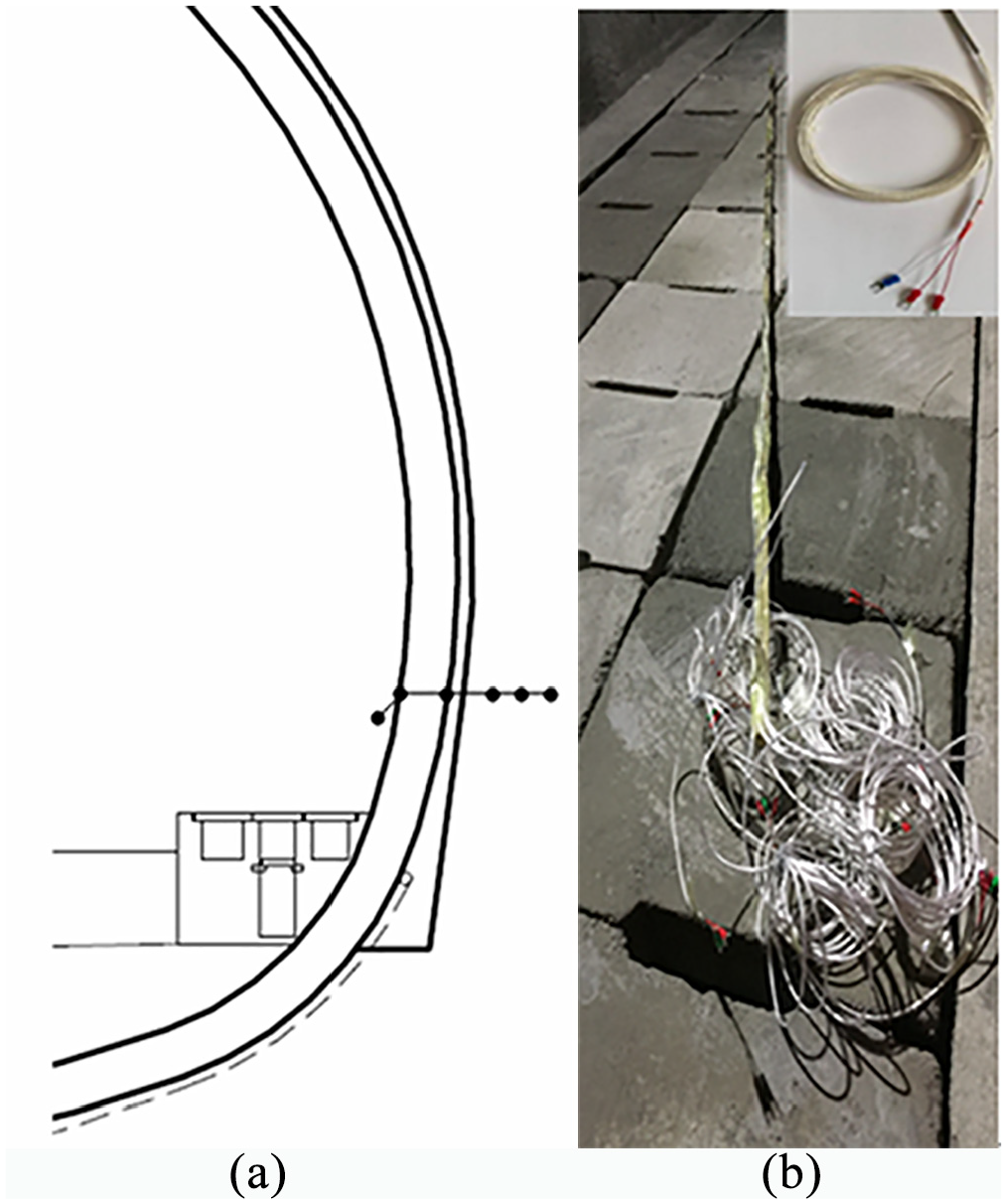
Field thermal testing: (a) measuring point arrangement and (b) temperature sensor.
Taking the K348 + 820 and K349 + 262 sections as examples, the temperature test results of six different monitoring time are extracted, as shown in Table 1. The radial variation of tunnel temperature at each monitoring section is plotted at different times, as shown in Figure 12.
The results of temperature test.


The temperature of measuring points at each monitoring section: (a) K348 + 820 and (b) K349 + 262.
It can be seen from Table 1 and Figure 12 that under the natural temperature outside the tunnel from −18°C to −22°C in winter of 2018–2020, the temperature of the interface between surrounding rock and lining of the tunnel monitoring sections are all above 0°C. The temperature of the outer surface of the secondary lining is higher than 2.7°C, which can avoid the frost heaving of stagnant water behind the tunnel lining and effectively ensure the smooth drainage in winter. Therefore, according to the field application and the heat preservation effect test, it is effective to use the polyurethane-corrugated steel plate insulation lining for the freezing damage treatment in the severely damaged section of the railway.
Conclusions
In order to deal with the severe freezing damage of railway tunnels in the seasonal frozen area, this paper proposes a polyurethane-corrugated steel insulation lining, which is mainly composed of corrugated steel plate, polyurethane insulation layer and waterproof layer. It has the advantages of fast construction speed, good heat preservation effect, prevention of concrete peeling off blocks, convenient removal and replacement, etc.
Compared to the conventional anti-freezing technology that destroys the tunnel concrete or drainage system, the installation of polyurethane-corrugated steel plate insulation lining is a permanent reinforcement of the tunnel without destroying the existing lining structure and drainage system conditions, with the elimination and eradication of disease. It is suitable for the treatment of single or several symbiotic diseases such as cracking, back voiding, insufficient strength, and leakage of water caused by frost heaving in the operation of railway tunnels in the seasonal frozen area.
After the application of the polyurethane-corrugated steel insulation lining, it is upgraded from 2 rings to 3–5 rings per day for each construction team. The actual construction period is 10 days ahead of the planned period, the cost is saved about 4.037 million yuan, and the economic benefit is obvious.
A non-anti-freezing design section of a passenger-dedicated tunnel is seriously damaged by freezing, and the polyurethane-corrugated steel insulation lining is used for remediation. The on-site temperature test shows that under the condition of natural temperature outside the hole −18∼–22°C, the temperature of the surrounding rock in the frozen section of the tunnel was positive temperature, the temperature of the interface between the secondary lining and the primary support was more than 2.7°C. Therefore, the insulation effect of the polyurethane-corrugated steel insulation lining is obvious.
Footnotes
Acknowledgements
The authors would like to thank the experts and scholars who gave us valuable suggestions in the process of writing this manuscript.
Author contributions
Guangyao Cui proposed the theoretical and experimental scheme, Xuelai Wang processed the data and wrote the first draft of the manuscript, and Guangyao Cui reviewed the manuscript finally.
Declaration of conflicting interests
The author(s) declared no potential conflicts of interest with respect to the research, authorship, and/or publication of this article.
Funding
The author(s) disclosed receipt of the following financial support for the research, authorship, and/or publication of this article: This work was supported by the < National Natural Science Foundation of China> under Grant [Nos. 51408008 and 51478277].
