



Abstract
Dynamic forces are very important boundary conditions in practical engineering applications, such as structural strength analysis, health monitoring and fault diagnosis, and vibration isolation. Moreover, there are many applications in which we have found it very difficult to directly obtain the expected dynamic load which acts on a structure. Some traditional indirect inverse analysis techniques are developed for load identification by measured responses. These inverse problems about load identification mentioned above are complex and inherently ill-posed, while regularization methods can deal with this kind of problem. However, most of regularization methods are only limited to solve the pure mathematical numerical examples without application to practical engineering problems, and they should be improved to exclude jamming of noises in engineering. In order to solve these problems, a new regularization method is presented in this article to investigate the minimum of this minimization problem, and applied to reconstructing multi-source dynamic loads on the frame structure of hydrogenerator by its steady-state responses. Numerical simulations of the inverse analysis show that the proposed method is more effective and accurate than the famous Tikhonov regularization method. The proposed regularization method in this article is powerful in solving the dyanmic load identification problems.
Introduction
It is well known that dynamic forces are very important boundary conditions in practical engineering applications, such as structural strength analysis, health monitoring and fault diagnosis, and vibration isolation. However, dynamic load identification theory in practical engineering is always very necessary and important in many cases. If dynamic load is exactly obtained, it is possible to exploit various advanced methods to ensure the safety and the reliability of engineering structures and to satisfy the requirement of modern industry. Moreover, there are many applications in which we have found it very difficult to directly obtain the expected dynamic load which acts on a structure. Therefore, it is very necessary and valuable to develop some indirect inverse analysis techniques for load identification by measured response. 1
In the subject of structural dynamics, many experts exploited the frequency response functions of the structure to solve the force identification problems in the 1980s.2–6 Chun et al. 7 identified the flight loads of an aircraft, exploiting the singular system theory to deal with the ill-posedness of the transfer function matrix. Thite and Thompson 8 presented the minimum condition numbers and sensor placement criterion for solving the force identification problem. Jiang et al. 9 eased the ill-posed problem of force identification using a weighted condition number method. Liu and Shepard 10 adopted the singular value decomposition (SVD) method to locate the small singular value affected by the noisy response. Liu and colleagues11,12 presented an inverse procedure for identifying both concentrated and extended line load using Green’s function and Heaviside step function in time domain. Lourens et al. 13 developed an augmented Kalman filter method for solving inverse problem of load identification in practical engineering structure. Zhang and Ohsaki 14 exploited the optimal method to identify the member forces in a prestressed pin-jointed structure. Unfortunately, these inverse problems mentioned above are complex and inherently ill-posed. In addition, it is impossible to directly measure distributed dynamic loads acting on the engineering structure. However, we sometimes need to know the expected distributed dynamic loads which act on the engineering structure. Moreover, regularization methods can well deal with these difficulties in practical engineering structure. So far, many regularization methods have been developed to solve these ill-posed phenomena.15,16 However, most of these methods are only limited to solve the pure mathematical numerical examples without application to practical engineering problems, and they should be improved to exclude jamming of noises in engineering. In order to solve these problems, a new regularization method is presented in this article to investigate the minimum of this minimization problem and applied to reconstructing multi-source dynamic loads on the frame structure of hydrogenerator by its steady-state responses.
This article is organized as follows. The determinate forward problem for a linear elastic structure is briefly introduced in section “Description of the forward problem.” In section “Reconstruction theory of distributed dynamic loads,” the regularization theory for load identification is detailedly analyzed; a new regularization method is established, and its validity and stability are strictly proved. The proposed method is applied to dynamic load identification of the frame structure of hydrogenerator in section “Application,” and we give a conclusion in section “Conclusion.”
Description of the forward problem
In order to assess the proposed method for use in reconstructing the expected unknown multi-source dynamic loads which act on the frame structure of hydrogenerator, it is very necessary for us to learn the following theory for a linear elastic structure.
For a linear and time-invariant dynamic system, we investigate the multi-source dynamic load identification problem. The response at an arbitrary receiving point in a structure can be expressed as a convolution integral of the forcing time-history and the corresponding Green’s kernel in time domain11,12,17–19

where
Exploiting the discretization of this convolution integral, we separate the whole concerned time period into equally spaced intervals and transform equation (1) into a matrix form of

or equivalently
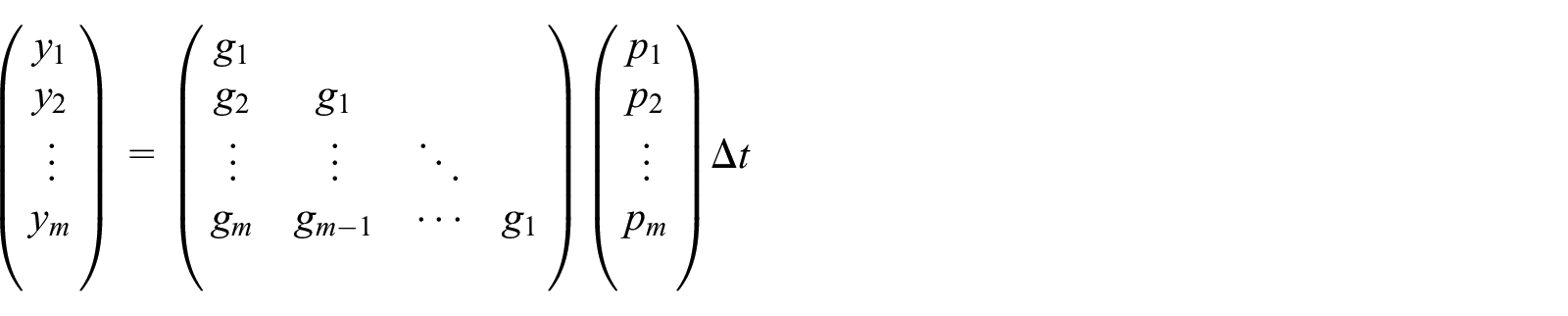
in which
When the structure without applied force is static before force is applied,
To reconstruct the time history
Reconstruction theory of distributed dynamic loads
Usually, we exploit regularization methods to deal with ill-posed inverse problems, using the minimization of the discretization error, the data error and the round-off error. In addition, when we solve inverse problems about load identification in practical engineering structure, we will encounter bad results. Especially, the identified dynamic loads are very sensitive to the error of the output response which causes large error for the true solution in solving inverse problems without any regularization method. Therefore, we cannot deconvolute it by traditional direct inverse matrix method. In general, we adopt regularization methods to seek the expected solution which is numerically stable and efficient solution.
Considering the measured response is noisy, equation (2) can be transformed into the following equation

where

where

From equation (5), we can easily find that system equation (2) is ill-conditioned because the singular value

When the regularization operator is given by

the corresponding regularization method is just the famous Tikhonov regularization method. Its corresponding regularized solution is

In fact, many experts have studied ill-posed problems which have attracted much attention in science and engineering.20,21
Let

Throughout this article, we assume

where
Then, we will need to solve

If

where the regularization parameter and the singular value will always be defined by

Theorem
Let


If the following conditions hold
1.
2. For any

3.
We can easily obtain that equation (1) has unique solution

Since
Next, we will propose a new regularization method based on new regularization operator, and prove its stability and regular property. Herein, we define

Actually, it is not difficult to check that: the function

First, it follows from

that
Second, it is also easy to obtain that

In the following, we will show
First of all, we construct the following function

Since
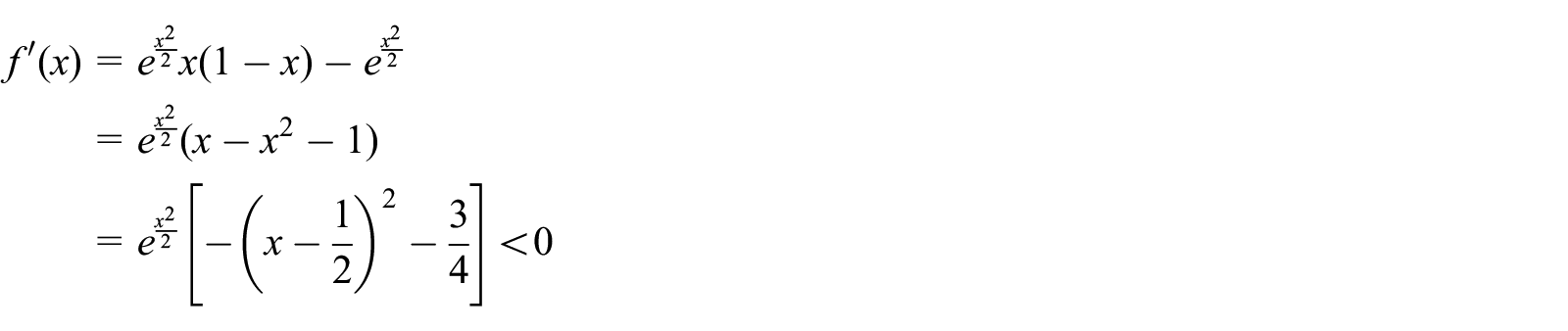
we have that the function
Due to

we have

then we immediately complete the proof of the two results above.
According to theoretical analysis above, we can obtain the good approximate solution

where

Application
Dynamic load identification of hydrogenerator frame structure as shown in Figure 1 is investigated. Its corresponding practical engineering problem is to reconstruct the vertical loads which act on hydrogenerator frame structure. The material properties of the plate are as follows:

where

The FEM model of the frame structure of hydrogenerator.

The vertical concentrated sine load acting at node 167010.

The vertical concentrated triangle load acting at node 109870.
We simulate the experimental data of measured response, using computational numerical solution. It can be easily obtained by the traditional finite-element method. The corresponding vertical displacement responses at nodes 166510 and 109710 are, respectively, shown in Figures 4 and 5. Moreover, in order to simulate the noise-contaminated measurement, we directly add a noise to the computer-generated response and define the noisy response as

in which

The corresponding vertical displacement response at node 166510.
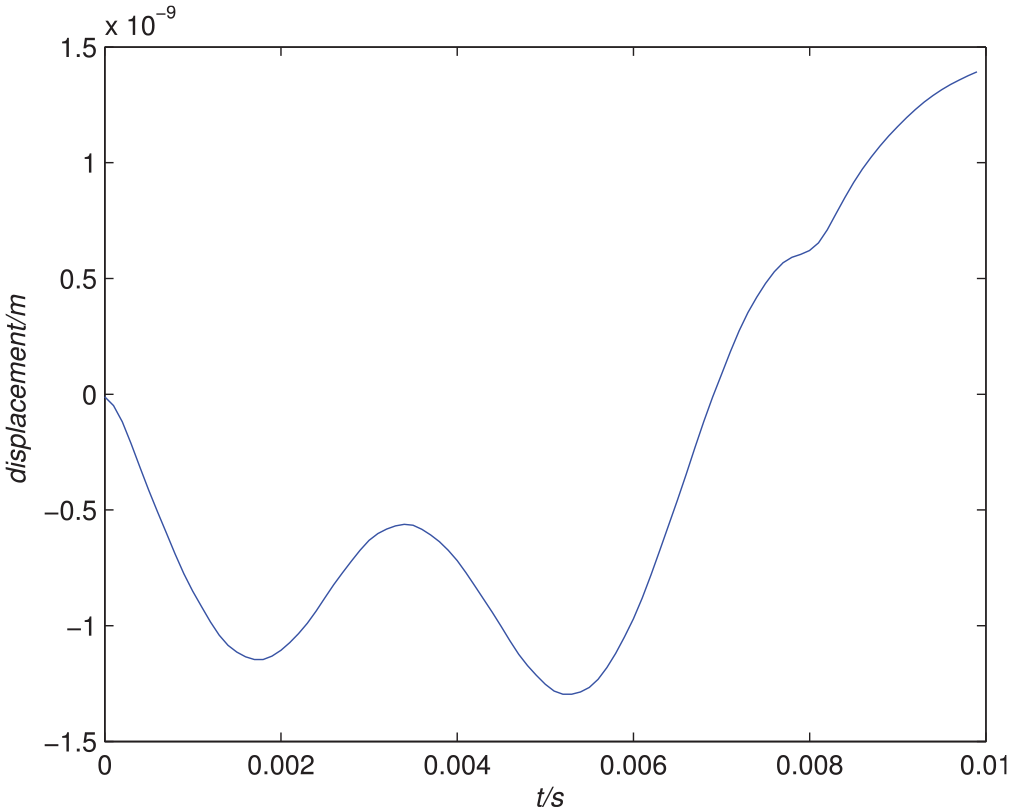
The corresponding vertical displacement response at node 109710.
Next, the effect of measurement error on the accuracy of estimated values is studied by considering the case of noise level

and the average error

where
To assess the stability and effectiveness of the proposed method and Tikhonov regularization method, we just select five time points. Moreover, we will compare the identified load and the corresponding true force for each point.
Numerical performances of the proposed method are given as follows: The proposed new regularization method (MRO) and the famous Tikhonov regularization method can both provide the stable and effective dynamic loads that act on the hydrogenerator frame structure, which can be shown in Figures 6 and 7. In addition, Table 1 shows more detailed results about the identified loads at five time points. From this table, we can find that most identified deviations by the famous Tikhonov regularization method are not greater than the proposed regularization method under the noise level

The identified sine force at noise level
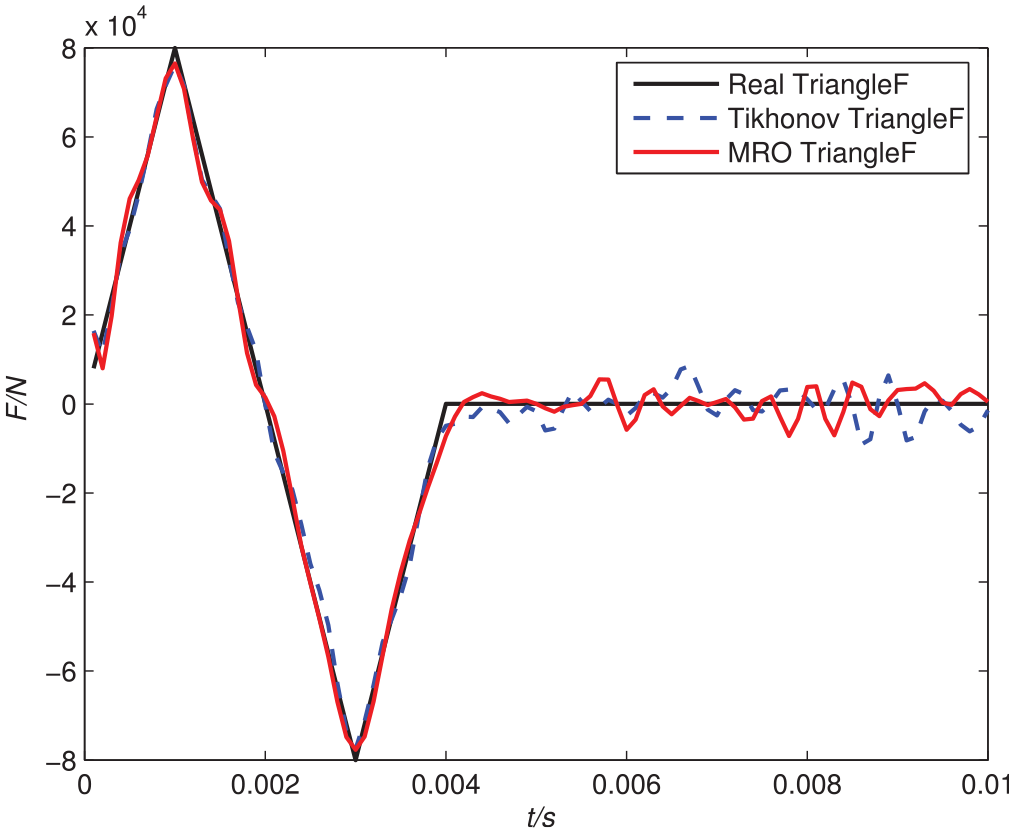
The identified triangle force at noise level
The identified force at five time points at noise level

Conclusion
A new regularization method is proposed in this article, which is based on an improved regularization operator. It is applied to multi-source dynamic load identification of hydrogenerator frame structure. It has been found from the numerical simulations that the proposed method has better identified results than the famous Tikhonov regularization method in reconstructing the expected dynamic loads which act on the hydrogenerator frame structure. This shows that the proposed new regularization method can stably and effectively provides better solution in solving the load identification problems of practical engineering.
Footnotes
Declaration of conflicting interests
The author(s) declared no potential conflicts of interest with respect to the research, authorship, and/or publication of this article.
Funding
The author(s) disclosed receipt of the following financial support for the research, authorship, and/or publication of this article: This work was supported by the National Natural Science Foundation of China (grant no. 51775308), the Open Fund of Hubei key Laboratory of Hydroelectric Machinery Design and Maintenance (grant no. 2019KJX12), and the Research Fund for Excellent Dissertation of China Three Gorges University (grant no. 2019SSPY046).
