




Abstract
The Social Solidarity Economy (SSE) plays a crucial role in the lives of People of African Descent (PAD). The SSE is where PAD find refuge and meet their socioeconomic needs. It also enables them to actively contribute to the economy and societies. However, the endeavors and contributions of PAD in the SSE have not been well recognized or documented, especially in the context of Europe. The purpose of our study was to fill this knowledge gap by mapping the SSE organizations (SSEOs) of PAD in Europe. To do so, informed by the Diverse Economies Theory, we employed a systematic scoping review method through which we identified and examined 109 previous studies. The results showed the existence of 24 specific types of SSEOs owned by 21 different PAD communities in 17 European countries. The results also revealed that these organizations engaged in all sectors of the economy, producing goods, services, and knowledge, and making multifaceted contributions to the economy and societies in both the host and origin countries. Given their contributions, governments and other stakeholders should support these organizations in terms of recognizing their existence and contribution, collaborating and cocreating with them, and helping them address their major challenges including funding-related problems and discrimination.
Keywords
Introduction
In this article, we present and discuss the major results of our systematic scoping review on the Social Solidarity Economy Organizations 1 (SSEOs) of People of African Descent (PAD) in Europe. As can be inferred from the above, the research target group (population for the review) is PAD in Europe. We define the term PAD comprehensively as “consisting of people of African origin living outside the continent, irrespective of their citizenship and nationality” (African Union [AU], n.d.). This definition covers all African emigrants and their descendants living outside the continent, including those with, for example, North African, South American, and Caribbean backgrounds.
Even though largely untold, PAD have a long and rich history in Europe, dating back to ancient times such as the Roman Empire. For instance, prominent PAD figures in the Roman Empire included Septimius Severus who served as emperor from 193 to 211; the legendary Saint Maurice who was a military leader in the third century (Otele, 2020); and the philosopher Saint Augustine who lived in the years 354 to 430 (Tornau, 2019).
Currently, the total number of PAD in Europe is unknown because of, among others, the lack of official data on “race” and ethnicity in many European countries (European Network Against Racism/ENAR, 2015). However, based on our definition of PAD and a review of the literature, we estimate that a total number of 15–20 million PAD live in Europe (ENAR, 2015, 2018; H.Res.256, 2019; Migration Data Portal, 2022), which has a total population of more than 742 million (Worldometer, 2023) in 45 countries including Russia and Turkey (United Nations/UN, n.d.a). This means PAD constitute approximately 2%–3% of the population in Europe. Most PAD in Europe live in major Western European countries such as France, the UK, Germany, Italy, Spain, and the Netherlands (ENAR, 2015).
PAD are one of the most marginalized groups in Europe and the world. They disproportionately suffer from the multiple economic, social, and ecological crises created and exacerbated by the dominant global economic system, that is, racial capitalism (Melamed, 2015; Robinson, 1983/2000). They face widespread racism, harassment, and structural discrimination in various spheres of life such as the justice system, education, healthcare, housing, employment, and business (ENAR, 2018; European Union Agency for Fundamental Rights/FRA, 2023; UN, n.d.b). Nonetheless, PAD do not remain passive when faced with such problems. To cope with and fight against the problems, they self-organize and engage in the SSE of PAD, which can be considered as a subset of the broader SSE (Hossein, 2013, 2018a, 2019; Hossein et al., 2023). The SSE encompasses enterprises, organizations and other entities that are engaged in economic, social, and environmental activities to serve the collective and/or general interest, which are based on the principles of voluntary cooperation and mutual aid, democratic and/or participatory governance, autonomy and independence, and the primacy of people and social purpose over capital in the distribution and use of surpluses and/or profits as well as assets. (International Labor Organization/ILO, 2022, para. 5)
2
The SSE is believed to contribute to sustainability transformation and the emancipation of marginalized communities. The SSE plays a key role in achieving Sustainable Development Goals (SDGs) such as no poverty; gender equality; decent work and economic growth; industry, innovation, and infrastructure; reduced inequalities; responsible consumption and production; peace, justice, and strong institutions; and partnerships for the SDG goals (Elsen, 2018; UN Research Institute for Social Development [UNRISD], 2016). For example, the European Commission (2023) recognizes SSEOs as contributors to “the EU's employment, social cohesion, regional and rural development, environmental protection, consumer protection, agricultural, third countries development, and social security policies.” This is not surprising given that there are around 160 million people who are members of SSEOs in Europe. In the EU alone, there are some 2.8 million SSEOs, representing 10% of all businesses and employing some 13.6 million people (around 6.2% of the EU's employees). Furthermore, SSEOs in the EU mobilize a large number of volunteers, whose size is equivalent to 5.5 million full-time workers (European Commission, 2023).
The SSE also holds immense significance for PAD. The SSE is where PAD find refuge and meet their fundamental needs. In addition, the SSE is where PAD make significant contributions to the economy and society through their own SSE. According to Hossein and her colleagues, the SSE of PAD is in fact a politicized activity in which PAD co-opt resources and collectively organize to meet their needs and counteract exclusion in business and society (Hossein, 2013, 2017b, 2018a, 2018b, 2019; Hossein et al., 2023).
Even though PAD are active participants in the SSE, their endeavors in and contributions to the SSE have not been well recognized and documented (Hossein, 2018b, 2019), especially in the context of Europe (Tadesse, 2020). Furthermore, the SSE literature has largely neglected informal organizations that are common among PAD (Hossein & Skerritt, 2018) and failed to sufficiently incorporate analyses or theories from PAD thinkers (Hossein, 2018b, 2019). These gaps show that there is a need for studying the SSE of PAD. Although it is in its infancy, such an effort has been initiated in the Americas by PAD scholars such as Hossein (2013, 2017b, 2018a, 2018b, 2019), who primarily focused on Rotating Savings and Credit Associations (ROSCAs) and Nembhard (2014), who primarily emphasized cooperatives. However, a similar effort has been lacking in Europe. Our study seeks to address these knowledge gaps by building upon the works of the above-mentioned (and other scholars) and covering all the diverse types of SSEOs of PAD in Europe. Accordingly, the purpose of our study is to explore the overall state of research and knowledge regarding the nature of SSEOs of PAD in Europe and to systematically map the evidence.
Theoretical Framework
Our study, which aims to explore and map the SSEOs of PAD in Europe, is informed by four related theoretical perspectives, that is, the concept of Racial Capitalism (Robinson, 1983/2000), Stratification Economics and Global Migration (Obeng-Odoom, 2022), the Diverse Economies Theory (Gibson-Graham, 1996), and the SSE (Elsen, 2018; Utting, 2015). These theoretical perspectives have similarities and differences. Their main similarity is that they critique capitalism or the “capitalocentric” worldview and practices as the main causes of various crises. Their main difference lies in the way they conceptualize the economy. While the theories of Racial Capitalism and Stratification Economics consider the economy as a system (i.e., racial capitalism), the other two, especially the Diverse Economies theory consider the economy as practices that are diverse. Despite their differences, we use them together as they can provide us with unique insights regarding the different aspects of our research topic. For example, the concept of Racial Capitalism and its recent development in the context of Stratification Economics and Global Migration helps us see the relationship between PAD and the hegemonic capitalist economy (i.e., the racial nature of capitalism) as well as understand the experiences of PAD in Europe and around the world (Obeng-Odoom, 2022; Robinson, 1983/2000). The Diverse Economies theory helps us see the big picture regarding the economy (i.e., its diversity) and encourages us to read the economy for difference and do an inventory of diverse economic practices (Gibson-Graham, 1996). The SSE helps us see alternative and sustainable ways of organizing the economy and informs us about what should be counted as SSEOs (Elsen, 2018; OECD, 2023; UNRISD, 2016; Yi, 2023). Below, we briefly discuss these theoretical perspectives.
Racial Capitalism
The concept of Racial Capitalism, which is made popular by the African American political scientist Cedric J. Robinson, considers the economy as a system that extracts social and economic value from marginalized “racial” identities, especially PAD. This theory argues that the economy cannot be viewed separately from the historical and political contexts of racialization. According to this theory, capitalism is a racialized mode of production and capital accumulation that has been dependent on multiple forms of racial violence including genocide, slavery, colonization, apartheid, and imperialism. This theory exposes how “race” has been used to rationalize the domination, exploitation, or extermination of racialized groups such as PAD (Robinson, 1983/2000). According to Melamed, “racism enshrines the inequalities that capitalism requires” to accumulate capital and stay alive. As we can see in our daily lives, conventional racial domination has continued with updated forms such as migrant exploitation, mass incarceration and criminalization of PAD, and neocolonialism (2015).
The concept of Racial Capitalism has been extended by, among others, the recent development in relation to stratification economics and global migration, enabling us to better understand the institutional, evolutionary, and racialized experiences of PAD in Europe and around the world.
Stratification Economics and Global Migration
Stratification Economics is a subfield of economics that examines how social stratification along the lines of race, ethnicity, gender, class, caste, sexuality, nationality, and so forth. affects economic outcomes. Unlike mainstream economics, which focuses on human capital or market competition, stratification economics underlines the significance and role of social relationships, power dynamics, and public policies in creating and maintaining economic inequalities (Obeng-Odoom, 2022).
In his study and book titled Global Migration beyond Limits: Ecology, Economics, and Political Economy, Obeng-Odoom (2022) has made the most extensive application of the Stratification Economics approach to migration at global level by synthesizing the original Institutional Economics 3 and Stratification Economics, while stressing the special importance of land (along with labor, capital, and the state) and its “role in producing and maintaining inequalities and stratification in income and wealth and in serving as a means of control, discrimination, and privilege.”
This new framework demonstrates how Racial Capitalism, characterized by slavery, colonialism, imperialism, neo-colonialism, and various forms of violence, is the main cause of (a) the historical and current global migration of PAD to Europe (and other regions like the Americas) and (b) the racialized (harmful) experiences of PAD (e.g., discrimination, wealth, and power inequality) in their host countries in Europe and other regions (Obeng-Odoom, 2022). Obeng-Odoom asserts that much of the crisis of migration and sustainability can be understood as a reflection of global cumulative stratification, reflected at different scales in the global system. […] It is an expression of the political-economic system in which socially created value is privately appropriated as rents by a privileged few who use institutions such as land and property rights, race, ethnicity, class, and gender to keep others in their place. (2022)
To provide specific examples in relation to the global migration of PAD, let us further discuss slavery, colonialism, and neo-colonialism. The transatlantic slave trade was one of the biggest forced migrations and forced extraction of labor in history. It is also the greatest transfer of a labor force from one continent to another. Approximately 10–12 million Africans were removed from Africa over five centuries (Apata, 2022; Rodney, 1972/2018; Tadesse & Obeng, 2023). Slavery was replaced by colonialism later as racial capitalism “switched the system around from labor to land, through territorial conquest and sovereign control […] Colonialism was the appropriation of territory and the subjugation of a people within their territory” (Apata, 2022). As Rodney puts it “When the citizens of Europe own the land and mines of Africa, this is the most direct way of sucking the African continent” (1972/2018). Slavery and colonialism are currently replaced by a subtle “liberal” world order of free trade and neo-colonialism, maintaining the impoverishment of Africa (Rodney, 1972/2018) and other countries with PAD population through the global economic structures (aid, debt, monopoly buying structures, and free trade agreements); global economic institutions (International Monetary Fund, World Bank, World Trade Organization); economic ideologies (e.g., the doctrine of comparative advantage); and political and military interventions (Nicholas, 2015/17; Tadesse & Obeng, 2023). The forced extraction of labor (e.g., in slavery) as well as land and other resources (e.g., in colonialism and neo-colonialism) are the main reasons for the underdevelopment of Africa (where people are now emigrating from) and the development of other regions such as Europe and North America (which are now the main host regions of PAD) (Apata, 2022; Obeng-Odoom, 2022; Rodney, 1972/2018; Tadesse & Obeng, 2023).
Racial Capitalism does not stop at causing the emigration of PAD from their origin countries. It continues to harmfully affect their experience even when they are living in capitalist societies (such as European and North American countries). Whether as asylum seekers, refugees, international students, labor migrants, permanent residents, or citizens, PAD face racial harassment, violence, and profiling; negative stereotypes (being portrayed as uncivilized, lazy, parasitic, incapable of innovation and creativity, incapable of contributing and competing, or culturally incompetent); discrimination in different social institutions and sectors (e.g., education, work, housing, health, media, religion, the criminal justice system, and the political system); exploitation (e.g., exploitation of temporary immigrants and prisoners); and inequalities in income, wealth, power, and wellbeing as a result of their identities (i.e., for being PAD or migrants, or both), which remain largely persistent (ENAR, 2018; FRA, 2023; Obeng-Odoom, 2022; UN, n.d.b).
Despite facing the above-mentioned racism-based challenges, PAD, like any other immigrant communities, transform their host countries. According to Obeng-Odoom, overall, migrants can, and often do, transform the spaces they occupy in ways that make a positive and lasting contribution to the host economy and to society more generally. Contrary to the view that minorities need to mix with whites to learn the ways of civility […], migrants themselves bring along ways of life, labor, and innovation that are transforming. (2022)
Obeng-Odoom also showed that “migrants have contributed mightily [not only] to local vitality [but also to] global prosperity” (2022). Such contributions can be seen in relation to the theories and practices of diverse and community economies (Gibson-Graham, 1996, 2006; Gibson-Graham et al., 2013; Gibson-Graham & Dombroski, 2020) and SSE (Elsen, 2018; Hossein, 2018b; Nembhard, 2014; OECD, 2023; UNRISD, 2016; Yi, 2023).
The Diverse Economies Theory
The diverse economies theory, which is based on the works of feminist economic geographers Gibson-Graham and their colleagues, argues that the economy is diverse and not just the “capitalocentric” practices like wage labor, commodity markets, capitalist enterprises, private property, and market finance. The “capitalocentric” practices are what we mostly see and consider as the economy as they are like the tip of an iceberg. However, in reality, the economy includes not only capitalist practices but also more-than-capitalist and non-capitalist practices within the different axes of the economy, that is, transaction, labor, enterprise, property, and finance. In fact, according to this theory, the majority of economic practices can be categorized as more-than-capitalist and non-capitalist practices, hidden below the waterline of the iceberg. This theory underlines the importance of adopting a weak theory (as opposed to determinism) and thick description as well as the need for reading “the economy for difference rather than dominance” and the inventory diversity within each dimension of the economy. Doing so helps destabilize the dominance of capitalist practices and encourages economic experimentation and transformation (Gibson-Graham, 1996, 2006; Gibson-Graham et al., 2013; Gibson-Graham & Dombroski, 2020).
Since the purpose of our study is to explore SSEOs of PAD, our reading for differences will emphasize the dimension of enterprise (i.e., the class process of surplus production, appropriation, and distribution). Doing so is indispensable since enterprise is the locus of economic activity (Cameron, 2020). Furthermore, doing an inventory of SSEOs is itself a performative aspect of research since it makes visible existing ethical economic practices and helps show the multitude of possibilities for fostering ethically oriented community economies and bringing about transformation (Cameron & Gibson-Graham, 2022).
The SSE
The SSE, which shares commonalities with the diverse and community economies advocated by Gibson-Graham and their colleagues, can be considered as a movement and a theoretical perspective that offers ideas and practices for alternative and sustainable ways of organizing the economy. Unlike conventional neoclassical/neoliberal economics which is based on pre-analytic visions (assumptions) such as self-interested individuals and an autonomous market economy functioning as an independent whole system, the SSE is based on pre-analytic visions that consider the economy as an open/interdependent subsystem and a social construct which can be shaped and reshaped. At the heart of the SSE is the vision of re-embedding economic activities into social, cultural, and ecological contexts to create an economy that supports people and the planet and is life-serving instead of life-threatening (Elsen, 2018; Utting, 2015).
In the SSE, organizations engage in economic activities producing goods, services, and knowledge to meet the needs of their members and communities by emphasizing and balancing social, economic, and environmental objectives. They have principles that revolve around voluntary association and self-organization; self-management and democratic governance; collective action and active citizenship; cooperation and solidarity; and autonomy from the state and profit-maximizing business/marketization. They strive to be more people-centered and environmentally sensitive by emphasizing ethics in economic activities and decisions. Their objectives, activities, and organizational cultures make them unique and indispensable. They help decommodify economic activities, generate social capital, make community resilience to crises, and promote inclusion and well-being for all including PAD (Elsen, 2018; ILO, 2009; UNRISD, 2016; Utting, 2015).
Methods
Our study employed a systematic scoping review method, which is an iterative literature review process that aims to comprehensively cover previous studies on a particular topic and attain in-depth and broad results. We utilized this research method because little was known about the SSEOs of PAD in Europe, and therefore, there was a need to (a) explore the extent, range, and nature of research activities/knowledge in this domain of research and (b) compile and synthesize such knowledge in a systematic way (Arksey & O’Malley, 2005; Peters et al., 2020; Xiao & Watson, 2019).
We prepared a detailed review protocol following the PCC (Population, Concept, Context) framework recommended by the Joanna Briggs Institute (JBI) (Peters et al., 2020) and the five key stages of a scoping review suggested by Arksey and O’Malley (2005). We used the PCC framework to help us pinpoint our research concepts/terms, information retrieval sources, and search strategies. Accordingly, we specified PAD as the Population, SSE and its various entities (SSEOs) as the Concept, and Europe as the Context. We then implemented the following five key stages of the scoping review: specifying the research questions; identifying relevant studies; selecting studies; charting the data; and collating, summarizing, and reporting the results.
Specifying Research Questions
Our overall research question, which was derived from the purpose of the study, was as follows: What is the nature of SSEOs of PAD in Europe? Based on this, we identified the following specific research questions:
Which PAD communities own SSEOs of PAD in Europe? How widespread are SSEOs of PAD in Europe? How old are SSEOs of PAD in Europe? What types of SSEOs of PAD are found in Europe? What are their objectives and activities? How do SSEOs of PAD in Europe contribute to the economy and societies? What challenges do SSEOs of PAD in Europe face?
Identifying Relevant Studies
This stage involved the process of identifying information retrieval sources, designing search terms and strategies, conducting the search, identifying studies, and removing duplicates.
Information Retrieval Sources
To identify studies for the review, we conducted a thorough and comprehensive search using multiple information retrieval sources including electronic databases, footnote chasing, gray literature searching (e.g., websites of research organizations), hand searching (e.g., searching selected journals), and consultation with authors. In the case of electronic databases, the following seven databases and platforms were used: Web of Science Core Collection, ProQuest, Scopus, ScienceDirect, JSTOR, EBSCOhost, and Google Scholar. For gray literature, among others, the following were searched: CERIEC's website and AGORA, ILO's website, UNRISD's website, RePEc, OpenGrey, the British Library Electronic Theses Online Service (EThOS), and ResearchGate. In the case of selected journals, among others, the following were searched: the Review of Black Political Economy; African and Black Diaspora: An International Journal; Journal of Black Studies; African Diaspora: A Journal of Transnational Africa in a Global World; International Journal of Social Economics; and Review of Social Economy. In the case of consultation, more than 10 authors, professors, and students were contacted.
Search Strategies and Processes
We searched for studies to be reviewed from the above-mentioned sources using a search strategy developed based on the PCC framework. Accordingly, in the case of electronic databases, we employed a five-step process. The first step was the development of exhaustive initial search terms by combining definitions, examples, synonyms, and related words identified in the PCC framework. For example, the P (Population), which is PAD, had the following examples/synonyms—person of African descent OR Black people OR Black person OR African immigrant OR African diaspora, and so forth. The C (Concept), which is SSE/SSEOs, had the following examples/synonyms—solidarity economy OR social economy OR Black social economy OR commons OR enterprise OR network, OR association, and so forth. The C (Context), which is Europe, had the following examples/synonyms—European Union OR EU OR West, OR France OR UK OR Germany, and so forth.
The second step was the refinement of the initial search terms by using, for example, truncation/wildcards to make them ready for searching. The third step was the further refinement of search terms in consultation with supervisors and a librarian. In the fourth step, the search strategy was tested and further refined by conducting multiple pilot searches on the various databases. Finally, from October 30, 2021 to November 2, 2021, we conducted a thorough search on the databases to identify potential studies for the next step. Accordingly, we identified 11,474 studies. We then exported the authors’ names, titles, and abstracts of these studies to Zotero and checked for duplicates. We found 533 duplicates and removed them. In the end, we were left with 10,941 studies to be screened in the next stage.
Selecting Studies
In this stage of the review, we conducted two levels of screening. First, we exported the remaining 10,941 studies to Rayyan, a web tool for systematic reviews, to conduct the first level of screening, that is, screening titles and abstracts based on the inclusion criteria (i.e., the PCC framework and the English language). After this level of screening, only 220 studies remained to be considered at the next level of screening, that is, full-text screening. Using the same inclusion criteria, we did the second level of screening by reading the full texts of all 220 studies and selecting 51 of them for the scoping review. Then, to find other relevant studies, we examined the reference lists of these 51 studies. This search, coupled with other non-electronic sources, helped us identify an additional 58 studies. Consequently, the total number of selected studies for the review reached 109 (Figure 1).
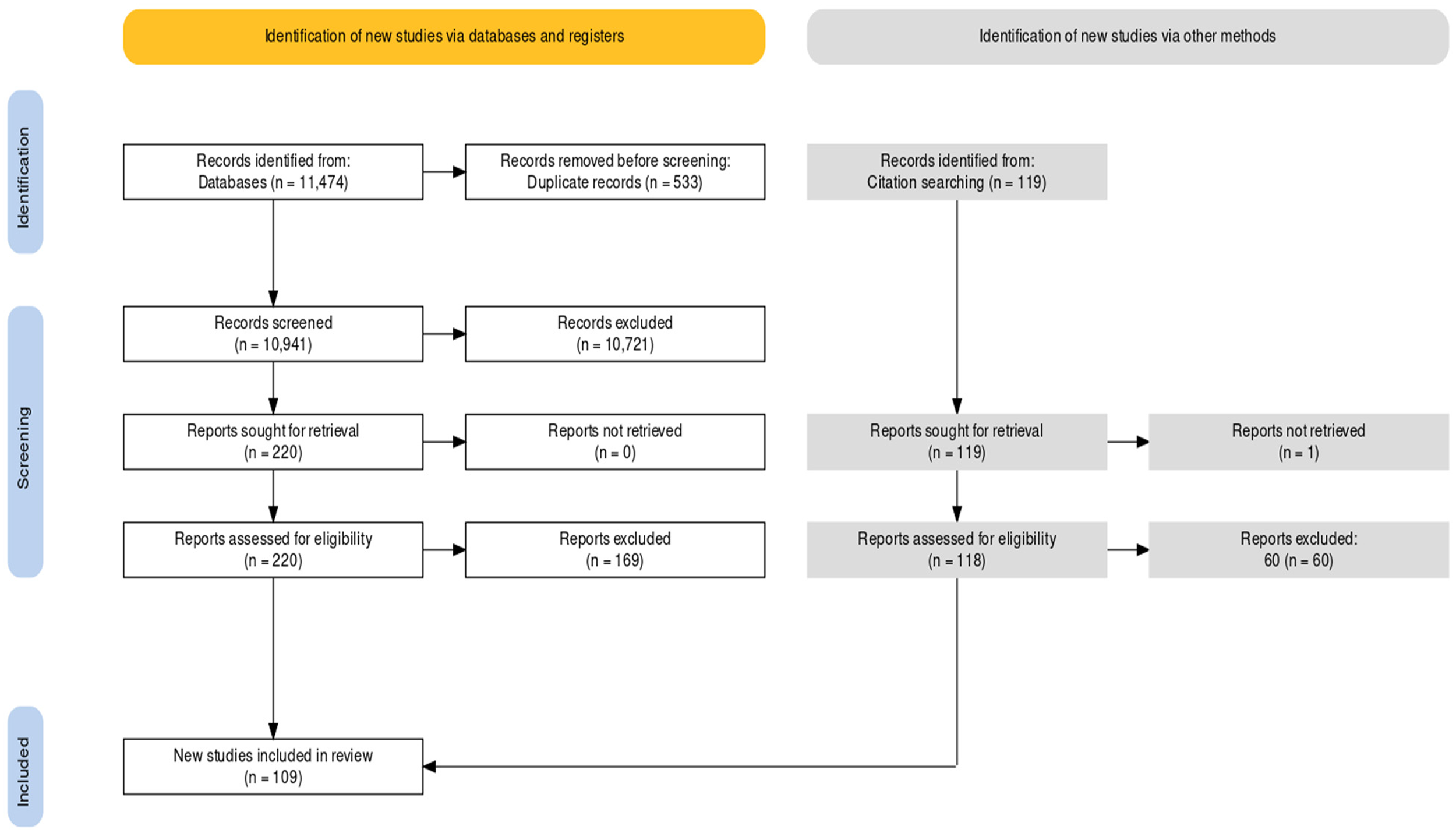
PRISMA flow diagram showing the process of identification and selection of studies (Haddaway et al., 2022). Source: Authors’ data.
Charting the Data
In this stage, we charted data from the selected 109 studies using a data charting form that was applied to NVivo qualitative data analysis software. The data charting form included, among others, the following items: data on article/publication details (e.g., full citation, author, year of publication, title, and article type); data on study details (e.g., study purpose, methodology, time, population, area, and results); and data regarding the specific research questions of the review listed above.
Collating, Summarizing, and Reporting
Finally, we analyzed the charted data qualitatively using a combination of deductive and inductive approaches (Bradley et al., 2007; Miles & Huberman, 1994) on NVivo. In the case of the deductive approach, we used the above-mentioned data charting form and other relevant concepts from our theoretical framework. In the case of the inductive approach, we followed the steps suggested by Creswell (2007): (a) reading the data thoroughly to understand the overall picture of the situation; (b) coding (highlighting significant quotes/points from the selected studies by grouping similar ideas together); (c) grouping together similar codes into categories; and (d) identifying fewer themes and patterns from the categories. The themes and patterns identified by both the deductive and inductive approaches were finally synthesized, interpreted, and presented in a discussion format.
Results and Discussion
In this section, we present and discuss the main results of the review including the characteristics of the reviewed studies, owner PAD communities, host countries, the number of SSEOs of PAD in Europe, the age of SSEOs of PAD in Europe, the types and classification of SSEOs, and the challenges faced by the SSEOs.
Characteristics of the Reviewed Studies
The major characteristics of the selected studies include their publication year, forms of publication, and research methods.
Publication Year of Selected Studies
As shown in Figure 2, the 109 selected studies for the review were published between the years 1994 and 2020, spanning 26 years. It is surprising that no studies were found that were published before 1994 given that there was no exclusion criterion in this review based on the time of publication. Nonetheless, as can be seen in the section regarding the age of SSEOs of PAD, many SSEOs of PAD existed before 1994.
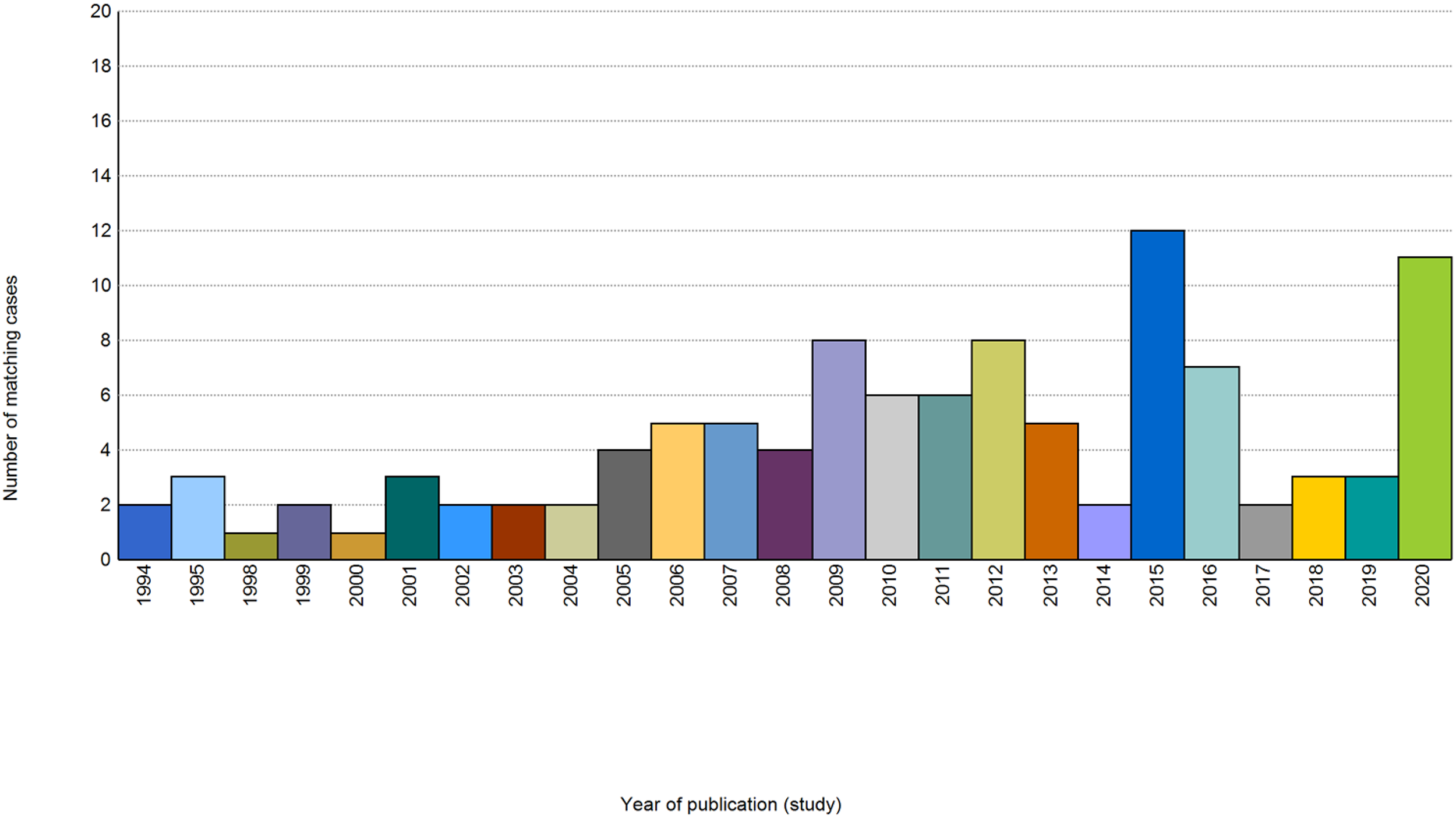
Publication year of selected studies. Source: Authors’ data.
Forms of Publication of Selected Studies
The selected studies were published in various forms. As shown in Figure 3, most (55.05%) were published as journal articles, while the rest were published as reports (18.35%), book chapters (12.84%), theses (7.34%), books (3.67%), unpublished manuscripts (0.92%), conference papers (0.92%), and newspaper articles (0.92%).
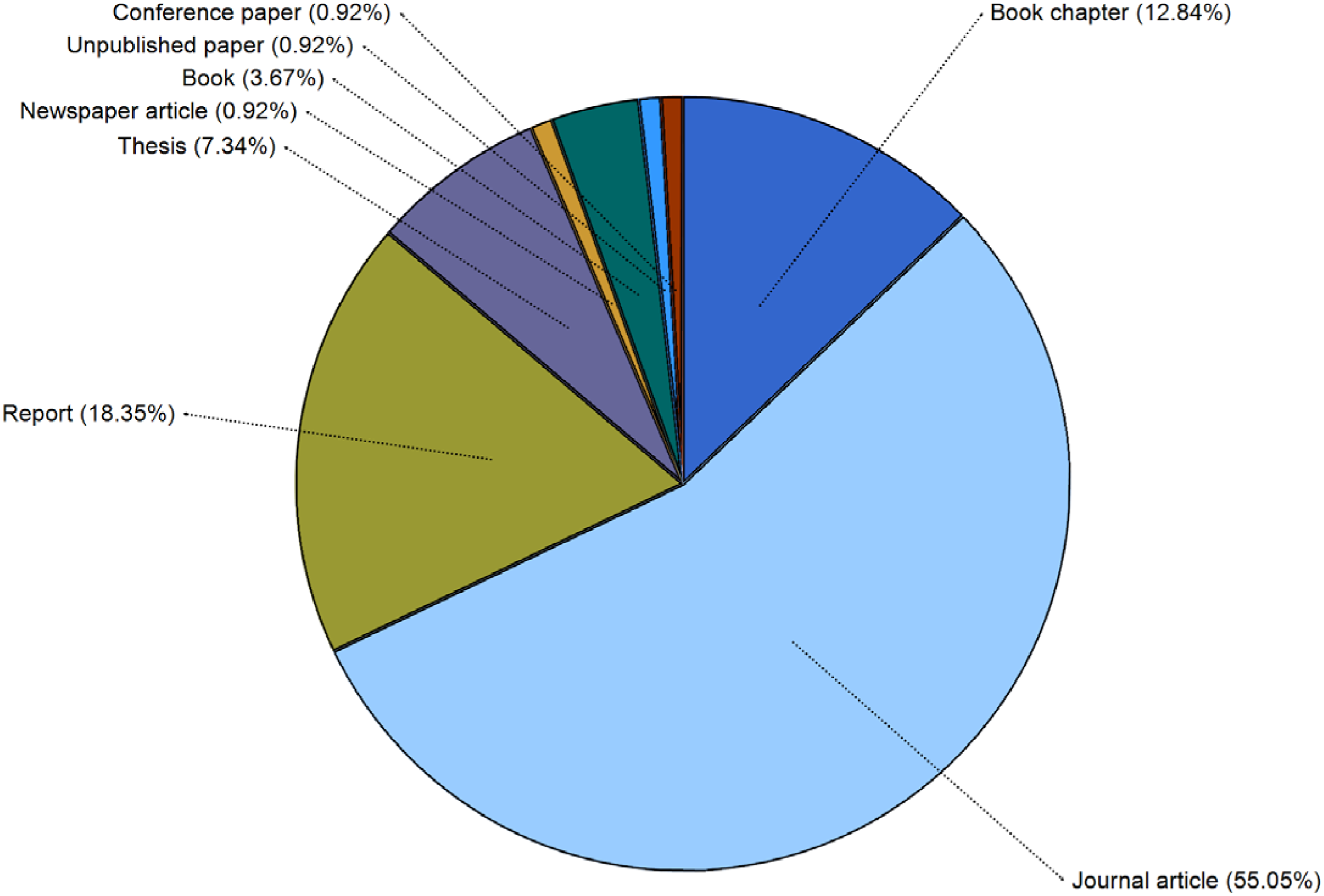
Forms of publication of selected studies. Source: Authors’ data.
Research Methods Used in the Selected Studies
The selected studies used various research methods. As presented in Figure 4, a significant majority of them (67.89%) were based on qualitative methods, followed by mixed methods (22.02%), other methods (e.g., methods not clearly specified) (5.50%), literature review (3.67%), and quantitative methods (0.92%).
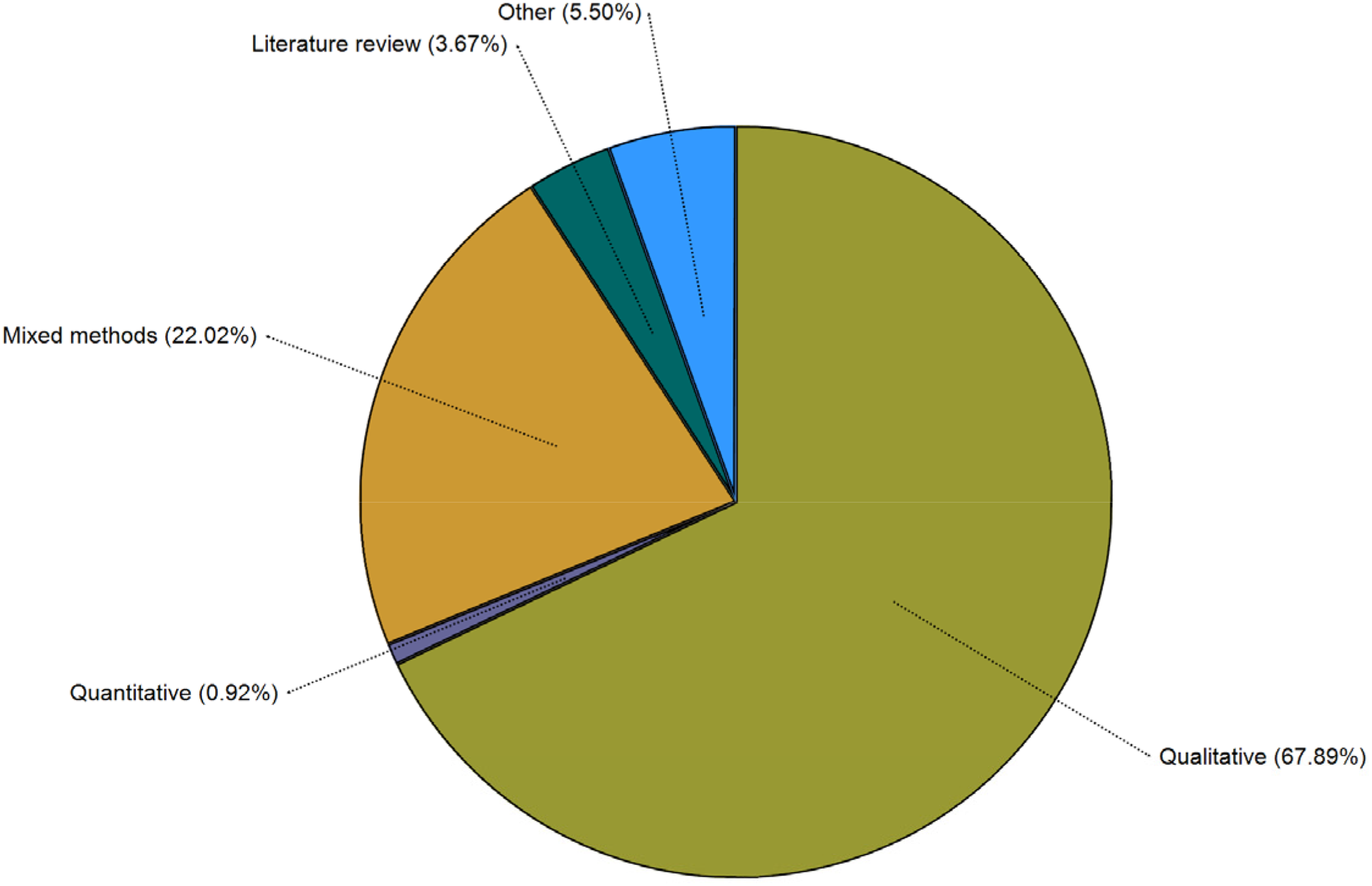
Methods used in selected studies. Source: Authors’ data.
Owners of SSEOs of PAD in Europe
Our review identified 21 specific PAD communities as creators, governors, and owners of the studied SSEOs in Europe. Owner PAD communities include Ghanaians, Ethiopians, Cameroonians, Senegalese, Nigerians, Somalis, Moroccans, Imazighen, 4 Zimbabweans, Eritreans, Afro-Caribbeans, Afro-Surinamese, Kenyans, Tunisians, Cape Verdeans, Malians, Guinea-Bissauans, Egyptians, Mauritanians, Liberians, Ivorians, a mix of different African immigrants, and a mix of different PAD. As can be seen above, owners of these organizations could be single PAD communities (e.g., Ghanaians) or a mix of different African immigrant communities (whose origin countries are in Africa) or a mix of various PAD communities (whose immediate home/origin countries are in multiple continents such as Europe, Africa, and the Americas). The above result shows that the SSEOs of PAD in Europe are owned, at least, by 21 specific PAD communities. We believe that, on the ground, there could be more owner PAD communities that were not identified by the review, which has its limitations. 5 One could also argue that this number is not big given that there are 54 African countries and many other American countries that could have PAD communities in Europe, with their own SSEOs of PAD communities.
Host Countries and the Number of SSEOs of PAD in Europe
Our scoping review identified 17 European countries as host countries of the studied SSEOs of PAD in Europe. These countries are the UK, Germany, the Netherlands, France, Italy, Ireland, Belgium, Portugal, Spain, Austria, Turkey, Denmark, Finland, Slovenia, Sweden, Malta, and Latvia. Again, this figure could be higher on the ground. There could be more host countries that were not identified by the review. Similarly, it could be argued that this number is not big enough given that there are 45 countries in Europe where various PAD communities with their own SSEOs might be present.
The results of the review also indicated that most of the SSEOs of PAD were found in major Western European countries especially the UK, Germany, the Netherlands, France, and Italy. This result may not be surprising given that the majority of PAD in Europe are found in such countries (ENAR, 2015).
We also attempted to look into the number of SSEOs of PAD in different countries in Europe. The results showed that the exact number of SSEOs of PAD in different countries is unknown and hard to estimate because of the following: the lack of studies that specifically address SSEOs of PAD and estimate their numbers; the inability of most studies on diaspora/migrant organizations of PAD to isolate and estimate the number of SSEOs; and the informal nature of many of the SSEOs of PAD that made it difficult for researchers to identify such organizations. Nevertheless, the results of the review provided us with some insights. The results showed that SSEOs of PAD in Europe are diverse and can be many in number in a given city or country.
For example, in the context of the UK, a relatively recent study by Ong’ayo (2016) conservatively estimated that there were some 200 Ghanaian associations in the UK. A study by Lampert (2009) also identified 325 different Nigerian diaspora organizations in London alone. In the context of Germany, Beloe-Nyamusa reported the presence of more than 100 Cameroonian Hometown Associations (HTAs) including over 40 HTAs in Berlin alone (2020). Warnecke was also able to compile a list of 150 various Ethiopian associations in Germany (2015). In the case of France, a study by Harris reported the presence of hundreds of associations of the Amazigh diaspora (2020). Another study by Lacroix and Dumont reported the presence of at least 1,605 Moroccan organizations in France (2016).
In the case of the Netherlands, Ong’ayo reported the presence of some 245 Ghanaian organizations (2016) and some 115 Ethiopian organizations (2014). A study by van Amersfoort and van Heelsum reported the presence of at least 720 Moroccan organizations in the Netherlands (2007). Vermeulen also reported the presence of more than 119 Afro-Surinamese organizations in the Netherlands, between 1960 and 1990 (2005). In the case of Belgium, a study by the AU identified 211 African organizations (2019). A study by Godin et al. also reported the presence of 658 Moroccan and 656 Congolese organizations in Belgium (2015).
In Denmark, a survey included 123 African diaspora organizations representing 22 countries and three pan-regions in Africa (Trans & Vammen, 2011). In Finland, a study by Pirkkalainen et al. (2013) reported the presence of over 100 registered Somali associations.
In Italy, a study by Pirkkalainen et al. (2013) reported the presence of at least 41 Somali associations. Riccio (2008) also identified 12 Fulbé (Fulani) associations in Italy. In Portugal, Sardinha (2005) compiled a list of 31 Cape Verdean SSEOs located in the Metropolitan area of Lisbon alone.
Here it is important to emphasize that in some cases of the above examples, the numbers provided refer to the overall PAD migrant/diaspora organizations including organizations that are not considered SSEOs in our review (e.g., political parties, churches, mosques, and capitalist businesses). However, we have noted that most of the organizations identified in different countries were SSEOs.
Age of SSEOs of PAD in Europe
We classified the history of the SSEOs of PAD in Europe into two broad periods, that is, before and after 1945/the Second World War (WWII). Our review found very few, three, studies referring to the time before WWII. However, these studies provided us with an important insight into the past. The first paper that indicated the existence of SSEOs of PAD in this period was a study by Craig (2011) on the UK's black and minority ethnic third sector. Craig (2011) noted that “informal religious and community organisations emerged from the seventeenth century, especially following the freeing of slaves during the nineteenth century.” The second study that identified early SSEOs of PAD was by Vermeulen (2005) who examined organizational patterns of Surinamese in Amsterdam. This study reported that “the history of Afro-Surinamese organization in Amsterdam began as far back as 1919, with the launch of the Bond voor Surinamers (Organization for Surinamese).” The third study was by Frost (1999) who also reported the existence of SSEOs of the Kru people in Liverpool throughout the twentieth century, including the early twentieth century. These SSEOs involved informal networks and social and cultural associations. Frost (1999) also identified SSEOs owned by other PAD communities. One such association was Stanley House, which was established in 1943 to serve as a community center for PAD in Liverpool.
In the case of after WWII, the scoping review identified plenty of references. The results showed that this period was a very important time for SSEOs of PAD in Europe as more and more diverse types of SSEOs of PAD were established and flourished (see, for example, AU, 2019; Aspinall & Chinouya, 2016; Bailey, 2012; Bernaschi & Crisci, 2018; Blackshire-Belay, 2001; Campbell & Williams, 2016; Craig, 2011; de Tona & Lentin, 2011; Ellerbe-Dueck, 2011; Faye, 2007; Frost, 1999; Godin et al., 2015; Hamidi, 2003; Chelpi-den Hamer & Mazzucato, 2010; Harrison, 1994a; Van Hear et al., 2004; Kane, 2006, 2012; Kerlin, 2000; Lacroix & Dumont, 2016; Marini, 2013; Mimbang, 2001; Mörath, 2015; Nieswand, 2008; Nijenhuis & Zoomers, 2015; Okai, 2020; Ong’ayo, 2010; Orozco et al., 2005; Owusu, 2020; Palmer, 2020; Pirkkalainen et al., 2013; Riccio, 2008; Sardinha, 2005; Scheffran et al., 2012; Schlenzka, 2009; Schmelz, 2007; Tadesse, 2020; Trans & Vammen, 2011; Trauner, 2005; van Amersfoort & van Heelsum, 2007; Vermeulen, 2005; Warnecke, 2015; Weißköppel, 2015). Example SSEOs of PAD established during this time are provided in the following sections of this paper.
The above results indicate that SSEOs of PAD have existed in Europe for a long time, dating back to the seventeenth century. Even though our review found limited references regarding the earliest SSEOs of PAD in Europe, we contend that SSEOs of PAD existed in Europe even before the seventeenth century. Since it is a way of life for PAD to establish and engage in SSEOs, as revealed by our review and other studies (Hossein, 2013, 2018b; Nembhard, 2014), it can be argued that the establishment of some sort of SSEOs of PAD was inevitable the moment PAD arrived in Europe. If we accept the above statement as plausible, we could point to an earlier century such as the fifteenth century (Bärwald et al., 2022) or the time of the Roman and Greek empires (Gnammankou, 2005; Otele, 2020) as the starting point for SSEOs of PAD in Europe. The above discussion shows that the SSEOs of PAD in Europe are long-standing and enduring.
Types and Classification of SSEOs of PAD in Europe
In our review, we identified many different SSEOs of PAD, which we categorized into 24 specific types based on their prevailing identity/characteristics taking into consideration their cultural origin, self-assertion, major objectives and activities, and legal structure. Here it is important to note that some of the types may overlap to some extent because of the challenging nature of classifying SSEOs discussed below. Nevertheless, given the purpose of this paper, which aims to inventory SSEOs of PAD, potential overlaps can be tolerated. Furthermore, this typology helps to provide, at least, an ideal type for the specific classification of SSEOs of PAD in Europe. Below, we provide a short discussion on the difficulties of classifying SSEOs of PAD, followed by brief descriptions of the different types of SSEOs of PAD, and a discussion on the application of the Diverse Economies theory to SSEOs of PAD.
Difficulties of Classifying the SSEOs of PAD
Coming up with a specific classification of the SSEOs of PAD was not an easy task for several reasons. First, there are many different specific types of SSEOs of PAD with subtle differences. Second, most of the SSEOs of PAD are multifunctional. Organizations from a single type of SSEOs of PAD may engage in different activities or sectors doing what other types of SSEOs of PAD are ideally supposed to do. Third, there are different legal frameworks and terminologies in different countries for registered SSEOs. In this case, a particular association could be labeled differently in different countries. Furthermore, this legal nomenclature could even differ from the original/traditional typology of the particular SSEO. For example, a burial society or HTA can sometimes be registered as a foundation for practical reasons (e.g., for the sake of registration or registration-associated advantages such as access to funding and tax advantages). Fourth, different studies/authors may classify PAD “migrant organizations,” which are mostly SSEOs, differently based on their study's purposes or the authors’ level of understanding. In relation to this, different authors used different criteria to classify the organizations they studied. While some authors used the main objectives or activities of the organizations as criteria, others used the names the organizations attributed to themselves, and others used classifications from the literature or the legal framework. In this case, a particular organization may be classified as an HTA, a socio-cultural association, or a development association by a different author. In short, there is a lack of standardization (see also Mercer et al., 2009b; Phaneuf, 2012a; Warnecke, 2015). We also noted that such challenges are not unique to SSEOs of PAD in Europe. They are common among other SSEOs found in Europe and beyond (see Barraket et al., 2017; Byrne, 2023; Yunus Center, 2021). The above discussion shows that SSEOs could have multiple valid classifications (Byrne, 2023). Accordingly, we provide our own specific classification of SSEOs of PAD below.
Specific Types of SSEOs of PAD in Europe
Hometown Associations (HTAs)
The first and most frequently observed type of SSEOs of PAD in our review is HTAs. 6 HTAs are transnational associations of migrants who belong to the same village, town, tribe, ethnic group, linguistic area, state/region, nation, or country (Beloe-Nyamusa, 2020; Mercer & Page, 2010). HTAs are multifunctional and engage “here” (in the host countries) and “there” (in the origin countries). They seek “to support their places of origin, maintain relationships with local communities, and retain a sense of community as they adjust to life in their new home countries” (Orozco & Garcia-Zanello, 2009). They provide mutual support to their members in host countries while engaging in development activities (e.g., remittance and small-scale projects) in their origin countries.
HTAs can be found as small associations (with a handful of members) or large associations (with hundreds of members). They can also be found in the form of informal or formal associations (Mercer & Page, 2010). HTAs can also have “branches” or “chapters,” which are usually autonomous, in different cities and countries (Mercer et al., 2009).
Some examples of HTAs identified in the scoping review include Ghanaian HTAs in the UK (Kandilige, 2017; Owusu, 2020); Cameroonian and Tanzanian HTAs in the UK (Mercer & Page, 2010); Cameroonian HTAs in Germany (Beloe-Nyamusa, 2020); Ethiopian HTAs in Germany (Schlenzka, 2009; Warnecke, 2015); and HTAs of two Amazigh groups in France, that is, the Algerian Kabyles and the Moroccan Chleuhs (Lacroix, 2013).
Rotating Savings and Credit Associations (ROSCAs)
ROSCAs, which are informal financial institutions found in many African societies, with different names, are also common among various PAD communities in Europe. A ROSCA can be defined as “[a]n association formed upon a core of participants who agree to make regular contributions to a fund which is given, in whole or in part, to each contributor in rotation” (Ardener, 1964, p. 201). Rotation and regularity are the two basic principles of ROSCAs that underpin their two main functions, that is, the provision of savings and credit services to their members (Ardener, 1964).
Some examples of ROSCAs identified in our review include Somali Hagbad in the UK (Summerfield, 1995); Ethiopian Equub and Ghanaian Susu in the Netherlands (Lehmann & Smets, 2020); Ethiopian Equub in Germany (Tadesse, 2018, 2020); Eritrean Equub in the UK (Almedom, 1995), Sweden, and Germany (Ali, 2020); Cameroonian Njangi in the UK (Ardener, 2014) and Berlin (Beloe-Nyamusa, 2020); Malian Tontine in France (Trauner, 2005); Senegalese Tontine in France (Kane, 2006); various African ROSCAs in Glasgow (Piacentini, 2015); and Cameroonian, Somali, and Congolese ROSCAs (Tontines, Hagbads, Likelembas, respectively) in London (Datta & Aznar, 2019).
Accumulating Savings and Credit Associations (ASCRAs)
Like ROSCAs, ASCRAs are informal savings and credit associations. 7 The main difference between the two concerns “what happens to the fund.” While ROSCAs are rotating (members receive the fund in rotation, e.g., every month), ASCRAs are accumulating (members contributions accumulate), that is, “funds are not immediately withdrawn but are left to grow for loan making,” at least for a year (Bouman, 1995). According to Ardener, ASCRAs can be considered as proto-banks and “may be able to accumulate bigger lump sum loans than ROSCAs. In other words, they begin to approach mini-bankhood” (2010). In ASCRAs, the contributions of members vary. “Each ASCRA member's deposit keeps its own accounting identity—unlike the pooled money collected in ROSCAs” (Ardener, 2010). In ASCRAs, members can withdraw the fund, for example, in times of sudden financial needs (Ardener, 2010; Kane, 2006) or for collective investment (Ardener, 2010). The scoping review identified two ASCRAs in Europe. The first was a Cameroonian ASCRA in the UK (Ardener, 2010). The second was a Senegalese ASCRA in France (Kane, 2006).
Micro Credit Associations
Microcredit is a form of microfinance that provides small (micro) loans to low-income individuals (especially those considered non-bankable) and small businesses at a very low-interest rate (Piacentini, 2015). Unlike ROSCAs and ASCAs, microcredit associations are usually formal organizations that are part of microfinance. A study by Piacentini (2015) reported a microcredit scheme of PAD in Glasgow. This microcredit scheme was initiated by the president of an SSEO of PAD who had experience in microfinance. This microcredit scheme was a self-organized one and had no link to an external organization. “Small cash amounts were borrowed by a handful of members to purchase equipment for clothes making and hairdressing” (Piacentini, 2015).
Burial Societies
Burial societies are institutions that primarily serve as insurance by sharing risks and expenses in the case of death, illness, and accident. They provide welfare and social benefits to members (and their families) who make regular financial contributions of a certain amount. The benefits they provide include offering financial compensation to the bereaved family, providing psychosocial support to the bereaved family, helping orphans and the elderly, assisting the sick and disabled, and assisting the poor and unemployed (Aredo, 2010; Pankhurst, 2008; Pankhurst & Mariam, 2000).
The scoping review identified several burial societies of PAD in Europe, that could be informal or formal associations. These include a Zimbabwean burial society in the UK (Mbiba, 2010); the early United Kroo National Society in the UK (Frost, 1999); and Ethiopian burial societies known as Iddir in Germany (Schlenzka, 2009; Warnecke, 2015).
Natural Resource-Based Commons
Commons can be defined as “a shared resource, which is co-owned and/or co-governed by its users and/or stakeholder communities, according to its own rules and norms” (Baunwens & Niaros, 2018, p. 5). Our review identified examples of commons in terms of several autonomous urban community gardens. A study by Ginn and Ascensao (2018) reported the presence of several (informal) community gardens of African immigrants (e.g., Cape Verdeans and Guinea-Bissauans) in Lisbon, Portugal. The gardens functioned as a space to provide food by cultivating potatoes, onions, tomatoes, cabbage, lettuce, beans (e.g., fava), corn, sugar cane, and so forth. They also served as “a means of expressing and performing cultural identity, while simultaneously experimenting with practices of belonging in Lisbon” (Ginn & Ascensao, 2018).
Cooperatives
According to the International Cooperative Alliance (ICA), “A cooperative is an autonomous association of persons united voluntarily to meet their common economic, social, and cultural needs and aspirations through a jointly owned and democratically controlled enterprise” (n.d., par. 1). The scoping review identified two cooperatives of PAD in Europe. 8 The first is Barikama, a worker cooperative of six African immigrants in Rome. Barikama is officially registered as a type B social cooperative that aims to integrate disadvantaged people into the labor market. Barikama promotes the social and employment integration of members and the local community through the production and sale of organic agricultural products such as yogurt and vegetables at local markets (Bernaschi & Crisci, 2016, 2018; Lintner & Elsen, 2020). The second is Somscan UK, which is a housing cooperative of the Somali diaspora in the UK and Scandinavian countries. The main aim of the cooperative is to collectively buy land in Somaliland and build houses for members and their (some 500) families (Van Hear et al., 2004).
Religion-Oriented Associations
Religion-oriented associations are faith-based groups that combine socio-cultural, economic, and religious objectives and activities. These are not purely religious organizations like churches and mosques. Our review identified three specific types of such associations, that is, Mahaber, Dahira, and the Nation of Islam (NOI).
Mahaber
Mahaber is an Ethiopian (and Eritrean) informal institution with social and religious purposes. It is a common practice among Ethiopian Orthodox Christians to establish Mahabers. In Mahabers people associate themselves in the name of a saint or an angel, to commemorate the saint's or angel's day which happens once a month. This means that members meet at least once a month at the house of one of the members (on a rotating basis) to celebrate and socialize together with their families and to contribute money and other resources for their association. “A mahaber often consists of twelve members and one Muse (Moses) who acts as chairman…. The functions are limited to prayers, eating and drinking, expression of primordial sentiments, social and political discussion and resolving disputes [and other problems] among members” (Mequanent, 1996). Several of the reviewed studies reported the presence of Mahaber among the Ethiopian diaspora in Europe, especially in Germany (Schlenzka, 2009; Tadesse, 2020; Warnecke, 2015).
Dahira
Dahira is a religion-oriented association of the Senegalese Muslim diaspora. Dahiras are usually informal associations connected with the Mouride Sufi Brotherhood in Senegal. Our review indicated that Dahiras exist in different European countries including Germany and Italy (Faye, 2007; Riccio, 2001, 2008). According to Riccio (2008), there could be “numerous dahiras […] widespread in the receiving countries.” Dahiras have overall aims of, among others, creating a cohesive group; representing members; maintaining cultural and religious values; maintaining transnational connections; controlling potentially deviant behavior in a foreign country; and avoiding “decadence in immigration.” Their main activities included regular meetings of members to recite religious texts and collect donations; selling cassettes with recordings of prayers, sacred poems, and information about decrees from the religious leader; receiving and helping new immigrants; and sending remittances (Faye, 2007; Riccio, 2001, 2008).
Nation of Islam (NOI)
NOI, “Despite being originally American, […] has become a global ethno-religious movement due to its appeal to blacks worldwide” (Tinaz, 2006). Our review identified the NOI's UK chapter, which also coordinated activities in other European countries. NOI-UK aimed to promote its ethno-religious and traditional self-help and self-reliance economic teachings as well as political agendas that have to do with the racial independence of Black people. It also emphasized members’ clean and respectful manners and appearance. It provided various activities and services including the provision of educational services using its nursery, primary and secondary schools; the management of business enterprises like restaurants, grocery stores, bookstores, and clothing stores; the publication of newspapers and magazines; the hosting of cultural programs and advocacy events including demonstrations; the provision of support to the unemployed and victims of racist violence; and creation of clean, drug- and alcohol-free, safe environments (Tinaz, 2006).
Social Enterprises
Social enterprises are businesses that run entrepreneurial activities to achieve the societal common good. Their primary goal is achieving a positive social impact. The main difference between social enterprises and many other SSEOs is that social enterprises are less member-oriented and pursue general interest aims beyond their members (Borzaga et al., 2020). Social enterprises are usually formal/registered organizations. Our review identified various PAD social enterprises in different sectors, addressing crucial gaps that affected PAD in local services. Their engagement involves, among others, fashion design and clothes making using African textiles, other sewing businesses, hairdressing and beauty businesses, community cafes with African food catering, music-related initiatives, IT services, daycare, hostels, restaurants, grocery stores, bookstores, clothing stores, and newspapers and magazines (Andrews, 2016; Faye, 2007; Hamidi, 2003; Piacentini, 2015; Tinaz, 2006). 9
Housing Associations
Housing associations are non-cooperative associations that aim to provide (social) housing services and advocacy for PAD communities to address problems they encounter in the housing sector (e.g., problems related to access, quality, discrimination, and racist attacks). Such associations seem to be especially common in the UK and Ireland (Craig, 2011; Gardiner, 2006; Harrison, 1994a, 1994b). There were also housing movements and associations in France (Pechu, 1999).
For example, in the UK, such housing associations are usually formal non-profit organizations registered as charities. They “seek to plan and develop their own housing schemes, to manage lettings, and to have ownership of the properties” (Harrison, 1994b). Specific examples of such associations were found among individual Black-run associations that constituted the Black Voluntary Housing Movement and the Federation of Black Housing Organisations (FBHO). It was reported that there were some 60 housing providers as members of the FBHO, providing homes for some 33,000 households (Craig, 2011; Gardiner, 2006; Harrison, 1994a, 1994b). In the case of France, examples of housing associations include Comité des Mal-Logés and Droit Au Logement. Activities of these associations included the following: mobilization against racial discrimination and criminal attacks that targeted PAD families and their neighborhoods; occupation of buildings and encampments; and lobbying public authorities (Pechu, 1999).
Foundations
A foundation can generally be defined as a legal structure to which the founder brings money/heritage […] to realize a predefined disinterested purpose […] From a management perspective a foundation has no members or associates [or shareholder]; the board of directors is the only managerial body requested by law. (Mernier, 2017, p. 67)
Our review found various examples of PAD foundations including the African Foundation for Development in the UK; several Nigerian foundations including Vital Aid Foundation and Goodwill Heritage foundations in the Netherlands (Adenekan-Koevoets, 2012; Van Hear et al., 2004); and a number of Ethiopian foundations such as Stichting Dir, Stichting Gobez, Stichting Meleya, and Stichting Ethiopia Morgen in the Netherlands (Ong’ayo, 2014). 10 PAD foundations in Europe engaged in various activities including providing social/welfare services; promoting gender and racial equality; promoting environmental protection; providing training and capacity building in various fields; supporting social entrepreneurship; giving donations/funding; carrying out development projects; and encouraging diaspora engagement (Adenekan-Koevoets, 2012; Van Hear et al., 2004; Ong’ayo, 2014).
Women's Associations
Women's associations refer to organizations that are established and led by women to achieve their common goals that primarily benefit women and girls. Examples of PAD women's associations in Europe include, among others, African Women's Network in Ireland; Women of Multi-Culture Balbriggan in Ireland; Al Huda Women's Group in Ireland (de Tona & Lentin, 2011); Zimbabwe Women's Network UK (McGregor, 2009); Itsekiri Women's Association in the UK (Lampert, 2009); Moroccan women's groups in Germany (Metzger, 2015); Generation Adefra—Schwarze Frauen in Deutschland (AU, 2019); and the Black European Women's Council in Austria (Ellerbe-Dueck, 2011). PAD women's associations engaged in various activities including providing culturally appropriate services for women; providing drop-in centers and (safe) spaces; offering various training (e.g., how to deal with domestic violence); engaging in personal and group capacity-building activities; creating employment opportunities; engaging in multicultural festivals and activities; advocating to address gender gaps; and conducting research (AU, 2019; de Tona & Lentin, 2011; Ejorh, 2011; Ellerbe-Dueck, 2011; Lampert, 2009; McGregor, 2009; Metzger, 2015).
Professional-Occupational Associations
Professional-occupational associations include professional associations, worker associations, and parent associations. In such associations, groups of PAD professionals, workers, and parents come together to promote their common interests. Some examples of such associations include the following: professional societies bringing together Zimbabwean journalists and medics in the UK (McGregor, 2009); associations of UK-based Nigerian accountants, lawyers, medics, and nurses (Lampert, 2009); Black Police Associations in the UK (Holdaway & O’Neill, 2004); professional associations of Ethiopian scientists in Germany (Warnecke, 2015); professional associations of Egyptian doctors and entrepreneurs in Germany (Weißköppel, 2015); Moroccan professional associations in France (Lacroix & Dumont, 2016); laborers’ associations of Moroccans in the Netherlands (van Amersfoort & van Heelsum, 2007); Moroccan Workers Association in Spain (Cebolla & López-Sala, 2015); and the Ghanaian Parents’ Association in London (Peil, 1995).
The above-mentioned organizations engage in different activities. For example, in the case of the professional associations of Ethiopian scientists, the following were observed: organizing a temporary return to Ethiopia to make professional contributions; transferring scientific materials and instruments to Ethiopia; engaging in teaching and research activities; and organizing seminars and other events (Warnecke, 2015).
Student Associations
Student associations are associations where (mainly university) students come together to support their members and other students. Some examples of PAD student associations include Moroccan student associations (Metzger, 2015), Kenyan student associations (Bonfiglio et al., 2015), and Ethiopian student associations (Warnecke, 2015) in Germany. Student associations also engage in various activities. For example, Moroccan student associations engaged in providing information about studying and living in Germany; offering personal consultation; and organizing workshops and seminars (Metzger, 2015).
Sports- and Youth-Oriented Associations
Sports- and youth-oriented associations mainly emphasize youth-related objectives and activities that especially have to do with physical activity and sports. Some examples of such associations include the following: Moroccan youth organizations in Germany (Metzger, 2015); youth organizations and sports groups of Ethiopians in Germany (Schlenzka, 2009); Zimbabwean football associations in the UK (McGregor, 2009); a football project of Somali young people in London (Van Hear et al., 2004); and the African-Caribbean heritage football club in Leicester (Campbell & Williams, 2015, 2016; Campbell, 2020).
Such associations organize and participate in various activities involving fitness and dance sessions; regular football training and competitions including national and European level tournaments; training and competitions in other sports such as cricket, darts, and netball; charity tournaments to raise funds for welfare, development, and social projects; and intercultural social activities and leisure provisions. These associations play a key role in mobilizing and bringing in contact young PAD who are born in and immigrated to Europe. The associations and the events they organize serve as a meeting and socializing point that is free from racism for young PAD. They also serve as a place where young PAD learn about their African culture and history. This is indispensable given that young PAD are largely unrepresented in other types of SSEOs of PAD in Europe (Campbell, 2020; Campbell & Williams, 2015; Metzger, 2015; Schlenzka, 2009).
Development-Oriented Organizations
Development-oriented organizations are primarily established to contribute to development in origin countries, regions, or continents. Our review identified various such organizations based in different European countries such as Denmark (Trans & Vammen, 2011); the UK (Van Hear et al., 2004); the Netherlands (Ong’ayo, 2014); and Germany (Bonfiglio et al., 2015; Faye, 2007; Schmelz, 2007, 2009; Schlenzka, 2009). These organizations are usually formal organizations. Their activities involve, among others, remitting used and new equipment to schools, hospitals, orphanages, and so forth; providing various vocational training; offering informational activities related to health; constructing schools, libraries, hospitals, health centers, toilet facilities, wells, roads, and so forth; supporting families and street children through education and social work; promoting sustainable ecological development; and fostering cooperation through twinning of host and origin countries’ cities, universities, and so forth (Faye, 2007; Lacroix & Dumont, 2016; Marchand et al., 2015; Ong’ayo, 2014; Trans & Vammen, 2011; Vermeulen, 2005; Van Hear et al., 2004; Warnecke, 2015).
Socio-Cultural Associations
Socio-cultural associations are associations that mainly focus on cultural and social objectives including the preservation, promotion, and celebration of material and non-material culture; encouragement of cultural exchanges and dialogue; facilitation of social contacts and socialization; and promotion of social inclusion. These associations can be small informal associations like social clubs or large formal organizations. Their activities include organizing and participating in various festivals, performing arts (like drama, music, and dance), art exhibitions, life events, holiday celebrations, and other forms of sociocultural activities. Their activities are usually performed in the host countries in Europe (Acheampong, 1998; AU, 2019; de Witte, 2019; Faye, 2007; Hamidi, 2003; Harris, 2020; Marchand et al., 2015; Phaneuf, 2012b; Peil, 1995; Ragab et al., 2013; Fernández Suárez et al., 2020; Triandafyllidou, 2009).
Our review identified many such organizations in Europe including the annual Black History Festival in Amsterdam (de Witte, 2019); Citizens of Alkebulan in the Netherlands (de Witte, 2019); the traditional musical and dance group Batuko Tabanka of the Cabo Verdean community in Spain (Fernández Suárez et al., 2020); the dance and music group Nongo in France (Hamidi, 2003); sub-Saharan African cultural associations in Slovenia and in Latvia (Triandafyllidou, 2009); the Senegalese amicale Bokk xalat in Berlin (Faye, 2007); various Ghanian social clubs in Germany (Peil, 1995); and the Africa Centre in London (Acheampong, 1998).
Welfare and Humanitarian Organizations
Welfare and humanitarian organizations are those that primarily aspire to provide social assistance, especially to vulnerable individuals, families, and groups (e.g., PAD children and undocumented PAD immigrants) in the host countries. Their specific activities include, among others, conducting home visits; providing housing services (e.g., short-term accommodations); helping with amenities like energy; giving cash payments and food; providing legal and general advice to people facing legal and administrative challenges; organizing after-school classes; and supporting returning migrants (AU, 2019; Aspinall & Chinouya, 2016; Chelpi-den Hamer & Mazzucato, 2010; Craig, 2011; Frost, 1999; Hamidi, 2003; Lacroix & Dumont, 2016; Okai, 2020; Vermeulen, 2005; Weißköppel, 2015). Some examples of such associations include the following: Sierra Leone Welfare Association Antwerp, in Belgium (AU, 2019); Black Community OÖ in Austria (Okai, 2020); Zimbabwean, Zambian, Nigerian, Ghanian (Aspinall & Chinouya, 2016) and Liberian (Frost, 1999) welfare associations in the UK; Afro-Surinamese welfare organizations in the Netherlands (Vermeulen, 2005); and North African welfare associations in France (Hamidi, 2003).
Anti-Racist and Anti-Imperialist/Colonialist Organizations
Anti-racist and anti-imperialist/colonialist organizations primarily focus on objectives and activities that concern political movements and activism; fighting against racism and discrimination in host countries; and countering the exploitation of their origin countries and regions. Such organizations are sources of counter-hegemonic political activism and knowledge production, which were anti-racist and anti-imperialist/colonialist stance (Frost, 1999; Palmer, 2020; Tinaz, 2006). Examples of such organizations include the following organizations in the UK: The Colonial People's Defence Association (Frost, 1999); the Racial Adjustment Action Society (RAAS); the Universal Coloured People's Association; Campaign Against Racial Discrimination (Tinaz, 2006); and the African Caribbean Self-Help Organisation (Palmer, 2020).
Educational Organizations
Educational organizations have knowledge- and skill-building objectives and activities. Such organizations engage in early childhood, primary, and secondary education; supplementary schooling such as weekend and summer schools; adult education; language courses; skills training (e.g., in IT, leadership, business); and internships. Such organizations play a key role in addressing the educational and professional needs and challenges (e.g., discrimination) of particularly second- and third-generation (and beyond) PAD in the host countries (Andrews, 2016; Clarke & Lewis, 2016; Craig, 2011; Schmelz, 2009; Tinaz, 2006). Examples of such organizations in the UK include the following: black supplementary schools (Andrews, 2016; Craig, 2011); adult education organization BAM! Sistahood (Clarke & Lewis, 2016); and various schools and educational programs of the NOI (Tinaz, 2006). In Germany, the following examples were identified: the African Youth Association for Culture, Science and Arts; Education without Borders; and the African Youth Foundation (Schmelz, 2009).
Health-Oriented Organizations
Health-oriented organizations primarily address issues related to PAD's health. They engage in mental health services and advocacy as well as physical health (e.g., HIV, diabetes, and cancer) services and advocacy (Aspinall & Chinouya, 2016; Craig, 2011; Newbigging et al., 2013). Our review identified the following example organizations in the UK: the Afro-Caribbean Mental Health Association, the Leicestershire Black Mental Health Group, the Afiya Trust for Health (Craig, 2011), Uganda AIDS Action Fund, Pamodzi (a Zambian association), Zimbabwean associations such as Simba and Ponayi, Ffena, and other member organizations of the African Health Policy Network (Aspinall & Chinouya, 2016), and various other African Caribbean mental health advocacy services (Newbigging et al., 2013).
These organizations had “the language skills and other competences that made them culturally relevant” to PAD (Aspinall & Chinouya, 2016). For instance, in the case of mental health advocacy, while some of the organizations provided direct services by themselves, others worked with established caseworkers to improve cultural sensitivity. Nevertheless, these organizations, unlike mainstream mental health advocacy services, which focused on individual casework, provided collective/community advocacy for PAD. They were characterized by culturally sensitive advocacy (Newbigging et al., 2013).
Internet-Based Associations
These types of associations include online-based associations and media platforms. They are usually focused on providing information, news, and entertainment for the benefit of PAD and the public. Some of the issues addressed by these organizations include immigration, social inclusion, empowerment, a positive image of Africa and PAD (e.g., presenting a counter-narrative to the mostly negative media coverage), and the development of Africa. Even though they mainly conduct their activities using the internet (e.g., using social media, blogs, radio, magazines, and webinars) as their main platform, they also engage in activities that require physical presence (e.g., physical meetings, workshops/conferences, exhibitions, festivals, and film screenings/reviews) (AU, 2019; Bonfiglio et al., 2015; Maluleke, 2017). Examples of such organizations identified by the review include Mkenya Ujerumani of Kenyans in Germany (Bonfiglio et al., 2015); Afrika Medien Zentrum in Germany; Africa Positive in Germany (AU, 2019); Goh and other virtual networks of the Ethiopian diaspora in Germany (Schlenzka, 2009); and African Women and Youth Europe (Maluleke, 2017).
PAD/African-European Friendship Associations
Such associations are created by members of PAD communities and their European friends in the host countries, with the aim of promoting good relationships as well as intercultural exchange between the two communities and their origin countries. Activities of these organizations include the following: promoting intercultural exchange via meetings, cultural events, and other types of gatherings; informing the host society about the origin countries of PAD and vice versa via information events and various publications; organizing conferences; supporting development projects in origin countries of PAD; and supporting the social integration of PAD in host countries (Mörath, 2015; Schlenzka, 2009; Warnecke, 2015). Our review identified various such organizations in Germany. Examples include Ghanaian-German associations such as Haskey Project Bochum (Mörath, 2015) as well as German-Ethiopian associations like Deutsch-Äthiopischer Verein, Deutsch-Äthiopische Gesellschaft, and Deutsch-Äthiopische Freundschaftsgesellschaft (Schlenzka, 2009; Warnecke, 2015).
Federations/Umbrella Organizations
Federations/umbrella organizations refer to associations of autonomous organizations that work together to coordinate activities, pool resources, and achieve common goals (USLegal, n.d.). Our review revealed the existence of many PAD umbrella organizations. Some examples include FBHO in the UK (Gardiner, 2006); Ghana Union London (Van Hear et al., 2004); Union of Ghanaian Associations Germany (Schmelz, 2009); Zentralrat der afrikanischen Gemeinde in Germany (AU, 2019); Die Initiative Schwarze Deutscher in Germany (Blackshire-Belay, 2001); Central Council of Egyptian Associations in Germany (Weißköppel, 2015); the federation of Senegalese Dahiras in Germany (Faye, 2007); and the Federation of Somali Associations Netherlands (AU, 2019).
These umbrella organizations are usually formal organizations that can involve small to large numbers of organizations as members. Their member organizations are usually related to a particular sector, profession, or origin country. Such organizations represent their member associations and protect their interests. They also engage in their own specific activities in social, cultural, economic, educational, political, and other spheres (AU, 2019; Blackshire-Belay, 2001; Faye, 2007; Gardiner, 2006; Van Hear et al., 2004; Schmelz, 2009; Weißköppel, 2015; Figure 5).
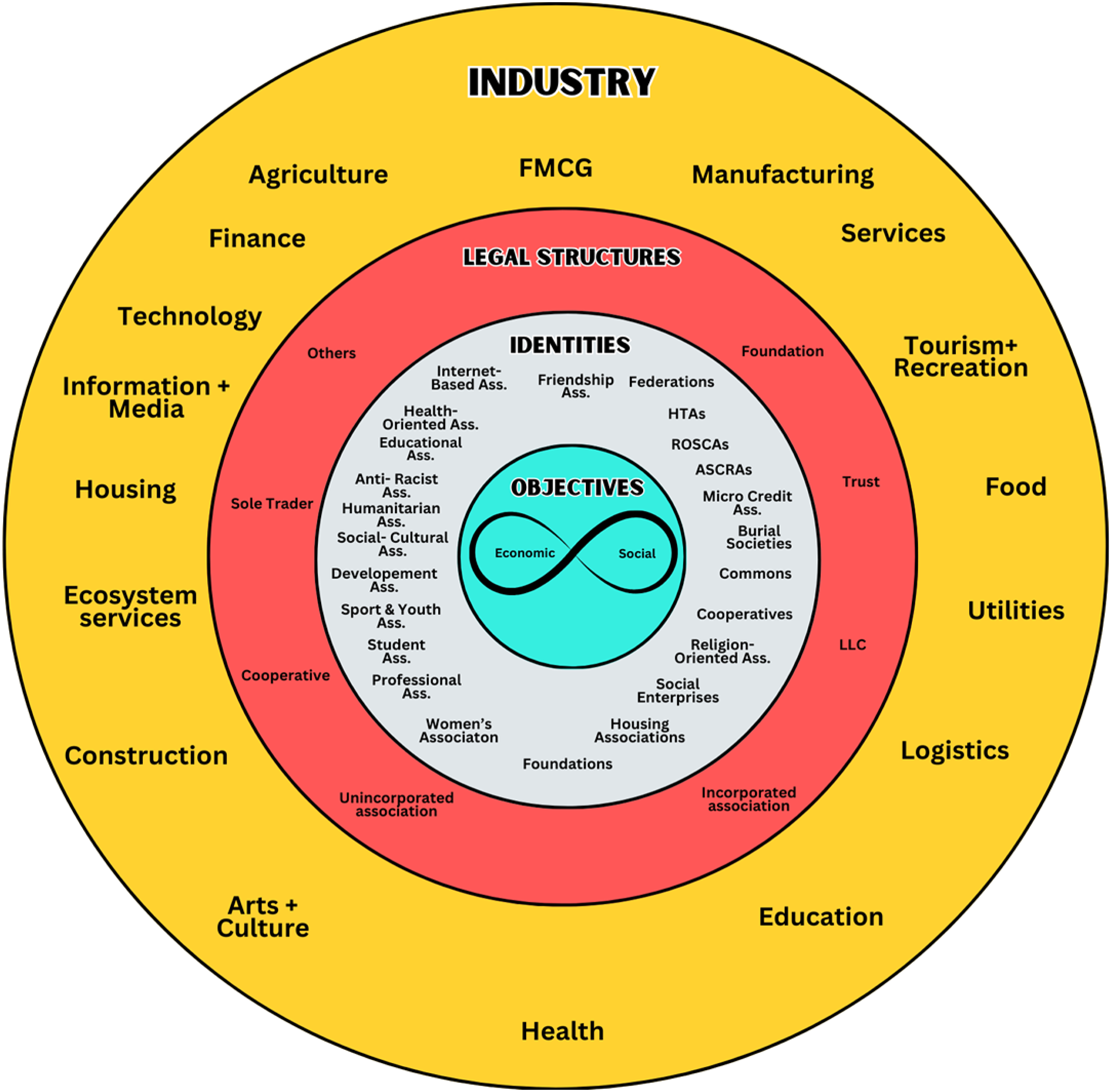
Situating the types/identities of SSEOs of PAD within the legal structures and industries where they operate in. Source: Authors’ illustration based on a diagram structure adapted from Yunus Center (2021).
Locating the SSEOs of PAD Within the Diverse Economies
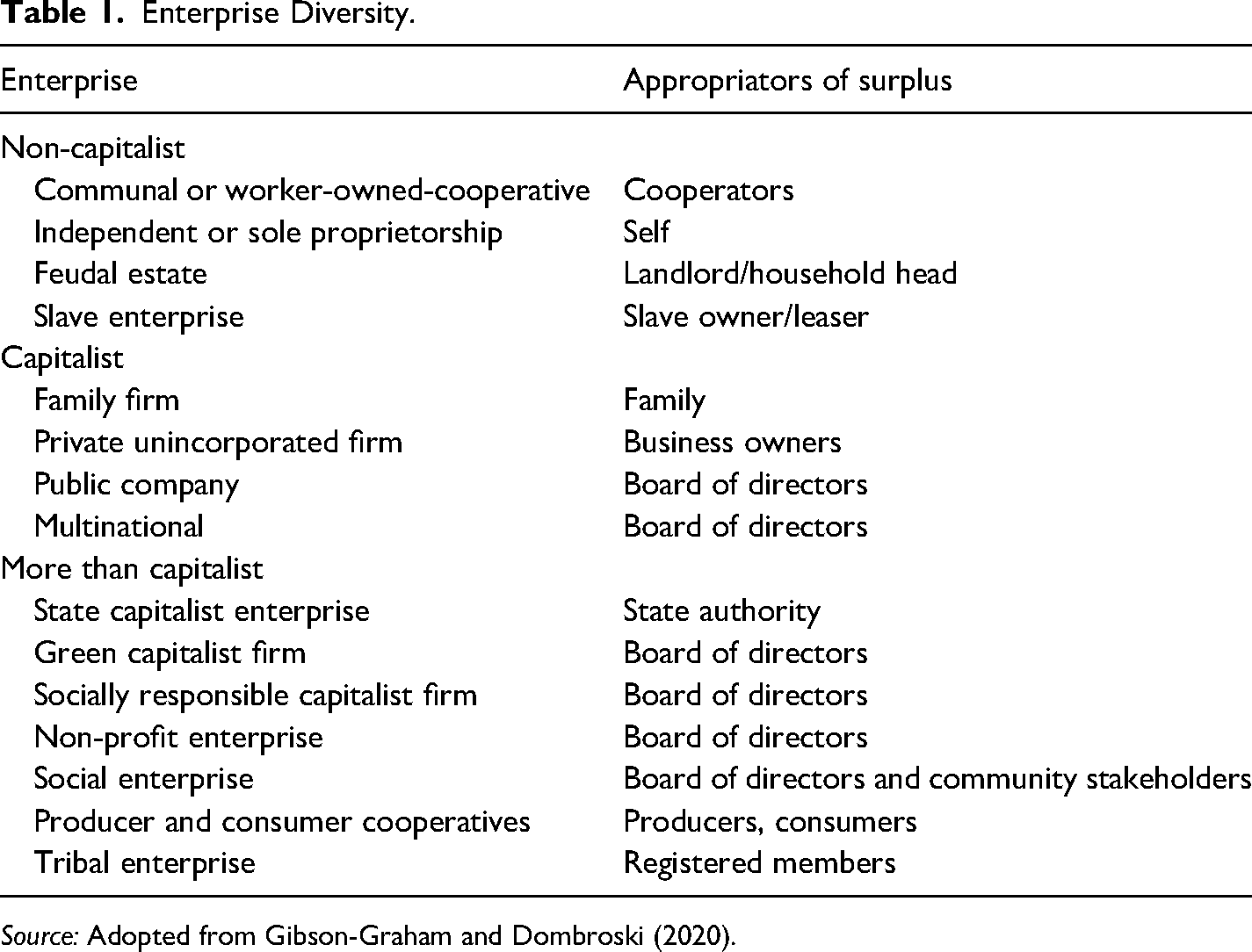
Let us now briefly discuss how we can locate the SSEOs of PAD in Europe in the diverse economies, emphasizing the dimension of enterprise. According to the Diverse Economies theory, the different ways enterprises organize the production, appropriation, and distribution of surplus labor are classified into three categories, that is, capitalist, more-than-capitalist, and non-capitalist (see Table 1). For instance, if we take the distribution of surplus, which is the main criterion for determining whether an enterprise is an SSEO, we see that non-capitalist (communal and independent) enterprises and more-than-capitalist enterprises distribute surplus (to society, workers/members, and/or the environment) while capitalist enterprises claim surplus as private wealth (Gibson-Graham, 1996, 2006; Gibson-Graham & Dombroski, 2020; Gibson-Graham et al., 2013).
Enterprise Diversity.
Source: Adopted from Gibson-Graham and Dombroski (2020).
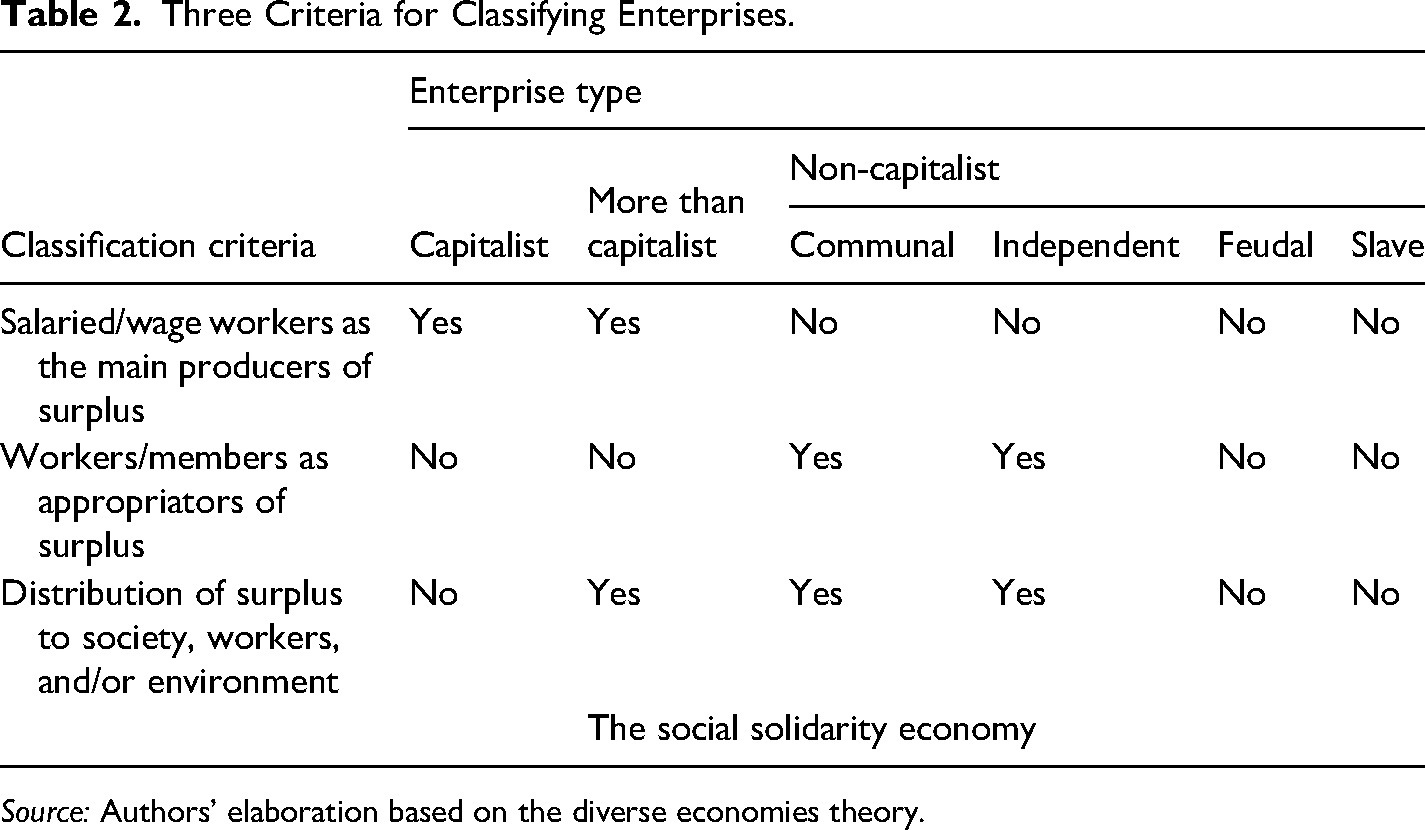
Accordingly, we can say that SSEOs of PAD are either non-capitalist or more-than-capitalist enterprises. However, this does not mean that all elements in the more-than-capitalist and non-capitalist categories presented in Table 1 are part of SSEOs of PAD. For example, state enterprises, feudal estates, and slave enterprises are not part of SSEOs of PAD. The main difference between non-capitalist and more-than-capitalist SSEOs concerns the presence or absence of salaried/wage workers as the main producers of surplus. In the case of non-capitalist SSEOs of PAD, organizations depend mainly on members/workers to produce surplus. Members/workers also appropriate and distribute surplus. In the case of more-than-capitalist SSEOs of PAD, organizations depend mainly on salaried workers (and also volunteers) to produce surplus. These workers do not have control over the appropriation and distribution of surplus. Another difference between the two, in many cases, is that while more-than-capitalist enterprises distribute surplus primarily to the society or the environment, most non-capitalist (communal and independent) enterprises distribute surplus primarily to their members/workers (Table 2).
Three Criteria for Classifying Enterprises.
Source: Authors’ elaboration based on the diverse economies theory.
Based on the above discussion, we can put the different specific types of SSEOs of PAD we identified into either non-capitalist (communal and independent) or more-than-capitalist categories. For example, core examples of non-capitalist SSEOs of PAD include, HTAs, ROSCAs, ASCAs, burial societies, worker cooperatives, community gardens, Mahabers, Dahiras, and other associations that use a worker/member-owner model. Typical examples of more-than- capitalist SSEOs of PAD include foundations, social enterprises, micro-credit associations, educational organizations, formal housing associations, formal development-oriented organizations, formal welfare/humanitarian organizations, formal health-oriented organizations, and other associations that depend on salaried employees and volunteers.
Challenges SSEOs of PAD in Europe Face
The scoping review shows that SSEOs of PAD in Europe face various internal and external challenges that hinder them from realizing their full potential and becoming more effective in contributing to the economy and society. Below, we discuss the five major challenges SSEOs of PAD face, that is, discrimination and lack of visibility/recognition; lack of financial resources; problems with policies, laws, and actions of governments; lack of skilled personnel and organizational/project management expertise; and the ethnicization of some associations.
Discrimination and Lack of Visibility/Recognition
Discrimination against and lack of visibility/recognition of SSEOs of PAD is one of the most frequently identified challenges. This is a host country-based external challenge that is usually connected with anti-PAD racism in Europe.
The lack of visibility/recognition of the existence, activities, and contributions of the SSEOs of PAD is highlighted by various studies (AU, 2019; Chelpi-den Hamer & Mazzucato, 2010; Craig, 2011; Datta & Aznar, 2019; Gakunzi, 2006; Godin et al., 2015; Newbigging et al., 2013; Ong’ayo, 2014). Lack of visibility/recognition can be seen from several angles. First, the very existence of SSEOs of PAD is not (well) recognized by societies, governments, and other institutions in the host countries in Europe. For example, informal SSEOs, which are significant parts of the SSE of PAD, are not recognized by societies and governments. There is bias against informal forms of associations and economies in Europe. A good example of this case is ROSCAs, which are not recognized as financial institutions in Europe (Ali, 2020; Datta & Aznar, 2019; Tadesse, 2018, 2020). For instance, a study by Datta & Aznar in London reported the consequence of lack of recognition: “We heard instances of ROSCA members who had collected their pick being subsequently arrested on suspicion of drug trafficking or money laundering” (2019). Similar findings were also reported in the Americas by Hossein. In her study of ROSCAs of PAD in Toronto, she noted that ROSCA activities were incorrectly associated with gambling, money laundering, or pyramid schemes (2017a).
Second, the contributions of SSEOs of PAD to the economy and society are not fully recognized. There is, according to Newbigging et al. (2013), “a lack of understanding about the contribution that these organizations make.” There is also a tendency to reduce their contribution only to financial remittance ignoring their other contributions, for example, in terms of, promoting social remittances and development (AU, 2019; Gakunzi, 2006), promoting social inclusion, meeting fundamental needs, fostering empowerment, and diversifying economic activities. Similar challenges were also observed in the context of the Americas (see Hossein, 2018b, 2019; Nembhard, 2014). The problem of lack of visibility and recognition has its own consequences. It could mean, among others, a lack of access to information, funding, and inclusion.
SSEOs that are somehow recognized also face discrimination/exclusion in the host countries. Such discrimination is connected with the discrimination their members and their larger PAD communities face (Aspinall & Chinouya, 2016; Bailey, 2012; Campbell & Williams, 2016; Craig, 2011; Datta & Aznar, 2019; Faye, 2007; Fernández Suárez et al., 2020; Gakunzi, 2006; Ginn & Ascensao, 2018; Marini, 2013; Mbiba, 2010; Palmer, 2020; Piacentini, 2015; Pirkkalainen et al., 2013; Sardinha, 2005; Schmelz, 2007, 2009; Tinaz, 2006; de Tona & Lentin, 2011). Studies reported that SSEOs of PAD tend to face “over scrutiny, and the perception of skill deficits in running organizations” (Aspinall & Chinouya, 2016); confrontation/negative reaction from the state (Datta & Aznar, 2019; Ginn & Ascensao, 2018; Palmer, 2020; Tinaz, 2006), society (Bailey, 2012; Campbell & Williams, 2016; Tinaz, 2006), and media (Tinaz, 2006); and considerable overall difficulties as a result of the negative image associated with Africa (Faye, 2007). Discrimination against SSEOs of PAD also happened, when such organizations were not invited to participate in decision-making processes about issues that affected them and their PAD community (Pirkkalainen et al., 2013; Sardinha, 2005; Schmelz, 2009; de Tona & Lentin, 2011). Even, when invited, in many cases, they were not considered as equal partners with other stakeholders (Gakunzi, 2006; Marini, 2013; Pirkkalainen et al., 2013). Some studies also reported the presence of marginalization of SSEOs of PAD even within the so-called “third sector” or mainstream SSE (Craig, 2011). Such problems can have their own consequences. For example, they could lead to the creation of mistrust between SSEOs of PAD and other stakeholders such as governments; self-exclusion of SSEOs of PAD; and limited cocreation possibilities between SSEOs of PAD and other stakeholders. Studies on SSEOs of PAD in the Americas also reported similar challenges and consequences (see Hossein, 2013; Hossein, 2018b; Hossein, 2019; Nembhard, 2014).
Lack of Financial Resources
Lack of financial resources is another frequently identified problem SSEOs of PAD in Europe face. This challenge has to do with a lack of diversified income sources, a lack of (sustainable) funding, and a limited budget. This challenge can be considered transversal in terms of having internal and external sources.
Our review shows that many if not most SSEOs of PAD (especially informal ones) were self-financed through membership fees paid by association members and donations given by other community members. In most cases, these membership fees and donations were small and symbolic. In addition, some SSEOs of PAD even encountered problems to regularly collect membership fees from all members (Adenekan-Koevoets, 2012; AU, 2019; Bonfiglio et al., 2015; Chelpi-den Hamer & Mazzucato, 2010; Craig, 2011; Faye, 2007; Kerlin, 2000; Mazzucato, 2007; Marchand et al., 2015; Sardinha, 2005; Schmelz, 2009).
Our review indicated that, compared to other SSEOs, there was marginalization of SSEOs of PAD in Europe when it comes to accessing state and other external funding. There was the problem of funders “not fully comprehending the work” and the contributions of SSEOs of PAD. Many SSEOs of PAD were also unaware of the existing funding opportunities. Even those who knew about funding opportunities faced challenges in relation to funding standards that were usually difficult to meet (e.g., “‘harsh conditionalities’ particularly targeting immigrant and ethnic minority applicants”) and application procedures that were complex (including language-related issues). Those formal SSEOs of PAD that were able to have access to funding also faced challenges as they were usually underfunded and/or threatened with direct funding cuts (in relation to, for example, austerity measures) (AU, 2019; Andrews, 2016; Aspinall & Chinouya, 2016; Bonfiglio et al., 2015; Campbell & Williams, 2016; Chelpi-den Hamer & Mazzucato, 2010; Craig, 2011; de Tona & Lentin, 2011; Ejorh, 2011; Faye, 2007; Fernández Suárez et al., 2020; Godin et al., 2015; Harrison, 1994a; Marchand et al., 2015; Newbigging et al., 2013; Nijenhuis & Zoomers, 2015; Ong’ayo, 2014; Owusu, 2020; Ragab et al., 2013; Sardinha, 2005; Schlenzka, 2009; Schmelz, 2007, 2009; Trans & Vammen, 2011; Warnecke, 2015; Weißköppel, 2015).
The above problems (lack of (sustainable) funding) have their impacts on SSEOs of PAD in Europe. For example, in order to meet funders’ requirements and philosophies, some organizations were forced to change their original purposes and even names (Chelpi-den Hamer & Mazzucato, 2010; Ejorh, 2011; Warnecke, 2015). In other cases, because of such problems, some organizations were unable to carry out the following: continue some of their projects; carry out newer or larger projects on their own; improve the quality of their services/products; achieve their short- and long-term goals; compete with other organizations (e.g., for the next round of funding); or continue to exist as organizations (Andrews, 2016; Aspinall & Chinouya, 2016; Fernández Suárez et al., 2020; Marchand et al., 2015; Newbigging et al., 2013; Sardinha, 2005; Warnecke, 2015).
Funding and financing problems are not unique to SSEOs of PAD in Europe. Such problems are common to most SSEOs, especially during and after a time of economic downturn which is usually accompanied by austerity measures that usually target social service providers including SSEOs. Various studies conducted on SSEOs in Europe and in the world identify difficulties in accessing funding as one of the main problems in the SSE (see OECD, 2023; Yi, 2023). However, our study indicates that SSEOs of PAD are disproportionately affected by such a problem. It can be argued that, compared to the “mainstream” SSEOs, there are much fewer opportunities for SSEOs of PAD in Europe to secure funding. This situation is related to the fact that their access to funding is further contracted by lack of visibility/recognition, discrimination, immigration/citizenship-related obstacles, and so forth (Craig, 2011; Ejorh, 2011; Faye, 2007; Fernández Suárez et al., 2020).
Government Policy Related Problems
The third major challenge faced by SSEOs of PAD is an external challenge, which concerns problematic policies and laws of governments of host countries (Ejorh, 2011; Fernández Suárez et al., 2020; Ginn & Ascensao, 2018; Knight, 2012; Mazzucato & Kabki, 2009; Ong’ayo, 2014; Tinaz, 2006; Trans & Vammen, 2011) and origin countries (Faye, 2007; Gakunzi, 2006; Marchand et al., 2015; Ong’ayo, 2010, 2014; Schlenzka, 2009; Warnecke, 2015; Weißköppel, 2015).
In the case of host countries, we can find several such problems. One such problem is the presence of policies and laws that are ill-conceived or discriminatory against, for example, migrants. For instance, a study by Knight (2012) reported the presence of a law in Turkey that required a Turkish citizen to be on an association's governing body for the association to be able to exist. This means that SSEOs of PAD that did not have a Turkish citizen on the governing body could not exist. A related problem observed in a number of host countries is the complexity and rigidity of bureaucratic procedures or unreasonably high standards, for example, in the case of applications for registration, funding, and so forth (Ejorh, 2011; Fernández Suárez et al., 2020; Trans & Vammen, 2011). In relation to this, Ejorh noted in the context of Irland that, “Community and voluntary sector organisations in Ireland operate in a highly politicised institutional context that inhibits African immigrant organisational mobilisation…” (2011). Another such challenge concerns states’ neo-liberal/capitalocentric policies that attempt to erase non-capitalist forms of enterprises and practices that are common among PAD (Ginn & Ascensao, 2018; Tinaz, 2006). For example, Ginn and Ascensao (2018) showed in their study in Portugal how the government attempted to erase informal urban gardening commons of PAD. Various studies also reported a lack of support systems and capacity-building infrastructure (e.g., advisory services and training courses) for SSEOs of PAD in Europe (Craig, 2011; Gakunzi, 2006; Newbigging et al., 2013; Schlenzka, 2009).
The above policy-related problems are not limited to host countries. In the case of origin countries, we find that bureaucratic red tape, coupled with corruption in government offices and companies (e.g., ports and airports), is one of the major external challenges faced by SSEOs of PAD (Faye, 2007; Marchand et al., 2015; Mörath, 2015; Ong’ayo, 2014; Schlenzka, 2009; Schmelz, 2007; Warnecke, 2015). According to Mörath, such problems “make the implementation, follow-up and sustainability of projects difficult or impossible” (2015). Another such problem in origin countries is the politicization of the civil society sector. Studies reported that the politicization of the civil society sector made it difficult to implement projects and activities in some countries (Faye, 2007; Ong’ayo, 2010, 2014; Weißköppel, 2015). For example, in the case of Ethiopia, “the 2009 NGO Act limits the geographical coverage of an organisational activity … [it] also limits the amount of resources that diaspora organisations can transfer to local partner organisations” (Ong’ayo, 2014).
Host and origin countries share further commonalities, especially in terms of making it difficult for SSEOs of PAD in Europe to send remittances including financial, material, and social remittances. This challenge is associated with bureaucratic barriers; unfavorable import regulations on in-kind donations; high shipping fees; high customs duties in origin countries (even on goods donated for humanitarian purposes, e.g., hospital beds); lack of storage facilities in origin countries in the case of material remittances; lack of institutional support mechanisms to facilitate remittances, especially social remittances; unfairly high costs for sending financial remittances; and so forth (Faye, 2007; Gakunzi, 2006; Kerlin, 2000; Nijenhuis & Zoomers, 2015; Schmelz, 2007, 2009; Warnecke, 2015; Weißköppel, 2015). For instance, Schmelz (2007, 2009) observed in relation to material remittances that “From a financial point of view, donations of goods and equipment no longer make sense when the overall expense is higher than the cost of the goods on site.”
Lack of Skilled Personnel and Organizational/Project Management Expertise
The lack of skilled personnel and organizational/project management expertise is an internal challenge, which is identified especially in relation to formal/public benefit SSEOs of PAD.
A number of studies noted that some SSEOs of PAD in Europe face problems with the lack of skilled personnel. This problem is also associated with the difficulties of retaining experts. There are several reasons behind these problems. One reason is PAD's precarious condition in Europe characterized by dispersal through the asylum system, making it difficult even to form and maintain the most important SSEOs of PAD. A second reason is related to situations whereby highly skilled members leave such organizations because of status change (e.g., immigration status) or physical mobility. Another reason is the limited ability of such organizations to meet the salary demands of both internal professionals (among association/community members) and external professionals (outside of community members) who could be hired as employees (AU, 2019; Bonfiglio et al., 2015; Ejorh, 2011; Marchand et al., 2015; Mörath, 2015; Sardinha, 2005; Schlenzka, 2009; Schmelz, 2007, 2009; Vermeulen, 2005; Wagemakers et al., 2015).
A related challenge to the lack of skilled personnel is the lack of organizational/project management expertise in some SSEOs of PAD. This challenge is usually discussed in relation to the lack of in-depth knowledge about policies (at national, regional, and international levels); a lack of concrete and pragmatic ideas for projects; lack of knowledge in project planning and management, lack of mechanisms for monitoring and evaluation (especially in the case of projects and activities in origin countries); and lack of self-promotion and networking (e.g., many associations either did not have websites or their websites were outdated/did not have sufficient information) (AU, 2019; Bonfiglio et al., 2015; Schlenzka, 2009; Schmelz, 2009; Wagemakers et al., 2015; Warnecke, 2015).
The above-discussed problems are also associated with the issue of effectiveness, relevance, and sustainability of interventions, especially in the case of development projects/activities in origin countries. Several studies reported concerns regarding the sustainability of development projects/activities carried out by SSEOs of PAD in origin countries. Some of the concerns identified include the following: a lack of proper needs assessment (in terms of consulting the local community as well as prioritizing the issue of development and the geographical area/target population for intervention); fragmented implementation of projects/activities and lack of coordination with others; duplication of interventions in few places (e.g., well-known hospitals, and schools); top-down management; and the ad hoc nature of some projects/activities, which do not target structural change (Marini, 2013; Mazzucato & Kabki, 2009; Nieswand, 2008; Nijenhuis & Zoomers, 2015; Schmelz, 2009; Trans & Vammen, 2011).
Ethnicization of Some Associations
The last major challenge for SSEOs of PAD identified by the review is the ethnicization of some associations and the support they provide, which is an internal challenge. This problem emanated from some origin countries’ politicized nature of ethnic identity and divisions, which in turn stemmed in most cases from the divide and conquer policies of colonial powers from the late nineteenth century onwards. This situation contributed to the formation of ethnic-based associations, for example, ethnic-based HTAs, which focused on helping only members of their particular ethnic groups in host or origin countries, leaving others without support. This also created unhealthy competition for resources and power as well as a lack of cooperation among different associations representing different ethnic groups (Van Hear et al., 2004; Lampert, 2009; Mazzucato & Kabki, 2009; Marchand et al., 2015; Ong’ayo, 2010, 2014; Schlenzka, 2009; Schmelz, 2007; Trans & Vammen, 2011). For instance, as a result of this problem, in the case of Ethiopian organizations in Germany, “a central Ethiopian association or an umbrella association of Ethiopian associations is missing, which could represent Ethiopians in Germany and function as a common voice of the Ethiopians” (Schlenzka, 2009).
Conclusion
In this paper, being informed by theories such as racial capitalism, stratification economics and global migration, diverse economies, and SSE, we have presented and discussed the results of our systematic scoping review on the SSEOs of PAD in Europe. Our study aimed at contributing toward filling the knowledge/research gap in the SSE literature by exploring the neglected topic of “SSEOs of PAD in Europe.” The general research question of the study was as follows: What is the nature of SSEOs of PAD in Europe? Accordingly, the study answered specific research questions related to the owner PAD communities of SSEOs of PAD; host countries of SSEOs of PAD; the age of SSEOs of PAD; types, activities, and contributions of SSEOs of PAD, and challenges of SSEOs of PAD.
Our study shows the enduring and diverse nature of the SSEOs of PAD in Europe. The various types of SSEOs of PAD, which are either non-capitalist or more than capitalist and owned by different PAD communities found in various European countries, engage in a multitude of activities, producing goods, services, and knowledge, and making crucial contributions to the economy and societies.
Their wide-ranging activities involve social and cultural activities; education and knowledge building; development activities/projects; welfare and social services; financial services; advocacy and lobbying; consulting, networking, and bridge-building; social entrepreneurship; health services; housing services; agricultural activities; and the provision of (safe) spaces. A unique characteristic of SSEOs of PAD is that most of them engage in multiple (two or more of the above) activities at the same time. Furthermore, many of them carry out their activities both in their host and origin countries.
Their multifaceted contributions can be seen in terms of promoting economic and social inclusion of PAD; meeting various fundamental needs of PAD in Europe using usually synergetic satisfiers (Max-Neef, 2017); empowering PAD at the individual, family, group, and community levels; supporting socioeconomic development in origin countries; and diversifying economic activities in the host countries and in Europe. They demonstrate solidarity on multiple levels, that is, within their organizations, their communities in the host countries, and their communities in their origin countries.
Furthermore, it is noted that, in all of their activities and contributions, the SSEOs of PAD in Europe are countering racial capitalism and its consequences that have to do with the legacy of slavery and colonialism; neo-colonialism; racial harassment, violence, and profiling; negative racist stereotypes; discrimination in different social institutions and sectors; exploitation; and inequalities in income, wealth, power, and well-being (see also Hossein et al., 2023 for a similar contribution of “co-operatives of the African diaspora” in other places).
Contrary to the negative racist stereotypes about PAD (that depict them as, among others, incapable of innovation, creativity, and contribution to society), this study shows that PAD and their diverse SSEOs transform societies and economies. They contribute greatly not only to the societies and economies of host countries but also to those of origin countries. This observation is consistent with, among others, the results of Obeng-Odoom's (2022) study on migrants and global migration.
Despite their contributions and strengths, SSEOs of PAD experience external and internal challenges that affect the quality of services/products they provide and endanger their existence. These challenges include discrimination against and lack of visibility/recognition of SSEOs of PAD; lack of financial resources; government policy-related problems; lack of skilled personnel and organizational/project management expertise; and the ethnicization of some associations. Addressing these challenges is of paramount importance so that SSEOs of PAD can continue to exist and make their share of contributions to a sustainable future for all.
To help support SSEOs of PAD in Europe to survive and thrive, we would like to close by making the following key recommendations to various stakeholders including governments of host and origin countries, local communities in Europe, the civil society sector including SSEOs in Europe, and scholars and researchers in the field of SSE. First, there is a need to recognize the existence and contributions of SSEOs of PAD in Europe. Second, there is a need for collaborating and cocreating with the SSEOs of PAD, especially in the case of issues that concern PAD and their host countries and regions. Third, there is a need to support SSEOs of PAD to address their various challenges including funding and government policy-related problems. Finally, SSEOs of PAD need to strengthen themselves by addressing their internal challenges, for example, by promoting themselves and their work (e.g., creating or maintaining their website), avoiding the ethnicization of associations, collaborating and uniting with one another, and focusing more on structural changes. In the case of structural changes, which is primarily about deinstitutionalizing inequalities and social stratifications, they need to emphasize in their work the need for equal access to land in both origin and destination settlements; commoning (preserving the commons); securing permanent residence and citizenship status to migrants; granting comprehensive and quality social protection for migrants; and historical reparations (see Obeng-Odoom, 2022 for details).
Limitation of the Study
Our scoping review provides the first comprehensive study on the SSEO of PAD in the context of Europe by analyzing a huge amount of data from 109 studies. However, our review is not without limitations. For example, one limitation is that our study focused only on reviewing studies that were published in the English language. Another limitation is that, because of the nature of the research topic (which was unexplored in the context of Europe), our study employed a scoping review method that included gray literature (non-peer-reviewed papers) and explored broader research questions with less intense synthesis. Given that we have done the foundational work, we recommend that future researchers conduct stronger systematic reviews such as meta-synthesis/analysis by emphasizing specific research questions, peer-reviewed studies, and the inclusion of more languages than English. We also suggest that future researchers examine the SSEOs of PAD in Europe using qualitative, quantitative, or mixed methods research.
Footnotes
Acknowledgements
We would like to express our profound gratitude to the following individuals and organizations for their invaluable support and contributions to this research. This study is part of the ASTRA research project (https://www.jyu.fi/en/research/astra), funded by the European Union's Horizon 2020 research and innovation programme under the Marie Skłodowska-Curie grant agreement No 955518. We are deeply appreciative of the support from ASTRA member and partner organizations, including UNIBZ, CIRIEC, LUKE, and ODL, which provided the essential resources and facilities for this study. We also appreciate all ASTRA supervisors and early-stage researchers for their assistance in various capacities. In particular, we would like to extend our heartfelt thanks to Prof. Urban Nothdurfter, Barbara Sak, Dr. Jérôme Schoenmaeckers, Dr. Jef Peeters, and Dr. Katja Kangas. We are grateful to the members of the Community Economies Research Network (CERN) for their insightful feedback on our work. Special thanks to Prof. Jenny Cameron, Prof. Esra Erdem, Prof. Craig Browiak, and Prof. Maliha Safri for their valuable contributions. We also extend our thanks to the members of the EMES International Research Network for their constructive feedback during the early stages of this research. We appreciate the constructive feedback provided by the anonymous reviewers, which significantly enhanced the quality of this manuscript. Our thanks also go to the journal editors for their diligent work and support. We extend our gratitude to the authors and librarians who assisted us during the data collection for this review. Special thanks go to Joyce Nyambura Njenga for her unwavering support, including providing various resources and designing the diagram used in this article. Finally, we would like to thank all the other individuals, including those we met at various conferences, workshops, and summer schools, who have supported us in different ways but whose names we have not mentioned here.
Declaration of Conflicting Interests
The authors declared no potential conflicts of interest with respect to the research, authorship, and/or publication of this article.
Funding
This article is a product of the ASTRA research project, which has received funding from the European Union’s Horizon 2020 research and innovation programme under the Marie Skłodowska-Curie grant agreement No 955518. The Article Processing Charge (APC) was funded by the same project. The article reflects only the authors’ views, and the funder is not responsible for any use that may be made of the information it contains.
